Tech Station

今日论文

2026-11-04 · 从 1343 篇新论文中选出 50 篇
#12026-11-03追踪学者 · Hao Dong104

DexHOT: Learning Hand-Object Configuration Transfer for Dexterous Manipulation

Zhewei Gui, Anthony Bolton, Jiyao Zhang, Zeyuan Chen, Qiyang Yan, Tianyu Wang 等

Dexterous manipulation involves not only moving objects, but also arranging the hand around them to maintain useful contacts and enable subsequent actions. Yet many learning-based …

Dexterous manipulation involves not only moving objects, but also arranging the hand around them to maintain useful contacts and enable subsequent actions. Yet many learning-based systems specify goals primarily through object poses or trajectories, leaving hand-object configurations to emerge implicitly. We introduce DexHOT, which formulates dexterous manipulation as hand-object configuration transfer: moving between feasible configurations that jointly specify hand articulation and object pose relative to the wrist. DexHOT learns a reusable relation-conditioned transfer primitive from synthetic feasible configuration pairs, without human reference motions, and composes long-horizon behaviors through closed-loop tracking of configuration subgoals. On DexHOTBench with 120 objects, a single policy achieves 80.5% transfer success on seen objects and 69.4% on unseen objects; on a real dexterous hand, it achieves 61.5% success over 200 real-robot transfers and 90% task success across six demonstration-guided tasks. These results show that explicit hand-object goals provide an expressive and composable interface for dexterous manipulation. More details and videos are available at https://dex-hot.github.io/.

cs.ROrobotmanipulationdexterous

追踪学者:Hao Dong;兴趣:robot manipulation and grasping with learned policies

#22026-11-03追踪学者 · Dhruv Shah102

RAFT: Reasoning-Aligned Fine-Tuning Improves Robustness of VLA Post-Training

Shresth Grover, Andrey Kolobov, Dhruv Shah

Adapting a generalist vision-language-action (VLA) policy to a target task with limited demonstrations can improve nominal task success while reducing robustness to variations in a…

Adapting a generalist vision-language-action (VLA) policy to a target task with limited demonstrations can improve nominal task success while reducing robustness to variations in appearance, objects, and instructions. We introduce reasoning-aligned fine-tuning (RAFT), a two-stage post-training procedure: RAFT first trains low-rank adapters on task-relevant reasoning annotations, then freezes them while fine-tuning the policy on action demonstrations. On a physical DROID robot, RAFT achieves $75.0%$ out-of-distribution success, compared with $27.9%$ for plain fine-tuning; on a multi-stage bimanual YAM task, it reaches $70.0%$ mean success, compared with $36.0%$ for the strongest baseline. RAFT also improves success under visual, object, and instruction shifts in simulated pick-and-place and open-drawer tasks. Compared with plain fine-tuning, RAFT policies place more attention on annotated task regions and yield higher linear-probe accuracy for object identity in later layers. A broader reasoning-data mixture further improves downstream success across demonstration budgets.

cs.ROcs.CVrobotVLAvision-language-action

追踪学者:Dhruv Shah;兴趣:vision-language-action (VLA) models and foundation models for robots

#32026-11-03追踪学者 · He Wang101

ReflexArc: Bottom-Up Integration of Instantaneous Tactile Reflexes into Whole-Body Humanoid Control

Mingyu Wang, Si Li, Ziqing Chen, He Wang, Li Yi

Humanoid robots operating in cluttered environments must react to unexpected contacts before the first impact peak, which arrives within tens of milliseconds. Learned whole-body po…

Humanoid robots operating in cluttered environments must react to unexpected contacts before the first impact peak, which arrives within tens of milliseconds. Learned whole-body policies running at 50 Hz introduce a policy-cycle delay and may suppress a protective withdrawal as a tracking error. To address these challenges, we propose ARC (Ascending Reflex Control), a bottom-up framework that integrates instantaneous tactile reflexes with learned whole-body control. ARC consists of two components: an instantaneous reflex pathway and bottom-up reflex integration. The reflex pathway detects hazardous contacts from full-body tactile sensing, solves a whole-body withdrawal pose, and delivers it directly to the motors within 10 ms. Bottom-up reflex integration combines reflex-in-the-loop policy learning, reflex-transparent policy alignment, and reflex-informed policy adaptation to sustain the withdrawal, maintain balance, and complete longer-horizon recovery. We deploy ARC on a Unitree G1 and evaluate three categories of hazardous contact. Compared with an otherwise identical reflex delayed by 20 ms, ARC reduces the first force peak by 34.1% and reduces the contact impulse from 0.2632 N s to 0.1225 N s (a 2.15x ratio). We further demonstrate protected motion tracking, teleoperation, and vision-free obstacle traversal guided by foot tactile sensing. Project page: https://minusmodulo.github.io/reflexarc-website/

cs.ROhumanoidtactile

追踪学者:He Wang;兴趣:humanoid robots and whole-body control

#42026-11-03追踪学者 · Hao Dong99

PrimeSim: A Generalist World Model Simulator from Large-Scale Cross-Embodiment Demonstrations

Travis Davies, Wentao Ma, Lihao Guo, Tengfei Ma, Xiaowen Chang, Jiafeng Xu 等

A robot world model that serves as a simulator must do more than generate plausible videos: it must faithfully follow commanded actions, maintain consistency across camera views, a…

A robot world model that serves as a simulator must do more than generate plausible videos: it must faithfully follow commanded actions, maintain consistency across camera views, and sustain coherent long-horizon rollouts. We present PrimeSim, an action-conditioned, multiview world model simulator that addresses these challenges through progressive midtraining and posttraining. Starting from a pretrained video generator, we midtrain on 30,110 hours of robot demonstrations spanning 22 platforms. To improve action following, we introduce a unified cross-embodiment action representation and frame-aligned dual-path conditioning to strengthen action-frame correspondence. To maintain multiview consistency, we develop view-aware interleaved attention with explicit camera identities, enabling cross-view information exchange while preserving view-specific representations. We further introduce a fast-video, slow-memory posttraining framework that transforms the bidirectional video generator into an efficient autoregressive simulator. By combining fast causal generation, self-rollout training, and hierarchical temporal memory, PrimeSim mitigates error accumulation from self-generated histories and supports coherent long-horizon simulation. PrimeSim runs at 10.1 FPS, remains stable over long-horizon rollouts on rigid and deformable manipulation tasks, and transfers to held-out platforms within 100 to 200 gradient steps where the pretrained backbone does not. Against five open-source action-conditioned world models it leads four of the five WorldSimProbe suites and posts the best overall EWMBench score, while fine-grained local calibration still trails the field; its rollouts are faithful enough to support GRPO-based policy optimization. We release the model weights, inference code, and training code.

cs.ROrobotmanipulationworld model

追踪学者:Hao Dong;兴趣:world models and video prediction for embodied agents

#52026-11-0397

Caging Vision-Language Navigation for Legged Robots via Barrier-Certified Safety Architecture

Abhijeet M. Kulkarni, Saimouli Katragadda, Yuze Du, Zijun Sha, Guoquan Huang

By harnessing the inherent commonsense capabilities of pretrained Large Language Models (LLMs) and Vision-Language Models (VLMs), current Vision-Language Action(VLA) models for leg…

By harnessing the inherent commonsense capabilities of pretrained Large Language Models (LLMs) and Vision-Language Models (VLMs), current Vision-Language Action(VLA) models for legged robots excel at interpreting language-based navigation commands but lack the physical grounding and explicit safety assurance required for real-world operation. Therefore, this paper aims to cage Legged-Vision-Language Navigation (VLN) through a safety architecture that provides physical grounding and ensures navigation safety. The key idea is not to abandon the powerful capabilities of end-to-end VLA planning, but rather to augment and cage them. In particular, we integrate a high-level VLA planner with a low-level physical-grounding layer that leverages efficient state estimation, in-situ 3D spatial perception, and an Signed Distance Field (SDF) representation to generate executable trajectories. We provide a navigation planner with provable collision-avoidance guarantees under the stated assumptions by combining a low-dimensional Bezier-parameterized MPPI planner with Discrete Exponential Barrier Function (dEBF) constraints. The proposed Legged-VLN system is modular, making it compatible with various VLM/VLA models and agnostic to the robot platform. The proposed system is validated with extensive real-world experiments on humanoid and quadrupedal robots, demonstrating versatile, efficient, and safe vision-language driven navigation capabilities.

cs.ROeess.SYrobotVLAhumanoidlegged

兴趣:vision-language-action (VLA) models and foundation models for robots

#62026-11-03追踪学者 · Marco Hutter97

WayTrace: A Map-to-Language-to-Trace Hierarchy for Embodied Urban Navigation

Manthan Patel, Jonas Frey, Pascal Roth, Marco Hutter, Cesar Cadena

Web services provide walking directions for nearly every city, but following them reliably over long routes remains challenging for autonomous robots. Point-goal navigation policie…

Web services provide walking directions for nearly every city, but following them reliably over long routes remains challenging for autonomous robots. Point-goal navigation policies rely heavily on accurate GNSS, while most vision-language navigation models struggle to execute even short instructions outdoors. We present WayTrace, a hierarchical system that connects web-map directions to robot motion through language. An off-the-shelf orchestrator vision-language model reads the turn-by-turn directions, a satellite map and recent camera images, and issues one atomic language command at a time, such as "cross the road to the left". An onboard trace predictor, trained on over one million automatically labelled samples from street-level images, draws the path for this command in the image, and a reinforcement learning policy tracks it. In long-range simulated missions, WayTrace remains robust to GNSS noise and rarely leaves crosswalks or sidewalks, while point-goal baselines degrade sharply with about ten times more violations. Deployed on a wheeled-legged robot, WayTrace completes real-world missions of up to 1.37 km at about 1.1 m/s through a busy city centre, rural trails and a university campus, handling crosswalks, staircases and construction sites. Project page: https://way-trace.github.io

cs.ROrobotleggedembodied

追踪学者:Marco Hutter;你点赞过:TANGO: Humanoid Navigation in Cluttered Environments with a

#72026-11-0397

Asynchronous Robot Policies

Sombit Dey, Luc Van Gool, Danda Pani Paudel

Scaling vision-language foundation models has significantly advanced generalist robot manipulation, but the increased model scale introduces computational latency that degrades rea…

Scaling vision-language foundation models has significantly advanced generalist robot manipulation, but the increased model scale introduces computational latency that degrades real-time physical reactivity. Existing Vision-Language-Action (VLA) architectures execute high-level semantic reasoning and action ex- ecution sequentially within the primary control loop, creating a fundamental tension between semantic-reasoning capability and robot agility. To address this, we propose Asynchronous Robot Policy (ARP), an architectural framework that decouples semantic reasoning from low-level action generation using asynchronous processes operating at independent frequencies. In ARP, a high-capacity Vision-Language Model (VLM) asynchronously updates a semantic memory at low fre- quency, while a lightweight Vision-Action Expert, conditioned on this semantic memory, generates robot actions at a much higher control frequency. Such a formulation, enables having a fast perception-action loop without compromising on the semantic capability. To overcome asynchronous memory staleness, ARP trains the vision-action expert on the semantic staleness and execution delay, with temporally mismatched observation across processes. On Franka manipulation tasks, ARP achieves an 18% higher success rate and 20% less time need for execution in quasi-static setups, while 3-5 times baseline performance in dynamic simulation environments. Furthermore, ARP enables operating the VLM at 10 times lower than its nominal frequency with no significant performance loss making it much more efficient than the baseline. These results highlight the architectural advantages of modeling robot policies as asynchronous processes, enabling real-world reactive deployment without sacrificing the scale of foundation models.

cs.ROcs.AIrobotmanipulationVLAvision-language-action

兴趣:vision-language-action (VLA) models and foundation models for robots

#82026-11-0395

Human-to-Robot Transfer via Bridging Representation and Action Space in VLAs

Junhyeong Park, Wook Jung, Taeyoung Kim, Huiwon Jang, Jinwoo Shin

Pretrained Vision-Language-Action (VLA) policies provide a strong starting point for deployment, but adapting them to a target robot and environment still requires costly embodimen…

Pretrained Vision-Language-Action (VLA) policies provide a strong starting point for deployment, but adapting them to a target robot and environment still requires costly embodiment-specific demonstrations. Human demonstrations are far easier to collect, yet directly leveraging them is challenging due to the substantial human-robot embodiment gap, particularly when the underlying VLA has been pretrained primarily on robot data. We introduce H2RB (Human-To-Robot Bridge), a human-robot co-training framework for adapting pretrained VLA policies from unpaired human and robot demonstrations. H2RB bridges the embodiment gap at both interfaces: geometry-anchored alignment grounds human and robot observations in a compatible representation, while a decoupled-decoder tokenizer shares action latents without forcing both domains through a single action mapping. This design allows human demonstrations to provide useful behavioral supervision while retaining the rich visual, semantic, and control priors of the pretrained VLA. Across real-world tasks, H2RB substantially improves object transfer performance from 8.0 to 51.8 and enables skill transfer to score 62.7, in settings where co-train baselines totally fail to transfer human-demonstrated skills. The benefit also persists under object-placement shifts, improving out-of-distribution transfer from 6.0 to 45.3. H2RB suggests a way for human demonstrations to serve as a scalable supervision source for adapting pretrained robotic policies, reducing the dependence on costly target-robot data collection.

cs.AIrobotVLAvision-language-action

兴趣:vision-language-action (VLA) models and foundation models for robots

#92026-11-0395

Action Intent as a Bridge: Transferring Manipulation Knowledge from Human-Centric Videos to Robots

Zhiqian Xia, Lianyang Ma, Haifeng Xia, Siyu Xia, Wei Wang, Xiaochun Cao

Vision-Language-Action (VLA) models have achieved promising performance for generalized robotic manipulation, yet their reliance on expensive real-robot data remains a fundamental …

Vision-Language-Action (VLA) models have achieved promising performance for generalized robotic manipulation, yet their reliance on expensive real-robot data remains a fundamental bottleneck. A scalable alternative is to transfer knowledge from off-the-shelf human-centric videos. However, existing methods extract latent action representations that are entangled with scene-specific noise, diluting the transferred knowledge. Motivated by this limitation, we propose Action-Intent Transfer (AIT), a two-stage method that transfers knowledge through a clean action representation shared across humans and robots. In the first stage, AIT extracts explicit action intents and disentangles the implicit action intent from manipulation videos. In the second stage, AIT aligns the human and robot domains within this shared intent space and decodes the intent into executable robot actions. Extensive experiments in both simulation and real-world environments demonstrate that AIT transfers human knowledge more effectively and consistently outperforms prior baselines.

cs.ROrobotmanipulationVLAvision-language-action

兴趣:vision-language-action (VLA) models and foundation models for robots

#102026-11-0394

Spectrally Routed Diffusion Policy for Multi-Task Robotic Manipulation

Mingcong Li, Yihan Zhou, Jiayu Qu, Xueyang Guo, Yilin Mo

Diffusion-based policies have achieved strong performance on single-task robotic manipulation. However, a single model trained jointly on multiple tasks consistently underperforms …

Diffusion-based policies have achieved strong performance on single-task robotic manipulation. However, a single model trained jointly on multiple tasks consistently underperforms the per-task specialists trained on the same demonstrations. We focus on two challenges. First, the convolutional encoders commonly used in diffusion-based policies produce visual conditions that are not discriminative enough. Second, gradients from incompatible action modes update the shared denoiser's dense parameters along the same directions, causing destructive interference during joint training. To address both, we propose SR-DP (Spectrally Routed Diffusion Policy). A frozen VGGT encoder with a spatial-compression adapter produces compact multi-scale semantic-geometric tokens, a task-discriminative visual condition for tasks that share a workspace. We first train the denoiser as a standard diffusion policy, then decompose selected linear layers by SVD into a frozen basis of orthogonal rank-one experts, adapted through spectral routing and Householder input rotations. On six RoboTwin tasks, SR-DP averages a 68.4% success rate, surpassing multi-task VO-DP by 21.8 points and the strongest per-task baseline by 3.8 points. On four real-world bimanual tasks, Stage 2 reaches a 43.0% average success rate and improves over Stage 1 by 19.0 points.

cs.ROmanipulationdiffusion policy

兴趣:imitation learning and diffusion policies for robot control

#112026-11-02追踪学者 · Tomás Lozano-Pérez追踪学者 · Leslie Pack Kaelbling94

FEIJOA: Task-Driven Grounding and Execution for Mobile Manipulation

Aditya Agarwal, William Shen, Sahit Chintalapudi, Lucy Cai, Nishanth Kumar, Aidan Curtis 等

A mobile manipulator asked to "put the toys away in the toy box" must decide which objects are toys and which container the user means, then find base poses, grasps, and placements…

A mobile manipulator asked to "put the toys away in the toy box" must decide which objects are toys and which container the user means, then find base poses, grasps, and placements it can execute. Because a scene representation is built before the instruction is known, it may lack the attributes, affordances, or concepts needed to resolve the task. We present FEIJOA, a language-model agent that grounds the instruction at test time. It queries a grounding tool over a posed RGB-D scan, inspects the returned candidates, and refines its queries until they resolve the instruction. An embodiment-aware harness checks each skill's preconditions, samples base poses from which the target is reachable, and verifies the skill's effect from observations before and after execution. On 103 open-ended grounding queries, FEIJOA resolves 94.2% exactly, compared with 68.0% for the best prebuilt representation. Over 50 real-world trials on Spot, it completes 35 tasks; 17 of these successes follow recovery from a failed tool call or verification check. Of the 15 failed trials, 13 were caused by the robot's physical skills, and only 2 by grounding or the agent's reasoning. Project website: https://williamshen-nz.github.io/feijoa/.

cs.ROrobotmanipulation

追踪学者:Tomás Lozano-Pérez、Leslie Pack Kaelbling;兴趣:robot manipulation and grasping with learned policies

#122026-11-0394

RoboTryOn: Synthesizing Dexterous Robot Demonstrations from Human Videos via Virtual Try-On

Seungyong Lee, Suhyeok Jang, Minyoung Kim, Jinwoo Shin

Robot foundation models have shown remarkable performance in robot control, yet adapting them to a new task still relies heavily on teleoperated demonstrations. Egocentric human vi…

Robot foundation models have shown remarkable performance in robot control, yet adapting them to a new task still relies heavily on teleoperated demonstrations. Egocentric human videos offer a scalable substitute, but overlaying rendered robots on human videos or retargeting human poses into robot actions leaves significant visual or action gaps for high-DoF robot embodiments. To address this limitation, we propose RoboTryOn, which treats human-to-robot translation as virtual try-on: try-on keeps the person and swaps the garment, RoboTryOn keeps the demonstrated motion and swaps the human for the robot. Specifically, RoboTryOn converts a human video into a video of the target robot specified by a reference image, while preserving the original task, objects, and background. To maintain visual consistency, we translate selected keyframes autoregressively and use them to guide video synthesis with motion conditioned on the human hand skeleton. Additionally, we use an inverse dynamics model (IDM) that incorporates depth features to infer action labels from synthesized videos for policy learning. Our experiments across multiple humanoid embodiments show that policies trained with our synthetic data improve the average success rate on novel tasks, including challenging bimanual manipulation, from 2% to 60%, without any real robot demonstration of those tasks. Moreover, training with our synthetic data matches the performance of policies trained solely on teleoperated demonstrations at approximately a third of the collection cost, demonstrating the cost efficiency of our approach.

cs.ROcs.AIrobotmanipulationhumanoiddexterous

兴趣:imitation learning and diffusion policies for robot control

#132026-11-0393

PolicyIK: High-Precision Inverse Kinematics for Robot Arms with Reinforcement Learning

Yuhan Liu, Xinqi Liu, Zixuan Dong, Keith W. Ross, Shenji Wan

Inverse kinematics (IK) converts end-effector pose commands into joint motion, and many vision-language-action (VLA) policies rely on it to act on a given arm and to transfer acros…

Inverse kinematics (IK) converts end-effector pose commands into joint motion, and many vision-language-action (VLA) policies rely on it to act on a given arm and to transfer across embodiments. Precise IK remains laborious: redundancy and singularities complicate the inverse mapping, execution depends on hand-tuned controllers, and training data on physical robots are costly to collect. We present PolicyIK, a goal-conditioned reinforcement learning policy for high-precision IK. It updates joint-position references from pose feedback and observes its accumulated reference relative to the measured joints, so it can retain the offset that the position controller needs at rest. Two-scale pose errors with an error-dependent action gain resolve millimeter residuals while preserving large motions. Progress and dwell rewards teach it to both reach the tolerance and stay within it. In simulation, a single attempt by the trained PPO policy keeps the mean errors over the final second within 1 mm and 0.2° on 93.5% of held-out tasks, and a deployment protocol raises success to 98.9%. When trained directly on a physical arm with an off-policy RL learner, PolicyIK achieves higher reaching and holding success than all four classical IK controllers under the same time budgets. In simulated pick-and-place, PolicyIK executes the end-effector commands of the $π_{0.5}$ VLA policy with 95.7% success. These results show that reinforcement learning can provide high-precision inverse kinematics for robot arms. Code is available at https://github.com/Tinaliu0123/PolicyIK.

cs.ROcs.LGrobotVLAvision-language-action

兴趣:robot manipulation and grasping with learned policies

#142026-11-0393

Coordinating Humanoid Loco-Manipulation through Action-Conditioned Latent Foresight

Ju Dong, Xinyu Xiao, Yiming Zhou, Tianshuo Yang, Xuerong Liu, Lei Zhang 等

Humanoid loco-manipulation requires coordinated body motion and hand interaction over time, and a plausible-looking command sequence can still drop a held object or leave an intera…

Humanoid loco-manipulation requires coordinated body motion and hand interaction over time, and a plausible-looking command sequence can still drop a held object or leave an interaction incomplete. We present action-conditioned latent foresight, a latent world-action model (WAM) that evaluates proposed command sequences before execution. An action generator proposes joint motion-hand command sequences from vision, language, and the robot state. An action-conditioned endpoint predictor estimates the visual features each sequence prefix reaches and measures progress toward a demonstration-derived subgoal, while a joint temporal prior scores temporal consistency given the robot state and preceding commands. The robot executes the first commands of the best-scoring sequence and replans from the next observation. During training, action consistency regularization reconstructs the first demonstrated command from observed and predicted feature changes, encouraging the predictor to retain action-relevant information. On ten tasks in the humanoid loco-manipulation simulation benchmark SIMPLE, our method achieves 89.7% average success, compared with 73.7% for Psi-Zero and 82.0% for DiT4DiT. On seven real-robot tasks, it achieves 85.7% under standard conditions and 65.7% under unseen object configurations, while GR00T N1.7 achieves 70.0% and 48.6%, respectively. Project page: https://ju6276.github.io/Action-Grounded-Foresight/

cs.ROrobotmanipulationhumanoid

兴趣:humanoid robots and whole-body control

#152026-11-0393

Physical Diffusion Policy via MPM-Guided 3D Gaussian Simulation

Can Wang, Qiyuan Qiao, Lei Liu, Ge Yuan, Xinhui Liu, Dong Xu

Learning robust manipulation policies for diverse everyday objects remains challenging because objects with different materials exhibit distinct deformation and contact dynamics. W…

Learning robust manipulation policies for diverse everyday objects remains challenging because objects with different materials exhibit distinct deformation and contact dynamics. While diffusion policies provide a powerful framework for modeling multimodal manipulation behaviors, they typically lack explicit physical reasoning and may produce averaged actions when facing heterogeneous objects. We present a physics-aware diffusion policy that augments visual imitation learning with object physical understanding. Our framework recovers material properties from visual demonstrations by coupling 3D Gaussian Splatting with differentiable Material Point Method simulation, where video guidance and particle-level constraints enable accurate physical parameter estimation. The estimated physics conditions are further integrated into a material-aware Mixture-of-Experts diffusion policy, allowing adaptive behavior generation across different physical regimes. For practical deployment, we introduce a physics memory bank that provides efficient physical retrieval without requiring online simulation optimization. Experiments on a wide range of simulated and real-world objects demonstrate improved manipulation success and generalization over existing diffusion-based approaches. These results show that incorporating physical knowledge is critical for scalable robot manipulation in diverse environments.

cs.ROrobotmanipulationimitation learningdiffusion policy

兴趣:imitation learning and diffusion policies for robot control

#162026-11-0292

Controlling Action-Head Co-Adaptation to VLM Representation Anisotropy

Ruijie Zhang, Jiayin Zheng, Yequan Zhao, Liyan Tan, Ziyue Liu, Zhengyang Wang 等

Modern learning systems increasingly combine pretrained models with downstream heads. Despite the growing importance of such modular designs, how the downstream model co-adapts to …

Modern learning systems increasingly combine pretrained models with downstream heads. Despite the growing importance of such modular designs, how the downstream model co-adapts to the geometry of pretrained representations remains relatively underexplored. We study this problem through vision-language-action models (VLAs), where a pretrained vision-language model (VLM) conditions an action model for control. We find that the action model progressively concentrates its sensitivity on high-variance dimensions of the VLM outputs. Through controlled experiments across different backbone-head models, we further show that counteracting this sensitivity concentration can be beneficial under representation--task mismatch settings. Motivated by these observations, we introduce Adaptive Interface Equalizer (AdaIE), a parameter-free mechanism that reweights pretrained representations according to the evolving downstream sensitivity during training. AdaIE improves VLA success rates on simulation benchmarks, with gains of up to $+5.28$ percentage points (pp) on RoboCasa-GR1 and $+1.68$ pp on RoboTwin 2.0, and achieves an average gain of $+19$ pp across five real-world manipulation tasks. It further generalizes to diffusion policies and world models, improving downstream performance in both settings. Our results highlight interface co-adaptation as an important optimization problem when coupling pretrained representations with downstream models.

cs.AImanipulationVLAvision-language-action

兴趣:vision-language-action (VLA) models and foundation models for robots

#172026-11-0391

GVT3D: Gesture-Vision-Text Token Enrichment for 3D Embodied Reference Understanding

Vimarsh Shah, Dulanga Weerakoon, Ajinkya Deshpande, Saksham Agarwal, Nilesh Bhatia, Neel Kiran Naik 等

Natural human-robot interaction requires robots to interpret language and gestures within a 3D environment to support tasks such as pick-and-place and object retrieval. 3D Embodied…

Natural human-robot interaction requires robots to interpret language and gestures within a 3D environment to support tasks such as pick-and-place and object retrieval. 3D Embodied Reference Understanding (3D-ERU) supports this by identifying the 3D location of a target object from a scene (point-cloud) containing a human pointing gesture and an accompanying language description. However, current 3D-ERU models lack alignment of cross-modal representations and incur high processing costs that increase with the point-cloud's size. To address this, we propose GVT3D, which employs an Embodied Fusion module that jointly models language, gesture, and vision inputs within a shared embedding space, promoting cross-modal alignment. We additionally introduce a foveation approach that selectively processes the point cloud within a coarse region around the estimated pointing direction to reduce computations. GVT3D achieves ~8% higher accuracy and foveation enables 2.95x faster execution while maintaining comparable accuracy, relative to prior 3D-ERU models.

cs.CVrobotembodied

兴趣:3D perception, point clouds and scene understanding for robotics

#182026-11-0391

CRONOS: Benchmarking Non-Episodic Reinforcement Learning for Robotic Manipulation

Po-Yi Wu, Djengo Cyun-Jyun Fang, Dian Cheng, Tsung-Wei Ke

Reinforcement learning (RL) is promising for adapting robot policies to unstructured real-world environments. However, standard RL pipelines rely on episodic training with frequent…

Reinforcement learning (RL) is promising for adapting robot policies to unstructured real-world environments. However, standard RL pipelines rely on episodic training with frequent scene resets, which is impractical for real-world deployment due to the need for substantial human intervention. While prior work has studied non-episodic RL in relatively small policies trained from scratch, its behavior when fine-tuning modern large-scale pre-trained vision-language-action (VLA) models remains underexplored. In this work, we introduce CRONOS, a simulation benchmark for RL fine-tuning of VLAs under non-episodic scene resets. CRONOS leverages high-fidelity physics simulators and adopts shared-scene multi-task settings. Using CRONOS, we show that naively fine-tuning pre-trained policies fails in non-episodic settings due to shifts in object configurations and end-effector poses; however, these challenges can be mitigated through targeted reset allocation and by addressing biases in pre-trained models. Moreover, we find that non-episodic training enhances long-horizon manipulation and improves generalization to previously unseen object configurations and task sequences. Project page: https://embodiedai-ntu.github.io/cronos/

cs.ROcs.LGrobotmanipulationVLAvision-language-action

兴趣:imitation learning and diffusion policies for robot control

#192026-11-0391

GUILD: Guided Iterative Data Collection for Imitation Learning

Shivin Dass, Kevin Nguyen, Rohan Yelandur, Junhong Xu, Roberto Martín-Martín

Imitation learning policies in robotics are trained on datasets collected through costly real-world teleoperation. Often, the data-collection process is unguided, relying on the te…

Imitation learning policies in robotics are trained on datasets collected through costly real-world teleoperation. Often, the data-collection process is unguided, relying on the teleoperator's intuition, resulting in data that contributes little to overall policy performance. Recent work has shown that curating such unguided datasets can substantially improve policy performance, but these approaches operate by filtering existing datasets after collection and therefore do not prevent the acquisition of uninformative data. In this work, we propose GUILD, a novel Guided Data Collection (GDC) method that actively reasons about which data should be collected to maximize downstream policy performance. We introduce an iterative framework that alternates between 1) task proposal and data collection and 2) data evaluation to close the loop. For task proposal, we leverage semantic priors from vision-language models to identify relevant environments, object configurations, and goals for data collection. However, since semantic relevance does not imply policy improvement, we perform data evaluation. By leveraging predictive data attribution we approximate how the collected trajectories influence policy performance on a target deployment setting. This signal is then used as feedback to guide subsequent data collection, closing the data collection loop. We evaluate our approach in simulation and real robot settings, demonstrating that guided data collection substantially improves sample efficiency and deployment performance compared to passive data collection strategies, multiple baselines and experienced roboticists. More information at https://robin-lab.cs.utexas.edu/guild2026/

cs.ROcs.LGrobotimitation learning

兴趣:imitation learning and diffusion policies for robot control

#202026-11-0290

Robot-Matched Soft Fingers for UMI Data Collection: Lessons from 100 Hours of Pick and Place

Kobi Kelemen, Tomasz Niedziałkowski, Marcin Paszczak, Victoriano Montesinos

Training robot policies for multi-task pick and place requires demonstrations on many objects, which handheld Universal Manipulation Interfaces (UMIs) can collect quickly and cheap…

Training robot policies for multi-task pick and place requires demonstrations on many objects, which handheld Universal Manipulation Interfaces (UMIs) can collect quickly and cheaply. However, existing UMIs depend on external base stations, use rigid fingers that give no signal about contact forces, or use parallel-jaw fingers that limit grip strength. We present a battery-powered handheld interface, built on YUBI, whose soft, angled fingers wrap around objects, deform visibly under load as a visual proxy for force, and match the grippers of the robot. With it, we collect a 99.7-hour dataset over 53 objects, train $π_{0.5}$ policies on 49 of them, and hold out the other 4 as unseen objects. We find that a top camera raises success by 13 points even when only about half of the data includes it, and that mid-training on our multi-task data raises success after fine-tuning on unseen objects from 35% to 57%. Finger design, dataset, and data processing code: https://lute-corp.github.io/soft-yubi-site/

cs.ROrobotmanipulation

兴趣:robot manipulation and grasping with learned policies

#212026-11-0390

ActOR: Ambient AI-Based Agentic Orchestration for Humanoid Autonomy in Operating Rooms

Han Zhang, Sicheng Lu, Aleks Santari, Jeffrey K. Jopling, Masaru Ishii, Mathias Unberath

Operating rooms (ORs) increasingly contain ambient sensing infrastructure to enable AI-based optimization of workflows and utilization. We pursue an alternative path: using ambient…

Operating rooms (ORs) increasingly contain ambient sensing infrastructure to enable AI-based optimization of workflows and utilization. We pursue an alternative path: using ambient AI to guide robot action and optimize utilization. Deploying humanoids in the OR without ambient AI is severely limited by cumbersome de novo orientation and planning due to partial onboard observations. We posit that this can be achieved by coupling an ambient AI-based agentic orchestrator with the humanoid robotic actor, providing shared perception and execution feedback for humanoid autonomy in the OR. ActOR fuses a wall-mounted ambient camera and the robot's head-mounted camera into a shared object-level digital twin (DT). A large language model agent plans over the DT using pre-programmed locomotion and manipulation skills without task-specific training. During execution, DT updates and execution outcomes inform retries, alternative approaches, or replanning. We evaluated ActOR in simulated and physical environments. Across three tasks in two simulated ORs reconstructed from real rooms, ambient perception reduced exploration from 1.05 to 0.12 Explore calls per trial when targets were initially outside the robot's view. Closed-loop feedback increased success from 46.7% to 83.3% under nominal execution and from 8.3% to 51.7% under injected navigation, object-relocation, and grasp perturbations. In a physical mock OR with a humanoid, ActOR completed 14 of 20 single-object disposal trials and demonstrated replanning after scene changes. Ambient AI-based observations provide scene state that improves robot action planning, increasing success and reducing exploration compared with robot-only observations. Feeding skill outcomes and DT updates back to the planner improves multi-step task success. Our results show the feasibility of humanoid task autonomy for multi-step disposal tasks in a mock OR.

cs.ROrobotmanipulationgrasphumanoidlocomotion

兴趣:humanoid robots and whole-body control

#222026-11-03追踪学者 · Animesh Garg90

FloMo: 3D Scene Flow as a World Action Model Intermediate for Learning from Human Video

Jeremy Collins, Namra Patel, Ayush Agarwal, Shitij Govil, Animesh Garg

Pretrained video generation models distill internet-scale motion priors into robot policies, but full video is a redundant signal for action prediction. We argue that dense 3D moti…

Pretrained video generation models distill internet-scale motion priors into robot policies, but full video is a redundant signal for action prediction. We argue that dense 3D motion is the medium through which video pretraining best transfers to robot actions, and that predicting motion rather than video affords better sample-efficiency for action prediction. FloMo is a 5B video-generation model fine-tuned to predict 3D scene-flow and action tokens. Rendering scene flow as RGB and encoding it into the same latent space as video enables a pretrained video generation backbone to efficiently adapt to predict 3D scene flow. Co-trained on action-free human video and action-labeled robot teleoperation data, our model benefits from human-video pretraining and generalizes to unseen objects, motion primitives, and tasks. Replacing motion prediction with a video prediction objective degrades out-of-distribution generalization, while adding a video prediction target alongside motion lowers policy success rather than improving it. When motion, video, and action are predicted jointly, action tokens attend far more to motion than to video, suggesting that predicting video wastes model capacity. Together, these results indicate that motion effectively mediates the transfer from video pretraining to action. More information can be found at flomo-wam.github.io.

cs.CVcs.AIrobot

追踪学者:Animesh Garg;兴趣:world models and video prediction for embodied agents

#232026-11-0390

Should the Action Expert Train the VLM? Action-Token Supervision and Gradient Routing in Mixture-of-Transformer VLAs

Asher James Hancock, Boyi Li, Yuxiao Chen, Shuhan Tan, Wenhao Ding, Thomas Tian 等

Vision-language-action (VLA) models increasingly pair a pre-trained vision-language model (VLM) with a flow-matching expert that conditions its action predictions on the VLM's key-…

Vision-language-action (VLA) models increasingly pair a pre-trained vision-language model (VLM) with a flow-matching expert that conditions its action predictions on the VLM's key-value representations. Those representations must carry information useful for control, yet the VLM was never trained for the action expert's flow-matching objective. Two signals can address this: gradients backpropagated from the expert's loss (coupling), or VLM supervision to predict discrete tokens encoding the same target actions. Prominent training recipes forgo the first, blocking expert-to-VLM gradients (insulation) to protect the VLM's existing capabilities, while also supervising it on vision-language data and action tokens. Because vision-language co-training also aims to preserve those capabilities, the additional protection provided by insulation is unclear. At the same time, insulation removes a direct signal about which features continuous action prediction requires. On the other hand, action-token supervision offers an alternative way to learn action-relevant representations, which may explain why insulation succeeds in practice. We disentangle these factors in autonomous driving and manipulation by independently varying action-token supervision and whether the expert's loss updates the VLM. In open-loop driving, insulation is competitive with coupling when action tokens are supervised; without them, coupling reduces trajectory-prediction error by roughly 25%. When both components are trained jointly from the outset, coupling increases closed-loop driving route progress by approximately 17% with action-token supervision and 40% without it, and similarly improves robot manipulation performance under both settings. These findings show that the value of gradient insulation depends on the VLM's action supervision and the evaluation setting, challenging insulation as a default VLA training recipe.

cs.ROrobotmanipulationVLAvision-language-action

兴趣:vision-language-action (VLA) models and foundation models for robots

#242026-11-0389

Say the Same, Act Differently: Diagnosing and Steering Text-Action Divergence in Reasoning VLAs

Zihao Feng, Qingzhao Zhang, Chunyu Xia, Bo Yu, Z. Morley Mao, Ramesh Govindan

Reasoning vision-language-action (VLA) models pair physical control with natural-language rationales that supervisors can read to monitor embodied safety. Prior attacks on VLA reas…

Reasoning vision-language-action (VLA) models pair physical control with natural-language rationales that supervisors can read to monitor embodied safety. Prior attacks on VLA reasoning corrupt the rationale itself and leave visible evidence in the text. We show that visual perturbations can instead alter the physical action while keeping the generated rationale word-for-word identical. At the shared text/action interface of Alpamayo for driving and InstructVLA for manipulation, our text-neutral action-subspace (TNAS) diagnostic shows that the locally most action-sensitive direction is nearly orthogonal to the active text-loss gradients, with 1.87% and 5.28% norm overlap. At equal hidden-state perturbation norms across both models, interventions along this text-neutral residual shift actions 4.64x to 47.8x more than text-gradient perturbations, whereas text-gradient perturbations induce 21.2x to 277x more text drift. Steering visual perturbations along this direction reaches the same decoupling from the image. Across 154 obstacle-annotated driving scenes in Alpamayo, TNAS-guided attacks induce a new collision under a word-for-word identical rationale in 52.6% of scenes under full-image perturbations and 35.1% under a localized forward-camera patch, compared with 4.55% for unguided action attacks. Relative to a text-preserving baseline, TNAS guidance raises exact rationale preservation from 83.0% to 89.5% and cuts teacher-forced text drift by 68.4% at a comparable collision rate. In InstructVLA, TNAS guidance cuts text drift by 40.5% and preserves the exact response on 85.0% of examples alongside a 1.73-unit action-chunk shift. An unchanged rationale therefore cannot certify a safe action, so monitors for reasoning VLAs must verify the predicted action channel directly.

cs.LGcs.CRcs.CVcs.ROmanipulationVLAvision-language-actionembodied

兴趣:vision-language-action (VLA) models and foundation models for robots

#252026-11-03追踪学者 · Sergey Levine89

GSBR: Geometric Support Behavior Regularization for Online RL

Charles Xu, Jacob Berg, Liyiming Ke, Sergey Levine

Regularizing online reinforcement learning (RL) toward a pretrained base policy can improve sample efficiency and learning stability, but regularization that is too restrictive lim…

Regularizing online reinforcement learning (RL) toward a pretrained base policy can improve sample efficiency and learning stability, but regularization that is too restrictive limits how much the policy can improve. Base policies -- typically diffusion or flow-matching models trained by imitation learning on large, diverse datasets -- capture many behaviors that are reasonable but suboptimal. Existing regularizers using such base policies are too restrictive in one of two ways: behavioral cloning regularizers pull the actor toward the full base-policy distribution, penalizing it for discarding suboptimal modes, while hard support constraints forbid improvements that lie just outside the base policy's support. We propose Geometric Support Behavior Regularization (GSBR), which penalizes actions by their distance from the base policy's support. Actions within the support incur no penalty, so the actor can concentrate on high-value modes; outside the support, where value estimates are less reliable, the penalty grows smoothly with distance while still permitting improvement when the value gained outweighs the penalty. GSBR estimates this distance from a finite set of base-policy samples, so it requires only sample access to the base policy. Across 19 tasks on four robotic benchmarks, GSBR raises the average success rate from 33% for the base policy to 95%, achieving the highest average success rate and throughput among all compared methods, with about 23% higher normalized throughput than the next-best RL method. Project website and open-source code at https://charlesxu0124.github.io/gsbr/ .

cs.ROcs.LGimitation learning

追踪学者:Sergey Levine;兴趣:imitation learning and diffusion policies for robot control

#262026-11-0389

HLO-AMP: Hierarchical Loco-Manipulation from Object-Aware Motion Priors

Jean-Pierre Sleiman, Bilal Hammoud, He Li, Jonathan Foster, Sylvain Bertrand, Jessica K. Hodgins 等

Hierarchical pipelines for humanoid loco-manipulation typically pair a task-agnostic whole-body controller (WBC) with a downstream task policy. Such WBCs are often trained through …

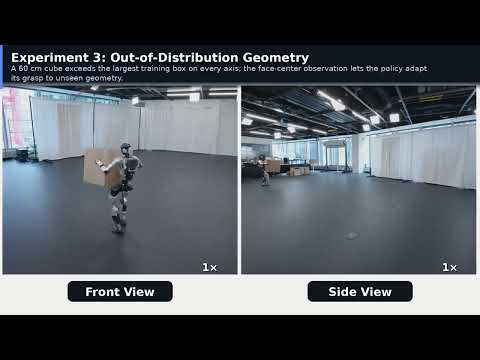
Hierarchical pipelines for humanoid loco-manipulation typically pair a task-agnostic whole-body controller (WBC) with a downstream task policy. Such WBCs are often trained through manual reward shaping, which yields visibly machine-like motions; more consequentially, they are trained without the manipulated object in the scene. Object dynamics are instead approximated through randomized end-effector force disturbances, a proxy that fails to reproduce the distributed multi-contact wrench a real payload applies across the arms and torso, with the gap becoming critical near the platform's payload limit. In this work, we train the low-level (LL) controller itself as an object-aware motion prior: a single policy trained via motion imitation on retargeted motion-capture (MoCap) references that span the core motion primitives of the downstream task, with the manipulated object physically present in the scene. This single stage inherits natural human-like coordination from the references and absorbs the realistic contact wrench at its source, while exposing the same compact task-space command interface used by command-tracking WBCs. A reference-free high-level (HL) policy is then trained on top, with its action channel anchored to the empirical envelope of the low-level training data so that it generalizes the priors to a long-horizon multi-stage task while structurally preventing queries that would push the low level off-distribution. We instantiate the framework on a Unitree G1 for bimanual box pick-and-place: the same deployed policy generalizes across object masses and dimensions, initial and goal poses, and reactively recovers from intentional drops mid-carry. Video: https://youtu.be/viR_ULnRDQQ.

cs.ROmanipulationhumanoid

兴趣:humanoid robots and whole-body control

#272026-11-0388

DiMuRe: Diagnosis-Guided Multilevel Recovery for Robotic Task Execution

Renkai Yi, Yuwei Wu, Haoyu Zhang, Penghao Dai, Zhi Gao, Jin Chen 等

Disturbances can invalidate the conditions required by a robot's next action even when much of its task program remains useful. A recovery system must therefore choose a response s…

Disturbances can invalidate the conditions required by a robot's next action even when much of its task program remains useful. A recovery system must therefore choose a response suited to the current state. We present DiMuRe (diagnosis-guided multilevel recovery), a framework for robot-use agents that uses phase-specific evidence and method preconditions to select program reuse or predefined recovery skills, including bounded vision-language-action (VLA) grasping. After the original program exits, a multimodal large language model (MLLM) can generate corrective code from images and execution feedback. Local verification checks the outcome of each recovery attempt. We also introduce LIBERO-Disturb, a benchmark for robustness and recovery under mid-execution disturbances, supporting program-based agents and VLA policies. On 801 scheduled disturbed Encore development cases, Local DiMuRe (program reuse and recovery skills) achieves 77.65% complete-task success, compared with 58.68% for the original program under the same physical-step allowance. Full DiMuRe achieves 81.90% with terminal replanning, an additional step allowance, and early handoff. Local DiMuRe also uses fewer physical steps per scheduled episode than the original program.

cs.ROcs.AIrobotVLAvision-language-action

兴趣:vision-language-action (VLA) models and foundation models for robots

#282026-11-0388

HiLo-WAM: Decoupling Long-Horizon Task Evolution and Local Dynamics in World Action Models

Xingyu Wang, Yanjiang Guo, Zhijing Ding, Jiaxin Fang, Zeyu Lai, Jiayu Dong 等

World Action Models (WAMs) improve robotic manipulation by jointly modeling visual dynamics and robot actions. However, most existing WAMs model dense short-horizon visual dynamics…

World Action Models (WAMs) improve robotic manipulation by jointly modeling visual dynamics and robot actions. However, most existing WAMs model dense short-horizon visual dynamics, capturing local interactions but providing limited long-range task context. Extending prediction horizons increases uncertainty and computation while entangling task-level evolution with fine-grained local dynamics, obscuring their dependencies and distinct roles in action generation. We propose HiLo-WAM, which decouples long-horizon task evolution from local visual dynamics while jointly modeling their interaction with robot actions. A sparse long-horizon visual stream captures historical task context and future evolution, while a dense local dynamics visual stream models short-horizon robot-object interactions. The two streams operate at different temporal scales within a unified dual-DiT architecture and guide actions through structured cross-stream attention. Progressive inference further reduces unnecessary computation through stream-wise partial denoising, joint denoising, and dynamic skipping. Experiments demonstrate strong long-horizon manipulation performance: HiLo-WAM achieves a 93.70% average success rate on RoboTwin 2.0 and a 17.43 progress score on RoboDojo long-horizon tasks, with robust in-domain and OOD performance on the Fourier GR-3 robot. Ablations confirm the complementary contributions of long-horizon task evolution and local interaction dynamics, while temporal-scale analyses highlight the importance of balancing temporal coverage and resolution. Progressive inference further achieves a 2.93x speedup while improving performance.

cs.ROrobotmanipulation

兴趣:vision-language-action (VLA) models and foundation models for robots

#292026-11-0388

Do Agentic Policies Need to Look at Every Step? Geometric Abstraction for Reasoning and Action

Yihang Liu, Yiming Chen, Mingzhe Zheng

Recent multimodal language models can reason directly about robot scenes, but it is unclear whether they need to repeatedly reinterpret raw visual observations at every step of an …

Recent multimodal language models can reason directly about robot scenes, but it is unclear whether they need to repeatedly reinterpret raw visual observations at every step of an interaction. We propose shifting routine spatial reasoning from images to text and symbols through a 3D geometric abstraction that is refreshed locally from observations and read directly by the language models. Specifically, our interface represents scene geometry via typed, evidence-aware symbolic references to object parts, grounds them from calibrated RGB-D, and returns compact textual checkpoints with metric residuals after each action. Symbolic task structure can thus be reused across decisions while metric values are rebound to the current scene, with direct visual reasoning invoked only on demand. Across offline policy synthesis and continuous online execution, reasoning over grounded text and symbols improves multi-step manipulation completion while substantially reducing repeated multimodal queries, positioning explicit geometric state as an effective substrate for agentic robot policies.

cs.ROcs.AIcs.CVrobotmanipulation

兴趣:large language models for robot task planning and reasoning

#302026-11-0387

RAIPAL: A Powerful and Agile Humanoid Arm for Human Tasks

Donggeon Kim, Hyungho Chris Choi, Donghyuk Choi, Jeongsoo Park, Choongin Lee, Chan Park 等

This paper presents humanoid manipulator hardware designed specifically for human-level performance throughout its broad domain of tasks, from heavy payloads to highly dynamic moti…

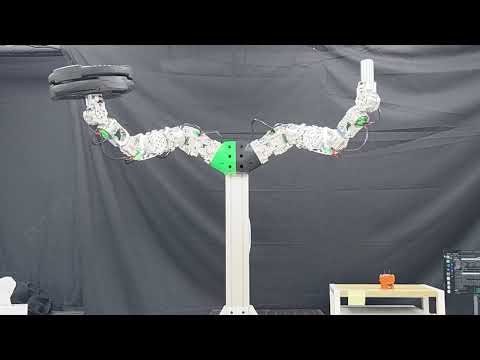
This paper presents humanoid manipulator hardware designed specifically for human-level performance throughout its broad domain of tasks, from heavy payloads to highly dynamic motions. Unlike conventional designs targeting uniform workspace capability, the proposed approach derives force, speed, and endurance targets from published measurements of task-relevant human upper-limb performance. These targets guide the actuator, mechanism, and thermal design toward torque transparency and sustained operation. The platform integrates force-oriented upper-arm components, speed-oriented forearm components, and a posture-dependent elbow mechanism that shifts its torque-speed behavior. These components are driven by planetary actuators and compact actuator-embedded electronics. Experimental results validate broad task capability, demonstrating a peak payload of 20 kg (2.25x its own mass), an endpoint speed of 20.6 m/s, and continued operation under repeated hammering impacts. Thermal analysis further confirms that the robot's sustained operation capability exceeds the published human load--duration boundary across nearly the entire load spectrum. These findings show that hardware targets derived from human-task measurements narrow the human-to-humanoid capability gap. A supplementary video is available at https://youtu.be/xVUWFICD5G0

cs.ROrobothumanoid

兴趣:humanoid robots and whole-body control

#312026-11-0387

LLMs as MDP Designers: A Dependency-Aware Agentic Framework for Automated Robot Policy Generation

Hong Je-Gal, Jinwoo Kim, Chanbin Yi, Hyun-Suk Lee

We investigate the automated generation of executable robot reinforcement learning (RL) policies from natural-language task descriptions. Rather than using large language models (L…

We investigate the automated generation of executable robot reinforcement learning (RL) policies from natural-language task descriptions. Rather than using large language models (LLMs) as execution-time decision makers, we use them as designers that construct RL pipelines before deployment, including Markov decision process (MDP) formulation and simulator implementation. We identify a phase-wise structure in this problem: MDP formulation is dependency-structured and sequential, whereas simulator implementation becomes modular once the formulation is fixed. Based on this structure, we propose ARPG, a dependency-aware agentic framework that performs sequential MDP modeling, localized verification and correction, and simulator-structured implementation while externalizing intermediate artifacts. ARPG targets a key failure mode of automated policy generation: executable code may still yield non-learnable policies when state, action, reward, and termination artifacts are not semantically aligned. Experiments in Isaac Sim show that ARPG improves modeling correctness, environment executability, and policy-generation success compared with monolithic LLM baselines and off-the-shelf agentic systems. Additional demonstrations on custom robotics, standard RL, and engineering-domain MDPs further suggest that the same modeling pipeline can be reused beyond the main benchmark suite.

cs.ROcs.AIrobot

兴趣:large language models for robot task planning and reasoning

#322026-11-0387

Trusting Imagined Futures: Auditing Imagined Rewards for VLA Post-Training

Zicheng Kong, Zhenbo Xu, Haoyan Zhang, Jinghan Yang, Zhenzhen Li, Yiwei Ru 等

Video world models enable candidate actions to be evaluated through imagined outcomes, but high predicted rewards can favor trajectories with poor execution quality. We introduce T…

Video world models enable candidate actions to be evaluated through imagined outcomes, but high predicted rewards can favor trajectories with poor execution quality. We introduce Trusting Imagined Futures (TIF), an offline supervision selection method for vision-language-action (VLA) post-training that audits predicted rewards using execution feedback. A multidimensional reward model predicts a utility score for candidate ranking and five dimensions of execution quality. An auditor uses reward predictions and uncertainty to identify overestimation patterns learned from paired imagined videos and real executions. TIF accepts the candidate with the highest predicted utility when its advantage over the existing trajectory exceeds a margin and its audit risk passes a threshold; otherwise, it retains the existing supervision. The retained real trajectories then supervise behavior cloning. Across four LIBERO suites and three training seeds, TIF achieves a mean success rate of 76.25%, improving over training on the existing trajectories by 3.00 percentage points with the same trajectory count and training budget. Adding audit gating yields 1.47 percentage points with the reward model and advantage margin held fixed. The gains persist against advantage ranking and logistic regression risk selection at matched replacement counts. On recorded videos from three real robot tasks, TIF increases clean completion among selected trajectories from 58.33% to 70.00% across 60 candidate pools.

cs.ROcs.CVrobotVLAvision-language-action

兴趣:vision-language-action (VLA) models and foundation models for robots

#332026-11-0386

LoopQ: Fair, Closed-Loop Evaluation of Quantized Vision-Language-Action Models

Syed Umer Bukhari, Magnus Almgren, Ahmed Ali-Eldin

Post-training quantization (PTQ) for vision-language-action (VLA) models promises smaller and faster VLA deployments. However, when analyzing existing VLA quantization works, we re…

Post-training quantization (PTQ) for vision-language-action (VLA) models promises smaller and faster VLA deployments. However, when analyzing existing VLA quantization works, we realised that it is hard to reason about the performance of the suggested quantization method compared to existing, similar, or in many cases, simpler PTQ methods. We present LoopQ, a closed-loop benchmark that compares multiple quantization policies on the same checkpoint, layers and engine, varying only the method and the kernels. We evaluate RTN, AWQ, GPTQ, ActQuant and QuantVLA on four VLAs with more than 180,000 episodes of LIBERO and LIBERO-plus, compare against QVLA's reported results on the same layers, and benchmark whether the four public VLA-quantization releases can be reproduced. We benchmark the methods on an NVIDIA H100, an L4, and a Jetson AGX Thor. Our results show that while quantization reliably saves memory, 2-3x for real low-bit models, VLA-specific PTQ methods underperform compared to simpler generic baselines. At 4 bits, RTN, AWQ and GPTQ match or exceed ActQuant and QuantVLA, plain RTN matches the calibrated methods, and plain AWQ matches the success QVLA reports for itself. Standard LIBERO hides the losses that do exist: configurations with no significant LIBERO loss lose 1.5-4.3 points under paired LIBERO-plus perturbations. Speed is a weaker story. At batch 1 on the H100, no quantized pi0.5 or OpenVLA-OFT configuration is faster than its 16-bit model (1.06-1.58x slower on library kernels); only the L4 with int8 kernels gains (4-14%), the Thor is slower on every 4-bit configuration, and the engine alone changes latency by 2.1x. Profiling explains why: pi0.5's quantized backbone is compute-bound, while its memory-bound action expert, 63% of GPU time and 13% of the parameters, stays in 16 bits.

cs.ROVLAvision-language-action

兴趣:vision-language-action (VLA) models and foundation models for robots

#342026-11-0286

VagueBench: Benchmarking the Robustness of Embodied Agents on Ambient Context Illusions

Yang Qu, Qiang Fu, Zonghao Ying, Jiayi Zhao, Yaoyuan Zhang, Jinyang Guo 等

Embodied agents are increasingly deployed in open-world environments, yet current robustness evaluations remain biased toward hazardous instructions and jailbreak vulnerabilities. …

Embodied agents are increasingly deployed in open-world environments, yet current robustness evaluations remain biased toward hazardous instructions and jailbreak vulnerabilities. A more fundamental issue is largely overlooked: agents are rarely tested under semantically sufficient but contextually minimal instructions (i.e., common in real-world human communication), where auxiliary contextual cues are absent. For the first, we identify a novel phenomenon termed Ambient Context Illusion, where agents fail to execute tasks correctly when non-essential contextual details are omitted, despite unchanged task semantics. To systematically study this, we establish VagueBench, a benchmark built upon the AI2-THOR interactive simulation environment for the evaluation of context dependency in embodied agents. We systematically consider key semantic components of instructions (entities, procedures, constraints, and prior knowledge) and derive a unified taxonomy with four categories and nine subtypes to reduce auxiliary information. VagueBench contains 1,303 instruction pairs across diverse indoor environments, constructed via a human-agent co-generation framework that integrates semantic redundancy estimation, taxonomy-guided transformation, and rigorous semantic-invariance verification. Through extensive evaluation on 6 state-of-the-art embodied agents, we observe significant degradation on VagueBench in both task performance and executability (relatively -19.65% in task success rate and relatively +54.10% in empty plan rate) revealing a strong reliance on auxiliary linguistic signals rather than core task semantics. Furthermore, we demonstrate that this phenomenon persists in real-world robotic systems, where it can lead to incorrect decisions and potential safety risks.

cs.AIcs.CVembodied

兴趣:world models and video prediction for embodied agents

#352026-11-0385

Cycle WAM: Coupling Action and Video through Cycle Consistency

Qinglin Yang, Jiepeng Wang, Yuxing Huang, Haibin Huang, Kai Xu, Chi Zhang 等

Recent advances in video modeling have driven substantial progress in world action models (WAMs). Existing approaches exploit pretrained video priors by decoding actions from laten…

Recent advances in video modeling have driven substantial progress in world action models (WAMs). Existing approaches exploit pretrained video priors by decoding actions from latent representations or inferring them from generated videos. The underlying link is causal: robot actions produce changes in the scene, and video observations of these changes provide evidence for inferring the actions that produced them. However, existing training formulations do not by themselves ensure that actions and their predicted visual consequences are consistent, potentially limiting the use of pretrained capabilities. We treat video and action as paired modalities linked by this causal relationship and learn their correspondence through a unified training framework designed to better exploit pretrained video priors. Cycle WAM first augments video-action co-training with bidirectional conversion to reinforce cross-modal correspondence and recover forward and inverse dynamics. It then introduces a differentiable cycle-reconstruction objective to further couple the two mappings. The resulting model supports both forward and inverse dynamics, with the potential to improve performance through more effective use of pretrained video priors. Cycle WAM achieves state-of-the-art performance among comparable methods on LIBERO-Pro and substantially improves DreamZero on DROID. Comparisons with UWM characterize its inverse-dynamics performance and show sharper visual detail in the displayed forward-dynamics predictions.

cs.CVcs.AIcs.ROrobot

兴趣:world models and video prediction for embodied agents

#362026-11-0385

Online iLQR-MPC with Whole-Body Control for Robust Humanoid Locomotion

Xiang Li, Linlin Ou, Ruihan Wu, Xinyi Yu

Humanoid locomotion requires deciding where to step and how to distribute contact forces. However, a disturbance can invalidate the nominal plan, requiring coordinated revision und…

Humanoid locomotion requires deciding where to step and how to distribute contact forces. However, a disturbance can invalidate the nominal plan, requiring coordinated revision under constraints that switch with every footfall. To solve this online, the proposed approach employs the single-rigid-body model, which retains attitude dynamics and the full contact wrench. An iterative linear-quadratic-regulator MPC (iLQR-MPC) then jointly optimizes contact forces and footstep locations in a single receding-horizon problem, without a separate step planner. Specifically, contact and motion constraints are incorporated into the backward pass through augmented-Lagrangian and relaxed-barrier penalties. A whole-body controller subsequently maps the plan to joint torques at 500 Hz while preserving contact feasibility. The model-based formulation makes disturbance responses interpretable through explicit costs and constraints, and requires no platform-specific policy training. In MuJoCo simulations, the iLQR-MPC replans at 100 Hz (mean solve time 8.9 ms); the Unitree G1 sustains steady-state walking and recovers from impulsive 245 N forward and 175 N lateral pushes.

cs.ROhumanoidlocomotion

兴趣:humanoid robots and whole-body control

#372026-11-0385

Future Representation Distillation for Imagination-Free World Action Models

Jaehyeong Jo, Sangwon Jang, Sihyun Yu, Seonghyeon Ye, Yekyung Nah, Hojung Jung 等

World Action Models (WAMs) use the predictive knowledge of pretrained video diffusion models for robot control through future video prediction. However, iterative video denoising i…

World Action Models (WAMs) use the predictive knowledge of pretrained video diffusion models for robot control through future video prediction. However, iterative video denoising is costly, and inaccurate visual predictions can compromise action prediction. Our key idea is to make this predictive knowledge available through visual representations computed from the current observation, enabling action prediction without generating future videos. We introduce DreamFree, a WAM that repurposes a pretrained video diffusion model as a predictive visual encoder through representation distillation. The visual encoder learns to predict a frozen video diffusion model's representation using only the current observation. An action module is then trained to predict actions by extracting action-relevant information from the visual encoder. Across real-world and simulated tasks, DreamFree achieves higher success rates than state-of-the-art VLAs and WAMs, while performing real-time closed-loop control at 11Hz with a 14B video diffusion backbone. Experiments show that DreamFree can translate stronger video priors and additional video data into better robot control and enable learning new robot tasks from video demonstrations, including videos from a different embodiment, without action annotation for the new tasks.

cs.ROrobot

兴趣:world models and video prediction for embodied agents

#382026-11-0385

All-For-One: Distilling Visual Foundation Models to a Fast, Memory-Efficient Visuomotor Policy

Byungkun Lee, Minho Park, Hojoon Lee, Dongyoon Hwang, Donghu Kim, Hyunseung Kim 等

Visual Foundation Models (VFMs) provide semantic cues such as depth and segmentation useful for robotic manipulation, but directly deploying them in closed-loop control is impracti…

Visual Foundation Models (VFMs) provide semantic cues such as depth and segmentation useful for robotic manipulation, but directly deploying them in closed-loop control is impractical due to high computational cost, temporal inconsistency, and distribution shift between static internet images and egocentric robot observations. We propose All-For-One (AFO), a two-stage distillation framework that leverages VFMs strictly as privileged information during training, using downstream robotic data. Following the privileged learning paradigm, AFO decouples semantic representation learning from inference-time policy execution. In the All stage, a teacher policy fuses RGB observations with outputs from multiple VFMs to learn a semantically enriched representation. In the For-One stage, this knowledge is distilled in-distribution into a lightweight RGB-only student policy. Evaluated on two Adroit tasks and five MetaWorld tasks in simulation, as well as three real-world manipulation tasks, AFO outperforms prior foundation-model-based approaches while using over 30x fewer parameters than VFM-based encoders and 50x lower latency than its own teacher in simulation benchmarks, providing an efficient pathway for transferring foundation-model knowledge to robotic control.

cs.ROrobotmanipulation

兴趣:vision-language-action (VLA) models and foundation models for robots

#392026-11-0384

CLARA: A Cognitively-Driven Clarification Framework for Grounding Ambiguous Requests

Dimitrios Bekris, Marios Glytsos, Panagiotis P. Filntisis, Niki Efthymiou, George Retsinas, Petros Maragos

Robotics and AI systems are increasingly deploying large vision-language models (LVLMs) to follow high-level instructions, from routine household chores to more complex organizatio…

Robotics and AI systems are increasingly deploying large vision-language models (LVLMs) to follow high-level instructions, from routine household chores to more complex organizational tasks. Yet, broad directives like "clean the room" or "organize the desk" frequently omit crucial details about user preferences and specific arrangement of objects that influence the desired outcome. Without any further guidance, such models tend to overestimate their grasp of ambiguous instructions and frequently assume they have sufficient understanding despite missing important details. In this paper, we propose CLARA (Conversational cLArification for Robotic Arrangement), a cognitively-driven clarification framework that proactively elicits key information from users, in a similar fashion as humans' clarification seeking behavior. Through targeted questioning, CLARA refines ambiguous requests into structured, detailed instructions describing precisely how objects should be organized or rearranged, according to the user's preferences. These clarifications then guide a diffusion-based image generation pipeline, producing realistic visual renderings of the final, desired scene. This final rendering also serves as a visual confirmation of the system's understanding from the user. Experimental results and user studies demonstrate that CLARA leads to more accurate and consistent outcomes compared to another State-of-the-Art LVLM system, highlighting the importance of interactive clarification for bridging the gap between vague directives and fully grounded task specifications.

cs.ROcs.AIgrasp

兴趣:large language models for robot task planning and reasoning

#402026-11-0283

AIRoA-0: Long-Horizon, Precise, Cross-Embodiment Manipulation from Handheld Data

Yueh-Hua Wu, Kei Ota, Hanlong Li, Hayata Yuasa, Jason Wang, Kengo Ikeuchi 等

AIRoA-0 (A-0) is a bimanual manipulation system learned from 16,151 hours of handheld demonstrations, with no robot data collected at any stage. The demonstrations are recorded wit…

AIRoA-0 (A-0) is a bimanual manipulation system learned from 16,151 hours of handheld demonstrations, with no robot data collected at any stage. The demonstrations are recorded with YUBI, our open-source handheld gripper, which lets people record manipulation data anywhere with no robot present. From a single instruction, A-0 sorts more than a dozen small parts into their numbered cells and changes the mop pads and brush of a robot vacuum; among other tasks, it unzips a pencil case and folds a towel. It performs these tasks using only a camera on each wrist, with no head or scene camera, at a site where none of its training data was recorded. Across the ten tasks of our evaluation, it averages a success rate of 78%, against 27% for the strongest of four other vision-language-action models post-trained on the same task demonstrations. We collect no teleoperation data and use no reinforcement learning or on-robot corrections, and the robot appears only at test time. The system learns which regions of each wrist view matter for the task, predicts the stage the task has reached, and decodes actions as a continuous stream. A-0 is embodiment-agnostic: it runs on robots that mount the YUBI gripper, such as a bimanual Franka, TX-G2, OpenArm and UR. We are releasing the dataset, to our knowledge the largest open dataset of handheld-gripper demonstrations with task and subtask instructions, together with the pre-trained weights and the post-training recipe. Videos of A-0 on every task are on the project page, https://a-0.airoa.io. Anyone can build the gripper, record a task of their own and post-train the model on it in under four hours on a single node of eight H200 GPUs.

cs.ROcs.AIcs.LGrobotmanipulationvision-language-action

兴趣:robot manipulation and grasping with learned policies

#412026-11-0383

DreamX: Video Diffusion Model is a Universal Latent Action Learner

Jisoo Kim, Chaehyun Kim, Junsu Kim, Jiho Park, Seongchan Kim, Eunbeen Hong 等

Learning a universal action representation from video requires modeling dynamics that are consistent across different executions of the same action yet invariant to changes in embo…

Learning a universal action representation from video requires modeling dynamics that are consistent across different executions of the same action yet invariant to changes in embodiment and appearance. Existing latent action models infer actions from visual transitions, but their representations often entangle the underlying action with irrelevant visual variations, limiting transfer across embodiments. We introduce DreamX, which repurposes a pretrained video diffusion model as a universal latent action learner. Our approach extracts compact latent actions from the video model's rich spatiotemporal features, compressing each latent video frame by $\boldsymbol{300\times}$ ($\boldsymbol{1{,}200 \rightarrow 4}$ tokens). In addition, by leveraging the video model's generative prior, these latent actions capture action-relevant dynamics disentangled from visual appearance. The resulting latent space serves as a shared action interface across embodiments (human and robot), environments, and action parameterizations. On LARY-Bench, DreamX achieves state-of-the-art performance among latent action models. Moreover, actions encoded in one setting remain effective in another: the latent space supports any-to-any video transfer and zero-shot action transfer across diverse embodiments and environments. Furthermore, this shared interface also enables policy learning in a compact latent action space, reducing the computational cost of video-diffusion-based policies.

cs.CVcs.AIcs.ROrobot

兴趣:world models and video prediction for embodied agents

#422026-11-0283

MABEL: An Open Anthropomorphic Mobile Bimanual Platform for Teleoperation and Learning

Qilong Cheng, Rooholla Khorrambakht, Mohamed Yassine Kabouri, Quang Nam Nguyen, Luca Macesanu, Haoran Zhou 等

As robot learning moves beyond the tabletop, many tasks require mobility, adjustable reach, active perception, and bimanual dexterity. Commercial platforms combining these capabili…

As robot learning moves beyond the tabletop, many tasks require mobility, adjustable reach, active perception, and bimanual dexterity. Commercial platforms combining these capabilities are costly, while affordable open-source alternatives cover only a subset and require software integration. We present MABEL, an open-source anthropomorphic mobile bimanual robot with 56 degrees of freedom (DOF) and a US$8.1k parts cost. It combines two 7-DOF arms with 17-DOF hands, a pitching torso, a lift, a 3-DOF neck, and a holonomic base. Back-drivable arms and torso support compliant interaction, with fingertip reach from floor level to 2.23 m. The head and torso roughly triple modeled camera coverage relative to a torso-fixed camera. Apple Vision Pro head and hand tracking enables whole-body teleoperation without handheld controllers, with 137 ms mean glass-to-glass stereo video latency over the robot's Wi-Fi hotspot. We demonstrate an end-to-end imitation learning pipeline, from teleoperated data collection to policy deployment, using a shared command interface and whole-body controller.

cs.ROrobotimitation learning

兴趣:humanoid robots and whole-body control

#432026-11-0382

PACT: Pose-Robust Actuation Co-Design for Tendon-Driven Robotic Hands

Prashant Kumar, Rachael Granberry, Taylor Niehues, Andrew A. Stanley, Gabe Pirie

Humanoid robotic hands must provide sufficient force, speed, and backdrivability within a human-scale envelope. Tendon-driven transmissions address this challenge by relocating act…

Humanoid robotic hands must provide sufficient force, speed, and backdrivability within a human-scale envelope. Tendon-driven transmissions address this challenge by relocating actuators to the palm and forearm, but routing paths, moment arms, and capstan dimensions jointly determine both force capability and joint speed, so selecting them sequentially satisfies one requirement at the expense of the other. This paper presents a pose-robust actuation co-design for tendon-driven robot hands (PACT) framework that optimizes tendon routing, moment arms, and capstan dimensions under pose-dependent force requirements and drivetrain-bandwidth constraints. A feasible-force formulation enforces actuator bounds and equilibrium at all joints, while a max-min objective maximizes task-force coverage at the weakest pose. Applied to a four-degree-of-freedom finger, the framework produces an asymmetric N + 1 tendon topology using quasi-direct-drive actuators. Across eight poses, the design achieves task-force coverage of 0.88-1.00 and a predicted 5 Hz minimum isolated-joint flexion/extension bandwidth within a 70th-percentile human-size envelope. Prototype measurements deviate from predictions by up to 24.5%, primarily due to unmodeled transmission losses. These results indicate that co-designing routing with the drivetrain can meet pose-dependent force requirements without relaxing the bandwidth constraint, paving the way for human-sized robotic hands with human-level performance.

cs.ROrobothumanoid

兴趣:humanoid robots and whole-body control

#442026-11-0382

CANDO: Conservative Action-Noise Directional Optimization for Residual Reinforcement Learning

Zeyu Gao, Chengkai Hou, Chaoyue Li, Zhuangzhe Wu, Jiaming Liu, Yao Mu 等

Pretrained generative policies provide strong behavior priors for robot control, but adapting them efficiently with online reinforcement learning remains difficult. A central chall…

Pretrained generative policies provide strong behavior priors for robot control, but adapting them efficiently with online reinforcement learning remains difficult. A central challenge is how to improve a frozen generative policy without destroying the structure learned from offline demonstrations. Noise-space residual methods address this by modifying the policy's input noise, but existing noise-space methods typically regulate adaptation through fixed latent feasible regions, which may exclude valuable noise edits. In contrast, action-space residual methods are more sample-efficient, but their efficiency can still be further improved. We propose Conservative Noise Directional Optimization (CNDO), a noise-space residual RL method that improves a frozen generative policy by learning state- and noise-conditioned directions around Gaussian latent samples. CNDO removes predefined latent feasible regions and instead regulates noise-space adaptation through the soft conservative constraint, which consists of conservative value estimation and gated execution. We further introduce Conservative Action-Noise Directional Optimization (CANDO), which adds an action-space residual, combining structured latent-space improvement with local action correction. Experiments show that, once CNDO narrows the gap between noise-space and action-space residual learning, CANDO further improves over single-space optimization, achieving 76.1 NAUC and a 91.4% final success rate, surpassing the best single-space results by 6.6 NAUC and 4.1% success rate. More demos and info are available on https://cando-rl.github.io/.

cs.LGcs.AIrobot

兴趣:imitation learning and diffusion policies for robot control

#452026-11-0382

AceAction-5M: Hierarchical Goals for Generalist Action Learning Across 3D Game Worlds

Kailing Li, Ruoxuan Zhang, Zheyuan Zhou, Boyang Chu, Yingshan Lei, Hongxia Xie 等

Video games provide a practical setting for collecting vision-language-action (VLA) data, whose acquisition in physical environments is costly. Existing datasets, however, remain l…

Video games provide a practical setting for collecting vision-language-action (VLA) data, whose acquisition in physical environments is costly. Existing datasets, however, remain limited by restricted game coverage, sparse language supervision, or temporal hierarchies that do not necessarily reflect changes in task objectives. We introduce AceAction, a dataset of human gameplay across multiple 3D games for learning skill composition and subgoal transitions. AceAction organizes demonstrations around complete tasks, linking overall instructions, ordered subgoals, and local skill instructions to temporally aligned visual observations and keyboard-and-mouse actions. To construct these annotations, we develop a vision-language model pipeline that identifies subgoals from changes in objectives or interaction targets, anchors navigation goals to visually recognizable waypoints, and composes adjacent subgoals into task instructions. The resulting demonstrations cover navigation, reconnaissance, combat, interaction, and recovery, with explicit stage boundaries that connect task progression to fine-grained control. We assess annotation quality through model-based verification and human inspection. An audit of 500 trajectories yields a 95.8% pass rate across independent reviewer assessments. AceAction provides a data foundation for studying how agents execute, combine, and switch skills to follow complex instructions in dynamic game environments.

cs.AIVLAvision-language-action

兴趣:vision-language-action (VLA) models and foundation models for robots

#462026-11-0382

HTCE: Homeomorphism-inspired Topological Cross-Scene Experience Canonicalization and Reuse for Object Navigation

Xiaoran Xu, Yupeng Wu, Tianyu Xue, Xuanran Dong, Yifan Xu, Xiaoshan Yang 等

As embodied agents perform object-goal navigation across residential environments, they accumulate successful experiences whose semantic structure recurs across scenes even when ge…

As embodied agents perform object-goal navigation across residential environments, they accumulate successful experiences whose semantic structure recurs across scenes even when geometric trajectories do not. Reusing such experience is challenging because differences in region naming and observation granularity produce distinct graph representations of similar approaches, while meaningful differences in anchors, branches, and endpoints must stay distinguishable. We introduce HTCE, a homeomorphism-inspired topological framework that canonicalizes and reuses navigation experience. Feature and topology subdivisions characterize representational variations, and their semantically constrained reductions produce comparable semantic sequences and structural signatures while preserving semantic anchors, branching relations, and navigation endpoints. HTCE then retrieves historical successful approaches through subdivision-aware matching as guidance for a frozen vision-language policy. Canonicalization compresses the experience index losslessly, merging 17.7--23.6% of distinct stored route descriptions while retaining full task performance. Under a single frozen vision-language backbone shared by all compared systems, HTCE attains the best SR and SPL in every setting---59.9%/31.8% on HM3D v0.1, 71.0%/31.5% on HM3D v0.2, and 46.6%/16.6% on MP3D---with SR gains of up to 4.9 points and structured retrieval contributing up to 2.8 SPL points. The code is available in https://github.com/startracker0/htce.git

cs.AIembodied

你点赞过:TANGO: Humanoid Navigation in Cluttered Environments with a

#472026-11-0381

Embodied AI for Scientific Discovery: From Physical Action to Scientific Evidence

Wenhao Xu, Changwei Wang, Shunpeng Chen, Yukun Song, Sifan Zhou, Kaize Luo 等

Scientific experiments are increasingly selected, executed and interpreted by learned systems that act through physical interfaces. Robot learning builds physical competence, where…

Scientific experiments are increasingly selected, executed and interpreted by learned systems that act through physical interfaces. Robot learning builds physical competence, whereas AI for science chooses which experiment to run, each reporting different endpoints. This review treats their interface as one problem, embodied AI for science, where the experiment itself is partially observed: specimen state, apparatus state and measurement processes are latent, actions are costly and irreversible, and missingness depends on execution and outcome. We organize the literature by three closures operating at distinct levels: operational closure (the experiment realized is the one intended), epistemic closure (the result updates beliefs or selects subsequent experiments) and evidential closure (the record supports a claim). We analyze workflows through a record-linked evidence cycle - Record, Diagnose, Calibrate, Confirm - as analytic functions with feedback. A taxonomy crosses these closures with six delegated decisions and five embodiment classes. Our formulation separates commanded, realized and observed conditions and models diagnosis with explicit resource, risk and sample-change costs. We compare experiment-selection methods by terminal decision, review perception, protocol compilation, visuomotor policies, world models, recovery and transfer by evidence emission requirements, and compare chemistry, materials, biology, microscopy and field workflows by what their records establish. An appendix provides an evidence map of 28 workflows (26 physical, two software-boundary), characterizing validation pathways and claim confirmation requirements. We propose evaluation that separates actions, valid experiments, campaigns and confirmed claims, framing open challenges as controlled comparisons with measurable failure conditions.

cs.AIrobotembodied

兴趣:world models and video prediction for embodied agents

#482026-11-0381

DualWorldBench: Can Agents Plan Deliveries across Symbolic and Grounded Worlds?

Yang Chen, Bin Wen, Danyang Peng, Hong-Jie You, Zi-Qiao Shang, Lan-Zhe Guo

Recent multimodal agents have shown promising progress in embodied planning and web interaction. However, existing evaluations often rely on simplified tasks with limited combinato…

Recent multimodal agents have shown promising progress in embodied planning and web interaction. However, existing evaluations often rely on simplified tasks with limited combinatorial structure, leaving it unclear whether current agents can robustly integrate perception and reasoning for multi-goal planning under temporal, physical, and multimodal constraints. We introduce DualWorldBench, a unified benchmark for evaluating agent planning under controlled symbolic--temporal and grounded--topological complexity. Built around a shared pickup--delivery interface, DualWorldBench consists of three complementary components: TextWorld, which isolates symbolic planning under varying task compositions and release dynamics; SimWorld, which evaluates grounded path planning under controlled topological variation with text, image, or multimodal inputs; and DualWorld-VQA, a diagnostic suite spanning perception, scene understanding, and planning. Experiments reveal a common gap between local understanding and globally consistent planning. In TextWorld, agents struggle to derive optimal task sequences under interacting temporal constraints; in SimWorld, grounded observations are not reliably converted into feasible action sequences. DualWorld-VQA further confirms that perception and topology understanding do not necessarily translate into constrained planning. Together, these results identify the central challenge as composing symbolic or grounded evidence into globally feasible and efficient multi-goal plans. These findings establish DualWorldBench as a challenging testbed for agents with tighter perception--reasoning--planning integration. All datasets and code are publicly available at our project website https://dualworld.netlify.app/.

兴趣:world models and video prediction for embodied agents

#492026-11-0381

Route Anything: A Study of Model and Policy Routing for General-Purpose AI Systems

Pengfei Zhou, Yixing Ma, Hexin Wang, Weidong Tang, Zhenglin Wan, Wangbo Zhao 等

Artificial general intelligence (AGI) requires a method that can understand, generate, reason, and act across diverse domains and modalities. Rather than relying on a single model …

Artificial general intelligence (AGI) requires a method that can understand, generate, reason, and act across diverse domains and modalities. Rather than relying on a single model to master every capability, a promising path toward AGI now is to orchestrate a heterogeneous ecosystem of specialized models, tools, and policies (candidates) into a unified AI system. At the heart of this vision lies a fundamental question: how can an AI system dynamically select and coordinate the most capable candidate for each task while balancing performance and computational cost? In this work, we present Route Anything, a unified framework for studying model and policy routing across general-purpose AI systems. We develop a unified theoretical foundation that characterizes optimal routing under quality--cost trade-offs and establishes how the information available to a router determines its attainable performance. To systematically investigate routing across diverse capabilities, we first construct an omni-modal trajectory matrix spanning 25 benchmarks across language understanding, image, video, and speech generation, coding and workplace agents, and robotic manipulation, comprising 374,401 scored runs from 452 candidate configurations. Building on this framework, we train and test different routers to investigate the potential of omni-modal model routing, the capabilities of learned routers, and the conditions under which routing improves efficiency. Our results reveal substantial opportunities for capability orchestration: per-input oracle routing outperforms the best fixed candidate by 5.4 points, and learned routers outperform it by 0.3 points across 16 benchmarks, by 2.1 points on video generation, and by 1.1 points on robot manipulation while using 24% less policy time. More importantly, routing raises efficiency by 8.82x on average compared with the reference model.

cs.CVrobotmanipulation

兴趣:large language models for robot task planning and reasoning

#502026-11-0381

Hybrid Particle-Voxel Dynamics for Multimodal 3D World Simulation

Jimmy Wang, Yifan Chou, Kaifeng Zhang, Yixuan Wang, Binghao Huang, Tao Yu 等

Predicting how the world evolves in response to robot actions is central to policy learning, evaluation, and planning. However, many action-conditioned world models predict future …

Predicting how the world evolves in response to robot actions is central to policy learning, evaluation, and planning. However, many action-conditioned world models predict future observations in 2D image or video space without explicitly modeling the underlying 3D scene, making spatial consistency across viewpoints and over long-horizon interactions challenging. We introduce 3D World Simulator, an action-conditioned multimodal world modeling framework that jointly predicts appearance, geometry, and tactile observations from a unified 3D representation. Our approach combines a hybrid particle-voxel autoencoder that compresses point clouds into compact 3D voxel latents with an action-conditioned latent dynamics model that predicts their evolution. The shared 3D representation supports geometrically consistent rendering from arbitrary viewpoints and flexible integration of spatially aligned tactile signals. Our experiments demonstrate interactive, long-horizon, multimodal prediction at 50 Hz. We then show how our model enables scalable data generation for policy training and evaluation using tactile and multi-view visual observations, including wrist-mounted and novel camera views. Furthermore, we scale our method to large datasets containing diverse objects and demonstrate model-based planning with unseen objects and robot configurations. Together, these results highlight the potential of hybrid particle-voxel dynamics as a foundation for multimodal 3D world simulation.

cs.ROcs.CVcs.LGrobottactile

兴趣:world models and video prediction for embodied agents

GitHub 项目速览

查看全部 →
#12026-10-30★ 16新项目76

anashoussaini/Dexsuite

Python

A Modular Robot Simulation Framework for Dexterous Manipulation

A Modular Robot Simulation Framework for Dexterous Manipulation

dexterityimitation-learningreinforcement-learningroboticsrobotics-simulationsimulationrobotmanipulationdexterous

兴趣:robot manipulation and grasping with learned policies

#22026-09-16★ 80 +1275

waltstephen/CaPtain

Python

CaPtain: A Pipeline for Post-Training Code-as-Policy Robot Agents — CaPtain-Harness, SFT and RL training code, benchmark adapters

CaPtain: A Pipeline for Post-Training Code-as-Policy Robot Agents — CaPtain-Harness, SFT and RL training code, benchmark adapters

code-as-policyembodied-ailiberollm-agentrobot-learningroboticsvision-language-modelrobotembodied

兴趣:vision-language-action (VLA) models and foundation models for robots

#32024-12-08★ 4.4k +1174

datawhalechina/every-embodied

Jupyter Notebook

仅需Python基础,从0构建自己的具身智能机器人;从0逐步构建VLA/OpenVLA/SmolVLA/Pi0, 深入理解具身智能

仅需Python基础,从0构建自己的具身智能机器人;从0逐步构建VLA/OpenVLA/SmolVLA/Pi0, 深入理解具身智能

embodied-agentembodied-aiembodied-intelligenceopenvlasmolvlavision-language-action-modelVLAvision-language-actionembodied

兴趣:world models and video prediction for embodied agents

#42026-10-12★ 328 +17新项目74

robosimstudio/robosimstudio

Python

An open agentic toolkit for physics-based Real2Sim of Robot Manipulation Tasks

An open agentic toolkit for physics-based Real2Sim of Robot Manipulation Tasks

agentinverse-physicsreal2simreal2sim2realroboticssimulationrobotmanipulation

兴趣:humanoid robots and whole-body control

#52026-09-30★ 320 +1673

groundingpi/GroundingPI

Python

A 4B grounding foundation model for physical intelligence. Unifies detection, referring, pointing, OCR, GUI, and layout grounding, achieving SOTA overall across 34 benchmarks and i…
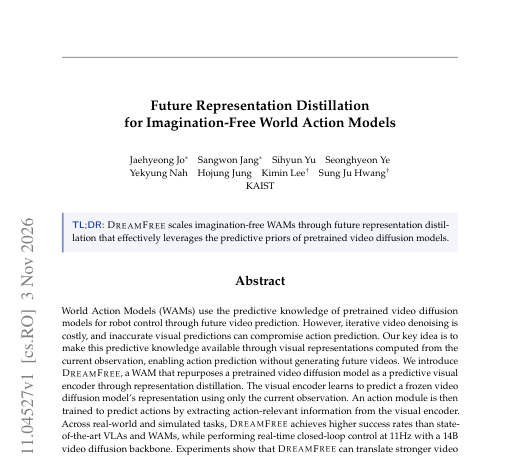
A 4B grounding foundation model for physical intelligence. Unifies detection, referring, pointing, OCR, GUI, and layout grounding, achieving SOTA overall across 34 benchmarks and improving robot generalization and data efficiency in controlled evaluations.

embodied-aigui-groundingobject-detectionocrphysical-intelligencepointingrobot-learningvision-language-modelrobotVLAembodied

兴趣:vision-language-action (VLA) models and foundation models for robots