Tech Station

学者追踪 › NYU › Jia Deng

Jia Deng

NYU / Columbia / Princeton · 最近 45 天 12 篇
#12026-11-04追踪学者 · Jia Deng

Procedural Adversarial Learning

Jack Nugent, Jia Deng

For many computer vision tasks, neural networks can be trained to produce a low average error, yet they still fail on seemingly simple scenes. Reducing these failures requires firs…

For many computer vision tasks, neural networks can be trained to produce a low average error, yet they still fail on seemingly simple scenes. Reducing these failures requires first finding them, but they may not be in a fixed dataset. We study procedural adversarial learning (PAL), a framework of minimax training and adversarial evaluation which searches the input space of a procedural generator for difficult instances. The procedural generator is an interpretable program mapping a low-dimensional vector of control parameters (e.g. layout, lighting, pose) to a rendered image and its label. We introduce the Simple-PAT algorithm, which uses zeroth-order optimization in the procedural generator's parameter space to propose adversarial training samples that are generated on demand. We also create PAL-Dojo, a collection of efficient procedural generators for surface normal estimation, image segmentation, and human pose estimation. Against a cross-model black-box adversary with 50M aggregate queries, Simple-PAT reduces worst-case error by a geometric mean of 3.15x compared to standard training and 2.63x compared to the strongest robust training baseline. Code is available at https://github.com/princeton-vl/procedural-adversarial-learning.

#22026-10-29追踪学者 · Jia Deng

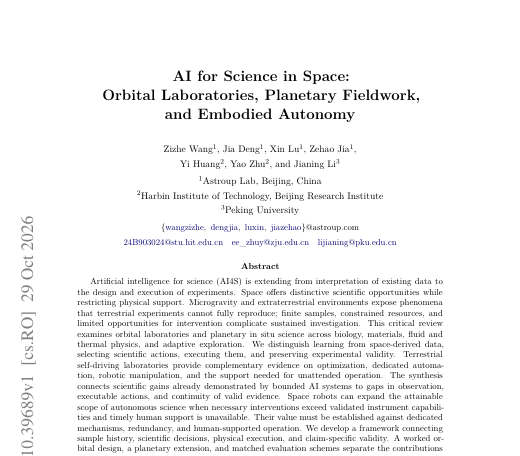
AI for Science in Space: Orbital Laboratories, Planetary Fieldwork, and Embodied Autonomy

Zizhe Wang, Jia Deng, Xin Lu, Zehao Jia, Yi Huang, Yao Zhu, Jianing Li

Artificial intelligence for science (AI4S) is extending from interpretation of existing data to the design and execution of experiments. Space offers distinctive scientific opportu…

Artificial intelligence for science (AI4S) is extending from interpretation of existing data to the design and execution of experiments. Space offers distinctive scientific opportunities while restricting physical support. Microgravity and extraterrestrial environments expose phenomena that terrestrial experiments cannot fully reproduce; finite samples, constrained resources, and limited opportunities for intervention complicate sustained investigation. This critical review examines orbital laboratories and planetary in situ science across biology, materials, fluid and thermal physics, and adaptive exploration. We distinguish learning from space-derived data, selecting scientific actions, executing them, and preserving experimental validity. Terrestrial self-driving laboratories provide complementary evidence on optimization, dedicated automation, robotic manipulation, and the support needed for unattended operation. The synthesis connects scientific gains already demonstrated by bounded AI systems to gaps in observation, executable actions, and continuity of valid evidence. Space robots can expand the attainable scope of autonomous science when necessary interventions exceed validated instrument capabilities and timely human support is unavailable. Their value must be established against dedicated mechanisms, redundancy, and human-supported operation. We develop a framework connecting sample history, scientific decisions, physical execution, and claim-specific validity. A worked orbital design, a planetary extension, and matched evaluation schemes separate the contributions of sensing, decision policies, and physical actions. The resulting agenda measures autonomy through valid scientific return, task coverage, intervention costs, and evidence integrity across complete campaigns.

#32026-10-27追踪学者 · Jia Deng

WorkFactory: Turning Professional Intents into Executable Work for Scalable Agent Training

Ziyang Zeng, Tingyang Chen, Jia Deng, Qiyao Wang, Shuo Tang, Yike Yang, Tao Ren, Wayne Xin Zhao 等

Scaling supervised fine-tuning for working agents requires not only broad coverage of professional tasks, but also expert demonstrations that faithfully carry out professional work…

Scaling supervised fine-tuning for working agents requires not only broad coverage of professional tasks, but also expert demonstrations that faithfully carry out professional workflows to completion. However, missing or inconsistent task information can disrupt expert demonstrations, weakening the resulting supervision. We introduce WorkFactory, a scalable task-construction framework that turns professional intents into executable task environments through hybrid intent sourcing, semantic workflow planning, and execution-based repair. Starting from these intents, WorkFactory constructs a Semantic Workflow Graph that explicitly represents information requirements, dependencies, and locations within the task environment. The graph guides the instantiation of task environments, while an adversarial execution-refinement loop exposes missing or inconsistent information and steers targeted repairs that preserve the original intent. Using WorkFactory, we construct 112,686 tasks spanning 612 occupations and train the WorkPilot family at 4B, 27B, and 35B-A3B scales on the resulting teacher trajectories. All three models improve over their respective base models across four professional-work benchmarks, with WorkPilot-35B-A3B rising from 879 to 1565 Elo on GDPval-AA v2.1. Scaling experiments with up to 110k tasks further show that larger models benefit more from additional task data but exhibit diminishing returns at smaller data scales, while WorkPilot's long-horizon execution evolves from verbose trajectories toward more efficient task completion. Controlled component studies quantify the negative effects of task-environment defects on downstream performance and show how semantic workflow planning and execution-based repair yield downstream gains through improved task-environment quality. The subset of data are available at https://github.com/IQuestLab/WorkFactory.

#42026-10-26追踪学者 · Jia Deng

Multiscale Policy Optimization for Long-Horizon LLM Agents

Tao Ren, Hui Yang, Jia Deng, Tingyang Chen, Qiyao Wang, Shuo Tang, Ziyang Zeng, Yuhua Jiang 等

Long-horizon LLM agents interact with their environments through complete assistant turns while generating each action token by token. We observe that critic values vary primarily …

Long-horizon LLM agents interact with their environments through complete assistant turns while generating each action token by token. We observe that critic values vary primarily across turns, motivating optimization anchored at turns with finer credit allocation among tokens. We propose Multiscale Policy Optimization (MPO), combining Multiscale Advantage Estimation (MAE) and turn-level importance sampling to align credit assignment and policy updates at the turn scale. Extensive experiments across search, tool-use, and automation tasks with 4B and 30B-A3B models demonstrate consistent gains over strong RL baselines.

#52026-10-22追踪学者 · Jia Deng

AstroBench: Benchmarking Free-Floating Capture and Space Robotic Manipulation

Zizhe Wang, Jia Deng, Xin Lu, Zehao Jia, Yi Huang, Yao Zhu

Capturing a loose object inside a spacecraft requires a robot to approach a target that can translate and rotate, and whose motion changes when contact is made. These conditions mo…

Capturing a loose object inside a spacecraft requires a robot to approach a target that can translate and rotate, and whose motion changes when contact is made. These conditions motivate evaluation beyond manipulation of supported objects. We introduce AstroBench, an open benchmark for free-floating capture and space robotic manipulation with a fixed-base arm. The task suite combines four initial-motion tracks with sample-storage operations based on MELFI hardware and cap and captive-screw servicing based on the Robotic Refueling Mission. The two workcells provide nine task definitions and 29 task-target combinations. A metadata-filtered Objaverse inventory supplies 8,414 object instances for asset expansion, alongside five cabin visual contexts and versioned task instructions. We report two acquisition-focused experiments using existing checkpoints. A frozen $π_{0.5}$ DROID joint-position policy captures 2 of 200 static targets and 4 of 200 moving targets across twenty object identities. A cube-specific ACT policy captures 8 of 10 static targets and 6 of 10 moving targets in a separate experiment. Each experiment retains its recorded observation, action and capture configuration. The results document difficult direct transfer for the tested generalist checkpoint and successful task-specific capture behavior, while identifying concrete settings for studying motion-aware perception and contact-sensitive control. Code, task definitions and editable workcell assets are available at https://github.com/AstroUpLab/AstroBench.

#62026-10-22追踪学者 · Jia Deng

IQuest-Q1: Advancing Foundation Capabilities for Agentic CLI Systems

A. Jian Yang, An Huang, Bo Dan, Chen Mu, Chengran Yang, Chuan Shi, Feng Chang, Hongxin Li 等

We present IQuest-Q1, a sparse Mixture-of-Experts (MoE) agentic foundation model with 320B total parameters (15B activated). IQuest-Q1 is developed through a three-stage process: (…

We present IQuest-Q1, a sparse Mixture-of-Experts (MoE) agentic foundation model with 320B total parameters (15B activated). IQuest-Q1 is developed through a three-stage process: (1) stable and efficient pre-training, combining Stable SplitNorm, Muon, and muP with a two-stage curriculum whose second stage increases the coding-data mixture, preserving a wide stability margin between safe and optimal learning rates; (2) fine-grained mid-training, expanding the data mixture across domains and formats and progressively extending the context; and (3) multi-scaffold with multi-version post-training, combining SFT, domain-specialized RL, and MOPD across various scaffolds to integrate complementary training signals and strengthen agentic coding capabilities. Furthermore, model merging combines different experts and checkpoints from different stages while mitigating conflicts among their parameter updates. The resulting IQuest-Q1 demonstrates capabilities in both coding and general tasks. We release IQuest-Q1 as an open-source model to support community research and development.

#72026-10-21追踪学者 · Jia Deng

Evolving with Open Worlds: Towards Recursive Self-Improvement for Future Forecasting

Zhipeng Chen, Yunsen Liang, Yanxi Chen, Hongkang Zhao, Lingyun Feng, Ruiyang Ren, Guoxin Chen, Jia Deng 等

Most contemporary artificial intelligence (AI) systems are released with frozen parameters and improve through external updates, whereas an ideal system would keep improving from i…

Most contemporary artificial intelligence (AI) systems are released with frozen parameters and improve through external updates, whereas an ideal system would keep improving from its own experience, a capacity we call recursive self-improvement (RSI). Yet studying RSI requires an environment that is continuously changing, objectively verifiable, and naturally grounded, posing a fundamental challenge for agent evolution. Here we introduce EvoForesight, a sustainable evolution agent system grounded in future event prediction, in which agents continuously interact with a dynamically evolving environment and improve by internalizing and externalizing the experience gained through these interactions. A living environment synthesizes verifiable tasks, and a recursive-evolution engine turns the reasoning trajectory behind each prediction back into capability: decoupling search from prediction adapts parameter-level evolution to the contamination-prone live environment, while distilling reusable skills lets the agent evolve from the limited live trajectories such an environment affords. On the external FutureX leaderboard, which evaluates predictions against real-world outcomes and is updated weekly, our self-improved forecaster ranked first across all systems over three consecutive weeks, achieving up to a 195% improvement in rating. On our synthesized evaluation, it ranked among the top three across four base LLMs, outperforming the strongest baseline by up to 10.7 Bradley--Terry points. More broadly, these results suggest that a system built for self-improvement is best understood as an agent that co-evolves with a genuinely living, open-ended environment, pointing to a shift in AI from training static models on fixed data toward cultivating agents that grow stronger from their own experience, with such an open world as the indispensable basis of that growth.

#82026-10-21追踪学者 · Jia Deng

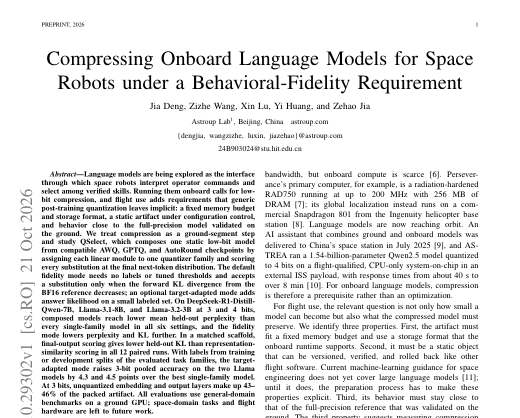
Compressing Onboard Language Models for Space Robots under a Behavioral-Fidelity Requirement

Jia Deng, Zizhe Wang, Xin Lu, Yi Huang, Zehao Jia

Language models are being explored as the interface through which space robots interpret operator commands and select among verified skills. Running them onboard calls for low-bit …

Language models are being explored as the interface through which space robots interpret operator commands and select among verified skills. Running them onboard calls for low-bit compression, and flight use adds requirements that generic post-training quantization leaves implicit: a fixed memory budget and storage format, a static artifact under configuration control, and behavior close to the full-precision model validated on the ground. We treat compression as a ground-segment step and study QSelect, which composes one static low-bit model from compatible AWQ, GPTQ, and AutoRound checkpoints by assigning each linear module to one quantizer family and scoring every substitution at the final next-token distribution. The default fidelity mode needs no labels or tuned thresholds and accepts a substitution only when the forward KL divergence from the BF16 reference decreases; an optional target-adapted mode adds answer likelihood on a small labeled set. On DeepSeek-R1-Distill-Qwen-7B, Llama-3.1-8B, and Llama-3.2-3B at 3 and 4 bits, composed models reach lower mean held-out perplexity than every single-family model in all six settings, and the fidelity mode lowers perplexity and KL further. In a matched scaffold, final-output scoring gives lower held-out KL than representation-similarity scoring in all 12 paired runs. With labels from training or development splits of the evaluated task families, the target-adapted mode raises 3-bit pooled accuracy on the two Llama models by 4.3 and 4.5 points over the best single-family model. At 3 bits, unquantized embedding and output layers make up 43-46% of the packed artifact. All evaluations use general-domain benchmarks on a ground GPU; space-domain tasks and flight hardware are left to future work.

cs.ROcs.LG
#92026-10-18追踪学者 · Jia Deng

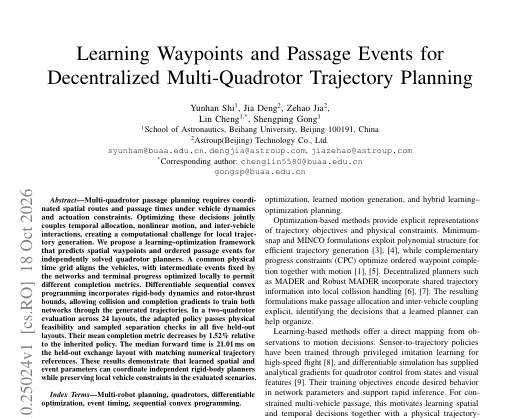
Learning Waypoints and Passage Events for Decentralized Multi-Quadrotor Trajectory Planning

Yunhan Shi, Jia Deng, Zehao Jia, Lin Cheng, Shengping Gong

Multi-quadrotor passage planning requires coordinated spatial routes and passage times under vehicle dynamics and actuation constraints. Optimizing these decisions jointly couples …

Multi-quadrotor passage planning requires coordinated spatial routes and passage times under vehicle dynamics and actuation constraints. Optimizing these decisions jointly couples temporal allocation, nonlinear motion, and inter-vehicle interactions, creating a computational challenge for local trajectory generation. We propose a learning-optimization framework that predicts spatial waypoints and ordered passage events for independently solved quadrotor planners. A common physical time grid aligns the vehicles, with intermediate events fixed by the networks and terminal progress optimized locally to permit different completion metrics. Differentiable sequential convex programming incorporates rigid-body dynamics and rotor-thrust bounds, allowing collision and completion gradients to train both networks through the generated trajectories. In a two-quadrotor evaluation across 24 layouts, the adapted policy passes physical feasibility and sampled separation checks in all five held-out layouts. Their mean completion metric decreases by 1.52% relative to the inherited policy. The median forward time is 21.01 ms on the held-out exchange layout with matching numerical trajectory references. These results demonstrate that learned spatial and event parameters can coordinate independent rigid-body planners while preserving local vehicle constraints in the evaluated scenarios.

cs.ROeess.SY
#102026-10-17追踪学者 · Jia Deng

Paired-Outcome Learning for Selective Spacecraft Attitude Capture under Torque Limits

Donghe Chen, Jia Deng, Zehao Jia, Lin Cheng, Shengping Gong

Torque-limited spacecraft attitude capture requires adapting the maneuver speed to uncertain braking authority. Faster settings can reduce average tracking error while worsening in…

Torque-limited spacecraft attitude capture requires adapting the maneuver speed to uncertain braking authority. Faster settings can reduce average tracking error while worsening individual maneuvers, making selective modification of an existing controller a baseline-relative learning problem. A paired-outcome method combines three mechanisms: physically interpretable continuation policies with different speed envelopes, separate prediction of task failure and successful-pair tracking gains, and context-dependent rejection that executes the unchanged baseline. Complete paired simulations provide labels under common plant parameters and measurement seeds; training, validation, and calibration are separated by context. Basilisk experiments use 108 development contexts, 324 labeling rollouts, and 624 evaluation episodes across 48 test contexts, including disclosed post-freeze diagnostics. The selective controller reduces aggregate integrated attitude error by 4.67% relative to the branch baseline, with 17 improvements, 31 exact ties, and no observed regressions. Always using the fast alternative achieves a 4.81% reduction but worsens 11 cases. Gains occur in principal-axis, near-axis, braking-boundary, and selected noise/drift maneuvers; general coupled cases retain the baseline. Ablations show no additional aggregate benefit from branch commitment, active querying, or score subtraction. The evidence supports a restricted empirical trade-off between average improvement and individual regression, without establishing a closed-loop safety guarantee.

#112026-10-16追踪学者 · Jia Deng

Foundation Models for Autonomous Space Robotics: Architectures, Physical Adaptation, and Validation

Zizhe Wang, Jia Deng, Xin Lu, Zehao Jia, Yi Huang, Yao Zhu, Jianing Li

Space robots must interpret tasks and act despite unfamiliar dynamics, difficult sensing conditions, and limited opportunities for human intervention. Foundation models offer reusa…

Space robots must interpret tasks and act despite unfamiliar dynamics, difficult sensing conditions, and limited opportunities for human intervention. Foundation models offer reusable perceptual and behavioral knowledge, but their value depends on how that knowledge reaches physical execution. This critical review follows space-specific requirements through perception, prediction, planning, and action to deployment and validation, emphasizing orbital manipulation and proximity operations. Terrestrial comparisons establish benefits of particular pretraining stages and model interfaces; their transfer to space dynamics and constrained onboard operation remains insufficiently tested. Event cameras offer timely motion observations across strong illumination contrasts, while spiking neural networks provide possible routes to sparse local computation. We examine how sensor degradation, state estimation and computing choices affect feedback and recovery. Higher action throughput need not yield fresher feedback; lower processor power can also coexist with higher energy per inference. We organize validation as an iterative sim-to-ground-to-space pathway, connecting physical tests with telemetry-based diagnosis and closed-loop revalidation. A satellite-capture example links observations to approach, contact and recovery, while a corresponding protocol separates generalization from adaptation with limited target-domain interaction. These comparisons identify what models already contribute and the physical evidence needed to support autonomous space operation.

#122026-09-23追踪学者 · Jia Deng

Agent-Editing World Model: Rethinking World Modeling for LLM Agents

Shuang Sun, Guoxin Chen, Fanzhe Meng, Jia Deng, Huatong Song, Jinhao Jiang, Wayne Xin Zhao, Hongteng Xu 等

Recent advances in large language models (LLMs) have enabled agents to tackle long-horizon tasks across diverse environments. To further improve agent performance, existing languag…

Recent advances in large language models (LLMs) have enabled agents to tackle long-horizon tasks across diverse environments. To further improve agent performance, existing language world models typically predict environment observations, yet reconstructing high-entropy, execution-dependent tool responses offers limited value when real feedback is available. Meanwhile, agents suffer from task-state contamination, where unsupported assumptions and outdated plans persist in history and distort subsequent decisions. We propose the Agent-Editing World Model (AEWM), which models how reasoning and actions shape future task progress rather than simulating tool responses. AEWM combines Action Judge to distinguish Critical, Exploratory, and Noisy decisions with State Revision to edit noisy reasoning--action continuations from the same observed history. EditAct integrates these capabilities with real execution, directly changing the state underlying subsequent decisions rather than merely providing critiques. We train AEWM across Search, Terminal, and Software Engineering through mid-training and supervised fine-tuning. AEWM achieves 70.5% macro-F1 on our Action Judge benchmark, exceeding the strongest frontier baseline by 10.6 points. Across six benchmarks and three agent backbones, EditAct improves average scores by 3.2--6.7 points over the strongest baseline. Furthermore, rejection sampling fine-tuning on verified EditAct trajectories, termed AEWM-RFT, improves over Self-RFT by 2.2--2.6 points across three domains without online AEWM guidance.

cs.CLcs.AIcs.LG

同实验室的其他学者