Tech Station

2026-09-10

50 篇论文 · 30 个项目 2026-09-11 →

论文

#12026-09-08追踪学者 · Dhruv Shah104

TANGO: Humanoid Navigation in Cluttered Environments with a Whole-Body Vision-Language-Action Model

Anqi Li, Yuxin Chen, Zhaobo Li, Zhuo Cao, Junli Ren, Masayoshi Tomizuka 等

We study the problem of navigating cluttered indoor environments with a humanoid robot. Unlike conventional methods that model navigation as a 2D path planning problem, humanoid tr…

We study the problem of navigating cluttered indoor environments with a humanoid robot. Unlike conventional methods that model navigation as a 2D path planning problem, humanoid traversal in cluttered environments requires continuous geometry-aware whole-body adaptation, including coordinated arm placement, torso adjustment, and gait modulation for collision-free movement through complex 3D spaces. We introduce TANGO, the first whole-body vision-language navigation framework for language-conditioned humanoid traversal in cluttered environments. Given a natural-language instruction and egocentric RGB observations, TANGO directly predicts 29-DoF joint-space actions for downstream whole-body control. We train TANGO entirely in simulation by synthesizing diverse collision-free traversal behaviors via global path planning, kinematic whole-body motion generation, obstacle-aware motion editing, and RL-based tracking. This pipeline provides dynamically feasible action supervision for learning language-conditioned whole-body policies. In extensive simulation experiments, TANGO demonstrates state-of-the-art performance in vision-language navigation, while outperforming strong modular baselines in navigating challenging scenes requiring obstacle negotiation. Lastly, we deploy TANGO zero-shot on a Unitree G1 humanoid robot, and observe robust language-guided traversal in cluttered real-world scenes without training on any real-world navigation data.

cs.ROcs.AIrobotvision-language-actionhumanoid

追踪学者:Dhruv Shah;你点赞过:TANGO: Humanoid Navigation in Cluttered Environments with a
#22026-09-07追踪学者 · Hao Dong89

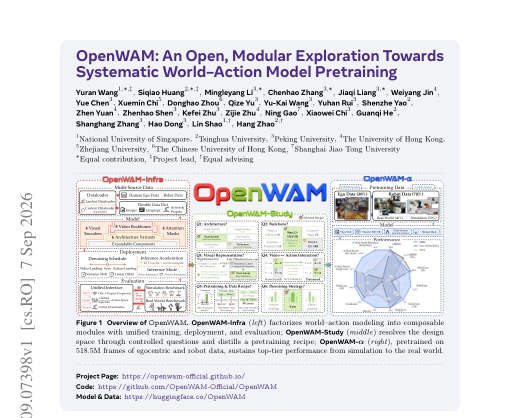
OpenWAM: An Open, Modular Exploration Towards Systematic World-Action Model Pretraining

Yuran Wang, Siqiao Huang, Mingleyang Li, Chenhao Zhang, Jiaqi Liang, Weiyang Jin 等

World-Action Models inherit world knowledge from video-generative priors, and channel it into executable control signals through embodied experience. Existing systems, however, are…

World-Action Models inherit world knowledge from video-generative priors, and channel it into executable control signals through embodied experience. Existing systems, however, are monolithic: the generative backbone, visual representation, architecture, information flow, inference procedure, and training data are tightly coupled, obscuring which design choices matter and why. We introduce OpenWAM, an open research stack that turns world-action pretraining into a controlled experimental program. OpenWAM-Infra factorizes the WAM design space into composable modules with unified training, inference, deployment, and evaluation. On this substrate, OpenWAM-Study examines three questions through controlled experiments: what to inherit, how world and action learning interact, and how their synergy scales; and distills three principles: upstream knowledge transfers through a sufficiently capable generative backbone and a compact, information-rich latent space; world-action synergy requires dedicated action capacity, explicit world-to-action information flow, and synchronized joint denoising; and embodied pretraining principally improves out-of-domain generalization, with one-stage co-training over egocentric and robot data integrating world coverage and action grounding. Composing these principles, we build OpenWAM-α, an open WAM pretrained on roughly 6,400 hours of egocentric human and robot data and evaluated across simulation and real-world benchmarks. Across the eight simulation benchmarks and the real-robot experiments, which together span embodiments from single-arm and bimanual manipulation to dexterous hands, OpenWAM-α delivers consistently excellent performance, sustaining its top-tier standing from simulation to the physical world. We release the full stack, including infrastructure, evaluation protocols, pretrained models, and data recipes, to facilitate future research.

cs.ROrobotmanipulationembodieddexterous

追踪学者:Hao Dong;兴趣:world models and video prediction for embodied agents

#32026-09-0589

MobileVLA-R1 2.0: RL-Enhanced Reasoning for Mobile Robot Control

Ting Huang, Yue Huang, Zeyu Zhang, Shuicheng Yan, Hao Tang

Grounding natural-language instructions into reliable and executable actions remains a fundamental challenge for vision-language-action (VLA) systems on mobile robots, due to the p…

Grounding natural-language instructions into reliable and executable actions remains a fundamental challenge for vision-language-action (VLA) systems on mobile robots, due to the persistent gap between high-level semantic reasoning and low-level locomotion and manipulation control. Existing approaches often rely on implicit reasoning or monolithic action prediction, making it difficult to maintain coherent long-horizon decision making while producing precise and adaptable robot actions. To address this challenge, we propose MobileVLA-R1 2.0, an RL-enhanced VLA framework that explicitly couples structured embodied reasoning with executable mobile robot control. The framework learns multi-granularity reasoning over embodied trajectories through supervised Chain-of-Thought (CoT) alignment and reinforcement learning, improving reasoning-to-action consistency beyond purely behavioral supervision. To support both locomotion and manipulation, we further introduce a reasoning-conditioned action decoder that maps multimodal reasoning representations to task-level action targets, which are subsequently translated into embodiment-specific commands by robot controllers. This design provides a unified perception-reasoning-action interface while decoupling high-level action generation from robot-specific actuation. We conduct extensive evaluations on language-guided navigation, quadruped control, and humanoid mobile manipulation, covering VLN-CE, QUARD, and real-world deployments on Unitree Go2 and G1 robots. MobileVLA-R1 2.0 consistently outperforms strong VLA baselines, achieving an average 1.6 point improvement in SR on VLN-CE and a 10.0 point improvement in full-task success on real-world G1 mobile manipulation tasks over MobileVLA-R1, while demonstrating robust long-horizon instruction following and closed-loop execution across different robotic platforms.

cs.CVcs.ROrobotmanipulationVLAvision-language-actionhumanoidlocomotion

兴趣:vision-language-action (VLA) models and foundation models for robots

#42026-09-0788

Measuring Language Transfer in Robot Policies: Adding Greek to a Cosmos3 Vision-Language-Action Policy

Ayoub Kirouane, Georgios Giaples, Christos Petrocheilos

Robot foundation models are trained and evaluated predominantly in English, and robot demonstration corpora do not exist for most languages. We study the addition of Greek to an op…

Robot foundation models are trained and evaluated predominantly in English, and robot demonstration corpora do not exist for most languages. We study the addition of Greek to an open vision-language-action stack using only machine-rephrased instructions and no architecture changes. The main challenge is measurement rather than translation. Several plausible instruments produce false conclusions: a color-histogram metric rewards noise, a single-goal benchmark scores 84.6% under correct Greek and 82.6% under deliberately wrong instructions, training loss fails to predict Greek success, and single-run comparisons are dominated by seed variation. On a discriminative ninety-task suite with three seeds per arm, a multilingual text tower without Greek demonstrations remains at its wrong-instruction floor, while Greek-only training exceeds its control by at most 2.7 points. Bilingual training yields a consistent 6.7-7.1 point margin over its control and reaches about two fifths of English performance. The policy also overfits the translator's phrasing; training on seven phrasings per task approximately halves this penalty. Warm-starting from a language-adapted world model and unfreezing the text tower both degrade performance. The results support two practical requirements for low-resource robot-policy localization: build a guaranteed null before trusting a metric, and replicate low-resource-language results across seeds.

cs.ROcs.AIrobotvision-language-actionworld model

兴趣:vision-language-action (VLA) models and foundation models for robots

#52026-09-09追踪学者 · Oliver Kroemer87

GTA-2: A Multi-VLM Framework for Synthesizing Robot Manipulation Skills via Grounded Task Axes

M. Yunus Seker, Shobhit Aggarwal, Ruwan Wickramarachchi, Jonathan Francis, Oliver Kroemer

Robotic manipulation tasks are often decomposed into behaviors or skills. However, one often needs to predefine these behaviors for specific tasks or try to cover a wide range of t…

Robotic manipulation tasks are often decomposed into behaviors or skills. However, one often needs to predefine these behaviors for specific tasks or try to cover a wide range of tasks using generic skills. As a result, these behaviors can remain too coarse to expose the geometric, control, and scene-dependent decisions required for execution. We introduce Grounded Task Axes v2 (GTA-2), a modular multi-VLM framework that constructs executable, task-bespoke manipulation skills from reusable object-centric task-axis components. Rather than predicting actions end-to-end or composing fixed task-level primitives, GTA-2 represents each skill as semantic subtasks comprising task-relevant keypoints and axes, controller compositions, and scene-dependent parameters. Four specialized VLM agents separately decompose the task, construct an abstract task-axis skill, assign controller parameters, and ground the required visual features from RGB-D observations. This abstraction-to-grounding factorization enables zero-shot skill generation without task-specific robot demonstrations, policy training, or fine-tuning. It also keeps intermediate decisions explicit, allowing targeted human feedback to refine an incorrect stage while preserving correct components. We evaluate GTA-2 on 14 real-robot manipulation tasks against a VLA policy pi_{0.5} and two Code-as-Policies baselines using task-axis controllers or conventional robot primitives. GTA-2 achieves an average zero-shot success rate of 73.9%, exceeding the strongest baseline by 31.4 percentage points, while targeted refinement raises GTA-2's average success rate to 90.7%. Project page: https://gta2-project.github.io/

cs.ROrobotmanipulationVLA

追踪学者:Oliver Kroemer;兴趣:vision-language-action (VLA) models and foundation models for robots

#62026-09-0487

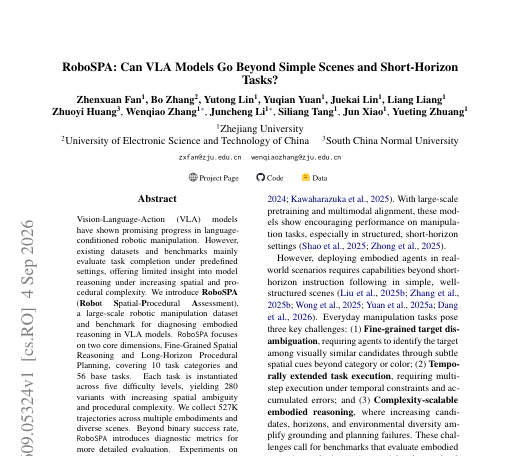
RoboSPA: Can VLA Models Go Beyond Simple Scenes and Short-Horizon Tasks?

Zhenxuan Fan, Bo Zhang, Yutong Lin, Yuqian Yuan, Juekai Lin, Liang Liang 等

Vision-Language-Action (VLA) models have shown promising progress in language-conditioned robotic manipulation. However, existing datasets and benchmarks mainly evaluate task compl…

Vision-Language-Action (VLA) models have shown promising progress in language-conditioned robotic manipulation. However, existing datasets and benchmarks mainly evaluate task completion under predefined settings, offering limited insight into model reasoning under increasing spatial and procedural complexity. We introduce RoboSPA (Robot Spatial-Procedural Assessment), a large-scale robotic manipulation dataset and benchmark for diagnosing embodied reasoning in VLA models. RoboSPA focuses on two core dimensions, Fine-Grained Spatial Reasoning and Long-Horizon Procedural Planning, covering 10 task categories and 56 base tasks. Each task is instantiated across five difficulty levels, yielding 280 variants with increasing spatial ambiguity and procedural complexity. We collect 527K trajectories across multiple embodiments and diverse scenes. Beyond binary success rate, RoboSPA introduces diagnostic metrics for more detailed evaluation. Experiments on representative VLA models show that current systems still struggle with complex spatial relations, precise low-level execution, and memory-intensive planning. These results establish RoboSPA as a challenging diagnostic benchmark for developing more capable, reliable, and generalizable embodied agents. Our data and code are available at https://github.com/fanzhenxuan/RoboSPA.

cs.ROcs.AIcs.CVrobotmanipulationVLAvision-language-actionembodied

兴趣:vision-language-action (VLA) models and foundation models for robots

#72026-09-0786

ICI-VLA: In-Context Imitation with Spatiotemporally Aligned Demonstrations for Vision-Language-Action Models

Songhua Yang, Ziyu Liu, Xuetao Li, Ruqi Xiao, Kangxin Zhu, Miao Li

Vision-Language-Action (VLA) policies are commonly adapted to new manipulation settings through additional gradient updates, which limits rapid deployment when task-specific data o…

Vision-Language-Action (VLA) policies are commonly adapted to new manipulation settings through additional gradient updates, which limits rapid deployment when task-specific data or compute is scarce. We present ICI-VLA, a training and retrieval framework that equips a text-action VLM with few-shot test-time adaptation through in-context demonstrations. Unlike mainstream VLA designs based on action-specific multimodal fusion, ICI-VLA retains the native text-generation interface. ICI-VLA updates its parameters only during offline training; at inference, the policy remains fixed and conditions action generation on retrieved micro-demonstrations. The framework decomposes long trajectories into short, semantically labeled examples and trains an RD-Encoder with positives mined by Dynamic Time Warping (DTW), aligning the retrieved context with the phase and geometry of the current subtask. We further introduce Target Action Masking, a context-corruption objective designed to reduce direct action copying and increase reliance on the current observation. ICI-VLA reaches average success rates of 97.7% on LIBERO and 60.4% on RoboTwin 2.0, exceeding the highest reported baseline average on RoboTwin 2.0 by 19.3 percentage points. It also achieves 83.2% across four physical tasks. These results indicate that a fixed VLA policy can benefit from conditioning on spatiotemporally aligned demonstrations at test time.

cs.ROmanipulationVLAvision-language-action

兴趣:vision-language-action (VLA) models and foundation models for robots

#82026-09-0786

WM-Craftnet: World Synesthesia Model for Generalizable and Robust Dexterous In-Hand Manipulation

Jie Yin, Zeyuan Zhao, Xiaojing Tan, Yang Liu, Chiyu Wang, Xinyang Gu

Generalizable and robust dexterous in-hand manipulation requires a policy to infer object pose, geometry, contact, and potential slip from partial and noisy observations. Although …

Generalizable and robust dexterous in-hand manipulation requires a policy to infer object pose, geometry, contact, and potential slip from partial and noisy observations. Although recent tactile and visuotactile RL methods achieve strong in-hand rotation in controlled settings, their robustness often degrades under pose shifts, force disturbances, and object variation. We propose WM-Craftnet, a world-model-conditioned framework that learns compact action-conditioned latent dynamics from proprioception, depth, tactile sensing, and actions, supervised by multimodal reconstruction and reward prediction. Rather than using the world model for latent imagination or policy optimization, WM-Craftnet uses the learned World Synesthesia Model (WSM) as recurrent task context for an asymmetric actor--critic policy. Importantly, WSM is trained to reconstruct clean depth targets from noisy depth inputs, providing a denoised geometric state for real-robot deployment. Ablations over recurrent baselines, auxiliary heads, tactile masking, and WSM modality heads show that predictive world modeling, clean-depth supervision, and tactile contact cues all shape the learned state. A WSM pretrained on nine \(z\)-axis objects serves as a reusable prior for \(49\)-object downstream policy learning. This context improves multi-object rotation, with quantitative and qualitative evidence for unseen-object, perturbation-recovery, and sim-to-real transfer.

cs.ROrobotmanipulationsim-to-realdexteroustactileworld model

兴趣:robot manipulation and grasping with learned policies

#92026-09-0486

One Word, Different Action: A Real-Robot Benchmark for Language-Conditioned Embodied Reasoning

Yiwei Liu, Luwei Yang, Shunbo Lei

Natural-language instruction changes can directly alter robot behavior. A reliable embodied system should preserve its action when the task is unchanged and update it correctly whe…

Natural-language instruction changes can directly alter robot behavior. A reliable embodied system should preserve its action when the task is unchanged and update it correctly when the task itself changes. We introduce One Word, Different Action, a real-robot benchmark built on physical decision states and executable actions, using task-preserving and task-changing instruction pairs to jointly evaluate Decision Invariance and Decision Sensitivity, with further evaluation under multi-constraint reasoning and real-RGB grounding. Experiments show that modern models are near saturation on single-constraint instruction changes, yet several models degrade noticeably when multiple task constraints must be integrated into one executable decision. These results suggest that the more salient remaining challenge is no longer recognizing an isolated instruction change, but reliably composing multiple task requirements into a correct robot action decision.

cs.ROrobotembodied

兴趣:large language models for robot task planning and reasoning

#102026-09-0586

GloVLA: Let Geometry Move and Local VLA Interact for Robust Object-Centric Manipulation in Unstructured Environments

Truong Thanh Nguyen, Huy Hoang Nguyen, Ha Anh Nguyen, Binh Khanh Dinh, Ngo Anh Vien, Duy Nguyen Ho Minh 等

Vision-language-action (VLA) models have shown promising generalization for language-conditioned robot manipulation, but deploying them in unstructured environments remains challen…

Vision-language-action (VLA) models have shown promising generalization for language-conditioned robot manipulation, but deploying them in unstructured environments remains challenging. A single end-to-end VLA policy must simultaneously solve long-range transport of the end effector to task-relevant regions and short-horizon, contact-rich interaction upon arrival. This formulation is inefficient and brittle: small visual shifts, distractors, clutter, occlusions, or unfavorable initial gripper poses can push the policy outside the local state distribution in which it was trained, leading to task failure. We introduce GloVLA, a hybrid framework that explicitly separates object-centric manipulation into two complementary regimes: a geometric transport controller moves the end-effector into interaction-centric handoff regions, and local VLA policies handle only the short-horizon interaction phases. GloVLA is model-agnostic and can be integrated with different VLA backbones with no additional demonstrations and no changes to the action space or success predicate. Experiments on standard LIBERO and LIBERO-Plus Object tasks together with a newly introduced LIBERO-Challenge benchmark ettings with clutter, distractors,illumination changes, visual shifts, and obstruction show that GloVLA improves task success and substantially lowers VLA inference cost compared with full end-to-Challenge, full-trajectory GR00T N1.6execution degrades to 20.9% average success while GloVLA retains 88.5%; on a physical UR10e, overall success improves from 35.6% to 90.0% while mean inference time is more than halved. Videos and additional results are available at https://glovla-project.github.io/

cs.ROrobotmanipulationVLAvision-language-action

兴趣:vision-language-action (VLA) models and foundation models for robots

#112026-09-0886

Actuator Dynamics Curricula for Narrow-Viability Tasks in Legged Robot Learning

Kousheek Chakraborty, Chandan K. Rajendra, Ayham Alharbat, Abeje Y. Mersha

Reinforcement learning has produced capable controllers across a broad range of legged-robot tasks, but a subset of these tasks fail to converge under standard training: those for …

Reinforcement learning has produced capable controllers across a broad range of legged-robot tasks, but a subset of these tasks fail to converge under standard training: those for which most exploration trajectories terminate before producing useful gradient signal. To address such tasks we introduce the Actuator Dynamics Curriculum, a procedure that initializes joint stiffness at a high value and anneals it toward the system-identified value as completed episode lengths grow. Using a cart-pole system as a representative example, we show that higher closed-loop joint natural frequency under critical damping enlarges the viability kernel of the underlying Markov Decision Process, increasing the fraction of initial states from which the task is feasible. We validate the kernel monotonicity on the cart-pole and apply the curriculum to a quadrupedal-to-handstand transition on the Boston Dynamics Spot, a narrow-viability task where training under fixed identified stiffness plateaus at a policy that never completes the transition. The trained policy executes the transition in simulation across 10 seeds and transfers to hardware. More broadly, our results suggest that simulated actuator dynamics is a useful axis along which to design curricula for tasks in which exploration is bottlenecked by termination conditions rather than by reward signal.

cs.ROrobotlegged

兴趣:reinforcement learning for legged locomotion and sim-to-real transfer

#122026-09-0786

Dex-X: Learning Visual-Tactile Dexterous Manipulation From Human Videos with Simulated Interaction

Ruoqu Chen, Feixiang Ruan, Liu Cao, Zihao Wang, Botian Xu, Shiqin Tong 等

Human videos are an abundant source of dexterous manipulation behaviors, but they lack tactile information that is crucial for contact-rich interaction. This raises a fundamental q…

Human videos are an abundant source of dexterous manipulation behaviors, but they lack tactile information that is crucial for contact-rich interaction. This raises a fundamental question: can robots learn deployable visual-tactile dexterous manipulation policies from human video demonstrations without robot-side data collection? We present DEX-X, a framework for learning visual-tactile dexterous manipulation from human videos through simulation. Our key insight is that simulation can serve as a tactile completion engine. Given monocular human demonstrations, DEX-X reconstructs hand-object interactions in simulation, where physically grounded contact dynamics provide tactile supervision unavailable in the original videos. Leveraging this recovered tactile information, we train visual-tactile dexterous manipulation policies and distill them into deployable policies operating on point-cloud observations and tactile sensing. We demonstrate zero-shot sim-to-real transfer on a dexterous hand-arm platform across diverse grasping and contact-rich tool-use tasks. The teacher policy achieves 65.9% average success across six task categories in simulation, while the distilled visual-tactile policy achieves 93% success on real-world cube picking and 53% on the challenging table-cleaning task. Zero-shot generalization to unseen object geometries is also observed on object-picking tasks. Our results suggest that simulated interaction is a key bridge between human videos and deployable dexterous manipulation policies, providing the missing physical supervision needed for scalable robot skill learning from Internet-scale human video data.

cs.ROrobotmanipulationsim-to-realdexteroustactile

兴趣:robot manipulation and grasping with learned policies

#132026-09-0685

VLA-Corrector: Stage-Aware Observable State Understanding for Prompt-Based Closed-Loop Recovery of Vision-Language-Action Policies

Chang Song, Bin Qian, Yan Feng, Zhijie Song

Long-horizon robot manipulation with Vision-Language-Action (VLA) policies remains vulnerable to execution-time deviations, as final task success provides little information for di…

Long-horizon robot manipulation with Vision-Language-Action (VLA) policies remains vulnerable to execution-time deviations, as final task success provides little information for diagnosing and correcting failures caused by action noise, object displacement, or goal misalignment. We introduce a stage-aware failure verification and Prompt Recovery framework that enables closed-loop correction of a fixed VLA policy without parameter updates or privileged simulator states. The framework introduces an observable-history-based Learned Verifier that jointly estimates manipulation progress and execution risk by temporally modeling multi-view visual observations, proprioceptive states, and executed actions. To provide interpretable task understanding, we represent manipulation execution through semantic progress stages, including approach, alignment, grasp, transport, and placement, and identify stage-specific failure patterns. Upon detecting abnormal execution, the framework preserves the original instruction and generates a stage-conditioned recovery prompt, allowing the same frozen VLA policy to produce corrective actions. Extensive multi-round evaluations on LIBERO and LIBERO Plus demonstrate that the proposed approach substantially improves closed-loop reliability under diverse perturbations. Without access to privileged object or goal coordinates, the Learned Verifier achieves recovery performance close to that of the privileged rule-based verifier in the evaluated settings. These results show that observable visual-proprioceptive-action history is sufficient to infer latent task states and enable practical failure recovery for existing VLA policies.

cs.ROrobotmanipulationgraspVLAvision-language-action

兴趣:vision-language-action (VLA) models and foundation models for robots

#142026-09-0985

JEPA Policy: Diffusion-Free Imitation Learning via Paired Action and Future Representation Prediction

Jie Xu, Kangjin Yu, Ziyi Jin, Junjie Gao, Liqing Chen, Yixian Li 等

Standard behavior cloning supervises actions without explicitly constraining the future representation paired with each demonstrated action chunk. We introduce JEPA Policy, a diffu…

Standard behavior cloning supervises actions without explicitly constraining the future representation paired with each demonstrated action chunk. We introduce JEPA Policy, a diffusion-free framework that uses the action chunk and its observed future representation as paired training targets. Action and future-representation tokens interact in a shared Transformer and are refined through two forward passes. Future prediction can therefore shape the representation used to generate actions. Dual-branch and gradient-routing controls attribute the gain to this shared topology rather than to an auxiliary prediction head alone. Across nine simulated tasks, JEPA Policy improves mean success over the action-only MIP baseline and outperforms Diffusion Policy under the evaluated configurations, while adding 0.29 ms to MIP's model latency. A five-task, 630-episode physical-robot study produces the same pooled ranking. Further audits find no complete representation collapse under action supervision and identify a task-conditioned failure-ranking signal in future-prediction error. These results support paired future-representation supervision as a practical approach to low-latency visuomotor imitation without iterative generative sampling.

cs.ROrobotimitation learningdiffusion policy

兴趣:imitation learning and diffusion policies for robot control

#152026-09-0485

Reasoning Without Inference Cost: Latent Semantic Scaffolding for Robot VLA Policies

Andrew Ting Yan Li, Zhuo Li, Zhelin Yang, Zhipeng Dong, Quentin Rouxel, Fei Chen

Vision-language-action (VLA) models are trained by imitation and capture what action to take but not why; adding causal reasoning improves manipulation, but current methods pay for…

Vision-language-action (VLA) models are trained by imitation and capture what action to take but not why; adding causal reasoning improves manipulation, but current methods pay for it at inference time - generating reasoning tokens or rolling out predicted future states at every step, a cost that compounds over long horizons. We ask whether this benefit can instead be captured during training and discarded before deployment. We introduce Latent Semantic Scaffolding (LSS), an auxiliary loss applied during human-demonstration pretraining that aligns a VLA's action-token representations to text embeddings of physical-reasoning rationales through a small projection head. The head is dropped at inference, leaving the unmodified base policy with zero added cost. Our central finding concerns alignment granularity: aligning each action token to the rationale of its own manipulation phase (Dense LSS) rather than to a single pooled episode-level embedding (Pooled LSS) yields representations that transfer markedly better to held-out tasks. Dense LSS attains both the best in-distribution success and the best transfer to tasks unseen during alignment, whereas pooled alignment over-specializes to the training task. A representational probe shows Dense LSS induces roughly twice the per-phase separability in the backbone, supporting that phase-local alignment is the operative mechanism.

cs.ROrobotmanipulationVLAvision-language-action

兴趣:vision-language-action (VLA) models and foundation models for robots

#162026-09-0984

Show-Harness: Just a VLM Agent Can Play Robots

Yanzhe Chen, Zechen Bai, Zhijun Cao, Wenzheng Zeng, Kevin Qinghong Lin, Yiqi Lin 等

Foundation vision-language models (VLMs) exhibit broad intelligence about the world, yet translating this intelligence into robot control remains challenging. We present Show-Harne…

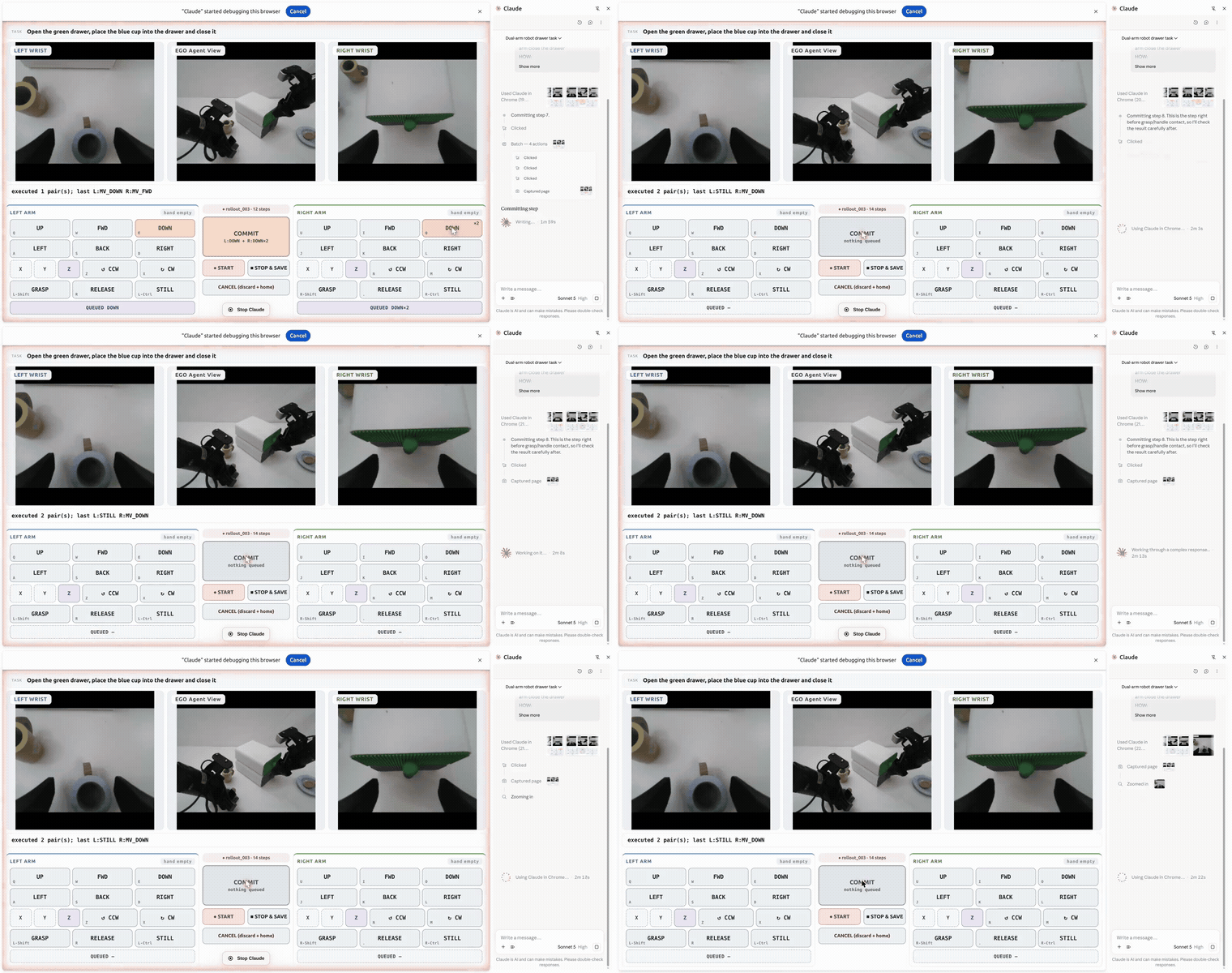
Foundation vision-language models (VLMs) exhibit broad intelligence about the world, yet translating this intelligence into robot control remains challenging. We present Show-Harness, an Embodied Harness that enables VLMs to "play" robots through a compact semantic interface linking intent to action. Show-Harness exposes discrete semantic action units that VLMs can naturally reason over, while embodiment-specific interpreters deterministically ground them into local robot actions, keeping the VLM directly responsible for fine-grained physical decisions. Through the same interface, Show-Harness demonstrates the feasibility of (1) directly unlocking closed-source frontier VLMs for zero-shot robot control, and (2) adapting small-scale open-source VLMs for low-cost deployment with just a few GPU-hours of fine-tuning. We further develop GUMI (GUI Manipulation Interface), which extends the same semantic action space to GUI-based demonstration collection, allowing humans and agents to "play" robots across embodiments without specialized teleoperation hardware. Extensive experiments show that Show-Harness-equipped VLM agents generalize robustly across tasks, embodiments, and environments, outperforming representative agentic and VLA paradigms. These results suggest that the right interface can unlock substantial embodied capability from foundation VLMs, without requiring additional model capacity or costly embodiment-specific pretraining.

cs.ROcs.AIcs.CVcs.MMrobotmanipulationVLAembodied

兴趣:vision-language-action (VLA) models and foundation models for robots

#172026-09-0484

Towards Neuro-Symbolic Procedural Reasoning for Long-Horizon Vision-Language-Action Manipulation

Vivek Chavan, Yahuan Shi, Oliver Heimann, Kevin Haninger, Jörg Krüger

Vision-language-action (VLA) models can execute short manipulation skills, but remain brittle in long-horizon procedures requiring persistent task state, dependency-aware reasoning…

Vision-language-action (VLA) models can execute short manipulation skills, but remain brittle in long-horizon procedures requiring persistent task state, dependency-aware reasoning, conditional decisions, and reliable grounding. We investigate a neuro-symbolic framework that combines learned VLA control with explicit task graphs and multimodal procedural memory. Task graphs encode action dependencies, valid transitions, and branch conditions, while memory maintains the active step, completed actions, textual context, and task-relevant visual evidence. Together, these structures guide object selection, destination grounding, subgoal dispatch, and verification of expected state transitions. Human demonstrations provide additional spatial and temporal guidance through gaze or saliency cues. To isolate their effect on policy learning, our initial study bypasses cross-view gaze transfer and directly annotates pseudo-gaze in robot-view teleoperation videos. The resulting guidance is used during VLA fine-tuning and inference. We study two long-horizon manipulation domains, workspace clearing and surgical-instrument handling, which require ordered execution, visually grounded decisions, and conditional branching. We evaluate correct-object and destination selection, subtask completion, task progress, step-order consistency, complete-task success, and procedural or execution mistakes. This work positions structured symbolic reasoning and demonstration-derived visual guidance as complementary mechanisms for reliable long-horizon VLA manipulation.

cs.ROcs.CVrobotmanipulationVLAvision-language-action

兴趣:vision-language-action (VLA) models and foundation models for robots

#182026-09-08追踪学者 · He Wang84

CASD: Chunk-Aligned Semantic Distillation for Multi-StageRobot Manipulation

Tinghe Ding, Jiahao Li, He Wang

An action chunk can span several stages of a manipulation task, yet a label for its first step describes only the current stage. We introduce Chunk-Aligned Semantic Distillation (C…

An action chunk can span several stages of a manipulation task, yet a label for its first step describes only the current stage. We introduce Chunk-Aligned Semantic Distillation (CASD), which derives semantic targets for entire action chunks. An offline vision--language model segments demonstrations into described stages. Their occupancy within each action chunk determines a weighted semantic target, including transitions between stages. A CASD generator learns to predict this target from the current observation, robot state, and task instruction. We then freeze the generator and train a policy conditioned on its predictions. The semantic branch runs once per policy query, without online VLM calls or reasoning-trace decoding. Teacher matching on annotated LIBERO training episodes is above chance for both single-stage and boundary-crossing chunks. We evaluate three Fast-WAM variants and a DreamZero integration across four benchmarks, including distribution shifts on LIBERO-Plus. Compared with published references, IDM+CASD reaches 98.9% versus 98.0% average success on LIBERO, while Uncond falls below its reference. Joint+CASD reaches 93.0% versus 90.6% on RoboTwin 2.0, and DreamZero+CASD reaches a 47.9% four-category MolmoSpaces manipulation average versus 40.7%. Performance varies across backbone integrations.

cs.ROcs.AIrobotmanipulation

追踪学者:He Wang;兴趣:large language models for robot task planning and reasoning

#192026-09-0584

CST-WM: A Causally Structured World Model for Embodied Visual Tracking

Junyi Hu, Shuaihang Yuan, Yi Fang

Embodied visual tracking requires a robot not only to react to the current view, but to choose actions that preserve or recover future evidence of a moving target under ego-motion,…

Embodied visual tracking requires a robot not only to react to the current view, but to choose actions that preserve or recover future evidence of a moving target under ego-motion, occlusion, and distractors. It is therefore a predictive decision problem over future target observability and apparent scale. A central difficulty is a task-specific form of causal hallucination: in action-conditioned prediction, a model can exploit the strong correlation between robot control and target-related observations by hallucinating a direct causal effect from the current action to target evidence, rather than letting action influence that evidence only through robot motion and the resulting observation change. The shortcut yields plausible futures with the wrong semantics for tracking-oriented planning and re-acquisition. We propose CST-WM, a causally structured world model that decomposes the latent state into target-evidence, robot, and observation branches and factorizes the transition so that direct action injection into the target-evidence branch is blocked, while action remains available to robot motion and observation updates. Combined with rollout-based model-predictive control, CST-WM supports both stable following and temporary target re-acquisition in one planning framework. On EVT-Bench and Habitat 3.0, covering standard tracking, target-loss recovery, and cross-dataset transfer, it improves following quality, distance-range control, safety, and re-acquisition over reactive and world-model baselines; offline diagnostics show better multi-step rollout fidelity, stronger planning-value consistency, and substantially reduced direct action leakage. For embodied visual tracking, future prediction alone is not enough: the predictive structure itself must align with how target evidence enters planning.

cs.CVcs.ROrobotembodiedworld model

兴趣:world models and video prediction for embodied agents

#202026-09-0583

RefGuard: Identity-Aware Language-Guided Robot Manipulation via Joint Target-Anchor-Frame Grounding

Lan Wei, Kangyi Lu, Yongchen Wang, Chenmeng Bi, Qi Chen, Hanlin Niu 等

Vision-language-action (VLA) models have substantially advanced language-guided robot manipulation, yet reliable execution still hinges on identifying which physical object an inst…

Vision-language-action (VLA) models have substantially advanced language-guided robot manipulation, yet reliable execution still hinges on identifying which physical object an instruction refers to. In cluttered scenes containing repeated objects, ambiguous anchors, or frame-dependent spatial terms, a robot can execute a geometrically valid action on a semantically compatible but unintended instance; we call this failure an identity switch. The referent is jointly determined by three coupled latent variables: the target, the anchor, and the reference frame, so committing to any one of them before execution turns residual ambiguity into a silent and irreversible error. We propose RefGuard, an identity-aware grounding framework that delays commitment by maintaining a joint posterior over all three variables. RefGuard builds a frame-conditioned object-centric scene graph from RGB-D observations, separating frame-independent geometry from directional relations, and routes the posterior through a decision policy that executes, clarifies, reobserves, or aborts. On a real UF850 arm, RefGuard records no identity switch on any ambiguity-stress trial and executes correctly on 90.0% of them, whereas fine-tuned VLA and LLM (Large Language Model)-based baselines switch identity in 33-46% of the same trials, while retaining 93.3% success on unambiguous scenes and recovering from post-grounding scene changes in 86.7% of trials. On a 3200-episode procedural suite, it raises correct execution on solvable instructions from 56.6% to 80.5% over the ablation that commits to the anchor and frame before the target, while deferring less often (19.5% vs. 43.4%).

cs.ROrobotmanipulationVLAvision-language-action

兴趣:vision-language-action (VLA) models and foundation models for robots

#212026-09-0583

A Brain-inspired Hierarchical Framework for Zero-Shot Robot Task Reasoning and Execution

Guangming Wang, Pengfei Ye, Qizhen Ying, Yixiong Jing, Yuxiang Ma, Haonan Chen 等

Robots that follow open-ended language instructions need to connect semantic intent to visual scene understanding, geometric feasibility, object states, and physical interaction co…

Robots that follow open-ended language instructions need to connect semantic intent to visual scene understanding, geometric feasibility, object states, and physical interaction conditions. End-to-end Vision-Language-Action policies have improved cross-task generalization, but they typically map visual and language inputs directly to robot actions, leaving limited explicit structure for long-horizon decomposition, physical verification, and recovery. We present \method, a zero-shot hierarchical framework functionally inspired by the division of roles in the human brain, comprising visual perception and state inference, language grounding and action-sequence generation from a shared atomic action library, cost-based plan selection, and real-robot execution and verification. The framework grounds commands in explicit object states, composes reusable atomic actions into task-conditioned sequences, ranks alternative sequences by execution cost, and verifies intermediate physical outcomes from refreshed observations. In the evaluation, \method{} completes 10/10 clean board trials, 10/10 pick-and-place trials, and 4/5 pyramid stacking trials for both the flat and irregular initial-layout conditions; the corresponding mean task progress is $99.03%$, $100.00%$, and $96.67%$ respectively. Across all evaluated conditions, \method{} achieves higher success rates than ReKep, Dream2Flow, and $π_{0.5}$ benchmarks, demonstrating the effectiveness of combining explicit object-state reasoning, compositional atomic actions, cost-based plan selection, and closed-loop execution verification.

cs.ROrobotvision-language-action

兴趣:large language models for robot task planning and reasoning

#222026-09-0983

Frequency-Conditioned Flow Matching for Vision-Language-Action Models

Haochen Niu, Shengye Dong, Hao Liu, Peiwen Lin, Wang Chuang

Robot actions are temporally correlated trajectories whose frequency components encode motion at different scales with highly non-uniform energy distributions. Yet Flow Matching--b…

Robot actions are temporally correlated trajectories whose frequency components encode motion at different scales with highly non-uniform energy distributions. Yet Flow Matching--based vision-language-action (VLA) models typically generate actions in temporal coordinates, without explicitly modeling or systematically leveraging this frequency heterogeneity. We introduce FreqFM, a frequency-conditioned Flow Matching framework for VLA models. It raises action frequency from an implicit trajectory property to an explicit conditioning dimension that spans the entire generation pipeline. Concretely, in DCT frequency coordinates, FreqFM constructs a spectrum-matched source distribution, adaptively balances the objective across frequencies, and constrains per-frequency guidance residuals using the corresponding reference transport scales. FreqFM integrates into existing Flow Matching action experts without changing the VLA backbone. Across LIBERO, LIBERO-Plus, and VLA-Arena, FreqFM consistently improves performance, including a 9.3-point gain on LIBERO-Plus, and further demonstrates its effectiveness on six real-robot tasks.

cs.ROrobotVLAvision-language-action

兴趣:vision-language-action (VLA) models and foundation models for robots

#232026-09-0883

3DWay: Generalizing Robot Manipulation via 3D Consistent Waypoints

Ziqin Huang, Yingyue Li, Chenyangguang Zhang, Ruida Zhang, Yuxin Chen, Gu Wang 等

Intermediate representations are key to bridging the modality gap between generalizable manipulation policies and large-scale pretrained vision-language models (VLMs). Among these,…

Intermediate representations are key to bridging the modality gap between generalizable manipulation policies and large-scale pretrained vision-language models (VLMs). Among these, trajectory-based representations compactly represent motion-relevant cues, yet most existing approaches predict trajectories in 2D image space, resulting in intrinsic 3D ambiguity. Moreover, using 2D trajectories with depth still leaves the free-space waypoints ambiguous, limiting reliable 3D reasoning. To address this, we propose predicting 3D consistent waypoints (3DWay) from multi-view images. By reformulating 3D waypoints prediction as generating multi-view consistent 2D waypoints followed by geometric triangulation, we enable explicit 3D motion specification while preserving the strong priors of pretrained VLMs. The predicted waypoints can guide existing VLA models for better generalization or be directly executed on simple tasks. Extensive experiments show that 3DWay substantially improves 3D spatial grounding and vision-language reasoning, demonstrating strong potential for generalizable robot manipulation. Codes will be released at https://github.com/ziqin-h/3DWay.

cs.ROcs.AIrobotmanipulationVLA

兴趣:3D perception, point clouds and scene understanding for robotics

#242026-09-0883

Safe Task Planning with Long-Term Graph Memory for Embodied Agents

Siyuan Li, Taiyan Lang, Aoqi Yan, Jia Yu, Feifan Liu, Yihan Du 等

Large language models (LLMs) and vision-language models (VLMs) have significantly advanced zero-shot task planning for embodied agents. However, most LLM- and VLM-driven methods st…

Large language models (LLMs) and vision-language models (VLMs) have significantly advanced zero-shot task planning for embodied agents. However, most LLM- and VLM-driven methods struggle to generate safe high-level actions due to a lack of physical risk awareness, particularly under partial observability, where hazards lie outside the immediate field of view. To address this challenge, we propose a novel safe task-planning framework, SafeMem, which constructs and maintains a long-term semantic graph memory of the open and dynamic environment. Based on egocentric observations, the proposed framework incrementally accumulates knowledge about surrounding objects and their relationships with a graph. Then, an LLM-based risk predictor evaluates candidate actions using the graph memory, triggering a conservatism-modulated replanning loop with explanations for detected hazards. Extensive experiments on the IS-Bench benchmark and a real-world robot platform demonstrate that the SafeMem framework substantially improves safe success rates compared to state-of-the-art VLM-driven task planners. Video results are available on our webpage: https://sites.google.com/view/safemem.

cs.ROrobotembodiedtask planning

兴趣:large language models for robot task planning and reasoning

#252026-09-0782

Mind the Phase: Effective Rank and Representation Health in Legged Locomotion

Felipe Tommaselli, Thiago H. Segreto, Juliano D. Negri, Ricardo V. Godoy, Marcelo Becker

Reinforcement learning has become the leading paradigm in legged locomotion, enabling complex behaviors from backflips to parkour through massively parallel simulation. Under PPO's…

Reinforcement learning has become the leading paradigm in legged locomotion, enabling complex behaviors from backflips to parkour through massively parallel simulation. Under PPO's non-stationarity, shallow networks remain the de facto architecture, supported by carefully staged curricula and environments, yet the representations these policies learn stay poorly understood, leaving no training-time signal of how they will behave on hardware. In this work, we empirically study locomotion policies through the effective rank of the policy Jacobian and show that conditioning rank on the gait phase exposes architectural structure that global rank averages away. In particular, we find that standard architectural choices, namely layer normalization and residual connections, allocate roughly two more dimensions of effective rank to swing than to stance, which is fully absent in vanilla MLPs. Building on this, we propose a simple recipe that turns these representational signatures into smoother, more reliable sim-to-real transfer. In practice, this results in roughly 3x lower joint jitter that holds from simulation onto a physical Spot, suggesting that representation health is an effective training-time lens to track sim-to-real smoothness.

cs.ROcs.AIleggedlocomotionsim-to-real

兴趣:reinforcement learning for legged locomotion and sim-to-real transfer

#262026-09-0982

ViBe: Visual Behavior Adaptation for Perceptive Humanoid Whole-Body Control

Lokesh Krishna, Sarvesh Venkatesan, An Zhang, Quan Nguyen

Motion tracking provides a scalable recipe for humanoid whole-body control. By design, the resulting trackers lack exteroceptive feedback hence reacting to the environment remains …

Motion tracking provides a scalable recipe for humanoid whole-body control. By design, the resulting trackers lack exteroceptive feedback hence reacting to the environment remains the responsibility of a higher-level planner. Existing perceptive controllers train geometry-only encoders from scratch, trading semantics for sim-to-real ease, and typically rely on teacher-student distillation for a task of interest. We present ViBe, a post-training framework for adapting motion trackers to perceptive control tasks. We leverage pre-trained visual encoders with a multi-query extractor module to learn task-relevant perceptive feedback. This feedback is grafted onto the tracker's input via low-rank adapters, enabling parameter-efficient fine-tuning. Given a task reward and a reference dataset, this modular controller can be adapted directly via policy optimization. Across four tasks, ViBe shows zero-shot sim-to-real transfer spanning perceptive walking on curbs and parkour, Repose Cube, omni-object loco-manipulation, and dodgeball, with visually robust performance across outdoor, low-light, and RGB distractor conditions. Finally, we solve a goal-oriented Repose Cube task with a deliberately simple planner, demonstrating the efficacy of perceptive controllers, adapted by our approach.

cs.ROmanipulationhumanoidsim-to-real

兴趣:humanoid robots and whole-body control

#272026-09-0582

IM-ENGINE: Image Editing for Embodied Data Generation

Yian Wang, Junyi Cao, Xiaowen Qiu, Chuang Gan

Learning-based manipulation requires supervision that is both semantically meaningful and physically executable, but current data pipelines often provide only one of these properti…

Learning-based manipulation requires supervision that is both semantically meaningful and physically executable, but current data pipelines often provide only one of these properties. Human demonstrations capture intent but are costly to collect and constrained by the human-robot embodiment gap, while simulation can scale data generation but often under-specifies functional behavior. We present IM-ENGINE, a simulator-grounded pipeline that uses image editing as an intermediate representation for embodied data generation. Given a rendered scene with known geometry, depth, segmentation, and camera parameters, IM-ENGINE edits the image to inject task-relevant semantics, recovers explicit 3D state using simulator priors and an unchanged anchor object, refines the state in physics, and converts it into robot-executable supervision. We instantiate the pipeline for dexterous grasp synthesis and goal-state generation. For grasping, IM-ENGINE generates a human grasp in image space, recovers the hand-object interaction, retargets it to a robot hand, and refines it into physically validated robot grasps. For goal generation, it edits a rendered scene into a desired outcome, recovers the target-object pose, and refines it into physically valid, semantically meaningful goals and trajectories. This combination of generative semantic priors and simulator grounding enables scalable task-relevant supervision for robot learning.

cs.ROcs.CVrobotmanipulationgraspembodieddexterous

兴趣:robot manipulation and grasping with learned policies

#282026-09-0582

Where Success Breaks: Failure-Boundary Learning for Robust Vision-Language-Action Models

Yanzhe Chen, Zhijun Cao, Mike Zheng Shou

Vision-language-action (VLA) models adapted through supervised fine-tuning (SFT) inherit a structural asymmetry: expert demonstrations teach the policy where success behavior lies,…

Vision-language-action (VLA) models adapted through supervised fine-tuning (SFT) inherit a structural asymmetry: expert demonstrations teach the policy where success behavior lies, but provide no signal about where it ceases to be reliable. We argue that robust VLA adaptation should therefore be viewed not as further demonstration fitting, but as **Failure-Boundary Learning**---the problem of *Discovering*, *Localizing*, and *Shaping* the boundary between recoverable deviations and task failure. To instantiate this view, we propose **DLS**: built on a **real-grounded behavioral prior** from few real demonstrations and simulated co-training, DLS *discovers* failure boundaries at scale through on-policy digital twin rollouts. Rather than reducing each rollout to a binary label, **semantic progress localization** uses privileged simulator states to assign progress-aware signals that capture *where* the failure boundary is crossed, not merely *whether*. These signals drive **directional boundary shaping** in the flow dynamics---reinforcing success-producing denoising directions and suppressing failure-producing ones, without action likelihoods or auxiliary critics. Across real-robot manipulation tasks, DLS improves robustness over SFT and online RL baselines, especially under randomized initial states and unseen visual conditions.

cs.ROrobotmanipulationVLAvision-language-action

兴趣:vision-language-action (VLA) models and foundation models for robots

#292026-09-0882

DeCAL: Towards Physically-Grounded Dexterous Vision-Language-Action Models via Contact-Aware Latent Co-Imagination

Yankai Fu, Ning Chen, Junkai Zhao, Heng Zhang, Guocai Yao, Pengwei Wang 等

Dexterous manipulation involves contact-rich and fine-grained interactions with the physical world, posing significant challenges for existing vision-language-action (VLA) models d…

Dexterous manipulation involves contact-rich and fine-grained interactions with the physical world, posing significant challenges for existing vision-language-action (VLA) models due to severe visual occlusions and complex contact dynamics. While recent works have incorporated tactile sensing into robotic manipulation, most approaches still rely on homogeneous multimodal fusion, lacking adaptive tactile integration and explicit modeling of physical dynamics. In this work, we present DeCAL, a physically-grounded dexterous vision-language-action model that unifies understanding, imagination and action generation for contact-rich dexterous manipulation. Built upon a Mixture-of-Transformers (MoT) architecture, DeCAL leverages specialized experts for each capability while enabling efficient information flow among them. To effectively leverage tactile information, we introduce Adaptive Visuo-Tactile Fusion that dynamically regulates tactile interactions via a contact-aware gating strategy. Furthermore, we propose Visuo-Tactile Latent Co-Imagination to jointly model visual and tactile dynamics, equipping the policy with implicit physical world knowledge. Experimental results show that DeCAL consistently achieves state-of-the-art performance across all tasks, attaining a 71% average success rate and an 83.4% progress success rate, while also demonstrating strong generalization to unseen scenarios. The website is available at https://aureleopku.github.io/DeCAL.

cs.ROcs.AImanipulationVLAvision-language-actiondexteroustactile

兴趣:dexterous hands and tactile sensing

#302026-09-0781

GIFT: Goal-Injected Fine-Tuning for Efficient Manipulation Policy Adaptation

Xiaoyuan Fang, Shuo Feng, Yuxuan Wang, Enhua Cheng, Peng Zhou, Piji Li

Compared with relying solely on initial observations and language instructions, predicting goal images with generative models as high-level visual guidance can significantly enhanc…

Compared with relying solely on initial observations and language instructions, predicting goal images with generative models as high-level visual guidance can significantly enhance the robustness of Vision-Language-Action (VLA) models. However, most existing foundation models have not systematically incorporated goal image conditioning due to the high computational training cost. To this end, we propose Goal-Injected Fine-Tuning (GIFT), a lightweight and efficient fine-tuning framework that seamlessly integrates generated goal images into multiple representative pretrained VLA models. Our approach introduces goal image features into observations via a zero-initialized convolution which progressively grows parameters from zero and prevents harmful noise from disrupting the pretrained policy during fine-tuning. As training proceeds, goal information is gradually incorporated, enabling efficient goal understanding without disrupting model stability. We further introduce a refined image editing method to generate semantically and visually consistent goal images from initial observations and task instructions. Experiments show that goal-aware VLA models achieve substantial performance gains across tasks: with only a single epoch of fine-tuning, GIFT outperforms the base model by 6.0% and 13.4% on two SIMPLER settings, and by 4.7% on LIBERO, demonstrating both efficiency and effectiveness.

cs.CVcs.ROmanipulationVLAvision-language-action

兴趣:vision-language-action (VLA) models and foundation models for robots

#312026-09-0480

GE-Act 2.0: Pretraining and Scaling a World-Action Model for Robotic Manipulation

AgiBot Research Team, Renhang Liu, Wenzhi Zhao, Zhuo Yang, Liliang Chen, Pengfei Zhou 等

World-action models (WAM) predict future states to guide robot actions, enabling learning from both action-free video and action-labeled interaction. Most inherit pretrained video …

World-action models (WAM) predict future states to guide robot actions, enabling learning from both action-free video and action-labeled interaction. Most inherit pretrained video generators, leaving WAM pretraining and scaling underexplored. We introduce Genie Envisioner Act 2.0 (GE-Act 2.0), a world-action model whose trainable generative and action components are all initialized from scratch on manipulation data. It combines a control-oriented autoencoder (CoAE), a single-step visual planner (SVP), and an inverse dynamics model (IDM). CoAE retains action- and instruction-relevant information under aggressive compression, while SVP produces a complete future state in one differentiable pass, so visual planning and inverse dynamics can be pretrained separately on complementary data. The components are then jointly trained with knowledge-aligned selective optimization (KASO), which reduces mismatched supervision by selecting only predicted futures judged behaviorally compatible with the recorded action. We evaluate pretrained checkpoints directly, without per-task fine-tuning, on 100 tasks across 20 manipulation skill groups with held-out scenes, backgrounds, lighting, and object instances. Scaling co-training data from 300 to 30,000 hours raises success from 17.1% to 44.1% on G1-OP and from 13.4% to 31.1% on G2-90D; despite comprising less than 2% of the co-training data, G2-90D improves by 17.7 points, suggesting cross-embodiment transfer. Gains span 19/20 and 18/20 skill groups, and skill-specific coverage strongly correlates with zero-shot out-of-distribution (OOD) success (Pearson r=0.80; Spearman rho=0.85). Under the same protocol, the model grounds object, color, shape, and position references in at least 90% of trials and follows explicit instructions even when they conflict with an already-committed behavior or a conventional scene association.

cs.ROcs.CVrobotmanipulation

兴趣:world models and video prediction for embodied agents

#322026-09-0580

GLoRI: Closed-Loop Whole-Body Tracking with Global-Local Reference Interaction for Humanoid Loco-Manipulation

Qingyao Xu, Sheng Yin, Zibo Zhou, Ya Zhang, Siheng Chen, Yue Hu

Humanoid loco-manipulation requires accurate whole-body motion tracking in the world frame for physical interaction. While local references preserve motion structure, they lack exp…

Humanoid loco-manipulation requires accurate whole-body motion tracking in the world frame for physical interaction. While local references preserve motion structure, they lack explicit constraints on absolute spatial placement, leading to accumulated global errors. Existing globally aware approaches augment teleoperation policies with global observations but do not explicitly integrate global correction with local motion guidance, limiting autonomous tracking accuracy. We present GLoRI, a closed-loop whole-body controller that integrates structured global reference and feedback with local motion guidance. Its GLoRI-Net uses Global-Local Cross Attention(GLCA) to refine local keypoint features with global target and pose-difference features, preserving motion structure while correcting world-frame placement. GLoRI achieves 100% completion and a g-MPJPE of 6.44cm on held-out HuMoTo motions. This accuracy remains robust under direct Isaac Gym-to-MuJoCo transfer without fine-tuning, demonstrating strong generalization. Furthermore, such accuracy and generalization enable autonomous loco-manipulation with a single policy on a real Unitree G1 interacting with diverse unseen objects, extending beyond prior systems that primarily rely on teleoperation or focus on single-object interactions.

cs.ROmanipulationhumanoid

兴趣:humanoid robots and whole-body control

#332026-09-0480

Benchmarking Dexterity of Multifingered Robot Hands: A Review and Perspective

Anthony Shilati, Anunth Ramaswami, Luke Batteas, Sylvia Tan, Anthony Barcio, Sairam Umakanth 等

Robot hands are a key interface between AI and the physical world, making advances in robotic dexterity essential to realizing the vision of physical AI. While impressive dexterity…

Robot hands are a key interface between AI and the physical world, making advances in robotic dexterity essential to realizing the vision of physical AI. While impressive dexterity has been demonstrated with simple grippers, multifingered hands offer the potential for substantially greater versatility, precision, and adaptability in manipulation. In this review, we survey the state of the art in benchmarking the dexterity of multifingered robot hands. Recognizing dexterity as a complex and multifaceted concept, we present the perspective of the U.S. National Science Foundation HAND Engineering Research Center, with a particular focus on fine in-hand manipulation. We introduce a framework consisting of three benchmark levels that correspond to increasing system complexity, review representative benchmarks at each level, and propose new benchmarks and metrics to address limitations in the literature. More information can be found at https://hand-erc.github.io/benchmarking/.

cs.ROrobotmanipulation

兴趣:dexterous hands and tactile sensing

#342026-09-0880

DISEIL: Demonstration Distillation for Sample-Efficient Imitation Learning

Suyog Khanal, Arun Kumar A, Santu Rana

A robot that can be taught a new task from a handful of demonstrations has to work out for itself what it still cannot do, and then ask for exactly that. Interactive imitation lear…

A robot that can be taught a new task from a handful of demonstrations has to work out for itself what it still cannot do, and then ask for exactly that. Interactive imitation learning takes a step in that direction by letting a policy practice on its own and calling an expert when it goes wrong. Existing methods decide when to interrupt the learner. A further 2 decisions are left to whichever episode happened to trigger the interruption: which failure to correct, and where the demonstration should start. This paper is a first attempt at making both of them deliberately. DISEIL (Demonstration dIstillation for Sample-Efficient Imitation Learning) marks each failed episode at the step where the policy first becomes unreliable, represents that moment with a geometric descriptor, and groups the failures into recurring failure modes. A vision-language model and a language model read the selected mode and write a request for the next demonstration, and a store of task constraints checks that the request can be carried out before any expert time is spent. No model produces a robot action. Across 5 simulated tasks under state and image observations, changing only what the expert is asked for gives the highest mean held-out success rate in all 10 settings, with a tie in 1, and the margin is widest at the smallest budget we tested. The scope is narrow: a single round of practice at a time, in simulation, with experts that are mostly scripted. The longer-term aim is a learner that also tracks what its demonstration set already covers, and that asks a human teacher for the missing behavior in proportion to the effort each request costs them.

cs.ROcs.AIcs.LGrobotimitation learning

兴趣:imitation learning and diffusion policies for robot control

#352026-09-0680

ContextFlow: In-Context Flow Matching for Robot Manipulation

Jian Ding, Xianjie Dai, Roei Herzig, Nussair Hroub, Jinjie Mai, Dengxin Dai 等

Although highly effective in vision and language domains, applying in-context learning to robotics remains challenging. Existing autoregressive in-context imitation methods discret…

Although highly effective in vision and language domains, applying in-context learning to robotics remains challenging. Existing autoregressive in-context imitation methods discretize continuous actions and exacerbate the accumulation of early prediction errors through next-token prediction, limiting their generalization on unseen task configurations. Meanwhile, flow-matching policies have been explored for continuous robot control and can help mitigate compounding errors; however, in-context imitation learning within a flow-matching framework remains underexplored. To address these limitations, we introduce ContextFlow, a conditional flow-matching model that learns continuous action distributions for in-context imitation learning. ContextFlow conditions flow-based action prediction on demonstrations and observations, enabling robust generation from noisy action distributions. To better encode multimodal in-context demonstrations, we adapt perceiver-style multimodal context compressors that distill visual, proprioceptive, and action sequences into compact, task-relevant latent representations. On LIBERO, ContextFlow outperforms ICRT by 35 percentage points in average success rate on unseen task configurations, while matching the performance of the task-specific fine-tuned VLA model $π_0$ without any fine-tuning on unseen tasks. On real robots, it generalizes to unseen configurations of both single-arm and bimanual tasks, achieving 40% success on a new pen-uncapping configuration. Project Page: https://dingjiansw101.github.io/contextflow-page/.

cs.ROrobotmanipulationVLAimitation learning

兴趣:imitation learning and diffusion policies for robot control

#362026-09-0980

SwingBot: Learning Whole-Body Brachiation for Humanoid Robots

Yujie Xiong, Peng Zhai, Taixian Hou, Quancheng Qian, Cunwang Liu, Kangmai Hu 等

Brachiation enables primates to move across overhead supports when ground paths are blocked, suggesting a complementary locomotion mode for robots operating in cluttered or hazardo…

Brachiation enables primates to move across overhead supports when ground paths are blocked, suggesting a complementary locomotion mode for robots operating in cluttered or hazardous environments. Bringing this capabil?ity to high-DoF humanoid robots is difficult because the controller must discover a long-horizon release-swing-capture sequence, coordinate alternating contacts with whole-body momentum, and act without reliable measurements of segment?relative displacement or hook-contact state. We present SwingBot, a learning framework for continuous humanoid brachiation with passive wrist hooks. Swing?Bot makes the task trainable by organizing learning around the structure of brachi?ation: biomimetic keyframes make rare release-swing-capture transitions reach?able during early exploration, and recurrent privileged-state estimation provides compact position and contact latents for deployment. Hardware experiments demonstrate continuous bar traversal and robustness to payload, external distur?bances and different bar spacings, showing that this formulation offers a practical route to whole-body robotic brachiation.

cs.ROhumanoidlocomotion

兴趣:humanoid robots and whole-body control

#372026-09-0780

SPOT: Spatial Perception-Oriented Long-Horizon Humanoid Teleoperation

Lixing Fang, Ziyan Xiong, Sunli Chen, Zhiyang Dou, Chuang Gan

High-quality demonstration data is becoming a central bottleneck for training general-purpose humanoid robots. While recent humanoid teleoperation systems have made substantial pro…

High-quality demonstration data is becoming a central bottleneck for training general-purpose humanoid robots. While recent humanoid teleoperation systems have made substantial progress in retargeting human motion to robot motion, long-horizon loco-manipulation requires another capability: operators must maintain task-relevant spatial awareness over time, e.g., object locations, surrounding environments, the robot's pose. We call the extent of this awareness the operator's perceptual horizon. However, existing methods often shorten this: narrow views miss peripheral events, robot-mounted cameras become unstable during locomotion, and coupled head-view control makes looking around interfere with robot motion. We present SPOT, a Spatial Perception-Oriented VR Teleoperation system for collecting long-horizon humanoid demonstration data by providing extended perceptual horizon. SPOT combines a robot-mounted binocular fisheye camera, a wide-field stereoscopic display, viewpoint-decoupled free-looking, and visual stabilization to provide a robot-centric view that is wide, stable, and actively inspectable. Unlike conventional egocentric interfaces, SPOT decouples visual exploration from robot actuation: the egocentric stereo observation is rendered on a virtual hemisphere around the operator, so natural head rotations change where the operator looks within the wide-field view rather than commanding the robot head, camera, or torso. We evaluate SPOT on perception-critical humanoid data-collection tasks spanning drop recovery, peripheral retrieval, large-workspace bimanual manipulation, fine alignment, and dynamic interaction. SPOT improves efficiency, accuracy, and recovery speed, demonstrating its effectiveness for user-friendly and scalable long-horizon humanoid data collection.

cs.ROrobotmanipulationhumanoidlocomotion

兴趣:humanoid robots and whole-body control

#382026-09-0880

PGMT: Perceptive General Motion Tracking for Humanoid Robots

Hongyi Li, Li Peizhuo, Yucheng Tao, Ze Wang, Fangzhou Xu, Jinyi Chen 等

Humanoid motion trackers can reproduce diverse whole-body motions, but their performance degrades on complex terrain where terrain-agnostic references become physically infeasible.…

Humanoid motion trackers can reproduce diverse whole-body motions, but their performance degrades on complex terrain where terrain-agnostic references become physically infeasible. We present PGMT, a Perceptive General Motion Tracking pipeline for humanoid robots that learns terrain adaptation from independently selected motion references and terrains. PGMT first learns a general tracking and recovery prior, then incorporates terrain perception through motion-conditioned terrain glimpses that selectively encode regions relevant to the current motion. Terrain-aware tracking relaxation allows necessary deviations from the reference while preserving its motion intent. Zero-shot deployment on a Unitree G1 demonstrates robust terrain-adaptive locomotion and whole-body motion execution over real-world terrain with obstacles up to 37 cm high, while supporting teleoperation, dynamic motion tracking, and fall recovery. PGMT extends general humanoid motion tracking beyond flat ground, providing a unified policy for terrain-adaptive locomotion, diverse whole-body behaviors, and teleoperation in complex environments. Project homepage: https://luyili.github.io/pgmt/

cs.ROhumanoidlocomotion

兴趣:humanoid robots and whole-body control

#392026-09-0780

RoboDreamer: Anticipatory Humanoid Locomotion with Predictive State-Space Models

Zhe Li, Yangyang Wei, Xichen Yuan, Zhenzhe Zhang, Weihao Yuan, Shanghang Zhang 等

Humanoid locomotion requires control policies that remain stable under imperfect sensing while exploiting temporal context for consistent motion. We present RoboDreamer, a two-stag…

Humanoid locomotion requires control policies that remain stable under imperfect sensing while exploiting temporal context for consistent motion. We present RoboDreamer, a two-stage teacher--student framework that combines next-observation consistency with randomized continuous temporal masking. A teacher is first trained on clean observations, and a student is then distilled under masked recent observations, encouraging the policy to infer missing current information from history. At inference, the same masking interface is reused for implicit closed-loop action refinement and optional multi-step action chunking. Mamba is used as the temporal backbone, while matched ablations show that masking/distillation provides a substantial part of the gain and Mamba contributes additional tracking improvements with real-time latency. Experiments in IsaacLab, MuJoCo, and on a Unitree G1 demonstrate robust motion tracking under observation masking and successful real-world deployment.

cs.ROhumanoidlocomotion

兴趣:humanoid robots and whole-body control

#402026-09-0480

Temporal Tactile Encoding and Compliance for Intent-Aware Robot-to-Human Bimanual Handover

Pasquale Marra, Stefano Berti, Gabriele Mario Caddeo, Lorenzo Natale

Reliable robot-to-human handover requires the robot to infer when the person is ready to receive the object, and release it safely, comfortably, and at the right time. This is chal…

Reliable robot-to-human handover requires the robot to infer when the person is ready to receive the object, and release it safely, comfortably, and at the right time. This is challenging because visual observations alone may not disambiguate clear taking intent from accidental contact, weak grasping, wrong-direction forces, or transient interactions. In this work we treat human-robot handover as an intrinsically multimodal problem. Our approach couples a VLA model with a compliance controller that reduces interaction forces during object transfer. We finetune the VLA model with human demonstrations using RGB observation, temporally encoded tactile feedback and proprioception. We evaluate the complete system in a human-subject study against two baselines: one without tactile feedback and one using tactile feedback without compliance control. We hypothesize that combining compliance and temporal tactile encoding yields the most reliable and comfortable handovers, as compliance facilitates physical interaction while tactile history captures sustained taking intent. Performance is measured through objective metrics and an ad-hoc questionnaire. The results show that the two components provide complementary benefits and substantially outperform the baselines. Code and data will be released upon acceptance.

cs.ROrobotVLAtactile

兴趣:dexterous hands and tactile sensing

#412026-09-0880

Monkey See, Can Monkey Do? A Benchmark for Evaluating Robot Skill Learning by Observation

Weiwei Gu, Anmol Gupta, Anant Sah, Ryan Varghese, Lalitha Shreya Vanam, Prabhath Adireddi 等

Learning from Observation (LfO) is a fundamental robotic capability that replicates how humans and animals socially learn from each other. Beyond its biological parallels, this mod…

Learning from Observation (LfO) is a fundamental robotic capability that replicates how humans and animals socially learn from each other. Beyond its biological parallels, this modality provides a practical solution for data scaling in sample-inefficient and data-starved domains like robotics. Recent work has demonstrated promising results in learning manipulation skills from human videos, yet progress in this area remains difficult to assess. Existing methods vary widely in assumptions, hardware choices, and environment setups making it difficult to draw meaningful comparisons and identify advances in the field. To address these challenges, we introduce RoboReel: a unified benchmark for evaluating models that learn policies from human videos. RoboReel consists of bundled real-world human demonstration videos, simulated robot trajectories, and evaluation environments on ten manipulation tasks. We develop four test suites to evaluate the models' performance on multiple axes, including the robustness to visual distractors and the ability to complete long-horizon tasks. Our benchmark covers learning-from-observation models from different categories, and studies the effectiveness of multiple representation choices in our benchmark evaluation that covers over seven state-of-the-art algorithms (including our VLA based variants) in the field of LfO. Finally, we present an analysis of the different types of algorithms showing that long-horizon tasks and tasks with low tolerances are still challenging for current models. Webpage: https://roboreel.github.io

cs.ROrobotmanipulationVLA

兴趣:imitation learning and diffusion policies for robot control

#422026-09-0979

DUET-DINO: Simultaneous Cross-View World Modeling for Latent Planning in Robot Manipulation

Nisarga Nilavadi, Ralf Römer, Moritz Reuss, Michael Krawez, Tobias Jülg, Angela P. Schoellig 等

Action-conditioned latent world models predict future visual representations, enabling zero-shot goal-conditioned robot planning and control. However, their predictions for fine-gr…

Action-conditioned latent world models predict future visual representations, enabling zero-shot goal-conditioned robot planning and control. However, their predictions for fine-grained spatial and rotational actions are unreliable for full 7-DoF end-effector control. To address this gap, we introduce DUET-DINO, a simultaneous cross-view latent world model that jointly learns action-conditioned predictions from static side- and wrist-camera observations through cross-view conditioning. By exploiting complementary global scene and gripper-centric information, DUET-DINO enables latent planning over the full 7-DoF action space. Across spatially diverse reach, orientation-intensive angled-reach, and multi-goal grasp-and-lift tasks, DUET-DINO consistently outperforms single-view and independent dual-view baselines, achieving 92% success on reach, 72.5% on angled-reach, and 60.0% on lift tasks. DUET-DINO is trained from scratch on DROID and RoboArena datasets and generalizes robustly under visual distribution shifts. We further show that while V-JEPA 2 wrist-view predictions underestimate visual dynamics induced by fine-grained actions, DINOv3 predictions better capture action-conditioned scene changes, leading to stronger downstream planning. The code and model checkpoints will be open-sourced. Project page: https://utn-air.github.io/DUET-DINO

cs.ROcs.CVrobotmanipulationgraspworld model

兴趣:robot manipulation and grasping with learned policies

#432026-09-0979

HaWMPO: Hallucination-Aware World Model-based Policy Optimization for Generalist Robot Policy

Zengjue Chen, Peidong Liu, Jiawei Li, Qi Wang

Generalist robot policies have demonstrated strong generalization across robotic manipulation tasks, yet their success rates remain limited in com- plex long-horizon scenarios. Rec…

Generalist robot policies have demonstrated strong generalization across robotic manipulation tasks, yet their success rates remain limited in com- plex long-horizon scenarios. Recent methods improve Visual-Language-Action (VLA) policies through online reinforcement learning on real robots, but such training relies on costly physical interactions, suffers from low sample efficiency, and may introduce hardware and safety risks. World models offer a promising alternative by enabling policy optimization with imagined rollouts. However, long-horizon rollouts generated by world models often suffer from prediction hal- lucinations, producing biased state transitions that can mislead policy learning. To address this issue, we propose Hallucination-aware World Model-based Pol- icy Optimization (HaWMPO), a closed-loop reinforcement learning pipeline for VLA policy post-training with world models. Specifically, HaWMPO introduces an action-conditioned hallucination-aware model to estimate the reliability of gen- erated image sequences, and incorporates hallucination scores into group relative policy optimization through a Reward-Soft mechanism, suppressing unreliable ac- tion chunks during training. On the LIBERO benchmark, HaWMPO achieves the best average success rate, with gains of 15.0% over the base model and 2.8% over the strongest baseline; real-world experiments on a G1 robot further validate its effectiveness, raising the average success rate on two manipulation tasks from 67.5% to 80.0%.

cs.ROrobotmanipulationVLAworld model

兴趣:vision-language-action (VLA) models and foundation models for robots

#442026-09-0979

Frame-Coded Legged Locomotion over Noisy Terrain

Lav R. Varshney

Open-loop multilegged locomotion over rough terrain has been interpreted as matter transport over a noisy channel: leg-ground interactions are discrete basic active contacts, terra…

Open-loop multilegged locomotion over rough terrain has been interpreted as matter transport over a noisy channel: leg-ground interactions are discrete basic active contacts, terrain deletes or perturbs those contacts, and spatial redundancy concentrates the resulting thrust and arrival time. That construction is repetition-like because every module carries the same scalar locomotion task. It consequently provides neither a positive task rate nor a decoder that changes with the surviving contact set. Here we formulate locomotion instead as a quantized finite-frame expansion with erasures. A d-dimensional body-level command is mapped into N>d heterogeneous local contact commands. Rough terrain erases or corrupts frame coefficients, while a contact-gated compliant morphology physically realizes the weighted active-subframe decoder. For a linear-Gaussian model, mechanical equilibrium is exactly the posterior mean, tangent stiffness is posterior precision, and mechanical compliance is posterior covariance. Equal-norm Parseval frames are shown to be minimax optimal against one missing contact, two-contact robustness is governed by frame coherence, and a harmonic frame gives a directly realizable gait family. For independently surviving contacts of probability q, random Gaussian gait frames admit exact reconstruction at every analog dimension rate R<q, with a binomial reliability exponent, whereas recovery of arbitrary commands is impossible for R>q. Residual contact noise yields an asymptotic per-mode amplification 1/(q-R) and a vanishing mechanical stiffness margin at the threshold. An information-locomotion inequality and an exact incremental-redundancy rule direct the next gait component toward the softest task-relevant unresolved mode. The resulting analog frame-coding theorem establishes a finite relative redundancy and converse as part of a fundamental limit theory of legged locomotion.

cs.ITcs.ROeess.SYleggedlocomotion

兴趣:reinforcement learning for legged locomotion and sim-to-real transfer

#452026-09-0679

SkillX: Unified Multi-Skill Policy Learning for Humanoid Soccer

Zhangchen Ye, Enxuan Ruan, Yifei Bao, Runhan Huang, Jiankun Yang, Jiakang Jin 等

Humanoid soccer is a challenging testbed for dynamic whole-body control, requiring robots to coordinate balance, locomotion, object interaction, and skill switching over long horiz…

Humanoid soccer is a challenging testbed for dynamic whole-body control, requiring robots to coordinate balance, locomotion, object interaction, and skill switching over long horizons. Existing humanoid sports methods often rely on task-specific multi-stage pipelines, making it difficult to jointly learn and compose multiple object-interactive skills within a single deployable policy. To address this, we present SkillX, a unified reinforcement learning framework that learns and composes multiple atomic soccer skills through a single command-conditioned policy. SkillX integrates three core designs: skill-specific adversarial motion priors, skill-specific critics, and an object-aware temporal encoder, enabling the robot to execute atomic skills and transition among them such as dribbling, trapping, and shooting. Experiments in simulation and on a real Noetix E1 humanoid demonstrate robust multi-skill execution, long-horizon skill composition, and successful sim-to-real deployment.

cs.ROrobothumanoidlocomotionsim-to-real

兴趣:reinforcement learning for legged locomotion and sim-to-real transfer

#462026-09-0579

CR-VLA-Force: Learning Control-aware Compliance VLA Model for Robust Contact-rich Robotic Manipulation

Zhaohong Mai, Chao Wang, Chao Zeng, Sitong Mao, Heng Zhang, Shunbo Zhou 等

Integrating visuomotor policies or Vision-Language-Action (VLA) models with force/torque (F/T) perception has demonstrated significant progress in imitation learning for robotic ma…

Integrating visuomotor policies or Vision-Language-Action (VLA) models with force/torque (F/T) perception has demonstrated significant progress in imitation learning for robotic manipulation. However, existing force-aware VLA models frequently exhibit limited capability in precise force tracking and rapid successive adjustments. This deficiency stems from the limitations of action-chunk execution strategies and the substantial latency between perception and real-time control. Such limitations can lead to task failures and safety risks, particularly when the execution of an action chunk exerts excessive interaction forces without timely adjustment. To overcome this challenge, we propose the Control-aware Compliance VLA (CC-VLA) framework for reactive control. The CC-VLA model employs a multimodal mixture-of-experts (MoE) to encode force signal sequences and vision-language fused feature. Furthermore, it utilizes a multi-stage training strategy to ensure robust perception within the visual-semantic space and effective force perception under sparse sampling conditions. Additionally, a VLA-guided adaptive compliance controller is designed to facilitate precise position tracking during contact-free motion and optimal force-position tracking for contact-rich tasks. To facilitate high-precision F/T data acquisition, we also implement an adversaria shared teleoperation strategy for contact-rich demonstrations that bolsters system safety and interactivity. Extensive real-world experiments demonstrate that CC-VLA significantly improves success rates in challenging force-perception tasks and enhances force-control precision, while providing multi-level safety and robustness under the tested partial-OOD pose-shift settings.

cs.ROmanipulationVLAvision-language-actionimitation learning

兴趣:vision-language-action (VLA) models and foundation models for robots

#472026-09-0879

Visible-Reachable Workspace for Perception-Aware Humanoid Design

Boxi Xia, Zijiang Yang, Ryan Shin, Bokuan Li, Eric Wun-Hao Lu, Jacob Lee 等

Workspace analysis measures where a robot can place its end effector. For visually guided manipulation, reachability alone is insufficient: a kinematically reachable target may not…

Workspace analysis measures where a robot can place its end effector. For visually guided manipulation, reachability alone is insufficient: a kinematically reachable target may not be visible in the specific pose required to reach it. The robot must then redirect its sensing or move its body to acquire a view, turning a perception limitation into additional motion. Existing humanoids largely inherit this limitation when copying human form factors. We introduce the visible-reachable workspace (VRW), a design-stage measure that conditions visibility on feasible reaching configurations and extends it to concurrent visibility of spatially separated work regions. We apply VRW by building a 31-DoF humanoid with independently actuated RGB-D cameras. On the same robot, camera articulation increases visible-reachable coverage from 38% to 97%. With actuated camera layouts, a second camera raises pairwise coverage from 0.45 to 0.95, while a third changes it only to 0.97. In a controlled two-target reach-and-grasp benchmark, our dual-actuated design reduces mean completion time by 17% and mechanical energy by 19% relative to the same robot with its cameras fixed. Hardware experiments demonstrate simultaneous observation and manipulation of front/back and left/right target pairs without torso reorientation. The results suggest that reachability becomes a more informative design quantity for perception-driven humanoid manipulation when it is evaluated together with the sensing configurations that make the reachable space observable. We will open-source all software and the humanoid hardware design. Our website is https://generalroboticslab.com/DukeHumanoidv2

cs.ROrobotmanipulationgrasphumanoid

兴趣:humanoid robots and whole-body control

#482026-09-0979

FolDeX: A Physical-World Benchmark for Long-Horizon Robotic Manipulation of Deformable Objects

Chenhuan Liu, Yi Xu, Feng Wu, Hanyang Wang, Wenxiao Kuai, Weihao Ding 等

Embodied AI, including vision-language-action and world-action models, must operate reliably in the physical world. Yet methods that perform well in simulation can degrade substant…

Embodied AI, including vision-language-action and world-action models, must operate reliably in the physical world. Yet methods that perform well in simulation can degrade substantially on real robots, especially in long-horizon deformable-object manipulation, where policies must track changing states and execute reliable multi-stage bimanual interactions. Existing real-robot benchmarks mainly focus on short-horizon rigid-object tasks and offer limited coverage of long-horizon deformable manipulation. We introduce FolDeX, a physical-world benchmark built entirely from real-robot data, with garment folding as its primary task. Since real-robot data collection is costly, FolDeX studies how heterogeneous physical experience can be reused efficiently. The benchmark is organized around four research axes: leveraging human intervention and recovery data collected during deployment; transferring data across tasks, including across garment categories and from rigid to deformable-object manipulation; reusing data across scenes with changes in lighting, background, and layout; and transferring data across robotic embodiments. FolDeX provides 2,000+ hours of real-robot data spanning 20+ tasks and 10+ embodiments. We also establish a fair real-robot evaluation platform for externally submitted policies, with standardized tasks, held-out physical objects, controlled initializations, and a unified execution protocol. The platform is publicly accessible at https://ai.midea.com/#/fold-challenge. We hope FolDeX will serve as a unified testbed for heterogeneous real-robot data reuse and reliable long-horizon deformable manipulation.

cs.ROrobotmanipulationvision-language-actionembodied

兴趣:humanoid robots and whole-body control

#492026-09-05追踪学者 · He Wang79

GIF: Agentic Generation of Interactive and Functional Object Compositions for Robot Learning

Long Xu, Zhiqi Zhang, Mi Yan, Shengliang Deng, Chong Xia, Mingyu Dong 等

Robot manipulation foundation models require scalable evaluation and data generation across diverse scenarios, with simulation providing an environment for both. Automated scene ge…

Robot manipulation foundation models require scalable evaluation and data generation across diverse scenarios, with simulation providing an environment for both. Automated scene generation offers a promising path, yet prior work has largely emphasized coarse-grained scene layouts rather than fine-grained functional object compositions. Motivated by this gap, we present GIF, an agentic Generation framework for Interactive and Functional object compositions. In this framework, we recast this problem as disentangled reconstruction followed by relative pose recovery. CoGen produces instance-disentangled meshes with coarse initial poses leveraging complementary strengths of 2D and 3D generative models. GPRM refines the relative pose under joint geometric and physical guidance, and a VLM verifier selects the candidate that best matches the structured specification. We further construct a benchmark spanning eight representative contact-geometry classes and compare with state-of-the-art generators; GIF improves both asset quality and relation matching, while reducing collision rate to below 1%. Finally, we synthesize data for policy learning, revealing diversity scaling in both simulation and real-world deployment.

cs.ROrobotmanipulation

追踪学者:He Wang;兴趣:robot manipulation and grasping with learned policies

#502026-09-0879

CLAMP: Constrained Decoding for Vision-Language Embodied Planning

Tianyi Ma, Parisa Kordjamshidi

Embodied planning increasingly relies on vision-language models (VLMs) to translate instructions and visual observations into executable action sequences. However, fluent plans are…

Embodied planning increasingly relies on vision-language models (VLMs) to translate instructions and visual observations into executable action sequences. However, fluent plans are not always executable. A VLM may refer to objects that are not visually observed, select actions whose required affordances are unavailable, or violate syntax and action constraints. We introduce CLAMP, a multimodal constraint-grounding framework that turns scene evidence into decoding-time constraints for a frozen VLM planner. CLAMP uses the initial observation to restrict object references to those supported by the scene, while a provided symbolic action model specifies state transitions and goals. During decoding, hard masks eliminate invalid next-token candidates, while a Hidden Markov Model (HMM)-based world-state lookahead module reweights the probabilities of the remaining feasible candidates based on action preconditions and goal reachability. This allows the planner to retain the VLM's language prior while preventing visually unsupported, unsafe, or infeasible candidates from entering the plan. For unseen tasks and environments, CLAMP adapts the HMM at test time using label-free continuations sampled from the frozen VLM. Experiments on VLABench, SafeAgentBench, and TaPA show that scene-grounded constraints improve object grounding and safety, while most remaining failures stem from perception errors or misaligned constraint specifications.

cs.AIembodied

兴趣:vision-language-action (VLA) models and foundation models for robots

GitHub 项目

#12026-09-07★ 162 +2新项目80

showlab/Show-Harness

Python

Just a VLM Agent Can Play Robots 🦾

Just a VLM Agent Can Play Robots 🦾

embodied-agentfoundation-modelsharnessroboticsembodied

兴趣:vision-language-action (VLA) models and foundation models for robots

#22026-06-26★ 422 +173

robocurve/inspect-robots

Python

Open source evals for physical AI. Run any LLM/VLA on any arm/humanoid against any real/sim benchmark.

Open source evals for physical AI. Run any LLM/VLA on any arm/humanoid against any real/sim benchmark.

benchmarkembodied-aievaluationphysical-airerunroboticsvision-language-actionvlaVLAvision-language-actionhumanoidembodied

兴趣:vision-language-action (VLA) models and foundation models for robots

#32025-09-09★ 45.7k +272

bojieli/ai-agent-book

Python

《深入理解 AI Agent:设计原理与工程实践》(李博杰 著)开源主仓库:全书正文、编译版 PDF 与按章配套代码

《深入理解 AI Agent:设计原理与工程实践》(李博杰 著)开源主仓库:全书正文、编译版 PDF 与按章配套代码

agentagent-memoryai-agentbookcoding-agentcontext-engineeringlarge-language-modelsllm

兴趣:multi-agent systems and LLM agents

#42026-08-25★ 118新项目68

starVLA/VLAct

Python

Beyond Data Scaling: Representation-Centric Continued Pre-training for Vision-Language-Action Models

Beyond Data Scaling: Representation-Centric Continued Pre-training for Vision-Language-Action Models

roboticsvision-language-actionvision-language-modelvision-language-action

兴趣:vision-language-action (VLA) models and foundation models for robots

#52024-02-29★ 15867

RobotControlStack/robot-control-stack

Python

A lean, ROS-free sim-to-real framework for training and deploying Vision-Language-Action (VLA) models and RL agents. Native MuJoCo Gymnasium wrappers with synchronous execution for…

A lean, ROS-free sim-to-real framework for training and deploying Vision-Language-Action (VLA) models and RL agents. Native MuJoCo Gymnasium wrappers with synchronous execution for Franka, UR5e, xArm, SO101 and YAM.

frankagymnasiummujocoreinforcement-learningrobot-learningrobot-manipulationsim-to-realvision-language-actions-modelsrobotmanipulationVLAvision-language-actionsim-to-real

兴趣:vision-language-action (VLA) models and foundation models for robots

#62021-08-27★ 15k +167

google-deepmind/mujoco

C++

Multi-Joint dynamics with Contact. A general purpose physics simulator.

Multi-Joint dynamics with Contact. A general purpose physics simulator.

mujocophysicsrobotics

兴趣:humanoid robots and whole-body control

#72026-07-06★ 48266

dexmal/opendm

Python

An Open-World Foundation Model for General-Purpose Embodied Intelligence.

An Open-World Foundation Model for General-Purpose Embodied Intelligence.

embodied-aiembodied-intelligenceroboticsvision-language-actionvlaVLAvision-language-actionembodied

兴趣:vision-language-action (VLA) models and foundation models for robots

#82026-09-10★ 227 +1新项目66

kevinzakka/mjbatch

Python

A Python library for running thousands of MuJoCo simulations in parallel on CPU

A Python library for running thousands of MuJoCo simulations in parallel on CPU

mpcmujocoreinforcement-learningsimulation

兴趣:imitation learning and diffusion policies for robot control

#92025-11-23★ 60666

sou350121/VLA-Handbook

HTML

本项目旨在为致力于进入VLA(Vision-Language-Action)领域的算法工程师提供一份全中文、实战导向的学习/面试手册。 不同于通用的 CV/NLP 面试指南,本项目聚焦于 Robotics 特有的挑战

本项目旨在为致力于进入VLA(Vision-Language-Action)领域的算法工程师提供一份全中文、实战导向的学习/面试手册。 不同于通用的 CV/NLP 面试指南,本项目聚焦于 Robotics 特有的挑战

chinesedeep-learningembodied-aillmrobot-learningroboticsvision-language-actionvlarobotVLAvision-language-actionembodied

兴趣:vision-language-action (VLA) models and foundation models for robots

#102025-04-04★ 1.9k66

RoboVerseOrg/RoboVerse

Python

RoboVerse: Towards a Unified Platform, Dataset and Benchmark for Scalable and Generalizable Robot Learning

RoboVerse: Towards a Unified Platform, Dataset and Benchmark for Scalable and Generalizable Robot Learning

imitation-learningreinforcement-learningroboticssimulationrobot

兴趣:imitation learning and diffusion policies for robot control

#112026-08-29★ 23新项目66

wadeKeith/SimpleMemVLA

Python

Native-video memory for vision-language-action models, using timestamped visual history and exact streaming inference for long-horizon robot manipulation.

Native-video memory for vision-language-action models, using timestamped visual history and exact streaming inference for long-horizon robot manipulation.

embodied-ailong-horizon-roboticsmultimodal-learningnative-video-memoryrobot-learningrobot-manipulationstreaming-inferencevideo-understandingrobotmanipulationVLAvision-language-actionembodied

兴趣:vision-language-action (VLA) models and foundation models for robots

#122026-07-19★ 52565

RealXiaoze/humanoid-motion-intelligence

人形机器人运动智能论文、开源项目、产业与求职知识库

人形机器人运动智能论文、开源项目、产业与求职知识库

embodied-aihumanoid-roboticslocomotionmotion-controlreinforcement-learningrobot-learningsim2realvlarobotVLAhumanoidlocomotionembodied

兴趣:humanoid robots and whole-body control

#132026-02-21★ 21064

RoboTwin-Platform/RMBench

Python

Memory-Dependent Manipulation Benchmark based on RoboTwin

Memory-Dependent Manipulation Benchmark based on RoboTwin

benchmarkembodied-aimanipulationmemoryroboticsmanipulationembodied

兴趣:robot manipulation and grasping with learned policies

#142026-04-16★ 1.4k64

OpenMOSS/Awesome-WAM

HTML

A curated collection of papers, explainers, and resources on World Action Models for embodied AI

A curated collection of papers, explainers, and resources on World Action Models for embodied AI

awesome-listembodied-aipaper-listroboticssurveyvision-language-actionworld-action-modelworld-modelsvision-language-actionembodied

兴趣:world models and video prediction for embodied agents

#152025-10-09★ 3.6k63

starVLA/starVLA

Python

StarVLA: A Lego-like Codebase for Vision-Language-Action Model Developing

StarVLA: A Lego-like Codebase for Vision-Language-Action Model Developing

robotic-foundation-modelroboticsvision-language-action-modelworld-action-modelvision-language-action

兴趣:vision-language-action (VLA) models and foundation models for robots

#162026-08-26★ 212新项目63

OpenMOSS/EasyWAM

Python

A unified framework for training, fine-tuning, and evaluating World Action Models

A unified framework for training, fine-tuning, and evaluating World Action Models

benchmarkcodebaseembodied-aifoundation-modelsloraroboticsvision-language-actionworld-action-modelvision-language-actionembodied

兴趣:vision-language-action (VLA) models and foundation models for robots

#172024-01-08★ 35.8k +163

sgl-project/sglang

Python

SGLang is a high-performance serving framework for large language models and multimodal models.

SGLang is a high-performance serving framework for large language models and multimodal models.

attentionblackwellcudadeepseekdiffusionglmgpt-ossinference

兴趣:vision-language-action (VLA) models and foundation models for robots

#182024-10-21★ 61162

maze-agent/Maze

Python

A distributed framework for LLM agents

A distributed framework for LLM agents

distributeddistributed-agentsdistributed-llm-agentsllm-agents

兴趣:multi-agent systems and LLM agents

#192024-12-08★ 3.6k62

datawhalechina/every-embodied

Python

仅需Python基础,从0构建自己的具身智能机器人;从0逐步构建VLA/OpenVLA/SmolVLA/Pi0, 深入理解具身智能

仅需Python基础,从0构建自己的具身智能机器人;从0逐步构建VLA/OpenVLA/SmolVLA/Pi0, 深入理解具身智能

embodied-agentembodied-aiembodied-intelligenceopenvlasmolvlavision-language-action-modelVLAvision-language-actionembodied

兴趣:world models and video prediction for embodied agents

#202026-07-25★ 17662

OpenMOSS/OpenETA

Python

An embodied task agent that connects perception, action, verification, and learning in a continuous physical-world loop

An embodied task agent that connects perception, action, verification, and learning in a continuous physical-world loop

agentembodied-agentembodied-agentsembodied-aiembodied-artificial-intelligenceembodied-intelligencephysical-airoboticsVLAembodied

兴趣:vision-language-action (VLA) models and foundation models for robots

#212023-11-29★ 76k +161

unslothai/unsloth

Python

Local UI to run and train LLMs and diffusion models. Supports GGUF, MLX, Qwen3.8, DeepSeek-V4, MiniMax-H3, Gemma 4, FLUX and more.

Local UI to run and train LLMs and diffusion models. Supports GGUF, MLX, Qwen3.8, DeepSeek-V4, MiniMax-H3, Gemma 4, FLUX and more.

agentaichatgptdeepseekfine-tuninggemmaimage-generationllama

兴趣:multi-agent systems and LLM agents

#222026-02-01★ 48k +160

HKUDS/nanobot

Python

Ultra-lightweight, open-source, self-hosted personal AI agent framework in Python with WebUI, tools, memory, MCP, multi-agent workflows, automation, and chat apps

Ultra-lightweight, open-source, self-hosted personal AI agent framework in Python with WebUI, tools, memory, MCP, multi-agent workflows, automation, and chat apps

agent-frameworkai-agentai-agentschatbotchatopsdiscord-botllm-agentsllms

兴趣:multi-agent systems and LLM agents

#232025-09-25★ 35360

syswonder/robonix

Rust

The Agentic Operating System for Robots

The Agentic Operating System for Robots

agentembodied-airobotsskill-mdvlavlmVLAembodied

兴趣:vision-language-action (VLA) models and foundation models for robots

#242026-08-29★ 45新项目60

nssmd/RoboRSI

Python

Robot-agent harness with a CLI and local Web console for LIBERO short evaluation

Robot-agent harness with a CLI and local Web console for LIBERO short evaluation

agentsembodied-aievaluationliberorobot-learningroboticsself-evolutionrobotembodied

兴趣:multi-agent systems and LLM agents

#252026-03-18★ 54.1k +160

rohitg00/ai-engineering-from-scratch

Python

Learn it. Build it. Ship it for others.

Learn it. Build it. Ship it for others.

agentsaiai-agentsai-engineeringcomputer-visioncoursedeep-learningfrom-scratch

兴趣:multi-agent systems and LLM agents

#262026-02-27★ 2.8k60

physical-superintelligence-lab/Psi0

Python

[RSS'26] Welcome to Psi-Zero, a Humanoid VLA towards Universal Humanoid Intelligence.

[RSS'26] Welcome to Psi-Zero, a Humanoid VLA towards Universal Humanoid Intelligence.

VLAhumanoid

兴趣:humanoid robots and whole-body control

#272025-10-24★ 22359

DexForce/EmbodiChain

Python

An end-to-end, GPU-accelerated, and modular platform for building generalized Embodied Intelligence.

An end-to-end, GPU-accelerated, and modular platform for building generalized Embodied Intelligence.

agentsdata-generationembodied-aigenerative-simulationgpu-accelerationmotion-generationphysics-simulationreal2simrobotembodied

兴趣:world models and video prediction for embodied agents

#282024-05-11★ 1.7k59

robocasa/robocasa

Python

RoboCasa: Large-Scale Simulation of Everyday Tasks for Generalist Robots

RoboCasa: Large-Scale Simulation of Everyday Tasks for Generalist Robots

humanoid-robotphysics-simulationrobot-learningroboticsrobothumanoid

兴趣:humanoid robots and whole-body control

#292026-08-20★ 109新项目59

mx-liu6/OptiGeo

Python

Official implementation of the paper: "OptiGeo: Efficient Monocular Geometry for Embodied Perception in Optically Challenging Scenes"

Official implementation of the paper: "OptiGeo: Efficient Monocular Geometry for Embodied Perception in Optically Challenging Scenes"

depth-estimationembodied-aigeometry-estimationembodied

兴趣:3D perception, point clouds and scene understanding for robotics

#302024-12-11★ 27459

iit-DLSLab/mpx

Python

Model Predictive Control in JAX

Model Predictive Control in JAX

humanoid-robotjaxlocomotionmujocooptimizationquadruped-robotrobothumanoidlocomotion

兴趣:humanoid robots and whole-body control