Tech Station

2026-09-22

50 篇论文 · 30 个项目 ← 2026-09-21 · 2026-09-23 →

论文

#12026-09-1999

H-VLA: Hierarchical Vision-Language-Action Model with Key-Action Reasoning and Motion Planning in a Unified Action Space

Xiongfeng Peng, Lu Xu, Yandong Wang, Jiaqian Yu, Zirui Zheng, Yamin Mao 等

Vision-Language-Action (VLA) models have shown strong potential for robotic manipulation, but many existing methods still rely on direct mappings from language and visual observati…

Vision-Language-Action (VLA) models have shown strong potential for robotic manipulation, but many existing methods still rely on direct mappings from language and visual observations to dense actions. This formulation can weaken the semantic reasoning capability inherited from pre-trained Vision-Language Models (VLMs), which are mainly optimized for visual-linguistic understanding rather than low-level control, and becomes fragile under spatial variations, including changes in object positions, scene layouts, robot embodiments, and camera viewpoints. To address these limitations, we propose H-VLA, a hierarchical VLA framework that decouples high-level key-action reasoning from low-level motion generation. H-VLA combines a Key-Action Model for predicting a key-action as the next manipulation subgoal, a Motion Planning Model for generating dense future actions conditioned on the predicted key-action, and a Unified Camera-Centric Action Space for consistent representation across datasets, embodiments, and viewpoints. We further adopt a two-stage training strategy that emphasizes key-action reasoning during pre-training and dense motion generation during fine-tuning. Experiments show that H-VLA achieves strong performance on SimplerEnv, reaching 91% on Google Robot visual matching, 84% on Google Robot variant aggregation, and 81% on WidowX visual matching. On Agilex real-robot tasks, H-VLA improves over the strongest baseline by 10, 47, and 16 percentage points under in-distribution, out-of-distribution position, and out-of-distribution scene/object settings, respectively.

cs.ROrobotmanipulationVLAvision-language-action

兴趣:vision-language-action (VLA) models and foundation models for robots

#22026-09-19追踪学者 · Oliver Kroemer97

BEACON: Belief-Enabled Adaptive CONtrol for Imitation Learning under Uncertainty

Moonyoung Lee, Soumojit Bhattacharya, George Kantor, Oliver Kroemer

Robot manipulation tasks often involve hidden state information that cannot be directly observed and must be inferred through sequential physical interactions. In such partially ob…

Robot manipulation tasks often involve hidden state information that cannot be directly observed and must be inferred through sequential physical interactions. In such partially observable settings, conditioning an imitation learning policy directly on the recent raw observation history leads to poor performance. This is due to state aliasing, wherein identical observations may arise from different hidden states, and the policy receives conflicting action labels for the same input. To enable history-aware disambiguation capability, we propose conditioning a diffusion policy on a structured representation of the hidden states using Bayesian belief that exposes both the current most likely state estimate and the remaining uncertainty. This representation replaces raw history with a structured, compact input, enabling the policy to implicitly modulate between exploratory and exploitative behaviors based on belief uncertainty, without explicit mode switching or reward shaping. We evaluate across two domains with qualitatively different belief representations: a continuous belief for cornstalk gripper alignment via tactile sensing, and a discrete categorical distribution for latched door opening. In both domains, the belief-conditioned policy substantially outperforms the observation-only baseline and approaches privileged ground-truth performance, with ablations illustrating that the policy adapts its exploration behavior depending on the belief uncertainty at inference time.

cs.ROrobotmanipulationimitation learningdiffusion policytactile

追踪学者:Oliver Kroemer;兴趣:imitation learning and diffusion policies for robot control

#32026-09-2194

Dexterous Robot Manipulation from Human Demonstrations via Contact-Anchored Retargeting and Residual Policy Learning

Zihao Yang, Chengyuan Liu, Yu Zhou, Runze Lv, Tianyu Cui, Sheng Yi 等

Learning dexterous manipulation from demonstrations is bottlenecked by data: the contact forces that determine whether a grasp succeeds are absent from every scalable source of hum…

Learning dexterous manipulation from demonstrations is bottlenecked by data: the contact forces that determine whether a grasp succeeds are absent from every scalable source of human demonstrations. This paper builds on two observations. First, what survives the change from a human hand to a robot hand is the contact structure of a demonstration - which finger regions touch which object locations, and in what order - rather than its joint motion. Second, physical consistency need not be engineered per task: a single residual reinforcement learning (RL) policy, trained once across diverse demonstrations, can repair kinematic recordings into physically consistent, contact-annotated trajectories, and the same residual formulation restores dynamic feasibility after retargeting. These observations yield a three-stage pipeline that converts human motion-capture recordings into dexterous robot policies with no real-robot training data: physics refinement with a simulated MANO hand recovers contacts and forces, contact-anchored retargeting transfers the demonstrated contact structure through an objective independent of hand morphology, and residual policy learning adapts the result to robot actuation. The pipeline reconstructs 25,454 single-hand trajectories (success 7.3% -> 59.3%) and 25 dual-hand tasks (16.0% -> 62.4%) with one shared policy per setting, transfers one human dataset to four morphologically distinct robot hands (+62.4 pp), and executes four contact-rich bimanual tasks on physical hardware with zero real-robot training data.

cs.ROrobotmanipulationgraspdexterous

兴趣:robot manipulation and grasping with learned policies

#42026-09-21追踪学者 · Trevor Darrell93

DexTacWAM: A Visuo-Tactile World-Action Model for Dexterous Manipulation

Haoran Yuan, Zekai Wang, Boning Shao, Haoran Lu, Trevor Darrell, Ismini Lourentzou 等

Dexterous manipulation depends on contact dynamics that are often only partially observable from vision. Recent World-Action Models (WAMs) couple predictive video world modeling wi…

Dexterous manipulation depends on contact dynamics that are often only partially observable from vision. Recent World-Action Models (WAMs) couple predictive video world modeling with action generation, but remain largely vision-centric and therefore cannot directly model these contact dynamics. We present DexTacWAM, a visuo-tactile WAM that encodes each fingertip independently, aggregates the resulting features through a finger- and pose-aware tactile compressor, and injects the tactile latent into a video diffusion world model for joint visuo-tactile world modeling. Across six contact-rich dexterous manipulation tasks on a 22-DoF bimanual platform, DexTacWAM achieves the highest score on every task, averaging 70.6 versus 38.0 for the strongest baseline. Ablations attribute the gain to modeling contact evolution as part of the predicted world state rather than tactile conditioning alone: removing tactile world modeling reduces the four-task mean from 74.7 to 26.6 while keeping the same tactile features and action expert. After four hours of tactile-encoder adaptation with a frozen pretrained vision VAE, our continual vision-to-touch learning extends the pretrained video model to touch using roughly 100 demonstrations per task without tactile midtraining, while retaining visual prediction quality within 0.5 dB of vision-only counterparts. The compressor retains 89.4% of pre-fusion contact recall while enabling 2.26x faster training and 1.29x faster inference. Together, these results show that pretrained video priors can be extended to distributed multi-finger contact dynamics in a data- and compute-efficient manner.

cs.ROcs.AIcs.CVmanipulationdexteroustactileworld model

追踪学者:Trevor Darrell;兴趣:dexterous hands and tactile sensing

#52026-09-1991

Whole-Body UMI: Transferring UMI Manipulation Skills to Humanoid Whole-Body Manipulation via Real-Time Motion Generation

Yuxuan Nai, Leixin Chang, Liangjing Yang, Shuo Yang, Zhongyu Li

Collecting whole-body demonstrations for humanoid manipulation mostly relies on teleoperation, which is costly and hard to scale up. The Universal Manipulation Interface (UMI) prov…

Collecting whole-body demonstrations for humanoid manipulation mostly relies on teleoperation, which is costly and hard to scale up. The Universal Manipulation Interface (UMI) provides a scalable data collection paradigm, but end-effector trajectories alone underdetermine humanoid whole-body coordination, which is insufficient for whole-body demonstration collection. Therefore, we introduce Whole-Body UMI (WB-UMI), a task-agnostic, real-time and end-effector conditioned motion generator that decouples whole-body coordination learning from task semantics learning through a shared end-effector interface. A diffusion policy learns from native UMI demonstrations, while WB-UMI learns independently from retargeted motion capture, requiring no body trackers or paired image--whole-body demonstrations during task-specific data collection. In real deployment, an asynchronous hierarchy integrates the diffusion policy, motion generator, and a whole-body controller with latency compensation and measured-state feedback. Real-robot experiments on G1 support real-time closed-loop transfer across four tasks, achieving 90% success in drawer closing, 80% in shelf pick-and-place, 30% in ball toss, and 40% in Loco-PnP, which shows the effectiveness of this hierarchy in transferring native UMI skills to humanoid whole-body manipulation.

cs.ROrobotmanipulationdiffusion policyhumanoid

兴趣:humanoid robots and whole-body control

#62026-09-2191

Think Like a World Model, Act Like a VLA: Distilling World-Model Representations into Compact Robot Policies

Trung Dao, Sankalp Yamsani, Jaden Park, Joohyung Kim, Yong Jae Lee

Vision-Language-Action (VLA) models map observations to actions with no objective that accounts for how the world responds, so their robustness is bounded primarily by data coverag…

Vision-Language-Action (VLA) models map observations to actions with no objective that accounts for how the world responds, so their robustness is bounded primarily by data coverage. World models carry precisely that missing objective and are better grounded for it, yet rolling the future forward costs seconds per decision and rules them out of the control loop. We show the two can be separated. What a world model knows about physical scenes lives in its internal features; generating the future is merely the objective that produced them, so the grounding can be inherited while the generative machinery is left behind. We add one feature-alignment term to ordinary VLA training: a frozen world model is run over the training frames once and cached, and the student learns to agree with that cache. No teacher is loaded during training, the projector is discarded after it, and the deployed policy is identical to the undistilled baseline, running in $32$~ms and $1.86$~GB on a consumer RTX~5090, so every gain is attributable to the representation rather than to added capacity or test-time compute. A $0.8$B student reaches $97.9%$ on LIBERO, improves from $48.2%$ to $50.5%$ on RoboCasa-GR1 humanoid manipulation, and the same objective carries over to real hardware, on both a single-arm and a bimanual platform. The gain survives changes of student scale, backbone, alignment layer, and teacher, indicating a broad representational prior rather than a fragile alignment between two particular networks. Project page: https://thaw-vla.trung-dt.com/.

cs.ROcs.CVrobotmanipulationVLAvision-language-actionhumanoidworld model

兴趣:vision-language-action (VLA) models and foundation models for robots

#72026-09-2191

Opt2VLA: Force-Aware Vision-Language-Action for Contact-Rich Humanoid Whole-Body Manipulation

Fukang Liu, Yipu Chen, Jaehwi Jang, Danfei Xu, Zsolt Kira, Ye Zhao

Humanoid robots are expected to perform diverse human-level tasks in daily environments, many of which require precise regulation of interaction forces. While recent vision-languag…

Humanoid robots are expected to perform diverse human-level tasks in daily environments, many of which require precise regulation of interaction forces. While recent vision-language-action (VLA) models have shown promise for semantic planning and visuomotor control, existing humanoid systems primarily represent actions through geometric motion goals and rely on whole-body controllers focused on motion tracking, with limited explicit reasoning or control of interaction forces. This limitation is particularly relevant in contact-rich tasks, where geometrically similar motions may require different force regimes depending on the task context and where visual observations may become unreliable after contact. In this work, we present Opt2VLA, a force-aware VLA framework that introduces explicit force commands at the VLA-to-control interface for humanoid whole-body manipulation. A single multi-task VLA policy jointly predicts both geometric motion goals and continuous contact-force references, which are tracked by task-specific reinforcement learning (RL)-based whole-body controllers. To provide scalable and physically grounded supervision, we generate dynamically feasible and contact-consistent training data via whole-body trajectory optimization (TO) with explicit force references. We evaluate Opt2VLA on three contact-rich humanoid tasks and show that explicit force conditioning enables more accurate and consistent force regulation than motion-only control, while physically grounded torque supervision from TO further improves force tracking accuracy and stability. Closed-loop evaluations further demonstrate language-conditioned force modulation with Opt2VLA in simulation and on humanoid hardware.

cs.ROmanipulationVLAvision-language-actionhumanoid

兴趣:humanoid robots and whole-body control

#82026-09-2089

MaskVLA: Visual Masking Against Trajectory Overfitting of Vision-Language-Action Model

Yuxuan Jiang, Jiaying Huang, Ge Wang, Shenhao Yan, Jiahao Yang, Chengsi Yao 等

Vision-Language-Action (VLA) models integrate vision-language understanding with executable robot actions, enabling end-to-end learning for robot control. However, our empirical an…

Vision-Language-Action (VLA) models integrate vision-language understanding with executable robot actions, enabling end-to-end learning for robot control. However, our empirical analysis reveals that existing models exhibit severe trajectory overfitting when finetuned on limited datasets. To guide the model in effectively utilizing wrist camera information, we propose MaskVLA, a masking-based fine-tuning strategy. By randomly masking a small portion of the main camera's visual information, the model is guided to autonomously learn more fine-grained, task-relevant, and effective visual features. This process leads to the emergence of robust policies, thereby enhancing the model's capability to tackle complex manipulation tasks and improving its generalization performance. Our method has been comprehensively evaluated on RoboTwin 2.0, achieving an average success rate improvement of 23.2% and 16.8% compared to $π_0$ and OpenVLA-OFT, respectively. Furthermore, experiments on real-world ALOHA robots also demonstrate the effectiveness of our approach.

cs.CVcs.AIcs.ROrobotmanipulationVLAvision-language-action

兴趣:vision-language-action (VLA) models and foundation models for robots

#92026-09-1889

VT-Bridge: Bridging Pretrained Foundation VLAs to VTLAs via Lightweight Residual Adaptation

Yansong Wu, Tuo Yang, Rongping Zhao, Lingyun Chen, Xiao Chen, Junnan Li 等

Vision-Tactile-Language-Action (VTLA) models have demonstrated clear advantages over Vision-Language-Action (VLA) models in contact-rich manipulation. However, developing VTLA mode…

Vision-Tactile-Language-Action (VTLA) models have demonstrated clear advantages over Vision-Language-Action (VLA) models in contact-rich manipulation. However, developing VTLA models is severely constrained by the massive amounts of vision-tactile data and computational resources required. To address this bottleneck, we propose VT-Bridge, a lightweight residual adaptation strategy that bridges pretrained foundation VLAs to VTLAs. Rather than training a VTLA model from scratch or modifying the original architecture of a pretrained VLA, VT-Bridge employs an identical lightweight residual-adapter architecture across VLA backbones and uses backbone-specific weights to refine actions at the robot execution frequency. This design substantially lowers the data and training barriers. Specifically, it requires up to 50 vision-tactile demonstrations per task to fine-tune a VLA backbone and train a 0.98M-parameter residual adapter. Experiments with three representative VLA backbones ($π_0$, $π_{0.5}$, and SmolVLA) across four contact-rich manipulation tasks further demonstrate its consistent effectiveness across VLA architectures. On average, VT-Bridge raises the task completion rate from 11.7% with task-level VLA fine-tuning alone to 62.9%. Together, these findings demonstrate the broad applicability, effectiveness, and accessibility of VT-Bridge for contact-rich manipulation. The project page is available at https://hoxnocha.github.io/vt-bridge-web/.

cs.ROrobotmanipulationVLAvision-language-actiontactile

兴趣:vision-language-action (VLA) models and foundation models for robots

#102026-09-2189

Smoothness as a Constraint for Stable Humanoid Locomotion

Utsav Panchal, Denis Kleyko, Unal Artan, Amy Loutfi

Embodied AI systems, particularly humanoid robots deployed in real world scenarios require whole-body control policies that are both task-responsive and physically smooth. However,…

Embodied AI systems, particularly humanoid robots deployed in real world scenarios require whole-body control policies that are both task-responsive and physically smooth. However, smoothness is not uniform across the body: lower body must remain sufficiently reactive, while the upper body must be tightly regulated to preserve stability. Existing reinforcement learning approaches typically impose smoothness through auxiliary terms in the reward function, which compete with task objectives, treating the body as uniform and provide no direct control over the physical quantities responsible for smooth behavior. We introduce DeCap (Decoupled Constraint-aware policy), a constrained reinforcement learning algorithm that decouples whole-body smoothness into separate upper- and lower-body constraint groups, each formulates smoothness as explicit constraints on physical motion limits. To improve constraint satisfaction near feasibility boundaries, DeCap incorporates a bounded barrier penalty that activates proactively as limits are approached and remains bounded at the constraint limit. On real-world humanoid whole-body control task, DeCap reduces upper-body action rate by 2.50x and acceleration by 2.18x relative to reward-based smoothness policies, while also improving lower-body smoothness and reducing transient motion. We demonstrate that a fixed set of smoothness constraints transfers across diverse terrains, alleviating the need of extensive reward tuning.

cs.ROhumanoidlocomotionembodied

兴趣:humanoid robots and whole-body control

#112026-09-2088

Beyond Appearance Shifts: Task-Semantic Action Calibration for VLA Models

Shuaijun Liu, Feiyang You, Chengyu Wu, Shuyang Hao, Chenglong Zhang, Jingyao Cai 等

Vision-language-action (VLA) models have achieved strong performance in embodied manipulation, but still lack a clear mechanism to balance behavioral stability with task-semantic s…

Vision-language-action (VLA) models have achieved strong performance in embodied manipulation, but still lack a clear mechanism to balance behavioral stability with task-semantic sensitivity. We identify two complementary failure modes. Under task-preserving changes, where task semantics remain unchanged but scene appearance varies (e.g., style, illumination, clutter, or paraphrasing), policies often exhibit unnecessary action drift. Conversely, under semantic-breaking changes, where key task semantics such as the target object or constraint are altered, policies frequently fail to produce sufficiently distinct behaviors and instead follow the original trajectory. To address this gap, we propose BAS-VLA, a task-semantic action calibration framework built on top of a frozen base VLA. BAS-VLA adopts a breaking-centered calibration core as the default path, and introduces a selective evidence-gated preserving auxiliary that activates only when nuisance variation is detected while task semantics remain consistent. On the OpenPI-pi0.5 / LIBERO-Object Milk-Swap benchmark, BAS-VLA maintains high success on clean (98.0%) and semantics-preserving conditions (97.5%), while reducing clean-criterion success to 0.0% under deliberate target-object swaps, demonstrating strong stale-task suppression and task-semantic separation. On validated style-preserving shifts, it improves success from 42% to 70% without degrading clean performance. These results highlight that reliable VLA behavior requires moving beyond appearance robustness toward explicit task-semantic action calibration.

cs.ROcs.LGmanipulationVLAvision-language-actionembodied

兴趣:vision-language-action (VLA) models and foundation models for robots

#122026-09-1988

Prioritized Rollouts for Efficient World Model-based Vision-Language-Action Policy Optimization

Yifei Sheng, Haoxiang Ren, Zhilong Zhang, Haonan Wang, Runjie Xu, Yihao Sun 等

Vision-Language-Action (VLA) models have emerged as a powerful paradigm for embodied intelligence, but fine-tuning them with reinforcement learning (RL) remains constrained by the …

Vision-Language-Action (VLA) models have emerged as a powerful paradigm for embodied intelligence, but fine-tuning them with reinforcement learning (RL) remains constrained by the cost of real-world robot interaction. Model-based reinforcement learning (MBRL) reduces this cost by using a learned world model to generate rollouts for policy optimization. However, it becomes computationally expensive as VLA policies and world models scale. Existing methods typically treat states equally, overlooking substantial differences in their utility for policy improvement. In this paper, we show that policy uncertainty helps identify states with greater potential for policy improvement. The policy exhibits high uncertainty at only a small subset of states, often during decision-sensitive stages where small action differences can alter task outcomes, suggesting that policy improvements at these states could be particularly valuable. Building on these findings, we introduce U-GROW, a lightweight, plug-and-play sampling layer that directs more model rollouts to these informative states. By modifying only the branched-start distribution, U-GROW can be integrated into existing MBRL pipelines without changing the policy optimization objective. Experiments in both simulated and real-world manipulation tasks demonstrate the efficiency and effectiveness of U-GROW, supporting the use of policy uncertainty to guide experience generation.

cs.LGrobotmanipulationVLAvision-language-actionembodiedworld model

兴趣:vision-language-action (VLA) models and foundation models for robots

#132026-09-2188

Imagine-RL: Residual-Confidence-Guided Cross-Attention for World-Model-Augmented VLA Reinforcement Learning

Kejia Hu, Wentong Zhai, Bo Zhao, Shuai Liang

Reliable action evaluation in contact-rich manipulation requires looking beyond the current observation to future visual and contact consequences. Existing noise-space reinforcemen…

Reliable action evaluation in contact-rich manipulation requires looking beyond the current observation to future visual and contact consequences. Existing noise-space reinforcement learning efficiently steers a frozen Vision-Language-Action (VLA) policy, but its critics largely ignore these consequences. We present Imagine-RL, which augments noise-space VLA post-training with action-conditioned visual-torque imagination. For each candidate action chunk, a frozen visual-torque latent world model (VTLWM) autoregressively predicts compact future representations without pixel reconstruction. A current image-state-action query attends to observed histories and predicted futures, while previous-window prediction residuals provide token-wise confidence priors that suppress unreliable future tokens. By combining current evidence with predicted consequences, the action critic better evaluates candidate actions and supervises the actor, while the VLA and VTLWM remain frozen. Across four real-robot tasks with 50 evaluation trials per task, Imagine-RL uses only 100 RL trajectories and improves the average success rate by (23.6%) over DSRL and by (60%) over VLA baselines.

cs.ROrobotmanipulationVLAvision-language-actionworld model

兴趣:vision-language-action (VLA) models and foundation models for robots

#142026-09-2088

CompVLA: A Variable Compliance Vision-Language-Action Model for Contact-rich Manipulation

Jongmin Kim, Junsu Ha, Che-Sang Park, Minchang Song, Hyeokju Jeong, Himchan Hwang 等

Contact-rich manipulation, requiring robots to regulate not only motion but also how they yield to external forces, has emerged as the next frontier for Vision-Language-Action (VLA…

Contact-rich manipulation, requiring robots to regulate not only motion but also how they yield to external forces, has emerged as the next frontier for Vision-Language-Action (VLA) models. However, existing VLAs output purely kinematic commands, degrading performance on real-world contact-rich tasks. In this paper, we introduce CompVLA, a unified VLA framework that jointly predicts motion and stiffness matrix from RGB and language inputs. Our approach augments the conventional architecture with a dedicated Compliance Expert, which outputs time-varying stiffness and virtual displacement profiles executed via geometric impedance control. We demonstrate that CompVLA achieves the highest average success rate across diverse contact-rich tasks, outperforming both vanilla and compliance-aware VLA baselines, with ablations confirming each component is essential.

cs.ROmanipulationVLAvision-language-action

兴趣:vision-language-action (VLA) models and foundation models for robots

#152026-09-2188

An Unexpected Robot Policy: Early Evaluations of GPT-6 Astra on RoboDojo and Beyond

Wenbo Zhang, Kaixuan Wang, Yutao Ouyang, Xiaoyu Huang, Liyang Li, Kailun Su 等

Embodied AI systems are often organized into System 1 and System 2. System 1 is typically a pretrained policy that generates actions at high frequency, whereas System 2 is often in…

Embodied AI systems are often organized into System 1 and System 2. System 1 is typically a pretrained policy that generates actions at high frequency, whereas System 2 is often instantiated as a vision-enabled language model for high-level planning. We ask whether a large language model (LLM) can act as the policy for robot manipulation without task-specific finetuning. We call this setting LLM as policy. We evaluate three LLMs on all 42 RoboDojo tasks and compare their scores with 40 public policies. Astra and GPT-5.5 use the official 50-episode-per-task protocol; DeepSeek-Flash uses 10 episodes per task. GPT-6 Astra achieves 22.48% average success rate and 28.97 Score over 2,100 trials, ranking above every public entry. Yet GPT-5.5 and DeepSeek-Flash reach only 0.88% and 1.92% average success rate with the same post-processing. We find that Astra exhibits a sharply polarized capability profile. It generalizes well to tasks that require semantic understanding but not high-precision control. In contrast, it performs poorly on tasks that require precision, dynamic control, or complex bimanual coordination. In-context experiments show no aggregate benefit from one-shot demonstrations, while selected interaction traces show within-episode corrections under perturbations. Overall, the evaluated LLMs vary substantially in manipulation performance. Astra stands out and provides initial evidence for the potential of a general-purpose manipulation model, although reliable precision and dynamic control remain limitations in the evaluated setting.

cs.CVrobotmanipulationembodied

兴趣:large language models for robot task planning and reasoning

#162026-09-2088

AR-WAM: A Visual-Conditioned Agent-Ready World Action Model for Robotic Manipulation

Yicheng Jiang, Zesen Gan, Xiaobo Wang, Tianlun He, Chenxu Zhao, Minghui Wu 等

As AI agents become increasingly capable, agent-driven robotic control is emerging as a compelling paradigm. However, prevailing vision-language-action (VLA) models and world actio…

As AI agents become increasingly capable, agent-driven robotic control is emerging as a compelling paradigm. However, prevailing vision-language-action (VLA) models and world action models (WAMs) still rely on natural-language instructions to specify manipulation tasks, an ill-suited interface for agent-driven control: referentially ambiguous, spatially imprecise, redundant with the agent's inherent language understanding, and entangling intent with execution. We present AR-WAM, a visual-conditioned, agent-ready world action model that replaces language with two complementary conditions: a visual grounding prompt (a bounding box of the target) denoting the interaction object and location, and a learnable operation token dictating the atomic skill to execute. Our compact 0.5B-parameter model, with a frozen pretrained visual encoder and no language encoder, predicts scene evolution within compact latent states while decoding actions, exposing the policy's intent through explicit, supervisable reasoning signals. A model-agnostic compatibility layer provides three primitives (detect, execute, and query) so that local VLMs or online agent APIs can drive the policy directly, with long-horizon memory and closed-loop error recovery delegated to the agent side. On RoboTwin 2.0, RMBench, and a real Astribot S1 dual-arm platform, AR-WAM matches the strongest baselines on standard manipulation (87.2% average success) and outperforms them on memory-dependent and real-robot long-horizon tasks, improving success rates by 5.9% and 36.7%, respectively, while maintaining the lowest inference latency (14.1 ms).

cs.ROrobotmanipulationVLAvision-language-action

兴趣:vision-language-action (VLA) models and foundation models for robots

#172026-09-2188

Learning tactile perception from high-bandwidth single-point sensing

Joseph Rigal, Emmanuel Virot, Caroline Pascal

Tactile sensing is increasingly being incorporated into learning-based robotic manipulation, yet many existing approaches rely on spatially distributed sensors. Here we introduce S…

Tactile sensing is increasingly being incorporated into learning-based robotic manipulation, yet many existing approaches rely on spatially distributed sensors. Here we introduce SpectRobot, a framework that transforms single-point tactile signals into compact time-frequency spectrograms. These spectrograms encode high-bandwidth tactile histories as fixed-size image-like representations. They can be processed by standard vision encoders and integrated into learning pipelines originally developed for vision, while preserving temporal and frequency information unavailable to conventional cameras. Rather than increasing spatial density through arrays of tactile elements, SpectRobot exploits the rich dynamics contained in sparse, high-bandwidth single-point measurements. In our implementation, the sensors are mounted away from the contact surface while remaining mechanically coupled to it, reducing direct exposure to wear and potentially improving robustness in harsh environments and for long-term deployment on dexterous robots. Our experiments demonstrate that: (1) a robot can exploit single-point vibration signals to solve a visually occluded manipulation task; (2) temporal history strongly influences policy performance, while sensing bandwidth controls the spectral information available, with measurements extending to 100~kHz; and (3) the same representation can be used across different tactile sensing technologies mediated by acceleration, force, or strain. We further show that capabilities previously associated with research-grade instrumentation can be accessed using readily available, off-the-shelf hardware. We believe that broader access to high-bandwidth tactile sensing could facilitate the integration of contact dynamics into embodied learning systems and, for some tasks, offer an alternative or complement to increasing the spatial density of tactile sensing.

cs.ROcs.LGrobotmanipulationembodieddexteroustactile

兴趣:dexterous hands and tactile sensing

#182026-09-2087

SCULPT-VLA: Learning Structured Control through Staged Action Grounding

Wenbo Li, Yiteng Chen, Wei Zhang, Wenhao Li, Jun Yang, Qingyao Wu

Vision-language-action (VLA) policies increasingly incorporate structured intermediate supervision beyond action labels. Yet specifying what an intermediate representation should e…

Vision-language-action (VLA) policies increasingly incorporate structured intermediate supervision beyond action labels. Yet specifying what an intermediate representation should encode leaves open how action prediction learns to depend on it. We introduce SCULPT-VLA, a policy that learns structured control through staged action grounding. Its action-conditioning state comprises complementary factors for task progression, scene dynamics, and spatial grounding. Training first forms these factors with teacher scaffolds, then grounds coarse action prediction through their composition as scaffold inputs are withdrawn. Direct perceptual access is subsequently restored for continuous refinement, combining the learned state with perceptual detail. The curriculum separates learning to condition actions on structure from refining continuous control. Deployment requires neither teachers nor discrete-action autoregression. SCULPT-VLA achieves higher average success than shared-backbone baselines on LIBERO, SimplerEnv-WidowX, and RoboTwin 2.0 Full. On SimplerEnv-WidowX, final success is 83.5%, versus 71.3% when Stage-II action learning directly accesses vision and language. Across four physical robot tasks, average success under the tested distribution shifts reaches 58.1%, compared with 45.6% for $π_{0.5}$. Training ablations and factor-wise interventions support the staged design and show that the learned state continues to contribute to control after direct perceptual access is restored.

cs.ROrobotVLAvision-language-action

兴趣:vision-language-action (VLA) models and foundation models for robots

#192026-09-2187

Touch2Robot: Robot Touch in the Human Demonstration Loop

Shengcheng Luo, Xiaoyang Cheng, Hong Ying, Xiaoying Zhou, Jiaming Jiang, Haoran Guo 等

Human demonstrations offer a scalable way to collect manipulation data, but their contacts may be unstable or infeasible when transferred to a robot hand. Collecting demonstrations…

Human demonstrations offer a scalable way to collect manipulation data, but their contacts may be unstable or infeasible when transferred to a robot hand. Collecting demonstrations directly on the target robot avoids this mismatch, but substantially increases the cost of data collection. To address this trade-off, we present Touch2Robot, a framework that lets humans collect demonstrations while seeing how the target robot hand would contact the object. We capture human hand motion, tactile-glove measurements, and object motion during human manipulation. These recordings guide object-specific RL policies to reproduce the demonstrated object motion while favoring contacts consistent with the recorded human touch. We distill the learned behaviors into a unified real-time retargeter that maps incoming human observations and object geometry to robot hand configurations. During collection, the predicted robot configuration is synchronized with the tracked object pose in simulation to reconstruct robot-object contacts, which are visualized to help the demonstrator adapt subsequent interactions to the target hand. Across four real-world tasks, Touch2Robot improves average real-robot replay completion from 37.9% to 72.1% over visual-only feedback, while reducing the collection time per replay-successful demonstration from 58.6~s to 18.2~s. Reconstructed target-hand contacts achieve 44.2% F1 against real-robot tactile measurements, and policies trained on Touch2Robot demonstrations improve downstream Diffusion Policy performance by 29.1 percentage points over visual-only feedback. These results show that bringing robot touch into the human demonstration loop improves both the quality and efficiency of scalable dexterous data collection. \textit{Project webpage: \href{https://Touch2Robot.github.io/}{https://Touch2Robot.github.io/}.}

cs.ROcs.AIrobotmanipulationdiffusion policydexteroustactile

兴趣:robot manipulation and grasping with learned policies

#202026-09-20追踪学者 · Hao Dong87

BiRoAD: Learning Shared and Role-Adaptive Representations for Bimanual Manipulation

Yan Shen, Yuchen Liu, Feng Jiang, Hangtian Hu, Xiaoqi Li, Shu Chen 等

Bimanual manipulation requires policies that coordinate two arms while adapting their functional roles to scene geometry, object configuration, and task context. Learning such scen…

Bimanual manipulation requires policies that coordinate two arms while adapting their functional roles to scene geometry, object configuration, and task context. Learning such scene-conditioned role adaptation remains challenging, as demonstrations may contain uneven role distributions that limit generalization to underrepresented arm--role configurations. In addition, many bimanual policies predict actions in fixed left- and right-arm action spaces. While this provides a natural parameterization for robot control, it does not explicitly specify how behaviors should transform when functional roles are exchanged across arms. Across different scene initializations, the two arms may follow a similar coordination pattern, but the role-specific behavior assigned to each arm should change with the scene. Therefore, we propose BiRoAD, a Bimanual Role-Adaptive Decomposition framework for learning shared and role-adaptive representations in bimanual policies. Given bimanual trajectory or action-token features, BiRoAD decomposes these features into swap--symmetric and swap--antisymmetric components: the former captures coordination structure invariant to arm exchange, and the latter captures role-specific distinctions that vary consistently with functional role assignment. The two components are then recomposed as residual updates to the original paired arm representations, allowing BiRoAD to serve as a modular feature transformation without changing the policy inputs, imitation-learning objective, or requiring manually defined role labels. Across multiple bimanual manipulation tasks with balanced and imbalanced role distributions, BiRoAD improves robustness across role configurations over corresponding base policies, with notable gains on underrepresented role configurations.

cs.ROrobotmanipulation

追踪学者:Hao Dong;兴趣:robot manipulation and grasping with learned policies

#212026-09-21追踪学者 · Cewu Lu87

PredActor: Predictive Action Diffusion for Steerable Onboard Humanoid Control

Lei Ye, Haibo Gao, Yitang Li, Peng Xu, Zetong Jing, Junhan Sun 等

Diffusion models offer flexible motion generation, but translating this flexibility into feedback-responsive humanoid control remains challenging. Hierarchical systems steer motion…

Diffusion models offer flexible motion generation, but translating this flexibility into feedback-responsive humanoid control remains challenging. Hierarchical systems steer motion through references that may exceed a separate tracker's capabilities, leaving recovery and physical execution largely to the tracker. Action-only diffusion generates actions directly but lacks an explicit future-state trajectory for test-time motion objectives. Joint state-action diffusion provides this representation, yet representative controllers often depend on privileged full-body states, and support for learned behavior selection and test-time motion steering remains fragmented. We present PredActor, a predictive action diffusion policy that brings these complementary steering capabilities into one directly executed policy using proprioceptive observations. Conditioned on proprioceptive history and optional task context, PredActor jointly generates executable actions and an internal future-state trajectory. Classifier-free guidance strengthens text-conditioned behavior, while classifier guidance steers predicted states toward test-time objectives. Only actions are executed, without a separate motion-reference tracker or externally estimated full-body states as policy inputs. In simulation, PredActor reaches all 15 destination targets and achieves a text retrieval score of 0.580, compared with 0.373 for conditional action diffusion, with similar observed disturbance survival. To make this guided policy practical onboard, rolling denoising and computation-preserving runtime optimizations reduce the complete callback to 16.790 ms median and 19.383 ms p95 on a Jetson Orin NX, both below the 20 ms control period. We deploy PredActor on a Unitree G1; evaluations across simulation and physical hardware demonstrate text-conditioned motion, disturbance response, joystick control, and semantic interpolation.

cs.ROcs.LGdiffusion policyhumanoid

追踪学者:Cewu Lu;兴趣:imitation learning and diffusion policies for robot control

#222026-09-1886

VLPSA: Vision-Language-Poisson-Safe Actions for Full-Body Safety of Learned Policies

Meg Wilkinson, Emily Fourney, Joel W. Burdick, Aaron D. Ames

Vision-language-action (VLA) models enable increasingly general-purpose robotic manipulation, but such learned policies do not provide safety guarantees for collision avoidance---e…

Vision-language-action (VLA) models enable increasingly general-purpose robotic manipulation, but such learned policies do not provide safety guarantees for collision avoidance---especially in environments outside of training distributions. This work presents Vision-Language-Poisson-Safe Actions (VLPSA), a safety filtering framework that provides full-body safety for VLA policies in cluttered and dynamic environments without retraining. VLPSA synthesizes Poisson Safety Functions (PSF) online from perception data, yielding a Control Barrier Function (CBF) that is enforced through a CBF-QP safety filter over the full body and any grasped object, treated as an extension of the final robot link. To enable real-time deployment while maintaining fine spatial resolution in critical task regions, VLPSA combines dual resolutions of this PSF using Boolean CBF compositions. We evaluate VLPSA on SafeLIBERO against safety-filtering baselines, where it achieves the highest collision avoidance rate among the evaluated methods, increasing collision avoidance from 23.1% for the base $π_{0.5}$ policy to 91.2% while surpassing its task success rate. We further deploy VLPSA on a Franka FR3 in cluttered scenes with dynamic obstacles and human interference, demonstrating real-time full-body safety during manipulation tasks.

cs.ROrobotmanipulationVLAvision-language-action

兴趣:vision-language-action (VLA) models and foundation models for robots

#232026-09-2186

GraspTune: Tactile-Driven Execution Refinement for Robust Grasping

Juntao Li, Xingke Xia, Sichao Liu, Daqiang Guo

Visual grasp proposal generation has advanced rapidly, yet converting a selected proposal into a stable physical grasp remains a central execution-stage challenge. This paper intro…

Visual grasp proposal generation has advanced rapidly, yet converting a selected proposal into a stable physical grasp remains a central execution-stage challenge. This paper introduces GraspTune, a tactile-driven execution-stage refinement framework that starts from a nominal proposal and applies bounded residual TCP motions during approach, contact formation, and final grasp execution. GraspTune learns control-facing contact semantics from local depth, tactile signals, state, and history using state-conditioned expert contact queries and multi-task supervision for contact change, contact risk, and post-close readiness. The representation conditions a diffusion-pretrained residual policy and is aligned with PPO for closed-loop execution. Across more than 60,000 simulated executions over 20 object categories, GraspTune establishes an execution-layer benefit across four proposal generators, raising stable grasp success by +19.22, +9.55, +12.45, and +20.70 percentage points for GraspNet, Contact-GraspNet, AnyGrasp, and VGN. A four-fold held-out category study raises unseen-object execution from 54.58% to 70.33%, showing category-disjoint generalization of contact correction. Across more than 1,000 real-robot trials on a UR5e setup with Xense fingertip sensors, GraspTune raises GraspNet execution from 71.0% to 84.3%, validating direct transfer without realworld policy fine-tuning. Together, these results turn visually plausible proposals into stable physical grasps for downstream contact-rich manipulation. A supplementary video is available at https://youtu.be/kcq7fSLNtzU.

cs.ROrobotmanipulationgrasptactile

兴趣:robot manipulation and grasping with learned policies

#242026-09-2186

TACIT: Tactile Contact Supervision for Spatial Attention in Dexterous Manipulation

Yanhou Lai, Fucai Zhu, Ruiqiang Wang, Koichi Hashimoto

Visuomotor policies trained from a few demonstrations may reproduce demonstrated trajectories without reliably following changes in object position. Existing approaches with explic…

Visuomotor policies trained from a few demonstrations may reproduce demonstrated trajectories without reliably following changes in object position. Existing approaches with explicit attention typically obtain spatial priors from human annotation or visual models. We introduce TACIT (tactile contact informs attention), which uses measured tactile contacts from teleoperated demonstrations to supervise spatial attention without additional point annotation. Gaussian targets over preceding camera point clouds supervise an attention head whose pooled output conditions a visuotactile diffusion policy. Targets are used only during training; tactile observations remain inputs at inference. In the primary real-robot benchmark, with ten demonstrations per task and five demonstrated placement regions, TACIT achieves 66.7% success on ball placement and 73.3% on peg insertion, compared with 10.0% and 20.0% for input-matched 3D visuotactile fusion and 20.0% and 43.3% for vision-only DP3. TACIT enters the 150 mm palm-to-object approach region within 12 seconds in all 30 trials per task; all remaining failures occur after arrival. Across three training seeds on real ball and simulated peg, TACIT outperforms input-matched fusion and an architecture-matched control without explicit attention supervision, supporting the contribution of supervision beyond branch capacity. Pre-contact and contact-time supervision show no consistent ordering. These results demonstrate that measured tactile contact provides effective spatial supervision for approach behavior from few demonstrations within the evaluated workspace.

cs.ROrobotmanipulationdiffusion policydexteroustactile

兴趣:dexterous hands and tactile sensing

#252026-09-2186

Bridge3D: Enabling Vision-Language-Action Models to See and Act in 3D

Haoxuan Li, Sixu Yan, Lianghui Zhu, Xuanlai Tang, Shikang Wang, Xinggang Wang

Vision-Language-Action (VLA) models have demonstrated remarkable generalization in robotic manipulation via large-scale multimodal pretraining. However, VLA models are mainly train…

Vision-Language-Action (VLA) models have demonstrated remarkable generalization in robotic manipulation via large-scale multimodal pretraining. However, VLA models are mainly trained on 2D-centric observations, which inherently constrains their capacity for precise spatial manipulation. Previous methods enhance 3D awareness by introducing implicit spatial priors, but still lack explicit geometry guidance. In this paper, we propose Bridge3D that integrates both implicit and explicit 3D geometry guidance into pre-trained 2D VLA models, enabling them to ''see'' and ''act'' in 3D. Bridge3D introduces two strategies: 1) Implicit Fusion, which enriches visual tokens with features from 3D foundation models to improve ''seeing'' in 3D; 2) Explicit Conditioning, which integrates action denoising with an explicit 3D semantic field to achieve ''acting'' in 3D. Furthermore, we utilize the proposed layer-wise linear probing to improve learning efficiency. Experiments show that Bridge3D achieves superior performance against state-of-the-art methods. On the RoboTwin 2.0 benchmark, Bridge3D exceeds $π_0$ by 14.0 percentage points, while in real-world experiments, it outperforms Spatial Forcing by 11.7 percentage points. These results demonstrate Bridge3D's strong capabilities in high-precision and spatial-sensitive manipulation tasks.

cs.ROmanipulationVLAvision-language-action

兴趣:3D perception, point clouds and scene understanding for robotics

#262026-09-2186

ARSTAG: An Agentic Real2Sim2Real System for Task-Specific Robot Data Generation

Bowei Li, Yuner Zhang, Changliu Liu

Adapting visuomotor policies to new manipulation tasks often requires substantial manual engineering or teleoperated data collection. Simulation can provide task-specific data at s…

Adapting visuomotor policies to new manipulation tasks often requires substantial manual engineering or teleoperated data collection. Simulation can provide task-specific data at scale, but constructing the scene, designing expert behavior, and configuring data generation still require significant per-task effort. We present ARSTAG, an agentic Real2Sim2Real system that turns a single RGB image and a natural-language instruction directly into robot policy-learning data. A hierarchy of language agents constructs a task-scoped simulation scene, generates robot-feasible demonstrations, and expands the training distribution through task-consistent randomization, while a coordinator agent manages cross-stage feedback and recovery. Across seven manipulation tasks spanning grasping, placement, and stacking, the ARSTAG-generated demonstrations enable sim-to-real transfer of three visuomotor policy architectures to a dual-arm robot, with pi0.5 achieving an average real-world success rate of 74.6%. Ablations show that task-consistent randomization substantially improves robustness, and policy performance increases with generated dataset size. Project webpage: https://boweili666.github.io/ARSTAG/.

cs.ROrobotmanipulationsim-to-real

兴趣:robot manipulation and grasping with learned policies

#272026-09-18追踪学者 · Katerina Fragkiadaki86

HIGenNTO: Scalable Humanoid Interaction Generation via Noise-Space Trajectory Optimization

Lalit Jayanti, Kashu Yamazaki, Yuto Shibata, Kotaro Amaya, Katerina Fragkiadaki

Humanoid robots can acquire complex skills by imitating kinematic humanoid motion references, yet reliable references for contact-rich interactions remain difficult to obtain: moti…

Humanoid robots can acquire complex skills by imitating kinematic humanoid motion references, yet reliable references for contact-rich interactions remain difficult to obtain: motion capture deteriorates under occlusion and close physical contact, while retargeting introduces additional contact and geometric inconsistencies. We present HIGenNTO, a framework that synthesizes humanoid-scene interaction motion references by optimizing the initial noise of a pretrained text-conditioned motion model under sparse spatiotemporal and scene constraints. The same formulation satisfies desired contacts, avoids collisions, and maintains stable support while retaining the prior's realism and temporal coherence, generating interaction motions from scratch and composing long-horizon behaviors stage-wise. Across robot-environment and robot-object tasks, HIGenNTO produces motions that can be executed by tracking policies in simulation and used to train depth-conditioned visuomotor policies operating solely from onboard sensing. We deploy these policies on a Unitree G1 across four contact-rich tasks. Finally, the task specifications themselves can be written by a coding agent, which proposes interaction tasks and compiles them into prompt, constraint, and scene programs, authoring three of our eight evaluated tasks and four further behaviors. Together, these results establish a scalable path from high-level task descriptions to physically executable humanoid interactions.

cs.ROcs.AIrobothumanoid

追踪学者:Katerina Fragkiadaki;兴趣:humanoid robots and whole-body control

#282026-09-2185

FoldQuantVLA: Native Low-Bit Quantization of Vision-Language-Action Models via Consistent Folding

Hung T. Ho, Khanh D. Nguyen, Quang D. Nguyen, Thanh Q. Duong, Ngan Le, Meng Guo 等

Low-bit vision-language-action inference must reduce observation-to-action latency while preserving robot behavior. We present FoldQuantVLA, a post-training quantization framework …

Low-bit vision-language-action inference must reduce observation-to-action latency while preserving robot behavior. We present FoldQuantVLA, a post-training quantization framework that carries a consistent activation representation through calibration, weight rounding, and native integer execution. It combines channel scaling and block Hadamard transforms with dynamic per-token quantization, without policy retraining. Custom TensorRT plugins execute projections in both the language backbone and iterative action expert with four-bit weights and activations (W4A4) on Ada GPUs and Jetson AGX Orin. Evaluation spans LIBERO, SimplerEnv, and two robot platforms. Across three GR00T checkpoints and $π_{0.5}$, W4A4 achieves $1.20$ to $1.33\times$ speedups over floating-point TensorRT on Orin and $1.25$ to $1.52\times$ on desktop. Retaining language attention-output and feed-forward down projections at eight bits (W8A8) improves held-out action fidelity on all four checkpoints. Across four real-robot tasks, this configuration raises observed GR00T N1.7 success from $80.0%$ with uniform W4A4 to $92.5%$ over 80 trials per configuration, with a measured additional Orin latency of 1 ms.

cs.ROcs.AIeess.SYrobotvision-language-action

兴趣:vision-language-action (VLA) models and foundation models for robots

#292026-09-1885

Latent Policy Steering: An Efficient and Flexible Framework for Cross-Embodiment Transfer

Yiqi Wang, Mrinal Verghese, Jeff Schneider

The performance of learned robot visuomotor policies depends heavily on the size and quality of their training data, yet collecting high-quality demonstrations remains costly for r…

The performance of learned robot visuomotor policies depends heavily on the size and quality of their training data, yet collecting high-quality demonstrations remains costly for robots in the real world. Although large-scale robot and human datasets are increasingly available, embodiment gaps and mismatched action spaces make them difficult to leverage directly. Cross-embodiment transfer, reusing experience from other embodiments to improve learning on a target embodiment, is therefore crucial for scaling robot learning beyond per-robot data collection. In this work, we find that efficient transfer can be achieved by learning from what is shared across embodiments, the visual dynamics of how the world responds to motion, and by effectively exploiting the scarce target-embodiment data at test time. The proposed framework, called Latent Policy Steering (LPS), implements an embodiment-agnostic pretraining phase, which trains an image-based World Model (WM) with optical flow across diverse embodiments. The resulting WM is finetuned on the target embodiment with robot actions. It then steers the base policy toward better actions by searching in the WM's latent space for plans that stay close to the finetuning data. LPS is a policy-agnostic framework: it can flexibly accommodate different policies without having to retrain them. In Robomimic and real-world evaluations, LPS improves the average performance of Diffusion Policy relatively by 16% and 62%, and Pi0.5 by 8% and 14%, with only 50 demonstrations on an unseen target embodiment.

cs.ROrobotdiffusion policyworld model

兴趣:imitation learning and diffusion policies for robot control

#302026-09-2085

TaskAnchor: Grounding Task State in Reactive VLAs for Long-Horizon Manipulation

Hengyan Liu, Wenlve Zhou, Bo Yue, Yongyi Su, Ruixiang Wang, Zhanqi Zhang 等

Reactive vision--language--action (VLA) models struggle with long-horizon manipulation when visually similar observations can correspond to different actions depending on the task …

Reactive vision--language--action (VLA) models struggle with long-horizon manipulation when visually similar observations can correspond to different actions depending on the task stage or interaction history. We refer to this ambiguity as task-state aliasing and introduce TaskAnchor, a lightweight adapter that grounds pretrained VLAs in execution history. TaskAnchor combines history-conditioned visual refinement with a milestone-supervised task-state coordinate, a scalar representing the semantic stage of execution. These signals are injected through the native visual and language interfaces, respectively, without introducing an explicit planner or modifying the action-generation mechanism. On RMBench, TaskAnchor achieves approximately 4.9--5.5$\times$ the average success rates of the published $π_{0.5}$ and X-VLA baselines, with consistent gains on RoboMemArena and real robots. The added latency is only 2.08\,ms per action chunk for $π_{0.5}$.

cs.ROmanipulationVLA

兴趣:vision-language-action (VLA) models and foundation models for robots

#312026-09-1985

Expert-Play Contouring Control: Faster-than-Demonstration Planning from Slow Expert and Fast Play

Seunghoon Cho, Wonsuhk Jung, Sundhar Vinodh Sangeetha, Shreyas Kousik

Expert demonstrations often specify what a robot should do, but not how fast it can do it. Imitation Learning (IL) inherits demonstration timing, while directly accelerating the le…

Expert demonstrations often specify what a robot should do, but not how fast it can do it. Imitation Learning (IL) inherits demonstration timing, while directly accelerating the learned motion can fail when faster execution changes the robot-object dynamics. We study faster-than-demonstration execution as a dynamics-aware control problem and introduce Expert-Play Contouring Control (EPCC), which combines slow expert demonstrations with fast, non-expert play. Expert demonstrations train a latent trajectory generator whose predictions are reparameterized into a time-independent contour of successful task progression, while play trains a world model (WM) of fast-action outcomes. At deployment, our proposed planner uses the WM to optimize actions that makes maximize progress along the expert-derived contour while penalizing deviation from the intended task evolution. Averaged across three visuomotor manipulation tasks, EPCC achieves a $2.0\times$ the throughput of the IL baseline, including $2.2\times$ that of the throughput of the strongest acceleration baseline on a task with interaction-sensitive object dynamics. Our analysis shows that the gains concentrate where faster execution changes robot-object evolution. Together, our results highlight a simple yet effective principle: demonstrations provide task intent, while play data provides the dynamic coverage needed to execute that intent faster.

cs.ROrobotmanipulationimitation learningworld model

兴趣:imitation learning and diffusion policies for robot control

#322026-09-2184

Steerable and Reactive Grasping Through Modular Design with a Three-Point Interface

Andrew Nguyen, Yonghyeon Lee, Sangbae Kim

Dexterous grasping requires deciding where to grasp, reaching the target, and maintaining stable contact. We connect these stages through a compact three-point interface that separ…

Dexterous grasping requires deciding where to grasp, reaching the target, and maintaining stable contact. We connect these stages through a compact three-point interface that separates global geometric reasoning from local contact control. Given object geometry and optional language commands, our framework samples contact triples from a precomputed grasp-affordance heatmap. A model-based reactive controller tracks the object, avoids collisions, and guides the hand toward the selected contacts. In the final centimeters, a Reinforcement Learning (RL) policy uses proprioceptive feedback to refine and stabilize the grasp despite reaching and perception errors. It observes only finger joint states and its recent actions, with no target points, visual observations, or object geometry, so a single policy is shared across objects and grasp configurations. In simulation, we compare grasp-and-lift success against squeeze and end-to-end baselines, characterize reaching convergence, and demonstrate grasp steering; hardware demonstrations on two training objects and one unseen object illustrate the full pipeline. Our modular framework uses geometry to guide the reach and local feedback to secure the grasp.

cs.ROgraspdexterous

兴趣:robot manipulation and grasping with learned policies

#332026-09-2084

STRIDER: Stepping-Enabled Multi-Gait Hierarchical 3D Loco-Manipulation Framework for Humanoid Robots

Yuanzhuo Li, Wen Zhao, Zhe Yong, Xiang Meng, Gang Han, Hengle Ren 等

Humanoid loco-manipulation faces two prominent limitations: controllers using continuous velocity commands cannot precisely regulate individual footholds, while specialized foothol…

Humanoid loco-manipulation faces two prominent limitations: controllers using continuous velocity commands cannot precisely regulate individual footholds, while specialized foothold-tracking modules are difficult to integrate with whole-body manipulation. Furthermore, standard action-based imitation distillation primarily transfers expert actions, without explicitly encouraging a shared representation of heterogeneous skills. This paper introduces STRIDER, a hierarchical multi-gait framework to bridge these gaps. The framework integrates terrain-aware 3D stepping logic, Adversarial Motion Priors (AMP)-based natural walking, and Cartesian upper-body control: its stepping expert selects feasible footholds in the stance-foot frame and generates clearance-aware swing trajectories. To fuse distinct walking and stepping experts into one executable student policy, we propose Latent Distillation Proximal Policy Optimization (LD-PPO), a distillation algorithm augmented with teacher-conditioned latent alignment. By jointly optimizing on-policy reinforcement learning, DAgger-based action reconstruction, and latent alignment, LD-PPO transfers expert actions while encouraging a shared skill representation across heterogeneous modes. Simulation and real-robot evaluations on the TianGong Omni humanoid show that LD-PPO outperforms vanilla distillation-PPO in foothold-tracking and posture-tracking accuracy. Deployed on hardware, STRIDER realizes multi-gait loco-manipulation with accurate foothold and end-effector tracking.

cs.ROrobotmanipulationhumanoid

兴趣:reinforcement learning for legged locomotion and sim-to-real transfer

#342026-09-2084

EmoPose: Vision-Language Model Guided Emotion-Aware Gesture Generation for Humanoid Robots

Daojie Peng, Bingtao Wang, Fulong Ma, Wenjun Yue, Liang Zhang, Jun Ma

Socially competent humanoid robots must communicate affect and intent through gesture as well as speech, yet open-ended interaction must become motion that is both expressive and e…

Socially competent humanoid robots must communicate affect and intent through gesture as well as speech, yet open-ended interaction must become motion that is both expressive and executable on a specific body. This demands semantic flexibility for contextual social intent while preserving deterministic, embodiment-aware robot control. We present EmoPose, a vision-language model (VLM)-guided framework that bridges this gap through an executable semantic interface. Given language, dialogue history, and optional visual context, the VLM selects an ordered gesture plan containing a communicative class, library variant, intensity, and speech anchor. A scalable robot-owned motion library defines the available expressive vocabulary and the source of 14-DoF joint targets. Pose Studio supports automatic trajectory generation, MuJoCo preview, and automatic synchronization of new library entries with the VLM guide; deterministic robot-side modules validate plans, construct trajectories, schedule gestures, and manage queueing and interruption. This division lets the interaction repertoire grow for new social contexts without changing the control interface or delegating raw joint commands to the foundation model. On the EmoPose-Bench, structured GPT-5.5 planning reaches $98.25\pm0.52%$ on the Easy tier and $76.50\pm0.54%$ overall, exceeding same-model direct-label prompting. Further tests validate dialogue-context use and ordered multi-action composition. The system completes the nominal MuJoCo suite and realizes all 29 authored variants on the physical Unitree G1. A four-stop laboratory tour demonstrates expressive narration with interruption, camera-grounded dialogue, and navigation.

cs.ROrobothumanoid

兴趣:vision-language-action (VLA) models and foundation models for robots

#352026-09-2183

Learning Beyond What Humans Can Demonstrate

Yuchen Song, Aditya Mittal, Unnat Jain

Behavior cloning for robot manipulation relies on expert demonstrations. However, for tasks that require dynamic stability, precise contact timing, or dexterous coordination, human…

Behavior cloning for robot manipulation relies on expert demonstrations. However, for tasks that require dynamic stability, precise contact timing, or dexterous coordination, human operators may find it hard or even impossible to collect data. We study this infeasible-demonstration regime and propose GLIDE: Guardrails for Learning from Infeasible Demonstrations Efficiently, a framework that infers task-specific failure modes and converts them into executable guardrails for data collection and policy deployment. Given a task description and the conditioning teleoperation code, GLIDE writes guardrails that use system states to filter teleoperation and policy commands, constrain failure-prone actions, and iteratively improve from trajectory feedback. Across three tasks, GLIDE discovers emergent guardrails that go beyond domain-expert hardcoded ones, improving data collection over naive VR teleoperation and domain-expert hardcoded guardrails. After refinement, GLIDE raises data-collection success from 0-10 percent to 70-90 percent across the three tasks. During policy execution, mixed-data guarded policies reach 70 percent, 60 percent, and 60 percent success on Tomato plate transfer, Marker handover and stand, and Wine serving tasks. These results show that GLIDE can support policy learning when direct demonstrations are infeasible. Project website: http://guardrail-policy.github.io/

cs.ROrobotmanipulationdexterous

兴趣:imitation learning and diffusion policies for robot control

#362026-09-2183

When Does Touch Matter? Charting the Vision-Interaction Gap in Cluttered Dexterous Grasping

Hao Jiang, Luis Dominguez, Daniel Seita

Dexterous grasping in clutter poses a basic sensing question: when do tactile measurements and external wrench estimates improve on visual geometry? Occlusion and contact can obscu…

Dexterous grasping in clutter poses a basic sensing question: when do tactile measurements and external wrench estimates improve on visual geometry? Occlusion and contact can obscure grasp quality, motivating a controlled evaluation of these interaction signals. We present a controlled real-world study over five tabletop scene conditions on a dexterous system that combines vision, per-finger and wrist wrench estimates, and distributed fingertip taxels. With demonstrations, visual observations, action space, and compliant control fixed, we compare vision-only, wrench, taxel, and combined policies plus representation and fusion baselines. The combined policy succeeds in 24/25 trials versus 14/25 for vision only, and 15/15 versus 6/15 across the three confined conditions. Ablations show that wrench and taxel feedback are complementary. Behavioral comparisons show that interaction feedback enables earlier rejection of inadequate contacts, regrasping before lift, and more stable grasps. To our knowledge, this is the first real-world study to combine and separately evaluate these interaction modalities for target-oriented dexterous grasping in clutter. These results chart a widening vision-interaction gap and position cluttered dexterous grasping as a benchmark for determining when the learned policy needs interaction sensing. Project website: https://interaction-dex-grasp.github.io/

cs.ROgraspdexteroustactile

兴趣:dexterous hands and tactile sensing

#372026-09-2083

Topology-Informed Visual Prompting For Vision Language Action Policies

Haoyang Wu, Abhinav Kumar, Dmitry Berenson

Vision-language-action (VLA) policies can struggle with manipulation tasks with complex obstacle geometries due to partial observability. These complex geometries can lead to simil…

Vision-language-action (VLA) policies can struggle with manipulation tasks with complex obstacle geometries due to partial observability. These complex geometries can lead to similar visual observations or robot configurations requiring qualitatively different actions, a distinction that can be quantified using topological signatures. While motion planners with full knowledge of environment geometries and object states can reason about these signatures in planning, this information is often not known at deployment. To address this issue, we present a topology-guided visual-prompting framework that uses simulation-based planning to augment a nominal demonstration dataset and provides vision-based guidance at deployment. Our method uses a Gauss-Linking-Integral topological signature representation to capture important topological properties of the environment. Using privileged geometry information from a simulation approximation of our environment, we augment a VLA fine-tuning dataset with trajectories that move the system to a demonstrated signature and, from the new configuration, resume task execution. A vision-language model (VLM) is fine-tuned on the same dataset to both predict signatures from live camera observations and predict end-effector waypoints, which are rendered as visual prompts on the observations to guide the VLA. Across three simulated bimanual tasks and a real-world box pickup task, our method outperforms a VLA fine-tuned only on nominal demonstrations and a VLM-prompting baseline that can remove topology-relevant information from observations. On hardware, it exceeds the strongest baseline by 40% in task success. Project website: https://topology-vla.github.io.

cs.ROrobotmanipulationVLAvision-language-action

兴趣:vision-language-action (VLA) models and foundation models for robots

#382026-09-1983

Stable and Efficient Real-World Online VLA Post-Training via Asynchronous Replay-Anchored Policy Improvement

Jiarui Yang, Jiajin Zhang, Bin Zhu, Jingjing Chen, Yu-Gang Jiang

Online post-training of vision-language-action (VLA) models requires efficient use of robot interaction and reliable policy improvement from continually collected experience. We pr…

Online post-training of vision-language-action (VLA) models requires efficient use of robot interaction and reliable policy improvement from continually collected experience. We propose asynchronous Replay-Anchored Policy improvement (RAPolicy), a framework that performs rollout and learning concurrently while grounding both critic and actor updates in replayed behavior. The critic learns chunk-level values from recorded actions and constructs Bellman targets without predicting next actions, reducing computation and dependence on action-value estimates outside replay coverage. The one-step flow actor reuses the initial noise stored during rollout and learns through advantage-weighted conditional likelihood, directly supervising the action mapping used for execution. We evaluate RAPolicy across four single-task settings and one joint five-task setting in the real world, with online training budgets of only 1--2 hours. Starting from policies fine-tuned on just 10 demonstrations per task, RAPolicy rapidly adapts to new single tasks and achieves an average 86.3% success rate. In the joint multi-task setting, RAPolicy improves overall success rate from 52% to 88% while preserving performance on already reliable tasks and improving weaker capabilities. Overall, RAPolicy substantially outperforms the baselines in aggregate task success while requiring fewer human interventions, demonstrating stable policy improvement and high online training efficiency. Project page: https://flyfaerss.github.io/RAPolicy.

cs.ROrobotVLAvision-language-action

兴趣:vision-language-action (VLA) models and foundation models for robots

#392026-09-1983

"Dear LLaVA, Please Drive": A Depth-Aware Vision-Language Agent for Closed-Loop Robotic Control

Sebastian Berger, Katharina Winter, Fabian B. Flohr

Vision-language models (VLMs) provide a compelling foundation for reasoning-driven mobile navigation, offering rich contextual understanding and strong generalization from large-sc…

Vision-language models (VLMs) provide a compelling foundation for reasoning-driven mobile navigation, offering rich contextual understanding and strong generalization from large-scale pretraining. Most existing navigation frameworks rely on imitation learning and therefore require substantial labeled trajectory data, limiting their scalability and robustness. In this work, we propose a parameter-efficient approach to fine-tune a pretrained VLM for autonomous navigation using an Imperative Learning paradigm. By optimizing against differentiable geometric cost fields rather than labeled trajectories, our model learns to generate collision-free paths exclusively from stereoscopic depth observations. We introduce a unified end-to-end navigation pipeline for natural-language-driven robotic control. This system leverages a shared VLM backbone with task-specific Low-Rank Adaptation (LoRA) modules, effectively bridging the gap from semantic target selection to low-level trajectory planning. Our approach achieves competitive Success weighted by Path Length (SPL) in unseen environments while updating less than 1% of the model's total parameters. Qualitative real-world experiments validate sim-to-real generalization and stable path planning without fine-tuning on real-world data. These results highlight a practical approach for deploying VLM-based agents on mobile robots, enabling high-level semantic navigation without the prohibitive requirement for large-scale, labeled trajectory data.

cs.ROimitation learningsim-to-real

兴趣:vision-language-action (VLA) models and foundation models for robots

#402026-09-2183

Zeva-Ego: Egocentric Mid-Training with In-Context Causal Learning for Robot Manipulation

Bingjia Huang, Xin Ding, Fu Chen, Kun Li, Wei Sun, Hao Wu 等

Egocentric video offers a scalable source of physical interaction experience, yet translating it into robot-executable knowledge and enabling continual adaptation remain challengin…

Egocentric video offers a scalable source of physical interaction experience, yet translating it into robot-executable knowledge and enabling continual adaptation remain challenging. We introduce Zeva-Ego, a unified framework that learns physical priors from human experience and evolves through robot interaction. An Action-Centric Encoder (ACE) converts egocentric visual transitions into action-centered supervision for VLA mid-training, while In-Context Causal Learning (ICCL) enables parameter-free adaptation from action-effect feedback at deployment. Scaling Ego data to 10K hours improves RoboTwin success from 63.8% to 75.3%, matching 2K hours of robot demonstrations (74.7%), corresponding to an empirical data ratio of roughly 4-5:1. With accumulated interaction experience, ICCL further improves success from 58% to 89% within four attempts without parameter updates. These results demonstrate a scalable path toward embodied intelligence that learns from human experience and continuously improves through its own interaction.

cs.ROrobotmanipulationVLAembodied

兴趣:imitation learning and diffusion policies for robot control

#412026-09-1883

FRAMES: Failure Recovery And Monitoring of Embodied Skills for Humanoid Loco-Manipulation

Ajay Vikram Periasami, Xinyuan Luo, Haoyu Li, Xianyi Cheng

Large language model (LLM) planners can decompose natural-language instructions and select reusable robot skills, but choosing the correct skill does not guarantee successful physi…

Large language model (LLM) planners can decompose natural-language instructions and select reusable robot skills, but choosing the correct skill does not guarantee successful physical execution. This gap is especially important in humanoid loco-manipulation, where errors during approach, grasping, transport, or placement can invalidate the remainder of a long-horizon plan. We present FRAMES, a failure-aware supervisory framework for the Unitree G1 humanoid that operates above the CEER whole-body controller. A Planner Agent selects subtasks through parameterized mid-level skills, while a vision-language-model-based Monitor Agent evaluates each skill using temporal multi-view observations and structured robot and contact evidence. Detected failures stop the active skill and provide grounded feedback to a Recovery Agent. The framework further includes a Memory Module for reusing prior skill experience, and geometric grounding via depth and segmentation. We independently evaluate the monitoring module of the framework in MuJoCo using 100 trials comprising 50 failed and 50 successful executions across five tasks. The monitor detects 48 of 50 failures, correctly accepts 46 of 50 successful executions, and achieves 94.0% overall accuracy. These results provide initial evidence for the monitoring component, while end-to-end evaluation of the complete recovery loop remains ongoing.

cs.ROcs.AIrobotmanipulationhumanoidembodied

兴趣:humanoid robots and whole-body control

#422026-09-1982

An Empirical Study and Open Testbed for Federated Fine-Tuning of Vision-Language-Action Models

Zhekai Duan, Kevin Ziyang Xie, Xinyu Tan, Shikai Geng, Chengxu Zhou, Ramana Kompella 等

Adapting a pretrained Vision-Language-Action (VLA) model to a new robot, environment, or task requires demonstrations that are collected locally and often discarded. Federated lear…

Adapting a pretrained Vision-Language-Action (VLA) model to a new robot, environment, or task requires demonstrations that are collected locally and often discarded. Federated learning is a promising approach to exploiting such distributed demonstrations by learning a shared policy. However, whether it can adapt large pretrained VLAs remains an open question, and a lack of reproducible benchmarks for pretrained VLAs and reusable training frameworks makes existing results difficult to compare. In this paper, we conduct a systematic study of federated fine-tuning of three modern pretrained VLA policies on the 40 simulated tasks of the LIBERO manipulation benchmark, and on six real-world tasks in two real-robot experiments, with demonstrations collected across two and three sites, respectively. Our study analyzes the key choices in this setting, spanning multiple federated parameter scopes, three aggregation algorithms, and evaluation under distribution shift. Based on the study, we derive a series of lessons, including the dominance of the federated scope over the choice of aggregation algorithm and the difficulty of matching centralized fine-tuning on physical robots, where cross-site heterogeneity is stronger than simulation captures. We also highlight opportunities for federated VLA learning, such as the ability to match centralized fine-tuning on heterogeneous data, to remain at least as robust as centralized fine-tuning under distribution shift, and to personalize, with each client federating part of the policy and keeping the rest local, which helps where the policy's pretraining is weak but leaves no usable global model. We open-source \decentvla{}, the model- and runtime-agnostic testbed behind the study, to facilitate future research and fair comparisons in federated VLA learning.

cs.ROrobotmanipulationVLAvision-language-action

兴趣:vision-language-action (VLA) models and foundation models for robots

#432026-09-2182

RoboTalk: Learning Multi-Robot Communication and Coordination from Multimodal Demonstrations

Dorian Benhamou Goldfajn, Mason Nakamura, Saaduddin Mahmud, Justin Svegliato, Kyle H. Wray, Shlomo Zilberstein

Multi-robot collaboration could enable more efficient and scalable solutions to complex robotic tasks, but collaboration under partial observability remains challenging. Natural-la…

Multi-robot collaboration could enable more efficient and scalable solutions to complex robotic tasks, but collaboration under partial observability remains challenging. Natural-language communication offers a promising approach to coordinating robots under partial observability. However, in decentralized manipulation, jointly learning explicit inter-robot communication and skill-level action selection from multimodal demonstrations remains underexplored for small vision-language models (VLMs) intended for on-device deployment. To address this gap, we introduce RoboTalk, a synthetic data-generation pipeline and dataset of 7,950 multimodal trajectories spanning 53 mobile-manipulation kitchen tasks for training small VLMs to communicate and coordinate. The dataset includes a leader-follower planning protocol, tool calls (perception, manipulation, navigation, and communication), rationale traces, and diversified natural-language communication. Fine-tuning open-source models on our dataset can reach 77% success on novel held-out tasks, a significant improvement over the untuned open source models, which had a success rate of around ~2%.

cs.ROcs.AIrobotmanipulation

兴趣:vision-language-action (VLA) models and foundation models for robots

#442026-09-1982

ForceRFT: Refining VLA Actions through Force-Guided Residual Reinforcement Learning

Yichen Wang, Chaoyang Zhang, Xuqi Su, Jun Ma, Haiyue Zhu, Xiaocong Li

Force-conditioned vision-language-action (VLA) policies can respond to contact, but when trained solely on demonstrations, their recovery behavior may be limited by demonstration c…

Force-conditioned vision-language-action (VLA) policies can respond to contact, but when trained solely on demonstrations, their recovery behavior may be limited by demonstration coverage, and they do not learn from deployment outcomes. Human corrective imitation provides additional recovery examples, but its objective matches local action targets without explicitly optimizing task return. We present ForceRFT, a force-guided residual reinforcement learning framework that learns contact-dependent corrections from human supervision and autonomous task outcomes. A frozen, demonstration-trained SmolVLA-based prior generates force-conditioned action chunks, while a lightweight residual actor refines individual end-effector pose commands using wrist feedback acquired during chunk execution. The decision-time wrist wrench, its temporal change, and the selected base motion condition both residual correction and value estimation. Human corrections supervise the residual actor, while verified autonomous transitions train the twin critics and support value-guided updates to the same actor. Bootstrapping is restricted to autonomous segments, preventing TD credit from crossing human-intervention boundaries. Real-robot experiments on plug insertion, ring-on-peg assembly, and whiteboard wiping show higher autonomous success rates than the evaluated demonstration-trained and residual-imitation baselines. Comparisons with residual imitation support value-guided residual optimization, while plug-insertion ablations indicate the benefit of direct execution-time wrist feedback.

cs.ROrobotVLAvision-language-action

兴趣:vision-language-action (VLA) models and foundation models for robots

#452026-09-1982

StateMem: Single-State Residual Memory with Adaptive Inference for Vision-Language-Action Policies

Wenzhuo Li, Qiongfeng Shi, Yi Zhou

Memory-dependent robotic manipulation often requires later actions to use information from earlier interactions. Existing vision-language-action (VLA) policies primarily rely on cu…

Memory-dependent robotic manipulation often requires later actions to use information from earlier interactions. Existing vision-language-action (VLA) policies primarily rely on current observations, limiting historical information retention. Memory-augmented VLAs, such as MemoryVLA, address this limitation with external memory banks but require explicit storage and retrieval. To address these limitations, we propose StateMem, a single-state residual memory framework for VLA policies that uses prediction error to update a persistent memory token through low-rank residuals and to adaptively route cached prefixes. A training-free controller adjusts the routing threshold online, while fast correction compensates for stale prefix features during cache reuse. We evaluate StateMem on LIBERO, RoboMemArena, and real-world manipulation tasks. On LIBERO, StateMem achieves an average success rate of 97.6% and reduces the average VLM prefix refresh rate by 20.25% relative to full refresh. In the Occlusion category of RoboMemArena, StateMem achieves the best performance among single-VLA methods, reaching 21.8% Task Success Rate (TSR) and 44.3% Cumulative Success Rate (CSR). Across six real-world manipulation tasks, it achieves +21% in average success rate.

cs.ROcs.LGmanipulationVLAvision-language-action

兴趣:vision-language-action (VLA) models and foundation models for robots

#462026-09-2082

Grounded Action Model: 3D Grounding as a Foundation for Robotics

Gehao Zhang, Weikai Huang, Shailesh Shailesh, Yiyan Peng, Jiafei Duan, Ranjay Krishna

Manipulation policies must know which objects matter and where they are, yet the pretrained backbones that current robot foundation models build on, from language in vision-languag…

Manipulation policies must know which objects matter and where they are, yet the pretrained backbones that current robot foundation models build on, from language in vision-language-action models (VLAs) to video generation in world-action models (WAMs), do not directly require this metric grounding, leaving it to be learned implicitly from robot demonstrations. We propose Grounded Action Models (GAMs), a new paradigm of robot foundation models built with 3D grounding. GAM can be conditioned using language, points, or box prompts, which are first transformed into a shared object-centric representation of the selected objects. This representation captures target-focused visual features and metric object geometry, which is mixed with robot state history through a multi-stream transformer to predict action chunks. Although GAMs can be run autonomously, they can also serve as a low-level controller that a high-level planner controls using its various input modalities, allowing for long-horizon and memory-dependent manipulation. On RoboTwin 2.0, GAM achieves an average success rate of 55.3% across 50 tasks (vs. 52.0% for Spatial Forcing), including 47.6% under scene randomization (vs. 30.4% for Abot-M0), with its action policy trained only on clean-scene demonstrations. On LIBERO-PRO, it achieves a state-of-the-art average success rate of 61% (vs. 53% for $π_{0.5}$) across 16 perturbation settings, with the largest gains when targets are relocated or newly designated. On two real robots, GAM retains 17/20 successes under visual shift on a bimanual YAM versus 4/20 for $π_{0.5}$, while its composition with a Molmo2 planner on a Franka achieves 64.7% ID and 49.8% OOD step completion on long-horizon and memory-dependent tasks.

cs.ROrobotmanipulationvision-language-action

兴趣:vision-language-action (VLA) models and foundation models for robots

#472026-09-1982

Transferring the Intelligence of VLMs to Robotic Control

Meng-Hao Guo, Zhe-Han Mo, Jia-Jun Wang, Yi Zhang, Kejin Wang, Yi-Xuan Deng 等

Humans can seamlessly adapt to both physical and digital worlds, suggesting that while a digital-to-real gap exists in embodiment, environment and task, human intelligence itself m…

Humans can seamlessly adapt to both physical and digital worlds, suggesting that while a digital-to-real gap exists in embodiment, environment and task, human intelligence itself may transfer across this gap. This naturally raises a fundamental question: can the intelligence of vision-language models (VLMs) similarly generalize from the digital world to the physical world for robotic control? We investigate this question through RoboDawn, a human-intuitive interface that exposes robotic control to an agentic VLM through a compact set of discrete translation, rotation, and gripper commands. Using this interface, the VLM controls a robot in a closed loop: it observes the current visual state, reasons about the next action, executes it, and adapts subsequent decisions to the resulting state. Furthermore, we introduce an in-context learning (ICL) scheme that uses a few demonstrations to ground the VLM in both interface usage and task-solving strategies. Experiments on RoboTwin 2.0 C2R and RoboDojo demonstrate that RoboDawn achieves strong performance without task-specific robot training. In the zero-shot setting, RoboDawn outperforms several strong policies trained on benchmarkspecific robot data, while a single in-context demonstration further yields substantial performance gains and establishes state-of-the-art (SOTA) results. On RoboTwin 2.0 C2R, the success rate increases from 53.2% zero-shot to 73.6% one-shot, exceeding the solid baseline π0.5 (46.0%). Similar gains are observed on RoboDojo, where success rate improves from 35.67% zero-shot to 47.17% one-shot. The same framework also transfers to real-world robots, performing block-in-basket and block stacking on Franka.

兴趣:vision-language-action (VLA) models and foundation models for robots
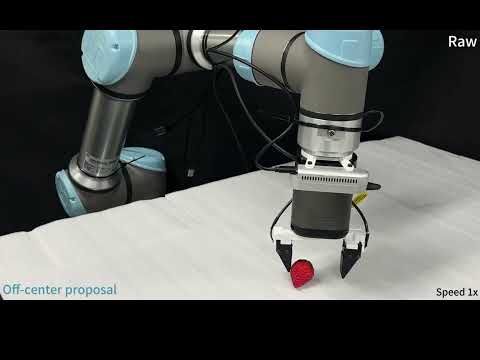
#482026-09-2182

LLM-based Conversational AI Knowledge Assistant for MyBuddy Humanoid Robot

Hanxiao Chen

Humanoid robots are increasingly being popular and developed for human-centered applications, yet their ability to provide intelligent conversations and natural interactive knowled…

Humanoid robots are increasingly being popular and developed for human-centered applications, yet their ability to provide intelligent conversations and natural interactive knowledge assistance remains constrained by traditional rule-based dialogue systems, pre-defined responses and limited knowledge repositories. Large language models (LLMs) have emerged as a powerful foundation for enabling natural, adaptive, and context-aware Human-Robot Interaction (HRI), which provides a significant opportunity to address such limitations by enabling robots to understand natural speech language, reason over complicated queries, maintain high-quality conversational context, and generate knowledge-rich responses. In this work, we originally present and implement an LLM-based versatile Conversational AI Knowledge Assistant for the Raspberry-Pi-powered 13-Axis MyBuddy humanoid robot, which integrates LLM-driven language understanding and AI reasoning with real-time speech recognition, knowledge retrieval via extensible access of internet engines (e.g., Wikipedia, arXiv), flexible dialogue management, and natural speech synthesis to enable much more intelligent multi-turn continuous conversations and advanced emotional-support Human-Robot Interaction.

cs.ROcs.AIrobothumanoid

兴趣:large language models for robot task planning and reasoning

#492026-09-2182

CARE: Experience-Guided Atomic Corrective Execution for Vision-Language-Action Policies

Junlan Xiao, Junwei Jiang, Zaibin Zhang, Yifan Wang, Zhongbo Zhang, Huchuan Lu 等

Vision-Language-Action (VLA) policies achieve strong performance in robotic manipulation but remain brittle once execution deviates from nominal trajectories. We propose CARE (Corr…

Vision-Language-Action (VLA) policies achieve strong performance in robotic manipulation but remain brittle once execution deviates from nominal trajectories. We propose CARE (Corrective Atomic Robotic Execution), a framework that improves recovery by learning from failures encountered during execution. Instead of generating corrective data from manually designed or random perturbations, CARE collects failed rollouts, models stage-conditioned post-failure deviations, and uses the resulting empirical distributions to synthesize representative failure states and corrective demonstrations. At inference time, CARE combines stage-wise planning with physically grounded 3D monitoring to trigger atomic adjustments or re-operations while preserving task progress. We further introduce the Failure State Recovery Benchmark (FSR-Bench), which evaluates recovery from intermediate failure states under local deviations and structural anomalies. Experiments across multiple VLA backbones, simulation benchmarks, and real-world dual-arm tasks show consistent improvements, with average task-success gains of 14.5 points in simulation and 15.9 points in the real world. Code, models, and data are available at https://github.com/xiaojunlan/care

cs.ROmanipulationVLAvision-language-action

兴趣:vision-language-action (VLA) models and foundation models for robots

#502026-09-21追踪学者 · He Wang82

DualWAM: Dual-System World Action Models for Asynchronous Global Planning and Local Refinement

Yixin Zheng, Jiangran Lyu, Yuntian Deng, Kai Liu, Yizhou Zhou, Yizhou Wang 等

World Action Models (WAMs) jointly generate robot actions and predict future world states, transferring priors from video pretraining to robot control. However, future visual predi…

World Action Models (WAMs) jointly generate robot actions and predict future world states, transferring priors from video pretraining to robot control. However, future visual prediction is computationally expensive, so existing WAMs often rely on long action chunks to amortize inference cost across control steps, at the cost of closed-loop responsiveness. We present \method, a dual-system WAM that preserves broader-horizon world-action generation while enabling high-frequency closed-loop action updates by decoupling global planning and local refinement. \systwo periodically performs high-noise bidirectional denoising over a broader world-action chunk to establish a global plan, while wrist-only \sysone extracts a temporally aligned short window from the intermediate denoising state and completes low-noise refinement using the latest wrist observations, which provide action-aligned cues about local geometry, motion, and contact during interaction. The two systems operate asynchronously along a shared denoising trajectory: each global plan is reused across multiple local updates, while \sysone repeatedly incorporates fresh interaction feedback. Across zero-shot manipulation tasks on Franka and Galbot, \method improves success over the strongest evaluated baseline by 4.5 percentage points on average, while achieving a 16.6$\times$ critical-path speedup. Further studies show that role-matched egocentric and UMI data improve success by 14 percentage points, and that the decoupled design naturally supports edge--cloud deployment with substantially lower communication overhead than the baseline.

cs.ROrobotmanipulation

追踪学者:He Wang;兴趣:world models and video prediction for embodied agents

GitHub 项目

#12025-11-23★ 648 +874

sou350121/VLA-Handbook

HTML

本项目旨在为致力于进入VLA(Vision-Language-Action)领域的算法工程师提供一份全中文、实战导向的学习/面试手册。 不同于通用的 CV/NLP 面试指南,本项目聚焦于 Robotics 特有的挑战

本项目旨在为致力于进入VLA(Vision-Language-Action)领域的算法工程师提供一份全中文、实战导向的学习/面试手册。 不同于通用的 CV/NLP 面试指南,本项目聚焦于 Robotics 特有的挑战

chinesedeep-learningembodied-aillmrobot-learningroboticsvision-language-actionvlarobotVLAvision-language-actionembodied

兴趣:vision-language-action (VLA) models and foundation models for robots

#22026-08-29★ 84 +19新项目74

nssmd/RoboRSI

Python

Robot-agent harness with a CLI and local Web console for LIBERO short evaluation

Robot-agent harness with a CLI and local Web console for LIBERO short evaluation

agentsembodied-aievaluationliberorobot-learningroboticsself-evolutionrobotembodied

兴趣:multi-agent systems and LLM agents

#32026-07-06★ 2.2k +674

dexmal/opendm

Python

An Open-World Foundation Model for General-Purpose Embodied Intelligence.

An Open-World Foundation Model for General-Purpose Embodied Intelligence.

embodied-aiembodied-intelligenceroboticsvision-language-actionvlaVLAvision-language-actionembodied

兴趣:vision-language-action (VLA) models and foundation models for robots

#42024-12-08★ 3.8k +1773

datawhalechina/every-embodied

Python

仅需Python基础,从0构建自己的具身智能机器人;从0逐步构建VLA/OpenVLA/SmolVLA/Pi0, 深入理解具身智能

仅需Python基础,从0构建自己的具身智能机器人;从0逐步构建VLA/OpenVLA/SmolVLA/Pi0, 深入理解具身智能

embodied-agentembodied-aiembodied-intelligenceopenvlasmolvlavision-language-action-modelVLAvision-language-actionembodied

兴趣:world models and video prediction for embodied agents

#52026-08-31★ 4k +143新项目73

Human-Agent-Society/reef

Python

Continual learning infra for self-improving agents

Continual learning infra for self-improving agents

agent-infrastructureai-agentscontinual-learninginferencellmllm-trainingreinforcement-learningself-improving-agents

兴趣:multi-agent systems and LLM agents

#62025-10-09★ 3.7k +972

starVLA/starVLA

Python

StarVLA: A Lego-like Codebase for Vision-Language-Action Model Developing

StarVLA: A Lego-like Codebase for Vision-Language-Action Model Developing

robotic-foundation-modelroboticsvision-language-action-modelworld-action-modelvision-language-action

兴趣:vision-language-action (VLA) models and foundation models for robots

#72026-03-16★ 3.6k72

nv-tlabs/kimodo

Python

Official implementation of Kimodo, a kinematic motion diffusion model for high-quality human(oid) motion generation.

Official implementation of Kimodo, a kinematic motion diffusion model for high-quality human(oid) motion generation.

你点赞过:TANGO: Humanoid Navigation in Cluttered Environments with a

#82026-09-12★ 37 +9新项目72

3587jjh/HuRo

Python

HuRo: Robotizing Human Videos for Scalable VLA Pretraining (CoRL 2026)

HuRo: Robotizing Human Videos for Scalable VLA Pretraining (CoRL 2026)

egocentric-videomotion-retargetingrobot-learningrobotizationvision-language-actionvlarobotVLAvision-language-action

兴趣:vision-language-action (VLA) models and foundation models for robots

#92026-08-29★ 71 +3新项目71

OpenBMB/SimpleMemVLA

Python

Native-video memory for vision-language-action models, using timestamped visual history and exact streaming inference for long-horizon robot manipulation.

Native-video memory for vision-language-action models, using timestamped visual history and exact streaming inference for long-horizon robot manipulation.

embodied-ailong-horizon-roboticsmultimodal-learningnative-video-memoryrobot-learningrobot-manipulationstreaming-inferencevideo-understandingrobotmanipulationVLAvision-language-actionembodied

兴趣:vision-language-action (VLA) models and foundation models for robots

#102026-07-19★ 591 +470

RealXiaoze/humanoid-motion-intelligence

人形机器人运动智能论文、开源项目、产业与求职知识库

人形机器人运动智能论文、开源项目、产业与求职知识库

embodied-aihumanoid-roboticslocomotionmotion-controlreinforcement-learningrobot-learningsim2realvlarobotVLAhumanoidlocomotionembodied

兴趣:humanoid robots and whole-body control

#112025-09-09★ 50k +36370

bojieli/ai-agent-book

Python

《深入理解 AI Agent:设计原理与工程实践》(李博杰 著)开源主仓库:全书正文、编译版 PDF 与按章配套代码

《深入理解 AI Agent:设计原理与工程实践》(李博杰 著)开源主仓库:全书正文、编译版 PDF 与按章配套代码

agentagent-memoryai-agentbookcoding-agentcontext-engineeringlarge-language-modelsllm

兴趣:multi-agent systems and LLM agents

#122024-01-26★ 27.7k +2670

huggingface/lerobot

Python

🤗 LeRobot: Making AI for Robotics more accessible with end-to-end learning

🤗 LeRobot: Making AI for Robotics more accessible with end-to-end learning

兴趣:imitation learning and diffusion policies for robot control

#132026-08-26★ 551 +526新项目69

whitecircle/halo

Python

Halo is an open-source framework built by White Circle for training large language and multimodal models

Halo is an open-source framework built by White Circle for training large language and multimodal models

agentasync-rldistributed-trainingfine-tuninggrpolarge-language-modelsllmlora

兴趣:vision-language-action (VLA) models and foundation models for robots

#142026-08-26★ 310 +2新项目69

OpenMOSS/EasyWAM

Python

A unified framework for training, fine-tuning, and evaluating World Action Models

A unified framework for training, fine-tuning, and evaluating World Action Models

benchmarkcodebaseembodied-aifoundation-modelsloraroboticsvision-language-actionworld-action-modelvision-language-actionembodied

兴趣:vision-language-action (VLA) models and foundation models for robots

#152025-08-14★ 5.3k +968

RLinf/RLinf

Python

RLinf: Reinforcement Learning Infrastructure for Embodied and Agentic AI

RLinf: Reinforcement Learning Infrastructure for Embodied and Agentic AI

agentic-aiembodied-aireinforcement-learningrl-infrarlinfvla-rlVLAembodied

兴趣:vision-language-action (VLA) models and foundation models for robots

#162026-06-26★ 588 +768

robocurve/inspect-robots

Python

Open source evals for physical AI. Run any LLM/VLA on any arm/humanoid against any real/sim benchmark.

Open source evals for physical AI. Run any LLM/VLA on any arm/humanoid against any real/sim benchmark.

benchmarkembodied-aievaluationphysical-airerunroboticsvision-language-actionvlaVLAvision-language-actionhumanoidembodied

兴趣:vision-language-action (VLA) models and foundation models for robots
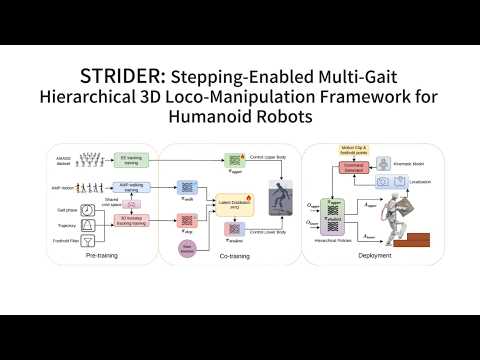
#172025-09-11★ 7k +3368

vllm-project/vllm-omni

Python

A framework for efficient model inference with omni-modality models

A framework for efficient model inference with omni-modality models

audio-generationdiffusionimage-generationinferencemodel-servingmultimodalpytorchtransformer

兴趣:vision-language-action (VLA) models and foundation models for robots

#182024-02-29★ 16067

RobotControlStack/robot-control-stack

Python

A lean, ROS-free sim-to-real framework for training and deploying Vision-Language-Action (VLA) models and RL agents. Native MuJoCo Gymnasium wrappers with synchronous execution for…

A lean, ROS-free sim-to-real framework for training and deploying Vision-Language-Action (VLA) models and RL agents. Native MuJoCo Gymnasium wrappers with synchronous execution for Franka, UR5e, xArm, SO101 and YAM.

frankagymnasiummujocoreinforcement-learningrobot-learningrobot-manipulationsim-to-realvision-language-actions-modelsrobotmanipulationVLAvision-language-actionsim-to-real

兴趣:vision-language-action (VLA) models and foundation models for robots

#192022-11-16★ 8.2k +1267

isaac-sim/IsaacLab

Python

Unified framework for robot learning with multi-physics/renderer support

Unified framework for robot learning with multi-physics/renderer support

isaac-simomniverse-kit-extensionrobot-learningroboticsrobot

兴趣:3D perception, point clouds and scene understanding for robotics

#202026-08-25★ 127 +1新项目67

starVLA/VLAct

Python

Beyond Data Scaling: Representation-Centric Continued Pre-training for Vision-Language-Action Models

Beyond Data Scaling: Representation-Centric Continued Pre-training for Vision-Language-Action Models

roboticsvision-language-actionvision-language-modelvision-language-action

兴趣:vision-language-action (VLA) models and foundation models for robots

#212026-09-12★ 65 +5新项目67

ASIG-X/JEPLO

C++

First JEPA-based learning framework for mapping-free LiDAR-based perceptive locomotion

First JEPA-based learning framework for mapping-free LiDAR-based perceptive locomotion

isaac-lablegged-robotslidarmujocoquadrupedreinforcement-learningrlrosleggedlocomotion

兴趣:reinforcement learning for legged locomotion and sim-to-real transfer

#222025-01-16★ 3.5k +267

jonyzhang2023/awesome-embodied-vla-va-vln

A curated list of state-of-the-art research in embodied AI, focusing on vision-language-action (VLA) models, vision-language navigation (VLN), and related multimodal learning appro…

A curated list of state-of-the-art research in embodied AI, focusing on vision-language-action (VLA) models, vision-language navigation (VLN), and related multimodal learning approaches.

VLAvision-language-actionembodied

兴趣:vision-language-action (VLA) models and foundation models for robots

#232026-09-06★ 847 +16新项目66

OpenWAM-Official/OpenWAM

Python

Official repository for "OpenWAM: An Open, Modular Exploration Towards Systematic World–Action Model Pretraining".

Official repository for "OpenWAM: An Open, Modular Exploration Towards Systematic World–Action Model Pretraining".

generalist-robot-policiespretrainingroboticsworld-action-modelrobot

兴趣:vision-language-action (VLA) models and foundation models for robots

#242025-04-04★ 1.9k66

RoboVerseOrg/RoboVerse

Python

RoboVerse: Towards a Unified Platform, Dataset and Benchmark for Scalable and Generalizable Robot Learning

RoboVerse: Towards a Unified Platform, Dataset and Benchmark for Scalable and Generalizable Robot Learning

imitation-learningreinforcement-learningroboticssimulationrobot

兴趣:imitation learning and diffusion policies for robot control

#252026-09-19★ 54 +10新项目66

Dimweaker/jev-libero

Python

Fine-grained robot control with Jev, physics previews, and configurable LIBERO tasks.

Fine-grained robot control with Jev, physics previews, and configurable LIBERO tasks.

emobodied-aijevliberollmmodel-based-controlmujocorobosuiterobot-manipulationrobotmanipulation

兴趣:humanoid robots and whole-body control

#262022-11-02★ 92065

mbreuss/diffusion-literature-for-robotics

Summary of key papers and blogs about diffusion models to learn about the topic. Detailed list of all published diffusion robotics papers.

Summary of key papers and blogs about diffusion models to learn about the topic. Detailed list of all published diffusion robotics papers.

diffusion-modelsgraspinggrasping-robotimitation-learningliteraturemotion-planningoffline-rlreinforcement-learningrobot

兴趣:imitation learning and diffusion policies for robot control

#272026-02-27★ 2.9k +565

physical-superintelligence-lab/Psi0

Python

[RSS'26] Welcome to Psi-Zero, a Humanoid VLA towards Universal Humanoid Intelligence.

[RSS'26] Welcome to Psi-Zero, a Humanoid VLA towards Universal Humanoid Intelligence.

VLAhumanoid

兴趣:humanoid robots and whole-body control

#282026-04-22★ 16.3k +3665

earthtojake/text-to-cad

Python

A library of agent skills for CAD, CAE and CAM

A library of agent skills for CAD, CAE and CAM

agentsai-agentscadmechanical-engineeringroboticsstepstlstp

兴趣:large language models for robot task planning and reasoning

#292024-10-31★ 23.6k +3664

verl-project/verl

Python

verl/HybridFlow: A Flexible and Efficient RL Post-Training Framework

verl/HybridFlow: A Flexible and Efficient RL Post-Training Framework

兴趣:vision-language-action (VLA) models and foundation models for robots

#302026-02-21★ 21564

RoboTwin-Platform/RMBench

Python

Memory-Dependent Manipulation Benchmark based on RoboTwin

Memory-Dependent Manipulation Benchmark based on RoboTwin

benchmarkembodied-aimanipulationmemoryroboticsmanipulationembodied

兴趣:robot manipulation and grasping with learned policies