Tech Station

2026-09-25

50 篇论文 · 30 个项目 ← 2026-09-24 · 2026-09-26 →

论文

#12026-09-2498

World Action Agent: Harnessing VLMs for Robot Manipulation via World Action Rehearsal

Yehang Zhang, Haojian Huang, Yifan Chang, Jianchong Su, Bohan Zhou, Yingjie Xu 等

General-purpose vision-language models (VLMs) bring broad knowledge and spatial reasoning to robot manipulation, yet existing systems either use them indirectly, to predict constra…

General-purpose vision-language models (VLMs) bring broad knowledge and spatial reasoning to robot manipulation, yet existing systems either use them indirectly, to predict constraints or write programs, or give them a view of the scene rather than a world in which to act. We present World Action Agent (WAA), a multi-agent harness through which VLMs pilot robots with basic tools, making every decision within a visual action workspace. The workspace has three properties. Contact views, selected automatically from the scene geometry, present the scene around the current interaction. Action rehearsal turns each action into an editable proposal that the agent, alone or through an Imagination Agent, previews and revises against planning feedback before execution. In-view correction closes the loop between observation, rehearsal, and low-level execution, letting the agent remove residual offsets in the view where it observes them. Through the same workspace, WAA acquires embodied procedural knowledge in two ways: it evolves multimodal skills from expert videos and human teaching under evidence-based review and consults them through a Skill Agent, and its interaction traces train smaller VLMs to pilot the same harness. On LIBERO-Pro, WAA with skills evolved only from LIBERO-90 reaches a state-of-the-art 75.6% average success, outperforming end-to-end VLAs, code-as-policy agents, and a visual-harness baseline with the same backbone; the same skills remain effective on robosuite without further learning. Fine-tuning Qwen3.5-9B on harness traces raises its out-of-domain success from 1.7% to 43.3%.

cs.ROcs.AIrobotmanipulationembodied

兴趣:vision-language-action (VLA) models and foundation models for robots

#22026-09-2498

Robo-Harness K1: Harnessing Robot-Use Agents via Perception Augmentation

Zexi Li, Yehang Zhang, Wenqian Li, Haojian Huang, Chenxu Wang, Shiyuan Deng 等

Foundation vision-language models (VLMs) understand objects, instructions, and spatial relations, yet translating this capability into robotic manipulation remains difficult. Visio…

Foundation vision-language models (VLMs) understand objects, instructions, and spatial relations, yet translating this capability into robotic manipulation remains difficult. Vision-language-action (VLA) models require extensive demonstrations and may compromise pretrained understanding, while direct RGB-only VLM control is costly and strongly dependent on model capability. We introduce Robo-Harness K1, a robot-use agent (RUA) framework that exposes perception as tools. The agent queries calibrated depth, persistent visual anchors, spatial measurements, and grasp hypotheses, then selects generic motions from the returned evidence. This interface makes 3D geometry accessible without changing the VLM architecture or training a depth encoder. On matched LIBERO-PRO tasks, Gemini 3.7 Flash with K1 reaches 77.8% accuracy, surpassing GPT-6 Astra's 61.1% with an RGB-only harness; K1 further improves Astra to 88.9%. Without target fine-tuning, Gemini with K1 transfers to three RoboSuite arms and dual-arm RoboTwin tasks. On RoboTwin, it achieves 32.0% on Easy and 28.0% on Hard, showing resilience to visual and environmental perturbations. K1 also produces tool-call traces aligned with next-token training. A Qwen3.5-9B student trained on only 107 teacher episodes reaches 44.2% accuracy on new initial states versus 30.2% for OpenVLA, and 13.9% on held-out task conditions versus 0.0% for OpenVLA. These results suggest that perception-augmented RUAs offer a promising route to sample-efficient, generalizable robotic policies that leverage VLM capabilities through an accessible tool interface.

cs.ROrobotmanipulationgraspVLAvision-language-action

兴趣:vision-language-action (VLA) models and foundation models for robots

#32026-09-2497

EgoSpeedUp: Transferring Human Manipulation Tempo to Robot Policies

Hanbit Oh, Yukiyasu Domae, Takuma Yagi

Robot manipulation policies trained through imitation learning inherit not only the demonstrated behavior but also the conservative execution tempo of robot demonstrations. Existin…

Robot manipulation policies trained through imitation learning inherit not only the demonstrated behavior but also the conservative execution tempo of robot demonstrations. Existing acceleration approaches can execute faster than the original demonstrations, but determine the appropriate acceleration primarily from robot-side information or a predefined set of tempo factors, leaving open how to obtain a task-appropriate reference for how fast each manipulation phase should progress. We introduce EgoSpeedUp, a framework that uses human manipulation as temporal supervision for robot imitation learning. Our key insight is that human demonstrations naturally reveal task-appropriate, phase-wise manipulation tempo. Given slow robot demonstrations and human demonstrations of the same task, EgoSpeedUp aligns corresponding manipulation phases, estimates their relative execution tempos from multiple human demonstrations, and transfers the resulting phase-wise tempo by retiming the robot demonstrations. The retimed demonstrations are then used for standard behavior cloning, allowing the robot to retain its executable manipulation behavior while learning to perform it at a human-informed tempo. Across two real-world manipulation tasks, EgoSpeedUp improves the task success rate by an average of 25 percentage points (pp) while reducing successful execution time by 36.5%. These results demonstrate that human manipulation tempo provides an effective temporal reference for learning faster and more reliable robot policies.

cs.ROcs.CVrobotmanipulationimitation learning

兴趣:imitation learning and diffusion policies for robot control

#42026-09-23追踪学者 · Jitendra Malik96

Morphometric Imitation: From Morphology and Contact Aware Hand Retargeting to Sim-to-Real Visuomotor Policy

Tara Sadjadpour, Siming He, C. K. Wolfe, Haozhi Qi, Lea Wilken, S. Shankar Sastry 等

Human hand-object interactions (HOIs) provide a rich source of demonstrations for dexterous manipulation, but learning directly from them presents challenges in bridging morphology…

Human hand-object interactions (HOIs) provide a rich source of demonstrations for dexterous manipulation, but learning directly from them presents challenges in bridging morphology gaps, ensuring dynamical feasibility, and sim-to-real deployment. We present Morphometric Imitation, a three-stage framework that transforms reconstructed HOIs into zero-shot sim-to-real visuomotor policies. First, morphometric optimization (MMO) kinematically retargets human motion across hand morphologies while preserving demonstrated contacts. Second, residual reinforcement learning (RL) refines the kinematic reference using object pose and contact information from the human motion to produce dynamically feasible robot demonstrations. Third, these demonstrations are distilled into visuomotor policies. Across three robot hands and ten HOIs, MMO improves contact F1 over the strongest of five baselines by at least 8 points for every hand, while also improving the success rate of downstream dynamic retargeting by as much as 35 points. Ablations on the residual RL show complementary benefits from using object pose and contact information. Finally, the visuomotor policies achieve 89.3% zero-shot success in 300 real-world trials on 30 objects. Project page: $\href{https://morphometricimitation.github.io}{this https URL}$

cs.ROrobotmanipulationsim-to-realdexterous

追踪学者:Jitendra Malik;兴趣:robot manipulation and grasping with learned policies

#52026-09-2494

Self-Adaptive VLA for Robust Robot Deployment

Hongxin Zhang, Chunru Lin, Tsun-Hsuan Wang, Zhenjia Xu, Chuang Gan

While Vision-Language-Action (VLA) models demonstrate impressive capabilities in robotic manipulation, their memoryless nature renders them brittle to test-time environment shifts,…

While Vision-Language-Action (VLA) models demonstrate impressive capabilities in robotic manipulation, their memoryless nature renders them brittle to test-time environment shifts, particularly hardware shifts caused by wear or imperfect calibration. Enabling these models to self-adapt during deployment without requiring continuous on-site recalibration remains a critical bottleneck for real-world scalability. In this work, we introduce Self-Adaptive VLA, a novel post-training recipe that enables the policy to iteratively adapt to deployment-time hardware shifts leveraging its own rollouts as context. To do so, we first collect policy rollouts under deliberately injected hardware shifts. We then transform the base policy's training data into shift-conditioned expert demonstrations by pre-compensating the expert actions for these known shifts. Next, we introduce a lightweight, plug-in context encoder that compresses the context, including visual observation, proprioception, and actions in the shifted environment, into a latent context token. This token modulates the policy through adaptive layer normalization (AdaLN). Furthermore, we find that context tokens can be ensembled, allowing the policy to iteratively self-correct and mitigate failures step by step. Extensive experiments across four precision-critical bi-manual and dexterous manipulation tasks show that Self-Adaptive VLA recovers over 80% of the base policy's performance under hardware shifts, such as actuation bias and joint encoder offsets. Moreover, Self-Adaptive VLA enables more robust deployment to new workstations compared to the base policy. Our approach provides a pathway for robust large-scale real-world robot deployments and easier maintenance. See videos at https://icefoxzhx.github.io/self-adaptive-vla.

cs.ROcs.CVrobotmanipulationVLAvision-language-actiondexterous

兴趣:vision-language-action (VLA) models and foundation models for robots

#62026-09-2494

Learning from Mixed-Quality Deployment Experience for Robot Manipulation

Yangang Ren, Yujie Yan, Zirui Li, Jiaming Guo, Di Zeng, Ji Tao 等

Robot policies deployed in real environments naturally accumulate mixed-quality experience, including successful executions, partial progress, and failures. Although these rollouts…

Robot policies deployed in real environments naturally accumulate mixed-quality experience, including successful executions, partial progress, and failures. Although these rollouts provide valuable information for further learning, directly incorporating them into imitation learning may reinforce undesirable behaviors, while offline reinforcement learning often suffers from unreliable value estimation under sparse rewards and limited data coverage. We consider a practical post-deployment setting where learning relies only on naturally accumulated autonomous rollouts, without additional human corrections or exploratory interaction. To effectively exploit such experience, we propose Predictive Action Chunk Learning (PACL). PACL first learns a predictive chunk-level critic that evaluates temporally extended action sequences and augments temporal difference learning with future latent prediction, providing richer supervision for long-horizon value estimation. The learned critic then converts chunk-level Q-values into discrete quality conditions, which guide a diffusion actor to learn jointly from these mixed-quality experiences without treating all behaviors as equivalent supervision. At inference, the actor generates multiple action chunks and the critic selects the highest valued candidate. Experiments across simulated and real-world robot manipulation tasks show that PACL consistently improves the pretrained policy and outperforms strong imitation learning and offline reinforcement learning baselines.

cs.LGrobotmanipulationimitation learning

兴趣:imitation learning and diffusion policies for robot control

#72026-09-2493

Res-HIL: Human-Guided Residual Reinforcement Learning for Sample-Efficient Dexterous Manipulation

Mariia Iavorskaia, Christian Dietz, Sebastian Albrecht, Majid Khadiv

Imitation learning enables robots to acquire manipulation skills from demonstrations, but the resulting policies can fail outside the training data, while collecting more demonstra…

Imitation learning enables robots to acquire manipulation skills from demonstrations, but the resulting policies can fail outside the training data, while collecting more demonstrations requires substantial human effort. Human-in-the-loop reinforcement learning uses corrective feedback during online training, but typically learns the complete task policy rather than refining a pretrained imitation policy. We introduce Res-HIL, a human-in-the-loop residual reinforcement learning framework that learns corrective actions on top of a frozen imitation policy. Each human intervention provides two complementary learning signals: direct supervision of the residual policy and reward shaping of preceding autonomous behavior. Res-HIL combines these signals with zero initialization of the residual policy to stabilize and accelerate online learning. We evaluate Res-HIL on five contact-rich manipulation tasks spanning high-precision and long-horizon behaviors. With only 20 initial demonstrations, Res-HIL outperforms state-of-the-art full-policy human-in-the-loop reinforcement learning and residual fine-tuning without human guidance on every task after ten minutes of online training. Res-HIL improves its pretrained base policies and outperforms imitation policies trained with five times more demonstrations. An ablation study shows that direct residual supervision is critical to performance, while intervention-aware reward shaping substantially improves training efficiency.

cs.ROmanipulationimitation learningdexterous

兴趣:imitation learning and diffusion policies for robot control

#82026-09-23追踪学者 · Animesh Garg93

KeyGen: Unsupervised Keypoint based Object-Centric Representations for Category-Level Policy Generalization

Shuxin Cao, Liquan Wang, Masoud Moghani, Benjamin Joffe, Animesh Garg

Generalization in robotic manipulation requires policies to perform tasks across diverse unseen object instances that vary in shape, size, and pose. However, conventional behavior …

Generalization in robotic manipulation requires policies to perform tasks across diverse unseen object instances that vary in shape, size, and pose. However, conventional behavior cloning (BC) methods often overfit to instance-specific geometry and appearance, limiting transfer to novel objects. We introduce KeyGen, a framework that learns canonicalized semantic 3D keypoints from point clouds and uses them as structured object-centric representations for policy learning. A visuomotor diffusion policy conditions on these keypoints together with object-centric geometry to predict full manipulation trajectories, enabling consistent geometric correspondence across object instances. To evaluate category-level generalization, we construct a photorealistic simulation benchmark with three manipulation tasks and a planning-driven data generation pipeline that produces expert trajectories across diverse object instances. Experiments show that KeyGen significantly outperforms prior methods on both seen and unseen objects under pose variation, scales effectively with additional demonstrations per object, maintains robustness to object rescaling, and achieves strong performance in both simulation and real-world manipulation.

cs.ROcs.AImanipulationdiffusion policy

追踪学者:Animesh Garg;兴趣:robot manipulation and grasping with learned policies

#92026-09-2492

AdaHVLA: Adaptive Harnesses for Long-Horizon Vision-Language-Action Execution

Junyi Tang, Jie Peng, Zezhen Ding, Yuan Shen, Tianlong Chen

Vision-language-action (VLA) models offer strong local control and instruction following but often struggle with long-horizon tasks requiring persistent memory and planning. Task h…

Vision-language-action (VLA) models offer strong local control and instruction following but often struggle with long-horizon tasks requiring persistent memory and planning. Task harnesses provide persistent context for agent reasoning by retaining task history and tracking progress across execution stages. To bring these complementary capabilities together, we introduce AdaHVLA, an adaptive harness that refines code-based coordination policies through robot experience to better align agent reasoning and memory with VLA execution. Its decoupled multiagent adaptation process separates evidence analysis, harness revision, and behavioral assessment into distinct working contexts, using testable coordination hypotheses to guide revisions and subsequent rollouts to assess their predicted effects. A stateful revision graph links execution evidence, hypotheses, revisions, and observed effects, preserving alternative harnesses and adaptation memory to guide refinement across repeated attempts and continued adaptation across tasks and environments. In simulation, AdaHVLA raises mean test success on NaVILA-LH from 22.5% to as high as 57.5% and improves manipulation test success across three VLA backbones by up to 30.8 percentage points over the initial harness. Real-world deployment further illustrates how the adapted policies support stable execution across task stages.

cs.ROrobotmanipulationVLAvision-language-action

兴趣:vision-language-action (VLA) models and foundation models for robots

#102026-09-2492

PolyUMI: Accessible Visual-Tactile-Audio Data Collection for Object Inference and Manipulation

Conor W. Hayes, Rickmer Krohn, Aravind Ramaswami, Anunth Ramaswami, Nils Dengler, Kevin M. Lynch 等

Humans typically rely on vision, touch, hearing, and proprioception to perceive contact and adapt their actions during manipulation. Providing robots with comparable responsiveness…

Humans typically rely on vision, touch, hearing, and proprioception to perceive contact and adapt their actions during manipulation. Providing robots with comparable responsiveness therefore requires hardware that can retain and use these complementary sensory signals. Most imitation-learning systems, however, observe demonstrations primarily through vision and proprioception, limiting access to contact information that is difficult to infer visually. We present PolyUMI, an open-source platform for scalable visual--tactile--audio demonstration collection and robot deployment. Its lightweight, wireless handheld gripper records synchronized wrist-camera, optical tactile, contact-audio, and proprioceptive observations without requiring a tethered workstation. The same sensing finger can be transferred to the robot end effector, preserving the sensing geometry between demonstration collection and policy execution. To effectively use these heterogeneous observations, we further introduce VisTA, a token-level multimodal policy that integrates information across sensors and time to predict contact-aware robot actions. Experiments spanning object inference, slip control, and contact-rich manipulation show that touch and audio reveal task-relevant information beyond vision and that VisTA is competitive with or outperforms existing multimodal policies. Together, PolyUMI and VisTA provide an accessible pipeline for collecting multimodal demonstrations and learning policies that perceive physical interaction beyond vision. Project Page: https://polyumi-vista.github.io

cs.ROrobotmanipulationtactile

兴趣:robot manipulation and grasping with learned policies

#112026-09-2490

Direction-Scale Decomposition in Action Representation: Rethinking What to Tokenize for Vision-Language-Action Models

Yufei Duan, Hang Yin, Alberta Longhini, Chao Tang, Danica Kragic

Action representation plays a central role in discrete-token vision-language-action (VLA) learning but remains underexamined. Under conventional pose-increment representations, act…

Action representation plays a central role in discrete-token vision-language-action (VLA) learning but remains underexamined. Under conventional pose-increment representations, action tokens are sensitive to execution speed and dataset-specific normalization, potentially obscuring geometric structure shared across demonstrations and datasets. We introduce Direction-Scale Decomposition (DSD), an action representation that decomposes translation and rotation increments into direction and scale components before tokenization. DSD isolates motion direction while retaining magnitudes in separate scale channels. We evaluate DSD with uniform binning (BIN) and BEAST, a B-spline-based tokenizer, in simulation and real-world manipulation under both single-dataset and mixed-dataset training. On LIBERO, DSD improves average success rates with both tokenizers. On SimplerEnv, DSD-BIN outperforms BIN by 10.3 percentage points in overall success rate under mixed-dataset training. Real-robot experiments further show gains both with and without robotics pretraining. These results support DSD as an effective action representation for discrete-token VLA models and suggest its potential to mitigate performance degradation when training on large and diverse dataset mixtures. Our project page with additional resources is available at https://vla-dsd.github.io/

cs.CVcs.ROrobotmanipulationVLAvision-language-action

兴趣:vision-language-action (VLA) models and foundation models for robots

#122026-09-2290

Know Your Body: A Harness for Direct and Self-Improving Robot Control with VLMs

Zeyu Lou, Yanhong Zeng, Yong Wang, Chenyang Si

A general-purpose vision-language model can understand a task goal without knowing how a particular robot's motion and functional parts produce the intended effect. We introduce Kn…

A general-purpose vision-language model can understand a task goal without knowing how a particular robot's motion and functional parts produce the intended effect. We introduce KnowBody, a harness that makes these action-relevant body relations explicit, queryable, and revisable while keeping the model weights frozen. Initialized from one off-task trajectory, a partial body model guides action selection and the interpretation of past interactions. New evidence refines the model, and knowledge dependent on revised body estimates is rechecked before reuse. Across 32 fixed-budget trials on four real-robot tasks, initialized KnowBody achieves 75% completion versus 25% for the native harness and requires fewer planner rounds on successful trials in tasks completed by both. With persistent updates enabled, planner rounds decrease by 29-53% from the first to the fifth recorded success.

兴趣:vision-language-action (VLA) models and foundation models for robots

#132026-09-2490

Decoupled Early Exits for Task-Dependent Compute Allocation in Flow-Matching VLAs

Riccardo Andrea Izzo, Rimvydas Rubavicius, Gianluca Bardaro, Subramanian Ramamoorthy, Matteo Matteucci, Alessandro Suglia

Flow-matching Vision-Language-Action (VLA) models have emerged as a potential solution for generalist robot control, designed by combining a pretrained Vision-Language Model (VLM) …

Flow-matching Vision-Language-Action (VLA) models have emerged as a potential solution for generalist robot control, designed by combining a pretrained Vision-Language Model (VLM) backbone with an action expert that generates continuous robot actions. While these models exhibit impressive capabilities, due to their very high number of parameters, their computational requirements are often prohibitive for robotics control. To mitigate these inefficiencies, existing methods predominantly skip VLM backbone layers with early exits or reduce denoising steps, while leaving action expert depth untouched. We propose a framework that exposes backbone depth $V$, action expert depth $A$, and denoising steps $D$ as three jointly configurable compute axes in a VLA. Starting from a pretrained VLA, we attach lightweight Exit Transformers (ET) at intermediate depths in both the backbone and the action expert, trained to distil the last layer of the policy into each exit. Furthermore, we introduce a KV Cache synthesis mechanism that manages the missing keys and values of the skipped backbone layers, allowing the action expert to exit deeper than the backbone. Finally, we show that the optimal compute budget is task-dependent, with different tasks benefiting from different axes and depths. Notably, our method does not require training the original policy from scratch, and for each exit, it increases the number of parameters by only $2.1%$ for SmolVLA and $4.1%$ for $π_{0.5}$. We validate our approach across two flow-matching VLAs (SmolVLA, $π_{0.5}$) and two benchmarks (LIBERO, Meta-World), revealing complementary effects: $V$ and $A$ respectively reduce FLOPs and latency, while $D$ improves both. Our joint configurations $(V,A,D)$ reduce latency by $79.2%$ and computation (FLOPs) by $31.8%$, while improving mean success rate by $5.6%$.

cs.ROcs.LGrobotVLAvision-language-action

兴趣:vision-language-action (VLA) models and foundation models for robots

#142026-09-2489

Self-Supervised Anchoring of Fingertip Sensing to Proprioception and Proactive Actions for Robot Imitation Learning

Tomohiro Motoda, Masaki Murooka, Keisuke Shirai, Hanbit Oh, Ryoichi Nakajo, Shotaro Miwa 等

Robotic imitation learning often relies on external cameras, yet local interaction cues such as object proximity, contact onset, and grasp state are difficult to observe near the f…

Robotic imitation learning often relies on external cameras, yet local interaction cues such as object proximity, contact onset, and grasp state are difficult to observe near the fingertips because of occlusion and limited temporal resolution. We study how to effectively incorporate complementary fingertip sensing into imitation learning using pressure-sensitive tactile and reflective proximity sensors, along with pretrained sensor encoders. The two modalities provide information at different manipulation phases: proximity sensing is informative before contact, whereas tactile sensing becomes informative after contact. However, naively adding these signals to a policy does not consistently improve performance and can even underperform vision-only policies, suggesting that sparse, phase-dependent sensor signals are difficult to exploit from limited demonstrations. We therefore propose a proprioception-anchored pretraining method, PROprioceptive-and-PRoactive Anchoring (PROPRA), which independently aligns each fingertip sensor history with proprioceptive and action segments. This provides a continuously available sensorimotor reference, allowing each sensor to be aligned independently during its informative phases. Experiments on real-world manipulation tasks show that our pretraining method improves average success rates over vision-only policies and image-anchored pretraining baselines. Representation analysis further shows that it preserves richer information about pre-contact states, enabling more effective use of complementary fingertip sensing. Please refer to our project page: https://tomohiromotoda.github.io/nia.propra/

cs.ROrobotmanipulationgraspimitation learningtactile

兴趣:dexterous hands and tactile sensing

#152026-09-2487

Design and Evaluation of LLM Chaining-Based Task Planning for General Purpose Service Robots

Lucas Da Mota Bruno, Jiahao Sim, Yoshinobu Hagiwara

General Purpose Service Robot (GPSR) tasks, as defined in the RoboCup@Home benchmark, require robots to interpret diverse natural language commands and generate multi-step action s…

General Purpose Service Robot (GPSR) tasks, as defined in the RoboCup@Home benchmark, require robots to interpret diverse natural language commands and generate multi-step action sequences in real home environments. Conventional Single Prompt (SP) approaches suffer from context bloat and the "Lost in the Middle" phenomenon, leading to unreliable task planning. We propose an LLM chaining architecture that separates instruction classification and action generation into two specialized stages, reducing per-inference prompt length by approximately 45% while improving planning consistency. We evaluate our method using 100 randomly generated GPSR commands across three language models spanning local open-source and frontier cloud deployment contexts. Results show consistent planning improvements over SP across all models, with gains of up to +37 percentage points on local models. Further, real-robot execution experiments on the Toyota Human Support Robot (HSR) reveal that planning success alone does not guarantee task completion, with 6 of 10 tasks completing successfully and execution-layer failures identified as the primary remaining bottleneck.

cs.ROcs.AIcs.CLrobottask planning

兴趣:large language models for robot task planning and reasoning

#162026-09-2487

Online Sim-to-Real Adaptation via Closed-Loop System Modeling

Yuhao Huang, Samuel A. Moore, Boyuan Chen

Sim-to-real transfer has made substantial progress, but can still produce controllers that remain stable and functional on hardware while suffering from degraded tracking accuracy …

Sim-to-real transfer has made substantial progress, but can still produce controllers that remain stable and functional on hardware while suffering from degraded tracking accuracy due to residual dynamics mismatch. Correcting these errors typically requires identifying the underlying system dynamics, adapting the control policy, or returning to simulation for additional training and finetuning, all of which can require substantial data and computation. We propose OSRAM (Online Sim-to-Real Adaptation via Closed-Loop System Modeling), a framework that instead adapts the reference commands provided to an existing controller. OSRAM treats the deployed robot and its policy as a unified closed-loop dynamical system and learns its task-level command-response behavior directly from tracking observations. A closed-loop dynamics model is meta-trained across randomized dynamics in simulation and rapidly finetuned after deployment using limited real-world interaction. The adapted model is then used to optimize future reference commands while leaving the underlying control policy unchanged. We evaluate OSRAM on bipedal velocity tracking and loco-manipulation in simulation and on hardware. Results show that closed-loop modeling improves prediction and tracking accuracy under unseen dynamics, while online reference adaptation reduces residual sim-to-real tracking errors across different control objectives and hardware configurations. These results demonstrate that adapting the behavior of the robot-policy closed loop provides a practical alternative to finetuning the policy or identifying the full physical dynamics for sim-to-real transfer. More information can be found at http://generalroboticslab.com/OSRAM.

cs.ROrobotmanipulationsim-to-real

兴趣:reinforcement learning for legged locomotion and sim-to-real transfer

#172026-09-2487

Representation World Model: Learning States, Transition and Executable Plans in Representation

Yijun Yuan, Weicheng Zheng, Weibang Wang, Minghui Qin, Chang Sun, Junhao Huang 等

We propose the Representation World Model (RWM), which learns states, transitions, and executable plans directly in representation space. Unlike existing world models that typicall…

We propose the Representation World Model (RWM), which learns states, transitions, and executable plans directly in representation space. Unlike existing world models that typically learn latent representations together with explicit dynamics models and perform planning through search, optimization, or policy-based prediction, RWM directly incorporates planning into the learned representation geometry. RWM learns the representation geometry by applying inverse-dynamics supervision locally along latent paths constructed from endpoint representations, requiring these paths to preserve task-relevant state and transition information. At inference, planning is performed by directly constructing a latent path between the current and goal representations, with inverse dynamics used to recover the corresponding actions, without recursive rollouts or action-space search. Experiments on continuous-control benchmarks demonstrate the effectiveness of RWM for direct planning, while results on robotic manipulation further show its potential to extend to more complex embodied control tasks. These results suggest that planning directly in representation space provides a promising alternative to conventional world-model planning.

cs.ROcs.CVmanipulationembodiedworld model

兴趣:imitation learning and diffusion policies for robot control

#182026-09-2487

ActGaze: Learning Action-Grounded Gaze through Counterfactual Visual Interventions for High-Precision Manipulation

Jinxuan Zhu, Jiaheng Wang, Chao Tang, Mengfan Wang, Hao Wei, Shengbao Li 等

Current Vision-Language-Action (VLA) models often struggle with high-precision robotic manipulation. We attribute this limitation primarily to their visual attention being disperse…

Current Vision-Language-Action (VLA) models often struggle with high-precision robotic manipulation. We attribute this limitation primarily to their visual attention being dispersed across task-irrelevant regions. To address this issue, we propose ActGaze, a training approach that guides VLA policies to gaze on task-relevant regions, much like humans gaze on critical visual cues while executing precise movements. Unlike prior methods that rely on external labels for gaze supervision, ActGaze derives spatial supervision directly from the VLA's own action objective by using counterfactual visual interventions to identify regions that are critical for action prediction. Extensive real-robot experiments on four high-precision robotic manipulation tasks demonstrate that ActGaze induces more focused visual attention on task-relevant regions and consistently outperforms the base VLA policy and other visual-grounding approaches.

cs.ROrobotmanipulationVLAvision-language-action

兴趣:vision-language-action (VLA) models and foundation models for robots

#192026-09-2486

GPT-6-Astra Lights Up Embodied Navigation: Evaluation in Zero-Shot Vision-and-Language Navigation in Continuous Environments

Guangzhao Dai, Qianru Sun, Qi Wu, Bin Zhu

We investigate whether GPT-6-Astra, a general-purpose foundation model, can navigate unfamiliar environments using its own perception, reasoning, and decision-making capabilities. …

We investigate whether GPT-6-Astra, a general-purpose foundation model, can navigate unfamiliar environments using its own perception, reasoning, and decision-making capabilities. Our evaluation focues on zero-shot vision-and-language navigation in continuous environments (VLN-CE) through a minimal interface in the Codex harness, aiming to unleash GPT-6-Astra's full potential for navigation. Using monocular RGB, GPT-6-Astra decides when to observe, how to move, and when to stop, without navigation-specific fine-tuning, a trained waypoint predictor, or a pre-built scene map. Our evaluation yields four main findings. First, GPT-6-Astra achieves strong zero-shot navigation performance using only monocular RGB observations. On the common-adopted zero-shot R2R-CE benchmark, ultra reasoning achieves a success rate of 79.0%, exceeding the strongest reported zero-shot and supervised success rates by 13.0 and 6.9 percentage points, respectively. Second, GPT-6-Astra advances multi-stage language instructions into coherent, adaptive navigation by grounding spatial relations, tracking task progress, and revising its actions. Third, reliable route execution and goal verification remain challenging, even with ultra reasoning. Plausible local landmark matches do not consistently lead to correct task completion. Fourth, these capabilities motivate rethinking the role of embodied learning. Future VLN research should build on foundation models to advance generalizable and reliable embodied intelligence.

cs.ROembodied

你点赞过:TANGO: Humanoid Navigation in Cluttered Environments with a

#202026-09-2485

From Passive Execution to Active Exploration: Agentic Embodied Manipulation in Realistic Environments

Shilin Ma, Chubin Zhang, Xulong Bai, Zifeng Gao, Shiyi Zhang, Yansong Tang

Recent advances in agentic systems have substantially enhanced the long-horizon capability of embodied manipulation. However, many existing frameworks still follow a passive execut…

Recent advances in agentic systems have substantially enhanced the long-horizon capability of embodied manipulation. However, many existing frameworks still follow a passive execution paradigm, which limits their applicability to real-world scenarios involving textual semantic cues, distractors, and initially invisible targets. To bridge this gap, we propose an agent-based active exploration framework that enables robots to dynamically interact with the environment rather than merely execute predefined instructions. Specifically, our framework consists of three collaborative modules: a planning module for high-level task reasoning, a perception module for visual scene understanding, and an execution module for low-level manipulation. This design allows the robot to actively acquire task-relevant information, adapt its behavior based on environmental feedback, and complete manipulation tasks under partial observability. Furthermore, we introduce a fine-grained perception-execution interleaving strategy, which tightly couples visual feedback with skill execution to improve exploration robustness. We evaluate our method on a realistic Find-and-Place task, demonstrating its effectiveness in challenging environments where target objects must be actively discovered before manipulation.

cs.ROrobotmanipulationembodied

兴趣:imitation learning and diffusion policies for robot control

#212026-09-2385

An Analysis of Streaming Deep Reinforcement Learning for Adaptive Continual Learning in Robotics

Teeratham Vitchutripop, Alyssa Quarles, Wenhe Zhang, Richard Xue, Daniel Rakita

Over the course of a lifetime, robots may encounter novel scenarios unaccounted for in its original training that result in performance degradation. One common approach to mitigati…

Over the course of a lifetime, robots may encounter novel scenarios unaccounted for in its original training that result in performance degradation. One common approach to mitigating this issue is to further grow the offline training dataset in hopes of producing a policy robust to these changes. In contrast, biological learning occurs moment-to-moment via a stream of experience, unlike the predominantly batch-based and offline nature of deep learning. Although recent works show the feasibility of stream-based deep reinforcement learning, where updates use only the latest experience, none have shown it to be a viable continual learning framework for adapting robotic policies to unseen changes. In this paper, we present the first analysis of streaming deep reinforcement learning for adaptive continual learning in robotics. In particular, we show that, following an initial pretraining phase, streaming deep RL can enable a robot to successfully adapt to unforeseen changes to itself, its environment, or goals. Our primary experiments within quadruped locomotion demonstrate that a deep neural network robotic policy with certain optimizers and plasticity loss mitigation techniques can successfully leverage domain task knowledge from its pretraining to quickly adapt online to diverse changes via stream learning, outperforming batch-based on-policy methods and improving task success rates by up to 90% over the pretrained policy. Furthermore, we perform additional evaluations on robotic manipulation tasks to determine if our previous observations extend to different robotic morphologies and scenarios. Our results show that the successes observed in quadruped locomotion can be partially realized in manipulation with stability and performance limitations. We conclude with a discussion on the limitations of our work and its implications for the future of continual robot learning.

cs.ROrobotmanipulationlocomotion

兴趣:reinforcement learning for legged locomotion and sim-to-real transfer

#222026-09-2485

Streaming-WAM: Action-Conditioned World-Action Model for Asynchronous Robot Manipulation

Xuyao Huang, Yixuan Wang, Zengyao Ye, Boyuan Zhao, Chenyang Yu, Haoran Wen 等

World action models (WAMs) that use future visual prediction at inference time incur substantial generation costs. Asynchronous execution reduces waiting by overlapping inference w…

World action models (WAMs) that use future visual prediction at inference time incur substantial generation costs. Asynchronous execution reduces waiting by overlapping inference with robot motion, but visual predictions used for subsequent action generation must anticipate the effects of actions already scheduled for execution during inference. We introduce Streaming-WAM, which couples action-conditioned world modeling with asynchronous robot control to account for committed actions in future visual prediction. At each streaming update, the model conditions future visual prediction on the latest observation and the committed actions, which form the fixed prefix of the next action chunk. The resulting action-conditioned visual features guide generation of the remaining actions within the same joint update, so the continuation is informed by the scene changes expected during execution of the fixed prefix. On LIBERO, Streaming-WAM achieves an average success rate of 98.35% and reduces mean episode time by a factor of 2.93 relative to Fast-WAM. On the real-world Stamp Paper task, mean episode time falls from 90 s with synchronous Joint-WAM to 38 s with Streaming-WAM. These results show that Streaming-WAM supports efficient asynchronous control while maintaining high task success rates.

cs.ROrobotmanipulation

兴趣:world models and video prediction for embodied agents

#232026-09-2485

DA-GRD: Decision-Aware Grasp-Relevant Disambiguation for tactile recovery under perception-to-execution mismatches

Haoran Wang, Yuteng Sun, Yuanjie Li, Ruofei Bai, Meng Yee, Chuah 等

Grasping is a fundamental robotic capability that bridges perception and physical task execution. This paper studies grasp pose recovery under a perception-to-execution mismatch, w…

Grasping is a fundamental robotic capability that bridges perception and physical task execution. This paper studies grasp pose recovery under a perception-to-execution mismatch, where a grasp generated from visual perception may become spatially stale if the object moves before execution, using only sparse tactile interactions and no further visual observations. We propose DA-GRD, Decision-Aware Grasp-Relevant Disambiguation, which maintains a weighted planar belief over possible object configurations and selects tactile probes according to their ability to eliminate hypotheses and improve agreement among candidate task grasps. Rather than fully relocalizing the object, DA-GRD stops when the remaining hypotheses support a common executable grasp. In MuJoCo experiments on ten rigid objects with translations up to 5~cm and yaw perturbations up to $\pm45^\circ$, DA-GRD achieves an 84.7% physical lift success rate, compared with 9.1% for stale AnyGrasp, 21.2% for the original fix-scan baseline, and 63.7% for fix-scan method adapted with an SE(2) belief. DA-GRD also achieves a 57.3% Task conditioned Success rate. Across objects, it uses a success-average of 4.13 tactile probes over the ten per-object means, corresponding to a 72.5% reduction relative to the fixed 15-probe baselines. Real-world experiments on six objects achieve 71.7% physical lift success and 38.3% task-conditioned success with 4.20 probes on average. These results show that tactile sensing can recover task-relevant grasps under vision-off conditions with limited physical interaction, without requiring complete object localization.

cs.ROgrasptactile

兴趣:robot manipulation and grasping with learned policies

#242026-09-2485

CrossSafe: Towards Cross-Embodiment Latent Safety Filters

Ihab Tabbara, Yuxuan Yang, Hussein Sibai

Cross-embodiment learning has shown that a single model, such as a vision-language-action (VLA) model, can learn state representations and manipulation skills that can be applied a…

Cross-embodiment learning has shown that a single model, such as a vision-language-action (VLA) model, can learn state representations and manipulation skills that can be applied across heterogeneous robots to accomplish various tasks. We hypothesize that the same holds for safety enforcement. The reasoning required to satisfy a safety constraint, such as detecting an obstacle, recognizing that it should be avoided, and selecting a safe abstract action, is largely shared across robots. What differs across embodiments is how the abstract safe action is realized: morphology, kinematics, and dynamics determine which actions are safe and feasible. Consequently, the same action can be safe for one robot and unsafe for another. This is especially important for generalist manipulation policies that operate in a common end-effector action space without explicitly capturing how safety depends on the robot's morphology and kinematics. We propose embodiment-conditioned safety filtering, in which a Hamilton-Jacobi reachability-based value function and its corresponding safety-maximizing policy are shared across robots. Using a morphology-aware latent representation of the robot and its environment, we perform Hamilton-Jacobi reachability analysis directly in latent space so that the learned safety concepts can generalize across embodiments while remaining explicitly conditioned on each robot's morphology and kinematics. We evaluate our approach across five bimanual robot embodiments and five manipulation tasks with whole-body collision-avoidance constraints. Our results show that a single policy, jointly trained across five manipulation tasks and four embodiments, exhibits zero-shot generalization to a held-out embodiment, reducing the nominal policy's collision rate. They also show that training using more embodiments improves generalization.

cs.ROcs.AIcs.LGeess.SYrobotmanipulationVLAvision-language-action

兴趣:robot manipulation and grasping with learned policies

#252026-09-24追踪学者 · Hao Dong84

Rolling-WAM: World Action Models with Rolling Imagination

Yinghua Zhou, Junjie Ye, Yiqi Zhao, Hao Dong, Celina Shiyu Wang, Ruohai Ge 等

World Action Models (WAMs) couple action generation with future visual prediction for robotic manipulation. However, completing the joint video-action denoising process at each rep…

World Action Models (WAMs) couple action generation with future visual prediction for robotic manipulation. However, completing the joint video-action denoising process at each replanning cycle incurs substantial latency, delaying action updates and limiting closed-loop responsiveness. We present Rolling-WAM, a formulation that distributes joint denoising across successive replanning cycles. Our method maintains a sliding window of video-action chunks at staggered noise levels. At each step, a rolling noise schedule fully denoises the imminent action chunk for execution, while partially refining farther-future chunks. As the window advances with new camera observations, the retained future chunks continue their denoising process. This distributes the computational cost over time while carrying an evolving visual-action context across chunk boundaries. Evaluations on LIBERO, RoboTwin, and a real-world Unitree G1 humanoid show that Rolling-WAM achieves competitive manipulation performance. By removing the need to denoise the entire prediction horizon from scratch, it delivers a 4.5x steady-state replanning speedup over standard joint WAMs.

cs.ROcs.AIcs.CVmanipulationhumanoid

追踪学者:Hao Dong;兴趣:world models and video prediction for embodied agents

#262026-09-2484

TactileStep: Sole Tactile Learning for Regulating Foot-Terrain Interaction in Humanoid Locomotion

Zizhuo Wang, Ming-ju Lee, Shaoting Zhu, Haozhe Lou, Hang Zhao, Yiming Li

Humanoid parkour policies can traverse various terrains, but task completion may mask challenges of harsh landings, edge contacts, and unstable stance contacts. Humans naturally re…

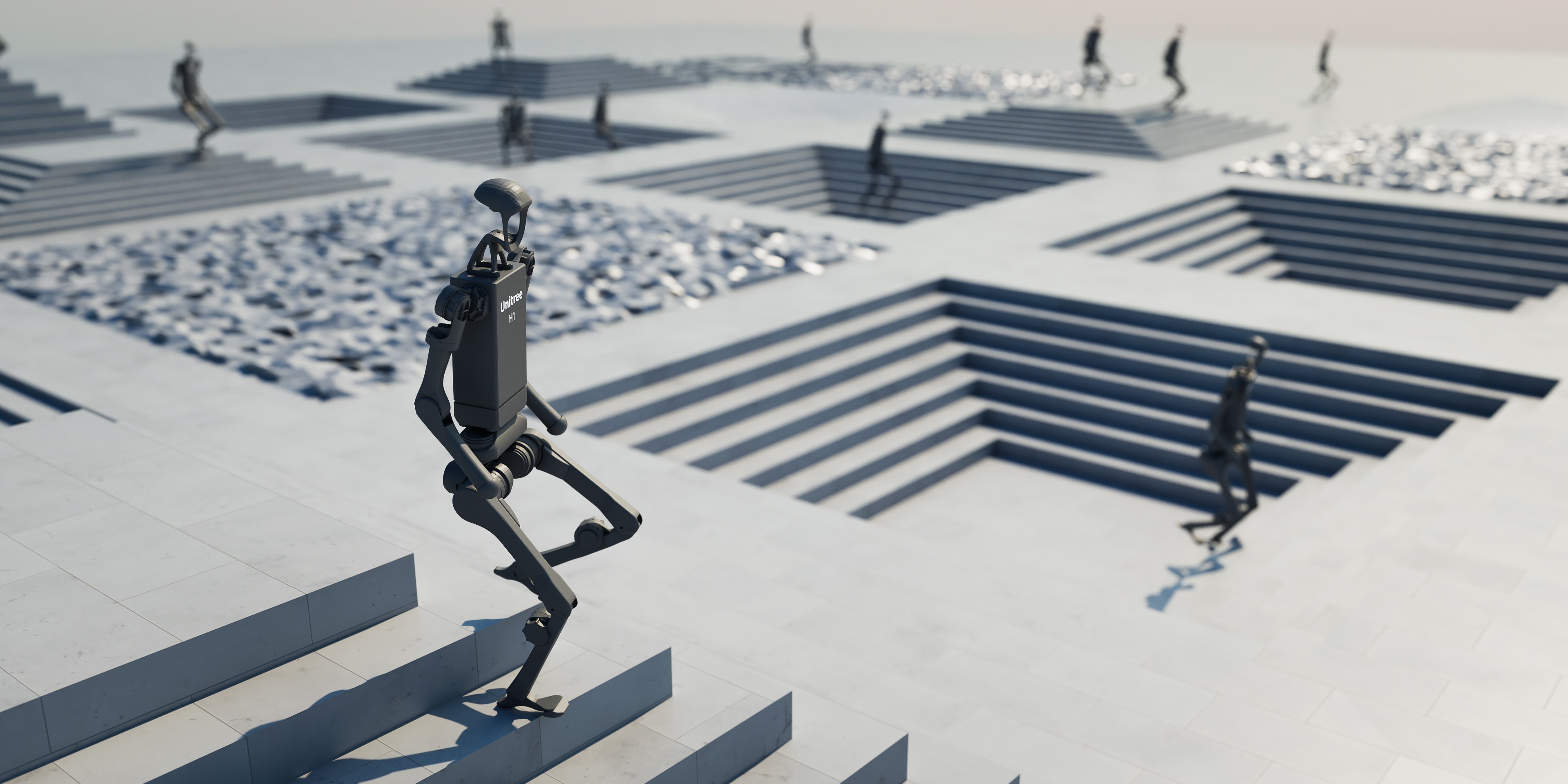
Humanoid parkour policies can traverse various terrains, but task completion may mask challenges of harsh landings, edge contacts, and unstable stance contacts. Humans naturally regulate foot-terrain interaction through tactile feedback, modulating contact compliance according to terrain stiffness. This highlights a key domain gap between humans and humanoid robots: the absence of rich tactile sensing in most humanoid systems. We address this problem with TactileStep, a deployable tactile learning framework that brings sole pressure sensing into humanoid locomotion control for softer touchdowns and more stable support. TactileStep aligns tactile simulation with the real pressure insole, allowing the policy to learn from the same contact features available on hardware. During training, we use tactile and motion cues to recognize different foot-contact phases and apply phase-aware rewards that encourage safer landing and more stable stance. Evaluated in simulation and on a Unitree G1 humanoid across diverse terrains, TactileStep reduces peak touchdown force by up to 48.8% and peak A-weighted impact noise by up to 30.1 dB over a strong perceptive baseline, while increasing stance contact area by up to 23.8%.

cs.ROhumanoidlocomotiontactile

兴趣:humanoid robots and whole-body control

#272026-09-24追踪学者 · Leslie Pack Kaelbling追踪学者 · Tomás Lozano-Pérez84

RAPID: Robot Agentic Programming from Demonstrations

Yuyao Liu, Jiayuan Mao, David Hsu, Leslie Pack Kaelbling, Tomás Lozano-Pérez

Coding agents have demonstrated enormous success in solving complex programming problems. To leverage their potential for robot systems, this work introduces Robot Agentic Programm…

Coding agents have demonstrated enormous success in solving complex programming problems. To leverage their potential for robot systems, this work introduces Robot Agentic Programming from Demonstrations (RAPID), which automatically generates, verifies, and refines robot programs, given a single visual human demonstration. The iterative agentic loop of code refinement requires several key ingredients: (i) a testable task specification, (ii) action primitives for robot execution, and (iii) an interactive environment for program execution and verification. RAPID infers all three from the demonstration automatically. To make the resulting program reusable beyond the demonstration setting, RAPID uses an object-centric relational program representation that focuses on the underlying structure of the demonstrated strategy rather than the specific motion per se: it expresses the action primitives as trajectory-optimization programs that realize object-level motion effects, while composing them through relational constraints that capture scene-specific geometry at run time. We evaluated RAPID in simulation on eight challenging contact-rich nonprehensile manipulation tasks as well as general prehensile manipulation tasks in the LIBERO-Pro benchmark. We also successfully deployed it on a real Franka arm and evaluated on all eight nonprehensile tasks. In all experiments, RAPID demonstrated strong performance, with generalization over object pose, shape, material, and environment. Website: https://yuyaoliu.me/projects/rapid.

cs.ROcs.AIcs.CVrobotmanipulation

追踪学者:Leslie Pack Kaelbling、Tomás Lozano-Pérez;兴趣:imitation learning and diffusion policies for robot control

#282026-09-2484

Real-Time Force Regulation for Whole-Hand Dexterous Grasping

Sang Min Kim, Alexander Alexiev, Tzu-Yuan Lin, Sangbae Kim, Young Min Kim, Yonghyeon Lee

Robust dexterous grasping requires maintaining physical stability despite contacts interactively evolving across the entire hand. A precomputed force distribution can easily fail u…

Robust dexterous grasping requires maintaining physical stability despite contacts interactively evolving across the entire hand. A precomputed force distribution can easily fail under object motion, modeling errors, or external disturbances. In this paper, we present a framework for real-time force regulation over dynamically changing whole-hand contacts. Our method geometrically estimates contacts across all hand links using a tracked object model and proprioception, without requiring tactile sensing at those contacts. It repeatedly recomputes the desired contact-force distribution subject to friction constraints, actuator limits, and an actuation-consistency constraint motivated by classical whole-limb force analysis. We integrate this force-regulation controller with reactive reaching, enabling the hand to acquire a grasp, maintain it under disturbances, and regrasp after losing the object. Simulation experiments without gravity demonstrate improved grasp retention over fixed-allocation and fingertip-only execution under controlled perturbations, while real-world experiments on a 27-DoF arm-hand system demonstrate grasp maintenance and recovery under human-applied disturbances as contacts evolve across the whole hand. Project page: https://sangminkim-99.github.io/reactive-grasp-whole-hand/

cs.ROeess.SYgraspdexteroustactile

兴趣:robot manipulation and grasping with learned policies

#292026-09-2484

CALM: Current Aligned Link Manipulation for Single Arm Oversized Object Lifting

Jun Hu, Sihan Chen, Kosta Jovanovic, David Navarro-Alarcon, Xueqian Wang, Jia Pan 等

Most robots manipulate objects solely with their end effectors, whereas humans flexibly leverage different body parts, such as the forearm and elbow, especially when handling overs…

Most robots manipulate objects solely with their end effectors, whereas humans flexibly leverage different body parts, such as the forearm and elbow, especially when handling oversized objects. Learning such whole-arm manipulation is chal-lenging due to long-horizon sparse rewards, limited contact sens-ing, and the sim-to-real gap in contact and actuator dynamics. To address these challenges, we propose Current-Aligned Link Manipulation, a framework for learning long-horizon contact-rich manipulation using motor current as joint load related feedback. Three stage-specific policies first learn repositioning, grasping, and lifting using privileged simulation information, and a stage router sequences them to generate complete task demonstrations. For sim-to-real transfer, a causal current mapper predicts physical motor current from simulated joint histories, aligning the actuator current observation between simulation and hardware. A unified student policy then learns from these demonstrations using only deployable sensor observations and is further refined with DAgger. The task policies are trained entirely in simulation, and the final student is deployed on hardware. Experiments demonstrate 76.2% (762/1000 trials) complete-task success in simulation and 73.3% success (22/30 trials) on the physical robot for sequential oversized-object lifting.

cs.ROrobotmanipulationsim-to-real

兴趣:robot manipulation and grasping with learned policies

#302026-09-2484

Contact as a Decision Variable: Capability-Tradeoff Contact Selection for Legged Loco-Manipulation

Al Jaber Mahmud, Shuai Li, Xuan Wang

In this paper, we study the joint selection of an environmental support contact and a whole-body configuration for a prescribed loco-manipulation task. A contact may provide greate…

In this paper, we study the joint selection of an environmental support contact and a whole-body configuration for a prescribed loco-manipulation task. A contact may provide greater physical support while restricting the motion required for the task. We formulate this problem through three capability measures: residual wrench, end-effector reach, and base mobility available after satisfying the task requirements, and we balance them against contact acquisition cost. Evaluating these capabilities for every candidate requires repeated whole-body optimizations. To reduce this computational cost, we propose Capability-Tradeoff Contact Selection (CTCS). CTCS screens candidates for contact and task feasibility, groups similar candidates within each surface, and predicts their capabilities from exact anchor evaluations using local sensitivity analysis. It checks these predictions through selective exact evaluations, ranks candidates by capability, and evaluates a shortlist exactly for final selection. We evaluate CTCS in simulations and hardware experiments using a Unitree Go2 quadruped with an AgileX NERO arm across $392$ task conditions with nine available support surfaces. Results show that CTCS outperforms ground-only and fixed-contact support, as it can select support surfaces that provide favorable capability trade-offs for the task. Compared with evaluating every candidate exactly, CTCS achieves approximately $3\times$ speedup while closely matching the resulting mean objective value.

cs.ROmanipulationlegged

兴趣:reinforcement learning for legged locomotion and sim-to-real transfer

#312026-09-2483

Training-free Behavior Cloning

Maximilian Adang, Timothy Chen, Lars Osterberg, Aiden Swann, Mac Schwager

Neural behavior cloning compresses demonstrations into large models, making individual actions difficult to trace and policy updates costly. Retrieval policies retain access to dem…

Neural behavior cloning compresses demonstrations into large models, making individual actions difficult to trace and policy updates costly. Retrieval policies retain access to demonstrations but struggle with mismatch between recorded and live behavior. We introduce Behavior Predictive Control (BPC), which synthesizes policies without end-to-end policy training by combining an action-aware retrieval metric, a Hankel-based action-continuation prior, and a closed-form one-step residual correction. Inspired by behavioral systems theory, BPC predicts future actions by blending stored observation-action data that best reconstructs the recent runtime observation--action history. Across simulated benchmarks and real-robot deployments, BPC is competitive with learned policies such as $π_{0.5}$ (surpassing it in some cases), while reducing policy fitting from hours to seconds on consumer GPUs and supporting closed-loop control upwards of 75 Hz on a Jetson Orin Nano. The retrieved demonstration windows and their coefficients also provide an intrinsic estimate of task progress. Retaining demonstrations within the deployed policy makes its predictions traceable to supporting trajectories and enables behavior revision through the demonstration bank.

cs.ROrobot

兴趣:imitation learning and diffusion policies for robot control

#322026-09-2483

Echo in the Steps: Learning Perceptive Humanoid Parkour with Gated Memory

Ming-Ju Lee, Zizhuo Wang, Shaoting Zhu, Haozhe Lou, Hang Zhao, Yiming Li

While recent advances in perceptive locomotion have enabled humanoid robots to traverse structured terrains, agile parkour in highly discontinuous environments remains an open chal…

While recent advances in perceptive locomotion have enabled humanoid robots to traverse structured terrains, agile parkour in highly discontinuous environments remains an open challenge. In particular, crossing sparse footholds and narrow support regions requires precise foothold selection, effective use of visual observations, and consistent alternating foot placement during fast transitions. In this paper, we present a perceptive humanoid parkour framework that enables stable traversal across terrains with limited foothold availability using only onboard depth observations. The framework features a saliency-guided temporal perception module that combines a saliency prior with gated memory. It retains informative depth features across frames, enabling reliable foot placement from partial observations. By introducing an alternation loss, our symmetry regularization encourages alternating gait patterns and improves traversal robustness. Extensive experiments show that our method significantly improves success rate and foothold accuracy on challenging terrains in both simulation and the real world.

cs.ROhumanoidlocomotion

你点赞过:TANGO: Humanoid Navigation in Cluttered Environments with a

#332026-09-2483

GRASP: Generating, Revising, and Assessing for Strategic Planning with Agentic AI

Arunabh Srivastava, Mohammad A., Khojastepour, Srimat Chakradhar, Sennur Ulukus

Large Language Models (LLMs) typically exhibit a performance profile where reliability degrades as task complexity increases. We address the challenge of generating high-quality na…

Large Language Models (LLMs) typically exhibit a performance profile where reliability degrades as task complexity increases. We address the challenge of generating high-quality natural language executable plans for complex tasks by introducing $GRASP$, a strategy-aware, multi-stage planning framework. GRASP decouples the planning pipeline across specialized, context-isolated modules: it pre-compiles global macro-guidelines (GenPlan), explores alternative localized strategies within isolated context windows (RevPlan), and independently evaluates trajectories using a multi-criteria discriminator (VerPlan). Empirical evaluations show that GRASP consistently establishes a new state-of-the-art frontier across diverse datasets, yielding substantial accuracy gains over direct LLM planners on Natural Plan Calendar Scheduling ($\sim$12.4$%$$\uparrow$), ZebraLogic ($\sim$30.8$%$$\uparrow$), and SciBench Math. Crucially, under multi-task scaling-where standard planners suffer immediate performance collapse-GRASP completely flattens the multi-task degradation penalty. In interleaved dual-task environments, GRASP achieves an absolute accuracy gain of up to 16.7$%$ over direct LLM planners. Furthermore, by isolating context and enforcing strict macro-regularization, GRASP outperforms frontier reasoning models (such as GPT-5-mini) by a margin of 14.5$%$.

cs.AIcs.CLcs.LGcs.MAgrasp

兴趣:large language models for robot task planning and reasoning

#342026-09-2482

Body-Grounded Replanning for Physically Adaptive Manipulation

Namiko Saito, Hiroshi Kera

Manipulation requires not only reasoning about the external environment, but also about the robot's physical condition. A strategy may remain geometrically feasible while becoming …

Manipulation requires not only reasoning about the external environment, but also about the robot's physical condition. A strategy may remain geometrically feasible while becoming physically unsuitable due to increased joint load or limited mobility, yet internal physical state is typically used only for low-level control. We propose body-grounded high-level replanning, which uses internal physical state to adapt manipulation strategies during execution. Body-state events trigger strategy replanning, and an LLM interprets the underlying joint-level state, recent execution statistics, and execution history to select a context-dependent alternative, while leaving the task objective and low-level controller unchanged. We evaluate the framework on a reaching task under controlled load and asymmetric mobility constraints in simulation and on a real robot. Our experiments show that body-grounded replanning maintains high task success while reducing physical effort and enabling more efficient strategy adaptation. Additional contact-rich manipulation experiments demonstrate the applicability of the same replanning interface beyond reaching. These results show that internal physical state can inform not only low-level control, but also high-level decisions about how a manipulation task should be performed.

cs.ROrobotmanipulation

兴趣:robot manipulation and grasping with learned policies

#352026-09-2382

DeltaWAM: Delta World Action Models for Bimanual Manipulation

Han Yan, Zishang Xiang, Haokai Jiang, Zeyu Zhang, Qilin Wang, Weiyu Guo 等

World-action models (WAMs) transfer visual and motion priors from pretrained video generators to robot control by jointly modeling visual dynamics and actions. Existing WAMs, howev…

World-action models (WAMs) transfer visual and motion priors from pretrained video generators to robot control by jointly modeling visual dynamics and actions. Existing WAMs, however, predict dense future frames during training, repeatedly modeling largely unchanged content and coupling action-conditioned dynamics to nuisance appearance variations. At inference, processing each complete observation with the heavy video expert bottlenecks few-step action generation. Accordingly, we propose DeltaWAM, which jointly predicts visual deltas and actions using dense-anchor, sparse-delta, and action streams, with three architectures that differ in representation and computation sharing. We further develop Streaming Delta Memory (SDM), which updates cached anchor context with compact observed deltas, reducing heavy video-expert processing. On RoboTwin, DeltaWAM with SDM improves average success over Fast-WAM from 81.3% to 85.4% in the clean setting and from 75.8% to 83.9% under visual randomization. The three architectures reduce training FLOPs by 17.78-23.77%, while SDM reduces one-step inference latency and FLOPs by 36.57% and 31.55%, respectively; real-world evaluations further show the highest overall success rate and normalized progress among the evaluated policies. Code: https://github.com/AIGeeksGroup/DeltaWAM. Website: https://aigeeksgroup.github.io/DeltaWAM.

cs.CVcs.ROrobotmanipulation

兴趣:world models and video prediction for embodied agents

#362026-09-2481

Faster Visuomotor Policy Learning on Action Manifolds via Riemannian MeanFlow

S. Talha Bukhari, Austin Garrett, Yi Wei, Ruiqi Ni, Zachary Kingston, Aniket Bera

Visuomotor policies learn a direct map from raw sensory observations to robot action sequences. Policies based on Diffusion and Flow Matching capture the multimodal distribution ov…

Visuomotor policies learn a direct map from raw sensory observations to robot action sequences. Policies based on Diffusion and Flow Matching capture the multimodal distribution over action sequences in an end-to-end manner. This expressivity comes at the cost of multi-step numerical integration of the learned vector field for action generation, which can be expensive and time-consuming, impeding fast control rates required in robotics applications. Furthermore, robot action sequences are usually defined on a smooth, differentiable manifold, requiring that the learned policy respects the intrinsic geometry of the robot's action space. Here, we present Riemannian MeanFlow Policy (RMFP), which learns the conditioned flow map of the probability path on the robot action manifold. Our formulation employs a flow map consistency objective grounded in the data by a Riemannian Conditional Flow Matching anchor. The flow map consistency condition is stable to train and constrains the learned model to finite-time transport, which yields on-manifold action sequence generation with as few as one network function evaluation. We present results on the spherical LASA and Push-T benchmarks, on the Tool Hang and Transport tasks of the Robomimic suite, and on the Franka Kitchen task with manifold-constrained action generation, and demonstrate that RMFP attains performance competitive with prior work at a lower sampling cost. We also employ RMFP on a real-world robotic manipulation task to demonstrate fast action generation under imperfect sensor measurements in the physical world.

cs.ROrobotmanipulation

兴趣:imitation learning and diffusion policies for robot control

#372026-09-2480

Robots That Take Initiative: A Framework for Building and Evaluating Proactive Robots

Maithili Patel, Sonia Chernova

Effective robot assistance beyond narrow roles and repetitive tasks requires robots to be proactive - to decide what needs to be done rather than waiting to be told. While proactiv…

Effective robot assistance beyond narrow roles and repetitive tasks requires robots to be proactive - to decide what needs to be done rather than waiting to be told. While proactivity is increasingly explored, it lacks a unified formulation, and work in the domain is typically evaluated offline against static human models that cannot capture the effect of a robot's actions on the environment and the user's own behavior. We introduce a unified formalism for proactive robot assistance, organize it into three levels, and provide a framework to address the highest level of unprompted proactive assistance. We then show that offline evaluation overstates performance in this setting, and contribute a closed-loop evaluation with a human model that adapts to the robot. Finally, we present a method, GAP, that instantiates our framework, learning from passive observation to anticipate user goals and act. Under closed-loop evaluation, prior state-of-the-art methods collapse, in some cases adding more work than they save, while GAP remains robust and substantially outperforms them.

cs.ROcs.AIrobot

兴趣:imitation learning and diffusion policies for robot control

#382026-09-2479

RACaP: Agentic Reasoning, Acting, and Coding as Policies for Evolvable Robot Learning

Zexi Li, Yehang Zhang, Haojian Huang, Bohan Zhou, Wenqian Li, Chenxu Wang 等

General-purpose robot agents must learn from experience, transfer to new tasks, and act efficiently. Code as Policies (CaP) methods generate and repair programs at runtime, incurri…

General-purpose robot agents must learn from experience, transfer to new tasks, and act efficiently. Code as Policies (CaP) methods generate and repair programs at runtime, incurring latency and entangling reusable mechanisms with task-specific decisions. We introduce RACaP, an agentic framework that moves coding to evolution and uses a Reasoning-and-Acting (ReAct) loop to call frozen, typed Policy APIs at deployment. A two-phase strategy combines capability curriculum learning with autonomous self-evolution to improve the APIs, the ReAct harness, and experience memory. The APIs encode reusable physical mechanisms while exposing arguments for runtime adaptation. ReAct combines task-specific working memory, long-term experience memory, and visual feedback to select actions, verify outcomes, and recover from failures without modifying source code. RACaP achieves 54.4% success on LIBERO-90, 45.0% on zero-shot LIBERO-PRO, and 46.0% on LIBERO-Long, compared with at most 4.0% for CaP baselines on long-horizon tasks. On LIBERO-PRO, it achieves 2.5 times the success rate of CaP baselines and a 1.9-fold speedup in median policy time. For efficient on-robot deployment, rejection-sampled fine-tuning distills GPT-5.6 ReAct decisions into Qwen3-VL-8B-Instruct, yielding a 13.2-fold per-decision inference speedup and reducing repeated physical calls from 16 to 4. These results show that separating reusable code from runtime decisions supports continued evolution, effective transfer, and efficient long-horizon control.

cs.ROrobot

兴趣:imitation learning and diffusion policies for robot control

#392026-09-2479

Outcome-Sensitive Motion Search for Impact-Aware Dexterous Catching

Guorui Pei, Jinsong Wu, Songyuan Su, Jiaming Qi, Sichao Liu, David Navarro-Alarcon 等

Skilled humans can catch fast-moving objects softly by coordinating interception, velocity matching, and follow-through to mitigate impact. Learning such impact-aware catching with…

Skilled humans can catch fast-moving objects softly by coordinating interception, velocity matching, and follow-through to mitigate impact. Learning such impact-aware catching with reinforcement learning (RL), however, is challenging, as the policy must achieve reliable interception and grasping while regulating the sensitive transition into contact. Moreover, even a capable privileged-state RL teacher may not provide ideal demonstrations for a deployable imitation-learning (IL) student: teacher failures limit task coverage, while small variations in pre-contact motion can produce substantially different impact and grasping outcomes. We characterize this phenomenon through interventional outcome sensitivity and introduce the outcome-sensitive window (OSW) to guide targeted demonstration construction. Building on this formulation, we propose Outcome-Sensitive Motion Search, which learns a task-conditioned manifold of successful OSW motions and performs local geodesic search to refine successful teacher rollouts and repair task conditions where the teacher fails. We then validate candidate motions through complete rollouts under a calibrated IL-student action-error model and retain only successful executions as demonstrations. Extensive simulation experiments demonstrate that our method effectively repairs task conditions where the teacher fails and enables the resulting IL policy to outperform the privileged RL teacher in both catching success and impact mitigation.

cs.ROdexterous

兴趣:robot manipulation and grasping with learned policies

#402026-09-2478

BeyondRetarget: Learning Executable Humanoid Motions Directly from Monocular Video

Tianyu Xiong, Yi Lu, Jinrui Wang, Ziqi Liang, Dandan Lei, Xiaoyang Zhou 等

Learning executable motions from human videos offers a scalable solution for humanoid robots to acquire demonstration motions. However, existing pipelines typically first construct…

Learning executable motions from human videos offers a scalable solution for humanoid robots to acquire demonstration motions. However, existing pipelines typically first construct an explicit human motion representation and then convert it into robot motions via motion retargeting. Although such methods can effectively leverage large volumes of existing human data for training, the substantial differences between humans and humanoid robots in locomotion mechanisms and joint degree-of-freedom configurations make motions generated by this human-representation-centric approach difficult to execute on robots. Furthermore, errors introduced during human motion estimation inevitably propagate to the retargeting stage and cannot be eliminated via joint optimization. We propose BeyondRetarget, an end-to-end framework that directly maps monocular RGB videos to robot motions. Discarding the explicit human representation, this framework learns robot-oriented implicit representations directly from visual observations, enabling the model to capture cross-morphology motion structures. To generate motions more suitable for robot execution, we further design a contact-aware motion optimization mechanism to improve temporal consistency and physical plausibility. Experiments show that BeyondRetarget significantly improves the accuracy and robustness of generated robot motions, while achieving higher execution success rates and lower latency in both simulation environments and real humanoid robots.

cs.ROcs.CVrobothumanoidlocomotion

兴趣:humanoid robots and whole-body control

#412026-09-2378

Looks the Same, Answers Differently: Flip-Direction Steering for Robust Vision-Language Reasoning

Yeonsung Jung, Joonhyun Jeong, Hoang Pham, Joowon Kim, Yoonsik Park, Viet Dac Lai 等

Vision-language models (VLMs) achieve strong visual reasoning performance, yet subtle changes from routine image capture and processing can alter their reasoning trajectories even …

Vision-language models (VLMs) achieve strong visual reasoning performance, yet subtle changes from routine image capture and processing can alter their reasoning trajectories even when images appear nearly identical. In long-horizon generation, the resulting activation shifts may accumulate across decoding steps, progressively altering reasoning tokens and ultimately changing the final answer, a phenomenon referred to as answer flips. To address this instability, we propose FlipDir (Flip-Direction Steering), a training-free inference-time method that estimates a low-rank flip-inducing activation subspace from contrastive pairs of original and answer-flipping inputs and selectively steers hidden states during decoding. A margin-based gate limits subspace attenuation to uncertain decoding steps, recovering original predictions while preserving stable ones. To evaluate robustness beyond accuracy or consistency on fixed test sets, we introduce VisFlip, a benchmark framework that constructs evaluation groups for a target model and visual variation setting to separately assess recovery of original predictions and preservation of stable ones. VisFlip spans nine dataset-variation combinations across scientific reasoning, robot-scene understanding, and medical VQA, covering subtle visual variations common in each domain. Experiments across 18 settings demonstrate that FlipDir consistently outperforms existing methods on the combined recovery and preservation metric. We will make our code publicly available.

cs.CVrobot

兴趣:vision-language-action (VLA) models and foundation models for robots

#422026-09-2477

RoboRecover: Benchmarking Robot Policy Recovery under Execution Deviations

Yang Li, Chen Zhao, Zhuoran Wang, Jiankang Wang, Chao Shao, Yihan Lin 等

Robot-policy benchmarks increasingly cover diverse tasks and preset out-of-distribution conditions, but typically evaluate complete trajectories from predefined initial states. The…

Robot-policy benchmarks increasingly cover diverse tasks and preset out-of-distribution conditions, but typically evaluate complete trajectories from predefined initial states. These evaluations often focus on the initialized scene and the final outcome, while paying less attention to the dynamic interaction process. During closed-loop execution, actions and contacts can alter object relations and task progress, producing off-nominal intermediate states that need recovery. Recovery requires a policy to infer how task progress has changed, correct the relevant relations, and continue the original goal. We introduce RoboRecover, a benchmark for robot policy recovery under execution deviations. RoboRecover selects deviation states from trajectories, reconstructs them by replaying action prefixes, and evaluates policies on the original task. RoboRecover contains 2,000 scenarios across RoboTwin and LIBERO, with 1,000 scenarios and a fixed 800/200 train/test split on each platform. Results show that initial-state performance does not determine recovery performance and policies exhibit different recovery strengths across scenarios. Using its training split, RoboRecover further supports study on recovery interventions. RoboRecover establishes recovery from execution-induced intermediate states as a distinct dimension of robot policy evaluation.

cs.ROrobot

兴趣:imitation learning and diffusion policies for robot control

#432026-09-2477

A Support-Enhanced Granular-Jamming Gripper for RL-based Grasping with Continuum Manipulators

Danyu Liu, Tianlin Zhang, Wei Chen, Wei Tang, Kecheng Qin, Zhongyu Li

Continuum manipulators provide dexterous motion in confined spaces, but structural compliance, hysteresis, and load-dependent deformation leave residual position and orientation er…

Continuum manipulators provide dexterous motion in confined spaces, but structural compliance, hysteresis, and load-dependent deformation leave residual position and orientation errors that can undermine reliable contact with rigid grippers. To address this limitation, this paper presents a lightweight support-enhanced granular-jamming gripper tailored to a continuum manipulator. The gripper maintains compliance before jamming while establishing a direct load path to the continuum manipulator tip after jamming. To improve its grasping performance, we systematically designed membrane materials, particles, filling ratios, and the internal support structure, and further identify geometry-dependent grasp boundaries with respect to contact offset and object shape. Building on these results, we construct a physical manipulation system integrating the continuum manipulator, granular-jamming gripper, visual feedback, tendon actuation, and pneumatic control. We then train a reinforcement-learning-based reaching controller in a randomized simulation and deploy it on the physical system, demonstrating how positioning control and contact level mechanical adaptation can complement each other in a modular grasp-and-release task. By introducing an adaptive structure that relaxes the need for highly accurate modeling and positioning control, this work explores a design paradigm that integrates physical and embodied intelligence.

cs.ROmanipulationgraspembodieddexterous

兴趣:robot manipulation and grasping with learned policies

#442026-09-2377

Uncertainty-Gated Exploration Noise Suppresses Task Collapse in Online RL Fine-Tuning of a Flow-Matching Vision-Language-Action Policy

Mehmet Turan Yardımcı, Yunus Emre Çoğurcu

Online reinforcement learning fine-tuning of pretrained flow-matching vision-language-action (VLA) policies promises robots that keep learning after deployment, but continued updat…

Online reinforcement learning fine-tuning of pretrained flow-matching vision-language-action (VLA) policies promises robots that keep learning after deployment, but continued updates often destroy competence on individual tasks while the aggregate still looks healthy. We study this failure mode, which we call task collapse, under a matched small-compute budget on LIBERO-10 with a 450M-parameter SmolVLA policy trained by PPO with stochastic (SDE) sampling. Three exploration-noise policies differ in one live variable: a fixed noise scale, a ReinFlow-style learned noise network, and an uncertainty-gated controller that redistributes exploration across task streams from task-agnostic novelty and competence signals, without task labels or episode boundaries. Under the pooled definition, fixed noise collapses tasks in two of three seeds and learned noise in every seed measured to iteration 200, while the controller collapses none in any of its three seeds. Measured parameter displacement shows the controller's action expert keeps changing, while its mean applied noise is close to the fixed scale in the available logs. The matched comparison supports the controller's effect on task preservation; the separate contributions of its adaptation across states and over time are not disentangled. A lower fixed scale slows the decline but does not stop it. No arm improves on the behavior-cloning baseline in this budget. Two properties of that regime are measured beside this result, not offered as its cause: following the reference recipe, training runs in bfloat16 with no fp32 master copy, under which 96.02% of the action expert's elements stay bit-identical across three consecutive iterations, and an fp32 master copy at the reference learning rate collapses both arms in a single-seed observation. We release tools measuring per-task collapse under four definitions, rescoring noise and instrument tares.

cs.ROcs.LGVLAvision-language-action

兴趣:imitation learning and diffusion policies for robot control

#452026-09-2477

CAMP: Cooperative Arm-Hand Motion Planning in Constrained Spaces

Ziyuan Wang, Yunlong Shan, Fei Mo, Sichao Liu, David Navarro-Alarcon, Jia Pan 等

Coordinated arm-hand motion planning is fundamental to dexterous robotic manipulation in complex and constrained environments. A straightforward solution is to decompose the proble…

Coordinated arm-hand motion planning is fundamental to dexterous robotic manipulation in complex and constrained environments. A straightforward solution is to decompose the problem into separate arm path planning and hand motion generation; however, this poses a dilemma: decomposition can miss feasible solutions that require coordinated arm-hand adaptation along the path. Alternatively, directly planning in the high-dimensional joint arm-hand configuration space captures such coupling but faces a substantially enlarged search space and nonconvex collision constraints. To characterize this coupling, we formulate feasible hand fibers that capture collision-free hand configurations for each arm configuration. Based on this formulation, we propose CAMP, a high-success and efficient cooperative arm-hand motion planner for constrained environments. CAMP constructs candidate trajectories through layered hand search with local arm relaxation, then compactly represents them using endpoint-preserving via-point movement primitives (VMPs) for coarse-to-fine joint optimization. Across six constrained simulation tasks, CAMP achieves 84.2-98.5% planning success, outperforming alternative planners with competitive efficiency. Ablation studies verify the contributions of arm relaxation, VMP representation, and coarse-to-fine optimization, while real-robot experiments demonstrate CAMP on constrained manipulation tasks. The project website is available at https://camp-armhand.github.io/.

cs.ROrobotmanipulationdexterous

兴趣:robot manipulation and grasping with learned policies

#462026-09-2476

Seeing Is Not Measuring: Tool-Augmented Metric Spatial Reasoning for Vision-Language Models

Kai Glantz, Clemens Grange

Vision-Language Models (VLMs) describe scenes well but reason poorly about metric 3D structure such as absolute distances, physical sizes, or egocentric directions. We present a mo…

Vision-Language Models (VLMs) describe scenes well but reason poorly about metric 3D structure such as absolute distances, physical sizes, or egocentric directions. We present a modular, predictor agnostic, tool-augmented framework that equips a small VLM (Qwen3.5-4B) with geometric tools: 3D object detection, metric depth estimation, and deterministic solvers for distance, size and bearing. Each object is detected in the camera frame of its own best view, and the tools use that frame's pose to lift every detection into one shared world frame. Moving metric computation out of the model's weights and into explicit solvers yields large gains on three of four ReVSI-Bench tasks: with a strong monocular detector (WildDet3D), absolute distance rises from 0.46 to 0.74 Mean Relative Accuracy (MRA), relative distance from 39.1% to 67.4%, and relative direction from a below-chance 25.9% to 73.4%. Because any detector can be swapped in behind the tool interface, comparing real detectors against ground-truth boxes separates perception error from reasoning error: orchestration costs only 0.03 MRA. Object size is bounded by the detector: the tools are near-exact on groundtruth boxes (0.97) yet the best real detector barely beats the no-tool baseline (0.61 vs. 0.58), because size reads straight off a box extent monocular detectors get wrong. Without a predefined recipe, the model already sequences the tools correctly on its own, matching a scripted pipeline on three of four tasks.

兴趣:3D perception, point clouds and scene understanding for robotics

#472026-09-2475

A Simple Gripper Interface for Simulator-Agnostic Cloth Manipulation

Abhilash Nayak, Franco Coltraro, Maria Alberich-Carramiñana, Carme Torras

This paper presents a grasping model for cloth manipulation specifically tailored to ease the deployment of robotic control methods. The model is robust, fast and easy to implement…

This paper presents a grasping model for cloth manipulation specifically tailored to ease the deployment of robotic control methods. The model is robust, fast and easy to implement avoiding at the same time contact and friction considerations between the gripper and the cloth in favor of simple positional constraints. The gripper is described by its pose, jaw state, and an attached grasping volume. Two kinds of grasping volumes are considered: an axis-aligned box to simulate a pinch grasping and a square pyramidal volume to simulate point grasping. When the gripper closes, the discrete cloth positions lying inside this volume are selected, stored in the local gripper frame, and then transported with the gripper motion. A simple squeezing step is also included to progressively move the selected cloth positions toward the center of the grasping region, avoiding an instantaneous displacement at closure. The model can be used in any simulator as it only requires access to discrete cloth positions and a mechanism for imposing target positions as constraints. We implement our grasping model in conjunction with a constraint-based inextensible cloth simulator, where grasping is implemented as moving positional equality constraints coupled with stretch, shear, collision, and table contact projection steps. The same gripper trajectory is applied on a robot arm to fold a real piece of cloth, serving as a simple bridge between simulation and physical cloth manipulation and showcasing the realism and practicality of our idealized grasping model.

cs.ROrobotmanipulation

兴趣:robot manipulation and grasping with learned policies

#482026-09-2475

M3GD: Multi-Modal Multi-View Geometric Diffusion for Camera--LiDAR Novel View Synthesis

Yang Zhou, Jiuhong Xiao, Shizhao Ye, Long Quang, Carlos Nieto-Granda, Giuseppe Loianno

Robotic novel view synthesis (NVS) must recover both visual appearance and metric 3D structure, yet most generative NVS methods rely only on images, overlooking LiDAR, a complement…

Robotic novel view synthesis (NVS) must recover both visual appearance and metric 3D structure, yet most generative NVS methods rely only on images, overlooking LiDAR, a complementary sensor common on robotic platforms. We present M3GD, a Camera--LiDAR multimodal representation for generative NVS that composes independently pretrained 2D image and 3D point-cloud foundation models without separately pretraining a cross-modal translator. We show that, after camera projection, frozen LiDAR and image features exhibit substantial shared spatial structure, providing a natural cross-modal representation. M3GD conditions generation on LiDAR through this structure: it combines explicit geometry statistics with learned point-cloud descriptors into view-aligned packets on the image-latent grid, injected through a lightweight residual adapter into a multi-view flow-matching generator whose latent space, decoders, and training objective remain intact. On the GrandTour dataset, M3GD improves target-view RGB and depth synthesis over an image-only version of the same backbone. Ablations show that the gains come from pixel-aligned LiDAR content and that target-view LiDAR acts as a geometric query linking the requested view to source observations. Deployment on a ground robot demonstrates practical real-world operation, with a configurable quality--cost trade-off controlled by the number of Euler integration steps.

cs.ROcs.CVrobot

兴趣:3D perception, point clouds and scene understanding for robotics

#492026-09-24追踪学者 · Yang Gao75

AD-WM: Action-Discriminative World Models for Counterfactual Model Predictive Control

Jiabin Qiu, Zixuan Chen, Hongye Cao, Jieqi Shi, Jing Huo, Yang Gao

Latent world models are typically trained to predict factual transitions, whereas model predictive control (MPC) must compare alternative actions from the same state. A model can t…

Latent world models are typically trained to predict factual transitions, whereas model predictive control (MPC) must compare alternative actions from the same state. A model can therefore achieve low factual prediction error yet poorly distinguish candidate actions. We introduce AD-WM, an action-discriminative joint-embedding world model for counterfactual MPC. AD-WM combines residual latent dynamics with predictor-level action-recovery regularization, using inverse dynamics and a normalized recovery objective motivated by conditional mutual information. Both objectives encourage planning transitions to preserve action information; their auxiliary heads are discarded at test time, leaving MPC unchanged. On OGBench-Cube, AD-WM improves hard-start success from 3.7% to 52.0% over a matched LeWM baseline and improves mean success over the reproduced baseline in four of five simulation environments. Planning diagnostics show that factual prediction error and whole-bank action ranking do not follow the closed-loop success ordering, whereas CEM-aligned elite regret tracks success more closely. With a frozen V-JEPA 2 encoder and matched DROID post-training, AD-WM also improves zero-shot transfer to our Franka setup, increasing basic pick-and-place success from 42.2% to 71.1% without lab-specific adaptation. These results suggest that world models for planning should preserve action-dependent differences needed for counterfactual selection, rather than optimize factual prediction accuracy alone. More videos and code are available at https://ad-wm.github.io/.

cs.AIcs.ROworld model

追踪学者:Yang Gao;兴趣:world models and video prediction for embodied agents

#502026-09-2374

Training Object Permanence in World Models

Haotian Zhang, Fengyuan Yu, Dezhi Luo, Haoran Sun, Zehong Zhao, Qingying Gao 等

Object permanence and solidity are hallmarks of human cognitive priors. Recent studies show that video generation models, a paradigmatic class of current world models, have begun t…

Object permanence and solidity are hallmarks of human cognitive priors. Recent studies show that video generation models, a paradigmatic class of current world models, have begun to show emerged reasoning abilities, making them ideal candidates for building human-like physical intelligence. Do video models have emerged object permanence in them? If not, could we train them with a core-cognition inspired dataset? We introduce WROP (World Reasoning with Object Permanence), a data infrastructure of 150 hand-designed cognitive science inspired tasks, divided into six cognitive categories. We build Blender generators that randomize speed, lighting, camera angle, and other nuisance parameters while preserving each task's cognitive structure, yielding 10,000+ samples per task. We release a 1.5M-sample training corpus and a 300-question exam. On this exam we evaluate 14 video models: 3 reference-to-video, 7 edit, and 4 continuation, among which PWM-WROP, our 16B world model. In a blind pairwise Elo study, PWM-WROP ranks first among continuation models and third overall, behind only a statistical tie between two reference-to-video models. We release the data, exam, model answers, scores, weights, and PWM, our native-PyTorch training stack on AWS Trainium2.

cs.AIcs.CVworld model

兴趣:world models and video prediction for embodied agents

GitHub 项目

#12026-08-31★ 5.1k +502新项目78

Human-Agent-Society/reef

Python

Continual learning infra for self-improving agents

Continual learning infra for self-improving agents

agent-infrastructureai-agentscontinual-learninginferencellmllm-trainingreinforcement-learningself-improving-agents

兴趣:multi-agent systems and LLM agents

#22026-08-26★ 339 +11新项目76

OpenMOSS/EasyWAM

Python

A unified framework for training, fine-tuning, and evaluating World Action Models

A unified framework for training, fine-tuning, and evaluating World Action Models

benchmarkcodebaseembodied-aifoundation-modelsloraroboticsvision-language-actionworld-action-modelvision-language-actionembodied

兴趣:vision-language-action (VLA) models and foundation models for robots

#32024-12-08★ 3.8k +1174

datawhalechina/every-embodied

Python

仅需Python基础,从0构建自己的具身智能机器人;从0逐步构建VLA/OpenVLA/SmolVLA/Pi0, 深入理解具身智能

仅需Python基础,从0构建自己的具身智能机器人;从0逐步构建VLA/OpenVLA/SmolVLA/Pi0, 深入理解具身智能

embodied-agentembodied-aiembodied-intelligenceopenvlasmolvlavision-language-action-modelVLAvision-language-actionembodied

兴趣:world models and video prediction for embodied agents

#42026-07-19★ 602 +574

RealXiaoze/humanoid-motion-intelligence

人形机器人运动智能论文、开源项目、产业与求职知识库

人形机器人运动智能论文、开源项目、产业与求职知识库

embodied-aihumanoid-roboticslocomotionmotion-controlreinforcement-learningrobot-learningsim2realvlarobotVLAhumanoidlocomotionembodied

兴趣:humanoid robots and whole-body control

#52025-10-09★ 3.7k +474

starVLA/starVLA

Python

StarVLA: A Lego-like Codebase for Vision-Language-Action Model Developing

StarVLA: A Lego-like Codebase for Vision-Language-Action Model Developing

robotic-foundation-modelroboticsvision-language-action-modelworld-action-modelvision-language-action

兴趣:vision-language-action (VLA) models and foundation models for robots

#62026-09-13★ 77 +48新项目73

ZJU-OmniAI/Spatial-Interactor

Python

Learning Spatial Reasoning through Interaction with the Observable Physical World

Learning Spatial Reasoning through Interaction with the Observable Physical World

embodied-aion-policy-distillationspatial-reasoningvideo-understandingvision-language-modelembodied

兴趣:world models and video prediction for embodied agents

#72025-11-23★ 652 +273

sou350121/VLA-Handbook

HTML

本项目旨在为致力于进入VLA(Vision-Language-Action)领域的算法工程师提供一份全中文、实战导向的学习/面试手册。 不同于通用的 CV/NLP 面试指南,本项目聚焦于 Robotics 特有的挑战

本项目旨在为致力于进入VLA(Vision-Language-Action)领域的算法工程师提供一份全中文、实战导向的学习/面试手册。 不同于通用的 CV/NLP 面试指南,本项目聚焦于 Robotics 特有的挑战

chinesedeep-learningembodied-aillmrobot-learningroboticsvision-language-actionvlarobotVLAvision-language-actionembodied

兴趣:vision-language-action (VLA) models and foundation models for robots

#82026-08-29★ 75 +1新项目73

OpenBMB/SimpleMemVLA

Python

Native-video memory for vision-language-action models, using timestamped visual history and exact streaming inference for long-horizon robot manipulation.

Native-video memory for vision-language-action models, using timestamped visual history and exact streaming inference for long-horizon robot manipulation.

embodied-ailong-horizon-roboticsmultimodal-learningnative-video-memoryrobot-learningrobot-manipulationstreaming-inferencevideo-understandingrobotmanipulationVLAvision-language-actionembodied

兴趣:vision-language-action (VLA) models and foundation models for robots

#92024-02-29★ 161 +172

RobotControlStack/robot-control-stack

Python

A lean, ROS-free sim-to-real framework for training and deploying Vision-Language-Action (VLA) models and RL agents. Native MuJoCo Gymnasium wrappers with synchronous execution for…

A lean, ROS-free sim-to-real framework for training and deploying Vision-Language-Action (VLA) models and RL agents. Native MuJoCo Gymnasium wrappers with synchronous execution for Franka, UR5e, xArm, SO101 and YAM.

frankagymnasiummujocoreinforcement-learningrobot-learningrobot-manipulationsim-to-realvision-language-actions-modelsrobotmanipulationVLAvision-language-actionsim-to-real

兴趣:vision-language-action (VLA) models and foundation models for robots

#102026-03-18★ 57.1k +1.2k72

rohitg00/ai-engineering-from-scratch

Python

Learn it. Build it. Ship it for others.

Learn it. Build it. Ship it for others.

agentsaiai-agentsai-engineeringcomputer-visioncoursedeep-learningfrom-scratch

兴趣:multi-agent systems and LLM agents

#112024-01-26★ 27.8k +2371

huggingface/lerobot

Python

🤗 LeRobot: Making AI for Robotics more accessible with end-to-end learning

🤗 LeRobot: Making AI for Robotics more accessible with end-to-end learning

兴趣:imitation learning and diffusion policies for robot control

#122026-07-06★ 2.2k +171

dexmal/opendm

Python

An Open-World Foundation Model for General-Purpose Embodied Intelligence.

An Open-World Foundation Model for General-Purpose Embodied Intelligence.

embodied-aiembodied-intelligenceroboticsvision-language-actionvlaVLAvision-language-actionembodied

兴趣:vision-language-action (VLA) models and foundation models for robots

#132025-01-16★ 3.6k +470

jonyzhang2023/awesome-embodied-vla-va-vln

A curated list of state-of-the-art research in embodied AI, focusing on vision-language-action (VLA) models, vision-language navigation (VLN), and related multimodal learning appro…

A curated list of state-of-the-art research in embodied AI, focusing on vision-language-action (VLA) models, vision-language navigation (VLN), and related multimodal learning approaches.

VLAvision-language-actionembodied

兴趣:vision-language-action (VLA) models and foundation models for robots

#142025-04-04★ 1.9k69

RoboVerseOrg/RoboVerse

Python

RoboVerse: Towards a Unified Platform, Dataset and Benchmark for Scalable and Generalizable Robot Learning

RoboVerse: Towards a Unified Platform, Dataset and Benchmark for Scalable and Generalizable Robot Learning

imitation-learningreinforcement-learningroboticssimulationrobot

兴趣:imitation learning and diffusion policies for robot control

#152024-05-11★ 1.8k +269

robocasa/robocasa

Python

RoboCasa: Large-Scale Simulation of Everyday Tasks for Generalist Robots

RoboCasa: Large-Scale Simulation of Everyday Tasks for Generalist Robots

humanoid-robotphysics-simulationrobot-learningroboticsrobothumanoid

兴趣:humanoid robots and whole-body control

#162026-02-21★ 219 +169

RoboTwin-Platform/RMBench

Python

Memory-Dependent Manipulation Benchmark based on RoboTwin

Memory-Dependent Manipulation Benchmark based on RoboTwin

benchmarkembodied-aimanipulationmemoryroboticsmanipulationembodied

兴趣:robot manipulation and grasping with learned policies

#172025-09-09★ 50.9k +20368

bojieli/ai-agent-book

Python

《深入理解 AI Agent:设计原理与工程实践》(李博杰 著)开源主仓库:全书正文、编译版 PDF 与按章配套代码

《深入理解 AI Agent:设计原理与工程实践》(李博杰 著)开源主仓库:全书正文、编译版 PDF 与按章配套代码

agentagent-memoryai-agentbookcoding-agentcontext-engineeringlarge-language-modelsllm

兴趣:multi-agent systems and LLM agents

#182026-06-26★ 604 +367

robocurve/inspect-robots

Python

Open source evals for physical AI. Run any LLM/VLA on any arm/humanoid against any real/sim benchmark.

Open source evals for physical AI. Run any LLM/VLA on any arm/humanoid against any real/sim benchmark.

benchmarkembodied-aievaluationphysical-airerunroboticsvision-language-actionvlaVLAvision-language-actionhumanoidembodied

兴趣:vision-language-action (VLA) models and foundation models for robots
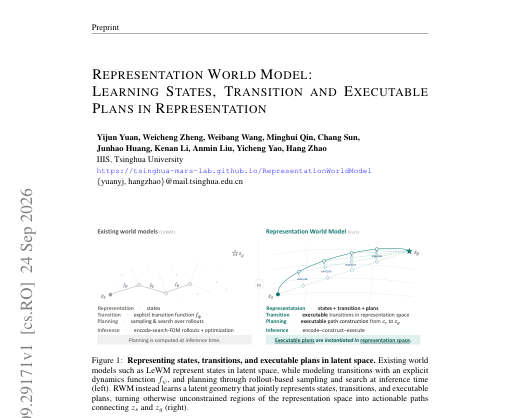
#192022-11-16★ 8.2k +667

isaac-sim/IsaacLab

Python

Unified framework for robot learning with multi-physics/renderer support

Unified framework for robot learning with multi-physics/renderer support

isaac-simomniverse-kit-extensionrobot-learningroboticsrobot

兴趣:3D perception, point clouds and scene understanding for robotics

#202026-09-06★ 883 +11新项目66

OpenWAM-Official/OpenWAM

Python

Official repository for "OpenWAM: An Open, Modular Exploration Towards Systematic World–Action Model Pretraining".

Official repository for "OpenWAM: An Open, Modular Exploration Towards Systematic World–Action Model Pretraining".

generalist-robot-policiespretrainingroboticsworld-action-modelrobot

兴趣:vision-language-action (VLA) models and foundation models for robots

#212026-09-12★ 75 +3新项目66

ASIG-X/JEPLO

C++

First JEPA-based learning framework for mapping-free LiDAR-based perceptive locomotion

First JEPA-based learning framework for mapping-free LiDAR-based perceptive locomotion

isaac-lablegged-robotslidarmujocoquadrupedreinforcement-learningrlrosleggedlocomotion

兴趣:reinforcement learning for legged locomotion and sim-to-real transfer

#222026-04-16★ 1.4k +266

OpenMOSS/Awesome-WAM

HTML

A curated collection of papers, explainers, and resources on World Action Models for embodied AI

A curated collection of papers, explainers, and resources on World Action Models for embodied AI

awesome-listembodied-aipaper-listroboticssurveyvision-language-actionworld-action-modelworld-modelsvision-language-actionembodied

兴趣:world models and video prediction for embodied agents

#232025-08-14★ 5.4k +265

RLinf/RLinf

Python

RLinf: Reinforcement Learning Infrastructure for Embodied and Agentic AI

RLinf: Reinforcement Learning Infrastructure for Embodied and Agentic AI

agentic-aiembodied-aireinforcement-learningrl-infrarlinfvla-rlVLAembodied

兴趣:vision-language-action (VLA) models and foundation models for robots

#242025-09-11★ 7.1k +1265

vllm-project/vllm-omni

Python

A framework for efficient model inference with omni-modality models

A framework for efficient model inference with omni-modality models

audio-generationdiffusionimage-generationinferencemodel-servingmultimodalpytorchtransformer

兴趣:vision-language-action (VLA) models and foundation models for robots

#252024-09-29★ 3.5k +265

enactic/openarm

MDX

A fully open-source humanoid arm for physical AI research and deployment in contact-rich environments.

A fully open-source humanoid arm for physical AI research and deployment in contact-rich environments.

bilateral-teleoperationforce-feedbackgenesisgravity-compensationhumanoid-robotimitation-learningmachine-learningmoveit2robothumanoid

兴趣:humanoid robots and whole-body control

#262026-09-12★ 44新项目65

3587jjh/HuRo

Python

HuRo: Robotizing Human Videos for Scalable VLA Pretraining (CoRL 2026)

HuRo: Robotizing Human Videos for Scalable VLA Pretraining (CoRL 2026)

egocentric-videomotion-retargetingrobot-learningrobotizationvision-language-actionvlarobotVLAvision-language-action

兴趣:vision-language-action (VLA) models and foundation models for robots

#272026-09-14★ 228 +98新项目65

Gen-Verse/ScienceBuddy

Python

ScienceBuddy: Recursive-in-Recursive Self-Improvement for Interactive Scientific Agents

ScienceBuddy: Recursive-in-Recursive Self-Improvement for Interactive Scientific Agents

agent-harnessaiforscienceautoresearchllm-agentsrecursive-self-improvement

兴趣:multi-agent systems and LLM agents

#282026-09-15★ 25新项目65

Lin-Murphy/Awesome-Robot-Agents

A source-aware directory of Embodied AI agents, LLM/VLM systems, VLA models, and robotic manipulation projects.

A source-aware directory of Embodied AI agents, LLM/VLM systems, VLA models, and robotic manipulation projects.

astraembodied-aigpt-astrallm-agentsreal-world-roboticsrobot-armrobot-learningrobot-manipulationrobotmanipulationVLAvision-language-actionsim-to-realembodied

兴趣:vision-language-action (VLA) models and foundation models for robots

#292026-09-15★ 25 +6新项目64

1173591564/Dynamics-memory

TypeScript

LLM agent 的有界自纠错长期记忆层:把连续、含矛盾的项目交互日志蒸馏成有界、可自更新的记忆库。Bounded, self-correcting long-term memory for LLM agents — candidate pool + value dynamics + tension adjudication + causal-replay…

LLM agent 的有界自纠错长期记忆层:把连续、含矛盾的项目交互日志蒸馏成有界、可自更新的记忆库。Bounded, self-correcting long-term memory for LLM agents — candidate pool + value dynamics + tension adjudication + causal-replay evals.

agent-memoryagentsllmllm-agentslong-term-memorymemorymemory-managementpythonLLM agent

兴趣:multi-agent systems and LLM agents

#302026-08-29★ 99新项目64

nssmd/RoboRSI

Python

Robot-agent harness with a CLI and local Web console for LIBERO short evaluation

Robot-agent harness with a CLI and local Web console for LIBERO short evaluation

agentsembodied-aievaluationliberorobot-learningroboticsself-evolutionrobotembodied

兴趣:multi-agent systems and LLM agents