Tech Station

学者追踪 › ETH / TUDa

ETH Zürich / TU Darmstadt

3 位学者 · 最近 45 天 46 篇

Marco Hutter 21 篇 专属页 →

2026-11-03追踪学者 · Marco Hutter

WayTrace: A Map-to-Language-to-Trace Hierarchy for Embodied Urban Navigation

Manthan Patel, Jonas Frey, Pascal Roth, Marco Hutter, Cesar Cadena

Web services provide walking directions for nearly every city, but following them reliably over long routes remains challenging for autonomous robots. Point-goal navigation policie…

Web services provide walking directions for nearly every city, but following them reliably over long routes remains challenging for autonomous robots. Point-goal navigation policies rely heavily on accurate GNSS, while most vision-language navigation models struggle to execute even short instructions outdoors. We present WayTrace, a hierarchical system that connects web-map directions to robot motion through language. An off-the-shelf orchestrator vision-language model reads the turn-by-turn directions, a satellite map and recent camera images, and issues one atomic language command at a time, such as "cross the road to the left". An onboard trace predictor, trained on over one million automatically labelled samples from street-level images, draws the path for this command in the image, and a reinforcement learning policy tracks it. In long-range simulated missions, WayTrace remains robust to GNSS noise and rarely leaves crosswalks or sidewalks, while point-goal baselines degrade sharply with about ten times more violations. Deployed on a wheeled-legged robot, WayTrace completes real-world missions of up to 1.37 km at about 1.1 m/s through a busy city centre, rural trails and a university campus, handling crosswalks, staircases and construction sites. Project page: https://way-trace.github.io

2026-11-02追踪学者 · Marco Hutter

SNAP: Semantic Navigation Among Pedestrians

Jakob Wolfram, Pascal Roth, Fan Yang, Cesar Cadena, Marco Hutter

Navigating crowded urban environments requires robots to avoid pedestrians while adhering to social norms such as remaining on sidewalks. Existing approaches typically address eith…

Navigating crowded urban environments requires robots to avoid pedestrians while adhering to social norms such as remaining on sidewalks. Existing approaches typically address either crowd avoidance or semantic path planning in isolation. We propose a reinforcement learning (RL) navigation policy that jointly reasons about semantic terrain and dynamic obstacles from a single semantically annotated bird's-eye-view (BEV) map, without relying on explicit human-state estimation. Our policy outperforms established crowd-navigation and semantic-aware baselines and transfers zero-shot to a legged robot, demonstrating socially compliant navigation in highly dynamic real-world scenarios.

2026-11-01追踪学者 · Marco Hutter

GoalDex: Learning Image-Goal-Conditioned Policies for Dexterous In-Hand Manipulation

Arjun Bhardwaj, Mayank Mittal, Maximum Wilder-Smith, Vaishakh Patil, Marco Hutter

Dexterous in-hand manipulation is commonly formulated around explicit object pose estimation, yet reliable pose tracking is challenging under severe hand-object occlusions and ofte…

Dexterous in-hand manipulation is commonly formulated around explicit object pose estimation, yet reliable pose tracking is challenging under severe hand-object occlusions and often requires object-specific supervision. This dependence creates a bottleneck between perception and control that can limit robustness and scalability. We present an end-to-end visuomotor framework for dexterous in-hand reorientation that operates on RGB observations and proprioception without intermediate pose estimation. Our approach jointly learns visual representations and control policies through behavior distillation from privileged state teachers and auxiliary reconstruction objectives. Furthermore, we introduce image-goal-conditioned reorientation, allowing desired object configurations to be specified directly through images rather than canonical pose representations. We evaluate our approach across a diverse set of object geometries and instances in simulation, where it consistently outperforms pose-based methods and policies built on pretrained visual encoders. Finally, we demonstrate direct sim-to-real transfer of a single image-goal-conditioned policy across five real-world objects, showing that accurate dexterous reorientation can be achieved without explicit pose estimation. For videos and code release, please refer to the project website: https://rffr.leggedrobotics.com/works/goaldex/

2026-10-31追踪学者 · Marco Hutter

Learning Agile Humanoid Dodgeball with Onboard Monocular Vision

Feng Tian, Yulin An, Chenhao Li, Matthias Heyrman, Marco Hutter

Humanoid robots operating in shared, dynamic environments must respond to rapidly approaching objects while maintaining balance. We study dodgeball as a controlled test of this cap…

Humanoid robots operating in shared, dynamic environments must respond to rapidly approaching objects while maintaining balance. We study dodgeball as a controlled test of this capability, coupling visual threat assessment with whole-body evasion, recovery, and target reacquisition. We develop a system that integrates onboard monocular perception, temporal ball-state and threat-flag estimation, and learned whole-body control. A ball detector supplies bounding-box histories, and a temporal estimator predicts relative ball position and a binary threat flag. Separate dodge/recovery and search/track policies share this interface and are composed to support repeated encounters. A three-stage curriculum first trains control with privileged ball states, then starts estimator supervision from stable policy rollouts, and finally replaces the actor's privileged inputs with estimator outputs. Analytic projection and perception randomization provide detector-like training observations without image rendering. Across approach-angle bins in controlled simulation, dodge success ranges from 97.8--100.0% for 5.0 m launches at 6 m/s to 33.2--40.8% for 2.5 m launches at 10 m/s, with 1000 throws per speed--distance condition. On a physical Unitree G1, controlled single-throw success exceeds 85% over more than 15 trials. A hardware sequence demonstrates full-azimuth target reacquisition followed by another dodge. These results demonstrate an integrated onboard-monocular-vision system under highly dynamic motions.

2026-10-30追踪学者 · Marco Hutter

SAFARI: Semantic- And Frontier-driven Autonomous Risk Inspection

Ugur Kafkasyali, Mihnea Toader, Julia Richter, Turcan Tuna, Cesar Cadena, Marco Hutter

Robotic exploration can reduce human exposure to hazardous environments by autonomously searching unknown areas for objects of interest while constructing a complete, risk-aware ma…

Robotic exploration can reduce human exposure to hazardous environments by autonomously searching unknown areas for objects of interest while constructing a complete, risk-aware map. However, existing autonomous exploration approaches typically prioritize geometric coverage or information gain, without explicitly coupling semantic object detection and the risk associated with operating near potentially hazardous objects. Moreover, many systems have been demonstrated primarily in simulation or controlled environments, leaving limited validation of risk-aware semantic exploration in complex, unstructured field settings. To address this gap, we propose SAFARI, a framework that treats object detection as a native channel of a unified probabilistic map, thereby jointly informing exploration and planning with both geometric and semantic evidence. We evaluated SAFARI in 11 missions across three field sites on a quadruped platform. The framework achieved an average coverage of 98.7% of the accessible mission area, without operator intervention for 97.6% of mission time, and detected objects with characteristic dimensions as small as 15cm. Lastly, through ablation studies and a detailed analysis of system behavior, we show that object-size awareness and safety-aware path planning are crucial for effective hazardous-object search.

2026-10-27追踪学者 · Marco Hutter

RESPLE2: Inertial-Informed Recursive Non-Uniform Spline Estimation for Multi-Sensor Odometry with Global Refinement

Ziyu Cao, William Talbot, Song Li, Pakpong Chirarattananon, Fredrik Gustafsson, Marco Hutter, Kailai Li

We present RESPLE2, a recursive multi-sensor state estimation framework using non-uniform B-splines for 6-DoF motion representation. By exploiting the knot-clamping boundary proper…

We present RESPLE2, a recursive multi-sensor state estimation framework using non-uniform B-splines for 6-DoF motion representation. By exploiting the knot-clamping boundary property, we propose a theoretically grounded mechanism for exact control-point prediction directly informed by inertial kinematics along the trajectory, with knot placement adapted to motion and measurement availability. Within an iterated extended Kalman filter, we perform this prediction using a subset of inertial measurements. A subsequent reset step preserves trajectory consistency as the knots extend. The update step further incorporates heterogeneous sensor measurements at their native timestamps through continuous-time observation models, supporting flexible combinations of LiDARs, cameras, inertial measurement units, and leg kinematics. We further develop a lightweight global optimization module that directly refines non-uniform B-spline control points by incorporating loop-closure constraints derived from LiDAR-visual cues. We conduct extensive evaluations on public and experimental datasets across handheld, tracked, legged, and hybrid aerial-legged platforms, covering highly dynamic maneuvers with extreme accelerations. Compared with state-of-the-art multi-sensor odometry systems, RESPLE2 achieves competitive or superior estimation accuracy and robustness in the corresponding sensor configurations, particularly under aggressive motion, while maintaining real-time operation. We publicly release our code and experimental datasets at https://github.com/ASIG-X/RESPLE2.

2026-10-26追踪学者 · Marco Hutter

Learning Multi-Phase Robot Loco-Manipulation via Phase-Conditioned Policy Optimization

Simone Manni, Annika Wollschläger, Dario Bellicoso, Abel Gawel, Marco Hutter, Simon Le Cleac'h, Jan Brüdigam
Complex whole-body loco-manipulation requires executing diverse maneuvers, such as crouching, grasping, and locomotion, within a single long-horizon task. While performing simple p…

Complex whole-body loco-manipulation requires executing diverse maneuvers, such as crouching, grasping, and locomotion, within a single long-horizon task. While performing simple pick-and-place behaviors is well-established, scaling to complex, long-horizon tasks remains difficult. Currently, this challenge is addressed by relying on human motion data and correspondingly humanoid platforms, which limits platform independence and introduces substantial data processing overhead. Instead, we extend proximal policy optimization (PPO) to train a single policy for multi-phase tasks across diverse robotic hardware, leveraging prior task structure to shape behavior. Our method adapts PPO using a phase-conditioned critic, phase-gated reward functions, and a multi-phase reset curriculum to guide exploration. To support varied hardware, we employ a decoupled hierarchical control architecture that separates lower-level balancing dynamics from high-level phase execution. We demonstrate multi-stage loco-manipulation skills on hardware on both the Unitree G1 and a Boston Dynamics Spot equipped with a manipulator arm, and validate our design choices through ablations. Our approach enables the acquisition of complex loco-manipulation behaviors purely through environment interaction while directly incorporating high-level task structure into policy learning.

2026-10-22追踪学者 · Marco Hutter

Humanoid Mobility via Attention-based Contacts

Junzhe He, Kehan Wen, Chong Zhang, Clemens Schwarke, Zewei Zhang, Kaixian Qu, Siyuan Hu, Matthias Müller 等

Humanoid mobility over complex terrain requires accurate foot placement and coordinated whole-body motion capable of robust adaptation. Reinforcement learning (RL) policies trained…

Humanoid mobility over complex terrain requires accurate foot placement and coordinated whole-body motion capable of robust adaptation. Reinforcement learning (RL) policies trained without motion references generalize well across terrains, yet eliciting effective whole-body coordination through reward design and exploration alone remains challenging. In contrast, reference-based methods yield natural motions but struggle to adapt beyond the predefined trajectories in their training data. We introduce a learning framework that bridges these two approaches by using motion data strictly as a training prior. An explicit, self-supervised, attention-based contact planner predicts future body-environment contacts, while a contact-conditioned tracker translates these plans into coordinated whole-body motion. Together, they establish contact as an interface between sensory observations and control actions. This abstraction allows the policy to internalize the contact-aware structure of locomotion rather than directly replicating kinematics. Consequently, a single policy can exploit data-driven motion priors for natural whole-body coordination while retaining the flexibility to discover environment-dependent behaviors through reinforcement learning. Building on the learned contact planner and tracker, a subsequent fine-tuning stage bootstraps their acquired capabilities to explore environment variations beyond those covered by the original motion data. Operating entirely from onboard observations without any reference inputs at deployment, this framework enables versatile humanoid mobility in challenging environments.

2026-10-21追踪学者 · Marco Hutter

RangeNav: Task-Aligned LiDAR Range-Image Pretraining for Robot Navigation

Samuel Foo Enze, Manthan Patel, Fan Yang, Linus Kramer, Pascal Roth, Marco Hutter, Cesar Cadena

Autonomous mobile robots operating in dense crowds and cluttered sites require $360^\circ$ perception to react to surrounding hazards. While panoramic LiDAR offers full-surround co…

Autonomous mobile robots operating in dense crowds and cluttered sites require $360^\circ$ perception to react to surrounding hazards. While panoramic LiDAR offers full-surround coverage, learning representations within reinforcement learning (RL) is sample-inefficient under sparse rewards, and existing 3D pretrained point-cloud encoders are too memory-heavy for massively parallel RL simulation. We present RangeNav, a compact (183k parameters) LiDAR range-image encoder pretrained entirely on synthetic data. RangeNav uses anisotropic convolutions and circular padding to handle the extreme aspect ratio and azimuthal seam of range images. We pretrain the network using a navigation-aligned objective combining range reconstruction, semantic segmentation, and bird's-eye-view (BEV) prediction, then freeze it for policy learning. In simulation, adding semantic and BEV supervision increases success rates over a reconstruction-only baseline by an average of 32.03 and 23.73 percentage points (pp) in procedurally generated training and out-of-distribution realistic test environments, respectively. Zero-shot real-world deployments on a Unitree B2-W quadruped demonstrate robust navigation through dense crowds, low-light settings, and construction zones where limited-field-of-view depth policies struggle. Code and models will be open-sourced. Project website: https://rangenav.github.io/.

cs.ROcs.LG
2026-10-21追踪学者 · Marco Hutter

Watch Your Step: Anticipated Perception for Humanoid Locomotion

Matthias Heyrman, Chenhao Li, Ioannis Dadiotis, Marco Hutter

Perceptive locomotion policies typically observe a dense robot-centric elevation map, although only the terrain beneath and around the next footsteps informs the control decision. …

Perceptive locomotion policies typically observe a dense robot-centric elevation map, although only the terrain beneath and around the next footsteps informs the control decision. Learned encoders compress the whole visual input, leaving the policy to work out which inputs matter while learning the baseline locomotion task. Learning both at once slows training and, without computationally expensive attention mechanisms, makes generalization to new terrain harder. We instead remove redundant inputs from the elevation map before the policy sees it. A lightweight foothold prediction model (FPM) predicts future footholds from proprioception and the velocity command alone, and we sample the elevation map only in small patches around these predicted footholds. We train the prediction model alongside the locomotion policy, periodically retraining it on new policy rollouts as the robot's gait matures. This allows the perception to anticipate where the policy will step, while the policy learns to leverage terrain information around those steps. With the proposed lightweight preprocessing, the policy reaches a given terrain difficulty in roughly a third of the training iterations required with the complete map. It outperforms policies that observe the complete map where footholds are sparse, including in narrow walled corridors, and on unseen terrain, and it matches an attention-based encoder trained at several times the cost. The policy transfers zero-shot to a Unitree G1 humanoid traversing various obstacles, stairs, gaps, and step-downs beyond the training distribution in both indoor and outdoor environments.

2026-10-21追踪学者 · Marco Hutter

End-to-End Reinforcement Learning for Quadrupedal Jumping in Lunar Gravity

Levin Müller, Oliver Fischer, Marco Trentini, Yusuke Tanaka, Marco Hutter

Legged robots can extend planetary exploration to rugged and discontinuous terrain that is inaccessible to conventional rovers. In lunar gravity, jumping further expands this mobil…

Legged robots can extend planetary exploration to rugged and discontinuous terrain that is inaccessible to conventional rovers. In lunar gravity, jumping further expands this mobility by enabling robots to cross obstacles and gaps that cannot be traversed by walking alone. We present a multistage reinforcement-learning approach that produces a single end-to-end control policy for commanded point-to-point jumping under lunar gravity. The resulting policy has a simple architecture and relies exclusively on mission-compatible onboard sensing, making its deployment on a real lunar mission plausible. In simulation, the learned policy performs accurate point-to-point jumps with landing errors smaller than the robot's body size. We analyze the torque and power demands of lunar jumping and characterize performance degradation under extreme outlier events, including control-update freezes of up to \SI{1}{s} during flight. Hardware transfer demonstrates that the policy can successfully execute a vertical jump under lunar-gravity offloading. Furthermore, the measured torque and power profiles are consistent with the simulation results and remain within the robot's hardware limits.

2026-10-18追踪学者 · Marco Hutter

Vision as Proprioception: Estimating Humanoid Robot Pose from Video

Jiaxi Jiang, Matthias Heyrman, René Zurbrügg, Marco Hutter, Christian Holz

Estimating a humanoid robot's internal state from video has a wide range of real-world applications but remains unexplored. During interactions with a robot, its onboard state info…

Estimating a humanoid robot's internal state from video has a wide range of real-world applications but remains unexplored. During interactions with a robot, its onboard state information may be unavailable due to privacy, ownership, or communication constraints. Meanwhile, online and AI-generated robot videos provide rich sources of data but typically lack corresponding joint configurations, limiting their direct use in robot learning. To address these issues, we present HumanoidPose, a new framework that treats vision as proprioception to recover full-body joint configurations in world space from video alone. Specifically, we combine pretrained human-pose features with robot kinematics in a unified model that predicts each embodiment's joint configurations. We retarget human motions to sixteen different humanoid embodiments, enabling scalable learning entirely from synthetic data. To improve real-world generalization, we further leverage unlabeled online videos through self-training to develop a 2D robot-pose detector. In our evaluation, HumanoidPose improves joint-angle and joint-position accuracy over the evaluated baselines and reduces joint-angle error by 18-32% relative to the best-performing baseline on each of the three real humanoid platforms. We further show improved global localization and generalization to unseen embodiments. HumanoidPose enables visual understanding of other robots during interaction and extraction of robot motion from online and generated videos.

cs.ROcs.AIcs.CV
2026-10-17追踪学者 · Marco Hutter

Solving a Giant Rubik's Cube with a Quadruped Robot

Lukas Amiet, Gabriel Sánchez-Blanco Repgen, Mayank Mittal, Victor Klemm, Andrei Cramariuc, Marco Hutter, Cesar Cadena

Pedipulating a freestanding articulated object requires controlling its pose and internal configuration while maintaining balance. We demonstrate this capability by autonomously so…

Pedipulating a freestanding articulated object requires controlling its pose and internal configuration while maintaining balance. We demonstrate this capability by autonomously solving a giant Rubik's Cube with a quadruped using only its feet. The task demands repeated precise interactions, since unintended layer motion can invalidate subsequent operations. We develop an onboard RGB-D perception pipeline that estimates the cube's metric pose and its full color state from partial views acquired through locomotion and flipping. A planner converts the computed solve into robot-executable skill sequences. Learned whole-body skills reorient the cube while preserving its layer configuration and turn its layers with one foot pinning the cube as the other pushes. We train these skills using reinforcement learning with privileged observations and distill them into policies that map onboard depth and proprioception to joint targets. The deployed policies tolerate variations in relative robot-cube placement and recover from external disturbances. The system completes three autonomous hardware solves, each about 30 steps over 8-9 minutes. These results show that combining onboard perception with coordinated pedipulation enables a quadruped to complete extended multi-step physical tasks. Additional material can be found at: https://leggedrobotics.github.io/rubik-skills/

2026-10-13追踪学者 · Marco Hutter

Walk Like This: Stylized Locomotion for Physics-Based Characters through Example-Driven Diffusion

Joshua Aurand, Agon Serifi, Sammy Christen, Ruben Grandia, Espen Knoop, Marco Hutter, Moritz Bächer

We present a real-time framework for expressive legged locomotion that enables independent control over velocity and style. Unlike existing data-driven controllers, which typically…

We present a real-time framework for expressive legged locomotion that enables independent control over velocity and style. Unlike existing data-driven controllers, which typically require explicit style labels for training, our method efficiently leverages large-scale unstructured motion data and generalizes to unseen styles. We disentangle style from functional locomotion through a tailored sampling strategy used to train a style encoder whose output conditions an autoregressive diffusion model. During inference, the user provides a style reference clip and a joystick velocity command. The diffusion model then generates a kinematic reference tracked by a reinforcement learning controller. To improve user controllability and stylization strength, we propose an attention biasing mechanism and a velocity command correction strategy. We demonstrate our method on a physics-based humanoid character in simulation and on a physical robot, showcasing robust real-time control and continuous style modulation. The results can be best seen in our supplemental video (https://www.youtube.com/watch?v=roFnS6N7nJ4).

2026-10-08追踪学者 · Marco Hutter

Toward Lunar Legged Robots: Field Deployment Lessons at LUNA

Adrian Fuhrer, Joseph Church, Oliver Fischer, William Talbot, Nicolas Faesch, Yannic Hofmann, Hendrik Kolvenbach, Yusuke Tanaka 等

Legged robots are promising candidates for future lunar surface missions because they can traverse steep, loose, and obstacle-rich terrain that challenges conventional wheeled rove…

Legged robots are promising candidates for future lunar surface missions because they can traverse steep, loose, and obstacle-rich terrain that challenges conventional wheeled rovers. However, readiness for lunar deployment is limited by uncertainties in foot-regolith interaction, dust generation, illumination-driven perception degradation, and operational constraints. This paper reports lessons from the 2025 LUNA analogue campaign, where ANYmal-D and Magnecko traversed loose regolith simulant and crater-like terrain and collected long-horizon navigation and visual-inertial data under challenging lighting. We show that quadrupedal robots can traverse regolith simulant, but performance is affected by sinkage and slip, dust-generating contacts, and perception failures caused by overexposure, shadows, and low-texture regions. These results motivate tighter integration of regolith-aware locomotion policies, illumination-robust perception, repeatable analogue testing, and mission-level operational validation for future lunar legged robots.

2026-10-06追踪学者 · Marco Hutter

Reactive Task-Oriented Robot-Human Handovers via Generative Hypothesis Selection

Carmen Scheidemann, Andreea Tulbure, Pascal Burkhardt, Marco Hutter

When humans hand each other objects, they incorporate both geometric and semantic information into this process. For example, passing a knife with the handle towards the recipient,…

When humans hand each other objects, they incorporate both geometric and semantic information into this process. For example, passing a knife with the handle towards the recipient, rather than the blade, is both more ergonomic and safer. Recent state-of-the-art methods for task-oriented robot-human handovers have progressed from modeling object geometry to incorporating object affordances. However, they often forgo predicting the explicit, task-specific hand poses a human selects to utilize an object. Since many objects support multiple interaction modalities, e.g., a claw hammer used to strike or pull nails, this variability must be modeled to achieve robust task-oriented handovers. To tackle this, we propose a novel approach, GENESIS-Handover (GENErative HypotheSIS), which leverages VLM image generation to produce a variety of task-specific hand-object interaction hypotheses. These hypotheses are matched in real time to the observed human hand pose, enabling inference of the most suitable handover configuration. By leveraging VLMs as priors of plausible hand-object interactions, the method produces task-conditioned handover strategies for previously unseen object-task pairs. We evaluate the standalone interaction proposal module before deploying the full system on a mobile manipulator. In a user study with 12 participants across five task-object pairs, 83.3% perceived our method to have better task understanding than the previous state of the art.

2026-10-02追踪学者 · Marco Hutter

Bidirectional Voronoi-biased Exploration Curriculum for Reinforcement Learning

Juri Pfammatter, Kaixian Qu, Clemens Schwarke, Victor Klemm, Marco Hutter

Long-horizon tasks with sparse rewards pose an exploration bottleneck for goal-conditioned reinforcement learning: a policy started from the initial state rarely reaches the goal a…

Long-horizon tasks with sparse rewards pose an exploration bottleneck for goal-conditioned reinforcement learning: a policy started from the initial state rarely reaches the goal and receives no learning signal. Reference motions, hand-designed curricula, and shaped rewards supply this signal but require demonstrations or task-specific engineering; automatic start-state and goal curricula avoid this but typically expand from one side only, so the full distance to the target must be covered from that side. We propose the Bidirectional Voronoi-biased Exploration curriculum for Reinforcement learning (BVER), which expands from both ends at once. Inspired by bidirectional RRT planning, BVER grows start states outward from the goal and goals outward from the initial state distribution, biases both toward unexplored task space, and steers them toward each other, training one goal-conditioned policy on both. On point-mass mazes, quadrupedal box climbing, and robot-arm ring-on-peg transfer, BVER learns faster than all compared reference-free curricula. On box climbing, it reaches 95% success on a 0.4 m box in roughly 65% fewer iterations than the best of them, is the only one of them to learn to climb a 0.7 m box, and yields a policy robust to start, goal, and yaw variation. Without a demonstration, it approaches the sample efficiency of reference-based curricula on the 0.4 m box and on ring-on-peg transfer. Ablations show that expanding from both ends outperforms either direction alone.

cs.LGcs.RO
2026-09-28追踪学者 · Marco Hutter

HOI-Retarget: Contact-Centric Retargeting for Human-Object Interaction

Jihwan Shin, Adrià López Escoriza, Junzhe He, Matthias Heyrman, Marco Hutter

Learning from demonstration (LfD) has enabled humanoid robots to acquire diverse whole-body skills, but extending this paradigm to human-object interaction (HOI) is limited by the …

Learning from demonstration (LfD) has enabled humanoid robots to acquire diverse whole-body skills, but extending this paradigm to human-object interaction (HOI) is limited by the availability of robot-compatible interaction references. We present HOI-Retarget, a contact-centric retargeting method that transfers HOI onto a humanoid robot for large-scale motion-data generation. Its windowed trajectory optimization uses every labeled contact as a target in the object frame, balancing body tracking, foot support and smoothness under the robot's kinematic limits. The method can augment a single demonstration across object sizes, absorb contacts reconstructed from monocular video, and extend to several robots manipulating one object. We publicly release the code and the retargeted motion dataset.

2026-09-25追踪学者 · Marco Hutter

Transformer-based Monte Carlo Localization in Construction Meshes

Linus Kramer, William Talbot, Olga Vysotska, Marco Hutter

To be able to perform inspection or digitization tasks, mobile robots on construction sites must be able to localize themselves reliably with respect to a global reference frame th…

To be able to perform inspection or digitization tasks, mobile robots on construction sites must be able to localize themselves reliably with respect to a global reference frame that is shared with a building map. Similar room layouts and low-texture surfaces pose a challenge for existing LiDAR- and vision-based localization methods. We approach this problem with a LiDAR-based global relocalization system that estimates the robot's pose relative to a building mesh and combines a PointNet++ encoder with a place recognition decoder, whose outputs serve as a learned observation model within a Monte Carlo Localization (MCL) framework. The pipeline is trained exclusively on synthetic LiDAR scans obtained by simulating the robot's sensors inside the building mesh. Our approach is robust in ambiguous environments due to an uncertainty-aware decoder that scales positional likelihoods and a resampling strategy that injects model hypotheses into the particle set, enabling recovery from potential particle depletion. Evaluations on real-world datasets show that our method outperforms both diffusion-based and ScanContext++ baselines while maintaining fast inference (18 ms per call), demonstrating the practicality of synthetic-data training for mesh-referenced global localization in construction robotics.

2026-09-25追踪学者 · Marco Hutter

Precision at Speed: Sample-Efficient Online Model-Based Reinforcement Learning for Hydraulic Excavator Control

Claudio Canales, Fang Nan, Marco Hutter, Javier Ruiz-del-Solar

Precise, high-speed control remains challenging for robots with complex actuation dynamics. Learning directly on hardware is further constrained by the cost of real-world interacti…

Precise, high-speed control remains challenging for robots with complex actuation dynamics. Learning directly on hardware is further constrained by the cost of real-world interaction. We present an online model-based reinforcement learning framework that learns a probabilistic dynamics ensemble model from scratch for sampling-based model predictive control. A precision-gated contouring objective conditions the progress reward on path accuracy, prioritizing precision over speed. In a data-driven excavator simulator, the framework achieves higher sample efficiency than the evaluated model-based reinforcement learning baselines. We validate the framework by learning directly on an 11.5-ton Menzi Muck M445 hydraulic excavator, without demonstrations or simulation pretraining. After 20 minutes of interaction, the controller reaches tracking accuracy comparable to prior learned controllers trained on 100-150 minutes of data. After 40 minutes, it sustains sub-centimeter mean path error at high operating speeds.

cs.ROcs.LGeess.SY
2026-09-21追踪学者 · Marco Hutter

What do VLM-Based Vision-Language Navigation Models Rely on: Interpreting and Steering Policy Behavior

Débora Oliveira Makowski, Samiran Gode, Abhijeet Nayak, Marco Hutter, Cordelia Schmid, Lukas Rosenberger Schmid, Wolfram Burgard

Modern Vision-Language Navigation (VLN) models rely mostly on pre-trained large Vision-Language Models (VLMs) to predict navigation actions. While this fusion of language instructi…

Modern Vision-Language Navigation (VLN) models rely mostly on pre-trained large Vision-Language Models (VLMs) to predict navigation actions. While this fusion of language instructions and visual observations allows multimodal reasoning, it obscures how information is routed across modalities or what mechanisms drive navigation decisions. Thus, it remains unclear whether VLN models ground their predictions in relevant semantic cues or can track task progress. In this work, we study the interpretability and steerability of VLN models. We use intervention-based metrics that measure how visual observations, instructions, and visual memory causally influence navigation decisions. Our results show that these navigation policies are sensitive to all input modalities and do not depend on a single one. We further show that these agents encode navigation progress and retain semantic structure from their VLM backbones, enabling concept-level steering through internal activations. Finally, we extract activation vectors for abstract behaviors to transfer them zero-shot to out-of-distribution real-world scenarios, improving performance without additional fine-tuning.

cs.ROcs.CV

Jan Peters 18 篇 专属页 →

2026-10-27追踪学者 · Jan Peters

Retrieve to Act: Motion Primitive Graph Retrieval for Robust VLA Execution

Pham Tri Quang, Bao-Ngoc Dao, Minh Duc Nguyen, Duc-Duy Nguyen, Hung T. Ho, Linh Dang Le, Trong-Bao Ho, Thien-Loc Ha 等

Vision-Language-Action (VLA) policies demonstrate remarkable semantic generalization, yet remain highly vulnerable to out-of-distribution (OOD) visual shifts during execution. Whil…

Vision-Language-Action (VLA) policies demonstrate remarkable semantic generalization, yet remain highly vulnerable to out-of-distribution (OOD) visual shifts during execution. While existing test-time methods attempt to suppress spurious visual cues, they fundamentally overlook the rich, uncorrupted kinematic priors embedded in the policy's own training experience. We introduce Retrieve to Act (R2A), a test-time scaling framework that formulates OOD robustness purely as a geometric motion primitive retrieval problem. R2A bypasses fragile visual features by structuring successful training demonstrations into an offline spatiotemporal motion primitive graph. During inference, a query-dependent Graph Neural Network dynamically localizes the robot's ongoing execution within this graph, retrieving structurally compatible future motion primitives. These retrieved geometric priors are then seamlessly harmonized with the frozen VLA's predicted actions via a learned, dimension-wise gating mechanism, adaptively rectifying erroneous spatial trajectories while preserving the policy's local reactivity. Extensive experiments across three state-of-the-art VLA architectures, GR00T N1.7, $π_{0.5}$, and StableVLA, demonstrate that R2A consistently and significantly enhances robustness against diverse contextual perturbations. R2A achieves absolute success rate improvements of up to +12% in simulation benchmarks (LIBERO-Plus, RoboTwin2.0-Plus) and +40% in real-world deployments, without requiring any finetuning of the base policies. Project page: https://retrieve2act.github.io/r2a/

2026-10-27追踪学者 · Jan Peters

Remember Where You Walk: Learning Spatial Memory for End-to-End Legged Robot Exploration

Leon Magnus, Nico Bohlinger, Jan Peters, Oleg Arenz

Humanoids and other legged robots operating in complex environments must remember information that leaves their field of view and only becomes relevant much later. Reinforcement le…

Humanoids and other legged robots operating in complex environments must remember information that leaves their field of view and only becomes relevant much later. Reinforcement learning policies address this using memory networks such as LSTMs that are trained end-to-end with the policy to memorize such task-relevant aspects. Yet, such architectures often fail to preserve sufficient information over long horizons. In this work, we propose a network architecture based on Hadamard memory that specifically targets robot navigation. Our Local Spatial Matrix Memory (LSMM) enables RL agents to store generic task-relevant information at specific, position-based memory cells, enabling flexible and spatially grounded memorization. We evaluate LSMM on the task of autonomous maze exploration, where it matches the maze coverage of strong recurrent and finite-history baselines while being the only architecture that remembers the maze layout, reducing the reconstruction error threefold.

2026-10-27追踪学者 · Jan Peters

Whole-Body Humanoid Control via Stochastic Motion Tokenization

Michael Drolet, Oleg Arenz, Jan Peters

While velocity-commanded RL policies are effective for controlling quadrupeds, they are a limited interface for humanoids that need to perform complex whole-body motions. Furthermo…

While velocity-commanded RL policies are effective for controlling quadrupeds, they are a limited interface for humanoids that need to perform complex whole-body motions. Furthermore, RL tracking policies for whole-body motions typically have limited information about the desired future motion, preventing them from performing controlled deviations to achieve long-term task success; such information is particularly relevant when a controller must prepare for transitions between behaviors. We address these challenges using concise motion representations that can be generated by a high-level controller, given a behavior label or text command. These representations can be fed directly into a tracking policy to provide a detailed motion reference. Our method exhibits a high degree of flexibility in performing real-world robot motions such as dancing, fighting, or walking based on conditional information. At matched capacity, our adopted stochastic motion tokenizer reconstructs motions from the Unitree G1 at a level that exceeds state-of-the-art approaches such as finite scalar quantization (FSQ) and the vector-quantized autoencoder (VQ-VAE). The resulting discrete interface conditions whole-body tracking policies that execute generated dance, fight, and walk motions lasting 16.8 s each and a 35 s fight-to-dance sequence on a physical Unitree G1.

cs.ROcs.LG
2026-10-24追踪学者 · Jan Peters

RoboWorM: Evaluating Movement Realism, Consistency and Acceleration Affects in Embodied Video World Models

Doanh Le Thien, Viet-Thanh Nguyen, Pham Tri Quang, Nhi Pham, Christopher Wewer, Minh-Loi Nguyen, Hoang H. Tran, Tho Le 等

Video world models (VWMs) are rapidly emerging as scalable neural simulators for robotic manipulation. However, most benchmarks only evaluate them as open-world video generators, u…

Video world models (VWMs) are rapidly emerging as scalable neural simulators for robotic manipulation. However, most benchmarks only evaluate them as open-world video generators, using Vision-Language Models (VLMs) that lack strict 3D spatial and kinematic reasoning. To bridge this gap, we introduce RoboWorM, a comprehensive, deployment-aware benchmark that leverages known hardware priors such as robot kinematic trees and fixed camera configurations, to systematically examine structural and spatiotemporal fidelity. RoboWorM curates 1,605 episodes across single-arm, bimanual, and humanoid morphologies, spanning both Markovian and long-horizon non-Markovian tasks under single- and multi-view setups. To explicitly measure physical consistency, we propose two deterministic, VLM-free metrics: KIVA for intra-view kinematic stability, and RIGIS for multi-view geometric consistency. By exploiting intrinsic robotic invariants, KIVA improves hallucination detection alignment with human annotations by 25.8% relative to the strongest frontier VLMs, while RIGIS achieves a 130% higher Spearman correlation with human preferences. Furthermore, since real-world deployment requires low inference latency, we utilize RoboWorM to conduct the first large-scale audit of the quality-efficiency trade-off. Evaluating 9 state-of-the-art acceleration techniques across 3 leading world models (over 29,000 generated rollouts), we demonstrate how these acceleration methods can retain superficial visual quality while silently compromising deployment-critical physical constraints. Using our metrics, we achieve 2.3$\times$ maximum inference speed-up with minimal quality loss.

2026-10-21追踪学者 · Jan Peters

Integrating Flow Matching and Model Predictive Control for Safe Robot Navigation

Philipp Holzmann, Maik Pfefferkorn, Joao Carvalho, Ali Younes, An Thai Le, Georgia Chalvatzaki, Jan Peters, Rolf Findeisen

Learning-based path planners based on diffusion and flow matching can generate diverse trajectories from demonstrations but typically lack mechanisms for constraint satisfaction an…

Learning-based path planners based on diffusion and flow matching can generate diverse trajectories from demonstrations but typically lack mechanisms for constraint satisfaction and collision avoidance during deployment. This work proposes a framework that combines flow-matching-based path planning with model predictive path-following control to integrate data-driven path generation with real-time, constraint-aware execution. The flow-matching model captures multimodal path distributions, while the predictive controller adapts motion online to satisfy state and input constraints and avoid obstacles using updated local sensor information. An event-triggered re-planning scheme incorporates predictive control solutions into subsequent path generation, promoting collision-free navigation in environments with previously unseen obstacles. Simulation results for mobile robot navigation demonstrate robust performance across cluttered environments. The framework provides a systematic approach to combining flow matching with predictive control for adaptive, data-driven navigation.

cs.ROeess.SY
2026-10-14追踪学者 · Jan Peters

Safe Reinforcement Learning with Receding-Horizon Safety Critic and Differentiable Action Shields

Siwei Ju, Jan Peters, Oleg Arenz

Despite the Markov assumption, safety failures in robot reinforcement learning rarely occur instantaneously; they typically emerge over several steps as the policy enters unfamilia…

Despite the Markov assumption, safety failures in robot reinforcement learning rarely occur instantaneously; they typically emerge over several steps as the policy enters unfamiliar states under disturbances and domain shift. We address this limitation by learning a receding-horizon safety critic that predicts whether a state will remain non-terminating over the next receding horizon, enabling anticipatory detection of impending locomotion failures. The critic is trained from rollout-derived horizon labels with a composite objective that combines horizon classification, control-barrier-function-inspired temporal consistency, and smoothness regularization, and we aggregate an ensemble of critics with a conservative Conditional Value at Risk estimate to account for uncertainty. Building on the learned critic, we derive a closed-form, differentiable CBF-style safety filter that minimally modifies the policy action to improve predicted safety, and integrate it into PPO with an anticipation loss to reduce policy-filter mismatch during training. In simulated quadruped locomotion, our method improves robustness under action noise, external perturbations, and terrain shifts, reducing catastrophic failures while maintaining competitive returns.

2026-10-07追踪学者 · Jan Peters

Continual Graph Multi-Agent Reinforcement Learning

Tommaso Marzi, Ahmed Hendawy, Jan Peters, Carlo D'Eramo, Andrea Cini, Cesare Alippi

In Continual Multi-Agent Reinforcement Learning (CMARL), agents learn cooperative policies across sequences of tasks, aiming to adapt effectively to new tasks while preserving the …

In Continual Multi-Agent Reinforcement Learning (CMARL), agents learn cooperative policies across sequences of tasks, aiming to adapt effectively to new tasks while preserving the ability to solve previously encountered ones. In many applications, tasks differ in their underlying structure, which can represent, for example, distinct operational conditions or target configurations (e.g., different network topologies in power grids or arrangements in formation control). Existing CMARL methods lack dedicated mechanisms to leverage this structural information when learning new tasks, failing to promote transfer and mitigate forgetting. To fill this gap, we propose Continual Graph Multi-Agent Reinforcement Learning (CGMARL), a novel framework for CMARL problems in which task sequences are mapped into a series of attributed graphs, each modeling a task-specific structure. In CGMARL, each graph determines the environment dynamics (next states and/or rewards) and the number of agents for the corresponding task. Then, we present Graph-based Formation (GRAFO), the first CGMARL benchmark, and show how forgetting arises in this setting. Finally, to address this limitation, we propose Frozen Graph Encoder (FROG), a method that relies on a frozen graph backbone to preserve past structural information in graph-based CMARL policies. Experiments on GRAFO show that pairing FROG with existing CL methods substantially improves performance on multiple CGMARL scenarios.

2026-10-07追踪学者 · Jan Peters

Do My Samples Help? Compute Budget Allocation for Real-World Sampling-Based MPC in Contact-Rich Manipulation

Magnus Dierking, João Carvalho, Vince Kurtz, Jan Peters, Nils Dengler, Georgia Chalvatzaki

Sampling-based model predictive control (SMPC) is increasingly practical for contact-rich manipulation because GPU-based physics simulators enable real-time evaluation of large num…

Sampling-based model predictive control (SMPC) is increasingly practical for contact-rich manipulation because GPU-based physics simulators enable real-time evaluation of large numbers of non-differentiable contact rollouts. However, this computation budget is finite and can be spent in competing ways, including denser control exploration, representing dynamics or state uncertainty, replanning more frequently, or aligning the simulation better with the physical state. Yet, the resulting trade-offs are not well understood in real-world sim-to-real control. In this work, we address this question through a systematic study of how to allocate a fixed computation budget for SMPC in contact-rich manipulation. To enable controlled comparisons, we develop a GPU-based framework named Budget-Allocating Model Predictive Control (BAMPC), which runs on MuJoCo Warp and exposes dynamics uncertainty, state uncertainty, and temporal alignment as independent dimensions of the computation budget while using the same control stack in simulation and on a real robot. Across three contact-rich manipulation tasks, we find that the best budget allocation depends on the dominant sim-to-real error, with dynamics randomization not universally the most effective one.

2026-10-06追踪学者 · Jan Peters

BluffJAX: Adversarial Imperfect Information Games in JAX

Aryaman Reddi, Jan Peters, Carlo D'Eramo

We introduce BluffJAX: an open-source suite of adversarial imperfect information games in JAX. We provide canonical implementations of games designed for high simulation throughput…

We introduce BluffJAX: an open-source suite of adversarial imperfect information games in JAX. We provide canonical implementations of games designed for high simulation throughputs and parallelization on GPU accelerators. Our suite consists of well-studied benchmarks such as Texas Hold'Em Poker and Kuhn Poker, as well as games that have not been previously studied in reinforcement learning research, such as Bluff, Stud Poker, and Kemps. We hope that implementing a variety of game mechanics and difficulties will introduce new challenges and foster novel research directions in game-theoretic methods for RL. We benchmark the throughput performance and memory usage of our environments in single and multi-GPU settings, demonstrating scaling of up to hundreds of millions of samples per second, and motivating the usage of BluffJAX over related GPU and CPU-based libraries. We benchmark reinforcement learning, tree search, and game-solving algorithms in JAX in order to provide users with baseline results and facilitate future comparisons.

2026-10-03追踪学者 · Jan Peters

Exploiting Hierarchical Controller Structure in Contextual Parameter Learning for Humanoid Loco-Manipulation

Sebastian Hirt, Lukas Theiner, Jan Peters, Rolf Findeisen

Hierarchical control architectures are widely used to decompose complex control problems into interacting control levels and are particularly important in robotics, where planning,…

Hierarchical control architectures are widely used to decompose complex control problems into interacting control levels and are particularly important in robotics, where planning, whole-body motion, and lower-level control must be coordinated across different levels of abstraction and time scales. Their overall closed-loop performance, however, depends strongly on parameters distributed across the hierarchy, such that tuning controllers on different levels independently may neglect relevant cross-layer interactions. We propose a contextual Bayesian optimization framework for joint parameter learning in hierarchical control systems. Rather than modeling closed-loop performance only as a scalar black-box function, we retain separate observations of task performance, realization quality, and control effort. A correlated multi-output Gaussian process models these performance components, while their known aggregation into the overall closed-loop objective is evaluated analytically. The formulation exploits three complementary consequences of hierarchical control: informative performance quantities exposed by the hierarchy, coupling between parameters of different controller levels, and variations of these relations with operating conditions. We evaluate the approach for humanoid loco-manipulation, jointly tuning a centroidal predictive controller and a whole-body controller for physical box pushing under varying box mass. The proposed method achieves the lowest mean empirical regret during both training and adaptation among the considered baselines.

cs.ROcs.LG
2026-10-02追踪学者 · Jan Peters

A Geometric Perspective on Reward Function Updates in Inverse Reinforcement Learning

Anish Diwan, Jan Peters, Oleg Arenz

Inverse Reinforcement Learning (IRL) is classically solved using Lagrangian optimisation, by jointly optimising a primal-dual problem with gradient descent to obtain the optimal re…

Inverse Reinforcement Learning (IRL) is classically solved using Lagrangian optimisation, by jointly optimising a primal-dual problem with gradient descent to obtain the optimal reward function parameters and corresponding optimal policy. While this algorithmic view of IRL has been highly influential, gradient-based reward updates only paint a partial picture, largely ignoring the geometry of the problem in occupancy space. In this paper, we present an occupancy-space view of reward updates in IRL. We leverage the insight that both the optimal solution and its geometry in occupancy space are known, and show that the geometry along the e-geodesic (straight line in occupancy space) toward the optimal occupancy directly affects the gradient of the IRL dual problem in reward parameter space. This perspective naturally suggests preconditioning the dual gradient with the average Fisher information along the occupancy trajectory. We show that this preconditioned gradient is just a convex interpolation of the old reward and a new target reward, yielding efficient natural-gradient-style updates with little additional computational overhead. We then analyse these occupancy-space reward updates from a Mirror Descent (MD) perspective, and show that policy search over the resulting rewards induces approximate entropic MD on the policy. Finally, we conclude with convergence results of such geometry-aware IRL algorithms.

cs.LGcs.AIcs.RO
2026-10-01追踪学者 · Jan Peters

Residual Compliant Policy: Learning Compliant Policies from Few Demonstrations

Chunyu Jiang, Yichen Cai, Shuai Li, Wenbin Sun, João Carvalho, Kostas Daniilidis, Oleg Arenz, Cristiana de Farias 等

Contact-rich manipulation requires a robot to be precise in free space to establish the intended contacts, and compliant once in contact to avoid excessive forces. Imitation learni…

Contact-rich manipulation requires a robot to be precise in free space to establish the intended contacts, and compliant once in contact to avoid excessive forces. Imitation learning has proven effective for simpler manipulation tasks, but the compliance underlying a demonstration is not directly observable and is therefore difficult to infer from demonstration data alone. We present a framework that makes compliance explicit at every stage. During data collection, the operator teleoperates the real robot while a synchronized digital twin visualizes the error between the commanded reference and the achieved pose, making the current compliance visible, and selects between two discrete compliance modes. To generalize across object poses, we combine Laplacian editing, which retargets trajectories efficiently but is not physics-consistent during contact, with simulation-based trajectory optimization, which enforces physical plausibility but offers no manual guidance. Finally, a residual reinforcement learning policy refines the interaction forces by adjusting the reference pose of the underlying admittance controller. We evaluate on three flipping and pushing tasks on a Franka FR3 based on a total of 7 demonstrations across tasks. Our method is successful on all 40 out-of-distribution trials, compared to 33/40 and 24/40 for two baselines, with our base policy alone reaching 35/40.

2026-10-01追踪学者 · Jan Peters

Continue, Abort, or Fall: Viability-Aware Policy Selection (VAPS) for Safe Humanoid Acrobatics

Siwei Ju, Lu Liu, Jan Peters, Oleg Arenz

Dynamic humanoid motions such as flips risk hardware damage due to suboptimal policies, disturbances or sim-to-real gaps. A motion tracking policy offers no way out once the maneuv…

Dynamic humanoid motions such as flips risk hardware damage due to suboptimal policies, disturbances or sim-to-real gaps. A motion tracking policy offers no way out once the maneuver leaves its reference, and a backup policy needs to take over to protect the hardware for a minimum-damage landing. Which backup to use matters as much as when to switch. We present Viability-Aware Policy Selection (VAPS), which treats safety as a policy-conditioned, receding-horizon decision. Besides a protective fall policy, we also train an abort policy which can abort the motion at any time, landing on its feet. At every control step, learned predictors estimate whether the nominal tracking policy and the abort policy remain viable over a short horizon, and a least-sacrificial hierarchy keeps the most task-ambitious behavior that remains viable. In simulation with randomized disturbances, VAPS sharply reduces head contact and hand contact, which are the dominant sources of hardware damage, with both a Unitree G1 and a LimX Oli; on the LimX Oli, we validate the viability predictors and the full VAPS controller for side-flip motions. VAPS Pareto-dominates the strongest single-network alternatives we could train, including an end-to-end safe-tracking policy and students distilled from VAPS's own oracle-routed decisions, in both task success and head impact. We also show that VAPS is a powerful framework to supervise undertrained policies and protect the hardware.

2026-09-30追踪学者 · Jan Peters

Neuro-Symbolic Predicate Learning for Semantic Safe Robot Control

Zihan Ye, Jiayi Liu, Puze Liu, Jiayun Li, Georgia Chalvatzaki, Jan Peters, Kristian Kersting

As robots are increasingly deployed in everyday environments, ensuring their safety has become a central challenge. Existing methods often encode safety requirements as opaque math…

As robots are increasingly deployed in everyday environments, ensuring their safety has become a central challenge. Existing methods often encode safety requirements as opaque mathematical/logical formulations or dense cost functions. While effective in specific tasks, they remain difficult to interpret, tightly coupled to individual tasks, and offer limited insight into why a robot action is considered safe or unsafe. To address this limitation, we propose ``Neuro-Symbolic Predicate Learning for Semantic Safe Robot Control'' (NEUPRO), which leverages a differentiable reasoner that can learn reusable safety representations from human-specified safety knowledge. NEUPRO allows practitioners to express task-related safety requirements as transparent symbolic rules, while enabling gradients to propagate through these rules to a feature extractor that maps raw observations to safety-relevant concepts. As a result, the learned feature extractor is (softly) grounded in human-understandable semantics, supports transparent constraint evaluation, and is transferable across tasks. By coupling interpretability with differentiability, NEUPRO moves beyond opaque cost design toward reusable safety reasoning. To evaluate NEUPRO's capability, we collect and release REASON, the first real robot benchmark dataset for interpretable robot safety specification. Experiments on REASON show that NEUPRO learns safety-critical features that generalize across tasks, mitigate the interpretability limitations of conventional black-box cost formulations, and provide explicit explanations of safety violation.

2026-09-29追踪学者 · Jan Peters

Does This Action Still Explain the Task? Reverse Scoring for Diffusion Language Model Agents

Jiacheng Qiu, Christopher E. Mower, Jan Peters, Haitham Bou-Ammar, Matthieu Zimmer

Diffusion-based large language models (dLLMs) promise to break the sequential latency bottleneck of autoregressive agents through parallel decoding, but recent evaluations show thi…

Diffusion-based large language models (dLLMs) promise to break the sequential latency bottleneck of autoregressive agents through parallel decoding, but recent evaluations show this efficiency does not transfer to embodied agentic competence: dLLM-backed agents repeatedly fall into retry loops, re-issuing an action long after it has failed. We give a mechanistic account of this failure and a training-free remedy. We trace the retry loop to the adaptivity of masked decoding: the sampler commits the positions it is most confident about and defers the uncertain ones, and at a failure state the context already offers a confident fill for the deferred decision, i.e. the failed action itself, so the retry is committed without the failure feedback ever being confronted. We model the resulting distortion of the action distribution as a task-blind corruption: contextually salient actions (e.g., the action just taken) receive inflated probability by a factor that depends on the state and the action but not on the task. Under this model, we analyse an invariance proposition: the task-blind factor cancels exactly from the reverse conditional, i.e. the likelihood of the task given the state and a candidate action, which coincides with the task posterior of an idealized uncorrupted model. Masked dLLMs evaluate the reverse conditional natively, unlike autoregressive models, by masking the task tokens and denoising, at the cost of a few parallel passes per candidate. We instantiate the rule as Reflect Reverse and evaluate it on four multi-turn embodied benchmarks, where it improves task success and progression rates over forward-scoring baselines.

cs.LGcs.AI
2026-09-29追踪学者 · Jan Peters

CrossBFM: Distilling a Shared Latent Behavior Space Across Humanoid Embodiments

Tan-Dzung Do, Tuan Dat Phuong, Nico Bohlinger, Cuc T. Trinh, Siwei Ju, Vien Anh Ngo, Jan Peters, Xinchao Wang 等

Behavior Foundation Models (BFMs) give humanoids a promptable policy over a latent behavior space, enabling one single vector to represent a motion to imitate, a pose to reach, or …

Behavior Foundation Models (BFMs) give humanoids a promptable policy over a latent behavior space, enabling one single vector to represent a motion to imitate, a pose to reach, or a reward to maximize. Forward-Backward representations successfully produce such spaces, but at the cost of hundreds of GPU-hours for a single robot. Moreover, when the training process is repeated for a second robot, it produces a second space unrelated to the first, resulting in embodiment-specific latents that do not unify or transfer. We address these problems with CrossBFM, treating the latent space as the transferable asset for various embodiments. As retargeting provides frame-level cross-embodiment correspondence, we propose a unified encoder architecture with no robot-specific parameters for distilling the behavior space to address all training embodiments simultaneously in less than a GPU-hour. Following this encoder, latent-conditioned trackers turn the distilled latent into whole-body control in a conventional PPO training manner in just 10 more GPU-hours. On three distilled humanoids, all three prompting modes transfer: motion tracking with latent-conditioned policy losing only $0.025$ rad to its joint-conditioned counterpart, smooth goal reaching between poses with no falls, and reward optimization for all $41$ reward prompts. Our experiments further reveal that 1) regressing the encoder on a quarter of the motion corpus costs only $5%$ of tracking performance and 2) training the encoder on a subset of robots and evaluating on an unseen one recovers up to $89%$ of the tracking performance of seen robots, demonstrating cross-embodiment generalization to morphologically similar robots. We also verify the pipeline on real robots across all three prompting modes and with flow-based generated latents. Project website: https://dotandung.github.io/crossbfm/

2026-09-28追踪学者 · Jan Peters

ChronoSRL: Temporal Geometry for Self-Supervised Reinforcement Learning

Nico Bohlinger, Jan Peters

A goal that is close in space can be far away in time. Obstacles, terrain, and the agent's own capabilities determine how long it takes to get there. Yet, critics in contrastive an…

A goal that is close in space can be far away in time. Obstacles, terrain, and the agent's own capabilities determine how long it takes to get there. Yet, critics in contrastive and survival reinforcement learning do not measure the distances in their representation space in units of time. We therefore introduce ChronoSRL, which gives the critic's embeddings an explicit temporal geometry. The distance between state-action and goal embeddings is trained to match the time that the agent takes to reach the goal (goal-reaching time), while goals that were not reached, and goals from other trajectories, are pushed at least one discount horizon away. Furthermore, reaching a goal quickly once does not mean that reaching it is reliable in general, so the policy should not follow the temporal distance directly. Instead, we build on survival reinforcement learning and predict from our temporal embeddings not only the full distribution of goal-reaching times but also the time spent near the goal. Thereby, the policy is trained to favor actions that reach the goal sooner and more reliably and that keep the agent near it. ChronoSRL learns faster and reaches higher performance than contrastive, action-chunked contrastive, and survival reinforcement learning baselines on seven standard locomotion and navigation benchmarks, even with much smaller networks. To test the limits of self-supervised reinforcement learning, we introduce velocity tracking, goal-position reaching, and box climbing tasks with a quadruped robot in a realistic sim-to-real locomotion setup, and show how the shaping terms that are typical for robotics can be naturally incorporated into our framework. ChronoSRL is the only one of the tested self-supervised reinforcement learning methods that learns to stay at the commanded velocities and goal positions, and climbs the highest boxes.

cs.AIcs.RO
2026-09-25追踪学者 · Jan Peters

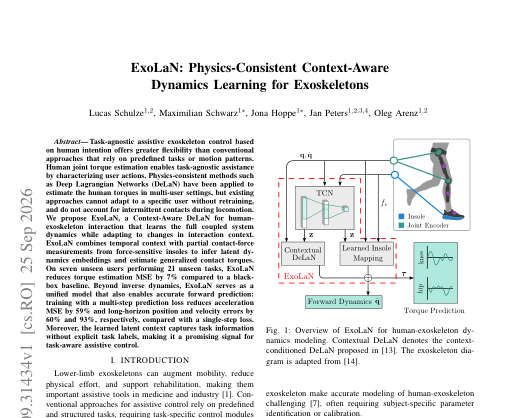
ExoLaN: Physics-Consistent Context-Aware Dynamics Learning for Exoskeletons

Lucas Schulze, Maximilian Schwarz, Jona Hoppe, Jan Peters, Oleg Arenz

Task-agnostic assistive exoskeleton control based on human intention offers greater flexibility than conventional approaches that rely on predefined tasks or motion patterns. Human…

Task-agnostic assistive exoskeleton control based on human intention offers greater flexibility than conventional approaches that rely on predefined tasks or motion patterns. Human joint torque estimation enables task-agnostic assistance by characterizing user actions. Physics-consistent methods such as Deep Lagrangian Networks (DeLaN) have been applied to estimate the human torques in multi-user settings, but existing approaches cannot adapt to a specific user without retraining, and do not account for intermittent contacts during locomotion. We propose ExoLaN, a Context-Aware DeLaN for human-exoskeleton interaction that learns the full coupled system dynamics while adapting to changes in interaction context. ExoLaN combines temporal context with partial contact-force measurements from force-sensitive insoles to infer latent dynamics embeddings and estimate generalized contact torques. On seven unseen users performing 21 unseen tasks, ExoLaN reduces torque estimation MSE by 7% compared to a black-box baseline. Beyond inverse dynamics, ExoLaN serves as a unified model that also enables accurate forward prediction: training with a multi-step prediction loss reduces acceleration MSE by 59% and long-horizon position and velocity errors by 60% and 93%, respectively, compared with a single-step loss. Moreover, the learned latent context captures task information without explicit task labels, making it a promising signal for task-aware assistive control.

cs.ROeess.SY

Davide Scaramuzza 7 篇 专属页 →

2026-11-03追踪学者 · Davide Scaramuzza

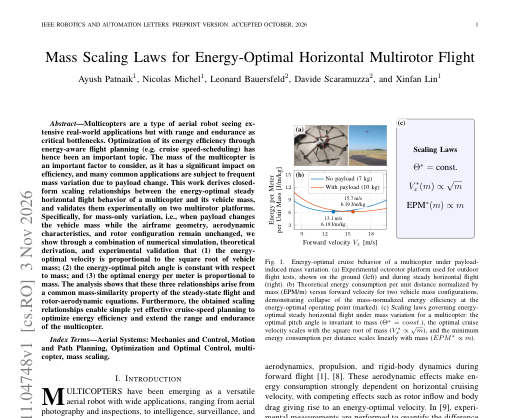
Mass Scaling Laws for Energy-Optimal Horizontal Multirotor Flight

Ayush Patnaik, Nicolas Michel, Leonard Baursfeld, Davide Scaramuzza, Xinfan Lin

Multicopters are a type of aerial robot seeing extensive real-world applications but with range and endurance as critical bottlenecks. Optimization of its energy efficiency through…

Multicopters are a type of aerial robot seeing extensive real-world applications but with range and endurance as critical bottlenecks. Optimization of its energy efficiency through energy-aware flight planning (e.g. cruise speed-scheduling) has hence been an important topic. The mass of the multicopter is an important factor to consider, as it has a significant impact on efficiency, and many common applications are subject to frequent mass variation due to payload change. This work derives closed-form scaling relationships between the energy-optimal steady horizontal flight behavior of a multicopter and its vehicle mass, and validates them experimentally on two multirotor platforms. Specifically, for mass-only variation, i.e., when payload changes the vehicle mass while the airframe geometry, aerodynamic characteristics, and rotor configuration remain unchanged, we show through a combination of numerical simulation, theoretical derivation, and experimental validation that (1) the energy-optimal velocity is proportional to the square root of vehicle mass; (2) the energy-optimal pitch angle is constant with respect to mass; and (3) the optimal energy per meter is proportional to mass. The analysis shows that these three relationships arise from a common mass-similarity property of the steady-state flight and rotor-aerodynamic equations. Furthermore, the obtained scaling relationships enable simple yet effective cruise-speed planning to optimize energy efficiency and extend the range and endurance of the multicopter.

cs.ROeess.SY
2026-10-29追踪学者 · Davide Scaramuzza

Event-SAMA: Language-Grounded Video Object Segmentation on Neuromorphic Event Streams

Sergei Fedorchenko, Max Zehnder, Nikola Zubić, Rong Zou, Davide Scaramuzza

Event cameras offer microsecond temporal resolution, high dynamic range and no motion blur, but referring video object segmentation (RVOS) lacks event-stream datasets and models. W…

Event cameras offer microsecond temporal resolution, high dynamic range and no motion blur, but referring video object segmentation (RVOS) lacks event-stream datasets and models. We introduce Event-SAMA-239K, a synthetic-event conversion of the SAMA-239K grounded video-chat corpus and all additional SAMA training data: 30,650 video clips and 392,162 images. Optical-flow, FILM or saccade upsampling followed by a linear event generator preserves all mask, referring-expression and dialogue annotations. We also introduce Event-SAMA, adapting SAMA-4B with a two-channel polarity patch embedding initialised from pretrained RGB weights and a zero-initialised event adapter. End-to-end training yields 24.37 $\mathcal{J}&\mathcal{F}$ on MeViS valid_u and 22.33 $\mathcal{J}&\mathcal{F}$ on the converted ReVOS valid subset, establishing the first event-native RVOS baseline (RGB SAMA-4B: 55.4 on MeViS). Frozen RGB SAMA-4B with pseudo-RGB renderings or E2VID reconstructions of the same events scores 13.23 and 15.94 $\mathcal{J}&\mathcal{F}$. Without retraining, Event-SAMA works on real event-camera recordings when the accumulation window matches their event density. A seed-controlled ablation with a measured noise floor of 0.47 $\mathcal{J}&\mathcal{F}$ finds gains from diverse training sources over MeViS alone (+4.99), RGB-mean event-stem initialisation (+4.33), and a trainable SAM2 mask decoder (+2.76); the event adapter, partial ViT unfreezing and event polarity are within noise at this budget. An earlier, partially converted corpus snapshot trained with the identical recipe scores 1.38 $\mathcal{J}&\mathcal{F}$ higher on MeViS and 1.12 higher on ReVOS. Both are single runs that also differ in schedule length, so we draw no conclusion about corpus scale.

cs.LGcs.AIcs.CLcs.CV
2026-10-28追踪学者 · Davide Scaramuzza

Learning Event-based Obstacle Avoidance via Differentiable Simulation

Chenlu Shou, Yunfan Ren, Jiaxu Xing, Davide Scaramuzza

Reliable obstacle avoidance is essential for safe quadrotor flight in unknown environments, yet conventional frame-based cameras remain challenged by motion blur, limited dynamic r…

Reliable obstacle avoidance is essential for safe quadrotor flight in unknown environments, yet conventional frame-based cameras remain challenged by motion blur, limited dynamic range, and latency under fast motion. Event cameras, with sub-millisecond latency, high dynamic range, and negligible motion blur, offer a promising alternative, but leveraging them for closed-loop control remains difficult. Existing approaches either adopt cascaded architectures that first estimate depth and then map it to control commands, introducing error propagation, or achieve end-to-end control through costly offline pretraining before online fine-tuning can even begin. We address these challenges with a CUDA-based event simulator that exploits GPU parallelism to render events efficiently within the training loop, integrated into a differentiable simulation pipeline that enables direct gradient backpropagation through the differentiable physics model, improving sample efficiency. This allows us to train an end-to-end policy that maps event frames directly to control commands, without intermediate depth estimation. We validate our approach through zero-shot real-world deployment on a quadrotor, achieving robust obstacle avoidance in both odometry-assisted and odometry-free settings, including under low-light conditions where conventional cameras typically fail.

2026-10-27追踪学者 · Davide Scaramuzza

Learning Visuomotor Quadrotor Flight Through Dynamic Narrow Gaps via Differentiable Simulation

Riccardo Bianco, Yunfan Ren, Jiaxu Xing, Davide Scaramuzza

Threading a quadrotor through a moving narrow gap is a demanding test of agile flight, requiring centimeter-level spatial alignment and precise temporal execution. We address this …

Threading a quadrotor through a moving narrow gap is a demanding test of agile flight, requiring centimeter-level spatial alignment and precise temporal execution. We address this challenge using a control policy that operates directly on onboard visual and inertial measurements to output collective thrust and body-rate commands. The task is difficult because success lies on a thin feasible manifold: small errors in timing, position, attitude, or visual observability cause collision. Prior planning and learning methods rely on privileged state, teachers, planners, or distillation; learning dynamic narrow-gap traversal directly, from scratch, remains open. We introduce a differentiable moving-gap formulation that gates centering, alignment, and smooth collision terms by signed distance to a time-varying gap plane, turning a sparse traversal event into a dense pathwise objective. We integrate this formulation into a visual-feature-to-command policy trained in one stage from random initialization, without a teacher, planner, or distillation. We validate our approach in both synthetic and real-world experiments. In controlled benchmarks, we demonstrate that pathwise gradients significantly outperform score-function gradients for precision-critical tasks, yielding a 99.3% success rate in simulation after only a few minutes of training on a single GPU. Furthermore, the policy transfers directly to a real quadrotor, successfully crossing a dynamic narrow gap from varied initial conditions using onboard sensing and inertial measurements, achieving an 80% success rate over 10 physical trials.

2026-10-05追踪学者 · Davide Scaramuzza

Adaptive Expert Guidance for Efficient On-Policy Reinforcement Learning

Daniele Affinita, Ming Xu, Rudolf Reiter, Davide Scaramuzza, Pascal Fua

With massively parallel simulation, on-policy Reinforcement Learning methods such as PPO have become standard in many domains. However, learning from scratch is sample-inefficient …

With massively parallel simulation, on-policy Reinforcement Learning methods such as PPO have become standard in many domains. However, learning from scratch is sample-inefficient and fails to exploit the potential existence of a suboptimal expert, such as a heuristic, a model-based controller, or a policy trained on a related task. Such an expert is often available and can guide early training, but its sub-optimality limits final performance. The challenge then becomes balancing expert guidance against learning from rewards. Existing methods set the expert's influence through a blending weight, a schedule, or an evaluation-driven curriculum. Alternatively, they adapt it with additional learned components such as critics over expert actions or auxiliary agents. However, none optimizes it using the same on-policy objective as the policy itself. We propose a method in which the learner and the expert alternate control within each training episode, and the expert's share of control is a single learnable parameter optimized jointly with the policy. The learner benefits from the expert early in training, but its share of control declines as the learner becomes more competent, until eventually vanishing completely. This leaves the learner acting alone and better than the suboptimal expert. We evaluate our method on 34 tasks across two benchmarks, spanning discrete and continuous action spaces, using both learned and model-based experts. Our method improves sample efficiency over guided and unguided baselines while requiring minimal hyperparameter variation. The expert's share decays to zero as the learner improves, vanishing when the expert is no longer useful.

cs.LGcs.AI
2026-09-25追踪学者 · Davide Scaramuzza

DAPEVO: Deep Adaptive Patch Frame-Event Visual Odometry

Luca Gandolfi, Simone Nascivera, Roberto Pellerito, Rong Zou, Chiara Plizzari, Davide Scaramuzza

Visual odometry is essential for autonomous navigation in GPS-denied environments, yet RGB-based methods remain vulnerable to motion blur, challenging illumination, and dropped fra…

Visual odometry is essential for autonomous navigation in GPS-denied environments, yet RGB-based methods remain vulnerable to motion blur, challenging illumination, and dropped frames. Event cameras complement conventional cameras with high temporal resolution and dynamic range, but their asynchronous measurements complicate reliable correspondence estimation. We present DAPEVO, a learned visual odometry system that estimates image and event correspondences independently at shared patch locations and fuses their correlation evidence before motion refinement. Each tracked patch maintains image and event descriptors, and a learned scalar gate combines modality-specific correlation embeddings for each patch--frame edge before a shared recurrent refinement and bundle-adjustment update. DAPEVO also supports event-only observations, enabling continued tracking when RGB frames are sparse or unavailable, while modality-aware keyframe culling preserves scarce frame constraints. On UZH-FPV, when retaining only one in six RGB frames, DAPEVO's mean absolute trajectory error (ATE) increases by only 36%, from 1.00 to 1.36m, whereas the ATE of DPVO and RAMP-VO rises by factors of $3.7\times$ and $3.1\times$, respectively. On TartanEvent, DAPEVO similarly remains below 1m ATE at 3Hz RGB input, while DPVO and RAMP-VO exceed 9m. Under degraded RGB input on TartanEvent, DAPEVO achieves an ATE of 0.60m, compared with more than 4m for both DPVO and RAMP-VO, while also outperforming event-only DEVO at 0.87m.

2026-09-24追踪学者 · Davide Scaramuzza

SEE Challenge 2026: Event-Guided Brightness Adjustment Across a Broad Illumination Range

Yunfan Lu, Mingchao Xu, Hanyu Zhou, Shaoyu Liu, Haoyue Liu, Peiqi Duan, Shihan Peng, Yinqiang Zheng 等

Event cameras provide a high dynamic range and preserve brightness-change cues in lighting conditions where conventional RGB frames may be noisy or saturated. To benchmark event-gu…

Event cameras provide a high dynamic range and preserve brightness-change cues in lighting conditions where conventional RGB frames may be noisy or saturated. To benchmark event-guided restoration across a broad illumination range, we organized the SEE Challenge 2026 with the Event-Based Multimodal Vision Workshop at ECCV 2026. The task conditions restoration on one or more RGB frames, synchronized events, and a scalar target-brightness statistic provided by the organizers. It uses SEE-600K, which contains 610,126 image-event observations from 202 real-world scenes spanning low-light, normal-light, and high-light conditions with illumination variations of up to 1,000$\times$. The challenge follows an open-system protocol: participants may use different temporal contexts, architectures, pretrained weights, test-time augmentation, and post-processing strategies. PSNR determines the ranking, and SSIM is reported as a secondary metric. Around 70 teams registered interest and 15 valid CodaBench submissions were received. Six distinct teams completed organizer-side identity and technical verification, provided method descriptions, checkpoints, inference code, and instructions, and are included in the verified open-system ranking reported here. Beyond the ranking, this report analyzes exposure subsets, semantically distinct test cases, a shared failure pattern, system design choices, and inference strategies. The top systems obtain closely spaced average scores, while the best-performing method varies across cases and metrics; under severe underexposure, all verified systems retain visible local errors.