Tech Station

学者追踪 › ETH / TUDa › Davide Scaramuzza

Davide Scaramuzza

ETH Zürich / TU Darmstadt · 最近 45 天 7 篇
#12026-11-03追踪学者 · Davide Scaramuzza

Mass Scaling Laws for Energy-Optimal Horizontal Multirotor Flight

Ayush Patnaik, Nicolas Michel, Leonard Baursfeld, Davide Scaramuzza, Xinfan Lin

Multicopters are a type of aerial robot seeing extensive real-world applications but with range and endurance as critical bottlenecks. Optimization of its energy efficiency through…

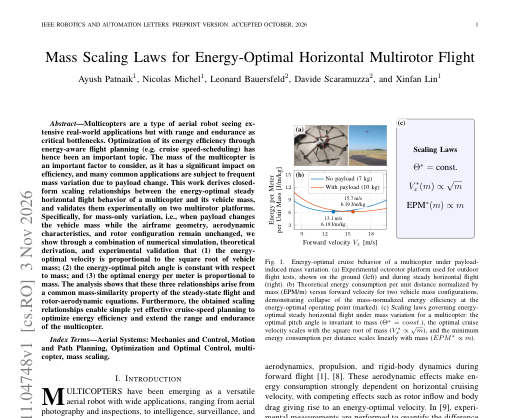
Multicopters are a type of aerial robot seeing extensive real-world applications but with range and endurance as critical bottlenecks. Optimization of its energy efficiency through energy-aware flight planning (e.g. cruise speed-scheduling) has hence been an important topic. The mass of the multicopter is an important factor to consider, as it has a significant impact on efficiency, and many common applications are subject to frequent mass variation due to payload change. This work derives closed-form scaling relationships between the energy-optimal steady horizontal flight behavior of a multicopter and its vehicle mass, and validates them experimentally on two multirotor platforms. Specifically, for mass-only variation, i.e., when payload changes the vehicle mass while the airframe geometry, aerodynamic characteristics, and rotor configuration remain unchanged, we show through a combination of numerical simulation, theoretical derivation, and experimental validation that (1) the energy-optimal velocity is proportional to the square root of vehicle mass; (2) the energy-optimal pitch angle is constant with respect to mass; and (3) the optimal energy per meter is proportional to mass. The analysis shows that these three relationships arise from a common mass-similarity property of the steady-state flight and rotor-aerodynamic equations. Furthermore, the obtained scaling relationships enable simple yet effective cruise-speed planning to optimize energy efficiency and extend the range and endurance of the multicopter.
cs.ROeess.SY
#22026-10-29追踪学者 · Davide Scaramuzza

Event-SAMA: Language-Grounded Video Object Segmentation on Neuromorphic Event Streams

Sergei Fedorchenko, Max Zehnder, Nikola Zubić, Rong Zou, Davide Scaramuzza

Event cameras offer microsecond temporal resolution, high dynamic range and no motion blur, but referring video object segmentation (RVOS) lacks event-stream datasets and models. W…

Event cameras offer microsecond temporal resolution, high dynamic range and no motion blur, but referring video object segmentation (RVOS) lacks event-stream datasets and models. We introduce Event-SAMA-239K, a synthetic-event conversion of the SAMA-239K grounded video-chat corpus and all additional SAMA training data: 30,650 video clips and 392,162 images. Optical-flow, FILM or saccade upsampling followed by a linear event generator preserves all mask, referring-expression and dialogue annotations. We also introduce Event-SAMA, adapting SAMA-4B with a two-channel polarity patch embedding initialised from pretrained RGB weights and a zero-initialised event adapter. End-to-end training yields 24.37 $\mathcal{J}&\mathcal{F}$ on MeViS valid_u and 22.33 $\mathcal{J}&\mathcal{F}$ on the converted ReVOS valid subset, establishing the first event-native RVOS baseline (RGB SAMA-4B: 55.4 on MeViS). Frozen RGB SAMA-4B with pseudo-RGB renderings or E2VID reconstructions of the same events scores 13.23 and 15.94 $\mathcal{J}&\mathcal{F}$. Without retraining, Event-SAMA works on real event-camera recordings when the accumulation window matches their event density. A seed-controlled ablation with a measured noise floor of 0.47 $\mathcal{J}&\mathcal{F}$ finds gains from diverse training sources over MeViS alone (+4.99), RGB-mean event-stem initialisation (+4.33), and a trainable SAM2 mask decoder (+2.76); the event adapter, partial ViT unfreezing and event polarity are within noise at this budget. An earlier, partially converted corpus snapshot trained with the identical recipe scores 1.38 $\mathcal{J}&\mathcal{F}$ higher on MeViS and 1.12 higher on ReVOS. Both are single runs that also differ in schedule length, so we draw no conclusion about corpus scale.

cs.LGcs.AIcs.CLcs.CV
#32026-10-28追踪学者 · Davide Scaramuzza

Learning Event-based Obstacle Avoidance via Differentiable Simulation

Chenlu Shou, Yunfan Ren, Jiaxu Xing, Davide Scaramuzza

Reliable obstacle avoidance is essential for safe quadrotor flight in unknown environments, yet conventional frame-based cameras remain challenged by motion blur, limited dynamic r…

Reliable obstacle avoidance is essential for safe quadrotor flight in unknown environments, yet conventional frame-based cameras remain challenged by motion blur, limited dynamic range, and latency under fast motion. Event cameras, with sub-millisecond latency, high dynamic range, and negligible motion blur, offer a promising alternative, but leveraging them for closed-loop control remains difficult. Existing approaches either adopt cascaded architectures that first estimate depth and then map it to control commands, introducing error propagation, or achieve end-to-end control through costly offline pretraining before online fine-tuning can even begin. We address these challenges with a CUDA-based event simulator that exploits GPU parallelism to render events efficiently within the training loop, integrated into a differentiable simulation pipeline that enables direct gradient backpropagation through the differentiable physics model, improving sample efficiency. This allows us to train an end-to-end policy that maps event frames directly to control commands, without intermediate depth estimation. We validate our approach through zero-shot real-world deployment on a quadrotor, achieving robust obstacle avoidance in both odometry-assisted and odometry-free settings, including under low-light conditions where conventional cameras typically fail.

#42026-10-27追踪学者 · Davide Scaramuzza

Learning Visuomotor Quadrotor Flight Through Dynamic Narrow Gaps via Differentiable Simulation

Riccardo Bianco, Yunfan Ren, Jiaxu Xing, Davide Scaramuzza

Threading a quadrotor through a moving narrow gap is a demanding test of agile flight, requiring centimeter-level spatial alignment and precise temporal execution. We address this …

Threading a quadrotor through a moving narrow gap is a demanding test of agile flight, requiring centimeter-level spatial alignment and precise temporal execution. We address this challenge using a control policy that operates directly on onboard visual and inertial measurements to output collective thrust and body-rate commands. The task is difficult because success lies on a thin feasible manifold: small errors in timing, position, attitude, or visual observability cause collision. Prior planning and learning methods rely on privileged state, teachers, planners, or distillation; learning dynamic narrow-gap traversal directly, from scratch, remains open. We introduce a differentiable moving-gap formulation that gates centering, alignment, and smooth collision terms by signed distance to a time-varying gap plane, turning a sparse traversal event into a dense pathwise objective. We integrate this formulation into a visual-feature-to-command policy trained in one stage from random initialization, without a teacher, planner, or distillation. We validate our approach in both synthetic and real-world experiments. In controlled benchmarks, we demonstrate that pathwise gradients significantly outperform score-function gradients for precision-critical tasks, yielding a 99.3% success rate in simulation after only a few minutes of training on a single GPU. Furthermore, the policy transfers directly to a real quadrotor, successfully crossing a dynamic narrow gap from varied initial conditions using onboard sensing and inertial measurements, achieving an 80% success rate over 10 physical trials.

#52026-10-05追踪学者 · Davide Scaramuzza

Adaptive Expert Guidance for Efficient On-Policy Reinforcement Learning

Daniele Affinita, Ming Xu, Rudolf Reiter, Davide Scaramuzza, Pascal Fua

With massively parallel simulation, on-policy Reinforcement Learning methods such as PPO have become standard in many domains. However, learning from scratch is sample-inefficient …

With massively parallel simulation, on-policy Reinforcement Learning methods such as PPO have become standard in many domains. However, learning from scratch is sample-inefficient and fails to exploit the potential existence of a suboptimal expert, such as a heuristic, a model-based controller, or a policy trained on a related task. Such an expert is often available and can guide early training, but its sub-optimality limits final performance. The challenge then becomes balancing expert guidance against learning from rewards. Existing methods set the expert's influence through a blending weight, a schedule, or an evaluation-driven curriculum. Alternatively, they adapt it with additional learned components such as critics over expert actions or auxiliary agents. However, none optimizes it using the same on-policy objective as the policy itself. We propose a method in which the learner and the expert alternate control within each training episode, and the expert's share of control is a single learnable parameter optimized jointly with the policy. The learner benefits from the expert early in training, but its share of control declines as the learner becomes more competent, until eventually vanishing completely. This leaves the learner acting alone and better than the suboptimal expert. We evaluate our method on 34 tasks across two benchmarks, spanning discrete and continuous action spaces, using both learned and model-based experts. Our method improves sample efficiency over guided and unguided baselines while requiring minimal hyperparameter variation. The expert's share decays to zero as the learner improves, vanishing when the expert is no longer useful.

cs.LGcs.AI
#62026-09-25追踪学者 · Davide Scaramuzza

DAPEVO: Deep Adaptive Patch Frame-Event Visual Odometry

Luca Gandolfi, Simone Nascivera, Roberto Pellerito, Rong Zou, Chiara Plizzari, Davide Scaramuzza

Visual odometry is essential for autonomous navigation in GPS-denied environments, yet RGB-based methods remain vulnerable to motion blur, challenging illumination, and dropped fra…

Visual odometry is essential for autonomous navigation in GPS-denied environments, yet RGB-based methods remain vulnerable to motion blur, challenging illumination, and dropped frames. Event cameras complement conventional cameras with high temporal resolution and dynamic range, but their asynchronous measurements complicate reliable correspondence estimation. We present DAPEVO, a learned visual odometry system that estimates image and event correspondences independently at shared patch locations and fuses their correlation evidence before motion refinement. Each tracked patch maintains image and event descriptors, and a learned scalar gate combines modality-specific correlation embeddings for each patch--frame edge before a shared recurrent refinement and bundle-adjustment update. DAPEVO also supports event-only observations, enabling continued tracking when RGB frames are sparse or unavailable, while modality-aware keyframe culling preserves scarce frame constraints. On UZH-FPV, when retaining only one in six RGB frames, DAPEVO's mean absolute trajectory error (ATE) increases by only 36%, from 1.00 to 1.36m, whereas the ATE of DPVO and RAMP-VO rises by factors of $3.7\times$ and $3.1\times$, respectively. On TartanEvent, DAPEVO similarly remains below 1m ATE at 3Hz RGB input, while DPVO and RAMP-VO exceed 9m. Under degraded RGB input on TartanEvent, DAPEVO achieves an ATE of 0.60m, compared with more than 4m for both DPVO and RAMP-VO, while also outperforming event-only DEVO at 0.87m.

#72026-09-24追踪学者 · Davide Scaramuzza

SEE Challenge 2026: Event-Guided Brightness Adjustment Across a Broad Illumination Range

Yunfan Lu, Mingchao Xu, Hanyu Zhou, Shaoyu Liu, Haoyue Liu, Peiqi Duan, Shihan Peng, Yinqiang Zheng 等

Event cameras provide a high dynamic range and preserve brightness-change cues in lighting conditions where conventional RGB frames may be noisy or saturated. To benchmark event-gu…

Event cameras provide a high dynamic range and preserve brightness-change cues in lighting conditions where conventional RGB frames may be noisy or saturated. To benchmark event-guided restoration across a broad illumination range, we organized the SEE Challenge 2026 with the Event-Based Multimodal Vision Workshop at ECCV 2026. The task conditions restoration on one or more RGB frames, synchronized events, and a scalar target-brightness statistic provided by the organizers. It uses SEE-600K, which contains 610,126 image-event observations from 202 real-world scenes spanning low-light, normal-light, and high-light conditions with illumination variations of up to 1,000$\times$. The challenge follows an open-system protocol: participants may use different temporal contexts, architectures, pretrained weights, test-time augmentation, and post-processing strategies. PSNR determines the ranking, and SSIM is reported as a secondary metric. Around 70 teams registered interest and 15 valid CodaBench submissions were received. Six distinct teams completed organizer-side identity and technical verification, provided method descriptions, checkpoints, inference code, and instructions, and are included in the verified open-system ranking reported here. Beyond the ranking, this report analyzes exposure subsets, semantically distinct test cases, a shared failure pattern, system design choices, and inference strategies. The top systems obtain closely spaced average scores, while the best-performing method varies across cases and metrics; under severe underexposure, all verified systems retain visible local errors.

同实验室的其他学者