Tech Station

学者追踪 › ETH / TUDa › Jan Peters

Jan Peters

ETH Zürich / TU Darmstadt · 最近 45 天 18 篇
#12026-10-27追踪学者 · Jan Peters

Retrieve to Act: Motion Primitive Graph Retrieval for Robust VLA Execution

Pham Tri Quang, Bao-Ngoc Dao, Minh Duc Nguyen, Duc-Duy Nguyen, Hung T. Ho, Linh Dang Le, Trong-Bao Ho, Thien-Loc Ha 等

Vision-Language-Action (VLA) policies demonstrate remarkable semantic generalization, yet remain highly vulnerable to out-of-distribution (OOD) visual shifts during execution. Whil…

Vision-Language-Action (VLA) policies demonstrate remarkable semantic generalization, yet remain highly vulnerable to out-of-distribution (OOD) visual shifts during execution. While existing test-time methods attempt to suppress spurious visual cues, they fundamentally overlook the rich, uncorrupted kinematic priors embedded in the policy's own training experience. We introduce Retrieve to Act (R2A), a test-time scaling framework that formulates OOD robustness purely as a geometric motion primitive retrieval problem. R2A bypasses fragile visual features by structuring successful training demonstrations into an offline spatiotemporal motion primitive graph. During inference, a query-dependent Graph Neural Network dynamically localizes the robot's ongoing execution within this graph, retrieving structurally compatible future motion primitives. These retrieved geometric priors are then seamlessly harmonized with the frozen VLA's predicted actions via a learned, dimension-wise gating mechanism, adaptively rectifying erroneous spatial trajectories while preserving the policy's local reactivity. Extensive experiments across three state-of-the-art VLA architectures, GR00T N1.7, $π_{0.5}$, and StableVLA, demonstrate that R2A consistently and significantly enhances robustness against diverse contextual perturbations. R2A achieves absolute success rate improvements of up to +12% in simulation benchmarks (LIBERO-Plus, RoboTwin2.0-Plus) and +40% in real-world deployments, without requiring any finetuning of the base policies. Project page: https://retrieve2act.github.io/r2a/

#22026-10-27追踪学者 · Jan Peters

Remember Where You Walk: Learning Spatial Memory for End-to-End Legged Robot Exploration

Leon Magnus, Nico Bohlinger, Jan Peters, Oleg Arenz

Humanoids and other legged robots operating in complex environments must remember information that leaves their field of view and only becomes relevant much later. Reinforcement le…

Humanoids and other legged robots operating in complex environments must remember information that leaves their field of view and only becomes relevant much later. Reinforcement learning policies address this using memory networks such as LSTMs that are trained end-to-end with the policy to memorize such task-relevant aspects. Yet, such architectures often fail to preserve sufficient information over long horizons. In this work, we propose a network architecture based on Hadamard memory that specifically targets robot navigation. Our Local Spatial Matrix Memory (LSMM) enables RL agents to store generic task-relevant information at specific, position-based memory cells, enabling flexible and spatially grounded memorization. We evaluate LSMM on the task of autonomous maze exploration, where it matches the maze coverage of strong recurrent and finite-history baselines while being the only architecture that remembers the maze layout, reducing the reconstruction error threefold.

#32026-10-27追踪学者 · Jan Peters

Whole-Body Humanoid Control via Stochastic Motion Tokenization

Michael Drolet, Oleg Arenz, Jan Peters

While velocity-commanded RL policies are effective for controlling quadrupeds, they are a limited interface for humanoids that need to perform complex whole-body motions. Furthermo…

While velocity-commanded RL policies are effective for controlling quadrupeds, they are a limited interface for humanoids that need to perform complex whole-body motions. Furthermore, RL tracking policies for whole-body motions typically have limited information about the desired future motion, preventing them from performing controlled deviations to achieve long-term task success; such information is particularly relevant when a controller must prepare for transitions between behaviors. We address these challenges using concise motion representations that can be generated by a high-level controller, given a behavior label or text command. These representations can be fed directly into a tracking policy to provide a detailed motion reference. Our method exhibits a high degree of flexibility in performing real-world robot motions such as dancing, fighting, or walking based on conditional information. At matched capacity, our adopted stochastic motion tokenizer reconstructs motions from the Unitree G1 at a level that exceeds state-of-the-art approaches such as finite scalar quantization (FSQ) and the vector-quantized autoencoder (VQ-VAE). The resulting discrete interface conditions whole-body tracking policies that execute generated dance, fight, and walk motions lasting 16.8 s each and a 35 s fight-to-dance sequence on a physical Unitree G1.

cs.ROcs.LG
#42026-10-24追踪学者 · Jan Peters

RoboWorM: Evaluating Movement Realism, Consistency and Acceleration Affects in Embodied Video World Models

Doanh Le Thien, Viet-Thanh Nguyen, Pham Tri Quang, Nhi Pham, Christopher Wewer, Minh-Loi Nguyen, Hoang H. Tran, Tho Le 等

Video world models (VWMs) are rapidly emerging as scalable neural simulators for robotic manipulation. However, most benchmarks only evaluate them as open-world video generators, u…

Video world models (VWMs) are rapidly emerging as scalable neural simulators for robotic manipulation. However, most benchmarks only evaluate them as open-world video generators, using Vision-Language Models (VLMs) that lack strict 3D spatial and kinematic reasoning. To bridge this gap, we introduce RoboWorM, a comprehensive, deployment-aware benchmark that leverages known hardware priors such as robot kinematic trees and fixed camera configurations, to systematically examine structural and spatiotemporal fidelity. RoboWorM curates 1,605 episodes across single-arm, bimanual, and humanoid morphologies, spanning both Markovian and long-horizon non-Markovian tasks under single- and multi-view setups. To explicitly measure physical consistency, we propose two deterministic, VLM-free metrics: KIVA for intra-view kinematic stability, and RIGIS for multi-view geometric consistency. By exploiting intrinsic robotic invariants, KIVA improves hallucination detection alignment with human annotations by 25.8% relative to the strongest frontier VLMs, while RIGIS achieves a 130% higher Spearman correlation with human preferences. Furthermore, since real-world deployment requires low inference latency, we utilize RoboWorM to conduct the first large-scale audit of the quality-efficiency trade-off. Evaluating 9 state-of-the-art acceleration techniques across 3 leading world models (over 29,000 generated rollouts), we demonstrate how these acceleration methods can retain superficial visual quality while silently compromising deployment-critical physical constraints. Using our metrics, we achieve 2.3$\times$ maximum inference speed-up with minimal quality loss.

#52026-10-21追踪学者 · Jan Peters

Integrating Flow Matching and Model Predictive Control for Safe Robot Navigation

Philipp Holzmann, Maik Pfefferkorn, Joao Carvalho, Ali Younes, An Thai Le, Georgia Chalvatzaki, Jan Peters, Rolf Findeisen

Learning-based path planners based on diffusion and flow matching can generate diverse trajectories from demonstrations but typically lack mechanisms for constraint satisfaction an…

Learning-based path planners based on diffusion and flow matching can generate diverse trajectories from demonstrations but typically lack mechanisms for constraint satisfaction and collision avoidance during deployment. This work proposes a framework that combines flow-matching-based path planning with model predictive path-following control to integrate data-driven path generation with real-time, constraint-aware execution. The flow-matching model captures multimodal path distributions, while the predictive controller adapts motion online to satisfy state and input constraints and avoid obstacles using updated local sensor information. An event-triggered re-planning scheme incorporates predictive control solutions into subsequent path generation, promoting collision-free navigation in environments with previously unseen obstacles. Simulation results for mobile robot navigation demonstrate robust performance across cluttered environments. The framework provides a systematic approach to combining flow matching with predictive control for adaptive, data-driven navigation.

cs.ROeess.SY
#62026-10-14追踪学者 · Jan Peters

Safe Reinforcement Learning with Receding-Horizon Safety Critic and Differentiable Action Shields

Siwei Ju, Jan Peters, Oleg Arenz

Despite the Markov assumption, safety failures in robot reinforcement learning rarely occur instantaneously; they typically emerge over several steps as the policy enters unfamilia…

Despite the Markov assumption, safety failures in robot reinforcement learning rarely occur instantaneously; they typically emerge over several steps as the policy enters unfamiliar states under disturbances and domain shift. We address this limitation by learning a receding-horizon safety critic that predicts whether a state will remain non-terminating over the next receding horizon, enabling anticipatory detection of impending locomotion failures. The critic is trained from rollout-derived horizon labels with a composite objective that combines horizon classification, control-barrier-function-inspired temporal consistency, and smoothness regularization, and we aggregate an ensemble of critics with a conservative Conditional Value at Risk estimate to account for uncertainty. Building on the learned critic, we derive a closed-form, differentiable CBF-style safety filter that minimally modifies the policy action to improve predicted safety, and integrate it into PPO with an anticipation loss to reduce policy-filter mismatch during training. In simulated quadruped locomotion, our method improves robustness under action noise, external perturbations, and terrain shifts, reducing catastrophic failures while maintaining competitive returns.

#72026-10-07追踪学者 · Jan Peters

Continual Graph Multi-Agent Reinforcement Learning

Tommaso Marzi, Ahmed Hendawy, Jan Peters, Carlo D'Eramo, Andrea Cini, Cesare Alippi

In Continual Multi-Agent Reinforcement Learning (CMARL), agents learn cooperative policies across sequences of tasks, aiming to adapt effectively to new tasks while preserving the …

In Continual Multi-Agent Reinforcement Learning (CMARL), agents learn cooperative policies across sequences of tasks, aiming to adapt effectively to new tasks while preserving the ability to solve previously encountered ones. In many applications, tasks differ in their underlying structure, which can represent, for example, distinct operational conditions or target configurations (e.g., different network topologies in power grids or arrangements in formation control). Existing CMARL methods lack dedicated mechanisms to leverage this structural information when learning new tasks, failing to promote transfer and mitigate forgetting. To fill this gap, we propose Continual Graph Multi-Agent Reinforcement Learning (CGMARL), a novel framework for CMARL problems in which task sequences are mapped into a series of attributed graphs, each modeling a task-specific structure. In CGMARL, each graph determines the environment dynamics (next states and/or rewards) and the number of agents for the corresponding task. Then, we present Graph-based Formation (GRAFO), the first CGMARL benchmark, and show how forgetting arises in this setting. Finally, to address this limitation, we propose Frozen Graph Encoder (FROG), a method that relies on a frozen graph backbone to preserve past structural information in graph-based CMARL policies. Experiments on GRAFO show that pairing FROG with existing CL methods substantially improves performance on multiple CGMARL scenarios.

#82026-10-07追踪学者 · Jan Peters

Do My Samples Help? Compute Budget Allocation for Real-World Sampling-Based MPC in Contact-Rich Manipulation

Magnus Dierking, João Carvalho, Vince Kurtz, Jan Peters, Nils Dengler, Georgia Chalvatzaki

Sampling-based model predictive control (SMPC) is increasingly practical for contact-rich manipulation because GPU-based physics simulators enable real-time evaluation of large num…

Sampling-based model predictive control (SMPC) is increasingly practical for contact-rich manipulation because GPU-based physics simulators enable real-time evaluation of large numbers of non-differentiable contact rollouts. However, this computation budget is finite and can be spent in competing ways, including denser control exploration, representing dynamics or state uncertainty, replanning more frequently, or aligning the simulation better with the physical state. Yet, the resulting trade-offs are not well understood in real-world sim-to-real control. In this work, we address this question through a systematic study of how to allocate a fixed computation budget for SMPC in contact-rich manipulation. To enable controlled comparisons, we develop a GPU-based framework named Budget-Allocating Model Predictive Control (BAMPC), which runs on MuJoCo Warp and exposes dynamics uncertainty, state uncertainty, and temporal alignment as independent dimensions of the computation budget while using the same control stack in simulation and on a real robot. Across three contact-rich manipulation tasks, we find that the best budget allocation depends on the dominant sim-to-real error, with dynamics randomization not universally the most effective one.

#92026-10-06追踪学者 · Jan Peters

BluffJAX: Adversarial Imperfect Information Games in JAX

Aryaman Reddi, Jan Peters, Carlo D'Eramo

We introduce BluffJAX: an open-source suite of adversarial imperfect information games in JAX. We provide canonical implementations of games designed for high simulation throughput…

We introduce BluffJAX: an open-source suite of adversarial imperfect information games in JAX. We provide canonical implementations of games designed for high simulation throughputs and parallelization on GPU accelerators. Our suite consists of well-studied benchmarks such as Texas Hold'Em Poker and Kuhn Poker, as well as games that have not been previously studied in reinforcement learning research, such as Bluff, Stud Poker, and Kemps. We hope that implementing a variety of game mechanics and difficulties will introduce new challenges and foster novel research directions in game-theoretic methods for RL. We benchmark the throughput performance and memory usage of our environments in single and multi-GPU settings, demonstrating scaling of up to hundreds of millions of samples per second, and motivating the usage of BluffJAX over related GPU and CPU-based libraries. We benchmark reinforcement learning, tree search, and game-solving algorithms in JAX in order to provide users with baseline results and facilitate future comparisons.

#102026-10-03追踪学者 · Jan Peters

Exploiting Hierarchical Controller Structure in Contextual Parameter Learning for Humanoid Loco-Manipulation

Sebastian Hirt, Lukas Theiner, Jan Peters, Rolf Findeisen

Hierarchical control architectures are widely used to decompose complex control problems into interacting control levels and are particularly important in robotics, where planning,…

Hierarchical control architectures are widely used to decompose complex control problems into interacting control levels and are particularly important in robotics, where planning, whole-body motion, and lower-level control must be coordinated across different levels of abstraction and time scales. Their overall closed-loop performance, however, depends strongly on parameters distributed across the hierarchy, such that tuning controllers on different levels independently may neglect relevant cross-layer interactions. We propose a contextual Bayesian optimization framework for joint parameter learning in hierarchical control systems. Rather than modeling closed-loop performance only as a scalar black-box function, we retain separate observations of task performance, realization quality, and control effort. A correlated multi-output Gaussian process models these performance components, while their known aggregation into the overall closed-loop objective is evaluated analytically. The formulation exploits three complementary consequences of hierarchical control: informative performance quantities exposed by the hierarchy, coupling between parameters of different controller levels, and variations of these relations with operating conditions. We evaluate the approach for humanoid loco-manipulation, jointly tuning a centroidal predictive controller and a whole-body controller for physical box pushing under varying box mass. The proposed method achieves the lowest mean empirical regret during both training and adaptation among the considered baselines.

cs.ROcs.LG
#112026-10-02追踪学者 · Jan Peters

A Geometric Perspective on Reward Function Updates in Inverse Reinforcement Learning

Anish Diwan, Jan Peters, Oleg Arenz

Inverse Reinforcement Learning (IRL) is classically solved using Lagrangian optimisation, by jointly optimising a primal-dual problem with gradient descent to obtain the optimal re…

Inverse Reinforcement Learning (IRL) is classically solved using Lagrangian optimisation, by jointly optimising a primal-dual problem with gradient descent to obtain the optimal reward function parameters and corresponding optimal policy. While this algorithmic view of IRL has been highly influential, gradient-based reward updates only paint a partial picture, largely ignoring the geometry of the problem in occupancy space. In this paper, we present an occupancy-space view of reward updates in IRL. We leverage the insight that both the optimal solution and its geometry in occupancy space are known, and show that the geometry along the e-geodesic (straight line in occupancy space) toward the optimal occupancy directly affects the gradient of the IRL dual problem in reward parameter space. This perspective naturally suggests preconditioning the dual gradient with the average Fisher information along the occupancy trajectory. We show that this preconditioned gradient is just a convex interpolation of the old reward and a new target reward, yielding efficient natural-gradient-style updates with little additional computational overhead. We then analyse these occupancy-space reward updates from a Mirror Descent (MD) perspective, and show that policy search over the resulting rewards induces approximate entropic MD on the policy. Finally, we conclude with convergence results of such geometry-aware IRL algorithms.

cs.LGcs.AIcs.RO
#122026-10-01追踪学者 · Jan Peters

Residual Compliant Policy: Learning Compliant Policies from Few Demonstrations

Chunyu Jiang, Yichen Cai, Shuai Li, Wenbin Sun, João Carvalho, Kostas Daniilidis, Oleg Arenz, Cristiana de Farias 等

Contact-rich manipulation requires a robot to be precise in free space to establish the intended contacts, and compliant once in contact to avoid excessive forces. Imitation learni…

Contact-rich manipulation requires a robot to be precise in free space to establish the intended contacts, and compliant once in contact to avoid excessive forces. Imitation learning has proven effective for simpler manipulation tasks, but the compliance underlying a demonstration is not directly observable and is therefore difficult to infer from demonstration data alone. We present a framework that makes compliance explicit at every stage. During data collection, the operator teleoperates the real robot while a synchronized digital twin visualizes the error between the commanded reference and the achieved pose, making the current compliance visible, and selects between two discrete compliance modes. To generalize across object poses, we combine Laplacian editing, which retargets trajectories efficiently but is not physics-consistent during contact, with simulation-based trajectory optimization, which enforces physical plausibility but offers no manual guidance. Finally, a residual reinforcement learning policy refines the interaction forces by adjusting the reference pose of the underlying admittance controller. We evaluate on three flipping and pushing tasks on a Franka FR3 based on a total of 7 demonstrations across tasks. Our method is successful on all 40 out-of-distribution trials, compared to 33/40 and 24/40 for two baselines, with our base policy alone reaching 35/40.

#132026-10-01追踪学者 · Jan Peters

Continue, Abort, or Fall: Viability-Aware Policy Selection (VAPS) for Safe Humanoid Acrobatics

Siwei Ju, Lu Liu, Jan Peters, Oleg Arenz

Dynamic humanoid motions such as flips risk hardware damage due to suboptimal policies, disturbances or sim-to-real gaps. A motion tracking policy offers no way out once the maneuv…

Dynamic humanoid motions such as flips risk hardware damage due to suboptimal policies, disturbances or sim-to-real gaps. A motion tracking policy offers no way out once the maneuver leaves its reference, and a backup policy needs to take over to protect the hardware for a minimum-damage landing. Which backup to use matters as much as when to switch. We present Viability-Aware Policy Selection (VAPS), which treats safety as a policy-conditioned, receding-horizon decision. Besides a protective fall policy, we also train an abort policy which can abort the motion at any time, landing on its feet. At every control step, learned predictors estimate whether the nominal tracking policy and the abort policy remain viable over a short horizon, and a least-sacrificial hierarchy keeps the most task-ambitious behavior that remains viable. In simulation with randomized disturbances, VAPS sharply reduces head contact and hand contact, which are the dominant sources of hardware damage, with both a Unitree G1 and a LimX Oli; on the LimX Oli, we validate the viability predictors and the full VAPS controller for side-flip motions. VAPS Pareto-dominates the strongest single-network alternatives we could train, including an end-to-end safe-tracking policy and students distilled from VAPS's own oracle-routed decisions, in both task success and head impact. We also show that VAPS is a powerful framework to supervise undertrained policies and protect the hardware.

#142026-09-30追踪学者 · Jan Peters

Neuro-Symbolic Predicate Learning for Semantic Safe Robot Control

Zihan Ye, Jiayi Liu, Puze Liu, Jiayun Li, Georgia Chalvatzaki, Jan Peters, Kristian Kersting

As robots are increasingly deployed in everyday environments, ensuring their safety has become a central challenge. Existing methods often encode safety requirements as opaque math…

As robots are increasingly deployed in everyday environments, ensuring their safety has become a central challenge. Existing methods often encode safety requirements as opaque mathematical/logical formulations or dense cost functions. While effective in specific tasks, they remain difficult to interpret, tightly coupled to individual tasks, and offer limited insight into why a robot action is considered safe or unsafe. To address this limitation, we propose ``Neuro-Symbolic Predicate Learning for Semantic Safe Robot Control'' (NEUPRO), which leverages a differentiable reasoner that can learn reusable safety representations from human-specified safety knowledge. NEUPRO allows practitioners to express task-related safety requirements as transparent symbolic rules, while enabling gradients to propagate through these rules to a feature extractor that maps raw observations to safety-relevant concepts. As a result, the learned feature extractor is (softly) grounded in human-understandable semantics, supports transparent constraint evaluation, and is transferable across tasks. By coupling interpretability with differentiability, NEUPRO moves beyond opaque cost design toward reusable safety reasoning. To evaluate NEUPRO's capability, we collect and release REASON, the first real robot benchmark dataset for interpretable robot safety specification. Experiments on REASON show that NEUPRO learns safety-critical features that generalize across tasks, mitigate the interpretability limitations of conventional black-box cost formulations, and provide explicit explanations of safety violation.

#152026-09-29追踪学者 · Jan Peters

Does This Action Still Explain the Task? Reverse Scoring for Diffusion Language Model Agents

Jiacheng Qiu, Christopher E. Mower, Jan Peters, Haitham Bou-Ammar, Matthieu Zimmer

Diffusion-based large language models (dLLMs) promise to break the sequential latency bottleneck of autoregressive agents through parallel decoding, but recent evaluations show thi…

Diffusion-based large language models (dLLMs) promise to break the sequential latency bottleneck of autoregressive agents through parallel decoding, but recent evaluations show this efficiency does not transfer to embodied agentic competence: dLLM-backed agents repeatedly fall into retry loops, re-issuing an action long after it has failed. We give a mechanistic account of this failure and a training-free remedy. We trace the retry loop to the adaptivity of masked decoding: the sampler commits the positions it is most confident about and defers the uncertain ones, and at a failure state the context already offers a confident fill for the deferred decision, i.e. the failed action itself, so the retry is committed without the failure feedback ever being confronted. We model the resulting distortion of the action distribution as a task-blind corruption: contextually salient actions (e.g., the action just taken) receive inflated probability by a factor that depends on the state and the action but not on the task. Under this model, we analyse an invariance proposition: the task-blind factor cancels exactly from the reverse conditional, i.e. the likelihood of the task given the state and a candidate action, which coincides with the task posterior of an idealized uncorrupted model. Masked dLLMs evaluate the reverse conditional natively, unlike autoregressive models, by masking the task tokens and denoising, at the cost of a few parallel passes per candidate. We instantiate the rule as Reflect Reverse and evaluate it on four multi-turn embodied benchmarks, where it improves task success and progression rates over forward-scoring baselines.

cs.LGcs.AI
#162026-09-29追踪学者 · Jan Peters

CrossBFM: Distilling a Shared Latent Behavior Space Across Humanoid Embodiments

Tan-Dzung Do, Tuan Dat Phuong, Nico Bohlinger, Cuc T. Trinh, Siwei Ju, Vien Anh Ngo, Jan Peters, Xinchao Wang 等

Behavior Foundation Models (BFMs) give humanoids a promptable policy over a latent behavior space, enabling one single vector to represent a motion to imitate, a pose to reach, or …

Behavior Foundation Models (BFMs) give humanoids a promptable policy over a latent behavior space, enabling one single vector to represent a motion to imitate, a pose to reach, or a reward to maximize. Forward-Backward representations successfully produce such spaces, but at the cost of hundreds of GPU-hours for a single robot. Moreover, when the training process is repeated for a second robot, it produces a second space unrelated to the first, resulting in embodiment-specific latents that do not unify or transfer. We address these problems with CrossBFM, treating the latent space as the transferable asset for various embodiments. As retargeting provides frame-level cross-embodiment correspondence, we propose a unified encoder architecture with no robot-specific parameters for distilling the behavior space to address all training embodiments simultaneously in less than a GPU-hour. Following this encoder, latent-conditioned trackers turn the distilled latent into whole-body control in a conventional PPO training manner in just 10 more GPU-hours. On three distilled humanoids, all three prompting modes transfer: motion tracking with latent-conditioned policy losing only $0.025$ rad to its joint-conditioned counterpart, smooth goal reaching between poses with no falls, and reward optimization for all $41$ reward prompts. Our experiments further reveal that 1) regressing the encoder on a quarter of the motion corpus costs only $5%$ of tracking performance and 2) training the encoder on a subset of robots and evaluating on an unseen one recovers up to $89%$ of the tracking performance of seen robots, demonstrating cross-embodiment generalization to morphologically similar robots. We also verify the pipeline on real robots across all three prompting modes and with flow-based generated latents. Project website: https://dotandung.github.io/crossbfm/

#172026-09-28追踪学者 · Jan Peters

ChronoSRL: Temporal Geometry for Self-Supervised Reinforcement Learning

Nico Bohlinger, Jan Peters

A goal that is close in space can be far away in time. Obstacles, terrain, and the agent's own capabilities determine how long it takes to get there. Yet, critics in contrastive an…

A goal that is close in space can be far away in time. Obstacles, terrain, and the agent's own capabilities determine how long it takes to get there. Yet, critics in contrastive and survival reinforcement learning do not measure the distances in their representation space in units of time. We therefore introduce ChronoSRL, which gives the critic's embeddings an explicit temporal geometry. The distance between state-action and goal embeddings is trained to match the time that the agent takes to reach the goal (goal-reaching time), while goals that were not reached, and goals from other trajectories, are pushed at least one discount horizon away. Furthermore, reaching a goal quickly once does not mean that reaching it is reliable in general, so the policy should not follow the temporal distance directly. Instead, we build on survival reinforcement learning and predict from our temporal embeddings not only the full distribution of goal-reaching times but also the time spent near the goal. Thereby, the policy is trained to favor actions that reach the goal sooner and more reliably and that keep the agent near it. ChronoSRL learns faster and reaches higher performance than contrastive, action-chunked contrastive, and survival reinforcement learning baselines on seven standard locomotion and navigation benchmarks, even with much smaller networks. To test the limits of self-supervised reinforcement learning, we introduce velocity tracking, goal-position reaching, and box climbing tasks with a quadruped robot in a realistic sim-to-real locomotion setup, and show how the shaping terms that are typical for robotics can be naturally incorporated into our framework. ChronoSRL is the only one of the tested self-supervised reinforcement learning methods that learns to stay at the commanded velocities and goal positions, and climbs the highest boxes.

cs.AIcs.RO
#182026-09-25追踪学者 · Jan Peters

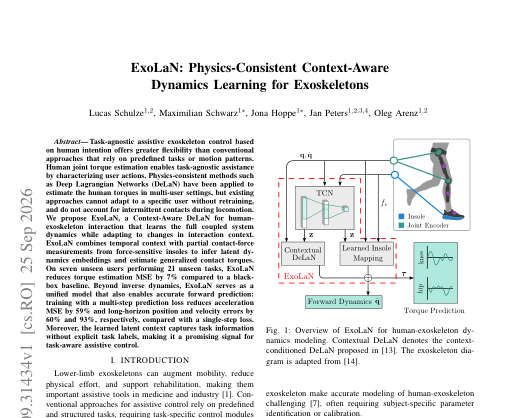
ExoLaN: Physics-Consistent Context-Aware Dynamics Learning for Exoskeletons

Lucas Schulze, Maximilian Schwarz, Jona Hoppe, Jan Peters, Oleg Arenz

Task-agnostic assistive exoskeleton control based on human intention offers greater flexibility than conventional approaches that rely on predefined tasks or motion patterns. Human…

Task-agnostic assistive exoskeleton control based on human intention offers greater flexibility than conventional approaches that rely on predefined tasks or motion patterns. Human joint torque estimation enables task-agnostic assistance by characterizing user actions. Physics-consistent methods such as Deep Lagrangian Networks (DeLaN) have been applied to estimate the human torques in multi-user settings, but existing approaches cannot adapt to a specific user without retraining, and do not account for intermittent contacts during locomotion. We propose ExoLaN, a Context-Aware DeLaN for human-exoskeleton interaction that learns the full coupled system dynamics while adapting to changes in interaction context. ExoLaN combines temporal context with partial contact-force measurements from force-sensitive insoles to infer latent dynamics embeddings and estimate generalized contact torques. On seven unseen users performing 21 unseen tasks, ExoLaN reduces torque estimation MSE by 7% compared to a black-box baseline. Beyond inverse dynamics, ExoLaN serves as a unified model that also enables accurate forward prediction: training with a multi-step prediction loss reduces acceleration MSE by 59% and long-horizon position and velocity errors by 60% and 93%, respectively, compared with a single-step loss. Moreover, the learned latent context captures task information without explicit task labels, making it a promising signal for task-aware assistive control.

cs.ROeess.SY

同实验室的其他学者