Tech Station

2026-09-16

50 篇论文 · 30 个项目 ← 2026-09-15 · 2026-09-17 →

论文

#12026-09-14追踪学者 · He Wang105

Bench2Dex: Benchmarking Visuo-Tactile Bimanual Dexterous Manipulation Across Dexterous Hands

Zhenjie Yang, Yideng Zhang, Dongjie Zhang, Chenyu Jiang, Xianshuai Liu, Yufeng Li 等

Tactile sensing provides contact information that can be difficult to infer from vision alone, but tactile hardware for dexterous hands has not converged to a common design. Dexter…

Tactile sensing provides contact information that can be difficult to infer from vision alone, but tactile hardware for dexterous hands has not converged to a common design. Dexterous hands differ in finger structure, contact surfaces, and sensor layouts, while simulated tactile signals still differ from measurements produced by physical sensors. These factors make it difficult to study visuo-tactile manipulation across diverse dexterous hands within a consistent experimental setting. We present Bench2Dex, a simulation benchmark for visuo-tactile bimanual manipulation across 12 dexterous hands. We adapt existing robot models with a shared simulated tactile interface that converts local contact geometry into image-like tactile observations. The interface provides a consistent observation format across different hand morphologies without attempting to reproduce the output of a specific physical tactile sensor. Bench2Dex includes 26 bimanual manipulation tasks that involve tool use, articulated-object interaction, and multi-stage manipulation, together with about 1.3K human-teleoperated demonstrations. The benchmark provides synchronized visual, tactile, proprioceptive, action, and object-state observations, together with executable task metrics. For robustness, we group seven perturbation types into invariance axis, where the correct action does not change, and equivariance axis, where the correct action changes together with the perturbation. We evaluate ACT, Diffusion Policy, pi0.5, and GR00T N1.5 on Bench2Dex and report their performance and failure modes. Bench2Dex is meant as a platform for studying visuo-tactile learning across dexterous hands. It does not assume that simulated tactile observations can replace real tactile sensing; it offers a shared setting for algorithm development while tactile hardware and simulation models are still evolving.

cs.ROcs.AIcs.CVrobotmanipulationdiffusion policydexteroustactile

追踪学者:He Wang;兴趣:dexterous hands and tactile sensing

#22026-09-12追踪学者 · Katerina Fragkiadaki98

GeomVLA: Unifying Scene, Motion, and Action in 3D

Ziyin Xiong, Nikos Gkanatsios, Moritz Reuss, Katerina Fragkiadaki

We present GeomVLA, a Vision-Language-Action (VLA) model that unifies perception, latent scene motion prediction, and action generation within a shared robot-centric 3D coordinate …

We present GeomVLA, a Vision-Language-Action (VLA) model that unifies perception, latent scene motion prediction, and action generation within a shared robot-centric 3D coordinate frame. Our approach lifts pretrained VLM features into spatially grounded 3D scene tokens using depth and camera calibration, while retaining the semantic representations learned during VLM pretraining. We further introduce a 3D Scene Trajectory Denoiser, a task-conditioned module that learns a latent representation of how scene points are expected to move in 3D. Rather than executing the predicted trajectory as an open-loop plan, GeomVLA extracts intermediate motion tokens from the trajectory denoiser and uses them to condition a 3D flow-based action denoiser through geometry-aware attention. GeomVLA achieves state-of-the-art performance on CALVIN, competitive performance on LIBERO and RoboTwin2.0, and outperforms strong baselines in real-world manipulation settings without robot-action pretraining. Extensive ablations show that future-motion reasoning alone is insufficient: the primary gains are associated with maintaining geometric consistency among scene representation, motion prediction, and robot actions throughout the perception-to-action pipeline.

cs.ROrobotmanipulationVLAvision-language-action

追踪学者:Katerina Fragkiadaki;兴趣:vision-language-action (VLA) models and foundation models for robots

#32026-09-1596

SAVLA: Symmetry-Aware Vision-Language-Action Models for Robotic Manipulation

Junle Li, Weixian Waylon Li, Fuxiang Wu, Fusheng Hao, Fengxiang He

Vision-language-action (VLA) models have become the dominant paradigm for language-conditioned robot manipulation. However, although images and language instructions inherently enc…

Vision-language-action (VLA) models have become the dominant paradigm for language-conditioned robot manipulation. However, although images and language instructions inherently encode geometric information, VLAs acquire their spatial competence purely from demonstrations. As a result, they are reliable only within the range of scene poses that the demonstrations cover. We propose SAVLA, an end-to-end symmetry-aware VLA model for robust and data-efficient policy learning. Our approach keeps the pretrained vision-language backbone entirely frozen while combining it with an equivariant flow-matching action head and a learned canonicalizer. The head decomposes its state, action, and conditioning inputs into invariant and equivariant channels, and preserves this typing throughout all of its layers. The canonicalizer transforms oblique-view images into a canonical frame and rotates the geometric conditions consistently. We evaluate our model on LIBERO. Compared with the GR00T N1.5 baseline, SAVLA improves the success rate averaged over all four LIBERO suites by 5.1 points and increases the mean success rate under rotation on LIBERO-Goal from 41.5% to 90.4%.

cs.ROrobotmanipulationVLAvision-language-action

兴趣:vision-language-action (VLA) models and foundation models for robots

#42026-09-1596

UniDex-ViTac: Learning Unified Visuo-Tactile Dexterous Manipulation Policy from Human Video Data

Hyesung Lee, Si-Hwan Heo, Sungwook Yang

Human videos provide demonstrations of dexterous manipulation but lack robot-executable actions and tactile measurements. We present UniDex-ViTac, a framework that uses human-video…

Human videos provide demonstrations of dexterous manipulation but lack robot-executable actions and tactile measurements. We present UniDex-ViTac, a framework that uses human-video-guided simulation to generate robot demonstrations paired with fingertip contact observations for training a deployable visuo-tactile policy. Object-specific residual reinforcement learning specialists adapt annotated human-object interaction references to a robotic arm-hand system. Their successful rollouts pair final robot action targets with robot-side fingertip contact observations. From 50 human demonstrations across ten objects, we collect 10,000 simulated trajectories to train a single Action Chunking with Transformers (ACT) based generalist. The policy combines point clouds, proprioception, and four binary contact signals encoded through fingertip labels and a separate token, without requiring human references or privileged object identity and pose at deployment. The contact-augmented configuration achieves 68.3% macro-average success in simulation, compared with 55.5% for the point-cloud-only baseline. Without real-robot demonstrations or policy fine-tuning, it succeeds in 73/110 physical trials (66.4%) across six seen and five unseen objects, compared with 60/110 (54.5%) for the baseline, an increase of 11.8 percentage points. These results support the feasibility of learning a unified visuo-tactile dexterous manipulation policy from video-guided simulated interactions. Project page: https://unidex-vitac.github.io/

cs.ROrobotmanipulationdexteroustactile

兴趣:robot manipulation and grasping with learned policies

#52026-09-1595

Weave: Learning Whole-Body Dexterous Loco-Manipulation from Human-Object Interactions

Liu Cao, Xingze Wu, Jingzhi Cui, Botian Xu, Mingzhi Pei, Ruoqu Chen 等

Learning humanoid-object interaction requires coordinating whole-body balance, locomotion, and dexterous hand contact to control both robot and object motion. Human demonstrations …

Learning humanoid-object interaction requires coordinating whole-body balance, locomotion, and dexterous hand contact to control both robot and object motion. Human demonstrations provide examples of coordinated interaction, but transferring these behaviors to humanoid robots requires learning how to establish and maintain effective contacts under different embodiments and dynamics. We present Weave, a unified framework for learning whole-body dexterous humanoid-object interaction from captured human demonstrations. Weave first converts captured human-object interactions into executable robot-object references through contact-aware retargeting and approach-motion completion. At its core is a contact- and geometry-aware policy that jointly commands 29 body joints and 12 actuated finger joints across multiple objects and interaction sequences. Evaluation across nine objects yields a 92.5% success rate on trained interactions and, without any additional training, 65.0% on sequences never seen during training. We additionally release ~9,000 physically executed rollouts spanning ~23 hours, providing robot-object trajectories with contact annotations for downstream interaction-policy learning and physically consistent HOI motion generation. Project website: https://xiaohu-art.github.io/Weave/

cs.ROcs.AIcs.LGrobotmanipulationhumanoidlocomotiondexterous

兴趣:humanoid robots and whole-body control

#62026-09-1095

Pelican-Sim 1.0: A General World Model Simulator for Embodied Intelligence

Shilong Zou, Shilin Zhang, Yingji Zhang, Yuhang Huang, Yi Zhang, Zeyuan Ding 等

In this technical report, we propose Pelican-Sim 1.0, a general world model simulator for embodied intelligence that predicts future observations from visual context and robot acti…

In this technical report, we propose Pelican-Sim 1.0, a general world model simulator for embodied intelligence that predicts future observations from visual context and robot actions to support downstream learning and decision making. The model incorporates four key design features: (1) Unified action representation: a 28-dimensional action value space covering most mainstream embodiments, keeping one model valid across heterogeneous devices. (2) Action-visual injection: URDF- and camera-rendered action videos bridge actions and pixels, giving markedly better controllability across embodiments, scenes, and tasks (PSNR +0.904 over alternative fusion baselines). (3) Sparse mixture-of-experts (MoE): sparse MoE layers add capacity for heterogeneous dynamics and absorb the action modality while reducing inter-modality conflict (FVD -6.530 vs. the dense backbone). (4) Efficient rollout generation: causal adaptation and few-step distillation yield a four-step autoregressive simulator, achieving a 5.67-fold speedup over the 35-step model. Benefiting from these designs, we train on approximately one million real-world and simulated trajectories and obtain large gains in action controllability and video quality: PSNR improves over the strongest evaluated baselines by 4.636 on AgiBotWorld Beta, 2.080 on RoboMIND, and 10.343 on RoboTwin, with the adapted EWMBench DYN score up 0.426 on RoboTwin. Relying on this, four downstream applications on RoboTwin succeed: 500 generated trajectories added to 50 demonstrations per task raise policy success from 70% to 93%; policy evaluation reaches a Pearson correlation of 0.994 across five checkpoints; and relative success gains reach 47.7% for action selection and 20.3% for policy improvement. Qualitative generalization across trajectory, scene, object, embodiment, and viewpoint shifts highlights its potential as a general-purpose world model simulator.

cs.ROcs.AIrobotembodiedworld model

兴趣:world models and video prediction for embodied agents

#72026-09-1594

Fingers as Legs: Learning Self-Supported Locomotion and Manipulation with an Anthropomorphic Hand

Amirhossein Kazemipour, Hehui Zheng, Robert Katzschmann

A walking robotic hand must use the same fingers to move its body, support its weight, and interact with the environment. We show how an anthropomorphic hand can learn these skills…

A walking robotic hand must use the same fingers to move its body, support its weight, and interact with the environment. We show how an anthropomorphic hand can learn these skills while retaining its finger design and position controller. Onboard power and computation make the platform self-contained. Our reinforcement learning approach accounts for the hand's unequal fingers, with training in a simulator calibrated from hardware measurements. In simulation, the hand moves faster with our reward formulation than with tuned rewards originally designed for quadrupeds. On hardware, task-specific policies enable untethered crawling, steering, and fall recovery. While supporting its own weight, the hand also executes successive keyboard commands without vision and pushes an object to targets using overhead visual feedback. These results demonstrate a compact mobile manipulator that reuses its fingers for locomotion and interaction, without a separate locomotion mechanism.

cs.ROeess.SYmanipulationlocomotion

兴趣:robot manipulation and grasping with learned policies

#82026-09-1494

Touch2Trace: Tactile-Driven Imitation Learning for Dexterous Cable Tracing

Matteo Grimaldi, David Klee, Ziling Chen, Tong Jian, Wonju Lee, Wenjie Lu 等

Dexterous manipulation of deformable objects demands continuous fingertip-level regulation of pressure, friction, and incipient slip. We study one of the most challenging cases: de…

Dexterous manipulation of deformable objects demands continuous fingertip-level regulation of pressure, friction, and incipient slip. We study one of the most challenging cases: dexterous cable tracing, feeding a cable through the hand with repeated pinch-and-curl motions of the thumb and index finger. We introduce Touch2Trace, a tactile-driven imitation-learning system for this task, and provide, to our knowledge, the first systematic real-world characterization of how encoder pretraining, control rate, temporal context, and spatial resolution each shape policy performance. The winning learning recipe combines a tactile encoder pretrained for a custom 32 x 32 piezoresistive sensor (TacV5) via self-supervised learning with a lightweight transformer policy trained on teleoperated demonstrations via behavior cloning, deployed at 60 Hz on a Tesollo DG-5F hand. Tactile feedback without vision or explicit cable-state estimation significantly improves tracing performance versus a proprioception-only baseline: from 0.2 cm to 20.1 cm mean distance and 0% to 93% success rate, with zero-shot transfer to unseen cables and routing conditions. The results quantify the influence of key parameters in tactile-driven systems for reliable dexterous deformable object manipulation.

cs.ROmanipulationimitation learningdexteroustactile

兴趣:dexterous hands and tactile sensing

#92026-09-1394

World-Action Models for Robot Learning and Control: A Survey

Zuxing Lu, Hongjia Zhai, Guanzhi Wang, Huajian Zeng, Jiaqi Yang, Jingyu Liu 等

Robots operating in open environments act under partial observability, physical constraints, and dynamic task contexts. Beyond mapping observations and language instructions to act…

Robots operating in open environments act under partial observability, physical constraints, and dynamic task contexts. Beyond mapping observations and language instructions to actions, they must anticipate how candidate actions may affect future states and task-relevant outcomes. Recent advances in world models, video generation, and Vision-Language-Action (VLA) policies have motivated the development of World-Action Models (WAMs), which couple future world prediction with executable action generation. This survey provides a robotics-oriented review of WAMs. We clarify their scope relative to conventional world models, model-based reinforcement learning, action-conditioned video generation, and reactive VLA policies, and organize existing methods through a unified taxonomy covering representations, transition modeling, action interfaces, architectures, training pipelines, data modalities, and scaling strategies. We further review applications of WAMs in manipulation, navigation, and autonomous driving, and we summarize the datasets, benchmarks, metrics, and protocols used to evaluate WAM systems. Finally, we discuss key challenges in action alignment, world-action factorization, spatial and multi-view consistency, long-horizon memory, neural simulation for closed-loop policy learning, and efficient inference. Taken together, this survey aims to provide a concise technical foundation for integrating predictive world modeling with action generation, toward more reliable embodied robot intelligence. Project page: https://rcl-robotics.github.io/Awesome-World-Action-Models.

cs.ROcs.CVrobotmanipulationVLAvision-language-actionembodied

兴趣:vision-language-action (VLA) models and foundation models for robots

#102026-09-1593

WholeBodyWAM: Generalizing Pre-trained World-Action Priors to Humanoid Loco-Manipulation via WBC-Grounded Coordination

Zhuo Li, Yiming Yao, Jim Tan, Mengjie Jing, Zhipeng Dong, Fei Chen

World Action Models (WAMs) offer a promising approach to general-purpose robot manipulation by jointly modeling visual dynamics and actions. However, most WAM studies focus on tabl…

World Action Models (WAMs) offer a promising approach to general-purpose robot manipulation by jointly modeling visual dynamics and actions. However, most WAM studies focus on tabletop or arm-centric manipulation, while humanoid loco-manipulation remains less explored. To address this gap, we introduce WholeBodyWAM, which jointly predicts future visual dynamics, manipulation actions, and whole-body control intents for generalizable humanoid loco-manipulation. It preserves pre-trained world-action priors while grounding heterogeneous whole-body controller (WBC) semantics and coordinating whole-body behavior. Extensive experiments show that WholeBodyWAM achieves an overall simulation task success rate of 91.9%, with a 0.23 improvement in real-world out-of-distribution task progress and a 70% reduction in success-rate variance across WBCs relative to the respective baselines. These results suggest a path toward scalable humanoid whole-body intelligence by extending pre-trained world-action priors through structured WBC grounding and coordination, rather than relearning whole-body behavior from scratch. Project page: https://wholebodywam.github.io/.

cs.ROrobotmanipulationhumanoid

兴趣:humanoid robots and whole-body control

#112026-09-1593

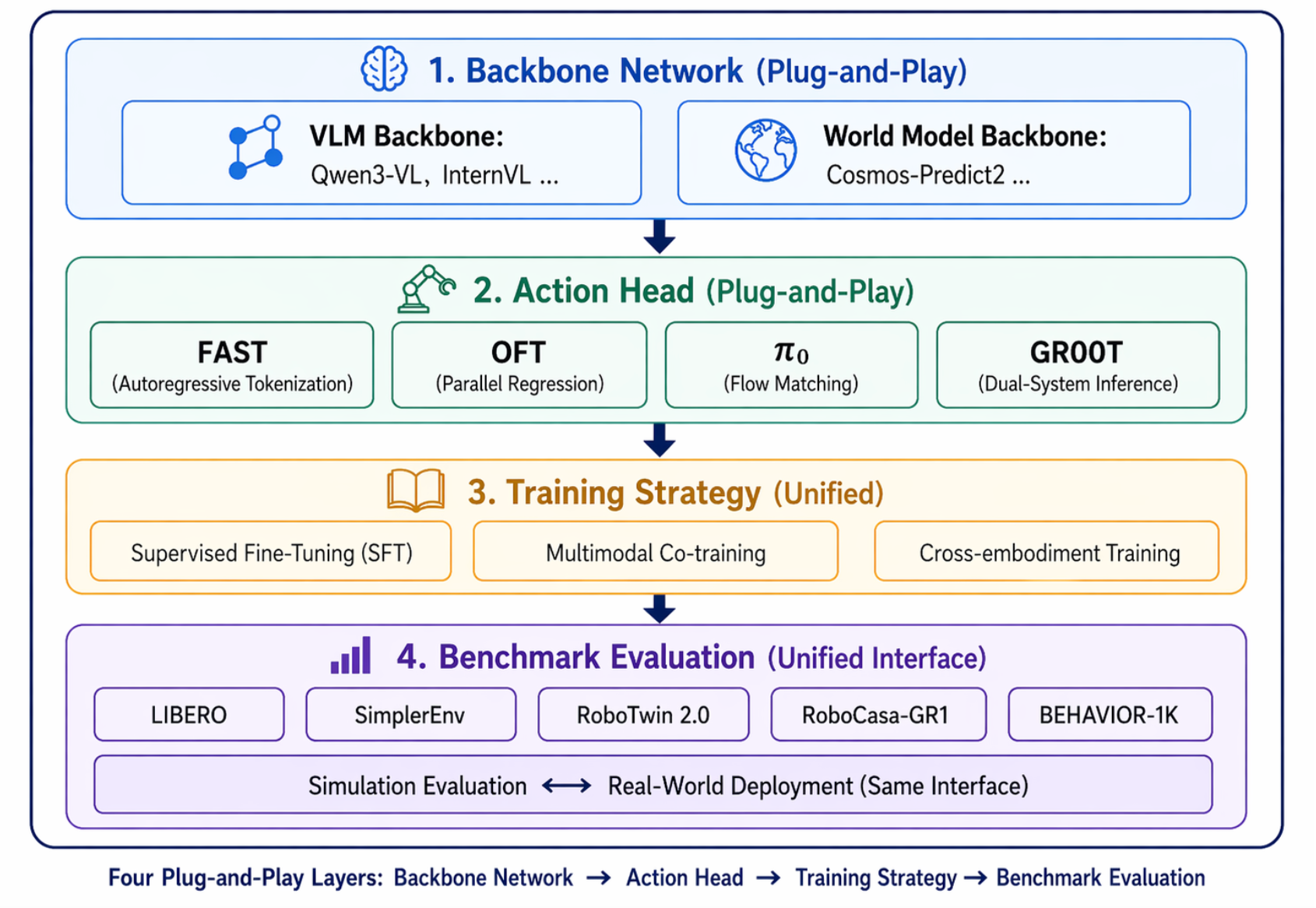
FluxVLA Engine: A One-Stop VLA Engineering Platform for Embodied Intelligence

Yinhao Li, Weixin Mao, Zihan Lan, Jikun Rong, Qirui Hu, Yiming Zhang 等

Vision-language-action (VLA) models, world-action models (WAMs), and offline reinforcement learning methods are rapidly expanding the design space of embodied policies, yet turning…

Vision-language-action (VLA) models, world-action models (WAMs), and offline reinforcement learning methods are rapidly expanding the design space of embodied policies, yet turning these algorithms into reliable robot systems remains constrained by fragmented data formats, training stacks, evaluation protocols, inference runtimes, and embodiment-specific interfaces. We present $FluxVLA$ Engine, an open, configuration-driven platform that turns heterogeneous embodied-policy components into a reproducible data-to-deployment workflow. Rather than introducing another policy model, $FluxVLA$ standardizes interfaces for datasets, visual-language and world models, action heads, reward- or advantage-weighted learning, distributed training, simulation evaluation, optimized inference, and robot operators. The engine further integrates compositional dual-arm simulation, scalable automatic data generation, and model-decoupled human-in-the-loop rollout, takeover, correction collection, and reward annotation. For responsive physical execution, it combines Real-Time Chunking (RTC) with accelerated inference backends, lightweight remote GPU serving, and configurable trajectory post-processing. Together, these capabilities connect offline learning, simulation validation, online correction, and real-robot execution through shared and auditable contracts. $FluxVLA$ therefore targets the engineering bottlenecks separating promising embodied-learning algorithms from reproducible evaluation and dependable deployment. Code is available at https://github.com/FluxVLA/FluxVLA

cs.ROcs.AIrobotVLAvision-language-actionembodied

兴趣:vision-language-action (VLA) models and foundation models for robots

#122026-09-1593

World Models for Embodied Intelligence: From Plausible to Controllable to Actionable

Nanjie Yao, Hao Wang, Chong Cheng, Zhikang Chen, Wenzhe Li, Jiafei Lyu 等

World models connect perception and decision-making in embodied intelligence by maintaining hidden state, anticipating consequences, comparing interventions, and adapting when exec…

World models connect perception and decision-making in embodied intelligence by maintaining hidden state, anticipating consequences, comparing interventions, and adapting when execution departs from expectations. Although progress is often measured by visual fidelity, their value lies in improving behavior. Before reaching for a cup, a person anticipates its weight and resistance to grasping, shaping the hand before contact. Such anticipation is coarse and rarely pictorial, yet it guides action. This raises a central question: which predictive capabilities improve behavior? Existing surveys, organized by architecture, output modality, or application domain, leave this question implicit. We introduce three progressively stronger capability levels: Plausible models preserve task-relevant temporal, geometric, or physical structure; Controllable models additionally predict how interventions alter that structure; and Actionable models translate predictions into measurable gains in planning, action, learning, evaluation, verification, recovery, or data selection. We complement this hierarchy with a 3 x 4 matrix crossing geometry, physics, and action grounding with improvement loops centered on data, rewards, policies, and the model itself. Using this framework, we survey manipulation, navigation, locomotion, autonomous driving, and general embodied learning, tracing technical progressions, clarifying capability requirements, and examining datasets, benchmarks, and evaluation protocols. We identify challenges in long-horizon consistency, uncertainty calibration, causal intervention testing, latency, verification and recovery, and cross-embodiment transfer. This perspective shifts evaluation from visual plausibility toward whether predictions capture task-relevant state, reflect intervention effects, and improve the closed-loop behavior of embodied agents.

cs.ROcs.AImanipulationlocomotionembodied

兴趣:world models and video prediction for embodied agents

#132026-09-1493

X-WBC: A Cross-Embodiment Foundation Model for Humanoid Whole-Body Control

Juntong Zhang, Chun Gu, Li Zhang

Scaling humanoid whole-body control toward general-purpose deployment requires large human motion corpora and training experience shared across robot bodies. Existing methods usual…

Scaling humanoid whole-body control toward general-purpose deployment requires large human motion corpora and training experience shared across robot bodies. Existing methods usually train one policy per robot, leaving motion experience isolated across embodiments. We introduce X-WBC, a cross-embodiment foundation framework that separates relatively shared human motion semantics from embodiment-specific physical execution. Human-centered command tokens align full human motion, robot reference motion, and sparse VR observations. A causal Transformer learns reusable temporal structure from mixed multi-robot rollouts, while lightweight robot-specific modules map the shared representation to each robot's proprioception and action space. Across nine simulated embodiments, external motions, and four real robots, experiments show that joint training improves tracking, the aligned representation supports consistent control across command sources, and the learned policy remains competitive beyond the training corpus. These results support heterogeneous humanoids as joint data sources and establish cross-embodiment joint training as a practical route toward whole-body control foundation models.

cs.ROrobothumanoid

兴趣:humanoid robots and whole-body control

#142026-09-1593

Intrinsic Robot Rewarding: Reusing VLA Representations for Autonomous Evaluation and Policy Improvement

Tobias Schaffer, Mohab Elkhayat, Daniela Nicklas, Mustafa Almohamad, Elham Al-Fuqara

Vision-language-action (VLA) systems already bring together two valuable resources for robot learning: rich visual representations and demonstrations of successful task execution. …

Vision-language-action (VLA) systems already bring together two valuable resources for robot learning: rich visual representations and demonstrations of successful task execution. Intrinsic Robot Rewarding (IRR) proposes to use these resources for a second, complementary purpose: evaluating the robot's own outcomes and providing feedback for policy improvement. Successful demonstration endpoints define task-specific references, and the policy's frozen visual encoder provides the feature space in which new outcomes are assessed. The core reward mechanism adds a reference bank and a scoring operation to the existing pipeline, without requiring a separate learned evaluator or an additional perception backbone. Our position is that this reuse offers a promising route to lower integration effort, efficient reward computation, and reduced recurring human outcome scoring. Building on established research in visual rewards and learning from experience, IRR brings these ideas into the robot's existing perception and demonstration pipeline. An operational COMAU Racer 3 demonstrator is available at technology readiness level 4 (TRL 4). This laboratory foundation supports the next research step: connecting internal outcome evaluation to physical policy improvement. We present the reward formulation, central research questions, and an evaluation methodology linking reward reliability to task success and supervision effort. The intended contribution is a reusable approach to learn and improve from the data and experience already available in industrial robot systems.

cs.ROcs.LGrobotVLAvision-language-action

兴趣:vision-language-action (VLA) models and foundation models for robots

#152026-09-1492

IMPACT-VLA: Interaction-aware Multimodal Propagation Attribution via Counterfactual Trajectories for Vision-Language-Action Policies

Jinwoong Kim, Sangjin Park

Vision-Language-Action (VLA) policies perform robot manipulation tasks using multimodal inputs such as visual observations, proprioceptive states, and language instructions. Howeve…

Vision-Language-Action (VLA) policies perform robot manipulation tasks using multimodal inputs such as visual observations, proprioceptive states, and language instructions. However, it remains unclear at which execution stages each modality contributes to final task success and how input interventions propagate through subsequent states, observations, and actions. Existing attribution approaches primarily measure local sensitivity or temporally aggregated importance, limiting their ability to capture phase-dependent contributions and cross-phase dependencies. We propose Interaction-aware Multimodal Propagation Attribution via Counterfactual Trajectories for Vision-Language-Action Policies (IMPACT-VLA). IMPACT-VLA constructs behavioral phases from action transitions in a successful reference rollout, aligns them with policy query boundaries, and defines phase-modality blocks as attribution units. It then performs closed-loop counterfactual re-execution to quantify each block's contribution to final task success. We further analyze cross-phase non-additive interactions and trajectory propagation while distinguishing behavioral from functional recovery. Across 30 LIBERO robot manipulation tasks using OpenVLA-OFT, dominant-modality transitions occurred in 25 tasks (83.3%), and closed-loop attribution identified task-critical information more faithfully than Static Action Perturbation. Later-block marginal gains for negatively interacting pairs increased by approximately 3.3x under early-phase input replacement, while functional recovery could occur without behavioral recovery. These results reveal when multimodal inputs support task success and how their contributions become conditionally coupled during closed-loop execution.

cs.ROcs.AIrobotmanipulationVLAvision-language-action

兴趣:vision-language-action (VLA) models and foundation models for robots

#162026-09-1492

LieSpline-DP: Lie-Group B-Spline Diffusion Policy for Smooth Robot Manipulation

Erxuan Xie, Bang Liu, Pingyun Nie, Xingkai Liu, Zhuang Fu, Bo Zhang

Diffusion Policy (DP) is a powerful Learning from Demonstration (LfD) method for robotic manipulation, yet it suffers from discontinuous and non-smooth trajectories. Spline-based a…

Diffusion Policy (DP) is a powerful Learning from Demonstration (LfD) method for robotic manipulation, yet it suffers from discontinuous and non-smooth trajectories. Spline-based action representations promote smooth motion within individual action chunks, but existing spline-based methods neither guarantee cross-chunk $C^2$ continuity nor account for the group structure of $SE(3)$. We therefore propose LieSpline-DP, a Lie-group B-spline diffusion policy that generates end-effector trajectories directly on $SE(3)$ and couples consecutive plans by sharing their boundary control poses, ensuring $C^2$ continuity throughout the entire planned trajectory. Across three real-robot tasks, LieSpline-DP produces lower trajectory jerk and higher task success rates than the DP baseline. The gains are particularly pronounced in real-world tasks involving liquids and flexible objects: in our real-robot experiments, LieSpline-DP achieved a 100% success rate on both pouring and bucket hooking, whereas the DP baseline achieved only 10% and 30%, respectively.

cs.ROrobotmanipulationdiffusion policy

兴趣:imitation learning and diffusion policies for robot control

#172026-09-1592

XPACE: Joint World and Action Modeling from Heterogeneous Experience

Jiacheng Wei, Jerry Bai, Xiaoyu Yue, Zidong Wang, Xiaoyang Guo, Cheng Chen 等

A general-purpose robot needs to draw on diverse experience, choose actions, and anticipate how those actions will change the world. We introduce XPACE, a unified embodied world mo…

A general-purpose robot needs to draw on diverse experience, choose actions, and anticipate how those actions will change the world. We introduce XPACE, a unified embodied world model that serves as both a world action model, jointly predicting executable robot actions and future video, and a world simulator, predicting the visual consequences of prescribed actions. Our key insight is that video prediction can both connect heterogeneous experience to action learning and generate new experience for policy improvement. With a shared video backbone between the policy and simulator, we use action-unlabeled video to learn visual dynamics and action-labeled human and robot demonstrations to jointly learn video and action prediction. Building on this architecture, a coarse-to-fine training curriculum progressively emphasizes robot control while retaining human experience, allowing the policy to learn behaviors beyond those covered by robot demonstrations. Beyond learning from recorded experience, XPACE uses its simulator to create additional recovery supervision for the policy. Specifically, we adapt the simulator to its own generated context, synthesize deviation-recovery trajectories around expert demonstrations, and fine-tune the policy on filtered recovery examples. Experiments on XPENG's IRON humanoid robot show that heterogeneous training improves robustness and enables transfer of human-observed skills to tasks absent from robot demonstrations, while recovery data generated by the model's own simulator further improves real-world task completion. Together, these results demonstrate how joint world and action modeling connects learning from heterogeneous experience with simulation-driven policy self-improvement.

cs.ROrobothumanoidembodiedworld model

兴趣:world models and video prediction for embodied agents

#182026-09-1192

Online Material Estimation for Conditioned Diffusion Policy in Shaping Deformable Linear Objects

Ryunosuke Yamada, Tomohiro Motoda, Yukiyasu Domae, Tokuo Tsuji

Shape control of deformable linear objects (DLOs) is challenging for imitation learning because deformation behavior varies with material properties such as stiffness and elasticit…

Shape control of deformable linear objects (DLOs) is challenging for imitation learning because deformation behavior varies with material properties such as stiffness and elasticity, so a single policy must generate different action sequences for different objects even when the goal shape is identical. We propose a diffusion policy conditioned on material labels that are estimated online during manipulation. A recurrent estimation network predicts the material label of the grasped object from the time series of multi-view images and robot joint states, and the predicted label conditions the diffusion policy at every inference step. We collected 480 real-robot demonstrations covering four DLO materials and three groove-placement tasks, and compared per-material specialist policies, a task-conditioned policy without material labels, a policy conditioned on ground-truth material labels, and the proposed policy. Conditioning on ground-truth material labels improved the average success rate from 45.8% to 60.0% over the task-only policy, and the proposed policy reached 60.8% without any prior material information, matching the policy given ground-truth labels. A post-hoc analysis shows that the estimator extracts material-related information from the manipulation observations and that the diffusion policy responds to the resulting conditioning signal, while the one pronounced failure case is associated with persistent confusion between two similar materials.

cs.ROrobotmanipulationimitation learningdiffusion policy

兴趣:imitation learning and diffusion policies for robot control

#192026-09-1491

HarnessVLN: Unifying Training-Free Embodied Navigation through an Agent Harness

Yang Chen, Lirong Che, Zhenyu Huang, Wenbo Fu, Chuang Wang, Xu Cao 等

Embodied navigation requires agents to interpret visual observations, accumulate spatial knowledge, and execute actions to follow instructions or locate objects. Training-based met…

Embodied navigation requires agents to interpret visual observations, accumulate spatial knowledge, and execute actions to follow instructions or locate objects. Training-based methods face generalization challenges, while training-free methods exploit multimodal large language models (MLLMs) but often lack mechanisms to reconcile proposed actions with spatial evidence, task progress, and execution failures. We present HarnessVLN, a zero-shot, training-free framework whose Agent Harness coordinates perception, retrieval, grounding, navigation, recovery, and termination through a unified tool interface. The Harness validates planner proposals against spatial evidence, geometric feasibility, and subgoal consistency, incorporating structured tool feedback into subsequent decisions. Hierarchical event memory tracks task progress and execution history, while a persistent Spatiotemporal Graph maintains reusable spatial evidence and failure annotations for verification and recovery. A replaceable Navigation Executor converts validated targets into executable motions, allowing the same Harness protocol to support instruction-following and object-goal navigation. HarnessVLN achieves success rates of 60.8%, 53.9%, 76.0%, and 59.3% on R2R, RxR, HM3D-v2, and HM3D-OVON, respectively, surpassing prior training-free SOTA results. Humanoid deployment further demonstrates its applicability to both tasks in real-world environments. The project page is: https://harnessvln.netlify.app/.

cs.ROhumanoidembodied

你点赞过:TANGO: Humanoid Navigation in Cluttered Environments with a

#202026-09-1291

GIFT: Glove-Inferred Force Transfer: Force-Aware Human-to-Robot Skill Transfer from a Wearable Sensing Glove to a Robot Hand Without Tactile Sensors

Tzah Sarusi

Human-to-robot skill transfer from sensing gloves has so far relied on shared hardware: the same tactile glove worn by the demonstrator and the robot, or a learned alignment betwee…

Human-to-robot skill transfer from sensing gloves has so far relied on shared hardware: the same tactile glove worn by the demonstrator and the robot, or a learned alignment between two tactile sensors. We present GIFT (Glove-Inferred Force Transfer), a pipeline in which the interface between human and robot is a physical unit rather than a shared sensor: fingertip force is measured in newtons on the human side and estimated in newtons on the robot side. A wearable glove records finger flexion, calibrated fingertip force, and wrist orientation, while a head-mounted camera records the demonstration; no robot is present. At deployment, the robot estimates force from actuator-current residuals relative to a free-space baseline, through a calibrated mapping to newtons, so any position-controlled hand that reports motor current can serve as the deployment platform. The policy uses a glove-space state and predicts finger-position targets; the robot enters only through two calibrated adapters, a retargeting decoder and a force estimator. We evaluate GIFT on a cup grasp-and-hold task with two action-chunking policies trained on the same demonstrations, with fingertip-force inputs retained in one and zeroed in the other. In a 50-rollout evaluation with sample size and metrics fixed before scoring, both policies succeeded in all 25 rollouts. The median of the per-rollout hold-phase grip-force estimates was 53% lower with force inputs: 1.20 N versus 2.55 N (one-sided Mann-Whitney U, p<0.0001). In an observation ablation, a vision-only policy achieved 0/15 grasps, policies given hand-command state acquired the grasp, and the force inputs determined how hard the policy held. A force channel measured on the human hand thus transfers to a robot hand with no tactile hardware, through a retargeting map from five glove channels to seven robot actuators, with no sensor shared between the two.

cs.ROrobotgrasptactile

兴趣:dexterous hands and tactile sensing

#212026-09-1091

Efficient Vision-Language-Action Management and Serving for Robot Factories

Dionysios Adamopoulos, Nattapol Chanpaisit, Basel Fakhri, Christina Giannoula

Vision-Language-Action (VLA) models show high robotic manipulation capabilities via a two-stage design: a Vision-Language Model (VLM) stage followed by an Action Diffusion Transfor…

Vision-Language-Action (VLA) models show high robotic manipulation capabilities via a two-stage design: a Vision-Language Model (VLM) stage followed by an Action Diffusion Transformer (ADiT) stage. Since robots must meet strict Service-Level Objectives (SLOs) for safety, VLA inference is inherently latency-critical. Meeting these SLOs requires high-end GPUs, yet weight, cost, and power constraints preclude integrating such GPUs on-robot. Prior works offload VLA inference to edge servers that serve many robots on VLA models. However, current VLA systems lack support for multi-request, multi-model execution on a multi-GPU server under SLOs, while existing serving systems for multi-stage models are optimized for throughput and stage disaggregation across separate GPUs, which are ill-suited for the millisecond-scale stages of VLA models. We design Robion, the first VLA serving and management system for multi-robot, multi-model requests on multi-GPU edge servers that meets SLOs. Our serving engine disaggregates the VLM and ADiT stages within a GPU via two streams, dynamically restricting the SMs on VLM stream so ADiT always finds SMs to run alongside it, and co-locates multiple models by sharing these streams across them, prioritizing requests by least remaining SLO time. Our management engine enables flexible model placements on multi-GPU servers, and integrates an intelligent traffic controller that maximizes per-model batching under the chosen placement while bounding each GPU's load to meet SLOs. For individual models, Robion serves on average 6.7$\times$ and 1.5$\times$ higher robot load within 98% SLO attainment over vLLM-Omni, the most widely used multi-stage serving system, and Monolithic, which runs VLM and ADiT as a single pipeline, respectively. In a large-scale experiment of serving 8 different models on a 4-GPU server, Robion can serve up to 64 robots within 98% SLO attainment.

cs.DCcs.ARcs.LGcs.PFcs.ROrobotmanipulationVLAvision-language-action

兴趣:vision-language-action (VLA) models and foundation models for robots

#222026-09-1590

SWIM: Vision-Language-Grounded Soft Whole-Body Interactive Manipulation

Tingcong Liu, Aye Phyu Phyu Aung, Junjie Xiong, Siyi Ma, Bo An, Ke Wu 等

Soft and continuum robots enable manipulation through distributed body deformation and contact, yet translating language and visual context into executable whole-body actuation rem…

Soft and continuum robots enable manipulation through distributed body deformation and contact, yet translating language and visual context into executable whole-body actuation remains a fundamental challenge. We present SWIM, a framework that maps an initial RGB observation and a language instruction to a complete actuation-command sequence. Its vision-language-action (VLA) policy, SWIM-VLA, combines a diffusion action head with Visual Soft Proprioception (VSP) through a shared representation of RGB observations, language instructions, and tendon states. The diffusion head models conditional distributions of expert command chunks, while VSP supervises ordered body-anchor predictions using simulation ground truth, encouraging the representation to retain body geometry when learning from limited demonstrations. Embodied mechanical intelligence supports physical execution of command sequences generated through iterative virtual rollout from evolving simulated observations, with intrinsic compliance providing local contact adaptation without online policy queries. We evaluate SWIM on packing, reaching, and grasping on a planar tendon-driven soft robot, with grasping targets anchored. In simulation, SWIM-VLA achieves success rates of 100%, 96%, and 88%, respectively, outperforming an adapted OpenVLA-OFT baseline and controlled ablations. On hardware, SWIM achieves success rates of 100%, 80%, and 75%, compared with 75%, 40%, and 25% for direct online deployment of the same policy checkpoint.

cs.ROrobotmanipulationVLAvision-language-actionembodied

兴趣:humanoid robots and whole-body control

#232026-09-1590

TEMPO: Learning Temporal Context for Dynamic Robot Manipulation

Zhenyang Feng, Jimin Heo, Erik B. Sudderth, Unnat Jain

Vision-language-action (VLA) models have achieved impressive performance in quasi-static manipulation, but struggle in dynamic manipulation tasks because they operate on a single o…

Vision-language-action (VLA) models have achieved impressive performance in quasi-static manipulation, but struggle in dynamic manipulation tasks because they operate on a single observation at inference time. We identify two representational failures that underlie this limitation. The first is motion ambiguity, where a single observation does not include scene dynamics and therefore cannot anticipate the future state of moving objects. The second is state aliasing, where visually similar observations from different points in a task require different actions. We argue that these failures persist regardless of model scale and inference latency, showing that the bottleneck is missing temporal context rather than model capacity. Based on this insight, we propose TEMPO, which augments a pretrained VLA with two temporal inputs: a motion summary extracted from a frozen video foundation model to resolve motion ambiguity and a compact proprioceptive history to resolve state aliasing. TEMPO requires no modification to the backbone and adds minimal compute overhead at training or deployment. Across four dynamic manipulation tasks, it improves Bottle Handover success from 44% to 74% and is the only method that solves state aliasing. Probing and ablation studies confirm that each temporal signal independently addresses its corresponding failure. We further release TEMPO-Bench, a benchmark of over 50k annotated frames for evaluating motion-aware robot perception in both regression and multiple-choice formats. Project Website: https://tempo-robot.github.io/

cs.ROcs.CVcs.LGrobotmanipulationVLAvision-language-action

兴趣:vision-language-action (VLA) models and foundation models for robots

#242026-09-1490

ManiSkillFormer: Demonstration-Free Compositional Manipulation via Task-Conditioned Geometric Contracts

Peiqi Yu, Mosam Dabhi, Shangtao Li, Bowei Li, Laszlo Jeni, Changliu Liu

We present ManiSkillFormer, a neuro-symbolic framework for demonstration-free and compositional robotic manipulation. Instead of learning end-to-end visuomotor policies, ManiSkillF…

We present ManiSkillFormer, a neuro-symbolic framework for demonstration-free and compositional robotic manipulation. Instead of learning end-to-end visuomotor policies, ManiSkillFormer introduces task-conditioned geometric contracts that explicitly structure the interface between perception and action. Each manipulation skill declares the semantic geometric primitives required for execution, such as object keypoints and surface normals. Building on human-defined skill structures, LLM agents generate these contracts and corresponding motion templates for different objects and task contexts. These contracts guide the perception module to ground task-relevant 3D primitives from observations, which are then used to instantiate reusable motion templates stored in a skill library. We evaluate ManiSkillFormer on Galaxea R1-Lite dual-arm robot across three settings: zero-shot pick-and-place over 8 object categories with 30 different instances, functional manipulation tasks including unscrewing, pouring, pressing, and folding, and 3 long-horizon tasks. ManiSkillFormer achieves higher average success rates than the evaluated baselines and two ablated pipelines: 88.24% for demonstration-free pick-and-place, 75.00% average success on functional manipulation and 50--80% completion rates across the long-horizon tasks. These results show that our design enables composable and reusable manipulation across objects and tasks without per-object policy fine-tuning or additional robot demonstrations.

cs.ROrobotmanipulation

兴趣:robot manipulation and grasping with learned policies

#252026-09-1490

PredTac: Learning Contact-Rich Manipulation with Predicted Touch

Weijia Fan, Daqiang Guo

Contact-rich manipulation benefits from tactile feedback, yet physical tactile sensors introduce hardware, calibration, synchronization, and maintenance costs that complicate polic…

Contact-rich manipulation benefits from tactile feedback, yet physical tactile sensors introduce hardware, calibration, synchronization, and maintenance costs that complicate policy learning and deployment. We formulate predicted touch as an alternative to measured tactile input and present PredTac, a framework that learns to infer tactile states from causal visual observations and robot states and uses the predicted touch as an explicit interface for policy learning and execution. A tactile predictor is first trained with tactile supervision and then used to provide contact information without requiring measured tactile input during downstream policy training or execution. We evaluate PredTac across three contact-rich manipulation tasks in simulation and on a real robot, and further examine how policy performance depends on the predicted contact content. In simulation goal-offset evaluations, predicted-touch policies achieve 27.0%, 52.0%, and 44.7% success on USB, Barbed-spike, and Valve, respectively, improving over the visual baseline by 8.0-13.7 percentage points. On the real robot, predicted-touch ACT achieves 70.0%, 50.0%, and 90.0% success on USB insertion, Barbed extraction, and Valve rotation, respectively, with a three-task mean of 70.0%, approaching measured-touch ACT at 72.2% and substantially outperforming visual ACT at 21.1%. Fixed-policy interventions further show that performance is sensitive to the spatial structure of predicted contact, with spatial rearrangement at fixed value distributions reducing Valve success by 10.7 percentage points. These results demonstrate that predicted touch can provide useful contact information for contact-rich manipulation without requiring tactile sensing as a policy input.

cs.ROrobotmanipulationtactile

兴趣:robot manipulation and grasping with learned policies

#262026-09-1290

Force-Aware Reinforcement Learning with Hybrid Sensorless Force Estimation for Wheeled-Legged Loco-Manipulation

Xuanqi Zeng, Jiaming Wang, Tianlin Zhang, Lingwei Zhang, Botian Xu, Weipeng Xia 等

Force-controlled loco-manipulation requires a whole-body policy to coordinate locomotion and arm motion while regulating end-effector interaction forces. This is challenging under …

Force-controlled loco-manipulation requires a whole-body policy to coordinate locomotion and arm motion while regulating end-effector interaction forces. This is challenging under floating-base dynamics and changing support contacts, particularly when end-effector force/torque sensing is unavailable for control. This paper presents a force-aware reinforcement learning approach with hybrid sensorless force estimation for wheeled-legged loco-manipulation. The proposed method provides a structured estimate of the end-effector force as an explicit policy observation, enabling force-guided contact behavior without using an end-effector force/torque sensor for control. The force estimate is obtained by combining generalized momentum observation, contact-constrained wrench projection, and temporal residual learning: the model-based components extract the physically structured part of the whole-body disturbance, while the residual network compensates the remaining motion-dependent bias. The estimated force is integrated into a mode-conditioned whole-body policy with an axis-wise force/position selector, allowing free-space motion, pure force regulation, and hybrid force/position control within one controller. Simulation results demonstrate improved sensorless force estimation and force-control performance. Hardware experiments further validate the proposed controller through quantitative valve-rotation and hybrid wiping evaluations, together with force-guided door opening and zero-force human-guided motion on a real wheeled-legged platform.

cs.ROmanipulationleggedlocomotion

兴趣:reinforcement learning for legged locomotion and sim-to-real transfer

#272026-09-14追踪学者 · Jeannette Bohg90

MessyMem: Learning-from-Doing Memory for Mobile Manipulation

Anuva Banwasi, William Muckelroy, Priya Sundaresan, Linfeng Zhao, Jeannette Bohg, Cherie Ho

Mobile manipulators deployed across many rooms and visits should improve with experience: after discovering that a cabinet is locked or finding an object in a drawer, the robot sho…

Mobile manipulators deployed across many rooms and visits should improve with experience: after discovering that a cabinet is locked or finding an object in a drawer, the robot should reuse that knowledge rather than start each task from scratch. Yet today's robots often treat each task as new: compact scene representations omit interaction-derived knowledge, raw video histories are difficult to query, and VLM planners reason at inference time without persistently updating what the robot knows. We present MessyMem, a persistent memory system that enables mobile manipulators to learn from experience and reuse that knowledge across future tasks. It maintains a spatially grounded 3D scene graph of objects and locations, augments it with properties and outcomes learned through interaction, and links visual observations for fine-grained recall. We evaluate MessyMem in simulation and on a real mobile manipulator. In a continuous 25-task simulation spanning over 3 hours, MessyMem achieves 80.0% task progress, outperforming the strongest ablation by 14.8 percentage points and the strongest external baseline by 28.9 points, while retrieving task-relevant evidence from thousands of stored keyframes and over an hour into the past.

cs.ROrobotmanipulation

追踪学者:Jeannette Bohg;兴趣:robot manipulation and grasping with learned policies

#282026-09-1189

DATAFARM: Distribution-Aligned Task and Motion Planning for Fine-Tuning Vision-Language-Action Models

Samrat Sahoo, Yixuan Huang, Tom Silver

Collecting high-quality robot data remains a fundamental challenge for training robot foundation models. Task and motion planning (TAMP) offers a scalable way to generate demonstra…

Collecting high-quality robot data remains a fundamental challenge for training robot foundation models. Task and motion planning (TAMP) offers a scalable way to generate demonstrations, but our experiments show that raw TAMP trajectories provide surprisingly little benefit when used to fine-tune pretrained vision-language-action (VLA) models, despite successfully solving the target tasks. We hypothesize that this failure arises from a behavioral distribution mismatch between planner-generated trajectories and the data used to pretrain the VLA. To address this mismatch, we introduce DATAFARM: Distribution-Aligned Task And motion planning for Fine-tuning A Robot foundation Model, an approach that incorporates the pretraining distribution directly into TAMP trajectory generation. DATAFARM aligns generated trajectories with the pretraining data in robot joint configurations, motion style, and temporal execution profiles. We evaluate DATAFARM on three tabletop manipulation tasks that TAMP can perform and a cloth-folding task beyond the capability of TAMP. DATAFARM achieves an average success rate of 56.7%, substantially outperforming raw TAMP (8.3%) while approaching human teleoperation (61.7%). On Deformable Object Manipulation, which is outside the fine-tuning distribution, the fine-tuned model retains 85% success, compared with 90% for the pretrained model. These results show that aligning planner-generated demonstrations with the pretraining distribution can make TAMP an effective source of data for VLA fine-tuning. Website and code: https://prpl-group.com/datafarm/

cs.ROrobotmanipulationVLAvision-language-action

兴趣:vision-language-action (VLA) models and foundation models for robots

#292026-09-0989

Ergodic Control and Controlled Diffusion for Robot Learning: Review and Tutorial

Max Muchen Sun, Cem Bilaloglu, Ananya Rao, Stefan Ivic, Guillaume Sartoretti, Kathleen Fitzsimons 等

Diffusion learning leverages the statistical mechanism of diffusion processes for learning, reasoning, and inferring complex distributions from data. Recent advances in diffusion l…

Diffusion learning leverages the statistical mechanism of diffusion processes for learning, reasoning, and inferring complex distributions from data. Recent advances in diffusion learning have been transformative, with robot learning emerging as a key opportunity area, with applications spanning perception, control, and decision-making. At the same time, the statistical mechanism of diffusion processes can be controlled to shape the temporal evolution of the state distribution underlying robot trajectories, inducing ergodic behavior in robotic systems. The frameworks of controlled diffusion and ergodic control were developed around the same time as diffusion learning, and their theories and algorithms have increasingly converged. Ergodicity induced by controlled diffusion has several significant implications for robot learning, distinct from applying diffusion learning to robotics problems: it formally enforces statistical properties required to ensure optimality of robot learning, enables non-myopic search over uncertain information landscapes for data collection, and enables behavior specification based on spatial rather than temporal characteristics of trajectories. This survey introduces the intuition behind controlled diffusion for robot learning, explores its connection to diffusion learning, presents theoretical foundations and numerical tutorials for solving controlled diffusion and ergodic control problems, and reviews applications across robotics. Finally, we discuss key challenges and future opportunities in leveraging controlled diffusion for robot learning.

cs.ROcs.LGrobot

兴趣:imitation learning and diffusion policies for robot control

#302026-09-1189

ArtManip: Category-Level Articulated In-Hand Manipulation

Yang Yang, Tengyu Liu, Puhao Li, Zeyuan Chen, Yuyang Li, Xingwan Wang 等

Category-level in-hand manipulation of articulated objects is a formidable yet underexplored challenge for dexterous robotic hands. This difficulty stems from two core bottlenecks:…

Category-level in-hand manipulation of articulated objects is a formidable yet underexplored challenge for dexterous robotic hands. This difficulty stems from two core bottlenecks: first, controlling an object's internal degrees of freedom is tightly coupled with maintaining grasp stability on a free-floating base; second, acquiring diverse object models and functional grasps at scale is highly labor-intensive, yet vital for generalization given the system's sensitivity to initial configurations. In this work, we present ArtManip, the first category-level articulated in-hand manipulation method that generalizes across object instances and diverse initial grasps. For initial configuration construction, we develop an automated pipeline that procedurally generates diverse articulated objects and synthesizes task-oriented functional grasps. For policy learning, we propose a robust two-stage training strategy that incorporates articulation physics randomization, reward curriculum, and latent representation distillation to handle complex contact and joint dynamics during deployment. Extensive experiments across four object categories demonstrate that our policy generalizes to unseen instances and varied configurations in simulation, and achieves zero-shot transfer to 12 real-world objects featuring diverse shapes and joint mechanics.

cs.ROmanipulationgraspdexterous

兴趣:robot manipulation and grasping with learned policies

#312026-09-1189

Improving Imitation Learning Efficiency for Manipulation through Geometric Prior Pretraining

Shogo Iwakata, Tomohiro Motoda, Ryosuke Yamada, Koshi Makihara, Ryoichi Nakajo, Keitaro Tanaka 等

Applying an imitation learning policy to a new manipulation task usually requires collecting new demonstrations and retraining the model, which makes sample efficiency a practical …

Applying an imitation learning policy to a new manipulation task usually requires collecting new demonstrations and retraining the model, which makes sample efficiency a practical concern. Pretraining on large-scale robot datasets is effective in this respect, but such datasets are costly to collect and train on, while data augmentation techniques typically require a new round of data generation and retraining for each task. A complementary question is what useful prior can be provided to a policy at negligible cost before any task-specific data are collected. In this study, we construct a geometric visual pretraining dataset in which each scene contains only a plane, an object, and a hand, and trajectories are generated automatically. The scenes contain neither textures nor backgrounds; pretraining primarily exposes the policy to the geometric relationship between the hand and the object. Furthermore, representing the hand as a cube avoids tailoring the dataset to a specific robot morphology. We evaluate this geometric prior using ACT on three simulated robots across five manipulation tasks each, as well as on three real-world robot tasks. Across many of these robot--task combinations, fine-tuning from the geometric prior achieves higher success rates in the early stages of training than training from scratch while using only a small number of task demonstrations. These results suggest that even highly simplified geometric scenes can provide a useful initialization that transfers across robots and to real-world tasks when task data are limited.

cs.ROrobotmanipulationimitation learning

兴趣:imitation learning and diffusion policies for robot control

#322026-09-1289

ReWeight: Leveraging Human Data for VLA Post-Training via Demonstration Retrieval and Sample Weighting

Chenwei Wang, Dianye Huang, Match W. L. Ko, Chenjia Bai, Zhongliang Jiang

Post-training vision-language-action (VLA) models for specific robots and tasks requires in-domain demonstrations, yet collecting diverse robot data is costly. Egocentric human dem…

Post-training vision-language-action (VLA) models for specific robots and tasks requires in-domain demonstrations, yet collecting diverse robot data is costly. Egocentric human demonstrations provide a scalable alternative, but directly mixing human and robot data can introduce cross-embodiment discrepancies and degrade policy performance. To address this challenge, we introduce ReWeight, a framework that incorporates human data into VLA post-training through demonstration-level retrieval and sample-level weighting. ReWeight learns a cross-embodiment visuomotor representation that combines visual observations with future actions to measure behavioral similarity between human and robot demonstrations. Based on optimal transport, it retrieves human demonstrations relevant to the target robot data and assigns larger weights to samples with smaller cross-embodiment discrepancies. We evaluate ReWeight using $π_{0.5}$ across eight simulation tasks and four real-world tasks under both clean and randomized settings. In simulation, ReWeight improves the average success rate of post-trained $π_{0.5}$ from 39% with only robot data and 44% with randomly mixed human-robot data to 57%. In the physical experimental setting, it achieves an average success rate of 68.8%, outperforming the baselines by 28.8% and 13.8%, respectively. Overall, ReWeight provides an effective paradigm for transforming abundant egocentric human experience into transferable supervision for robot learning. (Project webpage: https://reweight-vla.github.io/)

cs.ROcs.AIrobotVLAvision-language-action

兴趣:vision-language-action (VLA) models and foundation models for robots

#332026-09-1488

PhysBrain 1.5: From Vision-Language Models to Physical Foundation Models

DeepCybo Team, Yu Bin, Haipeng Cao, Zheng Chang, Kai Chen, Youning Chen 等

We present PhysBrain 1.5, a unified model for understanding physical environments, generating actions, and predicting future states. Motivated by the physical loop of observation, …

We present PhysBrain 1.5, a unified model for understanding physical environments, generating actions, and predicting future states. Motivated by the physical loop of observation, interaction, and environmental change, we bring these capabilities into a common learning framework. Starting from a general vision--language model, we encode language responses, end-effector motion, and dense visual targets as discrete sequences and jointly optimize them with autoregressive next-token prediction. Pre-training draws its embodied supervision entirely from human interaction videos, using task-centered episodes to pair semantic and spatial context with recovered motion and subsequent observations. We then adapt the model through supervised fine-tuning on a mixture of human demonstrations, robot trajectories, and simulated experience. Across 28 embodied understanding benchmarks, our 8B model achieves an average score of 72.5, setting a new open-source state of the art and performing on par with leading proprietary models such as GPT-6-Astra and Gemini 3.6 Flash. It achieves the best open-source results on 14 benchmarks while retaining general multimodal capabilities. Beyond these understanding evaluations, qualitative examples show the model's ability to produce end-effector trajectories and predict future scenes through spatially aligned RGB, depth, and robot-mask outputs.

cs.CVcs.ROrobotembodied

兴趣:world models and video prediction for embodied agents

#342026-09-1588

sensVLA: Spatially-Grounded Vision-Language-Action Model for Autonomous Wheel Loader

Gopi Krishna Erabati, Bjarne Johannsen, Angus Stewart, Vardeep Singh Sandhu

Autonomous wheel-loader control requires joint reasoning over task semantics, egocentric vision, proprioception, and 3D scene geometry. We present sensVLA, a Vision-Language-Action…

Autonomous wheel-loader control requires joint reasoning over task semantics, egocentric vision, proprioception, and 3D scene geometry. We present sensVLA, a Vision-Language-Action (VLA) architecture that combines a Qwen3-2B Vision-Language Model (VLM) with a fully trainable transformer action expert trained by flow-matching velocity regression. sensVLA routes Bird's-Eye-View (BEV) features, extracted from fused front and rear lidar, directly to the action expert through a dedicated cross-attention pathway, while the VLM consumes front and rear RGB views to provide task-conditioned semantic context. This design decouples spatial grounding from linguistic reasoning while preserving interaction between both streams at decision time. The expert predicts six action dimensions: longitudinal velocity, steering, body-frame displacement, arm rate, and bucket rate. On a real-world dataset from a wheel loader, sensVLA reaches aggregate per-step parity with a strong camera-only baseline and reduces longitudinal velocity RMSE by 28% and displacement error by 9% on loading centric scenarios. It also degrades 29% less when the camera stream is corrupted or removed, evidencing that explicit spatial grounding improves accuracy and fault-tolerance for heavy equipment autonomy.

cs.CVcs.ROVLAvision-language-action

兴趣:vision-language-action (VLA) models and foundation models for robots

#352026-09-1188

DWMP: Leveraging Dual World Models for Humanoid Obstacle Traversal

Rongjun Jin, Jianming Ma, Yue Gao

Humanoid robots must traverse cluttered obstacle fields using onboard proprioceptive and visual observations, yet existing methods usually process multimodal observations without e…

Humanoid robots must traverse cluttered obstacle fields using onboard proprioceptive and visual observations, yet existing methods usually process multimodal observations without explicitly considering their different characteristics: proprioceptive observations are low-dimensional but governed by highly nonlinear robot dynamics, while egocentric visual observations are high-dimensional, noisy, and redundant. We propose DWMP (Dual World Model Policy), a framework that provides the actor with separate but complementary world-model representations for humanoid obstacle traversal. A Koopman-based dynamics world model lifts proprioceptive observations into a latent space where their temporal evolution is approximately linear, making the dynamics features easier for the actor to learn from. An RSSM-based visual world model compresses egocentric depth observations into compact stochastic states while preserving obstacle-related geometry. The student policy receives the fused latent representation for action generation, combining linearized proprioceptive dynamics with compressed visual perception. Experiments in simulation and on a Unitree G1 humanoid robot show that DWMP improves obstacle traversal performance over baselines and supports real-world deployment under randomized obstacle layouts.

cs.ROrobothumanoidworld model

你点赞过:TANGO: Humanoid Navigation in Cluttered Environments with a

#362026-09-1188

Dynin-Robotics: Omnimodal Unified Diffusion Vision-Language-Action Model

Hoeun Lee, Jaeik Kim, Jusang Oh, Jinhyeok Kim, Geon Choi, Hyeonggeun Kim 等

Visual goal and dynamics prediction can provide language-conditioned robot policies with both a target outcome and a representation of action-dependent scene changes. We bring thes…

Visual goal and dynamics prediction can provide language-conditioned robot policies with both a target outcome and a representation of action-dependent scene changes. We bring these predictions into action generation and selection through a shared trajectory model. Dynin-Robotics implements this formulation on Dynin-Omni, an omnimodal masked-diffusion backbone, representing language, visual observations, goals, and actions as discrete tokens. By varying conditioning and target spans, the same model learns action prediction, action-conditioned next-observation prediction, terminal goal-state prediction, and trajectory-to-instruction reconstruction. These interfaces support test-time scaling through goal prediction, action-candidate evaluation, and joint refinement of action and future-state predictions. We continually pretrain the model on approximately 1.33 million trajectories from 48 Open X-Embodiment datasets and adapt it separately to downstream domains. On two VLABench tasks, robot pretraining improves adaptation within a fixed Stage-2 step budget, and the full objective mixture improves shifted-instruction success over Policy-only post-training under the same coupled decoder. Combining goal guidance with joint action-next-state denoising further improves shifted-instruction success over action-only decoding; the benefit depends on how the predictions are composed. Dynin-Robotics achieves competitive performance on LIBERO and zero-shot LIBERO-Plus, together with a 78.4% average success rate across four manipulation conditions on a Franka Research 3 robot. An optimized block-parallel implementation accelerates model-side action decoding by up to 29.2x relative to the base implementation under the reported profiling setup. These results support shared trajectory modeling as a common interface for learning complementary robot objectives and composing their predictions during control.

cs.ROcs.AIcs.LGrobotmanipulationvision-language-action

兴趣:vision-language-action (VLA) models and foundation models for robots

#372026-09-1188

STAR: Sparse Tactile Representation Learning in Vision-Tactile-Language-Action Models for Dexterous Manipulation

Xiangcheng Liu, Tianhao Wu, Le Zheng, Yidong Wang, Bowen Jiang, Mingjie Pan 等

Dexterous manipulation requires coordinated multi-finger control and effective tactile feedback, yet learning these capabilities remains challenging due to the lack of large-scale …

Dexterous manipulation requires coordinated multi-finger control and effective tactile feedback, yet learning these capabilities remains challenging due to the lack of large-scale real-world data and the difficulty of extracting effective representations from sparse tactile signals. We build a robot platform and teleoperation system to collect a 200-hour bimanual dexterous manipulation dataset with synchronized visual, tactile, and language annotations, comprising 10,576 trajectories across 65 tasks, 69.5% of which involve dexterous multi-finger manipulation. We further propose STAR, an integrated training recipe for vision-tactile-language-action (VTLA) models that addresses the spatial, temporal, and informational sparsity of tactile signals through visual-tactile joint pre-training, sparse-global tactile token representation, and sparse future tactile prediction. Trained on this dataset, STAR achieves a 61% average success rate across four real-world tasks with 100 post-training trajectories per task, demonstrating dexterous performance under task-specific post-training.

cs.ROrobotmanipulationdexteroustactile

兴趣:dexterous hands and tactile sensing

#382026-09-1488

JEPLO: Joint-Embedding Predictive Learning for LiDAR-Based Legged Locomotion

Qihao Yuan, Yixuan Qiu, Ziyu Cao, Ming Cao, Kailai Li

Light detection and ranging (LiDAR) remains less explored than RGB-D sensing for perceptive legged locomotion, and existing LiDAR-based approaches often rely on explicit mapping. W…

Light detection and ranging (LiDAR) remains less explored than RGB-D sensing for perceptive legged locomotion, and existing LiDAR-based approaches often rely on explicit mapping. We present JEPLO (Joint-Embedding Predictive learning for legged LOcomotion), a single-stage learning framework for mapping-free, LiDAR-based perceptive locomotion for legged robots. We introduce a proprio-exteroceptive JEPA (PE-JEPA) world model to learn predictive egocentric terrain representations from onboard observations, including raw LiDAR scans. A concurrent JEPA-teacher-student (CJTS) pipeline is further proposed to train a locomotion policy informed by JEPA latent representations in simulation using deep reinforcement learning with a simple reward formulation. The framework achieves successful sim-to-real transfer, enabling omnidirectional traversal of diverse terrains, including long staircases and high boxes, with lightweight onboard computation. Evaluations demonstrate greater robustness than existing perceptive locomotion frameworks, particularly under degraded perception caused by occlusion, sparsity and noise. Further analysis validates JEPLO's ability to retain task-relevant information under these challenging conditions. We open-source our implementation, experimental datasets, and hardware setup designs https://github.com/ASIG-X/JEPLO.

cs.ROleggedlocomotionsim-to-realworld model

兴趣:reinforcement learning for legged locomotion and sim-to-real transfer

#392026-09-1388

REVOLVE: An Automated Closed-Loop Framework for Evolving Robot Manipulation with Minimal Human Intervention

Hanyu Liu, Qian Li, Yizhu Ding, Jiayi Wen, Keqiang Ren, Yunsheng Ma 等

Recent advances in data-driven robot manipulation policies have substantially improved task execution and generalization. However, real-world deployment still relies heavily on hum…

Recent advances in data-driven robot manipulation policies have substantially improved task execution and generalization. However, real-world deployment still relies heavily on humans for failure assessment, correction, and environment reset, while models often fail to continually learn from failures and corrective experience. We present REVOLVE (Robot Evolving via Orchestrated Loops, Verification, and Experience), an automated closed-loop framework for evolving robot manipulation with minimal human intervention. Built on a unified software platform, REVOLVE integrates data collection, policy training and deployment, failure recovery, and continual learning into a single closed-loop workflow. Its Automated Reset and Collection (ARC) architecture automatically resets the environment and intervenes to correct policy failures. Dual-Loop Evolution (DLE) continually improves the manipulation policy and agent by feeding real-world interaction and failure--correction data back into policy learning and using an external mismatch memory to refine agent judgments. Experiments across four real-world manipulation tasks show that, after five iterations, REVOLVE improves average policy success rate by 18.5% and agent judgment accuracy by 8.5%, while reducing human effort in data collection and deployment testing by 94.4% and 95.1%, respectively. These results demonstrate that REVOLVE transforms real-world deployment into a closed-loop learning process that continually accumulates and uses execution experience, enabling continual evolution of both the policy and supervisory model with substantially less human intervention.

cs.ROrobotmanipulation

兴趣:imitation learning and diffusion policies for robot control

#402026-09-1088

DIA: Denoising Intermediate Advantage for Diffusion Policy Optimization

Arjun Sohal, Yuchi Zhao, Miroslav Bogdanovic, Alan Aspuru-Guzik

Diffusion-based robot policies have become widely used in robotic manipulation, where they are typically trained with behavior cloning. However, policies trained purely from demons…

Diffusion-based robot policies have become widely used in robotic manipulation, where they are typically trained with behavior cloning. However, policies trained purely from demonstrations are limited by the quality and coverage of the available data. Reinforcement learning can further improve the performance of these pretrained policies through interaction. A common approach is to use policy-gradient methods that formulate diffusion-policy fine-tuning as an outer environment MDP together with an inner denoising MDP. However, existing methods typically assign the same environment-level credit to all denoising steps used to construct an action chunk, without distinguishing which intermediate decisions contributed most to the final return. We introduce Denoising Intermediate Advantage (DIA), a policy-gradient method that learns a value function over partially denoised actions and uses it to construct a denoising level advantage for each step of the generative process. DIA combines this inner credit signal with the standard environment-level PPO advantage, providing state-dependent credit throughout the denoising chain. Across Robomimic, FurnitureBench, Franka Kitchen, and D3IL, DIA consistently improves final performance over existing diffusion-policy fine-tuning methods. Beyond final reward, DIA reaches successful states more efficiently and can shift farther from the pretrained behavior distribution, enabling it to discover more effective and efficient task-level strategies and subtask sequences that baseline methods fail to reach.

cs.ROrobotmanipulationdiffusion policy

兴趣:imitation learning and diffusion policies for robot control

#412026-09-1488

Real-World Reinforcement Learning with MPC Scaffolding for Dexterous Manipulation

Emek Barış Küçüktabak, Karankumar Patel, Zhaodong Yang, Jinda Cui, Kazuhiro Sasabuchi, Jun Takamatsu

Real-world reinforcement learning (RL) offers a promising route to dexterous manipulation policies that can adapt directly from physical interaction, but learning is hindered by in…

Real-world reinforcement learning (RL) offers a promising route to dexterous manipulation policies that can adapt directly from physical interaction, but learning is hindered by inefficient early exploration and costly failures. We propose a framework that uses sampling-based model predictive control (MPC) as scaffolding for real-world dexterous RL, providing structured prior experience and task-directed guidance during learning without human demonstrations or corrective actions. A small set of MPC trajectories is first used to populate an offline replay buffer and to pretrain the actor and critic. During online learning, MPC intermittently guides data collection while an off-policy Soft Actor-Critic learner trains from both prior MPC experience and newly collected physical interaction, with control gradually transitioning to the learned policy. On continuous in-hand rotation with a 16-DoF Allegro hand, the method reaches 100% success in policy-only evaluation (5/5 trials) after 7 minutes of online RL, following initialization with 20 MPC trajectories collected on hardware in 12 minutes. Online training incurs about three object drops on average. After 20 minutes of online learning, the policy achieves more than five times the rotation speed of the MPC controller. It completes 1000 consecutive rotations over more than 110 minutes without a drop. Ablations show complementary benefits from MPC-based pretraining, retained MPC experience, and online MPC guidance. We further demonstrate rapid adaptation to different object geometries and successful goal-conditioned reorientation, showing that the framework enables efficient, low-intervention, real-world dexterous RL.

cs.ROmanipulationdexterous

兴趣:robot manipulation and grasping with learned policies

#422026-09-14追踪学者 · Koushil Sreenath87

ResSafe: Learning Safety Filtering with Residual Reinforcement Learning for Humanoids

Gechen Qu, Tong Zhang, Bike Zhang, Yen-Jen Wang, Koushil Sreenath, Claire Tomlin 等

Safe control of humanoid robots remains challenging due to their high-dimensional dynamics, contact-rich interactions, and sensitivity to disturbances. Although reinforcement learn…

Safe control of humanoid robots remains challenging due to their high-dimensional dynamics, contact-rich interactions, and sensitivity to disturbances. Although reinforcement learning has enabled effective locomotion and motion tracking, learned policies can still generate unsafe actions that lead to instability or falls. In this work, we propose residual reinforcement learning as an implicit safety-filtering mechanism for safe humanoid control. Instead of relying on a single nominal policy to simultaneously balance performance, safety, and robustness, we decouple performance and safety. The nominal policy focuses solely on task performance, while a residual policy learns safety corrections. This decoupling leads to a better performance--safety Pareto trade-off and avoids the need for careful tuning of multiple competing reward terms within a single policy training. We show that the residual policy can act as an implicit safety filter.

cs.ROhumanoidlocomotion

追踪学者:Koushil Sreenath;兴趣:humanoid robots and whole-body control

#432026-09-1487

SlipSense: Multimodal Tactile Learning for Low-Latency and Generalized Slip Detection

Tong Jian, Aditya Thurvas Senthil Kumar, Xinyi Li, Ziling Chen, Tianyu Dai, Ali Sengul 等

Slip detection is fundamental to dexterous manipulation, yet existing systems often lack precise characterization of detection latency and cross-platform generalization. We present…

Slip detection is fundamental to dexterous manipulation, yet existing systems often lack precise characterization of detection latency and cross-platform generalization. We present SlipSense, a multimodal tactile slip-detection framework built on TacV5, a compact sensor integrating a $32 \times 32$ piezoresistive array operating at 240 Hz and a 3-axis MEMS accelerometer operating at 8 kHz. The piezoresistive array captures spatial pressure distributions, while the accelerometer captures friction-induced vibrations, providing complementary slip cues. The framework performs modality-specific encoding, intra-sensor fusion, and cross-modal attention with causal temporal prediction at 240 Hz. Experiments on a dataset of 1.4 million frames spanning 37 objects demonstrate the complementarity of the two modalities. SlipSense achieves 96.7% Macro F1 with a false-positive rate below 1.6%, detecting 76% of slip events within 23.1 ms. When trained solely on UMI data, SlipSense generalizes zero-shot to a Tesollo dexterous hand, transferring across unseen objects, distinct sensor units, and robotic platforms without retraining.

cs.ROcs.AIcs.LGmanipulationdexteroustactile

兴趣:dexterous hands and tactile sensing

#442026-09-1487

Steering Generative Robot Policies with Lexicographic Preferences

Yixuan Jia, Jonathan P. How

Pretrained generative robot policies can produce effective behaviors across diverse environments, but deployment can lead to requirements and preferences that may not have been rep…

Pretrained generative robot policies can produce effective behaviors across diverse environments, but deployment can lead to requirements and preferences that may not have been represented during training. Furthermore, at deployment, an operator, user, or application may assign these requirements and preferences a priority order that can vary across deployments. For example, embodiment-specific feasibility constraints may need to be satisfied first, while user-specific preferences guide behavior among the feasible options. We show that a frozen generative robot policy---based on either diffusion or flow matching---can be steered at inference time to respect such lexicographically ordered deployment objectives. To achieve this, we introduce two modifications to the sampler. First, we apply dynamic-barrier guidance to sampled trajectories, constraining lower-priority updates so that higher-priority costs do not increase (up to first order). Second, we select the executed sample using a cascade that successively filters candidate samples according to each priority level. The policy weights remain unchanged. On a navigation benchmark, we demonstrate that our method improves success, traversability, and preference compliance over the frozen policy, and achieves substantially better compliance than tuned weighted-sum baselines. The same method transfers to a flow-matching manipulation policy on LIBERO, where it improves compliance without reducing task success. A controlled manipulation study further shows that, in settings where a fixed weight can match the desired ordering, the dynamic barrier reaches comparable best performance over a substantially wider range of parameter settings.

cs.ROcs.AIrobotmanipulation

兴趣:imitation learning and diffusion policies for robot control

#452026-09-1087

AnchorVLN: Geometry-Anchored Vision-Language Grounding Reasoning for Open-Vocabulary Navigation

Long Giang Vu, Chengkai Yao, Yuxin Liu, FNU Aryan, Rajath Chandrashekar Aralikatti

Vision-Language Navigation (VLN) in unseen indoor environments is useful in real-world robotics, where an agent must follow natural-language instructions, locate objects, and answe…

Vision-Language Navigation (VLN) in unseen indoor environments is useful in real-world robotics, where an agent must follow natural-language instructions, locate objects, and answer spatial questions without a pre-built map or fixed object vocabulary. Multimodal vision-language models (VLMs) provide strong open-vocabulary grounding and zero-shot reasoning, but struggle to emit reliable metric quantities such as range, bearing, and comparative spatial relations directly from images. Existing approaches address this by folding geometry into hand-engineered pipelines or asking models to output waypoints, requiring changes to the control stack for different robots, tasks, or vocabularies. We introduce AnchorVLN, an open-vocabulary VLN system built on a simple rule: the VLM proposes semantics; geometry decides metrics. It is realised as EMBODIED-NAV-MCP, a Model Context Protocol (MCP) server driven by a VLM agent through a compact set of callable tools. Since no tool accepts distance in metres or bearing in radians, the schema enforces the semantic-geometry boundary without modifying the downstream autonomy stack. We benchmark both tasks of the CMU Vision-Language Navigation Challenge 2026: 30 instruction-following questions over 15 scenes and a frozen 45-question object-reference set. The full system achieves 64.4 percent on instruction following, dropping by 13.3 percentage points without controller modeling (t = 2.77). On object reference, geometric anchoring clears the challenge overlap threshold on 10 of 45 questions, versus 0 of 45 for direct coordinate estimation, reducing median center error from 3.37 m to 2.48 m.

cs.ROcs.CVembodied

兴趣:vision-language-action (VLA) models and foundation models for robots

#462026-09-1287

Learning In-Hand Object Reaching to General 6D Poses

Junxiao Lin, Tianyue Wu, Jie Yin, Jia Pan, Kaifeng Zhang, Weiming Zhi

In-hand manipulation allows multi-fingered dexterous hands to reconfigure grasped objects without releasing and regrasping them. This improves manipulation efficiency by reducing r…

In-hand manipulation allows multi-fingered dexterous hands to reconfigure grasped objects without releasing and regrasping them. This improves manipulation efficiency by reducing repeated grasp acquisition and large arm motions. However, most learning-based methods focus on reorientation, continuous rotation, or translation, whereas many tasks require joint control of object position and orientation. We formulate this capability as in-hand 6D object pose reaching: starting from an existing grasp, coordinated finger motions move the object to a palm-relative target pose. We present POISE (Palm-relative Object reaching In SE(3)), a sim-to-real reinforcement learning framework for this task. POISE combines diverse stable-grasp initialization, goal- and geometry-conditioned control, an adaptive 6D goal curriculum, and a compact reward scheme for pose reaching and grasp preservation. In simulation, diverse initialization raises held-out-grasp success from 40.1% to 51.5% and post-drop recovery from 33.8% to 72.9%; the curriculum raises full-range success from 6.2% to 59.5%. On hardware, the grasp-maintenance reward improves three-target sequence success from 20% to 80%. In real-world experiments, POISE reaches successive 6D targets without manual reset across multiple object geometries and wrist orientations, and recovers from external disturbances. To support further research in dexterous manipulation, we will release our code at https://junxiaolin.github.io/poise-website/.

cs.ROmanipulationgraspsim-to-realdexterous

兴趣:robot manipulation and grasping with learned policies

#472026-09-1587

Beyond Gestures: Estimating Full Hand Pose and Contact Forces from Wrist-Worn Pressure Sensor Array

Svetoslav Kolev, Lingni Ma, Michael Goesele, Renzo De Nardi, Jakob Engel, Richard Newcombe

Capturing hand motion and interaction forces is critical for interactive computing, VR, and high-fidelity tactile demonstrations for robot learning. We introduce a wrist-worn press…

Capturing hand motion and interaction forces is critical for interactive computing, VR, and high-fidelity tactile demonstrations for robot learning. We introduce a wrist-worn pressure-sensing wristband that recovers continuous full-hand pose and distributed contact force on a single wearable. The system consists of flexible capacitive sensor arrays around the wrist, which require no electrical skin contact, and a recurrent network that maps the resulting pressure signal to hand state. Our key insight is that muscle contraction and tendon displacement produce pressure patterns, which correlate strongly with hand pose and interaction force. To validate this, we collect synchronized recordings of wrist pressure, optical motion-capture hand pose, and tactile-glove interaction force, covering isolated finger motion, fingertip-force stress tests, and natural hand-object manipulation. On isolated single-user motion the wristband attains $4.6^\circ$ mean finger-joint MAE, and across four users manipulating everyday objects it estimates per-finger contact force at $R^2=0.57$, which an external pose signal brings up to $0.75$. We see the wristband as one node in a constellation of everyday wearables -- e.g. paired with an egocentric camera -- adding the contact force that vision cannot observe and taking over when the hand is occluded.

cs.HCcs.ROrobotmanipulationtactile

兴趣:dexterous hands and tactile sensing

#482026-09-1587

ProxiDex: Learning Dynamics-Guided Proximity Policy for Dexterous Manipulation

Yushan Bai, Boyu Zheng, Zhiyang Mao, Hongzheng Sun, Yuchuang Tong, En Li 等

Multi-finger dexterous manipulation relies on stable hand-object interactions, yet these interactions are partially observable in practice. Visual observations are often occluded b…

Multi-finger dexterous manipulation relies on stable hand-object interactions, yet these interactions are partially observable in practice. Visual observations are often occluded by the hand, tactile sensors introduce hardware-specific modalities and calibration burdens, and existing policies rarely model how these cues evolve under actions, making them brittle under contact uncertainty. To address these, we present ProxiDex, a dynamics-guided proximity policy framework that treats hand-object proximity as an interaction state for dexterous manipulation. ProxiDex reconstructs interaction point clouds and converts geometric distances into proximity cues, forming a hardware-agnostic contact representation that provides immersive feedback during VR teleoperation. Built on this representation, ProxiDex learns action-conditioned proximity dynamics with a coupled forward-inverse design: future observation latents are predicted from actions, while proximity variations are decoded from latent changes. Leveraging these dynamics, ProxiDex adaptively reweights proximity tokens across manipulation phases and uses dynamics-consistency supervision to guide policy inference, stabilizing action generation under unreliable visual feedback. Simulation and real-world experiments demonstrate improved success rates and robustness over representative baselines across standard, unseen objects, and perturbation scenarios. Additional visualizations are available at https://proxidex.github.io/.

cs.ROcs.AImanipulationdexteroustactile

兴趣:robot manipulation and grasping with learned policies

#492026-09-1387

Skill Composition for Legged Robot Reinforcement Learning

Daniel Gigliotti, Flavio Maiorana, Fabio Patrizi, Luca Iocchi

Robots, and humanoid robots in particular, are increasingly competent at individual behaviors, each obtained by training a specialized controller. A specialized skill is quick to t…

Robots, and humanoid robots in particular, are increasingly competent at individual behaviors, each obtained by training a specialized controller. A specialized skill is quick to train, converges reliably because the problem it faces is narrow, and can be validated on its own, none of which is true of a single end-to-end policy asked to cover everything. What remains fragile is the transition between them. We argue that the composition of independent sub-policies deserves to be treated as a research problem in its own right, rather than as an implementation detail left to whatever mechanism happens to be at hand. Reliable composition is what turns a collection of separate skills into a repertoire that can be used, extended and shared. More fundamentally, if control can be passed between specialized policies safely, and at any moment, the choice of what the robot should do next can be delegated to a component of an entirely different nature, such as a planner, an automaton or a symbolic controller, whose behavior can be inspected in advance. The policies would then only ever have to act, and what the robot can be trusted to do would become verifiable.

cs.ROcs.AIrobothumanoidlegged

兴趣:reinforcement learning for legged locomotion and sim-to-real transfer

#502026-09-1286

How to Better Train VLAs: Lessons Learned From the REAL-I Challenge at ICRA 2026

Jiaming Wang, Jizhuo Chen, Diwen Liu, Wang Song, Qiang Wang, Jie Ren 等

How can robot policies learn more effectively from a fixed demonstration budget? The first Real-world Embodied AI Learning (REAL-I) Challenge at ICRA 2026 examined this question th…

How can robot policies learn more effectively from a fixed demonstration budget? The first Real-world Embodied AI Learning (REAL-I) Challenge at ICRA 2026 examined this question through simulation, real-robot evaluation, and an on-site final on a shared dual-arm humanoid platform. We describe the challenge tasks, data and deployment interfaces, and competition results, then compare the approaches contributed by NUS-CLEAR, RCL-Lab, and Deeptouch.ai. Their systems combined pretrained vision-language-action models and task-specific imitation policies with different strategies for data curation, staged adaptation, checkpoint selection, and action-space design. The team reports highlight the importance of adapting to the deployment environment while retaining prior capabilities, treating demonstration quality at an appropriate temporal scale, and suppressing errors in inactive robot components. They also expose the limitations of offline action-prediction metrics for forecasting closed-loop success. These observations motivate a view of fixed-data robot learning that integrates data, adaptation, evaluation, and deployment.

cs.ROrobotvision-language-actionhumanoidembodied

兴趣:vision-language-action (VLA) models and foundation models for robots

GitHub 项目

#12026-07-06★ 907 +17287

dexmal/opendm

Python

An Open-World Foundation Model for General-Purpose Embodied Intelligence.

An Open-World Foundation Model for General-Purpose Embodied Intelligence.

embodied-aiembodied-intelligenceroboticsvision-language-actionvlaVLAvision-language-actionembodied

兴趣:vision-language-action (VLA) models and foundation models for robots

#22026-08-31★ 2.2k +489新项目78

Human-Agent-Society/reef

Python

Continual learning infra for self-improving agents

Continual learning infra for self-improving agents

agent-infrastructureai-agentscontinual-learninginferencellmllm-trainingreinforcement-learningself-improving-agents

兴趣:multi-agent systems and LLM agents

#32024-09-29★ 3.4k +11777

enactic/openarm

MDX

A fully open-source humanoid arm for physical AI research and deployment in contact-rich environments.

A fully open-source humanoid arm for physical AI research and deployment in contact-rich environments.

bilateral-teleoperationforce-feedbackgenesisgravity-compensationhumanoid-robotimitation-learningmachine-learningmoveit2robothumanoid

兴趣:humanoid robots and whole-body control

#42026-07-19★ 553 +1275

RealXiaoze/humanoid-motion-intelligence

人形机器人运动智能论文、开源项目、产业与求职知识库

人形机器人运动智能论文、开源项目、产业与求职知识库

embodied-aihumanoid-roboticslocomotionmotion-controlreinforcement-learningrobot-learningsim2realvlarobotVLAhumanoidlocomotionembodied

兴趣:humanoid robots and whole-body control

#52024-12-08★ 3.7k +1373

datawhalechina/every-embodied

Python

仅需Python基础,从0构建自己的具身智能机器人;从0逐步构建VLA/OpenVLA/SmolVLA/Pi0, 深入理解具身智能

仅需Python基础,从0构建自己的具身智能机器人;从0逐步构建VLA/OpenVLA/SmolVLA/Pi0, 深入理解具身智能

embodied-agentembodied-aiembodied-intelligenceopenvlasmolvlavision-language-action-modelVLAvision-language-actionembodied

兴趣:world models and video prediction for embodied agents

#62025-11-23★ 623 +573

sou350121/VLA-Handbook

HTML

本项目旨在为致力于进入VLA(Vision-Language-Action)领域的算法工程师提供一份全中文、实战导向的学习/面试手册。 不同于通用的 CV/NLP 面试指南,本项目聚焦于 Robotics 特有的挑战

本项目旨在为致力于进入VLA(Vision-Language-Action)领域的算法工程师提供一份全中文、实战导向的学习/面试手册。 不同于通用的 CV/NLP 面试指南,本项目聚焦于 Robotics 特有的挑战

chinesedeep-learningembodied-aillmrobot-learningroboticsvision-language-actionvlarobotVLAvision-language-actionembodied

兴趣:vision-language-action (VLA) models and foundation models for robots

#72025-08-14★ 5.3k +2672

RLinf/RLinf

Python

RLinf: Reinforcement Learning Infrastructure for Embodied and Agentic AI

RLinf: Reinforcement Learning Infrastructure for Embodied and Agentic AI

agentic-aiembodied-aireinforcement-learningrl-infrarlinfvla-rlVLAembodied

兴趣:vision-language-action (VLA) models and foundation models for robots

#82026-08-29★ 37 +2新项目72

OpenBMB/SimpleMemVLA

Python

Native-video memory for vision-language-action models, using timestamped visual history and exact streaming inference for long-horizon robot manipulation.

Native-video memory for vision-language-action models, using timestamped visual history and exact streaming inference for long-horizon robot manipulation.

embodied-ailong-horizon-roboticsmultimodal-learningnative-video-memoryrobot-learningrobot-manipulationstreaming-inferencevideo-understandingrobotmanipulationVLAvision-language-actionembodied

兴趣:vision-language-action (VLA) models and foundation models for robots

#92025-09-09★ 47.9k +47972

bojieli/ai-agent-book

Python

《深入理解 AI Agent:设计原理与工程实践》(李博杰 著)开源主仓库:全书正文、编译版 PDF 与按章配套代码

《深入理解 AI Agent:设计原理与工程实践》(李博杰 著)开源主仓库:全书正文、编译版 PDF 与按章配套代码

agentagent-memoryai-agentbookcoding-agentcontext-engineeringlarge-language-modelsllm

兴趣:multi-agent systems and LLM agents

#102024-01-26★ 27.5k +3772

huggingface/lerobot

Python

🤗 LeRobot: Making AI for Robotics more accessible with end-to-end learning

🤗 LeRobot: Making AI for Robotics more accessible with end-to-end learning

兴趣:imitation learning and diffusion policies for robot control

#112026-04-16★ 1.4k +770

OpenMOSS/Awesome-WAM

HTML

A curated collection of papers, explainers, and resources on World Action Models for embodied AI

A curated collection of papers, explainers, and resources on World Action Models for embodied AI

awesome-listembodied-aipaper-listroboticssurveyvision-language-actionworld-action-modelworld-modelsvision-language-actionembodied

兴趣:world models and video prediction for embodied agents

#122025-10-09★ 3.7k +770

starVLA/starVLA

Python

StarVLA: A Lego-like Codebase for Vision-Language-Action Model Developing

StarVLA: A Lego-like Codebase for Vision-Language-Action Model Developing

robotic-foundation-modelroboticsvision-language-action-modelworld-action-modelvision-language-action

兴趣:vision-language-action (VLA) models and foundation models for robots

#132026-06-26★ 501 +1370

robocurve/inspect-robots

Python

Open source evals for physical AI. Run any LLM/VLA on any arm/humanoid against any real/sim benchmark.

Open source evals for physical AI. Run any LLM/VLA on any arm/humanoid against any real/sim benchmark.

benchmarkembodied-aievaluationphysical-airerunroboticsvision-language-actionvlaVLAvision-language-actionhumanoidembodied

兴趣:vision-language-action (VLA) models and foundation models for robots

#142026-04-22★ 16k +11069

earthtojake/text-to-cad

Python

A library of agent skills for CAD, CAE and CAM

A library of agent skills for CAD, CAE and CAM

agentsai-agentscadmechanical-engineeringroboticsstepstlstp

兴趣:large language models for robot task planning and reasoning

#152022-09-17★ 6.4k +3369

PufferAI/PufferLib

C

Puffing up reinforcement learning

Puffing up reinforcement learning

reinforcement-learning

兴趣:reinforcement learning for legged locomotion and sim-to-real transfer

#162026-09-12★ 28新项目69

ASIG-X/JEPLO

C++

First JEPA-based learning framework for mapping-free LiDAR-based perceptive locomotion

First JEPA-based learning framework for mapping-free LiDAR-based perceptive locomotion

isaac-lablegged-robotslidarmujocoquadrupedreinforcement-learningrlrosleggedlocomotion

兴趣:reinforcement learning for legged locomotion and sim-to-real transfer

#172026-08-25★ 126 +1新项目69

starVLA/VLAct

Python

Beyond Data Scaling: Representation-Centric Continued Pre-training for Vision-Language-Action Models

Beyond Data Scaling: Representation-Centric Continued Pre-training for Vision-Language-Action Models

roboticsvision-language-actionvision-language-modelvision-language-action

兴趣:vision-language-action (VLA) models and foundation models for robots

#182026-09-06★ 735 +29新项目69

OpenWAM-Official/OpenWAM

Python

Official repository for "OpenWAM: An Open, Modular Exploration Towards Systematic World–Action Model Pretraining".

Official repository for "OpenWAM: An Open, Modular Exploration Towards Systematic World–Action Model Pretraining".

generalist-robot-policiespretrainingroboticsworld-action-modelrobot

兴趣:vision-language-action (VLA) models and foundation models for robots

#192025-01-16★ 3.5k +269

jonyzhang2023/awesome-embodied-vla-va-vln

A curated list of state-of-the-art research in embodied AI, focusing on vision-language-action (VLA) models, vision-language navigation (VLN), and related multimodal learning appro…

A curated list of state-of-the-art research in embodied AI, focusing on vision-language-action (VLA) models, vision-language navigation (VLN), and related multimodal learning approaches.

VLAvision-language-actionembodied

兴趣:vision-language-action (VLA) models and foundation models for robots

#202025-09-25★ 364 +768

syswonder/robonix

Rust

The Agentic Operating System for Robots

The Agentic Operating System for Robots

agentembodied-airobotsskill-mdvlavlmVLAembodied

兴趣:vision-language-action (VLA) models and foundation models for robots

#212025-07-30★ 703 +1168

HorizonRobotics/HoloMotion

Python

HoloMotion: A Foundation Model for Whole-Body Humanoid Control

HoloMotion: A Foundation Model for Whole-Body Humanoid Control

foundation-modelshumanoid-robotmotion-trackingroboticswhole-body-controlrobothumanoid

兴趣:humanoid robots and whole-body control

#222025-05-22★ 16467

philfung/awesome-reliable-robotics

Robotics research demonstrating reliability and robustness in the real world (continuously updated)

Robotics research demonstrating reliability and robustness in the real world (continuously updated)

fine-tuningimitation-learningmanipulationmanipulator-roboticsreinforcement-learningreward-shapingrobotic-armroboticsmanipulationVLA

兴趣:imitation learning and diffusion policies for robot control

#232026-09-07★ 384 +19新项目66

showlab/Show-Harness

Python

Just a VLM Agent Can Play Robots

Just a VLM Agent Can Play Robots

embodied-agentfoundation-modelsharnessroboticsembodied

兴趣:vision-language-action (VLA) models and foundation models for robots

#242026-04-18★ 87 +166

murobotics-ai/handumi-hw

An open-source, hand-worn variant of UMI for collecting bimanual manipulation data without a robot in the loop: modular for any parallel-jaw gripper.

An open-source, hand-worn variant of UMI for collecting bimanual manipulation data without a robot in the loop: modular for any parallel-jaw gripper.

data-collectionimitation-learningrobotmanipulation

兴趣:robot manipulation and grasping with learned policies

#252026-09-12★ 24 +1新项目66

3587jjh/HuRo

Python

HuRo: Robotizing Human Videos for Scalable VLA Pretraining (CoRL 2026)

HuRo: Robotizing Human Videos for Scalable VLA Pretraining (CoRL 2026)

egocentric-videomotion-retargetingrobot-learningrobotizationvision-language-actionvlarobotVLAvision-language-action

兴趣:vision-language-action (VLA) models and foundation models for robots

#262024-02-29★ 16066

RobotControlStack/robot-control-stack

Python

A lean, ROS-free sim-to-real framework for training and deploying Vision-Language-Action (VLA) models and RL agents. Native MuJoCo Gymnasium wrappers with synchronous execution for…

A lean, ROS-free sim-to-real framework for training and deploying Vision-Language-Action (VLA) models and RL agents. Native MuJoCo Gymnasium wrappers with synchronous execution for Franka, UR5e, xArm, SO101 and YAM.

frankagymnasiummujocoreinforcement-learningrobot-learningrobot-manipulationsim-to-realvision-language-actions-modelsrobotmanipulationVLAvision-language-actionsim-to-real

兴趣:vision-language-action (VLA) models and foundation models for robots

#272025-04-04★ 1.9k66

RoboVerseOrg/RoboVerse

Python

RoboVerse: Towards a Unified Platform, Dataset and Benchmark for Scalable and Generalizable Robot Learning

RoboVerse: Towards a Unified Platform, Dataset and Benchmark for Scalable and Generalizable Robot Learning

imitation-learningreinforcement-learningroboticssimulationrobot

兴趣:imitation learning and diffusion policies for robot control

#282022-11-16★ 8.1k +866

isaac-sim/IsaacLab

Python

Unified framework for robot learning with multi-physics/renderer support

Unified framework for robot learning with multi-physics/renderer support

isaac-simomniverse-kit-extensionrobot-learningroboticsrobot

兴趣:3D perception, point clouds and scene understanding for robotics

#292025-06-18★ 18.2k +4766

microsoft/agent-lightning

Python

The absolute trainer to light up AI agents.

The absolute trainer to light up AI agents.

agentagentic-aillmmlopsreinforcement-learning

兴趣:multi-agent systems and LLM agents

#302026-07-25★ 180 +165

OpenMOSS/OpenETA

Python

An embodied task agent that connects perception, action, verification, and learning in a continuous physical-world loop

An embodied task agent that connects perception, action, verification, and learning in a continuous physical-world loop

agentembodied-agentembodied-agentsembodied-aiembodied-artificial-intelligenceembodied-intelligencephysical-airoboticsVLAembodied

兴趣:vision-language-action (VLA) models and foundation models for robots