Tech Station

2026-09-30

50 篇论文 · 30 个项目 ← 2026-09-29 · 2026-10-01 →

论文

#12026-09-2997

MotorMind: Scaffolding General Vision Language Models for Zero-Shot Robot Manipulation

Bingxuan Li, Siqi Song, Yizhuo Wu, Jiarui Yao, Tong Zhang, Huan Zhang

Vision-language-action (VLA) models have advanced robotic manipulation, but their zero-shot generalization in new tasks and environments remains limited, and their reliance on spec…

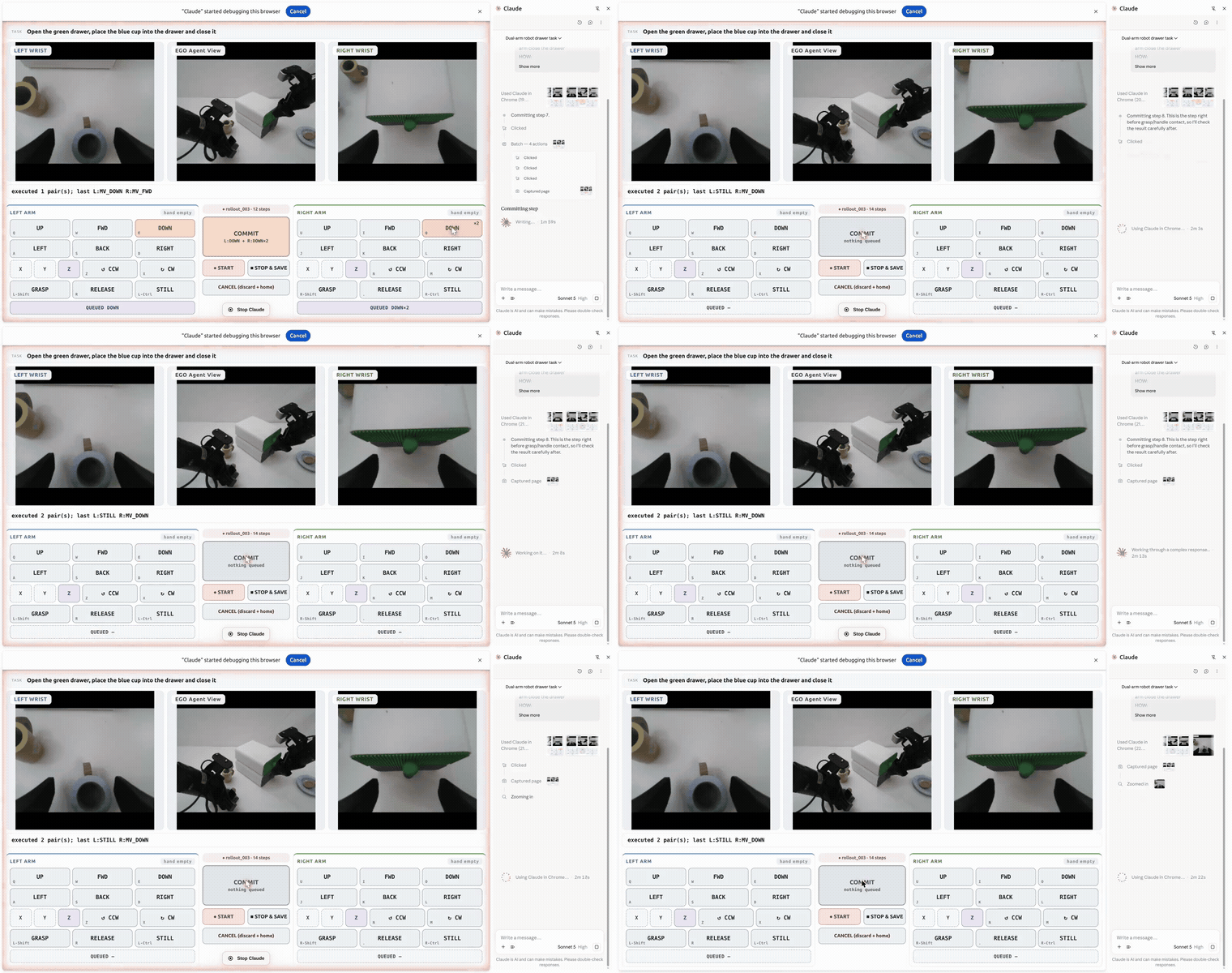
Vision-language-action (VLA) models have advanced robotic manipulation, but their zero-shot generalization in new tasks and environments remains limited, and their reliance on specialized training keeps them from benefiting directly from rapidly advancing general-purpose vision-language models (VLMs). In parallel, recent agentic robotic systems leverage VLMs for high-level reasoning or coding agents for robot control, but often depend on extensive external models and tools, introducing additional complexity and cost. This motivates us to ask: Can a general-purpose VLM itself operate a robot more like the human teleoperator by reasoning directly from observations, issuing actions, and continuously adapting to execution feedback, without relying on external models such as learned action experts, coding agents or grounding tools like SAM3? In this work, we introduce MotorMind, a robot manipulation harness that connects VLM-proposed mid-level actions to deterministic robot control and feedback, with asynchronous monitoring and background memory updates. Without task-specific policy training, coding agents, or additional grounding tools such as SAM3, MotorMind achieves 66.7% success on the base LIBERO-PRO suites and 53.8% under perturbations, compared with at most 13.3% and 19.2%, respectively, for the prior zero-shot methods we evaluate. The same interface reaches 95% average success on a real xArm6 robot across direct manipulation and human-perturbation settings. Replacing the backbone with a stronger VLM further improves performance, while the remaining failures - primarily due to visual grounding, embodied reasoning, and action knowledge - decrease as VLM capability improves. These results show that a general-purpose VLM, when equipped with an appropriate mid-level action representation and asynchronous execution harness, can perform effective zero-shot robotic manipulation.

cs.ROrobotmanipulationVLAvision-language-actionembodied

兴趣:vision-language-action (VLA) models and foundation models for robots

#22026-09-28追踪学者 · Katerina Fragkiadaki96

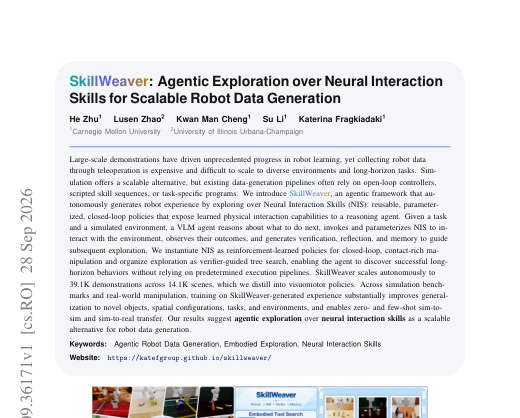
SkillWeaver: Agentic Exploration over Neural Interaction Skills for Scalable Robot Data Generation

He Zhu, Lusen Zhao, Kwan Man Cheng, Su Li, Katerina Fragkiadaki

Large-scale demonstrations have driven unprecedented progress in robot learning, yet collecting robot data through teleoperation is expensive and difficult to scale to diverse envi…

Large-scale demonstrations have driven unprecedented progress in robot learning, yet collecting robot data through teleoperation is expensive and difficult to scale to diverse environments and long-horizon tasks. Simulation offers a scalable alternative, but existing data-generation pipelines often rely on open-loop controllers, scripted skill sequences, or task-specific programs. We introduce SkillWeaver, an agentic framework that autonomously generates robot experience by exploring over Neural Interaction Skills (NIS): reusable, parameterized, closed-loop policies that expose learned physical interaction capabilities to a reasoning agent. Given a task and a simulated environment, a VLM agent reasons about what to do next, invokes and parameterizes NIS to interact with the environment, observes their outcomes, and generates verification, reflection, and memory to guide subsequent exploration. We instantiate NIS as reinforcement-learned policies for closed-loop, contact-rich manipulation and organize exploration as verifier-guided tree search, enabling the agent to discover successful long-horizon behaviors without relying on predetermined execution pipelines. SkillWeaver scales autonomously to 39.1K demonstrations across 14.1K scenes, which we distill into visuomotor policies. Across simulation benchmarks and real-world manipulation, training on SkillWeaver-generated experience substantially improves generalization to novel objects, spatial configurations, tasks, and environments, and enables zero- and few-shot sim-to-sim and sim-to-real transfer. Our results suggest agentic exploration over neural interaction skills as a scalable alternative for robot data generation.

cs.ROrobotmanipulationsim-to-real

追踪学者:Katerina Fragkiadaki;兴趣:imitation learning and diffusion policies for robot control

#32026-09-2994

Cooperative Multi-Agent Vision-Language-Action Models via Reinforced Fine Tuning

Ruixiao Xu, Wong Lik Hang Kenny, Zhiqian Liu, Jianing Guo, Hanxiao Li, Kejian Shi 等

We study reinforcement learning (RL) methods for cooperative multi-agent Vision-Language-Action (VLA) models. This problem is challenging because VLAs are pretrained on large-scale…

We study reinforcement learning (RL) methods for cooperative multi-agent Vision-Language-Action (VLA) models. This problem is challenging because VLAs are pretrained on large-scale single-agent data and therefore lack the fine-grained coordination skills required for inter-robot collaboration. Supervised fine-tuning (SFT) on multi-robot demonstrations partially bridges this gap, but its performance is bounded by the demonstration data and cannot improve from its own experience. We present a three-stage reinforced fine-tuning (RFT) pipeline for multi-agent VLAs. First, initialization-aware data collection sweeps over initial configurations and invokes human demonstrations only when the pretrained VLA repeatedly fails, yielding robustness to initialization shift with reduced human cost. Second, offline credit-filtered tuning assigns credit to individual agents and fine-tunes on per-agent trajectories with positive advantage rather than on entire joint rollouts. Third, we find existing online RL for VLAs are less effective for hard multi-agent tasks, which we attribute to noisy co-exploration and unstable updates. We instead use online latent-space fine tuning, which freeze the VLA and perform RL in its latent noise space. We evaluate our multi-agent VLA with both $π_0$ and $π_{0.5}$ backbones across 11 tasks in RoboTwin, RoboFactory and real-world manipulation with two Franka robots. Our multi-agent VLA improves the average success rate by $+23.1%$, $+16.4%$, and $+44%$ on RoboTwin, RoboFactory, and real-world tasks, respectively. Code available at https://anonymous.4open.science/r/mavla_rft-2BC0/.

cs.ROcs.AIcs.MArobotmanipulationVLAvision-language-action

兴趣:vision-language-action (VLA) models and foundation models for robots
#42026-09-2994

Wrench-ACT: Enhancing Robot Policies for Contact Rich Behavior Using Direct Wrench Control

Johannes Hechtl, Yannik Blei, Simon Ball, Reihaneh Mirjalili, Michael Krawez, Seongjin Bien 等

While contact-rich manipulation requires deliberate regulation of interaction forces, recent approaches to robot manipulation learning predominantly represent actions as target pos…

While contact-rich manipulation requires deliberate regulation of interaction forces, recent approaches to robot manipulation learning predominantly represent actions as target positions or poses. Even methods that incorporate force sensing either use it solely as an observation or, when predicting forces as part of the output, rely on a hybrid force controller. In this paper, we propose an imitation learning policy that predicts wrenches as its sole action output for direct use by a pure force controller. Our studies suggest that force-domain imitation learning depends critically on data collection, with force-feedback teleoperation improving policy performance by capturing the operator's deliberate force regulation. Using Action Chunking with Transformers (ACT) as the base architecture, we train single-task models on bilateral wrench demonstrations and evaluate them on five contact-rich manipulation tasks. The wrench policy matches or outperforms position-based baselines across all tasks, with gains varying according to the degree of deliberate force regulation each task requires. Cross-condition ablations show that the bilateral data collection interface and the wrench action space each contribute independently to performance. To support further research, we will release over 1000 wrench-action demonstrations spanning these tasks on a companion website upon publication.

cs.ROrobotmanipulationimitation learning

兴趣:robot manipulation and grasping with learned policies

#52026-09-2994

EgoHumanoid-V2: Human-to-Humanoid Transfer of Coordinated Whole-Body Skills for Loco-Manipulation

Jin Chen, Yiming Jiang, Chongyang Xu, Modi Shi, Shijia Peng, Li Chen 等

Human demonstrations capture diverse scenes and rich whole-body skills without requiring robot teleoperation. Prior work on egocentric transfer has emphasized scene generalization …

Human demonstrations capture diverse scenes and rich whole-body skills without requiring robot teleoperation. Prior work on egocentric transfer has emphasized scene generalization in loco-manipulation under decoupled control, leaving direct transfer of coordinated whole-body skills less explored. We present EgoHumanoid-V2, the first egocentric human-to-humanoid skill transfer framework for coordinated whole-body loco-manipulation. At its core, coarse-to-fine action alignment combines kinematic reference correction with dynamics-aware refinement. It improves end-effector pose accuracy while preserving whole-body coordination. We also use robot-arm rendering and training-time image augmentation to reduce the visual embodiment gap and improve viewpoint robustness. On four real-world tasks, vision-language-action (VLA) policies trained on aligned human data show zero-shot skill transfer without target-task robot demonstrations. Task scores are comparable to those of policies trained on teleoperation data at a lower collection cost. These results support human data as direct skill supervision.

cs.ROcs.AIrobotmanipulationVLAvision-language-actionhumanoid

兴趣:humanoid robots and whole-body control

#62026-09-2992

BlenDAgger: Blended Shared Control for Interactive Imitation Learning

Cailyn Smith, Geoffrey Sun, Henny Admoni, Zackory Erickson

Robot policies are frequently trained from human corrections, yet teleoperating a robot to provide corrections is burdensome, and human demonstrators are not always optimal. We pro…

Robot policies are frequently trained from human corrections, yet teleoperating a robot to provide corrections is burdensome, and human demonstrators are not always optimal. We propose Blended DAgger (BlenDAgger), an approach for collecting data to train imitation learning policies by using shared control to blend the policy's and demonstrator's actions during interventions. By blending human and policy actions, we aim to improve the autonomous performance of manipulation policies. We validate our approach across five manipulation tasks, two in the real world and three in simulation. Our approach achieves higher autonomous performance by 30 or more percentage points on two real-world tasks compared to a typical human-gated correction approach (HG-DAgger). We also investigate the advantages of BlenDAgger that allow for higher autonomous performance, finding that BlenDAgger results in 57% smoother transitions between policy control and human interventions, and 14% higher trajectory similarity to the training data. In a user study (n=14) on two real-world tasks, we find that BlenDAgger results in faster data collection (BF=13.32), and we do not find a difference in subjective perceptions. These results show that blended shared control leads to higher autonomous performance compared to typical methods for fine-tuning robot policies from fully teleoperated interventions.

cs.ROcs.LGrobotmanipulationimitation learning

兴趣:imitation learning and diffusion policies for robot control

#72026-09-2992

ComManip: Overfitting Manipulation Policies to Comfortable Regions

Yidan Lai, Xinyi Chen, Shuquan Man, Huiping Zhuang

Training robot manipulation policies relies on costly robot demonstrations, making large-scale data collection impractical. Meanwhile, to improve policy generalization, existing ap…

Training robot manipulation policies relies on costly robot demonstrations, making large-scale data collection impractical. Meanwhile, to improve policy generalization, existing approaches seek greater diversity in visual observations by varying object placements, viewpoints, and robot configurations during data collection. However, under a limited demonstration budget, this strategy forces the policy to model diverse visual observations, providing insufficient supervision to learn reliable observation-action correspondences under similar local conditions. Our study reveals that policies trained under this strategy achieve lower task success rates than those trained within a compact, visually and kinematically stable region. We refer to these stable regions as comfortable manipulation regions. To exploit this finding, we propose ComManip, a learning paradigm that specializes manipulation policies to comfortable manipulation regions. During inference, ComManip repositions the mobile base until the detected target center enters the familiar image-space range estimated from comfortable-region demonstrations. It then executes the same manipulation policy, enabling effective manipulation across diverse target locations. We conduct extensive experiments across multiple manipulation tasks, demonstration budgets, and policy families including ACT, $π_{0.5}$, RDT, OpenVLA-OFT, and SmolVLA. The results demonstrate that ComManip improves task success by roughly 20 percentage points or more across different policy architectures in large workspaces under limited demonstration budgets, suggesting that specializing manipulation policies to comfortable regions provides a more data-efficient learning paradigm for manipulation.

cs.ROrobotmanipulation

兴趣:robot manipulation and grasping with learned policies

#82026-09-2892

KPI: A Promptable Kernel for Physical Interaction on Humanoids

Yikai Wang, Honghao Zhu, Xiao Hu, Hao Zhang, Zelin Wang, Yip Fun Yeung 等

Humanoids now walk, balance and reach with remarkable generality: one whole-body tracking policy follows references from a human, or from an end-to-end policy. That generality trav…

Humanoids now walk, balance and reach with remarkable generality: one whole-body tracking policy follows references from a human, or from an end-to-end policy. That generality travels in the trajectory, and a trajectory alone carries limited information about the interaction it should produce: at contact, the executing controller determines how the robot behaves. Single-task policies usually reach hard interactions by optimising trajectory and controller together in simulation; general stacks usually assume a preset or hand-chosen controller. We present KPI, a promptable kernel for physical interaction between the trajectory source and an unmodified whole-body tracker. Instead of a controller fixed before the task, the trajectory source sends a contract: per direction, track, comply, or hold a force range. From tracking error and a wrench estimate, the kernel adapts the arms' stiffness, damping, reference and feedforward toward it at contact rate. We demonstrate KPI through an agentic framework: from one instruction, a vision-language agent writes both the reference trajectory and the contract, with no task-specific code. We demonstrate instruction-driven winch operation, door opening, and box transport, alongside scripted surface-interaction experiments. In the winch demonstration, the humanoid is able to turn a crank to hoist a second robot fully off the ground.

cs.ROrobothumanoid

兴趣:humanoid robots and whole-body control

#92026-09-29追踪学者 · Pieter Abbeel追踪学者 · Jitendra Malik追踪学者 · C. Karen Liu追踪学者 · Guanya Shi92

Counterfactual Video Generation Enables Scalable Humanoid Loco-Manipulation

Zihan Wang, Zhen Wu, Pieter Abbeel, Rocky Duan, Jitendra Malik, Carmelo Sferrazza 等

Teaching humanoids loco-manipulation skills, such as carrying diverse objects, via visual imitation is a promising path toward generalist robots. However, collecting diverse, high-…

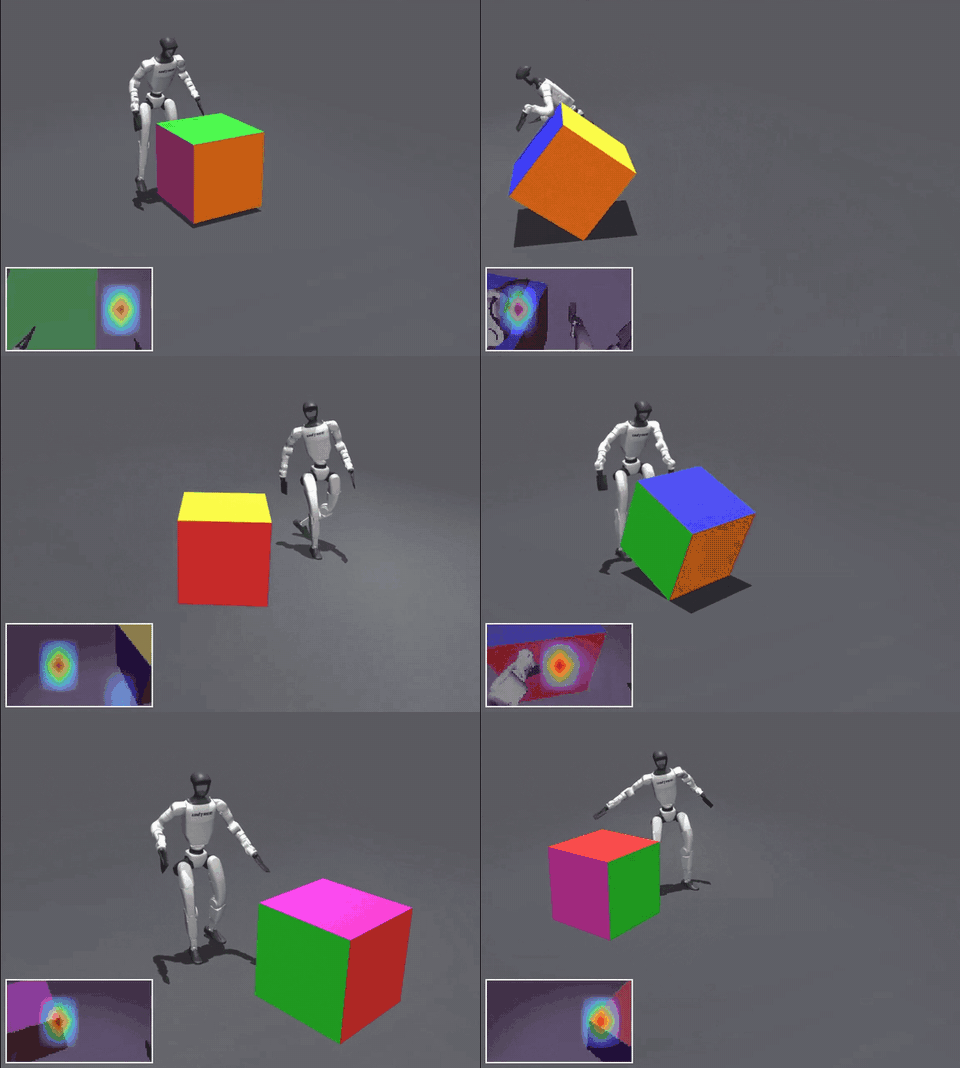
Teaching humanoids loco-manipulation skills, such as carrying diverse objects, via visual imitation is a promising path toward generalist robots. However, collecting diverse, high-quality interaction videos, such as clips that clearly show a person's full body and unoccluded interactions with objects, poses a practical barrier to scaling this approach. We propose PRISM, a real-to-sim-to-real framework that overcomes this limitation by amplifying a handful of real videos into a large, diverse training set. PRISM first generates hundreds of diverse "counterfactual" human-object interaction videos via video-to-video (V2V) generation from a few exemplar real videos. Our contact-anchored real-to-sim pipeline then reconstructs both human and object motions, retargeting this imperfect video data into physically plausible trajectories. The intra-class variability across these counterfactual videos lets us train a single policy that generalizes to unseen objects within each category. We demonstrate the full pipeline by deploying this policy on a real robot without any real-world fine-tuning. Using only onboard depth observations, our humanoid picks up, carries, and drops objects, including boxes, barrels, bins, and balls, across novel instances, sizes, and initial configurations.

cs.ROcs.CVcs.GRrobotmanipulationhumanoidsim-to-real

追踪学者:Pieter Abbeel、Jitendra Malik;兴趣:humanoid robots and whole-body control

#102026-09-2991

CoRe-VLA: Preserving Cross-View Coordination in VLAs under Camera Shifts

Tianhang Pan, Xuanhao Wang, Yiwen Pang, Bo Zhou, Jun Yang, Min-Ling Zhang 等

VLAs combine pretrained vision-language representations with action generation to enable language-guided control across diverse tasks, becoming a mainstream paradigm in embodied in…

VLAs combine pretrained vision-language representations with action generation to enable language-guided control across diverse tasks, becoming a mainstream paradigm in embodied intelligence. However, multiple studies have reported VLA's substantial declines in task success under camera shifts, revealing a key vulnerability that limits reliable deployment. To address this vulnerability, existing methods collect paired observations of the same scene from different viewpoints to fine-tune the VLA or train visual adaptation modules. Unfortunately, they require additional data collection and VLA training costs. In this paper, we first identify cross-view coordination breakdown under external camera shifts: the robot may rely too heavily on wrist-view cues and consequently execute subtasks in the wrong order when losing global view. Motivated by this, we propose CoRe-VLA, a plug-and-play framework requiring neither additional multi-view data collection nor VLA fine-tuning, which can incorporate with exsiting VLAs. It reconstructs a scene point cloud and renders the observation from the VLA's training viewpoint to restore cross-view coordination. In CoRe-VLA, Render-to-Camera (R2C) Restoration reduces rendering-induced visual degradation, while Execution-Trajectory-Conditioned Alignment (ETCA) reduces robot idle time and mitigates motion conflicts during asynchronous execution. Experiments on 5 real-robot tasks, LIBERO-100 and LIBERO-Plus demonstrate CoRe-VLA substantially improves task success across mainstream VLAs under camera shifts. For example, CoRe-VLA raises PI0.5's success rate from 13.3% to 83.3% at a 1.6m camera shift in real-robot environment.

cs.ROrobotVLAembodied

兴趣:vision-language-action (VLA) models and foundation models for robots

#112026-09-2991

FineART: Fine-grained Annotated Robotic Trajectory Dataset and Vision-Language-Action Model for Bimanual Manipulation

Jade Choghari, Pepijn Kooijmans, Mansi Agarwal, Yusuf Umut Ciftci, Aseem Doriwala, Catherine Weaver 等

Robots operating in real-world environments must execute complex, multi-step bimanual tasks over long horizons rather than single, isolated actions. Current manipulation datasets s…

Robots operating in real-world environments must execute complex, multi-step bimanual tasks over long horizons rather than single, isolated actions. Current manipulation datasets struggle to support this capability: although single-arm datasets reach hundreds of thousands of trajectories, they typically provide only one high-level instruction per episode while the rare bimanual effort that does label subtasks annotates only a fraction of its hours. We present FineART, a densely annotated bimanual manipulation dataset of 40,543 episodes, 1,718 hours, and 533,913 subtasks across 151 tasks. We also introduce FineART-VLA, a vision-language-action policy that predicts its own next subtask, and show that mid-training it this way yields substantial gains. Specifically, success on a spatial disambiguation task increases from 32.0% to 100.0%, and step-by-step human subtask guidance lifts success on an unseen long-horizon task from 16.0% to 76.0%. Furthermore, after minimal fine-tuning on a new robot, the policy requires one-tenth the data of baselines without mid-training and generalizes zero-shot to completely unseen tasks on the new hardware. We open-source the full dataset, model weights, and training code.

cs.ROcs.AIcs.CVcs.LGrobotmanipulationVLAvision-language-action

兴趣:vision-language-action (VLA) models and foundation models for robots

#122026-09-2991

Video2STL: Grounding VLM-Generated Temporal Specifications for Robot Learning

Merve Atasever, Keyan Azbijari, Cagan Bakirci, Bo-Ruei Huang, Tolga Izdas, Zahra Shahrooei 等

Video-based policy learning is particularly promising, as it illustrates target behaviors without requiring action annotations or embodiment-matched demonstrations. A central chall…

Video-based policy learning is particularly promising, as it illustrates target behaviors without requiring action annotations or embodiment-matched demonstrations. A central challenge is deciding what information should be transferred from the video to the robot. Existing approaches commonly convert visual observations into scalar similarity or value signals, or ask foundation models to directly generate reward code. These approaches can make the temporal structure of a task difficult to inspect, ground, and reuse. We present Video2STL, a framework that converts observation-only videos into parametric Signal Temporal Logic (STL) specifications and uses the resulting formal representation for robot learning. A vision-language model extracts an embodiment-independent semantic event trace and constructs a bank of symbolic temporal specifications. The model determines the task structure, while numerical predicate thresholds and temporal bounds are grounded from successful robot trajectories. For policy learning, we separate short- and long-timescale temporal information: short-horizon specifications provide dense rewards through rolling-window quantitative robustness, while a causal monitor over a retained long-horizon specification provides one-time progress rewards for valid temporal prefixes. The same representation supports cross-embodiment transfer from human or animal videos to robot control. Across four manipulation tasks, Video2STL achieves $85.8%$ average success-once and $67.0%$ success-at-end, compared with $81.5%/59.5%$ for native dense PPO and $65.0%/42.3%$ for Text2Reward; in quadruped locomotion, Qwen-3.8 and GPT-5.6-based Video2STL policies achieve $100%$ success across velocities from $0.3$ to $2.1\,m/s$ while remaining competitive in high-speed energy efficiency. Project webpage: \href{https://video2stl.github.io/}{video2stl}.

cs.ROcs.AIrobotmanipulationlocomotion

兴趣:vision-language-action (VLA) models and foundation models for robots

#132026-09-2991

Faster and Better? Benchmark Bugs and Design Limitations Distort the Evaluation of Vision-Language-Action Acceleration

Qiwei Chen, Kaijun Zhou, Nuohui Shi, Zhiyang Li, Yuxuan Feng, Jinyu Gu

Simulated manipulation benchmarks are the standard tool for evaluating vision-language-action (VLA) policies and the acceleration methods that reduce their inference latency for on…

Simulated manipulation benchmarks are the standard tool for evaluating vision-language-action (VLA) policies and the acceleration methods that reduce their inference latency for on-robot deployment. On these benchmarks, we observe that some training-free acceleration methods, which approximate the baseline policy's computation, achieve higher measured success rates than the baseline itself. Success rates alone cannot establish whether such gains come from better task execution or from evaluation flaws. We therefore investigate two kinds of benchmark flaws behind these gains: bugs, where the implementation does not match the intended task or evaluation protocol, and design limitations, where success criteria and simulation settings do not fully capture how acceleration affects task execution. Starting from tasks with anomalous gains, we localize root causes by plotting object trajectories against checker acceptance regions, and classify the resulting bugs into task consistency, initialization, and reproducibility. Extending this audit to seven benchmarks, including RoboTwin, LIBERO-Plus, and VLABench, we identify 22 bugs of these types and 4 design limitations. For the latter, we revise permissive success checkers, correct unrealistic object masses, and add a motion-aware score that favors smoother actions. Experiments show that bug fixes can reverse method rankings, moving the baseline from last to first on one task. Addressing design limitations can likewise remove anomalous gains: on another task, the baseline moves from 21 percentage points behind an accelerated method to 5 points ahead. Gains attributed to acceleration can therefore be artifacts of the benchmark rather than better task execution. We release our bug fixes and revised benchmark settings to support trustworthy evaluation of VLA acceleration.

cs.ROrobotmanipulationVLAvision-language-action

兴趣:vision-language-action (VLA) models and foundation models for robots

#142026-09-2991

RawVLA: Embodied Neural Image Signal Processor For Robotic Manipulation

Shuhong Liu, Heng Zhou, Lingfeng Qian, Yuhao Fang, Xianbao Hou, Qianyu Zhou 等

Vision-language-action (VLA) models typically operate on RGB images produced by a fixed camera image signal processor (ISP), leaving the imaging pipeline outside the learning and e…

Vision-language-action (VLA) models typically operate on RGB images produced by a fixed camera image signal processor (ISP), leaving the imaging pipeline outside the learning and evaluation loop. We systematically examine the consequences of this overlooked design choice across five fundamental ISP dimensions: gain, sensor noise, chromatic response, tonal response, and bit depth. Our analysis reveals that RAW-to-RGB processing materially shapes both action prediction and manipulation success, with different ISP dimensions exerting substantially different effects. Guided by these findings, we introduce RawVLA, a streaming neural ISP that adaptively renders RAW observations for frozen VLA policies while concentrating its capacity on the imaging factors relevant to embodied behavior. We further present RawVLA-Bench, a RAW-domain manipulation benchmark to expose image processing as an explicit evaluation variable across clean and adverse acquisition conditions. Experiments on RawVLA-Bench show that RawVLA preserves performance under standard conditions while substantially improving robustness under degraded imaging, establishing adaptive RAW processing as an effective interface between physical cameras and embodied policies.

cs.ROcs.CVmanipulationVLAvision-language-actionembodied

兴趣:vision-language-action (VLA) models and foundation models for robots

#152026-09-2990

EgoAlign: Bridging the Human-Humanoid Gap for Long-Range Loco-Manipulation

Yiming Jiang, Chen Jin, Chongyang Xu, Yilun Chen, Aimin Hao, Yisheng He

Egocentric human demonstrations offer an accessible source of task experience, but differences in body scale and controller response, together with missing robot states, limit thei…

Egocentric human demonstrations offer an accessible source of task experience, but differences in body scale and controller response, together with missing robot states, limit their value as humanoid training supervision. We present EgoAlign, a data-construction framework that converts these demonstrations into action and state supervision compatible with a general-purpose, continuous whole-body controller, without collecting physical-robot demonstrations. Using the target-robot model and simulator, EgoAlign guides demonstration collection through execution feedback. It preserves locomotion references for visually guided periodic stepping while adapting upper-body interaction geometry through scale alignment and controller-in-the-loop refinement. A final causal replay reconstructs the corresponding robot states and motion-token labels for training with the human observations. We assess the resulting supervision by fine-tuning a vision--language--action model solely on adapted human demonstrations and deploying it zero-shot on a physical humanoid. The resulting policies perform long-range object relocation, navigation to unseen goal positions, and independently evaluated foot interaction. Refinement improves simulated hand alignment and physical pickup success over kinematic alignment alone, while human collection reduces on-site acquisition time relative to teleoperation. https://lambdahumanoid.github.io/EgoAlign/

cs.ROrobotmanipulationhumanoidlocomotion

兴趣:humanoid robots and whole-body control

#162026-09-2990

Remember What You Did: Action-History Memory with Dual-Expert Denoising for Long-Horizon Vision-Language-Action Policies

Yaxin Zhao, Dianye Huang, Chenwei Wang, Chenguang Yang, Zhongliang Jiang

Vision-language-action (VLA) models have driven rapid progress in robotic manipulation, demonstrating strong fine-grained control and promising performance on long-horizon tasks. H…

Vision-language-action (VLA) models have driven rapid progress in robotic manipulation, demonstrating strong fine-grained control and promising performance on long-horizon tasks. However, many existing VLAs lack explicit access to interaction history, making them vulnerable to perceptual aliasing: similar current observations and robot states at different task stages may induce action ambiguity and lower success rate. Existing methods incorporate temporal or progress cues through feature conditioning, action-prior modification, or sampling guidance. However, methods that jointly fine-tune memory modules and the base VLA incur additional policy-training costs, motivating the separation of trainable history-conditioned steering from frozen base-policy refinement. We propose ActMem-VLA, a dual-expert handover architecture that augments a frozen, fine-tuned VLA with a memory plugin comprising a Mamba-based memory module and a lightweight PreAction Expert (PAE). Specifically, Mamba encodes executed-action history into memory that conditions PAE alongside current context. With these inputs, PAE steers task progression during early, high-noise denoising, then passes the partially denoised action to the frozen Action Expert (AE) to refine action details during the remaining low-noise steps. The fine-tuned base VLA remains frozen throughout training, while only the Mamba module and PAE are jointly optimized. On LIBERO-Mem, ActMem-VLA achieves 80.8% average success across all ten tasks, compared with 65.2% for $π_{0.5}$ and 49.5% for MemoryVLA, while introducing only 3.45% additional parameters. Across four real-world tasks, it improves the average success rate over $π_{0.5}$ by 28.8%.

cs.ROrobotmanipulationVLAvision-language-action

兴趣:vision-language-action (VLA) models and foundation models for robots

#172026-09-2990

TaRL: Learning General and Physical Rewards from Tactile Demonstrations

Po-Yi Wu, Dao-Jan Chang, Shang-Ya Hsiao, Hong-Ming Chen, Yu-Cheng Su, Tsung-Wei Ke

Contact-rich manipulation requires robots to sequence precise contacts, maintain stable grasps, and apply directed forces. Reinforcement learning (RL) can acquire such behaviors au…

Contact-rich manipulation requires robots to sequence precise contacts, maintain stable grasps, and apply directed forces. Reinforcement learning (RL) can acquire such behaviors automatically, but its performance hinges on reward design: sparse rewards reduce the learning efficiency, while dense rewards are hard to specify. Visual reward learning addresses this by inferring rewards from action-free demonstrations. Because it conditions only on visual observations, it fails to capture rewards beyond visual goals. We propose Tactile Reward Learning (TaRL), a framework that learns rewards from tactile demonstrations. TaRL takes a sequence of tactile deformation maps as input, and regresses task-completion progress from both successful and failed demonstrations. Because TaRL captures local robot-object interaction, it provides informative feedback to learn firm grasps and correctly directed forces; meanwhile, it is robust to changes in scene layout such as object position. We evaluate TaRL on four manipulation tasks in simulation and two in the real world. Used as a shaping reward, it substantially improves both sample efficiency and final success rate, raising success on Nut threading from 34% to 56% in simulation and on cube pickup from 37% to 97% in the real world. Combining tactile with visual rewards improves performance further. TaRL also generalizes across object instances: trained on box placement and directly deployed to can placement, it significantly improves policy learning on the new task. Project page is available at https://embodiedai-ntu.github.io/tarl.

cs.ROrobotmanipulationtactile

兴趣:robot manipulation and grasping with learned policies

#182026-09-2989

ProAct-VLM: Pre-Failure Vision-Language Task Replanning with Continuous Perception Feedback

Ahmed Nader Ahmed, Omar Moured, Mughni Irfan Mohammed Abdul, Muhayy Ud Din, Irfan Hussain

Long-horizon robotic tasks are vulnerable to unexpected environmental changes that can render planned actions ineffective or unsafe. To address this, robots must detect such change…

Long-horizon robotic tasks are vulnerable to unexpected environmental changes that can render planned actions ineffective or unsafe. To address this, robots must detect such changes as they occur, interpret their impact, and adjust their actions accordingly. Traditional rule-based decision-making pipelines are brittle in open-world conditions, as they are hand-tuned for specific scenarios and lack generalization. Vision-Language Models (VLMs) offer a promising alternative as they combine broad world knowledge with unified visual--text reasoning, enabling them to generalize across diverse scenarios and generate accurate, grounded task plans. However, for effective deployment in dynamic real-world settings, VLMs must be embedded into frameworks capable of handling uncertainty and environmental changes. Existing frameworks broadly address this reactively, triggering replanning only after execution failures or post-task checks, risking failed actions. Some methods verify conditions before actions, but these discrete checks miss changes occurring during execution. To address this, we present ProAct-VLM, an adaptive, physically grounded task planning framework that integrates VLMs within a real-time perception--feedback loop. ProAct-VLM continuously monitors the environment and re-plans as soon as relevant changes are detected, enabling adaptation before failure occurs. Evaluations against multiple baselines and across different VLM backbones show that our framework improves both success rates and efficiency in dynamic, long-horizon manipulation tasks. Project page: https://github.com/moured/ProAct-VLM

cs.ROmanipulationtask planning

兴趣:vision-language-action (VLA) models and foundation models for robots

#192026-09-2988

RoboHarn-Evo: Evolving Hierarchical Physical Knowledge for Self-Improving Robotic Manipulation

Shifeng Bao, Fanding Huang, Yihan Lin, Youhe Feng, Guanlin Li, Chen Zhao 等

Vision-language models can coordinate long-horizon robot manipulation, yet successful task reasoning still depends on whether local physical interactions produce the intended effec…

Vision-language models can coordinate long-horizon robot manipulation, yet successful task reasoning still depends on whether local physical interactions produce the intended effects. We study how repeated interaction can improve this capability without updating the base model. We introduce RoboHarn-Evo, a dual-loop harness that evolves Hierarchical Physical Knowledge (HPK) from physical experience. HPK couples two levels of reusable knowledge: Task Knowledge captures which subtask should be executed and when it is complete, while Action Knowledge captures object-relative geometric strategies and their physical effects. During execution, the agent retrieves knowledge at the corresponding decision level and grounds it in the current scene under the task goal. Across episodes, physical feedback is used to revise historical knowledge, update its applicability, and organize reusable entries for subsequent retrieval. Experiments on RMBench show that HPK improves average success by up to 24.2 percentage points across different agent models. With 80 interaction rollouts, held-out success rises from 48.3% to 75.0% for GPT-5.5 and from 70.0% to 88.3% for GPT-6. RoboHarn-Evo also resolves over 83% of historical knowledge errors while retaining 95.8% of valid knowledge, and transfers zero-shot from RMBench to RoboDojo with gains of 35.0 and 25.0 percentage points. These results demonstrate that physical interaction can be accumulated into reusable knowledge for improving subsequent manipulation.

cs.ROrobotmanipulation

兴趣:robot manipulation and grasping with learned policies

#202026-09-2988

RoboChrono: A Real Robot Benchmark for Streaming Task Understanding

Yuzhou Wu, Longteng Fan, Zimeng Li, Yu Wanchan, Ting Zhang, Yiyang Ma 等

Understanding ongoing robot manipulation requires models to interpret visual observations in relation to interaction history and task progress. We introduce RoboChrono, a benchmark…

Understanding ongoing robot manipulation requires models to interpret visual observations in relation to interaction history and task progress. We introduce RoboChrono, a benchmark for streaming task understanding comprising 39 scenarios and 34,713 evaluation instances, constructed from real robot executions and complementary bare-hand human recordings. The benchmark evaluates seven tasks grouped into recognition, alignment, and temporal grounding, covering action understanding and anticipation, visual correspondence, temporal ordering, and action localization. Zero-shot evaluation of 18 vision-language models reveals substantial differences across tasks. GPT-6-Astra achieves 98.3% accuracy on Frame Matching but 68.3% on Frame Ordering, while RynnBrain1.1-122B-A10B exhibits a larger gap, reaching 95.4% and 32.9%, respectively. Input ablations on matched questions with five open-weight models further reveal distinct dependencies on visual evidence: removing visual observations reduces Current Action Recognition accuracy by 22.1 percentage points, whereas Next Action Prediction decreases by only 0.7 points. These findings show that strong visual matching does not consistently coincide with strong temporal ordering, and suggest that next-action prediction can be supported by task and action priors even when visual evidence is unavailable. RoboChrono provides a diagnostic setting for examining these differences, highlighting the need for capability-specific evaluation beyond aggregate scores when assessing task understanding in robot manipulation.

cs.ROrobotmanipulation

兴趣:vision-language-action (VLA) models and foundation models for robots

#212026-09-2988

Taming VLAs under Robot Execution Errors: Self-Compensation and Stress Testing

Sohyun Lee, Yoonjae Baek, Jaesang Won, Jinnyeong Kim, Kang Hyunwoo, Seung-Hwan Baek 等

Vision-language-action (VLA) policies often fail when a robot's executed motion deviates from their commanded action. Such execution errors arise from the robot's mechanics and ope…

Vision-language-action (VLA) policies often fail when a robot's executed motion deviates from their commanded action. Such execution errors arise from the robot's mechanics and operating conditions, such as wear and payload changes. We propose self-compensating VLA, a deployment-time adaptation method that enables a VLA policy to pre-compensate for the robot's execution errors when generating commands. Without task rewards or labels, it updates the policy online using the residual between the action commanded by a VLA and the motion executed by the robot. To stress-test VLA robustness across execution conditions that are impractical to cover with physical robots alone, we introduce RoboStress, a controlled simulation benchmark. It combines established joint-level models of friction, backlash, compliance, and gravity-compensation error into seven deployment scenarios whose execution errors depend on the robot's state and motion history. On RoboStress, self-compensating VLA achieves higher average task success than both the base policies and methods that build in robustness during training. On two physical robot arms with different usage histories, it raises the average task success rate by more than 30 percentage points on each arm, and the gains extend to objects not seen in the task demonstrations.

cs.ROrobotVLAvision-language-action

兴趣:vision-language-action (VLA) models and foundation models for robots

#222026-09-2988

Rho: A Foundation for Efficiently Adaptable VLA Models

Rho Team, Simran Bagaria, Daphne Chen, Dean Fortier, Jianlong Fu, Michael Harrison 等

General-purpose physical AI models must combine broad visual and linguistic capabilities with precise control across robot embodiments and efficient adaptation to downstream tasks.…

General-purpose physical AI models must combine broad visual and linguistic capabilities with precise control across robot embodiments and efficient adaptation to downstream tasks. We introduce Rho, a family of open-weights VLA models for bimanual manipulation designed for data-light task adaptation on 3 embodiments representative of dual-arm robots across research labs and the industry -- YAM Box, UR AI Trainer, and FR3 Duo. We systematically ablate Rho's action-expert architecture and training recipe, and show in controlled simulation and physical-robot experiments that embodiment midtraining improves downstream adaptation. The resulting Rho variants for YAM Box, UR AI Trainer, and FR3 Duo match or outperform existing open-weights VLAs and achieve the strongest overall performance across the tasks, embodiments, and baselines evaluated in this report. We further demonstrate the Rho model family's built-in capacity for online adaptation: an internal latent policy learns from corrective feedback to select observation-conditioned noise inputs for the frozen flow-matching action expert. With as few as 15 corrected episodes, adapting this lightweight module enables Rho to handle task situations at the fringe of its offline finetuning distribution. Together, these results position Rho as both a strong general-purpose robotic manipulation model and a practical foundation for adaptation. We release the base Rho model and the embodiment-specific checkpoints to facilitate Rho's deployment in research experiments and practical industrial use cases.

cs.ROrobotmanipulationVLA

兴趣:vision-language-action (VLA) models and foundation models for robots

#232026-09-2988

LexiconVLA: Learning Reusable Atomic Action Codebooks for Unseen Tasks

Zeming Wei, Jianheng Ye, Xinshuai Song, Sirui Chen, Yang Liu, Liang Lin

Vision-language-action (VLA) models struggle to reuse recurring interactions in unseen tasks. Our diagnostic study reveals that reliable task completion does not imply consistent e…

Vision-language-action (VLA) models struggle to reuse recurring interactions in unseen tasks. Our diagnostic study reveals that reliable task completion does not imply consistent execution of constituent atomic actions across task contexts. We present LexiconVLA, a retrievable atomic-action lexicon for cross-task reuse. Global and detail codebooks capture shared interaction structure and fine-grained execution variation, respectively, preserving both reusable patterns and execution details. Visual-Atomic Action Alignment couples trajectory reconstruction from visual state changes with visual outcome prediction from action codes, grounding the lexicon in motion and its effects. We learn these codebooks with trajectory reconstruction and visual alignment on our AtomAction Dataset of 57,803 segments from 69 tasks. A planner and scene-aware adapter translate new goals into code-conditioned subtasks for a shared policy, without skill-specific experts or deployment-time parameter updates. Across five policy backbones on 26 RLBench tasks, LexiconVLA largely maintains performance on 18 seen tasks while improving success on 8 tasks held out from policy training. With BridgeVLA, unseen-task success rises from 16.67% to 34.17% (+17.50 percentage points), and overall success reaches 71.08%, the highest among methods with reported results. Real-robot experiments demonstrate stepwise execution and failure recovery.

cs.ROrobotVLAvision-language-action

兴趣:vision-language-action (VLA) models and foundation models for robots

#242026-09-2988

WorldLine: Action-Driven Visual Simulation for Robotic Manipulation

Shenghe Zheng, Wenbo Li, Jiyao Zhang, Bin Xia, Haoyang Huang, Nan Duan 等

Real-world robot learning is constrained by the cost of collecting experience and evaluating candidate behaviors. Video generation models offer a scalable foundation for visual sim…

Real-world robot learning is constrained by the cost of collecting experience and evaluating candidate behaviors. Video generation models offer a scalable foundation for visual simulators that predict action outcomes before physical execution. Yet they often favor visual plausibility over accurate action following and coherent robot--object dynamics, while action-conditioned simulators depend on scarce, embodiment-specific data that are difficult to share across incompatible control spaces. We introduce WorldLine, an action-driven visual simulator that decouples transferable dynamics learning from heterogeneous action grounding. WorldLine learns manipulation dynamics from more than 10,000 hours of action-free robot videos and grounds them using over 2,000 hours of action trajectories across more than ten embodiments. An image-space action representation provides a shared control interface across embodiments, while multi-view and failure-enriched training with relational regularization improves interaction-sensitive prediction. Robot-focused few-step distillation enables efficient causal rollout while preserving action-critical motion. Across held-out and out-of-domain settings, WorldLine maintains strong visual quality and robot-motion agreement; on failed trajectories, it improves robot-mask IoU by 0.1626 over the strongest baseline. It predicts trajectory success with 74% mean accuracy across RoboTwin and AgiBot, one percentage point above the strongest baseline. Without RoboTwin training or adaptation, its rollouts improve task success by up to 21.4 percentage points over direct policy execution. Together, these capabilities make WorldLine a scalable and efficient visual simulator for policy evaluation and embodied planning. More results are available at \href{https://zhengsh123.github.io/WorldLine/}{project page}.

cs.ROcs.CVrobotmanipulationembodied

兴趣:world models and video prediction for embodied agents

#252026-09-2987

HACo: Learning Haptic Active Compliance for Force-Aware Dexterous Manipulation

Naisheng Ye, Yinzhe Zhou, Junkai Zhao, Yuhang Lu, Checheng Yu, Zhenjie Yang 等

Contact-rich dexterous manipulation requires policies that translate physical feedback into motion commands while regulating interaction loads across evolving multi-contact interac…

Contact-rich dexterous manipulation requires policies that translate physical feedback into motion commands while regulating interaction loads across evolving multi-contact interactions. This requires haptic observations of contact state and action supervision showing how commands should adapt. Existing policies often overlook complementary fingertip tactile and joint-torque feedback, while common action targets either encode excessive loading or omit motion constrained by the object. We introduce HACo, a Haptic Active Compliance policy that learns force-regulating actions directly from haptic feedback. Compliance-regulated teleoperation converts operator inputs into controller-executable compliant actions that preserve motion intent while regulating loads. HACo learns these actions directly, using command-state discrepancy as auxiliary compliant-intent supervision. It combines local fingertip tactile responses with joint-torque feedback capturing load transmission through the articulated hand, including contacts beyond tactile coverage. A Compliance Grounding Module uses gated haptic cross-attention to ground action generation in the evolving haptic state, enabling closed-loop force regulation without explicit online contact modeling. We evaluate HACo on a real-world benchmark covering multi-contact friction, tangential interaction, fragile curved-surface contact, rotational torque, and deformable-object manipulation. Across 20 trials per task, HACo achieves an 83% mean success rate, compared with 35% for the strongest evaluated baseline. These results demonstrate active compliance across diverse force-sensitive dexterous manipulation tasks.

cs.ROmanipulationdexteroustactile

兴趣:robot manipulation and grasping with learned policies

#262026-09-2987

WayFinder: Hierarchical Visual-Language-Action for Zero-Shot Waypoint Generation and Low-Level Kinematic Control

Timothy K Johnsen, Marco Levorato

Visual Language Action (VLA) models offer unprecedented generalization for autonomous robots; however, their real-world deployment is frequently bottlenecked by unreliable executio…

Visual Language Action (VLA) models offer unprecedented generalization for autonomous robots; however, their real-world deployment is frequently bottlenecked by unreliable execution and the prohibitive computational cost of fine-tuning for specific robot embodiments and tasks. To bridge this gap, we propose WayFinder, an end-to-end, closed-loop hierarchical VLA framework that circumvents the need for fine-tuning by decoupling high-level task reasoning from low-level kinematic control. WayFinder utilizes a zero-shot, offboard Multimodal Large Language Model (MLLM) policy to process linguistic context and state maps for strategic waypoint generation. Asynchronously, a lightweight, onboard policy executes real-time kinematic control at high frequency based on continuous sensor feedback. We evaluate WayFinder in Microsoft AirSim, testing on four environments of varying complexity and three MLLM scales to balance prediction efficacy with computational efficiency. Our results demonstrate that WayFinder achieves superior navigation reliability compared to baseline low-level policies. By querying the high-level MLLM only during navigation failures, WayFinder eliminates the need for fine-tuning, minimizes expensive inferences, and significantly increases navigation success rates by up to 27.45%.

cs.ROrobotVLA

兴趣:vision-language-action (VLA) models and foundation models for robots

#272026-09-2987

Multi-Granularity Language-Guided Imitation Learning via Instruction Decomposition

Yi-Pei Chiu, Wei-Ta Chu

Using language instructions as conditions to guide robot policy learning has recently become an important research domain. However, existing language-guided policy learning methods…

Using language instructions as conditions to guide robot policy learning has recently become an important research domain. However, existing language-guided policy learning methods typically use an overall task description to guide the entire demonstration trajectory. For manipulation tasks involving multiple execution stages, these methods assign the same language description to different subtasks, making it difficult to distinguish the behaviors required at different stages. In this work, we propose a multi-granularity language guidance method based on instruction decomposition. The proposed method decomposes an overall task description into more fine-grained, concrete subtask-level language instructions, thereby enhancing learning efficiency and improving performance. We evaluate the proposed method in the setting of multi-task imitation learning and validate its effectiveness.

cs.CVrobotmanipulationimitation learning

兴趣:imitation learning and diffusion policies for robot control

#282026-09-2987

DROM: A Language-Guided Diffusion Framework for Multi-Skill Robotic Manipulation

Vincenzo Pomponi, Rocco Felici, Paolo Franceschi, Stefano Baraldo, Oliver Avram, Loris Roveda 等

Learning robust manipulation policies for diverse, long-horizon tasks from limited demonstrations remains a fundamental challenge in robotics. We present DROM, a language-guided di…

Learning robust manipulation policies for diverse, long-horizon tasks from limited demonstrations remains a fundamental challenge in robotics. We present DROM, a language-guided diffusion framework that enables robots to learn, represent, and compose multiple manipulation skills within a single generative policy. DROM leverages Dynamic Movement Primitives (DMPs) to augment a small set of expert demonstrations into expressive multi-skill datasets, substantially reducing data collection while improving spatial generalization beyond the demonstrated workspace. Building upon Motion Planning Diffusion (MPD), we extend the diffusion architecture to support language-conditioned multi-skill trajectory generation through cross-attention, allowing a single model to generate skill-consistent motions for a diverse set of manipulation primitives, including orientation-sensitive behaviors that are difficult to design using conventional motion planning or hard-coded controllers. For long-horizon manipulation, a large language model decomposes high-level operator requests into executable sequences of skills, enabling natural language interaction and autonomous task execution. We validate DROM on a Franka Emika Panda robot, a FANUC CRX25ia robot, and in MuJoCo simulation across a wide range of manipulation tasks. Experimental results demonstrate that DROM outperforms Motion Planning Diffusion and Behavior Cloning baselines, achieves robust multi-skill generalization, and composes learned skills to reliably execute long-horizon manipulation tasks from natural language instructions using only a limited number of human demonstrations. Datasets, simulation environments, and more at https://github.com/automation-robotics-machines/drom.

cs.ROrobotmanipulation

兴趣:imitation learning and diffusion policies for robot control

#292026-09-2987

In-context Robot Learning Made Simple: A Democratized Recipe for Manipulation Tasks

Minxing Li, Minghao Han, Weizhi Zhao, Hanwen Wang, Xiangshuo Liu, Shuyao Shang 等

We study robotic in-context learning (ICL), an emerging paradigm that enables robots to infer and execute tasks from visual demonstrations. Despite its growing promise, the problem…

We study robotic in-context learning (ICL), an emerging paradigm that enables robots to infer and execute tasks from visual demonstrations. Despite its growing promise, the problem itself remains under-defined: a visual demonstration simultaneously conveys action trajectories, object semantics, manipulation affordances, spatial relations, and task goals, making it unclear what information the robot is actually expected to follow. In this work, we first provide a clear problem definition of robot ICL that explicitly defines its learning target and resolves this fundamental prompt ambiguity. Building on this definition, we develop a minimalist and reproducible ICL framework (SimpleICL) with a visual prompt encoder and a low-cost data collection protocol. Without massive pre-training or specialized data infrastructure, our framework achieves strong performance in both simulation and real-world environments. Extensive experiments further reveal several key properties of robot ICL, including action, semantic, composition, and affordance discrimination. We will fully open-source our data and training pipeline to facilitate systematic and reproducible research on robot ICL. The project page can be found at https://simpleicl.github.io/simpleicl.

cs.ROrobotmanipulation

兴趣:robot manipulation and grasping with learned policies

#302026-09-2987

AeroManip-VLA: Scalable Vision-Language-Action Learning for Aerial Manipulation with RL-Generated Demonstrations

Rui Huang, Yanlin Mu, Lidong Li, Yucong Wang, Zichen Yan, Lin Zhao

Aerial manipulators extend robotic manipulation into 3D workspaces that are difficult for ground-based robots to access, creating new opportunities for general-purpose manipulation…

Aerial manipulators extend robotic manipulation into 3D workspaces that are difficult for ground-based robots to access, creating new opportunities for general-purpose manipulation. However, extending Vision-Language-Action (VLA) models to aerial robots introduces distinct challenges due to the tight coupling between manipulation and flight, continuously changing observations, and safety-critical physical interactions. These challenges demand diverse training data and systematic policy evaluation, yet collecting demonstrations and evaluating policies directly on physical aerial platforms are costly, difficult to scale, and hard to repeat under controlled conditions. We present AeroManip-VLA, a scalable benchmark for aerial VLA data generation and policy evaluation. AeroManip-VLA provides a GPU-accelerated simulation framework with low-level payload-aware flight and manipulation control in massively parallel environments. Building on this framework, we combine reusable reinforcement learning policies with expert task rules to automatically generate demonstrations without human teleoperation across diverse objects, environments, and randomized initial conditions. The generated data include basic skills such as grasping and placing, as well as long-horizon tasks that require both navigation and manipulation. We further introduce automated event labeling and trajectory categorization to filter demonstrations. These mechanisms enable fine-grained analysis of task progress, behavioral outcomes, and safety-related failures. Finally, we evaluate a range of imitation learning and VLA baselines across different task settings, revealing their performance characteristics and failure modes. Together, AeroManip-VLA enables scalable aerial manipulation data generation, structured trajectory analysis, and systematic VLA evaluation in simulation prior to real-world deployment.

cs.ROcs.AImanipulationVLAvision-language-actionimitation learning

兴趣:vision-language-action (VLA) models and foundation models for robots

#312026-09-2987

Disentangling Spurious Correlations in Vision-Language-Action Models via Predicting Domain-Invariant Latent Lookahead

Junghyun Kim, Ngseo Kim, ChungWoo Lee, Seoyeon Lee, Woo-Jeong Baek, Adam Zhou 等

Vision-Language-Action (VLA) models remain brittle under visual distribution shifts, often relying on spurious correlations tied to domain-specific factors rather than task-relevan…

Vision-Language-Action (VLA) models remain brittle under visual distribution shifts, often relying on spurious correlations tied to domain-specific factors rather than task-relevant structure. We propose Domain-Invariant Latent Lookahead (DILL), a representation-learning framework that mitigates shortcut learning in VLA policies. Our key idea is to supervise policies with domain-invariant future latents learned from domain-transformed trajectory data. A Task-Domain Encoder is trained with contrastive objectives and Gaussian disentanglement regularization to separate task-relevant structure from domain-specific visual variation. The learned encoder then provides future latents for VLA policy learning through lookahead prediction and domain disentanglement, encouraging the policy to focus on task-relevant structure rather than incidental visual factors. Counterfactual task-view evaluations show that DILL reduces shortcut reliance, while LIBERO-Plus evaluations demonstrate improved visual robustness, with 69.1% average success, 11.4 percentage points above the strongest baseline. Real-world manipulation experiments further support DILL's applicability beyond controlled simulation. Complementary latent-space diagnostics show that these behavioral gains are accompanied by representations that better preserve task-consistent structure while suppressing domain-specific variation. Our project page is available at https://dill-vla.github.io/.

cs.ROcs.LGmanipulationVLAvision-language-action

兴趣:vision-language-action (VLA) models and foundation models for robots

#322026-09-28追踪学者 · Jan Peters87

ChronoSRL: Temporal Geometry for Self-Supervised Reinforcement Learning

Nico Bohlinger, Jan Peters

A goal that is close in space can be far away in time. Obstacles, terrain, and the agent's own capabilities determine how long it takes to get there. Yet, critics in contrastive an…

A goal that is close in space can be far away in time. Obstacles, terrain, and the agent's own capabilities determine how long it takes to get there. Yet, critics in contrastive and survival reinforcement learning do not measure the distances in their representation space in units of time. We therefore introduce ChronoSRL, which gives the critic's embeddings an explicit temporal geometry. The distance between state-action and goal embeddings is trained to match the time that the agent takes to reach the goal (goal-reaching time), while goals that were not reached, and goals from other trajectories, are pushed at least one discount horizon away. Furthermore, reaching a goal quickly once does not mean that reaching it is reliable in general, so the policy should not follow the temporal distance directly. Instead, we build on survival reinforcement learning and predict from our temporal embeddings not only the full distribution of goal-reaching times but also the time spent near the goal. Thereby, the policy is trained to favor actions that reach the goal sooner and more reliably and that keep the agent near it. ChronoSRL learns faster and reaches higher performance than contrastive, action-chunked contrastive, and survival reinforcement learning baselines on seven standard locomotion and navigation benchmarks, even with much smaller networks. To test the limits of self-supervised reinforcement learning, we introduce velocity tracking, goal-position reaching, and box climbing tasks with a quadruped robot in a realistic sim-to-real locomotion setup, and show how the shaping terms that are typical for robotics can be naturally incorporated into our framework. ChronoSRL is the only one of the tested self-supervised reinforcement learning methods that learns to stay at the commanded velocities and goal positions, and climbs the highest boxes.

cs.AIcs.ROrobotlocomotionsim-to-real

追踪学者:Jan Peters;兴趣:reinforcement learning for legged locomotion and sim-to-real transfer

#332026-09-29追踪学者 · Li Fei-Fei追踪学者 · Jiajun Wu87

T$^2$Mem: Learning Test-Time Memory for Robotics

Yize Liu, Huang Huang, Yining Hong, Zijian Du, Zhi Cao, Li Fei-Fei 等

Memory-dependent robotic manipulation requires policies to use information that is no longer available in the current observation. Retaining history alone is insufficient: memory m…

Memory-dependent robotic manipulation requires policies to use information that is no longer available in the current observation. Retaining history alone is insufficient: memory must preserve information that supports future actions. One challenge is whether a memory-free foundation model can learn to retain and use historical information from action demonstrations alone, without external memory support. We introduce T$^2$Mem, a framework that develops this capability within a pretrained vision-language-action policy, without external reasoning models or memory-specific annotations. T$^2$Mem uses test-time training to encode observation history into compact fast weights through online self-supervised updates, avoiding repeated processing of the full history. An observation-grounded interface extracts vision-language information for memory formation and supplies retrieved context to the action expert. Action supervision shapes what the memory learns to retain and use, while alternating memory-policy learning gives each component a fixed counterpart during optimization. Across 16 RoboMME tasks, T$^2$Mem improves average success from 17.93% to 56.83% over the memory-free base policy and outperforms the recurrent-memory methods reported in the benchmark, while controlled profiling indicates at least 3x inference speedup over explicit methods. Project website: https://yzliu84.github.io/T2MEM-project/

cs.ROmanipulationvision-language-action

追踪学者:Li Fei-Fei、Jiajun Wu;兴趣:vision-language-action (VLA) models and foundation models for robots

#342026-09-29追踪学者 · Jan Peters86

CrossBFM: Distilling a Shared Latent Behavior Space Across Humanoid Embodiments

Tan-Dzung Do, Tuan Dat Phuong, Nico Bohlinger, Cuc T. Trinh, Siwei Ju, Vien Anh Ngo 等

Behavior Foundation Models (BFMs) give humanoids a promptable policy over a latent behavior space, enabling one single vector to represent a motion to imitate, a pose to reach, or …

Behavior Foundation Models (BFMs) give humanoids a promptable policy over a latent behavior space, enabling one single vector to represent a motion to imitate, a pose to reach, or a reward to maximize. Forward-Backward representations successfully produce such spaces, but at the cost of hundreds of GPU-hours for a single robot. Moreover, when the training process is repeated for a second robot, it produces a second space unrelated to the first, resulting in embodiment-specific latents that do not unify or transfer. We address these problems with CrossBFM, treating the latent space as the transferable asset for various embodiments. As retargeting provides frame-level cross-embodiment correspondence, we propose a unified encoder architecture with no robot-specific parameters for distilling the behavior space to address all training embodiments simultaneously in less than a GPU-hour. Following this encoder, latent-conditioned trackers turn the distilled latent into whole-body control in a conventional PPO training manner in just 10 more GPU-hours. On three distilled humanoids, all three prompting modes transfer: motion tracking with latent-conditioned policy losing only $0.025$ rad to its joint-conditioned counterpart, smooth goal reaching between poses with no falls, and reward optimization for all $41$ reward prompts. Our experiments further reveal that 1) regressing the encoder on a quarter of the motion corpus costs only $5%$ of tracking performance and 2) training the encoder on a subset of robots and evaluating on an unseen one recovers up to $89%$ of the tracking performance of seen robots, demonstrating cross-embodiment generalization to morphologically similar robots. We also verify the pipeline on real robots across all three prompting modes and with flow-based generated latents. Project website: https://dotandung.github.io/crossbfm/

cs.ROrobothumanoid

追踪学者:Jan Peters;兴趣:imitation learning and diffusion policies for robot control

#352026-09-2986

Encore: Few-Shot Agentic Discovery of Manipulation Strategies

Yifan Kang, Zihan Wang, Zhiwen Fan, Bangya Liu

Coding agents can now write, run, and debug programs with little human help. Robot tasks, however, are usually specified by a sentence that leaves out how to grasp, in what order t…

Coding agents can now write, run, and debug programs with little human help. Robot tasks, however, are usually specified by a sentence that leaves out how to grasp, in what order to make contact, and what the result should look like, and an agent given only the sentence must find these details by trial and error. We introduce ENCORE, which gives the agent a few demonstrations as evidence to read rather than as training data. A deterministic builder distills each demonstration into a pack of multi-view keyframes, gripper events, frame strips, and the full trajectory. A coding agent studies the pack, writes a policy program against a fixed perception and action API, refines it iteratively over a few development rollouts, and freezes it before a sealed evaluation that never reveals the success signal. On LIBERO-PRO, the agent's first program already succeeds in half of the perturbed tasks with demonstrations and in one task without them, and the frozen programs outperform the strongest prior agentic system run with the same language model (96.3% against 89.3%). On RoboDojo tasks whose instructions leave the goal unstated, no program succeeds without demonstrations. ENCORE also runs on a real bimanual robot, learning cube handover and cup inversion from five demonstrations each.

cs.ROcs.AIcs.CVcs.LGrobotmanipulationgrasp

兴趣:robot manipulation and grasping with learned policies

#362026-09-2986

One from Infinity: Actualizing Futures from Pretrained World Models into Robot Actions

Bang Du, Yichen Xie, Shuqi Zhao, Yuxin Chen, Menglin Wu, Masayoshi Tomizuka

A pretrained video world model admits many plausible futures for a scene, but a robot must realize the exact task-conditioned one. To turn world models into executable robot polici…

A pretrained video world model admits many plausible futures for a scene, but a robot must realize the exact task-conditioned one. To turn world models into executable robot policies, existing methods fine-tune the heavy world model backbone using large-scale robot data and computational resources. Challenging this status quo, we argue that the expensive part has already been paid in the world model pretraining since the representation space of a video world model lays out the diverse potential futures. In this case, what remains is to select the future that accomplishes the task and to read out the actions that realize it. We formalize this task as actualization, which learns a task-conditioned selection and realization on top of a prior supplied by a frozen world model. This can be solved by a tiny actualizer model. We implement RoboActualizer with as few as 60M parameters on top of a frozen world model encoder. The actualizer is composed of two lightweight DiT experts that jointly predict future latents and actions by flow matching. The model can be trained entirely on a single GPU with 32 GB peak memory. With up to 100x fewer trainable parameters than existing WAMs and VLAs, RoboActualizer reaches great performance on simulation benchmarks including LIBERO, LIBERO-Plus, RoboTwin 2.0 and five tasks on two real-world platforms, with a low latency of 39 ms that allows real-time control.

cs.ROrobotworld model

兴趣:world models and video prediction for embodied agents

#372026-09-2886

Passive-Dynamic-Walking-Inspired Dynamics Guidance for Energy-Efficient Humanoid Locomotion

Hyeonjin Choi, Joongheon Kim, Daekyum Kim

Learning energy-efficient humanoid locomotion requires discovering mechanically economical gait coordination, not merely reducing actuator effort. Reinforcement learning promotes e…

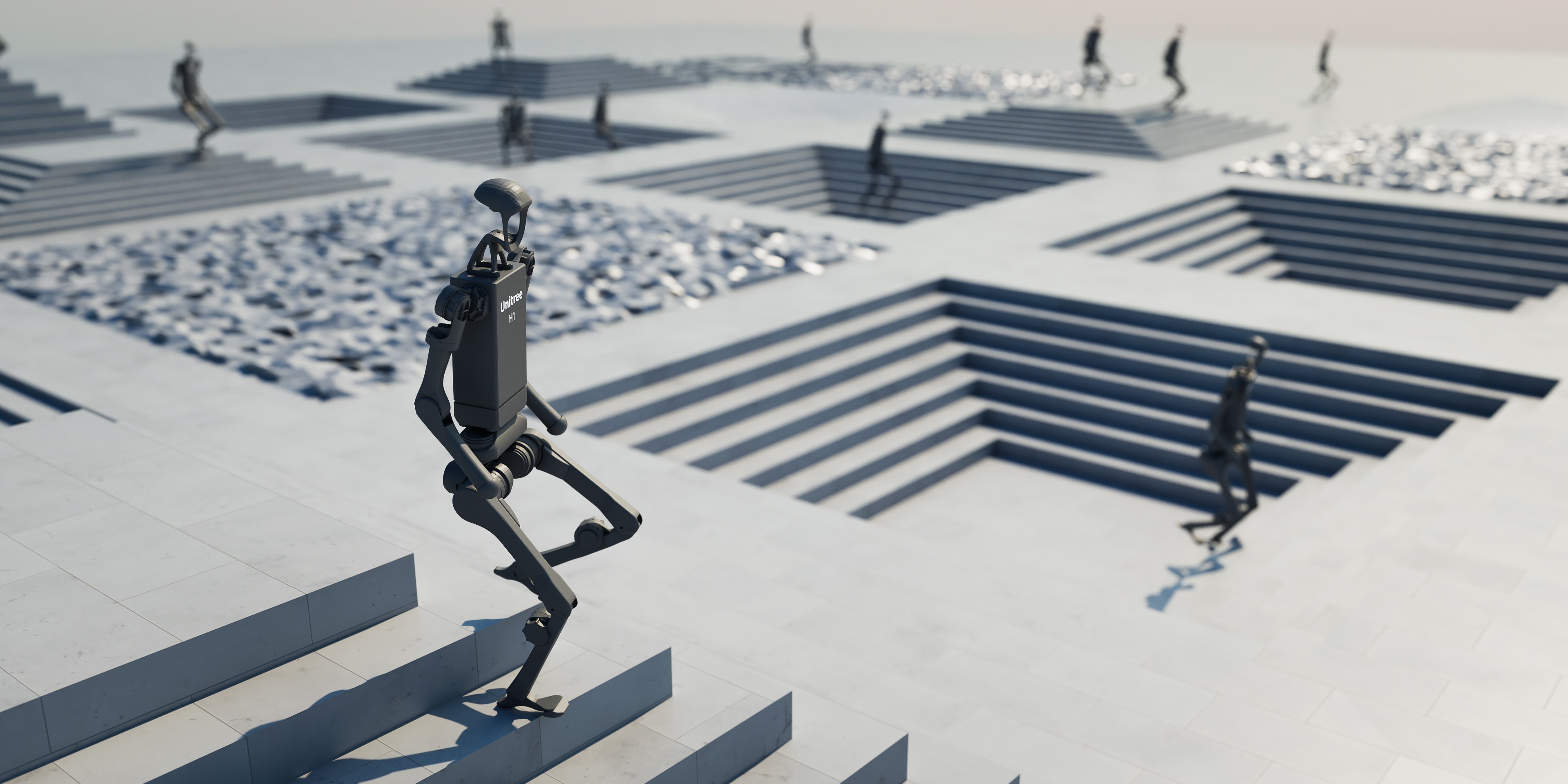
Learning energy-efficient humanoid locomotion requires discovering mechanically economical gait coordination, not merely reducing actuator effort. Reinforcement learning promotes efficiency through effort-related reward penalties, which guide the step-to-step mechanics of walking only indirectly. This article proposes a framework inspired by passive dynamic walking (PDW) that temporarily creates slope-equivalent conditions favorable to economical gait discovery and removes all PDW-specific guidance before nominal-dynamics optimization. During early training, a tilted-gravity field assists sagittal progression on flat collision geometry, complemented by curriculum-coupled reward terms. The core framework requires no reference trajectories, gait phases, or contact schedules. In a five-seed forward-locomotion study on a 29-DoF Unitree G1, the framework reduces mechanical cost of transport by 6.8-15.2% over commanded speeds of 0.5-2.0m/s without degrading velocity tracking. Mechanical-work decomposition attributes the reduction to positive actuator work, and reward-matched comparisons separate the guided regime's faster gait acquisition from the tilt's additional benefit to converged economy. The framework extends to unassisted omnidirectional locomotion, where its benefit persists once a walking-specific motion prior supplies kinematic coordination, the combination reducing speed-matched cost of transport by 18.7%. On hardware, forward cost of transport falls by 16.3% with the motion prior and by 4.5% without it, the latter within the trial-to-trial spread.

cs.ROhumanoidlocomotion

兴趣:reinforcement learning for legged locomotion and sim-to-real transfer

#382026-09-2986

PreferenceFlow: Test-Time Guidance of Flow-Matching Robot Policies from Human Interventions

Yiqi Tang, Diyuan Shi, Runze Li, Donglin Wang

Flow-matching policies can represent complex robot behaviors but remain susceptible to local errors under distribution shift at deployment. Many reinforcement learning approaches t…

Flow-matching policies can represent complex robot behaviors but remain susceptible to local errors under distribution shift at deployment. Many reinforcement learning approaches to policy improvement require reward signals that are difficult to specify or obtain in real-world manipulation. We present PreferenceFlow, a framework for improving a pretrained flow policy at test time without environment rewards or updates to the base policy. Human intervention chunks are paired with robot chunks generated from the same initial conditioning state to train a preference model. During infer- ence, we adopt the QGF sampling update, replacing its value gradient with the preference gradient evaluated at an estimated clean action. A gradient-cap loss penalizes excessive gradients on intervention pairs, while a zero-gradient loss discourages guidance near actions from expert demonstrations. On four real-world precision insertion tasks with a Franka robot, Pref- erenceFlow achieves a mean success rate of 90.5%, compared with 69% for the frozen policy. Ablations support the roles of gradient regularization and correctly ordered preference labels in the evaluated settings. These results demonstrate the utility of human interventions as local preference supervision for guiding frozen generative robot policies.

cs.ROrobotmanipulation

兴趣:imitation learning and diffusion policies for robot control

#392026-09-2985

Rethinking Representations for World-Action Modeling

Haoyi Jiang, Liu Liu, Xinjiang Wang, Zhihao Sun, Zequn Chen, Sen Wang 等

World-action models jointly learn robot policies and predict future observations, making the representation space an interface between control and prediction. We study the design o…

World-action models jointly learn robot policies and predict future observations, making the representation space an interface between control and prediction. We study the design of this space through controlled comparisons, finding that neither reconstruction fidelity nor pre-trained perceptual features alone ensure effective policy learning. These findings motivate ReWAM, a representation-centric world-action model built on pre-trained DINO features. Feature Calibration and a Temporal Representation Bottleneck organize these features into compact world states suited to dynamics modeling. Action-Grounded Representation Shaping routes only action-loss gradients to the bottleneck, thereby letting the policy shape what the representation encodes while the world model learns how it evolves. Without generative video pre-training, ReWAM achieves 93.6% success on RoboTwin 2.0. On RoboDojo, it achieves an average score of 12.29 and a success rate of 8.28% using approximately 600 hours of embodied pre-training data.

cs.CVcs.ROrobotembodiedworld model

兴趣:world models and video prediction for embodied agents

#402026-09-2985

EquivDP3: A SIM(3)-Invariant Point-Cloud Encoder for Data-Efficient Humanoid Loco-Manipulation

Abu Hanif Muhammad Syarubany, Chang D. Yoo

Visuomotor policies for humanoid loco-manipulation must generalize across object poses and lighting from only a handful of demonstrations. 3D Diffusion Policy (DP3) conditions a di…

Visuomotor policies for humanoid loco-manipulation must generalize across object poses and lighting from only a handful of demonstrations. 3D Diffusion Policy (DP3) conditions a diffusion-based action generator on point-cloud features, but its PointNet-style encoder has no built-in equivariance to the rotations, translations, and scalings (SIM(3)) that manipulation tasks respect. EquiBot closed this gap for wheeled manipulators with a SIM(3)-equivariant Vector Neuron Network (VNN) encoder. We extend this to a substantially more complex embodiment, the 43-joint Unitree G1 humanoid, and propose EquivDP3: a two-stage policy where a high-level diffusion planner with a SIM(3)-equivariant VNN encoder emits 6 Hz whole-body command chunks, executed at 50 Hz by a frozen, pre-trained RL locomotion policy and a differential inverse-kinematics module for the arms, trained end-to-end by behavior cloning. Across two simulated IsaacLab benchmarks and four non-equivariant baselines (5-100 demonstrations, in- and out-of-distribution), EquivDP3's advantage concentrates in the low-data regime: at 5-10 demonstrations it reaches 67.1% success versus 38.2-52.4% for the baselines, while by 50-100 all encoders converge (74.3-85.2%) and the ordering is no longer meaningful. A proprioception-only control confirms this gap is genuinely perceptual: with the point cloud removed, success drops to 31% vs. 60% (EquivDP3) at 5 demonstrations and 78% vs. 99% at 10, but vanishes by 50-100, showing the high-data plateau reflects a benchmark ceiling, not five encoders learning the same invariance. The encoder costs only 0.8 ms of extra latency per action chunk over the PointNet encoder it replaces. Baking geometric symmetry into a hierarchical diffusion policy's perception backbone is a practical, nearly free way to improve data efficiency for humanoid loco-manipulation when demonstrations are scarce.

cs.ROmanipulationdiffusion policyhumanoidlocomotion

你点赞过:TANGO: Humanoid Navigation in Cluttered Environments with a

#412026-09-2985

Explore, Execute, Evolve: A Skill Acquisition and Reuse Loop for Embodied Agents

Sicheng Xie, Yitong Chen, Haidong Cao, Shunlin Lu, Zuxuan Wu, Yu-Gang Jiang

Vision-language-action and world-action models have demonstrated impressive capabilities in robotics, yet generalization to unseen tasks remains challenging. More recently, general…

Vision-language-action and world-action models have demonstrated impressive capabilities in robotics, yet generalization to unseen tasks remains challenging. More recently, general-purpose multimodal agents have shown great potential for zero-shot robotic task solving. However, they often incur high execution costs by reasoning and exploring the physical world from scratch. To reduce these costs, we introduce RoboSkill, a framework that connects skill acquisition and reuse through an Explore, Execute, Evolve loop. Within this loop, the agent explores to gather task-relevant information, executes tasks while adapting to feedback, and evolves its skill library based on execution records. It then reuses these skills to guide exploration and execution in the next cycle, closing the loop. To improve loop efficiency, we complement vision with tactile feedback to reduce uncertainty during physical interaction. We further augment textual guidance with reusable code to reduce reasoning overhead during skill reuse. On LIBERO-10, RoboSkill improves first-episode success rates by 12.5--25.0 percentage points and reduces average runtime by 7.6--72.4% across four agents. On real robots, it improves success rates by 8.3 percentage points and reduces average runtime for successful trials by at least 14.4%.

cs.ROcs.AIvision-language-actionembodiedtactile

兴趣:imitation learning and diffusion policies for robot control

#422026-09-2885

SAKI: Skill Assembly and Kinematic Imitation from Human Videos for Long-Horizon Mobile Manipulation

Yijie Lu, James Zhao, Weiming Zhi

Learning from human videos offers a promising route to acquiring diverse manipulation skills. Extending this capability beyond tabletop settings to long-horizon mobile manipulation…

Learning from human videos offers a promising route to acquiring diverse manipulation skills. Extending this capability beyond tabletop settings to long-horizon mobile manipulation requires adapting and composing demonstrated interactions across changing scenes and robot configurations. We present Skill Assembly and Kinematic Imitation (SAKI), a framework connecting human-video skill acquisition, cross-demonstration assembly and closed-loop whole-body execution. SAKI prepares reusable object-centric skills that preserve task-critical interactions while allowing transfer paths to adapt. Given a goal and supplied task dependencies, it selects and orders skills, binds their object roles to the current scene, and carries scene estimates and robot configuration between successive skills. Whole-body kinematic imitation generates coordinated base, arm and gripper motion. During execution, persistent object estimates maintain task references across viewpoint changes, while visual feedback updates remaining trajectories. Real-robot experiments demonstrate skill reuse across layouts and the composition of independently demonstrated interactions into continuous mobile tasks, including tidying and wiping. Ablation results show that task-conditioned reference preparation substantially improves long-horizon task completion with whole-body optimisation and visual feedback held fixed. Check https://aus.bot/research/saki/ for video demos!

cs.ROrobotmanipulation

兴趣:robot manipulation and grasping with learned policies

#432026-09-2984

Recovering the View: Benchmarking Physical Active Vision for Occlusion Recovery in Robotic Manipulation

Kaijun Luo, Yudi Huang, Qijun Zhong, Xinshuai Song, Yang Liu, Liang Lin

Physical active vision allows robots to change their viewpoint when task-relevant observations become unreliable, yet existing manipulation benchmarks provide limited support for s…

Physical active vision allows robots to change their viewpoint when task-relevant observations become unreliable, yet existing manipulation benchmarks provide limited support for studying how policies recover from occlusion during execution. We introduce BAVO-Bench (Bimanual Active Vision under Occlusion), a bimanual active-vision benchmark that systematically controls external visibility through Clean, Stage Occlusion, and Random-time Occlusion conditions, enabling evaluation of both manipulation performance and active visual recovery. Building on this setting, we present A-FAR (Active Future-Aware Recovery), an active-vision policy for joint viewpoint and manipulation control. A-FAR represents moving-camera observations in a unified robot-centric 3D frame and distills relational structure together with its future evolution from a pretrained 4D model, providing the policy with future-aware geometric guidance without requiring future observations at deployment. Experiments across multiple manipulation tasks show that A-FAR improves robustness to both structured and temporally shifted occlusions while maintaining strong performance under clean observations.

cs.ROrobotmanipulation

兴趣:robot manipulation and grasping with learned policies

#442026-09-2984

Kinematic Nonlinear Spatio-Temporal Trajectory Warping for Contact-Rich Dexterous Manipulation Demonstrations

Hyojae Park, Arjun S. Lakshmipathy, Nancy S. Pollard

We present a straightforward but effective method for repurposing existing contact-rich dexterous manipulation demonstrations. Starting from inputs of hand and object trajectories,…

We present a straightforward but effective method for repurposing existing contact-rich dexterous manipulation demonstrations. Starting from inputs of hand and object trajectories, our method outputs high-quality nonlinear trajectory warps that account for intermediate waypoints, environmental barriers, temporal shifts, and varied start/end configurations. Foundational to our method is the utilization of contact distributions, which we show allows us to reliably compute complex and high-dimensional dexterous hand trajectories following a simple object-centric warp specification pipeline. We evaluate our method across 12 variations sourced from 4 demonstrations in a publicly available dataset of human hand motion data, perform baseline comparisons, and demonstrate generalization of our approach to different manipulators. Results and code will be made available on publication.

cs.ROmanipulationdexterous

兴趣:robot manipulation and grasping with learned policies

#452026-09-2984

Direct Experience World-Model Optimization: Learning the World Beyond Action Imitation

Xiangcheng Zhan, Zirui Chen, Yicheng Zhao, Ziteng Gao, Shuo Yang

World-Action Models (WAMs) couple action generation with predictions of how physical interactions unfold. However, current post-deployment learning paradigms typically improve beha…

World-Action Models (WAMs) couple action generation with predictions of how physical interactions unfold. However, current post-deployment learning paradigms typically improve behavior without requiring better world predictions. Especially in dexterous manipulation, small execution errors can compound in high-dimensional action spaces, hindering policy improvement and pushing interactions beyond the world model's training distribution. Motivated by this, we propose Direct Experience World-Model Optimization (DEWO), a post-deployment learning paradigm for WAMs that, alongside action imitation, refines world representations through visual experience to better condition action generation. Specifically, it identifies interaction turning points and learns from successful and failed futures to support classifier-free guidance. An additional value head estimates task progress from video representations and activates guidance when progress stalls during inference. Across five DexJoCo tasks, DEWO improves average success across all three WAM formulations. Ablations show that visual supervision from successful and failed continuations improves both prediction and control beyond action supervision alone. On four real-world tasks across Wuji and Sharpa, 3 x 3 grid evaluations show that two rounds of deployment learning increase success from 51.0% to 71.7% in cells with at least one initial success, a gain of 20.7 percentage points. These findings support continued predictive learning for improving control through deployment experience, making world modeling an active part of WAM adaptation.

cs.AIcs.ROmanipulationdexterousworld model

兴趣:world models and video prediction for embodied agents

#462026-09-2983

Simple Agentic Memory for Generalist Robot Policies

Yuyou Zhang, Yunbei Zhang, Miao Li, Janet Wang, Zijian Jin, Shilong Liu 等

Visual-memory systems commonly retain or compress past observations. Robot control additionally requires interaction-derived state that no individual frame may explicitly represent…

Visual-memory systems commonly retain or compress past observations. Robot control additionally requires interaction-derived state that no individual frame may explicitly represent, such as persistent identity relations, accumulated progress, or ordered procedures. We introduce Simple Agentic Robot Memory (SimpleARM), a training-free memory layer for frozen generalist robot policies. From the task instruction, SimpleARM specifies what to monitor; frozen perceptual tools maintain compact typed state online; structured access retrieves that state only when a proposed subgoal depends on history; and current-view grounding resolves recalled entities before execution. We evaluate SimpleARM on RoboMME, a benchmark of memory-dependent robot manipulation tasks that require history information no longer available in the current observation. Across all 16 tasks and three policy seeds, SimpleARM achieves 67.17% mean success, compared with 44.51% for the strongest non-oracle baseline. Matched ablations show mechanism specificity: removing relation, reference, progress, or route state produces large losses where the affected state is retrieved for control, while largely sparing other tasks. These results support a state-based view of robot memory: effective memory for control is not simply retained visual history, but compact task-relevant state derived from the interaction history.

cs.ROcs.AIrobotmanipulation

兴趣:robot manipulation and grasping with learned policies

#472026-09-2983

Predictive Safety Curricula for Robust Legged Locomotion

Ivan Ovinnikov, Pascal Sutter, Christian Gehring, Jordis Herrmann

Rare but consequential failures can persist in learned locomotion policies for legged robots even when average task performance is high, in part because standard curricula primaril…

Rare but consequential failures can persist in learned locomotion policies for legged robots even when average task performance is high, in part because standard curricula primarily adapt task difficulty rather than the distribution of safety-critical experience. We introduce Predictive Safety Curricula (PSC), a framework for allocating locomotion training experience using learned predictions of future safety cost. PSC trains a distributional safety critic from policy rollouts and uses its predictions to prioritize both terrain contexts and previously encountered randomized events. The resulting curriculum modifies the training distribution while leaving the task reward and policy-optimization loss unchanged. We evaluate PSC in controlled rough-terrain locomotion and in production locomotion systems. PSC improves reliability relative to standard terrain progression, advantage-based replay, and learning-progress curricula, with the largest gains on difficult terrain and under degraded observations. The same allocation principle transfers to two production locomotion stacks. On ANYmal-D hardware, PSC reduces shank-collision incidence by $63%$ relative to the learning-progress curriculum across three matched training seeds, with a reduction in every seed. On a production stair-climbing platform, PSC eliminates observed shank collisions in the evaluated hardware trials. These results show that learned predictions of future safety cost can provide an effective signal for allocating training experience toward rare failure modes and improving locomotion reliability.

cs.ROcs.AIcs.LGleggedlocomotion

兴趣:reinforcement learning for legged locomotion and sim-to-real transfer

#482026-09-2983

OTRetarget: Joint Robot and Object Motion Retargeting via Optimal Transport

Guillaume Besset, Erwann Carn, Timothée Carecchio, Valentin Tordjman-Levavasseur, Fabian Schramm, Yann de Mont-Marin 等

Transferring human motion to humanoid robots requires adapting the demonstrated motion to the robot morphology while preserving interactions with the environment. This is particula…

Transferring human motion to humanoid robots requires adapting the demonstrated motion to the robot morphology while preserving interactions with the environment. This is particularly challenging for loco-manipulation tasks, where contacts with the ground and manipulated objects must remain consistent despite differences in body proportions. Yet, skeletal motion alone does not fully describe these interactions, and fixing object trajectories limits the adaptation to a new embodiment. In this paper, we introduce OTR ETARGET, a unified approach to jointly retarget robot and multi-object motion from human demonstrations. Our approach represents surface interactions through signed distances, closest surface points, and relative directions, and uses entropic optimal transport to transfer these quantities across human, robot, and object geometries. We incorporate the resulting interaction targets into a constrained inverse kinematics formulation that balances contact preservation with motion style and jointly optimizes robot and object poses at each frame. This formulation accommodates robot-object and object-object interactions without rescaling the scene or the demonstration. We validate the proposed approach on OMOMO, where it achieves a robot- object interaction Jaccard score of 87% and a depth error of 8.7 mm, compared with 28% and 29.3 mm for OmniRetarget. Finally, we demonstrate transfer to a physical G1 humanoid using whole-body policies trained with reinforcement learning on the retargeted references, across motions including two-handed box pick-and-place onto a table.

cs.ROrobotmanipulationhumanoid

兴趣:humanoid robots and whole-body control

#492026-09-2983

Beyond Token Importance: Preserving Spatial Scaffolds for Efficient Vision-Language-Action Inference

Jiayu Chen, Shuyong Gao, Jingkai Jia, Xiaosheng Bu, Jiyuan Fu, Lingyi Hong 等

Existing VLA pruning strategies primarily select individual visual tokens according to task-level semantic relevance, while overlooking the spatial information required for robotic…

Existing VLA pruning strategies primarily select individual visual tokens according to task-level semantic relevance, while overlooking the spatial information required for robotic manipulation. To examine this limitation, we construct a simple Stride baseline that uniformly samples tokens along the flattened one-dimensional visual sequence, representing a purely geometric pruning strategy. Surprisingly, Stride outperforms semantic pruning and random pruning at certain pruning ratios, but collapses when the token budget is only slightly reduced. We characterize this phenomenon through the spatial coverage radius, defined as the largest spatial blind spot induced by the retained token set after pruning. Our analysis reveals a strong correlation between the spatial structure of retained tokens and task success, suggesting that reliable VLA pruning requires preserving not only task-relevant tokens but also the spatial scaffold of the scene. Motivated by this diagnosis, we propose GeoScaffold, a training-free visual token pruning method that partitions each image into spatial regions, allocates inter-region token budgets using task-relevance weights, and selects intra-region scaffold tokens via farthest point sampling to reduce the local coverage radius. On pi 0.5 and LIBERO, GeoScaffold retains only 20% of visual tokens while preserving a 93.2% average success rate, and achieves a 1.78 times prefill speedup over the unpruned baseline.

cs.ROmanipulationVLAvision-language-action

兴趣:vision-language-action (VLA) models and foundation models for robots

#502026-09-2982

Learning to Explore Hidden Kinematics for Articulated Object Manipulation

Ruiyao Liu, Boshu Lei, Zhuoyang Pan, Kostas Daniilidis

The kinematics of an articulated object is often ambiguous from vision alone. Interaction resolves the ambiguity, and active perception methods exploit this by searching for the si…

The kinematics of an articulated object is often ambiguous from vision alone. Interaction resolves the ambiguity, and active perception methods exploit this by searching for the single action that most sharpens a belief over the kinematic parameters at each step. Such greedy search cannot be extended over a horizon without forward models of the contact and inertial dynamics, which are themselves unknown. We instead amortize action selection into training. We maintain a belief distribution over joint type and parameters, initialized from a generative prior and updated by Bayesian filtering on the observed part motion. To condition the policy on this belief, we render it as a per-point articulation flow field, the motion that the current posterior predicts for every point on the object. Carrying the inductive bias of articulated motion, this representation generalizes better than a latent encoding of the belief or flow tracked from observation. We train the policy with reinforcement learning, rewarding the entropy that each interaction removes from the posterior, so that informative exploration becomes learned behavior rather than a search at every step. Our method outperforms previous approaches across door and drawer manipulation on the PartManip benchmark, and reaches 61.7% success on ArticuRiddle, a new dataset of objects whose appearance implies the wrong articulation, against 44.4% for the best previous method. Project Website: https://hiddenkinematics.github.io/

cs.ROmanipulation

兴趣:robot manipulation and grasping with learned policies

GitHub 项目

#12025-11-23★ 671 +877

sou350121/VLA-Handbook

HTML

本项目旨在为致力于进入VLA(Vision-Language-Action)领域的算法工程师提供一份全中文、实战导向的学习/面试手册。 不同于通用的 CV/NLP 面试指南,本项目聚焦于 Robotics 特有的挑战

本项目旨在为致力于进入VLA(Vision-Language-Action)领域的算法工程师提供一份全中文、实战导向的学习/面试手册。 不同于通用的 CV/NLP 面试指南,本项目聚焦于 Robotics 特有的挑战

chinesedeep-learningembodied-aillmrobot-learningroboticsvision-language-actionvlarobotVLAvision-language-actionembodied

兴趣:vision-language-action (VLA) models and foundation models for robots

#22026-07-06★ 2.2k +1276

dexmal/opendm

Python

An Open-World Foundation Model for General-Purpose Embodied Intelligence.

An Open-World Foundation Model for General-Purpose Embodied Intelligence.

embodied-aiembodied-intelligenceroboticsvision-language-actionvlaVLAvision-language-actionembodied

兴趣:vision-language-action (VLA) models and foundation models for robots

#32026-08-26★ 390 +875

OpenMOSS/EasyWAM

Python

A unified framework for training, fine-tuning, and evaluating World Action Models

A unified framework for training, fine-tuning, and evaluating World Action Models

benchmarkcodebaseembodied-aifoundation-modelsloraroboticsvision-language-actionworld-action-modelvision-language-actionembodied

兴趣:vision-language-action (VLA) models and foundation models for robots

#42024-12-08★ 3.9k +1374

datawhalechina/every-embodied

Python

仅需Python基础,从0构建自己的具身智能机器人;从0逐步构建VLA/OpenVLA/SmolVLA/Pi0, 深入理解具身智能

仅需Python基础,从0构建自己的具身智能机器人;从0逐步构建VLA/OpenVLA/SmolVLA/Pi0, 深入理解具身智能

embodied-agentembodied-aiembodied-intelligenceopenvlasmolvlavision-language-action-modelVLAvision-language-actionembodied

兴趣:world models and video prediction for embodied agents

#52018-04-25★ 3.5k74

PaddlePaddle/PARL

Python

A high-performance distributed training framework for Reinforcement Learning

A high-performance distributed training framework for Reinforcement Learning

large-scaleparallelizationreinforcement-learning

兴趣:imitation learning and diffusion policies for robot control

#62026-08-31★ 7.4k +13673

Human-Agent-Society/reef

Python

Infrastructure for continually self‑improving agents

Infrastructure for continually self‑improving agents

agent-infrastructureai-agentscontinual-learninginferencellmllm-trainingreinforcement-learningself-improving-agents

兴趣:multi-agent systems and LLM agents

#72026-09-08★ 43 +1新项目73

lok-i/vibe

Python

Post-training humanoid whole-body trackers for perceptive control tasks

Post-training humanoid whole-body trackers for perceptive control tasks

humanoid-controlmjlabperceptive-locomotionpporeinforcement-learningrobot-learningviberobothumanoidlocomotion

兴趣:humanoid robots and whole-body control

#82025-10-17★ 3k +5772

dexmal/dexbotic

Python

Dexbotic: Open-Source Vision-Language-Action Toolbox

Dexbotic: Open-Source Vision-Language-Action Toolbox

codebasecogactmemoryvlaopenvla-oftpi0real-worldroboticssimulationVLAvision-language-action

兴趣:vision-language-action (VLA) models and foundation models for robots

#92026-03-18★ 62k +1.1k72

rohitg00/ai-engineering-from-scratch

Python

Learn it. Build it. Ship it for others.

Learn it. Build it. Ship it for others.

agentsaiai-agentsai-engineeringcomputer-visioncoursedeep-learningfrom-scratch

兴趣:multi-agent systems and LLM agents

#102024-01-26★ 27.9k +2271

huggingface/lerobot

Python

🤗 LeRobot: Making AI for Robotics more accessible with end-to-end learning

🤗 LeRobot: Making AI for Robotics more accessible with end-to-end learning

兴趣:imitation learning and diffusion policies for robot control

#112024-02-29★ 163 +171

RobotControlStack/robot-control-stack

Python

A lean, ROS-free sim-to-real framework for training and deploying Vision-Language-Action (VLA) models and RL agents. Native MuJoCo Gymnasium wrappers with synchronous execution for…

A lean, ROS-free sim-to-real framework for training and deploying Vision-Language-Action (VLA) models and RL agents. Native MuJoCo Gymnasium wrappers with synchronous execution for Franka, UR5e, xArm, SO101 and YAM.

frankagymnasiummujocoreinforcement-learningrobot-learningrobot-manipulationsim-to-realvision-language-actions-modelsrobotmanipulationVLAvision-language-actionsim-to-real

兴趣:vision-language-action (VLA) models and foundation models for robots

#122024-09-29★ 3.5k +1270

enactic/openarm

MDX

A fully open-source humanoid arm for physical AI research and deployment in contact-rich environments.

A fully open-source humanoid arm for physical AI research and deployment in contact-rich environments.

bilateral-teleoperationforce-feedbackgenesisgravity-compensationhumanoid-robotimitation-learningmachine-learningmoveit2robothumanoid

兴趣:humanoid robots and whole-body control

#132025-08-14★ 5.4k +1070

RLinf/RLinf

Python

RLinf: Reinforcement Learning Infrastructure for Embodied and Agentic AI

RLinf: Reinforcement Learning Infrastructure for Embodied and Agentic AI

agentic-aiembodied-aireinforcement-learningrl-infrarlinfvla-rlVLAembodied

兴趣:vision-language-action (VLA) models and foundation models for robots

#142025-04-04★ 1.9k +-169

RoboVerseOrg/RoboVerse

Python

RoboVerse: Towards a Unified Platform, Dataset and Benchmark for Scalable and Generalizable Robot Learning

RoboVerse: Towards a Unified Platform, Dataset and Benchmark for Scalable and Generalizable Robot Learning

imitation-learningreinforcement-learningroboticssimulationrobot

兴趣:imitation learning and diffusion policies for robot control

#152024-05-11★ 1.8k +469

robocasa/robocasa

Python

RoboCasa: Large-Scale Simulation of Everyday Tasks for Generalist Robots

RoboCasa: Large-Scale Simulation of Everyday Tasks for Generalist Robots

humanoid-robotphysics-simulationrobot-learningroboticsrobothumanoid

兴趣:humanoid robots and whole-body control

#162022-11-16★ 8.3k +1269

isaac-sim/IsaacLab

Python

Unified framework for robot learning with multi-physics/renderer support

Unified framework for robot learning with multi-physics/renderer support

isaac-simomniverse-kit-extensionrobot-learningroboticsrobot

兴趣:3D perception, point clouds and scene understanding for robotics

#172025-10-09★ 3.8k +169

starVLA/starVLA

Python

StarVLA: A Lego-like Codebase for Vision-Language-Action Model Developing

StarVLA: A Lego-like Codebase for Vision-Language-Action Model Developing

robotic-foundation-modelroboticsvision-language-action-modelworld-action-modelvision-language-action

兴趣:vision-language-action (VLA) models and foundation models for robots

#182026-08-29★ 8068

OpenBMB/SimpleMemVLA

Python

Native-video memory for vision-language-action models, using timestamped visual history and exact streaming inference for long-horizon robot manipulation.

Native-video memory for vision-language-action models, using timestamped visual history and exact streaming inference for long-horizon robot manipulation.

embodied-ailong-horizon-roboticsmultimodal-learningnative-video-memoryrobot-learningrobot-manipulationstreaming-inferencevideo-understandingrobotmanipulationVLAvision-language-actionembodied

兴趣:vision-language-action (VLA) models and foundation models for robots

#192026-06-26★ 627 +468

robocurve/inspect-robots

Python

Open source evals for physical AI. Run any LLM/VLA on any arm/humanoid against any real/sim benchmark.

Open source evals for physical AI. Run any LLM/VLA on any arm/humanoid against any real/sim benchmark.

benchmarkembodied-aievaluationphysical-airerunroboticsvision-language-actionvlaVLAvision-language-actionhumanoidembodied

兴趣:vision-language-action (VLA) models and foundation models for robots

#202026-07-19★ 60868

RealXiaoze/humanoid-motion-intelligence

人形机器人运动智能论文、开源项目、产业与求职知识库

人形机器人运动智能论文、开源项目、产业与求职知识库

embodied-aihumanoid-roboticslocomotionmotion-controlreinforcement-learningrobot-learningsim2realvlarobotVLAhumanoidlocomotionembodied

兴趣:humanoid robots and whole-body control

#212023-05-28★ 75.2k +4668

hiyouga/LlamaFactory

Python

Unified Efficient Fine-Tuning of 100+ LLMs & VLMs (ACL 2024)

Unified Efficient Fine-Tuning of 100+ LLMs & VLMs (ACL 2024)

agentaideepseekfine-tuninggemmagptinstruction-tuninglarge-language-models

兴趣:multi-agent systems and LLM agents

#222026-09-07★ 494 +11新项目67

showlab/Show-Harness

Python

Just a VLM Agent Can Play Robots

Just a VLM Agent Can Play Robots

embodied-agentfoundation-modelsharnessroboticsembodied

兴趣:vision-language-action (VLA) models and foundation models for robots

#232025-01-16★ 3.6k +367

jonyzhang2023/awesome-embodied-vla-va-vln

A curated list of state-of-the-art research in embodied AI, focusing on vision-language-action (VLA) models, vision-language navigation (VLN), and related multimodal learning appro…

A curated list of state-of-the-art research in embodied AI, focusing on vision-language-action (VLA) models, vision-language navigation (VLN), and related multimodal learning approaches.

VLAvision-language-actionembodied

兴趣:vision-language-action (VLA) models and foundation models for robots

#242025-09-09★ 51.9k +18067

bojieli/ai-agent-book

Python

《深入理解 AI Agent:设计原理与工程实践》(李博杰 著)开源主仓库:全书正文、编译版 PDF 与按章配套代码

《深入理解 AI Agent:设计原理与工程实践》(李博杰 著)开源主仓库:全书正文、编译版 PDF 与按章配套代码

agentagent-memoryai-agentbookcoding-agentcontext-engineeringlarge-language-modelsllm

兴趣:multi-agent systems and LLM agents

#252026-09-11★ 37 +10新项目67

NiuTrans/RL-without-Tears

HTML

An Introduction to reinforcement learning in the era of large language models

An Introduction to reinforcement learning in the era of large language models

deep-learninglarge-language-modelsmachine-learningneural-language-processingreinforcement-learning

兴趣:large language models for robot task planning and reasoning

#262026-09-15★ 76 +9新项目67

1173591564/Dynamics-memory

TypeScript

LLM agent 的有界自纠错长期记忆层:把连续、含矛盾的项目交互日志蒸馏成有界、可自更新的记忆库。Bounded, self-correcting long-term memory for LLM agents — candidate pool + value dynamics + tension adjudication + causal-replay…

LLM agent 的有界自纠错长期记忆层:把连续、含矛盾的项目交互日志蒸馏成有界、可自更新的记忆库。Bounded, self-correcting long-term memory for LLM agents — candidate pool + value dynamics + tension adjudication + causal-replay evals.

agent-memoryagentsllmllm-agentslong-term-memorymemorymemory-managementpythonLLM agent

兴趣:multi-agent systems and LLM agents

#272026-02-21★ 220 +167

RoboTwin-Platform/RMBench

Python

Memory-Dependent Manipulation Benchmark based on RoboTwin

Memory-Dependent Manipulation Benchmark based on RoboTwin

benchmarkembodied-aimanipulationmemoryroboticsmanipulationembodied

兴趣:robot manipulation and grasping with learned policies

#282025-05-23★ 25067

AoqunJin/Awesome-VLA-Post-Training

A collection of vision-language-action model post-training methods.

A collection of vision-language-action model post-training methods.

embodied-agentembodied-aifine-tuningpost-trainingvision-language-action-modelvlaVLAvision-language-actionembodied

兴趣:vision-language-action (VLA) models and foundation models for robots

#292026-09-14★ 40 +10新项目67

xiao-yang25/robot-harness

C++

A harness for embodied intelligence — connecting agents, robot skills and the physical world through execution, feedback and recovery.

A harness for embodied intelligence — connecting agents, robot skills and the physical world through execution, feedback and recovery.

agentscppembodied-aiharnessphysical-airobot-runtimeroboticsros2robotembodied

你点赞过:TANGO: Humanoid Navigation in Cluttered Environments with a

#302025-09-11★ 7.2k +1867

vllm-project/vllm-omni

Python

A framework for efficient model inference with omni-modality models

A framework for efficient model inference with omni-modality models

audio-generationdiffusionimage-generationinferencemodel-servingmultimodalpytorchtransformer

兴趣:vision-language-action (VLA) models and foundation models for robots