Tech Station

2026-10-01

50 篇论文 · 30 个项目 ← 2026-09-30 · 2026-10-02 →

论文

#12026-09-29追踪学者 · He Wang105

Systematically Exploring the Capabilities of GPT-6 Astra as Embodied Policies

Galbot Team, Xuchuan Chen, Xiaoqian Cheng, Yu Deng, Lihe Ding, Shaocong Dong 等

GPT-6 Astra exhibits a remarkable ability to generate numerical robot actions, extending its role beyond high-level planning. To assess Astra's capabilities as general-purpose embo…

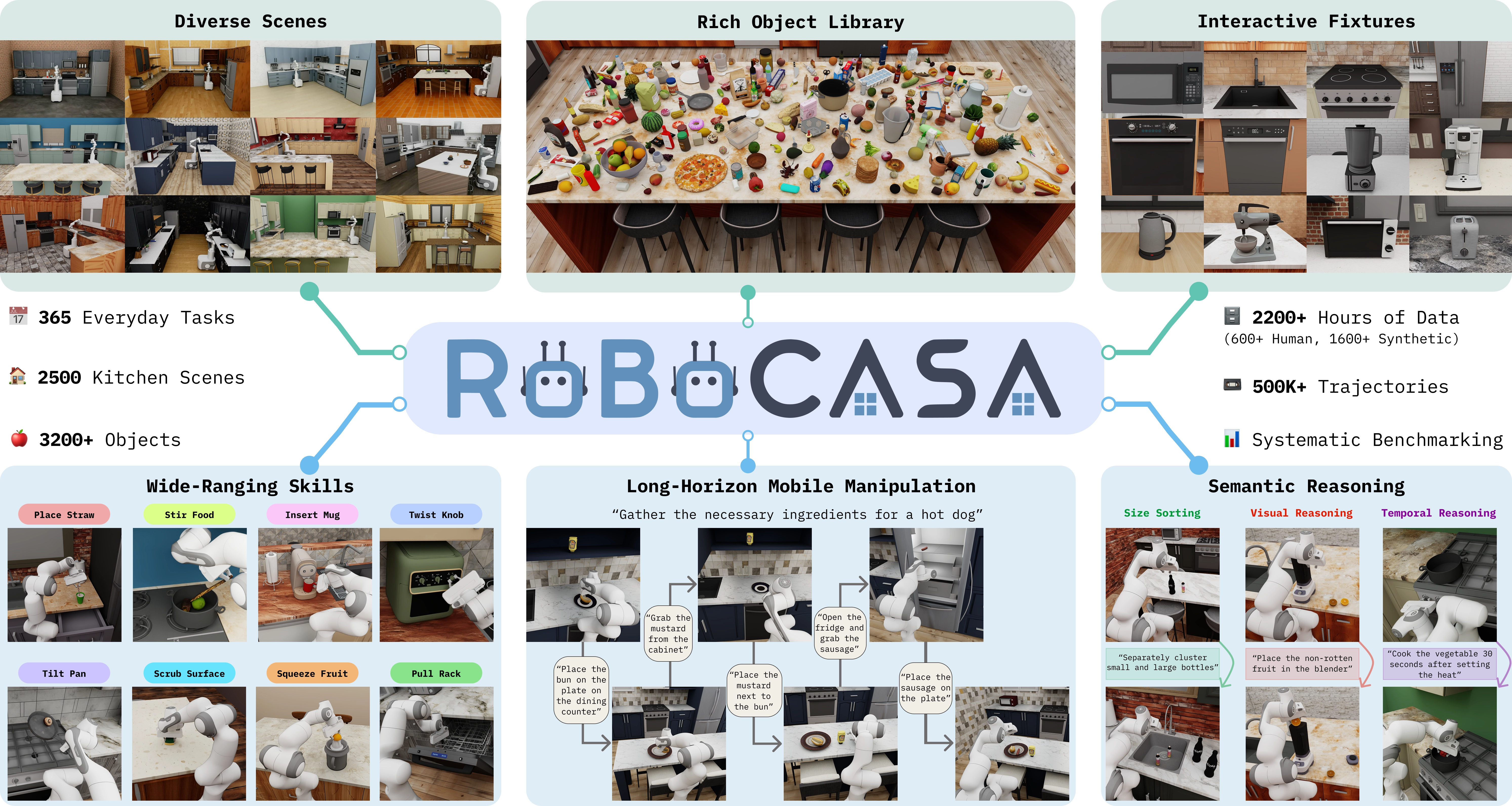
GPT-6 Astra exhibits a remarkable ability to generate numerical robot actions, extending its role beyond high-level planning. To assess Astra's capabilities as general-purpose embodied policies, we conduct comprehensive evaluations across six domains, examining direct control, cooperation with learned policies, and feedback-driven adaptation. In gripper manipulation, Astra can correct task targets and prepare contact conditions for subsequent policy execution; hybrid control with π0.5 achieves 48% success on the evaluated RoboDojo subset. In dexterous manipulation, hybrid control achieves 50% success in ten experience-guided DexJoCo trials, while direct in-hand control struggles to coordinate finger contacts. In mobile manipulation, hybrid control reaches 38.7% success on the evaluated RoboCasa365. In navigation, Astra leads our local comparisons, reaching 92% success on RxR instruction following and 82% on HM3D object search, although search incurs substantial detours. In locomotion, dense motion-reference generation remains unreliable: none of five sequential attempts on a single obstacle course reaches the goal, despite improvements in stability and forward progress. In humanoid loco-manipulation, Astra exceeds baseline methods on 13 of 30 HumanoidBench tasks with pretrained whole-body controllers. These findings reveal a gap between useful task decisions and reliable physical control. Inference latency further constrains practical control: across 50 RoboDojo instances per condition, policy-assisted and direct control consume 624.8 million and 1.132 billion tokens. A 30-second locomotion run requires 250 model calls averaging 39.86 seconds each, with physics paused during inference.

cs.ROrobotmanipulationhumanoidlocomotionembodieddexterous

追踪学者:He Wang;兴趣:humanoid robots and whole-body control

#22026-09-30追踪学者 · Pieter Abbeel101

Tactile Curiosity Drives Robot Interaction

Klemens Iten, Alexander Proshkin, Bhavya Sukhija, Stelian Coros, Andreas Krause, Pieter Abbeel 等

Mastering robot manipulation skills via reinforcement learning (RL) remains largely sample-inefficient. The most common RL algorithms rely on random action sampling to discover new…

Mastering robot manipulation skills via reinforcement learning (RL) remains largely sample-inefficient. The most common RL algorithms rely on random action sampling to discover new strategies, resulting in agents that allocate most of their training budget to motions in free space, away from the contacts from which manipulation skills emerge. Existing intrinsic motivation methods based on model disagreement or epistemic uncertainty improve on isotropic noise, but they can also reward uncertainty in functionally irrelevant transitions, such as erratic motions in free space. In this work, we argue that tactile feedback provides a natural signal for exploration, and introduce TacEx, a framework that incorporates touch into epistemic uncertainty-driven exploration by decomposing model uncertainty across sensory modalities and directing curiosity toward the tactile channel. By anchoring curiosity to the sense of touch, TacEx drives the robot to discover complex contact dynamics, learning to manipulate and grasp objects without task rewards or expert demonstrations during exploration. The interaction-dense dataset collected through this tactile-driven curiosity supports offline learning of downstream pick-and-place policies without additional environment interaction. We further use tactile-driven exploration to post-train vision-language-action (VLA) models. Although the VLAs are initially pre-trained without tactile feedback, post-training with TacEx substantially improves downstream performance while remaining highly sample-efficient.

cs.ROcs.AIrobotmanipulationgraspVLAvision-language-actiontactile

追踪学者:Pieter Abbeel;兴趣:robot manipulation and grasping with learned policies

#32026-09-2998

Correcting WHERE, Preserving HOW: Compositional Generalization for Vision-Language-Action Models via Referential Guidance

Yanyan Zhang, Disheng Liu, Xinpeng Li, Chaoda Song, Mohsen Hariri, Debargha Ganguly 等

While Vision-Language-Action (VLA) models enable flexible action generation, their generalization across diverse environmental elements, including manipulated objects, destinations…

While Vision-Language-Action (VLA) models enable flexible action generation, their generalization across diverse environmental elements, including manipulated objects, destinations, and backgrounds, is limited by the lack of diversity in robotic training data. Trained end-to-end on such data, VLAs tend to exploit visual shortcuts, associating actions with task-irrelevant visual features rather than the intended task semantics. These shortcuts block recomposition of elements already seen by the policy, that is, compositional generalization. Existing approaches mitigate such entanglement through task-relevant perception or targeted data diversification, but offer no explicit mechanism for unseen recomposition and require backbone-specific modifications with retraining. We observe that under such recomposition, VLAs often fail at global grounding while retaining local manipulation skills that recover near the correct target in familiar configurations. Therefore, we propose Referential Guidance (ReGuide), a training-free wrapper that, given object poses from a grounding module, combines semantic and geometric rebinding to guide the end-effector into demonstration-supported configurations of the instructed referent, where the frozen policy can resume execution. Experiments in simulation across multiple VLA backbones as well as on a real robot show that ReGuide improves success rates under compositional shifts by up to 56.8 and 75.0 percentage points, respectively, while preserving standard-task performance.

cs.ROcs.CVcs.LGrobotmanipulationVLAvision-language-action

兴趣:vision-language-action (VLA) models and foundation models for robots

#42026-09-2997

Memorize, Adapt, Ignore: Diagnosing Robot Learning Mechanisms under Training Data Variation

Ke Zhang, Danica J. Sutherland, Chao Liu

Training data variation, whether through designing a domain randomization (DR) scheme in simulation or curating demonstrations for imitation learning, is a primary lever for improv…

Training data variation, whether through designing a domain randomization (DR) scheme in simulation or curating demonstrations for imitation learning, is a primary lever for improving the robustness of robotic manipulation policies. Yet its underlying mechanisms remain poorly understood, and practitioners typically select randomization parameters through expensive trial and error. We investigate these mechanisms through a series of case studies, randomizing object size, color, and type as well as scene lighting and linguistic prompts across settings including pick-and-place RL in ManiSkill and fine-tuning of vision-language-action (VLA) models on LIBERO and RoboTwin. We examine both model behavior and internal representations, using the empirical neural tangent kernel (NTK) as our primary diagnostic tool. We show that the NTK distinguishes a shift in the internal learning mechanism from memorizing different situations with insufficient variation (e.g.\ learning what to do for a large cube, and what to do for a small cube) to adapting to the situation at hand with sufficient variation. An NTK-based signal-to-noise ratio also helps distinguish when policies have learned to ignore task-irrelevant factors (e.g.\ treating blue and red cubes identically, instead of learning a blue sub-policy and a red sub-policy). We use these diagnostics to develop practical guidance for designing DR schemes, selecting models, and detecting shortcut learning. We further compare different kinds of representations and validate our findings with real-world hardware experiments using ACT-based imitation learning.

cs.ROrobotmanipulationVLAvision-language-actionimitation learning

兴趣:imitation learning and diffusion policies for robot control

#52026-09-3097

EWAM: Emergent Depth-Wise Specialization in a Unified Embodied Model -- From Semantic Understanding through Visual Foresight to Action

Hao Wang, Jiajun Wen, Jingzhi Liu, Shuoshuo Xue, Zhiliang Chen, Min Lin 等

Vision-language-action (VLA) policies emphasize semantic understanding, whereas world-action models (WAMs) learn predictive representations of environment dynamics. Systems that ex…

Vision-language-action (VLA) policies emphasize semantic understanding, whereas world-action models (WAMs) learn predictive representations of environment dynamics. Systems that expose a policy to both sources often still concentrate action computation on a single expert. We present EWAM, an action-centric unified embodied model whose asymmetric joint attention lets action tokens read semantic, current-visual, predicted-future, and action information at every layer while the perceptual experts retain their distinct roles. Without layer-wise supervision, EWAM develops an emergent depth-wise specialization: action queries attend mainly to vision-language features in shallow layers, to predicted future frames in intermediate layers, and to action tokens themselves in deep layers. This handoff replicates across tasks and is stable across denoising steps. Checkpoint tracking and causal interventions show that it is learned and that action generation depends on it. EWAM is pretrained in two separate regimes, one on cross-embodiment robot trajectories and one on human egocentric video. In simulation and real-robot experiments, it surpasses existing VLA, WAM, and hybrid baselines. Human egocentric data improve both cross-embodiment transfer and real-robot robustness, and subtask-phase supervision improves long-horizon completion. Together, these results suggest that unified embodied learning can induce an ordered internal progression from semantic understanding, through visual foresight, to action formation.

cs.ROrobotVLAvision-language-actionembodied

兴趣:world models and video prediction for embodied agents

#62026-09-3094

CEER2: Directional and Tunable End-Effector and Root Compliance for Humanoid Loco-Manipulation

Xinyuan Luo, Chunyuan Yang, Boyuan Chen, Xianyi Cheng

Humanoids are increasingly capable of tracking complex whole-body motions, but physical interaction introduces a different challenge. When a robot makes contact with a person or th…

Humanoids are increasingly capable of tracking complex whole-body motions, but physical interaction introduces a different challenge. When a robot makes contact with a person or the environment, it needs to respond to external forces while preserving the motion needed for the task. This response can vary across directions in the end-effectors and on the body. For example, an end effector may need to accommodate contact force in one direction while maintaining motion accuracy in another, while the robot body may resist an external force or move with it. We present a compliance framework for humanoid loco-manipulation that combines directional and tunable end-effector (EE) compliance with selectable root compliance for external force rejection or force following. A hierarchical reinforcement learning controller modulates a fixed whole-body tracking policy through high-level EE and root commands, while interaction forces are estimated from proprioceptive history. Our simulation and real-world experiments on a humanoid demonstrate directional stiffness control, online stiffness adjustment, distinct root compliance, compliant manipulation, and collaborative carrying.

cs.ROrobotmanipulationhumanoid

兴趣:humanoid robots and whole-body control

#72026-09-30追踪学者 · Koushil Sreenath94

ChronoGraph: Functional 4D Scene Graphs with Vision-Language Models for Interaction Understanding and Grounded Planning

Chenyangguang Zhang, Malgorzata Gwiazda, Guanlong Jiao, Yuanchen Ju, Federico Tombari, Koushil Sreenath 等

Embodied agents must determine where to act, anticipate the resulting scene changes, and interpret observed outcomes to guide subsequent actions. This requires connecting 4D intera…

Embodied agents must determine where to act, anticipate the resulting scene changes, and interpret observed outcomes to guide subsequent actions. This requires connecting 4D interaction understanding, which explains how past actions changed the scene, with spatially grounded planning, which determines how and where to act toward a goal and anticipates the resulting scene changes. We introduce ChronoGraph, a functional 4D scene graph that links actions on affordance parts to semantic and geometric state changes. By representing observed and anticipated transitions in the same form, it provides a shared basis for understanding and planning. We construct ChronoGraphBench through an automatic data engine that converts human-interaction videos and simulated robot trajectories into graph-annotated questions for training and evaluating Vision-Language Models (VLMs) on both tasks. Using these annotations, we train ChronoGraphVLM by adapting pretrained VLMs in two stages. Graph-as-Chain-of-Thought supervised fine-tuning teaches the models to reconstruct observed transitions and predict future ones as graph traces before answering. Subsequent joint 4D graph reinforcement learning directly rewards graph properties and answer correctness. Experiments across model scales show improvements over the corresponding pretrained baselines and zero-shot transfer to VLM4D. Real-world demonstrations further show that graph-based planning and affordance grounding support mobile manipulation through existing robot skills without additional fine-tuning.

cs.AIrobotmanipulationembodied

追踪学者:Koushil Sreenath;兴趣:vision-language-action (VLA) models and foundation models for robots

#82026-09-30追踪学者 · Yuke Zhu94

ASENA: Self-evolving Agents for Embodied Navigation

An-Chieh Cheng, Isabella Liu, Edmund Bu, Johan Bjorck, Hongxu Yin, Zhengyi Luo 等

We present ASENA, an embodied agent system that connects general-purpose coding agents to robot sensing, computation, supervised execution, and persistent experience. Agents can wr…

We present ASENA, an embodied agent system that connects general-purpose coding agents to robot sensing, computation, supervised execution, and persistent experience. Agents can write and execute programs, inspect recorded outcomes, repair failures, and reuse notes and executable skills while keeping their model weights fixed. We further introduce ASENA-VLN, a 4B monocular navigation policy that serves as an optional tool within this programmable system. ASENA-VLN predicts body-frame trajectories for both extended routes and short-horizon behaviors using a shared vision-language decoder trained on route instructions, visual question answering, and a newly curated dataset of geometry-derived atomic navigation tasks. As a standalone policy, ASENA-VLN achieves state-of-the-art success rates of 68.7% on R2R and 70.2% on RxR. When integrated with a coding agent, learned navigation improves ASENA's success rate by 11 percentage points on both agentic benchmarks while reducing execution time. Through persistent workspace evolution and simulator feedback, ten passes over recurring 100-task subsets further improve success from 72% to 98% on R2R and from 65% to 89% on RxR. On embodied question answering, ASENA achieves state-of-the-art accuracy with fewer interaction steps. Finally, real-world demonstrations on a Unitree G1 combine search, visual inspection, spatial reasoning, and synthesized gestures without a pre-built map, illustrating how online programming extends robot behavior beyond route following and predefined skills.

cs.ROrobotembodied

追踪学者:Yuke Zhu;兴趣:world models and video prediction for embodied agents

#92026-09-3094

Inline Memory Meets Reusable Skills: Memory-centric Framework for Vision-Language-Action Model

Zaijing Li, Rui Shao, Bing Hu, Haoyu Zhang, Dongmei Jiang, Liqiang Nie

Vision-Language-Action (VLA) models have shown strong promise for general-purpose robotic manipulation, yet adapting them to new tasks and domains remains inefficient: existing met…

Vision-Language-Action (VLA) models have shown strong promise for general-purpose robotic manipulation, yet adapting them to new tasks and domains remains inefficient: existing methods often rely on parameter tuning, incurring substantial costs and risking catastrophic forgetting of previously learned tasks. To address this, we propose Optimus-R, a memory-centric VLA framework that formulates robotic adaptation as explicit query-skill memory tuning. Optimus-R introduces: (i) An Inline Memory Interface for skill extraction. It inserts learnable memory tokens into the VLA prefix stream, allowing the backbone to derive control-aware query and skill representations within the native action-conditioning pathway. (ii) A Query-Skill Memory Bank for skill learning. It externalizes skills into query prototypes for deciding what to retrieve and skill values for specifying how to act, supporting skill reuse and expansion with limited parameter updates. (iii) A lightweight Bridge-and-Adapt mechanism for skill updating. It aligns target-domain queries and skills with the existing memory space through a lightweight adapter and residual memory updates. Experiments on in-domain adaptation, cross-domain adaptation, and lifelong learning show that Optimus-R enables data-efficient skill learning while mitigating catastrophic forgetting.

cs.CVcs.ROmanipulationVLAvision-language-action

兴趣:vision-language-action (VLA) models and foundation models for robots

#102026-09-3093

Exploiting Vulnerabilities: Universal Adversarial Attacks on Vision-Language-Action Models in Robotics

Songhua Yang, Ziyu Liu, Yuanwei Liu, Xuetao Li, Xuanye Fei, He Huang 等

Recently, Vision-Language-Action (VLA) models have revolutionized robotic manipulation by seamlessly integrating visual perception, language understanding, and action generation in…

Recently, Vision-Language-Action (VLA) models have revolutionized robotic manipulation by seamlessly integrating visual perception, language understanding, and action generation in an end-to-end learning framework. However, since these models are designed to interact directly with the physical world and humans, their security is critical, and even small vulnerabilities can lead to catastrophic failures. In this work, we propose the Universal Adversarial Object, a sphere with optimized surface texture that significantly degrades task success rates when placed within the robot's field of view. Specifically, our approach introduces a multi-level attack framework that jointly disrupts trajectory planning, task execution, and action control. We validate our method in both simulated and real-world robotic settings. Experimental results demonstrate that the adversarial object reduces the average task success rates by 31.2%-39.9% for two representative VLA models (Pi0 and RDT), with success rates dropping to near zero in complex scenarios. Index Terms--Vision-Language-Action models, adversarial attack, robotic security, universal adversarial object

cs.ROcs.CRcs.CVrobotmanipulationVLAvision-language-action

兴趣:vision-language-action (VLA) models and foundation models for robots

#112026-09-3093

Benchmarking and Enhancing Skill-Level Memory for Partially Observable Robotic Manipulation

Yansong Shi, Jiange Yang, Xijie Yang, Shaowei Zhang, Yuhan Zhu, Tao Lu 等

Recent advances in robot learning have enabled manipulation policies to perform increasingly diverse tasks and generalize across environments. However, reliable execution often dep…

Recent advances in robot learning have enabled manipulation policies to perform increasingly diverse tasks and generalize across environments. However, reliable execution often depends on hidden task states that cannot be determined from current observations alone, making interaction history essential. We introduce $HIDE$, a benchmark for evaluating manipulation memory under partial observability. HIDE comprises 15 tasks covering repetition counting, historical-state recall, and execution-progress tracking, with randomized initial configurations and decision points where similar observations require different actions depending on prior events. We further propose $SEEK$, a framework combining three complementary memory mechanisms to retain historical evidence and track execution state. Evaluations reveal substantial limitations in existing policies on HIDE, while memory augmentation improves task success in both simulation and real-world experiments. Individual mechanisms benefit some tasks but can degrade others; their combination achieves the highest average success rate on HIDE among the evaluated configurations. These findings highlight the importance of maintaining internal representations of hidden task states and matching memory design to task-specific information requirements.

cs.ROrobotmanipulation

兴趣:robot manipulation and grasping with learned policies

#122026-09-3093

EmbodiRSI: Recursive Self-Improvement for Data-Efficient Robot Adaptation

Haoran Lang, Haotao Lu, Shiyu Sang, Haoyang Luo, Guo Chen, Qun Li 等

Adapting robot manipulation policies to new tasks and environments remains highly data-intensive, while the data needed for further improvement depends on the policy's current capa…

Adapting robot manipulation policies to new tasks and environments remains highly data-intensive, while the data needed for further improvement depends on the policy's current capabilities and failure modes. We introduce EmbodiRSI, an agentic system for recursive self-improvement (RSI) in a real-to-sim-to-real setting, where task-specific simulations are constructed from target deployment scenarios and used as low-cost environments for iterative policy improvement before transfer back to the physical world. EmbodiRSI uses policy execution feedback to guide subsequent experience acquisition and policy updates. Two complementary mechanisms close this loop: Collaborative Error Correction generates agent-assisted corrective trajectories from policy-reached states, while Adaptive Data Collection directs expert demonstration generation toward the current policy's weaknesses. The task-specific simulation serves as a reusable workspace for policy warm-up, repeatable evaluation, failure diagnosis, and targeted data generation across successive RSI rounds. Across three tabletop environments and 14 subtasks, EmbodiRSI increases scene-balanced autonomous simulation success from 50.4% to 83.5% over two RSI updates. With 400 adaptive simulated trajectories and only ten real-world refinement trajectories per subtask, EmbodiRSI achieves 83.1% scene-balanced autonomous real-world success, compared with 75.0% for adaptation using 200 real-world demonstrations per subtask. These results demonstrate that feedback-driven recursive improvement in deployment-specific simulations can enable data-efficient adaptation of embodied policies to physical environments.

cs.ROrobotmanipulationsim-to-realembodied

兴趣:imitation learning and diffusion policies for robot control

#132026-09-3093

Learning from Runtime Feedback through Failure-Bank Self-Evolution for Vision-Language-Action Models

Mingyue Cui, Zheyuan Liu, Yihan Zhu, Zheyuan Zhang, Meng Jiang

Vision-language-action (VLA) models generalize broadly across robotic manipulation tasks, but complex environments require balancing task success with unintended contact. Runtime s…

Vision-language-action (VLA) models generalize broadly across robotic manipulation tasks, but complex environments require balancing task success with unintended contact. Runtime shields can correct individual actions, but they leave the underlying policy unchanged, so repeated disagreements may create a persistent policy-shield mismatch that blocks task progress. To address this challenge, we introduce FailBank, a four-stage self-evolving framework that converts runtime feedback into persistent policy improvement. During collection, a fixed CBF-based safety module serves as an observe-only teacher, producing counterfactual corrections while the policy remains in control. Outcome-aware admission then converts useful proposals into corrective targets and retains successful uncorrected actions as quiet anchors for guarded LoRA updates. We evaluate FailBank on the VLA-Arena benchmark across two difficulty levels and two VLA backbones. Compared with the base policies, FailBank improves the joint success-cost operating point. Across the two backbones, FailBank improves task success rate by 8.5 and 6.9 percentage points, while reducing policy-induced cumulative cost by 35.6% and 23.8%, respectively. Compared with runtime shielding, FailBank raises task success rate by 25.4 and 9.5 percentage points, while maintaining comparable policy-induced cumulative cost. These results show that runtime feedback can serve as persistent policy supervision rather than only as a temporary action constraint.

cs.ROcs.AImanipulationVLAvision-language-action

兴趣:vision-language-action (VLA) models and foundation models for robots

#142026-09-30追踪学者 · Peter Stone93

STARS: From Spatiotemporal Dynamics to Social Representations in Human-Robot Interaction

Nathan Tsoi, Michael J. Munje, Tejas Oberoi, Rishab Maheshwari, Pengen Zheng, Tanush Chauhan 等

Robot navigation in dynamic, human-centered environments requires socially-compliant decisions grounded in robust scene understanding. Recent Vision-Language Models (VLMs) exhibit …

Robot navigation in dynamic, human-centered environments requires socially-compliant decisions grounded in robust scene understanding. Recent Vision-Language Models (VLMs) exhibit promising capabilities such as object recognition, common-sense reasoning, and contextual understanding, capabilities that align with the nuanced requirements of social robot navigation. However, it remains unclear whether VLMs can accurately understand complex social navigation scenes (e.g., inferring the spatial-temporal relations among agents and human intentions), which is essential for safe and socially compliant robot navigation. While some recent works have explored the use of VLMs in social robot navigation, no existing work systematically evaluates their ability to meet these necessary conditions. In this paper, we introduce the Social Navigation Scene Understanding Benchmark (SocialNav-SUB), a Visual Question Answering (VQA) dataset and benchmark designed to evaluate VLMs for scene understanding in real-world social robot navigation scenarios. SocialNav-SUB provides a unified framework for evaluating VLMs against human and rule-based baselines across VQA tasks requiring spatial, spatiotemporal, and social reasoning in social robot navigation. Through experiments with state-of-the-art VLMs, we find that while the best-performing VLM achieves an encouraging probability of agreeing with human answers, it still underperforms simpler rule-based approach and human consensus baselines, indicating critical gaps in social scene understanding of current VLMs. Our benchmark sets the stage for further research on foundation models for social robot navigation, offering a framework to explore how VLMs can be tailored to meet real-world social robot navigation needs. An overview of this paper along with the code and data can be found at https://larg.github.io/socialnav-sub.

cs.ROcs.LGrobot

追踪学者:Peter Stone;兴趣:vision-language-action (VLA) models and foundation models for robots

#152026-09-3092

LocoWM: High-Precision Locomotion through World-Model-Guided Residual Adaptation

Zijie Zhao, Shengqian Chen, Xiaoxu Wang, Han Jiang, Yuanheng Zhu, Dongbin Zhao

High-precision locomotion combines motion-command tracking with precise regulation of task-relevant physical states, enabling robots to interact reliably with their surroundings du…

High-precision locomotion combines motion-command tracking with precise regulation of task-relevant physical states, enabling robots to interact reliably with their surroundings during motion. Joint end-to-end optimization can leave precision objectives insufficiently optimized, while reactive residual control adjusts actions only after deviations become observable. We present LocoWM, a world-model-guided preactive residual adaptation framework for high-precision locomotion. A base policy provides command-following locomotion, while an action-conditioned world model predicts a sequence of future physical states from proprioceptive history and the proposed base action. A residual adapter conditions on this predicted sequence to generate additive action corrections that compensate for anticipated deviations. Two-stage training first learns locomotion and action-conditioned dynamics, then freezes both modules while training the adapter, separating locomotion acquisition from precision adaptation. Experiments spanning terrain leveling, acceleration compensation, and push recovery demonstrate improved control precision and disturbance robustness over end-to-end and reactive residual baselines. Demos and code are available at: https://zhaozijie2022.github.io/LocoWM

cs.ROlocomotionworld model

兴趣:reinforcement learning for legged locomotion and sim-to-real transfer

#162026-09-3092

The Planning Limits of Latent World Models

Ali Alrasheed, Basim Azam, Naveed Akhtar

World models offer a promising way to help robots understand how the physical world evolves and plan complex behaviours through imagination. Yet existing studies mainly demonstrate…

World models offer a promising way to help robots understand how the physical world evolves and plan complex behaviours through imagination. Yet existing studies mainly demonstrate what these models can accomplish, leaving unclear when their predictions remain useful for planning and where they fail. We study this question using action-conditioned predictors built on five frozen self-supervised visual backbones: V-JEPA 2, V-JEPA 2.1, VideoMAEv2, VideoPrism, and DINOv2. We use frozen backbones to test representations intended to transfer across environments. We evaluate these models on diverse Meta-World manipulation tasks and real-robot interactions from BridgeData V2. We find that a world model guides action selection reliably only when the goal lies within, or slightly beyond, the trajectory it imagines during planning. With five-step rollouts, the length the predictor was trained on, the world model ranks actions reliably only for targets five to ten control steps ahead, whereas task goals lie 16 to 53 steps away. Neither an 81-fold larger predictor nor longer-rollout training extends this range; the encoder affects both range and closed-loop success, with V-JEPA 2.1 performing most consistently. More fundamentally, the limit persists under perfect prediction: using the real simulator, success falls from 92% to 41% as the target moves from five to twenty steps ahead of a five-step rollout. Planning therefore requires either longer imagined trajectories or closer subgoals. For distant goals, pure imagination succeeds in 23% of episodes, planning with feedback (MPC) raises success to 30%, imagining as far as the goal to 47%, and nearby expert subgoals to 76%. Used within its plannable range, a world model can also improve a vision-language-action (VLA) policy: choosing among eight actions the VLA proposes raises its success from 65% to 77% across 16 different tasks.

cs.ROcs.CVrobotmanipulationVLAvision-language-actionworld model

兴趣:world models and video prediction for embodied agents

#172026-09-3092

From Local Whole-Body VLA Behaviors to Scene-Scale Aerial Manipulation

Weixiang Guo, Rui Jin, Haotian Jin, Xinhang Xu, Ruiyang Liu, Haoran Zhao 等

Vision-language-action (VLA) models enable task-conditioned interaction, but extending them to scene-scale aerial manipulation remains challenging due to costly whole-body demonstr…

Vision-language-action (VLA) models enable task-conditioned interaction, but extending them to scene-scale aerial manipulation remains challenging due to costly whole-body demonstrations, latency-induced action-state misalignment, and cross-site behavior composition. We present a unified framework for synthetic policy training and scene-scale execution on articulated uncrewed aerial manipulators (UAMs). A scene-reconfigurable pipeline synthesizes task-conditioned, kinodynamically feasible trajectories and synchronized multiview observations for VLA training without physical-platform demonstrations. Measured-progress-aligned realization (MPAR) aligns asynchronously returned action chunks with measured execution progress and realizes them as continuous, dynamically feasible trajectories. A relational Scene Graph grounds language goals to object instances and feasible interaction regions, while topology-guided transfer connects local behaviors across sites. Local VLA skills achieve 39/60 successes (65.0%) in simulation under oracle target and feasible-handoff conditions. Under 500-ms added latency, with and without a transient command-update stall, MPAR reduces median takeover phase error by 0.212 s over nominal-time alignment. The complete system completes 21/50 simulated multi-site missions (42.0%) and is further validated on a physical articulated UAM.

cs.ROmanipulationVLAvision-language-action

兴趣:vision-language-action (VLA) models and foundation models for robots

#182026-09-3092

MotionWeave: Learning Motion-Centered Future Dynamics for Vision-Language-Action Policies

Jingqiu Wang, Yan Wang

Vision-Language-Action (VLA) models have recently incorporated world models to provide richer dynamic supervision beyond sparse action labels. However, explicitly predicting future…

Vision-Language-Action (VLA) models have recently incorporated world models to provide richer dynamic supervision beyond sparse action labels. However, explicitly predicting future images or videos may include control-irrelevant appearance, while guidance derived from holistic future visual representations and shared global action features may fail to establish timestep-specific correspondence between actions and local visual changes. To address this issue, we propose MotionWeave, a motion-centric future-dynamics framework for action-chunk prediction with two modules: the Action-Induced Motion Grounder (AIMG) and the Horizon Residual Composer (HRC). Specifically, AIMG conditions on action and proprioceptive representations to construct horizon-specific queries that localize interaction regions associated with each future action timestep from current visual tokens. HRC extracts differences between interaction representations at adjacent horizons, encodes them as temporal motion cues, and injects them into action tokens through a gated residual. During training, robot-arm masks rendered from future frames are used to construct KL-based motion-grounding supervision, while inference uses only the current observation. On six MetaWorld tasks, MotionWeave achieves a 75.3% average success rate, an absolute gain of 8.6% over π0 (66.7%), especially on sustained-interaction tasks. Our code is available at https://github.com/autu-mn/MotionWeave.

cs.ROcs.CVcs.LGrobotVLAvision-language-action

兴趣:world models and video prediction for embodied agents

#192026-09-3091

Beyond Policy Alignment: Closing the Planning-Learning Loop for Robot Control with Learned World Models

Kowndinya Boyalakuntla, Yuhan Liu, Abdeslam Boularias

Planning with learned world models combines online trajectory optimization with learned value and policy functions for high-dimensional control. Because the planner determines the …

Planning with learned world models combines online trajectory optimization with learned value and policy functions for high-dimensional control. Because the planner determines the experience used for learning, while the learned critic and actor in turn score and propose future plans, planning and learning form a closed feedback loop. TD-MPC is a prominent instance of this design. Recent policy-constrained variants strengthen one part of the loop by aligning the learned policy with planner behavior. We introduce PL-MPC (Planning-Learning MPC), which additionally modifies critic supervision and planner terminal-value estimation. Hybrid multi-step TD targets expose critic updates to more realized rewards before bootstrapping; disagreement-aware terminal estimates reduce the influence of uncertain critic values during MPPI planning; and return-weighted actor distillation emphasizes planner-executed actions from high-return episodes. The world-model architecture and MPPI optimizer are otherwise unchanged. On HumanoidBench, the largest gains occur on balance-hard, where Total Average Return (TAR) increases from $98\pm18$ to $387\pm255$, and hurdle, from $199\pm13$ to $466\pm200$; performance across the broader benchmark remains task dependent, and PL-MPC remains competitive on DMControl. Controlled ablations show different component interactions across the two tasks. We further demonstrate zero-shot sim-to-real transfer on wrench-nut alignment with a 7-DoF KUKA IIWA14, obtaining higher observed success than TD-M(PC)^2 on the training object size and two unseen sizes. Code and data will be available at: https://pl-mpc-humanoid.github.io.

cs.ROrobothumanoidsim-to-real

兴趣:imitation learning and diffusion policies for robot control

#202026-09-3091

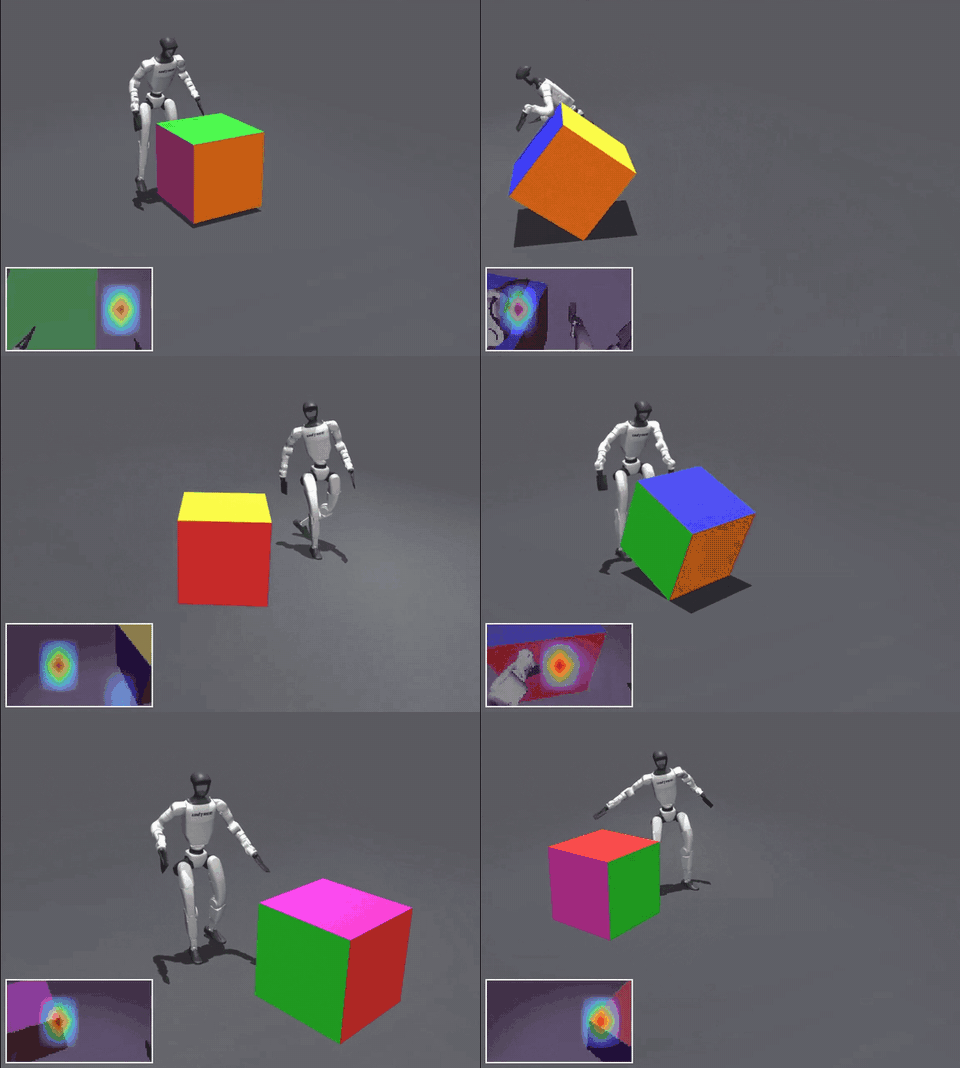
Locomotion-Grounded Humanoid Soccer: Task-Gated Reinforcement Learning of a Multi-Directional Kicking Library

Abu Hanif Muhammad Syarubany, Jaehyun Jang, Hwanhee Kim, Kyuwon Kim, Seungyeon Ryu, Chang D. Yoo

Recent humanoid soccer systems make motion tracking the substrate and derive locomotion from it, typically by steering a motion-reference anchor toward the ball. This yields strong…

Recent humanoid soccer systems make motion tracking the substrate and derive locomotion from it, typically by steering a motion-reference anchor toward the ball. This yields strong shooting results, but locomotion is trained only on the narrow, deterministic command distribution ball approach induces, never evaluated as a capability in its own right. We invert the stack: a general, command-conditioned locomotion policy is trained first as the substrate, and N motion-guided kicking skills are added on top as task-gated layers, so the reachable gait space is set by the locomotion curriculum rather than any reference clip. Because every skill starts from and returns to this same commandable state, locomotion also becomes a composition hub (O(N) transitions rather than O(N^2)), and post-strike stabilisation is handed back to the trained controller rather than scripted per clip. We instantiate this on a 29-DoF Unitree G1 with seven retargeted kicking skills spanning 259.5 degrees of nominal aim direction, including lateral, rearward and weak-foot strikes a single forward-facing reference cannot express, and report shooting accuracy alongside command-tracking, terrain and push-recovery results with the full skill library attached, an axis prior humanoid soccer systems do not report. The library is validated on hardware across forward, lateral, rearward and commanded approaches.

cs.ROhumanoidlocomotion

兴趣:reinforcement learning for legged locomotion and sim-to-real transfer

#212026-09-3090

IronMind: Scaling Humanoid Dexterous Manipulation via Camera-Space Ego-Centric Pretraining

Huimin Pan, Yufan Ren, Kunpeng Song, Siyang Wang, Xiwen Zhang, Xiaoyun Hu 等

Egocentric human video offers a scalable data source for dexterous manipulation, yet using it to train humanoid robots presents two challenges: (1) an embodiment gap, as human hand…

Egocentric human video offers a scalable data source for dexterous manipulation, yet using it to train humanoid robots presents two challenges: (1) an embodiment gap, as human hands differ structurally from robot end-effectors and low-cost egocentric recordings lack the torso kinematics required by conventional retargeting; and (2) heterogeneous data quality, including noisy hand-pose tracking and weakly aligned text annotations. We introduce IronMind, a vision-language-action (VLA) model that uses egocentric human video and heterogeneous robot data to pretrain policies for humanoid dexterous manipulation. To bridge the embodiment gap, IronMind bypasses explicit body-retargeting by using a camera-space action representation, the native reference space of egocentric video, and semantically aligning robot and human action dimensions. Across total pretraining budgets from 250 to 10,000 hours, validation loss decreases approximately log-linearly with data scale. Larger pretraining budgets also improve out-of-distribution real-robot manipulation after post-training: across six challenging tasks with unseen objects, affordances, and reasoning prompts, the 10,000-hour model achieves a 55.0% success rate, compared with at most 11.7% for every pretraining budget up to 5,000 hours and 5.0% without pretraining. At the same pretraining budget, the camera-space action representation also outperforms the torso-frame baseline. Together, these findings support pretraining with a camera-space action representation on large-scale human egocentric data as a scalable foundation for humanoid robot manipulation.

cs.ROrobotmanipulationVLAvision-language-actionhumanoiddexterous

兴趣:humanoid robots and whole-body control

#222026-09-3090

Dream4ACT: A Shared Visual Action Interface for Multi-Embodiment Video-Action Modeling

Xiangyu Zhu, Jin Xu, Yue Guo, Xin Wu, Yifan Sun, Xiancong Ren 等

Video generation models (VGMs) offer strong spatiotemporal priors for embodied observation--action modeling. However, joint-space action vectors lack explicit image-space structure…

Video generation models (VGMs) offer strong spatiotemporal priors for embodied observation--action modeling. However, joint-space action vectors lack explicit image-space structure and vary in dimensionality and semantics across embodiments, making it challenging to directly leverage the rich spatiotemporal priors of VGMs. End-effector visualizations provide an alternative but do not specify the full articulated configuration needed for robot execution. We present Dream4ACT, a world model built for joint video-action modeling across embodiments. To unify action representations across embodiments, we introduce a shared visual action interface, called action views, which render target joint configurations from four prescribed virtual cameras using URDF-based forward kinematics. This shared visual representation preserves embodiment-specific articulated geometry while allowing observation and action sequences to share a video autoencoder and diffusion transformer. Through masked flow-matching, our model supports forward dynamics, inverse dynamics, and joint observation--action generation within a single jointly trained model by varying which future sequences are corrupted. To recover executable action sequences from predicted action views, we propose a training-free, URDF-constrained multiview recovery mechanism, without a learned embodiment-specific decoder. Dream4ACT achieves an average success rate of 88.98% on RoboTwin~2.0 and an overall score of 65.66 on TriWorldBench, supporting effective closed-loop manipulation and competitive action-conditioned multiview prediction through the visual action interface.

cs.ROrobotmanipulationembodiedworld model

兴趣:world models and video prediction for embodied agents

#232026-09-3090

LIBERO-Agent: Evaluating General-Purpose Agents for Direct Embodied Manipulation

Zijie Diao, Yitong Chen, Sicheng Xie, Tianyi Lu, Wujian Peng, Guojin Zhong 等

General-purpose agents can plan, use tools, and revise their behavior from feedback, but it remains unclear whether these capabilities transfer from digital environments to embodie…

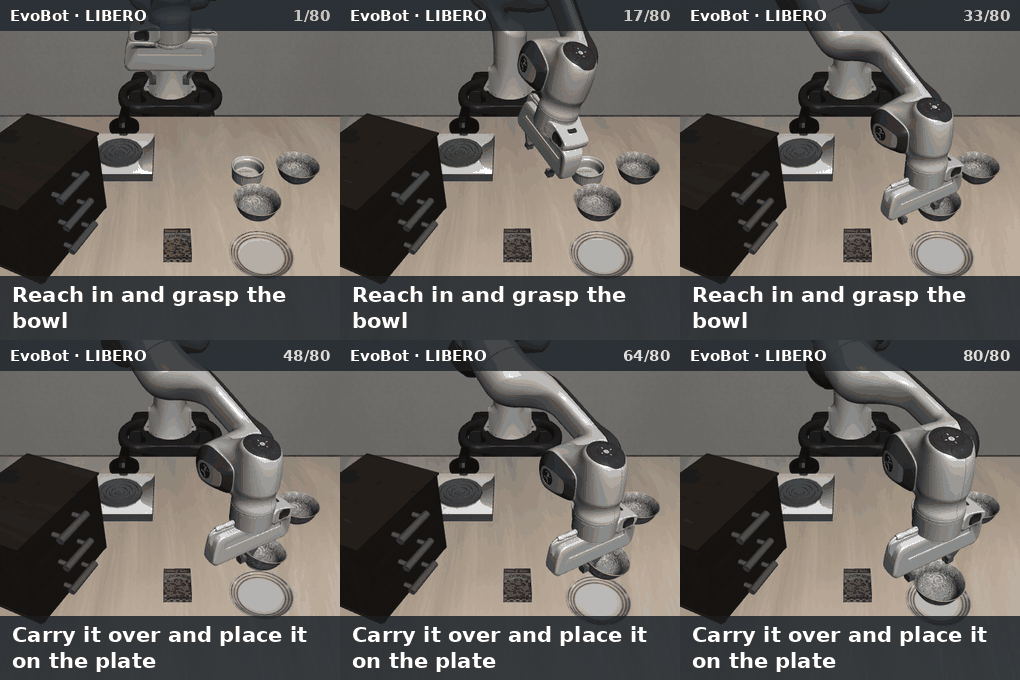
General-purpose agents can plan, use tools, and revise their behavior from feedback, but it remains unclear whether these capabilities transfer from digital environments to embodied manipulation. To investigate this question, we introduce LIBERO-Agent, an agent-native benchmark for evaluating these agents in robot manipulation tasks. Rather than asking agents to submit task-level Python control programs or operate through high-level robot skills, LIBERO-Agent provides an interactive robotic environment where agents can select which observations to inspect, process them with their own tools, and issue native action commands. LIBERO-Agent integrates 200 tasks into a common interaction framework and provides a 30-task primary suite that separates perception, short-horizon execution, and long-horizon composition. Results reveal a pronounced reliability gap: while agents perform well on perception and easy short-horizon tasks, their performance degrades substantially on hard short-horizon and long-horizon tasks. Richer observations improve short-horizon manipulation, while demonstration benefits depend on the agent and format. Among these agents, GPT-6 Astra achieves the strongest overall performance. Further analysis shows its major advantage lies in mechanism interaction, especially when sustained physical contact is needed, while its remaining failures stem from cross-stage interference and geometric errors.

cs.ROrobotmanipulationembodied

兴趣:robot manipulation and grasping with learned policies

#242026-09-3090

When Instructions Retrieve Trajectories: Diagnosing and Mitigating Generalization Failures in VLA Models

Hung-Jen Chen, Yu-Hsun Hou, Yan-Hong Chen, Yan-Fu Chen, Binghua Cai, Min Sun 等

Vision-language-action (VLA) models can exceed 90% success on in-distribution tasks and withstand nuisance changes that preserve the required action, yet fail under counterfactual …

Vision-language-action (VLA) models can exceed 90% success on in-distribution tasks and withstand nuisance changes that preserve the required action, yet fail under counterfactual changes that demand a different action. Aggregate robustness scores can therefore conceal a more specific failure, in which a policy responds to both language and vision yet does not combine them to select the action the task requires. We call this failure instruction-action binding. Instructions cue familiar trajectory families, and visual feedback adjusts their execution. Behavioral analyses of fine-tuned $π_{0.5}$ and GR00T-N1.7 policies reveal that failed rollouts often retain the source behavior or switch to another demonstrated task. These switches show that language is not simply ignored. Readouts and interventions connect these choices to task-conditioned internal states. Our analysis of the imitation objective shows how narrow conditional action support can leave grounded and instruction-keyed solutions indistinguishable on the demonstrations. This motivates Equivariant Counterfactual Training (ECT), which acts at two levels. ECT data supply valid demonstrations in which the same instruction requires different actions in distinguishable scenes, while the ECT loss trains each demonstration with its counterpart in the same update. In a controlled LIBERO-PRO comparison, full ECT raises $π_{0.5}$'s mean position-swap success from 36% to 59%. On CALVIN, where counterparts already occur in the original data, the ECT loss improves five-task completion without new demonstrations. On a real UR5e under a fixed demonstration budget, full ECT raises unseen-position success from 8% to 88%.

cs.ROcs.LGVLAvision-language-action

兴趣:vision-language-action (VLA) models and foundation models for robots

#252026-09-3089

Toward Real-Time VLAs: Stage-Aware Two-Step Flow Denoising and System-Level Evaluation

Di Wu, Rongtian Shen, Ping Liu, Yan Shen, Zhenhan Yin, Shun Zuo 等

Vision-language-action (VLA) models face a timing gap between low-rate inference and high-rate robot execution. We characterize this gap through end-to-end latency measurements of …

Vision-language-action (VLA) models face a timing gap between low-rate inference and high-rate robot execution. We characterize this gap through end-to-end latency measurements of model inference and the robot execution chain. Repeated Flow Matching denoising contributes substantially to inference cost, while robot-side delays mainly arise from perception acquisition, communication scheduling, and physical response. Analysis of the velocity field shows relatively stable magnitude and direction in early integration, followed by stronger directional correction near the terminal steps. Based on this stage heterogeneity, we propose two-stage non-uniform denoising, reducing the number of steps from 10 to 2 and model-inference time from 61.557 ms to 21.956 ms. We also develop a distributed real-time VLA framework with independent inference, action-publication, and robot-control rates, modular observation acquisition, and action-provenance logging. Using π0.5 as the baseline, we evaluate six real-time execution methods on a long-horizon physical garment-folding task. Legato performs best overall among training-based methods, while Temporal Smoothing leads among training-free methods; both perform strongly in task success, completion time, action continuity, and acceleration smoothness. Combining two-step denoising with representative execution methods substantially reduces inference cost with a small reduction in task performance. These results motivate joint optimization of model-inference efficiency and robot-system timing.

cs.ROrobotVLAvision-language-action

兴趣:vision-language-action (VLA) models and foundation models for robots

#262026-09-3089

Cue the Flow: Steering Flow-Matching Policies for Open-World Delivery Manipulation

Haoxuan Wang, Griffin Galimi, Junhua Huang, Selina Song, Wayne Wu, Yan Yan 等

Open-world goods delivery requires mobile manipulators to follow free-form user instructions and manipulate potentially novel objects. Existing dual-system approaches use high-leve…

Open-world goods delivery requires mobile manipulators to follow free-form user instructions and manipulate potentially novel objects. Existing dual-system approaches use high-level grounding models to convert language into grounded visual prompts, but their low-level controllers can remain brittle under noisy perception, dynamic scenes, and contact-rich interactions. We instead use a pretrained flow-matching vision-language-action model as the low-level control interface, leveraging its reactivity and robustness to environmental changes while treating the grounding output as a spatial cue for policy steering. Our key insight is that the pretrained VLA already provides a strong manipulation prior, while the spatial cue supplies the missing target information needed to guide actions under novel language--object mappings. Concretely, we introduce a lightweight cue-conditioned adapter. The adapter is first trained with contrastive objectives to produce salient and spatially discriminative cue representations, and is then supervised to predict a diagonal affine transformation over the generated action chunk, aligning policy steering with the cued target. Across tabletop and mobile-base settings, our method improves instruction following and manipulation success on both in-domain and out-of-domain objects, achieving up to near $2\times$ improvement in average task success rate with negligible inference overhead.

cs.ROmanipulationVLAvision-language-action

兴趣:vision-language-action (VLA) models and foundation models for robots

#272026-09-30追踪学者 · Jan Peters89

Neuro-Symbolic Predicate Learning for Semantic Safe Robot Control

Zihan Ye, Jiayi Liu, Puze Liu, Jiayun Li, Georgia Chalvatzaki, Jan Peters 等

As robots are increasingly deployed in everyday environments, ensuring their safety has become a central challenge. Existing methods often encode safety requirements as opaque math…

As robots are increasingly deployed in everyday environments, ensuring their safety has become a central challenge. Existing methods often encode safety requirements as opaque mathematical/logical formulations or dense cost functions. While effective in specific tasks, they remain difficult to interpret, tightly coupled to individual tasks, and offer limited insight into why a robot action is considered safe or unsafe. To address this limitation, we propose ``Neuro-Symbolic Predicate Learning for Semantic Safe Robot Control'' (NEUPRO), which leverages a differentiable reasoner that can learn reusable safety representations from human-specified safety knowledge. NEUPRO allows practitioners to express task-related safety requirements as transparent symbolic rules, while enabling gradients to propagate through these rules to a feature extractor that maps raw observations to safety-relevant concepts. As a result, the learned feature extractor is (softly) grounded in human-understandable semantics, supports transparent constraint evaluation, and is transferable across tasks. By coupling interpretability with differentiability, NEUPRO moves beyond opaque cost design toward reusable safety reasoning. To evaluate NEUPRO's capability, we collect and release REASON, the first real robot benchmark dataset for interpretable robot safety specification. Experiments on REASON show that NEUPRO learns safety-critical features that generalize across tasks, mitigate the interpretability limitations of conventional black-box cost formulations, and provide explicit explanations of safety violation.

cs.ROrobot

追踪学者:Jan Peters;兴趣:large language models for robot task planning and reasoning

#282026-09-3089

SplineWAM: Adaptive Action Horizons for World Action Models via B-Spline Representations

Jun Guo, Xiaoshen Han, Qiwei Li, Nan Sun, Peiyan Li, Heyun Wang 等

World action models (WAMs) are large embodied policies that jointly predict future video and the actions to execute, emitting a fixed-length action chunk per inference call. Such a…

World action models (WAMs) are large embodied policies that jointly predict future video and the actions to execute, emitting a fixed-length action chunk per inference call. Such a policy allocates its computational budget uniformly in time, unable to execute for longer over free-space motion or to spend more inference on contact-rich manipulation, which limits the throughput a WAM can reach when served in the cloud. We present SplineWAM, which adaptively compresses the action trajectory into a fixed-size window of cubic B-spline parameters, fitting the knot times to the characteristics of the motion. One parameter budget then decodes into chunks of varying temporal resolution and duration, and both the executed span and the interval until the next policy call follow from the prediction itself. Aligning the video supervision to the fitted knot times of the demonstration rather than to a uniform grid concentrates the supervised frames where the action trajectory is complex. For asynchronous deployment we introduce Jacobian-Pullback Real-Time Chunking (JP-RTC), which imposes chunk continuity on the decoded raw actions the robot executes rather than on the spline parameters, and corrects the parameters through the decoder so that the executed prefix agrees with the actions already committed. On LIBERO-Plus and RoboCasa, SplineWAM improves success rate over an action chunking WAM by $8.2$ and $4.4$ points while cutting policy calls per episode by 22% and 26%. On three bimanual real-robot tasks under asynchronous execution, it leads or matches the baseline while decoding 1.2 to 1.6 times as much executed motion per call.

cs.ROrobotmanipulationembodied

兴趣:world models and video prediction for embodied agents

#292026-09-3088

NEXUS: Perceptive Whole-Body Control for Terrain-Adaptive Teleoperation

Xiangyu Miao, Junsong Wu, Jiyuan Shi, Weiji Xie, Jinrui Han, Xingyi Wang 等

Whole-body teleoperation requires a humanoid robot to reproduce a human operator's behavior even when their terrains differ. This demands that the robot perceive local terrain and …

Whole-body teleoperation requires a humanoid robot to reproduce a human operator's behavior even when their terrains differ. This demands that the robot perceive local terrain and adapt its posture and contacts accordingly, rather than copy the operator's motion frame by frame. However, paired motion data linking the same behaviors across flat ground and different terrains remain scarce, limiting supervision for learning terrain-adaptive control. To enable whole-body teleoperation across mismatched terrains, we introduce NEXUS, a perceptive whole-body control framework that combines human motion commands with onboard sensory feedback. We first develop a scalable terrain-aware adaptation algorithm that efficiently generates high-quality motion pairs across motions and terrains without per-motion or per-terrain tuning. Using a paired motion corpus totaling nearly 1,000 hours, we train a perceptive whole-body controller through teacher-student learning to reproduce commanded behaviors across terrains. Experiments demonstrate efficient, scalable generation of high-quality motion data and show that NEXUS combines broad behavioral coverage with terrain adaptability and tracking fidelity, outperforming existing whole-body controllers on the evaluated benchmarks. Zero-shot real-world deployment enables real-time whole-body teleoperation on diverse unseen terrains, further validating the generalization of our method. Project website: https://nexus-humanoid.github.io/

cs.ROrobothumanoid

兴趣:humanoid robots and whole-body control

#302026-09-3088

PhasePlan: Ordered Future-Phase Planning for Robot Brain Models

Xiaoyu Yang, Yafei Zhang, Wensheng Li, Qing Zhan, Nan Wu

Robot brain models integrate vision, language, and robot state to generate actions for complex manipulation tasks. Most predict fixed-length action chunks that may span multiple ta…

Robot brain models integrate vision, language, and robot state to generate actions for complex manipulation tasks. Most predict fixed-length action chunks that may span multiple task phases. This can obscure phase transitions and favor frequent action patterns, compromising action timing in dynamic environments. We propose \method, an ordered future-phase planning method for robot brain models. From current multimodal observations, it predicts the task phase at each future action position. The resulting planning representations condition the corresponding actions, preserving temporal alignment between task progress and action generation. Training first learns the planner, then freezes it during action-model adaptation to maintain stable phase representations. We instantiate \method on pretrained $π_{0.5}$ and AcrossWAM1.0 robot brain models. Detailed quantitative evaluation uses the $π_{0.5}$ implementation. On conveyor-belt manipulation, \method reduces offline joint-action error by approximately 22.5% relative to the original $π_{0.5}$ model. It also improves phase-transition modeling and cross-phase action prediction. These results demonstrate the value of ordered future-phase planning for continuous action generation.

cs.ROrobotmanipulation

兴趣:imitation learning and diffusion policies for robot control

#312026-09-2888

SynIL: Leveraging Synergy for Offline Imitation Learning from Imperfect Demonstration Datasets

Yuto Tanaka, Kyo Kutsuzawa, Martina Doku, Dai Owaki, Mitsuhiro Hayashibe

Imitation learning enables robots to acquire complex skills directly from massive demonstration datasets, but its performance degrades severely when datasets are contaminated with …

Imitation learning enables robots to acquire complex skills directly from massive demonstration datasets, but its performance degrades severely when datasets are contaminated with suboptimal or noisy demonstrations. While prior quality-assessment methods attempt to filter or reweight data, they typically rely on manual pre-selection of expert reference data or task-specific heuristics, limiting scalability. To address this challenge, we introduce SynIL (Synergy-based Imitation Learning), a novel framework for automated, label-free demonstration quality assessment in offline reinforcement learning. Grounded in neuroscientific evidence that motor synergy, a low-dimensional coordinated structure in movement, correlates directly with motor proficiency, SynIL algorithmically quantifies synergy manifestation to generate dense, transition-level reward signals via self-supervised reward regression. Comprehensive evaluations on D4RL locomotion benchmarks and multi-human Robomimic manipulation datasets demonstrate that synergy-derived rewards correlate strongly with ground-truth rewards. Furthermore, SynIL substantially outperforms Behavior Cloning (BC) and achieves performance comparable to, and in sparse-reward human teleoperation scenarios, superior to, offline reinforcement learning trained on true environment rewards.

cs.ROcs.AImanipulationimitation learninglocomotion

兴趣:imitation learning and diffusion policies for robot control

#322026-09-3088

OccluDex: Hierarchical 3D Visuo-Tactile Representation Learning for Egocentric Dexterous Manipulation under Self-Occlusion

Ziheng Xu, Yueyuan Chen, Xinyuan He, Guoxing Liu, Yuanshuo Tan, Huiming Pan 等

Reliable dexterous manipulation requires continuous estimation of object geometry and hand-object contact throughout interaction. With egocentric sensing, however, the manipulating…

Reliable dexterous manipulation requires continuous estimation of object geometry and hand-object contact throughout interaction. With egocentric sensing, however, the manipulating hand frequently occludes task-relevant object surfaces and contact regions, reducing the visual evidence available for state estimation and thereby making robust closed-loop control and generalization to unseen object geometries particularly challenging. To address this, we present OccluDex, a hierarchical 3D visuo-tactile representation learning framework that integrates global geometric structure with local contact information for robust manipulation under dynamic self-occlusion during hand-object interaction. OccluDex adopts multi-scale masked autoencoding to progressively encode partial 3D geometry and fuses tactile contact tokens with high-level geometric features through cross-modal attention. The encoder is pretrained from synchronized human visuo-tactile demonstrations and transferred as a frozen perceptual backbone for downstream reinforcement learning. We evaluate OccluDex on a faucet rotation task, requiring one full clockwise handle revolution, and a tabletop object reorientation task, requiring a 180-degree tabletop object reorientation without toppling. In simulation experiments, OccluDex demonstrated 12.6% higher accuracy for unseen objects and 8.3% higher accuracy for previously seen objects than the strongest state-of-the-art baseline models. Physical experiments were further performed with a Shadow Hand to demonstrate successful zero-shot sim-to-real generalization on unseen physical objects. This results could enable humanoid egocentric object manipulation for seen and unseen objects even when the manipulating robotic hand occludes vision.

cs.ROmanipulationhumanoidsim-to-realdexteroustactile

兴趣:dexterous hands and tactile sensing

#332026-09-3087

Function beyond Form: Functional Correspondence for Cross-Embodiment Dexterous Grasp Generation

Bolin Zou, Wenlong Dong, Mu Ai, Chao Tang, Aoxiang Gu, Lipeng Chen 等

Cross-embodiment dexterous grasp generation remains challenging because robotic hands differ substantially in geometry, topology, and kinematics. Existing approaches often lack exp…

Cross-embodiment dexterous grasp generation remains challenging because robotic hands differ substantially in geometry, topology, and kinematics. Existing approaches often lack explicit correspondences between structurally different hand regions that play similar functional roles in a grasp, a concept we refer to as functional correspondence. Consequently, their models tend to learn hand-specific interaction patterns rather than transferable grasp knowledge, limiting generalization to unseen hands. To address this limitation, we introduce FunCo-Grasp, which establishes functional correspondences across heterogeneous hand embodiments. Specifically, Functional Part Alignment aligns each hand to a canonical functional schema by mapping physical links to shared functional parts according to their grasping roles, while Canonical Frame Alignment expresses these parts in canonical local frames. These two alignments provide a consistent representation for inter-part and hand-object interactions, allowing the model to learn transferable grasp knowledge across hands. Conditioned on the aligned hand representation and object geometry, a diffusion model generates the target spatial arrangement of the functional parts, which are then converted into an executable joint configuration. Adapting FunCo-Grasp to an unseen hand requires only its geometric and kinematic models and a one-time lightweight functional annotation, without target-hand grasp data, fine-tuning, or learned retargeting. In simulation on held-out objects from the filtered CMapDataset, we achieves average success rates of 92.40% on three seen hands and 74.02% on four unseen hands. In real-world experiments, the same model achieves an overall success rate of 76.00% on two unseen hands without additional training or fine-tuning. These results demonstrate the effectiveness of FunCo-Grasp in transferring grasp knowledge to unseen hands.

cs.ROgraspdexterous

兴趣:robot manipulation and grasping with learned policies

#342026-09-2987

BIND: Binding 3D Robot Actions to 2D Image Features

Cameron Smith, Arsh Tangri, Vitor Guizilini, Yue Wang, Zubair Irshad, Sergey Zakharov

We introduce BIND, a new action representation for visuomotor robot policies that binds 3D robot actions to their corresponding 2D image features, yielding strong data efficiency g…

We introduce BIND, a new action representation for visuomotor robot policies that binds 3D robot actions to their corresponding 2D image features, yielding strong data efficiency gains and robustness to out-of-distribution object positions and camera viewpoints. The action heads of current robot policies are typically formulated as an MLP regression from a single global feature vector produced by a pre-trained vision encoder. This global formulation requires the policy network to discover, from demonstrations alone, the relationship between target robot actions and the image features they project onto. The consequence is that although modern image features are semantically descriptive, spatially robust, and even multiview-consistent, the policies built on them are brittle to subtle changes in camera viewpoint and object placement--and surprisingly data-inefficient. BIND closes this gap by supplying the action-feature relationship through camera geometry rather than learning: it discretizes a volume of candidate end effector positions, attaches each candidate to the pre-trained features at its projection in each camera view, and selects actions by scoring each candidate's position and image-bound feature combination. On a real robot, we study data efficiency and out-of-distribution robustness to unseen object positions and camera viewpoints, as well as general long-horizon task execution and dexterity. We find BIND to be highly data-efficient and robust: it achieves near-perfect success on tasks with as few as 5 demonstrations, and degrades gracefully under steep camera-viewpoint shifts and held-out object positions where coordinate-regression baselines completely fail.

cs.ROcs.CVrobot

兴趣:3D perception, point clouds and scene understanding for robotics

#352026-09-3087

HiWE: Hierarchical World Knowledge Model with Visual Keypoint Enhancement for Zero-Shot 3D Path Planning

Guoqing Ma, Mingqi Yuan, Chen Gao, Jiayu Chen, Shan Yu

Robot demonstration generation requires a system to identify where an interaction should occur, plan a feasible motion, and execute the required contact. HiWE connects these decisi…

Robot demonstration generation requires a system to identify where an interaction should occur, plan a feasible motion, and execute the required contact. HiWE connects these decisions through a point-based interface between visual grounding and language-based planning. PointVLM is instruction-tuned to associate task-relevant objects with image coordinates using a mixture of point annotations, segmentation-derived samples, robot observations, and visual question answering data. Depth measurements lift these predictions into a semantic 3D representation. A language planner, 3DLLM, uses this representation to specify end-effector waypoints and gripper commands, while a hybrid grasping module resolves local grasp poses. The evaluation covers 14 simulated manipulation tasks and four physical-robot tasks, together with ablations of the visual training data, spatial inputs, and grasp selection. Here, zero-shot execution refers to deployment without task-specific demonstration training; the visual model uses existing robot data during fine-tuning. This paper describes the original point-based formulation of the framework; its relationship to the subsequent GeneralVLA extension is detailed in the introduction.

cs.ROcs.AIrobotmanipulationgrasp

兴趣:3D perception, point clouds and scene understanding for robotics

#362026-09-3087

DSDyn-VLA: A Dual-Stream Dynamic Manipulation Framework with Motion Perception, Future Awareness, and Realtime Correction

Wenhao Li, Xiu Su, Yu Han, Yichao Cao, Shan You, Chang Xu

While Vision-Language-Action (VLA) models excel in static tasks, they struggle in dynamic environments where objects are in motion (e.g., conveyor belt manipulation). We identify t…

While Vision-Language-Action (VLA) models excel in static tasks, they struggle in dynamic environments where objects are in motion (e.g., conveyor belt manipulation). We identify three fundamental limitations hindering current VLAs in these scenarios: the perception gap, where static visual inputs lack temporal motion cues; the latency gap, where inference delays render actions obsolete; and the control gap, caused by the open-loop action chunk execution without real-time adjustment. In this work, we propose DSDyn-VLA, a Slow-Fast Dual-Stream Dynamic manipulation framework that integrates motion-aware foresighted planning with real-time residual correction. The slow Flow-Planner serves as a macro-planner. By enhancing the VLA with optical flow for temporal perception and a future state awareness mechanism to preemptively offset inference latency, it produces globally consistent, motion-aware action chunks. Complementing this, the fast Res-Refiner employs a lightweight RL policy to inject high-frequency, closed-loop corrections into the planned action chunks based on real-time observations. In addition, we introduce DynBench, a MuJoCo-based benchmark for dynamic object manipulation that comprises nine tasks. Extensive experiments demonstrate that DSDyn-VLA reduces the failure rate by over 76% compared to current SOTA method in high-latency setting on the Kinetix dynamic benchmark, while achieving about 6$\times$ the success rate of PI0.5 in real-world dynamic settings and about 5$\times$ on DynBench. We will open-source all the code and weights.

cs.ROmanipulationVLAvision-language-action

兴趣:vision-language-action (VLA) models and foundation models for robots

#372026-09-3087

Magic-W0: A Structured World-Action Foundation Model for Physical Intelligence

Xuhua Chen, Zhenhan Yin, Yuan Zhang, Lingfeng Zhang, He Zheng, Tong Mu 等

World-action models (WAMs) augment robot policies with action-conditioned environment dynamics, yet existing approaches largely rely on future observation reconstruction or generic…

World-action models (WAMs) augment robot policies with action-conditioned environment dynamics, yet existing approaches largely rely on future observation reconstruction or generic latent prediction and lack structured, control-oriented world representations tightly coupled with action generation. We introduce Magic-W0, a world-action foundation model that jointly models structured physical state evolution and continuous actions. Magic-W0 represents interaction as a Structured World Transition consisting of Current State, Transition, and Future State. Current State combines vision-language context with Current 3D Geometry; Transition is represented by 3D Motion capturing action-induced three-dimensional changes; and Future State is represented by Future Semantics describing task-relevant outcomes. To couple prediction and control, we propose a layer-aligned world-action interaction architecture in which evolving action hypotheses condition world-transition prediction, while predicted world representations continuously inform action generation. Magic-W0 is pre-trained on large-scale egocentric human manipulation, UMI, real-robot, and simulation data, with latent supervision for geometry, 3D motion, and future semantics from pre-trained visual models. Inference-time interventions show that structured world representations respond systematically to changes in candidate actions and that action-related information propagates through shared 3D representations into future semantic predictions. On RoboDojo-Sim, Magic-W0 achieves an average Score of 27.10, the highest among the compared WAMs. Across multiple real-robot tasks, it also demonstrates strong downstream performance after fine-tuning with limited downstream data, supporting generalization and rapid adaptation.

cs.ROrobotmanipulation

兴趣:world models and video prediction for embodied agents

#382026-09-3087

GroundingPI: A Grounding Foundation Model towards Physical Intelligence with Visual Primitives

Qize Yu, Lianrui Fan, Boyu Chen, Jiaqi Liang, Xini Ding, Yue Chen 等

Precise grounding matters. It specifies which object is the target and where that object is, even in clutter and for tiny objects, and it has to be fast enough for closed-loop cont…

Precise grounding matters. It specifies which object is the target and where that object is, even in clutter and for tiny objects, and it has to be fast enough for closed-loop control. Yet vision-language-action (VLA) and world-action models (WAMs) take perception from general-purpose vision-language and video-generation backbones, which still fail in these settings. We introduce GroundingPI, a 4B grounding foundation model that generates points and boxes as quantized coordinates in a shared vocabulary. Training combines multimodal and spatial pretraining, supervised fine-tuning, and reinforcement learning with GRPO, using supervision from public datasets and dedicated data engines. Against 44 baselines across 34 grounding benchmarks spanning 11 perceptual capabilities, GroundingPI establishes a new state of the art, averaging 73.68%, above the larger GPT-6 Astra (71.54%). As a downstream visual backbone, GroundingPI improves performance on robotic manipulation and autonomous driving. On RoboTwin 2.0, it outperforms every mainstream backbone we evaluate in all four out-of-distribution settings, by up to 24.8% relative to the strongest backbone. On RoboCasa-GR1, GroundingPI trained with 50% of the demonstrations outperforms those baselines trained with 75%. On nuScenes, used as the visual backbone, GroundingPI attains an average open-loop L2 error of 0.296 m. We systematically analyze GroundingPI's pretraining in scale and data composition. Downstream autonomous driving and robotic manipulation improve as the pretraining is scaled. Analyzing the data recipe across these 11 perceptual capabilities shows dense grounding's substantial benefits for both, and OCR's potential as a catalyst for perceptual learning. These results support grounding as a perceptual foundation, and dedicated perceptual pretraining as a promising direction for foundation models of physical intelligence.

cs.CVcs.AIcs.LGcs.ROmanipulationVLAvision-language-action

兴趣:vision-language-action (VLA) models and foundation models for robots

#392026-09-3086

Social-WM: Safety-Aware Latent World Models for Robot Social Navigation

Zhihao Zheng, Mooi Choo Chuah

Safe social navigation requires a robot to anticipate not only the future consequences of its actions, but also whether a nominal action can actually be executed under surrounding …

Safe social navigation requires a robot to anticipate not only the future consequences of its actions, but also whether a nominal action can actually be executed under surrounding physical and social constraints. We present Social-WM, an efficient latent world-model planning framework trained from egocentric RGB video sequences. Our key observation is that social-navigation experience contains a systematic discrepancy between the nominal action and the realizable action: a nominal forward action may be fully executed in free space, but needs to be constrained when heading towards a pedestrian or obstacle. Social-WM learns these safety-relevant consequences directly through action-conditioned future prediction, where the target is the actual observed future following each command. We further introduce a realizable inverse-dynamics objective that associates observed latent transitions with the action actually realized rather than the nominal one. At deployment, candidate actions are imagined through the latent world model, and the inverse dynamics model estimates their realizability; nominal--realizable discrepancy then provides a safety signal before execution. The learned dynamics and realizability model remain goal-independent and support both position- and image-goal navigation. On Social-HM3D, Social-WM achieves 63.77% success while reducing human collisions to 21.67%, and maintains strong performance under zero-shot transfer to Social-MP3D, without explicit pedestrian tracking, privileged human state, or online reinforcement learning.

cs.ROrobotworld model

兴趣:world models and video prediction for embodied agents

#402026-09-3086

Looking Back to Move Forward: Temporal Verification for Generative Robot Policies

Haoxuan Wang, Wayne Wu, Yan Yan, Bolei Zhou

Generative policies have emerged as a promising paradigm for robot learning, combining expressive generative action modeling with scalable imitation learning from large demonstrati…

Generative policies have emerged as a promising paradigm for robot learning, combining expressive generative action modeling with scalable imitation learning from large demonstration corpora. However, heterogeneous demonstrations can induce suboptimal action chunks whose errors compound over time, eventually driving the robot into out-of-distribution states from which recovery is difficult. Action verification offers a test-time scaling strategy for mitigating this failure mode by sampling multiple candidate actions and using a verifier to select one for execution. Existing approaches, however, remain temporally myopic and costly to train, evaluating candidates from the current observation alone without accounting for trajectory continuity and often relying on large verifiers and additional expert demonstrations. In this paper, we introduce Temporal Verification (TeV), an efficient temporally aware action verification framework for flow-matching VLAs. TeV first learns a temporal token that summarizes recent observation--action history, enabling candidate chunks to be evaluated as continuations of the execution trajectory rather than as isolated predictions. Conditioned on this token, TeV constructs positive--negative pairs without additional expert demonstrations or preference annotations and trains an energy-based verifier contrastively to assign lower energy to higher-quality, trajectory-consistent action chunks. Beyond post-hoc ranking, TeV further uses the learned energy landscape to guide intermediate flow samples toward lower-energy regions, improving candidates before final selection. Extensive experiments in simulation and real-world settings demonstrate that TeV provides reliably ranks action candidates, improves task success rates, and produces smoother execution trajectories.

cs.ROrobotimitation learning

兴趣:imitation learning and diffusion policies for robot control

#412026-09-2986

Dense Temporal Motion Retargeting for Legged Robots

Jaeryeong Kim, Taerim Yoon, Jin Cheng, Sungjoon Choi, Stelian Coros

Legged robots can learn expressive whole-body skills from the motions of humans and animals. Due to the morphology gap between the source and the robot, however, the motion must be…

Legged robots can learn expressive whole-body skills from the motions of humans and animals. Due to the morphology gap between the source and the robot, however, the motion must be tailored to the dynamic properties of the robot. In particular, dynamic motions such as a jump require careful adjustment, since their timing and control are interdependent. We propose dense temporal motion retargeting (DTMR), which jointly optimizes timing and control within a single optimization, where dense means that the timing is adjusted for every control step. This dense formulation enables DTMR to deform only the parts of the motion that need a change in timing. The problem is solved with sampling-based model predictive control (MPC) in parallel on a GPU. We evaluate DTMR against baselines on two hours of human motion with four humanoid robots, where the results show that DTMR outperforms baseline methods, particularly on dynamic motions. We also show that allowing more temporal deformation yields more precise retargeting. We further compare DTMR with a baseline that optimizes the temporal dimension, where the result shows that DTMR retargets more precisely under the same deformation budget while being ~19x faster. Lastly, policies trained on our references transfer to a real humanoid robot.

cs.ROrobothumanoidlegged

兴趣:reinforcement learning for legged locomotion and sim-to-real transfer

#422026-09-3086

Discrete Forcing: Infusing Discrete Guidance into Continuous Denoising for Few-Step Action Experts

Jingbo Wang, Wenxuan Song, Wenhao Yu, Han Zhao, Xi Wang, Jiayi Chen 等

Efficient action generation in vision-language-action (VLA) models requires capturing both coarse action structure and fine-grained details. Discrete action tokens provide compact …

Efficient action generation in vision-language-action (VLA) models requires capturing both coarse action structure and fine-grained details. Discrete action tokens provide compact structural representations but sacrifice precision, while continuous action tokens offer high precision but often require multiple denoising steps. We introduce Discrete Forcing, a flow-matching framework that combines these representations through an explicit coarse-to-fine generation process. It first predicts discrete action tokens to establish a coarse action structure, then uses them to guide continuous action refinement. The discrete and continuous components share a common diffusion transformer backbone with specialized branches, maintaining a parameter count comparable to a conventional single-branch model while requiring only one forward pass per branch. Extensive evaluations across multiple benchmarks demonstrate improved performance and faster inference over a parameter-matched continuous action expert, with consistent performance gains as model capacity increases. Real-world experiments further demonstrate improvements on high-precision and dynamic manipulation tasks.

cs.ROmanipulationVLAvision-language-action

兴趣:vision-language-action (VLA) models and foundation models for robots

#432026-09-3086

RoboAssist: Interactive Human-Humanoid Planning for Long-Horizon Surgical Assistance

Jingwei Jia, Keyu Zhou, Jiewei Wang, Peisen Xu, Xingyuan Zhou, Liang Wang 等

Long-horizon surgical assistance requires humanoid robots to coordinate with evolving human activities while maintaining safety across planning and execution. We present RoboAssist…

Long-horizon surgical assistance requires humanoid robots to coordinate with evolving human activities while maintaining safety across planning and execution. We present RoboAssist, an agent-based framework for interactive human-humanoid planning that integrates workflow reasoning, task coordination, and cross-layer safety. At its core is an asymmetric dual-track representation that separates partially observed human process states from executable robot task sequences. By updating human-process estimates, scene context, and task dependencies online, RoboAssist revalidates the remaining task sequence and replans only the affected suffix when workflow requests change. A cross-layer safety architecture combines preventive navigation regulation, reactive regulation during close-range handover, and independent whole-body runtime supervision. This design couples online task coordination with safety constraints throughout execution. We demonstrate the framework on a Unitree G1 humanoid robot in long-horizon, multi-stage simulated surgical assistance scenarios encompassing multimodal interaction, instrument handling, medical material transport, navigation, and safe human-robot handover. Experiments show multi-stage task completion and adaptation to workflow-request changes. A targeted full-replanning ablation shows that residual replanning reduces plan-update latency and post-update token usage. Separate safety experiments demonstrate complementary protection across navigation, handover, and runtime supervision. Additional results and demonstrations are available online at https://roboassist.github.io.

cs.ROrobothumanoid

兴趣:humanoid robots and whole-body control

#442026-09-2986

Vision-Language-Action Autonomous Driving Agent with Language-based Memory

Kai Yan, Xiangyu Chen, Yulong Cao, Alex Naumann, Peter Karkus, Yan Wang 等

Vision-Language-Action (VLA) foundation models have recently emerged as one of the prevailing solutions for autonomous driving, as they can utilize knowledge acquired during vision…

Vision-Language-Action (VLA) foundation models have recently emerged as one of the prevailing solutions for autonomous driving, as they can utilize knowledge acquired during vision-language pretraining for accurate and interpretable driving. However, VLAs can take only a limited number of frames as visual input due to the high token cost of an image, which is problematic for memory-dependent tasks such as determining the arrival order at all-way stops and long-horizon driving scene understanding. Existing solutions use latent vector memories accessed through cross-attention, which are neither interpretable nor portable. In this paper, we propose AD-Memo, a general-purpose VLA driving agent with language-based memory. The agent outputs memory as an extension of its Chain-of-Thought (CoT) to record surrounding objects critical to driving; this memory becomes part of the agent's future input. We curate memory-based datasets and train VLAs with a two-stage recipe: Supervised Fine-Tuning (SFT) and Da Capo, a novel semi-closed-loop Reinforcement Learning (RL) algorithm which uses trajectory-level advantage for memory and step-level advantage for driving, leading to better credit assignment. Across scenarios such as all-way stops and general driving, AD-Memo improves driving quality, enables better question answering on driving scenes, and produces plug-and-play memory for other models.

cs.CVcs.ROVLAvision-language-action

兴趣:vision-language-action (VLA) models and foundation models for robots

#452026-09-3086

RoboCoach: World Models as Active Coaches for Compositional Robot Skills

Jiajun Liu, Yifan Chen, Yichao Liu, Jiayi Zhang, Ruoqu Chen, Shaoxuan Xie 等

Long-horizon robot manipulation reuses skills across many task compositions, but improving these compositions with additional end-to-end demonstrations is costly. A practical self-…

Long-horizon robot manipulation reuses skills across many task compositions, but improving these compositions with additional end-to-end demonstrations is costly. A practical self-improving system must decide both what to teach next and where to apply that supervision. We present ROBOCOACH, a world-model-guided coaching framework that uses imagined failures to guide demonstration requests and expert updates. Its Route-Imagine-Diagnose-Improve (RIDI) loop executes reusable skill experts inside COACHWORLD, our shared action-conditioned world model, and uses a progress judge to record the first subtask that fails to complete. Aggregated records select which subtask demonstrations to acquire and which expert adapters to update. Across two simulation suites and two real-robot platforms, imagined and deployed success correlate over 22 task-policy pairs (rho = 0.840). Controlled comparisons show that our coaching method outperforms matched baselines under matched data budgets and update schedules. With only 150 additional subtask demonstrations, success rises from 13.3% to 75.0% on Franka and from 40.0% to 83.8% on AgileX. The coached experts also transfer to four held-out compositions, achieving an average success of 35.0%, compared with 0% for a shared-policy baseline updated with uniformly acquired demonstrations. Together, these results show that world models can serve as active coaches, turning imagined failures into targeted supervision for modular policy improvement. Project Page: https://robocoach-ai.github.io/

cs.ROcs.AIrobotmanipulationworld model

兴趣:imitation learning and diffusion policies for robot control

#462026-09-3086

ECHO-G: Embodied Co-speech Humanoid mOtion Generation

Yizhao Li, Pusen Gao, Ming Wang, Shaojie Shen, Shuo Yang, Hao Xu

Generating full-body co-speech motion for humanoid robots requires coordinating speech prosody, linguistic content, and embodiment-specific motion. To this end, we present ECHO-G, …

Generating full-body co-speech motion for humanoid robots requires coordinating speech prosody, linguistic content, and embodiment-specific motion. To this end, we present ECHO-G, a framework jointly conditioned on speech audio and timed transcripts. Its Speech-Grounded Diffusion Transformer (SGDiT) combines frame-aligned acoustic features with token-level linguistic context, preserving their distinct granularities. Trained with rectified flow matching, it models one-to-many utterance-motion relationships directly in robot space. To support training and evaluation, we introduce a BEAT2-derived audio-text-robot dataset and a benchmark covering co-speech characteristics, robot-motion quality, and runtime efficiency. Comparative evaluation supports direct robot-space generation over the evaluated human-motion generation and retargeting pipelines, while modality ablations highlight the benefits of joint audio-text conditioning. We further demonstrate deployment on a physical humanoid robot. A complementary video-rating study also favors joint conditioning over the alternatives. The dataset and training, inference, and evaluation code are available through our project page.

cs.ROcs.AIrobothumanoidembodied

兴趣:humanoid robots and whole-body control

#472026-09-3086

Text-to-3D Policy: Fine-Grained Language-Behavior Alignment for Unseen Specification Generalization

Xinhao Yang, Wenhao Wu, Ning Lv, Yanshen Ding, Zhenhong Sun, Daoyi Dong 等

3D visuomotor policies provide a strong foundation for spatially precise manipulation, yet current text-to-3D policies struggle to follow unseen fine-grained behavioral specificati…

3D visuomotor policies provide a strong foundation for spatially precise manipulation, yet current text-to-3D policies struggle to follow unseen fine-grained behavioral specifications beyond those covered by demonstrations. We study this challenge as unseen specification generalization, where language specifies behaviorally significant variations, such as target position, displacement, or articulated state, that are absent from policy training. We find that pretrained language representations and conventional global behavior-language alignment capture coarse task semantics but often blur nearby specifications that require distinct behaviors. We introduce T3DP, a Text-to-3D Policy framework for fine-grained language-behavior alignment. Rather than compressing each instruction and demonstration into a single global embedding, T3DP preserves their local structures and establishes bidirectional token-level correspondence between linguistic elements and behavioral segments. This directly grounds subtle linguistic variations in the behavior components they affect, preventing closely related specifications from collapsing in the representation space. The resulting specification-sensitive language representation conditions a point-cloud-based 3D diffusion policy, enabling more precise control over unseen behavioral specifications without modifying the underlying policy architecture. Across Meta-World, ManiSkill, and RoboTwin, T3DP improves average held-out-specification success over global language-behavior alignment by +11.0-14.2 points, with gains on all 15 task families; on real-robot tasks, it further raises average success from 47.5% to 65.0% (+17.5 points). Representation and action-probe analyses show that fine-grained alignment better preserves specification geometry and action-relevant variation, linking local behavior grounding to downstream control.

cs.ROcs.AIrobotmanipulationdiffusion policy

兴趣:vision-language-action (VLA) models and foundation models for robots

#482026-09-3086

Online Evolution Strategy for Flow-Matching VLA Policies via Self-Supervised Trajectory Distribution Optimization

Gongxin Yao, Yongsheng Zhao, Jiayin Deng, Deng Liang, Han Gao, Lei Zhao 等

Vision-Language-Action (VLA) models based on generative frameworks, such as Flow Matching, have recently achieved impressive performance in robotic manipulation. Unlike determinist…

Vision-Language-Action (VLA) models based on generative frameworks, such as Flow Matching, have recently achieved impressive performance in robotic manipulation. Unlike deterministic policies, Flow Matching enables VLA models to learn conditional action trajectory distributions, where latent noise vectors induce different actions under the same task scenario. However, we observe that these distributions are often ill-formed, with successful and failed behaviors coexisting while considerable probability mass remains in unfavorable regions. To this end, we propose Online-ES, an online adaptation framework for Flow Matching VLAs based on Evolution Strategy (ES), which refines the learned action trajectory distribution through interaction feedback. Instead of pruning the latent noise space, our method performs evolutionary exploration directly in the action trajectory space, where diverse trajectories generated by Flow Matching provide candidate solutions for adaptation. By perturbing sampled trajectories and evaluating their execution outcomes, we derive a self-supervised MSE objective that transfers the evolution direction from trajectory space into model parameter space. Mathematically, we prove that the proposed objective provides an unbiased estimator of the optimal evolution direction. Moreover, we also incorporate failure experiences as negative feedback to regularize the evolution direction, steering the policy away from previously explored failure regions. Experiments in both simulation and real-world environments demonstrate that Online-ES achieves policy improvement comparable to reinforcement fine-tuning, without learning a value model or computing advantages.

cs.ROcs.AIeess.SYmanipulationVLAvision-language-action

兴趣:vision-language-action (VLA) models and foundation models for robots

#492026-09-2986

PneuTac: Tactile Manipulation with Soft Pneumatic Robots via Unified MPM-Gaussian Splatting Simulation

Shaohong Zhong, Marco Pontin, Joe Watson, Perla Maiolino, Ingmar Posner

Soft robots and tactile sensors have demonstrated great potential in delicate manipulation tasks. Soft pneumatic robots enable safe contact through compliance, and vision-based tac…

Soft robots and tactile sensors have demonstrated great potential in delicate manipulation tasks. Soft pneumatic robots enable safe contact through compliance, and vision-based tactile sensors offer high-resolution touch perception. However, learning tactile manipulation with compliant robots has been challenging, bottlenecked by the lack of efficient simulation. Existing simulators typically model them in isolation, and exhibit large calibration gaps that are difficult to overcome efficiently. We present PneuTac, a unified framework for tactile-feedback manipulation with soft pneumatic robots. We leverage the material point method (MPM) for modelling the dynamics of the soft robot and the deformable tactile membrane, and 3D Gaussian splatting (3DGS) for rendering. Real-to-sim modelling is done with a simple vision-based method, to then train action and perception networks for efficient simulation with surrogate models. We use the framework to drive a tactile-guided pipeline to collect demonstrations in simulation. Through experiments on a custom-designed pneumatic soft finger with a tactile sensing tip, together with additional cross-device evaluations, we show that PneuTac is capable of accurately modelling soft robots with tactile sensors, and that policies trained with simulation-augmented demonstrations outperform baselines trained on the same real data on three real-world contact-rich compliant manipulation tasks, making it a practical framework for tactile manipulation on compliant hardware.

cs.ROrobotmanipulationtactile

兴趣:dexterous hands and tactile sensing

#502026-09-3085

Make Code as Policy Great Again: Frontier Agents Write, Call, and Evolve Robot Tools

Shijia Ge, Alex Zhou, Jianshu Zeng, Yexing Wan, Di Wu, Zelin Zheng 等

Frontier models can control robots, but reasoning through every reach, grasp, and retreat makes manipulation slow and token-intensive. We revisit code as policy with a different di…

Frontier models can control robots, but reasoning through every reach, grasp, and retreat makes manipulation slow and token-intensive. We revisit code as policy with a different division of labor: models build executable tools, code handles multi-phase motions, and models decide what to do next. We introduce URAI (Universal Robot-Agent Interface), which couples a programming agent that constructs robot tools with an execution agent that uses them in a feedback loop. The programming agent writes reusable and task-specific tools from task intent and refines them through execution feedback and human guidance. The execution agent selects and parameterizes these tools from current observations; each call runs a complete motion locally before returning control to the agent. Unlike delegating subsequent decisions to a generated program, this design retains model-level decision-making between tool executions. Validated tool revisions persist across episodes without updating foundation-model weights, and a shared GUI and API make the same tools available to humans and agents. Across five RoboDojo tasks and four frozen execution agents, URAI raises aggregate success from 18.0% to 53.0% relative to direct fingertip control, with the largest gain on Swap Blocks; with the same tools, a program written in advance reaches only 24% against 56% for two agents deciding after each call. Three of the four agents also finish episodes 1.3-1.5 times faster with 1.5-1.7 times fewer execution-agent output tokens; DeepSeek-V4-Flash's cost barely changes. We further evaluate URAI on seven real-world AgileX dual-arm tasks, spanning object manipulation, cloth folding, and human-interactive tic-tac-toe. URAI connects the coding and decision-making capabilities of frontier agents, organizing robot control around reusable tools that agents can both invoke and revise.

cs.ROcs.AIrobotmanipulationgrasp

兴趣:large language models for robot task planning and reasoning

GitHub 项目

#12024-12-24★ 37788

manumerous/wb_humanoid_mpc

C++

Whole-Body Nonlinear MPC for Realtime Humanoid Loco-Manipulation Planning and Control

Whole-Body Nonlinear MPC for Realtime Humanoid Loco-Manipulation Planning and Control

aidata-generationhumanoidhumanoid-robotlocomotionmpcnonlinearoptimizationrobotmanipulationhumanoidlocomotion

兴趣:humanoid robots and whole-body control

#22024-03-23★ 1.2k80

simpler-env/SimplerEnv

Jupyter Notebook

Evaluating and reproducing real-world robot manipulation policies (e.g., RT-1, RT-1-X, Octo) in simulation under common setups (e.g., Google Robot, WidowX+Bridge) (CoRL 2024)

Evaluating and reproducing real-world robot manipulation policies (e.g., RT-1, RT-1-X, Octo) in simulation under common setups (e.g., Google Robot, WidowX+Bridge) (CoRL 2024)

computer-visionembodied-aireal2simreinforcement-learningrobot-learningrobot-manipulationroboticsrobotics-benchmarkrobotmanipulationembodied

兴趣:imitation learning and diffusion policies for robot control

#32022-06-07★ 22478

microsoft/MoCapAct

Python

A Multi-Task Dataset for Simulated Humanoid Control

A Multi-Task Dataset for Simulated Humanoid Control

deepmind-control-suitedm-controlhumanoid-controlimitation-learninglocomotionmocapmotion-capturemotion-imitationhumanoidlocomotion

兴趣:humanoid robots and whole-body control

#42026-09-08★ 44 +1新项目74

lok-i/vibe

Python

Post-training humanoid whole-body trackers for perceptive control tasks

Post-training humanoid whole-body trackers for perceptive control tasks

humanoid-controlmjlabperceptive-locomotionpporeinforcement-learningrobot-learningviberobothumanoidlocomotion

兴趣:humanoid robots and whole-body control

#52026-07-06★ 2.2k +574

dexmal/opendm

Python

An Open-World Foundation Model for General-Purpose Embodied Intelligence.

An Open-World Foundation Model for General-Purpose Embodied Intelligence.

embodied-aiembodied-intelligenceroboticsvision-language-actionvlaVLAvision-language-actionembodied

兴趣:vision-language-action (VLA) models and foundation models for robots

#62026-09-23★ 31新项目73

ABC12345anouys/EvoBot

Python

Agent + reusable skill library for LIBERO manipulation tasks (no RL / VLA / world model; no LLM calls at runtime)

Agent + reusable skill library for LIBERO manipulation tasks (no RL / VLA / world model; no LLM calls at runtime)

bddlembodied-ailiberomanipulationmujocorobosuiterobot-learningroboticsrobotmanipulationVLAembodiedworld model

兴趣:robot manipulation and grasping with learned policies

#72024-12-08★ 3.9k +673

datawhalechina/every-embodied

Python

仅需Python基础,从0构建自己的具身智能机器人;从0逐步构建VLA/OpenVLA/SmolVLA/Pi0, 深入理解具身智能

仅需Python基础,从0构建自己的具身智能机器人;从0逐步构建VLA/OpenVLA/SmolVLA/Pi0, 深入理解具身智能

embodied-agentembodied-aiembodied-intelligenceopenvlasmolvlavision-language-action-modelVLAvision-language-actionembodied

兴趣:world models and video prediction for embodied agents

#82025-11-23★ 672 +172

sou350121/VLA-Handbook

HTML

本项目旨在为致力于进入VLA(Vision-Language-Action)领域的算法工程师提供一份全中文、实战导向的学习/面试手册。 不同于通用的 CV/NLP 面试指南,本项目聚焦于 Robotics 特有的挑战

本项目旨在为致力于进入VLA(Vision-Language-Action)领域的算法工程师提供一份全中文、实战导向的学习/面试手册。 不同于通用的 CV/NLP 面试指南,本项目聚焦于 Robotics 特有的挑战

chinesedeep-learningembodied-aillmrobot-learningroboticsvision-language-actionvlarobotVLAvision-language-actionembodied

兴趣:vision-language-action (VLA) models and foundation models for robots

#92026-08-31★ 7.4k +4971

Human-Agent-Society/reef

Python

Infrastructure for continually self‑improving agents

Infrastructure for continually self‑improving agents

agent-infrastructureai-agentscontinual-learninginferencellmllm-trainingreinforcement-learningself-improving-agents

兴趣:multi-agent systems and LLM agents

#102026-08-29★ 81 +171

OpenBMB/SimpleMemVLA

Python

Native-video memory for vision-language-action models, using timestamped visual history and exact streaming inference for long-horizon robot manipulation.

Native-video memory for vision-language-action models, using timestamped visual history and exact streaming inference for long-horizon robot manipulation.

embodied-ailong-horizon-roboticsmultimodal-learningnative-video-memoryrobot-learningrobot-manipulationstreaming-inferencevideo-understandingrobotmanipulationVLAvision-language-actionembodied

兴趣:vision-language-action (VLA) models and foundation models for robots

#112024-01-26★ 27.9k +1471

huggingface/lerobot

Python

🤗 LeRobot: Making AI for Robotics more accessible with end-to-end learning

🤗 LeRobot: Making AI for Robotics more accessible with end-to-end learning

兴趣:imitation learning and diffusion policies for robot control

#122026-07-19★ 609 +171

RealXiaoze/humanoid-motion-intelligence

人形机器人运动智能论文、开源项目、产业与求职知识库

人形机器人运动智能论文、开源项目、产业与求职知识库

embodied-aihumanoid-roboticslocomotionmotion-controlreinforcement-learningrobot-learningsim2realvlarobotVLAhumanoidlocomotionembodied

兴趣:humanoid robots and whole-body control

#132026-03-18★ 62.3k +30370

rohitg00/ai-engineering-from-scratch

Python

Learn it. Build it. Ship it for others.

Learn it. Build it. Ship it for others.

agentsaiai-agentsai-engineeringcomputer-visioncoursedeep-learningfrom-scratch

兴趣:multi-agent systems and LLM agents

#142025-04-04★ 1.9k70

RoboVerseOrg/RoboVerse

Python

RoboVerse: Towards a Unified Platform, Dataset and Benchmark for Scalable and Generalizable Robot Learning

RoboVerse: Towards a Unified Platform, Dataset and Benchmark for Scalable and Generalizable Robot Learning

imitation-learningreinforcement-learningroboticssimulationrobot

兴趣:imitation learning and diffusion policies for robot control

#152026-09-15★ 87 +11新项目69

1173591564/Dynamics-memory

TypeScript

LLM agent 的有界自纠错长期记忆层:把连续、含矛盾的项目交互日志蒸馏成有界、可自更新的记忆库。Bounded, self-correcting long-term memory for LLM agents — candidate pool + value dynamics + tension adjudication + causal-replay…

LLM agent 的有界自纠错长期记忆层:把连续、含矛盾的项目交互日志蒸馏成有界、可自更新的记忆库。Bounded, self-correcting long-term memory for LLM agents — candidate pool + value dynamics + tension adjudication + causal-replay evals.

agent-memoryagentsllmllm-agentslong-term-memorymemorymemory-managementpythonLLM agent

兴趣:multi-agent systems and LLM agents

#162024-09-29★ 3.6k +769

enactic/openarm

MDX

A fully open-source humanoid arm for physical AI research and deployment in contact-rich environments.

A fully open-source humanoid arm for physical AI research and deployment in contact-rich environments.

bilateral-teleoperationforce-feedbackgenesisgravity-compensationhumanoid-robotimitation-learningmachine-learningmoveit2robothumanoid

兴趣:humanoid robots and whole-body control

#172026-09-18★ 103 +31新项目69

leggedrobotics/hoi-retarget

Python

HOI-Retarget: Contact-Centric Retargeting for Human-Object Interaction

HOI-Retarget: Contact-Centric Retargeting for Human-Object Interaction

human-object-interactionhumanoidsretargetingrobotics

兴趣:humanoid robots and whole-body control

#182025-10-09★ 3.8k +169

starVLA/starVLA

Python

StarVLA: A Lego-like Codebase for Vision-Language-Action Model Developing

StarVLA: A Lego-like Codebase for Vision-Language-Action Model Developing

robotic-foundation-modelroboticsvision-language-action-modelworld-action-modelvision-language-action

兴趣:vision-language-action (VLA) models and foundation models for robots

#192025-10-17★ 3k +1368

dexmal/dexbotic

Python

Dexbotic: Open-Source Vision-Language-Action Toolbox

Dexbotic: Open-Source Vision-Language-Action Toolbox

codebasecogactmemoryvlaopenvla-oftpi0real-worldroboticssimulationVLAvision-language-action

兴趣:vision-language-action (VLA) models and foundation models for robots

#202024-02-29★ 16368

RobotControlStack/robot-control-stack

Python

A lean, ROS-free sim-to-real framework for training and deploying Vision-Language-Action (VLA) models and RL agents. Native MuJoCo Gymnasium wrappers with synchronous execution for…

A lean, ROS-free sim-to-real framework for training and deploying Vision-Language-Action (VLA) models and RL agents. Native MuJoCo Gymnasium wrappers with synchronous execution for Franka, UR5e, xArm, SO101 and YAM.

frankagymnasiummujocoreinforcement-learningrobot-learningrobot-manipulationsim-to-realvision-language-actions-modelsrobotmanipulationVLAvision-language-actionsim-to-real

兴趣:vision-language-action (VLA) models and foundation models for robots

#212026-06-26★ 630 +368

robocurve/inspect-robots

Python

Open source evals for physical AI. Run any LLM/VLA on any arm/humanoid against any real/sim benchmark.

Open source evals for physical AI. Run any LLM/VLA on any arm/humanoid against any real/sim benchmark.

benchmarkembodied-aievaluationphysical-airerunroboticsvision-language-actionvlaVLAvision-language-actionhumanoidembodied

兴趣:vision-language-action (VLA) models and foundation models for robots

#222026-09-14★ 47 +7新项目68

xiao-yang25/robot-harness

C++

A harness for embodied intelligence — connecting agents, robot skills and the physical world through execution, feedback and recovery.

A harness for embodied intelligence — connecting agents, robot skills and the physical world through execution, feedback and recovery.

agentscppembodied-aiharnessphysical-airobot-runtimeroboticsros2robotembodied

你点赞过:TANGO: Humanoid Navigation in Cluttered Environments with a

#232026-08-26★ 39068

OpenMOSS/EasyWAM

Python

A unified framework for training, fine-tuning, and evaluating World Action Models

A unified framework for training, fine-tuning, and evaluating World Action Models

benchmarkcodebaseembodied-aifoundation-modelsloraroboticsvision-language-actionworld-action-modelvision-language-actionembodied

兴趣:vision-language-action (VLA) models and foundation models for robots

#242025-09-09★ 52k +10167

bojieli/ai-agent-book

Python

《深入理解 AI Agent:设计原理与工程实践》(李博杰 著)开源主仓库:全书正文、编译版 PDF 与按章配套代码

《深入理解 AI Agent:设计原理与工程实践》(李博杰 著)开源主仓库:全书正文、编译版 PDF 与按章配套代码

agentagent-memoryai-agentbookcoding-agentcontext-engineeringlarge-language-modelsllm

兴趣:multi-agent systems and LLM agents

#252025-08-14★ 5.4k +367

RLinf/RLinf

Python

RLinf: Reinforcement Learning Infrastructure for Embodied and Agentic AI

RLinf: Reinforcement Learning Infrastructure for Embodied and Agentic AI

agentic-aiembodied-aireinforcement-learningrl-infrarlinfvla-rlVLAembodied

兴趣:vision-language-action (VLA) models and foundation models for robots

#262022-11-16★ 8.3k +567

isaac-sim/IsaacLab

Python

Unified framework for robot learning with multi-physics/renderer support

Unified framework for robot learning with multi-physics/renderer support

isaac-simomniverse-kit-extensionrobot-learningroboticsrobot

兴趣:3D perception, point clouds and scene understanding for robotics

#272026-07-02★ 87 +167

ZJU-OmniAI/vla-corrector

Python

[NeurIPS 2026] VLA-Corrector: Lightweight Detect-and-Correct Inference for Adaptive Action Horizon

[NeurIPS 2026] VLA-Corrector: Lightweight Detect-and-Correct Inference for Adaptive Action Horizon

action-chunkingembodied-ailerobotneurips-2026robot-learningrobot-manipulationroboticsvision-language-actionrobotmanipulationVLAvision-language-actionembodied

兴趣:vision-language-action (VLA) models and foundation models for robots

#282025-05-23★ 25067

AoqunJin/Awesome-VLA-Post-Training

A collection of vision-language-action model post-training methods.

A collection of vision-language-action model post-training methods.

embodied-agentembodied-aifine-tuningpost-trainingvision-language-action-modelvlaVLAvision-language-actionembodied

兴趣:vision-language-action (VLA) models and foundation models for robots

#292024-05-11★ 1.8k +166

robocasa/robocasa

Python

RoboCasa: Large-Scale Simulation of Everyday Tasks for Generalist Robots

RoboCasa: Large-Scale Simulation of Everyday Tasks for Generalist Robots

humanoid-robotphysics-simulationrobot-learningroboticsrobothumanoid

兴趣:humanoid robots and whole-body control

#302026-09-12★ 48 +1新项目66

3587jjh/HuRo

Python

HuRo: Robotizing Human Videos for Scalable VLA Pretraining (CoRL 2026)

HuRo: Robotizing Human Videos for Scalable VLA Pretraining (CoRL 2026)

egocentric-videomotion-retargetingrobot-learningrobotizationvision-language-actionvlarobotVLAvision-language-action

兴趣:vision-language-action (VLA) models and foundation models for robots