Tech Station

2026-10-09

50 篇论文 · 30 个项目 ← 2026-10-08 · 2026-10-10 →

论文

#12026-10-0897

Recompose and Refine Latent Reasoning Flows for Vision-Language-Action Models

Hongyu Shi, Sen Zhao, Zuyu Zhang, Lifeng Shen, Ding Zou, Xinyu He 等

Latent reasoning enables vision-language-action (VLA) models to transform multimodal observations into task-relevant internal states before generating continuous robot actions. Whi…

Latent reasoning enables vision-language-action (VLA) models to transform multimodal observations into task-relevant internal states before generating continuous robot actions. While existing methods learn to generate or refine such states for each policy query, they discard successful reasoning after execution and therefore reconstruct similar computation from scratch. We present Reasoning and Flow Memory (FLOWMEM), a unified VLA model that turns successful latent computation into reusable reasoning experience. Rather than appending a fixed retrieved context, FLOWMEM dynamically retrieves and recomposes compatible latent fragments as the embodied context evolves, forming a reasoning route that follows the temporal structure and progress of successful computation. The route is then refined using current visual and proprioceptive evidence before it conditions action generation. Experiments on RoboMME and LIBERO-Plus show that FLOWMEM attains 48.0% and 77.3% success, outperforming memory-free policies by 1.7 and 4.1 percentage points, respectively. These results demonstrate the value of reusing successful latent computation for closed-loop VLA control.

cs.AIrobotVLAvision-language-actionembodied

兴趣:vision-language-action (VLA) models and foundation models for robots

#22026-10-0897

Dex-One2Many: Learning Dexterous Manipulation from a Single Human Demonstration

Jusuk Lee, Sungha Kim, Yeonsoo Park, Jonguk Cheon, Yoonkyo Jung, Yongjun You 等

While learning dexterous manipulation from a single human video offers a promising alternative to costly robot demonstrations, many recent methods predominantly imitate demonstrate…

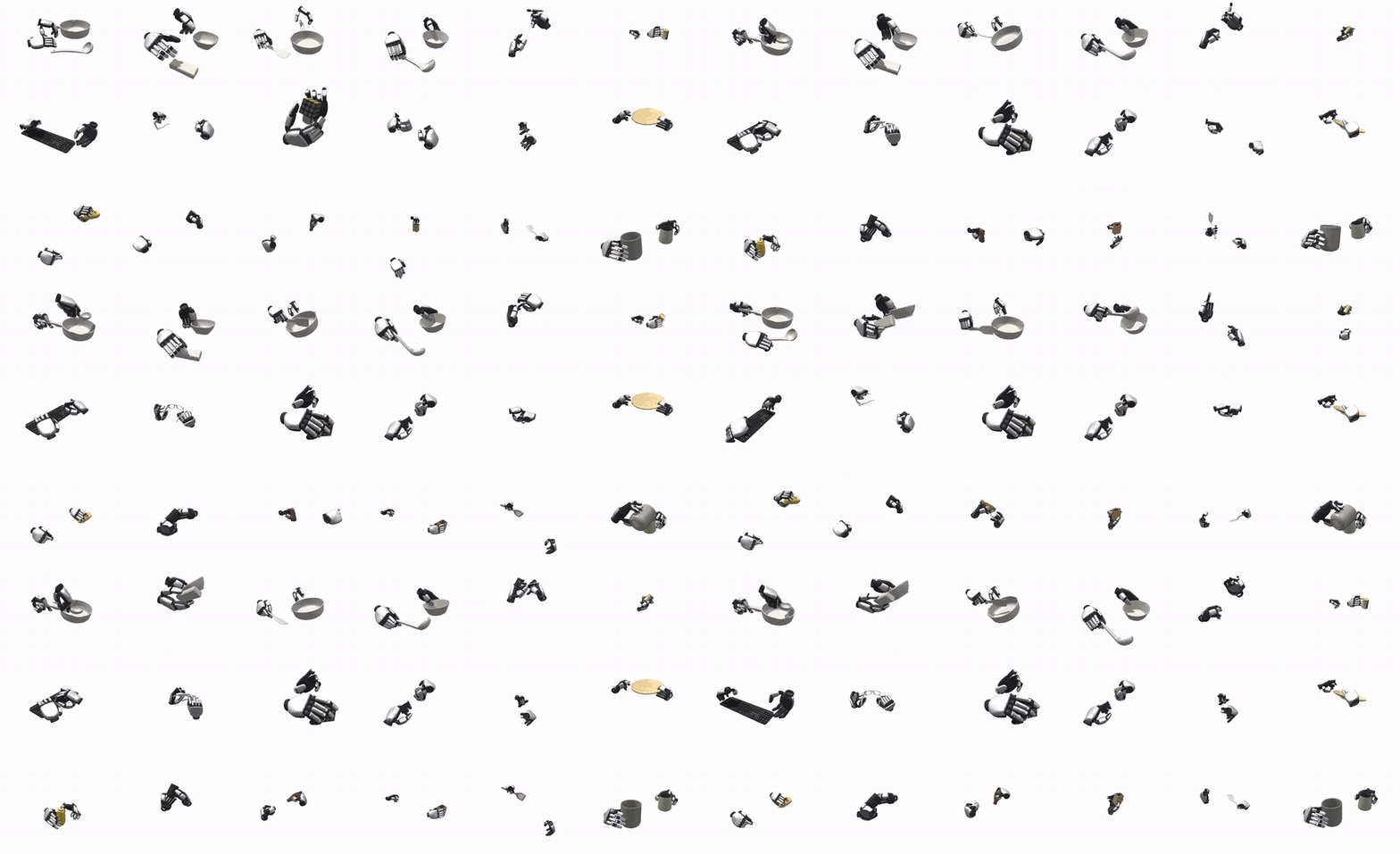
While learning dexterous manipulation from a single human video offers a promising alternative to costly robot demonstrations, many recent methods predominantly imitate demonstrated motions. Such strict motion matching often limits generalization to initial object poses, goal poses, and grasps not shown in the video. Alternatively, discovering a policy via reinforcement learning (RL) allows for broad generalization, but without prior guidance, it struggles with high-dimensional exploration in complex, multi-stage tasks. To address these coupled generalization and exploration challenges, we present Dex-One2Many, a real-to-sim-to-real framework that learns a generalizable dexterous manipulation policy from a single human video. Our key insight is to abstract the video into sequential scene graphs that guide RL, enabling efficient exploration while preserving broad generalizability. The graphs serve as generative constraints for sampling diverse reset states and provide dense rewards for each stage. Because the graphs constrain relations rather than exact poses, these reset states cover object poses and grasps beyond the video, while initializing each stage from them with dense rewards keeps exploration short and guided. Trained entirely in simulation, Dex-One2Many transfers zero-shot to a real multi-fingered hand. Across five tool-use and manipulation tasks, Dex-One2Many exceeds baselines by 6.5% in seen configurations, while its robust generalization widens this gap to 71% in unseen scenarios.

cs.ROcs.CVrobotmanipulationsim-to-realdexterous

兴趣:robot manipulation and grasping with learned policies

#32026-10-0896

Rewiring Semantics, Dynamics, and Control: A Simple yet Effective Action-Centric Tri-Stream Transformer

Shuang Luo, Yilun Kong, Yunpeng Qing, Yihang Jiao, Zhi Hou, Shunyu Liu 等

Vision-Language-Action (VLA) models have emerged as a prominent framework for complex robotic manipulation, building on the strong semantic understanding of pretrained Vision-Langu…

Vision-Language-Action (VLA) models have emerged as a prominent framework for complex robotic manipulation, building on the strong semantic understanding of pretrained Vision-Language Models (VLMs). However, such VLM backbones offer insufficient physical dynamics priors, which limits the generalization capabilities of robot policies. Recent efforts therefore integrate video-generation World Models (WMs) into robot policies through various strategies, using predictive dynamics to facilitate action generation. Despite these advances, harnessing semantic understanding and dynamics prediction as complementary guidance for action generation remains challenging. In this paper, we introduce $ACT^3$, a simple yet effective Action-Centric Tri-Stream Transformer that fuses semantic and dynamics information into control actions while preserving the distinct roles of context streams. Specifically, $ACT^3$ enables the dedicated action expert to access VLM and WM representations through layerwise attention, with each backbone attending only within its own stream. This straightforward interaction design maintains independent forward propagation in the context streams while allowing both backbones to be updated through control supervision. Experiments on both simulated and real-world robotic manipulation benchmarks show that the proposed $ACT^3$ yields results superior to its counterparts.

cs.ROcs.AIrobotmanipulationVLAvision-language-action

兴趣:vision-language-action (VLA) models and foundation models for robots

#42026-10-0896

WARP-VLA: Wrist-Camera Adaptation for View-Robust Policy Execution in Vision-Language-Action Models

Junmyeong Lee, Dongmin Shin, Min-Gyu Park, Wooseok Jeon, Inho Chang, Hae-Gon Jeon

Despite recent advances in Vision-Language-Action models (VLAs) for robotic manipulation, their performance remains sensitive to changes in camera configuration. The problem become…

Despite recent advances in Vision-Language-Action models (VLAs) for robotic manipulation, their performance remains sensitive to changes in camera configuration. The problem becomes more evident in cross-setup deployment, as reproducing the exact camera pose used for training is nearly impossible. Unlike fixed external views, wrist views are more challenging because the camera moves with the robot, causing even small mounting variations to alter fine-grained geometric cues. To address this, we propose WARP-VLA, a camera-view robust VLA for diverse wrist camera configurations. WARP-VLA adopts a Mixture-of-Experts (MoE) architecture where individual experts learn view-specific feature transformations, and a router combines them based on implicit view information. This allows the policy to be deployed without requiring camera extrinsic parameters as additional input. Through experiments on the LIBERO benchmark, WARP-VLA improves the average success rate of pi-0.5 from 39.2% to 78.3% under wrist-view perturbations. The real-robot experiments further show that the feature-level adaptation learned in simulation successfully transfers to diverse deployment settings. To facilitate reproducibility and future research, we release our wrist viewpoint robustness benchmark and a plug-and-play implementation.

cs.ROcs.CVrobotmanipulationVLAvision-language-action

兴趣:vision-language-action (VLA) models and foundation models for robots

#52026-10-0896

VioLA: Learning Generalist Humanoid Control Policies from Human Data

Mert Albaba, Jens Beißwenger, Anna Manasyan, Daniel Marta, Michael J. Black, Wieland Brendel 等

Teaching a humanoid to follow instructions with its whole body runs into two obstacles. Its action space is large and tightly coupled: legs, arms, and fingers must move together wh…

Teaching a humanoid to follow instructions with its whole body runs into two obstacles. Its action space is large and tightly coupled: legs, arms, and fingers must move together while the robot keeps its balance, which makes joint-level actions hard to learn. And humanoid demonstrations are scarce, so current humanoid generalist policies do not follow new instructions out of the box and are fine-tuned on teleoperated demonstrations of each task before deployment. Human demonstrations exist in far larger numbers, but a person's motion is not a robot command. We remove both obstacles by changing what the generalist policy predicts. We introduce VioLA, a generalist humanoid policy that predicts body and hand motion latents instead of joint commands. A pretrained body- and hand-controller execute these latents on the robot. Their corresponding motion encoders map human and robot motion into the same latent spaces. A human recording is therefore labeled in the policy's action space, and the training demonstration pool contains 140.6 million frames, 93.2% of them human. As a result, VioLA follows locomotion instructions on the real robot zero-shot, without task-specific fine-tuning, reaching 100% success where GR00T N1.7 and $Ψ_0$ reach 16.7% and 0%, respectively. It also reaches 88.6% manipulation success without task-specific fine-tuning. The same approach works across two VLA and one world-action model backbones. A generalist policy trained on human demonstrations alone performs locomotion tasks on the real robot zero-shot. Code and checkpoints will be released.

cs.ROcs.LGrobotmanipulationVLAhumanoidlocomotion

兴趣:humanoid robots and whole-body control

#62026-10-0895

Multi-Agent Egocentric World Model with Fine-Grained Embodied Interaction

Dahyun Chung, Siyoon Jin, Hyunwook Choi, Honggyu An, Junyoung Seo, Hyunsung Kim 等

Egocentric world models predict first-person observations conditioned on an agent's actions, but most focus on a single agent. Real embodied settings often involve multiple agents …

Egocentric world models predict first-person observations conditioned on an agent's actions, but most focus on a single agent. Real embodied settings often involve multiple agents that act and interact within a shared environment. Existing multi-agent world models rely on coarse actions like locomotion, camera control, or discrete commands, leaving fine-grained embodied interactions underexplored. We formulate multi-agent egocentric world modeling as synchronized ego-stream generation for multiple agents interacting through fine-grained actions in a shared world. This requires cross-view action consistency, shared-environment consistency, and consistent propagation of interaction-induced state updates. We propose Multi-agent Egocentric World Model (ME-World), which jointly denoises multiple ego streams in a shared token sequence, conditions each stream on all agents' target-view poses, and grounds generation with shared environment memory. We train and evaluate on real and synthetic multi-agent data and introduce shared-world consistency metrics for environment, update, and identity consistency. Experiments show ME-World improves shared-world consistency, action control, identity preservation, and video quality over existing methods.

cs.CVcs.AIlocomotionembodiedworld model

兴趣:world models and video prediction for embodied agents

#72026-10-0895

DreamTrue: Action-Faithful Robot World Model with Counterfactual Post-Training

Junyan Li, Ruizhi Li, Yu Liu, Xiangshuo Liu, Mingchao Sun, Hongyu Pan 等

We present DreamTrue, a multi-view, cross-embodiment robot world model for action-faithful and physically plausible video prediction. Training such a model on existing robot datase…

We present DreamTrue, a multi-view, cross-embodiment robot world model for action-faithful and physically plausible video prediction. Training such a model on existing robot datasets faces two obstacles: imprecise calibration can impair action following, while limited coverage of unsuccessful interactions can bias predictions toward successful outcomes. To improve action following across embodiments, we render action trajectories into image-space conditions and introduce offline geometric calibration to align these conditions with the target videos. To broaden interaction coverage, we introduce counterfactual post-training, modifying recorded action trajectories and generating future videos under a wider range of actions and contact configurations. To provide feedback on these predictions without paired ground-truth futures, we construct a human-annotated video dataset covering robot, object, and interaction defects and use it to train an embodied video reward model. Its scores guide reinforcement-learning post-training toward more physically plausible interaction outcomes. On AgiBot, DreamTrue attains state-of-the-art action following, while reducing the human-assessed interaction defect rate from from 48.12% to 6.25%. Notably, our model ranks first in the world model track of the AgiBot World Challenge 2026. The project page can be found at https://brave-eai.github.io/DreamTrue.

cs.ROcs.CVrobotembodiedworld model

兴趣:world models and video prediction for embodied agents

#82026-10-08追踪学者 · Abhishek Gupta追踪学者 · Byron Boots95

A Balanced Data Diet: Addressing the Exploration Bottleneck in Mega-Scale RL for Robot Control

Octi Zhang, Mateo Guaman Castro, Patrick Yin, Ignacio Dagnino, Abhishek Gupta, Rosario Scalise 等

General-purpose robots must perform a wide range of tasks from agile locomotion to dexterous manipulation. While sim-to-real reinforcement learning (RL) has proven to be a useful t…

General-purpose robots must perform a wide range of tasks from agile locomotion to dexterous manipulation. While sim-to-real reinforcement learning (RL) has proven to be a useful tool for this goal, current RL pipelines depend on engineering-heavy, per-task structural priors such as shaped rewards and demonstrations. Recent work has shown that diverse simulator resets, combined with massively parallel simulation, can alleviate much of this engineering burden on several manipulation problems. However, we find that naively scaling this paradigm to more precise or dynamic problems remains non-trivial. While simulator resets can help with exploration, uniformly sampling over this distribution wastes a growing fraction of learning experience on task configurations the policy has already mastered or cannot yet attempt. This makes it challenging to see the expected benefits of scaling parallel environments for RL, since much of the learning signal in a batch is wasted during learning. To mitigate this, we introduce Success Guided Sampling (SGS), a simple adaptive sampler that concentrates RL training on task configurations around the frontier of the policy's capabilities. Doing so allows large-scale simulated RL to make the most out of the experience in a batch, enabling much more effective scaling to large-scale parallel simulation. Across experiments using up to $2^{20}$ (over one million) parallel environments, SGS enables RL to solve challenging multi-terrain quadruped locomotion and contact-rich assembly tasks that prior methods fail to solve. Finally, we distill the learned manipulation policies into RGB-based policies and demonstrate zero-shot transfer to several challenging assembly tasks on real hardware. Project website: https://sgs-rl.github.io/.

cs.ROcs.LGrobotmanipulationlocomotionsim-to-realdexterous

追踪学者:Abhishek Gupta、Byron Boots;兴趣:reinforcement learning for legged locomotion and sim-to-real transfer

#92026-10-0895

Being-M0.7: A Latent World-Action Model for Humanoid Robots

Junpeng Yue, Boyuan Li, Yuxuan Wang, Zepeng Wang, Yuhui Fu, Feiyang Xie 等

Humanoid loco-manipulation requires coordinated locomotion and manipulation informed by future scene evolution and whole-body motion, yet learning these capabilities is constrained…

Humanoid loco-manipulation requires coordinated locomotion and manipulation informed by future scene evolution and whole-body motion, yet learning these capabilities is constrained by scarce robot demonstrations. Human video and motion datasets offer scalable supervision, but many contain only video or motion rather than paired video-motion data. Moreover, human motion does not directly specify executable robot actions. We present Being-M0.7, a latent world-action model that transfers visual-motion priors learned from mixed-modality human data to humanoid control through pre-training, robot mid-training, and action post-training. We curate a corpus from more than 10,000 hours of raw human-centric data, integrating video-only, motion-only, and paired video-motion streams to learn complementary visual dynamics and whole-body kinematic structure. Joint prediction of future latent visual states and motion encourages visual representations to encode future kinematics. Robot mid-training adapts this coarse-grained prior to robot viewpoints and body dynamics. During action post-training, an action expert combines visual predictive representations from the frozen, adapted prior with current images and proprioception through gated cross-attention, grounding predictive context in executable whole-body commands. Being-M0.7 achieves the highest aggregate success rate among the compared baselines on SIMPLE and matches the strongest baseline on real-world Unitree G1 loco-manipulation tasks.

cs.ROcs.CVcs.LGrobotmanipulationhumanoidlocomotion

兴趣:world models and video prediction for embodied agents

#102026-10-0895

UNITAS: A 3D-Native World Action Model for Embodied Manipulation

Ruixiang Wang, Yongyi Su, Wenlve Zhou, Bo Yue, Hengyan Liu, Dekun Lu 等

World action models (WAMs) aim to answer a coupled physical question: given a task instruction, what motion should the robot execute, and how will that motion change the surroundin…

World action models (WAMs) aim to answer a coupled physical question: given a task instruction, what motion should the robot execute, and how will that motion change the surrounding world? Most existing WAMs build on pretrained video generators and represent world evolution through images or visual latents. Robotic interaction, however, takes place in metric three-dimensional space, while images are view-dependent projections whose pixel distances do not directly encode physical distances. We introduce UNITAS, to our knowledge the first 3D-native world action model that unifies observations, actions, and scene dynamics in a shared metric 3D frame within each interaction, using a common representation across robot embodiments and human hands. Action flow represents human hands and robot grippers as 3D point trajectories, while scene flow describes scene-point displacements conditioned on these trajectories. World-aligned 3D positional embeddings ground visual tokens with or without depth input, and a physical-time trajectory tokenizer encodes each point trajectory as one token anchored at its current 3D position. This interface supports both direct action execution and action-conditioned scene prediction. With 1.7B parameters, UNITAS achieves the best action-conditioned scene prediction on RoboTwin among the compared methods, with up to 49% lower displacement errors than PointWorld, and state-of-the-art manipulation success, including 99.8% on LIBERO and an average of 85% across real-world tasks. The code is available at https://github.com/DexForce/UNITAS.

cs.ROrobotmanipulationembodied

兴趣:world models and video prediction for embodied agents

#112026-10-08追踪学者 · Yang Gao95

Residual Modeling Closes the Regression and Generative Policy Gap in Robot Learning

Yuchen Zhou, Jiacheng You, Weikang Wan, Weijun Dong, Yang Gao, Jiayuan Mao

Learning from demonstration has enabled impressive robot behaviors. A common choice for policy learning is to use diffusion or flow matching (Flow-Policies), which often outperform…

Learning from demonstration has enabled impressive robot behaviors. A common choice for policy learning is to use diffusion or flow matching (Flow-Policies), which often outperforms direct action regression trained with mean squared error (MSE-Policies). This gap is commonly attributed to multimodal demonstrations. We revisit this gap from the perspective of statistical modeling: how action-prediction residuals shape policy optimization. Our analysis of real-world robot demonstration data reveals substantial state-dependent variation in residual scales and heavier-than-Gaussian tails. While both MSE-Policies and Flow-Policies exhibit heavy-tailed action residuals, their training gradients behave differently: MSE allocates more gradient magnitude to observations with large action residuals, which hurts optimization. Motivated by these findings, we introduce heteroscedastic Student-t action regression (HT-Policies), which learns input-dependent residual scales and reduces the influence of heavy tails. HT-Policies predict action chunks with a single feed-forward pass and can reuse pretrained flow-matching-based policy networks as the backbone. Across four simulation benchmarks and real-robot evaluations, HT-Policies achieves success rates competitive with generative policy baselines, both when trained from scratch and from pretrained vision-language-action and world-action models, despite being faster in training and inference. Together, these findings shed light on the practical advantages of generative objectives in robot learning from demonstrations and offer an efficient direct-regression alternative for a range of architectures and tasks. Project page: https://the-labone.github.io/regression-policy-project/

cs.ROrobotvision-language-action

追踪学者:Yang Gao;兴趣:imitation learning and diffusion policies for robot control

#122026-10-0894

VersaCamVLA: Camera-Configurable VLA Policies for Robotic Manipulation

Boyao Han, Chen Shi, Jingjing Qian, ZhuoTan Tian, Li Jiang

Vision-Language-Action (VLA) models have emerged as powerful foundations for robotic manipulation, but their reliance on fixed camera configurations during training makes them brit…

Vision-Language-Action (VLA) models have emerged as powerful foundations for robotic manipulation, but their reliance on fixed camera configurations during training makes them brittle to changes in camera count or pose during deployment. To overcome these limitations, we propose VersaCamVLA, a camera-configurable framework that decouples camera-set representation from action learning. VersaCamVLA learns a unified scene-token interface that maps an arbitrary, variable set of posed RGB views into fixed-size latent scene tokens. This is achieved via multi-signal target-view prediction and Wrist-Augmented Pose Sampling (WAPS), which leverages natural wrist-camera motion for free pose diversity. At deployment, a lightweight spatial encoder injects these compact scene tokens into a pretrained base VLA as a supplementary visual condition, requiring no explicit 3D sensing or novel-view rendering. Experiments on RoboTwin, LIBERO, and a real-robot platform demonstrate that VersaCamVLA consistently outperforms prior VLA methods and direct multi-view baselines, maintaining robust performance across varying camera counts and unseen camera poses.

cs.CVcs.ROrobotmanipulationVLAvision-language-action

兴趣:vision-language-action (VLA) models and foundation models for robots

#132026-10-0694

Teaching a Robot Dog New Tricks: Diverse Quadruped Skills via Combined Reinforcement and Imitation Learning with Adversarial Task Selection

Lemon Foxmere, Anthony Furman, Yizheng Du, Oliver Chang, Leilani Gilpin, Steve McGuire

Reinforcement Learning (RL) has enabled legged robots to perform a range of skills in single-task settings. However, applications such as farm robotics or space exploration require…

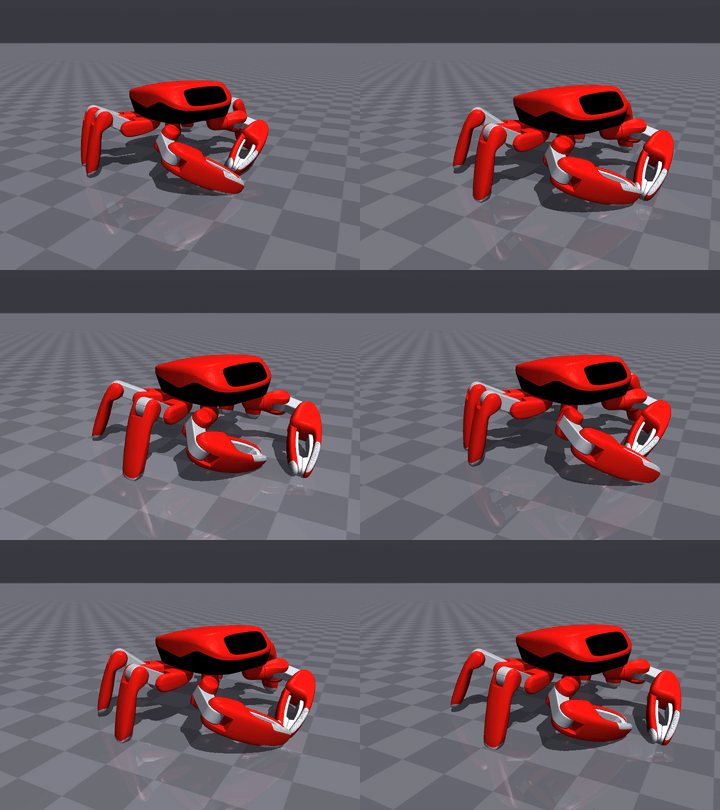
Reinforcement Learning (RL) has enabled legged robots to perform a range of skills in single-task settings. However, applications such as farm robotics or space exploration require diverse skills such as locomotion, digging, or close-range surveying. Training an end-to-end policy to address this problem remains difficult due to challenges such as sample inefficiency and gradient conflict between tasks in multi-task learning. We propose a three-stage method that trains a single policy to perform distinct tasks such as walking, digging, and hopping, and compose them into novel behaviors such as crawling. First, multiple teacher policies are trained using RL on narrowly defined tasks. Then, two additional stages train a student policy with a multi-teacher distillation setup that uses a combined RL and Imitation Learning (IL) objective under an adversarial task selection process that focuses training on the worst-performing task. With this method, we train a student policy that performs 22 tasks using 8 teachers. Evaluations show our method preserves motion quality and tracks commands more accurately than PPO and distill-then-finetune baselines, and in some cases generalizes to new tasks without explicit training. Finally, we demonstrate real-world robustness by deploying the resulting policy on a Unitree B1 quadruped. Video: https://youtu.be/V9yX04EBcFA

cs.ROrobotimitation learningleggedlocomotion

兴趣:reinforcement learning for legged locomotion and sim-to-real transfer

#142026-10-0894

PathTime-VLA: Path-Time Decoupling for Factorized Post-Training of Vision-Language-Action Policies

Qing Huang, Yifei Yang, Ziqing Zou, Anzhe Chen, Zhenjie Zhu, Yufei Wei 等

Vision-Language-Action (VLA) policies typically predict actions at fixed time intervals, coupling the route a robot follows with its execution pace. This coupling complicates adapt…

Vision-Language-Action (VLA) policies typically predict actions at fixed time intervals, coupling the route a robot follows with its execution pace. This coupling complicates adaptation from teleoperation: useful geometric guidance comes with timing shaped by interface delays and operator behavior. Our key insight is to bring the path-time parameterization of classical motion planning into the learned action representation of a VLA. We introduce PathTime-VLA, which represents motion as a progress-indexed interaction path $X(s)$ and a positive interval-time profile. The latter defines a monotone time law $t(s)$, yielding controller commands $X(s(t))$. For a given path, alternative executions are expressed through the time profile, allowing chunk-wise speed choices without changing the geometric prediction target. This representation supports a staged post-training procedure: demonstrations and DAgger interventions establish a target-domain prior, Speed-DQN learns execution multipliers from robot interaction, and Path-AWR uses rollout outcomes to refine the diffusion path generator. A path-conditioned action expert realizes the resulting motions while maintaining distinct learning interfaces for path generation and execution timing. Across three tasks, the complete method achieves $58/60$ successes versus $57/60$ for PathTime-VLA under BC + DAgger at fixed $1\times$, with approximately $39$-$52%$ shorter mean completion times over successful trials.

cs.ROrobotVLAvision-language-action

兴趣:vision-language-action (VLA) models and foundation models for robots

#152026-10-0894

ManiUnit: A Manipulation Skill Dataset and Benchmark for Long-Horizon Tasks

Guoting Wei, Dawei Yan, Xia Yuan, Gengming Zhang, Yelin He, Guodong Du 等

Long-horizon mobile manipulation requires a robot to navigate multi-room environments and execute a sequence of manipulation skills under a single natural language instruction. Lea…

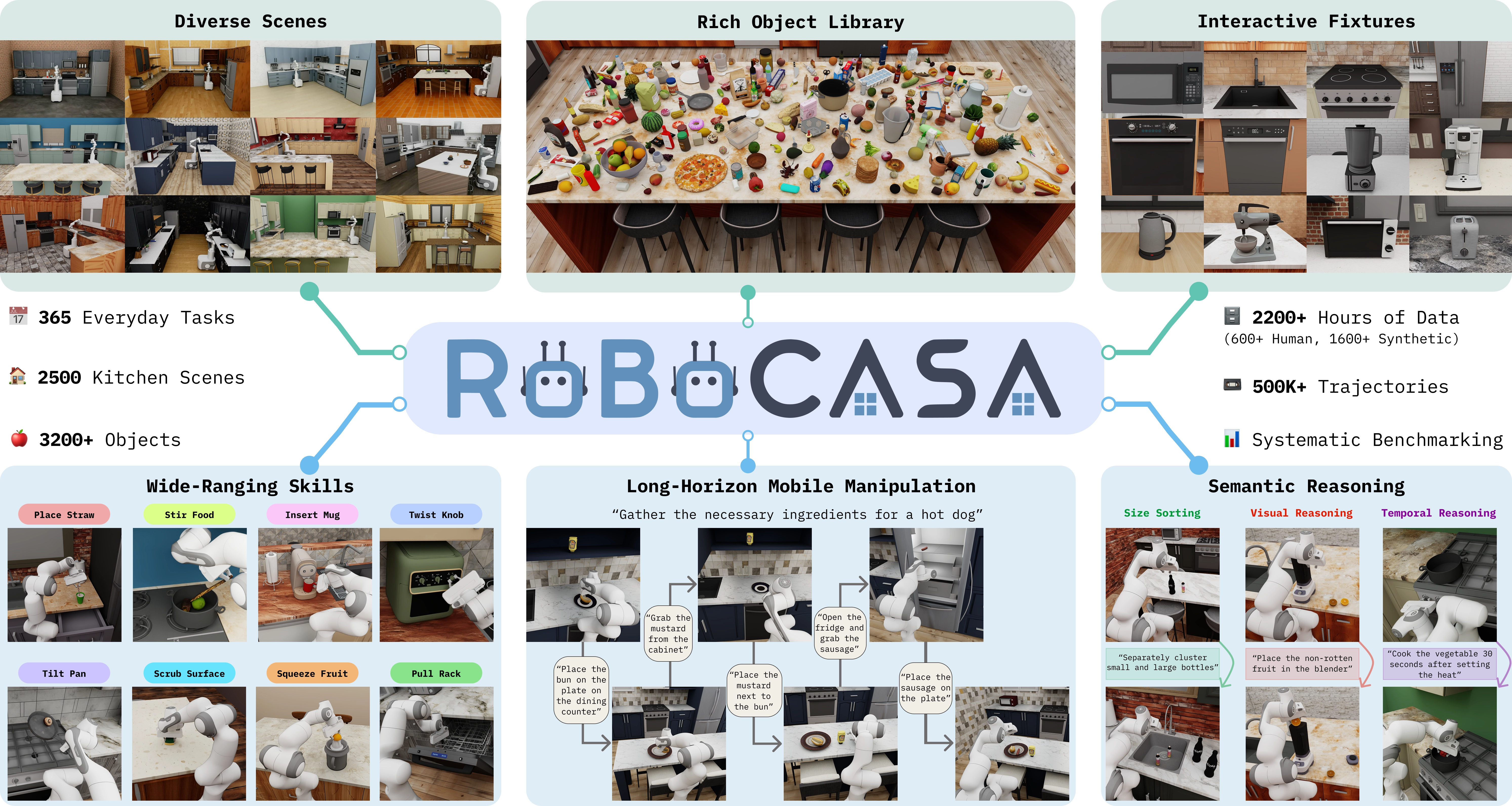
Long-horizon mobile manipulation requires a robot to navigate multi-room environments and execute a sequence of manipulation skills under a single natural language instruction. Learning and evaluating these skills present three challenges: similar observations under a fixed task instruction may make skill selection ambiguous; even when a preceding skill succeeds, the robot state inherited by the next skill may deviate from its demonstrated starting states and affect execution; and task-level metrics hinder skill-specific diagnosis, while early failures leave later skills untested. We therefore introduce ManiUnit, a manipulation skill dataset and benchmark built from 50 BEHAVIOR-1K activities. Its dataset contains 137,899 segments across 21 skill types and 417 subtasks, and its benchmark contains 1,260 test instances. Correspondingly, ManiUnit pairs each segment with an explicit subtask instruction; measures sensitivity to perturbations of the robot's starting base position or joint configuration; and restores intermediate simulator states and defines local success conditions so that each skill can be evaluated without executing preceding stages. Evaluations of representative vision-language-action (VLA) policies show that similar aggregate scores can hide substantial per-skill differences. The tested starting-state perturbations also degrade execution: on the full benchmark, joint perturbations reduce success rates by approximately 56% relative to those from demonstrated starting states. On two long-horizon activities, a skill policy trained on ManiUnit segments achieves 78.7% local manipulation success, compared with 49.3% for a task policy trained on complete demonstrations. The trained skills further support complete-task execution on these activities, as coordinating the task and skill policies through a planner raises full-task success from 4.0% to 18.0%.

cs.ROrobotmanipulationVLAvision-language-action

兴趣:robot manipulation and grasping with learned policies

#162026-10-0894

Generative Neural Retargeting for Human-to-Robot Dexterous Manipulation

Dechen Gao, Yue Yang, Ben Abbatematteo, Nathan Godwin, Pengcheng Wang, Roger Boldu 等

Human demonstrations are a scalable data source for learning dexterous manipulation, but the embodiment gap prevents human motion from being executed directly on robots. Inverse ki…

Human demonstrations are a scalable data source for learning dexterous manipulation, but the embodiment gap prevents human motion from being executed directly on robots. Inverse kinematics (IK) retargets human motion to robots efficiently but ignores dynamics, often producing infeasible motions. Reinforcement learning (RL) and sampling-based model predictive control (MPC) are commonly employed to yield dynamically feasible motions, but both are sample-inefficient and sensitive to hyperparameters. RL suffers from costly and unstable training and tedious reward engineering; MPC avoids policy optimization, yet retargets each trajectory in isolation, and solving one does not make the next easier. Sampling cost grows rapidly with dataset size and task difficulty. We hypothesize that dynamically feasible trajectories concentrate near a low-dimensional manifold shared across demonstrations, so that retargeting can be reduced to sampling from that manifold, conditioned on human motion, rather than solving a fresh optimization problem for every demonstration. We propose Generative Neural Retargeting (GNR), which uses a flow matching model to sample feasible trajectories. GNR outperforms MPC with only $8.5%$ of the samples required by MPC, achieving a success rate of $56.20%$ compared to $27.20%$ for MPC. GNR can be used for scalable and efficient retargeting of large-scale, long-horizon, and millimeter precision human demonstrations: by applying GNR within a real-to-sim data engine, we produce a dexterous manipulation dataset with dense contact-force labels, spanning $223$k demonstrations and $3.3$k object geometries.

cs.ROrobotmanipulationdexterous

兴趣:imitation learning and diffusion policies for robot control

#172026-10-07追踪学者 · Li Fei-Fei追踪学者 · Jiajun Wu93

Cross-Embodiment Robot Foundation World Models with Latent Actions

Huang Huang, Sriram Yenamandra, Arjun Majumdar, Elie Aljalbout, Tushar Nagarajan, Tsung-Yen Yang 等

The diversity of robot embodiments and action spaces makes it challenging to build robot world models that generalize across different embodiments. We introduce the Latent Action-C…

The diversity of robot embodiments and action spaces makes it challenging to build robot world models that generalize across different embodiments. We introduce the Latent Action-Conditioned Robot World Model (LAC-WM), which operates within a learned unified latent action space shared across diverse embodiments. This unified action space improves the world model's performance when adapted to previously unseen robot embodiments. We compare LAC-WM with an Explicit Action-Conditioned World Model (EAC-WM), which conditions on explicit motion labels. Our results show that explicit action conditioning leads to disjoint action representations across embodiments, limiting downstream performance when adapting to new robots. We evaluate both models on dexterous manipulation tasks and a modified LIBERO benchmark. LAC-WM improves downstream performance over EAC-WM by up to 46.7% on dexterous manipulation and 11.7% on LIBERO. Crucially, the unified latent action space allows LAC-WM's downstream performance to scale positively with the number of embodiments used during pretraining. In contrast, the disjoint action space in EAC-WM leads to decreased performance as the number of pretraining embodiments increases. These results highlight the importance of a unified action space for efficient cross-embodiment learning, addressing a key challenge in robotics. Project website: https://lacwm.github.io/

cs.ROrobotmanipulationdexterousworld model

追踪学者:Li Fei-Fei、Jiajun Wu;兴趣:imitation learning and diffusion policies for robot control

#182026-10-0793

When Listening Becomes Easier: Scrubbing Visual Cues for Shortcut-Free VLAs

Jasper Gerigk, Kenzo Aspuru-Takata, Chin-Hsuan Wu, Mohammad Mohammadi, Shuhong Zheng, Igor Gilitschenski

Shortcut learning is a prevalent issue in robot learning. The limited diversity of robot demonstration datasets can mislead policies into exploiting spurious correlations between t…

Shortcut learning is a prevalent issue in robot learning. The limited diversity of robot demonstration datasets can mislead policies into exploiting spurious correlations between tasks and irrelevant features, such as viewpoint or background. Collecting sufficiently diverse robot demonstrations is costly and inefficient, motivating algorithmic alternatives. We focus on vision-language-action (VLA) models and discover that different vision-language model backbones exhibit substantially different levels of susceptibility to visual shortcut learning. We find that model behavior correlates with our proposed representation-level metric, action margin, which requires no policy rollouts. Visual shortcuts consistently enter action representations in early layers, with models differing in the extent to which later layers correct them by incorporating language information. To boost models' attention to language, we introduce task scrubbing, a new domain-adversarial training method that decreases models' likelihood of using visual shortcuts and improves VLAs' generalization. Experiments in both simulation and the real world across multiple VLAs and visual cues show that task scrubbing improves out-of-distribution robustness and often eliminates visual shortcut learning.

cs.ROcs.CVcs.LGrobotVLAvision-language-action

兴趣:vision-language-action (VLA) models and foundation models for robots

#192026-10-0793

TAPNAV: Humanoid Navigation through Tactile Active Perception

Huaze Liu, Zhenyu Wu, Jaehwi Jang, Junjie Sheng, Andrew Collins, Aaron Xie 等

Navigation in vision-denied environments is challenging for humanoid robots because proprioceptive odometry drifts and localization uncertainty accumulates rapidly. We present TAPN…

Navigation in vision-denied environments is challenging for humanoid robots because proprioceptive odometry drifts and localization uncertainty accumulates rapidly. We present TAPNAV, a tactile active-perception framework that enables humanoid navigation toward a goal by actively probing surrounding structures without relying on vision. TAPNAV maintains a pose belief from odometry, IMU, and tactile contact observations, and couples uncertainty-aware global route planning with information-gain-driven local probing. The global planner searches for routes that keep predicted localization uncertainty bounded by exploiting opportunities for tactile correction, while the local planner selects probe actions that maximize expected information gain. A whole-body controller coordinates the humanoid's locomotion and end-effector contact to execute the planned navigation and probe motions. We evaluate TAPNAV in simulation and on a Unitree G1 across different floor plans and obstacle geometries. TAPNAV achieves lower state estimation error and a higher task completion rate than baselines. These results demonstrate that actively planning physical interactions with the environment can provide localization cues for reliable humanoid navigation without vision.

cs.ROhumanoidlocomotiontactile

你点赞过:TANGO: Humanoid Navigation in Cluttered Environments with a

#202026-10-0793

iAm.md: Robot Skill Self-Assessment through Agentic Introspection for Unknown Open-Vocabulary Domains

Vincenzo Guarino, Emanuele Musumeci, Vincenzo Suriani, Daniele Nardi

Agentic AI based on Large Language Model generalization capabilities offers a wide range of potential applications, including planning for embodied tasks. For example, embodied age…

Agentic AI based on Large Language Model generalization capabilities offers a wide range of potential applications, including planning for embodied tasks. For example, embodied agents based on Foundation models can generate plausible plans in autonomous robotics scenarios. Due to limited context windows or hallucinatory phenomena in the next-token prediction formulation, behaviors may be generated without establishing whether the deployed robot and the observed environment actually support the requested operation, in what we call a "grounding failure". Thanks to the recent improvements in reasoning capabilities of foundation models, autonomous robot behavior generation problem can be formulated as a code generation problem. We present iAm.md, a Markdown standard and generation framework, that allows anchoring this process in complementary forms of deployment evidence. Through open-vocabulary semantic mapping, we combine local vision-language detections and object segmentation and refer them to persistent object records in this intermediate standardized representation, allowing agentic introspection. We then study this new technique on a simulated TIAGo, on navigation-and-manipulation tasks, showing how this standardized representation jointly supports skill self-assessment and executable task generalization.

cs.ROcs.AIrobotmanipulationembodied

兴趣:large language models for robot task planning and reasoning

#212026-10-0893

TACROSS: An Efficient and Low-Cost Scalable Human Touch System Across Heterogeneous Tactile Sensors for Dexterous Robot Learning

Bo Chen, Huanzhang Hu, Junyang Ma, Bo Yue, Fangdi Yu, Haijier Chen 等

Collecting tactile demonstrations on robots is costly and slow, motivating the use of lower-cost human tactile gloves for scalable data collection. However, human capacitive/piezor…

Collecting tactile demonstrations on robots is costly and slow, motivating the use of lower-cost human tactile gloves for scalable data collection. However, human capacitive/piezoresistive gloves and robotic tactile sensors differ fundamentally in transduction principle, sensor layout, spatial resolution, and dynamic response, making alignment of raw sensor channels ill-posed. To address this problem, we present TACROSS, a scalable system for learning from human touch and transferring it to robots that bridges this heterogeneity by aligning tactile streams at the level of contact events rather than raw sensor values. The hardware component of TACROSS integrates a piezoresistive glove with five layers and a cost of USD 10.86 with 285 sensing points. To align contact semantics, we design canonicalizers and residual adapters that map heterogeneous signals into a shared tactile latent with 256 dimensions via a temporal Transformer with attention across fingers. We further introduce a robot-grounded policy learning scheme in which robot demonstrations provide the sole source of ground-truth action supervision, while human demonstrations support tactile representation learning and provide confidence-weighted auxiliary supervision through valid retargeted hand targets. We evaluate our system on four contact-rich manipulation tasks. Compared to conventional teleoperation, our proposed system achieves a 3.5-fold efficiency improvement while reducing demonstration acquisition equipment cost by 95.7%. We will open-source the TACROSS hardware and software system and publicly release a tactile dataset comprising over 150 hours of recordings. Project page: https://tacross-touch-project.github.io/.

cs.ROcs.LGrobotmanipulationdexteroustactile

兴趣:dexterous hands and tactile sensing

#222026-10-0893

DAMP: Humanoid Locomotion via Denoised Belief Learning and Adversarial Motion Priors

Puying Shen, Wenhao Cui, Huaxing Huang, Bangyu Qin, Shengtao Li, Ziyang Dong 等

Humanoid robots possess the structural capability to traverse complex terrains. However, achieving stable t raversal without relying on perceived information remains challenging, p…

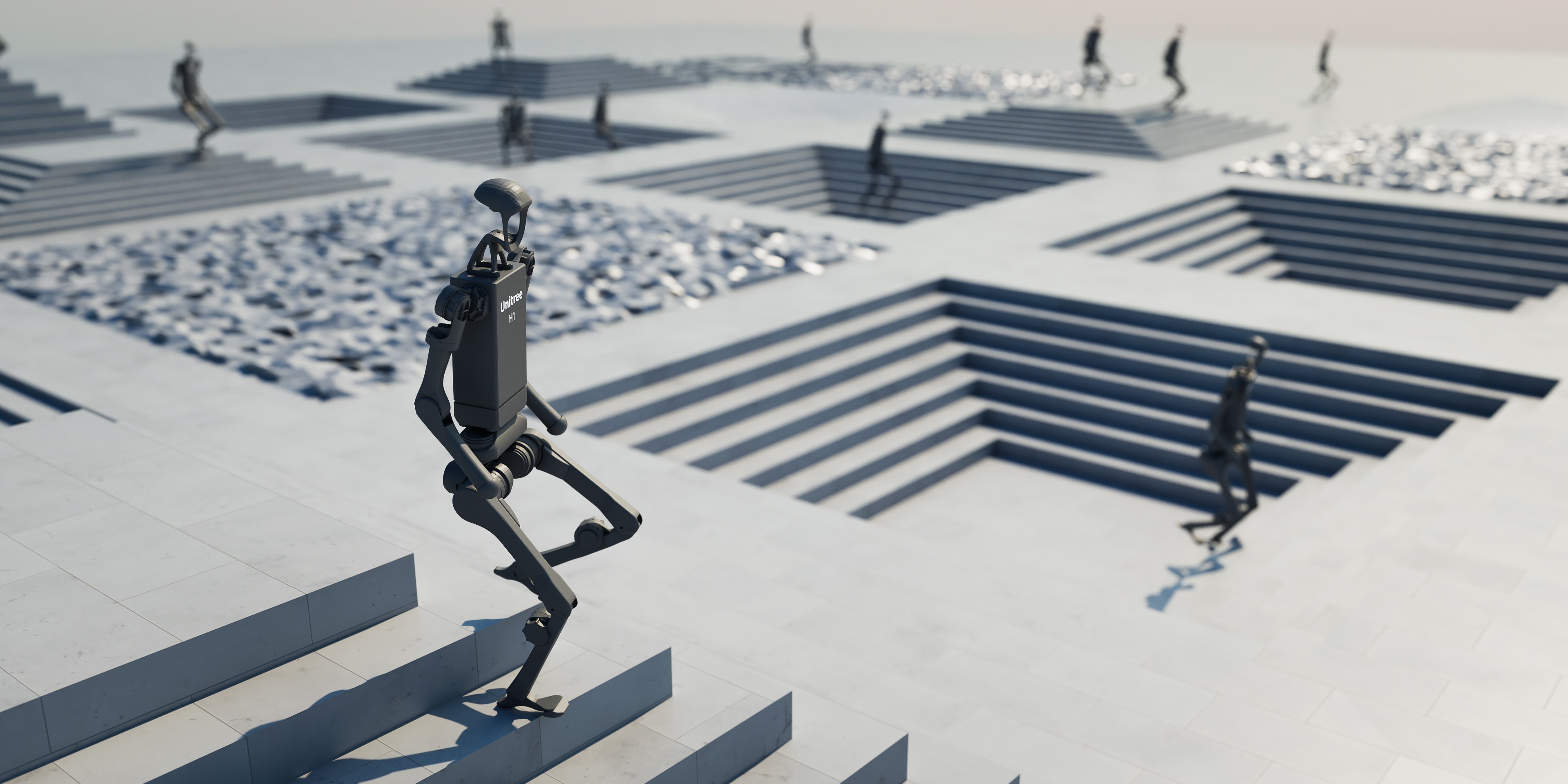
Humanoid robots possess the structural capability to traverse complex terrains. However, achieving stable t raversal without relying on perceived information remains challenging, particularly in complex environments. This paper introduces DAMP, a reinforcement learning framework aimed at achieving robust and naturalistic humanoid locomotion over challenging terrains, with the assumption that no perceived information is available. The framework leverages recurrent neural networks to capture temporal dependencies and implicitly infer privileged and other task-relevant latent information. By aligning the learned representations with the task objective, the method enables robust and goal-consistent policy learning. This end-to-end framework achieves transfer learning from simulation to real-world environments, demonstrating the proposed method's robustness and generalization capabilities. The video of the real-world demonstration can be found at the following link: https://youtu.be/AkI7TZB2DDM.

cs.ROhumanoidlocomotion

兴趣:reinforcement learning for legged locomotion and sim-to-real transfer

#232026-10-0892

PLaW-VLA: Predictive Latent World Modeling for Vision-Language-Action Policies

Yu Liu, Hetian Guo, Tianlv Huang, Ziyi Cai, Wudi Chen, Hantang Wang 等

Learning to predict how the world evolves can provide vision-language-action (VLA) policies with predictive context for long-horizon control, but its effectiveness depends on what …

Learning to predict how the world evolves can provide vision-language-action (VLA) policies with predictive context for long-horizon control, but its effectiveness depends on what future representation is modeled and how it conditions action generation. We introduce PLaW-VLA, which models task-relevant future states in a pretrained prediction-oriented representation space, reducing the need to predict control-irrelevant visual details. Built on a Mixture-of-Transformers architecture, PLaW-VLA conditions action generation on observation history, current task semantics, and predicted future states through structured causal attention. Experiments show a +11.8 percentage-point (pp) gain over reactive policies on RoboTwin Hard Horizon III and a +1.77 pp gain over reconstruction-oriented latent prediction on zero-shot LIBERO-Plus, supporting improved long-horizon control and generalization under distribution shift, respectively. By avoiding low-level visual reconstruction, PLaW-VLA lowers the burden of future prediction, enabling a lightweight latent world model with parallel future prediction and about 1/19 the inference latency of generative world-action modeling at comparable policy performance.

cs.ROVLAvision-language-actionworld model

兴趣:vision-language-action (VLA) models and foundation models for robots

#242026-10-0892

Tell Robot What Not to Do: A Negation Understanding Perspective

Fazeng Li, Gan Sun, Hao Cheng, Weihong Ren, Yang Cong

Instruction following enables robots to perform diverse tasks specified in natural language, making it a fundamental capability for human-robot interaction. Beyond communicating de…

Instruction following enables robots to perform diverse tasks specified in natural language, making it a fundamental capability for human-robot interaction. Beyond communicating desired outcomes, users also need to specify constraints on what not to do. We investigate how to enable vision-language-action models (VLAs) to follow negated instructions, where robots must accomplish task goals while respecting explicit exclusions. To this end, we propose NegaAlign, a parameter-efficient, plug-and-play framework that extends pretrained VLAs to follow negated instructions through image-language supervision alone. Specifically, we introduce Negation Transformation Layers into selected layers of the vision-language backbone to reshape intermediate instruction representations. Meanwhile, a teacher-guided alignment mechanism is designed to align instruction-relevant visual tokens, transferring action-relevant grounding from instructions that satisfy the negated constraint. The training phase uses supervision constructed from existing demonstrations and updates only the inserted layers, keeping all pretrained parameters frozen, including the action generator. We further introduce NegaBench, a simulation benchmark spanning 10 scenarios across five domains for systematically evaluating manipulation under negated constraints. Experiments across GR00T, $π_0$, and $π_{0.5}$ demonstrate consistent improvements in negated instruction following. With 11.6M trainable parameters, NegaAlign increases the negated-instruction success rate of $π_{0.5}$ from 2.60% to 88.45% on NegaBench and from 12.4% to 88.8% on real-world tasks, while retaining performance on affirmative instructions.

cs.ROrobotmanipulationvision-language-action

兴趣:vision-language-action (VLA) models and foundation models for robots

#252026-10-0891

Embodied Turing Machines: Stateful Code for Robot Recursive Self-Improvement

Kairui Hu, Siyuan Hu, Fangzhou Hong, Zhaoxi Chen, Ziwei Liu

Most robot policies keep a model in the control loop: a VLA maps observations to actions, and an Agent Harness, such as Agent-as-Policy or Harness VLA queries a VLM for decision ma…

Most robot policies keep a model in the control loop: a VLA maps observations to actions, and an Agent Harness, such as Agent-as-Policy or Harness VLA queries a VLM for decision making at run time. We propose a different view: the embodied world is an Embodied Turing Machine, whose tape is the robot and environment state and rules are the policy. If this state can be represented accurately, the decision making can be written entirely in code. We therefore propose Code-Only-as-Policy (COAP): code measures and tracks the robot, environment, and task state from camera images and proprioception, and makes every decision from it. The same code applies across episodes, and different tasks share one library without a VLM or VLA in the loop. Compared with VLAs and Agent Harnesses, we analyze three advantages of COAP: (i) Explicit State: the state can be stored in code; (ii) Execution: code makes decision making controllable, recovers from failures flexibly, and runs fast and cheaply online; (iii) Extensibility: new tasks reuse, inherit, or extend the shared library, so capabilities can accumulate over tasks. These advantages make COAP a suitable medium for recursive self-improvement (RSI): coding agents develop the library in a closed loop, and each change is explicit and controllable. On RoboDojo's 42 bimanual tasks, the resulting library reaches a success rate of 70.24% without a model at test time. The upper bound of COAP lies in how accurately the state is represented for decision making and how robust the code logic is. We thus propose COAP as a new paradigm for embodied tasks; since it applies across episodes, it can also serve as an efficient data engine for VLAs and Agent Harnesses.

cs.ROcs.CVrobotVLAembodied

兴趣:imitation learning and diffusion policies for robot control

#262026-10-0890

PMTRM: Pseudo-Memory Temporal Re-encoding Module for Embodied Policy Learning

Changchuan Yang, Haoxuan Xu, Wenbo Chen, Shuai Ren, Jianlong Zheng, Huarui Zhang 等

Robotic manipulation often contains repeated motions whose local observations look similar at different phases. When these phases require different actions, a policy that relies ma…

Robotic manipulation often contains repeated motions whose local observations look similar at different phases. When these phases require different actions, a policy that relies mainly on the current observation may repeat completed motions or switch phases at the wrong time. To address this phase ambiguity, we present the Pseudo-Memory Temporal Re-encoding Module (PMTRM), a lightweight plug-in module with only 7.61M parameters that encodes a bounded history of executed states and actions into a latent sequence for existing policies. To help distinguish phases, a temporal heterogeneity objective penalizes positive similarity between distant positions in this sequence, while anchor and reconstruction losses preserve information needed for action prediction. The reconstruction decoder is used only during training, leaving the temporal re-encoder to supply history to the policy at inference. We train the module progressively on synthetic sequences and robot data, then jointly with the policy, using temporal masking to accommodate partial histories. This integration retains the original action head and action space and adds auxiliary losses to the original policy loss. Experiments with multiple policy backbones in simulation and on a real robot show improved task success on tasks with phase ambiguity, with little additional computation.

cs.ROcs.AIrobotmanipulationembodied

兴趣:imitation learning and diffusion policies for robot control

#272026-10-0889

REACT: Rolling Denoising and Dual Decoupling for Reactive Robot Control with VLA Models

Houlong Xiong, Zhenqi Qiu, Zechen Wang, Suohang Zhang, Yiyu Ren, Wanting Xu 等

Flow-based vision-language-action (VLA) models generate action chunks for temporally coherent robot motion, but chunked control creates a fundamental closed-loop trade-off: long ch…

Flow-based vision-language-action (VLA) models generate action chunks for temporally coherent robot motion, but chunked control creates a fundamental closed-loop trade-off: long chunks provide smooth execution, whereas frequent replanning improves reactivity at the cost of action discontinuities. We introduce REACT, a rolling-denoising framework that makes flow-based VLAs more reactive while preserving long-horizon context. Instead of regenerating entire action chunks from scratch, REACT maintains a persistent action buffer with staggered flow timesteps. At each control step, the full horizon is denoised using the latest observation, the cleanest action block is executed, partially refined future blocks are shifted forward, and fresh noise is appended to the tail. As a result, each executed action block is refined across multiple recent observations before deployment. To support real-time control, we further introduce dual decoupling, which separates sensing, VLM encoding, DiT denoising, and action execution, enabling high-frequency observation updates and action streaming under practical compute constraints. Across the RoboTwin 2.0 simulation benchmark and real-world tasks spanning bimanual manipulation and dynamic control on multiple robot platforms, REACT improves task success and reduces reaction latency while producing smoother trajectories than frequent-replanning and asynchronous baselines.

cs.ROcs.AIrobotmanipulationVLAvision-language-action

兴趣:vision-language-action (VLA) models and foundation models for robots

#282026-10-0889

Humanoid World Action Model With Joint State--Action Generation

Yan Yang, Jikun Rong, Minzhao Zhu, Zheyi Zhao, Qirui Hu, Zihan Lan 等

Humanoid robots are a promising platform for general-purpose manipulation. Recent Vision-Language-Action (VLA) policies learn actions directly from multimodal observations, while W…

Humanoid robots are a promising platform for general-purpose manipulation. Recent Vision-Language-Action (VLA) policies learn actions directly from multimodal observations, while World Action Models (WAMs) further incorporate future visual prediction to improve action generation. However, in hierarchical humanoid systems, VLA and WAM policies output reference actions that are subsequently realized through whole-body control, robot dynamics, balance, and contact. This hierarchy creates an action--execution gap: the reference produced by the policy can differ from the motion realized by the robot. Without explicitly modeling the realized body state, future visual prediction must jointly explain scene evolution and discrepancies between reference actions and executed motion, making it difficult to associate an action with its physical outcome. We propose HWAM, a Humanoid World Action Model with joint state--action generation, which makes the robot's post-execution proprioceptive state an explicit prediction target. By jointly generating reference actions and their realized body states, HWAM directly incorporates supervision of executed motion into action learning. HWAM is trained through three complementary conditional paths. The Policy path jointly denoises state--action trajectories conditioned only on current observations, matching deployment conditions. Forward Dynamics Modeling (FDM) predicts future visual observations conditioned on actions and post-execution states, while Inverse Dynamics Modeling (IDM) reconstructs the joint trajectory from visual transitions. Together, these paths connect policy references, realized body motion, and visual outcomes. HWAM achieves the highest success rate among evaluated baselines on three real-robot tasks on the LimX OLI humanoid. On Candy Picking, HWAM achieves a 70.6% success rate, compared with 43.3% for Fast-WAM.

cs.ROcs.AIrobotmanipulationVLAvision-language-actionhumanoid

兴趣:vision-language-action (VLA) models and foundation models for robots

#292026-10-0789

Skill-SLM: Agent Skill-driven Small Language Models for Reliable Robot Operation

Wenhao Wang, Yanyan Li, Jiawei Yuan

Small language models (SLMs) have been increasingly adopted for onboard robot operation because they enable intelligent decision-making. However, existing approaches are mainly dis…

Small language models (SLMs) have been increasingly adopted for onboard robot operation because they enable intelligent decision-making. However, existing approaches are mainly distillation-oriented and rely on enumerating representative task-solution pairs. This makes dataset construction difficult and limits generalization to diverse robot tasks whose possible forms grow rapidly. This paper proposes Skill-SLM, a framework that reformulates SLM-driven robot operation as a task-decomposition and skill-composition problem. Given a natural language task instruction, Skill-SLM decomposes the task into subtasks, selects appropriate skills from the skill library, and orchestrates the selected skills into executable robot operations. First, to support the skill-driven workflow, we propose a novel robot operational skill aware context-free grammar (CFG) to extract the skills required to accomplish tasks and build the skill library accordingly. Then, we configure LLM teachers to induce and synthesize training datasets for the SLMs, enabling SLMs to decompose tasks and orchestrate skills reliably. Additionally, we employ a progressive skill orchestration strategy to improve the reliability of skill implementation and overall robot operation. Experiments on UAV operation tasks indicate that Skill-SLM substantially outperforms distillation-oriented baselines, especially on unseen tasks that require generalization of capabilities. Additional experiments on ground vehicle tasks further demonstrate that Skill-SLM can be applied to different robot platforms.

cs.ROrobot

兴趣:large language models for robot task planning and reasoning

#302026-10-0889

Reliability-Aware Future Conditioning for Temporally Robust Robot Manipulation

Mohammad Khoshnazar, Mohammad Dehghani Tezerjani, Zhiyuan Gao, Deyuan Qu, Max Gandyra, Yanxiang Zhan 等

A generated video of a task the robot is about to perform is useful guidance only if it depicts the phase the robot is actually in. We show that temporal misalignment can turn a ta…

A generated video of a task the robot is about to perform is useful guidance only if it depicts the phase the robot is actually in. We show that temporal misalignment can turn a task-consistent generated future into actively harmful guidance. On CALVIN, a five-frame early shift nearly erases the benefit of generated futures, reducing success from 81.3% to 54.8% against 54.0% without futures; imposed timing shifts reduce it even further to 34.2%, 19.8 points below the future-free policy. We introduce Reliability-Aware Future Conditioning (RAFC), which treats this as a control problem rather than a generation problem. At every step, RAFC estimates how far to trust the received clip and which nearby temporal hypothesis to prefer, falling back toward a static branch when neither fits, and it learns both from task reward alone without shift labels or alignment supervision. RAFC sits on top of Future-Experience Conditioning (FEC), which builds the clip once from task grounding, a robot-free digital-twin rollout, and mask-free video diffusion. Under deliberately off-grid phase shifts and rate mismatch, RAFC substantially improves success under temporal mismatch. Candidate ensembling accounts for most of the recovery near alignment, while learned reliability adds a further 7.0 percentage points over uniform averaging of the identical candidate bank under off-grid shifts. The gain holds on the evaluated task sets and survives on a Franka under natural timing mismatch nobody imposed, where aggregate success rises from 26.7% to 56.7%. All resources will be made publicly available. https://future-condition.github.io/.

cs.ROcs.LGrobotmanipulation

兴趣:imitation learning and diffusion policies for robot control

#312026-10-0888

RoboAware: Learning to Coordinate Embodied Skills from Counterfactual Outcomes

Bohan Zhou, Xingbei Chen, Emily Huang, Weilin Ruan, Haojian Huang, Yehang Zhang 等

Embodied coding agents can combine modular robot skills with frozen end-to-end policies, yet effective composition requires anticipating which policy family will succeed in the cur…

Embodied coding agents can combine modular robot skills with frozen end-to-end policies, yet effective composition requires anticipating which policy family will succeed in the current physical state. We present RoboAware, which builds on coding agents' skill orchestration by learning only a state-conditioned responsibility coordinator from counterfactual outcomes. Inspired by the success of REPL, we propose the $P^5$ schema and formulate a hierarchical MDP based on it. $P^5$ organizes skills uniformly into five semantic stages, defining where responsibility can be compared. To address the lack of counterfactual branch outcomes in existing work, we introduce State-Locked Counterfactual Branching (SCB), which restores the same training state to generate and execute a code block from each admissible family, exposing outcomes that selected-branch experience leaves unobserved. Building on this, we propose Execution-Aware Learning (EAL), which combines Monte Carlo tree search with Q-learning to distill these outcomes into family-conditioned values. At deployment, the coordinator selects the policy family according to observable context, and the frozen coding agent generates the next local code block. Comprehensive single-episode evaluations on 100 tasks show that RoboAware reaches a 77.0% overall success rate, with SOTA averages of 90.0% on RoboSuite, 73.8% on diverse LIBERO-Pro task clusters, and 90.0% on challenging RoboTwin bimanual tasks, outperforming existing code-as-policy and VLA-harness baselines.

cs.ROcs.AIrobotVLAembodied

兴趣:imitation learning and diffusion policies for robot control

#322026-10-0888

Towards Path-Creative Navigation: Robot Navigation through Embodied Interaction

Haoyu Xi, Siwei Cheng, Xiangyuan Liu, Brenda Li, Wei Zhang

Autonomous navigation in cluttered and constrained environments typically assumes a fixed environment and searches only for paths within existing free space. However, a route can b…

Autonomous navigation in cluttered and constrained environments typically assumes a fixed environment and searches only for paths within existing free space. However, a route can be blocked by an articulated structure, a movable object, or a pedestrian, and reaching the goal may therefore require appropriate embodied interaction with the environment. This paper formulates Path-Creative Navigation (PCN), a navigation paradigm in which the robot recovers free space by coordinating locomotion and embodied interaction, and addresses one class of PCN tasks with a mapless framework. The vision-LiDAR-odometry framework integrates local observations, obstacle geometry, and robot-state estimates through a unified navigation system, providing stable semantic and geometric information for navigation and interaction. The traversability-aware decision method utilizes visual and LiDAR distance information to determine whether a blockage is actionable and whether it can be safely bypassed, enabling the robot to interact only when necessary while supporting articulated structure pushing, movable object pushing, obstacle avoidance, and pedestrian requests. We design simulation scenarios and evaluate different methods in both simulation and two real-world tasks that cannot be completed by conventional navigation alone without embodied interaction. These results demonstrate that our framework achieves higher task completion than the baseline methods by coordinating navigation and interaction in cluttered and constrained environments. Code is available at:{https://anonymous.4open.science/r/path-creative-navigation/}.

cs.ROrobotlocomotionembodied

你点赞过:TANGO: Humanoid Navigation in Cluttered Environments with a

#332026-10-0788

NavGPT-3: Harnessing Context in a Hierarchical Navigation Runtime

Gengze Zhou, Yicong Hong, Jiazhao Zhang, Xunyi Zhao, Jian Zhou, Zixing Lei 等

Language models trained with long-horizon agentic reinforcement learning can generalize knowledge through reasoning, express precise actions, and pursue goals over many steps, rais…

Language models trained with long-horizon agentic reinforcement learning can generalize knowledge through reasoning, express precise actions, and pursue goals over many steps, raising the ceiling on what an embodied agent can understand and decide. Physical interaction, however, remains the domain of action policies, which provide dense, low-latency control. We present NavGPT-3, a harness that connects the two models, with an OS-like runtime built above it: reasoning, acting, and monitoring run as threads with their own context, tools, and permissions, while the runtime schedules them and decides which thread controls the robot's motion, so that the robot can react to sudden real-world events through interruption and thread switching. Beneath it, our action policy NavGPT VLA, trained on 19.28M examples, allocates visual tokens using codec allocation, in proportion to scene change; its 8B model alone reaches 74.51 SR on R2R-CE and leads RxR-CE with 78.19 SR. With the complete harness, NavGPT-3 sets the state of the art on R2R-CE (81.51 SR) and, for the first time, brings an autonomous agent to human level: on RxR-CE it matches human followers in success (90.43 vs. 90.4 SR) and path fidelity (78.47 vs. 77.7 nDTW) at 1 min 22 s per episode, versus roughly 3 min for a human. We comprehensively ablate the harness design and the interaction between the two models, showing how tools and the action policy shape the path from language-model reasoning to physical control: when NavGPT VLA executes the route, the reasoning loop shortens and the system's minimum reaction time falls from 3-19 s per language-model decision to 0.5-1 s per action-policy step (1-2 Hz). These results show that designing this embodied interface is central to connecting frontier language-model intelligence with low-level physical control. We will release all models, code, and evaluation records.

cs.ROcs.AIcs.CLcs.CVcs.LGrobotVLAembodied

兴趣:large language models for robot task planning and reasoning

#342026-10-0887

SkillWeave: Weaving Heterogeneous Demonstrations into Long-Horizon Manipulation Skills

Ryosei Tamura, Xiaoxiang Dong, Uksang Yoo, Yuemin Mao, Romina Mir, Jonathan Francis 等

Dexterous manipulation requires both large-scale task progression and precise contact-rich interaction, making it challenging to collect demonstrations that effectively support bot…

Dexterous manipulation requires both large-scale task progression and precise contact-rich interaction, making it challenging to collect demonstrations that effectively support both regimes. We present SkillWeave, a heterogeneous demonstration framework for long-horizon dexterous manipulation that combines teleoperation for coarse reaching and transport with kinesthetic teaching for precise, contact-rich skills. To address the visual mismatch introduced by the demonstrator's presence during kinesthetic data collection, we propose an object-mask-conditioned diffusion policy that uses offline object segmentation for training supervision and a lightweight learned mask predictor at deployment, avoiding online segmentation and image inpainting. To mitigate distribution shift between independently trained sub-task policies, we introduce successor-aware terminal steering, which selects among actions sampled from the predecessor policy to guide the system toward states supported by the successor's demonstrated initial-state distribution. Across three real-world long-horizon tasks, SkillWeave achieves 27% average end-to-end success. Mask-conditioned kinesthetic policies improve dexterous sub-task success to an average of 65%, while successor-aware handoffs achieve an average composition efficiency of 87%. These results show that matching demonstration modality to interaction regime, explicitly addressing kinesthetic visual mismatch, and steering policy handoffs toward successor-supported states substantially improves long-horizon dexterous manipulation. Videos and code are available at skillweave-authors.github.io .

cs.ROmanipulationdiffusion policydexterous

兴趣:robot manipulation and grasping with learned policies

#352026-10-0887

SafeInferCom: Safe Inference-Time Compute via Verifier-Guided Mid-Generation Intervention for Robotic Task Planning

Weizhe Xu, Jialiang Fan, Mengyu Liu, Fanxin Kong

Large Reasoning Language Models (LRLMs) enable multi-step reasoning for robotic task planning, but continued reasoning can overwrite valid intermediate plans or leave constraint vi…

Large Reasoning Language Models (LRLMs) enable multi-step reasoning for robotic task planning, but continued reasoning can overwrite valid intermediate plans or leave constraint violations unresolved, reducing planning reliability and wasting inference-time computation. We develop an inference-time monitor that exposes and verifies intermediate plans without disrupting the original decoding trajectory. Building on this monitor, we propose SafeInferCom, a formal verifier-guided framework that preserves valid intermediate plans and directs error correction during generation. Experiments across multiple LRLMs and planning domains reveal reasoning-response inconsistency and limited self-correction under one-shot inference. SafeInferCom improves planning success and accelerates error correction relative to one-shot inference. When combined with iterative refinement, it further improves success while reducing token usage compared with refinement alone. We additionally evaluate SafeInferCom in VirtualHome and provide a real-world robotic-arm demonstration.

cs.ROcs.AIcs.CLcs.LOtask planning

兴趣:large language models for robot task planning and reasoning

#362026-10-0887

SimVLA: Zero-Shot Sim-to-Real VLA Learning for Mobile Manipulation

Kyoungin Baik, Youngwoon Lee

Large-scale, diverse datasets have driven the success of LLMs and VLMs. But VLAs for robotics remain limited by the cost and complexity of real-world data collection. While simulat…

Large-scale, diverse datasets have driven the success of LLMs and VLMs. But VLAs for robotics remain limited by the cost and complexity of real-world data collection. While simulation offers a scalable alternative, its potential for sim-to-real VLA learning in mobile manipulation remains largely underexplored. We introduce SimVLA, an end-to-end framework that trains VLAs entirely on synthetic simulation data without teleoperation for mobile manipulation. SimVLA is first pre-trained on two complementary simulation-derived datasets: SimAction, a large-scale robot action dataset spanning 35 diverse mobile manipulation tasks, generated by composing atomic skills, and SimVQA, which leverages privileged simulator state to provide spatial, geometric, and subtask-level visual-language supervision. We further post-train SimVLA on a mixture of SimAction and SimDeploy, a dataset collected from policy rollouts across diverse simulated environments. We evaluate SimVLA on tasks including restocking, pouring, and cleaning, and show zero-shot transfer to real-world mobile manipulation, including real home environments. SimVLA outperforms policies trained on 50 in-domain real-world demonstrations, suggesting that simulation can enable scalable sim-to-real mobile manipulation. We further demonstrate the value of multiple complementary forms of supervision for effectively leveraging simulation in VLA training.

cs.ROrobotmanipulationVLAsim-to-real

兴趣:vision-language-action (VLA) models and foundation models for robots

#372026-10-0887

RESETTLE: Robotic Recovery through Disagreement-Triggered Retrieval and Efficient Corrective Control

Yuxin Chen, Senqiao Yang, Zixuan Wang, Jinhui Ye, Changsheng Lu, Pengguang Chen 等

Reliable robotic manipulation requires timely intervention to correct emerging deviations and restore progress after execution errors. However, recovery methods based on repeated v…

Reliable robotic manipulation requires timely intervention to correct emerging deviations and restore progress after execution errors. However, recovery methods based on repeated vision-language reasoning or iterative online optimization can incur substantial latency, delaying intervention. To address these challenges, we introduce RESETTLE(Robotic rEcovery through diSagrEement-Triggered reTrievaL and Efficient Corrective Control), a model-agnostic framework that provides computationally efficient recovery at the action-execution interface of frozen robot policies. RESETTLE triggers recovery when two action proposals independently sampled under identical conditioning persistently disagree. It retrieves a same-task demonstration reference using an adapted V-JEPA encoder and combines a state-servo prior with a guarded visual residual to execute one corrective action without online trajectory optimization or additional vision-language reasoning, then returns control to the base policy. Across six base policies in simulation, RESETTLE achieves up to 8.70%, 6.28%, and 6.83% absolute success-rate gains on LIBERO-Plus, Meta-World, and RoboCasa Tabletop, respectively, with further improvements on four real-world tasks using two policies. In QwenPI-based comparisons, its monitoring-and-recovery computation latency is 74.04%--93.57% lower than VoLoAgent's monitoring-and-planning latency for grasp and place tool calls. It also raises Harness VLA's LIBERO-Pro Swap success from 42% to 50%, demonstrating compatibility with high-level agentic planning. Code available at: https://github.com/JIA-Lab-research/RESETTLE

cs.ROrobotmanipulationgraspVLA

兴趣:robot manipulation and grasping with learned policies

#382026-10-08追踪学者 · Cewu Lu86

RoboRSI: Stable, efficient, and reusable robot self-evolution in complex real-world environments

Zimo Wen, Yijin Chen, Yuxuan Cao, Wendi Chen, Yanwen Zou, Wenye Yu 等

A generalist robot should not only perform diverse tasks but also improve through experience, turning what it learns during execution into capabilities that later tasks can reuse. …

A generalist robot should not only perform diverse tasks but also improve through experience, turning what it learns during execution into capabilities that later tasks can reuse. Robot agents that act through code can already repair programs from execution feedback, yet it remains a central challenge to organize this experience around the task structure that gives it meaning, so that each repair is attributed to the responsible capability, supported by execution evidence, and validated before it is reused. We introduce RoboRSI, a robot self-improvement system built on Top-Down Skill Refinement (TSR). TSR decomposes tasks into compound, atomic, and base skills with scoped responsibilities and explicit input--output contracts, attributes each execution outcome to the responsible branch, and confines revision to that branch. Building upon this structure, a Manager, Planner, Engineer, and Reviewer coordinate planning, execution, diagnosis, and the validated release of new skills, while people steer the process through objectives and corrections; stable skill sequences are further consolidated into reusable compound skills. On a mobile manipulator, RoboRSI develops multi-object household cleanup over 104 rounds. In simulation, it achieves the highest success rate on LIBERO, LIBERO-PRO, LIBERO-Plus, and RoboTwin, exceeding the strongest baseline by 2.7 to 11.0 percentage points.

cs.ROcs.AIrobot

追踪学者:Cewu Lu;兴趣:imitation learning and diffusion policies for robot control

#392026-10-0886

Leveraging Human-In-The-Loop Demonstrations in Reinforcement Learning for Digital Twin-Driven Robot Flexibility

Yuzhu Sun, Mien Van, Nguyen Minh Nhat, Stephen McIlvanna, Sean McLoone

Growing automation makes collaborative robots work in more variable environments, increasing the need for adaptation. We propose a human-in-the-loop online training framework combi…

Growing automation makes collaborative robots work in more variable environments, increasing the need for adaptation. We propose a human-in-the-loop online training framework combining a digital twin (DT), reinforcement learning (RL), and human demonstrations. Unlike DTs used mainly to generate synthetic data before task execution, our DT is synchronized with the physical system in real time through camera feeds, allowing the virtual robot to update its observations and policy from real-world feedback. A dual actor framework integrates imitation learning (IL) without adding a direct imitation loss to the RL actor, so demonstrations can guide adaptation instead of manual reprogramming. The proposed framework is demonstrated on the Ufactory Xarm5 collaborative robot, where the robot's end-effector aims to reach the target position while avoiding obstacles. The experiments show that the framework can resume training after a change in the physical workspace and that, with a fixed set of non-optimal demonstrations, the dual actor framework achieves a much higher final success rate than two methods that add an imitation loss to the actor. The same pattern holds with real human demonstrations collected in virtual reality (VR): with demonstrations that never reach the goal, the dual actor framework reached 83-100% mean deterministic evaluation success, against 0-17% for the two imitation-loss methods.

cs.ROeess.SYrobotimitation learning

兴趣:imitation learning and diffusion policies for robot control

#402026-10-0886

Unifying Policy Learning and State Prediction through Spatial Language Modeling

Minye Wu, Zehao Wang, Tinne Tuytelaars

Learning how actions change scene geometry can provide complementary supervision for goal-directed manipulation. We introduce Spatial Language Modeling, which represents scene cont…

Learning how actions change scene geometry can provide complementary supervision for goal-directed manipulation. We introduce Spatial Language Modeling, which represents scene contours, goals, action targets, and future states with a shared vocabulary of discrete coordinates and semantic tokens. A task-specific grammar organizes these elements into spatial sequences, allowing one autoregressive Transformer to learn action generation and action-conditioned state prediction through a common next-token objective. We train the model from scratch using random-play transition pretraining followed by joint action and state training on expert demonstrations. During pretraining, recorded action coordinates condition subsequent state predictions and are excluded from the prediction loss. During control, the model decodes only executable action targets and updates its history with newly observed states. We evaluate the approach on Push-T in simulation and on a real robot. The model achieves competitive simulation performance and higher task success and target coverage than the evaluated real-robot policy baselines. Training ablations show improved control with joint action and state sequences, with further gains from random-play pretraining. Given supplied action trajectories, the same model also predicts successive scene states, capturing the geometric effects of pushing.

cs.ROcs.AIrobotmanipulation

兴趣:large language models for robot task planning and reasoning

#412026-10-0885

WAM-Cache: Staleness-Bounded KV Reuse for Efficient World Action Models

Kai Ding, Yang He, Ruijie Quan, Yi Yang

World Action Models (WAMs) enable generalist robot manipulation by conditioning an action expert on representations from a pretrained video Diffusion Transformer (DiT). In closed-l…

World Action Models (WAMs) enable generalist robot manipulation by conditioning an action expert on representations from a pretrained video Diffusion Transformer (DiT). In closed-loop control, the video DiT runs at every chunk to encode the current observation into layerwise key-value (KV) pairs that the action expert queries. This prefill dominates the per-chunk computational cost, yet existing training-free accelerations leave it fully dense. We present WAM-Cache, a training-free framework that retains layerwise key-value representations across chunks and recomputes only a sparse refresh set of tokens. Crucially, we find that the intuitive heuristic of refreshing visually drifted tokens plateaus far below the dense baseline, even with an oracle predicting ground-truth KV drift. Downstream action accuracy is instead governed by where the action expert attends, not by what moved. WAM-Cache therefore selects the refresh set by uniting the action expert's cross-attention with visual latent surprise, complemented by a strict age bound that suppresses compounding error. On Fast-WAM, WAM-Cache cuts video DiT prefill FLOPs by 32-42% across RoboTwin 2.0, LIBERO, and real-world experiments, while staying within 0.7-1.8 percentage points of the dense policy in simulation and 2.5 points on a real robot.

cs.ROcs.CVcs.LGrobotmanipulation

兴趣:world models and video prediction for embodied agents

#422026-10-0784

OmniHOI: Dexterous Hand-Object Interaction from Monocular Human Video

Ting Mao, Yanming Shao, Ziheng Wang, Haoyu Liu, Yiqun Wang, Xuanye Wu 等

Monocular videos of human manipulation provide abundant dexterous demonstrations, yet reconstructing hand-object interaction from a single view and transferring it to robot hands r…

Monocular videos of human manipulation provide abundant dexterous demonstrations, yet reconstructing hand-object interaction from a single view and transferring it to robot hands remain difficult, limiting their direct use for robot execution. Prior methods either require task-specific RL training, limiting scalability, or assume clean motion-capture trajectories and thus cannot operate directly on video. We present OmniHOI, a pipeline that turns an RGB video of hand-object interaction into an interaction-faithful trajectory on dexterous hands. The key idea is to enforce physical consistency using the evidence available at each stage: image evidence during reconstruction, contact geometry during retargeting, and dynamics during physics-in-the-loop refinement. Each stage optimizes the corresponding representation directly, correcting errors before they propagate downstream or must be absorbed by a learned policy. Across 150 motion-capture trajectories transferred to each of five dexterous hands with 6 to 22 DoF, we achieve 39-89% success, compared with at most 31% for prior transfer methods. On 60 monocular video clips, we achieve 53% success, compared with 28% for the best prior video-to-robot pipeline. Its trajectories also execute on a real bimanual robot across diverse tasks.

cs.ROrobotmanipulationdexterous

兴趣:robot manipulation and grasping with learned policies

#432026-10-0884

ARC: A Reasoning Recipe for Robot Foundation Models

Gokul Puthumanaillam, Tao Sun, Elie Aljalbout, Moritz Reuss, Zhaoshuo Li, Fabio Ramos 等

The prevailing approach to improving robot foundation models (RFMs) relies on larger models, more robot demonstrations, and costly training at scale. We show that there exists an e…

The prevailing approach to improving robot foundation models (RFMs) relies on larger models, more robot demonstrations, and costly training at scale. We show that there exists an effective and efficient complementary approach: the right reasoning recipe can substantially improve the zero-shot task performance of existing state-of-the-art RFMs. We refer to this recipe as ARC. It consists of three key ingredients: a reasoning trace, a scalable automatic labeling pipeline, and a strategy for adapting pretrained RFMs to use these traces for control. First, we find that effective reasoning traces should be grounded in the robot's next action and explain its causal structure: why the action is appropriate and what effect it should produce. Second, we show that these traces can be generated automatically from existing demonstrations, enabling us to construct ARC-Trace-DROID from DROID without collecting new robot data. Third, we show how state-of-the-art VLAs such as $π_{0.5}$ and WAMs such as Cosmos3-Nano-Policy can learn to use these traces for control, with fine-tuning and inference tailored to each model's architecture and capabilities. Using ARC, we obtain gains in zero-shot RFM performance that, to our knowledge, are unprecedented without additional robot demonstrations or foundation-scale training. The adapted models establish a new state of the art on RoboLab-120 and MolmoSpaces, with gains of up to 50 percentage points on RoboLab-Reasoning-50. On real robots, ARC improves $π_{0.5}$'s task success by 82.2 percentage points. Project website: https://arc-robot-reasoning.github.io/

cs.ROcs.AIrobot

兴趣:large language models for robot task planning and reasoning

#442026-10-0883

OmniDex: Scaling Dexterous Hand Grasping to Diverse Cluttered Scenes

Naiyu Fang, Zhongjin Luo, Yuxin Mo, Siyuan Huang, Jianbo Liu, Yufei Liu 等

Dexterous grasping is the foundational primitive in embodied AI, demanding massive data to train robust models. As real-world data collection is expensive, simulation has become th…

Dexterous grasping is the foundational primitive in embodied AI, demanding massive data to train robust models. As real-world data collection is expensive, simulation has become the mainstream paradigm. Yet, while cluttered scenes best reflect real-world applications, learning to grasp within them is bottlenecked by a critical scarcity of large-scale data. To resolve this, we curate high-quality 3D objects and supporting bases, proposing a scalable seed-and-filter strategy that bypasses sluggish scene-level optimization. This yields an unprecedented benchmark comprising over 2.6 million scenes and 0.4B scene-specific grasp ground truths, featuring diverse realistic layouts paired with rich semantic and geometric observations. Furthermore, we introduce the OmniDex model to overcome the grasp multimodality and last-millimeter precision errors plaguing current generative models. By coupling Soft Winner-Takes-All learning with human-inspired physical constraints during training, and utilizing physics-driven ranking, our approach achieves robust dexterous grasping without the latency of post-optimization. Experimental results show that OmniDex model achieves state-of-the-art performance and strong generalization across diverse scenes, views, and unseen objects.

cs.ROcs.CVgraspembodieddexterous

兴趣:robot manipulation and grasping with learned policies

#452026-10-0882

LIVIN: Benchmarking Spatial and Embodied Intelligence in Digital Twins of Lived-In Homes

Peijun Xu, Chuansen Nie, Yiyang He, Yinuo Bai, Jingyang Liu, Kuixiang Shao 等

Realistic household simulation must capture not only diverse environments but also the lived-in object arrangements and spatial constraints that shape robot motion and interaction.…

Realistic household simulation must capture not only diverse environments but also the lived-in object arrangements and spatial constraints that shape robot motion and interaction. Existing resources often trade off scale, real-world correspondence, and interaction readiness, leaving a gap in faithful, interactive replicas of how real homes are actually arranged. To this end, we introduce LIVIN, a benchmark for spatial and embodied intelligence built on digital twins of 30 diverse lived-in homes. These replicas preserve observed room layouts, furniture configurations, and everyday belongings. To construct them, we design a human-in-the-loop workflow comprising instance recognition, architectural reconstruction, and object generation and placement, with intermediate results reviewed and corrected by humans against the source observations at each stage. We evaluate four tasks in LIVIN: 3D detection, 3D reconstruction, navigation, and loco-manipulation. Our evaluations show that current methods remain challenged by the dense object arrangements, occlusions, limited free space, and constrained interaction regions found in realistic lived-in homes. We hope LIVIN will help advance embodied AI in real-world homes, from spatial understanding to robotic interaction, and ultimately bring embodied intelligence into everyday home environments.

cs.CVrobotmanipulationembodied

兴趣:world models and video prediction for embodied agents

#462026-10-0882

A Geometric Approach to Soft Actor-Critic with Zonotopes for Locomotion Learning

Panagiotis Roditis, Panagiotis P. Filntisis, Petros Maragos

Off-policy actor--critic methods control overestimation bias by taking the minimum of two critics. This uses the same aggregation rule everywhere, regardless of how the critics dis…

Off-policy actor--critic methods control overestimation bias by taking the minimum of two critics. This uses the same aggregation rule everywhere, regardless of how the critics disagree. We propose GeZo-SAC, which uses auxiliary geometric representations to adapt critic pessimism to the state and action. Alongside its scalar value, each critic predicts a set of generators defining a zonotope. Probing this zonotope along sampled directions provides a geometric width, "subtracted from each critic value as a pessimistic offset, and a measure of disagreement between the two critics, aggregated with log-sum-exp. This disagreement controls how the critics are combined, moving from a width-weighted average toward the usual minimum as disagreement increases. At inference, the deployed policy is an unmodified SAC actor, since the generators are used only on the critic side during training.Across four MuJoCo-v5 locomotion benchmarks and six off-policy baselines, GeZo-SAC achieves the highest mean return on Ant-v5 and Hopper-v5 and remains competitive with other methods on the remaining tasks. Our analysis further shows that GeZo-SAC achieves the lowest average actuator work and action effort per metre among the evaluated methods, while maintaining near-zero measured overestimation frequency across all four environments.

cs.LGcs.AIlocomotion

兴趣:reinforcement learning for legged locomotion and sim-to-real transfer

#472026-10-0882

SpatialHarness: Test-Time Spatial Scaffolding for Fine Robotic Manipulation

Jiayu Wang, Yue Yu, Bin Zhu, Zhiyao Yang, Jingjing Chen

Frontier multimodal foundation models (e.g., GPT-6 Astra) have recently shown strong potential for direct robotic control, yet their performance on fine manipulation remains limite…

Frontier multimodal foundation models (e.g., GPT-6 Astra) have recently shown strong potential for direct robotic control, yet their performance on fine manipulation remains limited. We argue that an important source of failure is not necessarily insufficient policy capability, but insufficient spatial observability, where task-critical spatial relationships may be poorly revealed by the existing physical camera setup. We introduce SpatialHarness, a test-time embodied harness that provides test-time spatial scaffolding for fine robotic manipulation without policy fine-tuning or changes to the physical sensing setup. SpatialHarness maintains an online simulated scene synchronized with real-world execution, identifies task-critical spatial relationships, and renders complementary virtual views that expose them to a frozen multimodal policy. To keep the simulated scene aligned during interaction, we develop interaction-aware scene synchronization that distinguishes static, held, and transition modes. We evaluate SpatialHarness on four real-robot manipulation tasks spanning precise geometric alignment, object-relative placement, and articulated-object interaction. Using the same frozen GPT-6 Astra policy, SpatialHarness substantially improves task success, including from 26.7% to 66.7% on plug insertion and from 0% to 100% on Tower of Hanoi. These results indicate that improving spatial observability at test time can unlock fine-manipulation capabilities already present in strong multimodal foundation models. Project website: https://emilia113.github.io/SpatialHarness/.

cs.ROrobotmanipulationembodied

兴趣:robot manipulation and grasping with learned policies

#482026-10-0782

Self-Supervised Keyframe Discovery for Horizon-Invariant Behavior Cloning

Prabin Kumar Rath, Omkar Patil, Nakul Gopalan

Behavior cloning (BC) in non-Markovian environments is a challenging problem because policies have to reason over contextual information over long horizons. Existing policy archite…

Behavior cloning (BC) in non-Markovian environments is a challenging problem because policies have to reason over contextual information over long horizons. Existing policy architectures rely on recurrent or attention-based mechanisms to capture long-term dependencies. However, recurrent models suffer from hidden-state collapse and gradient instability under backpropagation through time, while attention-based models are fundamentally limited by context length. To address these issues, we propose Keyframe Mnemonics, a novel self-supervised method that $discovers$ a set of information-critical observations ($mnemonics$) by learning an objective from randomly sampled past observations and using it as a reward for keyframe selection. We then train a BC policy that conditions on the discovered keyframes to model the action distribution. Under certain task-structure assumptions, our formulation provides context retention guarantees over an infinite horizon, while maintaining a small set of decision-relevant keyframes in the policy's working memory. We evaluate our method on synthetic memory domains, where mnemonic-conditioned BC policies achieve $100$% success rates (SR) and generalize to horizons orders of magnitude beyond training without performance degradation. Additionally, we evaluate on memory-intensive robot manipulation benchmark, achieving a $13.9$% average absolute SR improvement over the strongest baseline across $23$ tasks and retaining $80$% SR at $20\times$ longer horizons on a real robot. Code and videos are available at https://keyframe-mnemonics.github.io.

cs.AIcs.ROrobotmanipulation

兴趣:imitation learning and diffusion policies for robot control

#492026-10-0882

CAPABLE: Capability-Aware Policy Adaptation via Behavioral Latent Encoding

Mohammad Khoshnazar, Mohammad Dehghani Tezerjani, Deyuan Qu, Zhiyuan Gao, Yanxiang Zhan, Jeroen Schafer 等

Vision-language-action (VLA) policies assume the embodiment on which they were trained and can fail when a joint fault changes how commanded actions are physically executed. Existi…

Vision-language-action (VLA) policies assume the embodiment on which they were trained and can fail when a joint fault changes how commanded actions are physically executed. Existing fault-recovery methods often require task-specific retraining, fault labels, explicit diagnosis, or privileged embodiment information. We introduce CAPABLE, a unified capability-aware adaptation framework for frozen VLAs that integrates self-supervised capability inference with residual reinforcement learning. CAPABLE infers capability, how much of the commanded motion each joint actually realizes and how that motion contributes to end-effector behavior, online from command-response history and kinematics using a temporal encoder shared across joints, Jacobian grounding, cross-joint attention, and self-supervised physical prediction. The resulting representation conditions a residual policy that adds bounded corrections to the VLA arm action without fault labels or faulty-joint identifiers. Across 28 LIBERO tasks, CAPABLE raises success on an actuator excluded from fault training from 24.8% to 59.3%, outperforming a parameter-matched global-history baseline by 17.4 points while preserving healthy performance. Leave-one-actuator-out experiments across six joints show that this transfer is not specific to one actuator, and additional evaluations characterize transfer to unseen fault families and demonstrate recovery on a physical Franka Panda. https://capable-vla.github.io/

cs.ROcs.LGeess.SYVLAvision-language-action

兴趣:vision-language-action (VLA) models and foundation models for robots

#502026-10-0882

SuperNav: An Agentic Navigation System for Any Task in Any Scene

Jinkai Zhang, Jingyi Xu, Yuanhong Yu, Jiarui Guo, Ruizhen Hu, Hujun Bao 等

General-purpose service robots need navigation systems that can handle diverse human requests in unfamiliar environments, combining task generality with scene generality. Some exis…

General-purpose service robots need navigation systems that can handle diverse human requests in unfamiliar environments, combining task generality with scene generality. Some existing methods fine-tune multimodal large language models (MLLMs) to predict navigation actions, making their behavior dependent on the coverage of navigation training data and potentially limiting generalization to new requests and environments. Our key insight is to let the MLLM focus on interpreting requests, understanding scenes, and making decisions while preserving its general-purpose capabilities and delegating motion execution to navigation tools. To realize this idea, we introduce SuperNav, which equips a pretrained MLLM with a specialized agent harness without navigation-specific fine-tuning of the MLLM. Our harness supports these decisions with Navigation Skills, agent-oriented Tools for physical interaction, and task-progress and context management. A unified visual-point interface connects decision-making to motion by allowing the model to specify destinations directly in images and revise its decisions from execution feedback. Together, these components support sustained navigation across different task requirements and environments. SuperNav outperforms four evaluated baselines on instance-level, multi-object, and demand-driven tasks. Category-level evaluation on HM3D and deployment on a real quadruped robot further demonstrate its applicability across environments. Project Page: https://zju3dv.github.io/SuperNav/

cs.ROcs.CVrobot

你点赞过:TANGO: Humanoid Navigation in Cluttered Environments with a

GitHub 项目

#12026-10-05★ 98 +17新项目80

AetherLabsAI/Video2World

Python

Benchmarking Coding Agents for Interactive World Modeling from Embodied Videos - Rethinking Embodied Real2Sim from a Software Engineering Perspective

Benchmarking Coding Agents for Interactive World Modeling from Embodied Videos - Rethinking Embodied Real2Sim from a Software Engineering Perspective

benchmarkcoding-agentembodied-aifoundation-modelsreal-to-simrobot-learningroboticssimulationrobotembodied

兴趣:world models and video prediction for embodied agents

#22025-10-09★ 3.8k +874

starVLA/starVLA

Python

StarVLA: A Lego-like Codebase for Vision-Language-Action Model Developing

StarVLA: A Lego-like Codebase for Vision-Language-Action Model Developing

robotic-foundation-modelroboticsvision-language-action-modelworld-action-modelvision-language-action

兴趣:vision-language-action (VLA) models and foundation models for robots
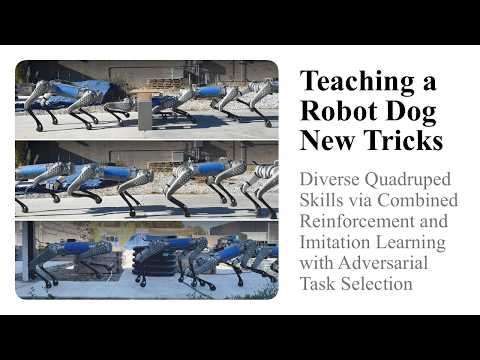
#32024-12-08★ 4k +1874

datawhalechina/every-embodied

Python

仅需Python基础,从0构建自己的具身智能机器人;从0逐步构建VLA/OpenVLA/SmolVLA/Pi0, 深入理解具身智能

仅需Python基础,从0构建自己的具身智能机器人;从0逐步构建VLA/OpenVLA/SmolVLA/Pi0, 深入理解具身智能

embodied-agentembodied-aiembodied-intelligenceopenvlasmolvlavision-language-action-modelVLAvision-language-actionembodied

兴趣:world models and video prediction for embodied agents

#52026-07-19★ 633 +774

RealXiaoze/humanoid-motion-intelligence

人形机器人运动智能论文、开源项目、产业与求职知识库

人形机器人运动智能论文、开源项目、产业与求职知识库

embodied-aihumanoid-roboticslocomotionmotion-controlreinforcement-learningrobot-learningsim2realvlarobotVLAhumanoidlocomotionembodied

兴趣:humanoid robots and whole-body control

#62025-09-22★ 2.7k +3372

NVlabs/LongLive

Python

Long Video Gen / World Model / World Action Model (Embodied) Infrastructure

Long Video Gen / World Model / World Action Model (Embodied) Infrastructure

infralongnvfp4parallelreal-timeroboticsvideo-generationworld-action-modelsembodiedworld model

兴趣:world models and video prediction for embodied agents

#72024-02-29★ 164 +171

RobotControlStack/robot-control-stack

Python

A lean, ROS-free sim-to-real framework for training and deploying Vision-Language-Action (VLA) models and RL agents. Native MuJoCo Gymnasium wrappers with synchronous execution for…

A lean, ROS-free sim-to-real framework for training and deploying Vision-Language-Action (VLA) models and RL agents. Native MuJoCo Gymnasium wrappers with synchronous execution for Franka, UR5e, xArm, SO101 and YAM.

frankagymnasiummujocoreinforcement-learningrobot-learningrobot-manipulationsim-to-realvision-language-actions-modelsrobotmanipulationVLAvision-language-actionsim-to-real

兴趣:vision-language-action (VLA) models and foundation models for robots

#82026-02-08★ 416 +1170

XPolicyLab/XPolicyLab

Python

[IROS 26 ScaleInfra Workshop Best Tool Paper] Involving over 50 Advanced Manipulation Policies

[IROS 26 ScaleInfra Workshop Best Tool Paper] Involving over 50 Advanced Manipulation Policies

embodied-aimanipulationpolicymanipulationembodied

兴趣:robot manipulation and grasping with learned policies

#92024-01-26★ 28k +2570

huggingface/lerobot

Python

🤗 LeRobot: Making AI for Robotics more accessible with end-to-end learning

🤗 LeRobot: Making AI for Robotics more accessible with end-to-end learning

兴趣:imitation learning and diffusion policies for robot control

#102026-07-06★ 2.2k +170

dexmal/opendm

Python

An Open-World Foundation Model for General-Purpose Embodied Intelligence.

An Open-World Foundation Model for General-Purpose Embodied Intelligence.

embodied-aiembodied-intelligenceroboticsvision-language-actionvlaVLAvision-language-actionembodied

兴趣:vision-language-action (VLA) models and foundation models for robots

#112024-12-24★ 38270

manumerous/wb_humanoid_mpc

C++

Whole-Body Nonlinear MPC for Realtime Humanoid Loco-Manipulation Planning and Control

Whole-Body Nonlinear MPC for Realtime Humanoid Loco-Manipulation Planning and Control

aidata-generationhumanoidhumanoid-robotlocomotionmpcnonlinearoptimizationrobotmanipulationhumanoidlocomotion

兴趣:humanoid robots and whole-body control

#122026-08-29★ 115 +469

nssmd/RoboRSI

Python

Robot-agent harness with a CLI and local Web console for LIBERO short evaluation

Robot-agent harness with a CLI and local Web console for LIBERO short evaluation

agentsembodied-aievaluationliberorobot-learningroboticsself-evolutionrobotembodied

兴趣:multi-agent systems and LLM agents

#132026-09-28★ 2.2k +222新项目69

KingKongRobotics/jumper

Python

🦀 Jumper — an crab robot.

🦀 Jumper — an crab robot.

crab-robotrobotroboticsrobot

兴趣:humanoid robots and whole-body control

#142025-08-14★ 5.5k +1169

RLinf/RLinf

Python

RLinf: Reinforcement Learning Infrastructure for Embodied and Agentic AI

RLinf: Reinforcement Learning Infrastructure for Embodied and Agentic AI

agentic-aiembodied-aireinforcement-learningrl-infrarlinfvla-rlVLAembodied

兴趣:vision-language-action (VLA) models and foundation models for robots

#152026-10-04★ 42 +2新项目69

Holiday-Robot/FlashDexRetarget

Python

FlashDexRetarget: Accelerating Dexterous Manipulation Data Generation through Multi-Motion Retargeting

FlashDexRetarget: Accelerating Dexterous Manipulation Data Generation through Multi-Motion Retargeting

dexterous-manipulationreinforcement-learningroboticsrobotmanipulationdexterous

兴趣:robot manipulation and grasping with learned policies

#162024-09-29★ 3.6k +768

enactic/openarm

MDX

A fully open-source humanoid arm for physical AI research and deployment in contact-rich environments.

A fully open-source humanoid arm for physical AI research and deployment in contact-rich environments.

bilateral-teleoperationforce-feedbackgenesisgravity-compensationhumanoid-robotimitation-learningmachine-learningmoveit2robothumanoid

兴趣:humanoid robots and whole-body control

#172025-11-23★ 68568

sou350121/VLA-Handbook

HTML

本项目旨在为致力于进入VLA(Vision-Language-Action)领域的算法工程师提供一份全中文、实战导向的学习/面试手册。 不同于通用的 CV/NLP 面试指南,本项目聚焦于 Robotics 特有的挑战

本项目旨在为致力于进入VLA(Vision-Language-Action)领域的算法工程师提供一份全中文、实战导向的学习/面试手册。 不同于通用的 CV/NLP 面试指南,本项目聚焦于 Robotics 特有的挑战

chinesedeep-learningembodied-aillmrobot-learningroboticsvision-language-actionvlarobotVLAvision-language-actionembodied

兴趣:vision-language-action (VLA) models and foundation models for robots

#182026-10-04★ 52 +13新项目67

PhysicalRSI/PhysicalRSI

Python

preview of PhysicalRSI infra an engine

preview of PhysicalRSI infra an engine

embodied-agentembodied-aiphysical-airoboticsrsiembodied

兴趣:humanoid robots and whole-body control

#192025-04-04★ 1.9k +-167

RoboVerseOrg/RoboVerse

Python

RoboVerse: Towards a Unified Platform, Dataset and Benchmark for Scalable and Generalizable Robot Learning

RoboVerse: Towards a Unified Platform, Dataset and Benchmark for Scalable and Generalizable Robot Learning

imitation-learningreinforcement-learningroboticssimulationrobot

兴趣:imitation learning and diffusion policies for robot control

#202026-09-15★ 154 +16新项目67

1173591564/Dynamics-memory

TypeScript

LLM agent 的有界自纠错长期记忆层:把连续、含矛盾的项目交互日志蒸馏成有界、可自更新的记忆库。Bounded, self-correcting long-term memory for LLM agents — candidate pool + value dynamics + tension adjudication + causal-replay…

LLM agent 的有界自纠错长期记忆层:把连续、含矛盾的项目交互日志蒸馏成有界、可自更新的记忆库。Bounded, self-correcting long-term memory for LLM agents — candidate pool + value dynamics + tension adjudication + causal-replay evals.

agent-memoryagentsllmllm-agentslong-term-memorymemorymemory-managementpythonLLM agent

兴趣:multi-agent systems and LLM agents

#212025-09-09★ 53.2k +21767

bojieli/ai-agent-book

Python

《深入理解 AI Agent:设计原理与工程实践》(李博杰 著)开源主仓库:全书正文、编译版 PDF 与按章配套代码

《深入理解 AI Agent:设计原理与工程实践》(李博杰 著)开源主仓库:全书正文、编译版 PDF 与按章配套代码

agentagent-memoryai-agentbookcoding-agentcontext-engineeringlarge-language-modelsllm

兴趣:multi-agent systems and LLM agents

#222026-08-29★ 85 +167

OpenBMB/SimpleMemVLA

Python

Native-video memory for vision-language-action models, using timestamped visual history and exact streaming inference for long-horizon robot manipulation.

Native-video memory for vision-language-action models, using timestamped visual history and exact streaming inference for long-horizon robot manipulation.

embodied-ailong-horizon-roboticsmultimodal-learningnative-video-memoryrobot-learningrobot-manipulationstreaming-inferencevideo-understandingrobotmanipulationVLAvision-language-actionembodied

兴趣:vision-language-action (VLA) models and foundation models for robots

#232026-03-18★ 66.1k +32967

rohitg00/ai-engineering-from-scratch

Python

Learn it. Build it. Ship it for others.

Learn it. Build it. Ship it for others.

agentsaiai-agentsai-engineeringcomputer-visioncoursedeep-learningfrom-scratch

兴趣:multi-agent systems and LLM agents

#242024-05-11★ 1.8k +766

robocasa/robocasa

Python

RoboCasa: Large-Scale Simulation of Everyday Tasks for Generalist Robots

RoboCasa: Large-Scale Simulation of Everyday Tasks for Generalist Robots

humanoid-robotphysics-simulationrobot-learningroboticsrobothumanoid

兴趣:humanoid robots and whole-body control

#252026-04-22★ 18.6k +26766

earthtojake/text-to-cad

Python

Give your agent CAD superpowers.

Give your agent CAD superpowers.

agentsai-agentscadmechanical-engineeringroboticsstepstlstp

兴趣:multi-agent systems and LLM agents

#262025-09-11★ 7.1k +2066

vllm-project/vllm-omni

Python

A framework for efficient model inference with omni-modality models

A framework for efficient model inference with omni-modality models

audio-generationdiffusionimage-generationinferencemodel-servingmultimodalpytorchtransformer

兴趣:vision-language-action (VLA) models and foundation models for robots

#272026-06-26★ 655 +566

robocurve/inspect-robots

Python

Open source evals for physical AI. Run any LLM/VLA on any arm/humanoid against any real/sim benchmark.

Open source evals for physical AI. Run any LLM/VLA on any arm/humanoid against any real/sim benchmark.

benchmarkembodied-aievaluationphysical-airerunroboticsvision-language-actionvlaVLAvision-language-actionhumanoidembodied

兴趣:vision-language-action (VLA) models and foundation models for robots

#282022-11-16★ 8.3k +565

isaac-sim/IsaacLab

Python

Unified framework for robot learning with multi-physics/renderer support

Unified framework for robot learning with multi-physics/renderer support

isaac-simomniverse-kit-extensionrobot-learningroboticsrobot

兴趣:3D perception, point clouds and scene understanding for robotics

#292025-05-23★ 25465

AoqunJin/Awesome-VLA-Post-Training

A collection of vision-language-action model post-training methods.

A collection of vision-language-action model post-training methods.

embodied-agentembodied-aifine-tuningpost-trainingvision-language-action-modelvlaVLAvision-language-actionembodied

兴趣:vision-language-action (VLA) models and foundation models for robots

#302026-02-24★ 13.7k +26765

cactus-compute/needle

Python

Automation foundation model for tiny devices: 2-bit, 8-29 MB, tool calls, ASR, structured extraction and embeddings on phones, wearables, smart homes, robots, cars and microcontrol…

Automation foundation model for tiny devices: 2-bit, 8-29 MB, tool calls, ASR, structured extraction and embeddings on phones, wearables, smart homes, robots, cars and microcontrollers.

cactusedge-aifoundation-modelfunction-callingllmon-device-aitinymltool-calling

兴趣:vision-language-action (VLA) models and foundation models for robots