Tech Station

2026-10-08

50 篇论文 · 30 个项目 ← 2026-10-07 · 2026-10-09 →

论文

#12026-10-0696

PAIR: Bridging Perception and Action in Vision-Language-Action Models

Kaixi Feng, Guoheng Sun, Ang li

Vision-language-action (VLA) models map visual observations and language instructions to continuous robot actions. This task requires a transition from representations that describ…

Vision-language-action (VLA) models map visual observations and language instructions to continuous robot actions. This task requires a transition from representations that describe the scene and instruction to representations that support action generation. Many continuous-action VLAs leave this transition implicit and supervise it mainly through the final action-prediction loss. We introduce PAIR, a framework that learns a shared perception-action representation between these two spaces. During training, a Masked Action Autoencoder encodes expert action chunks into horizon-aligned Action Latent Tokens. A Bridge Module extracts task-relevant features from the current visual-language representations. PAIR aligns these features with the Action Latent Tokens to form Bridge Tokens that preserve task information and capture the structure of expert actions. The Bridge Tokens are then projected into the action-token space and injected into the initial Action Tokens, providing an action-ready starting point for Action Expert refinement. At inference, the autoencoder is removed, and the Bridge Tokens are generated only from the current observation and instruction. Experiments on LIBERO, LIBERO-Plus, and CALVIN ABC-D show gains for the evaluated OpenVLA-OFT and VLA-Adapter models. On LIBERO-Plus, PAIR raises VLA-Adapter's success rate from 59.1% to 64.2%. On CALVIN, it increases VLA-Adapter's average completed sequence length from 4.42 to 4.53. Across seven real-world tasks, PAIR raises OpenVLA-OFT's success rate from 51.4% to 65.0%. Representation analyses show that Bridge Tokens retain task information while making continuous-action information accessible before Action Expert refinement. These results support a shared intermediate representation as a useful interface between perception and action in continuous-action VLAs.

cs.AIrobotVLAvision-language-action

兴趣:vision-language-action (VLA) models and foundation models for robots

#22026-10-06追踪学者 · Pieter Abbeel追踪学者 · Koushil Sreenath96

Workhorse: Learning Robust Whole-Body Humanoid Loco-Manipulation from Human Data

Songbo Hu, Qiayuan Liao, Yufeng Chi, Kevin Zakka, Yakun Sophia Shao, Pieter Abbeel 等

Humanoid robots still struggle to plan contact-rich whole-body manipulation from egocentric RGB and proprioception. Workhorse learns such manipulation from robot-free human demonst…

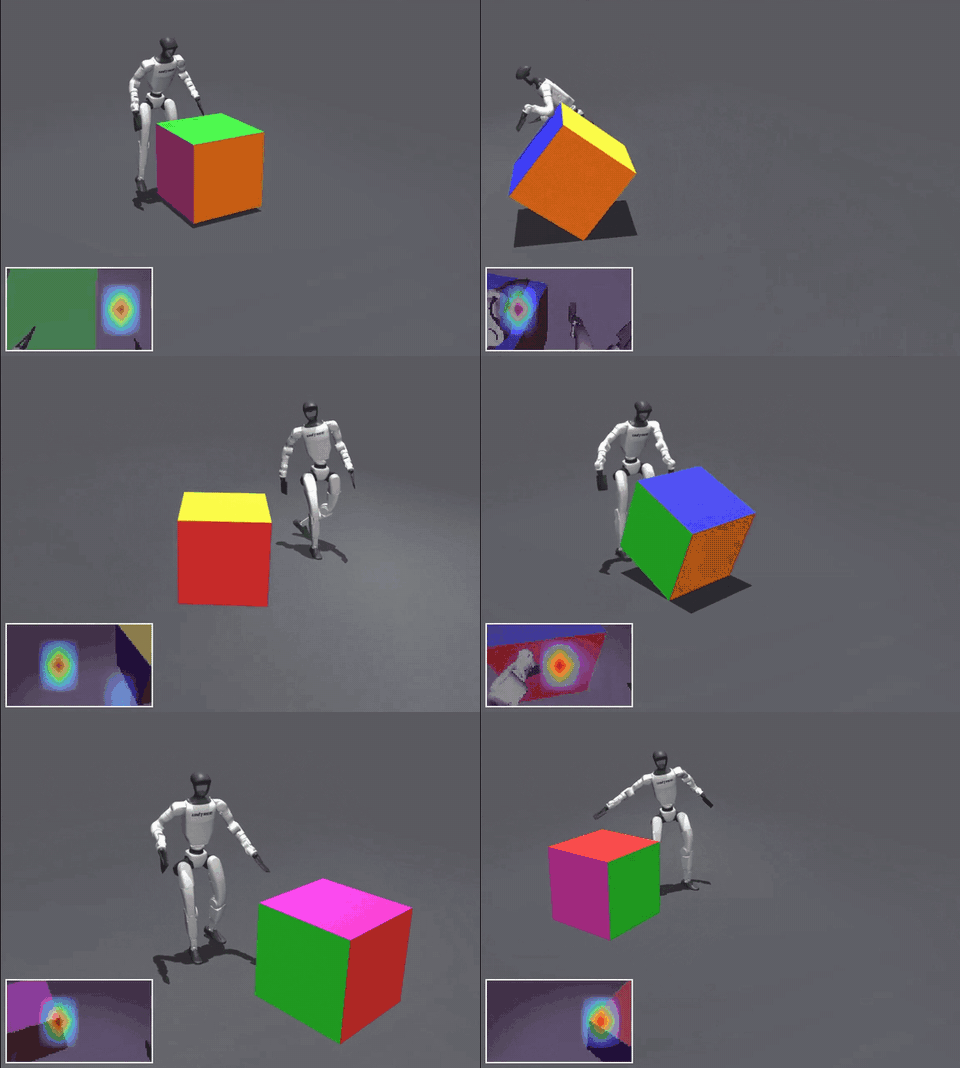
Humanoid robots still struggle to plan contact-rich whole-body manipulation from egocentric RGB and proprioception. Workhorse learns such manipulation from robot-free human demonstrations. A visual planner predicts five-link targets: the poses of the torso, both wrists, and both feet. A reinforcement-learning whole-body tracker follows them on the robot. Both policies train separately on the same recorded human poses, without retargeting. We augment the training data of each policy to imitate the errors that the other makes at deployment. On a real Unitree G1, Workhorse sorts boxes with its hands and a kick, catches a thrown box, and topples and climbs a suitcase. During box sorting, we show recoveries after a person pushes the robot or takes the box away. In a simulated copy of the demonstration room, the system completes box sorting in 77% of episodes, and in 64% under 40 N.s pushes. With both policies retrained from the same demonstrations, a simulated second humanoid completes box sorting in 83% of episodes without pushes.

cs.ROcs.LGrobotmanipulationhumanoid

追踪学者:Pieter Abbeel、Koushil Sreenath;兴趣:humanoid robots and whole-body control

#32026-10-07追踪学者 · Cewu Lu96

RoboPrompt: Intuitive Robot Policy Steering with Sparse Human Input

Yanwen Zou, Chenyang Shi, Guoxuan Xu, Wenye Yu, Wendi Chen, Ye Pan 等

End-to-end robot policies trained through imitation learning remain constrained by limited data diversity, making reliable zero-shot deployment in real-world settings challenging. …

End-to-end robot policies trained through imitation learning remain constrained by limited data diversity, making reliable zero-shot deployment in real-world settings challenging. Shared-autonomy methods enable human correction through teleoperation, but specialized hardware and operator training hinder deployment at scale. Other approaches incorporate human guidance as additional policy inputs, often requiring architectural changes and dedicated training for steerability, which limits their applicability across policies. We present RoboPrompt, a general-purpose, lightweight robot policy steering system that enables users to guide policy behavior through intuitive, sparse inputs, including drawn traces, target points, and coarse directional instructions. RoboPrompt decouples human-intention translation from the underlying policy: a reusable module converts human guidance into action drafts, which are refined through the diffusion or flow-matching dynamics of the base policy. By controlling action generation in noise space, RoboPrompt balances human intent with the policy prior without modifying the base policy architecture or fine-tuning it for steerability. Experiments demonstrate effective steering across Diffusion Policy, $π_{0.5}$, and FastWAM. We further use steered rollouts for online policy improvement through DAgger. After 2-3 rounds of iteration, average success rates increase by 15.5% for $π_{0.5}$ across three tasks and by 21.3% across three policies(Diffusion Policy, $π_{0.5}$, FastWAM) on the Insert Bread task, while average human intervention counts decrease by 44.0% (2.86 to 1.60) and 81.9% (2.60 to 0.47), respectively.

cs.ROrobotimitation learningdiffusion policy

追踪学者:Cewu Lu;兴趣:imitation learning and diffusion policies for robot control

#42026-10-0795

HuMBLE: Human Motion-Driven Behavior Learning for Embodied Locomotion

Mike Zhang, Dongho Kang, Kevin Bergamin, Nicola Burger, Robin Deits, Jonathan Foster 等

Despite recent advances in humanoid locomotion, controllers optimized for command tracking and robustness tend to produce mechanical gaits, whereas controllers tied to human motion…

Despite recent advances in humanoid locomotion, controllers optimized for command tracking and robustness tend to produce mechanical gaits, whereas controllers tied to human motion data often fail to generalize to commands outside the data distribution. This work introduces a learning framework that balances these competing objectives to synthesize real-time steerable, robust, and biomimetic locomotion policies from human data. Using an in-house curated locomotion dataset covering diverse speeds and directions, we first learn a natural locomotion prior policy through a teacher-student distillation process. Specifically, we train a full-body reference-conditioned policy with Reinforcement Learning (RL), then distill it into a lightweight prior policy conditioned solely on proprioception and a planar torso-velocity steering command. Next, we fine-tune the prior policy with multi-task RL to expand command coverage and robustness beyond the data distribution, pairing a goal-conditioned task that tracks arbitrary commands with a reference-guided task that tracks the human data as an explicit style regularizer. We validate our framework on three humanoid robots: the Boston Dynamics Atlas R1, Atlas D1, and Unitree G1. Experimental results demonstrate robust performance across real-world scenarios, including direct user-controlled locomotion in indoor and outdoor environments, and integration as the locomotion layer within hierarchical control stacks. Benchmarks against Tabula Rasa RL policies trained without human data and ablation studies confirm that our framework yields a lightweight, deployable policy that reconstructs coordinated whole-body behavior from a steering command, retaining the human gait characteristics while remaining robust and fully steerable.

cs.ROhumanoidlocomotionembodied

兴趣:reinforcement learning for legged locomotion and sim-to-real transfer

#52026-10-0794

Immiscible Diffusion Policy: Preserving Multimodal Robot Actions through Label-Free Noise Assignment

Xiao Zhang, Yuxin Chen, Zhixuan Liang, Guojian Zhan, Chenran Li, Chenfeng Xu 等

When diffusion policies were first introduced, they were expected to recover multi-modal action distributions. However, we find this expectation does not always hold, as diffusion …

When diffusion policies were first introduced, they were expected to recover multi-modal action distributions. However, we find this expectation does not always hold, as diffusion policies often collapse to a single modality even when we guarantee the balance of dataset modalities and exact within-batch symmetry. Our analysis indicates that independent action-noise pairing contributes to this failure by increasing mixing and crossing among diffusion paths, which can produce averaged denoising responses and suppress modality-specific behavior. This issue is especially severe in robot planning, where action spaces are dense and low-dimensional, significantly increasing such mixing and crossing. To alleviate this problem, we propose Immiscible Diffusion Policy, a label-free training-time add-on to diffusion policy that uses action-noise assignment to preserve relatively distinct noise-to-action routes without modifying the policy architecture or inference procedure. Across five simulated and two real-world humanoid manipulation tasks spanning state, RGB, and point-cloud observations, our method significantly improves the policy's preservation of action modalities while maintaining strong task performance. It increases the proportion of the non-dominant modality by 6.0x-14.6x across three two-modality tasks and recovers demonstrated modalities that are entirely absent from vanilla policy rollouts on both four-modality tasks. These results demonstrate that Immiscible Diffusion Policy provides a simple yet robust approach to preserving action multi-modality in general robot learning tasks.

cs.ROcs.LGrobotmanipulationdiffusion policyhumanoid

兴趣:imitation learning and diffusion policies for robot control

#62026-10-0794

Temporal Visuo-Tactile Learning for Dexterous Grasp Stability

Ken Nakahara, Aleksei Buvailik, Prokhor Kotov, Roberto Calandra

Humans can grasp everyday objects with almost perfect success rates using fingertip tactile feedback, yet much of the robotic grasping literature emphasizes vision-based grasp sele…

Humans can grasp everyday objects with almost perfect success rates using fingertip tactile feedback, yet much of the robotic grasping literature emphasizes vision-based grasp selection with parallel grippers. In this work, we systematically investigate how high-resolution, dynamic tactile sensing contributes to grasp stability prediction and model-guided grasping in dexterous robotic hands. To this end, we collected a dataset of 10,000 grasp trials across 200 objects using a multi-fingered robotic hand equipped with four Digit 360 tactile sensors, recording external vision, proprioception, and tactile streams throughout each grasp. With this dataset, we trained end-to-end temporal multimodal models to predict post-lift stability from pre-lift grasp observations and compared sensing modalities and encoding backbones. Experimental results and controlled input ablations show that incorporating touch, and particularly high-resolution, dynamic touch, improves grasp stability prediction. Finally, we deployed the learned predictor as an online stability gate on the real robot, where visuo-tactile model-guided regrasping improved the success rate among executed lifts by 10.5 percentage points over a non-tactile gate. These results show how rich fingertip sensing and expressive temporal models that capture the dynamics of touch can support learned grasping with multi-fingered hands without explicit contact or force modeling, providing a scalable data-driven path from tactile experience toward stable dexterous manipulation. The dataset is publicly available at https://lasr-lab.github.io/dexterous-grasp-stability/.

cs.ROcs.CVcs.LGrobotmanipulationgraspdexteroustactile

兴趣:dexterous hands and tactile sensing

#72026-10-0793

Juno: Taming Predictive Latents for Vision-Language-Action Models

Yuchen Zhu, Chenyi Xu, Yulin Zhang, Gang Xu, Wentao Zhu

Joint-embedding predictive architectures (JEPAs) predict masked or future observations in representation space, offering a natural source of predictive latents for vision-language-…

Joint-embedding predictive architectures (JEPAs) predict masked or future observations in representation space, offering a natural source of predictive latents for vision-language-action (VLA) models. Yet making these latents useful across pretraining, policy learning, and deployment requires addressing three failures: mismatch with embodiment-specific control, interference with action learning, and teacher miscalibration under distribution shifts. We introduce Juno, a unified framework built around one action-conditioned JEPA that serves as a control-aligned representation backbone, a predictive teacher, and an adaptable dynamics model. During pretraining, we train it on embodiment-matched trajectories and use a dynamic CLS loss to transfer motion-weighted patch dynamics to a compact global state. During policy learning, we fuse current-frame JEPA patches into VLA perception and use a decoupled reasoning branch with separate transformation parameters to distill future latent states for action generation. During deployment, we adapt the world model on all observed transitions, including failed rollouts, freeze the adapted teacher, and re-align the policy on verified executions using LoRA adapters and a trainable action head, without expert corrections or task rewards. On SimplerEnv, Juno raises average success from $60.9%$ to $68.5%$ over Qwen3GR00T, the strongest baseline, and test-time adaptation further reaches $72.7%$; on a real robot, it retains $70%$--$75%$ success under background, height, and object shifts where the base policy collapses to $0%$.

cs.ROcs.CVrobotVLAvision-language-actionworld model

兴趣:vision-language-action (VLA) models and foundation models for robots

#82026-10-0793

TempoBridge: Language-Guided Tempo Control for Vision-Language-Action Policies

Yeonseo Lee, Hyosup Shin, Guebin Hwang, Sungho Jo

Vision-Language-Action (VLA) models are effective at understanding what task to perform, but provide limited control over how it should be executed, such as moving quickly or slowl…

Vision-Language-Action (VLA) models are effective at understanding what task to perform, but provide limited control over how it should be executed, such as moving quickly or slowly. We introduce TempoBridge, a lightweight framework that uses frozen VLA representations to modulate actions according to tempo cues in the instruction at each task phase, without additional tempo-conditioned robot demonstrations or tempo-specific base-policy fine-tuning. TempoBridge extracts tempo cues from contextual VLM representations, aligns them with task progress through a causal phase router, and modulates nominal motion commands during execution. Across LIBERO tasks, TempoBridge improves Tempo Success Rate from 52.6% to 89.7% under canonical tempo instructions while retaining high task success. It also preserves near-baseline performance when no tempo cue is present and generalizes to unseen tempo expressions without additional training. Experiments on a physical robot further demonstrate language-conditioned tempo modulation in real-world manipulation.

cs.ROrobotmanipulationVLAvision-language-action

兴趣:vision-language-action (VLA) models and foundation models for robots

#92026-10-0692

From Wearable Interfaces to Dexterous Policies: Contact Shifts and Tactile Representations

Ruitong Tian, Fang Xu, Noah B. Wilson, Xianyao Li, Eric Jing Du

Unlike conventional teleoperation, wearable interfaces allow operators to collect dexterous demonstrations through their own hand motions while directly interacting with task objec…

Unlike conventional teleoperation, wearable interfaces allow operators to collect dexterous demonstrations through their own hand motions while directly interacting with task objects. This direct interaction reduces dependence on the target robot during collection, but it also makes the collection hardware part of the physical process that generates each demonstration. Interface geometry can influence both how a task is performed and what tactile observations are recorded for learning. We study two versions of a DexUMI-family exoskeleton that share the same robot command definition, mapping procedure, and tactile module type but differ in hand-side geometry. The revised interface reduces reported physical demand, improves selected device ratings, enables tactile access in a precision grasp that is mechanically blocked by the baseline, and produces task-dependent changes in recorded contact. Lid twisting primarily exhibits a change in contact location, whereas egg carton opening primarily exhibits a change in contact occurrence. We then train matched policies using either a binary aggregate input or a spatial-plus-force input. On lid twisting and egg carton opening, policies trained on revised-interface demonstrations achieve higher success than those trained on baseline demonstrations, with a significant pooled interface effect. Across these and two additional tasks, USB insertion and soldering tool pick and place, the spatial-plus-force input likewise outperforms binary aggregation. These results show that wearable collection hardware is part of the data-generation process for robot learning. Such interfaces should therefore be evaluated not only through operator experience, but also through the tactile interactions they make recordable and the policy performance their demonstrations support.

cs.ROrobotgraspdexteroustactile

兴趣:dexterous hands and tactile sensing

#102026-10-07追踪学者 · Li Fei-Fei追踪学者 · Jiajun Wu91

RoboRender: Robot-Oriented Video Generation for Visual Sim-to-Real Transfer

Huang Huang, Wensi Ai, Ziyu Chen, Youhui Wang, Zijian Du, Yang Liu 等

Simulation enables large-scale, low-cost robot data generation, but policies trained in simulation often fail to transfer to the real world due to the sim-to-real visual discrepanc…

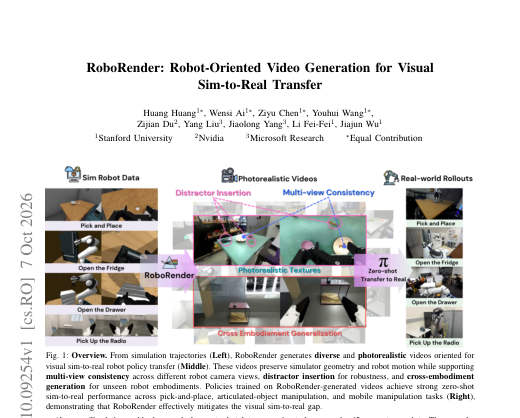
Simulation enables large-scale, low-cost robot data generation, but policies trained in simulation often fail to transfer to the real world due to the sim-to-real visual discrepancies. Existing approaches often rely on intermediate representations, which can discard rich semantic information or require additional perception modules at deployment. We address this visual sim-to-real gap with RoboRender, a framework that converts simulated trajectories into photorealistic RGB videos for policy learning. RoboRender trains a robot-oriented video generation model conditioned on simulated depth videos, language instructions, and robot RGB mask videos, preserving simulator geometry, robot motion, and action labels while synthesizing realistic textures, backgrounds, and distractors. The generated RGB videos are paired with simulator-provided states and actions to train policies for zero-shot real-world deployment. On robot video test sets, our video model outperforms depth-conditioned video generation baselines in generation quality. In real-world experiments across pick-and-place, articulated-object manipulation, and mobile manipulation tasks, policies trained on RoboRender-generated data achieve a 71% average success rate, outperforming raw simulation renderings and conventional visual domain randomization by approximately 7.1x and 3.6x, respectively. We further show that policy performance improves with more generated videos per simulation trajectory, increasing opening-task success by 65 percentage points. These results demonstrate that generative video rendering mitigates the visual sim-to-real gap for zero-shot policy transfer. Project website: https://robo-render.github.io/.

cs.ROrobotmanipulationsim-to-real

追踪学者:Li Fei-Fei、Jiajun Wu;兴趣:imitation learning and diffusion policies for robot control

#112026-10-0591

CIRRA: Dual-Level Continual Instruction Reconciliation with Ongoing Execution for Embodied Robot Agents in Interactive Household Tasks

Ci Zhang, Enfu Nan, Arman Akbari, Lin Zhao, Li Wang, Chen Wang 等

Household robots must accommodate new user instructions while executing ongoing tasks. Existing agents often regenerate or extensively revise the remaining task sequence, introduci…

Household robots must accommodate new user instructions while executing ongoing tasks. Existing agents often regenerate or extensively revise the remaining task sequence, introducing plan ambiguity, logical inconsistency, and redundant execution. We formulate continual instruction reconciliation and propose CIRRA (Continual Instruction Reconciliation for Robot Agents), a dual-level framework combining LLM-based semantic reasoning with rule-constrained structural integration. CIRRA first grounds incoming instructions to unique executable skills and resolves underspecified actions and execution locations. It then preserves the ongoing subtask sequence as an execution backbone and generates integration candidates by inserting incoming subtasks into location-matched segments. The semantic reasoner evaluates only modified segments to identify dependencies and conflicts and select the most logically coherent local integration. This structure-preserving process maintains alignment with ongoing execution, mitigates ambiguity and inconsistency, and reuses shared subtasks to reduce redundant execution. We also introduce CHIRP (Continual Household Instruction Reconciliation and Planning), a text-based benchmark of 120 episodes across eight household environments and six categories of everyday activities. On CHIRP, CIRRA achieves 74.2% decision agreement, exceeding the strongest replanning baseline by 30 percentage points; every correct fusion decision yields a correctly placed, conflict-free schedule. On a Unitree G1 humanoid, CIRRA interrupts ongoing skills at the correct moment in every trial and significantly outperforms all baselines on every metric.

cs.ROcs.CVrobothumanoidembodied

兴趣:large language models for robot task planning and reasoning

#122026-10-07追踪学者 · Guanya Shi追踪学者 · Koushil Sreenath90

Precise SE(3) End-Effector Tracking in Whole-Body Humanoid Control

Joohwan Seo, Xiaofeng Guo, Jinkun Cao, Roberto Horowitz, Rocky Duan, Guanya Shi 等

Precise end-effector tracking during humanoid whole-body motion is challenging due to floating-base oscillations, gravity, dynamic coupling, and locomotion-induced disturbances. We…

Precise end-effector tracking during humanoid whole-body motion is challenging due to floating-base oscillations, gravity, dynamic coupling, and locomotion-induced disturbances. We propose ResGAC, a whole-body humanoid controller for precise end-effector pose tracking that combines geometric admittance control (GAC) with residual reinforcement learning. GAC provides structured $\SE$ task-space feedback and generates nominal arm joint-position targets, while residual RL compensates for unmodeled dynamics and coordinates locomotion and balance in the shared joint-position action space. The left-invariant geometric formulation allows the same GAC law to be used across manipulation reference frames. This enables the use of a ground-attached heading frame that preserves planar locomotion while removing pelvis roll, pitch, and heave from the manipulation reference, thereby reducing reference-induced end-effector motion during locomotion. ResGAC is validated on a real Unitree G1 humanoid. Across four standing end-effector tracking benchmarks, ResGAC consistently outperforms representative baselines, including SONIC, achieving lower translational and rotational errors. Real-world experiments further demonstrate reduced propagation of pelvis motion to the desired end-effector pose using the proposed ground-attached heading frame. ResGAC achieves $90%$ success in a standing peg-in-hole task compared with $50%$ for SONIC, and accurate world-frame $\SE$ end-effector pose tracking during lower-body motion. Experimental videos are included in the supplementary material and are also available on the project website: https://resgac.github.io/ResGAC-website/.

cs.ROeess.SYmanipulationhumanoidlocomotion

追踪学者:Guanya Shi、Koushil Sreenath;兴趣:humanoid robots and whole-body control

#132026-10-06追踪学者 · Jiajun Wu90

Co-Evolving Robot Orchestrators and Policies through Deployment

Xilun Zhang, Maggie Wang, Erik Bauer, Hong-Xing Yu, Huang Huang, Jiajun Wu 等

Vision-language-action (VLA) policies trained on large datasets are capable within their training domains, yet they still fail to generalize to the variety of situations a robot me…

Vision-language-action (VLA) policies trained on large datasets are capable within their training domains, yet they still fail to generalize to the variety of situations a robot meets in real-world deployment. Agentic robot systems complement the policy with a vision-language model (VLM) orchestrator that learns when to call the policy, how to instruct it, and when to use scripted skills instead. However, because the harness is built around a frozen policy that has limited language steerability, the orchestrator can avoid the policy's failures but never overcome them. The policy becomes the bottleneck of the whole system. Fine-tuning the policy can remove this bottleneck, but updating it alone decouples it from an orchestrator tuned to its old behavior. We propose Robo-COP, in which the orchestrator and policy co-evolve during deployment. Robo-COP curates skill demonstrations from its own executions, fine-tunes the policy when this data can address recurring failures, and adopts each new policy only after it improves the skills it was trained for. Across ten simulated RoboLab tasks, Robo-COP raises mean held-out success from 64.8% to 73.8% over the same harness with a frozen policy, while fine-tuning on a fixed schedule without verification reaches only 65.8%. On three real-world tasks, Robo-COP raises held-out success from 38.3% to 50.0%. Robo-COP turns deployment into a self-improving flywheel in which robots learn by doing, with each improvement in execution producing better data for the next round of learning. Videos and code are available at https://robo-cop.pages.dev/.

cs.ROeess.SYrobotVLAvision-language-action

追踪学者:Jiajun Wu;兴趣:vision-language-action (VLA) models and foundation models for robots

#142026-10-0790

Contact-Aware Imitation Learning Through Contact Factorization

Jiho Hong, Daeun Song, Sanghyun Kim, Mingyo Seo

Generalizable contact-rich manipulation requires robots to preserve intended task behavior while adapting its physical realization to changing contact conditions. However, interact…

Generalizable contact-rich manipulation requires robots to preserve intended task behavior while adapting its physical realization to changing contact conditions. However, interaction forces can vary substantially with small changes in surface geometry, orientation, and friction, making policies trained directly on raw force measurements difficult to transfer beyond demonstrated conditions. We introduce FACE, a contact-factorized imitation learning framework that separates intended task behavior from environment-dependent contact factors. Our representation expresses interaction forces in normalized, contact-relative coordinates, while a learned contact-normal estimator and an online friction estimator infer the local contact normal and effective friction scale. Together, these estimators enable force observations to be encoded and policy outputs to be decoded into physical motion and force commands during execution. In this way, FACE adapts execution to current contact conditions while preserving the intended task behavior, without updating the policy parameters. We evaluate FACE on real-robot contact-rich manipulation under unseen variations in surface properties and geometry, demonstrating robust generalization across contact conditions through controlled comparisons with variants that adapt prior approaches to our setting. Videos and additional materials can be found on the project page: https://rcilab.khu.ac.kr/face.

cs.ROrobotmanipulationimitation learning

兴趣:robot manipulation and grasping with learned policies

#152026-10-0790

Energy-Efficient Gait Adaptation via Hierarchical Reinforcement Learning for Quadrupedal Locomotion Across Diverse Terrains

Ammar Issa, Anubhav Singh, Anton Tsaritsin, Sergey Kolyubin

While energy efficiency is a critical objective for legged-robot locomotion control, achieving low energy consumption while maintaining robust performance across different velocity…

While energy efficiency is a critical objective for legged-robot locomotion control, achieving low energy consumption while maintaining robust performance across different velocity ranges and terrain conditions remains a key challenge. This is particularly true for end-to-end RL policies, where gait generation, motion execution, and energy optimization are tightly coupled, leading to high sensitivity to reward design. In this work, we propose a hierarchical reinforcement learning (HRL) framework that separates a high-frequency policy for stable and robust joint-level motion execution from low-frequency gait adaptation that explicitly minimizes the cost of transport (CoT). The three-stage Isaac-based training procedure enables zero-shot sim-to-real transfer with improved tracking accuracy, robustness, and energy efficiency. The learned hierarchy exhibits automatic speed-dependent gait adaptation, transitioning from pacing at low speeds to trotting at higher speeds. We validate the proposed approach in simulation against representative single-policy and hierarchical locomotion baselines, demonstrating reduced CoT over a broad range of commanded velocities, while maintaining robust locomotion across flat, uneven rough, and inclined terrains. We further demonstrate its practical feasibility through zero-shot deployment on a physical Unitree AlienGo quadruped.

cs.ROcs.LGrobotleggedlocomotionsim-to-real

兴趣:reinforcement learning for legged locomotion and sim-to-real transfer

#162026-10-0789

OpenViTac: Learning and Benchmarking Visuo-Tactile Policies in a Unified Sim-and-Real Framework

Yifan Wu, Qin Li, Nan Min, Guojin Zhong, Haoyu Zhao, Zhiyuan Li 等

Tactile feedback provides embodied agents with physical information beyond visual observations, enabling more reliable interaction with the real world. However, despite the rapid p…

Tactile feedback provides embodied agents with physical information beyond visual observations, enabling more reliable interaction with the real world. However, despite the rapid progress of vision-tactile-language-action (VTLA) policies, there remains a lack of unified benchmarks for evaluating tactile-enabled robot manipulation across simulation and the real world. To address this gap, we introduce OpenViTac, a visuo-tactile manipulation benchmark for evaluating robot policies across simulation and the real world. OpenViTac organizes contact-rich manipulation into four tactile-relevant capability dimensions and provides paired simulation-real-world settings for consistent evaluation of VLA, WAM, and VTLA policies. Building upon this benchmark, we investigate how different tactile representations and integration strategies affect the performance of pretrained VLA models. Correspondingly, we introduce OpenVTLA, a tactile augmentation framework that combines the best-performing representation and integration strategy. Furthermore, we leverage the paired benchmark setting to study sim-real co-training and analyze factors affecting cross-domain policy learning. Together, OpenViTac provides a unified platform for evaluating and advancing visuo-tactile robot manipulation.

cs.ROrobotmanipulationVLAembodiedtactile

兴趣:robot manipulation and grasping with learned policies

#172026-10-0789

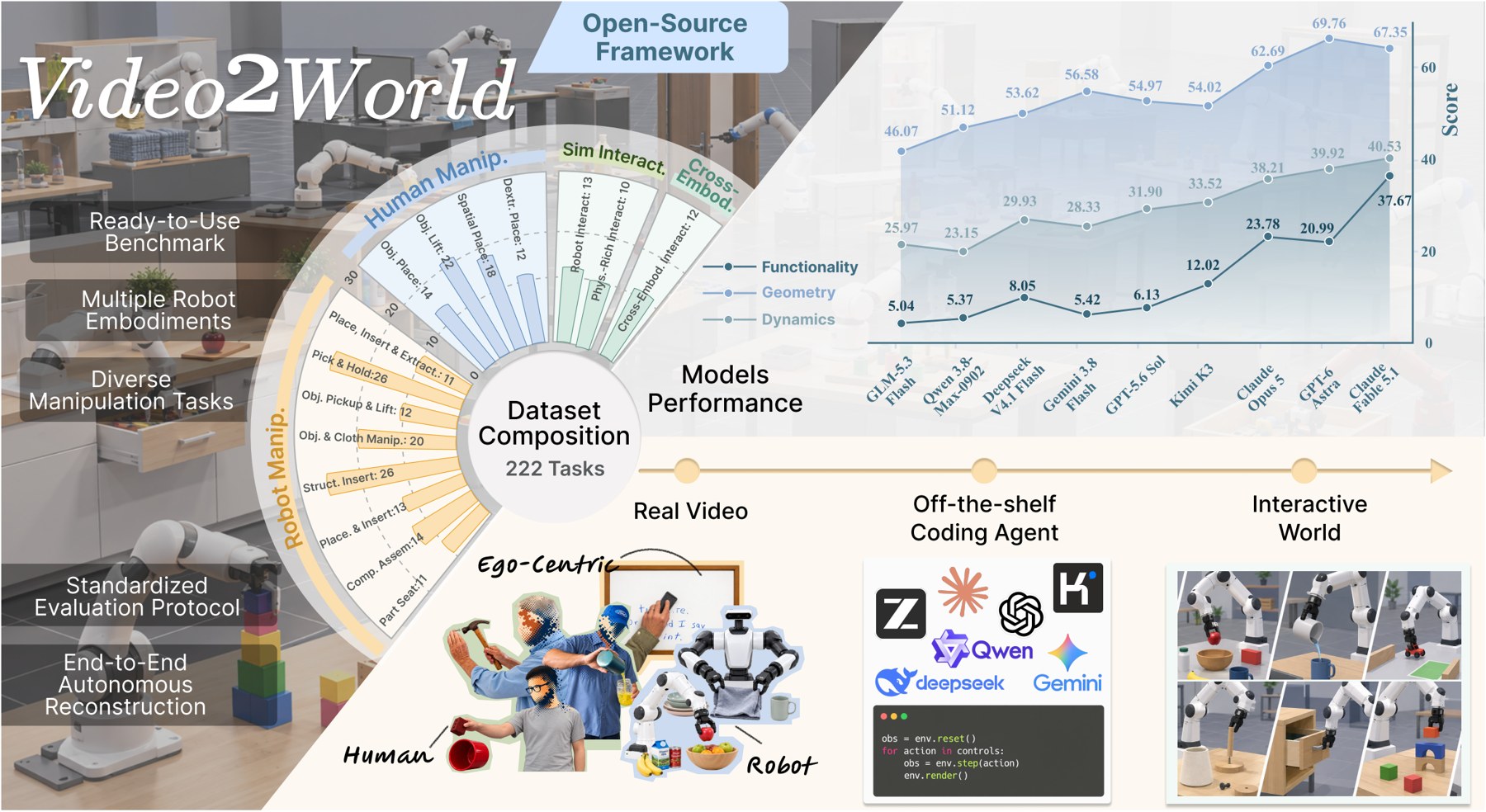
RobotWorld: Benchmarking Multimodal Agents for Robot Use Across Diverse Tasks and Embodiments

Zhiqin Yang, Chenxin Li, Xiaomeng Hu, Yibin Liu, Weidong Huang, Jiankai Sun 等

General-purpose agents increasingly write code, use tools, and complete complex digital tasks, raising the question of how far these capabilities carry into the physical world. To …

General-purpose agents increasingly write code, use tools, and complete complex digital tasks, raising the question of how far these capabilities carry into the physical world. To investigate this, we introduce RobotWorld, a challenging simulation testbed for robot use: turning instructions and observations into physical task execution through robot interfaces. Its 84 tasks span manipulation, mobile manipulation, locomotion, driving, and aerial control, with explicit interaction budgets and executable success checks. By analysing task outcomes alongside execution traces, we identify both the capabilities that transfer and the gaps that prevent reliable completion. Furthermore, we find that current agents can construct sophisticated perception and control workflows, including image segmentation, camera calibration, spatial estimation, and dynamics-based computation. These capabilities, however, do not consistently compose into successful behaviour: agents lose task-relevant object states despite reaching commanded poses, fail to correct ineffective actions, recover too late, or mistake unfinished tasks for completion. This uneven transfer also differs across models: Astra succeeds more often on spatial and constrained-contact goals, whereas Opus 5.5 succeeds more often on continuous-balance and timed-interaction goals. By linking these outcomes to execution behaviour, RobotWorld provides both a rigorous proving ground and an empirical account of the remaining capability gaps, thereby establishing concrete targets for training and designing more reliable physical-world agents.

cs.ROcs.LGrobotmanipulationlocomotion

兴趣:world models and video prediction for embodied agents

#182026-10-0789

YUBI-STAG: Contact and Semantic-Rich Alignment for VLAs via Automated Video-Language Grounding

Masatoshi Tateno, Takehiko Ohkawa, Yueh-Hua Wu, Hanlong Li, Tatsuya Matsushima, Yoichi Sato 等

Vision-Language-Action (VLA) models acquire broad manipulation capabilities via large-scale pretraining, yet eliciting them through language requires fine-grained alignment between…

Vision-Language-Action (VLA) models acquire broad manipulation capabilities via large-scale pretraining, yet eliciting them through language requires fine-grained alignment between instructions and physical interactions. Existing robot demonstrations typically provide only coarse task descriptions, omitting how actions are executed, including which gripper acts, which object is contacted, and how it is grasped and moved. We introduce YUBI-STAG, a framework for Spatio-Temporal Annotation and Grounding that automatically enriches manipulation demonstrations with interaction-rich semantics to align pretrained VLAs with fine-grained manipulation language. Combining contact-object segmentation with vision-language models, YUBI-STAG annotates object identities, attributes and states, per-gripper actions, bimanual coordination, and spatially grounded interactions. To address YUBI-STAG's reliance on localized sequences and multi-stage VLM inference, we distill it into YUBI-VLM. YUBI-VLM directly recovers action structure and annotations from raw, unsegmented video in few inference calls and operates from wrist views alone. We evaluate both frameworks on YUBI-STAG-Bench across temporal, semantic, and spatial grounding tasks. YUBI-VLM retains much of YUBI-STAG's annotation accuracy with fewer inference calls and shorter runtime while generalizing to unseen manipulations. Finally, post-training VLA policies on these annotations aligns them with fine-grained language and contact-aware structure. Bimanual experiments demonstrate improved performance and instruction following, including control over object identity, acting gripper, target location, and spatial relations absent from original labels.

cs.ROcs.CVrobotmanipulationVLAvision-language-action

兴趣:vision-language-action (VLA) models and foundation models for robots

#192026-10-0789

RoboPace: Contact-Aware Time-Optimal Retiming for Action-Chunk Policies

Mimo Shirasaka, Takehiko Ohkawa, Takuya Okubo, Nicola Scianca, Tatsuya Matsushima, Kei Ota

Robot manipulation data collection has been shifting from teleoperation toward robot-free demonstrations, through interfaces such as the Universal Manipulation Interface (UMI) or d…

Robot manipulation data collection has been shifting from teleoperation toward robot-free demonstrations, through interfaces such as the Universal Manipulation Interface (UMI) or directly from human hands. Vision-Language-Action (VLA) policies trained on such data inherit the demonstrator's timing. Yet human timing does not directly transfer to robots: compliant hands tolerate fast contact, whereas robots may overshoot due to actuator and tracking limitations; conversely, robots can move faster in free space. This motivates a unified approach that reconciles execution speed with contact safety. We present RoboPace, an online retiming layer that preserves the policy's geometric path while adapting its timing, respecting the target robot's kinematic and dynamic constraints. It adapts execution speed based on predicted contact, jointly accounting for contact-dependent speed limits and the robot's motion constraints. The method requires no policy retraining and operates in real time. Across three contact-rich tasks on a dual-arm robot, faster uniform execution and physical-limit-only retiming largely fail. RoboPace instead achieves higher overall success than slow uniform execution while completing four of five commands in approximately half the time, retaining the reliability of slow execution without its time cost.

cs.ROrobotmanipulationVLAvision-language-action

兴趣:robot manipulation and grasping with learned policies

#202026-10-0788

Sparse Feature Policy Unlearning Mitigates State Hallucination in Vision-Language-Action Models

Jiho Lee, Jeongeun Park, Heayoun Choi, Taekyung Kim, Eunwoo Kim

Vision-Language-Action (VLA) models have shown strong generalization in robotic manipulation by leveraging rich representations from pretrained vision-language models. However, the…

Vision-Language-Action (VLA) models have shown strong generalization in robotic manipulation by leveraging rich representations from pretrained vision-language models. However, their deployment in real-world environments remains limited by recurring unreliable behaviors. In this work, we study state hallucination, a recurring failure pattern in which a VLA continues acting as if an unrealized robot-object state had been achieved. Our analyses find that state hallucination coincides with weakened attention to task-relevant visual regions, and a mechanistic interpretation via sparse autoencoders reveals that hallucination-associated sparse features are activated when these failures occur. Based on this analysis, we propose SOUL (Sparse feature pOlicy UnLearning), which selectively unlearns policy knowledge associated with state hallucination behaviors, where sparse features identified from hallucination failures and successful behaviors serve as explicit forgetting and retention targets, respectively. Experiments across VLA architectures in simulated and real-world environments show that our method substantially reduces hallucinated failures and improves task success without substantially compromising the existing manipulation capabilities. These results suggest that interpretable feature analysis provides a practical basis for selectively modifying undesirable knowledge in robot policies.

cs.ROcs.AIcs.LGrobotmanipulationVLAvision-language-action

兴趣:vision-language-action (VLA) models and foundation models for robots

#212026-10-0688

HULK: Learning Whole-Body Forceful Loco-Manipulation for Humanoids

An Dang, Arturo Flores Alvarez, Yu-Ming Chen, Conor Mc Gartoll, Helen Sun, Aaron Ames 等

Humanoid loco-manipulation of large, heavy objects demands forceful interaction across the entire body. However, such payloads shift a humanoid's center of mass and impose sustaine…

Humanoid loco-manipulation of large, heavy objects demands forceful interaction across the entire body. However, such payloads shift a humanoid's center of mass and impose sustained loads across the upper body, challenging balance and command tracking. We present HULK, a whole-body control framework for forceful loco-manipulation. Using model predictive control (MPC) to guide reinforcement learning with predictions of the loaded dynamics, we train two teachers: one tracks arm motions under wrist forces, and the other locomotes while holding large objects against the body. A capture-point control barrier function augments the wrist-force teacher during training to improve balance under load. We distill both teachers into a single policy. Evaluation spans simulation and the Unitree G1. In simulation, the teacher with the barrier function achieves the lowest forward and lateral velocity tracking errors at 10 kg per arm among evaluated controllers and reduces aggregate divergent component of motion (DCM) excursion magnitude by 35.7% relative to MPC-guided reinforcement learning alone. Our wrist-force teacher withstands torso push disturbances of up to 130 N.

cs.ROcs.LGmanipulationhumanoid

兴趣:humanoid robots and whole-body control

#222026-10-0787

ΔWAM: Distilling Action Tangent Fields into World Action Models

Ke Wu, Hanwen Huang, Bo Gu, Kaizhao Zhang, Xiangting Meng, Yupeng Zheng 等

World Action Models (WAM) improve robot policies by augmenting sparse action supervision with dense future prediction. However, much of the predictable future is dominated by appea…

World Action Models (WAM) improve robot policies by augmenting sparse action supervision with dense future prediction. However, much of the predictable future is dominated by appearance and scene persistence rather than action-dependent dynamics. We observe that several recent WAM designs, including optical flow, motion-centric representations, and latent actions, can be understood from a common perspective in which world supervision becomes more efficient as it contains a higher proportion of action-relevant variation. Based on this insight, we introduce Action Tangent Fields, which reformulate world supervision through a local Taylor expansion of how actions induce changes in future dynamics. We represent future dynamics in Residual-VAE space, where the future latent remains recoverable from the current latent and its residual, and use a strong action-conditioned world model (ACWM) to probe the local correspondence between action variations and residual-world variations. This local first-order structure is distilled into the WAM to guide its denoising supervision toward dynamics that are more tightly coupled to action, rather than merely predictable from appearance. Across LIBERO-Plus, RoboTwin, and RoboTwin2.0-Plus, our method consistently improves robustness to lighting, background, camera, layout, and other environmental perturbations. Despite using no large-scale embodied pretraining, it achieves stronger robustness under several distribution shifts than pretrained policies. We further distill multi-step VideoDiT denoising into a single step for efficient inference. Our results suggest that effective WAM supervision should remain information-rich while concentrating its predictive capacity on the directions along which actions change the future.

cs.ROrobotembodiedworld model

兴趣:world models and video prediction for embodied agents

#232026-10-0687

DIVA: Dual-Space Intent-Aware Visual Attenuation for Vision-Language-Action Policies

Kaixi Feng, Guoheng Sun, Ziyao Wang, Yexiao He, Zheyu Shen, Ang Li

Vision-language-action (VLA) policies typically feed dense visual patch tokens into a language-action backbone, preserving scene context but offering no explicit mechanism to regul…

Vision-language-action (VLA) policies typically feed dense visual patch tokens into a language-action backbone, preserving scene context but offering no explicit mechanism to regulate how strongly different visual tokens influence policy computation. We introduce DIVA, a Dual-Space Intent-Aware Visual Attenuation module with an anchor-then-attenuate design. DIVA combines high-level task intent with low-level visual evidence to estimate patch-wise relevance anchors, then applies them in two complementary spaces: it reweights projected visual tokens before backbone entry and persistently attenuates low-relevance visual states within the backbone. DIVA preserves the full visual token sequence and requires no external grounding supervision. On LIBERO, DIVA improves OpenVLA-OFT from 96.6% to 98.0% average success and raises its zero-shot LIBERO-Plus score from 69.6 to 72.6. Real-world experiments further show consistent gains under task-irrelevant visual perturbations, supporting the robustness of intent-aware visual attenuation beyond simulation.

cs.AIVLAvision-language-action

兴趣:vision-language-action (VLA) models and foundation models for robots

#242026-10-0787

Predicted Futures Are Not Enough: Learning Executable Goals for Robot Manipulation

Tzu-Yu Chuang, Ching-Hsiang Chang, Yi-Hsiu Lee, Yi-Ting Chen, Min Sun, YuanFu Yang

Generative world models provide rich predictions of how manipulation scenes may evolve toward task objectives, yet those futures do not directly expose the compact task variables r…

Generative world models provide rich predictions of how manipulation scenes may evolve toward task objectives, yet those futures do not directly expose the compact task variables required by control. When training supervises future prediction alone, terminal goal accuracy is not an explicit learning objective, even when geometric recovery is available. We present Entity-Level Goal Readout, a learned prediction-to-execution interface that makes the executable terminal goal an explicit output of a 3D trace world model. It combines object-centric pose prediction with translation grounded in observed depth to produce a compact goal in SE(3). A shared Pose-Native Executor consumes this fixed goal with online object-pose feedback for closed-loop control without rerunning the world model. Across five manipulation tasks, the pipeline achieves a mean success rate of 79.69%. Goal diagnostics directly measure terminal goal accuracy, while controlled translation perturbations characterize how execution degrades under goal error. Zero-shot deployment on a Franka arm achieves 73.33% success on nominal StackCube, 66.67% with distractors, and 75.00% on PickPlate with a target unseen during policy training. These results support treating the prediction-to-execution interface as an explicit learned component of world-model planning rather than incidental post-processing in the control pipeline itself. Project page: https://claire0730.github.io/executable-goals/

cs.ROrobotmanipulationworld model

兴趣:robot manipulation and grasping with learned policies

#252026-10-0787

TouchScale: 500 Hours of Human Vision and Touch for Visual-Tactile Learning

Dayou Li, Hao Wang, Qianqian Yang, Zihao Zhu, Haoquan Fang, Ziyao Zeng 等

Large-scale egocentric human interaction data is becoming an important source of physical supervision for embodied learning, yet video alone leaves the contact and pressure that ch…

Large-scale egocentric human interaction data is becoming an important source of physical supervision for embodied learning, yet video alone leaves the contact and pressure that characterize physical interaction unrecorded. Recent visual-tactile datasets provide this missing supervision, but their synchronized tactile data remain far smaller in volume than human video. Moreover, the largest resources often merge recordings from different sensors or annotation procedures, which makes the effect of data scale difficult to isolate. We therefore introduce TouchScale, a 500-hour dataset of contact-rich human interaction recorded with a single unified wearable setup. Its approximately 2K predefined task descriptions span everyday activities and structured manipulation, and each recording temporally aligns egocentric RGB-D video with wrist RGB video and dense full-hand bimanual tactile measurements. Compared with prior tactile data, training on the full TouchScale raises zero-shot contact IoU on data from an unseen tactile sensor from 0.134 to 0.383. Pretraining a visual encoder on TouchScale also yields the highest action recognition accuracy on three benchmarks among the compared visual-tactile datasets. Used for visual-tactile mid-training of a robot policy, TouchScale improves the average real-world success rate across four contact-rich manipulation tasks from 22.5% to 57.5%. With the sensor and collection protocol held fixed, both zero-shot tactile prediction and robot success show an overall upward trend as more TouchScale data is used. These results suggest that human visual-tactile data collected at scale with consistent sensing benefits both perception and robot manipulation. We will publicly release TouchScale, including all synchronized visual-tactile recordings and reconstructed object models, to support future research on scalable visual-tactile learning.

cs.CVrobotmanipulationembodiedtactile

兴趣:dexterous hands and tactile sensing

#262026-10-0787

RFPO: Rectified Flow Policy Optimization for Embodied Control

Ting Huang, Lisiyu Pan, Haoyu Wang, Zeyu Zhang, Siyuan Qian, Yanjun Li 等

Flow-based policies provide an expressive framework for continuous robot control, but their iterative ODE integration incurs substantial inference cost. Naively reducing the integr…

Flow-based policies provide an expressive framework for continuous robot control, but their iterative ODE integration incurs substantial inference cost. Naively reducing the integration budget can severely degrade control, since policies optimized under full-step execution are not explicitly constrained to remain reliable under coarse numerical integration. We refer to this mismatch as the few-step discretization gap. To address this problem, we introduce RFPO, a flow-policy optimization framework for reliable few-step execution. Reward-aware online Reflow rectifies student-induced transport paths during on-policy learning, making the resulting policy more robust to coarse integration. A frozen Gaussian PPO controller supplies complementary action-space supervision at full and intermediate integration budgets, while the deployed policy remains a single flow student executed with one Euler step. Across Unitree Go2, Boston Dynamics Spot, Unitree H1, and Unitree G1, RFPO consistently preserves full-step control performance under one-step execution, with one-step returns remaining within 2.4% of their corresponding 64-step values across both zero and random initialization. On Unitree Go2, one-step execution retains 98.5% of the 64-step reward while reducing onboard mean inference latency from 4.39 ms to 0.08 ms, yielding a 54.9x speedup. Real-robot experiments further validate stable one-step locomotion. Code: https://github.com/AIGeeksGroup/RFPO. Website: https://aigeeksgroup.github.io/RFPO.

cs.ROrobotlocomotionembodied

兴趣:imitation learning and diffusion policies for robot control

#272026-10-0786

Targeted Modality Dropout for Real-Robot Manipulation Robust to Intermittent Vision Loss

Genki Shikada, Kazuki Osamura, Masaru Ide, Tetsuya Ogata, Kanata Suzuki

Imitation learning policies that integrate multiple sensory modalities are prone to overreliance on a dominant modality, such as vision, during training, which can disrupt policy e…

Imitation learning policies that integrate multiple sensory modalities are prone to overreliance on a dominant modality, such as vision, during training, which can disrupt policy execution when that modality is lost at inference time. In this paper, we introduce Targeted Modality Dropout (TMD), in which the dependence on each modality is estimated using attention and the most dominant modality is selectively dropped. This is combined with entropy regularization over the dependence distribution. Through real-robot evaluation using a bimanual manipulator, we show that under vision loss the success rate of the baseline policy drops substantially, whereas TMD sustains task execution. In contrast, a conventional dropout that selects the dropped modality at random, without the entropy regularization, fails on many tasks even without vision loss.

cs.ROrobotmanipulationimitation learning

兴趣:imitation learning and diffusion policies for robot control

#282026-10-0685

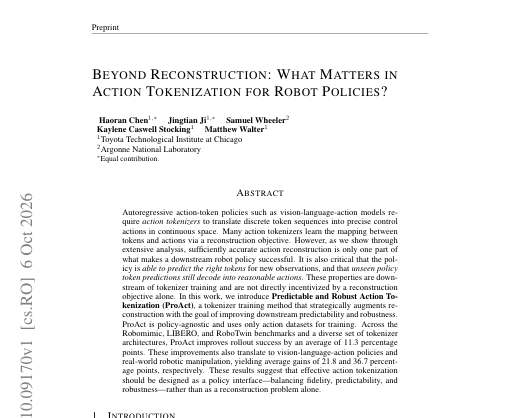
Beyond Reconstruction: What Matters in Action Tokenization for Robot Policies?

Haoran Chen, Jingtian Ji, Samuel Wheeler, Kaylene Caswell Stocking, Matthew Walter

Autoregressive action-token policies such as vision-language-action models require action tokenizers to translate discrete token sequences into precise control actions in continuou…

Autoregressive action-token policies such as vision-language-action models require action tokenizers to translate discrete token sequences into precise control actions in continuous space. Many action tokenizers learn the mapping between tokens and actions via a reconstruction objective. However, as we show through extensive analysis, sufficiently accurate action reconstruction is only one part of what makes a downstream robot policy successful. It is also critical that the policy is able to predict the right tokens for new observations, and that unseen policy token predictions still decode into reasonable actions. These properties are downstream of tokenizer training and are not directly incentivized by a reconstruction objective alone. In this work, we introduce Predictable and Robust Action Tokenization (ProAct), a tokenizer training method that strategically augments reconstruction with the goal of improving downstream predictability and robustness. ProAct is policy-agnostic and uses only action datasets for training. Across the Robomimic, LIBERO, and RoboTwin benchmarks and a diverse set of tokenizer architectures, ProAct improves rollout success by an average of 11.3 percentage points. These improvements also translate to vision-language-action policies and real-world robotic manipulation, yielding average gains of 21.8 and 36.7 percentage points, respectively. These results suggest that effective action tokenization should be designed as a policy interface that balances fidelity, predictability, and robustness, rather than as a reconstruction problem alone.

cs.ROrobotmanipulationvision-language-action

兴趣:vision-language-action (VLA) models and foundation models for robots

#292026-10-0784

Agentic RSR: Real-to-Sim-to-Real through Scene Reconstruction and Execution-Grounded Robot Policies

Yihan Li, Yating Feng, Shengjiu Sun, Jianing Chen, Hao Ren, Bowen Yang 等

A simulation of a real robot workspace must preserve task-relevant interactions, while policies developed in it must operate on observations available to the real robot. Yet scene …

A simulation of a real robot workspace must preserve task-relevant interactions, while policies developed in it must operate on observations available to the real robot. Yet scene reconstruction and policy development are often treated separately. We present Agentic Real-to-Sim-to-Real (Agentic RSR), a framework that links scene reconstruction, policy development, and real-robot execution through the same manipulation task. Given a workspace video, a task description, and a known robot model, an agent recovers metric scale, iteratively refines the scene using visual feedback, and checks task-relevant interactions in MuJoCo. A coding agent then develops an executable policy, progressing from privileged object poses to visual observations and randomized simulation. The policy can interleave multiple observations and actions within one invocation, while the agent uses execution feedback to continue, retry, or revise its approach. A shared task-level interface carries the policy and accumulated experience to the real robot, where fresh observations and safety checks guide execution. Across 18 reconstructed scenes involving two robots, the mean four-view Depth MAE against reference depth estimates is 0.1057 m, the mean Lab $ΔE_{76}$ is 11.04, and the mean grayscale SSIM is 0.6990. In real-robot experiments, the aggregate task success rate reaches 80% of the simulation task success rate, indicating substantial retention of simulated performance on hardware. Code and reconstructed scene data will be made publicly available.

cs.ROcs.CVrobotmanipulationsim-to-real

兴趣:imitation learning and diffusion policies for robot control

#302026-10-07追踪学者 · Jeannette Bohg84

RoboJEPA: Scaling Robotic Latent World Models

Artem Zholus, Nicolas Beltran-Velez, Jianhao Yuan, Sarath Chandar, Tushar Nagarajan, Daniel Severo 等

Latent world models have shown a remarkable ability to predict future states and to plan in the real world. In practice, however, we lack a principled way to estimate how their cap…

Latent world models have shown a remarkable ability to predict future states and to plan in the real world. In practice, however, we lack a principled way to estimate how their capabilities scale with model size, data, and compute, an open problem that slows progress in the field. In this work we present RoboJEPA, a world model based on the Joint Embedding Predictive Architecture (JEPA) and trained on a large-scale dataset spanning 12 robotic embodiments. We show that RoboJEPA's imagination error, the error of its latent rollouts, follows a second-order power law in compute, allowing us to predict model quality well beyond the scale at which the law is fit. We further show that downstream robotic planning performance improves predictably with compute, and that imagination error is strongly correlated with it, making it a reliable proxy for real-robot evaluation. Finally, we demonstrate that latent world models can be deployed zero-shot as robotic agents, planning toward a single goal image to solve tasks requiring long-horizon planning on real hardware. We release all model checkpoints together with our training and robot deployment code. To our knowledge, this is the first work to establish scaling laws for multi-embodiment robotic world models trained on real robot data, and RoboJEPA, at 8B parameters, is the largest JEPA predictor model trained to date.

cs.AIcs.ROrobotworld model

追踪学者:Jeannette Bohg;兴趣:world models and video prediction for embodied agents

#312026-10-0783

LLA-MPPI: Rapidly Adaptive Whole-body Control of Legged Robots with GPU-Accelerated Parallel Simulations

Sebin Jung, Maitham F. AL-Sunni, Juan Alvarez-Padilla, Zachary Manchester, Changliu Liu, John M. Dolan

Real-time whole-body controllers for legged robots typically plan through a fixed nominal model and degrade when the deployed dynamics change. Adaptive methods typically require a …

Real-time whole-body controllers for legged robots typically plan through a fixed nominal model and degrade when the deployed dynamics change. Adaptive methods typically require a model structure that contact dynamics do not provide, or they need offline training for each anticipated condition. We present Look-back and Look-ahead Adaptive Model Predictive Path Integral control (LLA-MPPI). The method converts whole-body adaptation into selection over a bank of GPU-batched contact simulators with different physical or structural parameters. Windowed prediction errors select the simulator that best explains recent motion. A whole-body MPPI planner optimizes controls through the selected model. The framework requires no offline training, and its selected hypotheses are physically interpretable. Across four simulated tasks, it achieves 97.5% success while the strongest baseline reaches 74% and an oracle with the true model reaches 98.5%. Hardware validation on a Unitree Go2 shows the robot walking under a payload added mid-run, walking after one leg is disabled, and pushing a box to its goal while increasing its mass on the fly. Code, videos, and project details are available at: https://lla-control.github.io

cs.ROeess.SYrobotlegged

兴趣:reinforcement learning for legged locomotion and sim-to-real transfer

#322026-10-0783

Factorized Tactile Representation and Control for Sim-to-Real Manipulation

Siqi Shang, Bianca Aumann, Tye Brady, Joshua Migdal, Taskin Padir

Tactile sim-to-real learning must bridge simulated contact and device-specific sensor responses while preserving information needed for control. We propose a factorized tactile rep…

Tactile sim-to-real learning must bridge simulated contact and device-specific sensor responses while preserving information needed for control. We propose a factorized tactile representation and control framework that maps normal force and contact patch to an effective contact response recoverable from sensor readings. The response is separated into contact geometry, force distribution, and temporal contact change, with representation-specific encoding and randomization. A Tactile Gated Policy preserves these representations separately through control and operates over all mask configurations without retraining. We evaluate the approach through response reconstruction, spatial alignment, force regulation, and contact-rich adversarial peg insertion in simulation and the real world, enabling the utility and transfer reliability of different tactile representations to be assessed independently. The approach achieves <1 mm contact localization, 1.69 N force-tracking error on unseen geometries, and a 35% improvement in real-world adversarial peg insertion over the unfactorized response, with different tactile representations benefiting different interactions.

cs.ROmanipulationsim-to-realtactile

兴趣:dexterous hands and tactile sensing

#332026-10-0783

Explicit Geometric Chain-of-Thought for Vision-Language-Action in Autonomous Driving

Xingtai Gui, Yucheng Zhou, Dongqian Guo, Jiahao Gong, Feiyang Tan, Jianbing Shen

Vision-language-action~(VLA) models have emerged as a promising paradigm for autonomous driving. However, existing VLA models still suffer from a fundamental mismatch: driving acti…

Vision-language-action~(VLA) models have emerged as a promising paradigm for autonomous driving. However, existing VLA models still suffer from a fundamental mismatch: driving actions require precise 3D geometric cues, while visual-language understanding and reasoning are largely conducted in a 2D semantic space. In this paper, we propose GeoCoTDrive, an explicit geometric chain-of-thought framework that grounds geometry in a planning-oriented manner. GeoCoTDrive follows a think with 2D first, drive with dedicated 3D priors paradigm. It first grounds 2D regions corresponding to decision-critical cues, and then retrieves localized 3D priors by sampling features from a geometric foundation model within the grounded regions. These localized geometric features are interleaved into the autoregressive context to support the trajectory generation. To supervise this process, we introduce planning-relevant grounding, a new region-level grounding task that focuses on local spatial cues directly affecting ego planning decisions, and construct the PlanningGrounding dataset to endow VLAs with planning-oriented grounding capability. Experiments across multiple end-to-end autonomous driving benchmarks show that GeoCoTDrive consistently improves safety-critical planning performance, demonstrating the effectiveness of the explicit geometric chain-of-thought process for VLA-based planning.

cs.CVVLAvision-language-action

兴趣:vision-language-action (VLA) models and foundation models for robots

#342026-10-0782

RobotAPO: Adversarial Physics Preference Optimization for Robotic Manipulation Video Generation

Kerui Li, Zhe Jing, Chenyi Huang, Xiaofeng Wang, Zheng Zhu, Haoming Cui 等

Robotic manipulation videos are increasingly used as visual plans for embodied agents, but optimizing purely for visual plausibility often fails to capture the fragile physical man…

Robotic manipulation videos are increasingly used as visual plans for embodied agents, but optimizing purely for visual plausibility often fails to capture the fragile physical manifold of real-world interactions. Even minor physics-violating errors at the interaction boundary, such as interpenetration or premature object motion, can completely invalidate the inferred timing and pose needed for downstream execution. Because standard supervised fine-tuning lacks the direct pressure to penalize these localized failures, we introduce AgiBot-PhysPref. This rigorously curated 10,000-sample preference dataset isolates condition-matched physics violations, turning the generator's own failure distribution into a foundational signal for physical consistency. Building upon this, we propose RobotAPO, an adversarial physics preference optimization framework operating in the continuous flow-matching denoising space. To prevent the policy from merely memorizing static curated failures, RobotAPO employs a lightweight adversarial counterfactual proposer that learns a condition-dependent, physical-failure-biased direction in denoising space. This encourages the model to explore and better respect the physical interaction boundary, all while maintaining a pure prompt-and-reference inference interface without requiring external structural conditioning. Comprehensive evaluations demonstrate that explicitly correcting these localized physics violations improves downstream robot execution from generated videos. On held-out AgiBot conditions, RobotAPO outperforms the strongest controlled internal baseline in physical consistency by 6.8% hard score and 10.0% soft score. Crucially, in real-robot replay, it translates these physical-consistency gains into a 37.4% relative improvement in task success over the strongest controlled internal baseline.

cs.ROrobotmanipulationembodied

兴趣:robot manipulation and grasping with learned policies

#352026-10-0782

RoboQuest: Generalist Physical Agents that Search, Inspect and Test

Liu Renhang, Navonil Majumder, Tej Deep Pala, Soujanya Poria

Recent advances in multimodal foundation models have made them capable generalist physical agents for a range of manipulation tasks. However, successful operation in an unfamiliar …

Recent advances in multimodal foundation models have made them capable generalist physical agents for a range of manipulation tasks. However, successful operation in an unfamiliar environment may require an agent to seek task-relevant information through interaction when it is absent from the observations: it may need to determine where a relevant object is, inspect an unobserved property, or discover the effect of an unfamiliar tool. We thus introduce RoboQuest, a benchmark for goal-directed embodied exploration, where agents must actively acquire task-relevant information through physical interaction, use the resulting evidence to adapt subsequent actions, and autonomously decide when to commit to task completion. RoboQuest comprises ten mobile manipulation tasks centered on three forms of uncertainty: search, manipulation-based inspection, and interactive testing. We evaluate five frontier multimodal agents through a common visuomotor interface, as well as a $π_{0.5}$ policy fine-tuned on the full-episode demonstrations we release. The best agent succeeds in only 23% of the episodes, and the fine-tuned policy almost never succeeds. Isolated tests of the execution skills the tasks are built from, with the hidden information supplied, show that the agents can carry out most of the required actions, and our failure analysis attributes only a minority of the failures to execution. Our failure analysis further finds that the agents often stop exploring too early as they make decisions before observing the required evidence for task completion. We also find that agents rarely prevent or repair the disturbances caused by their exploration. Moreover, learning by trial and error remains difficult for most models.

cs.ROcs.AIcs.CVmanipulationembodied

兴趣:robot manipulation and grasping with learned policies

#362026-10-0782

EmbodiedRSI: Active Continual Robot Learning Through Hypothesis-Guided Co-Evolution

Python Song, Zhixuan Liang, Kelsey Fu, Mengdi Wang, Junfeng Yang, Shilong Liu

Robot foundation models provide strong visuomotor control, yet their performance can degrade when object positions or task instructions change. Further improvements often require p…

Robot foundation models provide strong visuomotor control, yet their performance can degrade when object positions or task instructions change. Further improvements often require post-training on substantial robot data, which can be costly to collect through methods such as teleoperation. Agentic harnesses can adapt around the model, but current self-evolving harnesses use robot trials inefficiently when deciding which code and skill changes to pursue. We introduce EmbodiedRSI, a self-evolving agentic harness that autonomously decides where to explore next and turns the resulting physical interaction into improved code and skills. EmbodiedRSI realizes this through a Fast-Slow Dual-System Architecture, in which competing code and skill hypotheses are maintained in a Hypothesis Graph. Value-of-Information Experiment Selection chooses physical experiments that can distinguish these hypotheses. Their outcomes guide Code-Skill Co-Evolution. The Slow System builds Hierarchical Memory, and Reward-Grounded Memory Learning selects effective memory according to their value for later Fast-System improvement. On RoboCasa365, EmbodiedRSI reaches 77.0% overall success and 71.3% on Composite-Unseen, compared with 40.1% for the best baseline. EmbodiedRSI also reaches 86.8% overall success on LIBERO-Pro. Beyond benchmark performance, EmbodiedRSI transfers zero-shot to real-world robot, achieving 71.3% overall success across multiple challenging tasks.

cs.AIrobot

兴趣:imitation learning and diffusion policies for robot control

#372026-10-0782

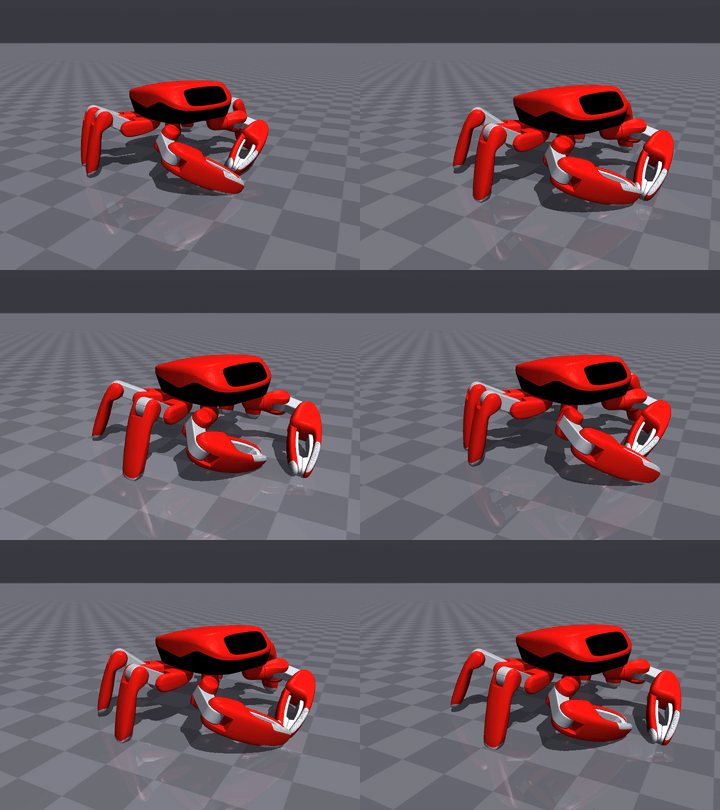
LACE-CRAFT: Robot Co-Design with Actor Inheritance and Blackboard Collaboration

Yuhan Wen, Jiawei Wang, Qixuan Zhang, Yusen Qin, Lan Xu

Robot co-design couples morphology search with policy learning, yet training every new design from scratch discards acquired control experience. We present LACE-CRAFT, which compar…

Robot co-design couples morphology search with policy learning, yet training every new design from scratch discards acquired control experience. We present LACE-CRAFT, which compares continued learning on the current robot with policy adaptation to new morphology-reward pairs. LACE resumes the incumbent's full learning state and initializes compatible challengers with its actor parameters and observation statistics. A fixed task metric selects among both branches and the frozen incumbent. CRAFT coordinates Feedback, Morphology, Reward, and Integration roles through shared experimental records and behavioral replays to generate and cross-review paired proposals. A generative extension converts generated meshes into editable articulated models with configured joints, actuator interfaces, and consistently updated simulation assets. Across five locomotion benchmarks, mean scores over three evaluation seeds are 6.4-91.9% higher than D2C. Both methods train 30 new morphology-reward pairs over five rounds; LACE additionally uses four continuation training units. Five-task ablations examine policy inheritance and replay-derived feedback. A fabricated prototype demonstrates indoor walking and illustrates the geometry-to-hardware workflow.

cs.ROrobotlocomotion

兴趣:imitation learning and diffusion policies for robot control

#382026-10-0781

Many Ways to Succeed: Diversity-Driven RL Fine-Tuning for VLA Generalization

Haoru Li, Jinmei Liu, Zhiyong Wang, Xiaoming Li, Zhenhong Sun, Daoyi Dong 等

Reinforcement learning (RL) fine-tuning improves vision-language-action (VLA) policies through closed-loop experience, yet generalization beyond the fine-tuning distribution remain…

Reinforcement learning (RL) fine-tuning improves vision-language-action (VLA) policies through closed-loop experience, yet generalization beyond the fine-tuning distribution remains limited. Our analysis reveals a selective reshaping of exploration: RL contracts behavior globally, yet diversifies successful trajectories, elicits success with fewer rollouts, and covers more of the latent task-valid solution space than supervised fine-tuning. Broader successful-mode coverage may provide alternative strategies under distribution shifts. Inspired by this, we introduce DRIVE (Diversity-driven RL fIne-tuning for VLA gEneralization), which turns successful-behavior diversity into an explicit RL objective. DRIVE groups rollouts under matched task conditions, compares their trajectories with temporal alignment, and derives a success-conditioned intrinsic reward from relative behavioral diversity. This design encourages broader coverage of feasible solutions without rewarding diverse failures or superficial timing differences. Across LIBERO-Plus, ManiSkill3, and RoboTwin 2.0, DRIVE improves the average out-of-domain (OOD) performance over vanilla RL fine-tuning by 5.3 points on $π_0$ and 2.0 points on $π_{0.5}$. On a dual-arm AgileX PiPER-X platform, DRIVE further increases average OOD success from 64.1% to 73.3% (+9.2 points), demonstrating gains that persist under physical deployment.

cs.ROcs.LGVLAvision-language-action

兴趣:vision-language-action (VLA) models and foundation models for robots
#392026-10-0781

Benchmarking Behavioral Steerability in Behavior Foundation Models

Minghe Gao, Zhanxi Yan, Jiahui Liu, Wendong Bu, Xiaoting Chen, Qizhou Wang 等

Behavior Foundation Models (BFMs) are emerging as a paradigm for translating human intentions into executable humanoid behaviors. As these models evolve beyond behavior generation …

Behavior Foundation Models (BFMs) are emerging as a paradigm for translating human intentions into executable humanoid behaviors. As these models evolve beyond behavior generation toward general-purpose behavioral systems, a fundamental question arises: can they be reliably steered according to user intentions? In this paper, we introduce the concept of behavioral steerability, defined as the ability of BFMs to faithfully generate behaviors that satisfy user-specified intentions. To study this capability, we present RoboSteer, the first benchmark for behavioral steerability in BFMs. RoboSteer organizes behavioral steerability into a three-level hierarchy-Conditional Steering, Constraint Steering, and Compositional Steering-and establishes a unified evaluation framework supported by a large-scale multimodal motion corpus. Using RoboSteer, we conduct the first large-scale empirical study of behavioral steerability across 9 existing BFMs. We view behavioral steerability as more than a capability for controlling motion: it concerns how embodied systems translate human intentions into purposeful actions. We hope RoboSteer will advance research on intention realization as a foundation for general-purpose embodied intelligence.

cs.ROhumanoidembodied

兴趣:world models and video prediction for embodied agents

#402026-10-0681

FlashNeRD: Performance-First Contact-Rich Neural Robot Dynamics

Mohammadmehdi Ataei, Mohammad Amin Nabian, Jie Xu, Miles Macklin, Yashraj Narang, Eric Heiden 等

Compared with analytical physics, learned dynamics models promise robot simulation that is faster, inherently differentiable, and easily adaptable to real data. Neural Robot Dynami…

Compared with analytical physics, learned dynamics models promise robot simulation that is faster, inherently differentiable, and easily adaptable to real data. Neural Robot Dynamics (NeRD) pursues this by keeping collision detection analytical and replacing a simulator's numerical dynamics for the robot with a learned model. Three limitations remain. NeRD offers little speedup over the simulator it learned from, accepts contact only at predefined points, and has no two-way coupling with objects it manipulates. FlashNeRD removes all three with a parallel streaming architecture that makes each prediction faster and more accurate, an encoder that accepts contacts wherever they occur, and two-way coupling with objects simulated by analytical solvers. Experiments across five robots show faster and more accurate dynamics, faster policy learning, and faster inference-time planning. Across three robots, FlashNeRD's dynamics model is up to $55\times$ faster than an optimized NeRD and more accurate over long rollouts. This speedup extends to policy learning, where PPO trains an ANYmal locomotion policy in 34 seconds, $3.8\times$ faster than the analytical simulator and $2.7\times$ faster than an optimized NeRD. With DIAL-MPC, a sampling-based MPC method, the robot climbs all six test platforms where fixed-contact NeRD manages one, at approximately half the analytical simulator's planning time. Cube-reorientation policies trained with FlashNeRD complete within 2% of the simulator-trained policy's target count.

cs.ROrobotlocomotion

兴趣:imitation learning and diffusion policies for robot control

#412026-10-0781

Do Vision-Language-Action Models Understand Instructions? A Mechanistic Interpretability Study on Language Grounding

Theodor Wulff, Angelo Cangelosi

Vision-Language-Action models are designed to generalise across environments and task descriptions, raising the question of whether their action generation actually depends on the …

Vision-Language-Action models are designed to generalise across environments and task descriptions, raising the question of whether their action generation actually depends on the language instruction, or whether they largely rely on visual cues and superficial correlations. Robustness to variance in the visual and linguistic observation space is critical for real-world deployment, yet VLAs lack explicit grounding modules and instead rely on the intrinsic language grounding capabilities of their Vision-Language model backbones. For this reason, we conduct a controlled mechanistic interpretability study on the language grounding capabilities of two state-of-the-art Vision-Language-Action models, $π_{0.5}$ and GR00T N1.7, by applying activation and attribution patching to the residual stream of the action generation modules. We systematically corrupt the task instruction of input samples of the LIBERO benchmark following five strategies: synonym replacement, semantic scaling, directional corruption, random object substitution, and empty string. Our experiments find that both models are comparatively insensitive to abstract rephrasing and to referencing non-existent objects, but react strongly to empty task descriptions and, especially, to directional language. During action generation, this sensitivity is concentrated in different loci for each model: mainly in the early, periodic cross-attention layers for GR00T N1.7, versus distributed across the earliest and selected later layers for $π_{0.5}$. For GR00T N1.7, directional perturbations drive some of the largest causal effects while leaving the internal representational geometry comparatively unchanged, a dissociation we do not observe clearly for $π_{0.5}$. Finally, the reliability of attribution patching is model-dependent: it closely tracks activation patching for GR00T N1.7 but not for $π_{0.5}$.

cs.ROvision-language-action

兴趣:vision-language-action (VLA) models and foundation models for robots

#422026-10-0780

Long-WAM: Scaling the Context of World-Action Models

Wei Huang, Bohan Zhang, Chenzhi Liu, Isabella Liu, Shuai Yang, Weian Mao 等

Real-time robot control demands enough visual history to infer motion and task progress, but processing that history can delay action. We present Long-WAM, a model-system framework…

Real-time robot control demands enough visual history to infer motion and task progress, but processing that history can delay action. We present Long-WAM, a model-system framework for scaling the context of causal world-action models under real-time control constraints. Our central finding is that access to history is not the same as using it: longer histories pay off far more when the video foundation is pretrained autoregressively (AR). We first learn causal prediction from robot and egocentric videos without action labels, then preserve this history-to-future structure during world-action adaptation. On RoboCasa GR-1, increasing context from 0.0 to 19.2 seconds raises success from 63.3% to 78.7%, whereas a bidirectionally pretrained initialization shows no net gain; robot-domain AR pretraining further raises peak success on GR-1 and LIBERO-Long. Long-WAM also achieves the best results among compared methods on LIBERO-Long, RoboTwin 2.0, and DOMINO. Streaming observation encoding, asynchronous execution, and hardware-specific acceleration enable deployment on RTX 5090, DGX Spark, and Jetson AGX Thor without dropping future prediction; on RTX 5090, each action chunk, including future-video latent prediction, takes 107.4 ms. Real-time deployment on Unitree G1 and YAM supports dynamic and long-horizon manipulation, including 95% success on dynamic cup stacking, where Pi0.5 and Fast-WAM succeed in none of 20 trials. As a memory-informed executor, Long-WAM also complements higher-level planning in composite tasks.

cs.ROcs.AIcs.CVrobotmanipulation

兴趣:world models and video prediction for embodied agents

#432026-10-0680

CARE: Certifying Acceleration for Vision-Language-Action Inference

Rui Liu, Tong Zheng, Jindong Gu, Zhipeng Wang

While vision-language-action (VLA) models have advanced rapidly, running them at every control step remains expensive. Prior work accelerates VLA inference using techniques like ac…

While vision-language-action (VLA) models have advanced rapidly, running them at every control step remains expensive. Prior work accelerates VLA inference using techniques like action chunking and visual-token pruning, typically evaluating based on latency and average task success. However, acceleration may discard information and break tasks the original policy would solve, a risk hidden by average metrics. Measuring these failures is challenging because action deviations compound over closed-loop trajectories, meaning task failure is only observable across full episodes. We therefore define an acceleration-induced failure via paired rollouts from identical initial conditions, tracking when the reference succeeds but the accelerated policy fails. To manage this, we introduce CARE, an approach for certified accelerator selection. CARE uses paired rollouts on a calibration set to provide finite-sample guarantees that acceleration-induced failure risk stays below a user-specified budget. It deploys the fastest certified candidate, falling back to the reference if none qualify. By relying only on terminal outcomes and measured compute, CARE applies unchanged across diverse acceleration mechanisms, while sequential testing and failure-triggered reference rollouts keep certification affordable. On four LIBERO suites with OpenVLA-OFT, CARE certifies $9.0$--$10.8\times$ speedups while guaranteeing (at $95%$ confidence) that at least $85.8%$ of reference-solved episodes are preserved. Under tight budgets, selectors without guarantees exceed the budget in up to $75%$ of trials, whereas CARE stays within budget and its sequential form uses $78.9%$ fewer rollouts than exhaustive evaluation. CARE further generalizes to flow-step reduction for $π_{0.5}$, and to Qwen3.5-9B and Llama-3.1-8B agents in Crafter.

cs.CLcs.LGVLAvision-language-action

兴趣:vision-language-action (VLA) models and foundation models for robots
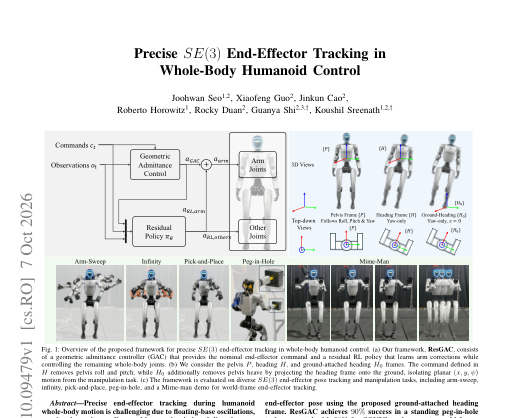
#442026-10-0680

PhysEvo: Astra Can Act, Let It

Wenqing Tian, Zeyu Zhang, Zhaocheng Liu, Fengwei Liu, Qiang Liu, Liang Wang

Astra can act, yet reliable manipulation depends on the system through which it observes and controls the world. We introduce PhysEvo, a framework for physical recursive self-impro…

Astra can act, yet reliable manipulation depends on the system through which it observes and controls the world. We introduce PhysEvo, a framework for physical recursive self-improvement (RSI) around a single frozen model. A task agent executes robot tasks; a meta-agent uses the resulting trajectories to diagnose failures, revise tools and skills, and test corrections. The meta-agent can also improve its own diagnostic tools, so retained revisions support both later action and later self-improvement. This process develops joint-level control, evidence-seeking observation, and reusable manipulation skills without model-weight updates or a separately trained action policy. Across 42 RoboDojo tasks, held-out-layout evaluation of retained task-specific deployment versions yields a five-dimension average score of 68.14/100 and 62.00% success, compared with 47.17% for RoboDawn's one-shot Astra agent, the strongest published reference in our comparison. On eight manipulation tasks challenging direct Astra, PhysEvo achieves 55.00% success, compared with 1.25% for the direct-Astra reference. Deploying the simulation-evolved harness on AgileX PiPER and continuing skill revision yields 90.60/100 average score and 84.00% success across 25 trials on five real-world tasks. PhysEvo turns the consequences of action into persistent, testable changes to how a frozen model acts and improves.

cs.ROcs.AIrobotmanipulation

兴趣:imitation learning and diffusion policies for robot control

#452026-10-0680

SPW-Nav: A Streaming Panoramic World Model for Language-Guided Navigation

Yunheng Liu, Ziqi Cai, Siqi Yang, Yimu Wang, Minggui Teng, Jiaming Tan 等

Language-guided panoramic video generation benefits various downstream applications, such as interactive 3D scene exploration, virtual reality experiences, and embodied agent train…

Language-guided panoramic video generation benefits various downstream applications, such as interactive 3D scene exploration, virtual reality experiences, and embodied agent training. Existing panoramic generators follow predefined trajectories, and interactive world models act through low-level actions in perspective views. We propose SPW-Nav, a streaming panoramic world model that understands movement instructions and streams one minute of 2K 360-degree video in real time from a single panorama. SPW-Nav interprets each instruction in the previously generated panorama as camera motion. Spherical rotation decoupling applies rotation exactly on the sphere, pose-aligned conditioning keeps translation inputs bounded over long streams, and a multi-term memory with a few-step generator continues the scene as instructions change. We also build SPW-NavSet, panoramic videos with camera trajectories and verified instructions. Driven by language, SPW-Nav outperforms prior panoramic generators in camera-following accuracy and video quality, and supports on-the-fly instruction switching.

cs.CVembodiedworld model

兴趣:world models and video prediction for embodied agents

#462026-10-0779

ECHO: Embodied Camera Observations of Human Object Carrying

Xuefei Sun, Lorin Achey, Kali Hamilton, Alberto Speranzon, Gregory Grebe, Yonatan Bisk 等

Embodied and assistive agents must do more than recognize objects: they must reason about where an object belongs given the layout of an environment and the habits of the people wh…

Embodied and assistive agents must do more than recognize objects: they must reason about where an object belongs given the layout of an environment and the habits of the people who live in it. Progress on this problem has been limited, in part because no dedicated benchmark or dataset exists to define and evaluate it. Existing RGB-D scan datasets reconstruct static rooms without human activity, while human-object-interaction datasets capture motion without a navigable, fully reconstructed scene or a ground-truth notion of an object's natural destination. We introduce contextual object placement as a benchmark task: predicting an object's destination during an observed object-carrying episode. To support this task, we present Embodied Camera observations of Human Object carrying (ECHO), a large-scale synthetic dataset that pairs dense RGB-D scans of indoor scenes with recordings of an embodied human carrying everyday objects to context-appropriate destinations. ECHO is the first publicly available dataset to combine reconstructed scenes, human activity, natural language, and contextual-placement annotations. It comprises 3,805 human-annotated episodes across 159 floors of 115 HM3D scenes, involving 198 distinct objects. Each floor includes a complete RGB-D scan with human-annotated room labels and a surface list. Each episode provides synchronized RGB-D encounter clips; 6-DoF camera, human, and object trajectories; start and destination surfaces; an action caption; and a human-written context: a single sentence describing the inhabitant's routine that implies the destination without naming it. We evaluate contextual object placement using input-masked probes and an end-to-end baseline. Results show that no single input modality is sufficient, highlighting the need to jointly reason over scene structure, human activity, and contextual knowledge.

cs.CVcs.ROembodied

兴趣:world models and video prediction for embodied agents

#472026-10-0779

Q-Learning with Scalar Adjoint Matching

Yonghoon Dong, Minsung Yoon, Jaehyuk Kim, Jungwoo Park, Changyeon Kim, Jinwoo Shin

Flow policies capture rich and diverse action distributions, and fine-tuning them with off-policy RL to improve beyond the demonstrations has drawn growing interest. However, fine-…

Flow policies capture rich and diverse action distributions, and fine-tuning them with off-policy RL to improve beyond the demonstrations has drawn growing interest. However, fine-tuning a flow policy against a learned value function is not trivial, because the policy generates its action over many flow steps. Adjoint matching offers a principled way to update the flow model itself by propagating value information from the final action back to each flow step, but it requires a vector--Jacobian product through the policy at every step, a cost that grows with the number of flow steps and the policy size. We observe that the batch-averaged velocity Jacobian of pretrained flow policies concentrates on its diagonal. Motivated by this finding, we derive a closed-form scalar adjoint that scales the value gradient at the final action by the flow time, eliminating the per-step vector--Jacobian products. We further find that controlling the critic's value at policy-generated actions is particularly important under the scalar adjoint. Based on these findings, we propose Q-learning with Scalar Adjoint Matching (SQAM), which combines the scalar adjoint with a value penalty at those actions. SQAM's gains concentrate on the four hardest OGBench domains, where its success rate exceeds that of the strongest baseline in each domain by 18 to 35 percentage points. To test whether SQAM extends to large pretrained policies, we also fine-tune a vision-language-action policy on a real bimanual robot. SQAM improves over supervised fine-tuning on all three tasks.

cs.LGcs.AIcs.ROrobotvision-language-action

兴趣:imitation learning and diffusion policies for robot control

#482026-10-0779

Video Prediction Policy 2: Predict Better, Act Better

Yanjiang Guo, Haodong Yan, Zhide Zhong, Zhongru Zhang, Qingyuan Yang, Qingzhou Lu 等

World action models (WAMs) have emerged as an important class of generalist robot policies, aiming to transfer video prediction priors to action learning. However, we find that exi…

World action models (WAMs) have emerged as an important class of generalist robot policies, aiming to transfer video prediction priors to action learning. However, we find that existing WAMs frequently produce incorrect motion predictions in open-ended environment, leading to erroneous actions. We attribute this limitation to two factors: (1) base video models are not optimized for manipulation, and (2) naively incorporating action components into video models can substantially degrade their generalization capabilities. We introduce Video Prediction Policy 2 (VPP2), a WAM that enables strong zero-shot generalization in both video prediction and action generation. First, we curate a large-scale, diverse dataset of manipulation videos to continue pretraining the base video foundation model. We annotate video clips with detailed captions and perform event-level video pretraining to promote generalization across open-ended manipulation tasks. Second, we post-train and distill the video model into a single-step visual planner with fixed prediction horizon. Finally, we introduce action module via a mixture-of-transformers (MoT) architecture to learn implicit inverse dynamics model. Experiments demonstrate three key results: (1) VPP2-14B outperforms Cosmos3-64B by 11.0% points in video prediction instruction-following success rate on open-ended tasks; (2) VPP2 surpasses the strongest baseline by 18.5% points in success rate on real-world zero-shot ALOHA manipulation tasks; and (3) following benchmark-specific post-training, VPP2 achieves the highest success rates among evaluated methods on the challenging LIBERO-Pro, LIBERO-OOD, and RoboDojo benchmarks.

cs.CVcs.ROrobotmanipulation

兴趣:world models and video prediction for embodied agents

#492026-10-0779

Co${}^{2}$Skill: Whole-Body Control via Skill Composition for Long-Horizon Human-Environment Interaction

Jeonghwan Kim, Hyeonwoo Kim, Hanbyul Joo

Achieving human-level dexterity in complex, unstructured environments requires the seamless integration of whole-body scene interaction and dexterous object manipulation skills. Wh…

Achieving human-level dexterity in complex, unstructured environments requires the seamless integration of whole-body scene interaction and dexterous object manipulation skills. While existing physics-based controllers generate physically plausible behaviors in each domain, they largely address these two capabilities independently. In this paper, we present Co${}^{2}$Skill that integrates scene interaction and dexterous manipulation through a unified policy formulation. Built on a pretrained motion prior, the policy uses task and phase dependent observation masks to select information relevant to the current interaction goals. We introduce a goal-conditioned loco-manipulation curriculum that combines partial reference guidance for precision with exploration from varied initial states while allowing goal-directed execution beyond the demonstrated trajectories. We further introduce a cross-task curriculum that jointly trains individual skills and selected task sequences, preserving physical states across task boundaries and maintaining grasps during subsequent scene interactions. Together, these support sequential task execution and simultaneous scene interaction with object manipulation. We evaluate sitting, standing, climbing, stair traversal, and goal-directed manipulation, together with sequential execution and with random different conditions. Additionally, we demonstrate skill compositions in indoor environments, illustrating their integration within the same control formulation.

cs.ROcs.GRmanipulationdexterous

兴趣:humanoid robots and whole-body control

#502026-10-0779

From Digital Human Interactions to Physics-Based Humanoid Skills: Physics-Grounded Post-Training of Interaction Generators

Kerui Chen, Jianrong Zhang, Kai Lv, Hehe Fan

Recent methods have made promising progress in generating interactions between two humanoids, largely relying on physics-based tracking policies to convert digital reference motion…

Recent methods have made promising progress in generating interactions between two humanoids, largely relying on physics-based tracking policies to convert digital reference motions into executable trajectories. However, limited tracking capabilities restrict the range of reference motions that can be successfully executed, reducing data utilization. Moreover, even successful tracking does not guarantee physically plausible responses or faithful realization of the intended interactions. In this paper, we introduce DIGHT, a co-adaptive framework that couples a Digital human Interaction Generator with a Humanoid Tracking policy. Our DIGHT first executes multiple text-conditioned interaction candidates in simulation using a fixed tracker. It then constructs physics-grounded preferences from the resulting rollouts, covering both general executability and interaction fidelity. Rather than collapsing these signals into a single scalar reward for candidate ranking, we align the pretrained generator using physics-decoupled diffusion direct preference optimization (DPO), preserving criterion-specific supervision without differentiating through the simulator. To improve executability, preference pairs are derived from tracking error, friction, and floating. Additionally, to improve interaction fidelity, we propose to incorporate force feedback from simulator as a measure of contact fidelity and construct preferences over contact occurrence, location, duration, and force magnitude. The aligned generator then supplies reference motions for fine-tuning the tracker, improving compatibility between generation and physical execution. Extensive experiments demonstrate that our approach not only improves the physical plausibility of generated motions but also enables more reliable and faithful humanoid interactions in simulation.

cs.CVhumanoid

兴趣:humanoid robots and whole-body control

GitHub 项目

#12026-10-05★ 81新项目80

AetherLabsAI/Video2World

Python

Benchmarking Coding Agents for Interactive World Modeling from Embodied Videos - Rethinking Embodied Real2Sim from a Software Engineering Perspective

Benchmarking Coding Agents for Interactive World Modeling from Embodied Videos - Rethinking Embodied Real2Sim from a Software Engineering Perspective

benchmarkcoding-agentembodied-aifoundation-modelsreal-to-simrobot-learningroboticssimulationrobotembodied

兴趣:world models and video prediction for embodied agents

#22026-09-28★ 2k +959新项目76

KingKongRobotics/jumper

Python

🦀 Jumper — an crab robot.

🦀 Jumper — an crab robot.

crab-robotrobotroboticsrobot

兴趣:humanoid robots and whole-body control

#32025-11-23★ 685 +775

sou350121/VLA-Handbook

HTML

本项目旨在为致力于进入VLA(Vision-Language-Action)领域的算法工程师提供一份全中文、实战导向的学习/面试手册。 不同于通用的 CV/NLP 面试指南,本项目聚焦于 Robotics 特有的挑战

本项目旨在为致力于进入VLA(Vision-Language-Action)领域的算法工程师提供一份全中文、实战导向的学习/面试手册。 不同于通用的 CV/NLP 面试指南,本项目聚焦于 Robotics 特有的挑战

chinesedeep-learningembodied-aillmrobot-learningroboticsvision-language-actionvlarobotVLAvision-language-actionembodied

兴趣:vision-language-action (VLA) models and foundation models for robots

#42024-12-08★ 3.9k +1675

datawhalechina/every-embodied

Python

仅需Python基础,从0构建自己的具身智能机器人;从0逐步构建VLA/OpenVLA/SmolVLA/Pi0, 深入理解具身智能

仅需Python基础,从0构建自己的具身智能机器人;从0逐步构建VLA/OpenVLA/SmolVLA/Pi0, 深入理解具身智能

embodied-agentembodied-aiembodied-intelligenceopenvlasmolvlavision-language-action-modelVLAvision-language-actionembodied

兴趣:world models and video prediction for embodied agents

#52026-10-04★ 40 +11新项目74

Holiday-Robot/FlashDexRetarget

Python

FlashDexRetarget: Accelerating Dexterous Manipulation Data Generation through Multi-Motion Retargeting

FlashDexRetarget: Accelerating Dexterous Manipulation Data Generation through Multi-Motion Retargeting

dexterous-manipulationreinforcement-learningroboticsrobotmanipulationdexterous

兴趣:robot manipulation and grasping with learned policies

#62025-10-09★ 3.8k +674

starVLA/starVLA

Python

StarVLA: A Lego-like Codebase for Vision-Language-Action Model Developing

StarVLA: A Lego-like Codebase for Vision-Language-Action Model Developing

robotic-foundation-modelroboticsvision-language-action-modelworld-action-modelvision-language-action

兴趣:vision-language-action (VLA) models and foundation models for robots

#72026-07-19★ 626 +674

RealXiaoze/humanoid-motion-intelligence

人形机器人运动智能论文、开源项目、产业与求职知识库

人形机器人运动智能论文、开源项目、产业与求职知识库

embodied-aihumanoid-roboticslocomotionmotion-controlreinforcement-learningrobot-learningsim2realvlarobotVLAhumanoidlocomotionembodied

兴趣:humanoid robots and whole-body control

#82024-12-24★ 382 +173

manumerous/wb_humanoid_mpc

C++

Whole-Body Nonlinear MPC for Realtime Humanoid Loco-Manipulation Planning and Control

Whole-Body Nonlinear MPC for Realtime Humanoid Loco-Manipulation Planning and Control

aidata-generationhumanoidhumanoid-robotlocomotionmpcnonlinearoptimizationrobotmanipulationhumanoidlocomotion

兴趣:humanoid robots and whole-body control

#92025-09-22★ 2.7k +2972

NVlabs/LongLive

Python

Long Video Gen / World Model / World Action Model (Embodied) Infrastructure

Long Video Gen / World Model / World Action Model (Embodied) Infrastructure

infralongnvfp4parallelreal-timeroboticsvideo-generationworld-action-modelsembodiedworld model

兴趣:world models and video prediction for embodied agents

#102026-09-08★ 52 +2新项目72

lok-i/vibe

Python

Post-training humanoid whole-body trackers for perceptive control tasks

Post-training humanoid whole-body trackers for perceptive control tasks

humanoid-controlmjlabperceptive-locomotionpporeinforcement-learningrobot-learningviberobothumanoidlocomotion

兴趣:humanoid robots and whole-body control

#122026-07-06★ 2.2k +171

dexmal/opendm

Python

An Open-World Foundation Model for General-Purpose Embodied Intelligence.

An Open-World Foundation Model for General-Purpose Embodied Intelligence.

embodied-aiembodied-intelligenceroboticsvision-language-actionvlaVLAvision-language-actionembodied

兴趣:vision-language-action (VLA) models and foundation models for robots

#132024-01-26★ 28k +2270

huggingface/lerobot

Python

🤗 LeRobot: Making AI for Robotics more accessible with end-to-end learning

🤗 LeRobot: Making AI for Robotics more accessible with end-to-end learning

兴趣:imitation learning and diffusion policies for robot control

#142024-02-29★ 16369

RobotControlStack/robot-control-stack

Python

A lean, ROS-free sim-to-real framework for training and deploying Vision-Language-Action (VLA) models and RL agents. Native MuJoCo Gymnasium wrappers with synchronous execution for…

A lean, ROS-free sim-to-real framework for training and deploying Vision-Language-Action (VLA) models and RL agents. Native MuJoCo Gymnasium wrappers with synchronous execution for Franka, UR5e, xArm, SO101 and YAM.

frankagymnasiummujocoreinforcement-learningrobot-learningrobot-manipulationsim-to-realvision-language-actions-modelsrobotmanipulationVLAvision-language-actionsim-to-real

兴趣:vision-language-action (VLA) models and foundation models for robots

#152025-08-14★ 5.5k +969

RLinf/RLinf

Python

RLinf: Reinforcement Learning Infrastructure for Embodied and Agentic AI

RLinf: Reinforcement Learning Infrastructure for Embodied and Agentic AI

agentic-aiembodied-aireinforcement-learningrl-infrarlinfvla-rlVLAembodied

兴趣:vision-language-action (VLA) models and foundation models for robots

#162026-02-08★ 405 +668

XPolicyLab/XPolicyLab

Python

[IROS 26 ScaleInfra Workshop Best Tool Paper] Involving over 50 Advanced Manipulation Policies

[IROS 26 ScaleInfra Workshop Best Tool Paper] Involving over 50 Advanced Manipulation Policies

embodied-aimanipulationpolicymanipulationembodied

兴趣:robot manipulation and grasping with learned policies

#172025-03-11★ 8.2k +8168

NVIDIA/Isaac-GR00T

Python

NVIDIA Isaac GR00T N1.7 - A Foundation Model for Generalist Robots.

NVIDIA Isaac GR00T N1.7 - A Foundation Model for Generalist Robots.

兴趣:vision-language-action (VLA) models and foundation models for robots

#182025-09-09★ 52.9k +24568

bojieli/ai-agent-book

Python

《深入理解 AI Agent:设计原理与工程实践》(李博杰 著)开源主仓库:全书正文、编译版 PDF 与按章配套代码

《深入理解 AI Agent:设计原理与工程实践》(李博杰 著)开源主仓库:全书正文、编译版 PDF 与按章配套代码

agentagent-memoryai-agentbookcoding-agentcontext-engineeringlarge-language-modelsllm

兴趣:multi-agent systems and LLM agents

#192025-04-04★ 1.9k68

RoboVerseOrg/RoboVerse

Python

RoboVerse: Towards a Unified Platform, Dataset and Benchmark for Scalable and Generalizable Robot Learning

RoboVerse: Towards a Unified Platform, Dataset and Benchmark for Scalable and Generalizable Robot Learning

imitation-learningreinforcement-learningroboticssimulationrobot

兴趣:imitation learning and diffusion policies for robot control

#202025-05-23★ 254 +168

AoqunJin/Awesome-VLA-Post-Training

A collection of vision-language-action model post-training methods.

A collection of vision-language-action model post-training methods.

embodied-agentembodied-aifine-tuningpost-trainingvision-language-action-modelvlaVLAvision-language-actionembodied

兴趣:vision-language-action (VLA) models and foundation models for robots

#212026-08-26★ 400 +167

OpenMOSS/EasyWAM

Python

A unified framework for training, fine-tuning, and evaluating World Action Models

A unified framework for training, fine-tuning, and evaluating World Action Models

benchmarkcodebaseembodied-aifoundation-modelsloraroboticsvision-language-actionworld-action-modelvision-language-actionembodied

兴趣:vision-language-action (VLA) models and foundation models for robots

#222026-06-26★ 650 +566

robocurve/inspect-robots

Python

Open source evals for physical AI. Run any LLM/VLA on any arm/humanoid against any real/sim benchmark.

Open source evals for physical AI. Run any LLM/VLA on any arm/humanoid against any real/sim benchmark.

benchmarkembodied-aievaluationphysical-airerunroboticsvision-language-actionvlaVLAvision-language-actionhumanoidembodied

兴趣:vision-language-action (VLA) models and foundation models for robots

#232026-09-15★ 138 +10新项目66

1173591564/Dynamics-memory

TypeScript

LLM agent 的有界自纠错长期记忆层:把连续、含矛盾的项目交互日志蒸馏成有界、可自更新的记忆库。Bounded, self-correcting long-term memory for LLM agents — candidate pool + value dynamics + tension adjudication + causal-replay…

LLM agent 的有界自纠错长期记忆层:把连续、含矛盾的项目交互日志蒸馏成有界、可自更新的记忆库。Bounded, self-correcting long-term memory for LLM agents — candidate pool + value dynamics + tension adjudication + causal-replay evals.

agent-memoryagentsllmllm-agentslong-term-memorymemorymemory-managementpythonLLM agent

兴趣:multi-agent systems and LLM agents

#242026-10-04★ 39新项目66

PhysicalRSI/PhysicalRSI

Python

preview of PhysicalRSI infra an engine

preview of PhysicalRSI infra an engine

embodied-agentembodied-aiphysical-airoboticsrsiembodied

兴趣:humanoid robots and whole-body control

#252026-03-18★ 65.7k +27266

rohitg00/ai-engineering-from-scratch

Python

Learn it. Build it. Ship it for others.

Learn it. Build it. Ship it for others.

agentsaiai-agentsai-engineeringcomputer-visioncoursedeep-learningfrom-scratch

兴趣:multi-agent systems and LLM agents

#262026-08-29★ 111 +166

nssmd/RoboRSI

Python

Robot-agent harness with a CLI and local Web console for LIBERO short evaluation

Robot-agent harness with a CLI and local Web console for LIBERO short evaluation

agentsembodied-aievaluationliberorobot-learningroboticsself-evolutionrobotembodied

兴趣:multi-agent systems and LLM agents

#272022-11-16★ 8.3k +666

isaac-sim/IsaacLab

Python

Unified framework for robot learning with multi-physics/renderer support

Unified framework for robot learning with multi-physics/renderer support

isaac-simomniverse-kit-extensionrobot-learningroboticsrobot

兴趣:3D perception, point clouds and scene understanding for robotics

#282024-09-29★ 3.6k +365

enactic/openarm

MDX

A fully open-source humanoid arm for physical AI research and deployment in contact-rich environments.

A fully open-source humanoid arm for physical AI research and deployment in contact-rich environments.

bilateral-teleoperationforce-feedbackgenesisgravity-compensationhumanoid-robotimitation-learningmachine-learningmoveit2robothumanoid

兴趣:humanoid robots and whole-body control
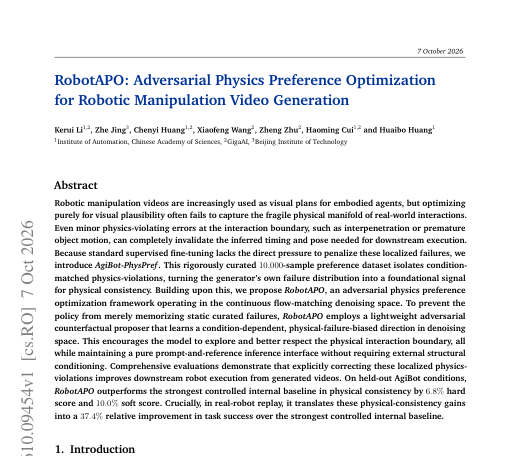
#292024-05-11★ 1.8k +465

robocasa/robocasa

Python

RoboCasa: Large-Scale Simulation of Everyday Tasks for Generalist Robots

RoboCasa: Large-Scale Simulation of Everyday Tasks for Generalist Robots

humanoid-robotphysics-simulationrobot-learningroboticsrobothumanoid

兴趣:humanoid robots and whole-body control

#302023-11-29★ 77.5k +17165

unslothai/unsloth

Python

Local UI to run and train LLMs and diffusion models. Supports GGUF, MLX, Qwen3.8, DeepSeek-V4, MiniMax-H3, Gemma 4, FLUX and more.

Local UI to run and train LLMs and diffusion models. Supports GGUF, MLX, Qwen3.8, DeepSeek-V4, MiniMax-H3, Gemma 4, FLUX and more.

agentaichatgptdeepseekfine-tuninggemmaimage-generationllama

兴趣:multi-agent systems and LLM agents