Tech Station

2026-10-12

50 篇论文 · 30 个项目 ← 2026-10-11 · 2026-10-13 →

论文

#12026-10-08追踪学者 · Shuran Song追踪学者 · Guanya Shi101

PanTact: Teaching Whole-Body Dexterity with a Wearable Contact Interface

Xiaomeng Xu, Han Zhang, Zhian Ruan, Xiaofeng Guo, Jinkun Cao, Ruihan Yang 等

Humanoid robots have many degrees of freedom and contact surfaces, yet most loco-manipulation research restricts manipulation to the hands and avoids other body contacts with the e…

Humanoid robots have many degrees of freedom and contact surfaces, yet most loco-manipulation research restricts manipulation to the hands and avoids other body contacts with the environment. To extend manipulation beyond the hands, we present PanTact, a system that learns humanoid whole-body dexterity, the capability to manipulate with any suitable body surface, directly from robot-free human demonstrations. Our key idea is to use contact as manipulation-centric information that transfers across embodiments. Contact locations and timing specify the interactions needed to accomplish a task, while the robot chooses how to coordinate its body to realize them within its own physical constraints. Specifically, PanTact captures, learns, and executes whole-body contact via: 1) a wearable, robot-free data collection interface that augments egocentric vision and bimanual UMI grippers with whole-body modular contact patches to record body contact locations and states; 2) a visuomotor policy that mitigates the egocentric observation gap and predicts whole-body contact goals; and 3) contact-aware whole-body control formulations that realize active contact goals using suitable robot surfaces. We deploy PanTact on a Unitree G1 humanoid without additional body contact sensors, demonstrating whole-body dexterity involving body support, pushing, sweeping, and load-sharing. Website: https://pantact.github.io

cs.ROrobotmanipulationhumanoid

追踪学者:Shuran Song、Guanya Shi;兴趣:humanoid robots and whole-body control

#22026-10-0897

Spa-Bench: A Real-Robot Benchmark for Spatial Grounding in Vision-Language-Action Models

Justin Tien-Smith, Matthew Pidden, Rolandos Alexandros Potamias

Vision-language-action models (VLAs) offer a promising route toward general-purpose robotics by transferring semantic knowledge from large-scale vision-language pretraining into la…

Vision-language-action models (VLAs) offer a promising route toward general-purpose robotics by transferring semantic knowledge from large-scale vision-language pretraining into language-conditioned control. However, most VLA evaluations emphasize aggregate manipulation success under changes in objects, instructions, or environments, leaving unclear how reliably these policies ground spatial descriptions in the physical scenes where they act. We therefore ask a sharper question: how reliably can current VLAs translate spatial descriptions into appropriate real-robot behavior? To investigate this, we introduce Spa-Bench, a real-robot benchmark that evaluates spatial grounding across six tabletop tasks covering Object State, Relative Size, Referential Description, Relational Placement, Ordinal Position, and Counting. Our primary evaluation compares in-distribution (ID) and out-of-distribution (OOD) spatial configurations while retaining training support for the relevant objects, concepts, and actions, reducing object and motor unfamiliarity as alternative explanations for failure. Four diagnostic conditions further probe physical execution, sensitivity to wording, object-task associations, and recognition that no action is required. We release 4,092 episodes collected on the SO-101 robot arm: 1,200 human-teleoperated demonstrations and 2,892 real-robot evaluation rollouts from five state-of-the-art VLA policies. Across the three fully evaluated policies, success falls from 67.5-73.3% on ID spatial configurations to 40.7-52.0% on OOD spatial configurations, while matched direct instructions improve success by 28.3-40.0 percentage points. These results show that the evaluated VLAs can often execute the required manipulations but lack robust spatial grounding. Project materials, including videos, code, and benchmark data, are available at https://justintiensmith.github.io/Spa-Bench/.

cs.ROrobotmanipulationVLAvision-language-action

兴趣:vision-language-action (VLA) models and foundation models for robots

#32026-10-0996

Beyond Actions: Learning Future Operation Targets for Vision-Language-Action Models

Min Lin, Bokai Zhou, Jianqi Lin, Kaiyuan Yang, Yicheng Chang, Junjie Yu 等

Actions specify what a robot should execute, but do not describe what those commands will achieve. Vision-language-action (VLA) policies nevertheless learn primarily by predicting …

Actions specify what a robot should execute, but do not describe what those commands will achieve. Vision-language-action (VLA) policies nevertheless learn primarily by predicting action chunks from images, language, and state. We introduce Action--Future Coupled Effect Learning (AFCE), which makes a future-grounded physical Effect the policy's primary prediction target. An offline tokenizer constructs temporally ordered Effect tokens from demonstrated actions, realized robot responses, and sparse visual transitions. Reconstruction objectives encourage the representation to retain executable detail and observed physical change. A flow-matching VLA predicts Effects from current images, instruction, and robot state, while a state-conditioned decoder converts them into action chunks. Embodiment-specific interfaces allow single- and dual-arm tasks to share the Effect model. On DexJoCo, AFCE achieves $50.97%$ overall success, improving over $π_{0.5}$ and UVT by 11.82 and 15.21 percentage points, respectively. It leads on all five bimanual tasks, highlighting the value of Effect supervision for coordinated dexterous manipulation. The project page is available at https://afceproject.github.io/AFCE-Web/.

cs.ROcs.AIrobotmanipulationVLAvision-language-actiondexterous

兴趣:vision-language-action (VLA) models and foundation models for robots

#42026-10-0995

VLMs are Native Action Models: Unleashing the Manipulation Capabilities of VLMs with Explicit Action-Space Grounding

Jingkun Yi, Shujie Zhang, Zirui Zhou, Haoxiao Wang, Haiyang Sun, Yuhang Dong 等

Pretrained vision-language models (VLMs) already exhibit strong visual, spatial and reasoning capabilities relevant to robotic manipulation. The key challenge in turning pretrained…

Pretrained vision-language models (VLMs) already exhibit strong visual, spatial and reasoning capabilities relevant to robotic manipulation. The key challenge in turning pretrained VLMs into generalist manipulation policies is to expose these capabilities through an appropriate action interface. Vision-language-action (VLA) models provide a unified trainable policy, but typically introduce learned action tokens, action heads, or action experts whose semantics must be learned from robot data pretraining. In contrast, modular foundation-model-based manipulation methods can exploit pretrained VLM capabilities for zero-shot manipulation, but rely on external planning and control scaffolds that are not end-to-end trainable as a unified continuous-action policy. In this work, we introduce EASG, an Explicit Action-Space Grounding framework that bridges these two paradigms. By projecting a tool center point (TCP)-centered action frame into the wrist camera observation and expressing actions in the form of VLM's native textual generation interface, EASG makes the semantics of a continuous robot action space directly observable in the VLM's perceptual context. This allows pretrained VLMs to directly generate executable robot actions using their existing visual-spatial reasoning capabilities, without robot-action pretraining or additional action modules. Besides, the same action interface supports direct fine-tuning with robot trajectories, allowing the models to continuously improve beyond their manipulation capabilities unleashed by EASG. Overall, EASG enables zero-shot manipulation and generalization across object positions, categories, and robot embodiments, while supporting effective fine-tuning in the same continuous action space. These results demonstrate that, given an appropriate action interface, pretrained VLMs can themselves serve as native action models for robotic manipulation.

cs.ROrobotmanipulationVLAvision-language-action

兴趣:vision-language-action (VLA) models and foundation models for robots

#52026-10-0993

OGPO: Offline Goal-conditioned Policy Optimization for Recoverable Vision-Language-Action Models

Xule Gao, Xi Wang, Zehua Zang, Rui Wang, Changwen Zheng, Chuxiong Sun

Vision-language-action (VLA) models have shown strong promise in robotic manipulation, yet their post-training still predominantly relies on trajectory-level supervised imitation o…

Vision-language-action (VLA) models have shown strong promise in robotic manipulation, yet their post-training still predominantly relies on trajectory-level supervised imitation over robot demonstrations. While effective for learning feasible actions, this paradigm supervises policies to reproduce expert actions at each step, biasing them toward demonstration-specific action paths and providing limited guidance for recovering toward task-progress states once execution deviates from demonstrated trajectories. To address this limitation, we propose OGPO, an Offline Goal-conditioned Policy Optimization framework for recoverable VLA post-training. Instead of treating offline demonstrations merely as step-wise action labels, OGPO adaptively relabels trajectories with semantic key states and constructs goal-conditioned process rewards to optimize the policy for reaching these task-progress states. In this way, OGPO shifts VLA post-training from trajectory-level action imitation to key-state reachability learning, enabling policies to acquire a more robust ability to complete goal states from feasible off-demonstration states without requiring additional online interaction. Experiments on LIBERO and MetaWorld show that OGPO consistently improves VLA policy performance over standard supervised fine-tuning. Moreover, evaluations on LIBERO-Plus and our proposed LIBERO-ReAct, a mid-execution perturbation benchmark, further demonstrate that OGPO achieves stronger robustness and goal-directed recoverability under distribution shifts and recoverable off-demonstration states.

cs.AIrobotmanipulationVLAvision-language-action

兴趣:vision-language-action (VLA) models and foundation models for robots

#62026-10-0992

Noise Space Learning for VLA Adaptation

Junjie Lu, Chuheng Zhang, Yucen Wang, Yuhua Jiang, Xinyao Qin, Min Xu 等

Pretrained vision-language-action (VLA) models encode broad manipulation priors, yet adapting them to specific tasks requires balancing limited robot interaction, computational res…

Pretrained vision-language-action (VLA) models encode broad manipulation priors, yet adapting them to specific tasks requires balancing limited robot interaction, computational resources, and safety constraints. Noise space learning (NSL) adapts flow-matching-based VLAs by learning a context-conditioned distribution over noise while keeping the pretrained VLA fixed. Building on prior noise-steering methods, we formulate NSL as an interface for VLA adaptation that accommodates different learning algorithms and instantiate it with PPO, SAC, and AWR. Theoretically, we provide an information-theoretic analysis of how NSL enables efficient adaptation. Empirically, we study these NSL algorithms on LIBERO, RoboTwin, and four real-robot manipulation tasks under interaction, computation, and execution constraints. Across these settings, we develop a suite of effective NSL variants and derive practical recommendations for choosing among them under different resource and deployment regimes.

cs.ROrobotmanipulationVLAvision-language-action

兴趣:vision-language-action (VLA) models and foundation models for robots

#72026-10-0991

Human2Dex: Dexterous Robot Learning from Wrist-Centric Human Demonstrations

Jiachen Zhang, Yuanyuan Li, Shaqi Luo

Collecting dexterous manipulation demonstrations for each robot hand requires repeated task-specific data acquisition. We ask whether one shared corpus of natural human demonstrati…

Collecting dexterous manipulation demonstrations for each robot hand requires repeated task-specific data acquisition. We ask whether one shared corpus of natural human demonstrations can instead serve as a reusable data interface for different dexterous hands, without collecting task demonstrations on each target robot. We present Human2Dex, a wrist-centric human demonstration interface that separates shared human observation and motion semantics from embodiment-specific execution. It aligns observations through local hand-appearance adaptation and a shared 21-point hand representation with consistent structural semantics across human and robot observations. It constructs executable supervision by retargeting fused human hand motion to each target hand, and introduces the Grasp-Pocket Interaction Representation (GPIR) to express tracked objects relative to a hand-centered Functional Grasp Pocket. The corpus is converted into separate training sets for Linker O6 and Wuji, while action labels, normalization, training, and diffusion-policy checkpoints remain hand-specific. Across six real-world tasks, Human2Dex achieves 109/120 (90.8%) successes on Linker O6 and 97/120 (80.8%) on Wuji. Across both hands, Human-Raw achieves 63/240 (26.3%) successes, whereas the complete Human2Dex configuration achieves 206/240 (85.8%). These results support the use of wrist-centric human demonstrations as a reusable interface across calibrated dexterous hands while retaining embodiment-specific policy learning. The project website is publicly available at https://human2dex.pages.dev/.

cs.ROrobotmanipulationgraspdexterous

兴趣:robot manipulation and grasping with learned policies

#82026-10-0990

Evo-World: A Lightweight Vision-Language-Action Model with Future Motion Prediction via Optical-Flow Supervision

Zile Zhong, Yuxin Du, Tao Lin, Haoxiao Wang, Wei Dai, Binhua Zuo 等

Vision-language-action (VLA) models provide a unified framework for visual understanding, language grounding, and robot control, yet anticipating how the scene will evolve beyond t…

Vision-language-action (VLA) models provide a unified framework for visual understanding, language grounding, and robot control, yet anticipating how the scene will evolve beyond the current observation can provide additional information for control. Action supervision alone does not explicitly encourage such anticipation, while future-image prediction entangles task-relevant motion with largely static appearance. To address these limitations, we introduce Evo-World, a lightweight VLA model that augments policy learning with future motion prediction through optical-flow supervision, thereby providing a task-relevant predictive signal focused on motion rather than appearance. We further design the training procedure to preserve these predictive representations during policy learning, regulating representation diversity while decoupling representation learning from action optimization. Across simulation benchmarks, Evo-World demonstrates strong performance, achieving a tier-averaged success rate of 91.1% on Meta-World MT50 , with a 13.0% relative improvement over the non-predictive baseline. On real-world AgileX robots, Evo-World outperforms the evaluated baselines across single-arm and bimanual manipulation tasks while using only 0.87B parameters and delivering lower GPU memory usage and higher inference efficiency. These results demonstrate that future motion prediction through optical-flow supervision provides an effective and lightweight approach to enhancing the predictive capabilities of VLA models.

cs.ROrobotmanipulationVLAvision-language-action

兴趣:vision-language-action (VLA) models and foundation models for robots

#92026-10-0990

RARA: Robust Policy Fine-Tuning through Retrieval-Anchored Representation Alignment for Robotic Manipulation

Xuhui Kang, Sung-Wook Lee, Yan Zhuang, Tianle Zhong, Yen-Ling Kuo

Pre-trained robot policies, such as Vision-Language-Action (VLA) models, provide a strong foundation for generalist robotic manipulation, but adapting them to new tasks with only a…

Pre-trained robot policies, such as Vision-Language-Action (VLA) models, provide a strong foundation for generalist robotic manipulation, but adapting them to new tasks with only a few demonstrations remains challenging. Directly fine-tuning a pre-trained policy often achieves strong in-distribution performance, yet it can distort the representations learned during pre-training and weaken the model's generalization ability under out-of-distribution shifts. We propose Retrieval-Anchored Representation Alignment (RARA), a two-stage adaptation method, to address this issue. First, RARA retrieves representation features from pretraining with similar task intent and motion, and aligns the policy's representations of the target demonstrations with the pre-trained representations of the retrieved demonstrations. Second, RARA fine-tunes the policy on the target demonstrations while limiting how much its representations of the retrieved demonstrations change during fine-tuning. By reducing the representation mismatch before action learning and preserving pre-trained knowledge during adaptation, RARA limits unnecessary representation drift during fine-tuning. Experiments with Diffusion Policy and GR00T on 13 tasks in RoboTwin, RoboCasa, and on a real robot show that RARA improves the average success of fine-tuning by 9.5 points in-distribution and 13.6 points out-of-distribution, and outperforms all compared baselines. Project page: https://shua-kang.github.io/RARA_robot/

cs.ROcs.CVcs.LGrobotmanipulationVLAvision-language-actiondiffusion policy

兴趣:imitation learning and diffusion policies for robot control

#102026-10-0988

Dream to Remember: Continual Steering of Generalist Robot Policies with World Models

Bahey Tharwat, Iman Nematollahi, Marvin Alles, Xingyuan Zhang, Akshay L Chandra, Abhinav Valada

Generalist robot policies are trained with imitation learning and are bounded by the quality and coverage of their demonstrations. Reinforcement learning can improve and extend the…

Generalist robot policies are trained with imitation learning and are bounded by the quality and coverage of their demonstrations. Reinforcement learning can improve and extend them, either by fine-tuning the policy weights or by training a small module to steer the input noise of a frozen generative policy. When tasks arrive sequentially, both approaches suffer from catastrophic forgetting. Fine-tuning on a task degrades prior tasks, and steering only shifts forgetting to the shared steering module. We propose Dream to Remember (D2R), which continually steers a frozen generalist policy toward new tasks, while retaining its earlier skills. As the steering module learns a new task, a frozen pretrained world model rehearses prior tasks through imagined rollouts, anchoring the module to its earlier behavior without a replay buffer or new data. When the world model is faithful enough, D2R learns the new task entirely in imagination. Otherwise, it learns the task in the environment while using the world model only to rehearse prior tasks. On CALVIN, D2R improves eight tasks in sequence entirely in imagination, raising average success from 63.7% to 74.8%, while LoRA fine-tuning on the same sequence drops it to 11.7%. With a frozen off-the-shelf generalist policy and world model, $π_0$ and A2World, D2R learns unseen LIBERO-90 tasks in the environment while keeping $π_0$'s performance on the LIBERO suites it was fine-tuned on, even though the world model is not accurate enough for policy optimization. Finally, on a real Franka robot, D2R improves three tasks in sequence entirely in imagination while retaining the earlier improvements.

cs.ROcs.CVcs.LGrobotimitation learningworld model

兴趣:imitation learning and diffusion policies for robot control

#112026-10-0988

PartiGen: Part-Aware Representations for Language-Conditioned Humanoid Motion Generation

Chuxuan Huang, Zhanxiang Cao, Tianyue Zhan, Haoyang Li, Yang Zhang, Liyun Yan 等

Translating language into humanoid motion requires coordinating body parts, determining motion duration, and producing references suitable for robot execution. We introduce PartiGe…

Translating language into humanoid motion requires coordinating body parts, determining motion duration, and producing references suitable for robot execution. We introduce PartiGen, a part-aware latent diffusion framework that incorporates anatomical structure into a shared whole-body motion representation. Part-specific attention processes anatomically masked frame features, and its outputs are fused to combine local limb information with whole-body context. Conditioned on text and motion history, the model generates motion primitives autoregressively. Forward-kinematics supervision encourages kinematic consistency, while a learned end-of-sequence predictor selects a frame-level endpoint after generation. On HumanML3D retargeted to the Unitree G1, PartiGen achieves a segment-level FID of 3.165, a 16.8% reduction over TextOp, and improves R@1 by 1.4 percentage points. In the duration study with 16-frame primitives, endpoint prediction reduces mean absolute duration error from 12.471 to 3.080 frames compared with a fixed-length cutoff. We further evaluate robot execution using a pretrained, frozen GRIT tracker: 409 of 500 generated references (81.8%) pass the posture-based stability screen in MuJoCo. Following simulation screening and manual selection, 26 of 27 attempted motions are judged successful on the real G1.

cs.ROrobothumanoid

你点赞过:TANGO: Humanoid Navigation in Cluttered Environments with a

#122026-10-0988

Forward Dynamics Models

Zipei Ma, Junzhe Jiang, Jiahui Zhang, Juntong Zhang, Chun Gu, Bozhou Zhang 等

Vision-language-action (VLA) models and world action models (WAMs) have advanced robotic policy learning by building on pretrained vision-language models (VLMs) and video generativ…

Vision-language-action (VLA) models and world action models (WAMs) have advanced robotic policy learning by building on pretrained vision-language models (VLMs) and video generative models (VGMs), respectively. Yet VLAs learn without explicit supervision from future world states, while WAMs that condition actions on predicted futures incur extra inference cost and let visual prediction errors propagate into actions. We present Forward Dynamics Models (FDM), a family of robotic action models that couples action and future world-state prediction through an action-to-future paradigm. Future prediction is conditioned on action features, never the reverse: end-to-end training lets ground-truth future states supervise the policy through these features, while prediction errors cannot propagate into actions. At inference, FDM skips future generation entirely, avoiding its computational cost. The paradigm is backbone-agnostic, and we instantiate it with both VLM and VGM backbones. Experiments in simulation and on real robots demonstrate the effectiveness of FDM across both backbone families, achieving a state-of-the-art 99.4% average success rate on LIBERO and absolute gains of up to 13% over VLA and WAM methods on real-world tasks.

cs.ROVLAvision-language-action

兴趣:vision-language-action (VLA) models and foundation models for robots

#132026-10-09追踪学者 · Shuran Song88

Chronos Policy: Learning Robot Policies on Physical Time

Changhao Wang, Jaden Clark, Shuran Song

Robot policies often convert sensing and control into fixed-rate observation-action sequences, leaving physical time implicit in sequence position. This assumption breaks when obse…

Robot policies often convert sensing and control into fixed-rate observation-action sequences, leaving physical time implicit in sequence position. This assumption breaks when observation rates or delays vary, or when inference latency changes. We introduce Chronos Policy, which makes physical time explicit by conditioning on observation capture times and desired action execution times. We study two ways to incorporate time into a diffusion transformer: adding timestamp embeddings to token features, or encoding physical time in positional encoding through time-aware rotary positional encodings (time-aware RoPE). We find that time-aware RoPE is more robust, allowing attention to depend directly on physical time while keeping token content unchanged. During training, we temporally randomize which observations are sampled and when the action chunk begins, exposing the policy to a wider range of sensing and execution schedules that may occur during deployments. This also enables learning from asynchronous, multi-rate data without forcing all measurements onto a fixed temporal grid. Across simulation and real-world experiments, Chronos Policy improves performance on dynamic tasks, where observation-to-action timing is critical, and on multisensory tasks, where the relative timing between observations matters. On standard quasi-static tasks, it preserves nominal performance while improving robustness to changes in sensing and inference timing.

cs.ROcs.CVrobot

追踪学者:Shuran Song;兴趣:imitation learning and diffusion policies for robot control

#142026-10-0987

LAPT-Scale: Scaling Embodied Policies with Latent Action Pre-Training on Human Videos

Zhiyuan Xiang, Peidong Liu, Mingyang Li, Jiawei Li, Wenhow Li, Wenbo Ding 等

Scaling generalist robotic policies is limited by the high cost of collecting embodied interaction data. Large-scale egocentric human videos offer a rich alternative, but they lack…

Scaling generalist robotic policies is limited by the high cost of collecting embodied interaction data. Large-scale egocentric human videos offer a rich alternative, but they lack robot action labels, and existing action annotation methods are often noisy under real-world visual complexity and diverse manipulation dynamics. We introduce LAPT-Scale, a scalable latent action pre-training paradigm with two components: LAPT-Scale-LAM learns continuous latent actions by explaining frame-to-frame visual transitions in human videos and uses them as human-derived supervision, while LAPT-Scale-Policy trains a VLA policy through human-video latent-action pre-training, target-robot embodiment alignment, and task-specific post-training. Unlike prior vector-quantized LAMs, LAPT-Scale-LAM uses a continuous latent space to preserve fine-grained motion and interaction dynamics. We further combine perceptual, semantic, and optical-flow alignment signals to improve transition-level supervision beyond pixel reconstruction. Trained on 23.3K hours of egocentric video, LAPT-Scale-LAM provides implicit action supervision for policy pre-training, yielding consistent scaling gains and improving real-robot success from 63.3% to 85.0% as annotated human video scales from 1K to 5K hours. The learned policy also generalizes to unseen visual conditions.

cs.CVcs.AIcs.ROrobotmanipulationVLAembodied

兴趣:world models and video prediction for embodied agents

#152026-10-0987

SmolWAM: A Latent World-Action Model for Robotic Manipulation on Edge Devices

Timi Owolabi, Hikmah Olawore, Frances Adelakun, Ayotomiwa Oyewumi

World-action models (WAMs) predict a robot's actions together with the observations those actions will produce. However, the strongest models rely on video diffusion transformers t…

World-action models (WAMs) predict a robot's actions together with the observations those actions will produce. However, the strongest models rely on video diffusion transformers that are far too computationally expensive for resource-constrained edge devices. We present SmolWAM, a latent WAM that we derive from the 2B-parameter Cosmos Policy by keeping its pretrained trunk and rebuilding its inference interface: single-frame visual latents, cached text features that preserve the trunk's attention sinks, 12 of 28 transformer blocks, and 1,008 tokens from which actions and future visual latents are read out in one rectified-flow step. Trained in 3.6 GPU-hours, SmolWAM succeeds in 95.5% of 400 LIBERO episodes at 57 ms and 2.3 TFLOP per 16-action chunk with 2.4 GiB of GPU memory, 11x faster than its teacher with 18.5x fewer FLOPs and 3.2x less memory, and its world head still forecasts scene motion.

cs.ROcs.LGrobotmanipulation

兴趣:world models and video prediction for embodied agents

#162026-10-0987

Evo-RL: Iterative Robot Reinforcement Learning from Selective Experience

Kai Ye, Yifan Jin, Qianhang Luo, Hongru Zhang, Jiedong Zhang, Shuyuan Hu 等

Existing real-world reinforcement learning methods improve robot policies by combining human corrections with autonomous rollouts. However, accumulated experience varies in its val…

Existing real-world reinforcement learning methods improve robot policies by combining human corrections with autonomous rollouts. However, accumulated experience varies in its value for policy improvement, and even successful trajectories can contain inefficient or redundant behavior, motivating more selective experience reuse. To this end, we propose Evo-RL, an iterative reinforcement learning method that combines human interventions with advantage-guided experience selection. Evo-RL uses human corrections and experience with positive estimated advantages from successful trajectories to iteratively refine the policy. To support learning from these different experience sources, we introduce RW-RL-Dataset, which spans over 1,000 hours across four robot embodiments. On a real-world high-precision manipulation task, Evo-RL improves attempt success rate over RECAP by 30.46%. Our code, model checkpoints, and dataset are publicly available.

cs.ROrobotmanipulation

兴趣:imitation learning and diffusion policies for robot control

#172026-10-0886

What Should Embodied Agents Remember? Benchmarking and Evaluating Memory Modality for Embodied Agents

Junxiang Wang, Yuchen Liu, Yi Wu, Guofei Chen, Nir Pechuk, Tao Chen 等

Memory allows large language model (LLM) agents to use past experience, often stored as textual records, when responding to requests. For embodied agents that control robots, visua…

Memory allows large language model (LLM) agents to use past experience, often stored as textual records, when responding to requests. For embodied agents that control robots, visual and spatial observations introduce a broader choice of memory modalities, affecting both the information available for subsequent tasks and the model inference costs of constructing and using memory. We introduce MeMoREval, a benchmark for studying this problem through a controlled experience-request protocol. Agents first experience a sequence of events without knowing the subsequent tasks, and subsequently they use memory to respond to information and action requests without receiving new observations. The benchmark comprises 53 tasks across four simulated indoor environments and measures task success alongside the inference costs of memory construction and use. Our reference evaluations reveal that storing frames outperforms storing generated descriptions at lower write-time inference cost for the primary model, while storing frames with scene graphs achieves the highest aggregate task success for every tested model. Extensions to accumulated experience, selective frame retention, and visual input to memory writers demonstrate how the benchmark accommodates further memory-design investigations. Two physical-robot demonstrations establish the feasibility of applying its protocol beyond simulation.

cs.ROrobotembodied

兴趣:world models and video prediction for embodied agents

#182026-10-0986

Beyond Successful Robot Demonstrations: Learning from Human Interactions and Modeling Failure Dynamics

Peiyan Tu, Cong Wang, Hanxin Zhu, Xin Jin, Zhibo Chen

Action-conditioned world models offer a promising foundation for generalist robotic intelligence by predicting the consequences of actions. However, existing robotic datasets provi…

Action-conditioned world models offer a promising foundation for generalist robotic intelligence by predicting the consequences of actions. However, existing robotic datasets provide limited coverage of the diverse interaction dynamics required for generalizable world modeling. Large-scale egocentric human videos offer complementary interaction experience, yet the embodiment gap between human hands and robotic manipulators hinders effective cross-embodiment learning. Meanwhile, the predominance of successful demonstrations leaves failure dynamics substantially underrepresented, limiting the ability of world models to anticipate unsuccessful executions. To address these limitations, we introduce HF-WM, an action-conditioned world model that combines Human interaction learning with Failure-aware post-training. To bridge the embodiment gap, we develop a dual-branch framework that couples video generation with auxiliary pointflow prediction, using stabilized pointflow as a unified motion representation across human and robot interactions while suppressing egocentric camera motion. To improve failure modeling, we further perform Group Relative Policy Optimization (GRPO) post-training on perturbed actions derived from successful demonstrations, guided by action alignment and physical plausibility rewards, enabling the model to learn plausible failure dynamics without paired ground-truth videos. Extensive experiments demonstrate that HF-WM achieves state-of-the-art performance in action-conditioned video generation and exhibits strong utility for policy evaluation in downstream robotic tasks.

cs.ROcs.CVrobotworld model

兴趣:world models and video prediction for embodied agents

#192026-10-0986

JitterVLA: A Replay Benchmark for Motion Quality in VLA-Driven Human-Robot Manipulation

Faith Ogunwoye, Didar Seyidov, Konstantin Gubernatorov, Dzmitry Tsetserukou

Vision-language-action (VLA) policies issue sparse targets whose arrival at the robot controller is delayed and irregular, so a reasonable predicted action can still produce abrupt…

Vision-language-action (VLA) policies issue sparse targets whose arrival at the robot controller is delayed and irregular, so a reasonable predicted action can still produce abrupt motion near people. Remedies are evaluated on different streams, delays and metrics. JitterVLA replays identical commands and arrival traces through alternative controllers, isolating the controller's effect. We apply it to synthetic reaches, hand trajectories from 20 people, three open VLA pipelines (838 episodes) and a physical UR3. Interpolation lowered modeled p99 jerk for every source, by 83% (615 to 106 m/s^3) on human motion with 200 ms delay, at a 2.0 cm tracking cost, and the effect replicated on 598 new episodes; jerk-limited generation lowered jerk further at a larger cost. Entropy-discontinuity associations had opposite, replicated signs in two pipelines, and entropy gating helped in one but not the other. On the UR3, interpolation lowered accelerometer-derived jerk by 3.0-14.0% in all six exploratory pairs, while a position-derived metric did not resolve the contrast. JitterVLA supports screening before human-centred studies; code and data will be released.

cs.ROcs.HCcs.LGrobotmanipulationVLAvision-language-action

兴趣:vision-language-action (VLA) models and foundation models for robots

#202026-10-0986

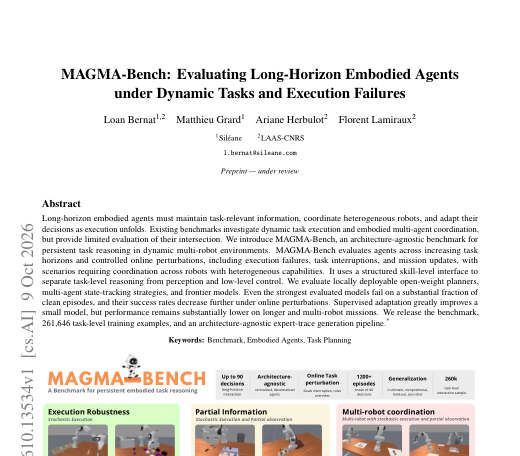
MAGMA-Bench: Evaluating Long-Horizon Embodied Agents under Dynamic Tasks and Execution Failures

Loan Bernat, Matthieu Grard, Ariane Herbulot, Florent Lamiraux

Long-horizon embodied agents must maintain task-relevant information, coordinate heterogeneous robots, and adapt their decisions as execution unfolds. Existing benchmarks investiga…

Long-horizon embodied agents must maintain task-relevant information, coordinate heterogeneous robots, and adapt their decisions as execution unfolds. Existing benchmarks investigate dynamic task execution and embodied multi-agent coordination, but provide limited evaluation of their intersection. We introduce MAGMA-Bench, an architecture-agnostic benchmark for persistent task reasoning in dynamic multi-robot environments. MAGMA-Bench evaluates agents across increasing task horizons and controlled online perturbations, including execution failures, task interruptions, and mission updates, with scenarios requiring coordination across robots with heterogeneous capabilities. It uses a structured skill-level interface to separate task-level reasoning from perception and low-level control. We evaluate locally deployable open-weight planners, multi-agent state-tracking strategies, and frontier models. Even the strongest evaluated models fail on a substantial fraction of clean episodes, and their success rates decrease further under online perturbations. Supervised adaptation greatly improves a small model, but performance remains substantially lower on longer and multi-robot missions. We release the benchmark, 261,646 task-level training examples, and an architecture-agnostic expert-trace generation pipeline.

cs.AIcs.ROrobotembodied

兴趣:large language models for robot task planning and reasoning

#212026-10-0985

Grounded-Dreamer: Robot Learning from World Model Synthetic Data with Physical Grounding

Feng Jiang, Shu Chen, Yuanfei Wang, Yuan Li, Zhenhao Shen, Jiaqi Liang 等

Scaling robot manipulation policies requires large amounts of diverse, action-labeled data, yet collecting such data in the real world remains expensive and difficult to scale. Exi…

Scaling robot manipulation policies requires large amounts of diverse, action-labeled data, yet collecting such data in the real world remains expensive and difficult to scale. Existing methods either depend on human teleoperation, rely on simulation with limited visual realism, or use human videos that lack embodiment-specific annotations. In this paper, we introduce Grounded-Dreamer, a framework for synthesizing physically grounded robot manipulation data with video world models while avoiding human teleoperation demonstrations. Grounded-Dreamer combines the visual realism of generative video models with simulator physics engines. Starting from a small set of real images depicting robot task initial states, our method automatically reconstructs task-relevant objects and camera geometry, aligns them in simulation, and collects physically valid trajectories. These trajectories are used to post-train both a video world model and an inverse dynamics model, enabling the generation of visually realistic robot manipulation videos and corresponding robot actions from real images. To filter physically implausible rollouts, Grounded-Dreamer replays generated trajectories in the reconstructed simulation and retains only those that successfully complete the tasks. The real-world robot policies are trained solely on the grounded synthetic trajectories without any human demonstrations. Empirical results in real-world tasks demonstrate that Grounded-Dreamer can synthesize physically grounded data and substantially facilitate policy learning without requiring human teleoperation effort.

cs.ROrobotmanipulationworld model

兴趣:world models and video prediction for embodied agents

#222026-10-0984

Adaptive Whole-Body MPC with Optimal Posture Planning for Humanoid Robots under Unknown Payloads

Manh Cuong Nguyen, Duc Cuong Vu, Viet Anh Vu, Duc Tuan Pham, Toan Nguyen, Minh Hiep Phung 等

Humanoid robots performing lifting and material-handling tasks must maintain balance despite unknown and varying payloads. However, payload uncertainty significantly affects whole-…

Humanoid robots performing lifting and material-handling tasks must maintain balance despite unknown and varying payloads. However, payload uncertainty significantly affects whole-body dynamics and may destabilize conventional controllers. We propose an adaptive whole-body control architecture that integrates three components: (i) a centroidal model predictive controller (MPC) that generates dynamically feasible reference motions, (ii) an adaptive fuzzy balance controller that compensates for payload-induced model mismatch by generating corrective torques distributed across the supporting-leg joints, and (iii) a waypoint-based optimal posture planner built on a triple-integrator model that produces smooth sit-to-stand and stand-to-sit trajectories satisfying center-of-mass (CoM) stability constraints, joint limits, and whole-body feasibility requirements. Together, these components enable stable lowering, grasping, lifting, carrying, and placing behaviors under significant payload uncertainty. Extensive simulation and hardware experiments demonstrate that the proposed framework improves balance robustness and reduces tracking degradation during posture transitions and lifting tasks compared to non-adaptive baselines.

cs.ROhumanoid

兴趣:humanoid robots and whole-body control

#232026-10-0984

Dual-Stream Memory for Vision-Language-Action Policies

Yang Wang, Ping Liu, Ruiyu Wang, Xuhua Chen, Lingfeng Zhang, Tao Zhang

Memory-dependent manipulation requires a policy to track execution state and recover visual evidence that is no longer observable. We propose dual-stream memory for vision-language…

Memory-dependent manipulation requires a policy to track execution state and recover visual evidence that is no longer observable. We propose dual-stream memory for vision-language-action policies, assigning these requirements to complementary representations. A task-agnostic Gated DeltaNet compresses history into one temporal token, supervised by progress prediction and action-conditioned feature reconstruction. A task-conditioned retriever retains frames above a fixed relevance threshold; linear multi-scale fusion encodes each frame into sixteen spatial tokens. We then freeze the temporal compressor and jointly optimize retrieval and policy learning. Across sixteen RoboMME tasks, the complete model achieves 49.22% mean success versus 44.51% for the published FrameSamp+Modul reference, improving fourteen tasks and all four suite means. On four real-robot tasks, mean success reaches 62.5% versus 37.5%, with the largest gains on repeated actions requiring execution-stage discrimination. These results support combining execution context with selective visual access, while failures under cup swaps expose persistent identity tracking as an unresolved requirement.

cs.ROcs.CVrobotmanipulationvision-language-action

兴趣:vision-language-action (VLA) models and foundation models for robots

#242026-10-0884

Verifier-Mediated Multi-LLM Coordination for Multi-Robot Path Planning

Vivek Khatana, Zijian Song, Naira Hovakimyan, Petros Voulgaris

Foundation models are increasingly used for high-level multi-robot task planning, yet independently generated symbolic plans can become jointly infeasible after geometric grounding…

Foundation models are increasingly used for high-level multi-robot task planning, yet independently generated symbolic plans can become jointly infeasible after geometric grounding because of shared spatial and temporal constraints. We study execution-aware coordination of large-language-model (LLM) planners for multi-robot navigation. We compare a centralized architecture, in which one LLM jointly reasons over the robot team, with a decentralized multi-LLM architecture in which each robot independently proposes a task plan. A geometric verifier grounds the candidate plans into robot trajectories, detects predicted inter-robot conflicts, and converts conflict information into structured feedback for targeted replanning. This verifier-mediated architecture separates semantic task reasoning from execution-level feasibility while enabling iterative coordination among LLM planners. Experiments in CARLA and on Crazyflie aerial robots evaluate coordination performance as task complexity increases and characterize the trade-offs between centralized reasoning, decentralized verifier-mediated coordination, and physical executability.

cs.ROeess.SYrobottask planning

兴趣:large language models for robot task planning and reasoning

#252026-10-0984

EgoReveal: Learning Active Vision and Object Manipulation under Partial Occlusions from Egocentric Demonstrations

Hiromu Kurihara, Kazutoshi Tanaka, Masashi Hatano, Tadashi Kozuno, Hideo Saito, Mariko Isogawa

Learning from Demonstrations (LfD) enables robots to learn object manipulation directly from human demonstrations. In contrast to resource-intensive and labor-intensive teleoperati…

Learning from Demonstrations (LfD) enables robots to learn object manipulation directly from human demonstrations. In contrast to resource-intensive and labor-intensive teleoperation, egocentric demonstrations are easy to collect, enabling scalable data collection. Manipulated objects are often partially occluded in everyday environments, yet prior egocentric demonstration-based methods that require no robots or specialized teaching devices do not explicitly address occlusions. To fill this gap, we propose EgoReveal, a framework that learns viewpoint-repositioning together with manipulation actions from egocentric human demonstrations to reposition the viewpoint and obtain target visibility under partial occlusions. EgoReveal instantiates this as two imitation policies: one predicts the future camera-arm pose sequence from the current view and camera-arm pose, and the other predicts the future control commands from object keypoints and a history of control commands. EgoReveal switches between the two based on target visibility. In experiments where the manipulated object is partially occluded initially, EgoReveal repositions the camera to obtain visibility and completes the task more reliably than fixed-camera baselines.

cs.ROmanipulation

兴趣:robot manipulation and grasping with learned policies

#262026-10-0984

EmbodiedCLBench: Evaluating Continual Learning for Self-Evolving Embodied Agents

Jie Huang, Yanan Chen, Ruixun Liu, Kaichen He, Xinyi He, Rui Huang 等

Continual learning requires models to accumulate past experience and transfer it to new tasks. Despite substantial research on continual learning, existing work remains largely con…

Continual learning requires models to accumulate past experience and transfer it to new tasks. Despite substantial research on continual learning, existing work remains largely confined to non-embodied settings, without extending to embodied environments. To address this gap, we introduce EmbodiedCLBench, the first benchmark in embodied simulation for evaluating the continual learning capability of self-evolving agents. With compositional generalization as the core evaluation principle, our benchmark evaluates whether agents can first learn from basic tasks and then recombine the acquired skills to solve complex, unseen advanced tasks. Based on EmbodiedCLBench, we conduct extensive experiments across multiple agent harnesses and learning methods, revealing consistent limitations and distinctive behaviors. Our results show that while advanced tasks can be hardly solved under zero-shot setting, the experience from basic tasks enables consistent improvement. Such benefit from the experience remains stable even if the task complexity increases. However, this improvement does not scale accordingly with the number of learning samples, and current agents cannot extract meaningful information from additional experience. Collectively, our findings highlight continual learning as a fundamental yet underexplored capability, and our benchmark offers valuable resources for designing effective self-evolving agents in embodied environments. Our code and dataset are available at https://pku-value-lab.github.io/EmbodiedCLBench-homepage.

cs.AIcs.CLcs.CVembodied

兴趣:world models and video prediction for embodied agents

#272026-10-0883

REMM: Revisable Embodied Memory for Manipulation

Revanth Krishna Senthilkumaran, Ruwan Wickramarachchi, Alessandro Oltramari, Jonathan Francis

Long-horizon manipulation requires robots to retain task-relevant history while revising conclusions no longer supported by physical evidence. Retaining observations alone does not…

Long-horizon manipulation requires robots to retain task-relevant history while revising conclusions no longer supported by physical evidence. Retaining observations alone does not specify which completed conditions should be withdrawn after a disturbance or which obligations require repair. We introduce REMM, Revisable Embodied Memory for Manipulation, a supervisory memory layer for a frozen G0.5 vision-language-action executor. REMM separates an append-only evidence history from revisable task state and explicitly links derived relations and completed conditions to their supporting facts. When accepted evidence changes a supporting fact, it withdraws dependent conclusions and schedules targeted recovery at verified skill boundaries without updating the executor. Across 51 physical trials, including operator-assisted runs, REMM improves mean recorded task progress over the strongest baseline from 57% to 91% in intervention recovery and from 43% to 70% in sequence recall. Complementary video diagnostics show improved grounding of retained history into the next instruction, including comparisons with $π_{0.5}$-compatible high-level planner adaptations. These results support revisable memory as a practical interface for continued manipulation without policy retraining. Project: https://revanthsenthil.github.io/remm/.

cs.ROmanipulationvision-language-actionembodied

兴趣:robot manipulation and grasping with learned policies

#282026-10-08追踪学者 · Guanya Shi83

Fly-by-Code: Embodied Coding Agents for Aerial Manipulation with Active Visual and Physical Feedback

Jaewoo Lee, Jeongyeon Seo, Sihyun Cho, Gyeongrak Choe, Yutong Wang, Bavin Saravanan 等

Embodied coding agents construct robot policies from natural-language instructions by generating executable programs and refining them from execution feedback. This refinement assu…

Embodied coding agents construct robot policies from natural-language instructions by generating executable programs and refining them from execution feedback. This refinement assumes that execution feedback reveals whether the task succeeded and, after a failure, provides sufficient evidence to guide program revision. Aerial manipulation violates this assumption in two ways. Payload constraints restrict onboard camera coverage and leave task-critical outcomes outside the robot's view (partial observability), while strong dynamic coupling and limited control margins make physical interactions fragile (limited interaction robustness) and leave failure causes unresolved. Re-examining the same feedback cannot recover observations that were never collected or separate failure causes that the available evidence does not distinguish. To acquire this missing evidence, we introduce Active Feedback (AF), an active "View and Probe" framework. When execution feedback leaves unresolved questions, the agent synthesizes a separate diagnostic program that runs in simulation to inspect unseen outcomes from informative viewpoints (View) or test hypotheses about failure causes through targeted physical interactions (Probe). Across six simulated aerial manipulation tasks with 60 trials per condition, AF reduces false completion declarations from 25 to 5 and raises final task success from 31.7% to 75% compared with terminal feedback under the same coding-agent configuration and task-execution limit. Using shared robot APIs, task programs refined with AF in simulation run on a physical aerial manipulator without task-program source-code modification and complete multi-stage manipulation tasks in the real world. These results show that executable diagnosis fills gaps in execution feedback for embodied coding agents, improving both completion assessment and program refinement in aerial manipulation.

cs.ROcs.CVcs.LGrobotmanipulationembodied

追踪学者:Guanya Shi;兴趣:world models and video prediction for embodied agents

#292026-10-0983

BT-Agent: Deploying Onboard Robot Agents with Behavior Trees and Multi-Fidelity Evaluation

Fabio Hübel, Adam Lilja, Yue Yin, Siming He, Claire Tomlin, Shankar Sastry 等

Deploying language-model agents onboard mobile robots requires task reasoning and responsive execution within limited compute and memory. We propose BT-Agent, an onboard architectu…

Deploying language-model agents onboard mobile robots requires task reasoning and responsive execution within limited compute and memory. We propose BT-Agent, an onboard architecture combining LLM-driven task decisions with predefined behavior-tree (BT) skills. These skills enforce execution conditions and return structured failure feedback. We demonstrate fully onboard operation with a 9B model on a quadruped across five task categories. Intervention tests show that local checks stop ongoing navigation without waiting for another model decision, while the agent remains active to retry or report constraints. To compare agent designs efficiently, we introduce a 161-task multi-fidelity benchmark, evaluated in text on all tasks and in Habitat on 39. Text supports 10.9$\times$ higher evaluation throughput, while simulation reveals how perception and motion failures change task outcomes. BT-Agent's largest success gains over the strongest Act/ReAct baseline occur at 4B and 9B: approximately 10 and 5 percentage points. Ablations identify structured tool calls and informative failure feedback as the most useful components.

cs.ROrobot

兴趣:large language models for robot task planning and reasoning

#302026-10-0883

Tactile Sensing-based Secure and Gentle Grasping of Unknown Objects

Feng Han

Reliable robotic manipulation requires maintaining a firm grasp while strictly avoiding both contact slip and structural damage to the object. Satisfying these inherent secure-and-…

Reliable robotic manipulation requires maintaining a firm grasp while strictly avoiding both contact slip and structural damage to the object. Satisfying these inherent secure-and-gentle grasping constraints is challenging for unknown objects. We present a novel online data-driven predictive control framework for safe dynamic robotic grasping of unknown objects. The proposed system features a pair of compact, single-channel tactile-sensing modules that characterize the gripper-object dynamic interaction in real time, entirely bypassing the need for prior knowledge or offline training. A finite-state-machine-based grasping force probing mechanism is developed to establish the initial grasping force and explicitly identify grasping force constraints. Through online dynamics learning, a Gaussian Process (GP) model captures gripper-object interaction dynamics. The model uncertainties are further used to form robust grasping constraints, which are embedded into a model predictive control scheme. We demonstrate error convergence in a probabilistic sense. The proposed control framework runs at 100~Hz in real time to dynamically manipulate and handle objects rather than static holding. Extensive experimental evaluations across diverse contact surface topologies and various types of objects validate superior performance and efficiency compared to baseline strategies. The proposed method is able to manipulate objects ranging from delicate items, such as raw tofu and marshmallows, to rough objects, such as rocks.

cs.ROmanipulationgrasptactile

兴趣:robot manipulation and grasping with learned policies

#312026-10-0883

CASTER: Formalizing Zero-Shot Manipulation from Synthetic Videos as Constrained Optimization

Yinlong Dai, Homanga Bharadhwaj, Dylan P. Losey

Prior research on learning from humans often requires real human demonstrations. But advances in video generation models offer a new paradigm: we can now prompt these generators to…

Prior research on learning from humans often requires real human demonstrations. But advances in video generation models offer a new paradigm: we can now prompt these generators to make synthetic videos of the task. On the plus side, these synthetic videos take place in the robot's current environment, and do not require actual human teaching. However, while the generated videos appear to show plausible motions, they lack both physical consistency and robot grounding, and thus the robot cannot directly roll out the trajectory shown by the video. In this paper we seek to formalize the process of going from synthetic video generation to real-world robot trajectories for zero-shot manipulation tasks. We recognize that this problem is an instance of constrained optimization. The object trajectories extracted from the synthetic video provide an initial guess at the correct motion, and the robot must refine these trajectories (for instance, within a digital twin) while enforcing physical feasibility and semantic consistency. Our optimization-based formalism provides insights into the video generation properties necessary for success. Specifically, we show that the video generation must probabilistically seed the search within a semantic basin of attraction where the trajectory can be locally modified without losing its task alignment. Our analysis further reveals that state-of-the-art approaches can be viewed as instances of our unified formalism with key simplifications. In our experiments we remove these simplifications to more closely match the underlying optimization, leading to more robust zero-shot trajectories from synthetic videos and improving average task success by 34.1% compared to the best-performing baseline. See videos at our project website: https://collab.me.vt.edu/CASTER

cs.ROcs.CVrobotmanipulation

兴趣:world models and video prediction for embodied agents

#322026-10-0883

Reflex: Visually Grounded Reactive Humanoid Control

Taoyang Jia, Weikai Huang, Linxin Song, Jared Darlington, Jieyu Zhao, Yue Wang 等

Humans effortlessly react to the world; they adeptly return a tennis shot, catch a falling cup, step aside from a passing cart, or pass a box tossed during truck unloading. These e…

Humans effortlessly react to the world; they adeptly return a tennis shot, catch a falling cup, step aside from a passing cart, or pass a box tossed during truck unloading. These everyday actions require anticipating a moving target and reflexively responding with the whole body within about a second. Such visual reactive whole-body control remains challenging for humanoids, which must (1) coordinate whole-body control, (2) react to object dynamics in real time, and (3) ground perception in egocentric vision. We study catching thrown boxes as a representative task that demands all three capabilities; existing systems cover only part of it, relying on end-effectors, motion capture, or marked objects. We present Reflex, a three-stage framework that learns these capabilities stage by stage while connecting them through a compact representation of object dynamics. First, a state-based policy learns whole-body catching with reinforcement learning. Second, the policy learns to infer the dynamics of a moving box from delayed and incomplete observations. Third, an egocentric RGB-D encoder learns to recover this dynamics representation directly from visual observations while keeping the whole-body controller fixed. This decomposition provides each capability with a direct training signal and makes visual learning substantially more scalable. In simulation, Reflex achieves 85.7% catch success from egocentric RGB-D, compared with 87.9% when given privileged box observations. Temporal visual history is critical: removing it reduces success by 35.6 and 39.8 points on centered and laterally offset throws. On a real Unitree G1, Reflex catches human-thrown boxes with 65% and 40% success at 2.5 and 5 m, reaching 76% and 59% of human catchers' success at the same distances.

cs.ROhumanoid

兴趣:humanoid robots and whole-body control

#332026-10-0982

ATHLETE: Learning Reactive Humanoid Tennis via Trajectory-Guided Motion Matching

Zhihao Tian, Zifan Wang, Enzheng Zhu, Xun Yang, Jialong Qin, Mengbo Wang 等

Humanoid tennis requires reactive whole-body coordination under rapidly changing ball dynamics, yet collecting task-specific motion-capture demonstrations that cover diverse approa…

Humanoid tennis requires reactive whole-body coordination under rapidly changing ball dynamics, yet collecting task-specific motion-capture demonstrations that cover diverse approach states, contact locations, and timing conditions is costly. Inspired by how humans acquire new skills by combining reusable motor experience with task-specific demonstrations, we present ATHLETE, a framework for learning reactive humanoid tennis from generic locomotion data and ordinary tennis videos. ATHLETE combines LAFAN1 locomotion with video-derived striking motions and uses Trajectory-Guided Motion Matching (TGMM) to construct diverse task-conditioned whole-body references. These references are transformed into a reactive policy through physics-based teacher--student learning with online DAgger distillation, followed by PPO fine-tuning for the tennis task. The resulting policy responds directly to robot and ball observations without requiring reference-motion inputs at deployment. On a real humanoid robot, ATHLETE achieves forehand and backhand hit rates of $90.00%$ and $86.67%$, respectively, and enables multi-shot rallies with human players. These results demonstrate that ATHLETE can learn dynamic humanoid tennis skills from reusable locomotion data and video demonstrations. Result videos and code can be found at https://anonymous.4open.science/w/ATHLETE2027/.

cs.ROrobothumanoidlocomotion

兴趣:humanoid robots and whole-body control

#342026-10-0982

JoyInside-VLM-Agent: Product-Conditioned Multimodal Policy Learning for Embodied Agents

Gangyi Li, LuYao Wang, Jingfu Sun, Jingyi Yuan, Hang Liu, Hao Zong 等

Embodied agents must translate multimodal observations and user requests into executable actions while adapting to product constraints, changing goals, and execution feedback. We p…

Embodied agents must translate multimodal observations and user requests into executable actions while adapting to product constraints, changing goals, and execution feedback. We present JoyInside-VLM-Agent, a ReAct-style multimodal agent developed through product-conditioned trajectory construction and staged policy learning for robotic platforms and smart hardware. A closed-loop sandbox generates multimodal interaction trajectories covering goal revisions and failure recovery, which are checked against execution outcomes and semantic criteria. Supervised fine-tuning and multi-teacher on-policy distillation precede reinforcement learning with DPER (Dual-Source Privileged On-Policy Self-Distillation with Token-Level Evidence Routing). DPER routes token-level evidence between a frozen privileged teacher and a privileged student sharing the rollout policy's parameters, modulating reward-derived token advantages while preserving their signs. Training rewards combine generative process evaluation, multi-judge rankings, and task-queue consistency. JoyInside-VLM-Agent achieves a BFCL v4 overall score of 77.44, exceeding the evaluated baselines; results on the other public benchmarks are mixed. On JoyInside-Devices and JoyInside-Robotics, the evaluated system, which includes domain-specific skill refinement, leads the baselines on all reported metrics. Two real-world quadruped case studies illustrate visually grounded search, replanning after execution failure, and explicit failure reporting.

cs.ROcs.AIcs.LGembodied

兴趣:imitation learning and diffusion policies for robot control

#352026-10-0982

Belief-Overlap Partial Inversion: Object-Centric Flow Replanning for Humanoid Loco-Manipulation

Chen Yu, Sudarshan S Harithas, Juan Borbon, Dingqi Zhang, Jiuguang Wang

People often learn how an unfamiliar object moves through a small exploratory push, using its response to guide their next motion. Inspired by this behavior, we study humanoids pus…

People often learn how an unfamiliar object moves through a small exploratory push, using its response to guide their next motion. Inspired by this behavior, we study humanoids pushing carts whose mass and caster stiffness are initially unknown. Our object-centric framework closes online estimation, flow-based planning, and whole-body control into a loop, creating a tension: replacing the plan whenever the belief shifts disrupts the maneuver under way, while keeping it strands the robot on a path its evidence has ruled out. Belief-Overlap Partial Inversion (BOPI) scales revision to agreement, inverting the flow under the old belief only as far as the beliefs disagree before reconstructing under the new one. Across 18 simulated goals it lowers pooled final position and yaw error by roughly 33% and 47% against fixed-depth replanning, and on hardware it translates and turns a non-holonomic cart.

cs.ROrobotmanipulationhumanoid

兴趣:imitation learning and diffusion policies for robot control

#362026-10-0982

VICAR: Video Imitation with Contact-Aware Retargeting for Humanoid Interactive Skills

Dvij Kalaria, Bike Zhang, S. Shankar Sastry

Third-person human videos offer a scalable alternative to task-specific reward engineering, teleoperation, and manually scripted demonstrations for humanoid loco-manipulation. Rece…

Third-person human videos offer a scalable alternative to task-specific reward engineering, teleoperation, and manually scripted demonstrations for humanoid loco-manipulation. Recent video-to-humanoid systems have shown that noisy human motion, object trajectories, and contacts can be extracted from unstructured videos and refined into deployable skills. However, a key gap remains for contact-rich imitation: the task is often defined by world-frame contacts whose poses, timing, and speed must survive embodiment mismatch and runtime scene changes. Towards this, we present VICAR (Video Imitation with Contact-Aware Retargeting), a pipeline for learning humanoid interactive skills from third-person human videos. The system first recovers human motion, reconstructs task-relevant obstacles from monocular video, and then retargets the motion to a humanoid while preserving global contact poses, motion speed, and collision clearance. Unlike retargeting methods that only remove penetration or preserve local interaction geometry, our formulation represents user-specified contact poses and collision clearance as high-priority Lagrangian penalty terms and optimizes the full motion to remain smooth through contact-rich transitions. The resulting motions are used to train a contact-conditioned motion generator whose inputs include movable contact points enabling runtime adaptation to new contact positions. We demonstrate the framework on ten diverse third-person video skills, including six table-tennis serves, three object-pickup tasks, and ladder climbing, and deploy the learned skills on hardware. These results suggest that contact-preserving retargeting is a practical step toward humanoids that learn useful interactive behavior by watching humans.

cs.ROmanipulationhumanoid

兴趣:humanoid robots and whole-body control

#372026-10-0981

ReAT: Residual Action Tokenization for Autoregressive Robot Policies

Dijia Zhan, Zhuo Li, Xuemiao Xu, Sun Zheng, Jinyi Li, Wenjun Wang 等

Autoregressive robot policies rely on action tokenizers to convert continuous action chunks into compact sequences of discrete prediction targets. Existing tokenizers can reconstru…

Autoregressive robot policies rely on action tokenizers to convert continuous action chunks into compact sequences of discrete prediction targets. Existing tokenizers can reconstruct action chunks from discrete codes, but often leave implicit what each individual token contributes to the reconstructed action. We introduce Residual Action Tokenization (ReAT), which gives each token an explicit role in refining the current action reconstruction. It uses the decoded reconstruction as feedback to construct the next token from the remaining action error. This closes the loop between encoding and decoding, making each new token responsive to the errors left by the actual decoded prefix. Across 19 manipulation tasks spanning three simulation benchmarks and real-world settings, 8-token ReAT policies outperform the evaluated baselines in task success; on LIBERO, even 4-token ReAT surpasses the evaluated 8-token action-tokenization baselines at half the token budget. These results suggest a path toward action tokenization that supports self-corrective policy learning, helping autoregressive policies learn to progressively refine their own action plans.

cs.ROrobotmanipulation

兴趣:imitation learning and diffusion policies for robot control

#382026-10-0881

Gamma: Grounded Multi-Agent Memory with Mechanical Audit for Memory-Intensive Manipulation

Yudong Liu, Yueqian Lin, Zijia Tang, Yuxi Zheng, Yuan Li, Shuai Zhang 等

Pretrained vision-language-action (VLA) policies fail on memory tasks, behaviour that depends on events observed long before the current frame, because their training data is overw…

Pretrained vision-language-action (VLA) policies fail on memory tasks, behaviour that depends on events observed long before the current frame, because their training data is overwhelmingly Markov and mapping episodic memory directly to action chunks is hard. Yet the same policy, finetuned once to follow a privileged oracle's grounded-subgoal text, nearly solves these tasks: the difficulty lies entirely in mapping memory to a grounded symbolic subgoal. Existing work entrusts this stage to a single VLM that selects keyframes and reasons over raw frames, and falls far short of the oracle: key identities and dynamics are buried in noisy pixels, the reasoning spans hundreds of frames in an unbounded context, and hallucination corrupts the memory itself. We instead present GAMMA (Grounded multi-Agent Memory with Mechanical Audit), which builds the stage as a collaborating two-agent memory system: a detector tool (SAM-3) for spatial grounding, a VLM writer that distils each replan window into one grounded text line, an append-only text memory bank, and a VLM reasoner that reads the bank and emits the next grounded subgoal at the oracle's cadence, wrapped in a propose-verify harness that admits, defers, corrects, or rejects every agent claim against mechanical visual evidence, at training-corpus construction and at deployment alike. On a sixteen-task memory-manipulation suite GAMMA recovers a large fraction of the oracle ceiling with the policy held fixed, reaching the ceiling on several tasks, and transfers with unchanged contracts to a second benchmark.

cs.ROmanipulationVLAvision-language-action

兴趣:vision-language-action (VLA) models and foundation models for robots

#392026-10-0880

StereoEngine: Scaling Stereo Bimanual Robot Data without Stereo Cameras

Jason Chen, I-Chun Arthur Liu, Gaurav Sukhatme, Daniel Seita

Stereo vision is increasingly used for robotic manipulation, with a growing body of work incorporating it into Vision-Language-Action (VLA) models. However, the scarcity of large-s…

Stereo vision is increasingly used for robotic manipulation, with a growing body of work incorporating it into Vision-Language-Action (VLA) models. However, the scarcity of large-scale, real-world stereo datasets remains a fundamental bottleneck for scaling such policies. Recent generative monocular-to-stereo methods target settings such as VR content and autonomous driving. No prior work produces realistic synthetic stereo data for robotic manipulation, where stereo supervision has come predominantly from simulation. We propose StereoEngine, which introduces two complementary methods to synthesize stereo data for robotic manipulation. In the first, we warp a monocular (left) video into the right view using estimated depth and inpaint the disoccluded regions with a video diffusion model, lifting monocular demonstrations into stereo pairs without training on real stereo. In the second, we render a stereo pair in simulation and jointly generate both photorealistic views, producing consistent left-right data without any real video as input. StereoEngine outperforms existing baselines in generated stereo quality, and using its synthetic data for policy mid-training or task-specific fine-tuning substantially improves downstream bimanual manipulation. Project website: https://stereoengine.github.io

cs.ROcs.CVcs.LGrobotmanipulationVLAvision-language-action

兴趣:3D perception, point clouds and scene understanding for robotics

#402026-10-0880

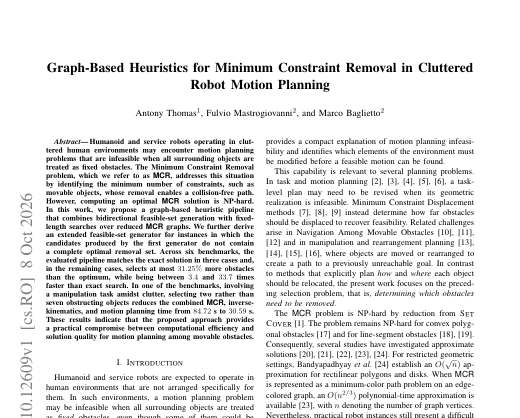
Graph-Based Heuristics for Minimum Constraint Removal in Cluttered Robot Motion Planning

Antony Thomas, Fulvio Mastrogiovanni, Marco Baglietto

Humanoid and service robots operating in clut- tered human environments may encounter motion planning problems that are infeasible when all surrounding objects are treated as fixed…

Humanoid and service robots operating in clut- tered human environments may encounter motion planning problems that are infeasible when all surrounding objects are treated as fixed obstacles. The Minimum Constraint Removal problem, which we refer to as MCR, addresses this situation by identifying the minimum number of constraints, such as movable objects, whose removal enables a collision-free path. However, computing an optimal MCR solution is NP-hard. In this work, we propose a graph-based heuristic pipeline that combines bidirectional feasible-set generation with fixed- length searches over reduced MCR graphs. We further derive an extended feasible-set generator for instances in which the candidates produced by the first generator do not contain a complete optimal removal set. Across six benchmarks, the evaluated pipeline matches the exact solution in three cases and, in the remaining cases, selects at most 31.25% more obstacles than the optimum, while being between 3.4 and 33.7 times faster than exact search. In one of the benchmarks, involving a manipulation task amidst clutter, selecting two rather than seven obstructing objects reduces the combined MCR, inverse- kinematics, and motion planning time from 84.72 s to 30.59 s. These results indicate that the proposed approach provides a practical compromise between computational efficiency and solution quality for motion planning among movable obstacles.

cs.ROrobotmanipulationhumanoid

兴趣:robot manipulation and grasping with learned policies

#412026-10-09追踪学者 · He Wang80

What Visual Representations Do World Action Models Need?

Kai Liu, Jiangran Lyu, Tingyu Deng, Yixin Zheng, Jingtian Wan, Wenbo Cui 等

World Action Models (WAMs) inherit powerful priors from pretrained video generation models, but their variational autoencoder (VAE) representations are optimized for visual reconst…

World Action Models (WAMs) inherit powerful priors from pretrained video generation models, but their variational autoencoder (VAE) representations are optimized for visual reconstruction rather than manipulation. External visual representations can improve manipulation, but existing methods couple representation choices with different integration mechanisms, obscuring their individual effects. We systematically compare visual representations, five integration mechanisms, and feature combinations under controlled settings. Our study yields three main findings. First, strong general-purpose visual representations provide broader robustness gains and can match or outperform representations pretrained for specific visual capabilities. Second, channel-wise joint prediction achieves the highest average success rate; further analyses suggest that future-feature prediction and the action expert's effective use of added visual information contribute to its gains. Third, additional sources should be selected for the task-relevant information they contribute beyond existing representations, as the same source can help one combination but harm another. However, even the best evaluated composition provides a smaller additional gain than the initial improvement from adding a strong general-purpose representation to the VAE-only baseline. We instantiate the resulting Representation Recipe as R$^2$-WAM. It achieves state-of-the-art performance on RoboCasa GR1 Tabletop with an 84.7% success rate and reaches 92.8% on RoboTwin 2.0, improving over the VAE-only baselines by 5.9 and 2.2 percentage points, respectively. Taken together, these findings suggest that future work should prioritize stronger general-purpose visual representations and more effective mechanisms for integrating them into WAMs, with feature composition serving as a supplementary route to improvement.

cs.CVcs.ROmanipulation

追踪学者:He Wang;兴趣:world models and video prediction for embodied agents

#422026-10-0879

Non-Prehensile Multi-Object Placement with Mobile Robots via Diffusion-Based Trajectory Planning

Lance Pharand, Megnath Ramesh, Mark Chiu, Yash Vardhan Pant, Stephen L. Smith

Non-prehensile manipulation with mobile robots has primarily targeted placement in coarse goal regions. Precision placement has been studied with manipulators on benchmarks such as…

Non-prehensile manipulation with mobile robots has primarily targeted placement in coarse goal regions. Precision placement has been studied with manipulators on benchmarks such as Push-T, where an omnidirectional end effector can readily re-approach an object from any side. For a mobile robot, correcting the same placement errors may require wide repositioning maneuvers around the object. We formalize multi-object pushing with a mobile robot as a multi-target assignment problem at tight tolerances. We propose a diffusion planner with a causal factorization: each robot denoising step is followed by an object step conditioned on the current clean robot estimate. This factorization allows us to sample multiple object outcomes for a single robot plan, capturing the multi-modality of pushing. We also design a set of pushing-specific costs for mobile robots, used for both guidance and best-of-$N$ sampling at inference. On Push-T, our planner attains the highest success rate of the methods we compare, while having the lowest rate of implausible object motion. Across three multi-box pushing environments resembling warehouse scenarios, it raises the fraction of boxes placed by $21.5$ percentage points over an unguided baseline, and replans $1.8\times$ faster than a planner that denoises the two trajectories together. Lastly, we deploy the guided planner on a TurtleBot 3 Burger with object shapes absent from the training data, where it places $85.0%$ of objects within tolerance against Diffusion Policy's $37.5%$.

cs.ROrobotmanipulationdiffusion policy

兴趣:imitation learning and diffusion policies for robot control

#432026-10-0979

TAME-Nav: Temporal Asymmetric Mixture-of-Experts Distillation for Agile and Versatile Robot Navigation

Lingjie Zhang, Jun Xue, Shanze Wang, Haoyu Xi, Xinming Zhang, Xiaoyu Shen 等

Agile and reliable navigation is a core capability for embodied robots navigating complex spatial constraints and dynamic interactions. However, a single policy often struggles to …

Agile and reliable navigation is a core capability for embodied robots navigating complex spatial constraints and dynamic interactions. However, a single policy often struggles to accommodate the distinct decision-making demands of diverse scenarios. We present TAME-Nav, an asymmetric Teacher-Student navigation framework built around a temporal soft mixture of experts (Soft-MoE). The Teacher combines clean observations with causally maintained dynamic-obstacle tracks to construct privileged representations, while the Student learns complementary navigation features from corrupted observation histories through temporal encoding, soft expert routing, and latent distillation. Procedural scenario generation and parallel task-level simulation broaden training coverage, while deployment-informed asymmetric domain randomization supports sim-to-real transfer. Across in-distribution and unseen compositional scenarios, TAME-Nav achieves higher success rates, lower collision rates, and higher navigation scores than representative baselines. On a real quadruped robot, it completes all twenty trials across local-trap escape and narrow-passage navigation with sudden dynamic obstacles, with only one minor contact.

cs.ROrobotsim-to-realembodied

兴趣:imitation learning and diffusion policies for robot control

#442026-10-0978

Evidence-Guided Counterfactual Learning for Long-Tailed Robotic Policies

Weiwei Chen, Chenghao Xu, Meiling Yu, Xu Yang, Cheng Deng

In the practical deployment of vision--language--action policies, handling long-tailed task distributions is a common challenge due to the highly imbalanced composition of robot de…

In the practical deployment of vision--language--action policies, handling long-tailed task distributions is a common challenge due to the highly imbalanced composition of robot demonstration datasets. To investigate this issue, we study the head-task action bias in shared robot policies, particularly focusing on its relationship with task-specific visual evidence. Our experimental analysis shows that, when the visual evidence required by a tail task is insufficient, the policy increasingly falls back on action patterns reinforced by data-rich head tasks, resulting in degraded performance on under-represented tasks. Motivated by this observation, we propose Evidence-Guided Counterfactual Learning, a training framework for long-tailed robot policies. Our method identifies decision-relevant visual evidence using instruction-related and action-related signals, and constructs counterfactual observations by removing the selected evidence. The resulting counterfactual predictions are used to strengthen the association among task instructions, visual evidence, and actions, with the supervision adaptively adjusted according to the number of demonstrations available for each task. The proposed framework requires neither additional training data nor region-level annotations and incurs no additional computation during deployment. Extensive experiments across simulated benchmarks, different VLA architectures, and real-world robot platforms demonstrate that our method robustly and consistently improves long-tailed robot policy learning, particularly for tail tasks, while maintaining reliable performance on head tasks.

兴趣:imitation learning and diffusion policies for robot control

#452026-10-0978

Splat2Act: From Captured Scenes to Personalized VLA Manipulation

Xiaomeng Ye, Krishna Jaganathan, Gyubeum Lim, Gunjan Chhablani, Muhammad Zubair Irshad, Zsolt Kira

A user who brings a generalist manipulation policy into their home or office wants it to pick up their objects from their shelves, counters, and tables. Yet even a strong generalis…

A user who brings a generalist manipulation policy into their home or office wants it to pick up their objects from their shelves, counters, and tables. Yet even a strong generalist like $π_{0.5}$ achieves 0% pickup success in our captured deployment scenes without adaptation, and collecting real demonstrations in every user's environment is prohibitively expensive. We present Splat2Act, an automated real-to-sim-to-real pipeline that personalizes a pretrained vision-language-action (VLA) policy to a specific scene and object set using only a handheld phone scan and images of the user's objects. Unlike prior real-to-sim work that reconstructs individual tabletops, Splat2Act operates on building-scale indoor environments: it builds a photorealistic digital twin with 3D Gaussian Splatting and collision geometry, automatically discovers tabletop and non-tabletop receptacles, constructs feasible pickup tasks, and generates successful demonstrations with a privileged simulation oracle, with only scene and object capture required from a human. Applied to 101 scanned campus environments with a median navigable area of 104.87 m$^2$ and 7 receptacles, the pipeline yields 852 receptacles and over 68,000 pickup demonstrations. We fine-tune $π_{0.5}$ in two stages: Stage 1 adapts to hundreds of public object assets, drawn either from the deployment scene alone or from all 101 scenes; Stage 2 personalizes to the user's own objects on the deployment scene's receptacles. Our strongest personalized policy reaches 62.5% aggregate pickup success in the target scene. Deployed on a real Stretch 3, the same policy achieves 63.9% success on a 12-task subset, closely tracking its 66.7% simulated success on those tasks. These results suggest that automated real-to-sim-to-real training can personalize VLA manipulation policies using only simulation-oracle data.

cs.ROcs.CVmanipulationVLAvision-language-actionsim-to-real

兴趣:vision-language-action (VLA) models and foundation models for robots

#462026-10-0976

Robot-WATCHDOG : failure detection through object-centric graph representation

Quentin Rolland, Fabrice Mayran de Chamisso, Jean-Baptiste Mouret

Reliable real-time failure detection is critical for deploying learned robotic policies, yet defining failures explicitly is infeasible in open-world settings. This motivates failu…

Reliable real-time failure detection is critical for deploying learned robotic policies, yet defining failures explicitly is infeasible in open-world settings. This motivates failure detection from nominal demonstrations alone. Existing methods, however, struggle to balance robustness to benign variations with the ability to capture semantic and interaction-level errors. We introduce Robot-WATCHDOG, a self-supervised framework that models manipulation scenes as object-centric spatio-temporal graphs. Building on this representation, we investigate two complementary failure scores: Trajectory Projection and Correlation (TPC), a non-parametric measure of geometric deviation and relational consistency, and GnnT, a Graph Attention Network with a Transformer that predicts future object states. We evaluate both on a public benchmark and on a new dataset of semantically complex manipulation tasks, across six tasks and ten random seeds. Both scores outperform image-based failure detectors, particularly on semantic and interaction-level failures. TPC provides the strongest performance in AUPR and MCC on both dataset averages, with low variance across seeds. Qualitative results are made available at https://cea-list.github.io/Robot-WATCHDOG/.

cs.ROrobotmanipulation

兴趣:large language models for robot task planning and reasoning

#472026-10-0976

AlphaNIST: Emergent Assembly Skills from Binary Task Rewards

Octi Zhang, Iretiayo Akinola, Rosario Scalise, Mateo Guaman Castro, Patrick Yin, Tobias Widmer 等

The NIST Assembly Task Board #1 remains a challenging benchmark for learning-based methods in robotic manipulation. Over short horizons, it demands precise, contact-rich control of…

The NIST Assembly Task Board #1 remains a challenging benchmark for learning-based methods in robotic manipulation. Over short horizons, it demands precise, contact-rich control of small, tight-fitting parts. Over long horizons, it requires recovery and coordination across extended action sequences. Demonstrations, task decomposition, and dense progress rewards have enabled research advances by providing guidance on how to assemble. But how much of the strategy must be specified? The progression from AlphaGo to AlphaGo Zero showed that RL at scale can discover superhuman strategies without prescribing how to win. AlphaNIST asks whether a sparse binary task reward and task diversity admitted by this task-agnostic reward can similarly let a robot discover how to assemble. In simulation, we train a single policy from scratch across all 20 assembly tasks on the NIST Assembly Task Board #1, reaching 98.2% overall training success without demonstrations, progress shaping, scripted primitives, or per-task tuning. The framework also trains policies to complete ten assembly pairs in a single episode without a prescribed order, with task success rewarded only when all ten pairs are simultaneously complete. The learned policies discover dexterous and planning-like behaviors: choosing grasps for later assembly, using surrounding geometry to reorient parts, and preparing one part, assembling another, then returning to finish the first without an explicit planner. For videos, see our website: https://alpha-nist.github.io/

cs.AIcs.ROrobotmanipulationdexterous

兴趣:robot manipulation and grasping with learned policies

#482026-10-0876

PriMoRetarget: Humanoid Motion Transfer Through Prioritized Motion Retargeting

Nicholas Ioannidis, Dun Yang, Max Smith, Tue Vu, Ziyu Zhang, Shayegan Omidshafiei 等

Motion retargeting is a critical preprocessing step for transferring human motion data to humanoid robots. While existing methods are effective for single-character motions, intera…

Motion retargeting is a critical preprocessing step for transferring human motion data to humanoid robots. While existing methods are effective for single-character motions, interactions involving multiple characters and objects introduce additional contacts and spatial relationships that must be preserved. Retargeting is commonly formulated as a weighted multi-objective optimization problem, where conflicting objectives can require careful tuning of relative weights and can still compromise important motion characteristics. We introduce PriMoRetarget, a prioritized motion-retargeting framework that replaces relative objective weighting with an explicit priority hierarchy. Lower-priority updates are constrained to preserve higher-priority objectives, allowing critical characteristics such as foot placement and interaction contacts to take precedence over lower-priority pose objectives. The method is evaluated on four datasets spanning single-character motion, character-object manipulation, and character-character interactions. The resulting motions better preserve task-relevant interactions and provide reference trajectories that can be tracked more reliably than those produced by widely used retargeting methods.

cs.ROcs.GRmanipulationhumanoid

兴趣:humanoid robots and whole-body control

#492026-10-0976

AutoBio+: Benchmarking Dexterous Manipulation with Dynamic Experimental Phenomena in Realistic Laboratories

Xuanye Wu, Yue Shi, Yongcan Yang, Yiqun Wang, Zhaoqi Wan, Dayu Xia 等

Automating biological laboratories requires robots to perform dexterous tool interactions under realistic visual conditions while handling dynamic experimental phenomena, presentin…

Automating biological laboratories requires robots to perform dexterous tool interactions under realistic visual conditions while handling dynamic experimental phenomena, presenting significant challenges for robotic manipulation. To enable systematic evaluation under these conditions, we introduce AutoBio+, a simulation benchmark and framework for dexterous manipulation in realistic biological laboratory environments. AutoBio+ comprises 14 tasks across 4 robot embodiments, spanning functional tool use, precision manipulation, language-conditioned visual grounding, and instrument operation. We introduce controllable dynamic experimental phenomena, including flames, vapor, and bubbles, to capture the evolving visual conditions of laboratory procedures. To further enhance environmental realism, we develop a hybrid rendering pipeline that integrates interactive simulated foreground objects with Gaussian-splatting backgrounds reconstructed from 6 real laboratory scenes. For efficient large-scale data generation and evaluation, we further build a parallel simulation framework on top of mjlab, proposing Parallel Finite-State Machine (PFSM) and integrating batched rendering with decoupled trajectory replay for demonstration generation and model-independent closed-loop policy evaluation. Our evaluation reveals substantial variation in policy performance across tasks, exposing distinct strengths and weaknesses of current manipulation policies. Real-world experiments further demonstrate a reduced sim-to-real gap, supporting the validity of AutoBio+ for realistic manipulation evaluation. Supplementary materials are available at https://autobio-plus.github.io/AutoBioPlus.

cs.ROrobotmanipulationsim-to-realdexterous

兴趣:robot manipulation and grasping with learned policies

#502026-10-0976

HorizonNav: Geometry-Guided Video Diffusion for Anticipatory 3D Robot Navigation

Hajira Amjad, Valerii Serpiva, Viacheslav Liubimov, Didar Seyidov, Dzmitry Tsetserukou

We present HorizonNav, a video diffusion-based framework for anticipatory robot navigation that transforms a single RGB image and a text prompt into a geometrically aligned represe…

We present HorizonNav, a video diffusion-based framework for anticipatory robot navigation that transforms a single RGB image and a text prompt into a geometrically aligned representation of plausible surrounding 3D space. Given the initial observation and a textual description of the reconstruction objective, a vision-language model, guided by designed instructions, interprets the scene and constructs structured prompts for a video diffusion model. The resulting video sequence provides plausible future observations of the environment, which are subsequently processed using monocular ORB-SLAM3 for camera pose estimation and Video Depth Anything for dense depth prediction. Our central contribution is a geometry-guided depth alignment stage that combines the estimated camera poses with triangulated visual landmarks to constrain dense depth predictions across multiple views. This alignment improves the geometric consistency of the reconstructed 3D environment, addressing inconsistencies that temporal coherence of the generated video alone cannot resolve. The experimental evaluation of navigation in imagined 3D environment shows that across a 19-scene horizon study, planning-feasible scenes increase from 13/19 at P20 to 15/19 at P81, while successful RRT trials increase from 62/90 to 75/90. In a separate corridor study, 6 of 25 evaluable generated-camera trajectories violate the reconstructed collision constraints; RRT planner recovers feasible alternatives in 5 of those 6 cases. A larger archive contains 58 usable reconstructions from 67 attempted cases, of which 36 support a downstream plan and 22 do not, exposing reconstruction and free-space failure modes rather than hiding them without lidar. Across 15 corridor reconstructions, the mean reconstruction error is approximately 0.30 m at matched structural landmarks.

cs.ROrobot

兴趣:3D perception, point clouds and scene understanding for robotics

GitHub 项目

#12026-07-06★ 2.3k +5782

dexmal/opendm

Python

An Open-World Foundation Model for General-Purpose Embodied Intelligence.

An Open-World Foundation Model for General-Purpose Embodied Intelligence.

embodied-aiembodied-intelligenceroboticsvision-language-actionvlaVLAvision-language-actionembodied

兴趣:vision-language-action (VLA) models and foundation models for robots

#22026-10-08★ 32新项目79

DexForce/UNITAS

Official codebase for Unitas: A 3D-Native World Action Model for Embodied Manipulation

Official codebase for Unitas: A 3D-Native World Action Model for Embodied Manipulation

robot-learningworld-action-modelsrobotmanipulationembodied

兴趣:world models and video prediction for embodied agents

#32026-10-05★ 138 +14新项目78

AetherLabsAI/Video2World

Python

Benchmarking Coding Agents for Interactive World Modeling from Embodied Videos - Rethinking Embodied Real2Sim from a Software Engineering Perspective

Benchmarking Coding Agents for Interactive World Modeling from Embodied Videos - Rethinking Embodied Real2Sim from a Software Engineering Perspective

benchmarkcoding-agentembodied-aifoundation-modelsreal-to-simrobot-learningroboticssimulationrobotembodied

兴趣:world models and video prediction for embodied agents

#42024-12-08★ 4k +2075

datawhalechina/every-embodied

Jupyter Notebook

仅需Python基础,从0构建自己的具身智能机器人;从0逐步构建VLA/OpenVLA/SmolVLA/Pi0, 深入理解具身智能

仅需Python基础,从0构建自己的具身智能机器人;从0逐步构建VLA/OpenVLA/SmolVLA/Pi0, 深入理解具身智能

embodied-agentembodied-aiembodied-intelligenceopenvlasmolvlavision-language-action-modelVLAvision-language-actionembodied

兴趣:world models and video prediction for embodied agents

#52025-10-09★ 3.8k +974

starVLA/starVLA

Python

StarVLA: A Lego-like Codebase for Vision-Language-Action Model Developing

StarVLA: A Lego-like Codebase for Vision-Language-Action Model Developing

robotic-foundation-modelroboticsvision-language-action-modelworld-action-modelvision-language-action

兴趣:vision-language-action (VLA) models and foundation models for robots

#62025-11-23★ 700 +573

sou350121/VLA-Handbook

HTML

本项目旨在为致力于进入VLA(Vision-Language-Action)领域的算法工程师提供一份全中文、实战导向的学习/面试手册。 不同于通用的 CV/NLP 面试指南,本项目聚焦于 Robotics 特有的挑战

本项目旨在为致力于进入VLA(Vision-Language-Action)领域的算法工程师提供一份全中文、实战导向的学习/面试手册。 不同于通用的 CV/NLP 面试指南,本项目聚焦于 Robotics 特有的挑战

chinesedeep-learningembodied-aillmrobot-learningroboticsvision-language-actionvlarobotVLAvision-language-actionembodied

兴趣:vision-language-action (VLA) models and foundation models for robots

#82026-10-04★ 58 +5新项目73

Holiday-Robot/FlashDexRetarget

Python

FlashDexRetarget: Accelerating Dexterous Manipulation Data Generation through Multi-Motion Retargeting

FlashDexRetarget: Accelerating Dexterous Manipulation Data Generation through Multi-Motion Retargeting

dexterous-manipulationreinforcement-learningroboticsrobotmanipulationdexterous

兴趣:robot manipulation and grasping with learned policies

#92026-08-26★ 405 +572

OpenMOSS/EasyWAM

Python

A unified framework for training, fine-tuning, and evaluating World Action Models

A unified framework for training, fine-tuning, and evaluating World Action Models

benchmarkcodebaseembodied-aifoundation-modelsloraroboticsvision-language-actionworld-action-modelvision-language-actionembodied

兴趣:vision-language-action (VLA) models and foundation models for robots

#102024-12-24★ 382 +-172

manumerous/wb_humanoid_mpc

C++

Whole-Body Nonlinear MPC for Realtime Humanoid Loco-Manipulation Planning and Control

Whole-Body Nonlinear MPC for Realtime Humanoid Loco-Manipulation Planning and Control

aidata-generationhumanoidhumanoid-robotlocomotionmpcnonlinearoptimizationrobotmanipulationhumanoidlocomotion

兴趣:humanoid robots and whole-body control

#112026-09-29★ 151新项目72

zqc3117/Spotter

Python

Official codebase for Spotter: Let the Embodied Model Lead, and the VLM Reflect for It

Official codebase for Spotter: Let the Embodied Model Lead, and the VLM Reflect for It

embodied-aillm-agentqwenrobocasarobodojorobot-learningrobot-manipulationroboticsrobotmanipulationembodied

兴趣:vision-language-action (VLA) models and foundation models for robots

#122024-01-26★ 28.1k +3372

huggingface/lerobot

Python

🤗 LeRobot: Making AI for Robotics more accessible with end-to-end learning

🤗 LeRobot: Making AI for Robotics more accessible with end-to-end learning

兴趣:imitation learning and diffusion policies for robot control

#132026-06-24★ 17771

MinghaoFu/lewam

Python

LeWAM: End-to-End World and Action Modeling with JEPAs

LeWAM: End-to-End World and Action Modeling with JEPAs

jeparobot-learningworld-modelsrobot

兴趣:vision-language-action (VLA) models and foundation models for robots

#142026-07-19★ 644 +471

RealXiaoze/humanoid-motion-intelligence

人形机器人运动智能论文、开源项目、产业与求职知识库

人形机器人运动智能论文、开源项目、产业与求职知识库

embodied-aihumanoid-roboticslocomotionmotion-controlreinforcement-learningrobot-learningsim2realvlarobotVLAhumanoidlocomotionembodied

兴趣:humanoid robots and whole-body control

#152026-08-29★ 131 +871

nssmd/RoboRSI

Python

Robot-agent harness with a CLI and local Web console for LIBERO short evaluation

Robot-agent harness with a CLI and local Web console for LIBERO short evaluation

agentsembodied-aievaluationliberorobot-learningroboticsself-evolutionrobotembodied

兴趣:multi-agent systems and LLM agents

#162025-10-17★ 3.2k +12371

dexmal/dexbotic

Python

Dexbotic: Open-Source Vision-Language-Action Toolbox

Dexbotic: Open-Source Vision-Language-Action Toolbox

codebasecogactmemoryvlaopenvla-oftpi0real-worldroboticssimulationVLAvision-language-action

兴趣:vision-language-action (VLA) models and foundation models for robots

#172026-10-09★ 18新项目71

ToberJ/reflex

Reflex: Visually Grounded Reactive Humanoid Control (code coming soon)

Reflex: Visually Grounded Reactive Humanoid Control (code coming soon)

catchinghumanoidreinforcement-learningrobot-learningsim-to-realwhole-body-controlrobothumanoidsim-to-real

兴趣:humanoid robots and whole-body control

#182025-08-14★ 5.5k +1270

RLinf/RLinf

Python

RLinf: Reinforcement Learning Infrastructure for Embodied and Agentic AI

RLinf: Reinforcement Learning Infrastructure for Embodied and Agentic AI

agentic-aiembodied-aireinforcement-learningrl-infrarlinfvla-rlVLAembodied

兴趣:vision-language-action (VLA) models and foundation models for robots

#192025-09-22★ 2.8k +1370

NVlabs/LongLive

Python

Long Video Gen / World Model / World Action Model (Embodied) Infrastructure

Long Video Gen / World Model / World Action Model (Embodied) Infrastructure

infralongnvfp4parallelreal-timeroboticsvideo-generationworld-action-modelsembodiedworld model

兴趣:world models and video prediction for embodied agents

#202024-02-29★ 16469

RobotControlStack/robot-control-stack

Python

A lean, ROS-free sim-to-real framework for training and deploying Vision-Language-Action (VLA) models and RL agents. Native MuJoCo Gymnasium wrappers with synchronous execution for…

A lean, ROS-free sim-to-real framework for training and deploying Vision-Language-Action (VLA) models and RL agents. Native MuJoCo Gymnasium wrappers with synchronous execution for Franka, UR5e, xArm, SO101 and YAM.

frankagymnasiummujocoreinforcement-learningrobot-learningrobot-manipulationsim-to-realvision-language-actions-modelsrobotmanipulationVLAvision-language-actionsim-to-real

兴趣:vision-language-action (VLA) models and foundation models for robots

#212026-02-08★ 435 +769

XPolicyLab/XPolicyLab

Python

[IROS 26 ScaleInfra Workshop Best Tool Paper] Involving over 50 Advanced Manipulation Policies

[IROS 26 ScaleInfra Workshop Best Tool Paper] Involving over 50 Advanced Manipulation Policies

embodied-aimanipulationpolicymanipulationembodied

兴趣:robot manipulation and grasping with learned policies

#222026-04-22★ 19.5k +40769

earthtojake/text-to-cad

Python

Give your agent CAD superpowers.

Give your agent CAD superpowers.

agentsai-agentscadmechanical-engineeringroboticsstepstlstp

兴趣:multi-agent systems and LLM agents

#232026-08-31★ 7.6k +3968

Human-Agent-Society/reef

Python

Infrastructure for continually self‑improving agents

Infrastructure for continually self‑improving agents

agent-infrastructureai-agentscontinual-learninginferencellmllm-trainingreinforcement-learningself-improving-agents

兴趣:multi-agent systems and LLM agents

#242026-03-18★ 67.9k +78968

rohitg00/ai-engineering-from-scratch

Python

Learn AI Engineering! Learn it. Build it. Ship it for others.

Learn AI Engineering! Learn it. Build it. Ship it for others.

agentsaiai-agentsai-engineeringcomputer-visioncoursedeep-learningfrom-scratch

兴趣:multi-agent systems and LLM agents

#252025-09-25★ 377 +468

syswonder/robonix

Rust

The Agentic Operating System for Robots

The Agentic Operating System for Robots

agentembodied-airobotsskill-mdvlavlmVLAembodied

兴趣:vision-language-action (VLA) models and foundation models for robots

#262026-09-28★ 2.5k +102新项目68

KingKongRobotics/jumper

Python

🦀 Jumper — an crab robot.

🦀 Jumper — an crab robot.

crab-robotrobotroboticsrobot

兴趣:humanoid robots and whole-body control
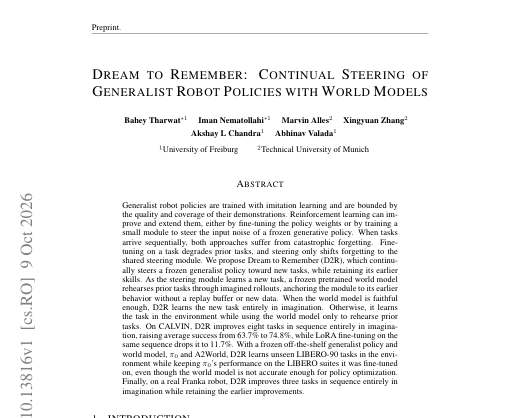
#272022-11-16★ 8.3k +967

isaac-sim/IsaacLab

Python

Unified framework for robot learning with multi-physics/renderer support

Unified framework for robot learning with multi-physics/renderer support

isaac-simomniverse-kit-extensionrobot-learningroboticsrobot

兴趣:3D perception, point clouds and scene understanding for robotics

#282025-09-09★ 53.7k +23567

bojieli/ai-agent-book

Python

《深入理解 AI Agent:设计原理与工程实践》(李博杰 著)开源主仓库:全书正文、编译版 PDF 与按章配套代码

《深入理解 AI Agent:设计原理与工程实践》(李博杰 著)开源主仓库:全书正文、编译版 PDF 与按章配套代码

agentagent-memoryai-agentbookcoding-agentcontext-engineeringlarge-language-modelsllm

兴趣:multi-agent systems and LLM agents

#292025-04-04★ 1.9k66

RoboVerseOrg/RoboVerse

Python

RoboVerse: Towards a Unified Platform, Dataset and Benchmark for Scalable and Generalizable Robot Learning

RoboVerse: Towards a Unified Platform, Dataset and Benchmark for Scalable and Generalizable Robot Learning

imitation-learningreinforcement-learningroboticssimulationrobot

兴趣:imitation learning and diffusion policies for robot control

#302026-09-15★ 178 +13新项目66

1173591564/Dynamics-memory

TypeScript

LLM agent 的有界自纠错长期记忆层:把连续、含矛盾的项目交互日志蒸馏成有界、可自更新的记忆库。Bounded, self-correcting long-term memory for LLM agents — candidate pool + value dynamics + tension adjudication + causal-replay…

LLM agent 的有界自纠错长期记忆层:把连续、含矛盾的项目交互日志蒸馏成有界、可自更新的记忆库。Bounded, self-correcting long-term memory for LLM agents — candidate pool + value dynamics + tension adjudication + causal-replay evals.

agent-memoryagentsllmllm-agentslong-term-memorymemorymemory-managementpythonLLM agent

兴趣:multi-agent systems and LLM agents