Tech Station

学者追踪 › Berkeley

UC Berkeley

6 位学者 · 最近 45 天 56 篇

Pieter Abbeel 14 篇 专属页 →

2026-11-03追踪学者 · Pieter Abbeel

Stabilizing On-Policy Targeted Guidance in Agentic Reinforcement Learning

Kevin Frans, Alexander M Rush, Sergey Levine, Pieter Abbeel, Ashvin Nair

Naive on-policy RL is often bottlenecked by the capabilities of the base model --- insufficient coverage can result in an inability to learn from certain rewards. At the same time,…

Naive on-policy RL is often bottlenecked by the capabilities of the base model --- insufficient coverage can result in an inability to learn from certain rewards. At the same time, rewards in modern post-training systems often come from rich textual sources, e.g. judge models with a rubric of criteria. Can we utilize such structures to provide a rich directional signal that enables improving on otherwise difficult to optimize rewards? In this work, we examine a framework we refer to as targeted guidance that learns from per-turn textual feedback via an on-policy self-distillation objective. Our focus is not only on directly improving hard-to-optimize behaviors, but on how to do so throughout the training process without degrading baseline RL performance. Over a range of settings across an agentic multi-turn software engineering environment, we find success by combining targeted self-distillation with a per-criteria RL reward, and by limiting feedback to turns where the policy specifically fails. We further examine the design choices that lead to stable entropy and reduce oscillatory behavior throughout training.

2026-11-02追踪学者 · Pieter Abbeel

Energy-Based Policy Orchestration

Weirui Ye, Yen-Jen Wang, Elvis Hsieh, Zhiyang Dou, Shibo Zhao, Pieter Abbeel, Yilun Du, Leslie Pack Kaelbling 等

Hierarchical control scales robot behavior by separating task-level planning from low-level control. In dynamic, high-dimensional tasks, however, a fixed planner-to-policy interfac…

Hierarchical control scales robot behavior by separating task-level planning from low-level control. In dynamic, high-dimensional tasks, however, a fixed planner-to-policy interface can fail when contacts, balance, or disturbances evolve faster than high-level policy updates. Execution therefore requires choosing not only which low-level policy to run, but also which policy-specific goal should be given to it. We formulate this problem as policy orchestration: runtime selection of a policy-goal pair that is likely to remain feasible while tracking the planner target. We develop EPO, an energy-based policy orchestrator for modular goal-conditioned policy families. For each policy, EPO learns a composite energy over low-level goals, where lower energy corresponds to higher feasibility and more accurate target realization. At runtime, EPO refines each policy's goal and executes the lowest-energy policy-goal pair. Because energies are policy-specific, new policies can be incorporated by learning their own energy models, without retraining the existing policies or a centralized scheduler. In simulation, EPO improves the empirical precision-robustness trade-off by refining policy-specific goals before selectively switching among policies based on energy scores. We further demonstrate sim-to-real deployment of the same frozen policies and energy models on real humanoid loco-manipulation tasks. Project website: https://yewr.github.io/epo

2026-11-01追踪学者 · Pieter Abbeel

Democratizing Robot-Use Agents: A Unified Harness with Open Models

Jiarui Yuan, Yuxin Zuo, Xiaoyu Huang, Wenbo Zhang, Kwanyoung Park, Junlin Yang, Tianxiang Zhang, Ruoqu Chen 等

Robot-use Agents (RUAs) have shown promising zero-shot manipulation capabilities, but reliance on frontier, proprietary models limits research into further training. To democratize…

Robot-use Agents (RUAs) have shown promising zero-shot manipulation capabilities, but reliance on frontier, proprietary models limits research into further training. To democratize RUA research, we introduce uni-robot-agent, a unified harness for competitive open-weight robot use that supports further training. Without privileged inputs, an out-of-the-box Qwen3.8-Flash-Next achieves a RoboDojo Score of 31.39, surpassing the published GPT-6 Astra-RoboProbe result of 28.97 and many VLA/WAM baselines, and performs competitively on 19 real-world tasks. Our analysis across model generations, families, and sizes links effective robot use to four general capabilities, suggesting that future RUA training should develop them jointly.

2026-10-20追踪学者 · Pieter Abbeel

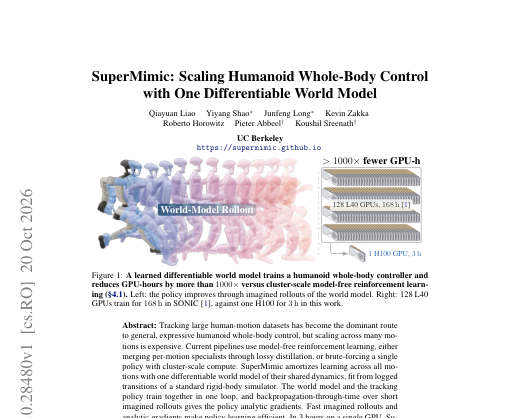
SuperMimic: Scaling Humanoid Whole-Body Control with One Differentiable World Model

Qiayuan Liao, Yiyang Shao, Junfeng Long, Kevin Zakka, Roberto Horowitz, Pieter Abbeel, Koushil Sreenath

Tracking large human-motion datasets has become the dominant route to general, expressive humanoid whole-body control, but scaling across many motions is expensive. Current pipelin…

Tracking large human-motion datasets has become the dominant route to general, expressive humanoid whole-body control, but scaling across many motions is expensive. Current pipelines use model-free reinforcement learning, either merging per-motion specialists through lossy distillation, or brute-forcing a single policy with cluster-scale compute. SuperMimic amortizes learning across all motions with one differentiable world model of their shared dynamics, fit from logged transitions of a standard rigid-body simulator. The world model and the tracking policy train together in one loop, and backpropagation-through-time over short imagined rollouts gives the policy analytic gradients. Fast imagined rollouts and analytic gradients make policy learning efficient. In 3 hours on a single GPU, SuperMimic surpasses the return of a state-of-the-art motion tracker baseline trained for 7 days on 128 GPUs. It reduces GPU-hours by more than $1000\times$ and fails on only 25 of 129,514 benchmark motions, versus 179 failures for the baseline. After 9.8 hours on two GPUs, SuperMimic achieves zero failures. From 1 to 264 hours of motion, the world model's prediction error stays stable, and GPU-hours to a target return grow slowly. Our policy transfers to a physical Unitree G1 across diverse and acrobatic motions. SuperMimic removes compute as the bottleneck to scaling humanoid whole-body control, making it practical to measure motion-tracking scaling laws.

2026-10-19追踪学者 · Pieter Abbeel

SSIO: Self-Supervised Inertial Odometry

Yuheng Qiu, Yutian Chen, Carlton Cort, Weison Huang, Shibo Zhao, Pieter Abbeel, Rocky Duan, Koushil Sreenath 等

Learning inertial odometry for a new platform usually requires ground-truth trajectories. We show that an inertial odometry model can instead be trained from scratch by a myopic te…

Learning inertial odometry for a new platform usually requires ground-truth trajectories. We show that an inertial odometry model can instead be trained from scratch by a myopic teacher that integrates the IMU over each short window independently, a scheme we call integration self-supervision. Interestingly, although supervised only by short-window velocity changes, the student learns to directly predict velocity, and does so more accurately than its integration teacher. Pose graph distillation then refines the model with sequence-consistent targets from a pose graph over many windows. Training on a new platform therefore no longer requires collecting ground-truth trajectories, but only calibrating the IMU and recording data during normal operation. Across six datasets spanning pedestrians, drones, quadrupeds, and a humanoid, the same recipe with no velocity or position labels trains models that come within 0.07~m/s average velocity error of a same-architecture supervised baseline.

2026-10-19追踪学者 · Pieter Abbeel

SWAP: Test-Time Steerable Humanoid Whole-Body Collision Avoidance

Zeji Yi, Guanqi He, Xiaofeng Guo, Guannan Qu, Pieter Abbeel, Yan Duan, Karen Liu, Guanya Shi

Humanoid robots operating in human-centric environments must coordinate the entire body to traverse tight, cluttered spaces while maintaining balance. Existing methods often strugg…

Humanoid robots operating in human-centric environments must coordinate the entire body to traverse tight, cluttered spaces while maintaining balance. Existing methods often struggle to jointly consider dynamic stability and collision avoidance from high-dimensional perceptual inputs. Moreover, for humanoids, safe behavior is inherently multimodal: the same obstacle may admit multiple valid traversals, which is difficult to represent with a single deterministic policy. To address these challenges, we propose SWAP (Steerable Whole-body Avoidance Policy), a hierarchical framework that separates collision-aware decision making from stabilization. A high-level, perception-conditioned diffusion policy generates multimodal, collision-aware motion proposals, while a low-level whole-body RL controller tracks these proposals and maintains dynamic balance. To efficiently train the high-level policy, we obtain scalable supervision via hindsight labeling: we roll out the low-level policy under randomized commands, place obstacles only in the space that each executed motion did not sweep, so the motion is collision-free by construction, and re-render the perception the robot would have seen. At deployment, Monte Carlo sampling with simple cost signals steers the diffusion model toward safe, task-aligned behaviors without heavy reward tuning. Experiments in simulation and on a real Unitree G1 humanoid show reliable avoidance with static and dynamic obstacles. Test-time steering further enables customization, improving targeted rewards (e.g., speed, orientation, or posture) by 34% on average while maintaining a high collision avoidance rate. Together, these results support a practical solution to humanoid whole-body collision avoidance with test-time steerability. Project website: https://iscoyizj.github.io/SWAP-steerable-humanoid-oa-website/

2026-10-16追踪学者 · Pieter Abbeel

StopWatch: Goal Grounding for Object-goal Navigation

Xinhao Liu, Yunsheng Tian, Yuheng Qiu, Pieter Abbeel, Xi Chen, Guanya Shi, Chen Feng

Pretrained VLMs bring rich world knowledge and semantic priors to object-goal navigation, and fine-tuning a VLM into a navigation policy has become a common recipe. Despite this pr…

Pretrained VLMs bring rich world knowledge and semantic priors to object-goal navigation, and fine-tuning a VLM into a navigation policy has become a common recipe. Despite this progress, success rates remain low, and it is unclear which capability these fine-tuned policies lack. Our diagnosis identifies goal grounding as the dominant failure. These policies explore well, yet often fail to notice that the goal is already in view or to estimate how far away it is. To address this failure, we ground the goal explicitly. Explicit grounding substantially improves success and reaches state-of-the-art results on six benchmarks across three scene collections. We also correct annotation defects in these benchmarks, so that future methods are evaluated more faithfully. Our analysis on the clean benchmarks shows that, with ground-truth grounding, our policy nearly matches the expert that generated its demonstrations, leaving the headroom in perception rather than policy learning. Our work points to goal grounding as a missing piece of object-goal navigation and offers a simple and effective solution to the task.

2026-10-15追踪学者 · Pieter Abbeel

Scaling Online Exploration for Robot Agents

Runhan Huang, Xiangcheng Zhang, Haoyu Chen, Yitong Li, Yen-Jen Wang, Bohan Lyu, Haotian Ye, Chuye Hong 等

Robot learning has advanced by scaling demonstration datasets and model capacity; however, deploying a new robot embodiment or task typically necessitates a dedicated teleoperation…

Robot learning has advanced by scaling demonstration datasets and model capacity; however, deploying a new robot embodiment or task typically necessitates a dedicated teleoperation corpus. The resulting policies remain bounded by their imitation distributions, limiting generalization and continual self-improvement. We introduce RAX (Robot Agent eXploration), an open-source framework for robot agents centered on scaling exploration: enabling agents to improve by acquiring online experience and synthesizing executable programs. In RAX, a general-purpose coding agent generates robot control code, operating without action demonstration data, hand-engineered action primitives, or value-function guidance. Through online exploration, the agent identifies decision sequences that achieve task goals and compiles them into modular programs encapsulating the full perception-planning-control loop. Using RAX, we present a systematic multi-embodiment study on scaling online exploration across precision and long-horizon manipulation tasks using single-arm, bimanual, dexterous, mobile, and humanoid systems in simulation and on real robots. Generalization performance on unseen environments improves consistently as exploration scales. In simulation, RAX outperforms top baseline models by +37.4% on average. On real robots, RAX autonomously learns memory-dependent, articulated, high-precision, deformable, and long-horizon mobile manipulation tasks without human demonstrations, continually improving performance by composing verified skills from prior exploration sessions. As exploration scales, we observe emergent capabilities including active perception, error recovery, safety guardrails, and human-robot collaboration. We open-source RAX as a generalist robot-agent platform in which new robot embodiments are integrated through their APIs alone, without teleoperated data collection or policy training.

2026-10-06追踪学者 · Pieter Abbeel

Workhorse: Learning Robust Whole-Body Humanoid Loco-Manipulation from Human Data

Songbo Hu, Qiayuan Liao, Yufeng Chi, Kevin Zakka, Yakun Sophia Shao, Pieter Abbeel, Koushil Sreenath

Humanoid robots still struggle to plan contact-rich whole-body manipulation from egocentric RGB and proprioception. Workhorse learns such manipulation from robot-free human demonst…

Humanoid robots still struggle to plan contact-rich whole-body manipulation from egocentric RGB and proprioception. Workhorse learns such manipulation from robot-free human demonstrations. A visual planner predicts five-link targets: the poses of the torso, both wrists, and both feet. A reinforcement-learning whole-body tracker follows them on the robot. Both policies train separately on the same recorded human poses, without retargeting. We augment the training data of each policy to imitate the errors that the other makes at deployment. On a real Unitree G1, Workhorse transport boxes with its hands and a kick, catches a thrown box, and topples and climbs a suitcase. During box transport, we show recoveries after a person pushes the robot or takes the box away. In a simulated copy of the demonstration room, the system completes box transport in 77% of episodes, and in 64% under 40 N.s pushes. With both policies retrained from the same demonstrations, a simulated second humanoid completes box transport in 83% of episodes without pushes.

2026-10-06追踪学者 · Pieter Abbeel

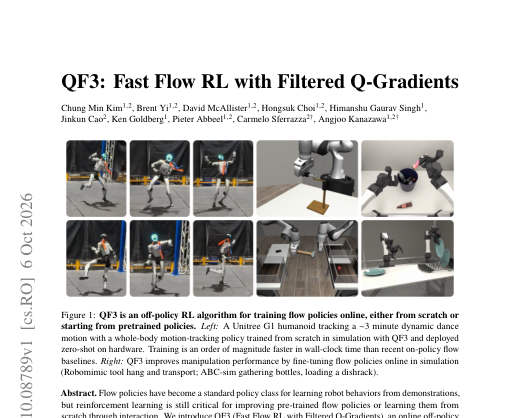
QF3: Fast Flow RL with Filtered Q-Gradients

Chung Min Kim, Brent Yi, David McAllister, Hongsuk Choi, Himanshu Gaurav Singh, Jinkun Cao, Ken Goldberg, Pieter Abbeel 等

Flow policies have become a standard policy class for learning robot behaviors from demonstrations, but reinforcement learning is still critical for improving pre-trained flow poli…

Flow policies have become a standard policy class for learning robot behaviors from demonstrations, but reinforcement learning is still critical for improving pre-trained flow policies or learning them from scratch through interaction. We introduce QF3 (Fast Flow RL with Filtered Q-Gradients), an online off-policy RL algorithm that trains a flow policy with flow matching plus the critic's action gradient, backpropagated through a one-step prediction of the flow's output. To keep updates where the critic and this prediction are reliable, QF3 applies the critic gradient only to action dimensions that stay near the replay action. To our knowledge, QF3 is the first off-policy flow RL method to train humanoid locomotion policies from scratch and transfer them zero-shot to hardware. Paired with a high-throughput off-policy training recipe, it trains humanoid locomotion and motion-tracking policies with a 10x wall-clock speedup over FPO++, a recent on-policy flow RL method. We further apply QF3 to fine-tune pretrained flow-based manipulation policies on both ABC-Sim and Robomimic tasks. These results suggest that QF3 can both learn robot policies from scratch and refine those acquired from demonstrations. Website: https://qf3-rl.github.io/

2026-10-02追踪学者 · Pieter Abbeel

GOTT: Object-centric Dexterous Manipulation with a Reusable Cross-Embodiment Primitive

Yulin Liu, Lai Wei, Yen-Jen Wang, Akash Sharma, Pieter Abbeel, Henrik I. Christensen, Haozhi Qi

Foundation models and large-scale human data provide rich sources of manipulation intent, but translating this intent into multi-fingered robot behavior remains difficult. Dexterou…

Foundation models and large-scale human data provide rich sources of manipulation intent, but translating this intent into multi-fingered robot behavior remains difficult. Dexterous hands still lack a reusable low-level primitive that reliably establishes contact across tasks and embodiments. We propose GOTT, a reach-acquire-move framework built around a single cross-embodiment contact-acquisition primitive. Given a robot-agnostic object trajectory and a reach specification, GOTT first brings the hand near a task-relevant contact region. The shared closed-loop primitive then establishes stable contact from this approximate initialization, and a pose-conditioned controller tracks the desired object motion. Reach specifications may come from future-aware planning, external models, or human demonstrations, while the primitive and tracking backend remain unchanged. Simulation and real-world experiments show that GOTT is able to establish robust contact across diverse objects, arm-hand platforms, and seen and unseen hand morphologies. It also consistently improves end-to-end task success over open-loop grasp execution.

cs.ROcs.AIcs.CV
2026-10-01追踪学者 · Pieter Abbeel

Reconstruct, Practice, Go Real: Guided Self-Improvement for Embodied Agents

Yen-Jen Wang, Haozhe Jiang, Shuying Deng, Haoru Xue, Weirui Ye, Rocky Duan, Nika Haghtalab, S. Shankar Sastry 等

Building reliable robot capabilities across diverse tasks requires substantial human effort to develop and maintain skills, design rewards, and integrate perception with control. W…

Building reliable robot capabilities across diverse tasks requires substantial human effort to develop and maintain skills, design rewards, and integrate perception with control. We present Reconstruct, Practice, Go Real (RPG), a framework for autonomous improvement of robot execution systems without updating model weights. RPG identifies manipulation capabilities in an offline dataset and constructs related practice tasks in simulation. During practice, RPG uses execution feedback, privileged simulator state, and available dataset videos to diagnose failures. It develops new reusable symbolic skills, refines existing skills, and revises the system prompt based on these diagnoses. Cross-task evaluation tests individual candidate changes and merged revisions before they are retained for reuse. At test time, a multimodal LLM uses the resulting system prompt and skill library to coordinate perception and robot control. On held-out initializations of 22 manipulation tasks, RPG improves task success from 28.6% after the first practice round to 95.0% after 15 rounds, outperforming all evaluated baselines, including ASPIRE (75.5%) and CaP-Agent0 powered by GPT-6 Astra Pro (60.0%). After a common calibration and hardware-adaptation procedure, the frozen system succeeds in all 30 physical trials, with ten trials on each of three tasks. Project Website: https://rpg-robot.github.io/

cs.ROcs.AIeess.SY
2026-09-30追踪学者 · Pieter Abbeel

Tactile Curiosity Drives Robot Interaction

Klemens Iten, Alexander Proshkin, Bhavya Sukhija, Stelian Coros, Andreas Krause, Pieter Abbeel, Carmelo Sferrazza

Mastering robot manipulation skills via reinforcement learning (RL) remains largely sample-inefficient. The most common RL algorithms rely on random action sampling to discover new…

Mastering robot manipulation skills via reinforcement learning (RL) remains largely sample-inefficient. The most common RL algorithms rely on random action sampling to discover new strategies, resulting in agents that allocate most of their training budget to motions in free space, away from the contacts from which manipulation skills emerge. Existing intrinsic motivation methods based on model disagreement or epistemic uncertainty improve on isotropic noise, but they can also reward uncertainty in functionally irrelevant transitions, such as erratic motions in free space. In this work, we argue that tactile feedback provides a natural signal for exploration, and introduce TacEx, a framework that incorporates touch into epistemic uncertainty-driven exploration by decomposing model uncertainty across sensory modalities and directing curiosity toward the tactile channel. By anchoring curiosity to the sense of touch, TacEx drives the robot to discover complex contact dynamics, learning to manipulate and grasp objects without task rewards or expert demonstrations during exploration. The interaction-dense dataset collected through this tactile-driven curiosity supports offline learning of downstream pick-and-place policies without additional environment interaction. We further use tactile-driven exploration to post-train vision-language-action (VLA) models. Although the VLAs are initially pre-trained without tactile feedback, post-training with TacEx substantially improves downstream performance while remaining highly sample-efficient.

2026-09-29追踪学者 · Pieter Abbeel

Counterfactual Video Generation Enables Scalable Humanoid Loco-Manipulation

Zihan Wang, Zhen Wu, Pieter Abbeel, Rocky Duan, Jitendra Malik, Carmelo Sferrazza, C. Karen Liu, Guanya Shi 等

Teaching humanoids loco-manipulation skills, such as carrying diverse objects, via visual imitation is a promising path toward generalist robots. However, collecting diverse, high-…

Teaching humanoids loco-manipulation skills, such as carrying diverse objects, via visual imitation is a promising path toward generalist robots. However, collecting diverse, high-quality interaction videos, such as clips that clearly show a person's full body and unoccluded interactions with objects, poses a practical barrier to scaling this approach. We propose PRISM, a real-to-sim-to-real framework that overcomes this limitation by amplifying a handful of real videos into a large, diverse training set. PRISM first generates hundreds of diverse "counterfactual" human-object interaction videos via video-to-video (V2V) generation from a few exemplar real videos. Our contact-anchored real-to-sim pipeline then reconstructs both human and object motions, retargeting this imperfect video data into physically plausible trajectories. The intra-class variability across these counterfactual videos lets us train a single policy that generalizes to unseen objects within each category. We demonstrate the full pipeline by deploying this policy on a real robot without any real-world fine-tuning. Using only onboard depth observations, our humanoid picks up, carries, and drops objects, including boxes, barrels, bins, and balls, across novel instances, sizes, and initial configurations.

cs.ROcs.CVcs.GR

Sergey Levine 10 篇 专属页 →

2026-11-03追踪学者 · Sergey Levine

GSBR: Geometric Support Behavior Regularization for Online RL

Charles Xu, Jacob Berg, Liyiming Ke, Sergey Levine

Regularizing online reinforcement learning (RL) toward a pretrained base policy can improve sample efficiency and learning stability, but regularization that is too restrictive lim…

Regularizing online reinforcement learning (RL) toward a pretrained base policy can improve sample efficiency and learning stability, but regularization that is too restrictive limits how much the policy can improve. Base policies -- typically diffusion or flow-matching models trained by imitation learning on large, diverse datasets -- capture many behaviors that are reasonable but suboptimal. Existing regularizers using such base policies are too restrictive in one of two ways: behavioral cloning regularizers pull the actor toward the full base-policy distribution, penalizing it for discarding suboptimal modes, while hard support constraints forbid improvements that lie just outside the base policy's support. We propose Geometric Support Behavior Regularization (GSBR), which penalizes actions by their distance from the base policy's support. Actions within the support incur no penalty, so the actor can concentrate on high-value modes; outside the support, where value estimates are less reliable, the penalty grows smoothly with distance while still permitting improvement when the value gained outweighs the penalty. GSBR estimates this distance from a finite set of base-policy samples, so it requires only sample access to the base policy. Across 19 tasks on four robotic benchmarks, GSBR raises the average success rate from 33% for the base policy to 95%, achieving the highest average success rate and throughput among all compared methods, with about 23% higher normalized throughput than the next-best RL method. Project website and open-source code at https://charlesxu0124.github.io/gsbr/ .

2026-11-03追踪学者 · Sergey Levine

Stabilizing On-Policy Targeted Guidance in Agentic Reinforcement Learning

Kevin Frans, Alexander M Rush, Sergey Levine, Pieter Abbeel, Ashvin Nair

Naive on-policy RL is often bottlenecked by the capabilities of the base model --- insufficient coverage can result in an inability to learn from certain rewards. At the same time,…

Naive on-policy RL is often bottlenecked by the capabilities of the base model --- insufficient coverage can result in an inability to learn from certain rewards. At the same time, rewards in modern post-training systems often come from rich textual sources, e.g. judge models with a rubric of criteria. Can we utilize such structures to provide a rich directional signal that enables improving on otherwise difficult to optimize rewards? In this work, we examine a framework we refer to as targeted guidance that learns from per-turn textual feedback via an on-policy self-distillation objective. Our focus is not only on directly improving hard-to-optimize behaviors, but on how to do so throughout the training process without degrading baseline RL performance. Over a range of settings across an agentic multi-turn software engineering environment, we find success by combining targeted self-distillation with a per-criteria RL reward, and by limiting feedback to turns where the policy specifically fails. We further examine the design choices that lead to stable entropy and reduce oscillatory behavior throughout training.

2026-11-01追踪学者 · Sergey Levine

Value Forcing: Aligning Return Distributions at All Noise Levels

Chongyi Zheng, Zhiyuan Zhou, Qiyang Li, Benjamin Eysenbach, Sergey Levine

Learning accurate value functions is central to reinforcement learning (RL), yet remains challenging because supervision is limited and indirect: ground-truth values are unavailabl…

Learning accurate value functions is central to reinforcement learning (RL), yet remains challenging because supervision is limited and indirect: ground-truth values are unavailable, and each transition in the data only provides an immediate reward that can be used to construct bootstrapped targets as supervision. This challenge is particularly pronounced when data is limited or reward signals are sparse, as is common in real-world applications such as robotics. We argue that the key to accurate value learning in this limited data regime is extracting richer learning signals from the available data. In this paper, we introduce Value Forcing, a new approach that uses flow matching to estimate return distributions and enables accurate value learning from limited data. Our key insight is that we can extract richer learning signals by enforcing Bellman consistency at every noise level. Empirically, Value Forcing improves the accuracy of estimating the return distribution, and prevents the distribution from collapsing to a single value, as occurs with prior methods. We instantiate Value Forcing with two practical value-learning algorithms: VF, an actor-critic method, and IVF, an implicit value-learning method. We evaluate both algorithms across $26$ long-horizon tasks in the offline RL setting and find that they outperform prior value-learning methods, with particularly large gains when data is limited. Our project website is available at https://chongyi-zheng.github.io/value-forcing.

2026-10-28追踪学者 · Sergey Levine

Robotic Data Inoculation

Qiyang Li, Zhiyuan Zhou, Charles Xu, Sergey Levine

Modern robot learning systems feed on high-quality demonstration data, and their performance hinges on coverage. Without good coverage, small errors compound and the policy can qui…

Modern robot learning systems feed on high-quality demonstration data, and their performance hinges on coverage. Without good coverage, small errors compound and the policy can quickly go into out-of-distribution states from which it cannot recover. Yet there is no principled way of collecting high-coverage data, and data collection often relies on heuristic instructions to human operators. Purely online reinforcement learning (RL) explores at the cost of safety and sample efficiency, while DAgger-style interventions require the policy to fail by chance before a human can correct it. In this paper, we ask instead whether we can modify how the robot behaves during data collection to collect more useful data. We propose Data Inoculation (DI), a shared-control framework in which a human provide closed-loop teleoperation commands while a residual policy perturbs these commands. The residual policy is trained online, on the growing dataset, with the same reward-maximizing objective later used for policy extraction, so its perturbations steer data collection toward the deviations a policy trained on the data would make. These perturbations expose the robot to a wider range of states, while the human's continuous corrections provide recovery demonstrations, "inoculating" the dataset against the learner's future mistakes while the human remains in control. On three challenging real-world robotic tasks, DI consistently improves or matches the success rate of policies trained with both behavioral cloning and offline RL, showing DI as an effective data collection strategy for improving downstream policy performance.

2026-10-17追踪学者 · Sergey Levine

Measuring Empowerment from Offline Data for Intrinsically Motivated Exploration

Ishir Garg, Vivek Myers, Qiyang Li, Catherine Ji, Benjamin Eysenbach, Sergey Levine

Large, unlabeled datasets of prior experience have become increasingly available for agentic tasks in domains such as robotics and coding. A common recipe for these tasks is to tra…

Large, unlabeled datasets of prior experience have become increasingly available for agentic tasks in domains such as robotics and coding. A common recipe for these tasks is to train a policy using the prior data, and then further improve it with online rollouts. But while much work has studied how to use both the offline and online data for policy extraction, far less work has been done to understand how the prior data can be used to efficiently explore during the online learning phase. Previous work has attempted to formalize this idea by defining the empowerment, a measure of how many future states an agent can realize; states with higher empowerment require more exploration as there are more futures to explore. However, existing methods for estimating empowerment require online policy rollouts in the environment. We propose the first method for estimating empowerment from unlabeled prior data, without any environment interaction. By jointly learning an empowerment-maximizing policy together with its discounted state-occupancy measure, our estimator can be trained on unlabeled trajectories generated from any unknown policy. We demonstrate that our empowerment estimator qualitatively gives intuitive empowerment measures and show that the pretrained estimator can be used to improve exploration in the online goal-conditioned reinforcement learning setting. Code is available at \url{https://github.com/ishirgarg/offline-empowerment}.

2026-10-14追踪学者 · Sergey Levine

Reinforcement Learning via Advantage Guidance

Zhiyuan Zhou, Sergey Levine

Reinforcement learning (RL) holds the promise of learning a policy that can outperform what is shown in the data. However, in practice, such systems suffer from instability and hyp…

Reinforcement learning (RL) holds the promise of learning a policy that can outperform what is shown in the data. However, in practice, such systems suffer from instability and hyperparameter sensitivity. In contrast, supervised learning provides a stable and scalable training objective, but is fundamentally limited by the quality of the demonstrated behavior. In this paper, we ask whether we can perform policy optimization with something as simple and stable as supervised learning but as performant as RL. Unfortunately, naively training the policy with supervised learning and conditioning on future rewards or advantages typically underperform dedicated RL methods. We introduce a new policy extraction method, Advantage Guidance, that retains the simple supervised learning structure with advantage conditioning while outperforming prior RL methods through effective conditional training and contrastive diffusion guidance during sampling. We show that Advantage Guidance can significantly improve a model's ability to respond to conditional advantage signals, and the contrastive guidance during sampling can use the learned advantage-conditioned policy to target the KL-regularized optimal policy. Empirically, we find that Advantage Guidance significantly outperforms prior state-of-the-art RL methods on 26 long-horizon, sparse reward tasks across datasets with varying degrees of optimality.

2026-10-13追踪学者 · Sergey Levine

Scaling Online Optimal Transport Minibatches for Flow Matching

Peter Chen, Sergey Levine

A central challenge in scaling flow models is maintaining stability in training and integration. In flow matching, this stability depends critically on how source samples are paire…

A central challenge in scaling flow models is maintaining stability in training and integration. In flow matching, this stability depends critically on how source samples are paired with data. Independent random pairing introduces substantial stochasticity, motivating minibatch optimal transport (OT) to construct online source-target couplings that reduce this randomness (Tong et al., 2024). However, as applications extend to larger and higher-dimensional datasets, small minibatches can limit these benefits, while scaling the coupling to substantially larger minibatches at every iteration is computationally prohibitive. Moreover, how OT coupling affects the full stochastic gradient and integration remains theoretically unresolved. In this work, we develop a scalable online entropic OT approximation that enables substantially larger source-target couplings while preserving the benefits of OT. We close the theoretical gap for both unregularized and entropic OT by proving strict reductions in full stochastic-gradient variance and integration error relative to independent pairing, and further characterize how these improvements strengthen as the online coupling minibatch grows. Experiments on single-cell gene interpolation-flow and image-flow training validate these predictions, showing that larger online couplings consistently improve training stability and final generation performance.

cs.LGcs.CV
2026-10-09追踪学者 · Sergey Levine

Scaling Empowered Agents

Catherine Ji, Vivek Myers, Joshua Lin, Alexandra Wingate, Sergey Levine, Benjamin Eysenbach

Empowerment measures the capacity of an agent to actively control its environment. In this work, we explain the connection between skill learning and empowerment. While skill learn…

Empowerment measures the capacity of an agent to actively control its environment. In this work, we explain the connection between skill learning and empowerment. While skill learning is not empowerment, we introduce a simple scalable recipe for empowerment maximization: empowerment corresponds to the number of executable skills from a state, so maximizing empowerment corresponds to reaching states that are good starting points for many skills. Our recipe applies to arbitrary underlying skill learning methods. Whereas most prior work on empowerment looks at tabular settings, this recipe enables us to study empowerment at a scale where we can realize theoretically-predicted but empirically-elusive properties of empowerment (e.g., gathering resources, environment modification, survival). Experiments show that empowerment maximization unlocks interesting emergent properties, such as building a house in Crafter. Website and code at \href{https://empowerment-geometry.github.io/scaling-empowerment/}{this https url}.

2026-10-06追踪学者 · Sergey Levine

The Geometry of Empowerment

Catherine Ji, Vivek Myers, Sergey Levine, Benjamin Eysenbach

Empowerment captures the capacity for an agent to actively control its environment. While conceptually appealing as an information-theoretic quantity, the connection between empowe…

Empowerment captures the capacity for an agent to actively control its environment. While conceptually appealing as an information-theoretic quantity, the connection between empowerment and structurally central states that provide broad access to future outcomes has remained an open question. In this work, we link empowerment maximization and skill-learning methods to provide new geometries for interpreting and analyzing empowerment. Our analyses answer longstanding open questions on the connections between empowerment and structural centrality. Our analyses also reveal distinctions between information and reward geometries, highlighting important theoretical implications to build scalable empowerment-maximization methods. Website and code can be found at https://empowerment-geometry.github.io/.

2026-10-05追踪学者 · Sergey Levine

Behavioral Cloning Mystery

Seohong Park, Sergey Levine

Behavioral cloning (BC), despite its simplicity, exhibits many counterintuitive phenomena in the real world. For example, the performance of BC often keeps increasing as the model …

Behavioral cloning (BC), despite its simplicity, exhibits many counterintuitive phenomena in the real world. For example, the performance of BC often keeps increasing as the model overfits more to the dataset, and fully closed-loop policies often completely fail without action chunking. Unfortunately, properly studying these anecdotal phenomena ("behavioral cloning mysteries") is challenging: in the real world, datasets and experiments are costly and not fully controllable; in simulation with synthetic data, these phenomena are often not easily observed partly due to the discrepancy between scripted policies and human demonstrations. In this work, we propose OCBench, a robotic manipulation benchmark with controllable scripted policies that have similar properties to human demonstrations. We show that, by mimicking key properties of human demonstrations, OCBench reproduces many anecdotal BC-related phenomena in controlled settings. With its GPU-accelerated environments and scripted policies, we demonstrate how OCBench enables scientific studies of previously reported BC-related phenomena by analyzing and refuting various hypotheses. Project page: https://seohong.me/projects/ocbench

Koushil Sreenath 10 篇 专属页 →

2026-10-20追踪学者 · Koushil Sreenath

SuperMimic: Scaling Humanoid Whole-Body Control with One Differentiable World Model

Qiayuan Liao, Yiyang Shao, Junfeng Long, Kevin Zakka, Roberto Horowitz, Pieter Abbeel, Koushil Sreenath

Tracking large human-motion datasets has become the dominant route to general, expressive humanoid whole-body control, but scaling across many motions is expensive. Current pipelin…

Tracking large human-motion datasets has become the dominant route to general, expressive humanoid whole-body control, but scaling across many motions is expensive. Current pipelines use model-free reinforcement learning, either merging per-motion specialists through lossy distillation, or brute-forcing a single policy with cluster-scale compute. SuperMimic amortizes learning across all motions with one differentiable world model of their shared dynamics, fit from logged transitions of a standard rigid-body simulator. The world model and the tracking policy train together in one loop, and backpropagation-through-time over short imagined rollouts gives the policy analytic gradients. Fast imagined rollouts and analytic gradients make policy learning efficient. In 3 hours on a single GPU, SuperMimic surpasses the return of a state-of-the-art motion tracker baseline trained for 7 days on 128 GPUs. It reduces GPU-hours by more than $1000\times$ and fails on only 25 of 129,514 benchmark motions, versus 179 failures for the baseline. After 9.8 hours on two GPUs, SuperMimic achieves zero failures. From 1 to 264 hours of motion, the world model's prediction error stays stable, and GPU-hours to a target return grow slowly. Our policy transfers to a physical Unitree G1 across diverse and acrobatic motions. SuperMimic removes compute as the bottleneck to scaling humanoid whole-body control, making it practical to measure motion-tracking scaling laws.

2026-10-19追踪学者 · Koushil Sreenath

SSIO: Self-Supervised Inertial Odometry

Yuheng Qiu, Yutian Chen, Carlton Cort, Weison Huang, Shibo Zhao, Pieter Abbeel, Rocky Duan, Koushil Sreenath 等

Learning inertial odometry for a new platform usually requires ground-truth trajectories. We show that an inertial odometry model can instead be trained from scratch by a myopic te…

Learning inertial odometry for a new platform usually requires ground-truth trajectories. We show that an inertial odometry model can instead be trained from scratch by a myopic teacher that integrates the IMU over each short window independently, a scheme we call integration self-supervision. Interestingly, although supervised only by short-window velocity changes, the student learns to directly predict velocity, and does so more accurately than its integration teacher. Pose graph distillation then refines the model with sequence-consistent targets from a pose graph over many windows. Training on a new platform therefore no longer requires collecting ground-truth trajectories, but only calibrating the IMU and recording data during normal operation. Across six datasets spanning pedestrians, drones, quadrupeds, and a humanoid, the same recipe with no velocity or position labels trains models that come within 0.07~m/s average velocity error of a same-architecture supervised baseline.

2026-10-14追踪学者 · Koushil Sreenath

Modeling and Understanding Neural Weights of Humanoid Policies with Diffusion

Huixuan Cheng, Bike Zhang, Shankar Sastry, Koushil Sreenath

Recent advances in robot learning have driven rapid progress in humanoid control, enabling increasingly agile behaviors in the real world. However, humanoid control networks are ty…

Recent advances in robot learning have driven rapid progress in humanoid control, enabling increasingly agile behaviors in the real world. However, humanoid control networks are typically obtained through conventional training procedures, while comparatively little attention has been given to directly modeling the distribution of their learned weights and generating functional networks in weight space. In this work, we investigate whether high-performing humanoid control networks can be generatively modeled directly through their weights. We adopt a latent diffusion framework that couples a linear autoencoder with a Diffusion Transformer. The autoencoder compresses actor network parameters into a compact latent space, and the Diffusion Transformer models the distribution of these latents. Trained on networks collected from reinforcement learning for the Unitree G1 robot, our approach generates deployable networks that perform various motions in the real world, including walking, dancing, and spin kick. Beyond generation, we further study the learned weight space to better understand the structure captured by these humanoid control networks. We identify a structural principle in the first-layer weights that consistently reflects the robot's kinematic prior. Notably, this kinematic prior emerges under both Reinforcement Learning (RL) and Imitation Learning (IL) training, suggesting that it is not specific to a particular optimization process but may instead reflect common knowledge associated with humanoid embodiment. Together, these results demonstrate the feasibility of generative modeling in humanoid network weight space, while providing initial insights into the information encoded by their learned weights. Additional results are available on our project website: https://humanoid-weight-diffusion.github.io/

cs.ROcs.AIcs.LG
2026-10-14追踪学者 · Koushil Sreenath

When Do Discrete Actions Make Good Continuous Controllers?

Zeji Yi, Soham Dasgupta, Xinyang Zhang, Koushil Sreenath, Guannan Qu, Xi Chen, Max Simchowitz, Guanya Shi

Though modern AI models like LLMs predict discrete tokens, today's robotic foundation models represent actions as continuous vectors. In this paper, we challenge this common consen…

Though modern AI models like LLMs predict discrete tokens, today's robotic foundation models represent actions as continuous vectors. In this paper, we challenge this common consensus by asking if continuous action parametrizations are superior to their discrete counterparts. We conduct an extensive comparison of single-step regression and multi-step flow variants of both continuous and discrete policies in both from-scratch single-task and multi-task VLA training, in both simulation and on real hardware. In all regimes, we find that discrete action prediction, even the most naive, uniform-bin quantization, can match or even outperform continuous-action policies in task success rate. Moreover, we find that the challenge to discrete action policies is not action precision, but rather factorization error introduced by product-distribution predictions across time and action dimensions. We show that, when paired with the correct interventions (iterative computation through discrete flows, or distribution sharpening through classifier-free guidance), discrete flow policies can turn this weakness into a strength, enabling more responsive action changes during a predicted action chunk. Lastly, we show that attempts to explicitly inject geometric information into discrete policies, e.g. through corruption processes that emulate continuous flow matching, do not yield consistent improvements. Taken together, our findings question existing assumptions that robotic action prediction requires distinct design decisions compared to other AI domains, and motivate the possibility of discrete action prediction as a compelling alternative to today's continuous action parametrizations. Project page: https://iscoyizj.github.io/discrete-action-website/

2026-10-07追踪学者 · Koushil Sreenath

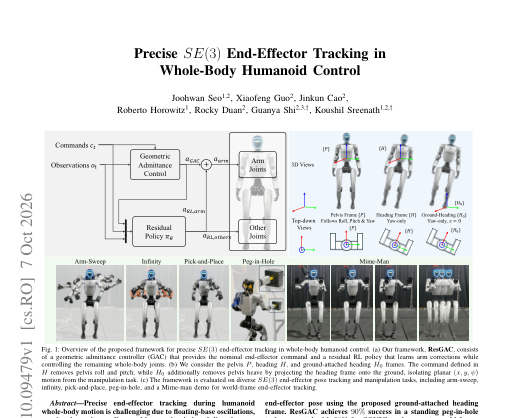
Precise SE(3) End-Effector Tracking in Whole-Body Humanoid Control

Joohwan Seo, Xiaofeng Guo, Jinkun Cao, Roberto Horowitz, Rocky Duan, Guanya Shi, Koushil Sreenath

Precise end-effector tracking during humanoid whole-body motion is challenging due to floating-base oscillations, gravity, dynamic coupling, and locomotion-induced disturbances. We…

Precise end-effector tracking during humanoid whole-body motion is challenging due to floating-base oscillations, gravity, dynamic coupling, and locomotion-induced disturbances. We propose ResGAC, a whole-body humanoid controller for precise end-effector pose tracking that combines geometric admittance control (GAC) with residual reinforcement learning. GAC provides structured $\SE$ task-space feedback and generates nominal arm joint-position targets, while residual RL compensates for unmodeled dynamics and coordinates locomotion and balance in the shared joint-position action space. The left-invariant geometric formulation allows the same GAC law to be used across manipulation reference frames. This enables the use of a ground-attached heading frame that preserves planar locomotion while removing pelvis roll, pitch, and heave from the manipulation reference, thereby reducing reference-induced end-effector motion during locomotion. ResGAC is validated on a real Unitree G1 humanoid. Across four standing end-effector tracking benchmarks, ResGAC consistently outperforms representative baselines, including SONIC, achieving lower translational and rotational errors. Real-world experiments further demonstrate reduced propagation of pelvis motion to the desired end-effector pose using the proposed ground-attached heading frame. ResGAC achieves $90%$ success in a standing peg-in-hole task compared with $50%$ for SONIC, and accurate world-frame $\SE$ end-effector pose tracking during lower-body motion. Experimental videos are included in the supplementary material and are also available on the project website: https://resgac.github.io/ResGAC-website/.

2026-10-06追踪学者 · Koushil Sreenath

Workhorse: Learning Robust Whole-Body Humanoid Loco-Manipulation from Human Data

Songbo Hu, Qiayuan Liao, Yufeng Chi, Kevin Zakka, Yakun Sophia Shao, Pieter Abbeel, Koushil Sreenath

Humanoid robots still struggle to plan contact-rich whole-body manipulation from egocentric RGB and proprioception. Workhorse learns such manipulation from robot-free human demonst…

Humanoid robots still struggle to plan contact-rich whole-body manipulation from egocentric RGB and proprioception. Workhorse learns such manipulation from robot-free human demonstrations. A visual planner predicts five-link targets: the poses of the torso, both wrists, and both feet. A reinforcement-learning whole-body tracker follows them on the robot. Both policies train separately on the same recorded human poses, without retargeting. We augment the training data of each policy to imitate the errors that the other makes at deployment. On a real Unitree G1, Workhorse transport boxes with its hands and a kick, catches a thrown box, and topples and climbs a suitcase. During box transport, we show recoveries after a person pushes the robot or takes the box away. In a simulated copy of the demonstration room, the system completes box transport in 77% of episodes, and in 64% under 40 N.s pushes. With both policies retrained from the same demonstrations, a simulated second humanoid completes box transport in 83% of episodes without pushes.

2026-09-30追踪学者 · Koushil Sreenath

ChronoGraph: Functional 4D Scene Graphs with Vision-Language Models for Interaction Understanding and Grounded Planning

Chenyangguang Zhang, Malgorzata Gwiazda, Guanlong Jiao, Yuanchen Ju, Federico Tombari, Koushil Sreenath, Marc Pollefeys, Sunghwan Hong

Embodied agents must determine where to act, anticipate the resulting scene changes, and interpret observed outcomes to guide subsequent actions. This requires connecting 4D intera…

Embodied agents must determine where to act, anticipate the resulting scene changes, and interpret observed outcomes to guide subsequent actions. This requires connecting 4D interaction understanding, which explains how past actions changed the scene, with spatially grounded planning, which determines how and where to act toward a goal and anticipates the resulting scene changes. We introduce ChronoGraph, a functional 4D scene graph that links actions on affordance parts to semantic and geometric state changes. By representing observed and anticipated transitions in the same form, it provides a shared basis for understanding and planning. We construct ChronoGraphBench through an automatic data engine that converts human-interaction videos and simulated robot trajectories into graph-annotated questions for training and evaluating Vision-Language Models (VLMs) on both tasks. Using these annotations, we train ChronoGraphVLM by adapting pretrained VLMs in two stages. Graph-as-Chain-of-Thought supervised fine-tuning teaches the models to reconstruct observed transitions and predict future ones as graph traces before answering. Subsequent joint 4D graph reinforcement learning directly rewards graph properties and answer correctness. Experiments across model scales show improvements over the corresponding pretrained baselines and zero-shot transfer to VLM4D. Real-world demonstrations further show that graph-based planning and affordance grounding support mobile manipulation through existing robot skills without additional fine-tuning.

2026-09-30追踪学者 · Koushil Sreenath

Learning Continuous Neural Representation of Stochastic Hybrid Systems

Sangli Teng, Hang Liu, Koushil Sreenath

A stochastic hybrid system (SHS) is governed by a stochastic differential equation (SDE) describing the continuous dynamics and a Markov reset kernel triggered on the guard surface…

A stochastic hybrid system (SHS) is governed by a stochastic differential equation (SDE) describing the continuous dynamics and a Markov reset kernel triggered on the guard surface. Its probability evolution can be described by a hybrid Fokker-Planck (HFP) equation with a partial differential term corresponding to the SDE and an integral term arising from the reset kernel. This work shows that such an SHS can be approximated by an SDE in a higher-dimensional latent space where the sample paths are continuous. The key to this result is to encode different branches of the reset kernel using auxiliary variables, transforming the resets into deterministic ones that enable topological gluing. By the embedding theorem, the glued manifold can then be embedded into a higher-dimensional Euclidean space. We show that the probability evolution on the embedded image no longer requires explicit reset terms in the HFP equation. Building on this theorem, we design a loss that matches the evolving state distributions, enabling a single latent SDE to recover the probability evolution of the SHS without mode labeling, trajectory segmentation, or event-based simulations.

cs.LGcs.AIeess.SY
2026-09-29追踪学者 · Koushil Sreenath

In-Distribution Imagination for Model-Based Offline Reinforcement Learning

Mintae Kim, Koushil Sreenath

Model-based offline reinforcement learning (MBORL) improves sample efficiency through model-generated trajectories. However, accumulative model error can drive imagined trajectorie…

Model-based offline reinforcement learning (MBORL) improves sample efficiency through model-generated trajectories. However, accumulative model error can drive imagined trajectories outside the offline data distribution, leading to unrealistic synthetic data and unstable policy optimization. Many existing methods primarily control rollouts using transition-level uncertainty. We propose in-distribution imagination (IDI), a rollout control framework that estimates trajectory support in a learned representation space and adaptively truncates rollouts that leave the offline trajectory manifold. Combined with trajectory-regularized RL, an extension of entropy-regularized RL, IDI consistently improves performance in limited-data settings. Experiments show that trajectory support predicts rollout failure substantially better than transition-level uncertainty, highlighting the importance of trajectory-level rollout control in MBORL.

2026-09-22追踪学者 · Koushil Sreenath

HiRE: Hindsight Reward Editing for Policy Finetuning

Haoyi Niu, Zhengtao Han, Yufeng Ji, Zhongyu Li, Koushil Sreenath

Pre-trained robot policies always require finetuning to adapt to specific environments. Reinforcement Learning (RL) offers high performance potential because it improves action opt…

Pre-trained robot policies always require finetuning to adapt to specific environments. Reinforcement Learning (RL) offers high performance potential because it improves action optimality rather than simply mimicking data. However, such potential depends heavily on reward quality. Sparse rewards lack process feedback, human-designed rewards are costly and biased, and semantic rewards from foundation representations are often not control-centric. We propose Hindsight Reward Editing (HiRE), a training-free framework to break this reward bottleneck. HiRE bridges the broad knowledge of foundation representation models with physical control awareness, by contrasting successful and failed trajectories in hindsight. It calibrates foundation representation models by identifying "trap states" that are predicted as high-rewarding states yet eventually result in failure, and vice versa. HiRE explicitly penalizes these traps while boosting rewards for critical successful states. This approach can be flexibly compatible with any foundation representations and RL algorithms. Experiments show that HiRE consistently outperforms other reward recipes by delivering dense, control-aware feedback that prevents value function collapse and reward hacking, thereby achieving superior sample efficiency, stable policy updates, and higher performance ceilings, e.g., at least 3x performance of the base policies. Qualitative results are at https://hire-project.github.io .

Jitendra Malik 8 篇 专属页 →

2026-10-27追踪学者 · Jitendra Malik

CARD: Contact-Anchored Retargeting for Dexterous Manipulation

Cunxi Dai, Botao He, Francois R Hogan, Wei Pan, Rao Fu, Wen-Han Hsieh, Ruoshi Liu, Jitendra Malik 等

Humans are dexterous, but traditional data collection paradigms such as teleoperation, kinesthetic teaching, and wearable exoskeletons force humans to act through the robot embodim…

Humans are dexterous, but traditional data collection paradigms such as teleoperation, kinesthetic teaching, and wearable exoskeletons force humans to act through the robot embodiment, bottlenecking their dexterity. Retargeting can avoid this. However, existing methods purely translate kinematics and ignore the real-world contact dynamics essential for task success. We present CARD: Contact-Anchored Retargeting for Dexterous Manipulation, a simulator and object-free framework that retargets human demonstrations to robot actions by explicitly preserving contact force targets. CARD unifies human data sources including video, motion capture, and tactile gloves via a shared hand--contact representation and generates explicit contact force targets in addition to kinematics. To maintain these contact targets during hardware open-loop replay, CARD also introduces a tactile tracking controller. For video which does not contain an explicit tactile source, we present Vid-HACO, our video-to-contact model that sets a new state of the art. Across our video, glove, motion-capture data and the GRAB dataset, CARD maintains contact on $43$--$78%$ of contact frames, while kinematic and object-aware retargeting methods maintain contact on $<10%$ and $22.5%$ of the frames respectively. Further, integrating our formulation into physics-based retargeting improves strict task success from 12% to 32% on GRAB dataset. Finally, we show that our tactile tracker is critical to reproduce demonstrated forces during hardware replay. These results establish that contact preservation via CARD is a scalable interface for transferring human dexterity to robots.

2026-10-15追踪学者 · Jitendra Malik

PlayPolicy: Dexterity from Supervised Play

Botao He, Yiming Dou, Yiannis Aloimonos, Jitendra Malik, Akash Sharma, Ruoshi Liu

How can robots autonomously collect the contact-rich experience needed to learn dexterous manipulation? We present PlayPolicy: Dexterity from supervised play (DSP), a framework in …

How can robots autonomously collect the contact-rich experience needed to learn dexterous manipulation? We present PlayPolicy: Dexterity from supervised play (DSP), a framework in which a robot learns a play policy from minutes of human play through behavior cloning, then deploys it autonomously to collect hours of interaction data to train a world model. During inference, the same play policy then guides model-predictive control (MPC) by proposing candidate action sequences for evaluation under the learned world model. To accelerate inference, we also introduce a method for distilling a closed-loop, goal-conditioned policy through self-play within the learned world model. We evaluate this framework on underactuated pushing and any-to-any in-hand pose reorientation with a multifingered hand, in simulation and real world. In real world experiment, our method outperforms hindsight behavior cloning by 69.6% in success rate and achieves comparable success to reinforcement learning with 490 times less interaction data. These results demonstrate that supervised play can autonomously collect interaction data, guide model-based planning, and enable policy learning without any task-specific demonstrations or sim-to-real transfer. Project page: https://play-policy.github.io/

cs.ROcs.AI
2026-10-12追踪学者 · Jitendra Malik

Force-Modulated Dexterity: Unified Compliance for Contact-Rich Manipulation

Ying Yuan, David Held, Jitendra Malik, Haozhi Qi

Teleoperation is widely used to collect high-quality demonstrations for robot learning. Dexterous manipulation, however, requires coordinated control of motion and contact forces. …

Teleoperation is widely used to collect high-quality demonstrations for robot learning. Dexterous manipulation, however, requires coordinated control of motion and contact forces. Operators can specify motion, but struggle to reproduce the subtle force adjustments of human manipulation without feeling the robot's contacts. We introduce Force-Modulated Dexterity (FOMO-Dex), a unified compliance formulation for contact-rich manipulation. FOMO-Dex expresses nominal actions in coordinates defined by task geometry and contact structure. It applies force-driven motion corrections along selected directions while leaving the remaining command components unchanged. Across card picking, paper cutting, screwdriving, and nut-and-bolt assembly, FOMO-Dex reduces excessive contact forces compared with stiff control. A user study shows that operators collect more successful demonstration data per hour after brief practice. For policy learning, imitating the corrected actions improves card-picking success over imitating raw operator commands. Policies trained on FOMO-Dex demonstrations also achieve more rotation in nut-and-bolt manipulation and screwdriving than those trained on demonstrations collected with the stiff controller. Videos are shown on https://yingyuan0414.github.io/fomo-dex/ .

2026-10-02追踪学者 · Jitendra Malik

EyeRobot 2.0: Active Gaze for Precise Manipulation without Wrist Cameras

Kush Hari, Justin Kerr, Nidhya Shivakumar, Samarth Mahapatra, Carmelo Sferrazza, Jiahui Lei, Jitendra Malik, C. Karen Liu 等

Inspired by human vision, we introduce a framework using active gaze to enable fine-grained bimanual manipulation with only a single stereo camera. EyeRobot 2.0 physically attends …

Inspired by human vision, we introduce a framework using active gaze to enable fine-grained bimanual manipulation with only a single stereo camera. EyeRobot 2.0 physically attends to a 3D fixation point in the scene by swiveling two eye viewpoints to center their gaze on it. The resulting images are processed foveally by allocating more visual tokens to the image centers, focusing computation on task-relevant features. Such Active Visual Fixation (AVF) requires carefully coordinated gaze during task execution, which we accomplish hierarchically by first training a low-level gaze servoing policy conditioned on a goal object, then training a target selector which emits fixation goals based on task progress. Both modules are trained with RL on real-world data: the first is trained with a dense geometric reward and the second co-trains with the BC gripper policy which allows it to discover fixation sequences that can resemble a human's fixation sequence while performing the task. EyeRobot 2.0 further takes advantage of fixation by canonicalizing gripper information into a fixation-relative SE(3) frame, which compacts the size of the action distribution to learn. We collect teleoperation data for 7 real-world and 6 simulated tasks, and conduct over 1000 physical and 1800 simulated robot trials comparing EyeRobot 2.0 against passive stereo and ego + wrist camera policies trained on the same data. Removing wrist cameras is costly for standard policies: with only passive stereo, real-world success drops from 52% to 27%. EyeRobot 2.0 closes this gap with only stereo, outperforming passive stereo by 40% in real and 20% in sim. It matches ego + wrist policies when their wrist views are clear (69% vs. 64%), and more than doubles their success when grasped objects occlude the wrist cameras (48% vs. 22%)

2026-09-29追踪学者 · Jitendra Malik

Counterfactual Video Generation Enables Scalable Humanoid Loco-Manipulation

Zihan Wang, Zhen Wu, Pieter Abbeel, Rocky Duan, Jitendra Malik, Carmelo Sferrazza, C. Karen Liu, Guanya Shi 等

Teaching humanoids loco-manipulation skills, such as carrying diverse objects, via visual imitation is a promising path toward generalist robots. However, collecting diverse, high-…

Teaching humanoids loco-manipulation skills, such as carrying diverse objects, via visual imitation is a promising path toward generalist robots. However, collecting diverse, high-quality interaction videos, such as clips that clearly show a person's full body and unoccluded interactions with objects, poses a practical barrier to scaling this approach. We propose PRISM, a real-to-sim-to-real framework that overcomes this limitation by amplifying a handful of real videos into a large, diverse training set. PRISM first generates hundreds of diverse "counterfactual" human-object interaction videos via video-to-video (V2V) generation from a few exemplar real videos. Our contact-anchored real-to-sim pipeline then reconstructs both human and object motions, retargeting this imperfect video data into physically plausible trajectories. The intra-class variability across these counterfactual videos lets us train a single policy that generalizes to unseen objects within each category. We demonstrate the full pipeline by deploying this policy on a real robot without any real-world fine-tuning. Using only onboard depth observations, our humanoid picks up, carries, and drops objects, including boxes, barrels, bins, and balls, across novel instances, sizes, and initial configurations.

cs.ROcs.CVcs.GR
2026-09-29追踪学者 · Jitendra Malik

OmniTaskonomy: When Does Visual Generation Improve Visual Understanding?

Jiaxin Ge, Yiming Qin, Ji Xie, Haozhe Jiang, Xiaochuang Han, Junyi Zhang, Andrew Dai, Yinfei Yang 等

Training a model to generate visual content can encourage it to learn rich perceptual capabilities related to geometry, spatial relationships, and objectness; yet, its benefits for…

Training a model to generate visual content can encourage it to learn rich perceptual capabilities related to geometry, spatial relationships, and objectness; yet, its benefits for visual understanding remain unclear. We ask: when and how does visual generation supervision improve visual understanding? We study controlled pairs of image-to-image (I2I) generation and image-to-text (I2T) understanding tasks that express the same underlying problem in different output modalities. We find that under the correct recipe, I2I training improves downstream I2T performance, with larger gains as the amount of I2I training data increases. We next ask which generation tasks benefit which understanding capabilities. To study transfer beyond paired tasks, we introduce OmniTaskonomy, a unified taxonomy spanning 19 I2I generation tasks and 25 I2T understanding capabilities. The resulting transfer map reveals selective, task-dependent benefits. Some follow intuitive correspondences, e.g., depth prediction improving metric 3D reasoning, object pointing improving counting, and jigsaw reconstruction improving 2D ordering. Interestingly, we also uncover surprising connections: 2.5D segmentation improving category recognition and Z-depth prediction improving localization. To probe these patterns, we analyze gradient alignment between generation and understanding tasks and find that stronger alignment is associated with larger downstream transfer gains. Together, our results highlight visual generation as a rich source of supervision for visual understanding and provide a roadmap for unlocking its benefits through the right training curriculum and task selection. Project page: https://omni-taskonomy.github.io/.

2026-09-23追踪学者 · Jitendra Malik

Morphometric Imitation: From Morphology and Contact Aware Hand Retargeting to Sim-to-Real Visuomotor Policy

Tara Sadjadpour, Siming He, C. K. Wolfe, Haozhi Qi, Lea Wilken, S. Shankar Sastry, Claire Tomlin, Jitendra Malik

Human hand-object interactions (HOIs) provide a rich source of demonstrations for dexterous manipulation, but learning directly from them presents challenges in bridging morphology…

Human hand-object interactions (HOIs) provide a rich source of demonstrations for dexterous manipulation, but learning directly from them presents challenges in bridging morphology gaps, ensuring dynamical feasibility, and sim-to-real deployment. We present Morphometric Imitation, a three-stage framework that transforms reconstructed HOIs into zero-shot sim-to-real visuomotor policies. First, morphometric optimization (MMO) kinematically retargets human motion across hand morphologies while preserving demonstrated contacts. Second, residual reinforcement learning (RL) refines the kinematic reference using object pose and contact information from the human motion to produce dynamically feasible robot demonstrations. Third, these demonstrations are distilled into visuomotor policies. Across three robot hands and ten HOIs, MMO outperforms five baselines in contact F1, improving on the strongest ones by 8 to 28 points, while improving the success rate of downstream dynamic retargeting by as much as 35 points. On a Sharpa hand, the visuomotor policies achieve 89.3% zero-shot success in 300 real-world trials on 30 objects spanning 10 categories. Project page: https://morphometricimitation.github.io

2026-09-21追踪学者 · Jitendra Malik

AgentSTAR: Agentic Shape Tracking and Reconstruction from Monocular Videos

Kirill Mazur, Nikita Karaev, Matthew Chang, Jitendra Malik, Nur Muhammad "Mahi'' Shafiullah

In this work, we present a method for shape reconstruction and tracking from video via agentic analysis-by-synthesis. Unlike prior methods which first estimate dense pixel correspo…

In this work, we present a method for shape reconstruction and tracking from video via agentic analysis-by-synthesis. Unlike prior methods which first estimate dense pixel correspondences and then recover object motion from them, our method infers a structured 3D object model, including its geometry and kinematic structure, and uses this model to optimise object track estimates over time. In our optimisation loop, a Vision-Language Model (VLM) agent iteratively refines shape or generalised pose through a render-and-compare loop, combining coarse visual reasoning with numerical pose optimisation for precise state estimation. This structured formulation enables our method to track through large motion, articulation, and severe occlusion without relying on pixel-matching objectives. Quantitatively, on ARCTIC, our method substantially outperforms state-of-the-art 3D point-tracking baselines for articulated objects, and on HOT3D it outperforms all evaluated rigid-object tracking baselines.

cs.CVcs.AI

Ken Goldberg 7 篇 专属页 →

2026-10-22追踪学者 · Ken Goldberg

KiRoSe: Using Kinematic Data for Efficient Segmentation of Robot Demonstrations

Shuangyu Xie, Kaiyuan Chen, Muhammad Zubair Irshad, Richard Cheng, Sergey Zakharov, Ken Goldberg

Segmenting robot demonstration data into disjoint temporal and semantic subsegments is valuable for learning, cleaning, retrieval, and analysis. Segmentation is often performed man…

Segmenting robot demonstration data into disjoint temporal and semantic subsegments is valuable for learning, cleaning, retrieval, and analysis. Segmentation is often performed manually in a tedious and error prone process. Multimodal Large Language Models (MLLMs) have the potential for automating this process, but directly ingesting raw multi camera video streams into MLLMs can be costly and can quickly exhaust context windows. In this paper, we introduce KiRoSe (Kinematics for Robot Segmentation), a novel framework that focuses on the companion stream of robot kinematic data. Inspired by the principle of classical entropy coding, such as Huffman coding, where frequently occurring symbols are represented more compactly, we propose Sparse Motion Tokens (SMTs), a discrete kinematic vocabulary designed to compactly represent recurring, temporally localized motion patterns, which we refer to as kinematic events. SMTs are learned by encoding kinematic trajectories with temporal segment supervision and quantizing the resulting features. We use increasingly available robot demonstration subtask annotations to supervise an open language model to interpret the resulting token sequences. Evaluation against human labeled segmentation shows that KiRoSe can substantially outperform baseline segmentation methods in F1 quality and transfers zero shot to unseen robot embodiments and egocentric human motion, while preserving the language models open vocabulary knowledge. Beyond segmentation, KiRoSe tracks task progress on an unseen robot and detects when an action is being reversed.(website: https://berkeleyautomation.github.io/kirose/)

2026-10-21追踪学者 · Ken Goldberg

Agentic World Action Models

Zhuoyang Liu, Dantong Niu, Botong Zhang, Boning Shao, Jing Wang, Ruijie Zheng, Yuvan Sharma, Runyu Lu 等

Recent world action models provide visual foresight and future prediction for robot manipulation, but lack explicit mechanisms for compositional skill reuse. Agentic robotics combi…

Recent world action models provide visual foresight and future prediction for robot manipulation, but lack explicit mechanisms for compositional skill reuse. Agentic robotics combines code-based planning and reasoning with reusable skills, but often lacks predictive grounding in physical dynamics. We introduce AW-0, an agentic world action model framework that integrates code-based planning with joint video and action prediction. We jointly model code, future video, and robot actions as three coupled generative streams within a unified mixture-of-transformers architecture. Within this architecture a code expert generates parameterized skill routines and control logic while video and action experts generate future visual states and low-level motor commands. Code serves two complementary roles: it structures multi-step prediction and control within the world model and represents skills as reusable programs for subsequent agentic execution. We further introduce an automated curation pipeline that labels robot and human video trajectories with aligned programs and consolidates recurring routines into reusable skill libraries. Evaluations on RoboTwin 2.0 and physical bimanual manipulation tasks show improved task performance over VLA and WAM baselines, alongside gains in language following, semantic reasoning and robustness, demonstrating that agentic code enables connection between planning, prediction and execution within WAMs.

2026-10-13追踪学者 · Ken Goldberg

RoboSimStudio: An Interactive Toolkit for Human and Agent Rapid Real2Sim of Robot Manipulation Tasks

Kaiyuan Chen, Shuangyu Xie, Uksang Yoo, Xinyue Zhu, Cael Magner, Alvin Zhu, Daehwa Kim, Eric Heiden 等

It has been difficult to accurately model the physics of the interaction between a robot and the objects it manipulates, including contact mechanics, coupled contact dynamics, defo…

It has been difficult to accurately model the physics of the interaction between a robot and the objects it manipulates, including contact mechanics, coupled contact dynamics, deformations, stiffness and friction. We present RoboSimStudio (RSS), an interactive toolkit that makes choices of solver, contact model, and physical parameters explicit and editable, allowing both humans and coding agents to quickly create and iteratively refine simulations based on observed physical behavior. We implement RSS with the open Newton physics simulation system and describe experiments with human-guided real2sim using (1) visual evaluation, (2) force-feedback and (3) agentic Real2Sim2Real. Code, video and additional information can be found on the project website: https://robosimstudio.github.io

cs.ROcs.AIcs.GRcs.LG
2026-10-06追踪学者 · Ken Goldberg

QF3: Fast Flow RL with Filtered Q-Gradients

Chung Min Kim, Brent Yi, David McAllister, Hongsuk Choi, Himanshu Gaurav Singh, Jinkun Cao, Ken Goldberg, Pieter Abbeel 等

Flow policies have become a standard policy class for learning robot behaviors from demonstrations, but reinforcement learning is still critical for improving pre-trained flow poli…

Flow policies have become a standard policy class for learning robot behaviors from demonstrations, but reinforcement learning is still critical for improving pre-trained flow policies or learning them from scratch through interaction. We introduce QF3 (Fast Flow RL with Filtered Q-Gradients), an online off-policy RL algorithm that trains a flow policy with flow matching plus the critic's action gradient, backpropagated through a one-step prediction of the flow's output. To keep updates where the critic and this prediction are reliable, QF3 applies the critic gradient only to action dimensions that stay near the replay action. To our knowledge, QF3 is the first off-policy flow RL method to train humanoid locomotion policies from scratch and transfer them zero-shot to hardware. Paired with a high-throughput off-policy training recipe, it trains humanoid locomotion and motion-tracking policies with a 10x wall-clock speedup over FPO++, a recent on-policy flow RL method. We further apply QF3 to fine-tune pretrained flow-based manipulation policies on both ABC-Sim and Robomimic tasks. These results suggest that QF3 can both learn robot policies from scratch and refine those acquired from demonstrations. Website: https://qf3-rl.github.io/

2026-10-02追踪学者 · Ken Goldberg

EyeRobot 2.0: Active Gaze for Precise Manipulation without Wrist Cameras

Kush Hari, Justin Kerr, Nidhya Shivakumar, Samarth Mahapatra, Carmelo Sferrazza, Jiahui Lei, Jitendra Malik, C. Karen Liu 等

Inspired by human vision, we introduce a framework using active gaze to enable fine-grained bimanual manipulation with only a single stereo camera. EyeRobot 2.0 physically attends …

Inspired by human vision, we introduce a framework using active gaze to enable fine-grained bimanual manipulation with only a single stereo camera. EyeRobot 2.0 physically attends to a 3D fixation point in the scene by swiveling two eye viewpoints to center their gaze on it. The resulting images are processed foveally by allocating more visual tokens to the image centers, focusing computation on task-relevant features. Such Active Visual Fixation (AVF) requires carefully coordinated gaze during task execution, which we accomplish hierarchically by first training a low-level gaze servoing policy conditioned on a goal object, then training a target selector which emits fixation goals based on task progress. Both modules are trained with RL on real-world data: the first is trained with a dense geometric reward and the second co-trains with the BC gripper policy which allows it to discover fixation sequences that can resemble a human's fixation sequence while performing the task. EyeRobot 2.0 further takes advantage of fixation by canonicalizing gripper information into a fixation-relative SE(3) frame, which compacts the size of the action distribution to learn. We collect teleoperation data for 7 real-world and 6 simulated tasks, and conduct over 1000 physical and 1800 simulated robot trials comparing EyeRobot 2.0 against passive stereo and ego + wrist camera policies trained on the same data. Removing wrist cameras is costly for standard policies: with only passive stereo, real-world success drops from 52% to 27%. EyeRobot 2.0 closes this gap with only stereo, outperforming passive stereo by 40% in real and 20% in sim. It matches ego + wrist policies when their wrist views are clear (69% vs. 64%), and more than doubles their success when grasped objects occlude the wrist cameras (48% vs. 22%)

2026-09-28追踪学者 · Ken Goldberg

AGRO-SUVIDE: Agentic Robotics for Surgical Viscoelastic Debridement

Shutong Jin, Ziyang Chen, Preethi Satish, Meadow Shen, Gary Guthart, Florian T. Pokorny, Ken Goldberg

Augmented dexterity has the potential to reduce the fatigue experienced by surgeons during repetitive surgical tasks. In this paper, we propose the first AGentic RObotics framework…

Augmented dexterity has the potential to reduce the fatigue experienced by surgeons during repetitive surgical tasks. In this paper, we propose the first AGentic RObotics framework for SUrgical VIscoelastic DEbridement (AGRO-SUVIDE), the repeated removal of small fragments attached to a viscoelastic substrate. Leveraging the self-improving and coding capability of agents, AGRO-SUVIDE adopts a modular framework. Specifically, the demonstration analysis module automatically identifies recurring skills from a single expert demonstration, using both visual and kinematic information. The construction module then builds each skill, either as a procedural model-based skill the agent codes against a scaffolded library or as a model-free policy-based skill. At runtime, the monitoring module composes the skills into a loop-style graph sized to the number of fragments it observes, then verifies pre- and post-conditions of each skill to decide whether to advance or retry. We evaluate AGRO-SUVIDE through 340 physical trials on the da Vinci Research Kit (dVRK). AGRO-SUVIDE achieves an average single-fragment removal success rate of 85%, completing consecutive three-fragment removal at 60% and at 95% with one human intervention. It further generalizes to unseen five-fragment scenarios with an average success rate of 80% for single-fragment removal. Project page: https://surgical-robotics.github.io/AGRO-SUVIDE/

2026-09-24追踪学者 · Ken Goldberg

TRACE: Interactive Bi-Directional Tracing of Monochrome Cables Amid Clutter

Nidhya Shivakumar, Ethan Ransing, Josh Zhang, Shamak Gowda, Kevin Yang, Miles Hua, Anika Agrawal, Justin Yu 等

Accurate state estimation (tracing) of Deformable Linear Objects (DLOs) such as cables is a critical challenge for data centers, manufacturing, construction, homes, and surgery, wh…

Accurate state estimation (tracing) of Deformable Linear Objects (DLOs) such as cables is a critical challenge for data centers, manufacturing, construction, homes, and surgery, where precise cable management directly impacts operational safety and efficiency. However, resolving the state of multiple monochrome cables amid foreground and background clutter poses challenges due to occlusions, overlap, and ambiguous crossings. We present Two-way Routing And Cable Estimation (TRACE), which combines bi-directional cable tracing with interactive perception primitives-Divergence Push and Cluster Dilation-to actively resolve ambiguities. Evaluation with 110 physical experiments suggests that TRACE can increase the percentage of cable length correctly traced in complex scenarios (with up to 4 cables and 40 crossings) from ~60% with the strongest prior method, HANDLOOM 2.0, to ~90%, outperforming RT-DLO, Nano Banana Pro, and ChatGPT 5.2 as well. For a trial run on a workstation with an NVIDIA GeForce RTX 4090 GPU, the average computation time is 0.4 seconds per cable. Project website: https://trace-paper.github.io/.

Trevor Darrell 7 篇 专属页 →

2026-10-21追踪学者 · Trevor Darrell

Agentic World Action Models

Zhuoyang Liu, Dantong Niu, Botong Zhang, Boning Shao, Jing Wang, Ruijie Zheng, Yuvan Sharma, Runyu Lu 等

Recent world action models provide visual foresight and future prediction for robot manipulation, but lack explicit mechanisms for compositional skill reuse. Agentic robotics combi…

Recent world action models provide visual foresight and future prediction for robot manipulation, but lack explicit mechanisms for compositional skill reuse. Agentic robotics combines code-based planning and reasoning with reusable skills, but often lacks predictive grounding in physical dynamics. We introduce AW-0, an agentic world action model framework that integrates code-based planning with joint video and action prediction. We jointly model code, future video, and robot actions as three coupled generative streams within a unified mixture-of-transformers architecture. Within this architecture a code expert generates parameterized skill routines and control logic while video and action experts generate future visual states and low-level motor commands. Code serves two complementary roles: it structures multi-step prediction and control within the world model and represents skills as reusable programs for subsequent agentic execution. We further introduce an automated curation pipeline that labels robot and human video trajectories with aligned programs and consolidates recurring routines into reusable skill libraries. Evaluations on RoboTwin 2.0 and physical bimanual manipulation tasks show improved task performance over VLA and WAM baselines, alongside gains in language following, semantic reasoning and robustness, demonstrating that agentic code enables connection between planning, prediction and execution within WAMs.

2026-10-19追踪学者 · Trevor Darrell

Train An Imaginative Agent

Jiaxin Ge, Junyi Zhang, Tianning Chai, Hanjun Yoo, Chenyang Wang, Xiuyu Li, Weijia Shi, XuDong Wang 等

A seemingly reasonable push in Sokoban can make the puzzle unsolvable. To avoid such mistakes, an agent has to anticipate the consequences of its actions before execution, especial…

A seemingly reasonable push in Sokoban can make the puzzle unsolvable. To avoid such mistakes, an agent has to anticipate the consequences of its actions before execution, especially when feedback from the real environment is sparse or actions are irreversible. We introduce Agentic Imagination (Agima), a training framework that trains an agent to imagine before acting, i.e. to be imaginative. Agima trains a single omni model to propose actions, generate images of their outcomes, and then reason over these imagined futures to decide what to execute in the real environment. Rather than committing to a single plan, the agent can simulate a sequence of actions, explore alternatives, and compare possible futures. We first use supervised fine-tuning (SFT) to unify policy and world modeling within a single omni model. This enables the agent to predict future outcomes and perform basic forms of imagination, such as forward thinking and counterfactual branching. We then use agentic reinforcement learning (RL) to teach the agent to reason with its imagined futures and use them effectively for planning. Across four environments spanning Maze2D, Sokoban, Pacman, and PushT, Agima generalizes to harder settings unseen during training. Trained with SFT alone on two-box Sokoban, Agima solves 40% of four-box puzzles while seeing the real board only once every five moves, compared with an action-only planner that only solves 2%. After RL, new behaviors emerge in how Agima uses its imagination: it learns a new unified format that was unseen during the SFT stage, learns to conduct forward thinking only when necessary, and branches more frequently at critical decision points. An agent that can picture where its actions lead can learn when and where to look ahead, that is, to plan. Project page: https://agima.net/.

2026-10-15追踪学者 · Trevor Darrell

Judging the Judges: Confidence and Disagreement in Rubrics as Rewards

Michael Tian-Yue Liu, Anne Harrington, Trevor Darrell, Yutong Bai

Rubrics as Rewards (RaR) extends reinforcement learning to non-verifiable domains by using an LLM judge to score responses against a structured rubric. Prior work has focused on im…

Rubrics as Rewards (RaR) extends reinforcement learning to non-verifiable domains by using an LLM judge to score responses against a structured rubric. Prior work has focused on improving the rubric or strengthening the single judge, with comparatively little attention to how different single or multiple judges might be used during RaR training. We first show that judge identity alone produces a substantial spread in scores when training Qwen3-4B-Base on RaR-Medicine and RaR-Science across five frontier and open-weight judges. Building on this, we propose RaRE (Rubrics as Rewards with Ensembles), a novel judge ensemble strategy for RaR with two mechanisms: a soft-Likert reward that uses judge logprobs to weight more confident judges more heavily, and a drop-on-disagreement mask that excludes high-disagreement rollouts from the GRPO update. We find that this design is critical: while a naive average of judge scores fails to outperform the best single judge, RaRE outperforms every single-judge RaR variant on both HealthBench and GPQA Diamond, with per-theme analysis showing that it inherits the complementary strengths of its constituent judges. Our findings establish judge ensembling as a compelling axis for improving RaR.

2026-10-14追踪学者 · Trevor Darrell

Robota-Embed: Unified VLA Embeddings for Robot In-Context Learning and Evolution

Yunze Liu, Jing Wang, Shenrui Wu, Wenkun He, Guanqi Zhan, Xianzheng Ma, Junyu Chen, Wenhang Ge 等

Retrieving useful context for a robot requires matching its task, execution stage, and the continuation that should follow. We introduce Robota-Embed, to our knowledge the first vi…

Retrieving useful context for a robot requires matching its task, execution stage, and the continuation that should follow. We introduce Robota-Embed, to our knowledge the first vision-language-action (VLA) embedding model to jointly encode all three modalities in both current-state queries and recorded future continuations. Predictive retrieval training aligns these endpoints, enabling historical continuations to serve as context at inference time. We construct a multi-source corpus of 1,695,684 cleaned training anchors and introduce Robota-Embed-Bench, with 4,000 queries and a shared 8,000-entry gallery. Robota-Embed achieves 47.33% clip-level and 81.77% episode-level R@1, exceeding action-free Gemini Embedding 2 by 22.09 and 33.47 percentage points. Controlled retrieval studies show that removing native action degrades retrieval more than removing vision. We study two complementary applications. Embed2ICL uses retrieved experience for training-free and training-based policy conditioning, increasing success from 47.0% to 56.3% in DROID-Sim and from 86.4% to 92.8% on the LIBERO difficult subset, while improving task progress on real robots. Embed2Evolve uses execution feedback to grow task-local memory and refine context use around a frozen GPT-6 Astra policy. Across five ManiSkill tasks, it achieves 68% success, compared with 24% for GPT-6 Astra Direct and 33% for a harness independently evolved with Omni-Embed-Nemotron-3B under the same protocol. Relative to the latter, it uses approximately 79.5% fewer policy tokens per test rollout, counting both successes and failures. These results show that a unified, action-aware retrieval space can support robot in-context learning and task-local context evolution.

2026-10-01追踪学者 · Trevor Darrell

World Motion Models: Flexible Sequence Modeling of SE(3) Trajectories

Jiahui Lei, Qianqian Wang, Trevor Darrell, Angjoo Kanazawa

Equipping artificial agents with spatial intelligence requires a comprehensive generative prior over the dynamic 3D world. We propose World Motion Models (WMMs) that capture "what …

Equipping artificial agents with spatial intelligence requires a comprehensive generative prior over the dynamic 3D world. We propose World Motion Models (WMMs) that capture "what was, is, and will be where across time" via sparse SE(3) pose trajectories. WMMs are built on the observation that elements of dynamic scenes can be well approximated by a set of rigid SE(3) trajectories, a minimal yet expressive primitive for 4D modeling. This representation unifies articulated objects, human bodies, hand-object interactions, piecewise-rigid scene dynamics, camera motion, and even robot states and actions into a single shared space. Given this representation, we cast the joint distribution of these entities as a flexible sequence modeling problem, utilizing flow-matching with per-token noise levels. Coupled with a context token mechanism for non-sequential conditioning, this formulation supports any-to-any marginal conditioning across an arbitrary number of entities and time steps. Tasks such as future prediction, motion infilling, model-predictive control, inverse kinematics, cross-embodiment retargeting, and policy learning all reduce to the application of different masks over the same network. Experiments on 6 diverse applications of 3D vision and robotics demonstrate the versatility and flexibility of WMMs with strong performance.

2026-09-29追踪学者 · Trevor Darrell

OmniTaskonomy: When Does Visual Generation Improve Visual Understanding?

Jiaxin Ge, Yiming Qin, Ji Xie, Haozhe Jiang, Xiaochuang Han, Junyi Zhang, Andrew Dai, Yinfei Yang 等

Training a model to generate visual content can encourage it to learn rich perceptual capabilities related to geometry, spatial relationships, and objectness; yet, its benefits for…

Training a model to generate visual content can encourage it to learn rich perceptual capabilities related to geometry, spatial relationships, and objectness; yet, its benefits for visual understanding remain unclear. We ask: when and how does visual generation supervision improve visual understanding? We study controlled pairs of image-to-image (I2I) generation and image-to-text (I2T) understanding tasks that express the same underlying problem in different output modalities. We find that under the correct recipe, I2I training improves downstream I2T performance, with larger gains as the amount of I2I training data increases. We next ask which generation tasks benefit which understanding capabilities. To study transfer beyond paired tasks, we introduce OmniTaskonomy, a unified taxonomy spanning 19 I2I generation tasks and 25 I2T understanding capabilities. The resulting transfer map reveals selective, task-dependent benefits. Some follow intuitive correspondences, e.g., depth prediction improving metric 3D reasoning, object pointing improving counting, and jigsaw reconstruction improving 2D ordering. Interestingly, we also uncover surprising connections: 2.5D segmentation improving category recognition and Z-depth prediction improving localization. To probe these patterns, we analyze gradient alignment between generation and understanding tasks and find that stronger alignment is associated with larger downstream transfer gains. Together, our results highlight visual generation as a rich source of supervision for visual understanding and provide a roadmap for unlocking its benefits through the right training curriculum and task selection. Project page: https://omni-taskonomy.github.io/.

2026-09-21追踪学者 · Trevor Darrell

DexTacWAM: A Visuo-Tactile World-Action Model for Dexterous Manipulation

Haoran Yuan, Zekai Wang, Boning Shao, Haoran Lu, Trevor Darrell, Ismini Lourentzou, Wei Zhan

Dexterous manipulation depends on contact dynamics that are often only partially observable from vision. Recent World-Action Models (WAMs) couple predictive video world modeling wi…

Dexterous manipulation depends on contact dynamics that are often only partially observable from vision. Recent World-Action Models (WAMs) couple predictive video world modeling with action generation, but remain largely vision-centric and therefore cannot directly model these contact dynamics. We present DexTacWAM, a visuo-tactile WAM that encodes each fingertip independently, aggregates the resulting features through a finger- and pose-aware tactile compressor, and injects the tactile latent into a video diffusion world model for joint visuo-tactile world modeling. Across six contact-rich dexterous manipulation tasks on a 22-DoF bimanual platform, DexTacWAM achieves the highest score on every task, averaging 70.6 versus 38.0 for the strongest baseline. Ablations attribute the gain to modeling contact evolution as part of the predicted world state rather than tactile conditioning alone: removing tactile world modeling reduces the four-task mean from 74.7 to 26.6 while keeping the same tactile features and action expert. After four hours of tactile-encoder adaptation with a frozen pretrained vision VAE, our continual vision-to-touch learning extends the pretrained video model to touch using roughly 100 demonstrations per task without tactile midtraining, while retaining visual prediction quality within 0.5 dB of vision-only counterparts. The compressor retains 89.4% of pre-fusion contact recall while enabling 2.26x faster training and 1.29x faster inference. Together, these results show that pretrained video priors can be extended to distributed multi-finger contact dynamics in a data- and compute-efficient manner.

cs.ROcs.AIcs.CV