Tech Station

学者追踪 › Berkeley › Koushil Sreenath

Koushil Sreenath

UC Berkeley · 最近 45 天 11 篇
#12026-11-03追踪学者 · Koushil Sreenath

Ctrl-F: Force as an Interface for Humanoid Loco-Manipulation

Mengjie Zhao, Yuxin Chen, Yiyang Shao, Chuye Hong, Jiakang Chen, Koushil Sreenath, Masayoshi Tomizuka

Humanoid motion tracking has scaled to general policies that reproduce diverse human motion, but the resulting behavior is in free-space: the tracker knows where the body should be…

Humanoid motion tracking has scaled to general policies that reproduce diverse human motion, but the resulting behavior is in free-space: the tracker knows where the body should be, not how it should interact with the environment. Other work makes the object part of the objective, yet abstracts that interaction to contact or geometry, which leaves the demanding cases under-explored. We argue that force is a natural command channel between motion imitation and object interaction, one that specifies not just where to make contact but how hard. We present Ctrl-F, a hierarchical motion-force framework that augments motion tracking with an explicit force command, a 3-D force at each designated contact body such as a hand or a foot. The hierarchical framework comprises: (1) A unified motion-force controller tracks the reference motion while applying the commanded force to the world. (2) A high-level force planner that issues a force command online based on object state and proprioception observations. In simulation and on hardware, Ctrl-F completes loco-manipulation that demands large, sustained interaction force and adjusts its command online as the load changes, both out of reach of a force-blind tracker. On hardware, Ctrl-F demonstrates hand-based dragging, pushing, and lifting, as well as foot-based kicking, successfully manipulating boxes weighing up to 20kg in pushing and kicking tasks where the force-blind baseline fails, while adapting online to additional loads introduced mid-task.

#22026-10-20追踪学者 · Koushil Sreenath

SuperMimic: Scaling Humanoid Whole-Body Control with One Differentiable World Model

Qiayuan Liao, Yiyang Shao, Junfeng Long, Kevin Zakka, Roberto Horowitz, Pieter Abbeel, Koushil Sreenath

Tracking large human-motion datasets has become the dominant route to general, expressive humanoid whole-body control, but scaling across many motions is expensive. Current pipelin…

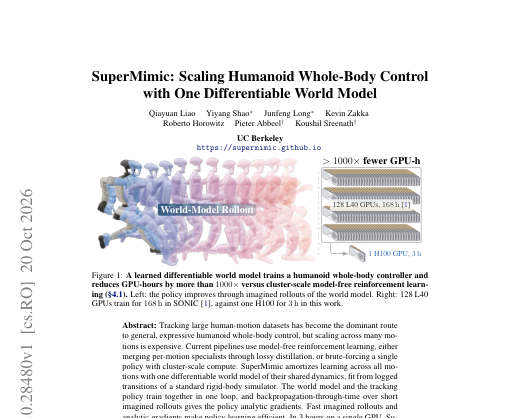
Tracking large human-motion datasets has become the dominant route to general, expressive humanoid whole-body control, but scaling across many motions is expensive. Current pipelines use model-free reinforcement learning, either merging per-motion specialists through lossy distillation, or brute-forcing a single policy with cluster-scale compute. SuperMimic amortizes learning across all motions with one differentiable world model of their shared dynamics, fit from logged transitions of a standard rigid-body simulator. The world model and the tracking policy train together in one loop, and backpropagation-through-time over short imagined rollouts gives the policy analytic gradients. Fast imagined rollouts and analytic gradients make policy learning efficient. In 3 hours on a single GPU, SuperMimic surpasses the return of a state-of-the-art motion tracker baseline trained for 7 days on 128 GPUs. It reduces GPU-hours by more than $1000\times$ and fails on only 25 of 129,514 benchmark motions, versus 179 failures for the baseline. After 9.8 hours on two GPUs, SuperMimic achieves zero failures. From 1 to 264 hours of motion, the world model's prediction error stays stable, and GPU-hours to a target return grow slowly. Our policy transfers to a physical Unitree G1 across diverse and acrobatic motions. SuperMimic removes compute as the bottleneck to scaling humanoid whole-body control, making it practical to measure motion-tracking scaling laws.

#32026-10-19追踪学者 · Koushil Sreenath

SSIO: Self-Supervised Inertial Odometry

Yuheng Qiu, Yutian Chen, Carlton Cort, Weison Huang, Shibo Zhao, Pieter Abbeel, Rocky Duan, Koushil Sreenath 等

Learning inertial odometry for a new platform usually requires ground-truth trajectories. We show that an inertial odometry model can instead be trained from scratch by a myopic te…

Learning inertial odometry for a new platform usually requires ground-truth trajectories. We show that an inertial odometry model can instead be trained from scratch by a myopic teacher that integrates the IMU over each short window independently, a scheme we call integration self-supervision. Interestingly, although supervised only by short-window velocity changes, the student learns to directly predict velocity, and does so more accurately than its integration teacher. Pose graph distillation then refines the model with sequence-consistent targets from a pose graph over many windows. Training on a new platform therefore no longer requires collecting ground-truth trajectories, but only calibrating the IMU and recording data during normal operation. Across six datasets spanning pedestrians, drones, quadrupeds, and a humanoid, the same recipe with no velocity or position labels trains models that come within 0.07~m/s average velocity error of a same-architecture supervised baseline.

#42026-10-14追踪学者 · Koushil Sreenath

Modeling and Understanding Neural Weights of Humanoid Policies with Diffusion

Huixuan Cheng, Bike Zhang, Shankar Sastry, Koushil Sreenath

Recent advances in robot learning have driven rapid progress in humanoid control, enabling increasingly agile behaviors in the real world. However, humanoid control networks are ty…

Recent advances in robot learning have driven rapid progress in humanoid control, enabling increasingly agile behaviors in the real world. However, humanoid control networks are typically obtained through conventional training procedures, while comparatively little attention has been given to directly modeling the distribution of their learned weights and generating functional networks in weight space. In this work, we investigate whether high-performing humanoid control networks can be generatively modeled directly through their weights. We adopt a latent diffusion framework that couples a linear autoencoder with a Diffusion Transformer. The autoencoder compresses actor network parameters into a compact latent space, and the Diffusion Transformer models the distribution of these latents. Trained on networks collected from reinforcement learning for the Unitree G1 robot, our approach generates deployable networks that perform various motions in the real world, including walking, dancing, and spin kick. Beyond generation, we further study the learned weight space to better understand the structure captured by these humanoid control networks. We identify a structural principle in the first-layer weights that consistently reflects the robot's kinematic prior. Notably, this kinematic prior emerges under both Reinforcement Learning (RL) and Imitation Learning (IL) training, suggesting that it is not specific to a particular optimization process but may instead reflect common knowledge associated with humanoid embodiment. Together, these results demonstrate the feasibility of generative modeling in humanoid network weight space, while providing initial insights into the information encoded by their learned weights. Additional results are available on our project website: https://humanoid-weight-diffusion.github.io/

cs.ROcs.AIcs.LG
#52026-10-14追踪学者 · Koushil Sreenath

When Do Discrete Actions Make Good Continuous Controllers?

Zeji Yi, Soham Dasgupta, Xinyang Zhang, Koushil Sreenath, Guannan Qu, Xi Chen, Max Simchowitz, Guanya Shi

Though modern AI models like LLMs predict discrete tokens, today's robotic foundation models represent actions as continuous vectors. In this paper, we challenge this common consen…

Though modern AI models like LLMs predict discrete tokens, today's robotic foundation models represent actions as continuous vectors. In this paper, we challenge this common consensus by asking if continuous action parametrizations are superior to their discrete counterparts. We conduct an extensive comparison of single-step regression and multi-step flow variants of both continuous and discrete policies in both from-scratch single-task and multi-task VLA training, in both simulation and on real hardware. In all regimes, we find that discrete action prediction, even the most naive, uniform-bin quantization, can match or even outperform continuous-action policies in task success rate. Moreover, we find that the challenge to discrete action policies is not action precision, but rather factorization error introduced by product-distribution predictions across time and action dimensions. We show that, when paired with the correct interventions (iterative computation through discrete flows, or distribution sharpening through classifier-free guidance), discrete flow policies can turn this weakness into a strength, enabling more responsive action changes during a predicted action chunk. Lastly, we show that attempts to explicitly inject geometric information into discrete policies, e.g. through corruption processes that emulate continuous flow matching, do not yield consistent improvements. Taken together, our findings question existing assumptions that robotic action prediction requires distinct design decisions compared to other AI domains, and motivate the possibility of discrete action prediction as a compelling alternative to today's continuous action parametrizations. Project page: https://iscoyizj.github.io/discrete-action-website/

#62026-10-07追踪学者 · Koushil Sreenath

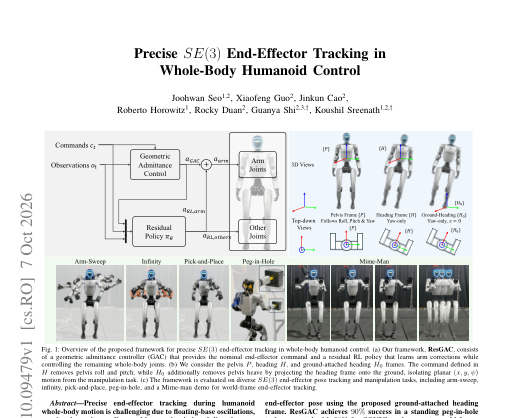
Precise SE(3) End-Effector Tracking in Whole-Body Humanoid Control

Joohwan Seo, Xiaofeng Guo, Jinkun Cao, Roberto Horowitz, Rocky Duan, Guanya Shi, Koushil Sreenath

Precise end-effector tracking during humanoid whole-body motion is challenging due to floating-base oscillations, gravity, dynamic coupling, and locomotion-induced disturbances. We…

Precise end-effector tracking during humanoid whole-body motion is challenging due to floating-base oscillations, gravity, dynamic coupling, and locomotion-induced disturbances. We propose ResGAC, a whole-body humanoid controller for precise end-effector pose tracking that combines geometric admittance control (GAC) with residual reinforcement learning. GAC provides structured $\SE$ task-space feedback and generates nominal arm joint-position targets, while residual RL compensates for unmodeled dynamics and coordinates locomotion and balance in the shared joint-position action space. The left-invariant geometric formulation allows the same GAC law to be used across manipulation reference frames. This enables the use of a ground-attached heading frame that preserves planar locomotion while removing pelvis roll, pitch, and heave from the manipulation reference, thereby reducing reference-induced end-effector motion during locomotion. ResGAC is validated on a real Unitree G1 humanoid. Across four standing end-effector tracking benchmarks, ResGAC consistently outperforms representative baselines, including SONIC, achieving lower translational and rotational errors. Real-world experiments further demonstrate reduced propagation of pelvis motion to the desired end-effector pose using the proposed ground-attached heading frame. ResGAC achieves $90%$ success in a standing peg-in-hole task compared with $50%$ for SONIC, and accurate world-frame $\SE$ end-effector pose tracking during lower-body motion. Experimental videos are included in the supplementary material and are also available on the project website: https://resgac.github.io/ResGAC-website/.

#72026-10-06追踪学者 · Koushil Sreenath

Workhorse: Learning Robust Whole-Body Humanoid Loco-Manipulation from Human Data

Songbo Hu, Qiayuan Liao, Yufeng Chi, Kevin Zakka, Yakun Sophia Shao, Pieter Abbeel, Koushil Sreenath

Humanoid robots still struggle to plan contact-rich whole-body manipulation from egocentric RGB and proprioception. Workhorse learns such manipulation from robot-free human demonst…

Humanoid robots still struggle to plan contact-rich whole-body manipulation from egocentric RGB and proprioception. Workhorse learns such manipulation from robot-free human demonstrations. A visual planner predicts five-link targets: the poses of the torso, both wrists, and both feet. A reinforcement-learning whole-body tracker follows them on the robot. Both policies train separately on the same recorded human poses, without retargeting. We augment the training data of each policy to imitate the errors that the other makes at deployment. On a real Unitree G1, Workhorse transport boxes with its hands and a kick, catches a thrown box, and topples and climbs a suitcase. During box transport, we show recoveries after a person pushes the robot or takes the box away. In a simulated copy of the demonstration room, the system completes box transport in 77% of episodes, and in 64% under 40 N.s pushes. With both policies retrained from the same demonstrations, a simulated second humanoid completes box transport in 83% of episodes without pushes.

#82026-09-30追踪学者 · Koushil Sreenath

ChronoGraph: Functional 4D Scene Graphs with Vision-Language Models for Interaction Understanding and Grounded Planning

Chenyangguang Zhang, Malgorzata Gwiazda, Guanlong Jiao, Yuanchen Ju, Federico Tombari, Koushil Sreenath, Marc Pollefeys, Sunghwan Hong

Embodied agents must determine where to act, anticipate the resulting scene changes, and interpret observed outcomes to guide subsequent actions. This requires connecting 4D intera…

Embodied agents must determine where to act, anticipate the resulting scene changes, and interpret observed outcomes to guide subsequent actions. This requires connecting 4D interaction understanding, which explains how past actions changed the scene, with spatially grounded planning, which determines how and where to act toward a goal and anticipates the resulting scene changes. We introduce ChronoGraph, a functional 4D scene graph that links actions on affordance parts to semantic and geometric state changes. By representing observed and anticipated transitions in the same form, it provides a shared basis for understanding and planning. We construct ChronoGraphBench through an automatic data engine that converts human-interaction videos and simulated robot trajectories into graph-annotated questions for training and evaluating Vision-Language Models (VLMs) on both tasks. Using these annotations, we train ChronoGraphVLM by adapting pretrained VLMs in two stages. Graph-as-Chain-of-Thought supervised fine-tuning teaches the models to reconstruct observed transitions and predict future ones as graph traces before answering. Subsequent joint 4D graph reinforcement learning directly rewards graph properties and answer correctness. Experiments across model scales show improvements over the corresponding pretrained baselines and zero-shot transfer to VLM4D. Real-world demonstrations further show that graph-based planning and affordance grounding support mobile manipulation through existing robot skills without additional fine-tuning.

#92026-09-30追踪学者 · Koushil Sreenath

Learning Continuous Neural Representation of Stochastic Hybrid Systems

Sangli Teng, Hang Liu, Koushil Sreenath

A stochastic hybrid system (SHS) is governed by a stochastic differential equation (SDE) describing the continuous dynamics and a Markov reset kernel triggered on the guard surface…

A stochastic hybrid system (SHS) is governed by a stochastic differential equation (SDE) describing the continuous dynamics and a Markov reset kernel triggered on the guard surface. Its probability evolution can be described by a hybrid Fokker-Planck (HFP) equation with a partial differential term corresponding to the SDE and an integral term arising from the reset kernel. This work shows that such an SHS can be approximated by an SDE in a higher-dimensional latent space where the sample paths are continuous. The key to this result is to encode different branches of the reset kernel using auxiliary variables, transforming the resets into deterministic ones that enable topological gluing. By the embedding theorem, the glued manifold can then be embedded into a higher-dimensional Euclidean space. We show that the probability evolution on the embedded image no longer requires explicit reset terms in the HFP equation. Building on this theorem, we design a loss that matches the evolving state distributions, enabling a single latent SDE to recover the probability evolution of the SHS without mode labeling, trajectory segmentation, or event-based simulations.

cs.LGcs.AIeess.SY
#102026-09-29追踪学者 · Koushil Sreenath

In-Distribution Imagination for Model-Based Offline Reinforcement Learning

Mintae Kim, Koushil Sreenath

Model-based offline reinforcement learning (MBORL) improves sample efficiency through model-generated trajectories. However, accumulative model error can drive imagined trajectorie…

Model-based offline reinforcement learning (MBORL) improves sample efficiency through model-generated trajectories. However, accumulative model error can drive imagined trajectories outside the offline data distribution, leading to unrealistic synthetic data and unstable policy optimization. Many existing methods primarily control rollouts using transition-level uncertainty. We propose in-distribution imagination (IDI), a rollout control framework that estimates trajectory support in a learned representation space and adaptively truncates rollouts that leave the offline trajectory manifold. Combined with trajectory-regularized RL, an extension of entropy-regularized RL, IDI consistently improves performance in limited-data settings. Experiments show that trajectory support predicts rollout failure substantially better than transition-level uncertainty, highlighting the importance of trajectory-level rollout control in MBORL.

#112026-09-22追踪学者 · Koushil Sreenath

HiRE: Hindsight Reward Editing for Policy Finetuning

Haoyi Niu, Zhengtao Han, Yufeng Ji, Zhongyu Li, Koushil Sreenath

Pre-trained robot policies always require finetuning to adapt to specific environments. Reinforcement Learning (RL) offers high performance potential because it improves action opt…

Pre-trained robot policies always require finetuning to adapt to specific environments. Reinforcement Learning (RL) offers high performance potential because it improves action optimality rather than simply mimicking data. However, such potential depends heavily on reward quality. Sparse rewards lack process feedback, human-designed rewards are costly and biased, and semantic rewards from foundation representations are often not control-centric. We propose Hindsight Reward Editing (HiRE), a training-free framework to break this reward bottleneck. HiRE bridges the broad knowledge of foundation representation models with physical control awareness, by contrasting successful and failed trajectories in hindsight. It calibrates foundation representation models by identifying "trap states" that are predicted as high-rewarding states yet eventually result in failure, and vice versa. HiRE explicitly penalizes these traps while boosting rewards for critical successful states. This approach can be flexibly compatible with any foundation representations and RL algorithms. Experiments show that HiRE consistently outperforms other reward recipes by delivering dense, control-aware feedback that prevents value function collapse and reward hacking, thereby achieving superior sample efficiency, stable policy updates, and higher performance ceilings, e.g., at least 3x performance of the base policies. Qualitative results are at https://hire-project.github.io .

同实验室的其他学者