Tech Station

学者追踪 › Berkeley › Ken Goldberg

Ken Goldberg

UC Berkeley · 最近 45 天 8 篇
#12026-11-04追踪学者 · Ken Goldberg

VABAR: A Variational Automation Benchmark for Agentic Robotics

Shuangyu Xie, Kaiyuan Chen, Uksang Yoo, Xinyue Zhu, Meadow Shen, Jaimyn Drake, Eugen Solowjow, Lionel Gulich 等

For robots to operate reliably in commercial and industrial applications, they must persistently perform specific tasks with known variations in object shape and pose. We call this…

For robots to operate reliably in commercial and industrial applications, they must persistently perform specific tasks with known variations in object shape and pose. We call this Variational Automation (VA) to differentiate these settings from fixed automation. Inspired by recent papers on Agentic Robotics, where pretrained LLM and VLM coding agents combine interpretable robot programming with the open-world adaptability of model free policies, we propose a general set of agentic robotics benchmark design criteria that includes accessibility, repeatability, diversity, relevance to agentic robotics and practical applications, physical realizability, resistance to benchmark saturation, and computational efficiency. We instantiate these principles in six manipulation task classes spanning industrial, medical, and infrastructure applications: tool sorting, tool hanging, gear meshing, syringe packing, cable insertion, and cable routing. We introduce the Variational Automation Benchmark for Agentic Robotics (VABAR), an open, easily replicable, simulation-based manipulation benchmark to systematically evaluating agentic robotics systems. Built fully on open-source tools, VABAR features detailed implementations using the Newton physics engine, standardized task variations, difficulty tiers, success metrics, and a library of 33 generalizable skills with human-authored programmatic reference solutions. We provide initial baseline evaluations using an open agentic manipulation harness, Graph-as-Policy (GaP), and Isaac Lab Arena.

#22026-10-22追踪学者 · Ken Goldberg

KiRoSe: Using Kinematic Data for Efficient Segmentation of Robot Demonstrations

Shuangyu Xie, Kaiyuan Chen, Muhammad Zubair Irshad, Richard Cheng, Sergey Zakharov, Ken Goldberg

Segmenting robot demonstration data into disjoint temporal and semantic subsegments is valuable for learning, cleaning, retrieval, and analysis. Segmentation is often performed man…

Segmenting robot demonstration data into disjoint temporal and semantic subsegments is valuable for learning, cleaning, retrieval, and analysis. Segmentation is often performed manually in a tedious and error prone process. Multimodal Large Language Models (MLLMs) have the potential for automating this process, but directly ingesting raw multi camera video streams into MLLMs can be costly and can quickly exhaust context windows. In this paper, we introduce KiRoSe (Kinematics for Robot Segmentation), a novel framework that focuses on the companion stream of robot kinematic data. Inspired by the principle of classical entropy coding, such as Huffman coding, where frequently occurring symbols are represented more compactly, we propose Sparse Motion Tokens (SMTs), a discrete kinematic vocabulary designed to compactly represent recurring, temporally localized motion patterns, which we refer to as kinematic events. SMTs are learned by encoding kinematic trajectories with temporal segment supervision and quantizing the resulting features. We use increasingly available robot demonstration subtask annotations to supervise an open language model to interpret the resulting token sequences. Evaluation against human labeled segmentation shows that KiRoSe can substantially outperform baseline segmentation methods in F1 quality and transfers zero shot to unseen robot embodiments and egocentric human motion, while preserving the language models open vocabulary knowledge. Beyond segmentation, KiRoSe tracks task progress on an unseen robot and detects when an action is being reversed.(website: https://berkeleyautomation.github.io/kirose/)

#32026-10-21追踪学者 · Ken Goldberg

Agentic World Action Models

Zhuoyang Liu, Dantong Niu, Botong Zhang, Boning Shao, Jing Wang, Ruijie Zheng, Yuvan Sharma, Runyu Lu 等

Recent world action models provide visual foresight and future prediction for robot manipulation, but lack explicit mechanisms for compositional skill reuse. Agentic robotics combi…

Recent world action models provide visual foresight and future prediction for robot manipulation, but lack explicit mechanisms for compositional skill reuse. Agentic robotics combines code-based planning and reasoning with reusable skills, but often lacks predictive grounding in physical dynamics. We introduce AW-0, an agentic world action model framework that integrates code-based planning with joint video and action prediction. We jointly model code, future video, and robot actions as three coupled generative streams within a unified mixture-of-transformers architecture. Within this architecture a code expert generates parameterized skill routines and control logic while video and action experts generate future visual states and low-level motor commands. Code serves two complementary roles: it structures multi-step prediction and control within the world model and represents skills as reusable programs for subsequent agentic execution. We further introduce an automated curation pipeline that labels robot and human video trajectories with aligned programs and consolidates recurring routines into reusable skill libraries. Evaluations on RoboTwin 2.0 and physical bimanual manipulation tasks show improved task performance over VLA and WAM baselines, alongside gains in language following, semantic reasoning and robustness, demonstrating that agentic code enables connection between planning, prediction and execution within WAMs.

#42026-10-13追踪学者 · Ken Goldberg

RoboSimStudio: An Interactive Toolkit for Human and Agent Rapid Real2Sim of Robot Manipulation Tasks

Kaiyuan Chen, Shuangyu Xie, Uksang Yoo, Xinyue Zhu, Cael Magner, Alvin Zhu, Daehwa Kim, Eric Heiden 等

It has been difficult to accurately model the physics of the interaction between a robot and the objects it manipulates, including contact mechanics, coupled contact dynamics, defo…

It has been difficult to accurately model the physics of the interaction between a robot and the objects it manipulates, including contact mechanics, coupled contact dynamics, deformations, stiffness and friction. We present RoboSimStudio (RSS), an interactive toolkit that makes choices of solver, contact model, and physical parameters explicit and editable, allowing both humans and coding agents to quickly create and iteratively refine simulations based on observed physical behavior. We implement RSS with the open Newton physics simulation system and describe experiments with human-guided real2sim using (1) visual evaluation, (2) force-feedback and (3) agentic Real2Sim2Real. Code, video and additional information can be found on the project website: https://robosimstudio.github.io

cs.ROcs.AIcs.GRcs.LG
#52026-10-06追踪学者 · Ken Goldberg

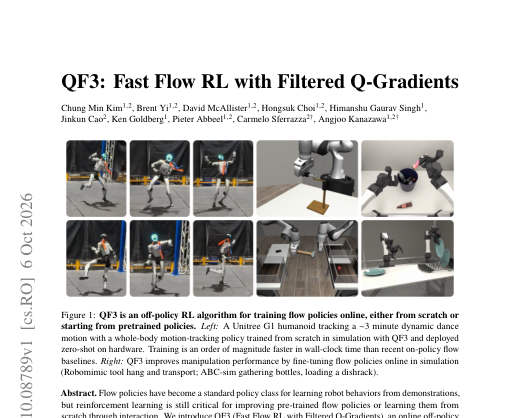
QF3: Fast Flow RL with Filtered Q-Gradients

Chung Min Kim, Brent Yi, David McAllister, Hongsuk Choi, Himanshu Gaurav Singh, Jinkun Cao, Ken Goldberg, Pieter Abbeel 等

Flow policies have become a standard policy class for learning robot behaviors from demonstrations, but reinforcement learning is still critical for improving pre-trained flow poli…

Flow policies have become a standard policy class for learning robot behaviors from demonstrations, but reinforcement learning is still critical for improving pre-trained flow policies or learning them from scratch through interaction. We introduce QF3 (Fast Flow RL with Filtered Q-Gradients), an online off-policy RL algorithm that trains a flow policy with flow matching plus the critic's action gradient, backpropagated through a one-step prediction of the flow's output. To keep updates where the critic and this prediction are reliable, QF3 applies the critic gradient only to action dimensions that stay near the replay action. To our knowledge, QF3 is the first off-policy flow RL method to train humanoid locomotion policies from scratch and transfer them zero-shot to hardware. Paired with a high-throughput off-policy training recipe, it trains humanoid locomotion and motion-tracking policies with a 10x wall-clock speedup over FPO++, a recent on-policy flow RL method. We further apply QF3 to fine-tune pretrained flow-based manipulation policies on both ABC-Sim and Robomimic tasks. These results suggest that QF3 can both learn robot policies from scratch and refine those acquired from demonstrations. Website: https://qf3-rl.github.io/

#62026-10-02追踪学者 · Ken Goldberg

EyeRobot 2.0: Active Gaze for Precise Manipulation without Wrist Cameras

Kush Hari, Justin Kerr, Nidhya Shivakumar, Samarth Mahapatra, Carmelo Sferrazza, Jiahui Lei, Jitendra Malik, C. Karen Liu 等

Inspired by human vision, we introduce a framework using active gaze to enable fine-grained bimanual manipulation with only a single stereo camera. EyeRobot 2.0 physically attends …

Inspired by human vision, we introduce a framework using active gaze to enable fine-grained bimanual manipulation with only a single stereo camera. EyeRobot 2.0 physically attends to a 3D fixation point in the scene by swiveling two eye viewpoints to center their gaze on it. The resulting images are processed foveally by allocating more visual tokens to the image centers, focusing computation on task-relevant features. Such Active Visual Fixation (AVF) requires carefully coordinated gaze during task execution, which we accomplish hierarchically by first training a low-level gaze servoing policy conditioned on a goal object, then training a target selector which emits fixation goals based on task progress. Both modules are trained with RL on real-world data: the first is trained with a dense geometric reward and the second co-trains with the BC gripper policy which allows it to discover fixation sequences that can resemble a human's fixation sequence while performing the task. EyeRobot 2.0 further takes advantage of fixation by canonicalizing gripper information into a fixation-relative SE(3) frame, which compacts the size of the action distribution to learn. We collect teleoperation data for 7 real-world and 6 simulated tasks, and conduct over 1000 physical and 1800 simulated robot trials comparing EyeRobot 2.0 against passive stereo and ego + wrist camera policies trained on the same data. Removing wrist cameras is costly for standard policies: with only passive stereo, real-world success drops from 52% to 27%. EyeRobot 2.0 closes this gap with only stereo, outperforming passive stereo by 40% in real and 20% in sim. It matches ego + wrist policies when their wrist views are clear (69% vs. 64%), and more than doubles their success when grasped objects occlude the wrist cameras (48% vs. 22%)

#72026-09-28追踪学者 · Ken Goldberg

AGRO-SUVIDE: Agentic Robotics for Surgical Viscoelastic Debridement

Shutong Jin, Ziyang Chen, Preethi Satish, Meadow Shen, Gary Guthart, Florian T. Pokorny, Ken Goldberg

Augmented dexterity has the potential to reduce the fatigue experienced by surgeons during repetitive surgical tasks. In this paper, we propose the first AGentic RObotics framework…

Augmented dexterity has the potential to reduce the fatigue experienced by surgeons during repetitive surgical tasks. In this paper, we propose the first AGentic RObotics framework for SUrgical VIscoelastic DEbridement (AGRO-SUVIDE), the repeated removal of small fragments attached to a viscoelastic substrate. Leveraging the self-improving and coding capability of agents, AGRO-SUVIDE adopts a modular framework. Specifically, the demonstration analysis module automatically identifies recurring skills from a single expert demonstration, using both visual and kinematic information. The construction module then builds each skill, either as a procedural model-based skill the agent codes against a scaffolded library or as a model-free policy-based skill. At runtime, the monitoring module composes the skills into a loop-style graph sized to the number of fragments it observes, then verifies pre- and post-conditions of each skill to decide whether to advance or retry. We evaluate AGRO-SUVIDE through 340 physical trials on the da Vinci Research Kit (dVRK). AGRO-SUVIDE achieves an average single-fragment removal success rate of 85%, completing consecutive three-fragment removal at 60% and at 95% with one human intervention. It further generalizes to unseen five-fragment scenarios with an average success rate of 80% for single-fragment removal. Project page: https://surgical-robotics.github.io/AGRO-SUVIDE/

#82026-09-24追踪学者 · Ken Goldberg

TRACE: Interactive Bi-Directional Tracing of Monochrome Cables Amid Clutter

Nidhya Shivakumar, Ethan Ransing, Josh Zhang, Shamak Gowda, Kevin Yang, Miles Hua, Anika Agrawal, Justin Yu 等

Accurate state estimation (tracing) of Deformable Linear Objects (DLOs) such as cables is a critical challenge for data centers, manufacturing, construction, homes, and surgery, wh…

Accurate state estimation (tracing) of Deformable Linear Objects (DLOs) such as cables is a critical challenge for data centers, manufacturing, construction, homes, and surgery, where precise cable management directly impacts operational safety and efficiency. However, resolving the state of multiple monochrome cables amid foreground and background clutter poses challenges due to occlusions, overlap, and ambiguous crossings. We present Two-way Routing And Cable Estimation (TRACE), which combines bi-directional cable tracing with interactive perception primitives-Divergence Push and Cluster Dilation-to actively resolve ambiguities. Evaluation with 110 physical experiments suggests that TRACE can increase the percentage of cable length correctly traced in complex scenarios (with up to 4 cables and 40 crossings) from ~60% with the strongest prior method, HANDLOOM 2.0, to ~90%, outperforming RT-DLO, Nano Banana Pro, and ChatGPT 5.2 as well. For a trial run on a workstation with an NVIDIA GeForce RTX 4090 GPU, the average computation time is 0.4 seconds per cable. Project website: https://trace-paper.github.io/.

同实验室的其他学者