Tech Station

学者追踪 › Berkeley › Pieter Abbeel

Pieter Abbeel

UC Berkeley · 最近 45 天 14 篇
#12026-11-03追踪学者 · Pieter Abbeel

Stabilizing On-Policy Targeted Guidance in Agentic Reinforcement Learning

Kevin Frans, Alexander M Rush, Sergey Levine, Pieter Abbeel, Ashvin Nair

Naive on-policy RL is often bottlenecked by the capabilities of the base model --- insufficient coverage can result in an inability to learn from certain rewards. At the same time,…

Naive on-policy RL is often bottlenecked by the capabilities of the base model --- insufficient coverage can result in an inability to learn from certain rewards. At the same time, rewards in modern post-training systems often come from rich textual sources, e.g. judge models with a rubric of criteria. Can we utilize such structures to provide a rich directional signal that enables improving on otherwise difficult to optimize rewards? In this work, we examine a framework we refer to as targeted guidance that learns from per-turn textual feedback via an on-policy self-distillation objective. Our focus is not only on directly improving hard-to-optimize behaviors, but on how to do so throughout the training process without degrading baseline RL performance. Over a range of settings across an agentic multi-turn software engineering environment, we find success by combining targeted self-distillation with a per-criteria RL reward, and by limiting feedback to turns where the policy specifically fails. We further examine the design choices that lead to stable entropy and reduce oscillatory behavior throughout training.

#22026-11-02追踪学者 · Pieter Abbeel

Energy-Based Policy Orchestration

Weirui Ye, Yen-Jen Wang, Elvis Hsieh, Zhiyang Dou, Shibo Zhao, Pieter Abbeel, Yilun Du, Leslie Pack Kaelbling 等

Hierarchical control scales robot behavior by separating task-level planning from low-level control. In dynamic, high-dimensional tasks, however, a fixed planner-to-policy interfac…

Hierarchical control scales robot behavior by separating task-level planning from low-level control. In dynamic, high-dimensional tasks, however, a fixed planner-to-policy interface can fail when contacts, balance, or disturbances evolve faster than high-level policy updates. Execution therefore requires choosing not only which low-level policy to run, but also which policy-specific goal should be given to it. We formulate this problem as policy orchestration: runtime selection of a policy-goal pair that is likely to remain feasible while tracking the planner target. We develop EPO, an energy-based policy orchestrator for modular goal-conditioned policy families. For each policy, EPO learns a composite energy over low-level goals, where lower energy corresponds to higher feasibility and more accurate target realization. At runtime, EPO refines each policy's goal and executes the lowest-energy policy-goal pair. Because energies are policy-specific, new policies can be incorporated by learning their own energy models, without retraining the existing policies or a centralized scheduler. In simulation, EPO improves the empirical precision-robustness trade-off by refining policy-specific goals before selectively switching among policies based on energy scores. We further demonstrate sim-to-real deployment of the same frozen policies and energy models on real humanoid loco-manipulation tasks. Project website: https://yewr.github.io/epo

#32026-11-01追踪学者 · Pieter Abbeel

Democratizing Robot-Use Agents: A Unified Harness with Open Models

Jiarui Yuan, Yuxin Zuo, Xiaoyu Huang, Wenbo Zhang, Kwanyoung Park, Junlin Yang, Tianxiang Zhang, Ruoqu Chen 等

Robot-use Agents (RUAs) have shown promising zero-shot manipulation capabilities, but reliance on frontier, proprietary models limits research into further training. To democratize…

Robot-use Agents (RUAs) have shown promising zero-shot manipulation capabilities, but reliance on frontier, proprietary models limits research into further training. To democratize RUA research, we introduce uni-robot-agent, a unified harness for competitive open-weight robot use that supports further training. Without privileged inputs, an out-of-the-box Qwen3.8-Flash-Next achieves a RoboDojo Score of 31.39, surpassing the published GPT-6 Astra-RoboProbe result of 28.97 and many VLA/WAM baselines, and performs competitively on 19 real-world tasks. Our analysis across model generations, families, and sizes links effective robot use to four general capabilities, suggesting that future RUA training should develop them jointly.

#42026-10-20追踪学者 · Pieter Abbeel

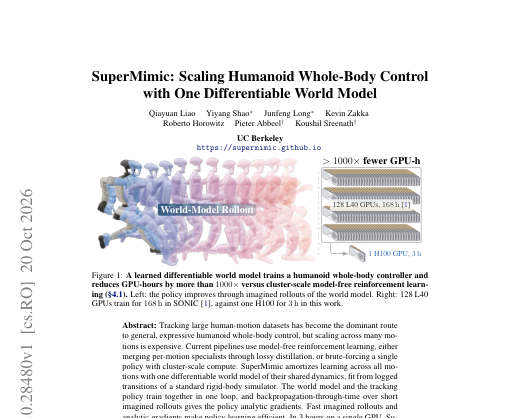
SuperMimic: Scaling Humanoid Whole-Body Control with One Differentiable World Model

Qiayuan Liao, Yiyang Shao, Junfeng Long, Kevin Zakka, Roberto Horowitz, Pieter Abbeel, Koushil Sreenath

Tracking large human-motion datasets has become the dominant route to general, expressive humanoid whole-body control, but scaling across many motions is expensive. Current pipelin…

Tracking large human-motion datasets has become the dominant route to general, expressive humanoid whole-body control, but scaling across many motions is expensive. Current pipelines use model-free reinforcement learning, either merging per-motion specialists through lossy distillation, or brute-forcing a single policy with cluster-scale compute. SuperMimic amortizes learning across all motions with one differentiable world model of their shared dynamics, fit from logged transitions of a standard rigid-body simulator. The world model and the tracking policy train together in one loop, and backpropagation-through-time over short imagined rollouts gives the policy analytic gradients. Fast imagined rollouts and analytic gradients make policy learning efficient. In 3 hours on a single GPU, SuperMimic surpasses the return of a state-of-the-art motion tracker baseline trained for 7 days on 128 GPUs. It reduces GPU-hours by more than $1000\times$ and fails on only 25 of 129,514 benchmark motions, versus 179 failures for the baseline. After 9.8 hours on two GPUs, SuperMimic achieves zero failures. From 1 to 264 hours of motion, the world model's prediction error stays stable, and GPU-hours to a target return grow slowly. Our policy transfers to a physical Unitree G1 across diverse and acrobatic motions. SuperMimic removes compute as the bottleneck to scaling humanoid whole-body control, making it practical to measure motion-tracking scaling laws.

#52026-10-19追踪学者 · Pieter Abbeel

SSIO: Self-Supervised Inertial Odometry

Yuheng Qiu, Yutian Chen, Carlton Cort, Weison Huang, Shibo Zhao, Pieter Abbeel, Rocky Duan, Koushil Sreenath 等

Learning inertial odometry for a new platform usually requires ground-truth trajectories. We show that an inertial odometry model can instead be trained from scratch by a myopic te…

Learning inertial odometry for a new platform usually requires ground-truth trajectories. We show that an inertial odometry model can instead be trained from scratch by a myopic teacher that integrates the IMU over each short window independently, a scheme we call integration self-supervision. Interestingly, although supervised only by short-window velocity changes, the student learns to directly predict velocity, and does so more accurately than its integration teacher. Pose graph distillation then refines the model with sequence-consistent targets from a pose graph over many windows. Training on a new platform therefore no longer requires collecting ground-truth trajectories, but only calibrating the IMU and recording data during normal operation. Across six datasets spanning pedestrians, drones, quadrupeds, and a humanoid, the same recipe with no velocity or position labels trains models that come within 0.07~m/s average velocity error of a same-architecture supervised baseline.

#62026-10-19追踪学者 · Pieter Abbeel

SWAP: Test-Time Steerable Humanoid Whole-Body Collision Avoidance

Zeji Yi, Guanqi He, Xiaofeng Guo, Guannan Qu, Pieter Abbeel, Yan Duan, Karen Liu, Guanya Shi

Humanoid robots operating in human-centric environments must coordinate the entire body to traverse tight, cluttered spaces while maintaining balance. Existing methods often strugg…

Humanoid robots operating in human-centric environments must coordinate the entire body to traverse tight, cluttered spaces while maintaining balance. Existing methods often struggle to jointly consider dynamic stability and collision avoidance from high-dimensional perceptual inputs. Moreover, for humanoids, safe behavior is inherently multimodal: the same obstacle may admit multiple valid traversals, which is difficult to represent with a single deterministic policy. To address these challenges, we propose SWAP (Steerable Whole-body Avoidance Policy), a hierarchical framework that separates collision-aware decision making from stabilization. A high-level, perception-conditioned diffusion policy generates multimodal, collision-aware motion proposals, while a low-level whole-body RL controller tracks these proposals and maintains dynamic balance. To efficiently train the high-level policy, we obtain scalable supervision via hindsight labeling: we roll out the low-level policy under randomized commands, place obstacles only in the space that each executed motion did not sweep, so the motion is collision-free by construction, and re-render the perception the robot would have seen. At deployment, Monte Carlo sampling with simple cost signals steers the diffusion model toward safe, task-aligned behaviors without heavy reward tuning. Experiments in simulation and on a real Unitree G1 humanoid show reliable avoidance with static and dynamic obstacles. Test-time steering further enables customization, improving targeted rewards (e.g., speed, orientation, or posture) by 34% on average while maintaining a high collision avoidance rate. Together, these results support a practical solution to humanoid whole-body collision avoidance with test-time steerability. Project website: https://iscoyizj.github.io/SWAP-steerable-humanoid-oa-website/

#72026-10-16追踪学者 · Pieter Abbeel

StopWatch: Goal Grounding for Object-goal Navigation

Xinhao Liu, Yunsheng Tian, Yuheng Qiu, Pieter Abbeel, Xi Chen, Guanya Shi, Chen Feng

Pretrained VLMs bring rich world knowledge and semantic priors to object-goal navigation, and fine-tuning a VLM into a navigation policy has become a common recipe. Despite this pr…

Pretrained VLMs bring rich world knowledge and semantic priors to object-goal navigation, and fine-tuning a VLM into a navigation policy has become a common recipe. Despite this progress, success rates remain low, and it is unclear which capability these fine-tuned policies lack. Our diagnosis identifies goal grounding as the dominant failure. These policies explore well, yet often fail to notice that the goal is already in view or to estimate how far away it is. To address this failure, we ground the goal explicitly. Explicit grounding substantially improves success and reaches state-of-the-art results on six benchmarks across three scene collections. We also correct annotation defects in these benchmarks, so that future methods are evaluated more faithfully. Our analysis on the clean benchmarks shows that, with ground-truth grounding, our policy nearly matches the expert that generated its demonstrations, leaving the headroom in perception rather than policy learning. Our work points to goal grounding as a missing piece of object-goal navigation and offers a simple and effective solution to the task.

#82026-10-15追踪学者 · Pieter Abbeel

Scaling Online Exploration for Robot Agents

Runhan Huang, Xiangcheng Zhang, Haoyu Chen, Yitong Li, Yen-Jen Wang, Bohan Lyu, Haotian Ye, Chuye Hong 等

Robot learning has advanced by scaling demonstration datasets and model capacity; however, deploying a new robot embodiment or task typically necessitates a dedicated teleoperation…

Robot learning has advanced by scaling demonstration datasets and model capacity; however, deploying a new robot embodiment or task typically necessitates a dedicated teleoperation corpus. The resulting policies remain bounded by their imitation distributions, limiting generalization and continual self-improvement. We introduce RAX (Robot Agent eXploration), an open-source framework for robot agents centered on scaling exploration: enabling agents to improve by acquiring online experience and synthesizing executable programs. In RAX, a general-purpose coding agent generates robot control code, operating without action demonstration data, hand-engineered action primitives, or value-function guidance. Through online exploration, the agent identifies decision sequences that achieve task goals and compiles them into modular programs encapsulating the full perception-planning-control loop. Using RAX, we present a systematic multi-embodiment study on scaling online exploration across precision and long-horizon manipulation tasks using single-arm, bimanual, dexterous, mobile, and humanoid systems in simulation and on real robots. Generalization performance on unseen environments improves consistently as exploration scales. In simulation, RAX outperforms top baseline models by +37.4% on average. On real robots, RAX autonomously learns memory-dependent, articulated, high-precision, deformable, and long-horizon mobile manipulation tasks without human demonstrations, continually improving performance by composing verified skills from prior exploration sessions. As exploration scales, we observe emergent capabilities including active perception, error recovery, safety guardrails, and human-robot collaboration. We open-source RAX as a generalist robot-agent platform in which new robot embodiments are integrated through their APIs alone, without teleoperated data collection or policy training.

#92026-10-06追踪学者 · Pieter Abbeel

Workhorse: Learning Robust Whole-Body Humanoid Loco-Manipulation from Human Data

Songbo Hu, Qiayuan Liao, Yufeng Chi, Kevin Zakka, Yakun Sophia Shao, Pieter Abbeel, Koushil Sreenath

Humanoid robots still struggle to plan contact-rich whole-body manipulation from egocentric RGB and proprioception. Workhorse learns such manipulation from robot-free human demonst…

Humanoid robots still struggle to plan contact-rich whole-body manipulation from egocentric RGB and proprioception. Workhorse learns such manipulation from robot-free human demonstrations. A visual planner predicts five-link targets: the poses of the torso, both wrists, and both feet. A reinforcement-learning whole-body tracker follows them on the robot. Both policies train separately on the same recorded human poses, without retargeting. We augment the training data of each policy to imitate the errors that the other makes at deployment. On a real Unitree G1, Workhorse transport boxes with its hands and a kick, catches a thrown box, and topples and climbs a suitcase. During box transport, we show recoveries after a person pushes the robot or takes the box away. In a simulated copy of the demonstration room, the system completes box transport in 77% of episodes, and in 64% under 40 N.s pushes. With both policies retrained from the same demonstrations, a simulated second humanoid completes box transport in 83% of episodes without pushes.

#102026-10-06追踪学者 · Pieter Abbeel

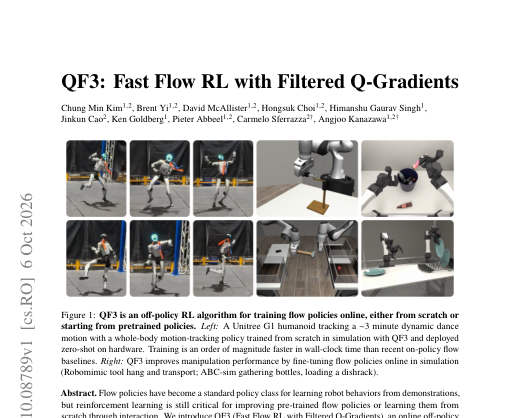
QF3: Fast Flow RL with Filtered Q-Gradients

Chung Min Kim, Brent Yi, David McAllister, Hongsuk Choi, Himanshu Gaurav Singh, Jinkun Cao, Ken Goldberg, Pieter Abbeel 等

Flow policies have become a standard policy class for learning robot behaviors from demonstrations, but reinforcement learning is still critical for improving pre-trained flow poli…

Flow policies have become a standard policy class for learning robot behaviors from demonstrations, but reinforcement learning is still critical for improving pre-trained flow policies or learning them from scratch through interaction. We introduce QF3 (Fast Flow RL with Filtered Q-Gradients), an online off-policy RL algorithm that trains a flow policy with flow matching plus the critic's action gradient, backpropagated through a one-step prediction of the flow's output. To keep updates where the critic and this prediction are reliable, QF3 applies the critic gradient only to action dimensions that stay near the replay action. To our knowledge, QF3 is the first off-policy flow RL method to train humanoid locomotion policies from scratch and transfer them zero-shot to hardware. Paired with a high-throughput off-policy training recipe, it trains humanoid locomotion and motion-tracking policies with a 10x wall-clock speedup over FPO++, a recent on-policy flow RL method. We further apply QF3 to fine-tune pretrained flow-based manipulation policies on both ABC-Sim and Robomimic tasks. These results suggest that QF3 can both learn robot policies from scratch and refine those acquired from demonstrations. Website: https://qf3-rl.github.io/

#112026-10-02追踪学者 · Pieter Abbeel

GOTT: Object-centric Dexterous Manipulation with a Reusable Cross-Embodiment Primitive

Yulin Liu, Lai Wei, Yen-Jen Wang, Akash Sharma, Pieter Abbeel, Henrik I. Christensen, Haozhi Qi

Foundation models and large-scale human data provide rich sources of manipulation intent, but translating this intent into multi-fingered robot behavior remains difficult. Dexterou…

Foundation models and large-scale human data provide rich sources of manipulation intent, but translating this intent into multi-fingered robot behavior remains difficult. Dexterous hands still lack a reusable low-level primitive that reliably establishes contact across tasks and embodiments. We propose GOTT, a reach-acquire-move framework built around a single cross-embodiment contact-acquisition primitive. Given a robot-agnostic object trajectory and a reach specification, GOTT first brings the hand near a task-relevant contact region. The shared closed-loop primitive then establishes stable contact from this approximate initialization, and a pose-conditioned controller tracks the desired object motion. Reach specifications may come from future-aware planning, external models, or human demonstrations, while the primitive and tracking backend remain unchanged. Simulation and real-world experiments show that GOTT is able to establish robust contact across diverse objects, arm-hand platforms, and seen and unseen hand morphologies. It also consistently improves end-to-end task success over open-loop grasp execution.

cs.ROcs.AIcs.CV
#122026-10-01追踪学者 · Pieter Abbeel

Reconstruct, Practice, Go Real: Guided Self-Improvement for Embodied Agents

Yen-Jen Wang, Haozhe Jiang, Shuying Deng, Haoru Xue, Weirui Ye, Rocky Duan, Nika Haghtalab, S. Shankar Sastry 等

Building reliable robot capabilities across diverse tasks requires substantial human effort to develop and maintain skills, design rewards, and integrate perception with control. W…

Building reliable robot capabilities across diverse tasks requires substantial human effort to develop and maintain skills, design rewards, and integrate perception with control. We present Reconstruct, Practice, Go Real (RPG), a framework for autonomous improvement of robot execution systems without updating model weights. RPG identifies manipulation capabilities in an offline dataset and constructs related practice tasks in simulation. During practice, RPG uses execution feedback, privileged simulator state, and available dataset videos to diagnose failures. It develops new reusable symbolic skills, refines existing skills, and revises the system prompt based on these diagnoses. Cross-task evaluation tests individual candidate changes and merged revisions before they are retained for reuse. At test time, a multimodal LLM uses the resulting system prompt and skill library to coordinate perception and robot control. On held-out initializations of 22 manipulation tasks, RPG improves task success from 28.6% after the first practice round to 95.0% after 15 rounds, outperforming all evaluated baselines, including ASPIRE (75.5%) and CaP-Agent0 powered by GPT-6 Astra Pro (60.0%). After a common calibration and hardware-adaptation procedure, the frozen system succeeds in all 30 physical trials, with ten trials on each of three tasks. Project Website: https://rpg-robot.github.io/

cs.ROcs.AIeess.SY
#132026-09-30追踪学者 · Pieter Abbeel

Tactile Curiosity Drives Robot Interaction

Klemens Iten, Alexander Proshkin, Bhavya Sukhija, Stelian Coros, Andreas Krause, Pieter Abbeel, Carmelo Sferrazza

Mastering robot manipulation skills via reinforcement learning (RL) remains largely sample-inefficient. The most common RL algorithms rely on random action sampling to discover new…

Mastering robot manipulation skills via reinforcement learning (RL) remains largely sample-inefficient. The most common RL algorithms rely on random action sampling to discover new strategies, resulting in agents that allocate most of their training budget to motions in free space, away from the contacts from which manipulation skills emerge. Existing intrinsic motivation methods based on model disagreement or epistemic uncertainty improve on isotropic noise, but they can also reward uncertainty in functionally irrelevant transitions, such as erratic motions in free space. In this work, we argue that tactile feedback provides a natural signal for exploration, and introduce TacEx, a framework that incorporates touch into epistemic uncertainty-driven exploration by decomposing model uncertainty across sensory modalities and directing curiosity toward the tactile channel. By anchoring curiosity to the sense of touch, TacEx drives the robot to discover complex contact dynamics, learning to manipulate and grasp objects without task rewards or expert demonstrations during exploration. The interaction-dense dataset collected through this tactile-driven curiosity supports offline learning of downstream pick-and-place policies without additional environment interaction. We further use tactile-driven exploration to post-train vision-language-action (VLA) models. Although the VLAs are initially pre-trained without tactile feedback, post-training with TacEx substantially improves downstream performance while remaining highly sample-efficient.

#142026-09-29追踪学者 · Pieter Abbeel

Counterfactual Video Generation Enables Scalable Humanoid Loco-Manipulation

Zihan Wang, Zhen Wu, Pieter Abbeel, Rocky Duan, Jitendra Malik, Carmelo Sferrazza, C. Karen Liu, Guanya Shi 等

Teaching humanoids loco-manipulation skills, such as carrying diverse objects, via visual imitation is a promising path toward generalist robots. However, collecting diverse, high-…

Teaching humanoids loco-manipulation skills, such as carrying diverse objects, via visual imitation is a promising path toward generalist robots. However, collecting diverse, high-quality interaction videos, such as clips that clearly show a person's full body and unoccluded interactions with objects, poses a practical barrier to scaling this approach. We propose PRISM, a real-to-sim-to-real framework that overcomes this limitation by amplifying a handful of real videos into a large, diverse training set. PRISM first generates hundreds of diverse "counterfactual" human-object interaction videos via video-to-video (V2V) generation from a few exemplar real videos. Our contact-anchored real-to-sim pipeline then reconstructs both human and object motions, retargeting this imperfect video data into physically plausible trajectories. The intra-class variability across these counterfactual videos lets us train a single policy that generalizes to unseen objects within each category. We demonstrate the full pipeline by deploying this policy on a real robot without any real-world fine-tuning. Using only onboard depth observations, our humanoid picks up, carries, and drops objects, including boxes, barrels, bins, and balls, across novel instances, sizes, and initial configurations.

cs.ROcs.CVcs.GR

同实验室的其他学者