Tech Station

学者追踪 › Stanford

Stanford

8 位学者 · 最近 45 天 72 篇

Jiajun Wu 30 篇 专属页 →

2026-11-01追踪学者 · Jiajun Wu

Advances in Agentic Computer Graphics

Hengyu Liu, Jihyeon Je, Ruiqi Wang, Mingxuan Wu, Haven Feng, Qixing Huang, Georgios Pavlakos, Hao Zhang 等

Computer graphics is built on code. Large language model (LLM) agents can now generate graphics code and iteratively refine it through various feedback. This capability opens the d…

Computer graphics is built on code. Large language model (LLM) agents can now generate graphics code and iteratively refine it through various feedback. This capability opens the door to a potentially new paradigm of computer graphics, with graphics algorithms increasingly built around agentic systems to automate progressively complex tasks. Over the past years, research on agentic graphics has expanded rapidly across a diverse range of tasks. This rapid growth makes it increasingly difficult for manual literature reviews to keep pace with new developments. At the same time, similar ideas are often described using different terminology across these tasks, further complicating efforts to develop a systematic understanding of the field. In this report, we address these challenges through two contributions. First, we introduce a unified taxonomy for characterizing agentic systems across diverse computer graphics tasks. Second, we develop an agentic literature system that can assist human researchers in analyzing existing and newly published papers at scale. Building on these contributions, we analyze emerging research trends and discuss open challenges in coordinating agents and tools across graphics tasks, designing interfaces and representations for human-agent collaboration, sustaining long-horizon planning and refinement, and reliably evaluating interactive graphics systems.

2026-10-29追踪学者 · Jiajun Wu

DyCraft: An Agentic System for Long-Horizon 4D Scene Generation

Jeff Tan, Hang Dai, Zeqian Long, Yanzhe Lyu, R. Kenny Jones, Shangzhe Wu, Chen Geng, Jiajun Wu

While frontier coding agents can generate high-quality 3D scenes and articulated assets, they struggle to create coherent long-horizon animations. When equipped with general-purpos…

While frontier coding agents can generate high-quality 3D scenes and articulated assets, they struggle to create coherent long-horizon animations. When equipped with general-purpose harnesses, they frequently produce physically implausible outputs, generating objects that interpenetrate, lack physical support, or move unnaturally. Such bare agents struggle to repair these errors because they default to scripting the full animation in one pass, making it difficult to verify their work and disentangle complex spatiotemporal constraints. Drawing on the practice of human animators, we introduce DyCraft, a system for animated 3D scene generation that breaks animation into steps that coding agents can more reliably solve. DyCraft first expands the user's prompt into a detailed plan and builds a static scene. It then creates a 3D storyboard of key animation poses, where each frame is a static 3D scene that the agent can build and debug in isolation. Storyboarding decomposes the problem into pairs of verified start and end states, allowing the agent to author local motion between them with a collection of motion authoring tools. We evaluate DyCraft on 24 long-horizon, multi-shot animation tasks covering humanoid robots, human and animal characters, and physical mechanisms. Compared with a native GPT-6 agent in Codex and prior agentic baselines, DyCraft substantially reduces physical violations and generates higher-quality animated 3D scenes that are more often preferred by human raters.

2026-10-25追踪学者 · Jiajun Wu

BEHAVIOR-Spatial Benchmark: Evaluating Spatial Understanding for Robotics

Sirui Chen, Huang Huang, Qineng Wang, Wenlong Huang, Manling Li, Ruohan Zhang, Li Fei-Fei, Jiajun Wu

Robot tasks require grounding spatial language in physical scenes, but task success alone cannot establish whether spatial instructions are followed. We present BEHAVIOR-Spatial, a…

Robot tasks require grounding spatial language in physical scenes, but task success alone cannot establish whether spatial instructions are followed. We present BEHAVIOR-Spatial, a benchmark built on BEHAVIOR-1K that measures spatial question answering, point-based target grounding, and robot action to examine how VLM spatial understanding relates to VLA behavior. It comprises 3,256 spatial questions across 49 activities, 1,240 grounding queries across 14 manipulation tasks, and action evaluations covering those 14 tasks and 10 navigation tasks. Our manipulation protocol evaluates held-out configurations and instruction following when the requested target changes within a fixed training layout. The baseline achieves 41.6% on held-out configurations but only 16.1% under changed instructions. VLM adaptation and robot-data pretraining provide limited improvements, whereas oracle visual target cues raise these rates to 60.3% and 38.0%, respectively. Perception evaluations reveal policy-dependent correlations between VLM question-answering and grounding accuracy and VLA manipulation performance. Together, these findings motivate evaluating spatial instruction following alongside task completion and examining when spatial perception performance translates into robot behavior. Project website: https://arielchen07.github.io/behavior-spatial/.

2026-10-23追踪学者 · Jiajun Wu

UniAction: Unified Action Conditioning for World Models

Bowen Xue, Zizhang Li, Hong-Xing Yu, Jiajun Wu

Actions that condition world models are highly heterogeneous, and thus existing action-conditioned world models are typically built for individual action types, fragmenting already…

Actions that condition world models are highly heterogeneous, and thus existing action-conditioned world models are typically built for individual action types, fragmenting already limited action-annotated data across separate models. We introduce UniAction, a unified action-conditioning framework that represents any action as a sparse set of action elements, each with a discrete semantic identity and a continuous spatiotemporal grounding coordinate. By mapping these coordinates directly into the pretrained video model's native positional space, UniAction allows heterogeneous actions to condition a shared world model within the same spatiotemporal structure. We further introduce cardinality-calibrated attention to address the bias from differing action representation granularities. We evaluate UniAction on four representative action forms: force, camera control, hand pose, and robot pose. UniAction outperforms conditioning alternatives in action following, and a single jointly trained model surpasses the action-specific experts, showing that heterogeneous action data benefit from unified model and joint training.

2026-10-22追踪学者 · Jiajun Wu

ProductWebBench: Evaluating Website Continuity Beyond Task Completion

Jiajun Wu, Jian Yang, Yaxin Du, Shukai Liu, Linzheng Chai, Tuney Zheng, Wei Zhang, Haitao Yang 等

Frontend coding agents are usually graded on one question: did the requested target get built. Real engineering changes carry a second obligation, because the rest of the site has …

Frontend coding agents are usually graded on one question: did the requested target get built. Real engineering changes carry a second obligation, because the rest of the site has to keep working. We call that second obligation website continuity, and introduce ProductWebBench, a benchmark that scores both on living frontend repositories: 320 Change tasks over existing code and 80 long-horizon Build tasks. Every task freezes a repository snapshot, staged requirements, browser evidence and deterministic checks before evaluation, and enters only once a reference passes every check and plausible-wrong ones fail. A simulated user reveals the requirements one stage at a time, and every check cleared earlier stays armed for the rest of the run. Across 8,737 runs from 13 models the two come apart: of the Change runs passing every requested-work check, 28.2% still fail a continuity check -- a blank route, horizontal overflow, console errors -- and 10.8% push a browser state they had already passed back to failing. Because the same checks also run on the untouched repository, each regression carries exact provenance, not a post-hoc label: on the 586 runs where both readings exist, 18.3% are caught breaking a verified state. Interaction is a further blind spot, failing in 29.5% of runs whose static DOM already passes. ProductWebBench therefore scores a patch against the living system it lands in, not the target alone.

cs.SEcs.AI
2026-10-22追踪学者 · Jiajun Wu

IQuest-Q1: Advancing Foundation Capabilities for Agentic CLI Systems

A. Jian Yang, An Huang, Bo Dan, Chen Mu, Chengran Yang, Chuan Shi, Feng Chang, Hongxin Li 等

We present IQuest-Q1, a sparse Mixture-of-Experts (MoE) agentic foundation model with 320B total parameters (15B activated). IQuest-Q1 is developed through a three-stage process: (…

We present IQuest-Q1, a sparse Mixture-of-Experts (MoE) agentic foundation model with 320B total parameters (15B activated). IQuest-Q1 is developed through a three-stage process: (1) stable and efficient pre-training, combining Stable SplitNorm, Muon, and muP with a two-stage curriculum whose second stage increases the coding-data mixture, preserving a wide stability margin between safe and optimal learning rates; (2) fine-grained mid-training, expanding the data mixture across domains and formats and progressively extending the context; and (3) multi-scaffold with multi-version post-training, combining SFT, domain-specialized RL, and MOPD across various scaffolds to integrate complementary training signals and strengthen agentic coding capabilities. Furthermore, model merging combines different experts and checkpoints from different stages while mitigating conflicts among their parameter updates. The resulting IQuest-Q1 demonstrates capabilities in both coding and general tasks. We release IQuest-Q1 as an open-source model to support community research and development.

2026-10-19追踪学者 · Jiajun Wu

Text-to-Image Generative Modeling Without Language Pretraining

Keshigeyan Chandrasegaran, Yue Zhao, Armin W. Thomas, Ehsan Adeli, Jiajun Wu, Juan Carlos Niebles, Li Fei-Fei, Michael Poli

Modern text-to-image (T2I) systems use internet-scale language pretraining for text-conditioned image generation. We ask whether language pretraining is necessary for strong T2I ge…

Modern text-to-image (T2I) systems use internet-scale language pretraining for text-conditioned image generation. We ask whether language pretraining is necessary for strong T2I generation. We introduce Halcyon, a family of early-fusion multimodal autoregressive models pretrained entirely from scratch on GPIC, a dataset of 100M image-text pairs. Halcyon-0.52B outperforms LlamaGen-XL/8 (48.0 vs. 63.3 gFD) with 18.2$\times$ less pretraining compute. Further, Halcyon-1.6B outperforms JiT-T2I-XXL/8++ (35.3 vs. 41.0 gFD) with 275$\times$ less pretraining compute. Controlled experiments show that text-only pretraining does not improve T2I generation. Halcyon also learns image captioning by replacing caption dropout with I2T supervision, maintaining competitive T2I generation quality under the same pretraining budget. We show that strong T2I systems can be trained from scratch without internet-scale language pretraining. Code and models are available at https://cs.stanford.edu/~keshik/halcyon

2026-10-19追踪学者 · Jiajun Wu

FluidGen: Physics-Aware Fluid Video Generation via Motion-Guided Post-Training

Yang Zheng, Zizhang Li, Boyang Deng, Jan Ackermann, Lei Shu, Yinghao Xu, Jiajun Wu, Gordon Wetzstein 等

Video generation models produce visually compelling motion but systematically fail on fluid phenomena, including smoke, fire, and explosion debris, where outputs lack coherent vort…

Video generation models produce visually compelling motion but systematically fail on fluid phenomena, including smoke, fire, and explosion debris, where outputs lack coherent vortical structure and collapse to bland dynamics that violate the physics of real fluids. Classical solvers achieve high physical fidelity but require detailed 3D scenes and carefully tuned parameters, making them impractical for in-the-wild imagery and video generation. We address this gap by injecting a data-driven fluid prior into a pre-trained video model, trained on a mixture of high-fidelity Houdini simulation data with paired velocity-field ground truth and curated in-the-wild fluid video data for appearance diversity. The core of our approach is a dual stream architecture that predicts per-frame velocity fields alongside RGB, supervised by simulation ground truth. This auxiliary signal regularizes generation toward physically consistent motion and exposes an interpretable physical quantity that we further leverage as a reward for velocity-aware direct preference optimization. Our model produces substantially more realistic fluid dynamics sequences than strong video baselines and optimization-based methods. Project page: https://y-zheng18.github.io/FluidGen/

2026-10-18追踪学者 · Jiajun Wu

Dream What I Can: Sparse Visual Planning for Long-Horizon Robot Manipulation

Chongkai Gao, Wenlong Huang, Haonan Chen, Lin Shao, Yilun Du, Jiajun Wu, Ruohan Zhang, Li Fei-Fei

Video models provide rich priors for generalizable robotic manipulation, but plausible visual futures are not always executable. We introduce DreamCan, a hierarchical policy that g…

Video models provide rich priors for generalizable robotic manipulation, but plausible visual futures are not always executable. We introduce DreamCan, a hierarchical policy that grounds video models through sparse visual planning: a high-level planner adapted from a pre-trained video model and a low-level visuomotor policy. Rather than predicting dense trajectories, the high-level planner generates sparse visual subgoals that balance reachability and task utility. From offline, action-free robot videos, we estimate these quantities and use dynamic programming to select subgoal sequences without manual annotations. The resulting subgoals are more reliably attained than uniformly spaced alternatives, and the full system outperforms language, dense-video, and uniform-subgoal planners, reaching high planning success rates on Language-Table tasks and 91.2% success on LIBERO-Long with a 0.1B-parameter low-level policy. Additional suboptimal videos and test-time compute further improve success. The system also performs challenging real-world bimanual tasks, including box folding and packing with unseen object combinations. More results are available at https://dreamcan.github.io/.

2026-10-16追踪学者 · Jiajun Wu

A Language-Informed Loss for Visual Generation

Suchir Agarwal, Keshigeyan Chandrasegaran, Ziyu Chen, Kyle Sargent, Juan Carlos Niebles, Li Fei-Fei, Jiajun Wu

End-to-end visual generation with pixel-space loss has recently achieved competitive performance without the need for learned image tokenizers. In this work, we study whether langu…

End-to-end visual generation with pixel-space loss has recently achieved competitive performance without the need for learned image tokenizers. In this work, we study whether language-informed supervision can provide a richer training signal than pixel loss for visual generation. We introduce LILIE (pronounced "lily"), a Language-Informed and Lossless Image Encoder. LILIE is an invertible image transform trained such that a vision-language model can recover captions from noised features. The encoder uses a normalizing flow transformer trained jointly with a vision-language model via next token prediction. We then use the encoder to extract a simple language-informed loss for text-to-image generation. We train JiT models with LILIE loss, reducing gFD by 14 points (66.84 $\to$ 53.01) against a pixel-only baseline on the GPIC dataset. Our code, encoders, and generative models are available at https://suchiragarwal.com/lilie.

2026-10-15追踪学者 · Jiajun Wu

T2-z: Test-Time Optimization of Environment Latents for Robotic World Models

Chenyuan Zhou, Yining Hong, Huang Huang, Yunfan Jiang, Wenlong Huang, David Held, Vitor Campagnolo Guizilini, Yue Wang 等

Predicting how the world responds to an action requires more than what can be seen: robots must account for environmental factors that are neither directly observable nor explicitl…

Predicting how the world responds to an action requires more than what can be seen: robots must account for environmental factors that are neither directly observable nor explicitly specified, from physical properties such as friction and mass to human-defined environmental rules. We introduce T2-Z for test-time optimization of environment latents, which augments a robotic world model with a learnable environment latent to condition world predictions. This compact latent captures underlying environmental variation without supervision of what environmental factors exist or what values they take. During training, T2-Z alternates between two stages: a world-model optimization stage that fixes the latents and learns general action-conditioned dynamics across environments; and an environment-latent optimization stage that freezes the world model and optimizes the conditioning latents, allowing latent structure to emerge purely through world prediction. At test time, the world model remains frozen and a newly initialized environment latent is optimized from one or more test-time interactions, adapting the model to previously unseen environmental configurations. Across 7 simulated settings and 4 real-world robotic tasks, T2-Z reduces object prediction error metric from 15.20 to 7.00 and raises action success from 33.73% to 72.96%. Its emergent latents capture structured representations of individual and compounded factors across diverse visual scenes. Ablations further show that T2-Z can efficiently infer environment latents from as little as a single test-time interaction trajectory.

cs.ROcs.AIcs.CV
2026-10-13追踪学者 · Jiajun Wu

FACT: A Multimodal Force-Action-Track Foundation Model for Human-to-Robot Dexterity

Zhi Cao, Yining Hong, Jiaolong Yang, Yejin Choi, Li Fei-Fei, Jiajun Wu, Huang Huang

Human demonstrations offer a scalable alternative to costly robot data collection for dexterous manipulation, but most human datasets lack force measurements. Dexterous manipulatio…

Human demonstrations offer a scalable alternative to costly robot data collection for dexterous manipulation, but most human datasets lack force measurements. Dexterous manipulation requires not only visual and proprioceptive understanding but also the ability to anticipate and regulate interaction forces. To scale force-aware human-robot co-training, we introduce EgoForce, a large-scale human tactile dataset capturing force-rich manipulation experience, and combine it with robot demonstrations for pretraining. We present FACT, a robot foundation model that cascades from prospective visual planning to force-aware refinement for dexterous manipulation. FACT comprises two jointly trained components. A Track-Guided Coarse Planner jointly predicts actions, future video, and visual tracks. Future video and visual tracks also provide a shared task representation that facilitates cross-embodiment knowledge transfer and coarse action generation. Building on this coarse plan, a Force-Action Joint Refiner jointly predicts future force and refines the coarse action, allowing anticipated force and action to shape each other during refinement. We evaluate the model on ten tasks requiring fine-grained coordination and force feedback, including tool use, musical instruments, and precision laboratory procedures. Using as few as 10 robot trajectories with 90 human trajectories for fine-tuning, FACT outperforms both baselines, with success-rate gains of up to 60 percentage points over T-Rex. Ablations show that force supervision in human pretraining data is crucial for downstream robot performance after fine-tuning, while visual track prediction and training with future-force prediction improve dexterous execution. Experiments varying the human-robot data ratio during fine-tuning further suggest that FACT learns from human demonstrations nearly as effectively as from robot demonstrations.

2026-10-13追踪学者 · Jiajun Wu

I3L: Iterative Interactive Imitation Learning for Whole-Body Mobile Manipulation

Wensi Ai, Christopher Luey, Karthik Dharmarajan, Evans Han, Yunfan Jiang, Stef Ren, Jianwen Xie, Jiajun Wu 等

Policies trained offline from teleoperated demonstrations can degrade outside their training distribution. This gap is particularly acute in long-horizon whole-body mobile manipula…

Policies trained offline from teleoperated demonstrations can degrade outside their training distribution. This gap is particularly acute in long-horizon whole-body mobile manipulation, where long horizons amplify compounding errors and coordinated arm, torso, and base motion makes exhaustive demonstration coverage impractical. We introduce I3L, an integrated hardware and learning system that combines whole-body correction with iterative policy refinement to address this last-mile reliability gap. Its low-cost, open-source JoyLo+ interface uses policy-tracking leader arms and touch-triggered takeover to enable coordinated corrections across the body parts, while iterative deployment and retraining allow operators to target failures of the updated policy. We evaluate I3L across three robot embodiments and eight simulated and real-world tasks, including four long-horizon whole-body mobile manipulation tasks. Controlled simulation experiments show that four-round HG-DAgger achieves the highest final success on both tasks. Under this protocol, I3L improves autonomous success over the base policies by an average of 68.3 percentage points and achieves at least 90% success on every task, outperforming demonstration-only training by 35.6 percentage points on average with the same number of training trajectories. Averaged across tasks, takeover duration per episode decreases by 72% over four rounds. Together, these results show that I3L helps close the last-mile gap between offline training and reliable deployment and provides practical insights into collecting and using corrections for long-horizon whole-body mobile manipulation. Videos, visualizations, and appendix are at https://i-3l.github.io/.

2026-10-13追踪学者 · Jiajun Wu

The Human--VLA Communication Gap: What Humans Leave Implicit and What Policies Cannot Recover

Yiqing Xu, Jiajun Wu

A robot may know how to perform a task yet fail when a human asks for it naturally. We study this human--VLA communication gap by separating an information gap, where task semantic…

A robot may know how to perform a task yet fail when a human asks for it naturally. We study this human--VLA communication gap by separating an information gap, where task semantics, grounding, or event structure remain unresolved, from a residual execution gap, where even a fully specified task depends on how it is organized and invoked. To do this, we characterize how people naturally express demonstrated objectives and evaluate controlled variants of the same physical tasks, with detailed analysis on $π_{0.5}$ and consistent trends on $π_0$-FAST and Cosmos3-Edge. Our study reveals that humans increasingly compress instructions as tasks grow, relying more on contextual grounding and implicit execution structure. Current policies are misaligned with this behavior: they tolerate grounding dependence relatively well, but struggle when task semantics or event structure must be reconstructed. Even after the information gap is resolved, execution remains sensitive to command granularity and invocation state. These findings identify concrete targets for human-centered policy learning and interfaces that better bridge natural human objectives to robot behavior. Project website: https://commgap.github.io/.

2026-10-11追踪学者 · Jiajun Wu

Inverse Garment Design with Visual Agents

Nanxiang Jiang, Yunuo Chen, Zeng Tao, Zizhang Li, Qi Guo, Jiajun Wu, Yin Yang, Chenfanfu Jiang

We study the problem of inverse garment design, reconstructing simulation-ready 3D outfits with arbitrary layers from a single image, with visual agents. Unlike differentiable opti…

We study the problem of inverse garment design, reconstructing simulation-ready 3D outfits with arbitrary layers from a single image, with visual agents. Unlike differentiable optimization that is time-consuming, or feed-forward methods limited by training data, we introduce DressAgent, a hierarchical agentic system that recovers garment sewing patterns through planning and closed-loop refinement grounded in physical simulation. To this end, we first present an enhanced representation based on GarmentCode for diverse styles and arbitrary dressing layers, and build the first multi-layer sewing pattern dataset with over 15K outfits for supervision and benchmarking. Inverse design then proceeds coarse to fine: In layer planning and coarse estimation, agents infer layer order and relations, peel each layer into its own view, and estimate coarse patterns. In fine-grained refinement, an agentic trio of Tailor, Critic, and Orchestrator refines patterns in a closed loop of editing, simulating, and judging against the reference with visual and measured evidence. Carefully designed tools and an evolving memory make this refinement converge on the target geometry. We also design an agentic generation method for high-fidelity textures. DressAgent outperforms feed-forward methods by a large margin, surpasses or matches differentiable optimization in a fraction of the time, and generalizes to complex layering, diverse poses, and body shapes.

2026-10-11追踪学者 · Jiajun Wu

Co-DSL: Human-LLM Co-design of Reusable Spatial Concepts for Layout Generation

R. Kenny Jones, Jiajun Wu, Maneesh Agrawala

We present Co-DSL, a framework in which users and LLMs co-design reusable spatial concepts for layout generation. In the first stage, our system allows users to create a library of…

We present Co-DSL, a framework in which users and LLMs co-design reusable spatial concepts for layout generation. In the first stage, our system allows users to create a library of personalized operations. To add a concept, a user provides a description, which the LLM converts into an initial implementation. The user can then observe the concept's execution behavior over example scenarios and provide lightweight feedback to the LLM, which revises the concept's implementation logic. In the second stage, given a library, an LLM can author a layout program that meets a new layout request from a user. Executing a layout program instantiates a concept-graph, a declarative composition of library concepts. In this way, we require the LLM only to specify which concepts should hold, while we use a solver to search for a layout that satisfies them. Across five spatial layout domains, we find that Co-DSL libraries let LLMs capture layout patterns that are challenging for prior fixed-operation systems, and demonstrate that our concept-graph representation is needed for LLMs to reliably compose concepts together. We further find that Co-DSL lets LLMs author generative layout programs that expose high-level parametric controls users can manipulate to explore a distribution of related layouts without re-prompting.

cs.GRcs.AIcs.CV
2026-10-08追踪学者 · Jiajun Wu

BrickBench: Evaluating Agentic Brick Design

Peter Kulits, Yiqing Xu, R. Kenny Jones, Cordelia Schmid, Jiajun Wu

We propose BrickBench, a benchmark for agentic text-conditioned LEGO-set design. Given a prompt, an agent is tasked with producing an assembly that not only satisfies semantic and …

We propose BrickBench, a benchmark for agentic text-conditioned LEGO-set design. Given a prompt, an agent is tasked with producing an assembly that not only satisfies semantic and design criteria, but that can also be physically built. To do so, it must select parts from a discrete library and reason jointly about local and global constraints. We score validity, alignment, and design across three settings that vary in scale and part availability. We provide BrickAgent, an environment for coding agents to construct, inspect, and validate their designs. We find that leading agents largely satisfy verifiable physical and semantic requirements, but fall short of human designs. We release our benchmark and environment at http://www.brickben.ch

cs.AIcs.CVcs.GR
2026-10-07追踪学者 · Jiajun Wu

Cross-Embodiment Robot Foundation World Models with Latent Actions

Huang Huang, Sriram Yenamandra, Arjun Majumdar, Elie Aljalbout, Tushar Nagarajan, Tsung-Yen Yang, Akshara Rai, Michael Rabbat 等

The diversity of robot embodiments and action spaces makes it challenging to build robot world models that generalize across different embodiments. We introduce the Latent Action-C…

The diversity of robot embodiments and action spaces makes it challenging to build robot world models that generalize across different embodiments. We introduce the Latent Action-Conditioned Robot World Model (LAC-WM), which operates within a learned unified latent action space shared across diverse embodiments. This unified action space improves the world model's performance when adapted to previously unseen robot embodiments. We compare LAC-WM with an Explicit Action-Conditioned World Model (EAC-WM), which conditions on explicit motion labels. Our results show that explicit action conditioning leads to disjoint action representations across embodiments, limiting downstream performance when adapting to new robots. We evaluate both models on dexterous manipulation tasks and a modified LIBERO benchmark. LAC-WM improves downstream performance over EAC-WM by up to 46.7% on dexterous manipulation and 11.7% on LIBERO. Crucially, the unified latent action space allows LAC-WM's downstream performance to scale positively with the number of embodiments used during pretraining. In contrast, the disjoint action space in EAC-WM leads to decreased performance as the number of pretraining embodiments increases. These results highlight the importance of a unified action space for efficient cross-embodiment learning, addressing a key challenge in robotics. Project website: https://lacwm.github.io/

2026-10-07追踪学者 · Jiajun Wu

RoboRender: Robot-Oriented Video Generation for Visual Sim-to-Real Transfer

Huang Huang, Wensi Ai, Ziyu Chen, Youhui Wang, Zijian Du, Yang Liu, Jiaolong Yang, Li Fei-Fei 等

Simulation enables large-scale, low-cost robot data generation, but policies trained in simulation often fail to transfer to the real world due to the sim-to-real visual discrepanc…

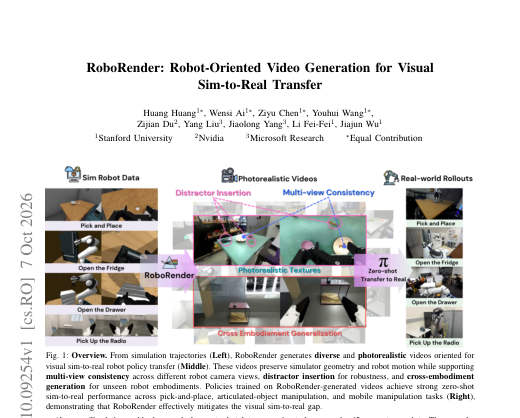
Simulation enables large-scale, low-cost robot data generation, but policies trained in simulation often fail to transfer to the real world due to the sim-to-real visual discrepancies. Existing approaches often rely on intermediate representations, which can discard rich semantic information or require additional perception modules at deployment. We address this visual sim-to-real gap with RoboRender, a framework that converts simulated trajectories into photorealistic RGB videos for policy learning. RoboRender trains a robot-oriented video generation model conditioned on simulated depth videos, language instructions, and robot RGB mask videos, preserving simulator geometry, robot motion, and action labels while synthesizing realistic textures, backgrounds, and distractors. The generated RGB videos are paired with simulator-provided states and actions to train policies for zero-shot real-world deployment. On robot video test sets, our video model outperforms depth-conditioned video generation baselines in generation quality. In real-world experiments across pick-and-place, articulated-object manipulation, and mobile manipulation tasks, policies trained on RoboRender-generated data achieve a 71% average success rate, outperforming raw simulation renderings and conventional visual domain randomization by approximately 7.1x and 3.6x, respectively. We further show that policy performance improves with more generated videos per simulation trajectory, increasing opening-task success by 65 percentage points. These results demonstrate that generative video rendering mitigates the visual sim-to-real gap for zero-shot policy transfer. Project website: https://robo-render.github.io/.

2026-10-06追踪学者 · Jiajun Wu

Co-Evolving Robot Orchestrators and Policies through Deployment

Xilun Zhang, Maggie Wang, Erik Bauer, Hong-Xing Yu, Huang Huang, Jiajun Wu, Marco Pavone

Vision-language-action (VLA) policies trained on large datasets are capable within their training domains, yet they still fail to generalize to the variety of situations a robot me…

Vision-language-action (VLA) policies trained on large datasets are capable within their training domains, yet they still fail to generalize to the variety of situations a robot meets in real-world deployment. Agentic robot systems complement the policy with a vision-language model (VLM) orchestrator that learns when to call the policy, how to instruct it, and when to use scripted skills instead. However, because the harness is built around a frozen policy that has limited language steerability, the orchestrator can avoid the policy's failures but never overcome them. The policy becomes the bottleneck of the whole system. Fine-tuning the policy can remove this bottleneck, but updating it alone decouples it from an orchestrator tuned to its old behavior. We propose Robo-COP, in which the orchestrator and policy co-evolve during deployment. Robo-COP curates skill demonstrations from its own executions, fine-tunes the policy when this data can address recurring failures, and adopts each new policy only after it improves the skills it was trained for. Across ten simulated RoboLab tasks, Robo-COP raises mean held-out success from 64.8% to 73.8% over the same harness with a frozen policy, while fine-tuning on a fixed schedule without verification reaches only 65.8%. On three real-world tasks, Robo-COP raises held-out success from 38.3% to 50.0%. Robo-COP turns deployment into a self-improving flywheel in which robots learn by doing, with each improvement in execution producing better data for the next round of learning. Videos and code are available at https://robo-cop.pages.dev/.

2026-10-06追踪学者 · Jiajun Wu

OpenWAM: An Open Framework for Composable World-Action Models

Heng Yu, David D. Yuan, Juze Zhang, Changan Chen, Yao Feng, Michelle Baldonado, Steve Cousins, Li Fei-Fei 等

World-action models (WAMs) couple future prediction with robot control, yet existing systems often vary the video backbone, interaction structure, supervision, and inference proced…

World-action models (WAMs) couple future prediction with robot control, yet existing systems often vary the video backbone, interaction structure, supervision, and inference procedure simultaneously, making their design choices difficult to compare. We introduce OPENWAM, an open world-action modeling framework built around a common causal robot-video foundation and configurable video-action interaction. Starting from Wan2.2-5B, we perform causal robot-video pretraining on over 10,000 hours of video, then integrate an action expert through a shared Mixture-of-Transformers architecture that supports joint, video-then-action, action-then-video, and decoupled generation. OPENWAM achieves high success rates on four LIBERO suites and real-world bimanual tasks; robot-video training with causal adaptation improves VTA success on LIBERO-Long from 68.4% to 97.8%. The same configurable architecture naturally extends to inverse and forward dynamics, allowing us to study how counterfactual transitions improve independently trained dynamics models beyond demonstrations alone. When only the video predictor is adapted to a new task, a frozen local-context inverse dynamics model trained on counterfactual data and demonstrations achieves 84.0% mean success across four held-out LIBERO-90 tasks, compared with 47.0% for a full-context inverse model and 21.5% for a local-context model trained only on demonstrations. For forward dynamics, counterfactual supervision reduces RGB prediction error by 34.5% and raises outcome identification from 21.1% to 71.3% among 16 same-state outcomes. OPENWAM provides a common testbed for comparing WAM interaction designs and for studying dynamics learning from video data beyond successful demonstrations.

2026-10-05追踪学者 · Jiajun Wu

MobileVISTA: Generative Data Augmentation for Pose Generalization in Mobile Manipulation

Suzannah Wistreich, Stephen Tian, Isabella Huang, Vitor Campagnolo Guizilini, Sergey Zakharov, Katherine Liu, Jiajun Wu

Mobile manipulators such as humanoid robots are increasingly deployed in dynamic, unstructured environments to perform dexterous manipulation tasks. However, end-to-end manipulatio…

Mobile manipulators such as humanoid robots are increasingly deployed in dynamic, unstructured environments to perform dexterous manipulation tasks. However, end-to-end manipulation policies trained to imitate demonstration data collected from a single robot pose are brittle: even centimeter-scale deviations in robot pose at deployment can drive ego-centric observations and end-effector trajectories out of the training distribution, leading to sharp drops in performance. We introduce MobileVISTA, a data generation framework that transforms demonstrations captured at canonical poses into diverse, pose-perturbed training data by jointly (1) augmenting egocentric visual observations and (2) retargeting actions to compensate for base pose changes. Unlike prior methods, which assume a camera rigidly mounted off the actuated chain or non-trivial articulated robot geometry largely out of frame, MobileVISTA targets compatibility with egocentric platforms (e.g., humanoids) where the camera is both influenced by and must observe the robot's kinematic chain as it moves. We study MobileVISTA in simulated tasks spanning humanoid and bimanual embodiments, and on a real Galaxea R1 Pro. We find policies trained on MobileVISTA-augmented data demonstrate improved robustness to previously out-of-distribution poses encountered at test time, without additional demonstration collection or a trained generative model. Additionally, we find MobileVISTA's benefit is largest on tested humanoids, where the camera rides the actuated chain and the robot fills much of the frame. Additional videos and appendix can be found on our website: https://mobilevista.github.io

cs.ROcs.CVcs.LG
2026-10-03追踪学者 · Jiajun Wu

Robot Learning with Visual Predicted Force

Haonan Chen, Feiyang Wu, Yuxiang Ma, Mustafa Mete, Pengfei Ye, Junxuan Shen, Cheng Zhu, Aurora Ruggeri 等

Force-aware manipulation typically relies on specialized force or tactile sensors. We show that force-aware manipulation can instead be achieved through visual force prediction fro…

Force-aware manipulation typically relies on specialized force or tactile sensors. We show that force-aware manipulation can instead be achieved through visual force prediction from the deformation of a compliant Fin Ray gripper. Our approach trains two models. First, we train a visual force estimator on calibration data and use it to annotate task demonstrations with force estimates. Second, we train an action--force proposal policy on these force-augmented demonstrations to jointly generate candidate robot actions and their associated forces. At test time, we sample candidate actions and the forces they are expected to produce, then execute the action whose predicted force is closest to a target from the demonstrations. We evaluate our approach on berry picking, empty-can grasping, in-hand reorientation, and plug insertion. Our results show that visual force prediction can guide inference-time action selection for contact-rich manipulation without requiring force or tactile sensors at deployment.

2026-10-02追踪学者 · Jiajun Wu

4DCodeBench: Benchmarking Agents on Inverse Graphics of Dynamic Scenes

Ruihong Shen, Žiga Kovačič, Peter Kulits, Xingrui Wang, Zizhang Li, Joshua B. Tenenbaum, Alan Yuille, Jieneng Chen 等

We introduce 4DCodeBench, a benchmark for 4D inverse graphics through code generation, in which agents reconstruct dynamic scenes from video as executable graphics programs. To acc…

We introduce 4DCodeBench, a benchmark for 4D inverse graphics through code generation, in which agents reconstruct dynamic scenes from video as executable graphics programs. To accomplish this, agents must translate visual observations into compact representations of scene structure and dynamics, by implementing abstractions such as physical simulations to reproduce complex behavior. To evaluate this capability, we curate a set of real-world videos and construct synthetic scenes spanning diverse physical phenomena, including deformation, fluid flow, and fracture. We perform extensive benchmarking of frontier models, finding that strong static reconstruction capabilities do not yet translate into reliable reconstruction of complex dynamics. 4DCodeBench provides a testbed for tracking progress toward agents that can interpret the dynamics of the world through code. Our benchmark is available at https://github.com/4DCodeBench/4DCodeBench

2026-09-30追踪学者 · Jiajun Wu

ECoMEM: Explicit Concept Memory for Memory-Dependent Robot Control

Yize Liu, Ke Wang, Mac Schwager, Yiqing Xu, Jiajun Wu

A robot may lose sight of an object it must later retrieve, need to recall what a person demonstrated earlier, or track which steps of a task it has already completed. Current visi…

A robot may lose sight of an object it must later retrieve, need to recall what a person demonstrated earlier, or track which steps of a task it has already completed. Current vision-language-action (VLA) policies often fail once the information needed for action disappears from the current observation, making memory critical for long-horizon robot behavior. Existing approaches typically provide longer histories or learn implicit memory from observation-action trajectories. But action supervision tells a policy how to act, not what to remember: it does not specify which past facts should persist or how they should change as new evidence arrives. We therefore separate maintaining an evidence-grounded account of the past from learning how to act on it. This insight motivates Explicit Concept Memory (ECoMEM), which represents task-relevant history with a reusable library of grounded concepts. An evidence-based Writer selects and updates these records, while a learned Reader turns them into memory tokens that directly condition the VLA. Across 16 RoboMME tasks, ECoMEM leads the evaluated robot policies on 15 tasks. On two new real-robot tasks, the same memory library either transfers directly or requires only one new concept, achieving 86.1% success versus 8.6% for a no-memory VLA. These results show that explicit concepts provide a reusable and extensible memory interface for robot control. Project website: https://ecomem.github.io/

2026-09-30追踪学者 · Jiajun Wu

DITTO-X: Forward and Reverse Teleoperation for Dexterous Manipulation and Human Intervention

Zhanpeng He, Joaquin Palacios, Zhangyu Wang, Chenhao Li, Katelyn Lee, Matei Ciocarlie, C. Karen Liu, Jiajun Wu

Teleoperated demonstrations are a primary source of data for robot manipulation, and teleoperated interventions are a primary mechanism for correcting policies at deployment. Yet m…

Teleoperated demonstrations are a primary source of data for robot manipulation, and teleoperated interventions are a primary mechanism for correcting policies at deployment. Yet most teleoperation systems close the loop through vision alone and are built around parallel-jaw grippers, limiting both what the robot can execute and what the operator can express through it. This is most damaging in shared autonomy, where the operator sees the scene only through occluded cameras and must take over a dexterous hand mid-task, often with an object already grasped. We present DITTO-X, a hand-agnostic dexterous teleoperation interface that renders joint-level force and fingertip contact events from sensing already on the robot hand, and drives three commercial dexterous hands (Sharpa, Wuji, and Inspire) without per-hand redesign. Because the exoskeleton is actuated, DITTO-X also supports reverse teleoperation, in which the robot back-drives the operator's fingers into its own configuration before control is transferred, so the human enters the loop already matched to the state they inherit. Our results show that DITTO-X improves demonstration quality and throughput over a commercial hand-tracking glove, both in regular data collection and in human intervention during policy deployment for contact-rich manipulation tasks. More information can be found from our website: https://tml.stanford.edu/ditto-x/.

2026-09-29追踪学者 · Jiajun Wu

CARAT: Do Materials LLMs Reason or Recite?

Jiajun Wu, Jian Yang, Zixiang Ni, Zhenzhu Li, Bin Chong

When a materials LLM answers a question about crystal structure, does it reason from the structure or copy an answer already printed in its input? Accuracy cannot tell: a structura…

When a materials LLM answers a question about crystal structure, does it reason from the structure or copy an answer already printed in its input? Accuracy cannot tell: a structural description often prints the very field it is scored against. CARAT holds question and gold answer fixed across eight matched views, names each structural relation separately in GraphSpace, and adds matched fine-tuning, answer masking, evidence injection, paired inference, and a rule that can withhold claims. First, on the benchmark's hardest families the grounded view is worth 17.3 points over formula inputs. Second, we turn that scrutiny on ourselves. GraphSpace beats a plain periodic graph by 19.3 points, but that margin is two effects at once: where the plain rendering carries everything the question needs it is 1.96 points, and where it omits those fields entirely, 46.7 points. The headline mostly measures what the baseline lacked, not how evidence is presented. Third, we attack our own benchmark. A rule that skips the link and reads the list directly answers four of seven hardened families, so we rebuilt it until eleven such shortcuts sat near chance. The frozen model quotes that link yet answers the same when we redirect it, on 95.6% of paired cases: it repeats the relation without using it. After matched supervision it reaches 99.8%, and deleting the link drops it to 23.4%, below the 27.0% the best shortcut reaches: both steps are learnable.

2026-09-29追踪学者 · Jiajun Wu

T$^2$Mem: Learning Test-Time Memory for Robotics

Yize Liu, Huang Huang, Yining Hong, Zijian Du, Zhi Cao, Li Fei-Fei, Jiajun Wu

Memory-dependent robotic manipulation requires policies to use information that is no longer available in the current observation. Retaining history alone is insufficient: memory m…

Memory-dependent robotic manipulation requires policies to use information that is no longer available in the current observation. Retaining history alone is insufficient: memory must preserve information that supports future actions. One challenge is whether a memory-free foundation model can learn to retain and use historical information from action demonstrations alone, without external memory support. We introduce T$^2$Mem, a framework that develops this capability within a pretrained vision-language-action policy, without external reasoning models or memory-specific annotations. T$^2$Mem uses test-time training to encode observation history into compact fast weights through online self-supervised updates, avoiding repeated processing of the full history. An observation-grounded interface extracts vision-language information for memory formation and supplies retrieved context to the action expert. Action supervision shapes what the memory learns to retain and use, while alternating memory-policy learning gives each component a fixed counterpart during optimization. Across 16 RoboMME tasks, T$^2$Mem improves average success from 17.93% to 56.83% over the memory-free base policy and outperforms the recurrent-memory methods reported in the benchmark, while controlled profiling indicates at least 3x inference speedup over explicit methods. Project website: https://yzliu84.github.io/T2MEM-project/

2026-09-28追踪学者 · Jiajun Wu

DexAgent: An Agentic Human2Sim2Robot Framework for Dexterous Manipulation with Self-Evolving Tool Library

Youhui Wang, Yunzhu Li, Li Fei-Fei, Jiajun Wu, Huang Huang

Human videos offer a scalable source of demonstrations for dexterous robot manipulation. However, existing human-to-simulation-to-robot (Human2Sim2Robot) pipelines rely on predefin…

Human videos offer a scalable source of demonstrations for dexterous robot manipulation. However, existing human-to-simulation-to-robot (Human2Sim2Robot) pipelines rely on predefined procedures that struggle to accommodate diverse object properties and interactions, particularly those involving articulated and deformable objects. We introduce DexAgent, an agentic Human2Sim2Robot framework that converts a single egocentric human video and a task prompt into physically grounded robot trajectories for policy training. It operates through four stages: semantic understanding of human videos, property-based simulation reconstruction, robot trajectory optimization, and robot data generation. At each stage, DexAgent adapts its approach to the task and object properties by selecting suitable skills from its tool library or developing new ones when needed. Property-specific verifiers assess stage outcomes for physical validity and task-specific requirements and provide feedback for refinement, preventing error propagation through the workflow. This adaptive, verification-guided process allows DexAgent to process diverse objects and long-horizon tasks. In the final stage, DexAgent varies object and robot states in simulation to generate diverse robot trajectories from a single human video, then retextures the rendered observations to facilitate sim-to-real transfer. Newly developed skills and verifiers are retained in its tool library, making it self-evolving to accumulate reusable capabilities. This reduces processing time as DexAgent encounters more human videos. Across eleven real-world tasks, policies trained with DexAgent-generated data achieve a 3.5x higher success rate than competing baselines. Project website: https://dexagent1.github.io/.

2026-09-24追踪学者 · Jiajun Wu

SWE-Prometheus: Measuring Engineering Governance Improvements in Real-World Repositories

Jiajun Wu, Leixin Sun, Zihan Tan, Yitao Liu, Zhenjun Zhao, Danyang Zhang, Shuo Li, Jiaru Qian 等

Large language model based coding agents have made substantial progress on repository-level software engineering tasks. Existing repository benchmarks, however, usually start from …

Large language model based coding agents have made substantial progress on repository-level software engineering tasks. Existing repository benchmarks, however, usually start from a human-identified issue and evaluate whether a patch satisfies a functional signal. We present SWE-Prometheus, a benchmark for the broader task of improving repository engineering governance. Each task provides a fixed snapshot and an open-ended objective, requiring the agent to identify risks, prioritize interventions, and verify the resulting changes. SWE-Prometheus evaluates six governance dimensions through paired evidence, clean-environment probes, behavior gates, and two independent teacher ratings of the same evidence. The benchmark contains 60 repositories; ten models are evaluated on a shared 22-repository public subset, where mean Normalized Governance Improvement ranges from 0.0568 to 0.5760 and observed behavior-breakage rates range from 0% to 23%. On a frozen ten-repository batch, a repository-blind template obtains mean NGI 0.272, but its gains concentrate in Tests & CI, Quality Gates, and Documentation; it improves Reproducible Environment and Dependency & Security on none of the repositories. This baseline makes the distinction between adding governance artifacts and producing execution-backed improvements measurable. The no-op condition has median NGI zero and standard deviation 0.073; two teachers agree exactly on 57 of 60 dimension scores for the same no-op evidence. For the two highest conditional-mean systems, common-valid NGI is similar, while full-pool comparisons that include behavior failures favor Kimi-K3. These results show why repository-governance evaluation should report improvement, behavior preservation, evidence quality, and coverage together.

cs.AIcs.SE

Li Fei-Fei 16 篇 专属页 →

2026-10-25追踪学者 · Li Fei-Fei

BEHAVIOR-Spatial Benchmark: Evaluating Spatial Understanding for Robotics

Sirui Chen, Huang Huang, Qineng Wang, Wenlong Huang, Manling Li, Ruohan Zhang, Li Fei-Fei, Jiajun Wu

Robot tasks require grounding spatial language in physical scenes, but task success alone cannot establish whether spatial instructions are followed. We present BEHAVIOR-Spatial, a…

Robot tasks require grounding spatial language in physical scenes, but task success alone cannot establish whether spatial instructions are followed. We present BEHAVIOR-Spatial, a benchmark built on BEHAVIOR-1K that measures spatial question answering, point-based target grounding, and robot action to examine how VLM spatial understanding relates to VLA behavior. It comprises 3,256 spatial questions across 49 activities, 1,240 grounding queries across 14 manipulation tasks, and action evaluations covering those 14 tasks and 10 navigation tasks. Our manipulation protocol evaluates held-out configurations and instruction following when the requested target changes within a fixed training layout. The baseline achieves 41.6% on held-out configurations but only 16.1% under changed instructions. VLM adaptation and robot-data pretraining provide limited improvements, whereas oracle visual target cues raise these rates to 60.3% and 38.0%, respectively. Perception evaluations reveal policy-dependent correlations between VLM question-answering and grounding accuracy and VLA manipulation performance. Together, these findings motivate evaluating spatial instruction following alongside task completion and examining when spatial perception performance translates into robot behavior. Project website: https://arielchen07.github.io/behavior-spatial/.

2026-10-19追踪学者 · Li Fei-Fei

Text-to-Image Generative Modeling Without Language Pretraining

Keshigeyan Chandrasegaran, Yue Zhao, Armin W. Thomas, Ehsan Adeli, Jiajun Wu, Juan Carlos Niebles, Li Fei-Fei, Michael Poli

Modern text-to-image (T2I) systems use internet-scale language pretraining for text-conditioned image generation. We ask whether language pretraining is necessary for strong T2I ge…

Modern text-to-image (T2I) systems use internet-scale language pretraining for text-conditioned image generation. We ask whether language pretraining is necessary for strong T2I generation. We introduce Halcyon, a family of early-fusion multimodal autoregressive models pretrained entirely from scratch on GPIC, a dataset of 100M image-text pairs. Halcyon-0.52B outperforms LlamaGen-XL/8 (48.0 vs. 63.3 gFD) with 18.2$\times$ less pretraining compute. Further, Halcyon-1.6B outperforms JiT-T2I-XXL/8++ (35.3 vs. 41.0 gFD) with 275$\times$ less pretraining compute. Controlled experiments show that text-only pretraining does not improve T2I generation. Halcyon also learns image captioning by replacing caption dropout with I2T supervision, maintaining competitive T2I generation quality under the same pretraining budget. We show that strong T2I systems can be trained from scratch without internet-scale language pretraining. Code and models are available at https://cs.stanford.edu/~keshik/halcyon

2026-10-19追踪学者 · Li Fei-Fei

SteerAct: Unlocking Action Models through Few-Shot Temporal Steering

Kaichen Zhou, Zhiyan Li, Chongkai Gao, Yuhan Wang, Wenlong Huang, Maggie Wang, Fangneng Zhan, Manling Li 等

Improving pretrained robot action models at test time from only a few rollouts remains challenging. Activation steering offers a lightweight approach by modifying feature activatio…

Improving pretrained robot action models at test time from only a few rollouts remains challenging. Activation steering offers a lightweight approach by modifying feature activations while keeping model weights fixed. However, effective steering requires identifying which features to modify and determining the timing and strength of modification. We introduce SteerAct, a few-shot temporal steering framework that uses a shared temporal descriptor of sparse-feature dynamics for offline feature selection and online control. A pretrained sparse autoencoder provides candidate features, and our temporal descriptor summarizes the distribution of local activation-order patterns for each feature, enabling comparisons across rollouts without requiring timestep alignment. Before steering begins (offline), we use successful and failed reference rollouts to select a single task-specific feature whose temporal descriptors best distinguish the two outcomes and construct its reference banks. During each new execution (online), we compare the feature's evolving temporal descriptor with these references to determine when to intervene and how strongly to increase or decrease its activation via a steering coefficient. Using only 24 outcome-labeled rollouts per task, SteerAct improves task success by approximately 10% relative to unsteered models in evaluations spanning $π_{0.5}$, Fast-WAM, RoboTwin 2.0, DexJoCo, and real-world manipulation, without updating action-model weights. Code and demos are available at: https://steeract.github.io/.

2026-10-18追踪学者 · Li Fei-Fei

Dream What I Can: Sparse Visual Planning for Long-Horizon Robot Manipulation

Chongkai Gao, Wenlong Huang, Haonan Chen, Lin Shao, Yilun Du, Jiajun Wu, Ruohan Zhang, Li Fei-Fei

Video models provide rich priors for generalizable robotic manipulation, but plausible visual futures are not always executable. We introduce DreamCan, a hierarchical policy that g…

Video models provide rich priors for generalizable robotic manipulation, but plausible visual futures are not always executable. We introduce DreamCan, a hierarchical policy that grounds video models through sparse visual planning: a high-level planner adapted from a pre-trained video model and a low-level visuomotor policy. Rather than predicting dense trajectories, the high-level planner generates sparse visual subgoals that balance reachability and task utility. From offline, action-free robot videos, we estimate these quantities and use dynamic programming to select subgoal sequences without manual annotations. The resulting subgoals are more reliably attained than uniformly spaced alternatives, and the full system outperforms language, dense-video, and uniform-subgoal planners, reaching high planning success rates on Language-Table tasks and 91.2% success on LIBERO-Long with a 0.1B-parameter low-level policy. Additional suboptimal videos and test-time compute further improve success. The system also performs challenging real-world bimanual tasks, including box folding and packing with unseen object combinations. More results are available at https://dreamcan.github.io/.

2026-10-16追踪学者 · Li Fei-Fei

A Language-Informed Loss for Visual Generation

Suchir Agarwal, Keshigeyan Chandrasegaran, Ziyu Chen, Kyle Sargent, Juan Carlos Niebles, Li Fei-Fei, Jiajun Wu

End-to-end visual generation with pixel-space loss has recently achieved competitive performance without the need for learned image tokenizers. In this work, we study whether langu…

End-to-end visual generation with pixel-space loss has recently achieved competitive performance without the need for learned image tokenizers. In this work, we study whether language-informed supervision can provide a richer training signal than pixel loss for visual generation. We introduce LILIE (pronounced "lily"), a Language-Informed and Lossless Image Encoder. LILIE is an invertible image transform trained such that a vision-language model can recover captions from noised features. The encoder uses a normalizing flow transformer trained jointly with a vision-language model via next token prediction. We then use the encoder to extract a simple language-informed loss for text-to-image generation. We train JiT models with LILIE loss, reducing gFD by 14 points (66.84 $\to$ 53.01) against a pixel-only baseline on the GPIC dataset. Our code, encoders, and generative models are available at https://suchiragarwal.com/lilie.

2026-10-15追踪学者 · Li Fei-Fei

T2-z: Test-Time Optimization of Environment Latents for Robotic World Models

Chenyuan Zhou, Yining Hong, Huang Huang, Yunfan Jiang, Wenlong Huang, David Held, Vitor Campagnolo Guizilini, Yue Wang 等

Predicting how the world responds to an action requires more than what can be seen: robots must account for environmental factors that are neither directly observable nor explicitl…

Predicting how the world responds to an action requires more than what can be seen: robots must account for environmental factors that are neither directly observable nor explicitly specified, from physical properties such as friction and mass to human-defined environmental rules. We introduce T2-Z for test-time optimization of environment latents, which augments a robotic world model with a learnable environment latent to condition world predictions. This compact latent captures underlying environmental variation without supervision of what environmental factors exist or what values they take. During training, T2-Z alternates between two stages: a world-model optimization stage that fixes the latents and learns general action-conditioned dynamics across environments; and an environment-latent optimization stage that freezes the world model and optimizes the conditioning latents, allowing latent structure to emerge purely through world prediction. At test time, the world model remains frozen and a newly initialized environment latent is optimized from one or more test-time interactions, adapting the model to previously unseen environmental configurations. Across 7 simulated settings and 4 real-world robotic tasks, T2-Z reduces object prediction error metric from 15.20 to 7.00 and raises action success from 33.73% to 72.96%. Its emergent latents capture structured representations of individual and compounded factors across diverse visual scenes. Ablations further show that T2-Z can efficiently infer environment latents from as little as a single test-time interaction trajectory.

cs.ROcs.AIcs.CV
2026-10-15追踪学者 · Li Fei-Fei

TRACER: A Multimodal Harness for Patient Care in Hospitals

Zane Durante, Paul Tang, Keshigeyan Chandrasegaran, Amit Kaushal, Shrinidhi Kowshika Lakshmikanth, Feolu Kolawole, Yu Jun Zheng, Yifan Geng 等

Continuous video and clinical records provide complementary information for understanding how patient behavior evolves over a hospital stay. A central challenge is how to represent…

Continuous video and clinical records provide complementary information for understanding how patient behavior evolves over a hospital stay. A central challenge is how to represent behavior across the entire stay while preserving access to fine-grained visual and clinical evidence. We introduce TRACER, a training-free multimodal harness that constructs minute-level action records from video and combines them with clinical records into hourly reports. The harness equips an LLM agent with tools to query this hierarchy, inspect relevant video, and retrieve clinical records. To evaluate TRACER, we construct two benchmarks. The first contains 397 annotated one-minute clips spanning 15 atomic actions; the second poses 144 clinician-informed multiple-choice questions, grounded in 264 hours of video and clinical records from two ICU patients. TRACER achieves up to 84.8% accuracy for action detection and 61.0% QA accuracy versus 49.3% for the strongest baseline using the same backbone. Across 280 patients spanning approximately 60,000 camera-hours, TRACER identifies significantly less purposeful activity in patients with a positive delirium assessment during their stay than in those without (p < 0.0001). Our results show that combining continuous video with clinical records can support understanding of patient behavior over time and across patient cohorts without training on protected health data.

2026-10-14追踪学者 · Li Fei-Fei

Generative Representation Learning for Scalable Latent Tokenization

Alan Baade, Kyle Sargent, Vincent Sitzmann, Eric Ryan Chan, Justin Johnson, Li Fei-Fei, Gordon Wetzstein

We introduce an approach for self-supervised representation learning designed to be used as a tokenizer for generative modeling. Our objective supervises a representation loss by f…

We introduce an approach for self-supervised representation learning designed to be used as a tokenizer for generative modeling. Our objective supervises a representation loss by factorizing the pointwise mutual information of the data, which we estimate by taking information differences between conditional predictions from a learned generative model. We justify our algorithm theoretically and empirically, demonstrating that our generative approach to representation learning avoids dimensional collapse and feature suppression in cases where commonly used methods like DINO and LeJEPA fail. Moreover, we show our representation learning technique is scalable; expending more compute leads to predictably better latent tokenization. For the first time, we perform a careful analysis of the combined flop efficiency of tokenizer and generative model and demonstrate that our approach is a compute-optimal improvement over direct diffusion for pixel-space generation, obtaining an FID-50K of 2.18 with JiT-L. Applied to ImageNet and the text-to-image dataset GPIC, we show tokenizer encoder scaling laws for diffusability, where extrapolating our approach achieves representations in 7x fewer FLOPs than DINOv2 on ImageNet and 8x fewer FLOPs than WebSSL on GPIC.

cs.LGcs.CV
2026-10-13追踪学者 · Li Fei-Fei

FACT: A Multimodal Force-Action-Track Foundation Model for Human-to-Robot Dexterity

Zhi Cao, Yining Hong, Jiaolong Yang, Yejin Choi, Li Fei-Fei, Jiajun Wu, Huang Huang

Human demonstrations offer a scalable alternative to costly robot data collection for dexterous manipulation, but most human datasets lack force measurements. Dexterous manipulatio…

Human demonstrations offer a scalable alternative to costly robot data collection for dexterous manipulation, but most human datasets lack force measurements. Dexterous manipulation requires not only visual and proprioceptive understanding but also the ability to anticipate and regulate interaction forces. To scale force-aware human-robot co-training, we introduce EgoForce, a large-scale human tactile dataset capturing force-rich manipulation experience, and combine it with robot demonstrations for pretraining. We present FACT, a robot foundation model that cascades from prospective visual planning to force-aware refinement for dexterous manipulation. FACT comprises two jointly trained components. A Track-Guided Coarse Planner jointly predicts actions, future video, and visual tracks. Future video and visual tracks also provide a shared task representation that facilitates cross-embodiment knowledge transfer and coarse action generation. Building on this coarse plan, a Force-Action Joint Refiner jointly predicts future force and refines the coarse action, allowing anticipated force and action to shape each other during refinement. We evaluate the model on ten tasks requiring fine-grained coordination and force feedback, including tool use, musical instruments, and precision laboratory procedures. Using as few as 10 robot trajectories with 90 human trajectories for fine-tuning, FACT outperforms both baselines, with success-rate gains of up to 60 percentage points over T-Rex. Ablations show that force supervision in human pretraining data is crucial for downstream robot performance after fine-tuning, while visual track prediction and training with future-force prediction improve dexterous execution. Experiments varying the human-robot data ratio during fine-tuning further suggest that FACT learns from human demonstrations nearly as effectively as from robot demonstrations.

2026-10-13追踪学者 · Li Fei-Fei

I3L: Iterative Interactive Imitation Learning for Whole-Body Mobile Manipulation

Wensi Ai, Christopher Luey, Karthik Dharmarajan, Evans Han, Yunfan Jiang, Stef Ren, Jianwen Xie, Jiajun Wu 等

Policies trained offline from teleoperated demonstrations can degrade outside their training distribution. This gap is particularly acute in long-horizon whole-body mobile manipula…

Policies trained offline from teleoperated demonstrations can degrade outside their training distribution. This gap is particularly acute in long-horizon whole-body mobile manipulation, where long horizons amplify compounding errors and coordinated arm, torso, and base motion makes exhaustive demonstration coverage impractical. We introduce I3L, an integrated hardware and learning system that combines whole-body correction with iterative policy refinement to address this last-mile reliability gap. Its low-cost, open-source JoyLo+ interface uses policy-tracking leader arms and touch-triggered takeover to enable coordinated corrections across the body parts, while iterative deployment and retraining allow operators to target failures of the updated policy. We evaluate I3L across three robot embodiments and eight simulated and real-world tasks, including four long-horizon whole-body mobile manipulation tasks. Controlled simulation experiments show that four-round HG-DAgger achieves the highest final success on both tasks. Under this protocol, I3L improves autonomous success over the base policies by an average of 68.3 percentage points and achieves at least 90% success on every task, outperforming demonstration-only training by 35.6 percentage points on average with the same number of training trajectories. Averaged across tasks, takeover duration per episode decreases by 72% over four rounds. Together, these results show that I3L helps close the last-mile gap between offline training and reliable deployment and provides practical insights into collecting and using corrections for long-horizon whole-body mobile manipulation. Videos, visualizations, and appendix are at https://i-3l.github.io/.

2026-10-07追踪学者 · Li Fei-Fei

Cross-Embodiment Robot Foundation World Models with Latent Actions

Huang Huang, Sriram Yenamandra, Arjun Majumdar, Elie Aljalbout, Tushar Nagarajan, Tsung-Yen Yang, Akshara Rai, Michael Rabbat 等

The diversity of robot embodiments and action spaces makes it challenging to build robot world models that generalize across different embodiments. We introduce the Latent Action-C…

The diversity of robot embodiments and action spaces makes it challenging to build robot world models that generalize across different embodiments. We introduce the Latent Action-Conditioned Robot World Model (LAC-WM), which operates within a learned unified latent action space shared across diverse embodiments. This unified action space improves the world model's performance when adapted to previously unseen robot embodiments. We compare LAC-WM with an Explicit Action-Conditioned World Model (EAC-WM), which conditions on explicit motion labels. Our results show that explicit action conditioning leads to disjoint action representations across embodiments, limiting downstream performance when adapting to new robots. We evaluate both models on dexterous manipulation tasks and a modified LIBERO benchmark. LAC-WM improves downstream performance over EAC-WM by up to 46.7% on dexterous manipulation and 11.7% on LIBERO. Crucially, the unified latent action space allows LAC-WM's downstream performance to scale positively with the number of embodiments used during pretraining. In contrast, the disjoint action space in EAC-WM leads to decreased performance as the number of pretraining embodiments increases. These results highlight the importance of a unified action space for efficient cross-embodiment learning, addressing a key challenge in robotics. Project website: https://lacwm.github.io/

2026-10-07追踪学者 · Li Fei-Fei

RoboRender: Robot-Oriented Video Generation for Visual Sim-to-Real Transfer

Huang Huang, Wensi Ai, Ziyu Chen, Youhui Wang, Zijian Du, Yang Liu, Jiaolong Yang, Li Fei-Fei 等

Simulation enables large-scale, low-cost robot data generation, but policies trained in simulation often fail to transfer to the real world due to the sim-to-real visual discrepanc…

Simulation enables large-scale, low-cost robot data generation, but policies trained in simulation often fail to transfer to the real world due to the sim-to-real visual discrepancies. Existing approaches often rely on intermediate representations, which can discard rich semantic information or require additional perception modules at deployment. We address this visual sim-to-real gap with RoboRender, a framework that converts simulated trajectories into photorealistic RGB videos for policy learning. RoboRender trains a robot-oriented video generation model conditioned on simulated depth videos, language instructions, and robot RGB mask videos, preserving simulator geometry, robot motion, and action labels while synthesizing realistic textures, backgrounds, and distractors. The generated RGB videos are paired with simulator-provided states and actions to train policies for zero-shot real-world deployment. On robot video test sets, our video model outperforms depth-conditioned video generation baselines in generation quality. In real-world experiments across pick-and-place, articulated-object manipulation, and mobile manipulation tasks, policies trained on RoboRender-generated data achieve a 71% average success rate, outperforming raw simulation renderings and conventional visual domain randomization by approximately 7.1x and 3.6x, respectively. We further show that policy performance improves with more generated videos per simulation trajectory, increasing opening-task success by 65 percentage points. These results demonstrate that generative video rendering mitigates the visual sim-to-real gap for zero-shot policy transfer. Project website: https://robo-render.github.io/.

2026-10-06追踪学者 · Li Fei-Fei

OpenWAM: An Open Framework for Composable World-Action Models

Heng Yu, David D. Yuan, Juze Zhang, Changan Chen, Yao Feng, Michelle Baldonado, Steve Cousins, Li Fei-Fei 等

World-action models (WAMs) couple future prediction with robot control, yet existing systems often vary the video backbone, interaction structure, supervision, and inference proced…

World-action models (WAMs) couple future prediction with robot control, yet existing systems often vary the video backbone, interaction structure, supervision, and inference procedure simultaneously, making their design choices difficult to compare. We introduce OPENWAM, an open world-action modeling framework built around a common causal robot-video foundation and configurable video-action interaction. Starting from Wan2.2-5B, we perform causal robot-video pretraining on over 10,000 hours of video, then integrate an action expert through a shared Mixture-of-Transformers architecture that supports joint, video-then-action, action-then-video, and decoupled generation. OPENWAM achieves high success rates on four LIBERO suites and real-world bimanual tasks; robot-video training with causal adaptation improves VTA success on LIBERO-Long from 68.4% to 97.8%. The same configurable architecture naturally extends to inverse and forward dynamics, allowing us to study how counterfactual transitions improve independently trained dynamics models beyond demonstrations alone. When only the video predictor is adapted to a new task, a frozen local-context inverse dynamics model trained on counterfactual data and demonstrations achieves 84.0% mean success across four held-out LIBERO-90 tasks, compared with 47.0% for a full-context inverse model and 21.5% for a local-context model trained only on demonstrations. For forward dynamics, counterfactual supervision reduces RGB prediction error by 34.5% and raises outcome identification from 21.1% to 71.3% among 16 same-state outcomes. OPENWAM provides a common testbed for comparing WAM interaction designs and for studying dynamics learning from video data beyond successful demonstrations.

2026-10-02追踪学者 · Li Fei-Fei

LoGo: Local-Global Rewards for Consistent Long-Horizon Video Generation

Ziqi Ma, Shreya Sharma, Mohamed El Banani, Katja Schwarz, Chongjie Ye, Chao-Yuan Wu, Li Fei-Fei, Ben Mildenhall 等

Camera-controlled video models are rapidly advancing toward long generation horizons and complex camera control. A key failure mode is 3D inconsistency: as the camera moves, object…

Camera-controlled video models are rapidly advancing toward long generation horizons and complex camera control. A key failure mode is 3D inconsistency: as the camera moves, objects lose permanence and scene structures shift. Existing post-training techniques, which assign a single scalar reward to the entire generation, are poorly suited to correcting these inconsistencies over long horizons. We introduce LoGo, which blends global and spatially localized rewards for camera-controlled video models. The local reward provides fine-grained credit assignment, which substantially improves 3D consistency, while the global reward preserves camera following and video quality. Across three base models, LoGo shows a clear advantage on DL3DV and TrajectoryBench, a new benchmark for long-horizon, complex-camera-control generation that current evaluations lack. LoGo effectively reduces local object shifts, artifacts, and global scene changes, illustrating the importance of credit assignment in post-training video models. Project website: https://ziqi-ma.github.io/logo-website/

2026-09-29追踪学者 · Li Fei-Fei

T$^2$Mem: Learning Test-Time Memory for Robotics

Yize Liu, Huang Huang, Yining Hong, Zijian Du, Zhi Cao, Li Fei-Fei, Jiajun Wu

Memory-dependent robotic manipulation requires policies to use information that is no longer available in the current observation. Retaining history alone is insufficient: memory m…

Memory-dependent robotic manipulation requires policies to use information that is no longer available in the current observation. Retaining history alone is insufficient: memory must preserve information that supports future actions. One challenge is whether a memory-free foundation model can learn to retain and use historical information from action demonstrations alone, without external memory support. We introduce T$^2$Mem, a framework that develops this capability within a pretrained vision-language-action policy, without external reasoning models or memory-specific annotations. T$^2$Mem uses test-time training to encode observation history into compact fast weights through online self-supervised updates, avoiding repeated processing of the full history. An observation-grounded interface extracts vision-language information for memory formation and supplies retrieved context to the action expert. Action supervision shapes what the memory learns to retain and use, while alternating memory-policy learning gives each component a fixed counterpart during optimization. Across 16 RoboMME tasks, T$^2$Mem improves average success from 17.93% to 56.83% over the memory-free base policy and outperforms the recurrent-memory methods reported in the benchmark, while controlled profiling indicates at least 3x inference speedup over explicit methods. Project website: https://yzliu84.github.io/T2MEM-project/

2026-09-28追踪学者 · Li Fei-Fei

DexAgent: An Agentic Human2Sim2Robot Framework for Dexterous Manipulation with Self-Evolving Tool Library

Youhui Wang, Yunzhu Li, Li Fei-Fei, Jiajun Wu, Huang Huang

Human videos offer a scalable source of demonstrations for dexterous robot manipulation. However, existing human-to-simulation-to-robot (Human2Sim2Robot) pipelines rely on predefin…

Human videos offer a scalable source of demonstrations for dexterous robot manipulation. However, existing human-to-simulation-to-robot (Human2Sim2Robot) pipelines rely on predefined procedures that struggle to accommodate diverse object properties and interactions, particularly those involving articulated and deformable objects. We introduce DexAgent, an agentic Human2Sim2Robot framework that converts a single egocentric human video and a task prompt into physically grounded robot trajectories for policy training. It operates through four stages: semantic understanding of human videos, property-based simulation reconstruction, robot trajectory optimization, and robot data generation. At each stage, DexAgent adapts its approach to the task and object properties by selecting suitable skills from its tool library or developing new ones when needed. Property-specific verifiers assess stage outcomes for physical validity and task-specific requirements and provide feedback for refinement, preventing error propagation through the workflow. This adaptive, verification-guided process allows DexAgent to process diverse objects and long-horizon tasks. In the final stage, DexAgent varies object and robot states in simulation to generate diverse robot trajectories from a single human video, then retextures the rendered observations to facilitate sim-to-real transfer. Newly developed skills and verifiers are retained in its tool library, making it self-evolving to accumulate reusable capabilities. This reduces processing time as DexAgent encounters more human videos. Across eleven real-world tasks, policies trained with DexAgent-generated data achieve a 3.5x higher success rate than competing baselines. Project website: https://dexagent1.github.io/.

Shuran Song 7 篇 专属页 →

2026-11-01追踪学者 · Shuran Song

Beyond Validation Loss: Coverage and Reliability Dynamics in Robot Policy Pretraining

Zhanyi Sun, Max Simchowitz, Shuran Song

In modern robot learning, generative robot policies are first pretrained through supervised learning from demonstrations, then refined through reinforcement learning, supervised fi…

In modern robot learning, generative robot policies are first pretrained through supervised learning from demonstrations, then refined through reinforcement learning, supervised finetuning, or other forms of posttraining. Yet conventional pretraining metrics, such as validation loss and average task success, provide an incomplete account of which policies support both effective direct deployment and subsequent posttraining. In this work, we study closed-loop pass@k, which evaluates the probability that k rollouts from the same initial condition attain at least one success. Thus, pass@1 measures mean task success; large-k pass@k measures whether success remains reachable under repeated sampling. Across a wide range of posttraining recipes, we show that large-k pass@k reveals posttraining differences not captured by pass@1. In particular, checkpoints with similar pass@1 but different large-k pass@k have different posttraining performance. Moreover, we show pass@k peaks at different checkpoints during supervised pretraining, revealing a coverage-reliability tradeoff over the course of training. Based on these observations, we propose two practical interventions: (1) a purely offline checkpoint-selection criterion that balances coverage and reliability without closed-loop evaluation, and (2) a generative data augmentation procedure that expands supervision beyond the finite demonstration set, preserving large-k pass@k while maintaining or improving pass@1 and raising the observed coverage-reliability Pareto frontier. Together, our results motivate evaluation, checkpoint selection, and training procedures that explicitly account for posttraining. Blog post, visualizations, and code are available at https://zhanyisun.github.io/robot-policy-learning-dynamics/.

2026-10-09追踪学者 · Shuran Song

Chronos Policy: Learning Robot Policies on Physical Time

Changhao Wang, Jaden Clark, Shuran Song

Robot policies often convert sensing and control into fixed-rate observation-action sequences, leaving physical time implicit in sequence position. This assumption breaks when obse…

Robot policies often convert sensing and control into fixed-rate observation-action sequences, leaving physical time implicit in sequence position. This assumption breaks when observation rates or delays vary, or when inference latency changes. We introduce Chronos Policy, which makes physical time explicit by conditioning on observation capture times and desired action execution times. We study two ways to incorporate time into a diffusion transformer: adding timestamp embeddings to token features, or encoding physical time in positional encoding through time-aware rotary positional encodings (time-aware RoPE). We find that time-aware RoPE is more robust, allowing attention to depend directly on physical time while keeping token content unchanged. During training, we temporally randomize which observations are sampled and when the action chunk begins, exposing the policy to a wider range of sensing and execution schedules that may occur during deployments. This also enables learning from asynchronous, multi-rate data without forcing all measurements onto a fixed temporal grid. Across simulation and real-world experiments, Chronos Policy improves performance on dynamic tasks, where observation-to-action timing is critical, and on multisensory tasks, where the relative timing between observations matters. On standard quasi-static tasks, it preserves nominal performance while improving robustness to changes in sensing and inference timing.

2026-10-08追踪学者 · Shuran Song

PanTact: Teaching Whole-Body Dexterity with a Wearable Contact Interface

Xiaomeng Xu, Han Zhang, Zhian Ruan, Xiaofeng Guo, Jinkun Cao, Ruihan Yang, Carmelo Sferrazza, Shuran Song 等

Humanoid robots have many degrees of freedom and contact surfaces, yet most loco-manipulation research restricts manipulation to the hands and avoids other body contacts with the e…

Humanoid robots have many degrees of freedom and contact surfaces, yet most loco-manipulation research restricts manipulation to the hands and avoids other body contacts with the environment. To extend manipulation beyond the hands, we present PanTact, a system that learns humanoid whole-body dexterity, the capability to manipulate with any suitable body surface, directly from robot-free human demonstrations. Our key idea is to use contact as manipulation-centric information that transfers across embodiments. Contact locations and timing specify the interactions needed to accomplish a task, while the robot chooses how to coordinate its body to realize them within its own physical constraints. Specifically, PanTact captures, learns, and executes whole-body contact via: 1) a wearable, robot-free data collection interface that augments egocentric vision and bimanual UMI grippers with whole-body modular contact patches to record body contact locations and states; 2) a visuomotor policy that mitigates the egocentric observation gap and predicts whole-body contact goals; and 3) contact-aware whole-body control formulations that realize active contact goals using suitable robot surfaces. We deploy PanTact on a Unitree G1 humanoid without additional body contact sensors, demonstrating whole-body dexterity involving body support, pushing, sweeping, and load-sharing. Website: https://pantact.github.io

2026-10-06追踪学者 · Shuran Song

EigenDEXplore: Structured Exploration for Dexterous Manipulation with Human Priors

Harsh Gupta, Tyler Ga Wei Lum, Changhao Wang, Chuer Pan, C. Karen Liu, Jeannette Bohg, Shuran Song

Dexterous manipulation poses a challenging high-dimensional optimization problem, as useful behaviors require coordinated motion across many hand joints. In reinforcement learning …

Dexterous manipulation poses a challenging high-dimensional optimization problem, as useful behaviors require coordinated motion across many hand joints. In reinforcement learning (RL) and sampling-based trajectory optimization, exploration commonly relies on independent robot joint perturbations, making coordinated behaviors difficult to discover. Prior work reduces this search space for grasp learning using low-dimensional spaces of coordinated joint motions learned from human hand data, but this restricts the expressivity required for general manipulation. Some combine learned and joint-space actions to restore expressivity, but this increases dimensionality and introduces redundancy. We study these effects across diverse manipulation settings, varying action dimensionality, exploration strategy, and the source of human data. Our experiments suggest that human-motion priors are most effective when used to structure exploration rather than change the action representation. Motivated by this finding, we propose EigenDEXplore, which induces correlated exploration by adding perturbations along human-derived eigenvectors to independent joint-space noise, leaving the action space unchanged. Across multiple dexterous hands, EigenDEXplore consistently outperforms joint-space and learned action-space baselines in grasping, in-hand reorientation, and contact-rich manipulation. These gains span unstructured and reference-guided RL, trajectory optimization, and sim-to-real deployment, and are largest in settings with less reward shaping and curriculum design.

2026-10-05追踪学者 · Shuran Song

Fluorescence-enhanced Whisker Array with Vision-based Deformation Analysis for Underwater Source Localization

Xiaochi Xie, Hao Li, Shixuan Zhao, Siyue Yao, Shuran Song, Mark R. Cutkosky

Deep-water biological observation is essential for understanding marine organisms and their interactions with the environment. However, conventional optical and acoustic approaches…

Deep-water biological observation is essential for understanding marine organisms and their interactions with the environment. However, conventional optical and acoustic approaches can introduce stimuli that alter animal behavior and bias biological observations. This paper proposes a fluorescence-enhanced whisker array sensing system that pinpoints underwater hydrodynamic sources through local optical readout rather than direct source imaging. Five spatially oriented whiskers, fabricated with nitinol cores and fluorescent urethane shells, are integrated with ultraviolet excitation and a monocular camera. Image enhancement and segmentation are applied to track the whisker deformation. A lightweight convolutional neural network captures temporal and cross-whisker features from 2 s sequences to estimate source localization. Pool experiments achieve a mean spatial localization error of 88 mm, with 73.5 mm in radius and $2.5^\circ$ in angle, across a test region of 600 mm with $\pm30^\circ$. Real-time localization of a moving thruster demonstrates the capability of the proposed method in dynamic scenarios, highlighting its potential for integration into underwater robots for hydrodynamic source detection, localization, and tracking in low-light environments.

2026-10-05追踪学者 · Shuran Song

Mulligan: Performance-Guided Data Collection for Efficient On-Robot Learning

Lars Ankile, Perry Dong, Rohan Bhowmik, Aneesh Muppidi, David D. Yuan, Shuran Song, Chelsea Finn

Learning from human demonstrations is a reliable way to teach robots new tasks, but the gains from each additional demonstration shrink as the policy improves. Continued improvemen…

Learning from human demonstrations is a reliable way to teach robots new tasks, but the gains from each additional demonstration shrink as the policy improves. Continued improvement can instead come from supervised deployment, where an operator places the objects and intervenes when the policy fails. We ask how to maximize improvement from a fixed budget of supervised episodes on high-precision manipulation tasks with wide ranges of object placements. We observe that failures can concentrate in a small subset of initial states, so uniform collection spends much of the operator's time on states the policy already handles. Mulligan makes the initial-state distribution a decision, starting each round's episodes at observed failures and untried states. To further improve data efficiency, we augment interactive imitation learning with a value function trained on all data, including failures that imitation discards. Across three real-world tasks evaluated on 2,550 held-out, blinded episodes and two simulated tasks, Mulligan outperforms uniform initial-state sampling at matched collection budgets, and combined with value-based action selection, HiL-IDQL+Mulligan, improves final real-task success by 10-34 percentage points. With operator interventions, the human-robot team completes 98% of collection episodes, remaining productive while the policy learns. Videos, code, and data are available at https://mulligan.page/.

2026-10-01追踪学者 · Shuran Song

NEEDLEWORK: Offline Rewriting of Robot Data with Verified Local Stitches

Juntao Ren, Yifan Hou, Shuran Song

Robot demonstrations may contain useful behavior even when individual episodes are inefficient or unsuccessful. Trajectory stitching offers a way to compose these behaviors into im…

Robot demonstrations may contain useful behavior even when individual episodes are inefficient or unsuccessful. Trajectory stitching offers a way to compose these behaviors into improved training data, but identifying useful connections and verifying their feasibility is difficult in high-dimensional robot data, where many prior methods rely on low-dimensional state representations. We introduce NEEDLE, an offline dataset-augmentation algorithm that addresses these challenges by adding short, verified action bridges between recorded observations in high-dimensional robot demonstrations. First, NEEDLE identifies and creates connections that bypass suboptimal detours, broaden action coverage, and augment the original dataset with failed trajectories, using only RGB images, proprioception, and episode-level outcomes, without new environment interaction or privileged object state. Next, we present a sampling technique that incorporates accepted bridges into policy training without synthesizing intermediate images or discarding the original demonstrations, allowing policies to learn alternative actions while retaining the original dataset's coverage. On real-robot tasks, NEEDLE improves success rate over the strongest baseline on each task by an average of 21 percentage points. Videos and supplementary materials are on https://needle-work.github.io/.

C. Karen Liu 7 篇 专属页 →

2026-10-19追踪学者 · C. Karen Liu

SSIO: Self-Supervised Inertial Odometry

Yuheng Qiu, Yutian Chen, Carlton Cort, Weison Huang, Shibo Zhao, Pieter Abbeel, Rocky Duan, Koushil Sreenath 等

Learning inertial odometry for a new platform usually requires ground-truth trajectories. We show that an inertial odometry model can instead be trained from scratch by a myopic te…

Learning inertial odometry for a new platform usually requires ground-truth trajectories. We show that an inertial odometry model can instead be trained from scratch by a myopic teacher that integrates the IMU over each short window independently, a scheme we call integration self-supervision. Interestingly, although supervised only by short-window velocity changes, the student learns to directly predict velocity, and does so more accurately than its integration teacher. Pose graph distillation then refines the model with sequence-consistent targets from a pose graph over many windows. Training on a new platform therefore no longer requires collecting ground-truth trajectories, but only calibrating the IMU and recording data during normal operation. Across six datasets spanning pedestrians, drones, quadrupeds, and a humanoid, the same recipe with no velocity or position labels trains models that come within 0.07~m/s average velocity error of a same-architecture supervised baseline.

2026-10-17追踪学者 · C. Karen Liu

Action-Aligned Latent Planning for Versatile Humanoid Loco-Manipulation

Yutang Lin, Guanya Shi, C. Karen Liu

Learning a single perceptive policy for diverse humanoid loco-manipulation requires unifying high-level task decisions without losing the state-dependent physical responses that ma…

Learning a single perceptive policy for diverse humanoid loco-manipulation requires unifying high-level task decisions without losing the state-dependent physical responses that make each interaction succeed. This makes the representation between high-level planning and whole-body control critical: kinematic or contact targets provide compact abstractions but do not directly encode interaction-specific control responses, while directly predicting low-level actions requires the planner to model high-frequency closed-loop feedback. We propose FIBER, a framework that uses the executable latent space of a frozen behavioral foundation model (BFM) as a shared planning representation for heterogeneous interaction skills. Our latent policy projection (LPP) maps independently acquired task-specific policies into this representation by identifying latent commands whose induced actions match their local control responses, enabling lower-rate planning while retaining the BFM's high-frequency state feedback. After projection, we aggregate closed-loop latent rollouts from all skills and train a single perceptive flow planner entirely offline. We further introduce AH-BFM, an adaptive-horizon BFM trained with multi-gamma forward-backward (FB) learning to support both precise control and temporally extended whole-body behavior. We evaluate FIBER on box pickup, door opening, and object grasping in simulation and on a real Unitree G1 humanoid. Across 128 diverse variations per task in simulation, FIBER achieves 42.0% mean success, more than tripling projected latent replay (11.6%) and substantially outperforming kinematic planning (3.5%). Real-world experiments further demonstrate sim-to-real transfer, skill chaining, and conditional steering through the same unified planner.

2026-10-14追踪学者 · C. Karen Liu

FoveaVLA: Foveation Actions Replace the Wrist Camera in VLAs

Bingao Chen, Lihan Zha, C. Karen Liu, Guy Tevet

We present FoveaVLA, a Vision-Language-Action (VLA) model that replaces the wrist camera with learned foveation actions. Wrist cameras provide close-up detail but restrict the view…

We present FoveaVLA, a Vision-Language-Action (VLA) model that replaces the wrist camera with learned foveation actions. Wrist cameras provide close-up detail but restrict the view to the end-effector's surroundings. External cameras see the whole scene, but the policy receives them at low resolution, so the fine detail needed for manipulation is lost. FoveaVLA recovers this detail by predicting, alongside each action chunk, the interaction region to observe at the next policy query. The policy then receives crops of these regions, taken from the original-resolution images, together with the full views. We build FoveaVLA on $π_{0.5}$ in two configurations, Single and Dual, using one or two external stereo cameras with full and foveal RGB and depth inputs, and post-train both on DROID with RoboInter interaction annotations. Across four real-world task suites, FoveaVLA-Single achieves 70.8% success with one external RGB-D view, and FoveaVLA-Dual achieves 77.1%, versus 52.1% for the wrist-equipped $π_{0.5}$. Both match the baseline on plain pick-and-place and improve success with distractors, cloth manipulation, and far-away objects.

2026-10-06追踪学者 · C. Karen Liu

EigenDEXplore: Structured Exploration for Dexterous Manipulation with Human Priors

Harsh Gupta, Tyler Ga Wei Lum, Changhao Wang, Chuer Pan, C. Karen Liu, Jeannette Bohg, Shuran Song

Dexterous manipulation poses a challenging high-dimensional optimization problem, as useful behaviors require coordinated motion across many hand joints. In reinforcement learning …

Dexterous manipulation poses a challenging high-dimensional optimization problem, as useful behaviors require coordinated motion across many hand joints. In reinforcement learning (RL) and sampling-based trajectory optimization, exploration commonly relies on independent robot joint perturbations, making coordinated behaviors difficult to discover. Prior work reduces this search space for grasp learning using low-dimensional spaces of coordinated joint motions learned from human hand data, but this restricts the expressivity required for general manipulation. Some combine learned and joint-space actions to restore expressivity, but this increases dimensionality and introduces redundancy. We study these effects across diverse manipulation settings, varying action dimensionality, exploration strategy, and the source of human data. Our experiments suggest that human-motion priors are most effective when used to structure exploration rather than change the action representation. Motivated by this finding, we propose EigenDEXplore, which induces correlated exploration by adding perturbations along human-derived eigenvectors to independent joint-space noise, leaving the action space unchanged. Across multiple dexterous hands, EigenDEXplore consistently outperforms joint-space and learned action-space baselines in grasping, in-hand reorientation, and contact-rich manipulation. These gains span unstructured and reference-guided RL, trajectory optimization, and sim-to-real deployment, and are largest in settings with less reward shaping and curriculum design.

2026-10-02追踪学者 · C. Karen Liu

EyeRobot 2.0: Active Gaze for Precise Manipulation without Wrist Cameras

Kush Hari, Justin Kerr, Nidhya Shivakumar, Samarth Mahapatra, Carmelo Sferrazza, Jiahui Lei, Jitendra Malik, C. Karen Liu 等

Inspired by human vision, we introduce a framework using active gaze to enable fine-grained bimanual manipulation with only a single stereo camera. EyeRobot 2.0 physically attends …

Inspired by human vision, we introduce a framework using active gaze to enable fine-grained bimanual manipulation with only a single stereo camera. EyeRobot 2.0 physically attends to a 3D fixation point in the scene by swiveling two eye viewpoints to center their gaze on it. The resulting images are processed foveally by allocating more visual tokens to the image centers, focusing computation on task-relevant features. Such Active Visual Fixation (AVF) requires carefully coordinated gaze during task execution, which we accomplish hierarchically by first training a low-level gaze servoing policy conditioned on a goal object, then training a target selector which emits fixation goals based on task progress. Both modules are trained with RL on real-world data: the first is trained with a dense geometric reward and the second co-trains with the BC gripper policy which allows it to discover fixation sequences that can resemble a human's fixation sequence while performing the task. EyeRobot 2.0 further takes advantage of fixation by canonicalizing gripper information into a fixation-relative SE(3) frame, which compacts the size of the action distribution to learn. We collect teleoperation data for 7 real-world and 6 simulated tasks, and conduct over 1000 physical and 1800 simulated robot trials comparing EyeRobot 2.0 against passive stereo and ego + wrist camera policies trained on the same data. Removing wrist cameras is costly for standard policies: with only passive stereo, real-world success drops from 52% to 27%. EyeRobot 2.0 closes this gap with only stereo, outperforming passive stereo by 40% in real and 20% in sim. It matches ego + wrist policies when their wrist views are clear (69% vs. 64%), and more than doubles their success when grasped objects occlude the wrist cameras (48% vs. 22%)

2026-09-30追踪学者 · C. Karen Liu

DITTO-X: Forward and Reverse Teleoperation for Dexterous Manipulation and Human Intervention

Zhanpeng He, Joaquin Palacios, Zhangyu Wang, Chenhao Li, Katelyn Lee, Matei Ciocarlie, C. Karen Liu, Jiajun Wu

Teleoperated demonstrations are a primary source of data for robot manipulation, and teleoperated interventions are a primary mechanism for correcting policies at deployment. Yet m…

Teleoperated demonstrations are a primary source of data for robot manipulation, and teleoperated interventions are a primary mechanism for correcting policies at deployment. Yet most teleoperation systems close the loop through vision alone and are built around parallel-jaw grippers, limiting both what the robot can execute and what the operator can express through it. This is most damaging in shared autonomy, where the operator sees the scene only through occluded cameras and must take over a dexterous hand mid-task, often with an object already grasped. We present DITTO-X, a hand-agnostic dexterous teleoperation interface that renders joint-level force and fingertip contact events from sensing already on the robot hand, and drives three commercial dexterous hands (Sharpa, Wuji, and Inspire) without per-hand redesign. Because the exoskeleton is actuated, DITTO-X also supports reverse teleoperation, in which the robot back-drives the operator's fingers into its own configuration before control is transferred, so the human enters the loop already matched to the state they inherit. Our results show that DITTO-X improves demonstration quality and throughput over a commercial hand-tracking glove, both in regular data collection and in human intervention during policy deployment for contact-rich manipulation tasks. More information can be found from our website: https://tml.stanford.edu/ditto-x/.

2026-09-29追踪学者 · C. Karen Liu

Counterfactual Video Generation Enables Scalable Humanoid Loco-Manipulation

Zihan Wang, Zhen Wu, Pieter Abbeel, Rocky Duan, Jitendra Malik, Carmelo Sferrazza, C. Karen Liu, Guanya Shi 等

Teaching humanoids loco-manipulation skills, such as carrying diverse objects, via visual imitation is a promising path toward generalist robots. However, collecting diverse, high-…

Teaching humanoids loco-manipulation skills, such as carrying diverse objects, via visual imitation is a promising path toward generalist robots. However, collecting diverse, high-quality interaction videos, such as clips that clearly show a person's full body and unoccluded interactions with objects, poses a practical barrier to scaling this approach. We propose PRISM, a real-to-sim-to-real framework that overcomes this limitation by amplifying a handful of real videos into a large, diverse training set. PRISM first generates hundreds of diverse "counterfactual" human-object interaction videos via video-to-video (V2V) generation from a few exemplar real videos. Our contact-anchored real-to-sim pipeline then reconstructs both human and object motions, retargeting this imperfect video data into physically plausible trajectories. The intra-class variability across these counterfactual videos lets us train a single policy that generalizes to unseen objects within each category. We demonstrate the full pipeline by deploying this policy on a real robot without any real-world fine-tuning. Using only onboard depth observations, our humanoid picks up, carries, and drops objects, including boxes, barrels, bins, and balls, across novel instances, sizes, and initial configurations.

cs.ROcs.CVcs.GR

Jeannette Bohg 6 篇 专属页 →

2026-10-30追踪学者 · Jeannette Bohg

Behavior Graphs: Unsupervised Graph Structures for Interpreting Robot Deployment Data

Erik Bauer, Jakob Thumm, Christopher Agia, Rohan Sinha, Chen Xu, Haruki Nishimura, Jeannette Bohg, Marco Pavone 等

Data flywheels promise continuous improvement via insights from deployment data. Understanding how the deployed model succeeds and fails can steer subsequent data collection toward…

Data flywheels promise continuous improvement via insights from deployment data. Understanding how the deployed model succeeds and fails can steer subsequent data collection towards patching failures and reinforcing successes. However, robot deployments create large volumes of high-dimensional rollout data, which is challenging to understand and confidently ground data collection decisions in. To make deployment data easier to analyze and act on, we propose behavior graphs, which compress policy rollouts into a single interpretable, directed graph. We construct the graphs by learning to identify similar behavior modes across rollouts, connecting the behaviors temporally, and finally linking them to outcomes. In a user study on three real-world tasks, where participants analyzed rollouts to choose a data collection strategy, 16 of 18 preferred behavior graphs to rollout videos, reaching comparable conclusions with 40.3% lower perceived temporal demand and 37.6% lower effort. Beyond interpretability for deployment data, behavior graphs are capable progress predictors: across 43 datasets, they improve the rank correlation between predicted progress and true temporal order by 22.9% and reduce mean absolute error by 53.5% relative to the strongest baseline. As the number of deployed robots grows, behavior graphs lend structure to high-dimensional policy rollouts and make deployment data easier to interpret and reason about.

2026-10-17追踪学者 · Jeannette Bohg

ContactBench 1.0: A Benchmark for Everyday Contact-Rich Robotic Manipulation

Jingyi Xiang, Yixuan Wang, Jeannette Bohg, Wenzhen Yuan

Contact-rich manipulation underlies many everyday human activities, yet evaluating robots on such tasks remains difficult: the tasks involve diverse contact behaviors and are hard …

Contact-rich manipulation underlies many everyday human activities, yet evaluating robots on such tasks remains difficult: the tasks involve diverse contact behaviors and are hard to reproduce across laboratories. Drawing on observations of everyday human manipulation, we identify eight essential skills that provide a practical framework for studying contact-rich manipulation. We introduce ContactBench 1.0, an extensible benchmark that instantiates these skills through 36 reference tasks and more than 40 object assets. The assets capture task-relevant geometry and contact behavior, can be fabricated reproducibly on consumer-grade 3D printers, and are each paired with a matching simulation model. Controlled task variations in both the real world and simulation enable evaluation of how well robot systems generalize. We evaluate recent representative vision-only and visual-tactile policy learning methods on six benchmark tasks. The results reveal that while vision-only policies struggle to perceive or react to contact events, visual-tactile policies do not meaningfully improve their performance, highlighting that contact-rich manipulation remains a significant challenge for current policy learning methods. By providing common task definitions alongside physical and simulated assets, ContactBench 1.0 offers a shared testbed for developing, evaluating, and comparing contact-rich manipulation systems. The benchmark will be open-sourced at https://jingyi-xiang.github.io/contactbench.

2026-10-12追踪学者 · Jeannette Bohg

ClothAtlas: Joint Garment Identification and State Estimation under Self-Occlusion

Jens Lundell, Alberta Longhini, Lei Shu, Hemal Arora, Evan Robert, Carlota Parés-Morlans, Marcel Büsching, Mårten Björkman 等

Garment manipulation requires inferring both garment identity and complete configuration from partial, self-occluded observations. This creates a chicken-and-egg problem: completin…
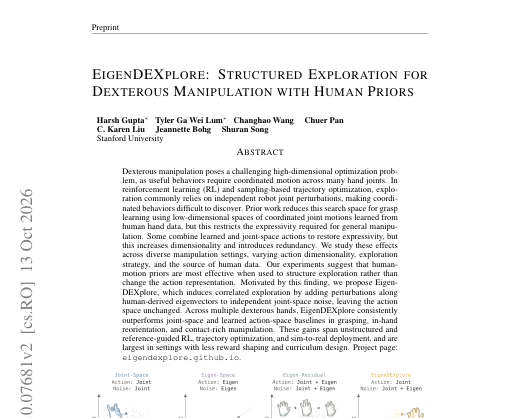
Garment manipulation requires inferring both garment identity and complete configuration from partial, self-occluded observations. This creates a chicken-and-egg problem: completing a partial observation requires a garment-specific deformation prior, while identifying the garment requires a configuration that explains the observation. We introduce ClothAtlas, which jointly identifies garments and estimates their complete configurations from partial point clouds and a library of canonical meshes. A shared graph-conditioned flow-matching model samples configurations for each candidate mesh and ranks candidates by observation fit. The model accommodates different mesh shapes, vertex counts, and connectivities, allowing new garments to be added from canonical meshes alone without retraining. On held-out DexGarmentLab garments, ClothAtlas ranks the correct mesh first among 221 candidates for all 22 test garments from a single flat observation. From a single self-occluded observation, it identifies 15/22 garments, compared with 8/22 for a deterministic graph estimator. Persistent vertex identities support grasp-target localization on real garments, reducing mean error from 15.4 to 6.4 cm overall and from 17.0 to 8.3 cm on occluded targets compared with dense descriptor matching. Project page: https://clothatlas.github.io/

2026-10-07追踪学者 · Jeannette Bohg

RoboJEPA: Scaling Robotic Latent World Models

Artem Zholus, Nicolas Beltran-Velez, Jianhao Yuan, Sarath Chandar, Tushar Nagarajan, Daniel Severo, Koustuv Sinha, Michal Drozdzal 等

Latent world models have shown a remarkable ability to predict future states and to plan in the real world. In practice, however, we lack a principled way to estimate how their cap…

Latent world models have shown a remarkable ability to predict future states and to plan in the real world. In practice, however, we lack a principled way to estimate how their capabilities scale with model size, data, and compute, an open problem that slows progress in the field. In this work we present RoboJEPA, a world model based on the Joint Embedding Predictive Architecture (JEPA) and trained on a large-scale dataset spanning 12 robotic embodiments. We show that RoboJEPA's imagination error, the error of its latent rollouts, follows a second-order power law in compute, allowing us to predict model quality well beyond the scale at which the law is fit. We further show that downstream robotic planning performance improves predictably with compute, and that imagination error is strongly correlated with it, making it a reliable proxy for real-robot evaluation. Finally, we demonstrate that latent world models can be deployed zero-shot as robotic agents, planning toward a single goal image to solve tasks requiring long-horizon planning on real hardware. We release all model checkpoints together with our training and robot deployment code. To our knowledge, this is the first work to establish scaling laws for multi-embodiment robotic world models trained on real robot data, and RoboJEPA, at 8B parameters, is the largest JEPA predictor model trained to date.

cs.AIcs.RO
2026-10-06追踪学者 · Jeannette Bohg

EigenDEXplore: Structured Exploration for Dexterous Manipulation with Human Priors

Harsh Gupta, Tyler Ga Wei Lum, Changhao Wang, Chuer Pan, C. Karen Liu, Jeannette Bohg, Shuran Song

Dexterous manipulation poses a challenging high-dimensional optimization problem, as useful behaviors require coordinated motion across many hand joints. In reinforcement learning …

Dexterous manipulation poses a challenging high-dimensional optimization problem, as useful behaviors require coordinated motion across many hand joints. In reinforcement learning (RL) and sampling-based trajectory optimization, exploration commonly relies on independent robot joint perturbations, making coordinated behaviors difficult to discover. Prior work reduces this search space for grasp learning using low-dimensional spaces of coordinated joint motions learned from human hand data, but this restricts the expressivity required for general manipulation. Some combine learned and joint-space actions to restore expressivity, but this increases dimensionality and introduces redundancy. We study these effects across diverse manipulation settings, varying action dimensionality, exploration strategy, and the source of human data. Our experiments suggest that human-motion priors are most effective when used to structure exploration rather than change the action representation. Motivated by this finding, we propose EigenDEXplore, which induces correlated exploration by adding perturbations along human-derived eigenvectors to independent joint-space noise, leaving the action space unchanged. Across multiple dexterous hands, EigenDEXplore consistently outperforms joint-space and learned action-space baselines in grasping, in-hand reorientation, and contact-rich manipulation. These gains span unstructured and reference-guided RL, trajectory optimization, and sim-to-real deployment, and are largest in settings with less reward shaping and curriculum design.

2026-10-01追踪学者 · Jeannette Bohg

SoTa: Soft Tactile Skins for Dexterous Manipulation

Jingyun Yang, Baiyu Shi, Timothy Yu, Haitian Liu, Alberta Longhini, Weichen Wang, Rika Antonova, Zhenan Bao 等

A growing body of work suggests that tactile sensing gives robot policies contact information that complements vision in dexterous manipulation. However, visuo-tactile robot data r…

A growing body of work suggests that tactile sensing gives robot policies contact information that complements vision in dexterous manipulation. However, visuo-tactile robot data remains scarce: dexterous demonstrations require teleoperating robots, which limits dataset scale. Human demonstrations are far cheaper to collect and offer a path to scale this data, but only if human and robot hands carry tactile sensors with corresponding signals. This requires sensors that conform to different hand geometries, cover the full hand, and share a common layout across embodiments. We present SoTa, a low-cost capacitive tactile skin that provides full-hand coverage on humans and robots while preserving a shared layout of 202 taxels across corresponding finger and palm regions. Our multilayer design with fabric electrodes enables in-house fabrication of thin, soft skins with customizable geometry for under $10 in materials per skin. The sensor retains over 97% of its initial response span after 10,000 loading-unloading cycles with traces retaining continuity through 1,280 tight-fist folding cycles. The shared taxel layout supports human-robot co-training with a common tactile encoder and no learned cross-sensor mapping. Across three contact-rich manipulation tasks, tactile observations improve in-distribution success over vision-only policies. With a fixed robot demonstration budget, adding human demonstrations more than doubles mean success across eight evaluation conditions, from 22.8% to 45.9%, improving success in all five out-of-distribution conditions. We plan to open-source the resources needed to fabricate and operate these skins.

Chelsea Finn 5 篇 专属页 →

2026-10-29追踪学者 · Chelsea Finn

Cross-Controller Transfer via In-Context Behavior Adaptation

Jonathan Yang, Chelsea Finn, Dorsa Sadigh

Generalist robot policies increasingly learn from data collected across diverse tasks and embodiments, yet typically assume a single controller for each robot. This assumption limi…

Generalist robot policies increasingly learn from data collected across diverse tasks and embodiments, yet typically assume a single controller for each robot. This assumption limits transfer because different controllers can assign different physical meanings to the same action and may require different strategies to complete a task. We study how to transfer robot data across both embodiments and controllers without allowing conflicting action interpretations to interfere with learning. Our setting spans six controller types as well as variations in controller gains and compliance. We propose a framework that encodes behavioral interaction under a controller through examples of commanded actions and the resulting robot motions. A transformer context encoder summarizes these interactions, allowing a single policy to adapt in context. Across real-world experiments, our method improves average success by 33 percentage points over naive data pooling, achieves 50% success on unseen controller modes and 52% on unseen controller gains, and transfers to tasks with limited controller-specific data. On contact-rich tasks such as USB insertion and surface wiping, behavioral interaction context enables the policy to adapt not only its actions but also its strategy. Our results provide a path toward generalist robot policies that can leverage data collected across diverse action interpretations. For more information, visit \href{https://controller-transfer.github.io}{https://controller-transfer.github.io}.

2026-10-15追踪学者 · Chelsea Finn

Generative Value Classifier

Alexander Swerdlow, Perry Dong, Chelsea Finn

Q-learning is premised on learning a function to predict the value of a state-action pair, with the goal of using such a function to guide policy improvement. Most approaches learn…

Q-learning is premised on learning a function to predict the value of a state-action pair, with the goal of using such a function to guide policy improvement. Most approaches learn this function from scratch using scalar or distributional return targets. This discriminative approach leaves another source of supervision for learning representations unused: the actions themselves. Rather than directly predict the return of a state-action pair, we ask the reverse question: how likely is the action under each possible return? This perspective provides a critic whose generative component is a return-conditioned policy, which can share the actor's architecture. Training this policy supervises the critic with every action rather than with returns alone, and a squared-error loss anchors the critic's Q-value to the bootstrapped target. We evaluate our approach on both offline and online RL tasks and show gains over leading discriminative methods, including distributional RL methods.

2026-10-15追踪学者 · Chelsea Finn

Librarian Agents: Training LLMs to Curate Long-Context Workspaces that Anticipate Future Queries

Anikait Singh, Teresa Zhang, Yoonho Lee, Roshen Sanjay Nair, Aviral Kumar, Chelsea Finn

Reasoning over long document contexts remains a challenge for large language models (LLMs). Standard retrieval methods are inherently reactive, bottlenecking agents with complex, c…

Reasoning over long document contexts remains a challenge for large language models (LLMs). Standard retrieval methods are inherently reactive, bottlenecking agents with complex, cross-document reasoning at inference time, while precomputed structures like knowledge graphs often fall short because they rely on rigid heuristics. Instead, can we allow agents to perform anticipatory directed curation: learning to proactively reorganize unstructured corpora prior to inference to efficiently serve diverse future queries. We build on a key asymmetry in modern agentic harnesses (e.g., Claude Code): while LLM agents are adept at navigating existing filesystems to solve an immediate task, they are rarely trained to construct reusable workspaces for future use. To instantiate this capability, we introduce Librarian Agents, a framework in which a builder agent transforms raw documents into a hierarchical filesystem of synthetic files and reference links, which forms a workspace tailored for a downstream answering agent. We formulate workspace construction as a Markov decision process and optimize the builder policy via reinforcement learning to directly maximize downstream answering accuracy. Empirically, Librarian Agents outperforms the strongest retrieval and precomputation baselines by 33 percentage points on BrowseComp-Plus, amortizes upfront construction costs across repeated queries, and generalizes zero-shot to unseen domains on BRIGHT with a 31-point average accuracy improvement.

cs.LGcs.AIcs.CL
2026-10-05追踪学者 · Chelsea Finn

Mulligan: Performance-Guided Data Collection for Efficient On-Robot Learning

Lars Ankile, Perry Dong, Rohan Bhowmik, Aneesh Muppidi, David D. Yuan, Shuran Song, Chelsea Finn

Learning from human demonstrations is a reliable way to teach robots new tasks, but the gains from each additional demonstration shrink as the policy improves. Continued improvemen…

Learning from human demonstrations is a reliable way to teach robots new tasks, but the gains from each additional demonstration shrink as the policy improves. Continued improvement can instead come from supervised deployment, where an operator places the objects and intervenes when the policy fails. We ask how to maximize improvement from a fixed budget of supervised episodes on high-precision manipulation tasks with wide ranges of object placements. We observe that failures can concentrate in a small subset of initial states, so uniform collection spends much of the operator's time on states the policy already handles. Mulligan makes the initial-state distribution a decision, starting each round's episodes at observed failures and untried states. To further improve data efficiency, we augment interactive imitation learning with a value function trained on all data, including failures that imitation discards. Across three real-world tasks evaluated on 2,550 held-out, blinded episodes and two simulated tasks, Mulligan outperforms uniform initial-state sampling at matched collection budgets, and combined with value-based action selection, HiL-IDQL+Mulligan, improves final real-task success by 10-34 percentage points. With operator interventions, the human-robot team completes 98% of collection episodes, remaining productive while the policy learns. Videos, code, and data are available at https://mulligan.page/.

2026-10-01追踪学者 · Chelsea Finn

ScholarCatalyst: A Benchmark for Retrieving Papers That Inspire New Research

Sohyeon Kim, Yoonho Lee, Bo Liu, Dayoon Ko, Rulin Shao, Seungone Kim, Graham Neubig, Pang Wei Koh 等

What makes great scientists great? Even as AI systems start to make progress on open problems, scientists remain far ahead of them at sensing which prior idea, buried in an ever-gr…

What makes great scientists great? Even as AI systems start to make progress on open problems, scientists remain far ahead of them at sensing which prior idea, buried in an ever-growing archive of research, a new problem needs. To study this skill, we draw on researchers who know firsthand which earlier work advanced their completed projects, with papers serving as pointers to the ideas within. Using our automated pipeline that makes author annotation scalable, we build ScholarCatalyst by having 184 lead authors of 207 recent computer science papers label which candidates did or could have advanced their project, each with a detailed rationale. We introduce a retrieval task with author-provided judgments: given an initial research question, retrieve these papers from only the literature available when the project began. Agentic search does no better than embedding retrieval (0.42 vs. 0.48 Recall@20) despite calling that same retriever as a tool. Even an agent built on Claude Fable 5.1, which may have seen the completed papers during training, reaches only 0.51 R@20. These results highlight the need for new training recipes that equip models with expert intuition for searching broad corpora. We envision ScholarCatalyst as a step toward scientific agents that can take a half-formed idea and point to the prior research it needs.

cs.AIcs.CLcs.IR

Dorsa Sadigh 1 篇 专属页 →

2026-10-29追踪学者 · Dorsa Sadigh

Cross-Controller Transfer via In-Context Behavior Adaptation

Jonathan Yang, Chelsea Finn, Dorsa Sadigh

Generalist robot policies increasingly learn from data collected across diverse tasks and embodiments, yet typically assume a single controller for each robot. This assumption limi…

Generalist robot policies increasingly learn from data collected across diverse tasks and embodiments, yet typically assume a single controller for each robot. This assumption limits transfer because different controllers can assign different physical meanings to the same action and may require different strategies to complete a task. We study how to transfer robot data across both embodiments and controllers without allowing conflicting action interpretations to interfere with learning. Our setting spans six controller types as well as variations in controller gains and compliance. We propose a framework that encodes behavioral interaction under a controller through examples of commanded actions and the resulting robot motions. A transformer context encoder summarizes these interactions, allowing a single policy to adapt in context. Across real-world experiments, our method improves average success by 33 percentage points over naive data pooling, achieves 50% success on unseen controller modes and 52% on unseen controller gains, and transfers to tasks with limited controller-specific data. On contact-rich tasks such as USB insertion and surface wiping, behavioral interaction context enables the policy to adapt not only its actions but also its strategy. Our results provide a path toward generalist robot policies that can leverage data collected across diverse action interpretations. For more information, visit \href{https://controller-transfer.github.io}{https://controller-transfer.github.io}.

Fei-Fei Li 0 篇

窗口期内没有新论文