Tech Station

学者追踪 › Stanford › Chelsea Finn

Chelsea Finn

Stanford · 最近 45 天 5 篇
#12026-10-29追踪学者 · Chelsea Finn

Cross-Controller Transfer via In-Context Behavior Adaptation

Jonathan Yang, Chelsea Finn, Dorsa Sadigh

Generalist robot policies increasingly learn from data collected across diverse tasks and embodiments, yet typically assume a single controller for each robot. This assumption limi…

Generalist robot policies increasingly learn from data collected across diverse tasks and embodiments, yet typically assume a single controller for each robot. This assumption limits transfer because different controllers can assign different physical meanings to the same action and may require different strategies to complete a task. We study how to transfer robot data across both embodiments and controllers without allowing conflicting action interpretations to interfere with learning. Our setting spans six controller types as well as variations in controller gains and compliance. We propose a framework that encodes behavioral interaction under a controller through examples of commanded actions and the resulting robot motions. A transformer context encoder summarizes these interactions, allowing a single policy to adapt in context. Across real-world experiments, our method improves average success by 33 percentage points over naive data pooling, achieves 50% success on unseen controller modes and 52% on unseen controller gains, and transfers to tasks with limited controller-specific data. On contact-rich tasks such as USB insertion and surface wiping, behavioral interaction context enables the policy to adapt not only its actions but also its strategy. Our results provide a path toward generalist robot policies that can leverage data collected across diverse action interpretations. For more information, visit \href{https://controller-transfer.github.io}{https://controller-transfer.github.io}.

#22026-10-15追踪学者 · Chelsea Finn

Generative Value Classifier

Alexander Swerdlow, Perry Dong, Chelsea Finn

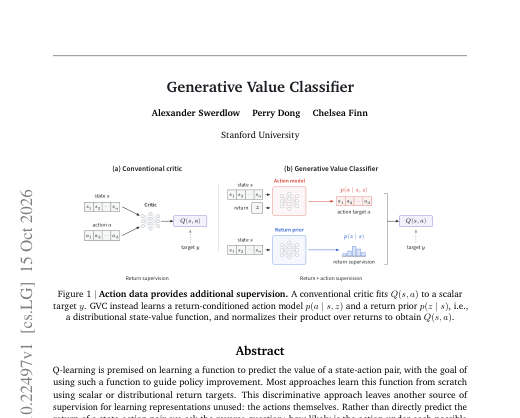
Q-learning is premised on learning a function to predict the value of a state-action pair, with the goal of using such a function to guide policy improvement. Most approaches learn…

Q-learning is premised on learning a function to predict the value of a state-action pair, with the goal of using such a function to guide policy improvement. Most approaches learn this function from scratch using scalar or distributional return targets. This discriminative approach leaves another source of supervision for learning representations unused: the actions themselves. Rather than directly predict the return of a state-action pair, we ask the reverse question: how likely is the action under each possible return? This perspective provides a critic whose generative component is a return-conditioned policy, which can share the actor's architecture. Training this policy supervises the critic with every action rather than with returns alone, and a squared-error loss anchors the critic's Q-value to the bootstrapped target. We evaluate our approach on both offline and online RL tasks and show gains over leading discriminative methods, including distributional RL methods.

#32026-10-15追踪学者 · Chelsea Finn

Librarian Agents: Training LLMs to Curate Long-Context Workspaces that Anticipate Future Queries

Anikait Singh, Teresa Zhang, Yoonho Lee, Roshen Sanjay Nair, Aviral Kumar, Chelsea Finn

Reasoning over long document contexts remains a challenge for large language models (LLMs). Standard retrieval methods are inherently reactive, bottlenecking agents with complex, c…

Reasoning over long document contexts remains a challenge for large language models (LLMs). Standard retrieval methods are inherently reactive, bottlenecking agents with complex, cross-document reasoning at inference time, while precomputed structures like knowledge graphs often fall short because they rely on rigid heuristics. Instead, can we allow agents to perform anticipatory directed curation: learning to proactively reorganize unstructured corpora prior to inference to efficiently serve diverse future queries. We build on a key asymmetry in modern agentic harnesses (e.g., Claude Code): while LLM agents are adept at navigating existing filesystems to solve an immediate task, they are rarely trained to construct reusable workspaces for future use. To instantiate this capability, we introduce Librarian Agents, a framework in which a builder agent transforms raw documents into a hierarchical filesystem of synthetic files and reference links, which forms a workspace tailored for a downstream answering agent. We formulate workspace construction as a Markov decision process and optimize the builder policy via reinforcement learning to directly maximize downstream answering accuracy. Empirically, Librarian Agents outperforms the strongest retrieval and precomputation baselines by 33 percentage points on BrowseComp-Plus, amortizes upfront construction costs across repeated queries, and generalizes zero-shot to unseen domains on BRIGHT with a 31-point average accuracy improvement.

cs.LGcs.AIcs.CL
#42026-10-05追踪学者 · Chelsea Finn

Mulligan: Performance-Guided Data Collection for Efficient On-Robot Learning

Lars Ankile, Perry Dong, Rohan Bhowmik, Aneesh Muppidi, David D. Yuan, Shuran Song, Chelsea Finn

Learning from human demonstrations is a reliable way to teach robots new tasks, but the gains from each additional demonstration shrink as the policy improves. Continued improvemen…

Learning from human demonstrations is a reliable way to teach robots new tasks, but the gains from each additional demonstration shrink as the policy improves. Continued improvement can instead come from supervised deployment, where an operator places the objects and intervenes when the policy fails. We ask how to maximize improvement from a fixed budget of supervised episodes on high-precision manipulation tasks with wide ranges of object placements. We observe that failures can concentrate in a small subset of initial states, so uniform collection spends much of the operator's time on states the policy already handles. Mulligan makes the initial-state distribution a decision, starting each round's episodes at observed failures and untried states. To further improve data efficiency, we augment interactive imitation learning with a value function trained on all data, including failures that imitation discards. Across three real-world tasks evaluated on 2,550 held-out, blinded episodes and two simulated tasks, Mulligan outperforms uniform initial-state sampling at matched collection budgets, and combined with value-based action selection, HiL-IDQL+Mulligan, improves final real-task success by 10-34 percentage points. With operator interventions, the human-robot team completes 98% of collection episodes, remaining productive while the policy learns. Videos, code, and data are available at https://mulligan.page/.

#52026-10-01追踪学者 · Chelsea Finn

ScholarCatalyst: A Benchmark for Retrieving Papers That Inspire New Research

Sohyeon Kim, Yoonho Lee, Bo Liu, Dayoon Ko, Rulin Shao, Seungone Kim, Graham Neubig, Pang Wei Koh 等

What makes great scientists great? Even as AI systems start to make progress on open problems, scientists remain far ahead of them at sensing which prior idea, buried in an ever-gr…

What makes great scientists great? Even as AI systems start to make progress on open problems, scientists remain far ahead of them at sensing which prior idea, buried in an ever-growing archive of research, a new problem needs. To study this skill, we draw on researchers who know firsthand which earlier work advanced their completed projects, with papers serving as pointers to the ideas within. Using our automated pipeline that makes author annotation scalable, we build ScholarCatalyst by having 184 lead authors of 207 recent computer science papers label which candidates did or could have advanced their project, each with a detailed rationale. We introduce a retrieval task with author-provided judgments: given an initial research question, retrieve these papers from only the literature available when the project began. Agentic search does no better than embedding retrieval (0.42 vs. 0.48 Recall@20) despite calling that same retriever as a tool. Even an agent built on Claude Fable 5.1, which may have seen the completed papers during training, reaches only 0.51 R@20. These results highlight the need for new training recipes that equip models with expert intuition for searching broad corpora. We envision ScholarCatalyst as a step toward scientific agents that can take a half-formed idea and point to the prior research it needs.

cs.AIcs.CLcs.IR

同实验室的其他学者