Tech Station

学者追踪 › Stanford › Shuran Song

Shuran Song

Stanford · 最近 45 天 7 篇
#12026-11-01追踪学者 · Shuran Song

Beyond Validation Loss: Coverage and Reliability Dynamics in Robot Policy Pretraining

Zhanyi Sun, Max Simchowitz, Shuran Song

In modern robot learning, generative robot policies are first pretrained through supervised learning from demonstrations, then refined through reinforcement learning, supervised fi…

In modern robot learning, generative robot policies are first pretrained through supervised learning from demonstrations, then refined through reinforcement learning, supervised finetuning, or other forms of posttraining. Yet conventional pretraining metrics, such as validation loss and average task success, provide an incomplete account of which policies support both effective direct deployment and subsequent posttraining. In this work, we study closed-loop pass@k, which evaluates the probability that k rollouts from the same initial condition attain at least one success. Thus, pass@1 measures mean task success; large-k pass@k measures whether success remains reachable under repeated sampling. Across a wide range of posttraining recipes, we show that large-k pass@k reveals posttraining differences not captured by pass@1. In particular, checkpoints with similar pass@1 but different large-k pass@k have different posttraining performance. Moreover, we show pass@k peaks at different checkpoints during supervised pretraining, revealing a coverage-reliability tradeoff over the course of training. Based on these observations, we propose two practical interventions: (1) a purely offline checkpoint-selection criterion that balances coverage and reliability without closed-loop evaluation, and (2) a generative data augmentation procedure that expands supervision beyond the finite demonstration set, preserving large-k pass@k while maintaining or improving pass@1 and raising the observed coverage-reliability Pareto frontier. Together, our results motivate evaluation, checkpoint selection, and training procedures that explicitly account for posttraining. Blog post, visualizations, and code are available at https://zhanyisun.github.io/robot-policy-learning-dynamics/.

#22026-10-09追踪学者 · Shuran Song

Chronos Policy: Learning Robot Policies on Physical Time

Changhao Wang, Jaden Clark, Shuran Song

Robot policies often convert sensing and control into fixed-rate observation-action sequences, leaving physical time implicit in sequence position. This assumption breaks when obse…

Robot policies often convert sensing and control into fixed-rate observation-action sequences, leaving physical time implicit in sequence position. This assumption breaks when observation rates or delays vary, or when inference latency changes. We introduce Chronos Policy, which makes physical time explicit by conditioning on observation capture times and desired action execution times. We study two ways to incorporate time into a diffusion transformer: adding timestamp embeddings to token features, or encoding physical time in positional encoding through time-aware rotary positional encodings (time-aware RoPE). We find that time-aware RoPE is more robust, allowing attention to depend directly on physical time while keeping token content unchanged. During training, we temporally randomize which observations are sampled and when the action chunk begins, exposing the policy to a wider range of sensing and execution schedules that may occur during deployments. This also enables learning from asynchronous, multi-rate data without forcing all measurements onto a fixed temporal grid. Across simulation and real-world experiments, Chronos Policy improves performance on dynamic tasks, where observation-to-action timing is critical, and on multisensory tasks, where the relative timing between observations matters. On standard quasi-static tasks, it preserves nominal performance while improving robustness to changes in sensing and inference timing.

#32026-10-08追踪学者 · Shuran Song

PanTact: Teaching Whole-Body Dexterity with a Wearable Contact Interface

Xiaomeng Xu, Han Zhang, Zhian Ruan, Xiaofeng Guo, Jinkun Cao, Ruihan Yang, Carmelo Sferrazza, Shuran Song 等

Humanoid robots have many degrees of freedom and contact surfaces, yet most loco-manipulation research restricts manipulation to the hands and avoids other body contacts with the e…

Humanoid robots have many degrees of freedom and contact surfaces, yet most loco-manipulation research restricts manipulation to the hands and avoids other body contacts with the environment. To extend manipulation beyond the hands, we present PanTact, a system that learns humanoid whole-body dexterity, the capability to manipulate with any suitable body surface, directly from robot-free human demonstrations. Our key idea is to use contact as manipulation-centric information that transfers across embodiments. Contact locations and timing specify the interactions needed to accomplish a task, while the robot chooses how to coordinate its body to realize them within its own physical constraints. Specifically, PanTact captures, learns, and executes whole-body contact via: 1) a wearable, robot-free data collection interface that augments egocentric vision and bimanual UMI grippers with whole-body modular contact patches to record body contact locations and states; 2) a visuomotor policy that mitigates the egocentric observation gap and predicts whole-body contact goals; and 3) contact-aware whole-body control formulations that realize active contact goals using suitable robot surfaces. We deploy PanTact on a Unitree G1 humanoid without additional body contact sensors, demonstrating whole-body dexterity involving body support, pushing, sweeping, and load-sharing. Website: https://pantact.github.io

#42026-10-06追踪学者 · Shuran Song

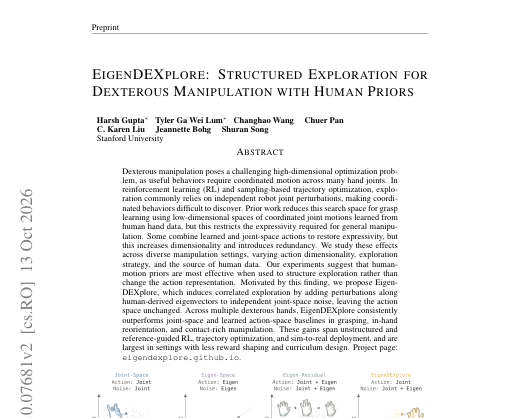
EigenDEXplore: Structured Exploration for Dexterous Manipulation with Human Priors

Harsh Gupta, Tyler Ga Wei Lum, Changhao Wang, Chuer Pan, C. Karen Liu, Jeannette Bohg, Shuran Song

Dexterous manipulation poses a challenging high-dimensional optimization problem, as useful behaviors require coordinated motion across many hand joints. In reinforcement learning …

Dexterous manipulation poses a challenging high-dimensional optimization problem, as useful behaviors require coordinated motion across many hand joints. In reinforcement learning (RL) and sampling-based trajectory optimization, exploration commonly relies on independent robot joint perturbations, making coordinated behaviors difficult to discover. Prior work reduces this search space for grasp learning using low-dimensional spaces of coordinated joint motions learned from human hand data, but this restricts the expressivity required for general manipulation. Some combine learned and joint-space actions to restore expressivity, but this increases dimensionality and introduces redundancy. We study these effects across diverse manipulation settings, varying action dimensionality, exploration strategy, and the source of human data. Our experiments suggest that human-motion priors are most effective when used to structure exploration rather than change the action representation. Motivated by this finding, we propose EigenDEXplore, which induces correlated exploration by adding perturbations along human-derived eigenvectors to independent joint-space noise, leaving the action space unchanged. Across multiple dexterous hands, EigenDEXplore consistently outperforms joint-space and learned action-space baselines in grasping, in-hand reorientation, and contact-rich manipulation. These gains span unstructured and reference-guided RL, trajectory optimization, and sim-to-real deployment, and are largest in settings with less reward shaping and curriculum design.

#52026-10-05追踪学者 · Shuran Song

Fluorescence-enhanced Whisker Array with Vision-based Deformation Analysis for Underwater Source Localization

Xiaochi Xie, Hao Li, Shixuan Zhao, Siyue Yao, Shuran Song, Mark R. Cutkosky

Deep-water biological observation is essential for understanding marine organisms and their interactions with the environment. However, conventional optical and acoustic approaches…

Deep-water biological observation is essential for understanding marine organisms and their interactions with the environment. However, conventional optical and acoustic approaches can introduce stimuli that alter animal behavior and bias biological observations. This paper proposes a fluorescence-enhanced whisker array sensing system that pinpoints underwater hydrodynamic sources through local optical readout rather than direct source imaging. Five spatially oriented whiskers, fabricated with nitinol cores and fluorescent urethane shells, are integrated with ultraviolet excitation and a monocular camera. Image enhancement and segmentation are applied to track the whisker deformation. A lightweight convolutional neural network captures temporal and cross-whisker features from 2 s sequences to estimate source localization. Pool experiments achieve a mean spatial localization error of 88 mm, with 73.5 mm in radius and $2.5^\circ$ in angle, across a test region of 600 mm with $\pm30^\circ$. Real-time localization of a moving thruster demonstrates the capability of the proposed method in dynamic scenarios, highlighting its potential for integration into underwater robots for hydrodynamic source detection, localization, and tracking in low-light environments.

#62026-10-05追踪学者 · Shuran Song

Mulligan: Performance-Guided Data Collection for Efficient On-Robot Learning

Lars Ankile, Perry Dong, Rohan Bhowmik, Aneesh Muppidi, David D. Yuan, Shuran Song, Chelsea Finn

Learning from human demonstrations is a reliable way to teach robots new tasks, but the gains from each additional demonstration shrink as the policy improves. Continued improvemen…

Learning from human demonstrations is a reliable way to teach robots new tasks, but the gains from each additional demonstration shrink as the policy improves. Continued improvement can instead come from supervised deployment, where an operator places the objects and intervenes when the policy fails. We ask how to maximize improvement from a fixed budget of supervised episodes on high-precision manipulation tasks with wide ranges of object placements. We observe that failures can concentrate in a small subset of initial states, so uniform collection spends much of the operator's time on states the policy already handles. Mulligan makes the initial-state distribution a decision, starting each round's episodes at observed failures and untried states. To further improve data efficiency, we augment interactive imitation learning with a value function trained on all data, including failures that imitation discards. Across three real-world tasks evaluated on 2,550 held-out, blinded episodes and two simulated tasks, Mulligan outperforms uniform initial-state sampling at matched collection budgets, and combined with value-based action selection, HiL-IDQL+Mulligan, improves final real-task success by 10-34 percentage points. With operator interventions, the human-robot team completes 98% of collection episodes, remaining productive while the policy learns. Videos, code, and data are available at https://mulligan.page/.

#72026-10-01追踪学者 · Shuran Song

NEEDLEWORK: Offline Rewriting of Robot Data with Verified Local Stitches

Juntao Ren, Yifan Hou, Shuran Song

Robot demonstrations may contain useful behavior even when individual episodes are inefficient or unsuccessful. Trajectory stitching offers a way to compose these behaviors into im…

Robot demonstrations may contain useful behavior even when individual episodes are inefficient or unsuccessful. Trajectory stitching offers a way to compose these behaviors into improved training data, but identifying useful connections and verifying their feasibility is difficult in high-dimensional robot data, where many prior methods rely on low-dimensional state representations. We introduce NEEDLE, an offline dataset-augmentation algorithm that addresses these challenges by adding short, verified action bridges between recorded observations in high-dimensional robot demonstrations. First, NEEDLE identifies and creates connections that bypass suboptimal detours, broaden action coverage, and augment the original dataset with failed trajectories, using only RGB images, proprioception, and episode-level outcomes, without new environment interaction or privileged object state. Next, we present a sampling technique that incorporates accepted bridges into policy training without synthesizing intermediate images or discarding the original demonstrations, allowing policies to learn alternative actions while retaining the original dataset's coverage. On real-robot tasks, NEEDLE improves success rate over the strongest baseline on each task by an average of 21 percentage points. Videos and supplementary materials are on https://needle-work.github.io/.

同实验室的其他学者