Tech Station

学者追踪 › Stanford › C. Karen Liu

C. Karen Liu

Stanford · 最近 45 天 8 篇
#12026-11-04追踪学者 · C. Karen Liu

Can Astra Solve RoboMME without Breaking the Bank?

Bingao Chen, Haoquan Fang, C. Karen Liu

Robotic manipulation often requires remembering information that is no longer visible, such as an object's location before occlusion or the order of a demonstrated action sequence.…

Robotic manipulation often requires remembering information that is no longer visible, such as an object's location before occlusion or the order of a demonstrated action sequence. A large vision-language planner can read this history, but calling it before every action chunk is slow and costly. We present a three-tier system for the RoboMME benchmark. GPT-6 Astra (System 2) selects a grounded subtask from stored visual history, a $π_{0.5}$ vision-language-action policy (System 1) executes it, and a fine-tuned Qwen3-VL-4B monitor (System 1.5) checks after each action chunk whether the subtask is finished. The instruction is kept until the monitor reports completion or a task-specific event occurs, while the policy keeps acting on new observations. On RoboMME, the system succeeds in 79.13% of episodes with an average of 3.63 Astra calls and 80.84 seconds per episode. This is 34.62 points above the best published non-oracle baseline and 4.95 points below GroundSG+Oracle, which gives the low-level policy ground-truth subgoals.

#22026-10-19追踪学者 · C. Karen Liu

SSIO: Self-Supervised Inertial Odometry

Yuheng Qiu, Yutian Chen, Carlton Cort, Weison Huang, Shibo Zhao, Pieter Abbeel, Rocky Duan, Koushil Sreenath 等

Learning inertial odometry for a new platform usually requires ground-truth trajectories. We show that an inertial odometry model can instead be trained from scratch by a myopic te…

Learning inertial odometry for a new platform usually requires ground-truth trajectories. We show that an inertial odometry model can instead be trained from scratch by a myopic teacher that integrates the IMU over each short window independently, a scheme we call integration self-supervision. Interestingly, although supervised only by short-window velocity changes, the student learns to directly predict velocity, and does so more accurately than its integration teacher. Pose graph distillation then refines the model with sequence-consistent targets from a pose graph over many windows. Training on a new platform therefore no longer requires collecting ground-truth trajectories, but only calibrating the IMU and recording data during normal operation. Across six datasets spanning pedestrians, drones, quadrupeds, and a humanoid, the same recipe with no velocity or position labels trains models that come within 0.07~m/s average velocity error of a same-architecture supervised baseline.

#32026-10-17追踪学者 · C. Karen Liu

Action-Aligned Latent Planning for Versatile Humanoid Loco-Manipulation

Yutang Lin, Guanya Shi, C. Karen Liu

Learning a single perceptive policy for diverse humanoid loco-manipulation requires unifying high-level task decisions without losing the state-dependent physical responses that ma…

Learning a single perceptive policy for diverse humanoid loco-manipulation requires unifying high-level task decisions without losing the state-dependent physical responses that make each interaction succeed. This makes the representation between high-level planning and whole-body control critical: kinematic or contact targets provide compact abstractions but do not directly encode interaction-specific control responses, while directly predicting low-level actions requires the planner to model high-frequency closed-loop feedback. We propose FIBER, a framework that uses the executable latent space of a frozen behavioral foundation model (BFM) as a shared planning representation for heterogeneous interaction skills. Our latent policy projection (LPP) maps independently acquired task-specific policies into this representation by identifying latent commands whose induced actions match their local control responses, enabling lower-rate planning while retaining the BFM's high-frequency state feedback. After projection, we aggregate closed-loop latent rollouts from all skills and train a single perceptive flow planner entirely offline. We further introduce AH-BFM, an adaptive-horizon BFM trained with multi-gamma forward-backward (FB) learning to support both precise control and temporally extended whole-body behavior. We evaluate FIBER on box pickup, door opening, and object grasping in simulation and on a real Unitree G1 humanoid. Across 128 diverse variations per task in simulation, FIBER achieves 42.0% mean success, more than tripling projected latent replay (11.6%) and substantially outperforming kinematic planning (3.5%). Real-world experiments further demonstrate sim-to-real transfer, skill chaining, and conditional steering through the same unified planner.

#42026-10-14追踪学者 · C. Karen Liu

FoveaVLA: Foveation Actions Replace the Wrist Camera in VLAs

Bingao Chen, Lihan Zha, C. Karen Liu, Guy Tevet

We present FoveaVLA, a Vision-Language-Action (VLA) model that replaces the wrist camera with learned foveation actions. Wrist cameras provide close-up detail but restrict the view…

We present FoveaVLA, a Vision-Language-Action (VLA) model that replaces the wrist camera with learned foveation actions. Wrist cameras provide close-up detail but restrict the view to the end-effector's surroundings. External cameras see the whole scene, but the policy receives them at low resolution, so the fine detail needed for manipulation is lost. FoveaVLA recovers this detail by predicting, alongside each action chunk, the interaction region to observe at the next policy query. The policy then receives crops of these regions, taken from the original-resolution images, together with the full views. We build FoveaVLA on $π_{0.5}$ in two configurations, Single and Dual, using one or two external stereo cameras with full and foveal RGB and depth inputs, and post-train both on DROID with RoboInter interaction annotations. Across four real-world task suites, FoveaVLA-Single achieves 70.8% success with one external RGB-D view, and FoveaVLA-Dual achieves 77.1%, versus 52.1% for the wrist-equipped $π_{0.5}$. Both match the baseline on plain pick-and-place and improve success with distractors, cloth manipulation, and far-away objects.

#52026-10-06追踪学者 · C. Karen Liu

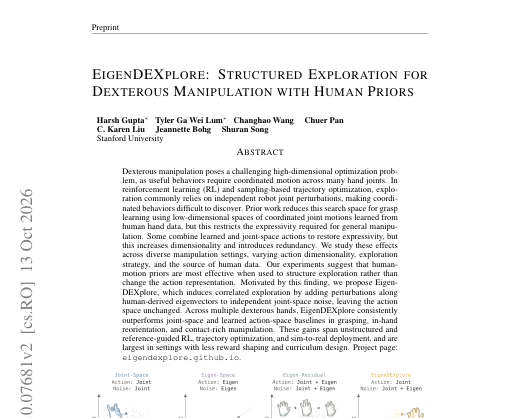
EigenDEXplore: Structured Exploration for Dexterous Manipulation with Human Priors

Harsh Gupta, Tyler Ga Wei Lum, Changhao Wang, Chuer Pan, C. Karen Liu, Jeannette Bohg, Shuran Song

Dexterous manipulation poses a challenging high-dimensional optimization problem, as useful behaviors require coordinated motion across many hand joints. In reinforcement learning …

Dexterous manipulation poses a challenging high-dimensional optimization problem, as useful behaviors require coordinated motion across many hand joints. In reinforcement learning (RL) and sampling-based trajectory optimization, exploration commonly relies on independent robot joint perturbations, making coordinated behaviors difficult to discover. Prior work reduces this search space for grasp learning using low-dimensional spaces of coordinated joint motions learned from human hand data, but this restricts the expressivity required for general manipulation. Some combine learned and joint-space actions to restore expressivity, but this increases dimensionality and introduces redundancy. We study these effects across diverse manipulation settings, varying action dimensionality, exploration strategy, and the source of human data. Our experiments suggest that human-motion priors are most effective when used to structure exploration rather than change the action representation. Motivated by this finding, we propose EigenDEXplore, which induces correlated exploration by adding perturbations along human-derived eigenvectors to independent joint-space noise, leaving the action space unchanged. Across multiple dexterous hands, EigenDEXplore consistently outperforms joint-space and learned action-space baselines in grasping, in-hand reorientation, and contact-rich manipulation. These gains span unstructured and reference-guided RL, trajectory optimization, and sim-to-real deployment, and are largest in settings with less reward shaping and curriculum design.

#62026-10-02追踪学者 · C. Karen Liu

EyeRobot 2.0: Active Gaze for Precise Manipulation without Wrist Cameras

Kush Hari, Justin Kerr, Nidhya Shivakumar, Samarth Mahapatra, Carmelo Sferrazza, Jiahui Lei, Jitendra Malik, C. Karen Liu 等

Inspired by human vision, we introduce a framework using active gaze to enable fine-grained bimanual manipulation with only a single stereo camera. EyeRobot 2.0 physically attends …

Inspired by human vision, we introduce a framework using active gaze to enable fine-grained bimanual manipulation with only a single stereo camera. EyeRobot 2.0 physically attends to a 3D fixation point in the scene by swiveling two eye viewpoints to center their gaze on it. The resulting images are processed foveally by allocating more visual tokens to the image centers, focusing computation on task-relevant features. Such Active Visual Fixation (AVF) requires carefully coordinated gaze during task execution, which we accomplish hierarchically by first training a low-level gaze servoing policy conditioned on a goal object, then training a target selector which emits fixation goals based on task progress. Both modules are trained with RL on real-world data: the first is trained with a dense geometric reward and the second co-trains with the BC gripper policy which allows it to discover fixation sequences that can resemble a human's fixation sequence while performing the task. EyeRobot 2.0 further takes advantage of fixation by canonicalizing gripper information into a fixation-relative SE(3) frame, which compacts the size of the action distribution to learn. We collect teleoperation data for 7 real-world and 6 simulated tasks, and conduct over 1000 physical and 1800 simulated robot trials comparing EyeRobot 2.0 against passive stereo and ego + wrist camera policies trained on the same data. Removing wrist cameras is costly for standard policies: with only passive stereo, real-world success drops from 52% to 27%. EyeRobot 2.0 closes this gap with only stereo, outperforming passive stereo by 40% in real and 20% in sim. It matches ego + wrist policies when their wrist views are clear (69% vs. 64%), and more than doubles their success when grasped objects occlude the wrist cameras (48% vs. 22%)

#72026-09-30追踪学者 · C. Karen Liu

DITTO-X: Forward and Reverse Teleoperation for Dexterous Manipulation and Human Intervention

Zhanpeng He, Joaquin Palacios, Zhangyu Wang, Chenhao Li, Katelyn Lee, Matei Ciocarlie, C. Karen Liu, Jiajun Wu

Teleoperated demonstrations are a primary source of data for robot manipulation, and teleoperated interventions are a primary mechanism for correcting policies at deployment. Yet m…

Teleoperated demonstrations are a primary source of data for robot manipulation, and teleoperated interventions are a primary mechanism for correcting policies at deployment. Yet most teleoperation systems close the loop through vision alone and are built around parallel-jaw grippers, limiting both what the robot can execute and what the operator can express through it. This is most damaging in shared autonomy, where the operator sees the scene only through occluded cameras and must take over a dexterous hand mid-task, often with an object already grasped. We present DITTO-X, a hand-agnostic dexterous teleoperation interface that renders joint-level force and fingertip contact events from sensing already on the robot hand, and drives three commercial dexterous hands (Sharpa, Wuji, and Inspire) without per-hand redesign. Because the exoskeleton is actuated, DITTO-X also supports reverse teleoperation, in which the robot back-drives the operator's fingers into its own configuration before control is transferred, so the human enters the loop already matched to the state they inherit. Our results show that DITTO-X improves demonstration quality and throughput over a commercial hand-tracking glove, both in regular data collection and in human intervention during policy deployment for contact-rich manipulation tasks. More information can be found from our website: https://tml.stanford.edu/ditto-x/.

#82026-09-29追踪学者 · C. Karen Liu

Counterfactual Video Generation Enables Scalable Humanoid Loco-Manipulation

Zihan Wang, Zhen Wu, Pieter Abbeel, Rocky Duan, Jitendra Malik, Carmelo Sferrazza, C. Karen Liu, Guanya Shi 等

Teaching humanoids loco-manipulation skills, such as carrying diverse objects, via visual imitation is a promising path toward generalist robots. However, collecting diverse, high-…

Teaching humanoids loco-manipulation skills, such as carrying diverse objects, via visual imitation is a promising path toward generalist robots. However, collecting diverse, high-quality interaction videos, such as clips that clearly show a person's full body and unoccluded interactions with objects, poses a practical barrier to scaling this approach. We propose PRISM, a real-to-sim-to-real framework that overcomes this limitation by amplifying a handful of real videos into a large, diverse training set. PRISM first generates hundreds of diverse "counterfactual" human-object interaction videos via video-to-video (V2V) generation from a few exemplar real videos. Our contact-anchored real-to-sim pipeline then reconstructs both human and object motions, retargeting this imperfect video data into physically plausible trajectories. The intra-class variability across these counterfactual videos lets us train a single policy that generalizes to unseen objects within each category. We demonstrate the full pipeline by deploying this policy on a real robot without any real-world fine-tuning. Using only onboard depth observations, our humanoid picks up, carries, and drops objects, including boxes, barrels, bins, and balls, across novel instances, sizes, and initial configurations.

cs.ROcs.CVcs.GR

同实验室的其他学者