Tech Station

学者追踪 › Stanford › Jeannette Bohg

Jeannette Bohg

Stanford · 最近 45 天 6 篇
#12026-10-30追踪学者 · Jeannette Bohg

Behavior Graphs: Unsupervised Graph Structures for Interpreting Robot Deployment Data

Erik Bauer, Jakob Thumm, Christopher Agia, Rohan Sinha, Chen Xu, Haruki Nishimura, Jeannette Bohg, Marco Pavone 等

Data flywheels promise continuous improvement via insights from deployment data. Understanding how the deployed model succeeds and fails can steer subsequent data collection toward…

Data flywheels promise continuous improvement via insights from deployment data. Understanding how the deployed model succeeds and fails can steer subsequent data collection towards patching failures and reinforcing successes. However, robot deployments create large volumes of high-dimensional rollout data, which is challenging to understand and confidently ground data collection decisions in. To make deployment data easier to analyze and act on, we propose behavior graphs, which compress policy rollouts into a single interpretable, directed graph. We construct the graphs by learning to identify similar behavior modes across rollouts, connecting the behaviors temporally, and finally linking them to outcomes. In a user study on three real-world tasks, where participants analyzed rollouts to choose a data collection strategy, 16 of 18 preferred behavior graphs to rollout videos, reaching comparable conclusions with 40.3% lower perceived temporal demand and 37.6% lower effort. Beyond interpretability for deployment data, behavior graphs are capable progress predictors: across 43 datasets, they improve the rank correlation between predicted progress and true temporal order by 22.9% and reduce mean absolute error by 53.5% relative to the strongest baseline. As the number of deployed robots grows, behavior graphs lend structure to high-dimensional policy rollouts and make deployment data easier to interpret and reason about.

cs.ROcs.AIcs.LG
#22026-10-17追踪学者 · Jeannette Bohg

ContactBench 1.0: A Benchmark for Everyday Contact-Rich Robotic Manipulation

Jingyi Xiang, Yixuan Wang, Jeannette Bohg, Wenzhen Yuan

Contact-rich manipulation underlies many everyday human activities, yet evaluating robots on such tasks remains difficult: the tasks involve diverse contact behaviors and are hard …

Contact-rich manipulation underlies many everyday human activities, yet evaluating robots on such tasks remains difficult: the tasks involve diverse contact behaviors and are hard to reproduce across laboratories. Drawing on observations of everyday human manipulation, we identify eight essential skills that provide a practical framework for studying contact-rich manipulation. We introduce ContactBench 1.0, an extensible benchmark that instantiates these skills through 36 reference tasks and more than 40 object assets. The assets capture task-relevant geometry and contact behavior, can be fabricated reproducibly on consumer-grade 3D printers, and are each paired with a matching simulation model. Controlled task variations in both the real world and simulation enable evaluation of how well robot systems generalize. We evaluate recent representative vision-only and visual-tactile policy learning methods on six benchmark tasks. The results reveal that while vision-only policies struggle to perceive or react to contact events, visual-tactile policies do not meaningfully improve their performance, highlighting that contact-rich manipulation remains a significant challenge for current policy learning methods. By providing common task definitions alongside physical and simulated assets, ContactBench 1.0 offers a shared testbed for developing, evaluating, and comparing contact-rich manipulation systems. The benchmark will be open-sourced at https://jingyi-xiang.github.io/contactbench.

#32026-10-12追踪学者 · Jeannette Bohg

ClothAtlas: Joint Garment Identification and State Estimation under Self-Occlusion

Jens Lundell, Alberta Longhini, Lei Shu, Hemal Arora, Evan Robert, Carlota Parés-Morlans, Marcel Büsching, Mårten Björkman 等

Garment manipulation requires inferring both garment identity and complete configuration from partial, self-occluded observations. This creates a chicken-and-egg problem: completin…

Garment manipulation requires inferring both garment identity and complete configuration from partial, self-occluded observations. This creates a chicken-and-egg problem: completing a partial observation requires a garment-specific deformation prior, while identifying the garment requires a configuration that explains the observation. We introduce ClothAtlas, which jointly identifies garments and estimates their complete configurations from partial point clouds and a library of canonical meshes. A shared graph-conditioned flow-matching model samples configurations for each candidate mesh and ranks candidates by observation fit. The model accommodates different mesh shapes, vertex counts, and connectivities, allowing new garments to be added from canonical meshes alone without retraining. On held-out DexGarmentLab garments, ClothAtlas ranks the correct mesh first among 221 candidates for all 22 test garments from a single flat observation. From a single self-occluded observation, it identifies 15/22 garments, compared with 8/22 for a deterministic graph estimator. Persistent vertex identities support grasp-target localization on real garments, reducing mean error from 15.4 to 6.4 cm overall and from 17.0 to 8.3 cm on occluded targets compared with dense descriptor matching. Project page: https://clothatlas.github.io/

#42026-10-07追踪学者 · Jeannette Bohg

RoboJEPA: Scaling Robotic Latent World Models

Artem Zholus, Nicolas Beltran-Velez, Jianhao Yuan, Sarath Chandar, Tushar Nagarajan, Daniel Severo, Koustuv Sinha, Michal Drozdzal 等

Latent world models have shown a remarkable ability to predict future states and to plan in the real world. In practice, however, we lack a principled way to estimate how their cap…

Latent world models have shown a remarkable ability to predict future states and to plan in the real world. In practice, however, we lack a principled way to estimate how their capabilities scale with model size, data, and compute, an open problem that slows progress in the field. In this work we present RoboJEPA, a world model based on the Joint Embedding Predictive Architecture (JEPA) and trained on a large-scale dataset spanning 12 robotic embodiments. We show that RoboJEPA's imagination error, the error of its latent rollouts, follows a second-order power law in compute, allowing us to predict model quality well beyond the scale at which the law is fit. We further show that downstream robotic planning performance improves predictably with compute, and that imagination error is strongly correlated with it, making it a reliable proxy for real-robot evaluation. Finally, we demonstrate that latent world models can be deployed zero-shot as robotic agents, planning toward a single goal image to solve tasks requiring long-horizon planning on real hardware. We release all model checkpoints together with our training and robot deployment code. To our knowledge, this is the first work to establish scaling laws for multi-embodiment robotic world models trained on real robot data, and RoboJEPA, at 8B parameters, is the largest JEPA predictor model trained to date.

cs.AIcs.RO
#52026-10-06追踪学者 · Jeannette Bohg

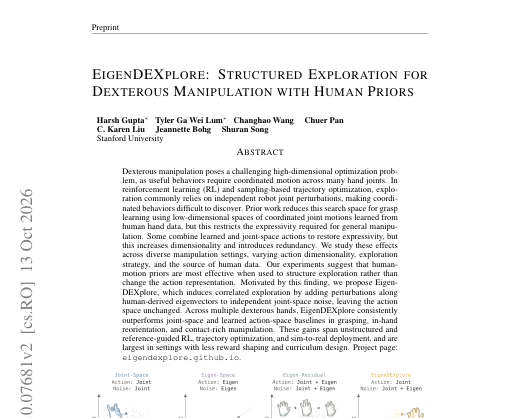
EigenDEXplore: Structured Exploration for Dexterous Manipulation with Human Priors

Harsh Gupta, Tyler Ga Wei Lum, Changhao Wang, Chuer Pan, C. Karen Liu, Jeannette Bohg, Shuran Song

Dexterous manipulation poses a challenging high-dimensional optimization problem, as useful behaviors require coordinated motion across many hand joints. In reinforcement learning …

Dexterous manipulation poses a challenging high-dimensional optimization problem, as useful behaviors require coordinated motion across many hand joints. In reinforcement learning (RL) and sampling-based trajectory optimization, exploration commonly relies on independent robot joint perturbations, making coordinated behaviors difficult to discover. Prior work reduces this search space for grasp learning using low-dimensional spaces of coordinated joint motions learned from human hand data, but this restricts the expressivity required for general manipulation. Some combine learned and joint-space actions to restore expressivity, but this increases dimensionality and introduces redundancy. We study these effects across diverse manipulation settings, varying action dimensionality, exploration strategy, and the source of human data. Our experiments suggest that human-motion priors are most effective when used to structure exploration rather than change the action representation. Motivated by this finding, we propose EigenDEXplore, which induces correlated exploration by adding perturbations along human-derived eigenvectors to independent joint-space noise, leaving the action space unchanged. Across multiple dexterous hands, EigenDEXplore consistently outperforms joint-space and learned action-space baselines in grasping, in-hand reorientation, and contact-rich manipulation. These gains span unstructured and reference-guided RL, trajectory optimization, and sim-to-real deployment, and are largest in settings with less reward shaping and curriculum design.

#62026-10-01追踪学者 · Jeannette Bohg

SoTa: Soft Tactile Skins for Dexterous Manipulation

Jingyun Yang, Baiyu Shi, Timothy Yu, Haitian Liu, Alberta Longhini, Weichen Wang, Rika Antonova, Zhenan Bao 等

A growing body of work suggests that tactile sensing gives robot policies contact information that complements vision in dexterous manipulation. However, visuo-tactile robot data r…

A growing body of work suggests that tactile sensing gives robot policies contact information that complements vision in dexterous manipulation. However, visuo-tactile robot data remains scarce: dexterous demonstrations require teleoperating robots, which limits dataset scale. Human demonstrations are far cheaper to collect and offer a path to scale this data, but only if human and robot hands carry tactile sensors with corresponding signals. This requires sensors that conform to different hand geometries, cover the full hand, and share a common layout across embodiments. We present SoTa, a low-cost capacitive tactile skin that provides full-hand coverage on humans and robots while preserving a shared layout of 202 taxels across corresponding finger and palm regions. Our multilayer design with fabric electrodes enables in-house fabrication of thin, soft skins with customizable geometry for under $10 in materials per skin. The sensor retains over 97% of its initial response span after 10,000 loading-unloading cycles with traces retaining continuity through 1,280 tight-fist folding cycles. The shared taxel layout supports human-robot co-training with a common tactile encoder and no learned cross-sensor mapping. Across three contact-rich manipulation tasks, tactile observations improve in-distribution success over vision-only policies. With a fixed robot demonstration budget, adding human demonstrations more than doubles mean success across eight evaluation conditions, from 22.8% to 45.9%, improving success in all five out-of-distribution conditions. We plan to open-source the resources needed to fabricate and operate these skins.

同实验室的其他学者