Tech Station

2026-10-05

50 篇论文 · 30 个项目 ← 2026-10-04 · 2026-10-06 →

论文

#12026-10-01追踪学者 · Jeannette Bohg105

SoTa: Soft Tactile Skins for Dexterous Manipulation

Jingyun Yang, Baiyu Shi, Timothy Yu, Haitian Liu, Alberta Longhini, Weichen Wang 等

A growing body of work suggests that tactile sensing gives robot policies contact information that complements vision in dexterous manipulation. However, visuo-tactile robot data r…

A growing body of work suggests that tactile sensing gives robot policies contact information that complements vision in dexterous manipulation. However, visuo-tactile robot data remains scarce: dexterous demonstrations require teleoperating robots, which limits dataset scale. Human demonstrations are far cheaper to collect and offer a path to scale this data, but only if human and robot hands carry tactile sensors with corresponding signals. This requires sensors that conform to different hand geometries, cover the full hand, and share a common layout across embodiments. We present SoTa, a low-cost capacitive tactile skin that provides full-hand coverage on humans and robots while preserving a shared layout of 202 taxels across corresponding finger and palm regions. Our multilayer design with fabric electrodes enables in-house fabrication of thin, soft skins with customizable geometry for under $10 in materials per skin. The sensor retains over 97% of its initial response span after 10,000 loading-unloading cycles with traces retaining continuity through 1,280 tight-fist folding cycles. The shared taxel layout supports human-robot co-training with a common tactile encoder and no learned cross-sensor mapping. Across three contact-rich manipulation tasks, tactile observations improve in-distribution success over vision-only policies. With a fixed robot demonstration budget, adding human demonstrations more than doubles mean success across eight evaluation conditions, from 22.8% to 45.9%, improving success in all five out-of-distribution conditions. We plan to open-source the resources needed to fabricate and operate these skins.

cs.ROcs.LGrobotmanipulationdexteroustactile

追踪学者:Jeannette Bohg;兴趣:dexterous hands and tactile sensing

#22026-10-02追踪学者 · Huazhe Xu101

AdaTempo: Learning Shared Relative Tempo from Demonstrations for Faster Robot Manipulation

Jiale Cao, Yike Niu, Zhengrong Xue, Huazhe Xu

Visuomotor policies trained via imitation learning often inherit the unnecessarily slow timing of teleoperated demonstrations. Yet uniform speedup is unreliable because different p…

Visuomotor policies trained via imitation learning often inherit the unnecessarily slow timing of teleoperated demonstrations. Yet uniform speedup is unreliable because different phases of a manipulation task tolerate acceleration differently. In this work, we introduce AdaTempo, a self-supervised method that accelerates visuomotor policies by exploiting shared relative-tempo structure in demonstrations. AdaTempo establishes phase correspondence, aggregates the aligned relative tempo into a consensus, and maps it to a continuous speedup profile used to resample demonstrations into accelerated training trajectories. Training standard policies such as ACT or Diffusion Policy on these resampled trajectories directly embeds the desired tempo in the learned behavior, without runtime tempo selection or online retiming. Extensive evaluations show that AdaTempo achieves up to a $3.57\times$ speedup and yields a stronger success--speed trade-off than the original policies and representative acceleration baselines.

cs.ROrobotmanipulationimitation learningdiffusion policy

追踪学者:Huazhe Xu;兴趣:imitation learning and diffusion policies for robot control

#32026-10-0295

CHASE-VLA: Post-Training Quantization Framework for Vision-Language-Action Models with Chunk-Aware Scale Estimation

Jin Hyun, Jung Gyu Min, Gyuhyun Jung, Youngjoo Lee

Vision-Language-Action (VLA) models map visual observations and language instructions to continuous robot actions, but a diffusion-based action expert (AE) poses a key challenge fo…

Vision-Language-Action (VLA) models map visual observations and language instructions to continuous robot actions, but a diffusion-based action expert (AE) poses a key challenge for low-bit post-training quantization (PTQ). The AE is repeatedly invoked across denoising steps and policy queries, where fixed calibration scales can be mismatched with activation ranges that vary with denoising progress and intended motion. We propose CHASE-VLA, a chunk-aware PTQ method that exploits a VLA-specific signal readily available from the policy: the generated action chunk, including its unexecuted future suffix. Rather than relying only on static scale matching for AE layers, CHASE-VLA combines the previously generated chunk as causal action context with denoising step group information to adapt AE activation scales. This enables W4A4 quantization of both MLP and attention projections in the repeated AE without modifying the pretrained policy. On LIBERO, CHASE-VLA achieves 97.3% average success rate on $π_{0.5}$ when both MLP and attention projections in the AE are quantized to W4A4, restoring FP16-level performance. CHASE-VLA also reduces the weight storage of the quantized AE linear layers by 73.4% and their single-chunk memory traffic by 70.9% and 71.2% on $π_{0.5}$ and GR00T N1.6, respectively, with a predictor overhead of at most 1.26% of the saved storage.

cs.CVrobotVLAvision-language-action

兴趣:vision-language-action (VLA) models and foundation models for robots

#42026-10-0294

MixVLA: Adaptive Mixing of Non-Invariant Information for Generalizable Vision-Language-Action Models

Pingrui Zhang, Yu Zhang, Pengyuan Wu, Bin Wang, Haoming Song, Xianqiang Gao 等

Vision-Language-Action (VLA) models have achieved remarkable advances in robotic manipulation, yet their zero-shot generalization under out-of-distribution (OOD) conditions remains…

Vision-Language-Action (VLA) models have achieved remarkable advances in robotic manipulation, yet their zero-shot generalization under out-of-distribution (OOD) conditions remains limited. These models often entangle task-relevant invariant structure with environment-specific non-invariant factors, causing policies to rely on spurious appearance cues during action prediction. In this work, we propose MixVLA, a model-agnostic training framework that improves the generalization of VLA models without requiring additional OOD data or architectural modifications. The key component of MixVLA is Adaptive Mixing of Non-Invariant Information (AMI). AMI stochastically mixes non-invariant representations to regularize distribution-specific variability while preserving complementary predictive cues. The mixed non-invariant features are then fused with invariant representations for final action prediction, resulting in improved robustness without sacrificing policy expressiveness. Extensive experiments across challenging manipulation settings, including LIBERO, LIBERO-Plus, the RoboTwin perturbation suite, and real-world tasks, demonstrate that MixVLA improves overall zero-shot robustness while retaining strong in-domain performance.

cs.ROmanipulationVLAvision-language-action

兴趣:vision-language-action (VLA) models and foundation models for robots

#52026-10-0294

Equivariant Visual-Tactile Diffusion Policy for Contact-Rich Manipulation

Lik Hang Kenny Wong, Yiyao Ma, Xiu-Shen Wei, Zelong Tan, Zhuheng Song, Dongsheng Xie 等

Imitation learning for contact-rich manipulation requires high-quality expert data that is expensive to obtain. This makes learning a sample-efficient policy a key issue. To addres…

Imitation learning for contact-rich manipulation requires high-quality expert data that is expensive to obtain. This makes learning a sample-efficient policy a key issue. To address this, we propose VISTA, a workspace-level equivariant visuotactile diffusion policy for data-efficient contact-rich imitation learning. VISTA projects visual and tactile observations into spherical tokens, injects tactile contact cues into visual spherical directions through permutation-equivariant spherical fusion, and rotates the fused harmonic representation using the end-effector orientation. The resulting representation conditions an equivariant diffusion policy to predict spatially consistent actions. Extensive experiments in both simulation and real-world robotic settings show that VISTA substantially improves data efficiency over strong visuotactile imitation learning baselines. Project website: https://vista-paper.github.io/

cs.ROcs.AImanipulationimitation learningdiffusion policytactile

兴趣:imitation learning and diffusion policies for robot control

#62026-10-0292

Learning Reflexive Behavior for Contact-Rich Manipulation

Quan Nguyen, Yunho Kim, Joonho Lee

During contact-rich manipulation, interactions between a robot and its environment carry information about local geometry: a surface prevents penetration, a bore guides a peg. A co…

During contact-rich manipulation, interactions between a robot and its environment carry information about local geometry: a surface prevents penetration, a bore guides a peg. A controller that exploits these interactions can comply with environmental constraints while preserving task intent. Robot-earning systems commonly use position, hybrid force-position, or Cartesian impedance control. Their prescribed tracking objectives, stiffness, or force-control directions may not match local constraints and may degrade performance. We learn a proprioceptive reflex policy in simulation on three simple interaction primitives: a spring, a plane, and a rail. The policy maps task-space commands to joint-position targets using state history, without direct force or geometrical measurements. Once trained, it serves as a frozen execution layer beneath higher-level controllers. We evaluate it in dual-arm box lifting, peg insertion, and surface following. In box lifting, the reflex kept the force below the threshold while the baseline failed. In rough-surface following it stayed below the 10 N reference, on par with tuned hybrid force-position control. In 0.02 mm peg insertion It reduced mean estimated contact force to less than half that of the baseline while increasing hardware success rates from at most 22 % to 36-58 %. By separating contact response from command generation, the reflex policy provides motion planners, learned policies, and teleoperators with robust contact-rich execution.

cs.ROrobotmanipulation

兴趣:robot manipulation and grasping with learned policies

#72026-10-0292

Skill2Real: Agentic Skill Learning for Zero-Shot Sim-to-Real Robot Manipulation

Xincheng He, Siyu Ma, Chang Yu, Yunuo Chen, Yanjia Huang, Ying Nian Wu 等

Transferring robotic skills from simulation to reality requires task knowledge that remains usable across differences in perception, dynamics, and embodiment. We introduce Skill2Re…

Transferring robotic skills from simulation to reality requires task knowledge that remains usable across differences in perception, dynamics, and embodiment. We introduce Skill2Real, an agentic policy framework that learns executable skills through a shared application programming interface (API). A Proposer-Verifier-Governor (PVG) loop uses privileged simulation evidence to diagnose outcomes and validate updates, while keeping learned skills grounded in public observations and API semantics. The Cerebellum first acquires local manipulation skills; the Brain then learns task-level composition with the Cerebellum frozen. Both memories transfer to the real robot without task-policy fine-tuning or skill-memory updates. As GPT-5.6 Sol learns skills on LIBERO-90, evaluating each frozen checkpoint with GPT-6 Astra raises LIBERO-Pro Long success from 2.0% to 56.3%, without training on Pro Long. Independent Robosuite training reaches 85.1% and 89.4% mean success with Sol and Opus 5 across seven tasks, respectively. Frozen Sol-trained LIBERO-90 skills achieve 78.75% mean completion across four real-world manipulation tasks with Astra. Removing the Verifier or Governor during LIBERO-90 training lowers final Pro Long success by 17.3 and 13.3 percentage points, respectively. These results support learning and transferring a hierarchy of executable skills through a common robot interface.

cs.ROrobotmanipulationsim-to-real

兴趣:imitation learning and diffusion policies for robot control

#82026-10-0292

PointWAM: 3D World Action Modeling for Dexterous Robotic Manipulation

Chunghyun Park, Beomjun Kim, Seungcheol Park, Heeseung Kwon, Yashu Shukla, Seunghoon Sim 等

World action models jointly learn to forecast world dynamics and predict robot actions, such that the learned internal world dynamics guide accurate actions. Existing approaches ty…

World action models jointly learn to forecast world dynamics and predict robot actions, such that the learned internal world dynamics guide accurate actions. Existing approaches typically represent the world as RGB frames or latent counterparts while predicting actions as end-effector poses or joint angles, but they often struggle to capture the 3D spatial structure and contact geometry central to dexterous manipulation. We introduce Point World Action Model (PointWAM), a 3D world action model that decomposes the world into a scene (i.e., environment) and hands (i.e., actor), and jointly forecasts both as 3D point trajectories within a shared space-time coordinate frame. This explicit, disentangled representation enables effective pre-training on large-scale human demonstration videos without requiring any task-specific object or keypoint selection. Given a colored point cloud and a language instruction, PointWAM predicts how the scene and hands co-evolve in 3D space over time, then retargets the forecast hand motion to robot actions. Pre-training on human videos improves average DexJoCo success by 56.9 percentage points, and scene-trajectory supervision adds 10.9 points over forecasting the hands alone. With both, PointWAM surpasses the prior state of the art on ten DexJoCo tasks by 11.7 points and outperforms strong VLAs on a real robot.

cs.ROcs.CVrobotmanipulationdexterous

兴趣:world models and video prediction for embodied agents

#92026-10-0290

FastOPD: On-Policy Distillation for Lightweight VLA Deployment

Yoojin Oh, Jeongsol Kim, Yeonwoo Seo, Jangho Park, Seonghyun Jin, Sunwoo Park 等

Vision-Language-Action (VLA) foundation models have scaled rapidly to enhance manipulation performance and generalizability, but this scaling incurs high computational costs that r…

Vision-Language-Action (VLA) foundation models have scaled rapidly to enhance manipulation performance and generalizability, but this scaling incurs high computational costs that render real-world deployment increasingly challenging. Existing approaches typically mitigate this issue by designing smaller architectures or reducing the iterative denoising steps in flow-based policies. In this work, we propose FastOPD, a foundation-to-lightweight VLA framework that enables the practical deployment of large-scale VLAs through efficient on-policy distillation. Specifically, FastOPD adapts a flow map for single-state teacher supervision and combines it with a self-consistency objective to construct a compact student that learns the teacher dynamics. Furthermore, we theoretically demonstrate that minimizing this objective allows the distilled student to recover a distribution on par with that induced by an ideal few-step teacher model. We evaluate FastOPD across diverse foundation policies in simulation and real-world experiments. On LIBERO, FastOPD retains 84% of the performance of $π_{0.5}$ with only two inference steps, reducing inference latency by 78.1% while outperforming existing few-step distillation baselines in average success rate. With LingBot-VLA as the teacher, FastOPD improves the single-step success rate over the base student by 15.9 percentage points on RoboTwin 2.0. We further demonstrate its applicability to a World Action Model (WAM) and deploy a compact student distilled from MolmoAct2 on a real robot.

cs.ROcs.AIcs.CVcs.LGrobotmanipulationVLAvision-language-action

兴趣:vision-language-action (VLA) models and foundation models for robots

#102026-10-0290

SimpleTouch: Can Vision-Language-Action Models Master Contact-Rich Manipulation Without Tactile Policy Pretraining?

Chen Yang, Linzhe Shi, Changjie Wu, Hang Zhang, Ronghan Chen, Lingjun Zhang 等

Tactile sensing provides essential contact information for robotic manipulation, yet incorporating it into pretrained vision-language-action (VLA) models remains challenging. A com…

Tactile sensing provides essential contact information for robotic manipulation, yet incorporating it into pretrained vision-language-action (VLA) models remains challenging. A common concern is that simply introducing touch during task-specific fine-tuning may fail to bridge the cross-modal gap, yielding limited gains or even reduced success. Consequently, existing methods often rely on large-scale tactile policy pretraining or separate visuotactile alignment, adding data requirements and training stages. We introduce SimpleTouch, a simple VLA extension that augments $π_{0.5}$ with a tactile expert, to test whether these additional stages are necessary. Leveraging all tokens from a frozen pretrained tactile encoder, the expert learns from action supervision and multi-horizon prediction of future tactile latents. This single-stage training uses only task demonstrations, without additional tactile policy pretraining or separate alignment. With 50 demonstrations per task, SimpleTouch achieves the highest success rate among evaluated methods on all six UniVTAC tasks. Its average success rate reaches 77.5%, compared with 45.2% for FTP-$π_{0.5}$ and 66.7% for FTP-1, corresponding to gains of 32.3 and 10.8 percentage points, respectively. Across four real-world tasks, it averages 71.3%, exceeding FTP-1 by 8.8 percentage points. These results demonstrate that, given pretrained VLA and tactile representations, additional tactile policy pretraining is not a prerequisite for strong performance on these tasks, offering a simpler route to contact-rich manipulation. Project page: https://simpletouch-robot.github.io/

cs.ROrobotmanipulationVLAvision-language-actiontactile

兴趣:vision-language-action (VLA) models and foundation models for robots

#112026-10-0290

ManiPhysicsBench: Physics-Based Assessment of Object Preservation in VLA Manipulation

Sangwu Park, Yeonjun In, Wonjoong Kim, Sungwon Kim, Sein Kim, Chanyoung Park

Vision-language-action (VLA) models aim to perform diverse manipulation tasks, but task success in existing rigid-body benchmarks does not indicate whether they preserve objects. W…

Vision-language-action (VLA) models aim to perform diverse manipulation tasks, but task success in existing rigid-body benchmarks does not indicate whether they preserve objects. We introduce ManiPhysicsZoo, which consolidates literature-supported material properties, 3D meshes, and supporting references into reusable object assets. Using these assets, a solver-based assessment computes grasp-specific damage thresholds from object geometry, material properties, and recorded grasp conditions and compares them with recorded contact forces to assess potential deformation and fracture. Building on these components, ManiPhysicsBench evaluates object preservation in LIBERO and SimplerEnv across three physics axes and three difficulty levels. Public VLA checkpoints show a substantial gap between task success and safe success, defined as task completion while preserving the object. Their gripper commands concentrate near full opening and closure, with largely similar aggregate distributions across objects, consistent with binary gripper supervision. We examine how object-specific continuous gripper labels change model behavior by retraining a VLA model. The retrained model shows more object-dependent gripping and higher safe success, but lower task success and limited generalization of object-preserving behavior.

cs.ROmanipulationgraspVLAvision-language-action

兴趣:robot manipulation and grasping with learned policies

#122026-10-0289

Beyond Reward Hacking: Proxy Divergence Across Four Layers of a Staged Humanoid Learning Pipeline

Arunabh Bora

A reinforcement-learning (RL) pipeline for a legged robot is assembled from proxies. A reward stands in for intended behaviour, a curriculum gate stands in for competence, an evalu…

A reinforcement-learning (RL) pipeline for a legged robot is assembled from proxies. A reward stands in for intended behaviour, a curriculum gate stands in for competence, an evaluation statistic stands in for robustness, and a reference motion stands in for an achievable skill. The traditional view treats only the first of these as optimised against, and so locates specification failure (reward hacking) in the reward alone. I argue that all four are proxies in the same formal sense, that each has a characteristic divergence mechanism, and that each admits a reformulation that closes it. For every layer I state the traditional formulation, derive the condition under which it diverges from its target, and give the alternative: first-order (L1) costs where quadratic kernels are flat, peak and outcome statistics where curriculum gates average, gate reachability and information checks, deterministic and phase-desynchronised evaluation, curriculum state treated as part of the model, feasibility-first reference design with residual feed-forward, and function-preserving input widening that lets one policy grow instead of being retrained. The arguments are illustrated by measurements from one continuous lineage of a PPO policy for a simulated 1.91 m humanoid, grown over four stages and 13,500 iterations on a single laptop GPU. Among them, a curriculum gate built on averaged error advanced at its rate limit on every check while the skill it gated was absent, and a batched push test whose synchronised resets aliased the gait phase ranked a 0.5 m/s push as more dangerous than a 2.0 m/s one.

cs.ROrobothumanoidlegged

兴趣:reinforcement learning for legged locomotion and sim-to-real transfer

#132026-10-02追踪学者 · Jitendra Malik追踪学者 · C. Karen Liu追踪学者 · Ken Goldberg89

EyeRobot 2.0: Active Gaze for Precise Manipulation without Wrist Cameras

Kush Hari, Justin Kerr, Nidhya Shivakumar, Samarth Mahapatra, Carmelo Sferrazza, Jiahui Lei 等

Inspired by human vision, we introduce a framework using active gaze to enable fine-grained bimanual manipulation with only a single stereo camera. EyeRobot 2.0 physically attends …

Inspired by human vision, we introduce a framework using active gaze to enable fine-grained bimanual manipulation with only a single stereo camera. EyeRobot 2.0 physically attends to a 3D fixation point in the scene by swiveling two eye viewpoints to center their gaze on it. The resulting images are processed foveally by allocating more visual tokens to the image centers, focusing computation on task-relevant features. Such Active Visual Fixation (AVF) requires carefully coordinated gaze during task execution, which we accomplish hierarchically by first training a low-level gaze servoing policy conditioned on a goal object, then training a target selector which emits fixation goals based on task progress. Both modules are trained with RL on real-world data: the first is trained with a dense geometric reward and the second co-trains with the BC gripper policy which allows it to discover fixation sequences that can resemble a human's fixation sequence while performing the task. EyeRobot 2.0 further takes advantage of fixation by canonicalizing gripper information into a fixation-relative SE(3) frame, which compacts the size of the action distribution to learn. We collect teleoperation data for 7 real-world and 6 simulated tasks, and conduct over 1000 physical and 1800 simulated robot trials comparing EyeRobot 2.0 against passive stereo and ego + wrist camera policies trained on the same data. Removing wrist cameras is costly for standard policies: with only passive stereo, real-world success drops from 52% to 27%. EyeRobot 2.0 closes this gap with only stereo, outperforming passive stereo by 40% in real and 20% in sim. It matches ego + wrist policies when their wrist views are clear (69% vs. 64%), and more than doubles their success when grasped objects occlude the wrist cameras (48% vs. 22%)

cs.ROcs.AIrobotmanipulation

追踪学者:Jitendra Malik、C. Karen Liu;兴趣:robot manipulation and grasping with learned policies

#142026-10-0288

RIFAR: Reliability and Forgetting-Aware Replay for Continual Robot Learning

Zirong Song, Zheng Lu, Haoran Liao, Wanqi Zhong, Yunhe Ni, Lijie Wang 等

Genuine embodied agency requires robots to turn continuous real-world experience into lasting, transferable skills. This demands continual learning that integrates new capabilities…

Genuine embodied agency requires robots to turn continuous real-world experience into lasting, transferable skills. This demands continual learning that integrates new capabilities without eroding prior knowledge as tasks and environments evolve. Experience replay mitigates forgetting, but storing complete demonstrations becomes costly as tasks accumulate. World-action models offer a generative alternative, reconstructing past experience through joint predictions of actions and future observations. However, visually coherent rollouts may contain actions that cannot realize the predicted transitions, while new-task adaptation can disrupt previously learned behavior. RIFAR therefore combines reliability screening with drift-aware replay selection. It reconstructs trajectories from compact demonstration prefixes and uses a frozen inverse-dynamics model to assess action-visual consistency. Training first combines current demonstrations with the highest-quality screened trajectories. RIFAR then compares action predictions before and after this adaptation on identical historical inputs, reselecting trajectories with larger normalized drift from the same screened pool for continued training. Across three LIBERO suites and real-world experiments, RIFAR surpasses the previous state of the art in WAM-based generative replay. On LIBERO-Goal, it achieves 90.97 AUC while retaining only 320 historical time steps per task, approximately 4.9% of the steps retained using 50-demonstration replay.

cs.AIrobotembodied

兴趣:imitation learning and diffusion policies for robot control

#152026-10-0288

RoboBridge: A Self-Evolving Embodied Agent Framework for Sim-to-Real Transfer

Chenxi Li, Zhangrui Zhao, Rui Li, Yuan Gao, Kehui Liu, Jiarui Li 等

A key challenge in bringing embodied intelligence into the real world is transferring capabilities from simulation to reality and enabling agents to continually adapt after deploym…

A key challenge in bringing embodied intelligence into the real world is transferring capabilities from simulation to reality and enabling agents to continually adapt after deployment. End-to-end vision-language-action policies provide strong manipulation capabilities, but their transfer to physical environments typically relies on calibrating simulated visual and dynamical conditions, collecting additional target-domain demonstrations, and optimizing the policy through further training. Tool-using embodied agents offer flexible task orchestration, yet existing systems primarily emphasize task execution and experience reuse within a given environment, with limited support for transferring procedural knowledge and continuously adapting it across simulation and reality. We propose RoboBridge, a framework that treats sim-to-real transfer as the continued adaptation of executable task skills. The agent represents task knowledge as procedures connecting task intent, observations, tool operations, and outcome verification. Interaction feedback is used to generate candidate skill revisions, which are evaluated before being persisted or rejected. A pretrained vision-language-action policy is exposed as a reusable action tool and enhanced with inference-time guidance, enabling fine-grained execution without retraining the underlying policy. RoboBridge grounds transferable skills in task semantics and interaction interfaces shared across simulation and reality. This representation preserves reusable task structure while allowing environment-dependent operations to be selectively revised through real-world execution feedback. We evaluate the framework on LIBERO-PRO and corresponding physical tasks, studying both skill evolution and post-transfer adaptation. Our framework provides a route from one-shot policy deployment to continual procedural learning across environments.

cs.ROmanipulationvision-language-actionsim-to-realembodied

兴趣:world models and video prediction for embodied agents

#162026-10-0188

Rethinking World-Action Model for Compositional and In-Context Robotic Manipulation

Shukai Gong, Xuanran Zhai, Yintianrun Zhang, Ruopeng Cui, Ye Huang, Yiyang Fu 等

Long-horizon compositional manipulation has become increasingly important for real-world robot deployment, where a single task involves multiple coordinated subtasks. Existing worl…

Long-horizon compositional manipulation has become increasingly important for real-world robot deployment, where a single task involves multiple coordinated subtasks. Existing world-action models (WAMs) jointly predict short-horizon visual futures and actions, but typically lack explicit subtask-level reasoning. We propose Visual Goal-conditioned Action Reasoning (ViGAR), a hierarchical framework that factorizes manipulation into a visual subgoal planner and a subgoal executor. Given the current observation and global instruction, the subgoal planner predicts a visual subgoal for the next subtask. The subgoal executor then jointly generates future visual trajectories and actions conditioned on the predicted subgoal. Both components share a pretrained world-model representation, enabling task-level planning and action generation to benefit from common physical knowledge. Moreover, our framework naturally supports in-context learning: using a global goal image as context can induce different subtask decompositions and behaviors without parameter updates. On the RoboTwin Clean2Random benchmark, ViGAR achieves 82.00% and 67.02% success rates under the Clean and Random settings, respectively, surpassing the strongest baseline by 12.86 percentage points in average success rate. Real-world robot experiments on five compositional and two in-context learning tasks further confirm the effectiveness of ViGAR.

cs.ROrobotmanipulation

兴趣:robot manipulation and grasping with learned policies

#172026-10-0187

World-Calibrated Proposal-to-Action Flow for Vision-Language-Action Models

Jie He, Wei Li, Junwen Tong, Rui Shao, Wei-Shi Zheng, Liqiang Nie

Flow-based Vision-Language-Action (VLA) policies generate action chunks by transporting samples from a task-agnostic isotropic Gaussian source. As this source is conditioned on nei…

Flow-based Vision-Language-Action (VLA) policies generate action chunks by transporting samples from a task-agnostic isotropic Gaussian source. As this source is conditioned on neither recent execution nor predicted future evolution, (i) it discards the local continuity established by recently executed motion. (ii) Even when predictive world representations are introduced, they often only condition the transport dynamics rather than determine where generation starts, how far it may deviate, or along which action directions it may expand. Building on this observation, we introduce ProAct, a world-calibrated proposal-to-action framework that makes the generative source itself predictable. (i) To preserve motion continuity, a lightweight Proposal Expert converts recent actions into a scene-aware hypothesis via one motion-anchored endpoint flow-matching step, initializing generation near the demonstrated action manifold. (ii) To jointly capture intended scene evolution and proposal-future compatibility, a prospective World Expert treats the hypothesis as a soft motion prior while predicting the task-consistent latent future. (iii) From this compatibility, the model calibrates a proposal-centered anisotropic source, where a bounded per-step extent controls the allowed deviation and a trace-normalized low-rank geometry under a condition-number budget allocates refinement over coupled translation, rotation, and gripper directions. Compared with $π_{0.5}$, ProAct improves performance across simulation and real-world tasks while reducing denoising steps by 50%, inference latency by up to 25.8%, and increasing throughput by up to 34.8%.

cs.ROcs.CVVLAvision-language-action

兴趣:vision-language-action (VLA) models and foundation models for robots

#182026-10-0287

MobiAgent: Dual-Loop Recursive Policy Self-Improvement for Long-Horizon Mobile Manipulation

Chenzhi Liu, Yue Zhang, Jiehong Lin, Jianan Wang, Bo Wang, Zhongrui Wang 等

Long-horizon mobile manipulation presents significant challenges due to compounding execution errors and capacity interference between locomotion and arm control. While recent Visi…

Long-horizon mobile manipulation presents significant challenges due to compounding execution errors and capacity interference between locomotion and arm control. While recent Vision-Language-Action models excel at short-horizon tasks, they lack the hierarchical reasoning required for multi-stage objectives. Furthermore, existing hierarchical agents suffer from rigid sub-task mapping, inflexible replanning, and a lack of continuous learning. To address these limitations, we introduce MobiAgent, a dual-loop agentic framework that bridges robust deployment execution and recursive policy self-improvement. During deployment, the Inner Loop decouples high-level reasoning from low-level control through highly composable atomic skills. It employs Vision-Language models for receding-horizon planning and visual reflection, dynamically composing skills to ensure robust error recovery. These skills are executed by specialized flow-matching experts that share a unified VLM backbone, maximizing reusability while mitigating capacity interference. Concurrently, the Outer Loop drives automated lifelong learning by autonomously segmenting and verifying deployment rollouts, clustering them to discover atomic skills, and continuously fine-tuning the skill library without human annotations. Evaluations on RoboCasa, BEHAVIOR-1K, and real-world tasks demonstrate the effectiveness of MobiAgent. It outperforms $π_{0.5}$-TA by 22.5 percentage points on BEHAVIOR-1K and enables robust recovery from execution failures. Through autonomous data recycling, success improves from 7.50% to 27.50% on RoboCasa and from 32.5% to 57.5% on Astribot S1.

cs.ROcs.AImanipulationvision-language-actionlocomotion

兴趣:robot manipulation and grasping with learned policies

#192026-10-0186

Filter-Aware Fine-Tuning for Safe Humanoid Whole-Body Tracking

Pranit Mohnot, Christian Helten, Daniele Gammelli, Marco Pavone

Safe whole-body motion is essential for deploying humanoid robots in unstructured environments. Modern humanoid control commonly separates reference specification from execution, w…

Safe whole-body motion is essential for deploying humanoid robots in unstructured environments. Modern humanoid control commonly separates reference specification from execution, with a planner, teleoperator, or motion generator providing a reference that a reinforcement-learning policy tracks through dynamically feasible whole-body control. Runtime safety filters, such as control barrier functions (CBFs), offer a promising approach for enforcing newly introduced constraints via interventions on the tracker's outputs. We show, however, that treating the tracking policy and safety filter independently induces fundamental mismatches, as filtering alters both the executed actions and the induced state distribution. We study this policy-filter interface through case studies that isolate dynamics, objective, and information mismatches, highlight their root causes, and use these insights to develop CoFiT (Constrained Filter-aware Tuning), a filter-aware fine-tuning method for pretrained trackers. Across diverse constraint scenes, CoFiT reduces violation time relative to filter-only training by 91% on TWIST2 and 21% on SONIC, while requiring smaller safety filter corrections. On Unitree G1 hardware, CoFiT reduces violation time by 83% for TWIST2 and completes every trial without operator intervention, whereas 50% of baseline trials require an operator stop. Together, these results provide actionable insights into policy-filter interactions and establish design principles for integrating learned trackers with runtime safety filters.

cs.ROhumanoid

兴趣:humanoid robots and whole-body control

#202026-10-0286

Bridging Frontier Reasoning and Robot Execution: From Autonomous Demonstration Generation to Dense Language Supervision

Bosung Kim, Alexander Trevithick, Ruiyi Wang, Prithviraj Ammanabrolu

Recent advances in frontier models enable robot manipulation from only a few demonstrations, but high inference latency limits their use for real-time robot control. To bridge this…

Recent advances in frontier models enable robot manipulation from only a few demonstrations, but high inference latency limits their use for real-time robot control. To bridge this gap, we study two complementary approaches that connect frontier reasoning with low-latency local execution. First, we use a frontier model to autonomously generate demonstrations that supplement human demonstrations for training a fast local policy. We augment its in-context examples with corrective demonstration segments that show how to recover from physical errors, improving generation reliability. Generation time and cost decrease as successful examples accumulate in context, suggesting a path toward more efficient data collection. At deployment, a harness combines frontier-generated instructions with a fast local policy, enabling efficient execution while preserving the frontier model's ability to guide and correct actions. With low-latency execution delegated to the local policy, the bottleneck shifts to its capacity to reliably follow the frontier model's diverse instructions. Our second bridge introduces dense language supervision across three nested granularities---primitive, atomic, and composite---with multi-aspect descriptions at each level. Across long-horizon tasks in RoboCasa 365 and BEHAVIOR-1K, where instructions change as execution progresses, the combined supervision achieves the highest performance under both oracle and frontier-model instructors, demonstrating more reliable instruction following through the policy's language interface. Finally, we evaluate both bridges together on a crossword task that combines semantic planning and manipulation within a fixed time budget. These results support autonomous demonstration generation and dense language supervision as complementary components for connecting frontier reasoning to low-latency local execution.

cs.ROrobotmanipulation

兴趣:large language models for robot task planning and reasoning

#212026-10-0286

XGenAct: Geometry-Enhanced World Action Models through Cross-Task Generation

Tingting Du, Ziyao Wang, Guoheng Sun, Ang Li

World action models (WAMs) have advanced robot control by predicting how observations and actions evolve over time. Despite this progress, RGB and action based future prediction do…

World action models (WAMs) have advanced robot control by predicting how observations and actions evolve over time. Despite this progress, RGB and action based future prediction does not explicitly address the spatial understanding needed for robot manipulation. Existing efforts often add a limited set of spatial prediction tasks through specialized heads or branches, leaving both the range of spatial supervision and the model architecture fragmented. We introduce XGenAct, a world action model that represents RGB observations, robot actions, metric depth, surface normals, and functional role segmentation as RGB videos through deterministic codecs. By sampling perception and action tasks during training, XGenAct uses one video diffusion transformer and one objective to learn temporal prediction across these spaces without modality specific learned heads. On held out RLBench tasks, structured perception training improves average closed loop success over RGB only training, and XGenAct achieves 52% success in the five task external comparison, versus 26% for the strongest evaluated baselines. It also predicts future depth and segmentation more accurately than the evaluated pipelines that generate RGB first and then apply a frozen perception expert.

cs.ROcs.CVcs.LGrobotmanipulation

兴趣:world models and video prediction for embodied agents

#222026-10-0286

World Action Learning via Interaction-Centric Spectral Latent Guidance

Zhiming Liu, Yikun Miao, Ying Chen, Hongrui Yin, Fangqi Zhu, Xiaoyi Pang 等

Learning general-purpose robot policies requires large-scale real-world interaction data, yet collecting robot demonstrations remains expensive and difficult to scale. Egocentric v…

Learning general-purpose robot policies requires large-scale real-world interaction data, yet collecting robot demonstrations remains expensive and difficult to scale. Egocentric videos offer abundant human interaction experience with task-relevant semantics for robotic manipulation, but direct transfer is challenging for two reasons: latent actions inferred from frame reconstruction can be dominated by nuisance variation such as ego-camera motion, and human and robot behaviors often exhibit different temporal dynamics. We propose WING (World Action Learning via INteraction-Centric Spectral Latent Guidance), a framework for transferring interaction knowledge from egocentric videos to robot policies. WING first separates observer-induced motion from hand-object interaction and distills the interaction-centric component into latent actions. It then exploits the observation that cross-embodiment task semantics are concentrated in slowly varying temporal structures, identifying shared low-frequency components between egocentric latent actions and robot behaviors in the spectral domain and using them to guide action generation. WING achieves average success rates of 99.20% on LIBERO, 93.80% on RoboTwin 2.0, and 57.7% on RoboCasa-GR1, and also performs strongly across four real-world manipulation tasks under diverse generalization settings. These results show that interaction-centric spectral guidance provides an effective and scalable way to transfer physical interaction knowledge from human egocentric video to robot control. Project page: https://mikuz12.github.io/wing/

cs.ROrobotmanipulation

兴趣:world models and video prediction for embodied agents

#232026-10-0185

CriticHack: Evaluating Visual Rewards Under Robot Policy Optimization

Jiaxuan Luo, Xingguo Xu, Shanshan Wang, Yuhan Zhou, Zhen Zhang

Learned visual reward models are increasingly used to optimize robot policies, yet a reward model can score an execution that acts on the wrong object as highly as one that complet…

Learned visual reward models are increasingly used to optimize robot policies, yet a reward model can score an execution that acts on the wrong object as highly as one that completes the task. We show that optimizing such a reward can amplify these wrong-object failures while reward and task success both rise, so the signals a practitioner would normally monitor look healthy. We fine-tune every denoiser parameter of a diffusion policy against Robometer on a drawer task. Starting from a supervised policy with no prior reward exposure, five training runs raise task success by 10.2 percentage points and wrong-object failures by 10.9 points on 512 evaluation seeds, whereas five runs trained on the simulator's task-completion signal raise success without amplifying wrong-object failures (difference 9.2 points, 95% CI 5.6 to 13.0). The amplification recurs from a policy previously optimized against learned rewards, under the policy's native diffusion sampler, at matched distance from the initial policy, and across constrained-policy experiments with two critics and two optimizers. A tilt model explains when it occurs: under KL-regularized optimization, an outcome becomes more frequent whenever its expected reward under the initial policy exceeds the population average. Robometer separates successes from failures well overall (AUROC .81) but scores wrong-object failures slightly above successes (AUROC .37), so optimization raises both. The same model predicts the outcome shifts across 26 constrained settings (Spearman .89), including those in which task success falls, and Robometer's own published success-termination recipe inherits the error. A frozen outcome verifier redirects the same optimization toward the requested task.

cs.ROcs.AIcs.LGrobotdiffusion policy

兴趣:imitation learning and diffusion policies for robot control

#242026-10-0285

Imagine the Future, Internalize the Gist: Efficient VLA Reasoning via Internalized Spatiotemporal Imagination

Shenglan Li, Zhendong Mi, Hengyi Zhu, Jingwu Luo, Chun Kit Chan, Geng Yuan 等

Vision-language-action (VLA) models increasingly incorporate intermediate reasoning to improve robotic manipulation, yet existing approaches primarily reason about observed states …

Vision-language-action (VLA) models increasingly incorporate intermediate reasoning to improve robotic manipulation, yet existing approaches primarily reason about observed states without explicitly anticipating future scene evolution. Extending such reasoning to explicit future rollouts at every inference step, however, introduces substantial computational overhead. We propose IG-VLA, a VLA reasoning framework that enables models to imagine the future and internalize the gist. Our Latent Spatiotemporal Reasoning learns to imagine task-relevant future scene evolution directly in visual representation space, guiding action prediction without costly pixel-level video generation. To further reduce inference overhead, we introduce Scene Gist Memory, which internalizes reasoning-derived scene-behavior associations into a compact Scene Gist Token, preserving the benefits of future reasoning while bypassing explicit future imagination at inference. Extensive experiments on LIBERO, LIBERO-Plus, and VLABench demonstrate the effectiveness and efficiency of IG-VLA. On the LIBERO-Plus Language suite, both the reasoning and gist policies outperform the strongest baseline by nearly 6% in success rate. The gist policy also achieves up to 6.38x speedup over baselines, reducing inference latency from 1081ms to 169.5ms per action chunk on a single NVIDIA A6000 GPU. These results demonstrate that future spatiotemporal reasoning can be effectively internalized for efficient VLA deployment.

cs.CVmanipulationVLAvision-language-action

兴趣:vision-language-action (VLA) models and foundation models for robots

#252026-10-0285

RATE: Risk-Aware Tactile Encoding for Contact-rich Robotic Manipulation

Yuyao Jiang, Haichao Liu, Jiarui Zheng, Zihan Ding, Weihao Yuan, Ziwei Wang

Tactile sensing is particularly valuable for contact-rich robotic manipulation. Recent work has made substantial progress in tactile representation learning for robotic manipulatio…

Tactile sensing is particularly valuable for contact-rich robotic manipulation. Recent work has made substantial progress in tactile representation learning for robotic manipulation. However, similar tactile observations can arise from interaction conditions with very different task-risk implications, such as sensor noise, task-necessary variations, and emerging undesirable contact. Without context-grounded risk information, these cases can be ambiguous to downstream policies, leading to unnecessary corrections to benign variations or delayed responses to genuinely risky contact. To address this limitation, we propose Risk-Aware Tactile Encoding (RATE), which learns tactile representations that encode task-conditioned interaction risk. Specifically, history-conditioned prediction captures interaction context, while alert supervision associates this context with task-conditioned risk. The learned risk-aware representation complements conventional tactile features through a lightweight residual adapter. Experiments in both simulation and the real world demonstrate substantial improvements in task success, with controlled ablations confirming the complementary benefits of alert-guided learning and predictive temporal modeling.

cs.ROmanipulationtactile

兴趣:dexterous hands and tactile sensing

#262026-10-0284

EVEWorld: Physical Evolution Supervision for Embodied World Models

Kaiqi Wang, Songxin Zhang, Zejian Xie, Xiao Xiong, Zhuoyang Song, Ziwei Wu 等

Embodied world models enable scalable simulation of embodied interactions for robot learning. However, existing models are prone to Model Laziness, as they focus on visual fidelity…

Embodied world models enable scalable simulation of embodied interactions for robot learning. However, existing models are prone to Model Laziness, as they focus on visual fidelity at the expense of physical reasoning and lack process-level supervision over the temporal dynamics of manipulated objects. In this work, we propose EVEWorld, a physical evolution-supervision framework for physically consistent target evolution. EVEWorld consists of two components: Instance-Guided Restoration (IGR) and Temporal Instance Alignment (TIA). First, IGR promotes instance consistency through restoration supervision. Second, TIA promotes cross-frame consistency by aligning target instances across adjacent frames. We further introduce the Model Laziness Rate (MLR), a metric that measures persistent violations of instance consistency in generated trajectories. Extensive experiments on DreamGenBench, EWMBench, and PBench demonstrate the effectiveness of EVEWorld, notably achieving an 87.5% reduction in MLR compared with GigaWorld-0. On the WorldArena 2.0 Track 1 leaderboard, our model ranks 6th in JEPA Similarity and 17th overall, which further validates the performance of our evolution supervision strategy.

cs.CVrobotembodied

兴趣:world models and video prediction for embodied agents

#272026-10-0184

SocialVLA: A Social Perception Gateway for Human-Reaction-Based Failure Detection and Recovery in VLA Manipulation

Sofya Konstantinova, Miguel Altamirano Cabrera, Artem Lykov, Dzmitry Tsetserukou

Vision-language-action (VLA) policies enable diverse robotic manipulation but can fail during execution without recognizing their own errors. Human observers provide complementary …

Vision-language-action (VLA) policies enable diverse robotic manipulation but can fail during execution without recognizing their own errors. Human observers provide complementary signals, as unexpected robot behavior can trigger rapid vocal, facial, or verbal reactions before failure is completed. We introduce SocialVLA, a local, policy-agnostic social perception gateway that converts spontaneous human reactions into runtime intervention signals for VLA manipulation. SocialVLA combines causal paralinguistic audio detection, visual reaction recognition, explicit stop phrases, and robot-relevance estimation. An asynchronous first-event fusion mechanism triggers a VLA hold from the earliest sufficiently confident signal, while a separate speech channel captures verbal corrections for participant-directed continuation, restart, or instruction revision. We evaluate SocialVLA on physical Unitree G1 manipulation using 15 participants, with 238 annotated intervention-worthy episodes and 1.038 h of non-intervention behavior. Frozen offline replay achieves 54.6% recall and 69.5% precision, while unfiltered audio-video fusion reaches 64.3% recall. Relevance estimation reduces false-stop episodes from 100 to 57 and increases precision from 60.5% to 69.8%. In prospective deployment on an unseen 16th participant, the frozen system achieves 59.5% recall and 91.7% precision. Median detector-to-fusion latency is 47.9 ms, VLA-gate-to-physical-hold latency is 336 ms, and reaction-onset-to-hold latency is 1.021 s. These results demonstrate a complete local pathway from spontaneous social reaction to physical VLA interruption and participant-directed recovery.

cs.ROrobotmanipulationVLAvision-language-action

兴趣:vision-language-action (VLA) models and foundation models for robots

#282026-10-0284

DexJoCo-X: Benchmarking Action Representations for Multi-Hand Dexterous Manipulation

Xiangwei Jiang, Yao Mu, Lixin Duan, Wen Li

As dexterous hands proliferate, collecting data and training policies separately for every morphology becomes increasingly impractical. Scalable cross-embodiment learning therefore…

As dexterous hands proliferate, collecting data and training policies separately for every morphology becomes increasingly impractical. Scalable cross-embodiment learning therefore requires a unified representation that captures shared manipulation structure while preserving morphology-specific control. Differences in hands, tasks, datasets, and control interfaces prevent existing studies from isolating the effects of representation, pretraining, and architecture. We introduce DexJoCo-X, a benchmark and toolkit for controlled comparison across seven representative dexterous hands, six single-arm and bimanual tasks, and 2,100 balanced demonstrations. DexJoCo-X provides a matched multi-hand, multi-task protocol with common scenes, success criteria, and execution interfaces, redesigned glove-to-hand mappings, and an automated pipeline that expands reviewed demonstrations across randomized scenes. Using $π_{0.5}$, Ego-Pi, and Being-H0.5, we examine whether a shared action interface is sufficient for multi-hand learning. Expanding $π_{0.5}$ to an 80-dimensional bimanual output yields near-zero success. Ego-Pi preserves the pretrained action head through interleaved prediction and supports per-hand multi-task learning, but remains ineffective for seven-hand joint training. By contrast, Being-H0.5 combines cross-embodiment pretraining, a unified action space, and embodiment-aware experts, enabling one policy to control all seven hands. Within this architecture, function-aligned action slots achieve 47.7% mean success, compared with 47.0% for native coordinates and 33.1% for DexLatent. These results show that cross-embodiment representation depends on the entire learning system: action coordinates, pretraining, and architecture must jointly separate shared manipulation structure from embodiment-specific control.

cs.ROmanipulationdexterous

兴趣:robot manipulation and grasping with learned policies

#292026-10-01追踪学者 · Shuran Song83

NEEDLEWORK: Offline Rewriting of Robot Data with Verified Local Stitches

Juntao Ren, Yifan Hou, Shuran Song

Robot demonstrations may contain useful behavior even when individual episodes are inefficient or unsuccessful. Trajectory stitching offers a way to compose these behaviors into im…

Robot demonstrations may contain useful behavior even when individual episodes are inefficient or unsuccessful. Trajectory stitching offers a way to compose these behaviors into improved training data, but identifying useful connections and verifying their feasibility is difficult in high-dimensional robot data, where many prior methods rely on low-dimensional state representations. We introduce NEEDLE, an offline dataset-augmentation algorithm that addresses these challenges by adding short, verified action bridges between recorded observations in high-dimensional robot demonstrations. First, NEEDLE identifies and creates connections that bypass suboptimal detours, broaden action coverage, and augment the original dataset with failed trajectories, using only RGB images, proprioception, and episode-level outcomes, without new environment interaction or privileged object state. Next, we present a sampling technique that incorporates accepted bridges into policy training without synthesizing intermediate images or discarding the original demonstrations, allowing policies to learn alternative actions while retaining the original dataset's coverage. On real-robot tasks, NEEDLE improves success rate over the strongest baseline on each task by an average of 21 percentage points. Videos and supplementary materials are on https://needle-work.github.io/.

cs.ROcs.LGrobot

追踪学者:Shuran Song;兴趣:imitation learning and diffusion policies for robot control

#302026-10-0282

Around the World: Unified Learned Locomotion on a 270 g Continuous-Rotation Quadruped

Arturo Flores Alvarez, Nathan Lintu, Dennis Hong

Closed-loop learned locomotion is established on commercial quadrupeds but remains uncommon at the sub-kilogram scale. Continuous-rotation legs give MiNI-Q, a 270 g quadruped, acce…

Closed-loop learned locomotion is established on commercial quadrupeds but remains uncommon at the sub-kilogram scale. Continuous-rotation legs give MiNI-Q, a 270 g quadruped, access to supporting configurations on either side of the body. We exploit this range with a single posture-conditioned reinforcement-learning policy that runs entirely onboard. A continuous joint-space reference on the torus $T^8$ and its gravity-conditioned transformation connect upright walking, inverted walking, and landing recovery without state machines or phase switching. Coordinated posture and release curricula train this behavior family; identified actuation, cross-engine validation, and embedded execution support hardware transfer. The same sub-100k-parameter network tracks forward velocity with RMSE of 0.037 m/s upright and 0.050 m/s inverted, resumes walking in 24 of 30 release trials, and operates with four interchangeable foot geometries across four indoor surfaces. Hardware experiments and simulation ablations connect these capabilities to the representation, conditioning, and training choices that exploit the platform's motion range. Demonstration videos and supplementary material are available on the project website: https://submissionreview.github.io/around-the-world/.

cs.ROlocomotion

兴趣:reinforcement learning for legged locomotion and sim-to-real transfer

#312026-10-0282

Native Action-Prior Learning from Videos for World Action Models

Zhaochong An, Fei Zhang, Menglin Jia, Duncan Frost, Zijian Zhou, Yikai Wang 等

World action models integrate future visual dynamics with robot action prediction, but their scalability remains limited by the need for action-annotated robot trajectories. Observ…

World action models integrate future visual dynamics with robot action prediction, but their scalability remains limited by the need for action-annotated robot trajectories. Observation-only videos contain rich evidence about interaction dynamics, but existing approaches typically use them either to pretrain visual representations that must later be adapted for control, or to infer latent actions that are subsequently grounded to robot commands. We present NAVA-WAM, which introduces native action-prior learning by directly pretraining the action policy from observation-only videos, avoiding indirect representation-to-control transfer or a separate latent-action model. Our training consists of two stages. First, we pretrain on observation-only videos, where future-video flow-matching supervision over visual transitions is propagated through transition-structured joint attention to optimize the Action-DiT and learn action-relevant priors. Second, we use action-labeled demonstrations to post-train the Action-DiT for robot control through joint video--action flow matching, while asymmetric attention decouples the visual branch from iterative action denoising and enables efficient action-only inference. Extensive experiments show that NAVA-WAM consistently outperforms prior approaches under both in-distribution and out-of-distribution settings, while demonstrating strong action-label efficiency and effective real-robot generalization. These results establish native action-prior learning as an effective approach to directly pretrain action policies from observation-only videos, providing a scalable path beyond action-labeled robot data.

cs.CVcs.ROrobot

兴趣:world models and video prediction for embodied agents

#322026-10-0281

Detect and Suppress: A Mechanistic Defense against Adversarial Patches in VLA Models

Yukiya Horiba, Koshiro Aoki, Shunsuke Yasuki, Bum Jun Kim, Taiki Miyanishi

Adversarial patches can disrupt Vision-Language-Action (VLA) models by manipulating visual observations, leading to failures in robot control. However, it remains poorly understood…

Adversarial patches can disrupt Vision-Language-Action (VLA) models by manipulating visual observations, leading to failures in robot control. However, it remains poorly understood which internal mechanisms underlie these failures and how targeted interventions can mitigate them. In this work, we mechanistically analyze VLA representations using a sparse autoencoder (SAE) and identify a feature whose activation strongly correlates with the presence of an adversarial patch. Based on this analysis, we suppress the identified feature at inference time only when a linear probe detects an attack. This intervention improves robustness without the cost of fine-tuning the VLA. We evaluate our method against VLA adversarial patch attacks on LIBERO-10. Conditional intervention improves success rate under intermittent attacks, whereas continuously applying the same intervention substantially degrades policy performance. These results show that attack-related internal representations can provide useful targets for VLA adversarial defense and that controlling when to intervene is important for limiting disruption to nominal policy behavior.

cs.ROcs.AIrobotVLAvision-language-action

兴趣:vision-language-action (VLA) models and foundation models for robots

#332026-10-02追踪学者 · Animesh Garg81

Less Decoder is More Encoder: Geometric Representation Learning from Novel View Synthesis

Keerthi Kaashyap, Dennis Anthony, Akshay Krishnan, Nhi Ngoc Nguyen, Jeremy Collins, James Hays 等

This paper examines the role of Novel View Synthesis (NVS) in geometric representation learning. In principle, NVS should reason about 3D scene structure, thereby enabling transfer…

This paper examines the role of Novel View Synthesis (NVS) in geometric representation learning. In principle, NVS should reason about 3D scene structure, thereby enabling transferable multi-view geometric representations. Yet, existing encoder-based NVS methods yield poor representations. This is not because of a lack of supervisory signal, but rather due to inconspicuous architectural choices: spatially expressive decoders that dilute representational capabilities of the scene encoder, and low-level pixel-space targets that hinder feature learning. We present SNAP, a self-supervised encoder-decoder transformer that addresses both through a pose-conditioned local decoder and a latent-space reconstruction objective. SNAP is task agnostic, and we show that it is competitive with special-purpose geometry-supervised methods. SNAP also performs competitively against self-supervised representations across five tasks: visual localization, pose estimation, point correspondence, depth estimation, and robot manipulation. Remarkably, SNAP's patch features exhibit emergent viewpoint invariance that approaches heavily supervised models despite lower compute and data budgets. Under camera shifts where standard 2D representations collapse, SNAP degrades more gracefully, revealing that restricting decoder expressivity actively prevents the suppression of transferable geometric structure. https://snap-nvs.github.io

cs.CVcs.AIcs.ROrobotmanipulation

追踪学者:Animesh Garg;兴趣:3D perception, point clouds and scene understanding for robotics

#342026-10-0181

Co-design Gym: A Unified Benchmark for Embodiment-Policy Co-optimization

Aviraj Newatia, Yordan Tsvetkov, Leonard Pleiss, Andrew Spielberg, Rika Antonova

Finding an optimal behaviour policy within a given environment is a widely studied problem in domains as diverse as games, robotics, energy infrastructure, communication networks, …

Finding an optimal behaviour policy within a given environment is a widely studied problem in domains as diverse as games, robotics, energy infrastructure, communication networks, and multi-agent systems. Numerous benchmarks have been developed to support such research, but the vast majority assume that the agent's embodiment (design) is fixed, focusing instead on policy learning alone. Lifting this assumption gives rise to a broader class of problems in which optimizing embodiment and policy separately is highly suboptimal. An agent's embodiment strongly shapes which control policies can be discovered, while the optimal embodiment is in turn defined by the policies it admits. To help the research community study this class of problems explicitly and systematically, we introduce Co-Design Gym - a suite of benchmark environments for jointly optimizing embodiment and policy. Our environments span domains such as robotic manipulation and locomotion, multi-robot cooperation, deformable and soft dynamics, video games, electricity grids, wireless networks, F1 racing, multi-agent warehouses, and optimal control, offering 20 environment families (domains), with over 85 distinct co-design presets in total. We further contribute a systematic evaluation of representative co-design algorithms, characterizing the current state of the art. Together, these contributions lay the groundwork for cumulative, comparable progress in co-design.

cs.LGcs.ROrobotmanipulationlocomotion

兴趣:imitation learning and diffusion policies for robot control

#352026-10-0281

Mind the Refinement Gap: When Safe High-Level Robot Plans Produce Unsafe Executions

Stabak Das, Priyesh Ranjan, Xiangfang Li, Lijun Qian

Language-enabled robot systems increasingly combine semantic-graph planning with temporal-logic safety monitors. We investigate a trace-completeness assumption in these systems: wh…

Language-enabled robot systems increasingly combine semantic-graph planning with temporal-logic safety monitors. We investigate a trace-completeness assumption in these systems: whether the high-level action sequence checked by a monitor represents the navigation and implicit action effects induced during execution. We audit this assumption in RoboGuard by comparing its verdict on a surface plan with its verdict on a graph-refined trace under the same Linear Temporal Logic (LTL) specification. Our evaluation comprises 28 controlled cases spanning five action-abstraction families and 14 end-to-end cases in which SPINE [1] generates plans from natural-language instructions while RoboGuard generates scene-grounded safety specifications. In the controlled evaluation, all 12 targeted abstraction cases exhibit the predicted surface-versus-refined discrepancy while all 16 controls behave as expected, motivating graph-based trace refinement as a lightweight mitigation and a diagnostic tool for physical-AI safety monitors.

cs.LGcs.ROrobot

兴趣:large language models for robot task planning and reasoning

#362026-10-02追踪学者 · Yang Gao79

GeoScaffold: Learning Compact Geometric Latents via Reconstruction for Efficient Vision-Language Navigation

Yixuan Jiang, Wentong Li, An Liu, Zihao Xin, Fulin Tang, Cong Leng 等

Recent vision-and-language navigation (VLN) systems increasingly adopt streaming Video-LLM policies that map egocentric RGB observations and instructions directly to low-level acti…

Recent vision-and-language navigation (VLN) systems increasingly adopt streaming Video-LLM policies that map egocentric RGB observations and instructions directly to low-level actions. Yet these policies inherit weak 3D geometric priors from 2D pretraining. Existing geometry-aware extensions charge a persistent inference-time price: depth sensors, 3D encoders, or per-step perception tool calls. We propose GeoScaffold, a geometric supervision framework that pays this price once, at training time, by internalizing geometry into the policy itself. It first learns a compact depth tokenizer on depth maps from the training trajectories and freezes it. It then fine-tunes the policy with a handful of learnable geometry query tokens, training their hidden states to reconstruct navigation-critical geometry such as depth, connectivity, and traversability. This supervision turns the query states into compact geometric latents for action decoding, and through the shared weights also internalizes geometry into the backbone's own representations. Like a scaffold, the tokenizer, target generators, and reconstruction heads are discarded after training, leaving the backbone and action interface unchanged. Extensive experiments show that GeoScaffold consistently outperforms leading vision-only navigators on continuous VLN benchmarks, offering a practical paradigm for lightweight edge deployment of spatially aware embodied navigation models.

cs.ROcs.CVembodied

追踪学者:Yang Gao;你点赞过:TANGO: Humanoid Navigation in Cluttered Environments with a

#372026-10-0179

Multi-Fidelity Policy Gradients Stabilize Data-Scarce Reinforcement Learning

Xinjie Liu, Ruihan Zhao, Anirban Chaudhuri, Cyrus Neary, Ufuk Topcu, David Fridovich-Keil

Policy gradient methods for on-policy reinforcement learning (RL) can become unstable when expensive, scarce target-domain data yield noisy gradient estimates. We address this chal…

Policy gradient methods for on-policy reinforcement learning (RL) can become unstable when expensive, scarce target-domain data yield noisy gradient estimates. We address this challenge by complementing limited high-fidelity (HF) target-domain data with abundant, cheap, but biased low-fidelity (LF) data, e.g., from a simplified simulator. Most existing methods directly optimize biased objectives based on LF data. In contrast, the recently introduced multi-fidelity policy gradient (MFPG) framework uses LF data solely to construct a control variate that reduces variance and improves HF data efficiency without biasing the policy gradient estimator. However, published work on MFPG is limited to REINFORCE on small-scale simulation tasks. We develop MFPG for modern actor-critic learning in GPU-parallel simulation and on a physical robot. Our analysis and experiments show that naive extensions to proximal policy optimization (PPO) can lose cross-fidelity correlation or inflate variance. Our MFPG-PPO addresses these failures by redesigning the sampling, advantage estimation, and control variate construction to preserve cross-fidelity correlation, and by monitoring estimator uncertainty to prevent variance inflation. We also introduce a budget-aware MFPG-PPO to divide a fixed sampling budget among high- and low-fidelity data sources. Across simulated robot locomotion tasks of varying LF-to-HF transfer difficulty and HF data budgets, MFPG-PPO improves upon PPO trained on HF data alone in nearly all settings, and consistently matches the performance of PPO trained with 16x more HF data on the hardest task at the smallest HF budgets. In contrast, most baselines that use LF data perform well only where direct LF-to-HF transfer succeeds. MFPG-PPO enables stable learning on a physical Franka arm using only 4 real-robot episodes per update and no human demonstrations.

cs.LGcs.AIcs.ROrobotlocomotion

兴趣:imitation learning and diffusion policies for robot control

#382026-10-02追踪学者 · Marco Hutter79

Bidirectional Voronoi-biased Exploration Curriculum for Reinforcement Learning

Juri Pfammatter, Kaixian Qu, Clemens Schwarke, Victor Klemm, Marco Hutter

Long-horizon tasks with sparse rewards pose an exploration bottleneck for goal-conditioned reinforcement learning: a policy started from the initial state rarely reaches the goal a…

Long-horizon tasks with sparse rewards pose an exploration bottleneck for goal-conditioned reinforcement learning: a policy started from the initial state rarely reaches the goal and receives no learning signal. Reference motions, hand-designed curricula, and shaped rewards supply this signal but require demonstrations or task-specific engineering; automatic start-state and goal curricula avoid this but typically expand from one side only, so the full distance to the target must be covered from that side. We propose the Bidirectional Voronoi-biased Exploration curriculum for Reinforcement learning (BVER), which expands from both ends at once. Inspired by bidirectional RRT planning, BVER grows start states outward from the goal and goals outward from the initial state distribution, biases both toward unexplored task space, and steers them toward each other, training one goal-conditioned policy on both. On point-mass mazes, quadrupedal box climbing, and robot-arm ring-on-peg transfer, BVER learns faster than all compared reference-free curricula. On box climbing, it reaches 95% success on a 0.4 m box in roughly 65% fewer iterations than the best of them, is the only one of them to learn to climb a 0.7 m box, and yields a policy robust to start, goal, and yaw variation. Without a demonstration, it approaches the sample efficiency of reference-based curricula on the 0.4 m box and on ring-on-peg transfer. Ablations show that expanding from both ends outperforms either direction alone.

cs.LGcs.ROrobot

追踪学者:Marco Hutter;兴趣:reinforcement learning for legged locomotion and sim-to-real transfer

#392026-10-0279

DeltaWorld: Physically Consistent Interactive World Simulators via Action-Conditioned Latent Increment Learning

Boyuan Hou, Xiaoge Cao, Chaofan Zhang, Shuo Wang, Shaowei Cui

Interactive world simulators can provide scalable environments for robot planning, policy training, and evaluation by predicting action consequences while reducing reliance on repe…

Interactive world simulators can provide scalable environments for robot planning, policy training, and evaluation by predicting action consequences while reducing reliance on repeated physical rollouts. To serve these applications, they must generate future image sequences that respond faithfully to robot actions and preserve the dynamics of robot-object interactions over long horizons. However, existing world models typically predict the entire next latent state and often fail to capture subtle changes induced by robot actions. Such omissions can produce physically implausible outcomes, including object interpenetration and excessive deformation. To address this limitation, we propose DeltaWorld, a physically consistent interactive world simulator for robotic manipulation. Our method introduces the Delta Latent Transition Model (Delta-LTM), which predicts action-induced latent feature changes and adds them to the current latent state to obtain the next state, rather than predicting the next latent state directly. To mitigate object interpenetration and excessive deformation in predicted future frames, Interaction-aware Latent Alignment is introduced to construct counterfactual interaction regions and supervise interaction-related latent changes. DeltaWorld is evaluated on the IWS manipulation benchmark and a self-collected cross-robot dataset covering multiple robot embodiments and manipulation tasks. On the cross-robot dataset, DeltaWorld reduces FVD by 46.6% and LPIPS by 31.1% relative to the IWS baseline. These results highlight the potential of DeltaWorld for long-horizon action-conditioned video prediction in robotic manipulation.

cs.ROrobotmanipulation

兴趣:world models and video prediction for embodied agents

#402026-10-0178

Keep the Effect, Drop the Actor: Programmable Effect-to-Execution World-Action Models

Junyi Hu, Zhewen He, Zhenhua Li, Yi Fang

A robot demonstration records two things in the same frames: what happened to the objects, and how one particular arm made it happen. We condition on the first. A demonstration is …

A robot demonstration records two things in the same frames: what happened to the objects, and how one particular arm made it happen. We condition on the first. A demonstration is compiled into an effect program: the 3D keypoint trajectories of the objects that moved, two points marking where each was held, and the configuration the scene ends in, with the demonstrator removed. PEWAM, a 71.5M-parameter world-action model, generates effect, robot execution, action and terminal state as four streams with independent flow-matching times, so clamping a program and sampling the execution turns inference into programming, re-solved closed loop from the live scene. On held-out LIBERO-Goal tasks, one demonstration's program completes 40 of 90 episodes, where the same backbone given a goal image or language, and published demonstration-conditioned methods, complete at most 19; on three of Meta-World's held-out classes it exceeds the best published results, though not on the five-class mean. Because a program is a set of coordinates, a person can edit it: the placement follows a shifted terminal state and the grasp turns with rotated contact points. The same program runs on four robot arms without retraining, and after a push, re-solving completes 23 of 60 episodes where replaying the demonstration completes 6. On a Franka arm, fine-tuned on real demonstrations of other tasks, programs compiled from single human videos complete 36 of 40 trials, against 22 for the same backbone conditioned on the video's last frame as a goal image.

cs.ROrobotgrasp

兴趣:world models and video prediction for embodied agents

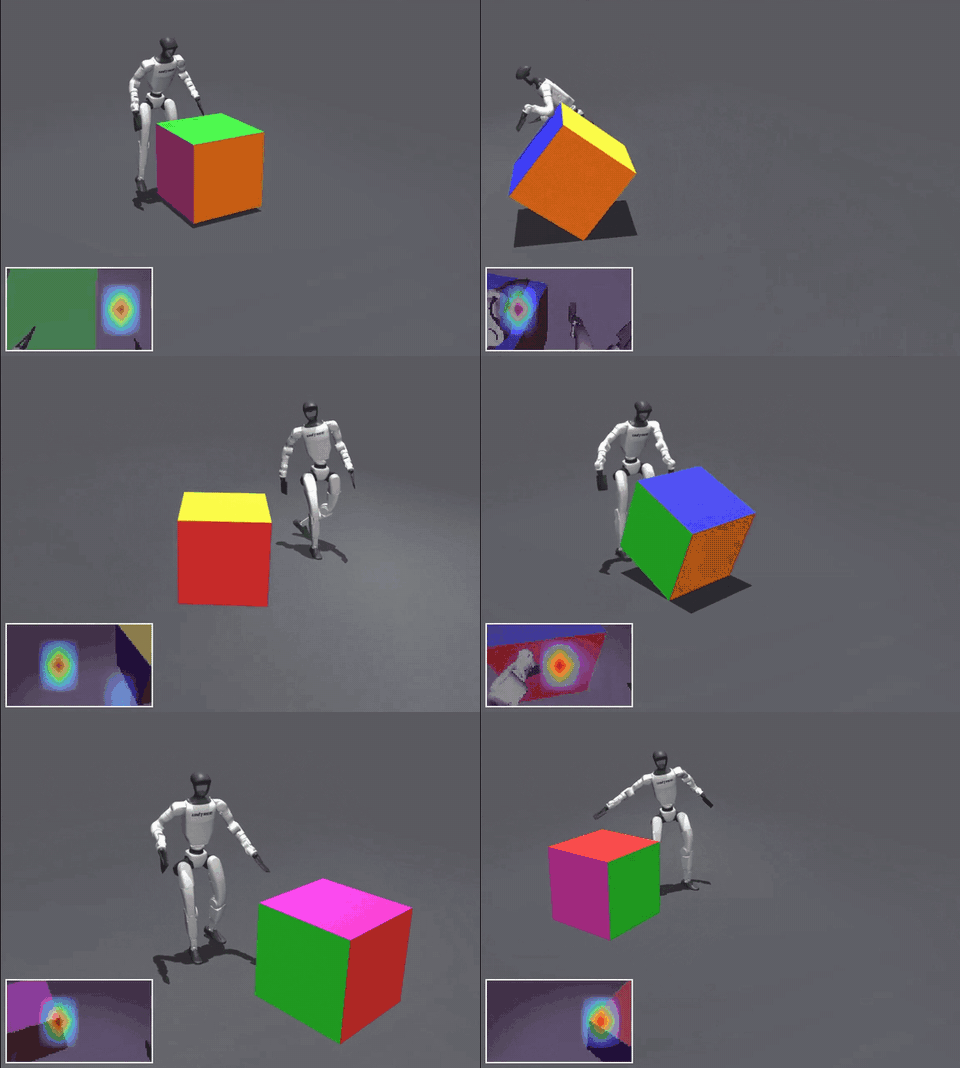
#412026-10-0278

KungfuAthleteBot: learning high-dynamic humanoid motion from video with unified robust recovery

Zhongxiang Lei, Lulu Cao, Xuyang Wang, Tianyi Qian, Jinyan Liu, Xuesong Li

Video is an abundant, inexpensive source of human motion data that is rich in extreme athletic behaviors. Making it usable for humanoid robots, however, is not a matter of simply r…

Video is an abundant, inexpensive source of human motion data that is rich in extreme athletic behaviors. Making it usable for humanoid robots, however, is not a matter of simply retargeting a reconstructed trajectory: video-derived motion is physically inconsistent, devoid of actuation information, and says nothing about failure or recovery. We present KungfuAthleteBot (KAB), a framework that treats learning high-dynamic motion from video as the central problem and resolves each of these three failure modes in turn. (C1) We build the KungfuAthlete dataset from videos of national-level martial artists and introduce a physics-guided parabolic trajectory correction that removes height floating, ground penetration, and high-frequency jitter from reconstructed aerial and landing phases. (C2) Because video carries no force information, strict tracking of a reconstructed trajectory is dynamically infeasible, and error-driven initialization keeps re-launching the policy from infeasible aerial poses. We introduce physics-driven pseudo-low-kinetic-energy (LKE) sampling, our central mechanism for making such references learnable: it biases initialization towards dynamically feasible states, letting the policy discover feasible actuation patterns instead of imitating infeasible ones. (C3) Finally, we introduce a direct training paradigm in which disturbance rejection and fall recovery are learned inside the same policy that tracks the video motion, requiring no recovery reference data and no manual mode switching. On a humanoid robot, KAB learns dynamic skills from video and recovers from arbitrary falls in about 0.7 s, the fastest reported recovery for a unified policy. Ablations on the unified policy confirm the necessity of its components, supporting the view that repairing and compensating video data, rather than only collecting more of it, is what unlocks high-dynamic humanoid skills.

cs.ROrobothumanoid

兴趣:humanoid robots and whole-body control

#422026-10-0278

UniIntervene++: An Adaptive Intervention Agent for Efficient Real-World Reinforcement Learning

Yudong Lin, Haoyuan Deng, Zhuoxuan Yuan, Zaijia Yang, Yuanjiang Xue, Ziwei Wang

Online reinforcement learning (RL) enables robot policies to improve through physical interaction, but the assistance they require changes as their competence evolves. Existing int…

Online reinforcement learning (RL) enables robot policies to improve through physical interaction, but the assistance they require changes as their competence evolves. Existing intervention strategies based on offline estimates or fixed decision rules can therefore become mismatched to the current policy. To address this, we propose UniIntervene++, an adaptive intervention agent that learns to allocate control between autonomous execution and heterogeneous assisted behaviors during online RL. Specifically, UniIntervene++ first formulates the evolving RL policy, trajectory correction, and a task-structured CodePolicy as Options in a unified semi-Markov decision process and learns their relative values online. Building on this, competence-adaptive intervention periodically probes the RL policy through unassisted execution, keeping control allocation responsive to its evolving capability. Finally, coupled experience learning allows assisted behaviors to improve the RL policy, whose evolving outcomes in turn reshape future intervention decisions. In this way, UniIntervene++ jointly determines when to intervene, how to intervene, and when to return control as the RL policy improves. Across five real-world manipulation tasks, UniIntervene++ achieves an average success rate of 89.67%, outperforming all baselines by at least 6 percentage points, while reducing human intervention to 0.77%, a relative reduction of at least 94.6% from the best baseline. Code is available in our \href{https://github.com/dannyyudong/An-Adaptive-Intervention-Agent-for-Efficient-Real-World-Reinforcement-Learning}{GitHub repository}.

cs.LGcs.ROrobotmanipulation

兴趣:imitation learning and diffusion policies for robot control

#432026-10-0277

Proprioceptive Sketches as Long-Horizon Intent for Generative Action Policies

Fangyuan Wang, Songhao Huang, Haoxiang Sun, Shipeng Lyu, Chengyang He, Anqing Duan 等

Generative robot policies predict short action chunks but lack explicit long-horizon intent. Recent methods expose longer-horizon structure through language plans, subgoal images, …

Generative robot policies predict short action chunks but lack explicit long-horizon intent. Recent methods expose longer-horizon structure through language plans, subgoal images, or video forecasts, which are costly to generate and still need to be translated into robot motion. Predicting future robot motions avoids this translation, but a dense, time-indexed trajectory requires numerous parameters to cover the full remaining task, and over a short horizon it largely repeats the action chunk and adds little guidance for action generation. We propose Proprioceptive Action Models (PAM), which jointly generate a compact, timing-free sketch of the robot's remaining joint-space path and a dense executable action chunk within a single transformer denoiser. The sketch parameterizes the path by arc length rather than time, capturing geometric intent invariant to execution timing. Block-causal attention and a staggered denoising schedule maintain directed sketch-to-action dependence, ensuring the action tokens condition on a progressively cleaner sketch throughout sampling. In simulation, PAM improves over its action-only counterparts on Push-T and LIBERO-Long; on four real-world bimanual tasks, it raises success from 47.5% to 75.0%. Project page: https://nicehiro.github.io/pam_dp/

兴趣:imitation learning and diffusion policies for robot control

#442026-10-0277

From Language Priors to Field Adaptation: Preference Learning for Traversability Estimation

Simon Schwaiger, David Seyser, Alessandro Scherl, Zlatan Ajanović, Wilfried Wöber, Gerald Steinbauer-Wagner

Image-based traversability estimation is inherently dependent on the robot platform, deployment domain, and mission preferences, which limits the applicability of purpose-trained m…

Image-based traversability estimation is inherently dependent on the robot platform, deployment domain, and mission preferences, which limits the applicability of purpose-trained models. To facilitate domain adaptation, this work aims to reduce the number of required annotations in the target domain using sample-efficient preference learning. Our method represents traversability through von Mises-Fisher mixture prototypes in a frozen vision-language feature space. Relative natural-language rules provide a commonsense prior, while sparse relative image annotations adapt the prototype directions and utilities to a target domain through computationally and sample-efficient fine-tuning. Experiments on WayFAST demonstrate accuracy competitive with end-to-end trained estimators while enabling sample-efficient image-based adaptation. Qualitative experiments further demonstrate the language prior's zero shot applicability and the fine-tuned estimator's improved dense prediction on semantic maps. Evaluation is complemented via semantic interpretation of learned prototypes by dissecting semantically close natural language prompts. Code and trained estimators available at https://resireg.github.io

cs.ROcs.CVrobot

兴趣:vision-language-action (VLA) models and foundation models for robots

#452026-10-0277

Self-Repairing Recurrent Ensembles for Real-Time Recovery from Distribution Shift

Julian Lemmel, Pedro D. Wendel Garcia, Taisuke Kobayashi, Radu Grosu

Deploying a pretrained controller exposes it to conditions that are absent from its training data. Sensor drift, outright sensor failure and accumulating measurement noise all indu…

Deploying a pretrained controller exposes it to conditions that are absent from its training data. Sensor drift, outright sensor failure and accumulating measurement noise all induce a distribution shift that can collapse an otherwise competent policy; typically at a point in time where no expert is available to supply corrective labels. We present a method that lets a policy recover from such shifts online and without supervision. Our controller is an ensemble of recurrent networks, each of which observes a randomly masked subset of the observation vector, and whose Gaussian outputs are combined through sequential Kalman fusion so that confident members dominate the consensus action. At deployment, we treat this consensus as a self-supervised label and fine-tune each member towards it, scaling each member's contribution proportional to the complement of its squared Kalman gain. Gradients are computed using RFLO, an efficient and biologically plausible approximation of Real-Time Recurrent Learning, so that a parameter update follows every environment step and the policy reacts to a shift as it unfolds. On a range of simulated continuous control tasks, our approach recovers close to the original performance after a sensor shift, while ensembles that see the full observation are unable to recover. The same framework subsumes fully online interactive imitation learning: when an expert is present, the consensus label is replaced by the expert action and the identical update rule refines the policy during teleoperation.

cs.NEcs.ROeess.SYimitation learning

兴趣:imitation learning and diffusion policies for robot control

#462026-10-0277

CSIR: Contextually and Socially Informed Robots for Efficient Person Goal Navigation

Tyler Chung, Nahl Farhan, Hao Zhang, Mingfeng Yuan, Jinjun Shan, Amy Wu 等

We address the Person Goal Navigation (PersonNav) problem, enabling robots to search for people under realistic constraints on information accessibility and language uncertainty. T…

We address the Person Goal Navigation (PersonNav) problem, enabling robots to search for people under realistic constraints on information accessibility and language uncertainty. This tackles the current solutions revolving around rigid person finding systems requiring exact knowledge of the individual for item-delivery in indoor settings. While the focus in literature is on learned methods using unavailable public or sparse data due to human privacy. We propose a planning framework that combines distance and semantic information about the recipient (habits and intent) weighted by the trust of the user-provided information. A synthetic benchmark of scenarios is also developed including actors, items, and requests to evaluate performance before real-world deployment aiming to simulate natural language human-robot interactions. Results show our informed search outperforms classical distance-based graph baselines, while semantics alone lead to ungrounded, sporadic search. Our method achieves strong gains over baselines, with an LLM-based variant performing comparably, and its explicit belief representation naturally supports future Bayesian filtering. Hardware tests demonstrate our method supports real-world embodiment able to leverage between semantic and distance information in a real setting. This work moves toward more intelligent mobile service agents capable of human-like, informed search in realistic environments to be leveraged in day-to-day use. https://anonymous.4open.science/r/personnavsite-4ED2/index.html.

兴趣:large language models for robot task planning and reasoning

#472026-10-0176

OpenRUA: Robot-Use Agents Are Zero-Shot Visuomotor Policies

Zhaoyang Chu, Earl T. Barr, Claire Le Goues, Peter O'Hearn, Mark Harman, Federica Sarro 等

Coding agents are extending their reach into the physical world by writing and executing robot control programs. One might expect the agents to use the existing mature software sta…

Coding agents are extending their reach into the physical world by writing and executing robot control programs. One might expect the agents to use the existing mature software stack that engineers have developed over decades to access sensors and control motion. Yet prior work primarily engineers complex custom harnesses to orchestrate agents for robot use, particularly by prescribing specialized workflows and providing bespoke interfaces. This raises the question: "Is such additional harness engineering necessary?" We introduce OpenRUA, a zero-abstraction harness that bypasses bespoke abstraction layers by providing off-the-shelf coding agents with only terminal access to the robot's native software interface ROS 2. OpenRUA employs a minimalist workspace-as-harness design, only offering ROS 2 documentation and basic tools while leaving the coding agent to organize its own work without orchestrating any agentic workflow. Within this workspace, OpenRUA recasts perception as file I/O and manipulation as coding. With Claude Code powered by Claude Opus 5, OpenRUA achieves success rates of 99.0% on CaP-Bench and 87.0% on LIBERO-PRO, demonstrating that an off-the-shelf coding agent can serve as a zero-shot visuomotor policy through the robot's native interface, without bespoke primitives or task-specific training. Under this minimalist design, further analysis reveals striking emergent behaviors of coding agents: (1) For perception, the agent spontaneously writes programs that process raw sensory inputs and derive metric measurements in 96.80% of episodes. (2) For manipulation, the agent spontaneously builds motion-control clients (e.g., gripper control) in 95.87% of episodes and closed-loop control programs (e.g., adjusting motion based on sensor feedback) in 50.13% of episodes. Our code is available at https://github.com/terminalworld/OpenRUA.

cs.ROrobotmanipulation

兴趣:vision-language-action (VLA) models and foundation models for robots

#482026-10-0276

Keeping JEPA World Models Plannable When Little of the Frame Moves

Florian Strohm, Patrick Wagner, Jannik Schwab, Marco Huber

Specifying a goal in language rather than as a goal frame is a natural interface for planning with a latent world model, but testing it needs scenes in which language must discrimi…

Specifying a goal in language rather than as a goal frame is a natural interface for planning with a latent world model, but testing it needs scenes in which language must discriminate between several objects. We build SLIM, a pushing benchmark with several small objects and paired visual and language goals on identical scenes. On SLIM a LeWM world model that solves PushT succeeds on under 1% of trials, although a scripted controller with simulator state solves every tier. Probes locate the failure in the encoder: its latent is nearly action-insensitive, neither pusher nor object positions can be decoded from it, and rollouts are no better than copying the current latent forward. One inverse-dynamics auxiliary loss, applied to encoder latents and to predicted latents through a shared head discarded at test time, restores every probe and raises success from 0.003 to 0.35 (0.16 on the hard pushing tier, where a goal-agnostic policy scores zero), and improves PushT at twice the trained horizon. Controls attribute the repair to the gradient into the encoder, and a response sweep shows that the vanilla model plans once enough of the frame responds to actions. A cheap action-sensitivity probe, computable without environment access, acts as an empirical necessary condition: all configurations below its threshold failed to plan. On the repaired latent, a small language-goal head plans from sentences without retraining the world model: it reaches 0.84 on navigation (visual-goal oracle 1.00), follows the named zone when it is swapped with a decoy, and degrades gracefully to unseen nouns. A single goal sentence rarely completes a push, but given the push as a sequence of stage sentences the head raises success on the medium and hard pushing tiers from 0.04 to 0.25, on par with the goal-frame oracle, also when the switch between stages is read from the latent alone.

cs.AIworld model

兴趣:vision-language-action (VLA) models and foundation models for robots

#492026-10-0276

ProAR: Learning Prospective Reasoning with Autoregressive Video Models

Linghui Shen, Tinghui Zhu, Sheng Zhang, Muhao Chen

Autoregressive (AR) video models excel at causal generation, but their reliance on next-chunk prediction confines them to a short-sighted, reactive paradigm. This limitation is par…

Autoregressive (AR) video models excel at causal generation, but their reliance on next-chunk prediction confines them to a short-sighted, reactive paradigm. This limitation is particularly consequential for reasoning-oriented generation, where achieving a target outcome through valid intermediate states matters more than local visual plausibility. To address this challenge, we propose Learning Prospective Reasoning with Autoregressive Video Models (ProAR), a novel framework that transforms autoregressive video generation into a goal-oriented reasoning process. ProAR introduces two key components: (1) To anchor generation to the long-range outcome, we integrate goal-frame prediction into the autoregressive loop via an asymmetric attention mask, enabling the predicted goal frame to guide the generation of intermediate states without being disrupted by them. (2) To guide short-range transitions, we introduce future representation self-alignment to encourage current hidden states to anticipate upcoming temporal dynamics. By leveraging teacher-forcing in AR training, we extract clean future representations in a single forward pass and align current representations with them using a lightweight, training-only predictor. Together, these two mechanisms seamlessly combine explicit, sparse target supervision with implicit, dense step-wise guidance, promoting coherent, goal-directed reasoning progress with modest computational cost. Experiments show that ProAR's complementary components consistently improve performance across diverse visual reasoning benchmarks. The framework proves highly training-efficient, surpassing fully trained standard AR baselines using only 25% of the training steps. This paradigm also demonstrates promising applicability to embodied reasoning tasks.

兴趣:world models and video prediction for embodied agents

#502026-10-0276

On Representational Alignment among Embodied Agents

Fulvio Mastrogiovanni

Embodied agents interacting with the same physical process may maintain heterogeneous, asynchronous, and observer-relative representations. Rather than assuming that such represent…

Embodied agents interacting with the same physical process may maintain heterogeneous, asynchronous, and observer-relative representations. Rather than assuming that such representations should always be globally aligned, we investigate which distinctions among them must actually be resolved for coherent interaction. We formalize this question through relational sufficiency: an interaction-specific relational-evidence map defines the representational ambiguity left unresolved by comparison, and sufficiency holds when each residual ambiguity fiber lies within an interaction-equivalence class. When this condition fails, additional sensorimotor anchors must separate precisely the ambiguities that can change the interaction-relevant outcome. For smooth systems, we derive a local first-order lower bound on the number of inde- pendent scalar anchors required, given by the dimension of directions that are invisible to relational evidence but visible to the interaction-relevant map. We instantiate the theory in two variants of an asynchronous hand-off scenario that share the same observer agents, representations, transports, and relational evidence. Relative synchronization requires no additional anchor, whereas hand-off at an absolute time requires exactly one. The analysis there- fore provides a task-relative stopping condition for representational alignment: residual disagreement need not be eliminated when it is invariant with respect to the interaction.

cs.ROembodied

兴趣:world models and video prediction for embodied agents

GitHub 项目

#12024-12-08★ 3.9k +1073

datawhalechina/every-embodied

Jupyter Notebook

仅需Python基础,从0构建自己的具身智能机器人;从0逐步构建VLA/OpenVLA/SmolVLA/Pi0, 深入理解具身智能

仅需Python基础,从0构建自己的具身智能机器人;从0逐步构建VLA/OpenVLA/SmolVLA/Pi0, 深入理解具身智能

embodied-agentembodied-aiembodied-intelligenceopenvlasmolvlavision-language-action-modelVLAvision-language-actionembodied

兴趣:world models and video prediction for embodied agents

#22026-07-06★ 2.2k +272

dexmal/opendm

Python

An Open-World Foundation Model for General-Purpose Embodied Intelligence.

An Open-World Foundation Model for General-Purpose Embodied Intelligence.

embodied-aiembodied-intelligenceroboticsvision-language-actionvlaVLAvision-language-actionembodied

兴趣:vision-language-action (VLA) models and foundation models for robots

#32026-08-26★ 396 +471

OpenMOSS/EasyWAM

Python

A unified framework for training, fine-tuning, and evaluating World Action Models

A unified framework for training, fine-tuning, and evaluating World Action Models

benchmarkcodebaseembodied-aifoundation-modelsloraroboticsvision-language-actionworld-action-modelvision-language-actionembodied

兴趣:vision-language-action (VLA) models and foundation models for robots

#42026-03-18★ 64.5k +95371

rohitg00/ai-engineering-from-scratch

Python

Learn it. Build it. Ship it for others.

Learn it. Build it. Ship it for others.

agentsaiai-agentsai-engineeringcomputer-visioncoursedeep-learningfrom-scratch

兴趣:multi-agent systems and LLM agents

#52024-12-24★ 38071

manumerous/wb_humanoid_mpc

C++

Whole-Body Nonlinear MPC for Realtime Humanoid Loco-Manipulation Planning and Control

Whole-Body Nonlinear MPC for Realtime Humanoid Loco-Manipulation Planning and Control

aidata-generationhumanoidhumanoid-robotlocomotionmpcnonlinearoptimizationrobotmanipulationhumanoidlocomotion

兴趣:humanoid robots and whole-body control

#62024-01-26★ 28k +2671

huggingface/lerobot

Python

🤗 LeRobot: Making AI for Robotics more accessible with end-to-end learning

🤗 LeRobot: Making AI for Robotics more accessible with end-to-end learning

兴趣:imitation learning and diffusion policies for robot control

#72026-07-19★ 617 +270

RealXiaoze/humanoid-motion-intelligence

人形机器人运动智能论文、开源项目、产业与求职知识库

人形机器人运动智能论文、开源项目、产业与求职知识库

embodied-aihumanoid-roboticslocomotionmotion-controlreinforcement-learningrobot-learningsim2realvlarobotVLAhumanoidlocomotionembodied

兴趣:humanoid robots and whole-body control

#82025-10-09★ 3.8k +570

starVLA/starVLA

Python

StarVLA: A Lego-like Codebase for Vision-Language-Action Model Developing

StarVLA: A Lego-like Codebase for Vision-Language-Action Model Developing

robotic-foundation-modelroboticsvision-language-action-modelworld-action-modelvision-language-action

兴趣:vision-language-action (VLA) models and foundation models for robots

#92026-04-22★ 17.2k +53169

earthtojake/text-to-cad

Python

Give your agent CAD superpowers.

Give your agent CAD superpowers.

agentsai-agentscadmechanical-engineeringroboticsstepstlstp

兴趣:multi-agent systems and LLM agents

#102024-02-29★ 16369

RobotControlStack/robot-control-stack

Python

A lean, ROS-free sim-to-real framework for training and deploying Vision-Language-Action (VLA) models and RL agents. Native MuJoCo Gymnasium wrappers with synchronous execution for…

A lean, ROS-free sim-to-real framework for training and deploying Vision-Language-Action (VLA) models and RL agents. Native MuJoCo Gymnasium wrappers with synchronous execution for Franka, UR5e, xArm, SO101 and YAM.

frankagymnasiummujocoreinforcement-learningrobot-learningrobot-manipulationsim-to-realvision-language-actions-modelsrobotmanipulationVLAvision-language-actionsim-to-real

兴趣:vision-language-action (VLA) models and foundation models for robots

#112025-05-23★ 251 +169

AoqunJin/Awesome-VLA-Post-Training

A collection of vision-language-action model post-training methods.

A collection of vision-language-action model post-training methods.

embodied-agentembodied-aifine-tuningpost-trainingvision-language-action-modelvlaVLAvision-language-actionembodied

兴趣:vision-language-action (VLA) models and foundation models for robots

#122026-09-08★ 44新项目69

lok-i/vibe

Python

Post-training humanoid whole-body trackers for perceptive control tasks

Post-training humanoid whole-body trackers for perceptive control tasks

humanoid-controlmjlabperceptive-locomotionpporeinforcement-learningrobot-learningviberobothumanoidlocomotion

兴趣:humanoid robots and whole-body control

#132024-09-29★ 3.6k +969

enactic/openarm

MDX

A fully open-source humanoid arm for physical AI research and deployment in contact-rich environments.

A fully open-source humanoid arm for physical AI research and deployment in contact-rich environments.

bilateral-teleoperationforce-feedbackgenesisgravity-compensationhumanoid-robotimitation-learningmachine-learningmoveit2robothumanoid

兴趣:humanoid robots and whole-body control

#142026-06-26★ 644 +869

robocurve/inspect-robots

Python

Open source evals for physical AI. Run any LLM/VLA on any arm/humanoid against any real/sim benchmark.

Open source evals for physical AI. Run any LLM/VLA on any arm/humanoid against any real/sim benchmark.

benchmarkembodied-aievaluationphysical-airerunroboticsvision-language-actionvlaVLAvision-language-actionhumanoidembodied

兴趣:vision-language-action (VLA) models and foundation models for robots

#152026-08-29★ 82 +168

OpenBMB/SimpleMemVLA

Python

Native-video memory for vision-language-action models, using timestamped visual history and exact streaming inference for long-horizon robot manipulation.

Native-video memory for vision-language-action models, using timestamped visual history and exact streaming inference for long-horizon robot manipulation.

embodied-ailong-horizon-roboticsmultimodal-learningnative-video-memoryrobot-learningrobot-manipulationstreaming-inferencevideo-understandingrobotmanipulationVLAvision-language-actionembodied

兴趣:vision-language-action (VLA) models and foundation models for robots

#162026-09-14★ 27 +5新项目68

luoyu100/PoS

Python

An inference-time framework for long-horizon LLM agents with explicit belief states, consistency validation, and trapping-aware recovery.

An inference-time framework for long-horizon LLM agents with explicit belief states, consistency validation, and trapping-aware recovery.

belief-statecontext-managementllm-agentslong-horizon

兴趣:multi-agent systems and LLM agents

#172025-11-23★ 67568

sou350121/VLA-Handbook

HTML

本项目旨在为致力于进入VLA(Vision-Language-Action)领域的算法工程师提供一份全中文、实战导向的学习/面试手册。 不同于通用的 CV/NLP 面试指南,本项目聚焦于 Robotics 特有的挑战

本项目旨在为致力于进入VLA(Vision-Language-Action)领域的算法工程师提供一份全中文、实战导向的学习/面试手册。 不同于通用的 CV/NLP 面试指南,本项目聚焦于 Robotics 特有的挑战

chinesedeep-learningembodied-aillmrobot-learningroboticsvision-language-actionvlarobotVLAvision-language-actionembodied

兴趣:vision-language-action (VLA) models and foundation models for robots

#182026-09-28★ 175 +89新项目67

KingKongRobotics/jumper

Python

🦀 Jumper — an open-source crab robot.

🦀 Jumper — an open-source crab robot.

crab-robotopen-source-robotsrobotroboticsrobot

兴趣:humanoid robots and whole-body control

#192025-04-04★ 1.9k67

RoboVerseOrg/RoboVerse

Python

RoboVerse: Towards a Unified Platform, Dataset and Benchmark for Scalable and Generalizable Robot Learning

RoboVerse: Towards a Unified Platform, Dataset and Benchmark for Scalable and Generalizable Robot Learning

imitation-learningreinforcement-learningroboticssimulationrobot

兴趣:imitation learning and diffusion policies for robot control

#202026-07-02★ 92 +367

ZJU-OmniAI/vla-corrector

Python

[NeurIPS 2026] VLA-Corrector: Lightweight Detect-and-Correct Inference for Adaptive Action Horizon

[NeurIPS 2026] VLA-Corrector: Lightweight Detect-and-Correct Inference for Adaptive Action Horizon

action-chunkingembodied-ailerobotneurips-2026robot-learningrobot-manipulationroboticsvision-language-actionrobotmanipulationVLAvision-language-actionembodied

兴趣:vision-language-action (VLA) models and foundation models for robots

#212025-08-14★ 5.4k +566

RLinf/RLinf

Python

RLinf: Reinforcement Learning Infrastructure for Embodied and Agentic AI

RLinf: Reinforcement Learning Infrastructure for Embodied and Agentic AI

agentic-aiembodied-aireinforcement-learningrl-infrarlinfvla-rlVLAembodied

兴趣:vision-language-action (VLA) models and foundation models for robots

#222026-02-08★ 394 +266

XPolicyLab/XPolicyLab

Python

[IROS 26 ScaleInfra Workshop Best Tool Paper] Involving over 40 Advanced Manipulation Policies

[IROS 26 ScaleInfra Workshop Best Tool Paper] Involving over 40 Advanced Manipulation Policies

embodied-aimanipulationpolicymanipulationembodied

兴趣:robot manipulation and grasping with learned policies

#232022-11-16★ 8.3k +666

isaac-sim/IsaacLab

Python

Unified framework for robot learning with multi-physics/renderer support

Unified framework for robot learning with multi-physics/renderer support

isaac-simomniverse-kit-extensionrobot-learningroboticsrobot

兴趣:3D perception, point clouds and scene understanding for robotics

#242026-09-15★ 115 +6新项目65

1173591564/Dynamics-memory

TypeScript

LLM agent 的有界自纠错长期记忆层:把连续、含矛盾的项目交互日志蒸馏成有界、可自更新的记忆库。Bounded, self-correcting long-term memory for LLM agents — candidate pool + value dynamics + tension adjudication + causal-replay…

LLM agent 的有界自纠错长期记忆层:把连续、含矛盾的项目交互日志蒸馏成有界、可自更新的记忆库。Bounded, self-correcting long-term memory for LLM agents — candidate pool + value dynamics + tension adjudication + causal-replay evals.

agent-memoryagentsllmllm-agentslong-term-memorymemorymemory-managementpythonLLM agent

兴趣:multi-agent systems and LLM agents

#252026-08-07★ 8.1k +3065

deeplethe/utopia

Rust

World's first open-source enterprise world model.

World's first open-source enterprise world model.

agent-memorybitemporalgraphragknowledge-baseknowledge-graphllmontologypgvectorworld model

兴趣:multi-agent systems and LLM agents

#262025-09-09★ 52.5k +15865

bojieli/ai-agent-book

Python

《深入理解 AI Agent:设计原理与工程实践》(李博杰 著)开源主仓库:全书正文、编译版 PDF 与按章配套代码

《深入理解 AI Agent:设计原理与工程实践》(李博杰 著)开源主仓库:全书正文、编译版 PDF 与按章配套代码

agentagent-memoryai-agentbookcoding-agentcontext-engineeringlarge-language-modelsllm

兴趣:multi-agent systems and LLM agents

#272024-10-21★ 61165

maze-agent/Maze

Python

A distributed framework for LLM agents

A distributed framework for LLM agents

distributeddistributed-agentsdistributed-llm-agentsllm-agents

兴趣:multi-agent systems and LLM agents

#282026-03-29★ 63.7k +84364

calesthio/OpenMontage

Python

World's first open-source, agentic video production system. 12 production pipelines, 100+ tools, 700+ agent skill and production-knowledge files. Turn your AI coding assistant into…

World's first open-source, agentic video production system. 12 production pipelines, 100+ tools, 700+ agent skill and production-knowledge files. Turn your AI coding assistant into a full video production studio.

agentagentic-aiaiclaudecopilotcursorelevenlabsffmpeg

兴趣:world models and video prediction for embodied agents

#292026-09-07★ 21 +4新项目64

jaz-lang/jaz-evals

Python

Reproduction package for "Harness as a Language: A Minimalist Agent Framework With Maximal Expressivity" — ten agent arms across AppWorld and StuLife

Reproduction package for "Harness as a Language: A Minimalist Agent Framework With Maximal Expressivity" — ten agent arms across AppWorld and StuLife

agent-frameworkappworldbenchmarkllm-agentslong-horizon-agentsreproducibilityself-improvement

兴趣:multi-agent systems and LLM agents

#302025-01-16★ 3.6k +264

jonyzhang2023/awesome-embodied-vla-va-vln

A curated list of state-of-the-art research in embodied AI, focusing on vision-language-action (VLA) models, vision-language navigation (VLN), and related multimodal learning appro…

A curated list of state-of-the-art research in embodied AI, focusing on vision-language-action (VLA) models, vision-language navigation (VLN), and related multimodal learning approaches.

VLAvision-language-actionembodied

兴趣:vision-language-action (VLA) models and foundation models for robots