Tech Station

2026-10-06

50 篇论文 · 30 个项目 ← 2026-10-05 · 2026-10-07 →

论文

#12026-10-05追踪学者 · Shuran Song追踪学者 · Chelsea Finn99

Mulligan: Performance-Guided Data Collection for Efficient On-Robot Learning

Lars Ankile, Perry Dong, Rohan Bhowmik, Aneesh Muppidi, David D. Yuan, Shuran Song 等

Learning from human demonstrations is a reliable way to teach robots new tasks, but the gains from each additional demonstration shrink as the policy improves. Continued improvemen…

Learning from human demonstrations is a reliable way to teach robots new tasks, but the gains from each additional demonstration shrink as the policy improves. Continued improvement can instead come from supervised deployment, where an operator places the objects and intervenes when the policy fails. We ask how to maximize improvement from a fixed budget of supervised episodes on high-precision manipulation tasks with wide ranges of object placements. We observe that failures can concentrate in a small subset of initial states, so uniform collection spends much of the operator's time on states the policy already handles. Mulligan makes the initial-state distribution a decision, starting each round's episodes at observed failures and untried states. To further improve data efficiency, we augment interactive imitation learning with a value function trained on all data, including failures that imitation discards. Across three real-world tasks evaluated on 2,550 held-out, blinded episodes and two simulated tasks, Mulligan outperforms uniform initial-state sampling at matched collection budgets, and combined with value-based action selection, HiL-IDQL+Mulligan, improves final real-task success by 10-34 percentage points. With operator interventions, the human-robot team completes 98% of collection episodes, remaining productive while the policy learns. Videos, code, and data are available at https://mulligan.page/.

cs.ROcs.LGrobotmanipulationimitation learning

追踪学者:Shuran Song、Chelsea Finn;兴趣:imitation learning and diffusion policies for robot control

#22026-10-03追踪学者 · Jiajun Wu99

Robot Learning with Visual Predicted Force

Haonan Chen, Feiyang Wu, Yuxiang Ma, Mustafa Mete, Pengfei Ye, Junxuan Shen 等

Force-aware manipulation typically relies on specialized force or tactile sensors. We show that force-aware manipulation can instead be achieved through visual force prediction fro…

Force-aware manipulation typically relies on specialized force or tactile sensors. We show that force-aware manipulation can instead be achieved through visual force prediction from the deformation of a compliant Fin Ray gripper. Our approach trains two models. First, we train a visual force estimator on calibration data and use it to annotate task demonstrations with force estimates. Second, we train an action--force proposal policy on these force-augmented demonstrations to jointly generate candidate robot actions and their associated forces. At test time, we sample candidate actions and the forces they are expected to produce, then execute the action whose predicted force is closest to a target from the demonstrations. We evaluate our approach on berry picking, empty-can grasping, in-hand reorientation, and plug insertion. Our results show that visual force prediction can guide inference-time action selection for contact-rich manipulation without requiring force or tactile sensors at deployment.

cs.ROcs.AIrobotmanipulationtactile

追踪学者:Jiajun Wu;兴趣:robot manipulation and grasping with learned policies

#32026-10-0598

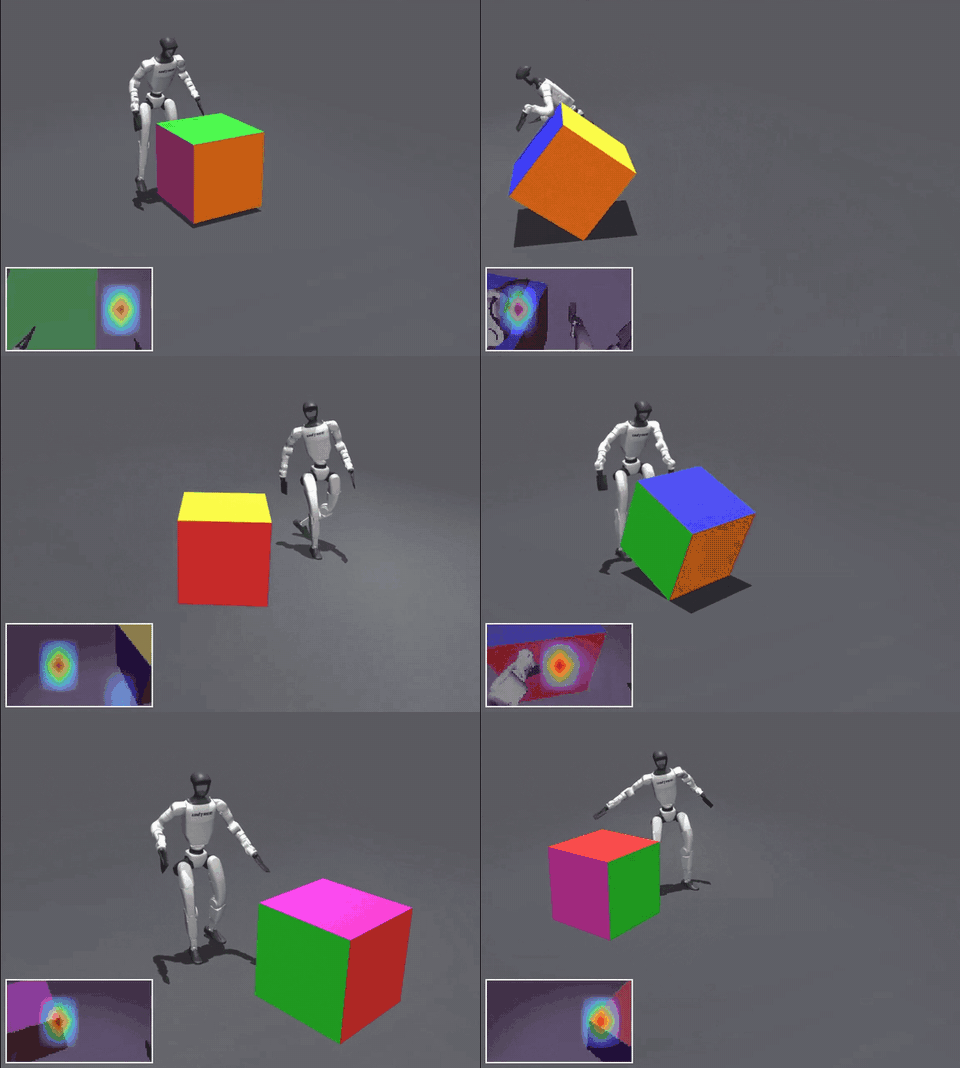
InterMimicGen: Scaling Humanoid Loco-Manipulation through Self-Evolving Motion Imitation

Yucheng Zhang, Sirui Xu, Jinhong Li, Liuyu Bian, Anatulya Nandi, Derek Zhang 等

Captured human-object interactions provide rich supervision for humanoid loco-manipulation, but they are sparse, heterogeneous, and not directly executable by robots. We introduce …

Captured human-object interactions provide rich supervision for humanoid loco-manipulation, but they are sparse, heterogeneous, and not directly executable by robots. We introduce InterMimicGen, a self-evolving motion-imitation framework in which robot motion data and a tracking policy improve each other. First, we consolidate motion-captured human-object interaction datasets and retarget them into humanoid robot references while preserving whole-body coordination and dexterous hand-object relationships. This produces a large and diverse humanoid robot reference collection for dexterous whole-body loco-manipulation. Second, we train a physics-based generalist tracker that executes these references in simulation on a humanoid with dexterous hands, covering a scale and diversity beyond prior humanoid tracking systems for loco-manipulation. Third, we close a data flywheel: each round makes small, task-preserving changes to where an interaction takes place and how the body performs it, fine-tunes the tracker on them, and keeps only the variants whose simulated execution completes the task, which seed the next round. With more iterations, these small edits compound into broader coverage around the sparse original demonstrations while preserving task semantics and motion quality. Experiments show contact-preserving retargeting across robot configurations, broad tracking with a single generalist policy, executable motions that keep growing over augmentation rounds, and transfer to real robots. InterMimicGen provides a unified path from heterogeneous human demonstrations to a continually expanding motion resource for humanoid robot learning.

cs.ROcs.CVcs.GRrobotmanipulationhumanoiddexterous

兴趣:humanoid robots and whole-body control

#42026-10-0497

Vela: Scaling Vision-Language-Action Models with Adaptive Action Curve Parametrization

Yifan Li, Jiaxu Wang, Dongming Wu, Yicheng Jiang, Ryan Ji, Xiangyu Yue 等

Most vision-language-action models represent future motion as fixed-rate action chunks, tying temporal resolution and prediction horizon to a fixed output budget. This pointwise re…

Most vision-language-action models represent future motion as fixed-rate action chunks, tying temporal resolution and prediction horizon to a fixed output budget. This pointwise representation wastes capacity on highly correlated neighboring actions, leaves temporal continuity and smoothness to be learned implicitly, and forces a tradeoff between long-horizon coverage and the local precision required for contact-rich manipulation. To address these limitations, we introduce Vela, a vision-language-action foundation model that represents future robot behavior as continuous trajectories. Vela combines a compact spline-based action representation with motion-dependent temporal support and a shared action interface for heterogeneous embodiments, allowing a fixed output budget to adapt its temporal resolution across motions. We pretrain Vela on large-scale multi-embodiment robot data and evaluate it on LIBERO-X, EBench, and two real-world long-horizon tasks, egg-cake cooking and potato shredding, obtaining promising results across simulation and physical manipulation. These results highlight the potential of continuous action representations as a foundation for future embodied foundation models. Project page and more results: https://clementine24.github.io/Vela/ .

cs.ROcs.AIrobotmanipulationvision-language-actionembodied

兴趣:vision-language-action (VLA) models and foundation models for robots

#52026-10-0496

EvoMem-VLA: State-Evolution Memory for Long-Horizon Robot Manipulation

Yuheng Na, Zhide Zhong, Junjie He, Junfeng Li, Haodong Yan, Jiaan Wang 等

Most vision-language-action (VLA) models rely on current observations and lose task-relevant evidence once it leaves view, limiting performance on long-horizon, memory-dependent ta…

Most vision-language-action (VLA) models rely on current observations and lose task-relevant evidence once it leaves view, limiting performance on long-horizon, memory-dependent tasks. Existing efforts incorporate compressed historical features or sparse visual keyframes. However, isolated snapshots can leave the policy uncertain about what changed during past interactions and which action should follow. To overcome this limitation, we propose EvoMem-VLA, which constructs state-evolution memory by explicitly encoding and retaining observed changes between historical states. These change representations preserve evidence of interaction outcomes, allowing the policy to track task progress beyond isolated snapshots. Specifically, we introduce conditional delta tokenization to encode ordered frame pairs into directional, source-conditioned delta tokens, each associated with its corresponding state evidence. A shared VLM backbone supports task-adaptive routing: normal long-horizon tasks follow a direct action route, whereas multi-stage tasks use a subtask route that generates an executable subtask as an additional input for action generation. With a single jointly trained policy for each simulation benchmark, EvoMem-VLA achieves success rates of 80.7% on RMBench, 82.0% on RoboMME and 83.8% across four real-world tasks spanning two robot embodiments. These results represent substantial improvements over the previous state of the art in all three evaluation settings.

cs.ROcs.CVrobotmanipulationVLAvision-language-action

兴趣:vision-language-action (VLA) models and foundation models for robots

#62026-10-0496

Beyond LLM Serving: Characterizing Vision-Language-Action Workloads for Embodied AI System Design

Seonghun Jung, Sieun Moon, Jiyoung Jeong, Jimin Lee, Jaehyuk Huh

Vision-language-action (VLA) models translate multimodal observations into low-level robot actions. During robot operation, each control period sets an inference deadline, and over…

Vision-language-action (VLA) models translate multimodal observations into low-level robot actions. During robot operation, each control period sets an inference deadline, and overruns leave the robot acting on stale observations, reducing task success. Meeting this deadline motivates on-device or nearby edge execution, where a single robot requires batch-1 inference outside the design point of LLM serving systems. Although VLA architectures combine familiar vision-language, autoregressive, and diffusion-style components, their runtime behavior in this batch-1 control setting remains uncharacterized. We characterize four representative VLA models on an edge GPU server and two onboard SoCs, using single-inference profiling and 43,200 closed-loop episodes. Action tensor dimensionality determines whether a stage is memory- or compute-bound, platform balance can shift that bottleneck, and GPU frequency scaling yields a platform-dependent energy-latency sweet spot. In closed-loop operation, overlapping inference with action execution creates an accuracy-speed-energy tradeoff, and no configuration is Pareto-dominant across deployment SLOs. These results guide joint design of VLA model architectures, hardware, and runtime policies.

cs.ARcs.ROrobotVLAvision-language-actionembodied

兴趣:vision-language-action (VLA) models and foundation models for robots

#72026-10-0496

GeoBridge-VLA: Geometry-Aware Residual Adaptation for Vision-Language-Action Models

Hyun Song, Kangmin Kim, Loren Jinsoo Um, Minhui Han, Jaehyeok Park, Taewan Cho 等

Vision-language-action (VLA) models encode semantic information from vision-language pretraining, but manipulation also requires precise spatial reasoning. We present GeoBridge-VLA…

Vision-language-action (VLA) models encode semantic information from vision-language pretraining, but manipulation also requires precise spatial reasoning. We present GeoBridge-VLA, a two-stage method for learning geometric features from a pretrained VLA's frozen visual encoder and using them for action prediction. Stage I trains a feature bridge and geometry decoder with depth supervision. Stage II freezes these modules and trains a gated residual interface together with the action-side projections and action expert. The residual augments the existing visual tokens without adding a second image encoder or increasing the token count. Deployment requires RGB, robot state, and language, but no depth observations. Under matched evaluation conditions, GeoBridge-VLA achieves 70.9% success on LIBERO, compared with 60.0% for SmolVLA. Disabling the residual in the same trained checkpoint reduces success from 70.90% to 69.85%, with mixed effects across suites. On a physical ROBOTIS OMY robot, GeoBridge-VLA succeeds in 148 of 200 trials (74.0%) across four tasks, compared with 108 of 200 (54.0%) for SmolVLA.

cs.CVcs.ROrobotmanipulationVLAvision-language-action

兴趣:vision-language-action (VLA) models and foundation models for robots

#82026-10-02追踪学者 · Pieter Abbeel96

GOTT: Object-centric Dexterous Manipulation with a Reusable Cross-Embodiment Primitive

Yulin Liu, Lai Wei, Yen-Jen Wang, Akash Sharma, Pieter Abbeel, Henrik I. Christensen 等

Foundation models and large-scale human data provide rich sources of manipulation intent, but translating this intent into multi-fingered robot behavior remains difficult. Dexterou…

Foundation models and large-scale human data provide rich sources of manipulation intent, but translating this intent into multi-fingered robot behavior remains difficult. Dexterous hands still lack a reusable low-level primitive that reliably establishes contact across tasks and embodiments. We propose GOTT, a reach-acquire-move framework built around a single cross-embodiment contact-acquisition primitive. Given a robot-agnostic object trajectory and a reach specification, GOTT first brings the hand near a task-relevant contact region. The shared closed-loop primitive then establishes stable contact from this approximate initialization, and a pose-conditioned controller tracks the desired object motion. Reach specifications may come from future-aware planning, external models, or human demonstrations, while the primitive and tracking backend remain unchanged. Simulation and real-world experiments show that GOTT is able to establish robust contact across diverse objects, arm-hand platforms, and seen and unseen hand morphologies. It also consistently improves end-to-end task success over open-loop grasp execution.

cs.ROcs.AIcs.CVrobotmanipulationgraspdexterous

追踪学者:Pieter Abbeel;兴趣:robot manipulation and grasping with learned policies

#92026-10-0395

Video2World: Benchmarking Coding Agents for Interactive World Modeling from Embodied Videos

Jinzhou Tang, Zijun Zhang, Jing Yang, Yuchen Yan, Kun Zhou, Lingjun Mao 等

Building interactive simulators from real-world observations is a promising way to scale embodied data, but current pipelines still rely heavily on manual environment construction …

Building interactive simulators from real-world observations is a promising way to scale embodied data, but current pipelines still rely heavily on manual environment construction and calibration. We study whether frontier foundation models and coding agents can automate this process end to end. We formulate autonomous video-to-simulation as a software engineering task in which an agent observes an embodied video, constructs the corresponding simulated environment and robot behavior, and iteratively refines the result through execution feedback. To evaluate this capability, we introduce Video2World, a benchmark comprising 222 reconstruction instances derived from 189 robot and human demonstration videos. Video2World measures reconstructed worlds along geometric fidelity, dynamic fidelity, and functional correctness, capturing spatial perception, physical reasoning, and executable interaction. Evaluating 9 frontier coding-agent systems reveals a sharp improvement in Task success beginning with Claude Opus 5, rising from below 5% to over 15%, while substantial gaps to human-assisted reconstruction remain. We further find that worlds that look better could work worse: better visual fidelity does not always lead to higher task success. This echoes the broader gap between perceptual realism and factual correctness observed in generative models.

cs.CVcs.AIcs.ROrobotembodied

兴趣:world models and video prediction for embodied agents

#102026-10-0594

VLA-ZO: Fast Zeroth-Order Adaptation for Vision-Language-Action Models

Jaemin Kim, Jiahn Kim, Taesik Gong

Adapting vision-language-action (VLA) models to deployment-time distribution shifts is important for reliable robotic operation, but conventional first-order adaptation can exceed …

Adapting vision-language-action (VLA) models to deployment-time distribution shifts is important for reliable robotic operation, but conventional first-order adaptation can exceed the memory budget of inference-oriented deployment platforms. Zeroth-order (ZO) optimization offers a forward-only alternative with inference-level memory, but accurate gradient estimation requires many perturbation queries, making naive ZO prohibitively slow for large VLA models. We present VLA-ZO, a framework for fast ZO adaptation that exploits the structure of VLA computation. By confining adaptation to the action side, VLA-ZO keeps the expensive vision-language prefix frozen and reuses its conditioning states across perturbation queries and optimizer steps, while schedule-aware prefetching hides state-transfer overhead. On LIBERO camera-viewpoint shifts, VLA-ZO reduces end-to-end adaptation time by 25.59$\times$ at $q=16$ and 32.54$\times$ at $q=64$ relative to baseline ZO, while improving average task success from 48.27% without adaptation to 58.17% and 63.58%, respectively. These results show that making ZO faster can make larger query budgets practical, providing a promising path toward resource-efficient VLA adaptation on deployment platforms.

cs.ROcs.AIVLAvision-language-action

兴趣:vision-language-action (VLA) models and foundation models for robots

#112026-10-0394

Humanoid Rickshaw Pulling: Whole-Body Locomotion under Coupled Wheeled Loads

Yangzhi Yang, Xiansheng Lin, Zhaoming Xie, Xiaobin Xiong

Humanoid robots could transport payloads substantially heavier than themselves by pulling passive wheeled vehicles instead of carrying the load. This capability, however, creates a…

Humanoid robots could transport payloads substantially heavier than themselves by pulling passive wheeled vehicles instead of carrying the load. This capability, however, creates a coupled locomotion problem: the robot must maintain persistent upper-body contact while adapting to unknown, configuration-dependent forces arising from the payload, vehicle, and terrain. We present a whole-body control framework for humanoid rickshaw pulling that tracks commanded vehicle motion while preserving balance and stable grasps under uncertain load dynamics. During training, a privileged teacher exploits vehicle states, interaction forces, and load properties. Its actions and latent are distilled into a history-conditioned student that implicitly infers coupled dynamics from proprioceptive responses, followed by reinforcement-learning fine-tuning. Comparisons with No History and Only History baselines show that the resulting policy achieves accurate vehicle tracking while reducing vehicle oscillation, torso tilt, and actuation cost. Behavioral analysis shows that Unitree G1 propels the rickshaw and generates gait-synchronized whole-body reactions that stabilize its lateral and roll motions. Moreover, pulling redistributes joint effort and yields a lower robot-normalized cost-of-transport proxy than unloaded walking over most tested load--speed conditions. On hardware, a single policy performs starting, sustained pulling, turning, and stopping with both rigid payloads and human passengers, handling a loaded rickshaw mass of up to 115~kg without load-specific retuning. These results demonstrate robust heavy-load transportation through coordinated and persistent humanoid--vehicle interaction.

cs.ROcs.LGrobothumanoidlocomotion

兴趣:humanoid robots and whole-body control

#122026-10-0594

Dataset-Free Compliant Humanoid Loco-Manipulation with Dynamic Online Posture

Seungho Yeom, Zhenyu Wu, Jaeyoung Huh, Diego Williams, Yuheng Zhi, Soofiyan Atar 等

Most humanoid loco-manipulation controllers require human motion data to learn whole-body coordination and posture, leaving policies reliant on external sources to provide this dat…

Most humanoid loco-manipulation controllers require human motion data to learn whole-body coordination and posture, leaving policies reliant on external sources to provide this data. We present OCLO (Online-posture Compliant LOco-manipulation), a humanoid loco-manipulation system trained without human motion data and commanded only through two end-effector targets. Because these targets do not uniquely determine whole-body posture, OCLO generates pelvis height and torso orientation online using an analytic reachability prior, further refined through policy-in-the-loop sampling with a task-agnostic cost. OCLO also learns whole-body compliance by displacing end-effector references according to measured forces through a spring-damper model, encouraging the legs, waist, and pelvis to yield to external loads. In simulation, using the reachability prior leads to a 77.8% success rate in acquiring the commanded reference, a vast improvement over the 37.8% success rate accomplished without the prior. Further, refinement reduces end-effector orientation error across all evaluated tasks. The same posture module improves a pretrained SONIC controller on four of five tasks. Without compliance training, policies tend to lose balance under disturbances rather than sacrifice tracking. On a Unitree G1, OCLO maintains balance under end-effector disturbances that cause its ablations to fail and performs seven loco-manipulation tasks, including crouched walking and picking up a box from a low surface. Project website: https://oclo-humanoid.github.io/

cs.ROmanipulationhumanoid

兴趣:humanoid robots and whole-body control

#132026-10-0393

TacOT: Learning Contact-Rich Dexterous Manipulation from Human Demonstrations via Tactile-Guided Optimal Transport

Xingting Li, Yifan Han, Zijian Lin, Wei Hou, Chuqiao Lyu, Shoujie Li 等

Learning contact-rich dexterous manipulation from human demonstrations provides a scalable source of interaction data, yet transferring such skills to robots remains challenging du…

Learning contact-rich dexterous manipulation from human demonstrations provides a scalable source of interaction data, yet transferring such skills to robots remains challenging due to unreliable human--robot correspondence. Existing human-to-robot transfer methods typically rely on visual appearance or motion similarity, which may associate similar motions with different contact states and force patterns. Tactile dynamics provide interaction-aware cues to distinguish manipulation processes with similar motions but different contact states. We introduce tactile-guided optimal transport (TacOT), a framework for human-to-robot contact-rich manipulation. TacOT leverages action--tactile dynamic time warping to identify human--robot demonstration correspondences with consistent interaction dynamics and uses these correspondences to guide soft optimal transport alignment in a shared policy representation space. This enables human demonstrations to provide contact-rich supervision for robot policy learning without requiring predefined frame-level human--robot pairing. Across four real-world dexterous manipulation tasks, TacOT improves closed-loop success rates over action-guided OT by up to 17 points on in-distribution tasks and 20 points under targeted human-to-robot out-of-distribution transfer. Further analyses show that tactile-guided correspondence selects demonstration pairs with more consistent contact dynamics and produces latent representations that better reflect interaction-state evolution. These results demonstrate that tactile dynamics provide an effective semantic signal for establishing reliable human-to-robot correspondence in contact-rich dexterous manipulation.

cs.ROrobotmanipulationdexteroustactile

兴趣:robot manipulation and grasping with learned policies

#142026-10-0293

SUAVE: Unified Video-Action Models via Masked Diffusion

Rhythm Syed, Jean Mercat, Sedrick Keh, Kushal Arora, Paarth Shah, Aykut Onol 等

Vision-language-action models (VLAs) inherit strong semantic grounding from pretrained vision-language backbones but are typically optimized for predicting actions rather than futu…

Vision-language-action models (VLAs) inherit strong semantic grounding from pretrained vision-language backbones but are typically optimized for predicting actions rather than future observations. They can see and act, but they do not imagine the future before acting. World action models (WAMs) built on video diffusion backbones can imagine but treat language as frozen conditioning on a continuous latent space. Unified models bring these modalities into one architecture, but they either decode autoregressively, one token at a time, or keep video continuous with an auxiliary action head. In this work, we present SUAVE, a Single vocabulary Unified Action-Video modEl in which a masked diffusion transformer generates video and actions conditioned on language, with all three modalities represented as discrete tokens in a shared sequence. Choosing which tokens to mask at inference turns the same network into a world model, a robot policy, or a video-action model. For action-free co-training, the action positions of unlabeled video are filled with mask tokens and excluded from the loss. Simulation and real-world experiments demonstrate two findings. First, a single SUAVE model predicts long-horizon video and acts as a policy, competitive with dedicated world models and specialized action policies on static and dynamic manipulation tasks. On a real robot, our model generates subgoal images and an action chunk spanning one second of motion in 1,030 ms on an RTX 5090 GPU, sustaining closed-loop control at 2.5 actions per second. Second, pretraining on robot video and co-training on human video substantially improves policy performance and zero-shot robustness to distribution shift. Together, these results show that masked diffusion is a practical and versatile foundation for unified video-action modeling.

cs.ROcs.CVcs.LGrobotmanipulationvision-language-actionworld model

兴趣:vision-language-action (VLA) models and foundation models for robots

#152026-10-0592

Learning Coordinated Visuomotor Box-Pushing from Solo Demonstrations

Ryusei Matsumoto, Mei Kinjo, Yoko Sasaki, Keisuke Okumura

Multi-robot imitation learning, particularly in settings where visuomotor policies are deployed in a communication-free, onboard decentralised style, represents an attractive parad…

Multi-robot imitation learning, particularly in settings where visuomotor policies are deployed in a communication-free, onboard decentralised style, represents an attractive paradigm. However, its realisation remains insufficiently understood, largely due to the difficulty of collecting collective demonstrations, since a single operator cannot control many robots simultaneously. Meanwhile, unlike coupled collaborative manipulation, many coordinated tasks achieve system-wide efficiency primarily through minimising inter-robot interference. This structure motivates us to study whether data collected by a teleoperated single-robot can be leveraged for large-scale coordinated box-pushing as a testbed. We systematically investigate dataset creation strategies and lightweight policy architectures. In particular, experiments with up to 40 robots highlight the difficulty of acquiring effective coordination solely through passive observation of other operating robots, revealing a concrete bottleneck for multi-robot research.

cs.ROrobotmanipulationimitation learning

兴趣:imitation learning and diffusion policies for robot control

#162026-10-0592

Demonstration-Calibrated Port-Hamiltonian Retuning for Manipulation Policies

Yulong Yang, Fan Wu, Christine Allen-Blanchette, Amit Chakraborty

Diffusion and VLA policies for manipulation are often deployed through downstream impedance controllers. The stiffness and damping gains of these controllers affect task success, y…

Diffusion and VLA policies for manipulation are often deployed through downstream impedance controllers. The stiffness and damping gains of these controllers affect task success, yet are commonly inherited from data collection rather than selected for the deployed policy. Although empirical gain sweeps can improve performance, they require repeated evaluation rollouts. We introduce PHRetune, an offline method that derives controller gains for a frozen policy without evaluation rollouts or gain search. Our approach learns a port-Hamiltonian model from demonstrations to estimate the effort and energy associated with the policy's predicted actions. The policy is applied to recorded demonstration observations, and its predictions are assessed against demonstration-derived effort and energy budgets. From this comparison, we derive a single gain scale in closed form, adjusting the downstream controller while preserving the policy and its action representation. The gains are fixed before evaluation, without requiring a prior manipulator model, task rewards, policy retraining, or additional runtime computation. Across LIBERO suites, PHRetune improves Diffusion Policy success by up to 9.4 percentage points, with the derived gains achieving the highest observed success rates in empirical gain sweeps. On all four real-world manipulation tasks, PHRetuned Diffusion Policy outperforms the nominal policy, alternative gain-tuning methods, and a policy-retraining baseline. The same procedure improves success with SmolVLA and OpenVLA-OFT on every task, while reducing acceleration and jerk for both VLA backbones.

cs.ROeess.SYmanipulationVLAdiffusion policy

兴趣:imitation learning and diffusion policies for robot control

#172026-10-03追踪学者 · Jan Peters91

Exploiting Hierarchical Controller Structure in Contextual Parameter Learning for Humanoid Loco-Manipulation

Sebastian Hirt, Lukas Theiner, Jan Peters, Rolf Findeisen

Hierarchical control architectures are widely used to decompose complex control problems into interacting control levels and are particularly important in robotics, where planning,…

Hierarchical control architectures are widely used to decompose complex control problems into interacting control levels and are particularly important in robotics, where planning, whole-body motion, and lower-level control must be coordinated across different levels of abstraction and time scales. Their overall closed-loop performance, however, depends strongly on parameters distributed across the hierarchy, such that tuning controllers on different levels independently may neglect relevant cross-layer interactions. We propose a contextual Bayesian optimization framework for joint parameter learning in hierarchical control systems. Rather than modeling closed-loop performance only as a scalar black-box function, we retain separate observations of task performance, realization quality, and control effort. A correlated multi-output Gaussian process models these performance components, while their known aggregation into the overall closed-loop objective is evaluated analytically. The formulation exploits three complementary consequences of hierarchical control: informative performance quantities exposed by the hierarchy, coupling between parameters of different controller levels, and variations of these relations with operating conditions. We evaluate the approach for humanoid loco-manipulation, jointly tuning a centroidal predictive controller and a whole-body controller for physical box pushing under varying box mass. The proposed method achieves the lowest mean empirical regret during both training and adaptation among the considered baselines.

cs.ROcs.LGmanipulationhumanoid

追踪学者:Jan Peters;兴趣:humanoid robots and whole-body control

#182026-10-0391

ForeAct3D: Policy-Grounded Future World Modeling for VLA Policies

Zhe Tao, Feiran Wang, Gaowen Liu, Ramana Rao Kompella$, Yan Yan

Robots need to anticipate how their actions will change the world, since manipulation success hinges on the resulting contacts and object motions. However, existing Vision-Language…

Robots need to anticipate how their actions will change the world, since manipulation success hinges on the resulting contacts and object motions. However, existing Vision-Language-Action (VLA) policies that predict future observations from shared features leave the forecast decoupled from the actions the policy will actually execute, and impose no physical constraints on how the scene may evolve. We introduce ForeAct3D, a framework for policy-grounded future world modeling within VLA policies. Learnable geometric queries decode depth, semantic segmentation, and camera pose from the policy representation into current and future semantic 3D scene states, and the future queries are conditioned on the policy-generated action chunk to ground the forecast in the planned interaction. A physical-consistency closure relates the two states through background staticity and instance-level rigidity, and anchors the wrist-camera pose to end-effector kinematics. These objectives shape the shared representation used for action generation during training, and no future prediction is required at inference. Without robot pretraining, ForeAct3D achieves 98.3% average success on LIBERO and an average task length of 3.73 on CALVIN, outperforming its base policy on every suite. Ablations show that semantic 3D supervision, physical consistency, and action conditioning each improve manipulation performance, and that action conditioning substantially improves future object localization. Real-world experiments on spatial placement, object insertion, and sequential manipulation further raise average success from 6.7% to 37.8% over the base policy. The project page and code are available at https://github.com/anthonytao80-crypto/ForeAct3D.

cs.ROcs.CVrobotmanipulationVLAvision-language-action

兴趣:vision-language-action (VLA) models and foundation models for robots

#192026-10-0491

When Does Retrieval Help? A Study of In-Context Adaptation in Vision-Language-Action Models

Zixuan Liu, Joris Köster, Zizhan Zheng, Siavash Khajavi

Vision-language-action (VLA) models have shown strong potential as generalist robot policies, but adapting them to unseen tasks often requires costly parameter updates. Recent work…

Vision-language-action (VLA) models have shown strong potential as generalist robot policies, but adapting them to unseen tasks often requires costly parameter updates. Recent work such as RICL introduces in-context adaptability by retrieving expert demonstrations based on the current VLA observation and providing them as additional context at test time. The effectiveness of this adaptation therefore depends critically on the retrieval mechanism. In this work, we systematically study how different retrieval methods affect both retrieval quality and task performance within the RICL framework. Specifically, we compare four different methods: image-based retrieval, retrieval augmented with VLA's state, retrieval using features from the VLA backbone, and random retrieval. Our experiments yield three main findings. First, no retrieval method consistently dominates the others in task success, while surprisingly, random retrieval achieves a non-trivial success rate. Second, standard retrieval-quality diagnostics do not reliably reflect downstream VLA performance. Third, demonstrations from different but related tasks can provide useful transferable information. Together, these results provide an initial step toward understanding how retrieval mechanisms shape the in-context learning capability of VLA models and their downstream task performance, while highlighting the need for more careful design and evaluation of retrieval mechanisms for reliable test-time adaptation.

cs.LGrobotVLAvision-language-action

兴趣:vision-language-action (VLA) models and foundation models for robots

#202026-10-0391

ExStereo: Lifting 2D Vision-Language-Action Models to 3D with Explicit Stereo Representations

I-Chun Arthur Liu, Jason Chen, Gaurav S. Sukhatme, Daniel Seita

Three-dimensional perception is critical for robotic manipulation, particularly for high-precision tasks, as recovering metric depth and precise 3D object positions from monocular …

Three-dimensional perception is critical for robotic manipulation, particularly for high-precision tasks, as recovering metric depth and precise 3D object positions from monocular RGB observations is inherently ill-posed. However, many Vision-Language-Action (VLA) models rely solely on RGB observations for perception. Leveraging recent advances in foundation models for stereo matching, we introduce ExStereo, a stereo module that augments pre-trained 2D VLAs with 3D perception. ExStereo reconstructs scene geometry from stereo image pairs and renders multi-view observations as an explicit stereo representation for stereo feature extraction. The action tokens from the action expert selectively attend to the resulting stereo tokens through our proposed action-stereo cross-attention mechanism, enabling the policy to generate robot actions conditioned on 3D scene information. To learn robust 3D representations, we introduce a mid-training stage before task-specific post-training, using a self-supervised learning objective on large-scale stereo data. We validate our approach by fine-tuning two publicly available VLAs, $π_{0.5}$ and SmolVLA, and evaluate them in simulation and on a real-world bimanual PiPER platform. Across both settings, VLAs fine-tuned with ExStereo consistently outperform baselines, demonstrating the effectiveness of stereo perception for robotic manipulation. Our project website is at: https://exstereo-vla.github.io/ExStereo/.

cs.ROcs.CVrobotmanipulationVLAvision-language-action

兴趣:vision-language-action (VLA) models and foundation models for robots

#212026-10-0590

SimForcing: Distilling Simulation Motion Priors into Real-Domain Robot World Models

Xiaodong Wang, Tianle Li, Chuanxin Song, Junliang Xie, Zhanmi Zhong, Suiying Wu 等

Action-conditioned robot world models must respond precisely to robot trajectories while preserving realistic visual dynamics, yet learning both from heterogeneous robot videos rem…

Action-conditioned robot world models must respond precisely to robot trajectories while preserving realistic visual dynamics, yet learning both from heterogeneous robot videos remains challenging. Simulation offers structured motion supervision, but appearance differences hinder direct transfer, and inaccurate simulation predictions can misguide real-video generation. We present SimForcing, a simulation-guided framework that uses simulation both as a source of transferable motion knowledge and as a controllable reference for prediction. First, we transfer motion knowledge from a simulation teacher through latent-motion distillation, aligning temporal changes in latent space to internalize motion priors while mitigating the influence of appearance differences. Second, we introduce multi-block simulation conditioning with condition dropout to exploit predicted simulation trajectories without relying excessively on their accuracy. Our simulation-conditioning classifier-free guidance scheme unifies these two ideas by balancing predictions based on internalized motion knowledge with those additionally guided by simulation latents. The jointly trained student generates both simulation conditions and real-domain videos, requiring no additional world model at inference. On Bridge, SimForcing achieves the best PSNR, SSIM, LPIPS, and FVD among the compared methods without external embodied pretraining. Evaluation on InternData-A1 further supports its applicability across robot datasets. Moreover, using our trained world model to initialize a vision-language-action model improves LIBERO success, suggesting its utility for downstream policy learning. \url{https://github.com/Wang-Xiaodong1899/SimForcing}

cs.ROcs.AIcs.CVrobotvision-language-actionembodiedworld model

兴趣:world models and video prediction for embodied agents

#222026-10-0590

Hierarchical Reinforcement Learning for Collision-Free Locomotion of an Underactuated Biped

Jagannath Prasad Sahoo, Saurabh Kumar, Surya Prakash S. K., Samiran Datta, Abhay Dwivedi, Amit Shukla

A bipedal robot cannot deviate from its path to avoid an obstacle without disturbing its balance, and this coupling is most severe on underactuated platforms such as the biped cons…

A bipedal robot cannot deviate from its path to avoid an obstacle without disturbing its balance, and this coupling is most severe on underactuated platforms such as the biped considered here, which has four actuated joints per leg and no hip or ankle roll. This paper presents a Hierarchical Reinforcement Learning (HRL) framework in which a High-Level (HL) policy observes the robot pose, 36 raycast proximity measurements, moving-obstacle states, and a receding-horizon local goal, and outputs a body-velocity command $(v_x, v_y, ω_{yaw})$ every ten control steps, while a velocity-conditioned Low-Level (LL) policy tracks each command through PD-controlled joint targets. Both policies are trained jointly with Soft Actor-Critic (SAC). Because the converged gait is task-agnostic, it is frozen and driven by classical planners over the same command interface, yielding three controlled baselines: SAC+A*, SAC+RRT*, and SAC+APF. Across 100 evaluation trials per method in randomized PyBullet environments, the proposed method reaches the goal in 98.0% of static and 88.0% of dynamic trials, against at most 78.0% and 68.0% for the planner hybrids, with path lengths within 4% of the A* reference, and ablations confirm that each observation channel and reward term contributes materially to this performance.

cs.ROcs.AIcs.HCeess.SYrobotlocomotion

兴趣:reinforcement learning for legged locomotion and sim-to-real transfer

#232026-10-0290

Reward-DAgger: Robot-Gated Interactive Imitation Learning with General-Purpose Progress-Based Reward Models

Ryan Li, Yigit Korkmaz, Erdem Bıyık

Recent advances in robot learning have enabled generalist control policies capable of completing a wide range of tasks. However, their performance degrades when deployed in unseen …

Recent advances in robot learning have enabled generalist control policies capable of completing a wide range of tasks. However, their performance degrades when deployed in unseen environments, making it critical to detect failures and teach recovery behaviors. Existing runtime monitoring methods often require task- and policy-specific training or hyperparameter tuning, limiting cross-task deployment and introducing additional overhead during iterative policy updates. We present Reward-DAgger, a robot-gated interactive imitation learning framework that uses dense progress signals from a general-purpose reward model to determine when human intervention is needed. Our approach is agnostic to the underlying policy architecture, requires no access to policy internals, and can be applied across tasks without retuning the gating mechanism. Our results show that Reward-DAgger achieves a better failure-detection accuracy-latency tradeoff than existing runtime monitoring baselines. Across eight simulated and real-world tasks, Reward-DAgger consistently improves the downstream policy's autonomous success rate throughout interactive learning and achieves strong return on human effort, outperforming the baselines in most settings. Importantly, the same gating configuration is used across tasks without task-specific hyperparameter tuning, demonstrating transfer across tasks, environments, and policy architectures. Code and videos are available at https://liralab.usc.edu/reward-dagger.

cs.ROcs.AIrobotimitation learning

兴趣:imitation learning and diffusion policies for robot control

#242026-10-0390

PatternDex: Learning Interaction Patterns to Guide Reinforcement Learning of Bimanual Dexterous Manipulation of Articulated Objects

David Minkwan Kim, Runfa Blark Li, Beckham Po-Ju Lee, Nikolay Atanasov, Truong Nguyen

In this paper, we develop a method that enables bimanual dexterous hands to manipulate articulated objects with a high success rate without suffering from an embodiment gap. We obs…

In this paper, we develop a method that enables bimanual dexterous hands to manipulate articulated objects with a high success rate without suffering from an embodiment gap. We observe that the correlation between hand motions and object motions is dictated by the object rather than the hands and can be learned from human-object demonstrations. Based on this observation, we propose PatternDex, a method that learns this correlation and represents it as a token sequence, which we call an interaction pattern. From this pattern, PatternDex estimates the wrist motions and contact points that fit the target robot, and then trains a reinforcement learning policy that exploits these estimates as guidance. Since the guidance fits the target embodiment, the policy explores only the actions that the target robot can execute and thus achieves high success rates. PatternDex also requires only simple fine-tuning to train a new robot, since it can reuse the learned interaction pattern. We evaluate PatternDex with bimanual dexterous hands on human demonstrations from the ARCTIC dataset. PatternDex achieves, on average, a 92.8% success rate with Allegro hands, while the state-of-the-art baseline achieves 52.2%. Also, it achieves success rates above 70% with three other robot hands after fine-tuning alone. Furthermore, we verify that the learned policy transfers well to a real-world task of opening a microwave. Videos and additional results are available at https://patterndex.github.io/PatternDex/

cs.ROrobotmanipulationdexterous

兴趣:robot manipulation and grasping with learned policies

#252026-10-0489

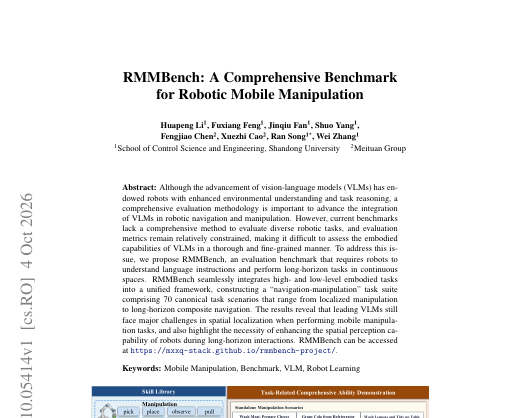
RMMBench: A Comprehensive Benchmark for Robotic Mobile Manipulation

Huapeng Li, Fuxiang Feng, Jinqiu Fan, Shuo Yang, Fengjiao Chen, Xuezhi Cao 等

Although the advancement of vision-language models (VLMs) has endowed robots with enhanced environmental understanding and task reasoning, a comprehensive evaluation methodology is…

Although the advancement of vision-language models (VLMs) has endowed robots with enhanced environmental understanding and task reasoning, a comprehensive evaluation methodology is important to advance the integration of VLMs in robotic navigation and manipulation. However, current benchmarks lack a comprehensive method to evaluate diverse robotic tasks, and evaluation metrics remain relatively constrained, making it difficult to assess the embodied capabilities of VLMs in a thorough and fine-grained manner. To address this issue, we propose RMMBench, an evaluation benchmark that requires robots to understand language instructions and perform long-horizon tasks in continuous spaces. RMMBench seamlessly integrates high- and low-level embodied tasks into a unified framework, constructing a "navigation-manipulation" task suite comprising 70 canonical task scenarios that range from localized manipulation to long-horizon composite navigation. The results reveal that leading VLMs still face major challenges in spatial localization when performing mobile manipulation tasks, and also highlight the necessity of enhancing the spatial perception capability of robots during long-horizon interactions. RMMBench can be accessed at https://mxxq-stack.github.io/rmmbench-project/

cs.ROmanipulationembodied

兴趣:vision-language-action (VLA) models and foundation models for robots

#262026-10-0589

KineWorld: Action-Induced Transport Fields for Embodied World Modeling

Ziying Song, Yuchen Liu, Zhuoran Xu, Ziyang Liu, Jian Jin, Jiangtao Su 等

Embodied world models predict the visual consequences of candidate actions before execution. However, existing action-conditioned world models often adopt uniformly weighted visual…

Embodied world models predict the visual consequences of candidate actions before execution. However, existing action-conditioned world models often adopt uniformly weighted visual generation objectives that can be misaligned with embodied prediction needs. Even with explicit motion conditioning, these objectives can underemphasize spatially sparse changes that are critical to interaction. We propose KineWorld, a transport-aware world-modeling framework that extends robot kinematics from motion conditioning to the spatial allocation of generative supervision. Kinematic Transport Lifting (KTL) constructs renderer-derived, camera-aligned transport fields from commanded robot motion. Transport-Aware World Diffusion (TAWD) calibrates their motion support on the video-latent grid and reweights future-RGB flow matching through a normalized mixture of uniform and transport-focused distributions. We train KineWorld using ALOHA-AgileX bimanual manipulation data from RoboTwin 2.0. KineWorld achieves an EWMScore-P of 68.95 in single-view evaluation and a TWB-Score of 54.82 in multi-view evaluation. These results support a shift from appearance fitting toward action-consequence modeling for embodied decision-making.

cs.CVcs.ROrobotmanipulationembodied

兴趣:world models and video prediction for embodied agents

#272026-10-0389

Grounded in Time: A Multi-Source Dataset and Benchmark for Temporal Grounding in Robotic Manipulation

Yi Wang, Yang Yang, Guangqi Xu, Sumin Lin, Ning Kang, Pengxiang Lu 等

Robotic manipulation often requires inferring task-relevant states from past interactions when the current observation alone is insufficient to determine the appropriate action. De…

Robotic manipulation often requires inferring task-relevant states from past interactions when the current observation alone is insufficient to determine the appropriate action. Despite progress in benchmarking memory-augmented vision-language-action (VLA) models, application-oriented tasks requiring history-dependent semantic inference remain underrepresented. We introduce GiT (Grounded in Time), a dataset and benchmark for grounding manipulation decisions in past events across biolaboratory, household, and industrial scenarios. It includes real-robot and Universal Manipulation Interface (UMI) style demonstrations covering 18 bimanual tasks, together with simulation data and a ManiSkill-based evaluation suite covering nine tasks. Fine-grained subtask annotations and annotated counterfactual task pairs, in which similar current observations require different actions depending on prior events, support policy learning and targeted evaluation of history use. Evaluations of representative end-to-end VLA models in simulation and on selected real-world tasks reveal substantial room for improvement in history-dependent manipulation. The dataset and benchmark are available at the project page.

cs.ROcs.CVrobotmanipulationVLAvision-language-action

兴趣:vision-language-action (VLA) models and foundation models for robots

#282026-10-05追踪学者 · Abhishek Gupta89

Bilinear Flow Policy: Distributional Extrapolation for Goal-Conditioned Visuomotor Imitation

Wonsuhk Jung, Sundhar Vinodh Sangeetha, Chen Xu, Abhishek Gupta, Masha Itkina, Shreyas Kousik 等

Goal-conditioned imitation learning (GCIL) with flow matching is a promising framework that can represent multimodal behaviors while adapting to diverse, user-specified goals, yet …

Goal-conditioned imitation learning (GCIL) with flow matching is a promising framework that can represent multimodal behaviors while adapting to diverse, user-specified goals, yet often fails when goals lie outside the demonstration support. To extrapolate to such unseen goals without collapsing multimodality - a problem we call distributional extrapolation - we introduce Bilinear Flow Policy (BFP), a generative visuomotor policy that combines transductive retrieval with a bilinear conditional flow. Given an unseen observation-goal pair, BFP retrieves an "anchor" training example and transductively reformulates the unseen pair as this familiar anchor plus a residual term. For this decomposition to guide action prediction, the residual must compactly encode how the current observation-goal pair differs from the anchor, and the anchor must be chosen so that this difference is predictive of the corresponding action distribution. BFP achieves this with pretrained visual features and a novel learned anchor-selection algorithm. The novel bilinear flow then models how the anchor and the residual jointly determine the multimodal action distribution. We prove that, for bilinear flow under suitable assumptions, action distribution error at unseen goals is bounded by the in-distribution flow-matching error up to problem-dependent factors. Across five manipulation tasks in simulation, BFP achieves 2.63x the out-of distribution success rate of a GCIL policy and 1.36x that of the strongest extrapolation-targeted baseline. On two real-world tasks, BFP improves over GCIL by 32%. Finally, our theory yields practical, pre deployment diagnostics for predicting which trained policies will extrapolate well and to which unseen goal.

cs.ROmanipulationimitation learning

追踪学者:Abhishek Gupta;兴趣:imitation learning and diffusion policies for robot control

#292026-10-0489

DiVeR: Decision-Critical Verifier Learning for VLA Test-Time Scaling

Seongheon Park, Heecheol Kim, Shulin Tian, Lilika Makabe, Namiko Saito, Katsushi Ikeuchi 等

Scaling robot data and model capacity has improved Vision-Language-Action (VLA) policies, but further progress is constrained by the high cost of robotic data. Verifier-guided test…

Scaling robot data and model capacity has improved Vision-Language-Action (VLA) policies, but further progress is constrained by the high cost of robotic data. Verifier-guided test-time scaling offers an efficient alternative by sampling multiple action candidates and selecting the one most likely to lead to task success at inference time. Existing classification-based verifiers learn from trajectory-level outcomes but treat all visited states equally, even though their value for candidate discrimination can vary across a trajectory. At many states, plausible actions are similar and provide limited discrimination signal, while only a sparse set of decision-critical states admits meaningfully different actions that can substantially affect downstream outcomes. To address this, we propose DiVeR, which estimates decision criticality from the dispersion of sampled action representations. DiVeR then uses this signal to reweight verifier learning toward states where action selection is most consequential, without requiring step-level annotations or additional environment interaction. Across LIBERO, RoboCasa, and real-world experiments on a Franka Research 3 robot, DiVeR consistently improves task success through more effective verifier-guided action selection, while adding negligible verifier inference overhead.

cs.ROcs.AIcs.LGrobotVLAvision-language-action

兴趣:vision-language-action (VLA) models and foundation models for robots

#302026-10-0589

I-BFM: Reward-Conditioned Robust Humanoid Interaction via Unsupervised Reinforcement Learning

Ziqi Han, Yitang Li, Junhan Sun, Fanrong Dong, Yaojie Shen, Lei Ye 等

Behavioral foundation models (BFMs) have recently shown that a single humanoid policy can support diverse whole-body control, but extending such generality to physical interaction …

Behavioral foundation models (BFMs) have recently shown that a single humanoid policy can support diverse whole-body control, but extending such generality to physical interaction remains challenging. We introduce I-BFM, to our knowledge the first BFM for humanoid-object interaction. Rather than relying on task-specific policies or reference tracking, I-BFM learns a shared representation of the coupled dynamics among the humanoid, objects, and their contacts using forward-backward representations and unsupervised reinforcement learning. Given a downstream task reward, the same policy can be directly conditioned on a latent command to execute closed-loop interaction without task-specific policy optimization. To improve interaction control over different time scales, we further train the policy with both short-horizon interaction targets and longer-horizon goal targets. A single I-BFM policy performs carrying, pushing, and kicking, while also supporting goal reaching, motion tracking, stylistic control, and long-horizon task chaining. More importantly, it remains effective after large deviations from nominal execution: on Carry, I-BFM achieves 94.3% nominal success and retains 89.3% success after robot falls, compared with 1.3% for a planning-based baseline. Real-world experiments on a Unitree G1 further demonstrate diverse loco-manipulation behaviors, rapid recovery from interaction failures and external disturbances, and task chaining without task-specific retraining.

cs.ROrobotmanipulationhumanoid

兴趣:humanoid robots and whole-body control

#312026-10-0589

Recursive Video In-Context Learning for Agentic Robot

Wenrui Bao, Xinxin Liu, Bingxin Xu, Yuzhang Shang

LLM agents that orchestrate frozen vision-language-action (VLA) policies improve across episodes through text memory, which records what the agent did but not how the task is done.…

LLM agents that orchestrate frozen vision-language-action (VLA) policies improve across episodes through text memory, which records what the agent did but not how the task is done. A demonstration video shows it, but fits poorly into an agent's context. The full video slows every turn, fixed keyframes lose the contact detail that decides whether a grasp holds, and what the agent needs shifts from the task's structure while planning to the frames around each contact. We introduce Recursive Video In-Context Learning (RV-ICL), a training-free method that turns a demonstration into a hierarchy the agent navigates rather than a prompt it receives. The hierarchy is built from the sub-events of the demonstration, such as grasps and releases. Its levels grow finer, from keyframes of the whole task to phases, moments and short clips, and are exposed through read-only tools. The agent reads the coarse levels before planning. During execution it re-enters the hierarchy whenever a step needs more detail and loads only the clip of its current sub-goal. One demonstration per task is enough. Built on RPent, RV-ICL raises success from 92.6% to 96.5% on LIBERO-PRO and from 86.7% to 95.8% on LIBERO-Plus.

cs.ROcs.AIcs.CLcs.MArobotgraspVLAvision-language-action

兴趣:vision-language-action (VLA) models and foundation models for robots

#322026-10-0389

RoboIRS: Inference-Time Internal Representation Steering for Generalist Robot Policies

Jiuzhou Lei, Chang Liu, Dayou Li, Zhiyuan Zhang, Xiao Liang, Yu She 等

Vision-language-action (VLA) and world-action models (WAMs) often degrade under out-of-distribution task variations despite retaining partial task capability. To recover such capab…

Vision-language-action (VLA) and world-action models (WAMs) often degrade under out-of-distribution task variations despite retaining partial task capability. To recover such capability, we propose RoboIRS, an inference-time internal representation steering method that uses successful and failed rollouts to train linear classifiers, select outcome-relevant intervention locations, and derive task-specific steering directions without updating policy parameters. On 15 simulation tasks with a frozen $π0.5$ policy, RoboIRS improves the average success rate from 44.4% to 66.2%, outperforming alternative inference-time intervention baselines while adding little inference time. We further validate RoboIRS on real-robot manipulation using the same $π0.5$ policy and demonstrate its applicability to a world-action model Cosmos Policy, where the average success rate improves from 35.4% to 55.4%. These results show that directly steering internal robot-policy representations can improve the performance of robot policies at inference time. Project website is available at https://rollingoat.github.io/roboirs/.

cs.ROrobotmanipulationVLAvision-language-action

兴趣:imitation learning and diffusion policies for robot control

#332026-10-0589

Encoded but Not in Control: Revealing the Grounding Gap in Vision-Language Robot Policies

Shaohan Jiang, Jiahang Cao, Qiduo He, Fengting Deng, Kun Wu, Jingkai Sun 等

Instruction following is central to language-conditioned robot policies: language should determine what to do when the same scene permits multiple valid actions. Yet successful exe…

Instruction following is central to language-conditioned robot policies: language should determine what to do when the same scene permits multiple valid actions. Yet successful execution alone cannot establish whether a policy follows the instruction or infers the task from the scene. We study this ambiguity through scene-preserving instruction interventions, using valid target substitutions, arbitrary nouns, and unrelated sentences while holding the scene fixed. We evaluate vision-language-action (VLA) policies and world-action models (WAMs) in simulation and in real-world experiments. Our analysis addresses three questions: (a) Does task success imply instruction following? When instructions request a different visible object, all evaluated policies predominantly approach and pick up the incorrect original target associated with the scene. (b) Is this failure caused by language insensitivity? Instruction perturbations affect task performance. A layerwise action lens shows intermediate action predictions respond to these perturbations. Linear probes accurately recover instructed targets, indicating modified instructions are encoded despite rarely determining target selection. (c) Why does encoded language fail to control action? Attention analysis indicates weak instruction-token contributions to action generation. Target-token attention can remain focused on the original object, revealing a mismatch between target encoding and visual grounding. UMAP and shared non-negative matrix factorization show target information remains accessible within representations increasingly organized by scene identity. Our findings expose a grounding gap concealed by nominal success and provide a diagnostic framework. They further establish a concrete criterion for progress: policies should reliably follow valid changes in user intent, even when they conflict with scene-favored behavior.

cs.ROcs.LGrobotVLAvision-language-action

兴趣:vision-language-action (VLA) models and foundation models for robots

#342026-10-0588

FreeSpeed: Training-Free Speed Control for Generative Robot Policies

Yuxuan Hu, Shilin Shan, Qiheng Wang, Jinghan Yang, Junqiao Fan, Hao Wan 等

Online control of execution speed is essential for deploying robot policies in real-world scenarios, as robots may need to speed up under time constraints or slow down to facilitat…

Online control of execution speed is essential for deploying robot policies in real-world scenarios, as robots may need to speed up under time constraints or slow down to facilitate human interaction and improve safety. However, imitation-learned policies inherit the execution speed of their demonstrations, and test-time speed modification can introduce unrecoverable out-of-distribution observations, reducing task success. We observe that the directional inconsistency of action chunks reflects task-phase criticality, indicating how aggressively action step lengths can be modified while preserving task success. Based on this observation, we introduce FreeSpeed, a training-free module that post-processes action chunks from pretrained policies. FreeSpeed resamples each predicted chunk at the requested rate, then uses directional inconsistency between adjacent actions as the primary signal for rescaling. This signal adaptively determines how closely the execution speed can approach the requested speed, allowing flexible speed adjustment within the evaluated limits without compromising task success. Across three policy families and 50 simulated tasks, FreeSpeed supports online speed changes, with realized execution rates spanning 0.22x to 2.53x among settings that preserve per-task success. Across four real-world manipulation tasks, FreeSpeed achieves an average success rate of 94.0%, matching the frozen policy's 93.8%, while realizing execution rates from 0.38x to 1.97x.

cs.ROrobotmanipulation

兴趣:imitation learning and diffusion policies for robot control

#352026-10-0588

When to Switch: Reliable Action-Chunk Extension for Vision-Language-Action Models

Seonghoon Yu, Dongwon Kim, HyungRok Jung, Yoonjae Baek, Byung-kwan Lee, Suha Kwak 等

Vision-Language-Action (VLA) models serve as unified policies for robotic manipulation, yet their expensive inference forces robots to pause between policy calls, resulting in stop…

Vision-Language-Action (VLA) models serve as unified policies for robotic manipulation, yet their expensive inference forces robots to pause between policy calls, resulting in stop-and-go execution that interrupts smooth motion and prolongs task completion. Extending the action chunk reduces policy calls and hence these pauses, but predicting farther into the future makes long-chunk execution unreliable. To understand where this unreliability arises, we analyze action errors within long chunks and find that they concentrate around transitions between manipulation subskills, growing sharply with chunk length. This suggests the importance of transition timing, i.e., when to switch subskills within a chunk. Motivated by this observation, we introduce RACE (Reliable Action-Chunk Extension), a framework that predicts the transition timing from an auxiliary one-step denoising pass and conditions action generation on it. By learning and conditioning on transition timing, RACE reduces errors at subskill transitions and enables reliable execution of longer action chunks. Across simulation benchmarks, RACE outperforms fine-tuning at the same chunk length; with 2x longer chunks, it surpasses recent state-of-the-art and efficient VLAs in success rate, and with 4x longer chunks, it remains competitive. On a real robot, RACE uses 4x longer chunks, which reduces the idle time caused by stop-and-go execution by about 5x, while achieving a higher success rate than fine-tuning with the same chunk length. Code and a real-robot demo are available at https://github.com/Seonghoon-Yu/RACE-VLA

cs.ROrobotmanipulationVLAvision-language-action

兴趣:vision-language-action (VLA) models and foundation models for robots

#362026-10-0388

DreamFormer: Dream Imitation with a Transformer World Model for Language-Conditioned Robotic Manipulation

Mostafa Kotb, Cornelius Weber, Muhammad Burhan Hafez, Stefan Wermter

We introduce DreamFormer, a model-based agent that acquires language-conditioned, multi-task skills by imitating expert demonstrations within the latent imagination of a learned wo…

We introduce DreamFormer, a model-based agent that acquires language-conditioned, multi-task skills by imitating expert demonstrations within the latent imagination of a learned world model. DreamFormer first learns a task-agnostic Transformer world model from unstructured play data, then acquires task-specific behaviors by optimizing an intrinsic reward that aligns agent-generated rollouts with expert demonstrations in latent space. Since the policy is trained on-policy inside imagination, it is exposed to its own errors during training, mitigating the covariate shift inherent to offline behavioral cloning. To make long-horizon imagination affordable, DreamFormer encodes a high-resolution multi-view robotic observation into a single input token, avoiding both spatial downsampling and the multi-token representations used by prior Transformer world models. On the long-horizon CALVIN benchmark, DreamFormer outperforms LUMOS, the comparable model-based agent, on single-environment evaluation (2.52 vs 2.34 average tasks completed per chain of five) while keeping imagination rollouts tractable. Against HULC, the behavior cloning baseline, it nearly doubles performance on zero-shot transfer to an unseen environment (1.30 vs 0.67), indicating that dynamics learned by the world model transfer more readily than a directly cloned policy. This is consistent with the role attributed to internal models in biological agents, where a model of environment dynamics supports behavior in situations not previously encountered.

cs.ROmanipulationworld model

兴趣:imitation learning and diffusion policies for robot control

#372026-10-0387

PerturBot: Breaking Shortcut Priors in Vision-Language-Action Models with Perturbative Training

Mingyu Liu, Chonghao Sima, Tianjian Feng, Hanqing Wang, Cong Chen, Hao Chen 等

A vision--language--action (VLA) policy can complete complex tasks while ignoring the evidence that should determine its actions. An object held near the wrist camera can displace …

A vision--language--action (VLA) policy can complete complex tasks while ignoring the evidence that should determine its actions. An object held near the wrist camera can displace the instructed target. Language and action show the same pattern: a familiar noun can trigger the operation it was paired with in training even after the verb changes, and a gripper that closed on nothing may lift anyway. We call these dependencies modality shortcuts: regularities in successful demonstrations make visual, lexical, or motor cues sufficient to predict expert actions without the task evidence needed for the underlying decision. More demonstrations of the same kind can raise task success while leaving these shortcuts intact. We propose Perturbot which makes task-relevant evidence easier to use and shortcuts insufficient on their own: it applies task-preserving wrist-view perturbations, enriches instructions with decision-relevant captions, and adds random and failed trajectory segments relabeled with the behavior they contain. It complements scaling by changing what is scaled, and leaves inference unchanged. Moreover, we propose GroundingFscore, an offline score that diagnoses how severely a policy relies on modality shortcuts. Task success rate shows whether a policy improves, while GroundingFscore reveals whether the policy scales healthily, relying on task evidence rather than shortcuts. Together, Perturbot and GroundingFscore provide a training-and-evaluation framework for disentangling VLA decisions from shortcut priors while preserving responsiveness to task-relevant evidence.

cs.ROcs.CVVLAvision-language-action

兴趣:vision-language-action (VLA) models and foundation models for robots

#382026-10-0487

Triggering Generalist Reasoning via Predictive Uncertainty for Dual-System VLA

Hyemin Yang, Wooseong Jeong, Giwon Lee, Kuk-Jin Yoon

Dual-system Vision-Language-Action (VLA) models improve real-time robotic control by pairing a slow, reasoning-capable generalist with a fast specialist action expert. However, exi…

Dual-system Vision-Language-Action (VLA) models improve real-time robotic control by pairing a slow, reasoning-capable generalist with a fast specialist action expert. However, existing methods invoke the generalist at a fixed frequency, ignoring the fact that decision-making complexity varies throughout a rollout. This static strategy wastes computation in easy phases and can delay renewed reasoning when the scene changes unexpectedly. We propose TUD (Triggering generalist reasoning via predictive Uncertainty for Dual-system VLA), an adaptive inference framework that selectively skips unnecessary generalist calls. TUD measures the cross-step dispersion of action re-predictions at the upcoming chunk slot under the cached generalist context, as a predictive uncertainty signal. This signal captures how much the future action plan shifts as new observations arrive and is computed from forwards the architecture already runs, requiring neither manual phase labels nor an auxiliary uncertainty model. On VLA-Arena, it achieves a higher success rate at matched call budgets than alternative uncertainty baselines while maintaining low wall-clock overhead, and more consistently separates successful from failed rollouts. Also, TUD finds a more favorable cost-success trade-off than non-adaptive baselines, tracing an entire operating curve as a single threshold is varied, and substantially reduces VLM calls at matched success rate. The same trade-off appears in our real-robot experiments, where TUD cuts generalist calls by 75% relative to the strongest fixed-interval baseline while achieving an even higher success rate. Our results suggest that predictive uncertainty provides a practical criterion for adaptive reasoning in efficient VLA control.

cs.CVrobotVLAvision-language-action

兴趣:vision-language-action (VLA) models and foundation models for robots

#392026-10-05追踪学者 · Yann LeCun86

H-JEPA: End-to-End Learning of Hierarchical World Models for Visual Planning

Wancong Zhang, Basile Terver, Michael Rabbat, Yann LeCun, Randall Balestriero

Long-horizon planning with latent world models requires reasoning across timescales and levels of abstraction. Existing task-agnostic JEPA world models predict and plan at a single…

Long-horizon planning with latent world models requires reasoning across timescales and levels of abstraction. Existing task-agnostic JEPA world models predict and plan at a single timescale or with multiple horizons in one shared latent space. We introduce H-JEPA, an end-to-end recipe for training a hierarchy of action-conditioned JEPAs in which each level predicts farther ahead in its own learned latent space. Planning proceeds top-down: the top level optimizes progress toward the goal, and each level's predictions become subgoals for the planner below it. When factors in the data evolve at separated timescales, higher levels discard fast, unpredictable detail and retain slower task-relevant state. Across four simulated navigation and manipulation environments, hierarchical planning improves over a flat JEPA; on Visual AntMaze, a three-level hierarchy raises success from 18% to 73% using less planner compute. Ablations attribute these gains to both temporal decomposition and higher-level goal representations. With inverse-dynamics supervision, the approach extends to diverse real-robot videos from DROID, where hierarchy improves offline planning fidelity at lower planner compute.

cs.LGcs.ROrobotmanipulation

追踪学者:Yann LeCun;兴趣:world models and video prediction for embodied agents

#402026-10-0586

Transporting Unsecured Stacked Payloads with a Quadrupedal Robot via Multi-Objective Reinforcement Learning

Nobuo Namura, Masayuki Hiromoto, Kento Uemura, Hironobu Sasaki, Kanata Suzuki

Transporting unsecured payloads with legged robots over uneven terrain requires balancing locomotion performance and payload stability, since aggressive motion can destabilize the …

Transporting unsecured payloads with legged robots over uneven terrain requires balancing locomotion performance and payload stability, since aggressive motion can destabilize the payload even when the robot remains stable. We study quadrupedal transportation of unsecured stacked boxes on an edgeless torso-mounted board without dedicated payload sensors or active carrier mechanisms. To address this trade-off, we propose Payload-Adaptive Multi-Objective Reinforcement learning for Transportation (PAMORT). PAMORT trains a multi-objective base policy conditioned on a preference vector that weights locomotion and payload-stability reward groups, then trains a weight adjuster on the frozen policy to adapt this preference online from proprioception. In simulation, PAMORT achieves comparable or better overall transportation success than a corresponding single-objective baseline across different payload configurations, including an unseen three-box stack, despite training only with two boxes. Real-world experiments on a Unitree Go2 demonstrate zero-shot transfer to slopes and steps at or beyond the training difficulty, with mean success rates of 0.850 for PAMORT and 0.675 for the baseline across eight tasks. These results demonstrate robust unsecured-payload transportation with online adaptation of the locomotion--payload trade-off from proprioceptive information.

cs.ROcs.LGrobotleggedlocomotion

兴趣:reinforcement learning for legged locomotion and sim-to-real transfer

#412026-10-0586

Adaptive Mean Flow for Responsive Closed-Loop Robot Control

Aksel Vaaler, Marco Job, Christian Holden, Olav Egeland

Diffusion- and flow-based robot policies have recently become widespread in robotic Imitation Learning (IL) due to their high performance and ability to model continuous and multim…

Diffusion- and flow-based robot policies have recently become widespread in robotic Imitation Learning (IL) due to their high performance and ability to model continuous and multimodal distributions. However, the iterative denoising procedure used by these models introduces significant prediction latency, hindering high-frequency closed-loop robot control and leading to jittery, unstable motion when frequent updates to the robot's action predictions are used. Therefore, it is common practice to train models to predict chunks of actions that can be executed sequentially without feedback, even when this reduces responsiveness and may mean the most recent state information is not used. In this article, we present Adaptive Mean Flow (AMF), a flow-based IL method that enables smooth and responsive, fully closed-loop robot control. AMF uses Mean Flow, which is an accelerated form of Flow Matching (FM), to minimize prediction latency. To ensure smoothness and consistency across predictions, AMF uses a corrupted version of the trajectory from the previous step when predicting new robot actions, with the signal-to-noise ratio increasing over the time parameter of the trajectory. This discourages large changes in the prediction from one step to the next, while allowing freedom to adapt the predictions for future steps. We evaluate AMF across a wide range of simulated and real robot tasks and demonstrate significantly improved performance compared with baselines. Code: https://github.com/akselva/Adaptive-mean-flow-RoboticIL.

cs.ROcs.AIrobotimitation learning

兴趣:imitation learning and diffusion policies for robot control

#422026-10-0386

ROOT: Discovering Rewards for User-Specified Embodied Behaviors

Eren Sadikoglu, Aditya Taparia, Xinyuan Liu, Ransalu Senanayake

Reinforcement learning for embodied control remains constrained by the difficulty of reward specification. Although recent large language model (LLM)-based methods can synthesize r…

Reinforcement learning for embodied control remains constrained by the difficulty of reward specification. Although recent large language model (LLM)-based methods can synthesize reward functions from natural-language descriptions, they often fail to capture subtle behavioral properties that humans care about, such as natural gait, posture, and movement style. This limitation arises because many desired behaviors are easier to recognize visually than to encode in a reward function. We introduce Reward Optimization via Observable Trees (ROOT), a framework for discovering reward functions that align learned policies with user-specified embodied behaviors. Rather than relying solely on scalar training statistics, ROOT casts reward design as an observation-guided search over a persistent experiment tree that stores reward programs, trained policies, and rollout observations, together with behavioral insights distilled by a video-language model, to diagnose behavioral failures and guide subsequent reward refinements. We evaluate ROOT on seven tasks across four embodiments: simulated Hopper, HalfCheetah, Ant, Unitree Go2, and as well as the real-world Unitree Go2. ROOT produces behaviors that better align with user intent than those generated by existing LLM-based reward-generation methods, achieving up to 86.8% locomotion-completeness accuracy and improving Vid-LLM behavioral alignment from 3.56/5 to 4.14/5, a 16.5% improvement over baselines. Human evaluations further support these results, with ROOT preferred in 51-63% of pairwise comparisons.

cs.ROlocomotionembodied

兴趣:reinforcement learning for legged locomotion and sim-to-real transfer

#432026-10-0386

AgenticTactileVLA: Contact-Guided Execution-Time Supervision for Generalizable Dexterous Manipulation without VLA Retraining

Elizaveta Semenyakina, Ivan Snegirev, Mikhail Kiselev, Miguel Altamirano Cabrera, Artem Lykov, Hajira Amjad 等

Vision-language-action policies may predict a transferable manipulation strategy yet fail to realize it reliably on the encountered object: objects compatible with the same grasp d…

Vision-language-action policies may predict a transferable manipulation strategy yet fail to realize it reliably on the encountered object: objects compatible with the same grasp differ in geometry and compliance, and visual feedback degrades under closure occlusion. AgenticTactileVLA is presented as an execution-time supervisor that shifts part of object-specific adaptation from prediction to physical interaction. A fixed VLA provides the approach and hand targets; the supervisor decides whether to remain transparent, refine finger flexion, retain or release the corrected configuration, return control to the VLA for retry, or select a compliant hand-control regime. It uses finger-position and motor-effort feedback as proprioceptive contact evidence and requires neither tactile sensors nor VLA retraining. On a Unitree G1 with a BrainCo Revo2 hand, a randomized matched-block evaluation on five objects held out from VLA training yields 61.3% completion for the base VLA, 72.0% for unconditional close-to-stall control, and 84.0% for the supervisor under a shared budget; the gain is positive on every object and persists under moderate pose perturbations. Ablations show the gain is not explained by extended closure alone, and that selective triggering reduces correction episodes by 65.7% with no detected change in completion. A retention audit shows acceptance predicts retention in 88.9% of held-out cases, while compliant objects expose conservative false rejection. A thin-walled-cup study demonstrates contextual routing to compliant control, matching an always-compliant reference. These results suggest that contact-guided execution-time adaptation can improve the object-level generalization of a fixed VLA to held-out objects by adapting physical realization without object-specific retraining.

cs.ROmanipulationgraspVLAvision-language-actiondexteroustactile

兴趣:robot manipulation and grasping with learned policies

#442026-10-0485

CoDance: Learning Reactive and Compliant Human-Humanoid Interaction from Video

Zhuoqun Chen, Shucheng Jia, Boyuan Chen

Partnered human-humanoid interaction couples locomotion with continuous physical contact. A humanoid needs to coordinate with a person's motion while responding to interaction forc…

Partnered human-humanoid interaction couples locomotion with continuous physical contact. A humanoid needs to coordinate with a person's motion while responding to interaction forces and maintaining stable and natural movement. We present CoDance, a framework for learning reactive and compliant human-humanoid interaction from video. We study partnered dancing as a challenging instantiation, where a humanoid coordinates its footsteps with a moving partner and maintains continuous two-hand contact. Given a single video of two human dancers, CoDance retargets their motions into a robot reference and a moving partner. We introduce a multi-link compliance augmentation that transforms the kinematic demonstration into force-aware training data by adapting the robot reference under structured forces at both hands. Policies trained on this data follow the observed partner while preserving the demonstrated locomotion style and responding compliantly to physical interaction. In simulation, the policies adapt their footsteps to changes in the partner and reproduce approximately 80% of the wrist displacement encoded by the augmented demonstrations. On a physical humanoid, CoDance enables sustained two-hand dancing with a human partner including repeated transitions between forward and backward motions.

cs.ROcs.AIcs.LGeess.SYrobothumanoidlocomotion

兴趣:humanoid robots and whole-body control

#452026-10-0585

How (and How Not) to Use Data Augmentation in VLA Post-Training

Bram Grooten, Joaquin Vanschoren

Vision-language-action (VLA) models currently demonstrate strong performance in a wide range of real-world robotics tasks. However, they often still lack the generalization ability…

Vision-language-action (VLA) models currently demonstrate strong performance in a wide range of real-world robotics tasks. However, they often still lack the generalization ability to handle large visual out-of-distribution shifts. Post-training of VLAs with reinforcement learning (RL) has been shown to benefit robustness, but significant room for improvement remains. In this work, we systematically study the effect of image augmentation on VLA post-training. We find that it is crucial to augment only the critic module during RL updates, while leaving the actor's input clean during both rollouts and updates. For $π_{0.5}$ and GR00T N1.5 this raises out-of-distribution success on LIBERO-Plus by $7.8$ and $10.0$ points respectively, while augmenting the actor collapses training entirely. We investigate a range of augmentation types and strengths, and provide practical recommendations for improving generalization in VLA post-training.

cs.ROcs.LGVLAvision-language-action

兴趣:vision-language-action (VLA) models and foundation models for robots

#462026-10-0585

GAMBIT: Learning to Plan Continuous Multi-Robot Trajectories

Rishabh Jain, Akmaral Moldagalieva, Lorenzo Magnino, Michael Amir, Keisuke Okumura, Ajay Shankar 等

GAMBIT is an opening chess move in which a player sacrifices a piece, typically a pawn, to gain a positional advantage later in the game. Analogously, in multi-robot coordination, …

GAMBIT is an opening chess move in which a player sacrifices a piece, typically a pawn, to gain a positional advantage later in the game. Analogously, in multi-robot coordination, individual robots may need to forgo locally reward-maximising behaviours to improve overall team performance. Such self-sacrificial behaviours are difficult to capture with manually designed heuristics, particularly in dense, interaction-rich environments. Focusing on double-integrator continuous dynamics, this work studies how to learn such coordinated heuristics over motion primitives for multi-robot trajectory execution. Our framework, GAMBIT, first learns coordinated motion-primitive selection through imitation learning and subsequently fine-tunes the policy through reinforcement learning. We further introduce a safeguarded rollout mechanism with backup trajectories that guarantees collision-free execution at all times. Experiments demonstrate that GAMBIT substantially outperforms a range of baselines, including centralised motion planners and decentralised reactive planners, while exhibiting strong scalability. In particular, it coordinates over a thousand robots with planning latency below a few hundred milliseconds in continuous domains.

cs.ROcs.AIcs.LGcs.MArobotimitation learning

兴趣:imitation learning and diffusion policies for robot control

#472026-10-0485

Now You Feel It, Now You See Me: Digital-Twin-based Teleoperation Interface for Dexterous Manipulation

Youngchan Shim, Kyutae Lee, JooYun Kim, Jaeseong Hwang, Harim Ji, Yongseok Lee

Teleoperation is becoming increasingly important for collecting high-quality demonstrations to teach robots dexterous manipulation skills. For dexterous manipulation, bare-hand tra…

Teleoperation is becoming increasingly important for collecting high-quality demonstrations to teach robots dexterous manipulation skills. For dexterous manipulation, bare-hand tracking provides a practical way to control robotic hands and demonstrate coordinated finger movements without gloves or exoskeletons. However, this type of teleoperation faces two key feedback limitations: a lack of force feedback and visual feedback of occluded region. The absence of force feedback hinders precise and safe manipulation, as operators must infer contact force visually rather than feel them directly. Occlusion by objects or other robot parts impairs the assessment of hand positions, approach distances, and pre-grasp configurations suited to the object's shape. To address these limitations, we propose a digital-twin-based augmented reality (AR) teleoperation interface that integrates bare-hand tracking, bimanual robotic hands, and virtual representations of the robot and task objects. The interface renders tactile measurements on robot hand meshes as visuo-force feedback. Furthermore, it offers a user-controlled virtual view panel or occlusion-aware transparency rendering to provide occlusion-mitigating visual feedback. We evaluated the interface through user studies involving Task 1 and Task 2, examining how force visualization and visual assistance support demonstration collection in tasks requiring careful force regulation and manipulation under occlusion.

cs.ROrobotmanipulationgraspdexteroustactile

兴趣:dexterous hands and tactile sensing

#482026-10-0485

VAMPS: Visual and Motor Policies from Sampling-Based Planning

Mohamed Yassine Kabouri, Pietro Noah Crestaz, Quang-Nam Nguyen, Qilong Cheng, Ludovic Righetti, Nicolas Mansard

Learning robot policies directly on physical systems remains difficult because data collection is costly and policy exploration can be unsafe. We introduce Visual and Motor Policie…

Learning robot policies directly on physical systems remains difficult because data collection is costly and policy exploration can be unsafe. We introduce Visual and Motor Policies from Sampling-Based Planning (VAMPS), a framework that uses Model Predictive Path Integral (MPPI) control to train reusable policies without human demonstrations. VAMPS supports two training modes. For one-step proprioceptive policies, it operates iteratively in simulation: the policy warm-starts MPPI, and the refined trajectories provide new supervision as the policy changes. A learned terminal value improves short-horizon planning, while an Implicit Q-Learning (IQL) critic guides the policy update. Iterative refinement outperforms training once on frozen MPPI data, and we transfer the learned locomotion policy to a Unitree Go2. For visuomotor policies, VAMPS operates directly from real-robot data. MPPI uses task-specific state estimates to plan and execute trajectories while recording RGB and sensor observations on a Flexiv Rizon 10S. Action Chunking with Transformers predicts action chunks, reducing the effective prediction horizon, and is trained offline on this fixed dataset. We demonstrate visuomotor pick-and-place and force-aware whiteboard erasing. In the latter task, the policy additionally observes the measured $6$-D wrench and desired normal force. These results show that VAMPS can learn policies either in simulation followed by hardware transfer or directly from autonomously collected real-robot data.

cs.ROcs.AIcs.LGrobotlocomotion

兴趣:reinforcement learning for legged locomotion and sim-to-real transfer

#492026-10-0584

Inspect Robots: Evaluating the Capabilities and Safety of Embodied AI

Christopher Leet, Achu Menon, Sravanthi Machcha, Sabrina Zou, Aayushya Patel, Aditya Kumar Singh 等

General purpose language models are increasingly able to control robotic hardware. Understanding the capabilities and safety of these models when embodied is therefore increasingly…

General purpose language models are increasingly able to control robotic hardware. Understanding the capabilities and safety of these models when embodied is therefore increasingly important for understanding their societal impact and risks. To this end, we introduce Inspect Robots, a modular, open-source framework for developing and running evaluations of embodied agents. Inspect Robots pairs customizable, reusable abstractions for specifying physical evaluations and analyzing their results with infrastructure that automates evaluation setup, execution and termination. We demonstrate Inspect Robots by using it to evaluate the capabilities and safety of six policies based on frontier language models. Inspect Robots has seen significant early uptake, receiving nearly 100,000 downloads in the three months since its release.

cs.ROembodied

兴趣:vision-language-action (VLA) models and foundation models for robots

#502026-10-0584

Talk, Render, Act: Integrating Social Gesture and Digital Face with Synchronized Speech for Conversational Humanoid Robot

Jin Jiang, Kun Li, Jiancong Ma, Shengcai Liao

Expressive humanoid interaction requires speech, facial animation, and body gestures to form a coherent response. However, many full-body humanoid robots produce speech and gesture…

Expressive humanoid interaction requires speech, facial animation, and body gestures to form a coherent response. However, many full-body humanoid robots produce speech and gestures without a visually expressive face, while talking-face animation and robot gesture generation are typically developed separately. We present Talk, Render, Act (TRABot), an agent-based framework comprising specialized agents for motion-atom construction, dialogue generation, motion planning, and facial animation. First, to produce natural and semantically meaningful gestures, we construct Robot-Ready Semantic Motion Atoms by segmenting long-form, G1-retargeted BEAT2 motion into units with natural gesture boundaries, human-verified communicative functions, and feasible trajectories. Second, to preserve semantic order and coordinate body motion with the spoken response, we introduce a Semantic-Conditioned Compositional Planner. Given an ordered semantic function sequence and an estimated response duration, the planner selects approved atoms to realize the longest feasible action sequence while accounting for transitions and neutral recovery. Finally, we deploy a Streaming Face-Speech-Body Integration system on a physical G1 humanoid, combining streaming dialogue audio, audio-driven facial animation, and semantically planned body motion in a unified real-time interaction loop. Quantitative and qualitative experiments demonstrate that TRAbot achieves the best overall performance among all compared conditions in terms of naturalness, expressiveness, and multimodal coherence.

cs.ROrobothumanoid

兴趣:humanoid robots and whole-body control

GitHub 项目

#12026-09-08★ 49 +5新项目75

lok-i/vibe

Python

Post-training humanoid whole-body trackers for perceptive control tasks

Post-training humanoid whole-body trackers for perceptive control tasks

humanoid-controlmjlabperceptive-locomotionpporeinforcement-learningrobot-learningviberobothumanoidlocomotion

兴趣:humanoid robots and whole-body control

#22025-04-04★ 1.9k +171

RoboVerseOrg/RoboVerse

Python

RoboVerse: Towards a Unified Platform, Dataset and Benchmark for Scalable and Generalizable Robot Learning

RoboVerse: Towards a Unified Platform, Dataset and Benchmark for Scalable and Generalizable Robot Learning

imitation-learningreinforcement-learningroboticssimulationrobot

兴趣:imitation learning and diffusion policies for robot control

#32024-12-24★ 38071

manumerous/wb_humanoid_mpc

C++

Whole-Body Nonlinear MPC for Realtime Humanoid Loco-Manipulation Planning and Control

Whole-Body Nonlinear MPC for Realtime Humanoid Loco-Manipulation Planning and Control

aidata-generationhumanoidhumanoid-robotlocomotionmpcnonlinearoptimizationrobotmanipulationhumanoidlocomotion

兴趣:humanoid robots and whole-body control

#42026-08-26★ 399 +370

OpenMOSS/EasyWAM

Python

A unified framework for training, fine-tuning, and evaluating World Action Models

A unified framework for training, fine-tuning, and evaluating World Action Models

benchmarkcodebaseembodied-aifoundation-modelsloraroboticsvision-language-actionworld-action-modelvision-language-actionembodied

兴趣:vision-language-action (VLA) models and foundation models for robots

#52026-09-28★ 335 +160新项目70

KingKongRobotics/jumper

Python

🦀 Jumper — an crab robot.

🦀 Jumper — an crab robot.

crab-robotrobotroboticsrobot

兴趣:humanoid robots and whole-body control

#62025-11-23★ 676 +170

sou350121/VLA-Handbook

HTML

本项目旨在为致力于进入VLA(Vision-Language-Action)领域的算法工程师提供一份全中文、实战导向的学习/面试手册。 不同于通用的 CV/NLP 面试指南,本项目聚焦于 Robotics 特有的挑战

本项目旨在为致力于进入VLA(Vision-Language-Action)领域的算法工程师提供一份全中文、实战导向的学习/面试手册。 不同于通用的 CV/NLP 面试指南,本项目聚焦于 Robotics 特有的挑战

chinesedeep-learningembodied-aillmrobot-learningroboticsvision-language-actionvlarobotVLAvision-language-actionembodied

兴趣:vision-language-action (VLA) models and foundation models for robots

#72026-03-18★ 65.1k +61270

rohitg00/ai-engineering-from-scratch

Python

Learn it. Build it. Ship it for others.

Learn it. Build it. Ship it for others.

agentsaiai-agentsai-engineeringcomputer-visioncoursedeep-learningfrom-scratch

兴趣:multi-agent systems and LLM agents

#82026-04-22★ 17.7k +53770

earthtojake/text-to-cad

Python

Give your agent CAD superpowers.

Give your agent CAD superpowers.

agentsai-agentscadmechanical-engineeringroboticsstepstlstp

兴趣:multi-agent systems and LLM agents

#92024-12-08★ 3.9k +369

datawhalechina/every-embodied

Python

仅需Python基础,从0构建自己的具身智能机器人;从0逐步构建VLA/OpenVLA/SmolVLA/Pi0, 深入理解具身智能

仅需Python基础,从0构建自己的具身智能机器人;从0逐步构建VLA/OpenVLA/SmolVLA/Pi0, 深入理解具身智能

embodied-agentembodied-aiembodied-intelligenceopenvlasmolvlavision-language-action-modelVLAvision-language-actionembodied

兴趣:world models and video prediction for embodied agents

#102026-08-29★ 84 +269

OpenBMB/SimpleMemVLA

Python

Native-video memory for vision-language-action models, using timestamped visual history and exact streaming inference for long-horizon robot manipulation.

Native-video memory for vision-language-action models, using timestamped visual history and exact streaming inference for long-horizon robot manipulation.

embodied-ailong-horizon-roboticsmultimodal-learningnative-video-memoryrobot-learningrobot-manipulationstreaming-inferencevideo-understandingrobotmanipulationVLAvision-language-actionembodied

兴趣:vision-language-action (VLA) models and foundation models for robots

#112024-02-29★ 16369

RobotControlStack/robot-control-stack

Python

A lean, ROS-free sim-to-real framework for training and deploying Vision-Language-Action (VLA) models and RL agents. Native MuJoCo Gymnasium wrappers with synchronous execution for…

A lean, ROS-free sim-to-real framework for training and deploying Vision-Language-Action (VLA) models and RL agents. Native MuJoCo Gymnasium wrappers with synchronous execution for Franka, UR5e, xArm, SO101 and YAM.

frankagymnasiummujocoreinforcement-learningrobot-learningrobot-manipulationsim-to-realvision-language-actions-modelsrobotmanipulationVLAvision-language-actionsim-to-real

兴趣:vision-language-action (VLA) models and foundation models for robots

#122026-07-06★ 2.2k +-168

dexmal/opendm

Python

An Open-World Foundation Model for General-Purpose Embodied Intelligence.

An Open-World Foundation Model for General-Purpose Embodied Intelligence.

embodied-aiembodied-intelligenceroboticsvision-language-actionvlaVLAvision-language-actionembodied

兴趣:vision-language-action (VLA) models and foundation models for robots

#132025-09-22★ 2.7k +1367

NVlabs/LongLive

Python

Long Video Gen / World Model / World Action Model (Embodied) Infrastructure

Long Video Gen / World Model / World Action Model (Embodied) Infrastructure

infralongnvfp4parallelreal-timeroboticsvideo-generationworld-action-modelsembodiedworld model

兴趣:world models and video prediction for embodied agents

#142024-09-29★ 3.6k +567

enactic/openarm

MDX

A fully open-source humanoid arm for physical AI research and deployment in contact-rich environments.

A fully open-source humanoid arm for physical AI research and deployment in contact-rich environments.

bilateral-teleoperationforce-feedbackgenesisgravity-compensationhumanoid-robotimitation-learningmachine-learningmoveit2robothumanoid

兴趣:humanoid robots and whole-body control

#152025-08-14★ 5.4k +767

RLinf/RLinf

Python

RLinf: Reinforcement Learning Infrastructure for Embodied and Agentic AI

RLinf: Reinforcement Learning Infrastructure for Embodied and Agentic AI

agentic-aiembodied-aireinforcement-learningrl-infrarlinfvla-rlVLAembodied

兴趣:vision-language-action (VLA) models and foundation models for robots

#162024-05-21★ 64467

ServiceNow/AgentLab

Python

AgentLab: An open-source framework for developing, testing, and benchmarking web agents on diverse tasks, designed for scalability and reproducibility.

AgentLab: An open-source framework for developing, testing, and benchmarking web agents on diverse tasks, designed for scalability and reproducibility.

agentagentsbenchmarkevaluation-frameworklabllmllm-agentsprompting

兴趣:multi-agent systems and LLM agents

#172026-07-19★ 61766

RealXiaoze/humanoid-motion-intelligence

人形机器人运动智能论文、开源项目、产业与求职知识库

人形机器人运动智能论文、开源项目、产业与求职知识库

embodied-aihumanoid-roboticslocomotionmotion-controlreinforcement-learningrobot-learningsim2realvlarobotVLAhumanoidlocomotionembodied

兴趣:humanoid robots and whole-body control

#182025-05-23★ 25166

AoqunJin/Awesome-VLA-Post-Training

A collection of vision-language-action model post-training methods.

A collection of vision-language-action model post-training methods.

embodied-agentembodied-aifine-tuningpost-trainingvision-language-action-modelvlaVLAvision-language-actionembodied

兴趣:vision-language-action (VLA) models and foundation models for robots

#192026-09-07★ 29 +8新项目66

jaz-lang/jaz-evals

Python

Reproduction package for "Harness as a Language: A Minimalist Agent Framework With Maximal Expressivity" — ten agent arms across AppWorld and StuLife

Reproduction package for "Harness as a Language: A Minimalist Agent Framework With Maximal Expressivity" — ten agent arms across AppWorld and StuLife

agent-frameworkappworldbenchmarkllm-agentslong-horizon-agentsreproducibilityself-improvement

兴趣:multi-agent systems and LLM agents

#202025-10-09★ 3.8k +166

starVLA/starVLA

Python

StarVLA: A Lego-like Codebase for Vision-Language-Action Model Developing

StarVLA: A Lego-like Codebase for Vision-Language-Action Model Developing

robotic-foundation-modelroboticsvision-language-action-modelworld-action-modelvision-language-action

兴趣:vision-language-action (VLA) models and foundation models for robots

#212024-05-11★ 1.8k +365

robocasa/robocasa

Python

RoboCasa: Large-Scale Simulation of Everyday Tasks for Generalist Robots

RoboCasa: Large-Scale Simulation of Everyday Tasks for Generalist Robots

humanoid-robotphysics-simulationrobot-learningroboticsrobothumanoid

兴趣:humanoid robots and whole-body control

#222026-02-27★ 2.9k +365

physical-superintelligence-lab/Psi0

Python

[RSS'26] Welcome to Psi-Zero, a Humanoid VLA towards Universal Humanoid Intelligence.

[RSS'26] Welcome to Psi-Zero, a Humanoid VLA towards Universal Humanoid Intelligence.

VLAhumanoid

兴趣:humanoid robots and whole-body control

#232024-01-26★ 28k +465

huggingface/lerobot

Python

🤗 LeRobot: Making AI for Robotics more accessible with end-to-end learning

🤗 LeRobot: Making AI for Robotics more accessible with end-to-end learning

兴趣:imitation learning and diffusion policies for robot control

#242026-05-19★ 337 +165

Open-X-Humanoid/HEX

Python

HEX is a whole-body vision-language-action framework for full-sized humanoid robots.

HEX is a whole-body vision-language-action framework for full-sized humanoid robots.

cross-embodimentembodied-aihumanoid-roboticsimitation-learningmultimodal-aivision-language-action-modelvla-modelwhole-body-manipulationmanipulationVLAvision-language-actionhumanoidembodied

兴趣:humanoid robots and whole-body control

#252026-03-29★ 64.5k +81264

calesthio/OpenMontage

Python

World's first open-source, agentic video production system. 12 production pipelines, 100+ tools, 700+ agent skill and production-knowledge files. Turn your AI coding assistant into…

World's first open-source, agentic video production system. 12 production pipelines, 100+ tools, 700+ agent skill and production-knowledge files. Turn your AI coding assistant into a full video production studio.

agentagentic-aiaiclaudecopilotcursorelevenlabsffmpeg

兴趣:world models and video prediction for embodied agents

#262024-10-21★ 61164

maze-agent/Maze

Python

A distributed framework for LLM agents

A distributed framework for LLM agents

distributeddistributed-agentsdistributed-llm-agentsllm-agents

兴趣:multi-agent systems and LLM agents

#272026-02-08★ 395 +164

XPolicyLab/XPolicyLab

Python

[IROS 26 ScaleInfra Workshop Best Tool Paper] Involving over 50 Advanced Manipulation Policies

[IROS 26 ScaleInfra Workshop Best Tool Paper] Involving over 50 Advanced Manipulation Policies

embodied-aimanipulationpolicymanipulationembodied

兴趣:robot manipulation and grasping with learned policies

#282026-09-07★ 514 +5新项目64

showlab/Show-Harness

Python

Just a VLM Agent Can Play Robots

Just a VLM Agent Can Play Robots

embodied-agentfoundation-modelsharnessroboticsembodied

兴趣:vision-language-action (VLA) models and foundation models for robots

#292026-09-12★ 51 +2新项目64

3587jjh/HuRo

Python

HuRo: Robotizing Human Videos for Scalable VLA Pretraining (CoRL 2026)

HuRo: Robotizing Human Videos for Scalable VLA Pretraining (CoRL 2026)

egocentric-videomotion-retargetingrobot-learningrobotizationvision-language-actionvlarobotVLAvision-language-action

兴趣:vision-language-action (VLA) models and foundation models for robots

#302026-07-02★ 93 +164

ZJU-OmniAI/vla-corrector

Python

[NeurIPS 2026] VLA-Corrector: Lightweight Detect-and-Correct Inference for Adaptive Action Horizon

[NeurIPS 2026] VLA-Corrector: Lightweight Detect-and-Correct Inference for Adaptive Action Horizon

action-chunkingembodied-ailerobotneurips-2026robot-learningrobot-manipulationroboticsvision-language-actionrobotmanipulationVLAvision-language-actionembodied

兴趣:vision-language-action (VLA) models and foundation models for robots