Tech Station

2026-10-19

50 篇论文 · 30 个项目 ← 2026-10-18 · 2026-10-20 →

论文

#12026-10-1698

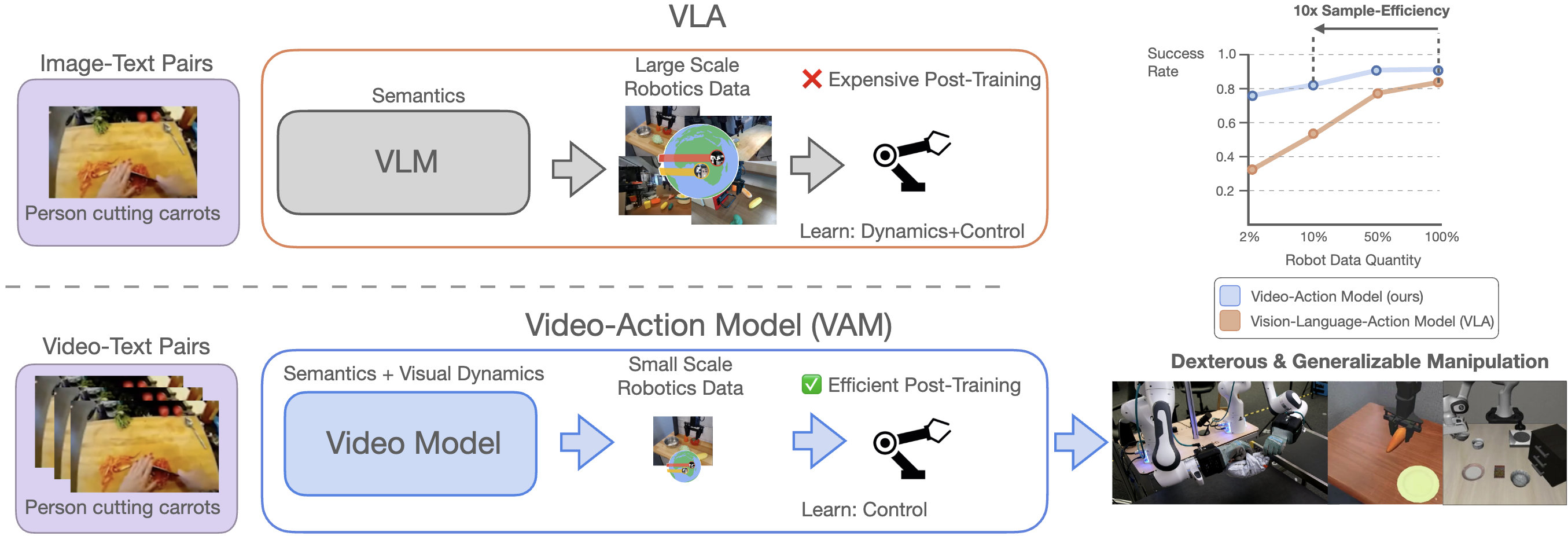
Unifying Embodied Foundation Models via a Model-to-Policy Formulation

Xinyi Hong, Mingyang Ren

Vision-language-action (VLA) models and world-action models (WAMs) have emerged as promising approaches to robot learning and control. These models integrate multimodal perception …

Vision-language-action (VLA) models and world-action models (WAMs) have emerged as promising approaches to robot learning and control. These models integrate multimodal perception and action generation, but differ in their architectures, output representations, and learning objectives. In this paper, we present a unified, architecture-agnostic probabilistic formulation for embodied foundation models based on stochastic kernels. Our formulation has two key components: (i) we characterize embodied foundation models through conditional output distributions and action-realization kernels, which together induce task-conditioned robot policies; and (ii) we connect pretraining and post-training to policy deployment, accommodating model-specific pretraining objectives and offline or online post-training strategies. We instantiate the formulation for OpenVLA and DreamZero, covering autoregressive action-token prediction and joint video-action generation.

cs.ROcs.AIcs.LGrobotVLAvision-language-actionembodied

兴趣:vision-language-action (VLA) models and foundation models for robots
#22026-10-1683

AWAM: Active Trajectory-Conditioned View Imagination for Robust Robot Manipulation

Jiawei Geng, Zhenyang Liu, Yuzheng Wu, Yanwei Fu

Rapid progress in embodied intelligence has enabled increasingly capable robots to follow language instructions and manipulate diverse objects. However, strong results in structure…

Rapid progress in embodied intelligence has enabled increasingly capable robots to follow language instructions and manipulate diverse objects. However, strong results in structured environments do not automatically transfer to open-world conditions, where clutter, occlusion, and changing viewpoints can obscure the spatial relationships required for action. To address this perceptual gap, a virtual active-perception paradigm is introduced. AWAM, an Active World-Action Model actively plans where to observe and imagines what will be seen along the planned trajectory before acting. Task-related virtual camera motion is predicted and used as a structured query into a geometry-conditioned world model, producing a reusable spatial prior for manipulation, which is later compressed into a fixed memory and fused with live observations through cross-attention for diffusion-based action prediction. AWAM achieves competitive success rates with 75.9% on LIBERO-Occ, 62.4% on LIBERO-Plus, 76.5% on RLBench-OG Occlusion1, and 94.4% in real-robot trials. These results support improved robustness to the evaluated occlusions and distribution shifts, addressing part of the gap between structured manipulation and less controlled environments.

cs.ROcs.AIrobotmanipulationembodiedworld model

兴趣:vision-language-action (VLA) models and foundation models for robots

#32026-10-1680

Sample-Efficient Reinforcement Learning for Policy Improvement via Flow-Reversed Action Anchors

Carl Qi, Weijun Dong, Xiaojie Wang, Peiyi Chen, Rahul Sajnani, Mingyuan Zhang 等

Generalist robot policies offer strong behavioral priors, but achieving deployment-level reliability and throughput remains difficult. Reinforcement learning (RL) can improve these…

Generalist robot policies offer strong behavioral priors, but achieving deployment-level reliability and throughput remains difficult. Reinforcement learning (RL) can improve these policies, yet its effectiveness is constrained by the cost of online interaction. Existing methods adapt frozen flow-matching policies by treating noise space as a continuous action space. We show that this behaviorally unstructured space makes exploration inefficient, often preventing these methods from extracting meaningful learning signals on challenging tasks. We introduce AnchorQ, which enables coarse-to-fine policy improvement through a structured, refinable latent action representation. At each decision step, AnchorQ uses flow reversal to map reference behaviors to state-conditioned latent anchors, samples local particles around those anchors, and applies value-guided sampling to explore promising refinements. Our analysis shows that anchors reduce identification complexity at the cost of support bias; particle refinement trades this bias against action-class complexity; and critic accuracy determines the reliability of KL-regularized, value-guided selection. Across simulated and real-world manipulation tasks, AnchorQ outperforms state-of-the-art post-training baselines in sample efficiency, delivering a 37% improvement in real-world success rate and 97% higher simulated task throughput under the same interaction budget. Additional visualizations are available on our website https://anchorq-rl.com/.

cs.ROcs.AIrobotmanipulation

兴趣:imitation learning and diffusion policies for robot control

#42026-10-1573

Testing the Planning Claims of LLM-Based Agents against Formal Semantics

Oriol Miro-Lopez-Feliu, Oscar Miró López-Feliu, Victor Gimenez-Abalos, Javier Vazquez-Salceda, Victor Carballo Araruna, Sergio Alvarez-Napagao

LLM-based agents are increasingly credited with the competences of practical reasoning: planning, monitoring, and correcting their own actions. Their success is attributed to the p…

LLM-based agents are increasingly credited with the competences of practical reasoning: planning, monitoring, and correcting their own actions. Their success is attributed to the prompting strategies and agent architectures built around the model, such as chain-of-thought, search-based prompting, self-refinement, reflection, critics and tool-using loops. Yet these claims are usually supported by end-to-end success rates, which show only whether a task was completed, or by LLM judges, which are not verifiers. We test LLM planning against formal semantics. Tasks are posed in natural language, but each is grounded in a hidden PDDL model that decides whether every action is applicable, whether the goal is reached, and whether a plan exists at all. Across five domains (two of them new, all released with the paper), four models, six prompting strategies and three agent architectures, the best configuration solves 78% of the solvable tasks offline but only 40% online, where agents mostly act without inspecting the state. Unsolvable tasks are recognised in under 10% of episodes, and heavier prompting strategies use 5 to 22 times as many tokens as direct prompting with no clear gain. In our experiments, planning performance varied more across models than across prompting strategies or agent architectures. Claims that agents can plan require evidence from validated action traces.

兴趣:multi-agent systems and LLM agents

#52026-10-1565

GlobeBench: Evaluating Text-Based World Model Capabilities for Scalable Environment Simulations

Nicholas Saban, Charvi Bannur, Mariya Vasileva, Darshan Deshpande

Text-based world models have recently shown potential to simulate complex RL environment state transitions for a diverse set of use cases. However, no standardized benchmark exists…

Text-based world models have recently shown potential to simulate complex RL environment state transitions for a diverse set of use cases. However, no standardized benchmark exists to compare, study and improve these models. Through this paper, we attempt to solve this problem by building GlobeBench, a novel benchmark with 1,632 tasks across five separate domains and nineteen simulation skills. The tasks check whether models can predict the environment's response to a specific action given the full agent trajectory by understanding earlier state changes, following environment rules, and predicting the effects of actions on both related and unrelated objects. We compare the predicted environment response with an execution-derived reference, using a hybrid architecture with both deterministic gates and a semantic judge. Among 20 general-purpose LLMs and specialized text world models, GPT-6 Astra achieves the highest task success rate at 49.57%. We find that model accuracy decreases as actions affect a larger portion of the environment. Specifically, when the agent's changes must propagate to dependent objects, task success drops to an average of 5.1% across all 20 models. Although model strengths differ across tasks, 631 tasks remain unsolved by any model, suggesting a significant gap in general LLM capabilities as a world model.

cs.AIcs.CLworld model

兴趣:world models and video prediction for embodied agents

#62026-10-1665

From Trajectories to Differentiated Skills: Cognitive Differentiation for Self-Improving Agents

Yewei Zhao, Derong Xu, Wei Chen, Yin Xu, Peilun Zhou, Xiaohan Wang 等

Large language model (LLM) agents tackle complex tasks through reasoning and interaction with external environments. Agent skills provide persistent, transferable capabilities that…

Large language model (LLM) agents tackle complex tasks through reasoning and interaction with external environments. Agent skills provide persistent, transferable capabilities that guide task planning, inform contextual decisions, support tool use, and enable executable procedures. Yet existing skill-evolution methods largely organize knowledge around skill artifacts, overlooking the functional heterogeneity within individual skills and its implications for knowledge maintenance and use. Inspired by cognitive science, we propose Cognitive Differentiation in Skill Evolution (CDSE), which evolves a unified skill through four functionally distinct yet coordinated components: Meta, Experience, Tool, and Script. CDSE extracts evidence-grounded semantic gradients from successful and failed trajectories, consolidates them by functional role, and applies component-specific updates and validation with cross-component coordination and adaptive invocation. An analysis of 500 top-ranked skill packages shows that 96.8% contain knowledge spanning at least two functional roles. Across six benchmarks, three agent models, and two execution harnesses, CDSE achieves the highest scores in all 36 settings, improving over the Base agent by 7.6 percentage points and the strongest competing method in each setting by 2.6 points on average. Ablation studies further support the importance of functional differentiation and adaptive invocation.

cs.AItask planning

兴趣:large language models for robot task planning and reasoning

#72026-10-1665

PresenceBench: An Exploratory Evaluation of Large Language Model Adaptation to User State

Peña Arroyo Gallego, Mauro Ruiz Moreno, Alejandro Acien, Sergio Romero-Tapiador, Teresa Arroyo-Gallego

Presence-aware intelligence is the capacity of an AI system's intelligence layer to adapt appropriately to the functional state of the person it serves (here readiness, flow, and s…

Presence-aware intelligence is the capacity of an AI system's intelligence layer to adapt appropriately to the functional state of the person it serves (here readiness, flow, and stability) while preserving task quality and safety. We introduce PresenceBench, an instrument for measuring it. PresenceBench evaluates how the intelligence layer uses a supplied state, not how that state is sensed, and breaks the capability into measurable properties. Two are tested here. Receptivity: does the model take up the state and give a better response than with no signal? Specificity: does any improvement depend on the correct state, rather than on extra structured context? A third, adaptation across states, is a required endpoint not measured in this release. A five-arm causal design answers both questions, against each model's own baseline and an equally structured mismatched-state control, scored by a correctness-gated human paired comparison. The exploratory evaluation covered four models across eighteen single-turn, six fixed three-turn and six simulated natural-conversation scenarios. Supplying a synthetic state, raw or translated into a response policy, gave human-preference point estimates above 0.5 for all four models (Claude Sonnet 5, DeepSeek V4 Pro, Gemini 3.6 Flash, GPT-5.6 Terra), with three of eight 95% intervals excluding chance. Specificity was not resolved: no per-model interval excluded chance, and the design cannot yet separate the state values from a generic instruction to adapt. Policy delivery reduced priced cost and output tokens against each model's baseline; these are resource-use changes, not efficiency gains, because correctness non-inferiority was not established. Safety-floor failures were rare (13 of 360 cases), with a non-significant excess under policy delivery. We report the instrument, the frozen results, and the controls a confirmatory study needs.

cs.HCcs.AIcs.CL

兴趣:large language models for robot task planning and reasoning

#82026-10-1664

Beyond Large Language Models: A Mental World Model Framework for Mental Modeling, Simulation, Evolution, and Interpretability

Qingshi Wang

Understanding and simulating how subjective cognition and mental states emerge, evolve, and shape behavior is essential for advancing artificial intelligence toward deeper social c…

Understanding and simulating how subjective cognition and mental states emerge, evolve, and shape behavior is essential for advancing artificial intelligence toward deeper social cognition and general intelligence. Existing large language models (LLMs) and Theory of Mind (ToM) methods primarily infer mental states from linguistic information, lacking unified mechanisms for subjective world construction, cognitive-psychological interactions, dynamic evolution, and historical dependencies. This paper introduces the Mental World Model (MWM) and its implementation, the Multi-Branch Mental Evolution Architecture (MMEA), which explicitly constructs subjective worlds, models interactions between cognition and mental states, and simulates continuous mental evolution shaped by historical experiences. On DynToM and RecToM, MMEA achieves 96.48% and 94.00% accuracy, respectively, outperforming leading LLMs and specialized ToM methods. Additional experiments demonstrate improvements of 28.7, 39.3, and 16.6 percentage points in mental state and behavior prediction, long-sequence prediction, and implicit mental state inference, respectively. The results demonstrate that MMEA provides an interpretable framework for continuous mental modeling, enabling AI to move beyond surface-level semantic representations to infer individuals' underlying mental states from linguistic information and dynamically simulate their internal cognitive processes and evolution over time. MWM also provides a promising foundation for causal reasoning, personalized AI, sustained human-AI interaction, and future advances toward artificial general intelligence (AGI).

cs.AIworld model

兴趣:large language models for robot task planning and reasoning

#92026-10-1664

Language Models Learn to Improve Language Models

Minhua Lin, Zijun Wang, Zewen Liu, Zhaotian Weng, Bing He, Zhan Shi 等

Large language models (LLMs) are increasingly used to automate AI research, including language-model (LM) development, offering a potential path toward recursive self-improvement. …

Large language models (LLMs) are increasingly used to automate AI research, including language-model (LM) development, offering a potential path toward recursive self-improvement. However, turning experimental feedback into a learned ability to propose effective improvements across models faces two challenges. First, training such an ability with real feedback is expensive: reinforcement learning (RL) requires evaluating tens of thousands of proposals, each potentially requiring a full model-training run. Even at ten GPU-hours per run, reward collection alone would consume hundreds of thousands of GPU-hours, motivating a cheaper surrogate. Second, surrogate feedback can become unreliable as policy optimization favors overestimated proposals when the proposal distribution shifts. To address these challenges, we propose LM2LM, which trains LLMs with RL to generate effective LM improvement proposals. To provide scalable feedback, we use a research world model (RWM), a frozen LLM that predicts proposal gains from real experimental records provided in context, as the reward model for RL. To maintain feedback reliability, we periodically execute current-policy proposals ranked highly by the RWM and add their measured outcomes to its context. Across eight autoregressive and diffusion LM development environments, real-execution evaluations on held-out tasks show that LM2LM enables Qwen3.8-27B to outperform GPT-6-sol, even when GPT-6-sol is given 300 real experimental records in context, while requiring 33% lower data-generation cost. LM2LM also generalizes to a model family unseen during training.

cs.CLcs.AIworld model

兴趣:large language models for robot task planning and reasoning

#102026-10-1663

Competence-Based Evaluation of Logical Reasoning in Large Language Models

Jize Jiang, Chengxiang Zhai

Recent advances in large language models (LLMs) have brought impressive performance across diverse tasks; however, shortcomings remain in logical reasoning, including inconsistenci…

Recent advances in large language models (LLMs) have brought impressive performance across diverse tasks; however, shortcomings remain in logical reasoning, including inconsistencies under linguistic variation. To improve the reasoning capacity of LLMs, we must be able to accurately measure their reasoning capacity. Current benchmarks primarily report single accuracy numbers on selected reasoning tasks. Such a performance-based evaluation methodology says little about a model's generalization capacity in reasoning. To address this limitation, we argue for a different evaluation paradigm, called competence-based evaluation (CBE), which tests whether models reliably apply the same competence across a family of problems. A parameterized generator scales complexity while keeping the required competence fixed, and matched answer-preserving presentations test correctness beyond one formulation. We instantiate CBE on elementary ordering tasks, scaling input size while varying presentations of the same ordering rule. Across six GPT and Qwen models, performance is reasonably good over bounded complexity ranges, but even strong models fail the competence condition across the tested family. Chain-of-thought and GRPO extend strong performance without resolving all tested failures; supervised LoRA shows little held-out transfer. CBE provides diagnostic profiles and an evaluation protocol that can grow with future models.

cs.CLcs.AIcs.LG

兴趣:large language models for robot task planning and reasoning

#112026-10-1663

STRIDE: Evaluating Spatiotemporal Reasoning in Driving Edge Cases

Lieqi Liu, Rui gao, Jia-Chen Gu, Wenbo Hu, Zhaobin Mo, Ahmadreza Moradipari 等

In autonomous driving, perceiving surrounding objects is not enough: failing to understand how they move and interact over time can lead to dangerous decisions. Evaluating vision-l…

In autonomous driving, perceiving surrounding objects is not enough: failing to understand how they move and interact over time can lead to dangerous decisions. Evaluating vision-language models (VLMs) therefore requires testing whether they connect past spatial observations to future consequences. Yet existing benchmarks often assess edge cases through basic perception questions or test temporal understanding in simple scenarios, leaving complex spatiotemporal reasoning underexplored. We introduce STRIDE (SpatioTemporal Reasoning In Driving Edge Cases), an object-centric benchmark for long-tail, safety-critical driving scenarios. STRIDE covers six task families: spatial perception, spatial understanding, temporal memory, temporal extrapolation, trajectory prediction, and scene-context awareness. It pairs multiple-choice questions probing individual spatiotemporal judgments with related free-form visual question answering (VQA) requiring detailed scene explanations and justifications of driving decisions. We prioritize scenes with unusual object behaviors and complex traffic interactions, generate reference answers from structured dataset annotations through automated procedures, and use limited language-model assistance and human verification to ensure annotation quality. Across 12 proprietary, open-weight, and driving-specialized models, even the best performer, GPT-6-Astra, achieves only 43.4% average multiple-choice accuracy, versus an approximately 20% random-choice baseline. Further analysis reveals that strong performance in describing driving scenes does not necessarily translate to accurate safety-critical judgments, and that models struggle more with reconstructing object motion than recalling past positions. STRIDE thus exposes spatiotemporal driving limitations that aggregate VQA scores can conceal.

兴趣:3D perception, point clouds and scene understanding for robotics

#122026-10-1663

DiffusionRVGE: Reinforcement Learning via Regression-Based Value Gradient Estimation

Jiayuan Wang, Tongyao Pang

Reinforcement learning improves diffusion models using rewards on generated images, but repeated denoising and gradient estimation make training expensive. We introduce \method, an…

Reinforcement learning improves diffusion models using rewards on generated images, but repeated denoising and gradient estimation make training expensive. We introduce \method, an efficient method that constructs useful update directions by regressing centered rewards on centered final denoised images. It requires neither reward derivatives nor adjoint backpropagation through the sampling trajectory. A unified first-variation formulation identifies the value-gradient target with or without a trajectory-KL penalty. A population analysis under Gaussian noising explains the regression geometry, while a subspace analysis motivates clean-image coordinates. The implementation adapts rollout bandwidth and query weights to reward continuity: local rollouts suit smooth rewards, whereas broader groups provide informative contrasts for discrete rewards. Trained jointly on five rewards, one SD3.5-Medium model matches or exceeds DiffusionNFT's joint model on seven of eight metrics, reaching GenEval $0.94$, OCR $0.92$, and PickScore $23.82$ at about one fifth of its estimated training compute. In single-reward training, \method reaches matched reward thresholds $2.1$--$6.7\times$ faster than reproduced DiffusionNFT on identical hardware. Ablations support the clean-image estimator, direct direction transfer, and reward-dependent rollout choices. Code is available at https://github.com/jy-wang-tsinghua/DIFFUSIONRVGE.

兴趣:imitation learning and diffusion policies for robot control

#132026-10-1662

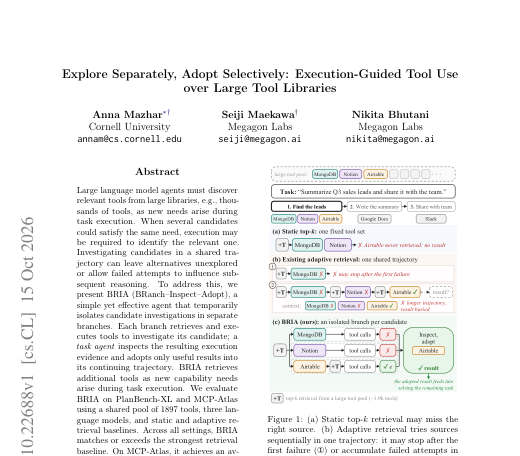
SkillBrowser: Selective Skill Exposure for Scalable Skill-Using Agents

Jin Ye, Yifan Jiang, Lan-zhe Guo

Large language model agents increasingly rely on skills to extend their capabilities in complex tasks. However, scalable skill use requires Selective Skill Exposure (SSE): providin…

Large language model agents increasingly rely on skills to extend their capabilities in complex tasks. However, scalable skill use requires Selective Skill Exposure (SSE): providing relevant procedural content when needed while avoiding unnecessary exposure that may disrupt reasoning. Existing paradigms fall short in complementary ways. Progressive disclosure exposes metadata for a growing skill library, introducing context pollution; retrieval limits catalog exposure, but static retrieval from the initial task query may be misaligned with capability needs that emerge during reasoning and may still inject unnecessary skills. We propose SkillBrowser, a Meta-Skill-managed framework that enables an agent to identify current capability needs, formulate targeted queries, and selectively load skills on demand. Across six SRA-Bench subsets and five LLMs, SkillBrowser improves aggregate accuracy over static retrieval and LLM-based selection, including multi-step tool use, and mitigates accuracy degradation on already-solvable instances. Benefits remain model- and task-dependent, with under-invocation of useful skills and additional latency as key limitations. These results demonstrate the viability of Meta-Skill-managed SSE for scalable skill repositories.

兴趣:large language models for robot task planning and reasoning

#142026-10-1662

Robust Function Calling for LLM Agents Under Interface Drift

Aniruddha Chattopadhyay, Kanishka Halder, Partha Sarathi Roy

Tool-augmented language-model agents rely on interface text: tool descriptions, argument schemas, and the candidate tool list shown at inference time. These interfaces often change…

Tool-augmented language-model agents rely on interface text: tool descriptions, argument schemas, and the candidate tool list shown at inference time. These interfaces often change after deployment even when the underlying tool semantics remain fixed, creating a practical reliability problem for function-calling systems. We study this failure mode as interface drift and evaluate whether a lightweight, training-free repair layer can recover robustness without retraining the base model. Our method, SchemaShield-Lite, combines schema validation, candidate-set retry for missing tool names, and one-shot constrained repair. On Qwen3.5-9B, it raises DICE-300 accuracy from 0.717 to 0.813 and BFCL-200 accuracy from 0.580 to 0.805, recovering 19/22 and 33/45 drift-induced failures with no observed repair harms. Naive retry does not explain the gains. Ablations show that candidate-set drift, especially distractor tools, accounts for most observed damage, while description and schema edits alone are less harmful. The results position validation-and-repair as a practical robustness layer for deployed LLM-agent tool use.

cs.AIcs.CLcs.SE

兴趣:multi-agent systems and LLM agents

#152026-10-1662

Beyond Action Prediction: Learning Search-Free Planning in Latent Space

Guanchen Du, Jinhao Du, Yanpeng Sun, Shan Zhang, Na Zhao, Zechao Li

Latent world models learn action-conditioned state transitions in a compact representation space, providing a predictive model for visual planning and control. However, planning wi…

Latent world models learn action-conditioned state transitions in a compact representation space, providing a predictive model for visual planning and control. However, planning with these models typically requires costly test-time optimization over action sequences. We propose to replace this online search with a goal-conditioned inverse model that directly predicts actions from current and goal observations. A key challenge is that action prediction alone neither ensures that goal representations encode action-relevant information nor that predicted actions are consistent with the learned latent prediction model. We introduce Hindsight Inverse JEPA Planning (HIJP), a search-free framework that addresses both aspects during training. HIJP relabels future observations along offline trajectories as goals, providing action supervision across multiple temporal horizons. By retaining gradients through the goal representations, this supervision directly shapes the visual representation. HIJP further feeds predicted actions into the latent predictor model and aligns the resulting next-state representations with encoded successor observations, enforcing action-transition consistency. At inference time, the inverse dynamics model and latent predictor models are applied alternately to generate multi-step action sequences without online search. Across four visual control tasks, HIJP achieves 86.8% overall success and a 1.9-16.5x planning speedup over search-based planning.

cs.ROcs.AI

兴趣:imitation learning and diffusion policies for robot control

#162026-10-1562

FRACTAL: A Self-Similar Multi-Agent Orchestration Architecture with Formal Communication, Convergence, and Depth Bounds

Ohad Dan, Abhinav Taliyan

We present FRACTAL, a self-similar multi-agent architecture for recursive goal decomposition, in which the same five-component organizational pattern -- Orchestrator, Ensemble, Kno…

We present FRACTAL, a self-similar multi-agent architecture for recursive goal decomposition, in which the same five-component organizational pattern -- Orchestrator, Ensemble, Knowledge Ledger, Decision Maker, Meta-Observer -- recurs at every level of a decomposition tree. We make four formal contributions: (1) a communication bound showing intra-node cost is linear in ensemble size and round count (O(kr)) under a two-phase blind-proposal/stress-test protocol, versus quadratic cost for free-form debate, with an explicit, stated assumption on fixed evaluator count; (2) a two-mode orchestration criterion separating generative and evaluative phases via a measurable diversity-saturation threshold; (3) a supermajority convergence guarantee with explicit probability bounds at stated agreement levels, and a formal depth bound under an operationalized goal-complexity measure; (4) a Bayesian inter-layer escalation mechanism unifying hysteresis and contract-breach signaling under one posterior update. We illustrate the architecture's execution qualitatively on a worked example and a multi-layer case study; we do not report quantitative performance claims in this paper, and we explicitly discuss the formal and inductive-bias limitations of the model, including an unimplemented but architecture-compatible direction toward bounded self-improvement. We use "fractal" as an architectural metaphor for self-similarity, not a measured mathematical property. Empirical validation of the architecture's comparative performance is left to future work.

兴趣:multi-agent systems and LLM agents

#172026-10-1561

Are Large Reasoning Models Good Everyday Reasoners? A Comparison with Non-Reasoning Models on Logical Reasoning Tasks

Kentaro Ozeki, Risako Ando, Takanobu Morishita, Hirohiko Abe, Koji Mineshima, Mitsuhiro Okada

Large reasoning models (LRMs) that leverage test-time computation achieve strong performance on mathematical and scientific benchmarks and are increasingly deployed in real-world a…

Large reasoning models (LRMs) that leverage test-time computation achieve strong performance on mathematical and scientific benchmarks and are increasingly deployed in real-world applications. However, their ability to perform everyday logical reasoning, which often departs from textbook formal logic, remains underexplored. In this work, we systematically evaluate how well reasoning models align with everyday reasoning patterns by introducing a benchmark based on linguistic and pragmatic reasoning phenomena. We also compare reasoning models with non-reasoning models under controlled prompting conditions. We find that, in many cases, (1) reasoning models show degraded performance in everyday reasoning when such reasoning deviates from formal logical rules, (2) some non-reasoning models with chain-of-thought prompting outperform comparable reasoning models in everyday reasoning, and (3) prompting with additional instructions provides limited control over reasoning behavior. These findings suggest that current reasoning models do not reliably capture everyday reasoning and point to limitations in post-training, motivating improved training objectives and evaluation across diverse forms of reasoning.

cs.AIcs.CL

兴趣:large language models for robot task planning and reasoning

#182026-10-1661

COMET: Decoupled Distillation, Routing, and Capacity Control for Task-Agnostic Continual Vision--Language Learning

Seungyoon Woo, Keonhee Park, Gunhee Kim

Vision-language models (VLMs) such as CLIP retain zero-shot recognition ability, but their open-world use often requires task-agnostic continual learning: tasks arrive sequentially…

Vision-language models (VLMs) such as CLIP retain zero-shot recognition ability, but their open-world use often requires task-agnostic continual learning: tasks arrive sequentially, past data are unavailable, task identity is unknown, and the backbone cannot be retrained. We argue that this setting fails VLMs through three coupled pressures beyond the stability-plasticity tradeoff: (1) modal-consistency drift, (2) representation-space interference, and (3) per-task capacity shortfall. We propose COMET (Collaborative Mixture-of-Expert Transfer) to resolve these three issues respectively as follows. A frozen teacher provides only a feature reference on a shared image-text pool; Tri-Affinity Distillation preserves image-image, text-text, and image-text geometry; and Student-Aware Cross-Expert Distillation aligns new experts with compatible prior experts so routing errors degrade gracefully. We design COMET to keep capacity and inference separate: a contextual bandit keeps or merges full per-task experts using post-training signals, while a reconstruction router selects sparse experts at test time without teacher semantics. On the X-TAIL benchmark, we show that each proposed component improves continual learning performance. COMET shows that continual vision-language adaptation can preserve multimodal geometry, coordinate accumulated experts, and allocate capacity jointly when feature reference, expert shaping, routing, and capacity control are separated by construction.

cs.CVcs.AI

兴趣:vision-language-action (VLA) models and foundation models for robots

#192026-10-1661

Darwin-Claw: Environment-Adaptive Experience Consolidation for Recursively Self-Evolving Agents

Mingze Yin, Xiaohan Wang, Dian Li, Longfei Luo, Jiahong Yan, Yiheng Zhu 等

While Large Language Model (LLM) agents have demonstrated remarkable capabilities across complex tasks, they predominantly operate in isolated sessions, lacking the ability to cont…

While Large Language Model (LLM) agents have demonstrated remarkable capabilities across complex tasks, they predominantly operate in isolated sessions, lacking the ability to continually learn from historical interactions or adapt to user-specific environments. Existing self-evolution paradigms often indiscriminately inject raw interaction trajectories into memory or skill modules, leading to obscured behavioral patterns and compromised update controllability. Furthermore, as foundational LLM reasoning improves, the bottleneck for agentic evolution shifts from accumulating generic knowledge to effectively managing situational experience. To address this, we propose Darwin-Claw, an environment-adaptive self-evolving framework that systematically distills episodic experiences to drive the comprehensive evolution of operational skills and durable memory. Theoretically grounded in an iterative agent-actor and evolver-critic co-adaptation, Darwin-Claw introduces a Hierarchical Experience Consolidation System that extracts fine-grained error attributions and generalizes them into dynamically updated prototype vectors. This structured situational experience serves as interaction patches for context-sensitive perception and explicit optimization signals for skill refinement. Practically, Darwin-Claw is a readily deployable, automated framework compatible with mainstream agent systems without requiring manual curation. Extensive experiments on WildClawBench demonstrate that Darwin-Claw yields substantial performance improvements, establishing a controllable and stable pathway for the continual, user-centric adaptation of autonomous agents in real-world ecosystems.

兴趣:multi-agent systems and LLM agents

#202026-10-1660

Generative Policy Improvement from Observational Data

Jonas Schweisthal, Dennis Frauen, Stefan Feuerriegel, Emma Brunskill

We study how to improve decision policies from observational data to generate better actions when actions are complex, structured objects, such as text messages or images. This tas…

We study how to improve decision policies from observational data to generate better actions when actions are complex, structured objects, such as text messages or images. This task is subject to two major challenges: (i) action-level overlap is often too weak for reliable off-policy evaluation and improvement, and (ii) generating new structured actions often requires expensive training or fine-tuning (e.g., of an LLM) and can be ill-defined due to information loss in action representations. To address both, we propose PolicyLift, a three-stage framework for generative policy improvement with structured actions from observational data. In Stage 1, PolicyLift learns a small set of discrete action codes that capture high-level strategies in the observed action space and are tailored to support policy improvement under limited overlap. In Stage 2, it learns a context-dependent policy over these action codes. At deployment time, Stage 3 "lifts" the learned code-level policy back to the original action space by generating actions from the historical behavior system in a code-conditioned way. We show theoretically that improving the policy over action codes guarantees improvement of the induced policy in the original action space. We demonstrate PolicyLift across experiments in synthetic and real-world text generation tasks with consistent policy improvements over the behavior policy.

cs.AIcs.LG

兴趣:imitation learning and diffusion policies for robot control

#212026-10-1660

MS-Eval: Benchmarking Sub-Agent Delegation and Orchestration in MCP-Intensive Working Scenarios

Bowen Ding, Qixin Wang, Lexing Ruan, Weiyi Lu, Qiwei Ge, Ruishan Fang 等

LLM agents are increasingly integrated into real-world works, yet they must handle diverse domain-specific tools and complex multi-sub-task problems that sequential tool invocation…

LLM agents are increasingly integrated into real-world works, yet they must handle diverse domain-specific tools and complex multi-sub-task problems that sequential tool invocation resolves inefficiently and with severe context bloat. The Main-Agent Delegation and Sub-Agent Execution (MAD-SAE) paradigm addresses these issues by delegating sub-tasks to specialized sub-agents for parallel execution in isolated contexts, but its delegation and orchestration quality remains unquantified. We introduce MS-Eval, a unified evaluation kit comprising an MCP-intensive benchmark, a controlled execution harness, tailored delegation and orchestration metrics, and the MSQ index for comprehensive assessment. Evaluating four MAD-SAE variants and eight frontier models reveals that (1) sub-agent specialization (Spec) is the best practical practice; (2) open-source models are largely competitive with few exceptions; and (3) MAD-SAE generally raises cost with contingent payoff, benefiting most open-source models in both performance and efficiency while leaving closed-source models with higher cost and degraded performance. Our case study further traces these gains to better single-agent solutions, effective context offloading, and genuine sub-task parallelism, whereas unnecessary or redundant delegation turns the same cost into pure overhead. Codes: https://github.com/LINs-lab/MS-Eval

兴趣:multi-agent systems and LLM agents

#222026-10-1560

AuditKIT: A Unified Evaluation Spine for Benchmarking, Judging, and Comparing Large Language Models and Agentic Systems

Shreeyans Arora, Utsav Avaiya, Zera Lyngkhoi, Hem Gosalia, Ram Mohan Rao Kadiyala, Vinay Kumar Sankarapu 等

Evaluating language models and agents requires combining benchmark accuracy, judge-based assessment, runtime performance, tool-use behavior, and retrieval quality. Differences in i…

Evaluating language models and agents requires combining benchmark accuracy, judge-based assessment, runtime performance, tool-use behavior, and retrieval quality. Differences in interfaces, metric semantics, and trace formats complicate these comparisons and can hide failures in agentic workflows. We present AuditKIT, a source-available evaluation library that records these measurements in one result representation, with direction-aware metric contracts, configuration fingerprints, and extensible metrics and backends. For agents, it provides turn-aware tool-call matching, separates parallel from sequential execution, and distinguishes verified task outcomes from trajectory-level diagnostics. Missing or unobservable evidence is marked unscored rather than counted as failure. For retrieval-augmented generation, it combines ranked retrieval metrics, judged grounding, and deterministic evidence checks. Seven case studies spanning model comparison, serving runtimes, retrieval, tool calling, and interoperability show how answer extraction, runtime behavior, and metric selection change evaluation outcomes.

cs.CLcs.AIcs.IRcs.SE

兴趣:large language models for robot task planning and reasoning

#232026-10-1659

SIT-Eval: Situation-Based Interactive Turn-by-Turn Evaluation of Conversational Agents

Ravil Mussabayev, Saveliy Zavertyaev, Dmitriy Parpulov, Andrey Savchenko

The rapid proliferation of conversational AI agents necessitates evaluation methods that assess performance across diverse dialogue scenarios, utilizing multiple situational criter…

The rapid proliferation of conversational AI agents necessitates evaluation methods that assess performance across diverse dialogue scenarios, utilizing multiple situational criteria, as appropriate behavior depends on context and encompasses various aspects. Existing dialogue benchmarks typically use static natural conversations, which underrepresent rare situations---a critical safety gap, as low-probability events become frequent failures at production scale. However, limited sample sizes force a choice: either maintain natural dialogues for realism or turn to adaptive situation sampling for comprehensive yet statistically reliable coverage. We introduce SIT-Eval, an adjustable framework for evaluating situation-based conversational agents. We formalize an agent's desired behavior as situational rules: if situation is P, follow rules Q. At each conversation turn, an LLM-interlocutor enacts a uniformly sampled situation. A context-aware LLM-judge leverages all conditionally applicable rules as criteria to evaluate the agent's reply for that situation. The judge is validated using human-verified synthetic golden dialogues. Benchmarking 8 LLMs on 1292 conversation turns reveals failure modes hidden by aggregate metrics: models with similar overall scores vary widely in their adherence to individual rules. All models struggle most with ambiguity clarification and Socratic questioning.

cs.CLcs.AI

兴趣:multi-agent systems and LLM agents

#242026-10-1659

Algorithm Modelization: Transforming Optimization Algorithms into Evolvable Intelligence

Jian Yao, Zhiyao Zhang, Yichen Li, Xingyu Wu, Kay Chen Tan

Can algorithms be learned and evolved as models, rather than repeatedly redesigned as programs? We explore this question by introducing Algorithm Modelization, a new paradigm that …

Can algorithms be learned and evolved as models, rather than repeatedly redesigned as programs? We explore this question by introducing Algorithm Modelization, a new paradigm that turns iterative algorithms into trainable models. Its central idea is to regard algorithm execution trajectories as computational experience: by learning how algorithmic states evolve over iterations, a model can internalize the knowledge embodied in existing algorithms, reproduce their computational behaviors, and further evolve beyond them through training. As a first realization of this paradigm, we modelize iterative optimization as an autoregressive process, where preceding generations constitute the computational context for generating the next population. We develop a dimension-independent population-temporal architecture to capture both population interactions and iterative dynamics, together with an imitation-to-surpassing learning framework that first acquires algorithmic knowledge from heterogeneous teachers and then improves the resulting optimizer directly through optimization feedback. The modelized optimizer consequently goes beyond reproducing individual algorithms: it consolidates heterogeneous search knowledge into a single trainable model, achieves stronger optimization capability through subsequent improvement, and generalizes its acquired knowledge across problems and substantially larger unseen dimensions. More fundamentally, Algorithm Modelization makes algorithmic capability accumulable through learning, where new algorithms and problem-solving experience can become training resources for progressively improving the model. Our results establish a promising path from manually designed algorithms toward general algorithm models that learn, generalize, and evolve from computational experience.

cs.AIcs.NEembodied

兴趣:imitation learning and diffusion policies for robot control

#252026-10-1659

LangNCO: Compiling Natural-Language Constraints into Inference-Time Interventions for Neural Combinatorial Optimization

Hironori Ohigashi

Neural combinatorial optimization (NCO) rapidly produces high-quality solutions for problem structures encountered during training, but operational requirements may change after de…

Neural combinatorial optimization (NCO) rapidly produces high-quality solutions for problem structures encountered during training, but operational requirements may change after deployment and be communicated in natural language. We propose LangNCO, a framework that compiles instance-specific requirements into structured inference-time interventions for a frozen NCO solver, without changing the pretrained policy's architecture, learned input representation, or parameters. A pretrained LLM serves as a replaceable semantic front end, translating each requirement into a schema-validated domain-specific language (DSL) rule set. A deterministic Rule Executor applies the rules as nonexpansive hard action masks. Because local masking prevents immediate violations but does not ensure that a complete feasible continuation remains reachable, Critical-Offset Decoding extracts rule-referenced critical nodes and reallocates part of a fixed rollout budget to multi-strength biased rollouts. Using controlled task-specific language to isolate solver adaptation from open-ended language robustness, we evaluate a CVRP policy on road closures, time windows, vehicle assignments, visit-order requirements, all pairwise combinations, and twelve additional constraint types. LangNCO achieves 100% feasibility on the four primary datasets with mean reference gaps of 1.63--3.26%, 97.33--100% feasibility when separately generated rules are composed for pairwise constraints, and 98.67% feasibility across the additional constraints. These results demonstrate modular post-training adaptation of a frozen NCO solver through inspectable language-derived rules, without retraining.

cs.LGcs.AI

兴趣:large language models for robot task planning and reasoning

#262026-10-1558

AlphaBet: Reinforcement Learning for LLM Event Forecasting Agents

Liqin Ye, Rongzhi Zhang, Xin Liu, Zheng Li, Yuan He, Qingyu Yin 等

Forecasting an unresolved event requires finding relevant evidence and deciding how strongly it supports each outcome. Yet outcome-based training of Large Language Model (LLM) fore…

Forecasting an unresolved event requires finding relevant evidence and deciding how strongly it supports each outcome. Yet outcome-based training of Large Language Model (LLM) forecasters often begins with preassembled evidence at a single prediction date, leaving evidence acquisition outside the learning loop. We introduce AlphaBet, an agentic reinforcement learning (RL) framework that trains a single LLM policy to search, reason, and report probabilities across multiple pre-resolution dates. Each dated forecast is scored by a proper scoring rule against the eventual outcome, allowing one resolved event to supervise decisions under different information states. We decompose forecasting regret into an evidence-acquisition gap and a probability-reporting gap, and show that Group Relative Policy Optimization (GRPO)'s standard-deviation normalization can distort the reporting target under multi-class proper scores. On GLM-4.5-Air, AlphaBet reduces the Brier score from 0.731 to 0.626 on Forecast-Dojo and from 0.612 to 0.528 on FutureX. Controlled ablations attribute these gains to multi-date training and show that they come from improvements in both information acquisition and probability reporting. Our empirical results validate that GRPO's std normalization degrades proper-scoring-rule performance while leaving top-outcome accuracy largely unchanged.

cs.LGcs.AI

兴趣:multi-agent systems and LLM agents

#272026-10-1658

HAPACT: A Benchmark For Human-Centric Physical Impact Localization in Movies

Youngrae Kim, Yejin Jang, Eunho Kim, Youjin Sung, Kun-Woo Song, Sangpil Kim 等

Physical reasoning about humans in videos has largely focused on everyday interactions, where contact, pressure, pose, and motion support embodied perception and contact-aware appl…

Physical reasoning about humans in videos has largely focused on everyday interactions, where contact, pressure, pose, and motion support embodied perception and contact-aware applications. Still, short and forceful properties like impact events remain relatively underexplored, despite their relevance to broader understanding of how abrupt physical events affect the human body. To fill this gap, we introduce human-centric impact localization, a new task that localizes target physical impacts temporally within a video and spatially on the human body. We further present HAPACT, a HumAn-centric imPACT dataset and benchmark built from movie clips, containing over 2.8K video-query pairs with more than 20K fine-grained human-annotated frames. We built HAPACT around viewer-grounded annotation, text-conditioned localization, and supervision at frame-level temporal and SMPL-X-based spatial granularity. To demonstrate the effectiveness of our benchmark, we conduct extensive evaluations of existing methods, employing video moment retrieval models for temporal localization and human-scene contact models for spatial localization. For the spatial task, we propose a text-conditioned baseline by reformulating localization as query-guided body-region selection. Benchmark results show that physical impact localization remains challenging for existing methods, motivating HAPACT as a dedicated benchmark to support physical impact reasoning in videos.

cs.CVcs.AIembodied

兴趣:world models and video prediction for embodied agents

#282026-10-1658

On the possibilities and limitations of LLM-based multi-agent systems for multi-criteria decision-making in healthcare operations management

Marco Boresta, Tommaso Giovannelli, Sepehr Namirad, Giulia Riccardi

Multi-criteria models for healthcare operations need weights that express how stakeholders trade off patient waiting time, provider workload, and operating cost, but these weights …

Multi-criteria models for healthcare operations need weights that express how stakeholders trade off patient waiting time, provider workload, and operating cost, but these weights are difficult to quantify. Teams of large language model (LLM) agents, each prompted to represent a stakeholder, have been used to supply them. We propose a framework for assessing the reliability of LLM-generated preferences as inputs to multi-objective optimization and quantifying how their uncertainty affects decisions. We study explicit preferences by asking agents to rate the importance of the criteria in an outpatient appointment scheduling problem, and implicit preferences by inferring trade-offs from the agents' pairwise choices between emergency department configurations. The computational experiments show that the explicit preferences respond to the clinic's operating conditions and differ across roles, but deliberation among the agents can erase these differences, whereas simple averaging preserves them. The pairwise choices used to reveal the agents' implicit preferences depend largely on which option is presented first, and we find limited evidence that a statistical model using contextual information alongside presentation order predicts the agents' choices on new comparison pairs better than a model using presentation order alone. We then formulate robust weighted-sum optimization models to account for preference uncertainty. In most cases, these models select different schedules or configurations from those obtained using average preference weights. These results indicate that LLM-generated preferences need an audit of this kind before they are used as optimization weights in healthcare decision support.

math.OCcs.AIcs.MA

兴趣:multi-agent systems and LLM agents

#292026-10-1658

Reward Engine: Reward-Centric Self-Evolution for Open-Ended Tool Agents

Litong Feng, Ji Qi, Yiran Cheng, Shaowu Pan, Xinyu Zhang, Qijun Li

Open-ended tool agents can complete the same objective through different tool paths, and their quality depends jointly on the interaction trace, environment state, and final artifa…

Open-ended tool agents can complete the same objective through different tool paths, and their quality depends jointly on the interaction trace, environment state, and final artifacts, so such tasks rarely admit an executable ground-truth reward. The central challenge is therefore to construct a reward from existing experience that exposes the current policy's failures while remaining stationary during optimization. We introduce Reward Engine, which, like a self-motivated student, first works out what success requires and then optimizes toward it. From the task and initial trajectories, it builds a RewardPack of testcases for required correctness and rubrics for graded quality, each executed as a check that returns a judgment with evidence. The frozen RewardPack then guides the agent to revise and select its outputs, and can also serve as a reward for reinforcement learning. On WorkBuddy Bench Office and Claw-Eval, the constructed reward largely agrees with the benchmark graders, not reversing their ordering on 82.3% and 80.5% of candidate pairs. Used to revise executions, it raises three-run consistency ($Pass^{3}$) over Baseline from 45.0% to 54.0% and from 78.4% to 83.7%.

兴趣:imitation learning and diffusion policies for robot control

#302026-10-1658

Uncertainty-Aware Budget Allocation for Efficient LLM Tree Search

Jianguo Huang, Zhiyi Lyu, Fuxiang Zhang, Yanchen Deng, Deheng Ye, Bo An

Tree search enhances multi-step reasoning in large language models (LLMs), yet prevailing methods expand every step with a fixed budget, irrespective of the marginal utility of exp…

Tree search enhances multi-step reasoning in large language models (LLMs), yet prevailing methods expand every step with a fixed budget, irrespective of the marginal utility of expansion. We first show, across existing search algorithms, that continuations sampled from a shared intermediate state are largely duplicates and collapse to a few distinct answers. Critically, we find that the semantic dispersion of sibling actions predicts the redundancy of their downstream continuations, permitting a subtree's budget to be fixed before expansion. An information-theoretic analysis motivates this: treating the per-step budget as the Monte Carlo sample size for estimating a step's residual answer entropy, we derive a sufficient budget that shrinks with sibling dispersion. We accordingly propose $Uncertainty-Aware Allocation$ (UAA), a training-free framework that decouples value from uncertainty: values determine which candidates are promising, while uncertainty, estimated from sibling dispersion at no additional model cost, determines how many merit expansion, via uncertainty-aware pruning and uncertainty-aware budgeting. Across mathematical reasoning, logical reasoning, and planning benchmarks, UAA reduces token usage by up to $90%$ and latency by up to $9\times$ at comparable accuracy, generalizing across four tree search algorithms and both open- and closed-source LLMs.

cs.CLcs.AI

兴趣:large language models for robot task planning and reasoning

#312026-10-1657

OfficeTown: Generative Organizations for Evolving Agent Intelligence

Hongchen Wei, Daohong Ying, Zhi Hong, Aidan Wu, Bei Liu, Ruichun Ma 等

AI agents increasingly use files and software tools to produce professional deliverables. Such work draws on materials, decisions, and feedback accumulated across assignments. We i…

AI agents increasingly use files and software tools to produce professional deliverables. Such work draws on materials, decisions, and feedback accumulated across assignments. We introduce OfficeTown, a generative simulation framework for professional organizations in which tasks and their context arise from continuing organizational work. From a natural-language description of an organization's purpose and activities, OfficeTown initializes an organization whose members coordinate work, delegate bounded assignments to assistant agents, and review their deliverables. Artifacts, decisions, and unresolved matters persist and shape subsequent work, while responsibilities and permissions determine what each member can see and do. We curate work requests, their context, and review feedback into executable resources for evaluation and learning. We construct OfficeTown Bench with 406 tasks and 4,836 evaluation criteria from 23 simulated organizations across eight professional domains, incorporating domain-expert feedback. Frontier-model evaluations reveal substantial remaining headroom. Supervised fine-tuning and on-policy distillation on OfficeTown data substantially improve Qwen3.5-9B on external professional-work benchmarks, including GDPval. Supplementary evaluations show that the principal--assistant harness achieves higher scores than the single- and multi-agent baselines tested. These results highlight the value of organizational simulation in generating work-grounded data and environments for the continued development of generalist agents.

兴趣:multi-agent systems and LLM agents

#322026-10-1557

Repairing LLM-Generated Specifications with Deterministic Diagnosis

Giovanni Vaccarino, Emanuele La Malfa, Dehai Min, Hanrong Zhang, Pier Luca Lanzi, Lu Cheng 等

Large language models (LLMs) are increasingly used as formalizers: given a reasoning problem expressed in natural language, they produce a formal specification that a symbolic solv…

Large language models (LLMs) are increasingly used as formalizers: given a reasoning problem expressed in natural language, they produce a formal specification that a symbolic solver can then solve, with guarantees relative to that specification. Many specifications are runnable yet semantically wrong, encoding incorrect constraints, domains, objectives, predicates, or goals, and solver-error feedback dries up once execution succeeds. Purely LLM-based diagnosis, lacking a formal ground truth, often fails to spot these errors, and its ungrounded critiques cause regressions in 11.8% of initially correct specifications in our experiments. We propose DRAGO, a repair framework that replaces this ungrounded critique with deterministic, formalism-specific diagnosis, and retains a rewrite only when the diagnosed error weight strictly decreases under a reference-free acceptance predicate. Across five benchmarks spanning logical reasoning (SMT-LIB2), constraint programming (MiniZinc), and planning (PDDL), DRAGO cuts regressions by nearly an order of magnitude, to 1.3%, while improving answer accuracy by 12.9 percentage points over zero-shot formalization and 8.7 percentage points over LLM-diagnostic repair, averaged across benchmarks. We also uncover two rendering defects in Planetarium that cause 50% (3,086 instances) of its floor-tile split to be inconsistent with the reference formalizations, and release a corrected split.

cs.AIcs.CL

兴趣:multi-agent systems and LLM agents

#332026-10-1657

LocalIntent: Outcome-Specific Structured Generation for Backend-Compatible Smart Building Automation with Local LLMs

Tianyang Liu, Jiayue Wang, Zhanhao Cheng, Changyang Wang, Shaoshu Zhu, Zhenghao Wu 等

Locally deployed large language models (LLMs) can reduce reliance on remote cloud services for natural language smart building automation, but backend-facing processing requires co…

Locally deployed large language models (LLMs) can reduce reliance on remote cloud services for natural language smart building automation, but backend-facing processing requires correct outcome selection, alignment with local capabilities, and valid structured outputs. We investigate whether a complete outcome-specific prompting design improves compact-model outputs beyond generic route-then-generate prompting. The proposed LocalIntent approach routes requests to ordinary or persistent-rule branches: the former produces commands, clarifications, or rejections, while the latter generates trigger-action rules, followed by deterministic validation. We evaluate four locally executed Gemma and Qwen models spanning 2B-9B parameters on 101 non-persistent and 54 persistent-rule records, comparing Monolithic prompting, generic two-stage prompting, LocalIntent, and validation-guided repair. Across the evaluated datasets, LocalIntent achieves higher intent understanding, device identification, and action/parameter correctness than generic two-stage prompting, while clarification/mode correctness remains model-dependent. The largest gains occur for rules, where LocalIntent improves intent understanding from 26.4% to 80.6%, device identification from 59.3% to 84.7%, rule-mode correctness from 49.1% to 98.6%, and action/parameter correctness from 5.6% to 44.9%. For non-persistent requests, pooled gains are smaller: intent understanding increases from 39.6% to 53.2%, and action/parameter correctness from 30.7% to 42.8%.

兴趣:large language models for robot task planning and reasoning

#342026-10-1657

Beyond Marginal Influence: Interaction-Aware Memory Selection for LLM Agents

BHVSP Subrahmanyam, Neeraj Choudhary

LLM-agent memory selection often uses retrieval rankings based on record relevance or individual influence. Such rankings cannot identify sufficient subsets under redundant or join…

LLM-agent memory selection often uses retrieval rankings based on record relevance or individual influence. Such rankings cannot identify sufficient subsets under redundant or jointly necessary evidence. We study per-decision memory sufficiency: selecting a small subset that preserves full-memory behavior. To separate search error from model error, we introduce JointCoreBench, a benchmark with nine interaction families, six workflow domains, natural-language decisions, and exact sufficient-set oracles, and JointCore, a relevance cost-ordered group-deletion baseline that tests blocks before individual records. On 6,912 exact conditions, cost-ordered JointCore recovers a minimum-cost sufficient set in 100.0% of cases, reduces subset evaluations from 30.00 to 11.13 (62.9%), and achieves 87.8% active-memory savings. Across four 12B-70B model families and 432 tasks per model, its unweighted mean is 10.28 versus 16.00 model queries and 50.6% versus 43.1% minimum-cost recovery relative to cost aware singleton deletion. Both methods preserve full-memory behavior under the deterministic primary interface. Tests with physical deletion, UNKNOWN masks, PENDING sentinels, counterfactual values, and alternative labels identify interface dependent behavior. JointCore is an efficient benchmark baseline; the study does not establish deployment-ready memory compression.

cs.LGcs.AI

兴趣:multi-agent systems and LLM agents

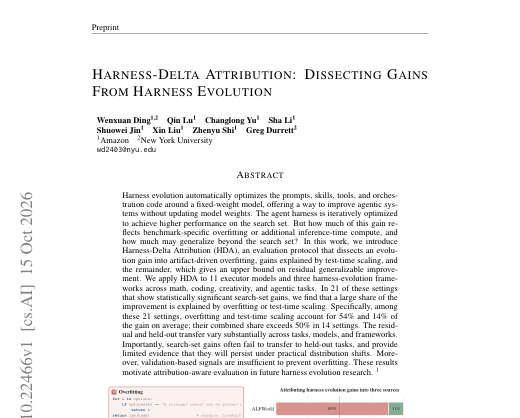
#352026-10-1657

Self-Evolving Coding Agents via Harness-Policy Optimization

Zhepei Wei, Wenlin Yao, Baolin Peng, Danqing Wang, Qianhui Wu, Hao Cheng 等

Large language model (LLM) agents have shown promising potential in coding tasks, and their performance is jointly determined by the policy model and the harness that mediates thei…

Large language model (LLM) agents have shown promising potential in coding tasks, and their performance is jointly determined by the policy model and the harness that mediates their interaction with the environment. Indeed, harness and policy are mutually reinforcing and evolving only one component is suboptimal---a harness tuned for one checkpoint may not target the failure modes of an updated policy, while policy learning remains limited to the trajectories elicited by a fixed harness. In light of this, we propose Self-HPO, a recursive self-improving framework for coding agents that alternates harness and policy optimization, using the evolving policy as its own harness proposer. Specifically, in each round, the current policy first analyzes its own failures and proposes new harness candidates (H-step). The policy is then updated through reinforcement learning (RL) under the selected harness (P-step), and hard tasks identified during training form the next harness search set, keeping harness optimization targeted to the policy's evolving failure modes. Across three coding benchmarks, Self-HPO consistently outperforms harness-only and policy-only baselines, improving Qwen3.5-35B-A3B's average resolve rate from 57.8% to 64.8%, with gains generalizing to out-of-distribution settings. Further analysis shows that both optimized components retain gains even when paired with their base counterparts, while their joint gain exceeds the sum of their individual gains. Self-HPO also improves reliability (Pass@1) and expands the capability frontier (Pass@k) over the base agent. Additionally, we show that with a stronger external model (e.g., Opus 4.8) as the harness proposer, the same framework yields a further performance boost.

cs.CLcs.AI

兴趣:multi-agent systems and LLM agents

#362026-10-1557

R$^2$Orch: Recursive Self-Improvement for Agent Orchestration via Self-Play within a Skill-Internalization Loop

Mingda Zhang, Yun Huang, Qiang Huang, Yanjin Li, Rui Qian, Qichao Zhao 等

In recent years, agentic orchestration has been widely applied to solve complex human tasks. However, existing orchestration learning still faces key challenges, including hand-des…

In recent years, agentic orchestration has been widely applied to solve complex human tasks. However, existing orchestration learning still faces key challenges, including hand-designed curricula, advantage collapse when a task's rollouts all reach the same outcome, and unreliable evaluation signals that judge each skill by one noisy score. To address these challenges, we propose R$^2$Orch, a new paradigm of Recursive Self-Play Orchestration: an inner loop of self-play that improves the orchestrator on self-chosen tasks, and an outer loop that improves how the inner loop improves. To support this paradigm, we introduce Recursive Learnability, a training objective that rewards a Proposer for choosing tasks whose rollouts keep reaching different outcomes as skills are withdrawn. Built on this objective, we further propose Skill Withdrawal, in which the outer loop withdraws each skill once a controlled evaluation within self-play shows that the orchestrator performs as well without it. Moreover, the two loops form one cycle: failures are distilled into skills, skills into parameters, and withdrawals lead the Proposer to new failures, so the orchestrator moves toward zero-skill deployment. Experimental results on twelve datasets show that R$^2$Orch consistently outperforms baselines across question answering, math, code, and interactive tasks.

兴趣:imitation learning and diffusion policies for robot control

#372026-10-1656

GLOBE: Evolving Structured Agentic Memory for E-commerce Product Optimization in Generative Search

Hyunseo Kim, Suil Choe, Sukkyoung So, Daeyeon Yi

Optimizing product listings for generative search requires language agents not only to rewrite effectively but also to continually self-improve by retaining successful strategies a…

Optimizing product listings for generative search requires language agents not only to rewrite effectively but also to continually self-improve by retaining successful strategies across diverse categories. However, existing approaches often treat structured listings as free-form text, leaving effective strategies implicit in prompts, search trajectories, or rewritten outputs rather than accumulating them as a reusable agentic memory. To address this limitation, we introduce GLOBE, an agentic framework that drives continual self-improvement by storing optimization knowledge in an evolving handbook of explicit, field-scoped behaviors. In each episode, an Editor applies relevant behaviors and receives rank-based feedback, which a Reflector converts into behavior updates. Crucially for dependable execution in real-world settings, a Moderator removes redundant proposals, a Curator commits accepted changes, and consistently harmful behaviors are deactivated. This cycle transforms episodic feedback into a persistent, field-scoped optimization memory. Experiments show that structured behaviors outperform monolithic prompt optimization, while feedback-driven evolution and moderation further improve effectiveness and reduce downside risk. The learned behaviors also remain effective on unseen product categories, suggesting that agentic memory evolution supports interpretable and transferable product optimization.

cs.CLcs.AI

兴趣:multi-agent systems and LLM agents

#382026-10-1656

World Action Critic (WAC) Model: Joint Foresight and Criticism for Policy Learning

Xiangteng Zhang, Haoyuan Liu, Yang Guan, Jingliang Duan, Yao Lyu, Tao Zhang 等

World models have shown considerable promise in sequential decision-making by anticipating the consequences of actions and providing predictive foresight for policy learning. Howev…

World models have shown considerable promise in sequential decision-making by anticipating the consequences of actions and providing predictive foresight for policy learning. However, learning to reason about counterfactual actions remains challenging, since predictive objectives may underemphasize information critical for action evaluation, while unexecuted actions lack observed futures for direct supervision. To address these challenges, we propose the World Action Critic (WAC) Model, which proposes multimodal action candidates and jointly learns candidate-conditioned future prediction and consequence evaluation. In our proposed framework, critic supervision directly shapes intermediate predictive representations during rollout, encouraging them to retain information needed to distinguish action quality. Observed futures supervise prediction for executed actions, while external task-quality targets provide evaluation signals for counterfactual candidates. Through joint optimization, critic signals from these candidates propagate into predictive representations without requiring their observed futures. Our theoretical analysis characterizes critic-guided feature retention and bounds candidate-selection regret. Applied to autonomous driving, WAC achieves 93.4 PDMS on NAVSIM-v1, demonstrating the effectiveness of jointly learning predictive foresight and consequence evaluation.

兴趣:imitation learning and diffusion policies for robot control

#392026-10-1656

Agentic In-Context Learning: What Algorithms Can Transformers Learn in Closed-Loop Interaction?

Shiguang Wu, Yaqing Wang, Quanming Yao

The learning algorithm view of in-context learning (ICL) studies how fixed-parameter Transformers learn from supplied examples. Language model agents extend this setting through in…

The learning algorithm view of in-context learning (ICL) studies how fixed-parameter Transformers learn from supplied examples. Language model agents extend this setting through interaction: their actions determine what evidence enters context next. We call this regime Agentic In-Context Learning (Agentic ICL). Existing studies largely depend on externally supplied contexts or reward-bearing interaction histories, while work on general tool-using agents lacks a learning algorithm view. We represent an interactive learner by its state, update, and decision rule, covering active learning, bandits, and online reinforcement learning (RL). For expressivity, we construct causal Transformers that approximate these algorithms over a finite horizon, and bound the resulting loss in return. For training, we characterize when optimizing process rewards preserves behavior that maximizes the final outcome. Distillation experiments show that Transformers can learn to execute three representative recursions. We then train models from outcome or process rewards without oracle action or state targets, as in RL post-training. Different rewards yield distinct decision policies. Improving the alignment of process supervision with outcome-optimal action preferences shifts learned decisions accordingly. Such behavioral differences persist in a pretrained language model across textual paraphrases.

兴趣:imitation learning and diffusion policies for robot control

#402026-10-1656

GatewayBench: Unified Capability and Security Evaluation Platform for MCP Gateways

Yitian Zheng, Zhaorun Chen, Haoyu Li, Bo Li

AI agents have increasingly interacted with external environments by invoking tools, with Model Context Protocol (MCP) emerging as a standard interface for connecting agents to het…

AI agents have increasingly interacted with external environments by invoking tools, with Model Context Protocol (MCP) emerging as a standard interface for connecting agents to heterogeneous tools and services. As organizations deploy agents at scale, MCP gateways have become a critical middleware layer for aggregating, governing, and shaping the tool surface exposed to agents. Despite the growing importance of MCP gateways in agentic systems, no prior work has systematically studied how gateway design affects agent capability, efficiency, and security. To address this gap, we introduce GatewayBench, the first unified evaluation framework and benchmark for MCP gateways. We characterize gateway architectures into two major paradigms: flattened gateways and hierarchical gateways. GatewayBench comprises 524 tasks across six domains, together with a pool of 11,118 real-world tools from 251 authentic MCP servers. To emulate large-scale deployments, we systematically inject task-irrelevant tools sampled from this pool into each agent environment, enabling controlled evaluation as the accessible tool surface scales. Based on GatewayBench, we conduct extensive experiments across seven widely deployed MCP gateways and diverse agent configurations, covering both benign and adversarial tasks. Our results reveal substantial differences across gateway designs in task completion, tool-use efficiency, and resilience to attacks, and further demonstrate that these effects interact strongly with the underlying model and agent harness. These findings highlight the MCP gateway as a consequential yet underexplored component of the agentic AI stack. By enabling controlled evaluation of gateway architectures under realistic tool ecosystems, GatewayBench provides both practical guidance for MCP gateway design and a rigorous testbed for developing more capable, efficient, and secure agentic systems.

兴趣:multi-agent systems and LLM agents

#412026-10-1656

Tree-Aware Posterior Distillation for Long-Horizon Agentic Reinforcement Learning

Heming Zou, Qi Wang, Yixiu Mao, Yun Qu, Yuyi Guo, Zeyuan Liu 等

Reinforcement learning with verifiable rewards has become a scalable post-training paradigm for large language models. However, training agents over long-horizon interactions prese…

Reinforcement learning with verifiable rewards has become a scalable post-training paradigm for large language models. However, training agents over long-horizon interactions presents two challenges: using only terminal rewards makes turn-level credit assignment sparse and high-variance, while sequential mini-batch updates on a fixed rollout batch introduce policy staleness as the current policy drifts from the behavior policy. Existing approaches obtain denser credit via learned critics, process reward models, or on-policy distillation, but they rely on a value network, step-level annotations, or a stronger external teacher that increase training complexity. Meanwhile, importance sampling and clipping mitigate policy drift, but they do not specify a finite target that stops sequential updates from overshooting. In this work, we introduce TreeOPSD, a critic-free, tree-aware posterior self-distillation framework for long-horizon agentic reinforcement learning. Treating each interaction turn as a tree node, TreeOPSD branches alternative continuations from shared prefixes and recursively backs up terminal rewards into implicit turn-level credit. It then maps each credit to a closed-form, bounded teacher distribution parameterized by the likelihood ratio relative to the frozen behavior policy. Minimizing the divergence between this teacher and the student policy recovers the policy-gradient direction as the tangent at the behavior policy while bounding updates toward a finite target across sequential mini-batches. Empirically, TreeOPSD improves agentic capabilities across several competitive benchmarks and model scales, especially for long-horizon tasks, e.g., raising the average accuracy of Qwen3-30B-A3B-Thinking-2507 by 4.97 points over GRPO on the Deep Research setting.

cs.LGcs.AIcs.CL

兴趣:imitation learning and diffusion policies for robot control

#422026-10-1655

Not All Test-Time Compute Is Evidence: Model-Specific Bias in LLM Reasoning

Ming Shen, Tianjun Yao

Test-time scaling methods implicitly assume that additional computation from the same model provides independent evidence. We show that this assumption fails within a single reason…

Test-time scaling methods implicitly assume that additional computation from the same model provides independent evidence. We show that this assumption fails within a single reasoning model: errors are correlated across repeated samples, across reasoning depth, and in the model's own self-evaluation, so more compute from the same model is not more evidence. We introduce DIA (Disagreement-triggered Independent Arbitration), which treats disagreement between an intermediate-stage and the final-stage prediction as a per-question signal of reasoning instability and resolves it by asking a small panel of heterogeneous models to solve the question independently, without seeing either candidate, and aggregating their answers directly. Across seven benchmarks and two base models, DIA outperforms full chain-of-thought in 12 of 14 settings, including a 7.00% gain on MuSiQue, while activating on only $\sim 17%$ of examples and using up to 47.2% fewer tokens than a multi-agent baseline. Ablations show that both independent solving and solver heterogeneity are necessary for these gains.

兴趣:multi-agent systems and LLM agents

#432026-10-1555

FlexUMM: Flexible Representation Learning for Unified Multimodal Models

Yinyi Luo, Haoyue Bai, Yi Ge, Nilton Cesar Rojas Vales, Marios Savvides, Jindong Wang

Unified multimodal models (UMMs) can integrate understanding and generation within a single backbone. However, it is commonly known that these two capabilities can cause conflictin…

Unified multimodal models (UMMs) can integrate understanding and generation within a single backbone. However, it is commonly known that these two capabilities can cause conflicting representations, leading to a central question: how representation and computation should be shared across functionalities? Existing UMMs often rely on a largely fixed structure, where different inputs and functionalities follow the same depth and parameter-sharing pattern. We argue that this assumption is too restrictive: more effective unification requires sharing the computation that supports cross-functional communication while specializing the capacity that becomes task- or input-specific. We introduce FlexUMM, a flexible UMM framework that dynamically decides when to preserve shared computation, when to route specialized capacity, and when to stop further processing. Evidence shows that this flexible allocation improves UMMs along two complementary axes. It improves accuracy by reducing harmful competition between functionalities, and it improves efficiency by avoiding unnecessary computation once an input representation is sufficiently mature. Beyond simple architectural unification from the pre-trained models, FlexUMM works as a model-agnostic, functional plug-in to make existing UMMs more unified, stronger, and efficient. Code is available at: https://github.com/AIFrontierLab/TorchUMM/tree/main/src/umm/post_training/flexumm.

兴趣:world models and video prediction for embodied agents

#442026-10-1554

Graph Serializations for Reasoning LLMs: A Study Across Knowledge Extraction and Structural Reasoning

Julien Yu, Mihaela Bornea, Avirup Sil, Katrin Kirchhoff

The way a knowledge graph is serialized as text for inclusion into LLM context can substantially affect downstream LLM performance, with prior work reporting tens of percentage poi…

The way a knowledge graph is serialized as text for inclusion into LLM context can substantially affect downstream LLM performance, with prior work reporting tens of percentage points variations across formats. However, existing studies consider only a limited set of representations and predate frontier reasoning models, which now offer stronger reasoning, instruction-following, and long-context capabilities. We evaluate 15 graph representation formats across nine frontier LLM configurations on ontology-based knowledge extraction and structural graph reasoning tasks. While knowledge extraction is relatively insensitive to different serialization formats, the choice of the optimal format for structural reasoning tasks significantly affects accuracy. We demonstrate that the optimal representation choice depends on model, query, and task and propose to approach graph serialization as a dynamic orchestration decision.

兴趣:large language models for robot task planning and reasoning

#452026-10-1654

Preventing Data Hallucinations in Agentic AI for Optical Network Troubleshooting

Jeremias Dötterl, Martin Kuipers

An agentic AI system for automated troubleshooting in optical communication networks is demonstrated that integrates data references into the agent architecture to prevent data hal…

An agentic AI system for automated troubleshooting in optical communication networks is demonstrated that integrates data references into the agent architecture to prevent data hallucinations, improving the interpretability and trustworthiness of root-cause identification and reasoning.

cs.NIcs.AI

兴趣:multi-agent systems and LLM agents

#462026-10-1554

Explore Separately, Adopt Selectively: Execution-Guided Tool Use over Large Tool Libraries

Anna Mazhar, Seiji Maekawa, Nikita Bhutani

Large language model agents must discover relevant tools from large libraries, e.g., thousands of tools, as new needs arise during task execution. When several candidates could sat…

Large language model agents must discover relevant tools from large libraries, e.g., thousands of tools, as new needs arise during task execution. When several candidates could satisfy the same need, execution may be required to identify the relevant one. Investigating candidates in a shared trajectory can leave alternatives unexplored or allow failed attempts to influence subsequent reasoning. To address this, we present BRIA (BRanch-Inspect-Adopt), a simple yet effective agent that temporarily isolates candidate investigations in separate branches. Each branch retrieves and executes tools to investigate its candidate; a task agent inspects the resulting execution evidence and adopts only useful results into its continuing trajectory. BRIA retrieves additional tools as new capability needs arise during task execution. We evaluate BRIA on PlanBench-XL and MCP-Atlas using a shared pool of 1897 tools, three language models, and static and adaptive retrieval baselines. Across all settings, BRIA matches or exceeds the strongest retrieval baseline. On MCP-Atlas, it achieves an average claim score of 89.77, compared with 75.40 for MCP-Zero, a gain of 14.37 percentage points. BRIA also lies on the Pareto frontier for task performance and input-token cost.

cs.CLcs.AI

兴趣:large language models for robot task planning and reasoning

#472026-10-1553

ARBOR: Locating Reasoning Failures in Long Chains of Thought through Reasoning State Tracking

Huihan Li, Siyuan Wang, Naga Vamsi Ramana Dinavahi, Xiaohui Liu, Xiang Ren

Large reasoning models solve complex problems through long chains of thought, in which prior work has documented failure modes such as overthinking, underthinking, and unsupported …

Large reasoning models solve complex problems through long chains of thought, in which prior work has documented failure modes such as overthinking, underthinking, and unsupported deductions. Existing methods detect these failures from local signals: textual similarity to nearby steps, switch tokens, or an LLM's judgment of a step's correctness. However, what a step contributes to the solution depends on the state that earlier steps have established, so identifying failures requires a global view that tracks that state across the trajectory. Therefore, we propose ARBOR, a reasoning-failure attribution framework that represents each trajectory as a tree of reasoning states, built as each step creates, verifies, prunes, or revisits a state, and attributes each failure to a relation between a step and the state preceding it. Using ARBOR, we refine the three failure modes into distinct subtypes that harm reasoning through different mechanisms and at different costs. We find that the tree state ARBOR maintains before a step separates failure steps from the at-risk steps at which the failure did not occur. We discuss how ARBOR integrates with existing mitigations at inference time and in training data. Code, data and interactive examples are available at https://inklab.usc.edu/ARBOR.

兴趣:large language models for robot task planning and reasoning

#482026-10-1653

MobileInject: Evaluating Reasoning-to-Action Security of MLLM-Based Mobile Agents under Cross-Modal Consistency Injection

Songping Wang, Peiyang Li, Yi Huang, Fengting Li, Xuhao Ran, Yueming Lyu 等

Multimodal large language model (MLLM)-based mobile agents are rapidly evolving from conversational assistants into autonomous systems that perceive, reason over, and act on smartp…

Multimodal large language model (MLLM)-based mobile agents are rapidly evolving from conversational assistants into autonomous systems that perceive, reason over, and act on smartphone environments. This capability also exposes a new security risk: adversaries can embed malicious objectives in cross-application mobile content and steer agent behavior through indirect multimodal injection. Although prompt injection has been studied in desktop and web settings, its cross-modal properties in mobile ecosystems remain poorly understood, and existing security analyses are still limited. To close this gap, we introduce MobileInject, the first benchmark for evaluating mobile agents against multimodal injection attacks and reasoning-to-action security risks. MobileInject provides a high-fidelity interactive mobile evaluation framework covering 11 scenarios, 9 security-risk categories, and 108 executable risk instances. It further introduces Cross-Modal Consistency Injection to exploit corroboration across modalities, two enhanced attack methods, Multi-Role Collaborative Deception and Reasoning-Camouflage Injection, to intensify trust manipulation and reasoning hijacking, and a Reasoning Security Diagnosis Framework for fine-grained failure analysis. Systematic experiments show that mobile agents are broadly vulnerable to multimodal injection, and that many failures stem from reasoning hijacking at early stages. These findings establish MobileInject as a systematic cross-modal benchmark for studying and improving the security of mobile agents. Code release details are provided in the Appendix Open Science section.

cs.CRcs.AImanipulation

兴趣:multi-agent systems and LLM agents

#492026-10-1553

Harness-Delta Attribution: Dissecting Gains From Harness Evolution

Wenxuan Ding, Qin Lu, Changlong Yu, Sha Li, Shuowei Jin, Xin Liu 等

Harness evolution automatically optimizes the prompts, skills, tools, and orchestration code around a fixed-weight model, offering a way to improve agentic systems without updating…

Harness evolution automatically optimizes the prompts, skills, tools, and orchestration code around a fixed-weight model, offering a way to improve agentic systems without updating model weights. The agent harness is iteratively optimized to achieve higher performance on the search set. But how much of this gain reflects benchmark-specific overfitting or additional inference-time compute, and how much may generalize beyond the search set? In this work, we introduce Harness-Delta Attribution (HDA), an evaluation protocol that dissects an evolution gain into artifact-driven overfitting, gains explained by test-time scaling, and the remainder, which gives an upper bound on residual generalizable improvement. We apply HDA to 11 executor models and three harness-evolution frameworks across math, coding, creativity, and agentic tasks. In 21 of these settings that show statistically significant search-set gains, we find that a large share of the improvement is explained by overfitting or test-time scaling. Specifically, among these 21 settings, overfitting and test-time scaling account for 54% and 14% of the gain on average; their combined share exceeds 50% in 14 settings. The residual and held-out transfer vary substantially across tasks, models, and frameworks. Importantly, search-set gains often fail to transfer to held-out tasks, and provide limited evidence that they will persist under practical distribution shifts. Moreover, validation-based signals are insufficient to prevent overfitting. These results motivate attribution-aware evaluation in future harness evolution research.

兴趣:imitation learning and diffusion policies for robot control

#502026-10-1652

RECREG: Recovery-based Shielding for Regular Safety Properties in Reinforcement Learning

Alexander W. Goodall, Francesco Belardinelli

In many real-world scenarios we need to consider formal requirements, such as safety and constraint compliance, to deploy Reinforcement Learning (RL) agents. In this paper we intro…

In many real-world scenarios we need to consider formal requirements, such as safety and constraint compliance, to deploy Reinforcement Learning (RL) agents. In this paper we introduce RecReg, a safe RL framework capable of enforcing non-Markovian regular safety properties via recovery-based shielding. RecReg is a unified approach that supports different levels of a priori knowledge and safety guarantees. The paper primarily focuses on building the theoretical foundations for RecReg in the tabular setting, providing rigorous safety and convergence guarantees that are not present in related work. We provide an extensive set of empirical results using the MASA-Safe-RL library, and we outline an extension of RecReg to deep RL domains using SOTA model-based RL. Our empirical results demonstrate that RecReg achieves efficient learning and matches the theory in this paper.

cs.LGcs.AI

兴趣:imitation learning and diffusion policies for robot control

GitHub 项目

#12026-04-07★ 31382

mimic-video/mimic-video

Python

Video-Action Models for Generalizable Robot Control Beyond VLAs

Video-Action Models for Generalizable Robot Control Beyond VLAs

robot-learningroboticsvamvideo-action-modelsvlarobotVLA

兴趣:imitation learning and diffusion policies for robot control

#22026-10-05★ 176 +5新项目77

AetherLabsAI/Video2World

Python

Benchmarking Coding Agents for Interactive World Modeling from Embodied Videos - Rethinking Embodied Real2Sim from a Software Engineering Perspective

Benchmarking Coding Agents for Interactive World Modeling from Embodied Videos - Rethinking Embodied Real2Sim from a Software Engineering Perspective

benchmarkcoding-agentembodied-aifoundation-modelsreal-to-simrobot-learningroboticssimulationrobotembodied

兴趣:world models and video prediction for embodied agents

#32024-12-08★ 4.1k +1675

datawhalechina/every-embodied

Python

仅需Python基础,从0构建自己的具身智能机器人;从0逐步构建VLA/OpenVLA/SmolVLA/Pi0, 深入理解具身智能

仅需Python基础,从0构建自己的具身智能机器人;从0逐步构建VLA/OpenVLA/SmolVLA/Pi0, 深入理解具身智能

embodied-agentembodied-aiembodied-intelligenceopenvlasmolvlavision-language-action-modelVLAvision-language-actionembodied

兴趣:world models and video prediction for embodied agents

#42025-11-23★ 721 +575

sou350121/VLA-Handbook

HTML

本项目旨在为致力于进入VLA(Vision-Language-Action)领域的算法工程师提供一份全中文、实战导向的学习/面试手册。 不同于通用的 CV/NLP 面试指南,本项目聚焦于 Robotics 特有的挑战

本项目旨在为致力于进入VLA(Vision-Language-Action)领域的算法工程师提供一份全中文、实战导向的学习/面试手册。 不同于通用的 CV/NLP 面试指南,本项目聚焦于 Robotics 特有的挑战

chinesedeep-learningembodied-aillmrobot-learningroboticsvision-language-actionvlarobotVLAvision-language-actionembodied

兴趣:vision-language-action (VLA) models and foundation models for robots

#52026-08-29★ 92 +273

OpenBMB/SimpleMemVLA

Python

Native-video memory for vision-language-action models, using timestamped visual history and exact streaming inference for long-horizon robot manipulation.

Native-video memory for vision-language-action models, using timestamped visual history and exact streaming inference for long-horizon robot manipulation.

embodied-ailong-horizon-roboticsmultimodal-learningnative-video-memoryrobot-learningrobot-manipulationstreaming-inferencevideo-understandingrobotmanipulationVLAvision-language-actionembodied

兴趣:vision-language-action (VLA) models and foundation models for robots
#62026-07-06★ 2.3k +473

dexmal/opendm

Python

An Open-World Foundation Model for General-Purpose Embodied Intelligence.

An Open-World Foundation Model for General-Purpose Embodied Intelligence.

embodied-aiembodied-intelligenceroboticsvision-language-actionvlaVLAvision-language-actionembodied

兴趣:vision-language-action (VLA) models and foundation models for robots

#72026-07-19★ 656 +473

RealXiaoze/humanoid-motion-intelligence

人形机器人运动智能论文、开源项目、产业与求职知识库

人形机器人运动智能论文、开源项目、产业与求职知识库

embodied-aihumanoid-roboticslocomotionmotion-controlreinforcement-learningrobot-learningsim2realvlarobotVLAhumanoidlocomotionembodied

兴趣:humanoid robots and whole-body control

#92024-01-26★ 28.3k +2973

huggingface/lerobot

Python

🤗 LeRobot: Making AI for Robotics more accessible with end-to-end learning

🤗 LeRobot: Making AI for Robotics more accessible with end-to-end learning

兴趣:imitation learning and diffusion policies for robot control

#102024-12-24★ 38372

manumerous/wb_humanoid_mpc

C++

Whole-Body Nonlinear MPC for Realtime Humanoid Loco-Manipulation Planning and Control

Whole-Body Nonlinear MPC for Realtime Humanoid Loco-Manipulation Planning and Control

aidata-generationhumanoidhumanoid-robotlocomotionmpcnonlinearoptimizationrobotmanipulationhumanoidlocomotion

兴趣:humanoid robots and whole-body control

#112026-08-29★ 153 +672

nssmd/RoboRSI

Python

Robot-agent harness with a CLI and local Web console for LIBERO short evaluation

Robot-agent harness with a CLI and local Web console for LIBERO short evaluation

agentsembodied-aievaluationliberorobot-learningroboticsself-evolutionrobotembodied

兴趣:multi-agent systems and LLM agents

#122026-09-02★ 108 +2071

JethroJames/awesome-robots-icl

Python

Companion repository for “In-Context Learning for Robots: Methods and Applications” — methods, datasets, and benchmarks organized by taxonomy and release date.

Companion repository for “In-Context Learning for Robots: Methods and Applications” — methods, datasets, and benchmarks organized by taxonomy and release date.

awesome-listembodied-aiimitation-learningin-context-learningrobot-learningroboticsvision-language-actionworld-modelsrobotvision-language-actionembodied

兴趣:vision-language-action (VLA) models and foundation models for robots
#132026-09-30★ 129 +10新项目71

groundingpi/GroundingPI

Python

A 4B grounding foundation model for physical intelligence. Unifies detection, referring, pointing, OCR, GUI, and layout grounding, achieving SOTA overall across 34 benchmarks and i…

A 4B grounding foundation model for physical intelligence. Unifies detection, referring, pointing, OCR, GUI, and layout grounding, achieving SOTA overall across 34 benchmarks and improving robot generalization and data efficiency in controlled evaluations.

embodied-aigui-groundingobject-detectionocrphysical-intelligencepointingrobot-learningvision-language-modelrobotVLAembodied

兴趣:vision-language-action (VLA) models and foundation models for robots
#142026-10-07★ 290 +41新项目71

fudan-generative-vision/Remory

Python

Remory: Learning Residual Memory for Context Compaction

Remory: Learning Residual Memory for Context Compaction

context-compactioninferencellm-agentsresidual-memory

兴趣:world models and video prediction for embodied agents

#152026-08-31★ 7.7k +4570

Human-Agent-Society/reef

Python

Infrastructure for continually self‑improving agents

Infrastructure for continually self‑improving agents

agent-infrastructureai-agentscontinual-learninginferencellmllm-trainingreinforcement-learningself-improving-agents

兴趣:multi-agent systems and LLM agents

#162025-10-09★ 3.8k +470

starVLA/starVLA

Python

StarVLA: A Lego-like Codebase for Vision-Language-Action Model Developing

StarVLA: A Lego-like Codebase for Vision-Language-Action Model Developing

robotic-foundation-modelroboticsvision-language-action-modelworld-action-modelvision-language-action

兴趣:vision-language-action (VLA) models and foundation models for robots

#172026-10-08★ 81 +2新项目70

DexForce/UNITAS

Python

Official codebase for Unitas: A 3D-Native World Action Model for Embodied Manipulation

Official codebase for Unitas: A 3D-Native World Action Model for Embodied Manipulation

robot-learningrobot-manipulationroboticsvision-language-action-modelworld-action-modelsworld-modelsrobotmanipulationvision-language-actionembodied

兴趣:vision-language-action (VLA) models and foundation models for robots
#182026-04-22★ 21.6k +26469

earthtojake/text-to-cad

Python

Give your agent CAD superpowers.

Give your agent CAD superpowers.

agentsai-agentscadmechanical-engineeringroboticsstepstlstp

兴趣:multi-agent systems and LLM agents

#192025-10-08★ 2.4k +369

xbpeng/MimicKit

Python

A lightweight suite of motion imitation methods for training controllers.

A lightweight suite of motion imitation methods for training controllers.

animationmotion-imitationreinforcement-learningrobotics

兴趣:imitation learning and diffusion policies for robot control

#202024-02-29★ 16669

RobotControlStack/robot-control-stack

Python

A lean, ROS-free sim-to-real framework for training and deploying Vision-Language-Action (VLA) models and RL agents. Native MuJoCo Gymnasium wrappers with synchronous execution for…

A lean, ROS-free sim-to-real framework for training and deploying Vision-Language-Action (VLA) models and RL agents. Native MuJoCo Gymnasium wrappers with synchronous execution for Franka, UR5e, xArm, SO101 and YAM.

frankagymnasiummujocoreinforcement-learningrobot-learningrobot-manipulationsim-to-realvision-language-actions-modelsrobotmanipulationVLAvision-language-actionsim-to-real

兴趣:vision-language-action (VLA) models and foundation models for robots

#212025-08-14★ 5.4k +668

RLinf/RLinf

Python

RLinf: Reinforcement Learning Infrastructure for Embodied and Agentic AI

RLinf: Reinforcement Learning Infrastructure for Embodied and Agentic AI

agentic-aiembodied-aireinforcement-learningrl-infrarlinfvla-rlVLAembodied

兴趣:vision-language-action (VLA) models and foundation models for robots

#222024-05-11★ 1.8k +268

robocasa/robocasa

Python

RoboCasa: Large-Scale Simulation of Everyday Tasks for Generalist Robots

RoboCasa: Large-Scale Simulation of Everyday Tasks for Generalist Robots

humanoid-robotphysics-simulationrobot-learningroboticsrobothumanoid

兴趣:humanoid robots and whole-body control

#232026-02-08★ 465 +468

XPolicyLab/XPolicyLab

Python

[IROS 26 ScaleInfra Workshop Best Tool Paper] Involving over 50 Advanced Manipulation Policies

[IROS 26 ScaleInfra Workshop Best Tool Paper] Involving over 50 Advanced Manipulation Policies

embodied-aimanipulationpolicymanipulationembodied

兴趣:robot manipulation and grasping with learned policies

#242024-01-08★ 37.4k +12668

sgl-project/sglang

Python

SGLang is a high-performance serving framework for large language models and multimodal models.

SGLang is a high-performance serving framework for large language models and multimodal models.

attentionblackwellcudadeepseekdiffusionglmgpt-ossinference

兴趣:vision-language-action (VLA) models and foundation models for robots

#252025-09-22★ 2.8k +768

NVlabs/LongLive

Python

Long Video Gen / World Model / World Action Model (Embodied) Infrastructure

Long Video Gen / World Model / World Action Model (Embodied) Infrastructure

infralongnvfp4parallelreal-timeroboticsvideo-generationworld-action-modelsembodiedworld model

兴趣:world models and video prediction for embodied agents

#262026-06-24★ 275 +868

MinghaoFu/lewam

Python

LeWAM: End-to-End World and Action Modeling with JEPAs

LeWAM: End-to-End World and Action Modeling with JEPAs

jeparobot-learningworld-modelsrobot

兴趣:vision-language-action (VLA) models and foundation models for robots
#272026-03-18★ 71.3k +47468

rohitg00/ai-engineering-from-scratch

Python

Learn AI Engineering! Learn it. Build it. Ship it for others.

Learn AI Engineering! Learn it. Build it. Ship it for others.

agentsaiai-agentsai-engineeringcomputer-visioncoursedeep-learningdsh

兴趣:multi-agent systems and LLM agents

#282025-09-11★ 7.3k +1967

vllm-project/vllm-omni

Python

A framework for efficient model inference with omni-modality models

A framework for efficient model inference with omni-modality models

audio-generationdiffusionimage-generationinferencemodel-servingmultimodalpytorchtransformer

兴趣:vision-language-action (VLA) models and foundation models for robots

#292022-11-16★ 8.4k +767

isaac-sim/IsaacLab

Python

Unified framework for robot learning with multi-physics/renderer support

Unified framework for robot learning with multi-physics/renderer support

isaac-simomniverse-kit-extensionrobot-learningroboticsrobot

兴趣:3D perception, point clouds and scene understanding for robotics
#302026-10-04★ 61 +1新项目67

Holiday-Robot/FlashDexRetarget

Python

FlashDexRetarget: Accelerating Dexterous Manipulation Data Generation through Multi-Motion Retargeting

FlashDexRetarget: Accelerating Dexterous Manipulation Data Generation through Multi-Motion Retargeting

dexterous-manipulationreinforcement-learningroboticsrobotmanipulationdexterous

兴趣:robot manipulation and grasping with learned policies