Tech Station

2026-10-20

50 篇论文 · 30 个项目 ← 2026-10-19 · 2026-10-21 →

论文

#12026-10-1998

PaceVLA: Adaptive Temporal Action Quantization in Vision-Language-Action Models

Hojin Jeon, Jimin Lee, Taekwan Kim, Nayoung Oh, Taeyoung Kim, Myungkyu Koo 等

Fast and reliable manipulation is crucial for practical robot deployment. Although Vision-Language-Action (VLA) models have recently shown remarkable progress as generalist robot p…

Fast and reliable manipulation is crucial for practical robot deployment. Although Vision-Language-Action (VLA) models have recently shown remarkable progress as generalist robot policies, their execution often remains temporally inefficient. A key source of this inefficiency is that policies learn fine-grained temporal patterns from teleoperated demonstrations, requiring many low-level action steps. Temporal action quantization offers a simple way to accelerate execution by aggregating consecutive low-level actions into temporally coarser actions. However, applying action quantization without considering when fine-grained control is required introduces a speed-accuracy trade-off: accelerated actions may efficiently reduce redundant steps in some phases, while discarding critical motion details in precision-sensitive interactions. To address this, we propose PaceVLA, a unified framework for adaptive temporal execution in VLAs that integrates two coupled components: (1) mode-specific action decoders built on a shared action expert, supporting multiple temporal granularities and prediction horizons, and (2) a quantizability-guided mode selection scheme which decides whether coarse execution is appropriate, and a context-conditioned router that selects an execution mode at each inference step. Experiments across three multi-task simulation benchmarks and six real-world tasks show that PaceVLA improves execution efficiency while maintaining task success rate across multiple embodiments, including long-horizon and dexterous manipulation.

cs.ROcs.AIrobotmanipulationVLAvision-language-actiondexterous

兴趣:vision-language-action (VLA) models and foundation models for robots

#22026-10-1996

Learn the Task, Not the Schedule: Reducing Spurious Cross-Arm Coupling in Bimanual Imitation Learning

Shuyuan Hu, Deng-Ke Wu, Yifan Jin, Qianhang Luo, Mingchen Ju, Kai Ye 等

A bimanual demonstration specifies both what the robot should do and one particular schedule for when each arm should act. Standard imitation learning does not distinguish task-req…

A bimanual demonstration specifies both what the robot should do and one particular schedule for when each arm should act. Standard imitation learning does not distinguish task-required cross-arm constraints from incidental scheduling choices, and may therefore exploit opposite-arm progress as a shortcut cue, creating spurious cross-arm coupling even where relative timing is irrelevant for the current task phase. We introduce Constraint-preserving Temporal Recombination (CTR), a training-time data intervention that preserves recorded arm-local sensorimotor content while retiming the corresponding segments to realize admissible schedules that preserve task-required cross-arm constraints. We use CTR to train Diffusion Policy, Action Chunking with Transformers, and $π_{0.5}$, and evaluate them on four simulated and four real-robot tasks. Across six real-robot bimanual progress-state initializations, CTR raises worst-state success from 56% for the strongest non-CTR schedule mixture to 76%. With $π_{0.5}$ on an Independent task, a 4 s pause transfers 2.56 s of delay to the opposite arm under the Concurrent schedule distribution, but only 0.25 s with CTR. On real robots, CTR violates task constraints in only 0--4% of trials, versus 36--98% for narrow-schedule baselines. Code will be released at https://github.com/MINT-SJTU/CTR.

cs.ROcs.AIcs.LGrobotimitation learningdiffusion policy

兴趣:imitation learning and diffusion policies for robot control

#32026-10-1995

EmbodiedWorld-200K: Toward Embodied World Agents via Embodied-Planning Dataset and Interactive World Models

X. Feng, J. Tang, Z. Lin, L. Chen, S. Shao, Q. Lu 等

Building embodied agents that can perceive, reason, and act across diverse 3D worlds is a central research direction toward artificial general intelligence. Yet most existing work …

Building embodied agents that can perceive, reason, and act across diverse 3D worlds is a central research direction toward artificial general intelligence. Yet most existing work remains confined to specific tasks in a single scene and transfers poorly to new environments, leaving general embodied agents for open-world settings under-explored. We refer to such agents as Embodied World Agents (EWAs), whose defining property is the ability to understand diverse visual environments and execute general actions in open-world conditions. To advance EWA research, we study open-world embodied navigation-planning and release EmbodiedWorld-200K, a large-scale dataset of over 200K samples spanning diverse scenes. Each example is equipped with multi-level annotations, ranging from low-level camera-motion trajectories to high-level semantic instructions. The dataset also provides unified evaluation splits and task-specific metrics, supporting offline pretraining and fair evaluation of EWAs. Beyond offline supervision, a defining characteristic of an EWA is its interaction with the environment; training solely on offline data is therefore insufficient, especially for generalizing to scenes not covered in the training distribution. Building dedicated real interactive environments, however, is often prohibitively expensive. To address this, we propose a novel training scheme that employs a video world model as a low-cost environment proxy and performs interactive reinforcement-learning (RL) post-training of the EWA within it. Empirically, pretraining on EmbodiedWorld-200K substantially improves the open-world embodied planning ability of the EWA, and further RL post-training inside a world model yields clear gains on out-of-distribution scenes. The dataset, baseline checkpoints, and training and evaluation code are available at https://xiaokunfeng.github.io/EmbodiedWorld-200K/.

cs.AIembodiedworld model

兴趣:world models and video prediction for embodied agents

#42026-10-1991

SPAR: Structural Pruning and Action Recovery for Vision-Language-Action Models

Shenli Zheng, Zhou Fang, Yuan Du, Yijiang Liu, Li Du

The limited onboard computing resources of robots make the inference demands of vision-language-action (VLA) models costly to accommodate. Reducing these demands through aggressive…

The limited onboard computing resources of robots make the inference demands of vision-language-action (VLA) models costly to accommodate. Reducing these demands through aggressive compression, however, can degrade manipulation performance beyond what supervised fine-tuning alone recovers. We present SPAR (Structural Pruning and Action Recovery), which simultaneously prunes the hidden and feed-forward intermediate dimensions of the large language model (LLM) backbone through pruning-aware tuning, then applies reinforcement learning (RL) to recover policy performance. Applied to $π_{0.5}$, SPAR reduces the language backbone from 2.34B to 0.09B parameters and the full model from 3.37B to 1.12B, removing approximately 96% and 67% of their parameters, respectively. At this compression level, RL raises average success across the four LIBERO suites from 84.55% to 93.45%, an 8.90-percentage-point gain. The compressed policy achieves a $1.98\times$ full-policy inference speedup over the unpruned model. These results identify substantial intermediate-dimension redundancy and show that post-pruning RL can recover manipulation performance in compact policies.

cs.ROcs.AImanipulationVLAvision-language-action

兴趣:vision-language-action (VLA) models and foundation models for robots

#52026-10-1990

Robotic Photography System based on Vision-Language-Action Model

Song-Li Wu, Chubin Zhang, Wenbo Ding, Yansong Tang

Modern robotic photography requires understanding photographic intent, planning camera motions, and producing aesthetically pleasing images in complex environments. We present Robo…

Modern robotic photography requires understanding photographic intent, planning camera motions, and producing aesthetically pleasing images in complex environments. We present RoboPhoto-VLA, a unified Vision-Language-Action framework that jointly models perception, reasoning, and camera control for autonomous robotic photography. RoboPhoto-VLA incorporates PhotoCoT for structured action planning and Aesthetic Direct Preference Optimization (ADPO) to align camera behaviors with human aesthetic preferences. To facilitate training and evaluation, we construct OpenPhotography, a robotic photography dataset with language-guided demonstrations. Extensive real-world experiments demonstrate that RoboPhoto-VLA produces photographs better aligned with human aesthetic preferences while generalizing effectively to unseen subjects, viewpoints, poses, and complex photographic instructions.

cs.ROcs.AIVLAvision-language-action

兴趣:vision-language-action (VLA) models and foundation models for robots

#62026-10-1989

TESS: LLM-guided Translation, Exploration, Simulation, and Search for Embodied Task Planning

Peiran Xu, Yixiang Yang, Jinghan Li, Fei Li, Cao Sheng, JiaZhong Yu 等

In this work we focus on the problem of embodied task planning, which requires an agent to accomplish a complex task by separating it into atomic actions. Recent studies have devel…

In this work we focus on the problem of embodied task planning, which requires an agent to accomplish a complex task by separating it into atomic actions. Recent studies have developed LLM-based methods to address this problem. However, the executability and correctness of the generated plans remain suboptimal in complex environments and tasks. On the other hand, classical search algorithms have the potential to solve the planning problems perfectly, yet they require fully observable environments, known state transitions and goal state, which are often unattainable in general task domains. Therefore, we propose to implement an LLM-guided search algorithm that makes the search process possible and efficient by incorporating LLMs' commonsense knowledge. Our method leverages LLMs to (1) translate natural language instructions into formatted goal conditions, (2) facilitate efficient exploration in partially observable environments, (3) implement a rule-based world simulator, and (4) prune the space of candidate actions to improve search efficiency. Experimental results on VirtualHome and ALFWorld demonstrate its superior performance.

cs.AIembodiedtask planning

兴趣:large language models for robot task planning and reasoning

#72026-10-1987

OV-PEAR: Observation-Verified Pose-Scale Estimation and Reconstruction for Unknown Industrial Manipulation Objects

Guoqin Tang, Qingxuan Jia, Yichen Tan, Zihang Lv, Ruiquan Wang, Zeyuan Huang 等

Fine industrial robotic manipulation requires 6D pose, scale, and an operation-ready 3D model. Existing industrial pose estimation relies on CAD models, object-specific training da…

Fine industrial robotic manipulation requires 6D pose, scale, and an operation-ready 3D model. Existing industrial pose estimation relies on CAD models, object-specific training data, or stable workcells, limiting use with unseen objects; zero-shot methods suffer from single-view occlusion, generative bias, and scale uncertainty. We present OV-PEAR, an observation-verified framework for 3D reconstruction and pose-scale estimation of unknown industrial objects. Its three-stage object-centric pipeline: (1) segments RGB-D instances and generates object-level 3D hypotheses; (2) anchors them to the robot frame via appearance-aware view retrieval, explicit scale search, and visibility-sensitive registration; (3) back-projects multi-view RGB-D evidence into the object-canonical frame to verify voxel occupancy, suppress hallucinations, and produce reusable trusted object models. On BOP-Industrial, OV-PEAR achieves 0.657 average AR and improves pose and voxel-level geometric consistency in real scenes; real-robot connector assembly reaches 99.67% grasp and 84.00% assembly success. The model library and pose-scale log enable short-term object-level state maintenance at 0.02 ms/frame.

cs.ROcs.AIrobotmanipulationgrasp

兴趣:3D perception, point clouds and scene understanding for robotics

#82026-10-1987

ALIGN: Aligning Condition Estimation and Expression in Advantage-Conditioned Behavior Cloning

Zechen Wang, Zhenqi Qiu, Houlong Xiong, Suohang Zhang, Yiyu Ren, Wanting Xu 等

Human-collected robot manipulation data often mix successful behavior with retries, pauses, recoveries, and failures. Advantage-Conditioned Behavior Cloning (AC-BC) can exploit suc…

Human-collected robot manipulation data often mix successful behavior with retries, pauses, recoveries, and failures. Advantage-Conditioned Behavior Cloning (AC-BC) can exploit such mixed-quality data, but only if the conditioning signal is both accurately constructed from offline trajectories and effectively incorporated into the policy's action-vector-field prediction. Existing pipelines can weaken this signal by thresholding estimator-derived advantage scores into noisy conditions, and by routing conditions through prompts that weakly affect the action vector field. We introduce ALIGN, a condition-aligned AC-BC framework for vision-language-action policies. ALIGN directly predicts categorical pairwise conditions in the policy-facing label space and injects them into a DiT action expert through AdaRMS modulation fused with flow time. We evaluate ALIGN on deliberately mixed real-robot datasets for ARX X5 bowl stacking and Franka key hanging, each combining standard demonstrations with retry-heavy trajectories. ALIGN improves condition fidelity, strengthens conditional vector-field separability, and achieves 90.0% and 56.7% closed-loop success, compared with 56.7% and 33.3% for the strongest AC-BC baseline. These results indicate that aligning conditions from estimation to action prediction is an effective way to extract robust manipulation policies from data in which success, recovery and error coexist.

cs.ROcs.AIrobotmanipulationvision-language-action

兴趣:imitation learning and diffusion policies for robot control

#92026-10-1985

BetaMem: Learning to Remember a Changing World for Embodied Agents

Mai Liu, He Sun, Siru Zhong, Kerun Chen, Hao Yan, Xiaohui Lv 等

Long-horizon embodied agents face temporal confusion and incomplete or distorted records, recurring errors from fixed memory rules, and growing storage and retrieval costs. We pres…

Long-horizon embodied agents face temporal confusion and incomplete or distorted records, recurring errors from fixed memory rules, and growing storage and retrieval costs. We present BetaMem, a framework for building and evolving traceable long-term memory through six linked layers: working, spatial, entity, episodic, experiential, and procedural memory. A dual-level write contract constrains operation executability and source support for content: supervised fine-tuning learns compliant memory operations, while reinforcement learning combines repeated sampling with teacher verification of the original observations to reward complete, accurate records and penalize omissions, distortion, and unsupported content. We formulate failure-driven policy recursive self-improvement through diagnosis along the causal sequence of memory operations and local rule repairs gated by independent replay. Atomic tools frame storage, updates, retrieval, and forgetting as cost-utility allocation under storage and read budgets. Using the open-source Qwen3.5-9B model for memory generation, BetaMem achieves overall scores of 48.08% on M3-Bench-robot, 92.08% on LoCoMo, 72.6% on OpenEQA EM-EQA, and 62.4% on EgoLifeQA, the highest among the listed memory methods under their respective evaluation protocols. Training the model for memory generation raises the contract pass rate from 50.9% to 86.2% while reducing output tokens per stored action by 47.3%. A separate Qwen3-VL-8B-Instruct evaluation on EMem-Bench achieves an average success rate of 38.4% and an average error recurrence rate of 24.9%. We perform best among evaluated methods using comparably sized open-source models. Category results show that we have advantages in integrating information across observations, recalling events over long histories, and inferring personal habits.

cs.AIrobotembodied

兴趣:world models and video prediction for embodied agents

#102026-10-1982

Progress-Guided Preference Generation for Aligning Generative Control Policies

Tung M. Luu, Tri Ton, Duc M. Nguyen, Xuan Thanh Nguyen, Nguyen Gia Binh, Quang Tan Nguyen 等

Generative policies have achieved strong performance in imitation learning tasks, but their success is often constrained by the limited availability of expert demonstrations. Altho…

Generative policies have achieved strong performance in imitation learning tasks, but their success is often constrained by the limited availability of expert demonstrations. Although preference-based fine-tuning can leverage suboptimal rollouts to improve performance, existing approaches heavily rely on expensive human annotations. In this work, we introduce Progress-Guided Preference Generation (PGPG), an unsupervised preference alignment framework that eliminates the need for human-in-the-loop supervision. Our method leverages ordered coverage alignment to measure sequential progress relative to a small set of expert demonstrations, enabling the automatic extraction of pseudo-preference labels from autonomously collected rollouts. Furthermore, we introduce key enhancements to improve the reliability of these progress-guided preferences, enabling effective fine-tuning of pretrained generative policies without requiring manually designed reward functions. Extensive experiments across a suite of challenging long-horizon manipulation tasks demonstrate that PGPG outperforms standard supervised fine-tuning baselines. Moreover, our conceptually simple framework is broadly applicable across multiple classes of generative policies, demonstrating strong versatility when integrated with both diffusion and flow-matching policies.

cs.LGcs.AIcs.ROmanipulationimitation learning

兴趣:imitation learning and diffusion policies for robot control

#112026-10-1981

Agent World Model in the Wild: Computer-Use Agent Environment Synthesis

Zhaoyang Wang, Qianhui Wu, Haorui Wang, Simon Yu, Baolin Peng, Canwen Xu 等

Agent learning is shifting from learning from human data toward learning through interaction with the world. However, scaling such learning directly in real-world computer systems …

Agent learning is shifting from learning from human data toward learning through interaction with the world. However, scaling such learning directly in real-world computer systems is challenging and can introduce substantial security risks. We therefore propose Agent World Model in the Wild (WildAWM), a scalable pipeline for synthesizing controllable environments and tasks for training general computer-use agents (CUAs). Whereas existing approaches typically specialize in a single agent interaction interface, we construct executable environments that jointly support graphical user interfaces, model context protocol services, and command-line interfaces, allowing agents to flexibly combine visual interaction, tool use, and code execution. WildAWM is entirely powered by open-source models, demonstrating that high-quality computer-use environments can be generated without proprietary frontier models. Beyond environments, we address three recurring challenges in task synthesis: ensuring solvability, maintaining sufficient difficulty, and producing reliable verifiers, by introducing execution-based quality gates that combine heterogeneous agent rollouts, cross-judge consistency checks, and counterfactual probes of judgment robustness. The resulting pipeline synthesizes 341 long-horizon environment-task pairs that can require over 100 agent steps to solve and remain challenging even for frontier models, with GPT-6-Astra solving only 60% of them. We train two Qwen models of different sizes exclusively in these synthetic worlds. Both models achieve substantial gains across 8 out-of-distribution benchmarks spanning web, claw, and computer-use agents, demonstrating that learning in WildAWM's synthesized worlds generalizes broadly to unseen computer-use tasks. The code is publicly available at https://github.com/MSR-Orchard/WildAWM.

cs.AIcs.CLcs.LGworld model

兴趣:multi-agent systems and LLM agents

#122026-10-1975

Procedural Memory for Language Agents: A Neurosymbolic Perspective on Explicit Goal Structure

Jonathan Leung, Zhiqi Shen, Deheng Ye

Large language models remain unreliable on long-horizon tasks requiring procedural reasoning. We argue that a key cause is the absence of explicit procedural memory: accessible, mo…

Large language models remain unreliable on long-horizon tasks requiring procedural reasoning. We argue that a key cause is the absence of explicit procedural memory: accessible, modifiable knowledge of how tasks are accomplished, distinct from semantic and episodic memory. Goal-Oriented Graphs offer such a representation, encoding goals and prerequisite dependencies as inspectable symbolic structure. We examine their construction, the challenges they pose, and principles for integrating them with neural reasoning.

兴趣:large language models for robot task planning and reasoning

#132026-10-1975

Policy Search in Code Space for Multi-Agent Pathfinding

Matthias Eder, Pantelis Emmanouil, Vivek Farias, Fabian Fischer, Adam Jozefiak, Tianyi Peng 等

Developing coordination policies for complex multi-agent systems relies on either labor-intensive algorithm design or opaque task-specific reinforcement learning. With recent advan…

Developing coordination policies for complex multi-agent systems relies on either labor-intensive algorithm design or opaque task-specific reinforcement learning. With recent advances in autonomous coding agents, we show that policy search directly in code space offers a compelling third path that combines automated optimization with explicit interpretability. We investigate a human-directed workflow in which coding agents iteratively propose, implement, evaluate, diagnose, and eventually refine algorithms guided by simulation feedback and explicit correctness verification. We conducted two case studies and found that this workflow robustly outperformed any manually engineered solutions. On a challenging map in the 2024 League of Robot Runners competition, a two-day search discovered a policy that exceeds the stronger locally reproduced competition entry by 35.0% on the densest instance and generalizes to unseen map instances. In simulated real-world warehouses with irregular lanes, continuous robot geometry, and asynchronous motion, a week-long search discovered an entirely new class of multi-agent pathfinding algorithm that outperforms a calibrated proprietary solution in throughput by 58.9%. Under stated assumptions, we further prove that the new algorithm is collision-free and completes, in finite time, every accepted goal that is not withdrawn or replaced. Together, the studies show that policy search in code space powered by state-of-the-art coding agents offers a highly competitive path to building real engineering solutions that are both effective and analytically tractable.

cs.ROcs.AIrobot

兴趣:multi-agent systems and LLM agents

#142026-10-1973

CoopUQ: Robust Multi-Robot Social Navigation via Uncertainty-Aware Cooperative Forecasting

Zehao Wang, Jianpeng Yao, Yuping Wang, Yiping Li, Jiaqi Li, Zhixu Li 等

Reinforcement learning enables mobile robots to make fast and scalable navigation decisions in constrained human-shared environments. However, directly extending single-robot appro…

Reinforcement learning enables mobile robots to make fast and scalable navigation decisions in constrained human-shared environments. However, directly extending single-robot approaches to multi-robot settings often fails to ensure safety and efficiency, especially under occlusions and out-of-distribution (OOD) scenarios, where individual robots may overlook potential risks or make inaccurate predictions. Leveraging cooperation effectively for both prediction and navigation remains a major challenge. We propose CoopUQ, a multi-robot social navigation framework that bridges uncertainty-aware cooperative occupancy forecasting and robust decision making. CoopUQ predicts future occupancy grid maps through cross-robot spatiotemporal feature fusion and further leverages forecasts and their uncertainty to guide policy via constrained multi-agent reinforcement learning, where the cost penalizes navigation through regions predicted to be occupied or highly uncertain. This design enables the policy to adapt its risk sensitivity under distribution shifts. Experimental results across multiple Unity3D-based simulation environments with both in-distribution and OOD settings, including diverse layouts, pedestrian densities, and rushing behavior, demonstrate improved prediction performance and safety over representative baselines. Real-robot experiments further demonstrate its robustness across various scenes. Our code and videos are available at https://coopuq.github.io/.

cs.ROcs.AIcs.LGrobot

兴趣:imitation learning and diffusion policies for robot control

#152026-10-1973

AnyGoal: On World Model Generalization Beyond Expert Rollouts

Heejeong Nam, Divyat Mahajan, Quentin Le Lidec, Randall Balestriero, David Klindt

The goal of a world model is to capture the dynamics of an environment. This has the great appeal that it allows agents to plan and simulate a course of actions with the help of a …

The goal of a world model is to capture the dynamics of an environment. This has the great appeal that it allows agents to plan and simulate a course of actions with the help of a world model. For these uses to be reliable, however, the learned dynamics must behave well beyond the specific state-action combinations observed in expert rollouts. Despite this, the relationship between data coverage, dynamics generalization, and downstream planning performance remains underexplored. We study this relationship through the lens of compositional generalization: can a world model recombine familiar state and action factors into valid dynamics? To answer this, we introduce AnyGoal, a benchmark of goal-shifted task variants built from widely used world-model environments, together with an open-source library. Each task is designed to be within reach of a world model that has learned the underlying dynamics: individual state factors and actions remain within their training support, but their combinations are underrepresented in expert trajectories. Across multiple environments and world model families, we find that current models consistently exhibit failures under these recombinations. By examining dynamics and representation failures across model families, interaction regimes, and evaluation metrics, we study where current world models generalize and where challenges remain for goal-shifted prediction and planning. Together, this framework, benchmark, and analysis provide a basis for evaluating progress toward world models that generalize to new planning tasks.

cs.AIworld model

兴趣:world models and video prediction for embodied agents

#162026-10-1972

VaDar: Implicit Goal Conditioning via Value Disaggregation

Shashwat Saxena, Mehul Goel, Sreyas Venkataraman, Sarvesh Patil, Max Simchowitz

Long-horizon tasks are important for modern AI and robotics, yet pose a challenge for reinforcement learning. Historically, a popular approach has been to decompose a task into sub…

Long-horizon tasks are important for modern AI and robotics, yet pose a challenge for reinforcement learning. Historically, a popular approach has been to decompose a task into subgoals, and learn a subgoal-conditioned policy to execute each subtask in sequence. We introduce an alternative called Value Disaggregation (VaDar), which trains a single subgoal-independent policy to maximize a linear combination of per-subgoal critic values. Because subgoal information is needed only at training-time, VaDar removes the need for possibly costly or cumbersome subgoal-selection during policy deployment. Moreover, through careful experiments, we show that VaDar (1) is always competitive with, and frequently outperforms, natural baselines like goal-conditioning and (2) succeeds on tasks with non-sequential goal structure and multiple optimization objectives. In particular, VaDar is the first algorithm to solve challenging, long-horizon tasks in the RoboCasa suite, even when starting from a policy pretrained from behavior cloning with near-zero initial task success. Taken together, VaDar's successes suggest that subgoal information benefits actor-critic reinforcement learning by enhancing the efficacy of critic learning, whereas policy goal-conditioning is often unnecessary.

cs.LGcs.AIcs.RO

兴趣:imitation learning and diffusion policies for robot control

#172026-10-1972

OpenVLHarness: Real World Visual Agentic Tool-Use with Multimodal Memory

Yu Zhou, Cheng-Fu Yang, Rui Sun, Di Wu, Sibo Peng, Mingyang Zhang 等

Multimodal large language models (MLLMs) have made rapid progress on visual reasoning, yet many tasks require evidence that is difficult to obtain through internal reasoning alone:…

Multimodal large language models (MLLMs) have made rapid progress on visual reasoning, yet many tasks require evidence that is difficult to obtain through internal reasoning alone: our controlled study on 22 benchmarks shows that simply increasing the inference budget of the base model yields only modest gains. Such tasks demand grounded perception, external knowledge, and numerical measurements obtained through heterogeneous tools, whose outputs must be made interpretable to the model and retained across reasoning steps. We introduce OpenVLHarness, a multimodal reasoning harness organized around a capability layer and persistent multimodal memory. The capability layer combines task-level tool interfaces with evidence rendering, providing consistent access to heterogeneous backends and converting their outputs into model-readable observations. Persistent multimodal memory retains the corresponding images, structured data, and web references as addressable artifacts throughout each query. A coding interface executes generated programs over stored data, enabling computations that combine results from multiple tools. Together, these mechanisms support an iterative process of acquiring, inspecting, and composing multimodal evidence. Evaluated on 22 benchmarks with eight open and proprietary backbones, OpenVLHarness improves average scores by 9.7-12.6 points over matched no-tool baselines, including +11.2 with Qwen3-VL-8B, +9.7 with Kimi K3, and +9.9 with GPT-6 Astra. With GPT-6 Luna at medium reasoning effort, OpenVLHarness outperforms the base model, Codex, and Visual Sketchpad at maximum effort by 7.7-8.5 points while incurring at most 37% of their model-token cost.

cs.CLcs.AIcs.CVcs.LGcs.MM

兴趣:vision-language-action (VLA) models and foundation models for robots

#182026-10-1972

RefCraft: Benchmarking Visual-Reference-Conditioned Agentic Generation through Web Development

Yuchi Wang, Rongyao Fang, Weihao Yu, Xilin Wei, Tiancheng Gu, Dingkang Yang 等

Beyond basic tool use and coding skills, effectively incorporating visual references into agentic generation is equally essential for applying AI agents to real-world productivity …

Beyond basic tool use and coding skills, effectively incorporating visual references into agentic generation is equally essential for applying AI agents to real-world productivity tasks. We study this crucial capability through webpage development, a practical and readily evaluable setting in which existing benchmarks remain largely idealized: they typically focus on reconstructing visual targets or generating webpages from textual instructions alone, overlooking the more common workflow of developing from visual examples. Specifically, we introduce RefCraft, a benchmark comprising 300 realistic multimodal webpage-development tasks that combine natural-language instructions with screenshots from one to five reference webpages. Agents must selectively interpret and utilize these references while rendering, visually inspecting, and iteratively refining their outputs. We evaluate the resulting open-ended artifacts using independently verifiable keypoints and complementary programmatic and VLM judges. Across nine frontier (M)LLMs, the strongest system achieves an overall score of only 52.12 out of 100, revealing that visual-reference-conditioned agentic generation remains a substantial challenge for current models in practical webpage-development settings.

cs.CLcs.AIcs.CV

兴趣:world models and video prediction for embodied agents

#192026-10-1969

Map-Distribution Mixture-of-Experts for Multi-Agent Pathfinding

Fumimaro Suzuki, Keisuke Okumura

Designing capable neural policies for multi-agent pathfinding (MAPF), which map local observations to action distributions, represents an important challenge in multi-agent learnin…

Designing capable neural policies for multi-agent pathfinding (MAPF), which map local observations to action distributions, represents an important challenge in multi-agent learning, with practical relevance to scalable collective automation problems such as warehouse logistics. In contrast to prior studies focusing primarily on individual policy design, this study explores a meta-level Mixture-of-Experts (MoE) approach to learning-based MAPF. Specifically, given a collection of compact yet high-performing experts specialised for different map distributions, our architecture learns a router that selectively fuses their outputs according to each agent's local situation. We instantiate and validate this MoE approach with a commonly used graph neural network-based policy as well as a newly developed recursive action-token refinement model. Combined with supervised and reinforcement learning fine-tuning of the experts, our experiments show that MoE generally improves upon the pretrained policy and outperforms existing leading methods. At the same time, our findings reveal that appropriately trained, parameter-matched monolithic models still outperform MoE, highlighting a nuanced role for map-distribution MoE for MAPF.

兴趣:imitation learning and diffusion policies for robot control

#202026-10-19追踪学者 · He Wang69

Where is Physical RSI capability from? An Observational Scaling Law of LLM-as-policy

Zekai Li, Jiayi Yu, Jinlu Zhang, Luyang Niu, Zekun Qi, Jun Zheng 等

In this paper, we systematically investigate the mechanisms, scaling behavior, and generalization of physical Recursive self-improvement. We introduce PhysRSI-eval to quantify phys…

In this paper, we systematically investigate the mechanisms, scaling behavior, and generalization of physical Recursive self-improvement. We introduce PhysRSI-eval to quantify physical RSI through a five-axis metric: First-Attempt Performance, Efficiency, Success, Budget and Improvement from failure. Different VLMs are evaluated on 18 manipulation tasks under a fixed interaction budget. The analysis of experimental results motivates the Physical Barrel Hypothesis: different capabilities may constrain different parts of improvement. The five-axis metrics also distinguish systems with close public benchmark averages and show that high scores need not come with early or efficient gains. We study observational scaling from two perspectives: predicting the relative performance of VLM agents from their public capabilities, and forecasting later progress from early physical feedback. Together, these analyses ask how quickly and how far an agent can improve. Moreover, we conduct workspace interventions and then analyze what improvement leaves behind. Removing history reduces late-round success, frozen workspaces remain useful on unseen layouts, and three cross-task cases achieve success earlier. The results suggest that scene-specific adaptation and reusable experience can coexist.

cs.ROcs.AIcs.CVmanipulation

追踪学者:He Wang;兴趣:multi-agent systems and LLM agents

#212026-10-1969

WeAct: Dynamic Weight Switching as Agent Actions

Rui Shi, Xunjian Yin, Jiacheng Sang, Zichuan Liu, Shuyan Zhou

Long-horizon agents must learn heterogeneous capabilities from interleaved trajectories. Updating shared parameters to learn new capabilities can degrade previously acquired ones, …

Long-horizon agents must learn heterogeneous capabilities from interleaved trajectories. Updating shared parameters to learn new capabilities can degrade previously acquired ones, resulting in catastrophic forgetting. As a trajectory unfolds, different stages may require different capabilities, yet conventional joint training and static adapter merging maintain a fixed parameter configuration throughout execution. We introduce WeAct (Weight-level Internal Actions), which trains independent capability-specific LoRA adapters over a frozen backbone and adds adapter selection to the agent's action space. These internal actions use the model's native tool-calling interface for on-demand capability composition in a shared context. Across eight deep-research benchmarks, Qwen3-32B with WeAct improves average accuracy by 6.2% relative to full fine-tuning counterparts despite using less compute, and by 27.5% relative to the strongest static LoRA-merging method. WeAct also supports modular continual adaptation, by adding a new code computation adapter to expand the agent's capabilities and updating the existing writing adapter to improve report quality. Both updates leave the backbone and other adapters unchanged, supporting modular continual adaptation in agents.

cs.LGcs.AIcs.CL

兴趣:multi-agent systems and LLM agents

#222026-10-1968

RouterWorld: Scaling Conversational AI with Latency-Aware LLM Routing

Jinyang Li, Denis Emelin, Simone Tedeschi, Weiwei Cheng, Cristina Morariu, Haytham Assem 等

Conversational AI systems built on Large Language Models (LLMs) require routing mechanisms that balance answer quality and response latency at scale. However, existing LLM routing …

Conversational AI systems built on Large Language Models (LLMs) require routing mechanisms that balance answer quality and response latency at scale. However, existing LLM routing benchmarks assume full observability of all candidate model outcomes, under-emphasize latency as a first-class metric, and fragment evaluation across heterogeneous protocols misaligned with real-world settings. We introduce RouterWorld, a comprehensive benchmark for LLM routing in conversational GenAI. RouterWorld unifies 371k single-turn responses and 76k multi-turn agentic trajectories, adopts natural user interactions with a standardized LLM-as-a-judge protocol, and decouples efficiency from transient pricing via hardware-grounded latency annotations. Crucially, RouterWorld formalizes routing under partial observability through two setups: Cold-Start, which restricts learning to sparse, static logs, and Voyager, which models continuous data streams where routing decisions shape future training distributions. Evaluating 13 routing baselines, we find that most routers over-emphasize accuracy while ignoring latency under partial observability. Code and benchmark data are publicly available.

cs.AIcs.CLcs.LG

兴趣:large language models for robot task planning and reasoning

#232026-10-19追踪学者 · Trevor Darrell67

Train An Imaginative Agent

Jiaxin Ge, Junyi Zhang, Tianning Chai, Hanjun Yoo, Chenyang Wang, Xiuyu Li 等

A seemingly reasonable push in Sokoban can make the puzzle unsolvable. To avoid such mistakes, an agent has to anticipate the consequences of its actions before execution, especial…

A seemingly reasonable push in Sokoban can make the puzzle unsolvable. To avoid such mistakes, an agent has to anticipate the consequences of its actions before execution, especially when feedback from the real environment is sparse or actions are irreversible. We introduce Agentic Imagination (Agima), a training framework that trains an agent to imagine before acting, i.e. to be imaginative. Agima trains a single omni model to propose actions, generate images of their outcomes, and then reason over these imagined futures to decide what to execute in the real environment. Rather than committing to a single plan, the agent can simulate a sequence of actions, explore alternatives, and compare possible futures. We first use supervised fine-tuning (SFT) to unify policy and world modeling within a single omni model. This enables the agent to predict future outcomes and perform basic forms of imagination, such as forward thinking and counterfactual branching. We then use agentic reinforcement learning (RL) to teach the agent to reason with its imagined futures and use them effectively for planning. Across four environments spanning Maze2D, Sokoban, Pacman, and PushT, Agima generalizes to harder settings unseen during training. Trained with SFT alone on two-box Sokoban, Agima solves 40% of four-box puzzles while seeing the real board only once every five moves, compared with an action-only planner that only solves 2%. After RL, new behaviors emerge in how Agima uses its imagination: it learns a new unified format that was unseen during the SFT stage, learns to conduct forward thinking only when necessary, and branches more frequently at critical decision points. An agent that can picture where its actions lead can learn when and where to look ahead, that is, to plan. Project page: https://agima.net/.

追踪学者:Trevor Darrell;兴趣:imitation learning and diffusion policies for robot control

#242026-10-1967

Remember Less, Adapt Longer: Bounded-State In-Context Reinforcement Learning with Recurrent Summary Memory

Jiawen Wang, Cheng Xue, Peng Zhang, Jochen Renz

In-context reinforcement learning (ICRL) enables agents to adapt to new tasks without parameter updates, relying on memory to retain what they learn from experience. For agents ope…

In-context reinforcement learning (ICRL) enables agents to adapt to new tasks without parameter updates, relying on memory to retain what they learn from experience. For agents operating continually, existing approaches using memory trade off bounded cost against access to past experience. Approaches using growing memories, such as full-history attention and accumulating summaries, incur storage and per-decision costs that increase with task length. Fixed-size memories bound storage but restrict access: sliding windows discard older steps, while recurrent networks compress even recent interactions into a hidden state. We introduce Recurrent Summary Memory (RSM), a Transformer policy that attends exactly to a short working buffer of recent interactions and carries a fixed-capacity summary of earlier experience. When the buffer fills, RSM rewrites the summary from its previous contents and the buffer, then clears the buffer, so deployment memory and per-decision cost stay $O(1)$ in task length. On long-running partially observable tasks, frozen RSM policies sustain their adapted performance for eight times the training horizon with about 1% of full-history memory, ending ahead of every evaluated baseline while growing memories deteriorate. When the task configuration changes mid-run, RSM re-adapts better than growing and recurrent memories. Clearing the summary or blocking the policy's access to it removes its benefit, while swapping in another task's summary steers behaviour towards that task. Together, these results show that our fixed-capacity summary can sustain in-context adaptation far beyond the training horizon.

cs.LGcs.AI

兴趣:imitation learning and diffusion policies for robot control

#252026-10-1967

AdaExploreBench: Benchmarking LLM Agents for Proactive Exploration and Test-time Adaptation in Evolving Environments

Rui Wang, Zishen Lai, Jiayu Liu, Cheng Qian, Jeonghwan Kim, Heng Wang 等

Large Language Model (LLM) agents are increasingly deployed in unfamiliar and evolving environments, requiring them to proactively explore, understand, and adapt to environmental d…

Large Language Model (LLM) agents are increasingly deployed in unfamiliar and evolving environments, requiring them to proactively explore, understand, and adapt to environmental dynamics. However, existing benchmarks rarely test whether agents can proactively discover how an environment works and adapt as it evolves. To address this gap, we introduce AdaExploreBench, a benchmark for proactive exploration and test-time adaptation in evolving environments. By instantiating environmental dynamics as hidden rules, AdaExploreBench requires agents to actively acquire evidence and infer the rules. Under implicit rule drift, the latent rule changes without announcement, requiring agents to detect from degraded performance that prior knowledge is stale and re-explore. Experiments on eight leading LLMs show that proactive and adaptive exploration remain challenging: GPT-6 Sol achieves only 61.9% calibrated accuracy, while providing sufficient evidence or removing rule drift improves average performance significantly by close to 10%. These results reveal a critical bottleneck in current LLM agents: they can often reason effectively from informative evidence once it is available, but struggle to actively acquire the right evidence and recognize when previously acquired evidence is no longer valid.

cs.CLcs.AI

兴趣:multi-agent systems and LLM agents

#262026-10-1966

Correctness-Dependent Asymmetric Target Distributions for Self-Distillation Policy Optimization

Suwan Yoon, Seongryong Jung, Changhee Lee

Self-distillation policy optimization provides dense token-level supervision for LLM post-training through feedback-conditioned self-teachers. However, directly matching the self-t…

Self-distillation policy optimization provides dense token-level supervision for LLM post-training through feedback-conditioned self-teachers. However, directly matching the self-teacher can disrupt successful behaviors on correct rollouts while providing insufficient correction on incorrect ones. We propose Asymmetric Policy Optimization via Self-Distillation (APSD), which constructs correctness-dependent targets by mixing student and self-teacher distributions: interpolation preserves successful behaviors on correct rollouts, while extrapolation beyond the self-teacher strengthens correction on incorrect ones. We analyze APSD through divergence decomposition, reverse-KL barycentric geometry, and gradient analysis, highlighting the importance of gradient flow through student-dependent targets. Experiments under reinforcement learning with verifiable rewards and rich feedback show that APSD achieves strong overall performance against reinforcement-learning and self-distillation baselines and matches SDPO performance with 2.6x fewer training steps on average across Qwen3 model scales.

cs.LGcs.AIcs.CL

兴趣:imitation learning and diffusion policies for robot control

#272026-10-1966

VibeTraining-Bench: Data-Trainer-Harness Co-Design for Iterative System Improvement

Ruotian Peng, Yuanyi Ren, Shuaiqi Liu, Xin Guo, Fang Zhu, Yangyi Huang 等

Recursive self-improvement (RSI) requires agents to diagnose system bottlenecks and coordinate improvements across training and inference. We refer to the agents' capability to joi…

Recursive self-improvement (RSI) requires agents to diagnose system bottlenecks and coordinate improvements across training and inference. We refer to the agents' capability to jointly optimize training data, the trainer, and the inference harness as cross-component co-design. We introduce VibeTraining-Bench, a benchmark for evaluating this capability across tasks spanning terminal operation, software engineering, multi-turn tool use, and mathematical reasoning. Within each task, research agents start from an identical initial agent system under a fixed resource budget. Guided by validation feedback, they iteratively refine data, trainers, and inference harnesses, then select and submit a final agent system for evaluation on the test set. To prevent reward hacking, we enforce three safeguards: test data isolation, separate research and grading containers, and network restrictions for research agents. Our evaluation results show that frontier research agents substantially improve target agent systems. For example, on SWE-bench Verified, GPT-6-Astra raises the target agent system's performance from 32.9% to 53.7%, comparable to the human-developed instruct model's 55.4%. However, there is still room to improve their ability to co-design and iteratively refine data, trainer, and harness to achieve cumulative performance gains. We hope that VibeTraining-Bench will serve as a unified platform for advancing RSI, deepening our understanding of cross-component optimization for agent systems. Code and data are available at https://github.com/D2I-ai/VibeTrainingBench.

兴趣:multi-agent systems and LLM agents

#282026-10-1965

Productive State-Space Exploration for Multi-turn RL in LLM Agents

Mohammed Haroon Dupty, Yong Liang Goh, Song Guo, Wee Sun Lee

Reinforcement Learning (RL) for Large Language Model (LLM) agents in multi-turn, long-horizon environments remains challenging due to inefficient action selection and repetitive be…

Reinforcement Learning (RL) for Large Language Model (LLM) agents in multi-turn, long-horizon environments remains challenging due to inefficient action selection and repetitive behavioral patterns. In particular, agents often become trapped in high-confidence yet unproductive behaviors, repeatedly executing invalid actions or entering action loops that hinder task completion. We observe that these frequently violate environment preconditions, revealing a mismatch between the agent's representation of the internal state and the dynamics of the underlying environment. In addition, repetitive high-confidence actions lead to cyclical behaviors that provide little to no progress towards the goal. We argue that addressing these challenges requires more productive task-aligned exploration to improve the agent's understanding of environment dynamics. Motivated by intrinsic curiosity-driven exploration, we propose a conditional state-space exploration framework that balances task completion with intrinsic information-seeking behavior. Specifically, we introduce an intrinsic reward that penalizes actions whose observation duplicates prior state memory. This provides the benefit of reducing redundant behaviors and encouraging state-space coverage without relying on a general information-theoretic measure. Strong experimental results demonstrate that our approach substantially improves policy learning in multi-turn environments, mitigating invalid actions and repetitive loops.

cs.AIcs.LG

兴趣:multi-agent systems and LLM agents

#292026-10-1965

The Forward/Inverse Duality of Controlled Emergence:A Computational Design Program from Explanation to Engineering

Hao Li, Minghui Ren, Shaowen Lu

The macroscopic capabilities of intelligent systems arise from the local interactions of many simple units. When such systems are deployed in the real world, their behaviour must n…

The macroscopic capabilities of intelligent systems arise from the local interactions of many simple units. When such systems are deployed in the real world, their behaviour must nevertheless be constrained, leaving designers caught between releasing adaptability and preventing loss of control, yet without formal tools to resolve the dilemma. This paper proposes a unified research program for controlled emergence that restates this tension as a pair of dual problems: the forward problem explains macroscopic behaviour from local rules, and the inverse problem solves for controllable rules and readout mechanisms from a desired target. We take an augmented quintuple as the formal object shared by both ends, and decompose ``engineering'' into three independently measurable coordinates: controllability, reproducibility, and degree of formalizability. On this basis we give three testable working hypotheses (critical scale; the cooperation and trade-off between constraint and adaptability; minimal constraint) and one feasibility criterion, which reduce inverse design from unconstrained optimization to interval checking. The program takes explicit failure boundaries as its premise, does not pursue complete control, and always preserves the system's room for self-organization. The reduced pilot experiment attached to this paper serves only to verify the executability of the research protocol and does not constitute a statistical test of the working hypotheses. This design language generalizes to multi-agent artificial intelligence, the industrial internet, and emergency response systems, all of which must confront emergence and controllability at once.

cs.AIeess.SY

兴趣:multi-agent systems and LLM agents

#302026-10-1965

Computation, Not Memory: Chain-of-Thought and State Tracking in LLM Agents

Pedram Mouseli, Massieh Moayedi

Language-model agents often reason before they act, and the value of monitoring that reasoning depends on how it relates to their actions. We ask how an agent's actions depend on i…

Language-model agents often reason before they act, and the value of monitoring that reasoning depends on how it relates to their actions. We ask how an agent's actions depend on its reasoning when the correct action depends on a changing state. In a small file-system task, background events announce which file's lock has been toggled but not its new value. The agent therefore has to reconstruct the current locks from its history before it can move files safely. With Qwen3-8B and Qwen3.5-9B, we separate two roles of reasoning: generating it before each action, and retaining earlier reasoning in the prompt. Most of the reduction in lock-violating commands comes from reasoning written at the moment of action. Retaining earlier reasoning adds little to rule-following, although it helps one model complete the task. The benefit depends on what the reasoning says. Filler text, reasoning written for another history and an accurate table of the state do not reproduce it. When we give the agent reasoning written for a history that differs in one lock value, the agent acts on that reasoning even against its own history. Without reasoning, linear probes recover the state from the model's activations about as well as a text classifier recovers it from the transcript. However, decoding accuracy does not predict which interventions change the agent's actions. In this setting, the benefit of reasoning for rule-following comes mainly from generating it at each step. The state that can be decoded without reasoning is a limited guide to how the agent acts.

cs.LGcs.AIcs.CL

兴趣:multi-agent systems and LLM agents

#312026-10-19追踪学者 · Yang Gao64

Nash-MOPD: Optimizing Task Trade-offs in Multi-Teacher On-Policy Distillation

Siyuan Gan, Bo Yang, Linjian Meng, Boyan Wang, Xiaolong Qi, Jing Huo 等

Multi-teacher on-policy distillation (MOPD) aggregates the capabilities of multiple domain-expert teachers into a single student model. However, all domains in MOPD share the stude…

Multi-teacher on-policy distillation (MOPD) aggregates the capabilities of multiple domain-expert teachers into a single student model. However, all domains in MOPD share the student's finite budget of optimization steps and rollouts. Fixed uses constant domain sampling ratios based on corpus sizes; by contrast, D$^3$-MOPD adjusts the ratios using the teacher-student reverse-KL divergence and its recent decrease. However, favoring large recent decreases can direct more training toward domains that already improve quickly, while domains that improve more slowly may receive too few examples. To address inflexible allocation and the risk of giving insufficient training to domains that improve more slowly, we propose Nash-MOPD, an adaptive domain scheduler based on a local minimax game using existing reverse-KL statistics. The equilibrium maximizes the smallest predicted proportional reduction under the local model and gives more prompts to domains that need more examples for comparable improvement. Consequently, Nash-MOPD responds to changing learning progress and supports domains that improve more slowly without extra teacher queries or rollouts. At step 100, Nash-MOPD exceeds both baselines' final mathematics and code checkpoint scores on DeepSeek-R1-Distill-Qwen-1.5B and reaches Fixed's on Qwen3-8B-Base. Furthermore, it leads eight of nine reported metrics and is best or tied best on all six mathematics and code accuracy metrics, respectively.

cs.LGcs.AI

追踪学者:Yang Gao;兴趣:imitation learning and diffusion policies for robot control

#322026-10-1864

Design and Cross-Domain Evaluation of an Agent Execution Harness

Saurav Joshi, Manas Gupta, Ashwin Venkatesh Raman, Akshay Budhkar

Completing complex tasks with language-model agents requires coordinating planning, execution, and review so the final result addresses the user's original objective. We present an…

Completing complex tasks with language-model agents requires coordinating planning, execution, and review so the final result addresses the user's original objective. We present an agent execution harness that keeps the original objective separate from a revisable plan and an execution record. A planner assigns scoped tasks, workers produce outputs and artifacts, and a reviewer examines results against the original request before submitting or requesting additional work. Reusable domain-specific instructions guide these roles and are refined during construction using task inputs and execution trajectories, without official grading feedback. We evaluate complete harness configurations across terminal tasks, clinical responses, application building, and scientific questions. On Terminal-Bench 2.1, the harness passes 83 of 89 instances (93.26%); on HealthBench Professional, a Fable-configured system achieves a length-adjusted rubric score of 69.63 across 525 tasks. In a 53-task paired HealthBench comparison, the Fable-configured harness achieves an aggregate score 19.89 points higher than direct completion, despite a $-1.46$-point median task-level change; mean inference cost rises from \$0.29 to \$2.13 per task. We combine these outcomes with latency, documented instruction revisions, and reviewer decisions. Evaluating outcomes alongside execution trajectories and resource use clarifies how coordination supports task completion, where it introduces regressions, and at what cost.

兴趣:large language models for robot task planning and reasoning

#332026-10-1964

ActTime: Action-Conditioned World Modeling for Time Series

Xinxing Zhou, Xiaojie Yuan, Yanlong Wen, Ming Jin

Time-series models increasingly condition on known future inputs. In controlled systems, some of these inputs are actions that can be changed, compared, and optimized before execut…

Time-series models increasingly condition on known future inputs. In controlled systems, some of these inputs are actions that can be changed, compared, and optimized before execution. A model must therefore do more than predict the realized future: it must predict how outcomes change under different actions from the same observed history and support reliable comparison of candidate plans. We introduce ActTime, an action-conditioned world model for time series. Over the observed history, ActTime updates variable-specific latent states through an action-conditioned transition and corrects them using observations. It then rolls the same transition forward under candidate actions to generate future trajectories. Training uses only factual trajectories, without paired alternative-action outcomes or planning supervision. We construct a simulator-grounded evaluation suite across building energy, traffic, greenhouse climate, and inventory management, covering factual prediction, intervention-effect prediction, offline decision making, and closed-loop planning. ActTime ranks first in 12 of 16 domain-task settings. Across eight methods, the mean pairwise model-ranking reversal rate is 17.8% between factual prediction and intervention fidelity, and rises to 28.4% between intervention fidelity and decision ranking. These results show that factual accuracy, intervention fidelity, and decision quality are related but not interchangeable.

cs.AIworld model

兴趣:world models and video prediction for embodied agents

#342026-10-1964

ToolOPD: Credit-Aware On-Policy Distillation for Tool-Use Agents

Chu Zhao, Lei Tang, Yanming Wang, Jianzhe Zhao, Guibing Guo, Zhengzong Chen 等

On-policy distillation (OPD) enhances the capabilities of small language agents by providing dense, token-level supervision from a teacher model on student-generated trajectories. …

On-policy distillation (OPD) enhances the capabilities of small language agents by providing dense, token-level supervision from a teacher model on student-generated trajectories. However, standard OPD implicitly assumes that credit is uniformly distributed across long-horizon trajectories, assigning the same strength of teacher supervision to different actions. Through credit-distribution analysis and outcome-reversal counterfactual experiments, we find that trajectory credit is concentrated on a small number of critical actions. Moreover, even when the trajectory is held fixed, reversing only the final outcome substantially changes the credit assigned to multiple interaction turns. These findings show that the uniform-credit assumption fails to identify critical decisions and ultimately degrades the model's reasoning accuracy. To address these challenges, we propose ToolOPD, an outcome-aware on-policy distillation framework designed for long-horizon tool use. ToolOPD first summarizes each completed trajectory and its outcome into a reusable hindsight skill. It then measures how this skill changes the teacher's probability of each student action token and converts the change into outcome-aware credit. The resulting credit preserves supervision that supports successful decisions or discourages failed ones, while suppressing irrelevant and conflicting signals. ToolOPD uses these credits to reweight the action-level distillation loss and jointly optimizes it with reinforcement learning. Extensive experiments across multiple long-horizon tool interaction benchmarks demonstrate that ToolOPD significantly outperforms existing reinforcement learning and self-distillation baselines.

兴趣:imitation learning and diffusion policies for robot control

#352026-10-1964

AllPath: Layered Verification for a Deployed, Self-Revising LLM Trading Agent under Human-Gated and Autonomous Regimes

Tian Zhang, Meng Li

LLM trading agents are evaluated almost exclusively in backtests and autonomous benchmark harnesses. Deployment, where actions are irreversible, raises a different question: who ve…

LLM trading agents are evaluated almost exclusively in backtests and autonomous benchmark harnesses. Deployment, where actions are irreversible, raises a different question: who verifies the agent's actions, and which failures can each verifier structurally catch? We report on AllPath, a personal LLM trading agent deployed against a live paper-brokerage account. The system watches positions through a deterministic rules engine, and each night it reviews its own day and proposes revisions to its own trading strategies. Verification is split across three layers. Code verifies what must not depend on judgment: deterministic gates enforce risk limits and block any strategy revision that fails an integrity check. The agent verifies itself within fixed bounds: its nightly review has an iteration cap and no tools that can act. A human verifies judgment, through approval screens that show the current state of each proposal. We also compared two verification policies for the agent's self-revisions on the live system: two and a half weeks with every self-revision human-gated, then five weeks with reflection revisions auto-applied behind the same code gates, while the operator's chat channel stayed human-gated throughout. Each layer caught a different kind of failure. The code gates rejected no proposal; their role was keeping revisions consistent. The human rejected two proposals that passed every code check, both over a disagreement about the market, and later removed 11 of the 19 rules the agent had added on its own, at a median lag of eight days. The most instructive production incidents, such as strategies silently left unmonitored, passed every gate; the operator found them by hand, and the fix each time was an interface change that makes the condition visible. We contribute the layered architecture, the two-regime account, and a production incident taxonomy, none observable in a backtest.

兴趣:multi-agent systems and LLM agents

#362026-10-1964

Think, Compress, Answer: Reinforcement Learning for Multimodal Grounding via Reasoning Compression

Jinbae Seo, Hyeongjun Kwon, Jiyoung Lee, Hyunsung Jang, Namkoo Ha, Jungin Park 等

Extended reasoning has substantially improved multimodal large language models (MLLMs) on tasks requiring compositional and relational inference. However, multimodal grounding impo…

Extended reasoning has substantially improved multimodal large language models (MLLMs) on tasks requiring compositional and relational inference. However, multimodal grounding imposes a distinct requirement: reasoning must ultimately converge on a target-specific compact representation that supports precise localization. As reasoning trajectories grow longer, they often expand into broad scene narratives and peripheral relational details, which can dilute grounded perceptual evidence and lead to ambiguous or incorrect predictions. Motivated by the information bottleneck principle, we propose Think-Compress-Answer (TCA), a reinforcement learning framework that decomposes multimodal grounding into three phases: free-form reasoning, target-aware context compression, and answer generation conditioned on the compressed context. TCA is optimized through a multi-stage Group Relative Policy Optimization (GRPO) with progressive rewards that establish the structured output protocol, minimize reasoning-specific information while preserving target-relevant content, and directly improve localization accuracy. This staged design enables MLLMs to retain the benefits of extended reasoning while distilling it into the minimal context required for grounding. Experiments across six multimodal grounding benchmarks show that TCA attains substantial zero-shot performance gains, demonstrating the effectiveness of reasoning compression.

兴趣:large language models for robot task planning and reasoning

#372026-10-1964

GLOBE: Geometry-Led Online Behavioral Early Exit via Unit-Sphere Trajectories

Xinyue Peng, Zhenlin Liang, Meng Cai, Hua Wang

Chain-of-thought (CoT) reasoning can improve problem solving, but models often keep generating after the correct answer is already reachable; the extra steps raise serving costs an…

Chain-of-thought (CoT) reasoning can improve problem solving, but models often keep generating after the correct answer is already reachable; the extra steps raise serving costs and may replace a correct intermediate result with an incorrect one. We propose GLOBE (Geometry-Led Online Behavioral Early Exit), an online, training-free algorithm that terminates the model's CoT process early. GLOBE embeds each completed reasoning segment as a point on a unit sphere and reads the shape of the resulting semantic trajectory. GLOBE first applies a trial phase that generates short trial answers in a separate branch, stopping the main stream on an accepted trial after checking confidence against a threshold. If generation continues, a trajectory phase stops the stream once this path repeatedly reverses direction with little net progress. On five benchmarks including mathematical reasoning, tool calling, and agent memory, GLOBE cuts output tokens by 49.7% and active end-to-end wall time (E2E) by 51.0% across two models, and achieves a five-task average of 80.58%, comparable to Full CoT.

cs.AIcs.CL

兴趣:large language models for robot task planning and reasoning

#382026-10-1963

StebBench: Diagnosing Real-World Procedural Understanding in AI Agents

Hossein A. Rahmani, Bin Wu, Chaeeun Lee, Fanghua Ye, Sahan Bulathwela, Sujay Kumar Jauhar 等

Evaluating an agent's planning ability remains challenging for open-domain tasks, where verifying procedures through execution is often impractical. Existing evaluations typically …

Evaluating an agent's planning ability remains challenging for open-domain tasks, where verifying procedures through execution is often impractical. Existing evaluations typically assess only the final plan and do not distinguish procedural errors such as missing, incorrect, or misordered actions. We introduce STEPBENCH, a benchmark of 6,885 verified procedures crawled from wikiHow across 81 open-domain categories. From each procedure, we derive 5 diagnostic tasks: four with deterministic answers involving withheld, incorrect, or shuffled steps, and one requiring next-step generation. We additionally evaluate full-plan generation to examine how diagnostic performance correlates with end-to-end plan validity. Using the same procedures across tasks lets us directly compare different planning capabilities. For generation, STEPEVAL identifies critical failures that prevent goal completion. Across 14 configurations of 12 models, we find substantial differences across planning capabilities, with step ordering proving the most difficult: the strongest model correctly orders only 63.0% of procedures, dropping to 33.1% for those with nine or more steps. Incorrect-step detection also predicts judged plan validity across models, suggesting a lower-cost alternative for evaluating generation quality. On STEPBENCH-Val, comprising 214 procedures published in 2026, comprehension scores and rankings remain stable, suggesting limited influence from memorisation.

兴趣:large language models for robot task planning and reasoning

#392026-10-1963

ABACUS: Program-Guided Multistep Reasoning over Frozen Judgment Models

Yuhao Wang, Zelin Zang

Judgment models answer semantic questions by scoring a finite set of candidate outcomes. Can reusable programs turn these local decisions into powerful multistep reasoning? We intr…

Judgment models answer semantic questions by scoring a finite set of candidate outcomes. Can reusable programs turn these local decisions into powerful multistep reasoning? We introduce \method, a framework that jointly constructs judgment schemas and composition programs for frozen judgment models. A generative teacher designs the procedure offline; the judgment model resolves local semantic questions online, and the saved program composes its decisions into an answer. We study three allocations of design effort between humans and the teacher, focusing on construction through a shared interface. We instantiate the framework with Kev. On three selected BIG-Bench Hard tasks, nine independently constructed programs solve all 450 executions of 150 development inputs. A separate deployment study freezes three programs after development-set reference-agreement refinement and evaluates them on 600 held-out questions. These programs achieve near-perfect 99.67% macro accuracy, versus 64.00% for direct Kev and 68.80% for final-answer-only Qwen3.5-4B. They attain comparable observed accuracy to Qwen's unrestricted response policy (99.07%) with an 8.43-fold online speedup: 0.255 versus 2.150 seconds per question. These results show how reusable programs can substantially expand the reasoning capability of a compact judgment model while keeping its parameters fixed.

兴趣:large language models for robot task planning and reasoning

#402026-10-1963

CXBench: A Benchmark for Process-Compliant LLM Agents in Regulated Customer-Experience Workflows

Boxi Yu, Yuzhong Zhang, Zhenfeng Su, Linfu Xi, Yinghan Yao, Shitao Chen 等

Tool-using language agents increasingly perform regulated customer-service workflows, where a correct final state is insufficient: agents must also provide disclosures, obtain cons…

Tool-using language agents increasingly perform regulated customer-service workflows, where a correct final state is insufficient: agents must also provide disclosures, obtain consent, and follow required procedures. Existing tool-agent benchmarks largely score final business states, accepting trajectories that reach correct outcomes through non-compliant processes. We introduce cxbench, a benchmark that evaluates outcome and process compliance separately across six regulated domains. Each task combines a customer request, a tool-based environment, and explicit process requirements. Rule cards link cited regulatory obligations to observable trace evidence. A hybrid grader combines deterministic checks for ordering and authority with an LLM judge for semantic requirements. We define a false-pass as an outcome-pass run that fails process checks. Across seven models and 120 tasks, 55.5% of the 840 retained executions are false-passes, representing 80.1% of outcome-passing runs; only 13.8% pass both checks. Process-inclusive evaluation changes the observed model ordering and exposes differences hidden by outcome-only scoring. cxbench makes these failures inspectable through trace-linked criteria.

兴趣:multi-agent systems and LLM agents

#412026-10-1963

OpenSaC: A Python Library for Search as Code in Deep Research Agents

Qi Liu, Jiaxin Mao, Fengbin Zhu, Tat-Seng Chua, Ji-Rong Wen

Deep research agents investigate complex questions through iterative search, source examination, and evidence synthesis. A conventional workflow alternates reasoning with individua…

Deep research agents investigate complex questions through iterative search, source examination, and evidence synthesis. A conventional workflow alternates reasoning with individual search and reading actions. Search as Code introduces a new paradigm: agents write programs that compose search, source reading, reranking, model calls, and local processing, returning selected observations for further reasoning. To support this workflow in existing coding agents, we present OpenSaC, an open-source Python library with a companion Search as Code skill. Configurable capability interfaces let agents combine these operations while retaining evidence for inspection and reuse. Compared with standard Codex using its built-in web search, the OpenSaC configuration uses less execution time and fewer model tokens on BrowseComp and WideSearch, with higher accuracy on BrowseComp and slightly lower row F1 on WideSearch. We aim to lower the barrier to adopting Search as Code and provide an open foundation for community development and transparent research on deep research agents.

兴趣:multi-agent systems and LLM agents

#422026-10-1963

MASIF: Implicit Failures for Process Observability in Multi-Agent Systems

Yanwei Huang, Arpit Narechania, Atanu Sinha

Multi-agent systems (MAS) can complete a task despite local execution errors that are corrected, bypassed, or carried forward without individually determining its outcome. We call …

Multi-agent systems (MAS) can complete a task despite local execution errors that are corrected, bypassed, or carried forward without individually determining its outcome. We call these implicit failures (IFs) and study them as signals for process observability beyond final task outcome. Across 1,828 traces from nine MAS-benchmark configurations, IFs occur in 54.3% of successful and 75.2% of failed traces. We develop taxonomies of error types and subsequent absorption mechanisms, supported by human and cross-model annotation audits. Counterfactual replay further probes how repairing an IF changes the final outcome. To examine the practical value of IFs, we evaluate IF-based best-of-N trace selection against existing process reward models, and introduce a novel RL algorithm, IF-GRPO, that uses IF costs to refine preferences among successful trajectories in GRPO. Experiments show that IF-GRPO exhibits some gains in accuracy and process metrics. Importantly, it exposes trade-offs between task performance, IF count and cost, and token-normalized IF density. Overall, our results show that IFs provide complementary process observability into how MAS reach their outcomes, including error recovery, propagation, and IF-based process differences that final task success alone does not expose.

兴趣:multi-agent systems and LLM agents

#432026-10-1962

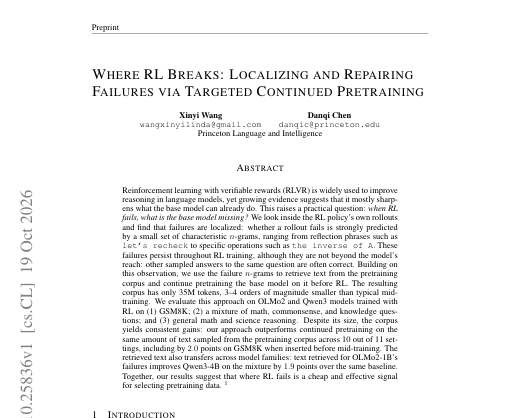
Where RL Breaks: Localizing and Repairing Failures via Targeted Continued Pretraining

Xinyi Wang, Danqi Chen

Reinforcement learning with verifiable rewards (RLVR) is widely used to improve reasoning in language models, yet growing evidence suggests that it mostly sharpens what the base mo…

Reinforcement learning with verifiable rewards (RLVR) is widely used to improve reasoning in language models, yet growing evidence suggests that it mostly sharpens what the base model can already do. This raises a practical question: when RL fails, what is the base model missing? We look inside the RL policy's own rollouts and find that failures are localized: whether a rollout fails is strongly predicted by a small set of characteristic n-grams, ranging from reflection phrases such as "let's recheck" to specific operations such as "the inverse of A". These failures persist throughout RL training, although they are not beyond the model's reach: other sampled answers to the same question are often correct. Building on this observation, we use the failure $n$-grams to retrieve text from the pretraining corpus and continue pretraining the base model on it before RL. The resulting corpus has only 35M tokens, 3--4 orders of magnitude smaller than typical mid-training. We evaluate this approach on OLMo2 and Qwen3 models trained with RL on (1) GSM8K; (2) a mixture of math, commonsense, and knowledge questions; and (3) general math and science reasoning. Despite its size, the corpus yields consistent gains: our approach outperforms continued pretraining on the same amount of text sampled from the pretraining corpus across 10 out of 11 settings, including by $2.0$ points on GSM8K when inserted before mid-training. The retrieved text also transfers across model families: text retrieved for OLMo2-1B's failures improves Qwen3-4B on the mixture by $1.9$ points over the same baseline. Together, our results suggest that where RL fails is a cheap and effective signal for selecting pretraining data.

cs.CLcs.AI

兴趣:large language models for robot task planning and reasoning

#442026-10-1962

SOMA: Continuous Monitoring and Intervention for System Two Reasoning with System One Models

Ruizhi Qian, Lei Shi, Tianyu Hu, Bo Yan, Song Wang, Yu Tian

Reasoning models often run into problems without noticing them, even when symptoms are visible in their own text. In humans, metacognition separates monitoring from control: fast, …

Reasoning models often run into problems without noticing them, even when symptoms are visible in their own text. In humans, metacognition separates monitoring from control: fast, intuitive signals keep watch while slow, deliberate reasoning unfolds and help decide whether to continue, change course, or stop. System One (S1) decision models, such as Jev, are a natural candidate for this role: they return a calibrated probability for a natural-language question about a text in one fast call, yet they are used only as gates before reasoning. We introduce SOMA (System One Metacognitive Awareness), in which an S1 model continuously monitors a System Two (S2) reasoning model and intervenes when needed. SOMA has three layers: a scenario layer states each objective in natural language with predefined actions, an awareness layer lets S1 judge whether the described behavior appears, and a control layer accumulates these judgments, first reminds S2, and takes over only if the behavior persists. Sharing one S1 model and one controller across tasks, without training, SOMA addresses two different failures on two reasoning models: on overthinking, it cuts reasoning tokens by up to 36% while improving average accuracy, and on unanswerable questions, it raises abstention from 70.5% to 87.2%.

兴趣:large language models for robot task planning and reasoning

#452026-10-1962

VeriCUA: Learning Proactive Verification for Reliable GUI Agent Rewards

Zhizhou Wang, Yaxi Lu, Zhong Zhang, Zikun Hu, Xin Cong, Yankai Lin 等

Reinforcement learning for computer-use agents increasingly relies on proactive reward agents that interact with the post-execution GUI environment to verify what recorded screensh…

Reinforcement learning for computer-use agents increasingly relies on proactive reward agents that interact with the post-execution GUI environment to verify what recorded screenshots cannot reveal. The reliability of such verification hinges on two coupled decisions: what to check and when to stop. Existing methods leave these decisions to prompted foundation models. However, neither scaling up the model nor providing few-shot examples reliably improves verification: prompted Judges ranging from 4B to GPT-5.4 all plateau at 68%-70% macro-average agreement. This is because the value of a check depends on the environment rather than the task alone, and becomes apparent only through execution. Learning from execution is itself constrained, as the Actor's terminal state cannot be faithfully replicated during training, allowing only one verification attempt per state. We introduce VeriCUA, a proactive reward agent that learns its verification strategy from these single attempts. A trainable Judge decides what to check and when to stop, while a frozen Probe executes the checks in the live environment. Online reinforcement learning optimizes the Judge for both verdict correctness and efficient Probe use, with returns normalized across terminal states. Trained only on OSWorld and evaluated without further training on MobileWorld and WebArena-Verified, VeriCUA achieves the highest reward agreement across all three benchmarks and lies on the agreement-cost Pareto frontier among proactive verifiers. It surpasses few-shot GPT-5.4 by 5.36 points with 47.6%-59.8% fewer Probe tokens, and even a 1B VeriCUA exceeds every prompted Judge. As the reward for Actor RL, it raises task success by 3.21 points overall and 5.40 points on held-out multi-application tasks. These results identify the verification strategy, not verifier scale, as the key to reliable GUI rewards.

兴趣:imitation learning and diffusion policies for robot control

#462026-10-1962

Are Self-Evolving Agents Continual Learners?

Xiaoyin Chen, Yizheng Huang, Yinglun Xu, Ziyun Zhao, Emmett McQuinn, Julie Liu 等

Large language model agents are often deployed in environments where new knowledge, tools, and workflows keep arriving. Such an agent is therefore expected to adapt continually, le…

Large language model agents are often deployed in environments where new knowledge, tools, and workflows keep arriving. Such an agent is therefore expected to adapt continually, learning new tasks as they arrive without forgetting earlier ones. This resembles the continual learning problem, but at a pace that conventional gradient updates cannot sustain. Nonparametric self-evolving agents are a natural alternative: they adapt by rewriting their own harness, such as prompts, memory, and skills, from task feedback while the model weights stay frozen. We study whether such agents are effective continual learners across four drifting task streams that shift in topic, workflow, or domain (built from BIRD, BFCL, and ScienceWorld). Evaluating three representative methods spanning experience retrieval and self-modification (ReasoningBank, GEPA, and Meta-Harness), we find that although self-evolution improves aggregate performance on most streams, higher plasticity consistently comes at the cost of stability. Specifically, self-modifying methods apply global edits to a shared prompt or workspace, interfering with unseen tasks and overwriting earlier knowledge as the stream shifts. Conversely, similarity-based memory retrieval localizes updates across distant domains, but still retrieves foreign memories on unseen tasks and suffers from retrieval collision when similar queries require conflicting workflows. These findings show that current self-evolving agents remain incomplete continual learners.

cs.AIcs.LG

兴趣:multi-agent systems and LLM agents

#472026-10-1962

BOSS: Token-Budgeted Online Sampling and Selection for LLM Reasoning

Yupeng Chang, Yahan Li, Chenlu Guo, Diana Inkpen, Yuan Wu, Yi Chang

Test-time scaling can improve LLM reasoning, but existing approaches typically adapt generation or apply answer selection after a predetermined generation schedule. We study within…

Test-time scaling can improve LLM reasoning, but existing approaches typically adapt generation or apply answer selection after a predetermined generation schedule. We study within-instance allocation: under a hard per-instance prompt-plus-completion token cap, when should inference stop, generate another candidate, or spend residual tokens adjudicating candidates already observed? BOSS is a training-free policy for this three-way decision, with worst-case budget checks before every generation and judge call. Its key contribution is online generation-adjudication allocation under one shared token ledger. Across two Llama-3.1 models and four reasoning benchmarks, BOSS attains the highest accuracy in 22 of 24 model-task-budget cells under the common hard cap. At Llama-3.1-8B and B=4k, it reaches 60.5 macro-average accuracy versus 58.6 for Adaptive-Consistency, 59.1 for TALE-EP, and 58.9 for fixed-schedule League. On identical Stage-I candidate pools, randomized A/B judging with repeated voting improves plurality from 58.4 to 60.3, with the full BOSS selector reaching 60.5. Approximately matched-cost controls further characterize how the benefit of adjudication changes with available inference budget. Together, these results establish generation-adjudication allocation as a distinct design axis for reasoning under strict per-instance caps.

兴趣:multi-agent systems and LLM agents

#482026-10-1962

NIOCIS: Typed-Decision Next-Hop Routing with Node-Conditioned Option Spaces for Tool-Use Agents

Jin Han, Mingfeng Xin, Feng Liang, Jingtao Yu

Tool-use agents pay per decision: at each hop a language model re-reads the state and thinks for seconds, though its actions are finite and decisions recur. We present NIOCIS, a ro…

Tool-use agents pay per decision: at each hop a language model re-reads the state and thinks for seconds, though its actions are finite and decisions recur. We present NIOCIS, a routing layer that folds execution logs into a loop-collapsed action graph (forward transitions plus recovery back-edges) answering one typed question: which declared option at a state, plus stop, does the fleet take next? A small model reads a calibrated distribution over them in one pass, emitting no text. On 1,615 production security-operations episodes we measure what the layer replaces, returns and is bounded by. Replaces: the typed encoder matches the logged next hop on 32.2% of the 3,875 held-out decisions (34.9% within the declared options) in 10 ms of encoder time (19.5 ms for the typed-choice form), against 2.2 s per LLM hop; two feature readouts reach 32.8% and 32.3%, an ordering the paired test does not resolve, so the typed layer is chosen for cost, not a separated lead. Tuning: jpt-4b reaches 9.9% zero-shot and 31.9% fine-tuned, a gap an exact paired test does not resolve (p=0.68), at 244 ms. Returns little: the realised hop falls outside the declared options for 7.9% of decisions and outside the model's top twenty for 9.3%; the most confident 15% holds 91.9% accuracy. Bounded: a cross-trace leave-one-out test puts the released state's ceiling at 25.6--44.9% as the state key grows more specific, i.e. repeated states disagree more often than they agree; the option-space ablation attributes the gain to per-node candidate restriction (+3.5 points over a flat catalog) rather than graph traversal (zero within its interval); a gated self-evolution loop lifts every arm above its anchor yet ends below full supervision; a confidence-gated cascade loses agreement when the escalation arm is the zero-shot stand-in; and agreement past a third of the fleet needs a state carrying the plan and the observation.

cs.CRcs.AIcs.LG

兴趣:large language models for robot task planning and reasoning

#492026-10-1962

Understanding When Reflective Prompt and Skill Optimization Helps on Locally Served Reasoning Models: A Two-Model Study of GEPA and SkillOpt

Andrea Giummarra, Carmelo Baglieri, Antonio Di Maria, Andrea Farruggio, Michele Piatto, Giovanni Micale

Reflective text-space optimizers such as GEPA and SkillOpt have reported large gains on frontier and mid-size models. We test replication across two reasoning-native target-serving…

Reflective text-space optimizers such as GEPA and SkillOpt have reported large gains on frontier and mid-size models. We test replication across two reasoning-native target-serving configurations: DeepSeek V4 Flash through DwarfStar and Qwen3.8-27B through LM Studio. For each target, we evaluate the same held-out tasks and four conditions - minimal baseline, GEPA prompt, SkillOpt skill, and manually engineered prompt - on HotpotQA (n=500 per condition) and MATH-500 (n=250). In the primary Qwen v2 rerun under the same frozen protocol, GEPA selects the HotpotQA seed and exactly reproduces baseline behavior, whereas SkillOpt's validation gain reverses into held-out degradation. On MATH-500, GEPA raises exact match from 0.828 to 0.904 while reducing latency but increasing token consumption, so lower response time does not imply lower token cost. DeepSeek likewise shows its strongest GEPA effect on MATH-500 (0.852 to 0.908). Across both targets, GEPA's strongest gains occur on MATH-500, while neither optimizer improves the HotpotQA baseline. Optimization is therefore task- and method-dependent, and validation gains may reverse on held-out evaluation. An earlier Qwen run is retained as serving-sensitivity evidence. These results suggest that textual headroom for a model-task pair and the observed effect of a text-space optimizer are more informative when decomposed into content/reasoning, answer-realization/evaluator alignment, and serving-completion/reliability. The cross-benchmark pattern further suggests that optimization may benefit from low-ambiguity, actionable evaluation signals.

cs.AIcs.CL

兴趣:large language models for robot task planning and reasoning

#502026-10-1962

Not Every Rollout Needs Distillation: Correctness-Filtered On-Policy Self-Distillation

Harrison Zhao, Lei Huang, Fei Liu, Wen Shi, Zijian Jin

On-policy self-distillation (OPSD) supervises student-generated trajectories with a reference-conditioned version of the same base model. We ask whether every trajectory supplies d…

On-policy self-distillation (OPSD) supervises student-generated trajectories with a reference-conditioned version of the same base model. We ask whether every trajectory supplies distinct supervision that warrants its distillation cost. Gradient measurements on Qwen3-1.7B at initialization reveal that correct and incorrect responses have similar individual gradient magnitudes, but incorrect responses have approximately three times the coherent gradient share. Their estimated population-mean directions also largely overlap. A signal--noise model fitted at a small group size tracks alignment at larger group sizes without refitting. Motivated by these measurements, we introduce correctness-filtered OPSD (C-OPSD), which generates one response per problem and distills only a subset of incorrect responses. Removing unselected rows before both distillation forwards avoids their teacher/student forward and student backward work. Across Qwen3-1.7B, 4B, and 8B on AIME24, AIME25, and HMMT25, C-OPSD achieves on-par performance with full OPSD. In a measured micro-batch-size-four implementation, executed rows decrease by approximately 68%, and with retained rows packed into full micro-batches, training takes about 40% less time while rollout generation remains unchanged. Together, the measurements and training results connect outcome-conditioned supervision redundancy to more compute-efficient distillation.

兴趣:imitation learning and diffusion policies for robot control

GitHub 项目

#12026-02-04★ 31577

VLARLKit/VLARLKit

Python

Elegant VLA-RL library

Elegant VLA-RL library

embodied-aireinforcement-learningroboticsvision-language-action-modelvla-rlVLAvision-language-actionembodied

兴趣:vision-language-action (VLA) models and foundation models for robots

#22026-10-05★ 181 +5新项目77

AetherLabsAI/Video2World

Python

Benchmarking Coding Agents for Interactive World Modeling from Embodied Videos - Rethinking Embodied Real2Sim from a Software Engineering Perspective

Benchmarking Coding Agents for Interactive World Modeling from Embodied Videos - Rethinking Embodied Real2Sim from a Software Engineering Perspective

benchmarkcoding-agentembodied-aifoundation-modelsreal-to-simrobot-learningroboticssimulationrobotembodied

兴趣:world models and video prediction for embodied agents

#32026-04-18★ 113 +775

murobotics-ai/handumi-hw

An open-source, hand-worn variant of UMI for collecting bimanual manipulation data without a robot in the loop: modular for any parallel-jaw gripper.

An open-source, hand-worn variant of UMI for collecting bimanual manipulation data without a robot in the loop: modular for any parallel-jaw gripper.

data-collectionimitation-learningrobotmanipulation

兴趣:robot manipulation and grasping with learned policies

#42026-07-01★ 9774

cair-vinuni/FOCA

Python

Repository associated with paper titled "FOCA: Future-Oriented Conditioning for Data-Efficient Vision-Language-Action Adaptation", presented at ICML 2026.

Repository associated with paper titled "FOCA: Future-Oriented Conditioning for Data-Efficient Vision-Language-Action Adaptation", presented at ICML 2026.

data-efficient-learningimitation-learningrobot-learningvision-language-action-modelworld-modelsrobotvision-language-action

兴趣:vision-language-action (VLA) models and foundation models for robots
#52024-12-08★ 4.1k +1174

datawhalechina/every-embodied

Python

仅需Python基础,从0构建自己的具身智能机器人;从0逐步构建VLA/OpenVLA/SmolVLA/Pi0, 深入理解具身智能

仅需Python基础,从0构建自己的具身智能机器人;从0逐步构建VLA/OpenVLA/SmolVLA/Pi0, 深入理解具身智能

embodied-agentembodied-aiembodied-intelligenceopenvlasmolvlavision-language-action-modelVLAvision-language-actionembodied

兴趣:world models and video prediction for embodied agents

#62026-10-08★ 88 +7新项目73

DexForce/UNITAS

Python

Official codebase for Unitas: A 3D-Native World Action Model for Embodied Manipulation

Official codebase for Unitas: A 3D-Native World Action Model for Embodied Manipulation

robot-learningrobot-manipulationroboticsvision-language-action-modelworld-action-modelsworld-modelsrobotmanipulationvision-language-actionembodied

兴趣:vision-language-action (VLA) models and foundation models for robots
#72024-01-26★ 28.3k +3173

huggingface/lerobot

Python

🤗 LeRobot: Making AI for Robotics more accessible with end-to-end learning

🤗 LeRobot: Making AI for Robotics more accessible with end-to-end learning

兴趣:imitation learning and diffusion policies for robot control

#82025-10-09★ 3.8k +1073

starVLA/starVLA

Python

StarVLA: A Lego-like Codebase for Vision-Language-Action Model Developing

StarVLA: A Lego-like Codebase for Vision-Language-Action Model Developing

robotic-foundation-modelroboticsvision-language-action-modelworld-action-modelvision-language-action

兴趣:vision-language-action (VLA) models and foundation models for robots

#92026-07-19★ 660 +473

RealXiaoze/humanoid-motion-intelligence

人形机器人运动智能论文、开源项目、产业与求职知识库

人形机器人运动智能论文、开源项目、产业与求职知识库

embodied-aihumanoid-roboticslocomotionmotion-controlreinforcement-learningrobot-learningsim2realvlarobotVLAhumanoidlocomotionembodied

兴趣:humanoid robots and whole-body control

#112024-12-24★ 382 +-172

manumerous/wb_humanoid_mpc

C++

Whole-Body Nonlinear MPC for Realtime Humanoid Loco-Manipulation Planning and Control

Whole-Body Nonlinear MPC for Realtime Humanoid Loco-Manipulation Planning and Control

aidata-generationhumanoidhumanoid-robotlocomotionmpcnonlinearoptimizationrobotmanipulationhumanoidlocomotion

兴趣:humanoid robots and whole-body control

#122026-08-26★ 406 +372

OpenMOSS/EasyWAM

Python

A unified framework for training, fine-tuning, and evaluating World Action Models

A unified framework for training, fine-tuning, and evaluating World Action Models

benchmarkcodebaseembodied-aifoundation-modelsloraroboticsvision-language-actionworld-action-modelvision-language-actionembodied

兴趣:vision-language-action (VLA) models and foundation models for robots
#132026-08-29★ 93 +171

OpenBMB/SimpleMemVLA

Python

Native-video memory for vision-language-action models, using timestamped visual history and exact streaming inference for long-horizon robot manipulation.

Native-video memory for vision-language-action models, using timestamped visual history and exact streaming inference for long-horizon robot manipulation.

embodied-ailong-horizon-roboticsmultimodal-learningnative-video-memoryrobot-learningrobot-manipulationstreaming-inferencevideo-understandingrobotmanipulationVLAvision-language-actionembodied

兴趣:vision-language-action (VLA) models and foundation models for robots

#142025-08-14★ 5.5k +1171

RLinf/RLinf

Python

RLinf: Reinforcement Learning Infrastructure for Embodied and Agentic AI

RLinf: Reinforcement Learning Infrastructure for Embodied and Agentic AI

agentic-aiembodied-aireinforcement-learningrl-infrarlinfvla-rlVLAembodied

兴趣:vision-language-action (VLA) models and foundation models for robots

#152026-09-30★ 139 +10新项目71

groundingpi/GroundingPI

Python

A 4B grounding foundation model for physical intelligence. Unifies detection, referring, pointing, OCR, GUI, and layout grounding, achieving SOTA overall across 34 benchmarks and i…

A 4B grounding foundation model for physical intelligence. Unifies detection, referring, pointing, OCR, GUI, and layout grounding, achieving SOTA overall across 34 benchmarks and improving robot generalization and data efficiency in controlled evaluations.

embodied-aigui-groundingobject-detectionocrphysical-intelligencepointingrobot-learningvision-language-modelrobotVLAembodied

兴趣:vision-language-action (VLA) models and foundation models for robots

#162025-11-23★ 722 +171

sou350121/VLA-Handbook

HTML

本项目旨在为致力于进入VLA(Vision-Language-Action)领域的算法工程师提供一份全中文、实战导向的学习/面试手册。 不同于通用的 CV/NLP 面试指南,本项目聚焦于 Robotics 特有的挑战

本项目旨在为致力于进入VLA(Vision-Language-Action)领域的算法工程师提供一份全中文、实战导向的学习/面试手册。 不同于通用的 CV/NLP 面试指南,本项目聚焦于 Robotics 特有的挑战

chinesedeep-learningembodied-aillmrobot-learningroboticsvision-language-actionvlarobotVLAvision-language-actionembodied

兴趣:vision-language-action (VLA) models and foundation models for robots

#172026-09-02★ 120 +1270

JethroJames/awesome-robots-icl

Python

Companion repository for “In-Context Learning for Robots: Methods and Applications” — methods, datasets, and benchmarks organized by taxonomy and release date.

Companion repository for “In-Context Learning for Robots: Methods and Applications” — methods, datasets, and benchmarks organized by taxonomy and release date.

awesome-listembodied-aiimitation-learningin-context-learningrobot-learningroboticsvision-language-actionworld-modelsrobotvision-language-actionembodied

兴趣:vision-language-action (VLA) models and foundation models for robots

#182026-09-18★ 8370

mll-lab-nu/embodied-first-exam

Python

The first exam for code agents in the physical world: frozen robot tasks from many benchmark suites, each answered with a program and verified in a separate sandbox. Runs on Harbor…

The first exam for code agents in the physical world: frozen robot tasks from many benchmark suites, each answered with a program and verified in a separate sandbox. Runs on Harbor.

ai-agentsbenchmarkcoding-agentsembodied-aievaluationharborllm-agentsrobot-learningrobotembodied

兴趣:vision-language-action (VLA) models and foundation models for robots

#192026-09-08★ 65 +370

lok-i/vibe

Python

Post-training humanoid whole-body trackers for perceptive control tasks

Post-training humanoid whole-body trackers for perceptive control tasks

humanoid-controlmjlabperceptive-locomotionpporeinforcement-learningrobot-learningviberobothumanoidlocomotion

兴趣:humanoid robots and whole-body control

#202026-06-24★ 288 +1370

MinghaoFu/lewam

Python

LeWAM: End-to-End World and Action Modeling with JEPAs

LeWAM: End-to-End World and Action Modeling with JEPAs

jeparobot-learningworld-modelsrobot

兴趣:vision-language-action (VLA) models and foundation models for robots

#212026-04-22★ 21.9k +24069

earthtojake/text-to-cad

Python

Give your agent CAD superpowers.

Give your agent CAD superpowers.

agentsai-agentscadmechanical-engineeringroboticsstepstlstp

兴趣:multi-agent systems and LLM agents

#222025-11-12★ 32569

realsee-developer/RealSee3D

Python

RealSee3D: A multi-view RGB-D dataset combining real-world captures and procedurally generated scenes, with extensible annotations for diverse 3D vision research.

RealSee3D: A multi-view RGB-D dataset combining real-world captures and procedurally generated scenes, with extensible annotations for diverse 3D vision research.

3d-dataset3d-perception3d-reconstructionembodied-aiindoorsceneembodied

兴趣:3D perception, point clouds and scene understanding for robotics

#232024-02-29★ 16669

RobotControlStack/robot-control-stack

Python

A lean, ROS-free sim-to-real framework for training and deploying Vision-Language-Action (VLA) models and RL agents. Native MuJoCo Gymnasium wrappers with synchronous execution for…

A lean, ROS-free sim-to-real framework for training and deploying Vision-Language-Action (VLA) models and RL agents. Native MuJoCo Gymnasium wrappers with synchronous execution for Franka, UR5e, xArm, SO101 and YAM.

frankagymnasiummujocoreinforcement-learningrobot-learningrobot-manipulationsim-to-realvision-language-actions-modelsrobotmanipulationVLAvision-language-actionsim-to-real

兴趣:vision-language-action (VLA) models and foundation models for robots

#242026-10-04★ 62 +1新项目69

Holiday-Robot/FlashDexRetarget

Python

FlashDexRetarget: Accelerating Dexterous Manipulation Data Generation through Multi-Motion Retargeting

FlashDexRetarget: Accelerating Dexterous Manipulation Data Generation through Multi-Motion Retargeting

dexterous-manipulationreinforcement-learningroboticsrobotmanipulationdexterous

兴趣:robot manipulation and grasping with learned policies

#252026-10-07★ 313 +23新项目69

fudan-generative-vision/Remory

Python

Remory: Learning Residual Memory for Context Compaction

Remory: Learning Residual Memory for Context Compaction

context-compactioninferencellm-agentsresidual-memory

兴趣:world models and video prediction for embodied agents

#262026-10-15★ 103 +61新项目69

Gen-Verse/DiscoveryRSI

Python

DiscoveryRSI: Recursively Learning to Discover Valuable Hypotheses

DiscoveryRSI: Recursively Learning to Discover Valuable Hypotheses

agent-frameworkagentic-workflowaiforsciencellm-agentsrecursive-self-improvement

兴趣:multi-agent systems and LLM agents

#272022-11-16★ 8.4k +1069

isaac-sim/IsaacLab

Python

Unified framework for robot learning with multi-physics/renderer support

Unified framework for robot learning with multi-physics/renderer support

isaac-simomniverse-kit-extensionrobot-learningroboticsrobot

兴趣:3D perception, point clouds and scene understanding for robotics

#282026-06-26★ 693 +569

robocurve/inspect-robots

Python

Open source evals for physical AI. Run any LLM/VLA on any arm/humanoid against any real/sim benchmark.

Open source evals for physical AI. Run any LLM/VLA on any arm/humanoid against any real/sim benchmark.

benchmarkembodied-aievaluationphysical-airerunroboticsvision-language-actionvlaVLAvision-language-actionhumanoidembodied

兴趣:vision-language-action (VLA) models and foundation models for robots

#292025-04-04★ 1.9k68

RoboVerseOrg/RoboVerse

Python

RoboVerse: Towards a Unified Platform, Dataset and Benchmark for Scalable and Generalizable Robot Learning

RoboVerse: Towards a Unified Platform, Dataset and Benchmark for Scalable and Generalizable Robot Learning

imitation-learningreinforcement-learningroboticssimulationrobot

兴趣:imitation learning and diffusion policies for robot control

#302026-08-31★ 7.7k +2668

Human-Agent-Society/reef

Python

Infrastructure for continually self‑improving agents

Infrastructure for continually self‑improving agents
agent-infrastructureai-agentscontinual-learninginferencellmllm-trainingreinforcement-learningself-improving-agents

兴趣:multi-agent systems and LLM agents