Tech Station

2026-10-21

50 篇论文 · 30 个项目 ← 2026-10-20 · 2026-10-22 →

论文

#12026-10-19追踪学者 · Pieter Abbeel追踪学者 · Guanya Shi100

SWAP: Test-Time Steerable Humanoid Whole-Body Collision Avoidance

Zeji Yi, Guanqi He, Xiaofeng Guo, Guannan Qu, Pieter Abbeel, Yan Duan 等

Humanoid robots operating in human-centric environments must coordinate the entire body to traverse tight, cluttered spaces while maintaining balance. Existing methods often strugg…

Humanoid robots operating in human-centric environments must coordinate the entire body to traverse tight, cluttered spaces while maintaining balance. Existing methods often struggle to jointly consider dynamic stability and collision avoidance from high-dimensional perceptual inputs. Moreover, for humanoids, safe behavior is inherently multimodal: the same obstacle may admit multiple valid traversals, which is difficult to represent with a single deterministic policy. To address these challenges, we propose SWAP (Steerable Whole-body Avoidance Policy), a hierarchical framework that separates collision-aware decision making from stabilization. A high-level, perception-conditioned diffusion policy generates multimodal, collision-aware motion proposals, while a low-level whole-body RL controller tracks these proposals and maintains dynamic balance. To efficiently train the high-level policy, we obtain scalable supervision via hindsight labeling: we roll out the low-level policy under randomized commands, place obstacles only in the space that each executed motion did not sweep, so the motion is collision-free by construction, and re-render the perception the robot would have seen. At deployment, Monte Carlo sampling with simple cost signals steers the diffusion model toward safe, task-aligned behaviors without heavy reward tuning. Experiments in simulation and on a real Unitree G1 humanoid show reliable avoidance with static and dynamic obstacles. Test-time steering further enables customization, improving targeted rewards (e.g., speed, orientation, or posture) by 34% on average while maintaining a high collision avoidance rate. Together, these results support a practical solution to humanoid whole-body collision avoidance with test-time steerability. Project website: https://iscoyizj.github.io/SWAP-steerable-humanoid-oa-website/

cs.ROrobotdiffusion policyhumanoid

追踪学者:Pieter Abbeel、Guanya Shi;兴趣:humanoid robots and whole-body control

#22026-10-1999

HAF-VLA: Hierarchical Action Flow Framework for Humanoid Vision-Language-Action Control

Langzhe Gu, Chengkai Hou, Meng Li, Xinhua Wang, Xinyuan Lv, Shuanghao Bai 等

Humanoid robots hold great promise as general-purpose agents in human-centered environments, yet adapting generalist vision-language-action (VLA) policies to real-world humanoid lo…

Humanoid robots hold great promise as general-purpose agents in human-centered environments, yet adapting generalist vision-language-action (VLA) policies to real-world humanoid loco-manipulation remains challenging. Unlike fixed-base or wheeled manipulators, humanoids must coordinate locomotion, posture, gaze, and dual-arm manipulation over a high-dimensional whole-body action space, where inaccurate base or waist motions can easily induce unstable and aggressive upper-body compensation. We propose HAF-VLA, a hierarchical action-flow framework for humanoid VLA control. Built upon a pretrained flow-matching VLA, HAF-VLA inherits the vision-language prefix encoder and action expert weights, and adapts them to humanoid whole-body loco-manipulation with learnable stage embeddings and cross-stage KV-cache conditioning. Instead of generating the full action chunk in a single pass, HAF-VLA progressively denoises a shared whole-body action space: first locomotion and head commands, then waist refinement, and finally full-body manipulation. To preserve structural dependencies across stages, we introduce a cross-stage KV cache conditioning mechanism, enabling subsequent action generation stages to refine and augment their outputs based on the action representations from preceding stages. Experimental results across six real-world tasks demonstrate that our framework significantly enhances the performance of existing models in humanoid loco-manipulation tasks, demonstrating an effective pathway for adapting strong mobile-manipulation VLAs to humanoid whole-body loco-manipulation.

cs.ROmanipulationVLAvision-language-actionhumanoidlocomotion

兴趣:vision-language-action (VLA) models and foundation models for robots

#32026-10-2098

UniWALM: Unified World Action Language Model for Embodied Robot Control

Rahul Sajnani, Diego Romeres, Mingyuan Zhang, Kai Gao, Carl Qi, Baichuan Huang 等

Motivated by the human ability to integrate experience across language, perception, and action, we introduce UniWALM, a unified world-action-language model that learns video, actio…

Motivated by the human ability to integrate experience across language, perception, and action, we introduce UniWALM, a unified world-action-language model that learns video, action, and language in a single shared representation, where each modality is both a conditioning signal and a supervision target. We ask: can jointly generating language enrich this shared representation, improving manipulation and supporting memory-dependent behavior? Unlike prior approaches that attach a reasoning or vision-language model to a video-action backbone and run them as distinct stages, UniWALM unifies all three modalities inside a single mixture-of-transformers backbone whose per-modality diffusion heads co-denoise synchronously, decoding subtask and textual memory in the same pass as action with no separate planning stage; the generated language is re-consumed on the next step, closing a language-as-memory loop without an external planner or memory bank. To keep the action stream reliable under this richer objective, we further introduce Flow Matching with Correction (FMC), a training objective that teaches recovery from perturbed action trajectories at no inference-time cost. UniWALM consistently improves over same-backbone baselines (e.g., FastWAM) on compositional pick-and-place (MolmoSpaces) and across the memory-dependent subset of RMBench, where it reaches 34.5% without any pretrained language or reasoning model and exceeds Mem-0's keyframe-equipped setup (28.5%) using only a single anchor frame. On a real-world Find-the-Item task, generating textual memory lifts success from 11.1% to 61.1%, while state-of-the-art VLAs stay at or below chance (<=33.3%).

cs.ROcs.AIcs.CVrobotmanipulationembodied

兴趣:vision-language-action (VLA) models and foundation models for robots

#42026-10-19追踪学者 · Guanya Shi97

EmbodyHOI: Embodiment-Aware Generation of Hand-Object Interactions for Humanoid Dexterous Manipulation

Chaitanya Chawla, Kartik Sharma, Ananya Bal, Laszlo A. Jeni, Guanya Shi

Humanoid dexterous manipulation needs reference motions that are both semantically rich and kinematically feasible for the target robot. Text-conditioned hand-object interaction (H…

Humanoid dexterous manipulation needs reference motions that are both semantically rich and kinematically feasible for the target robot. Text-conditioned hand-object interaction (HOI) generators supply diverse, language-specified demonstrations, but they synthesize motion in human (MANO) space. The embodiment gap is therefore deferred to post-hoc retargeting, where trajectories deployed on the robot can fail to maintain contact with objects and also degrade policy learning. Our key idea is that robot reachability should constrain the interaction trajectories while they are being generated. We present EmbodyHOI, which runs a differentiable inverse-kinematics (IK) solver for a specific humanoid embodiment inside the sampling loop of a frozen flow-matching HOI trajectory generator. We feed back gradients from the embodiment-aware IK solver into the HOI sampler and jointly optimize the position of the humanoid with respect to the object. Because guidance acts only at inference, one HOI trajectory generator trained on human hand poses transfers across humanoid embodiments without retraining. On ARCTIC trajectories with two contrasting humanoids (Unitree G1 and H1-2), our proposed guidance-based method cuts the retargeted wrist error from 8.9 cm to 0.6 cm while leaving text-to-HOI generation quality intact, and raises task success from 68% to 79% on 50 random G1 tasks and from 62% to 76% on a four-task H1-2 suite. Critically, cheaper alternatives for bridging the embodiment gap fail to beat EmbodyHOI. Post-hoc wrist refinement and compute-matched best-of-N selection both reach lower IK energy than our guidance yet train worse policies. For simulation results, see our website: https://embodyhoi.github.io/

cs.ROrobotmanipulationhumanoiddexterous

追踪学者:Guanya Shi;兴趣:humanoid robots and whole-body control

#52026-10-2095

FIT-MAC: A Closed-Loop Multi-Agent Framework for Robust Vision-Language-Action Models

Jiatong Li, Jisheng Dang, Qiangqiang Ma, Bimei Wang, Jingwen Zhao, Wenjun Ma 等

Vision-language-action (VLA) models have achieved strong performance on standard robotic manipulation benchmarks. However, their reliability can degrade substantially when task con…

Vision-language-action (VLA) models have achieved strong performance on standard robotic manipulation benchmarks. However, their reliability can degrade substantially when task conditions deviate from the nominal setting. Perturbations in object positions and task instructions may lead to complete task failure. Existing VLA policies generally lack an explicit runtime mechanism for distinguishing these failure modes and selecting an appropriate recovery strategy. To systematically mitigate this issue, we propose FIT-MAC, a failure-aware, closed-loop multi-agent control framework for improving the robustness of VLA policies at inference time. FIT-MAC augments a VLA policy with an inference-time control layer. First, the Planner Agent parses the language instruction into a structured task specification that captures the manipulation goal and spatial constraints, and the Grounder Agent resolves each instruction-level reference to a visual target. Next, the Verifier Agent tracks phase-specific execution progress, distinguishes target-binding errors from local execution failures, and determines whether intervention is warranted. The Correction Agent then routes permitted interventions to target rebinding or bounded grasping or placement recovery, depending on the failure type. When no intervention is required, the pretrained VLA remains the default action generator. Extensive experiments on LIBERO-PRO demonstrate that FIT-MAC improves robustness across multiple VLA backbones, consistently increasing success rates and achieving state-of-the-art performance under diverse perturbations.

cs.ROmanipulationVLAvision-language-action

兴趣:vision-language-action (VLA) models and foundation models for robots

#62026-10-17追踪学者 · Guanya Shi追踪学者 · C. Karen Liu95

Action-Aligned Latent Planning for Versatile Humanoid Loco-Manipulation

Yutang Lin, Guanya Shi, C. Karen Liu

Learning a single perceptive policy for diverse humanoid loco-manipulation requires unifying high-level task decisions without losing the state-dependent physical responses that ma…

Learning a single perceptive policy for diverse humanoid loco-manipulation requires unifying high-level task decisions without losing the state-dependent physical responses that make each interaction succeed. This makes the representation between high-level planning and whole-body control critical: kinematic or contact targets provide compact abstractions but do not directly encode interaction-specific control responses, while directly predicting low-level actions requires the planner to model high-frequency closed-loop feedback. We propose FIBER, a framework that uses the executable latent space of a frozen behavioral foundation model (BFM) as a shared planning representation for heterogeneous interaction skills. Our latent policy projection (LPP) maps independently acquired task-specific policies into this representation by identifying latent commands whose induced actions match their local control responses, enabling lower-rate planning while retaining the BFM's high-frequency state feedback. After projection, we aggregate closed-loop latent rollouts from all skills and train a single perceptive flow planner entirely offline. We further introduce AH-BFM, an adaptive-horizon BFM trained with multi-gamma forward-backward (FB) learning to support both precise control and temporally extended whole-body behavior. We evaluate FIBER on box pickup, door opening, and object grasping in simulation and on a real Unitree G1 humanoid. Across 128 diverse variations per task in simulation, FIBER achieves 42.0% mean success, more than tripling projected latent replay (11.6%) and substantially outperforming kinematic planning (3.5%). Real-world experiments further demonstrate sim-to-real transfer, skill chaining, and conditional steering through the same unified planner.

cs.ROmanipulationhumanoidsim-to-real

追踪学者:Guanya Shi、C. Karen Liu;兴趣:reinforcement learning for legged locomotion and sim-to-real transfer

#72026-10-1995

HandsOn: A Large-Scale Simulation Benchmark for Generalizable Dexterous Manipulation

Tianwei Luo, Yiming He, Hongjin Wu, Ting Pan, Debin Ren, Haorui Guo 等

General-purpose manipulation requires reliable behavior across embodiments, objects, and task demands. We introduce HandsOn, a composable simulation platform and benchmark for cros…

General-purpose manipulation requires reliable behavior across embodiments, objects, and task demands. We introduce HandsOn, a composable simulation platform and benchmark for cross-embodiment dexterous manipulation. It supports five robotic arms, six dexterous hands, and approximately 200 rigid, articulated, and deformable assets in randomized scenes. The benchmark pairs 18,000 curated human demonstrations with 66 human-verified tasks: Core-50 supports demonstration-based learning and execution tests, while Transfer-16 evaluates asset and relation transfer, skill composition, and deformable manipulation without target-task training demonstrations. Qualitative real-robot rollouts illustrate sim-to-real transfer. Across diffusion, vision-language-action, world-action, and prompted VLM-based methods, the best trained multi-task policy achieves 29.1% Core-50 success. Without benchmark finetuning, GPT-6 using move_eef for palm-and-finger control achieves 5.2% on Core-50 and 1.9% on Transfer-16 over 660 trials. Trained-policy stage diagnostics expose failures in contact establishment, action coordination, and maintaining achieved goals, with additional sequencing errors in composed tasks. HandsOn provides a shared basis for investigating manipulation generalization and the limits of reliable physical interaction.

cs.ROrobotmanipulationvision-language-actionsim-to-realdexterous

兴趣:robot manipulation and grasping with learned policies

#82026-10-1995

Vision-Language-Delta-Action: Learning Compact Deltas as Actionable Transition Interfaces for Robotic Manipulation

Lingsen Zhang, Wei Li, Jie He, Henghua Zhang, Kai Mo, Shiyong Li 等

Robotic manipulation is not merely observation-to-action generation, but the realization of task-specified state changes in the physical world. Existing vision-language-action (VLA…

Robotic manipulation is not merely observation-to-action generation, but the realization of task-specified state changes in the physical world. Existing vision-language-action (VLA) methods directly learn observation-to-action mappings, imposing a substantial learning burden due to the gap between semantic understanding and action execution. Although world-action models (WAMs) improve control through future prediction, modeling complete future states wastes capacity on static appearance and action-irrelevant changes. We propose Vision-Language-Delta-Action (VLDA), a paradigm that reformulates full future prediction as compact actionable transition modeling. Its core is a compact Delta variable that captures latent world-state changes, serving as an interface between vision-language understanding and action generation. VLDA learns Delta through a unified objective composed of the Local Transition Filter (LT-Filter) and Global Transition Anchor (GT-Anchor). LT-Filter captures task-relevant manipulation-centric changes while suppressing static reconstruction biases. GT-Anchor provides coarse future-level regularization to preserve the overall direction of state changes. Delta-Driven Action Refinement (DDAR) further grounds Delta in the action manifold and injects it as a structured seed to guide action denoising. We implement VLDA within LoongForge, an open-source training framework for large-scale foundation and embodied models, using its modular and distributed infrastructure for unified two-stage optimization. Experiments show that VLDA improves long-horizon consistency, robustness, and generalization, validating actionable Delta as an alternative to direct action prediction and full future-state modeling.

cs.ROcs.CVmanipulationVLAvision-language-actionembodied

兴趣:vision-language-action (VLA) models and foundation models for robots

#92026-10-2094

Reasoning as a Distribution: Generative Plan Latents for Vision-Language-Action Models

Matteo Cercola, Katie Z Luo, Milan Ganai, John Alora, Simone Formentin, Marco Pavone

Vision-Language-Action (VLA) policies increasingly reason before acting, but existing reasoning models compress this intermediate decision into a single representation. When severa…

Vision-Language-Action (VLA) policies increasingly reason before acting, but existing reasoning models compress this intermediate decision into a single representation. When several plans are valid, this commitment hides alternatives that could otherwise be selected or revised. We introduce the Generative Plan Latent (GPL), which represents the reasoning state as a low-dimensional conditional distribution over plans, such as which object, grasp, or route to use. This makes the reasoning state addressable: without retraining the VLA, plans can be sampled (coverage), selected on request (steering), and reweighted by deployment outcomes (outcome adaptation). We test all three on SimplerEnv manipulation with $π_0$, and extend the analysis to RoboCasa, LIBERO, and a maze domain. Steering the plan raises the fraction of executions that follow the request from 0.48 to 0.94, while the same guidance on the native action distribution shows no reliable gain. Finally, we show that an explicit plan is most useful when it carries decision information not already determined by the observation.

cs.ROmanipulationgraspVLAvision-language-action

兴趣:vision-language-action (VLA) models and foundation models for robots

#102026-10-18追踪学者 · Marco Hutter94

Vision as Proprioception: Estimating Humanoid Robot Pose from Video

Jiaxi Jiang, Matthias Heyrman, René Zurbrügg, Marco Hutter, Christian Holz

Estimating a humanoid robot's internal state from video has a wide range of real-world applications but remains unexplored. During interactions with a robot, its onboard state info…

Estimating a humanoid robot's internal state from video has a wide range of real-world applications but remains unexplored. During interactions with a robot, its onboard state information may be unavailable due to privacy, ownership, or communication constraints. Meanwhile, online and AI-generated robot videos provide rich sources of data but typically lack corresponding joint configurations, limiting their direct use in robot learning. To address these issues, we present HumanoidPose, a new framework that treats vision as proprioception to recover full-body joint configurations in world space from video alone. Specifically, we combine pretrained human-pose features with robot kinematics in a unified model that predicts each embodiment's joint configurations. We retarget human motions to sixteen different humanoid embodiments, enabling scalable learning entirely from synthetic data. To improve real-world generalization, we further leverage unlabeled online videos through self-training to develop a 2D robot-pose detector. In our evaluation, HumanoidPose improves joint-angle and joint-position accuracy over the evaluated baselines and reduces joint-angle error by 18-32% relative to the best-performing baseline on each of the three real humanoid platforms. We further show improved global localization and generalization to unseen embodiments. HumanoidPose enables visual understanding of other robots during interaction and extraction of robot motion from online and generated videos.

cs.ROcs.AIcs.CVrobothumanoid

追踪学者:Marco Hutter;兴趣:humanoid robots and whole-body control

#112026-10-2094

Embodied Task Agents Can Perform Fine Manipulation through Tactile In-Context Learning

Yubang Wang, Zezheng Huai, Yifei Zhang, Jinhao Wu, Yitong Chen, Haozhe Zhang 等

Can embodied task agents use tactile experience to perform fine manipulation without task-specific model training? We investigate this capability through Tactile-ETA, a system that…

Can embodied task agents use tactile experience to perform fine manipulation without task-specific model training? We investigate this capability through Tactile-ETA, a system that incorporates tactile experience into an embodied task agent through in-context learning. Successful expert demonstrations show how contact changes during manipulation. We pair each recorded robot movement with its camera views and bilateral tactile observations. We keep tactile observations at the start and end of each movement and add two neighboring time points when the tactile images change markedly in between. The agent combines these demonstrations with current vision, tactile observations, and proprioception to select actions through general-purpose robot tools, without updating model parameters. Across four simulated manipulation tasks, adding tactile observations to the same two expert demonstrations increases average success from 15.75% to 24.00%, with current sensing and execution interfaces held fixed. Further experiments show that performance depends on the sensory content and representation of demonstrations, while comparing agent models on Lift Bottle reveals substantial differences under the same system configuration. On the real-robot tasks, demonstrations with aligned visual and tactile observations increase the task success rate from 0% to 60%. These findings demonstrate the feasibility of using tactile experience in context for fine manipulation and suggest a path toward extending embodied task agents to additional sensory inputs.

cs.ROrobotmanipulationembodiedtactile

兴趣:robot manipulation and grasping with learned policies

#122026-10-1794

DiPLO: Self-distilled Diffusion Planning for Loco-manipulation

Shafeef Omar, Sebastian Sanokowski, Elham Daneshmand, Dian Yu, Daniel Cremers, Cordelia Schmid 等

Humanoid loco-manipulation is particularly challenging because it requires coordinating locomotion, balance, and object interaction, making it difficult to learn from limited demon…

Humanoid loco-manipulation is particularly challenging because it requires coordinating locomotion, balance, and object interaction, making it difficult to learn from limited demonstrations or from scratch through Reinforcement Learning (RL). We introduce DiPLO (self-distilled Diffusion Planning for Loco-manipulation), a framework that combines a self-distilled diffusion planner with a low-level whole-body tracking policy. Our planner is pretrained via supervised learning on motions derived from human-to-humanoid retargeting, while the tracker is trained via RL to execute them. DiPLO centers around two complementary post-training stages. First, we introduce Self-Distillation Diffusion Policy Optimisation (SD:DPO) to remove the planner's dependence on strong task conditioning, which we identify as a crucial ingredient for effective pretraining, as downstream fine-tuning does not recover comparable performance when it is omitted.. We then fine-tune this distilled model with Diffusion-Augmented Proximal Policy Optimization (DA:PPO), a maximum-entropy RL method for diffusion models, to improve task success and align generated plans with the frozen tracker's execution capabilities. Together, these stages enable motion generation through state-history and goal conditioning alone, enabling 99% task success in pick-carry-place tasks, compared to just 45% for the pretrained model. The resulting planner also generates motions for unseen object goals, with further evaluations on kicking and pushing/pulling tasks. Finally, we deploy our pipeline on the hardware, using our DA:PPO planner-tracker on a Unitree G1, achieving repeated successful executions without any real-world fine-tuning.

cs.ROmanipulationdiffusion policyhumanoidlocomotion

兴趣:imitation learning and diffusion policies for robot control

#132026-10-20追踪学者 · Pieter Abbeel追踪学者 · Koushil Sreenath93

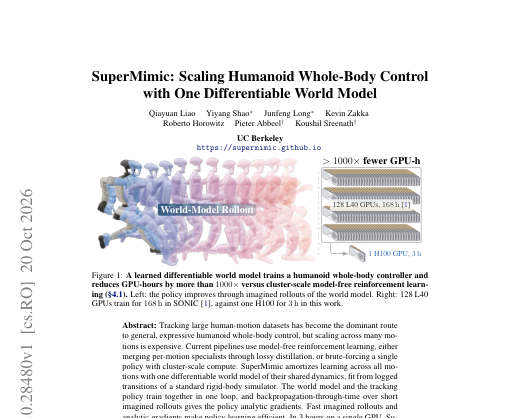
SuperMimic: Scaling Humanoid Whole-Body Control with One Differentiable World Model

Qiayuan Liao, Yiyang Shao, Junfeng Long, Kevin Zakka, Roberto Horowitz, Pieter Abbeel 等

Tracking large human-motion datasets has become the dominant route to general, expressive humanoid whole-body control, but scaling across many motions is expensive. Current pipelin…

Tracking large human-motion datasets has become the dominant route to general, expressive humanoid whole-body control, but scaling across many motions is expensive. Current pipelines use model-free reinforcement learning, either merging per-motion specialists through lossy distillation, or brute-forcing a single policy with cluster-scale compute. SuperMimic amortizes learning across all motions with one differentiable world model of their shared dynamics, fit from logged transitions of a standard rigid-body simulator. The world model and the tracking policy train together in one loop, and backpropagation-through-time over short imagined rollouts gives the policy analytic gradients. Fast imagined rollouts and analytic gradients make policy learning efficient. In 3 hours on a single GPU, SuperMimic surpasses the return of a state-of-the-art motion tracker baseline trained for 7 days on 128 GPUs. It reduces GPU-hours by more than $1000\times$ and fails on only 25 of 129,514 benchmark motions, versus 179 failures for the baseline. After 9.8 hours on two GPUs, SuperMimic achieves zero failures. From 1 to 264 hours of motion, the world model's prediction error stays stable, and GPU-hours to a target return grow slowly. Our policy transfers to a physical Unitree G1 across diverse and acrobatic motions. SuperMimic removes compute as the bottleneck to scaling humanoid whole-body control, making it practical to measure motion-tracking scaling laws.

cs.ROhumanoidworld model

追踪学者:Pieter Abbeel、Koushil Sreenath;兴趣:humanoid robots and whole-body control

#142026-10-2093

Physical Canvas: A Vision Tactile World Model For Robot Policy Evaluation And Learning

Zebin Xing, Yuhang Zheng, Yupeng Zheng, Yichen Zhang, Zichen Li, Shangqing Zhou 等

Evaluating and post-training robot policies through physical interaction is costly and difficult to scale, motivating action-conditioned world models as interactive simulators. How…

Evaluating and post-training robot policies through physical interaction is costly and difficult to scale, motivating action-conditioned world models as interactive simulators. However, visually plausible predictions can misrepresent contact dynamics, providing unreliable feedback for policy evaluation and learning. We introduce PhysCanvas, a state-consistent visuo-tactile world model for contact-rich robot manipulation. PhysCanvas unifies multi-view RGB, tactile images, marker displacement, task state, and actions within a unified vision space. All modalities share a video VAE and pretrained generative backbone, allowing optical touch to reuse visual and temporal priors. Motion images derived through forward kinematics and camera projection provide spatially aligned action conditioning, while an initial RGB anchor and updated reference observations guide sequential generation. Our consistency-aware post-training uses the frozen Scene Reward Model, Modality Reward Model, and State Reward Model to supervise scene preservation, visual-tactile compatibility, and agreement with real task outcomes. The resulting world model supports closed-loop policy rollouts for evaluation and provides imagined interactions and rewards for GRPO policy updates. Across four real-world manipulation tasks, when policies are rolled out in the world model, State Reward Model supervision increases the arithmetic mean of task-wise Pearson correlations between world-model and real-world success rates from 0.602 to 0.885. Policy post-training in the reward-guided world model further increases $π_{0.5}$'s mean real-world success rate from a 59.1% SFT baseline to 70.8%. These results demonstrate the value of unified multimodal modeling and consistency-aware post-training for robot policy evaluation and learning. Project page: https://zebinx.github.io/PhysCanvas_HomePage/.

cs.ROrobotmanipulationtactileworld model

兴趣:robot manipulation and grasping with learned policies

#152026-10-18追踪学者 · Jiajun Wu追踪学者 · Li Fei-Fei93

Dream What I Can: Sparse Visual Planning for Long-Horizon Robot Manipulation

Chongkai Gao, Wenlong Huang, Haonan Chen, Lin Shao, Yilun Du, Jiajun Wu 等

Video models provide rich priors for generalizable robotic manipulation, but plausible visual futures are not always executable. We introduce DreamCan, a hierarchical policy that g…

Video models provide rich priors for generalizable robotic manipulation, but plausible visual futures are not always executable. We introduce DreamCan, a hierarchical policy that grounds video models through sparse visual planning: a high-level planner adapted from a pre-trained video model and a low-level visuomotor policy. Rather than predicting dense trajectories, the high-level planner generates sparse visual subgoals that balance reachability and task utility. From offline, action-free robot videos, we estimate these quantities and use dynamic programming to select subgoal sequences without manual annotations. The resulting subgoals are more reliably attained than uniformly spaced alternatives, and the full system outperforms language, dense-video, and uniform-subgoal planners, reaching high planning success rates on Language-Table tasks and 91.2% success on LIBERO-Long with a 0.1B-parameter low-level policy. Additional suboptimal videos and test-time compute further improve success. The system also performs challenging real-world bimanual tasks, including box folding and packing with unseen object combinations. More results are available at https://dreamcan.github.io/.

cs.ROrobotmanipulation

追踪学者:Jiajun Wu、Li Fei-Fei;兴趣:robot manipulation and grasping with learned policies

#162026-10-1793

Relational Spatial Alignment for Vision-Language-Action Models

Chaoran Zhu, Hengyi Wang, Chenglin Cui, Yazhe Wan, Taein Kwon, Changjae Oh

Spatial understanding is essential for robots to perceive their surrounding environments and execute actions. Existing approaches typically encode 3D awareness into vision-language…

Spatial understanding is essential for robots to perceive their surrounding environments and execute actions. Existing approaches typically encode 3D awareness into vision-language-action (VLA) models by directly aligning their representations with pre-trained 3D foundation models. However, we observe that such direct geometric feature alignment essentially exploits 3D foundation priors as a form of low-rank regularization in the feature space, resulting in severe rank collapse of the pre-trained VLA representations. In contrast, we shift the focus from enforcing point-wise equality to aligning pair-wise relationships. We propose a representation-alignment method that enables the injection of 3D spatial awareness without compromising the model's original expressivity. Extensive experiments on public benchmarks, our new spatial reasoning benchmark, and real-world manipulation scenarios demonstrate that our approach effectively incorporates 3D spatial representations into VLA reasoning, achieving robust performance and enhanced spatial awareness across diverse manipulation tasks.

cs.ROmanipulationVLAvision-language-action

兴趣:vision-language-action (VLA) models and foundation models for robots

#172026-10-1993

Compositional Humanoid Manipulation through Isomorphic Teleoperation and Independent Skill Routing

Yiming Wang, Peixian Yang, Lifeng Zhuo, Lai Wei, Xinling Du, Kun Song 等

Humanoid manipulation requires reusable arm skills, yet demonstrating every possible skill combination is impractical. We present Humanoid Semantic Mixture-of-Experts Diffusion Pol…

Humanoid manipulation requires reusable arm skills, yet demonstrating every possible skill combination is impractical. We present Humanoid Semantic Mixture-of-Experts Diffusion Policy (HS-MoDP), which composes separately demonstrated arm skills through independent semantic routing over a shared expert pool. This design preserves arm-specific skill control while sharing action-generation parameters across arms. A semantic scheduler integrates the learned policy with an existing locomotion controller through alternating manipulation and repositioning stages, extending the effective workspace and enabling skill reuse across location changes. To acquire demonstrations of whole-body contact manipulation, we develop G1Exo, an isomorphic exoskeleton that provides direct joint-level control of arm configurations. Experiments on a Unitree G1 show stronger skill composition than the baselines. G1Exo enables more reliable contact teleoperation than end-effector VR-IK, and its demonstrations improve contact-skill learning across four policy architectures. For HS-MoDP, switching from VR-IK to G1Exo demonstrations raises full cabinet workflow success from 35% to 65%. All project hardware designs and source code will be released as open source after the review process.

cs.ROmanipulationdiffusion policyhumanoidlocomotion

兴趣:humanoid robots and whole-body control

#182026-10-2093

VLA-Retain: Benchmarking Cross-Dimension Effects of Vision Tuning in VLAs

Borui Xu, Han Chen, Bingsheng He, Ming Wu, Jason Zeng, Michael Heinrich

Vision-language-action (VLA) models transfer knowledge from large-scale pretraining into robot control, but their manipulation performance remains sensitive to changes in observati…

Vision-language-action (VLA) models transfer knowledge from large-scale pretraining into robot control, but their manipulation performance remains sensitive to changes in observation conditions, which recent work addresses by fine-tuning the visual module on target-domain data. However, it remains unclear how such adaptation affects robustness beyond the target condition, as existing robustness benchmarks only evaluate models without fine-tuning and adaptation studies only report the target gain. Measuring this cross-dimension effect requires separating target gains from off-target changes, isolating adaptation effects from architectural differences, ruling out generic forgetting, and comparing tuning choices. Therefore, we introduce VLA-Retain, a benchmark that compares five open VLA models, tuned on Camera-view or Sensor-noise data, with their own base checkpoints on LIBERO-Plus dataset spanning seven perturbation dimensions. Our study reveals four findings. First, targeted vision tuning is not local, and its target gain does not predict retention. Mean off-target gain is negative in 8 of 10 model--domain configurations. Under Camera-view tuning, X-VLA gains $69.4$ percentage points on the target but loses $4.6$ points on average elsewhere, whereas OpenVLA-OFT gains $39.3$ and $1.4$ points, respectively. Second, these regressions are not explained only by performance loss on the same tasks without perturbations. Third, broader training coverage raises overall gain over target-specific training but does not eliminate dimension-level regressions. Fourth, tuning strategies are model-dependent, as DELTA-style feature preservation raises X-VLA's mean off-target gain to $+1.2$ points but lowers OpenVLA-OFT's to $-23.1$. Overall, these findings show that target-domain success alone is insufficient and highlight cross-dimensional retention as a key criterion for targeted VLA adaptation.

cs.CVcs.AIrobotmanipulationVLAvision-language-action

兴趣:vision-language-action (VLA) models and foundation models for robots

#192026-10-1993

Humanoid SRL: Augmenting Humanoids with Supernumerary Limbs for Coordinated Loco-Manipulation

Fukang Liu, Feiyang Wu, Paul Barsa, Jaehwi Jang, Akshat Jain, Zhigen Zhao 等

Humanoid robots are envisioned to perform diverse human-level tasks through their anthropomorphic morphology. Their dual-arm configuration enables a broad range of everyday actions…

Humanoid robots are envisioned to perform diverse human-level tasks through their anthropomorphic morphology. Their dual-arm configuration enables a broad range of everyday actions. Yet, as in humans, this morphology can constrain loco-manipulation when both arms are occupied or additional contacts are required beyond their reach. Supernumerary robotic limbs (SRLs) offer a way to extend these capabilities, but their integration requires the added limb to be coordinated with whole-body motion and balance. In this study, we develop and integrate a supernumerary arm into a humanoid platform to investigate how morphological augmentation reshapes its feasible action space. Through quantitative analysis and hardware experiments across two configurations, we show how the additional limb expands whole-body interaction capabilities by enabling manipulation and support to be coordinated beyond the constraints of the native dual-arm configuration. To control this augmented morphology, we leverage model-based trajectory optimization (TO) to generate dynamically feasible motions for goal-conditioned reinforcement learning (RL) controllers. The controllers are trained in simulation and transferred to hardware in a zero-shot manner, enabling coordinated whole-body skills for contact-rich tri-arm loco-manipulation. We further show vision-guided autonomous execution on selected tasks using diffusion policies trained from hardware demonstrations. Our findings suggest that humanoid morphology need not be restricted to human-like forms, but can be reimagined as an extensible design space for robotic augmentation.

cs.ROmanipulationhumanoid

兴趣:humanoid robots and whole-body control

#202026-10-1892

T(R,O) Grasp++: Cross-Embodiment Dexterous Grasping in Cluttered Environments at Scale

Xin Fei, Zhixuan Xu, Huaicong Fang, Fangjun Chen, Zhaoyu Mu, Rui Yang 等

Dexterous grasping in cluttered scenes remains a central challenge in robotic manipulation, as it requires high-dimensional hand coordination under complex object-environment const…

Dexterous grasping in cluttered scenes remains a central challenge in robotic manipulation, as it requires high-dimensional hand coordination under complex object-environment constraints. To address this problem, we introduce one of the largest simulation benchmarks to date, comprising around 0.5B grasp annotations across eight dexterous hands and approximately 50K objects. Furthermore, we propose T(R,O) Grasp++, a scalable diffusion-based framework for cross-embodiment dexterous grasp synthesis in cluttered environments. Extensive experiments demonstrate that our model significantly outperforms existing baselines, achieving an average success rate of 88% across eight dexterous embodiments. Meanwhile, our pipeline achieves only 0.3s inference latency while improving inference sample efficiency by over 10 times.

cs.ROmanipulationgraspdexterous

兴趣:robot manipulation and grasping with learned policies

#212026-10-1992

Ropedia W0: Scaling Loco-Manipulation World Models across Embodiments with Human Experience

Tianqi Liu, Hanfei Zhao, Qifeng Liang, Hui En Pang, Jiarui Xu, Sayang Mu 等

World models enable embodied agents to anticipate action consequences, yet jointly modeling locomotion and manipulation across diverse embodiments remains challenging due to hetero…

World models enable embodied agents to anticipate action consequences, yet jointly modeling locomotion and manipulation across diverse embodiments remains challenging due to heterogeneous action spaces and limited multimodal supervision. We present Ropedia W0, the first egocentric loco-manipulation world foundation model spanning humans and robots with diverse embodiments. We curate Xp-Data, comprising 10k hours of egocentric human data and 3k hours of robot data with unified multimodal annotations and systematic quality control. A unified kinematic representation encodes locomotion through camera poses and manipulation through projected skeletons, with robot skeletons combining embodiment-specific forward kinematics with extensive manual keypoint annotation and correction. We also introduce Xp-Teleop, a long-horizon loco-manipulation benchmark based on high-quality dexterous humanoid teleoperation data. Evaluations demonstrate state-of-the-art performance across five cross-embodiment benchmarks (DreamDojo, $Ψ_0$, $ω$-HOME, Xp-Teleop, and AgiBot) and on held-out human egocentric video, from zero-shot inference to few-shot and full-data post-training. Scaling human pre-training data improves performance on both human and robot evaluations. After distillation, our model supports real-time, minute-long rollouts, enabling live VR interaction. Applications in policy evaluation, model-based planning, and world-action modeling further demonstrate the model's utility for embodied decision-making.

cs.CVcs.ROrobotmanipulationhumanoidlocomotionembodieddexterous

兴趣:world models and video prediction for embodied agents

#222026-10-1992

ReDOA: Real-World Distillation via Observation Alignment for Image-Based Manipulation Policy Learning

Kotaro Kajitsuka, Masaki Murooka, Fumio Kanehiro

Data-driven learning for general-purpose robotic manipulation presents a fundamental trade-off between data-collection cost and adaptability to real-world environments. Imitation l…

Data-driven learning for general-purpose robotic manipulation presents a fundamental trade-off between data-collection cost and adaptability to real-world environments. Imitation learning (IL) requires costly human demonstrations, whereas simulation-based learning is vulnerable to sim-to-real gaps in dynamics and sensor observations. We propose ReDOA (Real-World Distillation via Observation Alignment), a framework that decouples control learning from perception learning to learn image-based policies in the real world. A state-based teacher policy trained in simulation is executed on a real robot, and its control knowledge is distilled into an image-based student policy using the collected trajectories. Observation Alignment resolves observation mismatches between data collection and deployment. This framework collects successful, efficiently executed trajectories paired with real-world visual observations, without requiring demonstrations from human experts. In real-robot experiments on three non-prehensile manipulation tasks, including bimanual manipulation, our method achieves better overall performance when jointly considering task success and execution efficiency than both IL based on human demonstrations and policy distillation in simulation. https://isri-aist.github.io/redoa-project-page/

cs.ROrobotmanipulationimitation learningsim-to-real

兴趣:imitation learning and diffusion policies for robot control

#232026-10-1992

Tactile In-Hand Object Rotation: A Comparative Study of Hand Morphology in Simulation and Hardware

Wenhao He, Max Yang, Chenghua Lu, Yijiong Lin, David A. W. Barton, Nathan F. Lepora

Continuous in-hand rotation requires coordinated contact maintenance and renewal, linking manipulation performance to both hand geometry and tactile feedback. We investigate these …

Continuous in-hand rotation requires coordinated contact maintenance and renewal, linking manipulation performance to both hand geometry and tactile feedback. We investigate these relationships through rotational progress, finger participation, and fingertip loading on two versions of the low-cost LEAP Hand with anthropomorphic and symmetric finger arrangements. Both hands are integrated with TacTip vision-based tactile sensors and use a shared reinforcement learning framework. Simulation evaluates full tactile, binary touch, and proprioception-only observations on 12 unseen objects; hardware experiments evaluate full tactile policies on ten objects under multiple hand orientations. In simulation, full tactile observations increase mean normalized rotation per episode over proprioception alone by 94.8% for the anthropomorphic hand and 66.9% for the symmetric hand, with longer mean episode durations and lower mean total fingertip loads. Hardware contact measurements reveal more differentiated finger participation in the anthropomorphic hand, while cumulative loading is more evenly distributed across the symmetric hand's fingers. Overall, the symmetric hand achieves a 32.0% higher mean rotation count and a 25.8% higher aggregate rotation rate, together with longer manipulation duration. Additional hardware force recordings show a 19.9% lower mean total fingertip load for this layout. These findings relate finger arrangement to contact organization and load sharing, and show that richer tactile information supports greater task progress at lower mean loading in both simulated embodiments.

cs.ROmanipulationtactile

兴趣:dexterous hands and tactile sensing

#242026-10-1991

Physical Words: A Vocabulary for Structuring Latent Reasoning in Robot Manipulation

Jiaming Liu, Xinghao Zhu, Yiming Zhang, Shanghang Zhang, Yinxi Wang, Yichu Yang 等

Multimodal reasoning provides robotic foundation models with predictive context needed for reliable action generation. However, language-based reasoning captures task semantics but…

Multimodal reasoning provides robotic foundation models with predictive context needed for reliable action generation. However, language-based reasoning captures task semantics but struggles to express fine-grained physical dynamics, while latent reasoning models future state evolution but offers limited structure for organizing these dynamics into reusable reasoning primitives. To bridge this gap, we introduce PhysWord, a reasoning-before-acting foundation model built on Physical Words, which use atomic action verbs as shared semantic anchors for continuous representations of physical dynamics. Specifically, PhysWord predicts upcoming atomic action words and directly aligns their contextual hidden states with latent targets derived from the corresponding future observations. Building on these primitives, we construct a temporally structured PhysWord space with visual and optional tactile variants of each action word. Autoregressively predicting Physical Words across future timesteps captures transitions between execution stages, providing structured multimodal context for action generation. PhysWord achieves state-of-the-art success rates of 90.3% on visuotactile UniVTAC and 99.6% on vision-based LIBERO-Long, and outperforms competing methods on real-world tasks using bimanual grippers and dexterous hands. Further evaluations demonstrate that our structured latent reasoning framework generalizes to unseen scenarios and enables long-horizon manipulation.

cs.ROrobotmanipulationdexteroustactile

兴趣:large language models for robot task planning and reasoning

#252026-10-2091

RoboJudge: Multimodal Language Models as Judges for Embodied Video Generation

Siyuan Ma, Yu Qi, Cheng Ye, Ruotian Peng, Xinyi Xu, Zitiantao Lin 等

Video generation models are promising foundations for embodied world models, but only if their generated rollouts are physically valid and faithful to task instructions. Multimodal…

Video generation models are promising foundations for embodied world models, but only if their generated rollouts are physically valid and faithful to task instructions. Multimodal large language models (MLLMs) are increasingly used to judge these properties, yet their agreement with human judgments on embodied videos has not been systematically evaluated. To address this gap, we introduce RoboJudge-Bench, a benchmark for evaluating MLLMs as judges of embodied video generation. The benchmark measures two fundamental dimensions, Physical Adherence and Instruction Alignment, across 800 human-annotated videos from 8 source corpora and 10 video generators, spanning grippers, human hands, and dexterous hands. Experiments reveal uneven alignment between existing judges and human ratings: general-purpose MLLMs show lower agreement on physical adherence, while specialized video judges designed for general-domain physical reasoning do not consistently transfer to embodied scenarios. Motivated by these findings, we construct RoboJudge-Train, comprising 12K videos annotated with 25K human-verified scores and model-assisted rationales for Physical Adherence and Instruction Alignment. We fine-tune a 9B MLLM on this dataset with supervised learning followed by reinforcement learning, yielding RoboJudge-9B. Among the model judges evaluated on RoboJudge-Bench, RoboJudge-9B achieves the highest overall agreement, reaching a Pearson correlation of 0.719 with a statistically significant 0.089 gain over Gemini-3.7-Flash, the best-performing proprietary baseline in our evaluation. Training on RoboJudge-Train also yields gains on external benchmarks, including VideoPhy2 and Physion-Eval. We further use RoboJudge-9B as a downstream evaluator to benchmark video generation models according to Physical Adherence and Instruction Alignment.

cs.CVcs.ROembodieddexterous

兴趣:world models and video prediction for embodied agents

#262026-10-1990

Robot Learning with Vision-Language-Action Models for Agricultural Manipulation

Hamid Hafezi, Javad Mohammadpour Velni, Mohammadreza Davoodi

Robotic manipulation in agricultural environments remains challenging due to variations in plant geometry, occlusion, and camera viewpoints. Pretrained vision-language-action (VLA)…

Robotic manipulation in agricultural environments remains challenging due to variations in plant geometry, occlusion, and camera viewpoints. Pretrained vision-language-action (VLA) and generalist robot policies offer a promising approach to addressing these challenges by learning manipulation behaviors from multimodal observations and language instructions. However, adapting these policies to agricultural tasks requires domain-specific demonstrations, which are costly and time-consuming to collect on physical robots. In this work, we develop a simulation-to-real robot-learning framework for agricultural reaching and grasping that integrates task-specific demonstration collection and pretrained policy adaptation. A MuJoCo-based agricultural environment is developed with diverse tomato plant structures to support demonstration collection and controlled evaluation. Expert demonstrations are collected through joystick teleoperation, with a low-level controller used to execute robot actions. Two pretrained generalist robot policies, Octo and $π_{0.5}$, are adapted using simulated demonstrations, followed by further fine-tuning on a physical Franka Research 3 manipulator using real-robot demonstrations. The adapted policies are evaluated under in-distribution, viewpoint/spatial-shift, and out-of-distribution conditions in simulation, followed by physical-robot experiments. The influence of proprioceptive information on policy performance is also investigated. Results show that $π_{0.5}$ achieves higher task-performance scores than Octo and exhibits less degradation under distribution shifts. These findings demonstrate the potential of integrating pretrained generalist policies with task-specific demonstration learning for agricultural manipulation.

cs.ROrobotmanipulationVLAvision-language-action

兴趣:robot manipulation and grasping with learned policies

#272026-10-20追踪学者 · Katerina Fragkiadaki追踪学者 · Shubham Tulsiani90

Learning Adaptable Dexterous Skills via Hybrid Dexterous Mimicking

Yuxuan Kuang, Jiashun Wang, Yixuan Sun, Yufei Ye, Sungjae Park, Umar Iqbal 等

Dexterous multi-finger hands hold promise to unlock diverse skills like functional grasps, in-hand reorientation, and dynamic handover that the human-designed world assumes, yet ex…

Dexterous multi-finger hands hold promise to unlock diverse skills like functional grasps, in-hand reorientation, and dynamic handover that the human-designed world assumes, yet existing learning recipes force a trade-off. Goal-reaching reinforcement learning generalizes to arbitrary object poses but, lacking any human prior, converges to unnatural and unreliable finger strategies; motion tracking reproduces human-like behavior from a single clip but cannot deviate from it. We present AdaDex, a goal-conditioned RL framework that turns a single hand-object trajectory of a few seconds---from mocap data or HOI reconstruction from in-the-wild RGB(D) video---into an adaptable dexterous skill. At the core of AdaDex is Hybrid Dexterous Mimicking: a shared policy is trained on two populations of massively parallel environments: motion tracking environments trained with dense motion tracking objective, which instill the human prior from human motion; and generalization environments with noised initial states and goals and a sparse object-success reward, which force the skill to work far off the reference. From seconds of human motion per skill, the resulting policies can learn diverse adaptable dexterous skills, such as functional grasping, object reposing, in-hand reorientation with finger gaiting, and dynamic behaviors like throw-and-catch. Our method outperforms baselines in terms of generalization and functionality, and we demonstrate transfer across simulators and to the real world. Project page: https://yuxuank.com/AdaDex/.

cs.ROcs.CVcs.GRcs.LGdexterous

追踪学者:Katerina Fragkiadaki、Shubham Tulsiani;兴趣:robot manipulation and grasping with learned policies

#282026-10-1790

LIBERO-Pro2.0: A Benchmark for Evaluating the Robustness of Embodied Foundation Models

Xueyang Zhou, Yangming Xu, Qianjiang Li, Guiyao Tie, Junhao Wu, Ziheng Huang 等

LIBERO has emerged as a widely adopted benchmark for evaluating robotic manipulation policies. However, strong performance on LIBERO does not necessarily indicate robust embodied c…

LIBERO has emerged as a widely adopted benchmark for evaluating robotic manipulation policies. However, strong performance on LIBERO does not necessarily indicate robust embodied capabilities, as models may exploit benchmark-specific regularities rather than generalize to diverse operating conditions. In this work, we introduce LIBERO-Pro2.0, a comprehensive benchmark for systematically evaluating the robustness of embodied foundation models under distribution shifts. LIBERO-Pro2.0 encompasses 22 static perturbations and 20 runtime interventions across six dimensions: Condition, Environment, Observation, Execution, Robot State Configuration, and Language, yielding 1,648 validated shifted task instances. To support robustness-oriented learning, we further collect 39,390 training trajectories through model-generated and human demonstrations. All shifted task instances undergo six rounds of iterative human review and correction to ensure physical plausibility and task validity. We evaluate 17 representative robot policies spanning vision-language-action models, world-action models, and robustness-oriented policies. Our results reveal substantial robustness gaps across all evaluated paradigms: under runtime distribution shifts, the evaluated models exhibit an average performance drop of 26.5 percentage points, with individual drops reaching 32.5 points. These findings highlight the gap between nominal benchmark performance and robustness under distribution shifts, underscoring the need for systematic robustness evaluation of embodied foundation models.

cs.ROrobotmanipulationvision-language-actionembodied

兴趣:vision-language-action (VLA) models and foundation models for robots

#292026-10-2090

GPT-6-Astra Understands Touch and Outperform Vision--Tactile--Language--Action Models

Ziyong Wang, Yupei Lin, Runxuan Huang, Liang Lin, Dongyu Zhang, Guangrun Wang

General-purpose multimodal models have shown promise as direct robot action policies, yet whether they grasp the physics underlying real-world interactions and can apply that under…

General-purpose multimodal models have shown promise as direct robot action policies, yet whether they grasp the physics underlying real-world interactions and can apply that understanding to guide action remains underexplored. We investigate this question using contact-rich manipulation as a representative testbed, examining tactile understanding as a concrete instance of this broader capability. Contact-rich manipulation requires interpreting tactile feedback and adjusting actions after obstruction. Existing learned tactile policies acquire these capabilities through specialized pretraining and per-task optimization, with substantial data and training costs. We present GPT-as-Tactile-Policy, which summarizes expert demonstrations into task guidance and tactile references for contact assessment and corrective action. GPT-6-Astra combines this context with multimodal observations and interaction history to generate control commands and adjust actions through contact feedback. Without additional robotics-specific pretraining or per-task policy fine-tuning, our method achieves 93.8% mean success across five UniVTAC tasks. Overall performance is comparable to state-of-the-art policies, with higher success on selected tasks. On Insert Hole, tactile feedback improves success from 31% to 99%. Execution analysis further demonstrates contact-guided probing and correction, supporting manipulation progress through explicit expert experience and online feedback.

cs.ROcs.CLrobotmanipulationgrasptactile

兴趣:robot manipulation and grasping with learned policies

#302026-10-2089

PLaCA: Learning Patch-Level Future Latent Change for Action Generation

Zhan Yi, Yuchen Wang, Chao Li, Lei Hong, Boyuan Yang

Vision-Language-Action (VLA) models generate robot actions from visual observations and language instructions, but effective manipulation also requires anticipating how the environ…

Vision-Language-Action (VLA) models generate robot actions from visual observations and language instructions, but effective manipulation also requires anticipating how the environment will change. Existing world-action models explore future image prediction and latent dynamics modeling. However, generating complete future images can be computationally expensive, while highly compressed latent representations may obscure local changes. To address these challenges, we propose PLaCA, a world-to-action framework built around future latent change. PLaCA directly predicts spatially structured patch-level future latent change from the current multimodal input, preserving local information about expected environmental changes. We introduce patch-level change-aware supervision to emphasize regions undergoing larger changes and a future-to-action interface that explicitly incorporates predicted future latent change into action generation. Experiments on LIBERO-Long show that PLaCA achieves a 79.0% success rate, improving upon the Action-only baseline by 5.0 percentage points. On CALVIN, PLaCA improves the average sequence length from 2.784 to 3.564. These improvements are achieved while updating only 2.95% of the model parameters during the second training stage, demonstrating the effectiveness of future latent change modeling for downstream robotic manipulation.

cs.ROcs.CVrobotmanipulationVLAvision-language-action

兴趣:vision-language-action (VLA) models and foundation models for robots

#312026-10-2089

From Predictive Geometry to Action: Learning Complementary Predictive Representations for Embodied Manipulation

Xiaoxu Xu, Hao Li, Hongtao Zhang, Yili Tang, Jiafei Cao, Junhao Cai 等

Effective manipulation requires a policy to capture not only about the current scene geometry, but also about how that geometry will evolve under interaction. Existing approaches e…

Effective manipulation requires a policy to capture not only about the current scene geometry, but also about how that geometry will evolve under interaction. Existing approaches either augment policies with geometric information from current observations or introduce future prediction as auxiliary supervision, leaving open how predictive geometry should be represented for action generation. Therefore, we propose a two-stage framework, which learns complementary predictive representations from multi-view video clips. During pretraining, a frozen 3D foundation model provides dense geometric features that are compressed into predictive geometric representations and optimized to preserve scene structure and its temporal evolution. Action supervision is then applied to geometric transitions to extract a complementary motor representation that emphasizes action-relevant transitions. During downstream post-training, predictive geometry is transferred through geometry queries, while the motor representation guides intermediate features along the action-generation pathway. Future observations are used only as privileged supervision during training and are not required at inference time. Across LIBERO, LIBERO-Plus, SimplerEnv, and real-world bimanual and single-arm tasks, our approach consistently improves downstream policies, including an absolute gain of 10.4 percentage points on the WidowX evaluation. We further demonstrate transfer across multiple VLA architectures and WAMs, with improvements in both future-world and action prediction. The code will be available at https://github.com/xuxiaoxxxx/CPR.

cs.ROmanipulationVLAembodied

兴趣:world models and video prediction for embodied agents

#322026-10-2089

Frontier LLMs Enter the World of Robotics: A Cross-Model Evaluation on RoboColiseum

Da Huang, Jichao Wang, Junhui Wu, Tong Ran, Linting Guo, Siying Zhang 等

Recent studies have explored the potential of multimodal large language models for robot control, yet the models' embodied capabilities remain insufficiently characterized across m…

Recent studies have explored the potential of multimodal large language models for robot control, yet the models' embodied capabilities remain insufficiently characterized across models, tasks, and execution settings. We conduct a multidimensional comparative evaluation on RoboColiseum across four tracks: Instruction Following, Spatial Reasoning, General Manipulation, and Robustness. We implement Agent2Act, a control harness that integrates GPT-6 Astra, GPT-6.1 Sol, Claude Opus 5.5, and Gemini 4 Argon into the evaluation environment through shared observation, action execution, and feedback interfaces. Under common task settings and scoring criteria, all four models exhibit a consistent capability profile: high instruction-following scores, with three approaching perfect performance; strong spatial reasoning; and general manipulation scores below those of the other three tracks. Within the evaluated configurations, Astra leads instruction following and robustness, while Opus leads spatial reasoning, general manipulation, and overall performance. These results reveal complementary strengths across models and a persistent gap between task understanding and reliable physical execution. Component comparisons on selected tasks further show that harness design affects task success, planning cost, and execution time. Additionally, case studies with Astra examine whole-body coordination, manipulation across robot embodiments, precision manipulation, dexterous-hand manipulation, and real-robot tasks, providing further insight into the model's capabilities and limitations across embodied tasks.

cs.ROrobotmanipulationembodieddexterous

兴趣:large language models for robot task planning and reasoning

#332026-10-1989

GPT-6 Astra Is a Native Visuo-Tactile Policy for Contact-Rich Manipulation

Chen Yang, Linzhe Shi, Hang Zhang, Mu Xu, Jiansheng Fan, Chen Wang

Recent advances in multimodal models have enabled GPT-6 Astra to perform robotic manipulation through in-context learning. Yet contact-rich control and tactile perception are often…

Recent advances in multimodal models have enabled GPT-6 Astra to perform robotic manipulation through in-context learning. Yet contact-rich control and tactile perception are often regarded as strengths of specialist policies, leaving open whether Astra can directly understand and use tactile observations. We provide, to our knowledge, the first demonstration that Astra directly interprets vision-based tactile images and uses their contact cues for manipulation. Tactile RGB images enter through its existing visual interface, enabling few-shot closed-loop control on nineteen simulated UniVTAC and OpenViTac tasks with 210 sampled scene seeds per setting. With visuo-tactile input, Astra achieves mean success rates of 93.8% and 81.8%, exceeding the strongest reported specialist baselines in our comparison by 22.9 and 13.1 percentage points, respectively. Vision-only performance also leads these baselines, reaching 76.3% and 80.6%. Trajectory analysis reveals active probing, cautious grasping, contact-guided alignment, and recovery, alongside difficulties with tangential loading and corrective execution. Our findings challenge the exclusivity of specialist policies in contact-rich manipulation and show that fine-grained vision can partially compensate for missing touch. They also identify vision-based tactile sensing as an interface for scaling contact understanding with foundation models and reveal signs of benchmark saturation. These results motivate joint visual-tactile pretraining, harder contact-rich evaluations, and physical-robot validation.

cs.ROrobotmanipulationtactile

兴趣:robot manipulation and grasping with learned policies

#342026-10-2089

LocoPilot: Single-Operator Bilateral Teleoperation for Loco-Manipulation Policy Learning

Antonio Langella, Giovanni Minelli, Giovanni B. Dessy, Lorenzo Amatucci, Giulio Turrisi, Victor Barasuol 等

Learning loco-manipulation policies requires demonstrations that capture coordinated base and arm motion on the target embodiment. Robot-free interfaces allow demonstrations to be …

Learning loco-manipulation policies requires demonstrations that capture coordinated base and arm motion on the target embodiment. Robot-free interfaces allow demonstrations to be collected independently of the target robot, increasing flexibility but without directly capturing platform-specific commands, proprioception, and body-mounted observations. On-robot teleoperation allows to capture these signals directly, but requires an interface capable of commanding the complete system concurrently. This paper presents LocoPilot, a single-operator bilateral teleoperation and data-collection framework implemented on a 12-DoF Unitree Go2 quadruped equipped with a 6-DoF AgileX Piper L manipulator, an Intel RealSense D435 wrist camera, and an Intel RealSense D405 head camera. A second 6-DoF Piper L arm, used as the leader and two handheld controllers provide simultaneous control of the base, body posture, manipulator, and gripper. The follower arm interaction forces are estimated without a dedicated force/torque sensor and rendered to the operator through a passivity-constrained haptic channel. A ROS~2 pipeline records synchronized multimodal observations together with a unified 11D action shared by teleoperation and policy deployment. Compared to prior work, LocoPilot uniquely unifies robot-in-the-loop legged data collection, force feedback without motion-capture instrumentation, and the same action interface at deployment. We evaluate the interface across multiple loco-manipulation tasks and validate the complete collection-to-deployment pipeline by fine-tuning MolmoAct2 \cite{MOLMO} on pick-and-place demonstrations and deploying on the physical robot without action retargeting or additional inverse kinematics. Code available at: https://github.com/iit-DLSLab/LocoPilot

cs.ROrobotmanipulationlegged

兴趣:reinforcement learning for legged locomotion and sim-to-real transfer

#352026-10-2089

Large Multimodal Models for Direct Robot Control: GPT-6 as a Beginning

Youwei Zhou, Bohan Hou, Yankai Fu, Yaoxu Lyu, Yifan Ye, Shilin Shan 等

Recent advances in visuospatial understanding and agentic reasoning enable direct robotic manipulation with general-purpose multimodal models, but their embodied capabilities remai…

Recent advances in visuospatial understanding and agentic reasoning enable direct robotic manipulation with general-purpose multimodal models, but their embodied capabilities remain poorly understood. This paper systematically evaluate GPT-6 Astra for closed-loop robotic manipulation using a lightweight agent execution framework. We first probe three fundamental embodied capabilities-depth perception, embodied in-context learning, and tactile understanding-and demonstrate that the model can exploit depth information, acquire simple manipulation strategies from contextual demonstrations, and use tactile feedback to correct its actions. We then evaluate GPT-6 Astra across five established manipulation benchmarks along six capability dimensions. Despite competitive performance on several benchmarks-26.92% success on RoboDojo and 76.0% on RoboTwin 2.0-our analysis reveals a pronounced gap between semantic reasoning and physical execution, particularly in consequence-aware action planning, precision, and complex motion coordination. To further examine these limitations, we introduce LIBERO-GeoMotion, a new benchmark of geometry-constrained tasks that require precise pose alignment, coordinated translation and rotation, and anticipation of physical action consequences. GPT-6 Astra achieves only 11.1% zero-shot success, exposing the difficulty of translating spatial understanding into physically feasible motion. Real-world experiments corroborate these findings: zero-shot execution is feasible for simple tasks, yet persistent deficits remain in motion feasibility, precise control, and physical safety, while substantial inference latency further hinders practical deployment. Overall, our results characterize the emerging embodied capabilities of general-purpose multimodal models and delineate the key challenges toward safe, efficient, and reliable robotic manipulation.

cs.ROrobotmanipulationembodiedtactile

兴趣:robot manipulation and grasping with learned policies

#362026-10-2089

Learning Tactile-Aware Hand Representations from Human Hand-Object Interaction Data

Yeonguk Yu, Jaehong Kim, Byungok Han

Tactile representation learning for dexterous manipulation often requires substantial robot-side data collection, limiting its scalability across different hands and sensors. We ex…

Tactile representation learning for dexterous manipulation often requires substantial robot-side data collection, limiting its scalability across different hands and sensors. We explore whether large-scale human hand-object interaction (HOI) data can provide a useful prior for robotic tactile learning. To this end, we propose HuTact, a framework that pretrains tactile-aware hand representations from human HOI data without requiring real tactile signals during pretraining. HuTact transfers the interaction structure learned from human hand motions to robotic tactile observations and can be further adapted with a small amount of unlabeled robot interaction data. We evaluate HuTact on tactile perception and manipulation tasks, including grasp prediction, slip detection, object classification, and tactile-conditioned policy learning. Across these tasks, human HOI pretraining improves data efficiency and provides a strong initialization for downstream learning. Notably, with HOI pretraining followed by midtraining on unlabeled robot play data, HuTact achieves 88.26% Macro-F1 on grasp prediction using only 25% of the labeled downstream data, comparable to training from scratch on the full labeled dataset (88.23%). These results suggest that human interaction data can serve as a scalable complementary source for robotic tactile representation learning.

cs.ROcs.AIrobotmanipulationgraspdexteroustactile

兴趣:dexterous hands and tactile sensing

#372026-10-2089

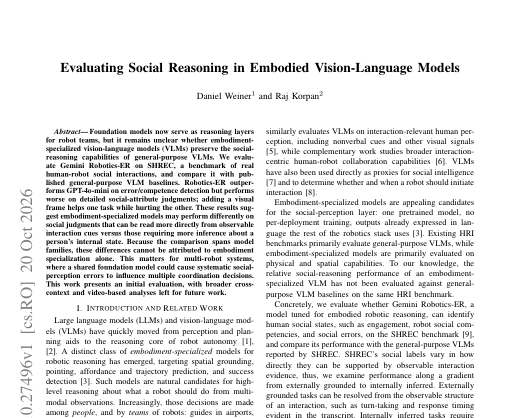
Evaluating Social Reasoning in Embodied Vision-Language Models

Daniel Weiner, Raj Korpan

Foundation models now serve as reasoning layers for robot teams, but it remains unclear whether embodiment-specialized vision-language models (VLMs) preserve the social-reasoning c…

Foundation models now serve as reasoning layers for robot teams, but it remains unclear whether embodiment-specialized vision-language models (VLMs) preserve the social-reasoning capabilities of general-purpose VLMs. We evaluate Gemini Robotics-ER on SHREC, a benchmark of real human-robot social interactions, and compare it with published general-purpose VLM baselines. Robotics-ER outperforms GPT-4o-mini on error/competence detection but performs worse on detailed social-attribute judgments; adding a visual frame helps one task while hurting the other. These results suggest embodiment-specialized models may perform differently on social judgments that can be read more directly from observable interaction cues versus those requiring more inference about a person's internal state. Because the comparison spans model families, these differences cannot be attributed to embodiment specialization alone. This matters for multi-robot systems, where a shared foundation model could cause systematic social-perception errors to influence multiple coordination decisions. This work presents an initial evaluation, with broader cross-context and video-based analyses left for future work.

cs.ROcs.HCrobotembodied

兴趣:vision-language-action (VLA) models and foundation models for robots

#382026-10-20追踪学者 · Katerina Fragkiadaki88

VLM-Guided Contact Retargeting and Generative Partner Modeling for Humanoid-Human Interaction

Yuto Shibata, Kotaro Amaya, Kashu Yamazaki, Lalit Jayanti, Yoshimitsu Aoki, Mariko Isogawa 等

Humanoid-human interaction requires robots to operate under severe partial observability: during close physical contact, the human partner is occluded, truncated, or outside the ro…

Humanoid-human interaction requires robots to operate under severe partial observability: during close physical contact, the human partner is occluded, truncated, or outside the robot's field of view, causing pose estimation to fail and often necessitating external tracking or privileged human state. At the same time, heavy mutual occlusions introduce errors into the human-human motion-capture data used for learning. We present REACT, a framework for learning deployable humanoid-human interaction policies from human-human demonstrations. REACT treats semantic contact structure as the key supervisory signal connecting demonstration processing, interaction learning, and onboard control. First, a VLM-guided contact modeling and retargeting pipeline identifies semantically meaningful contacts and transfers them onto humanoid-human geometry while preserving interaction structure. Using these annotations, privileged interaction policies learn physically grounded behaviors through interaction-aware contact rewards and are then distilled into deployable egocentric depth policies trained entirely from onboard sensing using photorealistic human depth rendering. To address severe partial observability, we introduce generative partner-state modeling objectives that predict partner motion from occluded egocentric views. We evaluate REACT in simulation and on a real Unitree G1 humanoid across five contact-rich interactions. Semantic contact modeling substantially improves preservation of demonstrated interactions, while generative partner-state modeling improves contact recall on four of five interactions, most under heavy occlusion. On real hardware, REACT performs all five interactions using onboard sensing alone.

cs.ROcs.AIcs.CVrobothumanoid

追踪学者:Katerina Fragkiadaki;兴趣:humanoid robots and whole-body control

#392026-10-1988

Vector-Quantized World Model: Latent Feedback Motion Planning for Robot Manipulation

Xuezhou Xu, Chung-Pang Wang, Zhenzhen Li, Benjamin Riviere

Visual world models have shown strong potential for robot planning, yet long-horizon manipulation remains challenging due to compounding prediction errors, large search complexity,…

Visual world models have shown strong potential for robot planning, yet long-horizon manipulation remains challenging due to compounding prediction errors, large search complexity, and latent plans that the low-level controller cannot reliably reach. In this work, we introduce Vector-Quantized World Model (VQ-WM), a latent feedback motion planning framework that integrates discrete long-horizon search with continuous visual feedback control: a discrete latent predictor models transitions between vector-quantized latent states, allowing the planner to look far ahead and find a shortest path to the goal through discrete search and a continuous learned controller sequentially reaches the planned states through visual feedback, correcting deviations to mitigate compounding errors. Whereas most vector quantization uses Euclidean distance, we use a novel estimator of the first-passage-time as a quasi-metric, which aligns the planning abstraction with the controller's capabilities. We evaluate on the physical robot manipulation of the Tower of Hanoi puzzle: whereas existing state-of-the-art foundation models (VLAs, WAMs) only succeed when the solution trace in their training dataset, our method achieves 100% success rate with only short-play data, demonstrate its ability to compose long-horizon solutions beyond the short demonstrated trajectories and execute them reliably. Our solution also outperforms strongest world-models by 13.3--85.3 percentage points on simulation benchmarks spanning manipulation and locomotion, demonstrating consistent progress and new capabilities.

cs.ROrobotmanipulationlocomotionworld model

兴趣:robot manipulation and grasping with learned policies

#402026-10-1987

FR-VLA: Implicit Force Reasoning VLA for Contact-Rich Manipulation

Jiaju He, Zhiyuan Yang, Ruyang Han, Jiahong Tang, Zhiping Lin, Haiyue Zhu

Integrating force awareness into Vision-Language-Action (VLA) models involves not merely encoding wrench measurements as an additional modality, but determining when and how strong…

Integrating force awareness into Vision-Language-Action (VLA) models involves not merely encoding wrench measurements as an additional modality, but determining when and how strongly physical interaction should influence robot action generation. Existing VLAs that use force typically inject it through a fixed pathway, without explicitly determining when it is relevant to the current action. This calls for an intermediate force relevance mechanism inside the VLA, in which visual-language context estimates the relevance of physical feedback to the current task before force enters the action pathway. FR-VLA addresses this gap with a Vision-Language Force-Reasoning Model that uses learnable force query tokens to derive a force admission signal grounded in visual-language context, and uses this signal to modulate an external tokenized force pathway for action generation. In real-world experiments on five contact-rich tasks across two robotic platforms, FR-VLA achieves the highest mean success rate over six evaluated stages, and trajectory visualizations show that its force admission varies with the interaction phase.

cs.ROrobotmanipulationVLAvision-language-action

兴趣:vision-language-action (VLA) models and foundation models for robots

#412026-10-1987

RoboMMT: Learning Stable Tracking of Modulated Expressive and Interactive Robot Motion

Till Hielscher, Kai O. Arras

Expressive robot motion can improve naturalness, effectiveness, and perceived likability in human-robot interaction. When deployed on dynamically unstable platforms, however, react…

Expressive robot motion can improve naturalness, effectiveness, and perceived likability in human-robot interaction. When deployed on dynamically unstable platforms, however, reactive execution of expressive body motion may bring the robot to its stability limits, especially when expressivity is decoupled from physical control. In this paper, we present RoboMMT (Robot Modulated Motion Tracking), a modular control architecture that couples parameterized expressive motion synthesis, physics-based character control, and reactive adaptation to spatial interaction goals. Our approach trains a reference-conditioned tracking policy across a broad domain of expressivity, enabling it to faithfully realize the commanded motions while maintaining dynamic stability. Goal reactivity is achieved by training lightweight, task-specific interaction policies that modulate the reference generator's spatial goal-attraction point, with the stabilizing tracking policy kept in the loop. Evaluations on a quadruped and two humanoid robots show that the learned tracker remains stable and accurate across the entire modulation domain, whereas trackers trained without this coverage lose balance, tracking accuracy, or both. We show that layering closed-loop goal adaptation over this foundation enables interactive facing and pointing behaviors, while maintaining stable execution and comparable reference-tracking fidelity. The robot learns to proactively redistribute its weight and take corrective steps. Zero-shot sim-to-real transfer is demonstrated through real-robot experiments on a quadruped under heavy disturbances.

cs.ROrobothumanoidsim-to-real

兴趣:humanoid robots and whole-body control

#422026-10-2086

Plausible Future, Wrong Choice: Steering World-Action Models toward Intended Future

Zhuohao Li, Jiawei He, Yuxuan Yan, Lang Zhou, Yinghao Li, Yanrui Li 等

World-Action Models (WAMs) have emerged as a promising paradigm for embodied generalist policies by jointly modeling future world evolution and robot actions across diverse manipul…

World-Action Models (WAMs) have emerged as a promising paradigm for embodied generalist policies by jointly modeling future world evolution and robot actions across diverse manipulation tasks. However, representing diverse futures is only the first step: a capable WAM must also generate futures that match the requirements of the current task and execution progress. In long-horizon manipulation where similar observation-action segments occur across different tasks and stages, existing approaches may generate locally plausible yet misdirected rollouts to drift toward wrong task stage, i.e., a phenomenon we term Stage Confusion. To address this problem, we propose TaskWAM, a closed-loop, stage-aware framework that represents fine-grained task requirements with Mode Tokens and tracks execution progress with State Tokens, forming a structured task state to steer world--action generation toward intended future. We further introduce StageBench, a controlled multi-stage manipulation benchmark with parameterized stage variations and automated evaluation.Extensive experiments on both simulation benchmarks and real-world tasks demonstrate that TaskWAM effectively reduces confusion and achieves competitive performance with state-of-the-art methods. Moreover, TaskWAM provides strong plug-and-play transfer across heterogeneous WAM architectures and robot embodiments, including single-arm robots, dual-arm grippers, dexterous hands, and humanoid robots.

cs.ROcs.AIrobotmanipulationhumanoidembodieddexterous

兴趣:robot manipulation and grasping with learned policies

#432026-10-2086

EventSync: Event-Driven Memory Updates for History-Dependent Manipulation

Jingjiao Zhao, Dong Jing, Mingyu Cao, Ruochuan Shi, Xiansheng Chen, Pengwei Wang 等

History-dependent robotic manipulation requires task context and interaction history, as the current observation alone is insufficient to determine the next action. Hierarchical fr…

History-dependent robotic manipulation requires task context and interaction history, as the current observation alone is insufficient to determine the next action. Hierarchical frameworks use task memory for high-level subgoal reasoning and low-level policies for execution. However, memory updates require accurate completion assessment: similar observations may correspond to different execution phases, and prematurely recording completion can mislead subsequent subgoal reasoning. We present EventSync, a hierarchical framework that coordinates task reasoning and action execution through event-driven memory updates. A vision-language model generates subgoals from task plans and interaction history, while a vision-language-action model executes them. A lightweight Event Monitor combines visual observations with end-effector trajectories to determine whether the current subgoal is complete. The framework records the current subgoal in its completed-subgoal history and triggers subsequent reasoning only after obtaining completion evidence. With visual history in the executor, EventSync achieves 64.5% overall success on RoboMME, exceeding the best baseline reported in the benchmark by 20.0 percentage points. Further analysis shows that this update mechanism helps build a reliable completed-subgoal history. Experiments on four real-robot tasks with different memory requirements validate the framework's effectiveness in real-world robotic manipulation.

cs.ROrobotmanipulationvision-language-action

兴趣:large language models for robot task planning and reasoning

#442026-10-1886

BiDex-100: A Comprehensive Benchmark for Bimanual Dexterous Manipulation Across 100+ Simulation Tasks

Yong Wang, Kecheng Zheng, Xing Zhu, Chao Xu, Yujun Shen, Shengze Cai

Bimanual manipulation with dexterous hands has attracted growing attention in research on robotic action models. However, few studies have developed benchmarks specifically tailore…

Bimanual manipulation with dexterous hands has attracted growing attention in research on robotic action models. However, few studies have developed benchmarks specifically tailored for dexterous manipulation, leaving the dexterous manipulation capabilities of existing models insufficiently characterized. In this paper, we present BiDex-100, a simulation benchmark for bimanual dexterous manipulation that combines broad task coverage, multi-dimensional evaluation, and high-DoF hand embodiments. Concretely, the benchmark comprises 106 tasks organized along five capability axes: generalization, instruction following, limited demonstrations, long horizon, and memory. Each task is paired with an out-of-domain variant featuring controlled visual and spatial changes, allowing systematic assessment of robustness. In addition, the benchmark supports two embodiments and provides 8,080 success-validated teleoperated demonstrations, totaling 6.25 million frames. We evaluate seven recent Vision-Language-Action models under a unified protocol, establishing baselines for capability-specific performance, robustness, and data efficiency. The website is available at https://BiDex-100.github.io/BiDex-100/.

cs.ROcs.CVcs.LGmanipulationvision-language-actiondexterous

兴趣:robot manipulation and grasping with learned policies

#452026-10-1886

Structure over Reasoning: Unified Zero-Shot Navigation with a Small Vision-Language Model

Zeqi Li, Xunyi Zhao, Zerui Li, Sihao Lin, Qi Wu, ShiJie Li

Vision-language navigation is moving into photorealistic, physically simulated scenes, where the leading zero-shot agents put a vision-language model in the control loop to choose …

Vision-language navigation is moving into photorealistic, physically simulated scenes, where the leading zero-shot agents put a vision-language model in the control loop to choose every move and stop. Robots favour small models, whose abilities are uneven: Qwen3-VL-4B can judge whether a single view looks like the goal, but its route reasoning is at chance, its distance estimates nearly constant, its stop votes unreliable. Our agent therefore asks it two perceptual questions per step, which direction looks like the goal and whether the view justifies stopping, plus one gated frontier query on route-bearing instructions, and treats the answers as evidence, not actions: a route-blind semantic field over a bird's-eye map accumulates the directional scores through a tempered update, a skeleton graph supplies frontiers and geodesic distances, and a two-stage terminator turns stop votes into termini through a trail-consistency gate and a budget-forced return. With every baseline re-run in one installation at one budget, the agent exceeds all four zero-shot baselines of the VLNVerse subset in mean success on both granularities, though the paired interval against the strongest coarse-grained baseline includes zero. Termination is the dominant lever in ablation, thirteen attempts to give the model more of the navigation establish no reliable gain, and the agent runs on a Unitree Go2 quadruped with off-board inference. Code, per-episode logs and a robot video will be released at https://anonymous.4open.science/r/structure-over-reasoning-PAGE.

兴趣:vision-language-action (VLA) models and foundation models for robots

#462026-10-1786

Learning Structured Locomotion References for Optimization-Based Whole-Body Control

Ömer Tarık Banuş, Uluç Saranlı, M. Mert Ankaralı

Quadruped locomotion requires coordinating body motion,contact forces, foothold placement, and gait timing. We present a hierarchical controller in which reinforcement learning ada…

Quadruped locomotion requires coordinating body motion,contact forces, foothold placement, and gait timing. We present a hierarchical controller in which reinforcement learning adapts these structured locomotion references while a gait scheduler, reactive footstep planner, and whole-body impulse controller retain responsibility for high-frequency execution. The model-based backbone can sustain a nominal trot independently, allowing the policy to focus on when and how to modify an already functional locomotion controller. We train the complete hierarchy in a vectorized controller-in-the-loop environment using a six-direction disturbance curriculum. Under a common simulator and evaluation protocol, the proposed controller achieves 77.29% mean survival across the tested disturbance grid, compared with 50.35% for the model-based reference controller. Training-time channel ablations identify adaptive foothold placement as the largest marginal contributor to grid survival and reveal direction-dependent effects of gait-rate adaptation. Together, these results demonstrate the viability of the proposed hierarchical controller architecture for integrating learned adaptation with optimization-based whole-body control through structured locomotion references.

cs.ROlocomotion

兴趣:reinforcement learning for legged locomotion and sim-to-real transfer

#472026-10-1785

LIBERO-Dynamic: Benchmarking Robotic Manipulation in Dynamic Environments

Shaojie Ren, Jingwen Sun, Zezhi Liu, Hongjin Chen, Xin Jin, Wei Zou 等

Most simulation benchmarks for robotic manipulation keep target objects static and treat policy inference as instantaneous. These assumptions simplify evaluation but hide how a mov…

Most simulation benchmarks for robotic manipulation keep target objects static and treat policy inference as instantaneous. These assumptions simplify evaluation but hide how a moving target evolves during computation and how stale an observation is when an action is executed. We introduce LIBERO-Dynamic, a dynamic extension of all 40 LIBERO tasks. It drives objects through contact friction along three trajectory families and speed tiers, while advancing the physical world according to calibrated, model-specific inference latency. The same mechanism supports training by replaying verified static demonstrations and compensating robot actions online for target displacement, producing 9,000 quality-filtered dynamic trajectories. We evaluate six pretrained policies on 1,800 dynamic conditions per configuration, compare execution strategies and action horizons with fixed checkpoints, and fine-tune three architectures using dynamic and mixed data. Faster motion degrades every policy but not uniformly; execution timing and horizon can change the behavior of the same policy; and asynchronous replanning benefits from frequent feedback only when the action queue avoids underflow. Dynamic demonstrations improve each architecture under at least one recipe, with gains varying by temporal conditioning, data composition, and training budget. A small-scale physical study shows task-dependent execution-strategy differences consistent with simulation. LIBERO-Dynamic makes object motion, inference latency, and action execution explicit and controllable for evaluating and improving robot policies in moving-target manipulation.

cs.ROrobotmanipulation

兴趣:robot manipulation and grasping with learned policies

#482026-10-2085

AWLS: Advantage-Weighted Latent Steering for One-Step Generative Robotic Manipulation Policies

Jiahong Tang, Jiaju He, Zhiyuan Yang, Ruyang Han, Haiyue Zhu

Human-collected real-world robotic manipulation demonstrations often contain mixed-quality trajectories, including hesitant, indirect, or inefficient action segments. While diffusi…

Human-collected real-world robotic manipulation demonstrations often contain mixed-quality trajectories, including hesitant, indirect, or inefficient action segments. While diffusion- and flow-based policies can model such multimodal data, standard behavior cloning (BC) assigns equal likelihood to all demonstrated actions and may therefore reproduce suboptimal modes. Offline RL value estimates offer a natural signal for biasing policies toward higher-value behavioral modes, but directly fine-tuning the generative policy or using critic gradients for policy steering can amplify critic errors and induce prior drift. We propose Advantage-Weighted Latent Steering (AWLS), an offline post-training method for improving frozen one-step generative manipulation policies without updating their decoders. AWLS learns a residual noise shaper, an observation-conditioned residual correction to the policy's latent noise, and trains it with an advantage-weighted action reconstruction objective. The advantages are detached, scale-normalized, and used only as supervised weights on demonstrated actions, avoiding critic-gradient policy updates while preserving fast single-step inference. We further introduce a rollout-free decoder-sensitivity criterion for selecting pretrained checkpoints that remain responsive to latent-noise perturbations. Experiments on simulated and real-world robotic manipulation tasks with clean and mixed-quality demonstrations show that AWLS improves over the frozen base policy while limiting drift from the pretrained behavior prior. Project page: https://awls-corl2026.github.io/

cs.ROmanipulation

兴趣:imitation learning and diffusion policies for robot control

#492026-10-1985

PVBench: Quantifying Physical Plausibility in Video Generation with Object-Level Physical Measurements

Kaiwei Chen, Moran Li, Zhenye Gan, Yabiao Wang, Chengjie Wang, Kexin Zhang 等

Recent video generation models produce visually compelling outputs, yet their physical plausibility remains poorly measured. Physical plausibility asks whether generated objects ob…

Recent video generation models produce visually compelling outputs, yet their physical plausibility remains poorly measured. Physical plausibility asks whether generated objects obey geometry, kinematics, dynamics, and conservation laws. Existing benchmarks rely on coarse visual-language model judgments or target embodied world models rather than video generation itself. We introduce PVBench, a physical video benchmark that quantitatively measures the plausibility of generated videos across 46 dimensions organized into seven domains, spanning: i) instruction and semantic fidelity, ii) behavioral and causal consistency, iii) perceptual and temporal quality, iv) geometric and spatial consistency, v) material properties and field states, vi) kinematic and spatiotemporal persistence, vii) and mechanical plausibility with conservation laws. PVBench comprises 600 carefully crafted prompts, of which 30% involve physical embodied agents such as robot arms, humanoids, quadrupeds, and multi-agent systems. For challenging physically tractable dimensions, it pairs each with specialized vision models that derive verifiable, physically grounded measurements, such as object-level 6D pose, metric scale, surface normals, kinematics, and numerical conservation-law residuals. It thus avoids relying solely on subjective scoring, while supporting both text-to-video and image-to-video generation. Finally, we validate the agreement between automatic metrics and human judgments through human evaluation. Meanwhile, we evaluate mainstream open-source and closed-source models and present several insights. By releasing the benchmark, prompts, and calibration protocol, we aim to foster physically grounded video generation.

cs.CVrobotembodied

兴趣:world models and video prediction for embodied agents

#502026-10-2085

Learning the 4D World through Point Trajectory Forecasting

Byungwoo Jeon, Sunghwan Hong, Dohyeon Kim, Jonghoon Lee, Jungwoo Park, Inhee Lee 等

Reliable multi-view forecasting requires videos from different cameras to describe the same evolving 3D scene. To this end, we introduce Video-Point Model (VPM), a world model that…

Reliable multi-view forecasting requires videos from different cameras to describe the same evolving 3D scene. To this end, we introduce Video-Point Model (VPM), a world model that conditions on multi-view video histories and a language instruction to jointly forecast future videos from arbitrary viewpoints and the 3D trajectories of persistent scene points. We extend a pretrained world model with camera-conditioned multi-view processing that integrates complementary observations across cameras, and add a trajectory head that predicts how physical points move through time. Each trajectory tracks a single point across all views, and supervising these trajectories alongside video generation therefore anchors appearance changes in every camera to a shared description of 3D motion. To support training and evaluation, we build VPM-Data, a simulation corpus pairing synchronized multi-view videos with persistent point trajectories, and VP-WorldBench, a forecasting benchmark spanning simulated and real environments. We further extend VPM to robot control by adding robot actions as a token modality in the generator. Action tokens share the point-supervised backbone and are denoised jointly with future videos, thereby grounding the policy in the same 3D-aware representation. On VP-WorldBench and existing 4D generation benchmarks, point supervision improves both video fidelity and 3D motion accuracy over a video-only counterpart, and in simulated and real-robot experiments, it also raises the manipulation success of the action-enabled model.

cs.CVrobotmanipulationworld model

兴趣:world models and video prediction for embodied agents

GitHub 项目

#12026-10-05★ 190 +9新项目79

AetherLabsAI/Video2World

Python

Benchmarking Coding Agents for Interactive World Modeling from Embodied Videos - Rethinking Embodied Real2Sim from a Software Engineering Perspective

Benchmarking Coding Agents for Interactive World Modeling from Embodied Videos - Rethinking Embodied Real2Sim from a Software Engineering Perspective

benchmarkcoding-agentembodied-aifoundation-modelsreal-to-simrobot-learningroboticssimulationrobotembodied

兴趣:world models and video prediction for embodied agents

#22026-07-19★ 668 +875

RealXiaoze/humanoid-motion-intelligence

人形机器人运动智能论文、开源项目、产业与求职知识库

人形机器人运动智能论文、开源项目、产业与求职知识库

embodied-aihumanoid-roboticslocomotionmotion-controlreinforcement-learningrobot-learningsim2realvlarobotVLAhumanoidlocomotionembodied

兴趣:humanoid robots and whole-body control

#32025-11-23★ 727 +575

sou350121/VLA-Handbook

HTML

本项目旨在为致力于进入VLA(Vision-Language-Action)领域的算法工程师提供一份全中文、实战导向的学习/面试手册。 不同于通用的 CV/NLP 面试指南,本项目聚焦于 Robotics 特有的挑战

本项目旨在为致力于进入VLA(Vision-Language-Action)领域的算法工程师提供一份全中文、实战导向的学习/面试手册。 不同于通用的 CV/NLP 面试指南,本项目聚焦于 Robotics 特有的挑战

chinesedeep-learningembodied-aillmrobot-learningroboticsvision-language-actionvlarobotVLAvision-language-actionembodied

兴趣:vision-language-action (VLA) models and foundation models for robots

#42024-12-08★ 4.2k +1375

datawhalechina/every-embodied

Python

仅需Python基础,从0构建自己的具身智能机器人;从0逐步构建VLA/OpenVLA/SmolVLA/Pi0, 深入理解具身智能

仅需Python基础,从0构建自己的具身智能机器人;从0逐步构建VLA/OpenVLA/SmolVLA/Pi0, 深入理解具身智能

embodied-agentembodied-aiembodied-intelligenceopenvlasmolvlavision-language-action-modelVLAvision-language-actionembodied

兴趣:world models and video prediction for embodied agents

#52026-09-18★ 123 +4074

mll-lab-nu/embodied-first-exam

Python

The first exam for code agents in the physical world: frozen robot tasks from many benchmark suites, each answered with a program and verified in a separate sandbox. Runs on Harbor…

The first exam for code agents in the physical world: frozen robot tasks from many benchmark suites, each answered with a program and verified in a separate sandbox. Runs on Harbor.

ai-agentsbenchmarkcoding-agentsembodied-aievaluationharborllm-agentsrobot-learningrobotembodied

兴趣:vision-language-action (VLA) models and foundation models for robots

#62024-01-26★ 28.4k +3374

huggingface/lerobot

Python

🤗 LeRobot: Making AI for Robotics more accessible with end-to-end learning

🤗 LeRobot: Making AI for Robotics more accessible with end-to-end learning

兴趣:imitation learning and diffusion policies for robot control

#72024-06-07★ 2.2k73

HCPLab-SYSU/Embodied_AI_Paper_List

[Embodied-AI-Survey-2025] Paper List and Resource Repository for Embodied AI

[Embodied-AI-Survey-2025] Paper List and Resource Repository for Embodied AI

agentcausalityembodied-aiinteractionmanipulationnavigationpercpetionreasoningmanipulationembodied

兴趣:world models and video prediction for embodied agents

#82017-01-23★ 6.6k73

yandexdataschool/Practical_RL

Jupyter Notebook

A course in reinforcement learning in the wild

A course in reinforcement learning in the wild

course-materialsdeep-learningdeep-reinforcement-learninggit-coursehacktoberfestkerasmoocpytorch

兴趣:imitation learning and diffusion policies for robot control

#92026-10-08★ 94 +6新项目73

DexForce/UNITAS

Python

Official codebase for Unitas: A 3D-Native World Action Model for Embodied Manipulation

Official codebase for Unitas: A 3D-Native World Action Model for Embodied Manipulation

robot-learningrobot-manipulationroboticsvision-language-action-modelworld-action-modelsworld-modelsrobotmanipulationvision-language-actionembodied

兴趣:vision-language-action (VLA) models and foundation models for robots

#102026-07-06★ 2.3k +272

dexmal/opendm

Python

An Open-World Foundation Model for General-Purpose Embodied Intelligence.

An Open-World Foundation Model for General-Purpose Embodied Intelligence.

embodied-aiembodied-intelligenceroboticsvision-language-actionvlaVLAvision-language-actionembodied

兴趣:vision-language-action (VLA) models and foundation models for robots

#112024-02-29★ 167 +172

RobotControlStack/robot-control-stack

Python

A lean, ROS-free sim-to-real framework for training and deploying Vision-Language-Action (VLA) models and RL agents. Native MuJoCo Gymnasium wrappers with synchronous execution for…

A lean, ROS-free sim-to-real framework for training and deploying Vision-Language-Action (VLA) models and RL agents. Native MuJoCo Gymnasium wrappers with synchronous execution for Franka, UR5e, xArm, SO101 and YAM.

frankagymnasiummujocoreinforcement-learningrobot-learningrobot-manipulationsim-to-realvision-language-actions-modelsrobotmanipulationVLAvision-language-actionsim-to-real

兴趣:vision-language-action (VLA) models and foundation models for robots

#122025-08-14★ 5.5k +1472

RLinf/RLinf

Python

RLinf: Reinforcement Learning Infrastructure for Embodied and Agentic AI

RLinf: Reinforcement Learning Infrastructure for Embodied and Agentic AI

agentic-aiembodied-aireinforcement-learningrl-infrarlinfvla-rlVLAembodied

兴趣:vision-language-action (VLA) models and foundation models for robots

#132026-09-30★ 153 +14新项目72

groundingpi/GroundingPI

Python

A 4B grounding foundation model for physical intelligence. Unifies detection, referring, pointing, OCR, GUI, and layout grounding, achieving SOTA overall across 34 benchmarks and i…

A 4B grounding foundation model for physical intelligence. Unifies detection, referring, pointing, OCR, GUI, and layout grounding, achieving SOTA overall across 34 benchmarks and improving robot generalization and data efficiency in controlled evaluations.

embodied-aigui-groundingobject-detectionocrphysical-intelligencepointingrobot-learningvision-language-modelrobotVLAembodied

兴趣:vision-language-action (VLA) models and foundation models for robots

#142024-12-24★ 38271

manumerous/wb_humanoid_mpc

C++

Whole-Body Nonlinear MPC for Realtime Humanoid Loco-Manipulation Planning and Control

Whole-Body Nonlinear MPC for Realtime Humanoid Loco-Manipulation Planning and Control

aidata-generationhumanoidhumanoid-robotlocomotionmpcnonlinearoptimizationrobotmanipulationhumanoidlocomotion

兴趣:humanoid robots and whole-body control

#152026-08-29★ 94 +171

OpenBMB/SimpleMemVLA

Python

Native-video memory for vision-language-action models, using timestamped visual history and exact streaming inference for long-horizon robot manipulation.

Native-video memory for vision-language-action models, using timestamped visual history and exact streaming inference for long-horizon robot manipulation.

embodied-ailong-horizon-roboticsmultimodal-learningnative-video-memoryrobot-learningrobot-manipulationstreaming-inferencevideo-understandingrobotmanipulationVLAvision-language-actionembodied

兴趣:vision-language-action (VLA) models and foundation models for robots

#162026-02-08★ 477 +871

XPolicyLab/XPolicyLab

Python

[IROS 26 ScaleInfra Workshop Best Tool Paper] Involving over 50 Advanced Manipulation Policies

[IROS 26 ScaleInfra Workshop Best Tool Paper] Involving over 50 Advanced Manipulation Policies

embodied-aimanipulationpolicymanipulationembodied

兴趣:robot manipulation and grasping with learned policies

#172026-10-07★ 350 +37新项目71

fudan-generative-vision/Remory

Python

Remory: Learning Residual Memory for Context Compaction

Remory: Learning Residual Memory for Context Compaction

context-compactioninferencellm-agentsresidual-memory

兴趣:world models and video prediction for embodied agents

#182026-04-22★ 22.1k +28170

earthtojake/text-to-cad

Python

Give your agent CAD superpowers.

Give your agent CAD superpowers.

agentsai-agentscadmechanical-engineeringroboticsstepstlstp

兴趣:multi-agent systems and LLM agents

#202026-08-26★ 408 +270

OpenMOSS/EasyWAM

Python

A unified framework for training, fine-tuning, and evaluating World Action Models

A unified framework for training, fine-tuning, and evaluating World Action Models

benchmarkcodebaseembodied-aifoundation-modelsloraroboticsvision-language-actionworld-action-modelvision-language-actionembodied

兴趣:vision-language-action (VLA) models and foundation models for robots

#212026-09-02★ 132 +1270

JethroJames/awesome-robots-icl

Python

Companion repository for “In-Context Learning for Robots: Methods and Applications” — methods, datasets, and benchmarks organized by taxonomy and release date.

Companion repository for “In-Context Learning for Robots: Methods and Applications” — methods, datasets, and benchmarks organized by taxonomy and release date.

awesome-listembodied-aiimitation-learningin-context-learningrobot-learningroboticsvision-language-actionworld-modelsrobotvision-language-actionembodied

兴趣:vision-language-action (VLA) models and foundation models for robots

#222025-10-09★ 3.8k +470

starVLA/starVLA

Python

StarVLA: A Lego-like Codebase for Vision-Language-Action Model Developing

StarVLA: A Lego-like Codebase for Vision-Language-Action Model Developing

robotic-foundation-modelroboticsvision-language-action-modelworld-action-modelvision-language-action

兴趣:vision-language-action (VLA) models and foundation models for robots

#232026-04-18★ 114 +169

murobotics-ai/handumi-hw

An open-source, hand-worn variant of UMI for collecting bimanual manipulation data without a robot in the loop: modular for any parallel-jaw gripper.

An open-source, hand-worn variant of UMI for collecting bimanual manipulation data without a robot in the loop: modular for any parallel-jaw gripper.

data-collectionimitation-learningrobotmanipulation

兴趣:robot manipulation and grasping with learned policies

#242026-06-26★ 698 +569

robocurve/inspect-robots

Python

Open source evals for physical AI. Run any LLM/VLA on any arm/humanoid against any real/sim benchmark.

Open source evals for physical AI. Run any LLM/VLA on any arm/humanoid against any real/sim benchmark.

benchmarkembodied-aievaluationphysical-airerunroboticsvision-language-actionvlaVLAvision-language-actionhumanoidembodied

兴趣:vision-language-action (VLA) models and foundation models for robots

#252023-05-28★ 75.6k +3368

hiyouga/LlamaFactory

Python

Unified Efficient Fine-Tuning of 100+ LLMs & VLMs (ACL 2024)

Unified Efficient Fine-Tuning of 100+ LLMs & VLMs (ACL 2024)

agentaideepseekfine-tuninggemmagptinstruction-tuninglarge-language-models

兴趣:multi-agent systems and LLM agents

#262026-08-29★ 157 +268

nssmd/RoboRSI

Python

Robot-agent harness with a CLI and local Web console for LIBERO short evaluation

Robot-agent harness with a CLI and local Web console for LIBERO short evaluation

agentsembodied-aievaluationliberorobot-learningroboticsself-evolutionrobotembodied

兴趣:multi-agent systems and LLM agents

#272025-04-04★ 1.9k68

RoboVerseOrg/RoboVerse

Python

RoboVerse: Towards a Unified Platform, Dataset and Benchmark for Scalable and Generalizable Robot Learning

RoboVerse: Towards a Unified Platform, Dataset and Benchmark for Scalable and Generalizable Robot Learning

imitation-learningreinforcement-learningroboticssimulationrobot

兴趣:imitation learning and diffusion policies for robot control

#282026-08-31★ 7.7k +2368

Human-Agent-Society/reef

Python

Infrastructure for continually self‑improving agents

Infrastructure for continually self‑improving agents

agent-infrastructureai-agentscontinual-learninginferencellmllm-trainingreinforcement-learningself-improving-agents

兴趣:multi-agent systems and LLM agents

#292022-11-16★ 8.4k +868

isaac-sim/IsaacLab

Python

Unified framework for robot learning with multi-physics/renderer support

Unified framework for robot learning with multi-physics/renderer support

isaac-simomniverse-kit-extensionrobot-learningroboticsrobot

兴趣:3D perception, point clouds and scene understanding for robotics

#302026-07-25★ 207 +268

OpenMOSS/OpenETA

Python

An embodied task agent that connects perception, action, verification, and learning in a continuous physical-world loop

An embodied task agent that connects perception, action, verification, and learning in a continuous physical-world loop

agentembodied-agentembodied-agentsembodied-aiembodied-artificial-intelligenceembodied-intelligencephysical-airoboticsVLAembodied

兴趣:vision-language-action (VLA) models and foundation models for robots