Tech Station

2026-10-22

50 篇论文 · 30 个项目 ← 2026-10-21 · 2026-10-23 →

论文

#12026-10-20追踪学者 · Deepak Pathak98

COWBOY: A Scalable Sim-to-Real Framework for Learning Contextual Whole-Body Manipulation

Jiahui Yang, Jason Jingzhou Liu, Ray Muxin Liu, Andrew E. Wang, Kenneth Shaw, Deepak Pathak 等

Mobile manipulators must adapt not only to objects, but also to the spatial context in which they appear: where to position the base, how to manipulate, and where to look while nav…

Mobile manipulators must adapt not only to objects, but also to the spatial context in which they appear: where to position the base, how to manipulate, and where to look while navigating surrounding scene geometry. To address this, we present COWBOY, a scalable sim-to-real framework for learning such contextual whole-body manipulation. On whole-body dexterous grasping, COWBOY transfers zero-shot to hundreds of objects and diverse in-the-wild scenes, spanning cluttered tabletops, shelves, drawers, and other unstructured settings. Rather than learning scene adaptation directly with RL in simulation, a vectorized environment-aware whole-body controller (WBC) handles reaching in thousands of scenes by coordinating base-arm motion, collision avoidance, and active vision. Then, local RL experts are trained in local scenes for object interaction and can be reused across thousands of full-scene layouts. We distill these composed WBC-RL teachers into a single vision policy that controls the mobile base, arm, dexterous hand, and actuated camera from point-cloud observations. The resulting policy exhibits contextual whole-body behavior, automatically adapting base placement, camera viewpoint, arm trajectory, and grasp strategy to observed scene and object geometry. Videos are available at https://cowboy-manip.com

cs.ROmanipulationgraspsim-to-realdexterous

追踪学者:Deepak Pathak;兴趣:robot manipulation and grasping with learned policies

#22026-10-21追踪学者 · Ken Goldberg追踪学者 · Yuke Zhu追踪学者 · Trevor Darrell98

Agentic World Action Models

Zhuoyang Liu, Dantong Niu, Botong Zhang, Boning Shao, Jing Wang, Ruijie Zheng 等

Recent world action models provide visual foresight and future prediction for robot manipulation, but lack explicit mechanisms for compositional skill reuse. Agentic robotics combi…

Recent world action models provide visual foresight and future prediction for robot manipulation, but lack explicit mechanisms for compositional skill reuse. Agentic robotics combines code-based planning and reasoning with reusable skills, but often lacks predictive grounding in physical dynamics. We introduce AW-0, an agentic world action model framework that integrates code-based planning with joint video and action prediction. We jointly model code, future video, and robot actions as three coupled generative streams within a unified mixture-of-transformers architecture. Within this architecture a code expert generates parameterized skill routines and control logic while video and action experts generate future visual states and low-level motor commands. Code serves two complementary roles: it structures multi-step prediction and control within the world model and represents skills as reusable programs for subsequent agentic execution. We further introduce an automated curation pipeline that labels robot and human video trajectories with aligned programs and consolidates recurring routines into reusable skill libraries. Evaluations on RoboTwin 2.0 and physical bimanual manipulation tasks show improved task performance over VLA and WAM baselines, alongside gains in language following, semantic reasoning and robustness, demonstrating that agentic code enables connection between planning, prediction and execution within WAMs.

cs.ROrobotmanipulationVLAworld model

追踪学者:Ken Goldberg、Yuke Zhu;兴趣:world models and video prediction for embodied agents

#32026-10-2196

SP-HLM: Sparse-Pose-Driven Motion Generation and Whole-Body Control for Humanoid Loco-Manipulation

Zhaohui Yang, Quanbao Lin, Chengqi Shi, Zhenglang Weng, Jicheng Lin, Boyu Chen 等

Humanoid loco-manipulation requires an effective interface between high-level task policies and whole-body control. Existing interfaces typically rely on a single action representa…

Humanoid loco-manipulation requires an effective interface between high-level task policies and whole-body control. Existing interfaces typically rely on a single action representation for both task intent and whole-body coordination. This may burden the high-level policy or leave one aspect underspecified. We present SP-HLM, a framework built on a sparse-pose-driven interface. The interface combines five task-critical body poses with a learned latent motion prior to represent spatial intent and whole-body coordination in complementary forms. SP-VLA, a vision-language-action model, first predicts task-relevant sparse poses and finger joint positions from multimodal observations and language instructions using asynchronous action-chunk inference. Given these sparse targets, SP-MGM, a motion generation model trained through two-stage distillation, reconstructs coordinated full-body motion in real time. A pretrained motion encoder maps this motion to a compact latent representation. SP-GMT, a general motion tracker, then integrates the explicit sparse targets with this implicit motion prior for whole-body control. Experiments in simulation and on a real humanoid robot demonstrate improved motion tracking, whole-body coordination, and loco-manipulation success over existing approaches. Additional results and videos are available on our \href{https://sp-hlm.github.io/}{\textcolor{blue}{project page}}.

cs.ROcs.AIrobotmanipulationVLAvision-language-actionhumanoid

兴趣:humanoid robots and whole-body control

#42026-10-2196

Plan First, Act Later: Streaming Reasoning for Executable Memory in Robot Control

Qinghang Liu, Conglin Wang, Zongsheng Li, Boyong He, Han Gao, Pengcheng Wang 等

Long-horizon robot manipulation requires a robot to remember task-relevant information beyond its short observation window. Existing memory-augmented policies typically retrieve re…

Long-horizon robot manipulation requires a robot to remember task-relevant information beyond its short observation window. Existing memory-augmented policies typically retrieve relevant information from history and reason over it at execution time, placing a heavy reasoning burden on the high-level model. To address this challenge, we propose PAL (Plan first, Act Later), a hierarchical memory framework for vision-language robot manipulation. It maintains a short-term visual buffer, a semantic-event memory, and an executable subtask_list. A high-level vision-language model (VLM) converts streaming visual observations into the subtask_list. At execution time, the VLM selects the currently relevant subtask from the subtask_list and passes it to a low-level vision-language-action (VLA) policy. To teach the model what to write to memory and when to update it, we introduce a two-stage data generation procedure that first expands sparse update supervision and then uses self-labeling with task-grounded verification to generate training data that better match the state distribution encountered during execution. We evaluate our approach on memory-dependent benchmarks and real-world manipulation tasks. On RoboMME, PAL achieves a 56.05% success rate, outperforming the strongest baseline, FrameSamp-Modul, at 44.51%. In real-world experiments across four manipulation tasks, \pal{} reaches 60.83% overall success, surpassing MemER (45.00%) and FrameSamp-Modul (28.33%). These results show that proactively writing future-relevant subtasks into hierarchical memory improves long-horizon visual reasoning and robot control. Code and videos can be found on our website: https://qinghangliu.github.io/pal-webpage/

cs.ROrobotmanipulationVLAvision-language-action

兴趣:large language models for robot task planning and reasoning

#52026-10-17追踪学者 · Jeannette Bohg96

ContactBench 1.0: A Benchmark for Everyday Contact-Rich Robotic Manipulation

Jingyi Xiang, Yixuan Wang, Jeannette Bohg, Wenzhen Yuan

Contact-rich manipulation is essential to everyday activities, yet evaluating robots' ability to perform these activities remains challenging because of their diverse contact behav…

Contact-rich manipulation is essential to everyday activities, yet evaluating robots' ability to perform these activities remains challenging because of their diverse contact behaviors and the difficulty of reproducing tasks across laboratories. Drawing on observations of everyday human manipulation, we identify eight recurring skill categories that provide a practical framework for studying these capabilities. We introduce ContactBench 1.0, an extensible benchmark that instantiates these skills through 36 reference tasks and more than 40 object assets. The assets capture task-relevant geometry and contact behavior, support reproducible fabrication using consumer-grade 3D printers, and are paired with simulation models with tunable resistance loads. Controlled task variations enable evaluation of policy generalization. We evaluate recent vision-based and vision-tactile policy learning methods on six benchmark tasks. The results reveal that the evaluated vision-only policies struggle to perceive or react to contact events, while the evaluated visual-tactile policies do not meaningfully improve performance. By providing shared tasks and physical and simulated assets, ContactBench 1.0 establishes a foundation for reproducible evaluation of contact-rich manipulation research. The benchmark is open-sourced at https://jingyi-xiang.github.io/contactbench

cs.ROmanipulationtactile

追踪学者:Jeannette Bohg;兴趣:robot manipulation and grasping with learned policies

#62026-10-21追踪学者 · Marco Hutter95

Watch Your Step: Anticipated Perception for Humanoid Locomotion

Matthias Heyrman, Chenhao Li, Ioannis Dadiotis, Marco Hutter

Perceptive locomotion policies typically observe a dense robot-centric elevation map, although only the terrain beneath and around the next footsteps informs the control decision. …

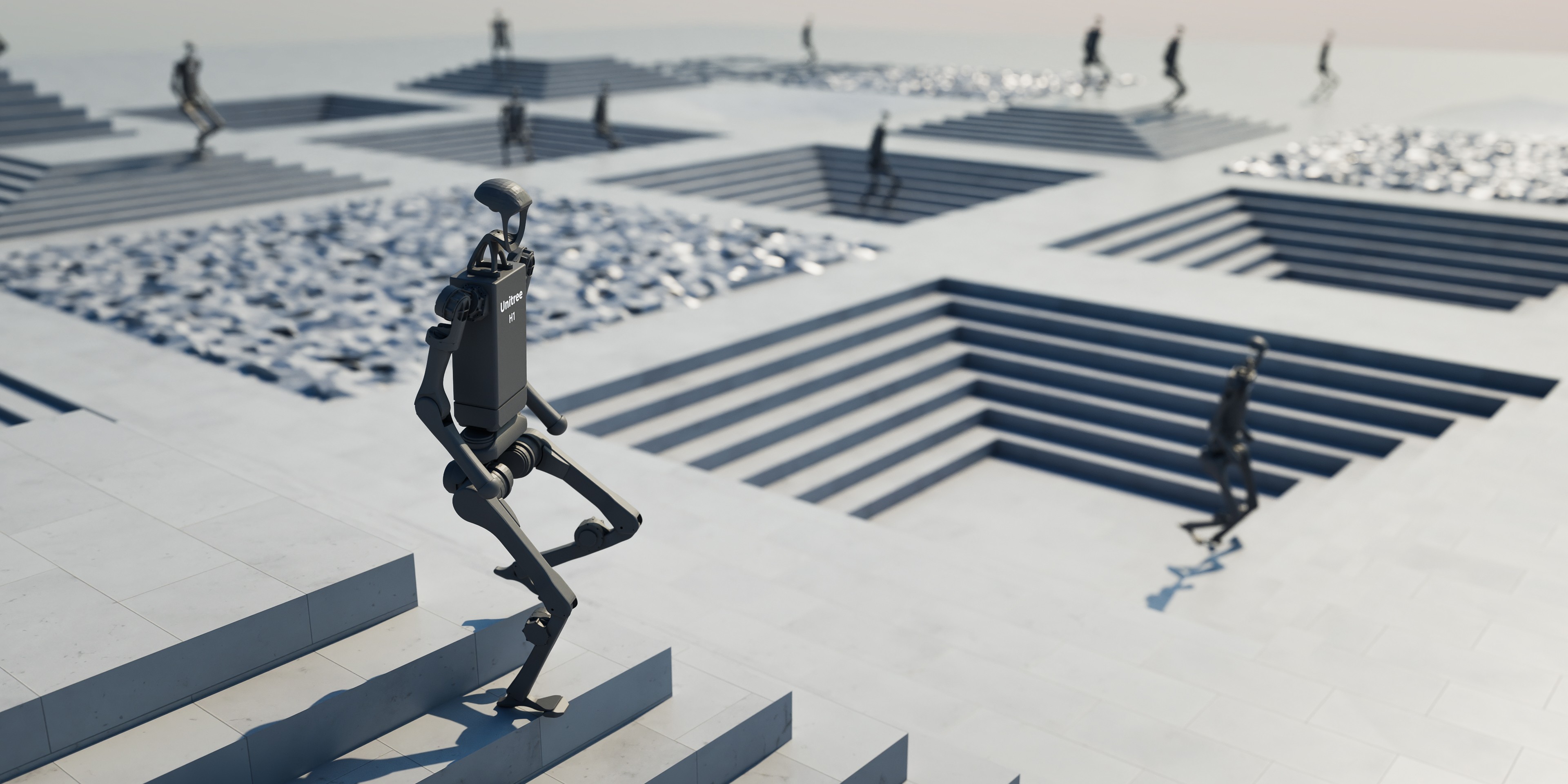
Perceptive locomotion policies typically observe a dense robot-centric elevation map, although only the terrain beneath and around the next footsteps informs the control decision. Learned encoders compress the whole visual input, leaving the policy to work out which inputs matter while learning the baseline locomotion task. Learning both at once slows training and, without computationally expensive attention mechanisms, makes generalization to new terrain harder. We instead remove redundant inputs from the elevation map before the policy sees it. A lightweight foothold prediction model (FPM) predicts future footholds from proprioception and the velocity command alone, and we sample the elevation map only in small patches around these predicted footholds. We train the prediction model alongside the locomotion policy, periodically retraining it on new policy rollouts as the robot's gait matures. This allows the perception to anticipate where the policy will step, while the policy learns to leverage terrain information around those steps. With the proposed lightweight preprocessing, the policy reaches a given terrain difficulty in roughly a third of the training iterations required with the complete map. It outperforms policies that observe the complete map where footholds are sparse, including in narrow walled corridors, and on unseen terrain, and it matches an attention-based encoder trained at several times the cost. The policy transfers zero-shot to a Unitree G1 humanoid traversing various obstacles, stairs, gaps, and step-downs beyond the training distribution in both indoor and outdoor environments.

cs.ROcs.LGrobothumanoidlocomotion

追踪学者:Marco Hutter;兴趣:reinforcement learning for legged locomotion and sim-to-real transfer

#72026-10-1695

LAW: Unifying Language, Action, and World Modeling for Agentic Physical Intelligence

Jiajun Cao, Kai Tang, Bohua Zhang, Zezhong Qian, Ying Li, Xiaozhu Ju 等

World-action models jointly predict actions and future world states, but long-horizon manipulation further requires language reasoning to plan subtask objectives, assess execution …

World-action models jointly predict actions and future world states, but long-horizon manipulation further requires language reasoning to plan subtask objectives, assess execution progress, and guide action selection. We present LAW, a closed-loop VLM--WAM framework that unifies language reasoning, action generation, and world modeling through semantic subtask progress. Within the LAW agent, a hybrid-expert vision-language model plans the remaining subtasks, estimates the values of and fuses actions proposed by a world-action model, and asynchronously assesses execution status to support continued execution and subtask transitions. Within the world-action model, Mixture-of-Transformer Experts integrates modality-specific and shared computation for joint video--action modeling. Dual-stream hierarchical visual memory maintains temporal context for both models, while subtask-local value learning aligns action evaluation with semantic objectives and preserves supervision from successful prefixes of failed trajectories. LAW achieves 94.21% average success across 50 RoboTwin tasks. Replacing the WAM backbone with OpenWAM-$alpha$ further raises the average success rate to 95.56%, establishing a new open-source state of the art on RoboTwin. Despite having only 2B parameters, our VLM also outperforms variants using Embodied-R1.5 and GPT-5.5 High. On three long-horizon real-robot tasks, LAW achieves 65% average success, compared with 28.33% for $pi_{0.5}$ and 25% for Fast-WAM.

cs.ROrobotmanipulationembodied

兴趣:vision-language-action (VLA) models and foundation models for robots

#82026-10-1794

GazeAct: A Human-Gaze-Annotated Manipulation Dataset for Attention-Regularized Policies

Anupam Pani, Wang Yuan, Qifan Wang, Yanchao Yang

Vision-language-action (VLA) policies must ground language instructions in the right objects, contact points, and target locations for reliable manipulation. Human gaze provides a …

Vision-language-action (VLA) policies must ground language instructions in the right objects, contact points, and target locations for reliable manipulation. Human gaze provides a natural signal for this grounding, but existing robot datasets rarely pair real human gaze with the multi-camera observations used by modern policies. We introduce GazeAct, a gaze-equipped real-robot manipulation dataset and training framework for multi-view VLA policies. Using screen-based teleoperation, we record gaze directly on the robot camera feed viewed by the operator, yielding 12000 demonstrations across 40 tasks and five domains with 300 Hz gaze synchronized with images, proprioception, and actions. We transfer gaze from the operator-selected view to the remaining synchronized cameras, producing spatially consistent targets across the policy's visual inputs. We then use these gaze-derived targets to regularize language-conditioned visual attention during training while keeping inference gaze-free. Across 18 real-world tasks, our method improves average success from 48.1% to 58.6%, with gains up to 25 percentage points. Ablations show that gaze works best as soft supervision and that real human gaze provides stronger attention targets than generic attention-shaping priors. The gains transfer to LIBERO-Spatial (57.9% to 69.6%) and different VLA backbones.These results show that gaze collected in the robot observation space can provide effective training-time targets for improving visual grounding in VLA manipulation.

cs.ROcs.AIrobotmanipulationVLAvision-language-action

兴趣:vision-language-action (VLA) models and foundation models for robots

#92026-10-1694

VLA-Fabric: Learning Interaction for Composable Multi-Arm VLA Agents

Chenglong Zhang, Shuaijun Liu, Feiyang You, Shuyang Hao, Chengyu Wu, Ningxin Su

Vision-language-action (VLA) models are rapidly expanding what individual robots can accomplish, yet many real-world manipulation settings require multiple arms to operate as a coo…

Vision-language-action (VLA) models are rapidly expanding what individual robots can accomplish, yet many real-world manipulation settings require multiple arms to operate as a coordinated system. Existing approaches organize multi-arm coordination in different ways, including centralized joint policies, high-level task or role assignment, and locally executed policies that react to teammates. However, how complete action-producing VLAs should explicitly interact with one another during action generation remains largely unexplored. We introduce VLA-Fabric, which organizes one complete VLA per arm while preserving local perception and action ownership, and enables coordination through learned interaction across policy boundaries. We first systematically study where such interaction should occur, how peer information should be aggregated, and how the interaction should be learned, revealing complementary coordination functions spanning shared context, peer-specific latent information, and action-stage interaction. We then re-instantiate these functions in a structurally different VLA architecture, showing that the coordination principle is not tied to a particular tensor layout or backbone implementation. Finally, we compose teams of three and four arms and evaluate them in simulation and physical experiments. On all four physical tasks, Full interaction improves success over independently trained local policies by 16--40 percentage points. Together, these results suggest that explicit interaction among complete VLA policies offers a scalable path toward networked embodied intelligence.

cs.ROmanipulationVLAvision-language-actionembodied

兴趣:vision-language-action (VLA) models and foundation models for robots

#102026-10-21追踪学者 · Cewu Lu94

DepState-JEPA: Learning Depth-Grounded State Representation for Visual Perception and Manipulation

Xiujian Liang, Liuyuan Na, Zehao Du, Jiacheng Xu, Weixi Song, Mingyang Sun 等

Predictive representations for robot manipulation should connect scene geometry with the state changes induced by actions. Our intuition is that understanding what an action will c…

Predictive representations for robot manipulation should connect scene geometry with the state changes induced by actions. Our intuition is that understanding what an action will change starts with understanding where things are: complementary RGB and depth observations ground a common scene representation from which to infer those changes. Guided by this intuition, we introduce DepState-JEPA, a dual-stream RGB--Depth joint-embedding predictive architecture that connects spatial understanding with action-conditioned prediction through a shared latent state, DepState. Built on V-JEPA~2.1, the framework uses depth both as a complementary observation stream and to ground both modalities in metric 3D space, aggregating shared information into DepState while retaining modality-private features for decoding. Ray-conditioned readouts predict local features without target depth; after an action-conditioned transition, the same decoders predict future RGB and depth features using the predicted state and fixed initial private features. Robot-state readouts provide recursive proprioceptive inputs; object-trajectory supervision and calibrated forward kinematics shape state learning through motion targets and joint--TCP consistency. Comparisons show stronger RGB-encoder transfer after RGB-D adaptation, feature completion, conditioned visual forecasting, and manipulation success. Within-model ablations identify contributions from depth content, metric coordinates, and future-state matching, with additional control gains from FK regularization.

cs.ROcs.CVrobotmanipulation

追踪学者:Cewu Lu;兴趣:3D perception, point clouds and scene understanding for robotics

#112026-10-1694

From Sliding Windows to Self-evolving Lifelong Memory: A Dual-perspective Survey of Memory Paradigms for Long-Horizon Robotics VLA Models

Yong Wang, Boyu Shen, Xinwei Zhang, Yizheng Li, Keyuan Luo

Long-horizon robotic tasks expose a fundamental limitation of current Vision-Language-Action (VLA) models because their restricted temporal context pre-vents effective accumulation…

Long-horizon robotic tasks expose a fundamental limitation of current Vision-Language-Action (VLA) models because their restricted temporal context pre-vents effective accumulation and reuse of past experiences. As a result, memory has become a fundamental component for enabling embodied agents to perform long-horizon reasoning and adaptive decision-making. This survey presents a systematic taxonomy of VLA memory mechanisms based on memory scope and persistence, categorizing existing approaches into five representative paradigms and one emerging frontier. Based on this taxonomy, we compare representative VLA memory systems in terms of memory characteristics, architectural com-plexity, and open-source maturity, revealing a clear trade-off in which increasing architectural complexity is generally accompanied by decreasing open-source ma-turity. Finally, we discuss the key challenges in building full-lifecycle memory systems, including efficient memory management and lifelong knowledge evolu-tion. Overall, this survey provides a unified perspective on memory architectures for VLA agents and offers insights into the development of lifelong embodied in-telligence.

cs.ROVLAvision-language-actionembodied

兴趣:vision-language-action (VLA) models and foundation models for robots

#122026-10-1792

Touch Where It Matters: Learning Local Tactile Policies for Fine-Grained Gripper Control

Mingyuan Ba, Yanan Zhou, James Zhao, Weiming Zhi

Visual imitation policies can organise task motion, yet contact-rich object use demands gripper adjustments beyond coarse opening and closing. We study fine-grained gripper control…

Visual imitation policies can organise task motion, yet contact-rich object use demands gripper adjustments beyond coarse opening and closing. We study fine-grained gripper control as a local feedback problem within ongoing task execution. Our approach assigns tactile feedback a dedicated control role during contact-rich task stages. We introduce ContactPolicy, a learned local controller that takes over the gripper while a visual base policy continues to control the arm. ContactPolicy combines tactile and force histories with current robot state to jointly predict gripper increments and their modulation, updating the gripper target from each new observation. An Intent policy manages control handover between the visual base policy and ContactPolicy. Real-world experiments on container opening, object handling, and tool operation show improved task success over both the Visuomotor Policy and Tactile-Force Policy baselines. Execution analysis illustrates how the gripper adjusts contact within an ongoing task, including periods of target retention and fine-grained changes as interaction conditions evolve. Arm-state ablations and failure analysis further examine how execution context supports local regulation. These results support task-local tactile policies for fine-grained gripper control within visual manipulation.

cs.ROrobotmanipulationtactile

兴趣:robot manipulation and grasping with learned policies

#132026-10-1692

No Eyes, No Problem: What Does Touch Contribute to Blind Baoding Ball Manipulation?

Ayush Deshmukh, Nalin Agarwal, Elle Miller, Sethu Vijayakumar

Humans manipulate objects within their hands through touch alone with remarkable ease, but for robots, achieving sustained real-world manipulation without vision remains an open ch…

Humans manipulate objects within their hands through touch alone with remarkable ease, but for robots, achieving sustained real-world manipulation without vision remains an open challenge. Although reinforcement learning (RL) can generate sophisticated blind manipulation policies in simulation, transferring them to a real dexterous hand remains hindered by continuously changing contacts, motion-induced tactile information drift, and the gap between simulated and physical dynamics. We study this problem through Baoding ball rotation on the Shadow Dexterous Hand Lite, using only proprioception and binary tactile feedback as observations. We achieve successful zero-shot transfer through a combination of a sensor-aligned, coupling-aware embodiment in simulation, tactile calibration, and two novel episodic domain randomisations: slew-rate action limits and STuck-AT Taxels. On the physical hand, the policy achieves sustained blind Baoding rotation, completing 225 consecutive $180^\circ$ rotations (112.5 full rotations) at $\sim0.36 \;rot/s$ in a single continuous trial without any vision or object-state information. Furthermore, we evaluate the contribution of tactile sensing relative to proprioception alone and identify the hand regions where tactile information is most important. This is the strongest reported hardware result for Baoding ball manipulation in both rotation count and speed, irrespective of the sensing modality used. By effectively bridging the sim-to-real gap, our framework sets a new benchmark for sustained tactile-driven dexterous manipulation on physical hardware.

cs.ROmanipulationsim-to-realdexteroustactile

兴趣:dexterous hands and tactile sensing

#142026-10-2092

Flexible Language-Guided Representation Editing for Adaptive Robot Behavior

Audrey Lee, Nathaniel Dennler, Ilia Sucholutsky, Andreea Bobu

Trajectory demonstrations show robots how to behave but not why, leaving them to guess which features of the task actually matter. Incorrect guesses produce misaligned internal rep…

Trajectory demonstrations show robots how to behave but not why, leaving them to guess which features of the task actually matter. Incorrect guesses produce misaligned internal representations and lead to incorrect robot behaviors. Because task features are often semantically defined, we argue that natural language is better suited for specifying features rather than relying on demonstrations. Although existing representation editing methods have proposed using language to specify new features, only allowing additive edits produces feature sets that are often over-specified or too narrowly scoped, especially in sequential editing tasks. We propose the Flexible Feature Editing Pipeline (FLEX), which uses language models to iteratively refine a robot's internal representation of task features from natural language corrections via three complementary operations: Add missing features, Generalize existing specific features, and Mask irrelevant features. We evaluate FLEX on 2D navigation scenarios, 7DoF Franka tabletop manipulation tasks, and a real-world study using naturalistic human language corrections and real-robot demonstrations. Comparisons against single-operation and unscaffolded baselines show that all three operations are necessary in interactive scenarios, and that FLEX achieves consistently higher normalized reward compared to other feature editing approaches while maintaining compact, transferable representations. Project available at https://mit-clear-lab.github.io/FLEX/

cs.ROrobotmanipulation

兴趣:large language models for robot task planning and reasoning

#152026-10-1692

Look Before You Act: Bridging Active Perception and Vision-Language-Action Models via Observation-Aligned Data Adaptation

Jiawei Geng, Zhenyang Liu, Yuzheng Wu, Yongchong Gu, Yanwei Fu

Robots manipulating objects in clutter must decide not only how to act, but also where to look. Although active camera motion can expose an occluded target, it may move the robot i…

Robots manipulating objects in clutter must decide not only how to act, but also where to look. Although active camera motion can expose an occluded target, it may move the robot into an initial observation-state distribution that differs from the manipulation policy's training distribution. We identify this problem as first-frame distribution sensitivity: under perturbed starts in LIBERO, naively prepending camera repositioning to pi_0.5 reduces success from 46.3% to 11.5%. We introduce ActiveAlign, a data-adaptation framework that trains a Vision-Language-Action (VLA) policy from the states at which active perception terminates. A learned viewpoint module first generates a camera trajectory. Offline, ActiveAlign uses closed-loop alignment to connect the trajectory endpoint to an existing demonstration, replays the remaining manipulation trajectory, and retains successful continuations for fine-tuning. At deployment, the same viewpoint module precedes the adapted VLA without modifying its architecture. Across 40 LIBERO tasks, ActiveAlign achieves 70.7% success with pi_0 and 72.7% with pi_0.5, outperforming their standard-training baselines by 40.0% and 26.4% respectively. Matched-state and data-matched controls support gains beyond prefix shortening and generic viewpoint augmentation; OpenVLA and GR00T N1 also show the same trend. Success rate under physical occlusion in real world increases from 35/90 to 83/90. These results show that active perception benefits manipulation when policy training is aligned with the observation and robot-state distribution induced by viewpoint selection.

cs.ROrobotmanipulationVLAvision-language-action

兴趣:vision-language-action (VLA) models and foundation models for robots

#162026-10-16追踪学者 · Pulkit Agrawal92

Blind Precise Assembly: Proprioceptive Sim-to-Real Peg-in-Hole for Diverse Parts

Antonia Bronars, Younghyo Park, Kushal Kedia, Pulkit Agrawal

Every robot already carries high-resolution contact sensors: its own joints. Legged robots and humanoids exploit them to walk, run, and track whole-body motions without vision, but…

Every robot already carries high-resolution contact sensors: its own joints. Legged robots and humanoids exploit them to walk, run, and track whole-body motions without vision, but there the contacts are large and forceful. Is joint sensing also enough for precise, contact-rich assembly, where the robot must find a millimeter-scale opening, mesh gear teeth, or catch a thread through light contact? We study this question by training blind assembly policies that observe only a short history of joint positions, velocities, and their own actions, without visual, force, torque, or tactile sensing. The poses of both the fixture and the part are unknown to the policy, and the grasp is randomized substantially. The policy must therefore assemble the parts through contact, sensed exclusively through its own proprioception. Trained with reinforcement learning entirely in simulation over randomized parts, grasps, and contacts, such policies learn peg insertion, gear meshing, and nut threading. The peg insertion policy transfers zero-shot to the real world and inserts pegs of different shapes and sizes in 73% of trials. Controlled comparisons with matched visual policies in simulation show that blind policies generalize far better to unseen part shapes and sizes, though they can be slower. Training such policies needs thousands of different assemblies, each simulated with its clearance intact, so we also release an open-source generator that builds them procedurally from exact convex pieces for MuJoCo; it is more accurate and faster than convex decomposition or MuJoCo's signed-distance collision. Videos and interactive simulations are at https://younghyopark.me/blind-proprioceptive-assembly/.

cs.ROrobotgraspleggedsim-to-realtactile

追踪学者:Pulkit Agrawal;兴趣:robot manipulation and grasping with learned policies

#172026-10-15追踪学者 · Pieter Abbeel92

Scaling Online Exploration for Robot Agents

Runhan Huang, Xiangcheng Zhang, Haoyu Chen, Yitong Li, Yen-Jen Wang, Bohan Lyu 等

Robot learning has advanced by scaling demonstration datasets and model capacity; however, deploying a new robot embodiment or task typically necessitates a dedicated teleoperation…

Robot learning has advanced by scaling demonstration datasets and model capacity; however, deploying a new robot embodiment or task typically necessitates a dedicated teleoperation corpus. The resulting policies remain bounded by their imitation distributions, limiting generalization and continual self-improvement. We introduce RAX (Robot Agent eXploration), an open-source framework for robot agents centered on scaling exploration: enabling agents to improve by acquiring online experience and synthesizing executable programs. In RAX, a general-purpose coding agent generates robot control code, operating without action demonstration data, hand-engineered action primitives, or value-function guidance. Through online exploration, the agent identifies decision sequences that achieve task goals and compiles them into modular programs encapsulating the full perception-planning-control loop. Using RAX, we present a systematic multi-embodiment study on scaling online exploration across precision and long-horizon manipulation tasks using single-arm, bimanual, dexterous, mobile, and humanoid systems in simulation and on real robots. Generalization performance on unseen environments improves consistently as exploration scales. In simulation, RAX outperforms top baseline models by +37.4% on average. On real robots, RAX autonomously learns memory-dependent, articulated, high-precision, deformable, and long-horizon mobile manipulation tasks without human demonstrations, continually improving performance by composing verified skills from prior exploration sessions. As exploration scales, we observe emergent capabilities including active perception, error recovery, safety guardrails, and human-robot collaboration. We open-source RAX as a generalist robot-agent platform in which new robot embodiments are integrated through their APIs alone, without teleoperated data collection or policy training.

cs.ROrobotmanipulationhumanoiddexterous

追踪学者:Pieter Abbeel;兴趣:imitation learning and diffusion policies for robot control

#182026-10-1691

Enhancing Visual Task-Redirection Attacks on Vision-Language-Action Models via Closed-Loop Optimization

Chunjin Ye, Guanying Chen, Jianjie Huang, Jianhao Chen, Quanlin Chen, Hanjie Zhao 等

Vision-language-action (VLA) models enable language-guided robot manipulation, but remain vulnerable to visual attacks that undermine user control over robot behavior. Prior studie…

Vision-language-action (VLA) models enable language-guided robot manipulation, but remain vulnerable to visual attacks that undermine user control over robot behavior. Prior studies optimize visual perturbations using fixed target supervision. However, the perturbation can change earlier actions and, in turn, the physical states reached later. As the attacked trajectory evolves, this supervision may no longer match the behavior needed at the states actually reached. Accurately matching these targets can therefore fail to advance the attacker-specified task. Even with suitable supervision, reducing average matching error does not ensure sustained task progress. The robot may still fail at a critical stage, and further updates can disrupt previously successful behavior. To address these limitations, we propose TRACO, a framework that enhances existing targeted visual attacks through closed-loop optimization. Its Execution-Driven Supervision rebuilds supervision for the states reached under attack to guide subsequent updates. Within this framework, Progress-Guided Selection focuses updates where progress stalls while maintaining supervision on the earlier behavior needed to reach that point. Experiments across VLA models and simulation environments show improved task-redirection success with TRACO, highlighting the security implications of closed-loop attack optimization.

cs.ROrobotmanipulationVLAvision-language-action

兴趣:vision-language-action (VLA) models and foundation models for robots

#192026-10-1691

NestedVLA: Learning to Consolidate and Generate Skills for Vision-Language-Action Models

Guodong Du, Wanyu Lin

Vision-language-action (VLA) models can learn a wide range of robotic skills, but combining separately trained skills remains challenging. The original training data may be unavail…

Vision-language-action (VLA) models can learn a wide range of robotic skills, but combining separately trained skills remains challenging. The original training data may be unavailable for joint retraining, while directly merging model weights can cause interference. We propose NestedVLA, which consolidates independently fine-tuned VLA policies without access to their original training data. Instead of merging all updates into one checkpoint, a hypernetwork embedded in the VLA generates action-expert weight updates for a selected task. Each task's compressed vision-language model update is stored separately, and both updates are added to a frozen base VLA to instantiate the corresponding policy. We evaluate NestedVLA by consolidating three policies fine-tuned with reinforcement learning on MetaWorld, ManiSkill, and CALVIN. It achieves 66.7% average success, improving on the strongest model-merging baseline by 41.1 percentage points. It performs within 1 percentage point of per-task fine-tuning on ManiSkill and substantially narrows the gap on CALVIN. In this three-policy setting, total storage is 1.5x that of a single full checkpoint. Code is available at https://github.com/WanyuGroup/NeurIPS2026-NestedVLA.

cs.ROcs.LGVLAvision-language-action

兴趣:vision-language-action (VLA) models and foundation models for robots

#202026-10-1691

DefFlow: Goal-Conditioned Deformable Object Manipulation using 3D Point Flows

Gaurav Singh, Sergio Orozco, Ryan Duong, Mete Tuluhan Akbulut, George Konidaris, Srinath Sridhar

Manipulating deformable objects toward desired 3D configurations is a fundamental capability for robots operating in unstructured physical environments. However, as the range of po…

Manipulating deformable objects toward desired 3D configurations is a fundamental capability for robots operating in unstructured physical environments. However, as the range of possible initial and target configurations grows, goal-conditioned deformable manipulation requires a robot to infer increasingly diverse manipulation behaviors in addition to precise continuous actions. We introduce DefFlow, a framework for goal-conditioned manipulation of deformable objects toward a broad range of 3D configurations. DefFlow learns from demonstrations by jointly predicting the goal-conditioned 3D point flow of the robot and deformable object. We show that this formulation better captures both the manipulation decisions, such as when and where to grasp, release, or re-grasp, and the precise continuous motions required for goal reaching, rather than predicting only the robot flow. Across rope, granular-media, and cloth manipulation settings with diverse initial and target configurations, DefFlow substantially outperforms goal-conditioned action-prediction and robot-flow-only baselines on success rates and goal-distance metrics. We further demonstrate deployment of our framework on a real robot using real point-cloud observations and unseen goal configurations.

cs.ROrobotmanipulationgrasp

兴趣:robot manipulation and grasping with learned policies

#212026-10-2191

TARSphere: A Robot-Oriented Full-Stack Framework for Long-Horizon Embodied Agents in Evolving Physical and Social Environments

Yicheng Xu, Zhikai Xu, Ziyuan Chen, Yuhang Dong, Tao Zhang, Zhucun Xue 等

Robots must act under physical and social constraints while adapting to changes in their environment and human needs. Existing embodied-agent systems often focus on specified goals…

Robots must act under physical and social constraints while adapting to changes in their environment and human needs. Existing embodied-agent systems often focus on specified goals or abstract execution into symbolic actions, limiting evaluation in an evolving world. We introduce TARSphere, a robot-oriented full-stack framework for physically and socially grounded long-horizon embodied agents. TARSphere-Infra runs robot policies in a physics simulator with embodied NPCs and constrained dialogue. An event-driven finite-state machine (FSM) uses completed actions and delivered information to update task states and evaluate outcomes. TARSphere-Harness, its embodied brain harness, lets a frozen multimodal large language model (MLLM) act through multi-level executable skills, using observations, hierarchical memory, and execution feedback to revise its decisions. On this foundation, agent-in-the-loop curation aligns task semantics, causal dependencies, and scene geometry to construct TARSphere-Bench: 360 episodes across 30 indoor scenes. Five paired conditions assess perceptual robustness, disruption adaptation, task update, human coordination, and intent understanding for navigate-and-report and fetch-and-deliver tasks. Our evaluation of 8 MLLMs shows that general-purpose models can outperform embodied models, while task updates and human interaction remain difficult. Frequent collisions and falls further motivate evaluating execution safety alongside task success, even with a shared action interface and decision budget.

兴趣:world models and video prediction for embodied agents

#222026-10-1691

CoEvolve: Self-Evolving Code Policies from Skills to Strategies for Humanoid Robots

Zicheng Liu, Haochen Wu, Jiawei He, Suyun Zhao, Huan Yang, Cheng Chi 等

Recent advances in Vision-Language-Action (VLA) models and World Action Models (WAMs) have expanded the manipulation and whole body capabilities of individual robots. Yet a single …

Recent advances in Vision-Language-Action (VLA) models and World Action Models (WAMs) have expanded the manipulation and whole body capabilities of individual robots. Yet a single robot remains limited by its embodiment, and many real world tasks require capabilities that can only emerge through cooperation. Existing multi robot frameworks largely emphasize task decomposition, allocation, and replanning, while providing limited support for adapting executable coordination when physical execution deviates from the intended behavior. We present CoEvolve, a framework that represents team coordination as executable code over fixed robot motor skills. CoEvolve introduces Verifier Guided Coordination Evolution, where a multimodal foundation model instantiates coordination strategies through motion primitives, semantic objectives, temporary robot roles, and bounded execution parameters. Physical verification evaluates each executed transition, rejected behaviors trigger structured coordination revision from an accepted checkpoint, and verified experience is retained to guide subsequent decisions. We evaluate CoEvolve with two simulated Unitree G1 humanoids transporting a freely supported rigid payload through constrained corridors. Across 15 base task runs with three multimodal backbone families, CoEvolve completes 8 tasks, with every backbone achieving end to end success. Additional evaluations yield verified placement on two additional corridor layouts and after both same-backbone and cross-backbone experience initialization, while exposing persistent limitations in motion precision and contact stability. These results support executable coordination as a practical interface for adapting long horizon multi robot collaboration under shared physical constraints.

cs.ROrobotmanipulationVLAvision-language-actionhumanoid

兴趣:humanoid robots and whole-body control

#232026-10-1690

BeJEPA: A Goal-Conditioned Humanoid Behavior World Model via Unsupervised RL

Liyun Yan, Haoyang Li, Yang Zhang, Jialing Zhu, Zhanxiang Cao, Zihao Zhou 等

Humanoid control requires coordinating whole-body posture with position and heading in the world frame. Mainstream controllers imitate trajectories in the root frame, but struggle …

Humanoid control requires coordinating whole-body posture with position and heading in the world frame. Mainstream controllers imitate trajectories in the root frame, but struggle to regain the target world pose after displacement. We introduce BeJEPA, a goal-conditioned Behavior World Model learned through unsupervised reinforcement learning from human motion priors and robot interaction. BeJEPA learns a shared representation of body configuration and world placement through a joint-embedding predictive architecture (JEPA). A Dynamic Predictor predicts the next state embedding under an action, while a Successor Predictor summarizes a goal-conditioned policy's expected discounted future state embeddings in a single vector. During joint training, Dynamic grounds the initial representation in observed physical transitions, while Successor increasingly organizes it around long-term behavior. Their composition guides policy improvement through one physical prediction and one behavioral summary, without long imagined rollouts. In 20-second motion-tracking experiments, BeJEPA with online action refinement using Dynamic outperforms all evaluated baselines in global body-position error, reducing it on AMASS by 61.7% relative to BFM-Zero with world-pose inputs and 58.7% relative to SONIC. Physical deployment on a Unitree G1 demonstrates joint attainment of posture, world position, and heading goals, recovery from the ground, and closed-loop return after disturbances and goal changes. Project page: https://ylyem9x.github.io/BeJEPA-project.

cs.ROrobothumanoidworld model

兴趣:humanoid robots and whole-body control

#242026-10-1690

Embodiment-Aware Planning for Heterogeneous Bimanual Manipulation

Sukhvansh Jain, Anurag Maurya, Shivam Vats, Narendra Kumar Dhar, Ravi Prakash

Many manipulation tasks that are effortless for dexterous human hands remain challenging for robotic systems equipped with simple, task-specialized grippers. Industrial platforms c…

Many manipulation tasks that are effortless for dexterous human hands remain challenging for robotic systems equipped with simple, task-specialized grippers. Industrial platforms commonly rely on end-effectors such as suction cups or parallel-jaw grippers, yet no single mode can reliably satisfy the diverse constraints encountered across different phases of complex manipulation tasks, including pickup, reorientation, insertion, and constrained placement. In this work, we investigate whether complementary simple grippers within a heterogeneous bimanual setup can collectively realize tasks that exceed the capability of any individual gripper alone. Given a single human demonstration specifying the desired object motion, we formulate embodiment-aware execution as a finite-horizon optimization over arm-trajectory assignments. At each segment, the planner determines whether single-arm manipulation or a coordinated dual arm handover is required, jointly reasoning over heterogeneous grasp feasibility, motion constraints, manipulability, and cross-gripper compatibility. Exploiting this formulation, we compute globally consistent assignments with explicit switching regularization. Experiments on a dual Franka FR3 platform equipped with suction and parallel-jaw grippers demonstrate improved feasibility and reliability in tasks that are infeasible under single-gripper execution.

cs.ROmanipulationgraspdexterous

兴趣:robot manipulation and grasping with learned policies

#252026-10-2190

From Reasoning to Action: Benchmarking Frontier AI Models on LIBERO-10 Robot Manipulation Tasks

May Espinola, Qifan Zhang, Yu Xiang

Recent advances in frontier AI models have demonstrated remarkable capabilities in visual understanding, reasoning, planning, and tool use, raising the possibility of using general…

Recent advances in frontier AI models have demonstrated remarkable capabilities in visual understanding, reasoning, planning, and tool use, raising the possibility of using general-purpose AI models for robot manipulation without task-specific training. However, their manipulation capabilities have not been systematically evaluated on standardized robotics benchmarks. In this report, we present a unified closed-loop manipulation framework for evaluating frontier AI models on the LIBERO-10 benchmark. Our framework enables models to control a robot directly through visual observations, robot proprioception, and structured tool calls, primarily by specifying target end-effector poses and gripper commands, without task-specific fine-tuning or pretrained manipulation skills. We evaluate six frontier AI models, including GPT-6 Astra, GPT-6.1 Sol, GPT-6 Luna, Claude Opus 5, Claude Opus 5.5, and Gemini-4 Argon, across three reasoning effort levels, resulting in 18 configurations and 1,800 evaluation episodes. Our results show that GPT-6 Astra achieves the highest success rate of 44%, followed by Gemini-4 Argon at 43%. Increasing reasoning effort generally improves manipulation performance, but the benefits vary across models and come at additional inference cost. We also observe substantial differences across tasks, with models performing relatively well on object placement tasks but struggling with precise spatial arrangements and complex multi-step interactions. These findings demonstrate both the potential and limitations of frontier AI models for robot manipulation, highlighting the challenges of translating reasoning capabilities into reliable physical actions. We release our evaluation framework and experimental results to support reproducible benchmarking and future research on reasoning-based robot manipulation.

cs.ROcs.AIrobotmanipulation

兴趣:large language models for robot task planning and reasoning

#262026-10-1990

PrismWAM: Decoupling State Representations in World Action Models

Tianyu Xin, Wanqi Zhong, Bowen Hu, Zhangchi Guo, Lijie Wang, Yiming Wang 等

World Action Models (WAMs) typically represent the world through latent embeddings from pretrained video models, which entangle heterogeneous aspects of the world, from how it look…

World Action Models (WAMs) typically represent the world through latent embeddings from pretrained video models, which entangle heterogeneous aspects of the world, from how it looks (e.g., texture and color) to how it is physically configured (e.g., occupancy and pose). This raises an underexplored question: $what should constitute the state of a WAM?$ We argue that the world state should separate how the world appears from how the world evolves under action: the former captures semantic context, while the latter is governed by physical state. To this end, we propose $PrismWAM$, which decouples physics from semantics while jointly modeling state and action. PrismWAM factorizes an embodied task into a $Semantic\ Planning\rightarrowPhysical\ Rollout\rightarrowExecutable\ Action$ pipeline: given only the initial RGB observation, semantic planning learns to predict the final goal image, while physical rollout predicts the fine-grained evolution toward this goal in depth space; executable actions are then generated from the depth rollout. Without any embodied action pretraining or additional data augmentation, PrismWAM achieves strong manipulation performance in both simulation and the real world. Notably, PrismWAM even surpasses a broad range of models with large-scale embodied action pretraining (e.g., OpenWAM-$α$). More broadly, we reframe World Action Models from modeling how the world looks to how it responds to action, paving the way for action-centric world models grounded in occupancy, flow, tactile sensing, proprioception, and beyond.

cs.CVmanipulationembodiedtactile

兴趣:world models and video prediction for embodied agents

#272026-10-1690

Reinforcement Learning Based Multi-Terrain Adaptive Whole-Body Control for a Quadruped Manipulator

Yanzhou Jin, Fei Suo, Chang Liu, Yasuhisa Hasegawa, Liming Chen, Yusuke Iwasawa 等

Legged robots equipped with manipulators offer promising capabilities for loco-manipulation tasks in unstructured environments. However, achieving task-consistent end-effector beha…

Legged robots equipped with manipulators offer promising capabilities for loco-manipulation tasks in unstructured environments. However, achieving task-consistent end-effector behavior during locomotion remains challenging due to terrain-induced disturbances and the strong coupling between locomotion and manipulation, particularly for small-scale quadruped platforms. A reinforcement-learning based whole-body control framework is proposed for quadruped loco-manipulation on complex terrain. The proposed framework combines a hybrid task representation with task-prioritized whole-body learning to coordinate locomotion and manipulation while preserving task-consistent end-effector behavior. A lightweight quadruped manipulator platform is further developed to validate the proposed framework on a small-scale quadruped system. Real-world experiments demonstrate successful deployment on complex terrains such as slopes up to 30 degrees, stairs, and deformable terrain. These results demonstrate the feasibility of deploying learned whole-body control policy for quadruped loco-manipulation in real-world environments and highlight the importance of task-consistent whole-body coordination for terrain-adaptive loco-manipulation.

cs.ROmanipulationleggedlocomotion

兴趣:reinforcement learning for legged locomotion and sim-to-real transfer

#282026-10-2190

From VLM Planners to Robotic Agents: Self-Evolving Harnesses for History-Dependent Manipulation

Tingwen Du, Haoyu Guo, Hanxue Zhang, Xuanxu Wang, Junting Dong, Chao Gao 等

Vision-language-action (VLA) models achieve strong performance across embodied manipulation tasks by unifying visual understanding, language conditioning, and action generation. Ho…

Vision-language-action (VLA) models achieve strong performance across embodied manipulation tasks by unifying visual understanding, language conditioning, and action generation. However, long-horizon tasks can involve non-Markovian dependencies: successful decisions may require retaining task progress and past interaction outcomes, while partial observability and execution errors compound over time. Existing work has begun to address these challenges by augmenting foundation-model policies with memory and by introducing hierarchical architectures that separate high-level planning from low-level execution. We organize the high-level VLM as a robotic agent through an editable harness to maintain task context and improve planning through execution experience. We instantiate this approach as SERA (Self-Evolving Robotic Agent), with a fixed VLA executor providing low-level control. The harness maintains and updates task context using observations and execution feedback to guide subsequent planning. Self-evolution uses environment rollouts to propose and evaluate harness revisions, with the selected configuration fixed before held-out testing. On RoboMME, SERA achieves 51.38% overall success with autonomous selection, compared with 44.38% without self-evolution. Our exploration suggests that agentic planning is a promising direction for history-dependent robotic manipulation.

cs.ROmanipulationVLAvision-language-actionembodied

兴趣:vision-language-action (VLA) models and foundation models for robots

#292026-10-1690

MambaAct: Efficient Mamba Action Experts for Flow-Matching Vision-Language-Action Models

Khuyen Pham, Tran Nguyen Le, Edoardo Fazzari, Cesare Stefanini

Vision-language-action (VLA) models have shown strong promise for generalist robotic manipulation, but their inference cost remains a major bottleneck for real-time control. This l…

Vision-language-action (VLA) models have shown strong promise for generalist robotic manipulation, but their inference cost remains a major bottleneck for real-time control. This limitation is especially pronounced in flow-matching VLAs such as $π_{0.5}$, where the action expert is evaluated repeatedly during iterative denoising. We introduce MambaAct, an efficient Mamba action expert for flow-matching VLA policies. MambaAct retains the pretrained visual-language prefix encoder of $π_{0.5}$, while replacing its transformer-based action expert with a compact Mamba-based action expert. Within this expert, Mamba serves as the action mixer that models dependencies across the noisy continuous-action sequence. To preserve visual-language conditioning without repeated token-level cross-attention, MambaAct uses a lightweight Context Compressor to map Vision-language model (VLM) prefix tokens into a compact conditioning signal that gates and modulates each Mamba action block. MambaAct uses a $10\times$ smaller action expert and reduces flow-matching denoising latency by $64.8%$ on LIBERO and $58.8%$ in real-world deployment, while improving mean LIBERO success by $1.08$ percentage points across three independent fine-tuning seeds and maintaining gains on LIBERO-Plus and real-world benchmarks. Our code and model weights are publicly available at https://github.com/giakhuyendihoc/MambaAct.

cs.ROcs.CVmanipulationVLAvision-language-action

兴趣:vision-language-action (VLA) models and foundation models for robots

#302026-10-2190

GeoMem-VLA: Internalizing 3D Scene Understanding into Temporal Memory for Vision-Language-Action Models

Qinfan Zhang, Yifan Luo, Haoyuan Shi, Guanlin Liu, Han Dong, Haozhe Shan 等

Geometric structure is essential for robotic manipulation and understanding the 3D world. Most VLA models rely on 2D representations of current observations, while geometry-aware a…

Geometric structure is essential for robotic manipulation and understanding the 3D world. Most VLA models rely on 2D representations of current observations, while geometry-aware approaches often require additional 3D information. However, geometry inferred independently from individual observations is often discarded rather than accumulated into a persistent task representation. Our key insight is that action generation needs a compact, task-relevant geometric abstraction that can be continuously updated, rather than a complete, renderable 3D reconstruction at every step. We introduce GeoMem-VLA, a VLA framework that internalizes explicit 3D supervision into dedicated geometric tokens and maintains them as temporal memory for action generation, without directly aligning the VLM's native visual embeddings with the teacher feature space. During training, a frozen geometry foundation model supervises learnable GeoPlan tokens through a geometric flow-matching objective over the current scene point map and future end-effector tracks. These tokens are integrated with the memory of observation representations, where historical information is retrieved, adaptively fused with current observations, and consolidated to retain event frames as the task progresses. At inference, the policy retrieves historical representations and fuses them with the current working representation to predict actions, without invoking the 3D teacher or explicitly reconstructing the scene. After benchmark-specific downstream adaptation, GeoMem-VLA achieves 98.9% average success on LIBERO and 91.10% / 91.24% on RoboTwin's clean/randomized settings. Across five real-world tasks, GeoMem-VLA achieves 78.0% average success. These results suggest that internalizing and remembering 3D scene understanding is a promising approach to robot control.

cs.CVrobotmanipulationVLAvision-language-action

兴趣:vision-language-action (VLA) models and foundation models for robots

#312026-10-2190

Post-hoc Epistemic Uncertainty for Vision-Language-Action Policies

Johannes Keller, Albrecht M. Bloße, Adrian Lindenmeyer, Thomas Neumuth, Daniel Schneider

Vision-language-action (VLA) policies need to recognize gaps in their training knowledge to request useful demonstrations or assistance in new situations, especially when failures …

Vision-language-action (VLA) policies need to recognize gaps in their training knowledge to request useful demonstrations or assistance in new situations, especially when failures are costly. Disagreement within an ensemble of independently trained policies can guide these decisions, but requires training and running multiple policies. We propose post-hoc kernel-variance heads that estimate epistemic uncertainty from the embeddings of a single policy. Each head computes the conditional variance of a Gaussian process conditioned on embeddings from the training demonstrations. Fitting requires no regression targets or gradient updates and leaves the policy unchanged. In experiments with SmolVLA on LIBERO-10, the kernel variance heads perform competitively with two-policy ensemble scores in task-level correlation with task success, in demonstration acquisition during active learning, and in referral to a stronger supervisor policy as a proxy for human assistance. For SmolVLA, the head on the vision-language backbone reduces uncertainty-scoring time by up to approximately a factor of 50 compared with ensemble scores, while also substantially reducing setup costs. We also show that the established evaluation protocol on LIBERO-10 primarily rewards recognition of coverage differences between tasks, while execution variability weakens assessment of within-task rankings. Thus, controlled perturbations provide a complementary evaluation: modality-specific heads identify unfamiliar camera, instruction, or state inputs, while fused heads can detect unfamiliar combinations of individually familiar inputs. With a supervisor proxy trained on the evaluated perturbation families, the decoder head improves within-task referral over ensemble disagreement. These findings show that useful uncertainty estimates for adaptive robot learning can be obtained from a single policy.

cs.ROcs.LGstat.MLrobotVLAvision-language-action

兴趣:vision-language-action (VLA) models and foundation models for robots

#322026-10-2190

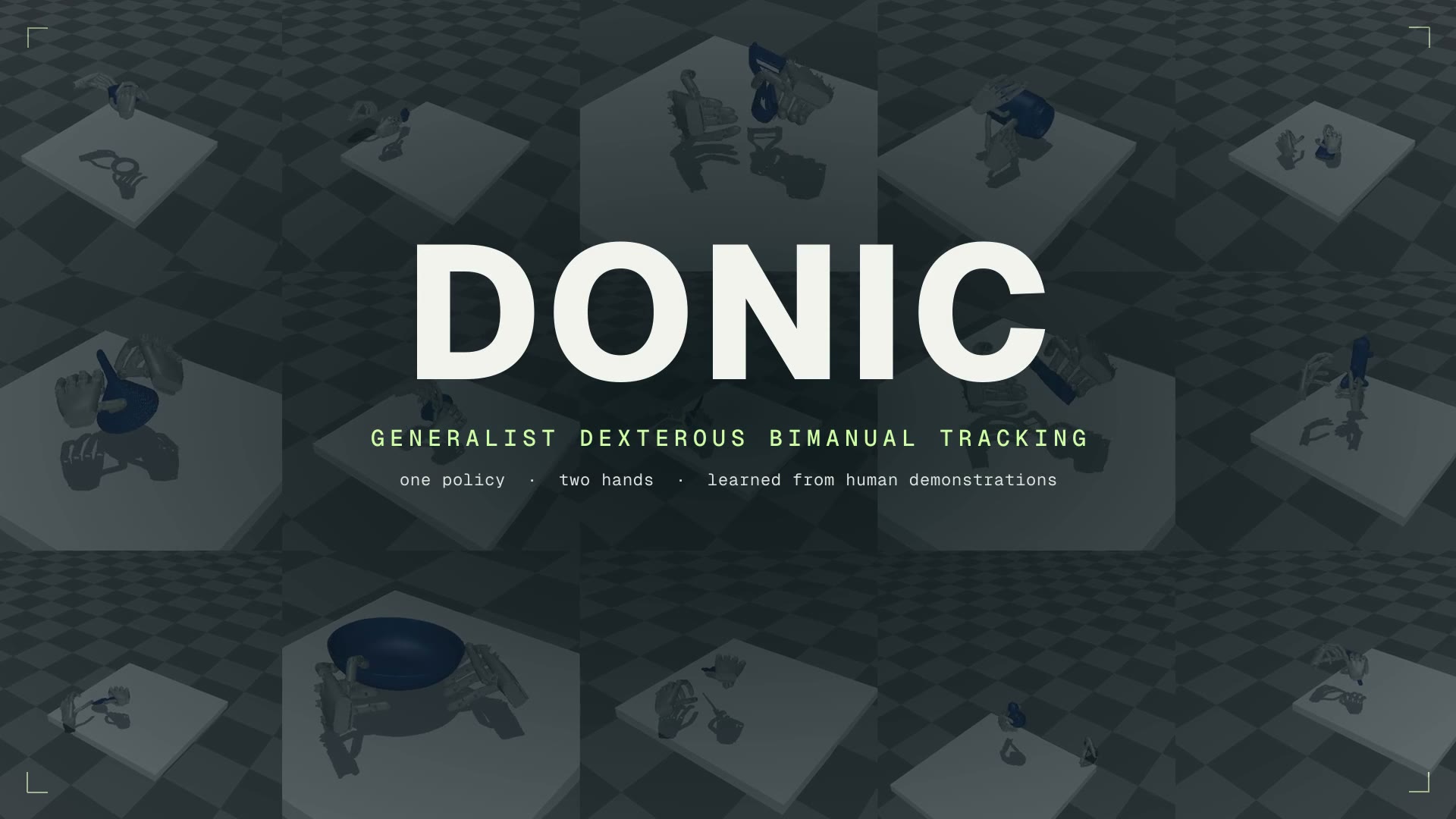
DONIC: Generalist Dexterous Bimanual Tracking Control from Human Demonstrations

Mingze Sun, Ziang Cao, Yuan Fei, Qiankuan Tao, Zihan Wang, Tianqi Liu 等

Despite recent progress in dexterous reference tracking, existing models focus primarily on single-hand manipulation and a limited range of interactions, leaving the bimanual dexte…

Despite recent progress in dexterous reference tracking, existing models focus primarily on single-hand manipulation and a limited range of interactions, leaving the bimanual dexterous behaviors common in real life unaddressed. The scarcity of contact-rich bimanual manipulation data and the increased complexity of coordinating contacts make developing a generalist bimanual tracker particularly challenging. Therefore, we present 1) DONIC, the first generalist bimanual tracker jointly trained across operation categories and human-motion sources, together with 2) BiHOI, a multi-view dataset of 1,575 sequences spanning 229 objects and emphasizing sustained bimanual interaction, where reconstructed interactions are retargeted into robot references. DONIC combines proximal policy optimization with behavioral cloning in a feedback loop that recycles verified successful executions into training demonstrations. An object-centered per-hand reward maintains object-motion feedback while supervising each hand according to its reference contact role. Clip-Centered Advantages remove reference-dependent advantage offsets while preserving within-trajectory differences. Together, these designs enable one single policy to learn coordinated manipulation across heterogeneous references. Without finetuning, a single checkpoint achieves 86.79% success on unseen trajectories of training objects and 57.32% on held-out objects, surpassing the state-of-the-art bimanual tracking baselines by 77.36 and 45.73 percentage points.

cs.ROcs.CVrobotmanipulationdexterous

兴趣:robot manipulation and grasping with learned policies

#332026-10-20追踪学者 · Animesh Garg89

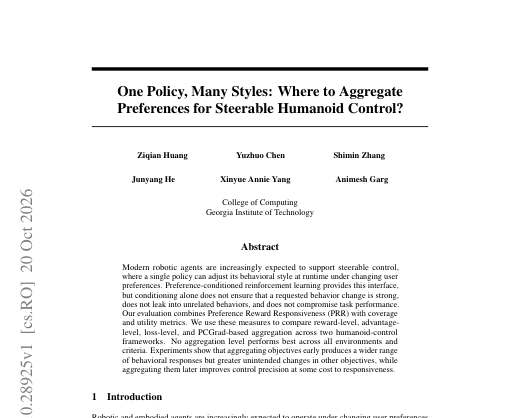
One Policy, Many Styles: Where to Aggregate Preferences for Steerable Humanoid Control?

Ziqian Huang, Yuzhuo Chen, Shimin Zhang, Junyang He, Xinyue Annie Yang, Animesh Garg

Modern robotic agents are increasingly expected to support steerable control, where a single policy can adjust its behavioral style at runtime under changing user preferences. Pref…

Modern robotic agents are increasingly expected to support steerable control, where a single policy can adjust its behavioral style at runtime under changing user preferences. Preference-conditioned reinforcement learning provides this interface, but conditioning alone does not ensure that a requested behavior change is strong, does not leak into unrelated behaviors, and does not compromise task performance. Our evaluation combines Preference Reward Responsiveness (PRR) with coverage and utility metrics. We use these measures to compare reward-level, advantage-level, loss-level, and PCGrad-based aggregation across two humanoid-control frameworks. No aggregation level performs best across all environments and criteria. Experiments show that aggregating objectives early produces a wider range of behavioral responses but greater unintended changes in other objectives, while aggregating them later improves control precision at some cost to responsiveness.

cs.ROcs.LGhumanoid

追踪学者:Animesh Garg;兴趣:imitation learning and diffusion policies for robot control

#342026-10-1589

When Plans Change, Remember: Replanning-Guided Visual Memory for Vision-Language-Action Models

Victoria Smelova, Daniil Kazachkov, Georgiy Kazantsev, Iuliia Tsvetkova, Egor Cherepanov, Nikita Kachaev 等

Long-horizon, multi-stage Vision-Language-Action (VLA) policies often require visual information that is no longer present in the current observation. Retaining the complete observ…

Long-horizon, multi-stage Vision-Language-Action (VLA) policies often require visual information that is no longer present in the current observation. Retaining the complete observation history is computationally expensive and highly redundant, motivating selective visual memory. We introduce RePlanMem-VLA (Replanning-Guided Keyframe Memory for VLA), which turns a policy's own plan revisions into an online memory-write signal. Under receding-horizon execution, consecutive action chunks predict some of the same future actions. RePlanMem-VLA treats unusually large disagreement between these temporally aligned predictions as evidence of a task-relevant event. We first compare 35 disagreement measures across single-task autoregressive decoder-only and Flow-Matching Transformers trained from scratch, then validate the selected signals on pretrained OpenVLA-OFT and $π_{0.5}$ policies over MIKASA-Robo-VLA tasks. The resulting detectors achieve ROC-AUC of 0.981-0.997. We then use the selected signals in RePlanMem-VLA to trigger updates to a bounded visual memory, with a robot-masked write filter suppressing redundant frames. In the evaluated memory-retention experiments, RePlanMem-VLA preserves task-relevant observations until the later decision point in 100% of episodes. Real-robot replay data further show that event selection and redundancy suppression extend beyond simulation. These results establish plan revision as a policy-internal signal for controlling what a VLA remembers. Website: https://vika787.github.io/RePlanMem/.

cs.ROcs.LGrobotVLAvision-language-action

兴趣:vision-language-action (VLA) models and foundation models for robots

#352026-10-2189

Multimodal Embodied Agents: A Unified Capability-centric Perspective from Computer-Use to Robot-Use

Yanzhe Chen, Ziyi Yang, Jifeng Zhu, Qiming Huang, Ruihe An, Peiyao Xu 等

Multimodal agents (MMAs) sustain interaction through reasoning, memory, tools, and feedback, most visibly as computer-use agents, while robotic systems (RSs) couple sensing and act…

Multimodal agents (MMAs) sustain interaction through reasoning, memory, tools, and feedback, most visibly as computer-use agents, while robotic systems (RSs) couple sensing and actuation under physical dynamics. We define multimodal embodied agents (MMEAs) as goal-directed systems that couple multimodal task reasoning with physical action and revise decisions from the resulting feedback. This raises a central question: what changes when a multimodal agent moves from computer-use to robot-use? We introduce PAPAV, a unified capability-centric framework of five recurring functions: Perceive the current state, Anticipate action effects, Plan a feasible course, Act through an interface or body, and Verify the outcome. Defined by function rather than architecture, these capabilities let PAPAV identify what all three share and then compare MMEAs with MMAs and with RSs. Five physical constraints, from partial observability to unverifiable outcomes, leave fewer choices fixed in advance and less room to reverse errors. Across 64 benchmarks, explicit evaluation centers on Act; only 5 assess Anticipate and 3 assess Verify, leaving both largely hidden behind task success. These constraints also frame the open challenges we identify. PAPAV therefore provides a common basis for designing reliable physical agents and measuring progress across all five capabilities rather than task success alone.

cs.ROcs.AIcs.CVcs.MAcs.MMrobotembodied

兴趣:world models and video prediction for embodied agents

#362026-10-1689

ACTS: Learning Visuo-Tactile World Models from Human Physical Interaction

Yuxiang Ma, Weihan Xu, Pengfei Ye, Anna Mei, Yuxin Ray Song, Tingle Li 等

Abstract Action-conditioned world models for contact-rich manipulation require data that captures how contact forms, slides, and releases under varying force. Such data are slow to…

Abstract Action-conditioned world models for contact-rich manipulation require data that captures how contact forms, slides, and releases under varying force. Such data are slow to collect through robot teleoperation, which often lacks force feedback and is constrained by gripper geometry. We ask whether these dynamics can instead be learned from human physical interaction and transferred to a robot. We present ACTS, a visuo-tactile world model trained only on human interaction data. Operators manipulate handheld GelSight sensors while we record third-person and wrist video, tactile images, 6-DoF sensor motion, and tactile-derived normal force, yielding React, a 4.9-hour bimanual dataset across three objects. We represent actions at the tactile sensor as motion augmented by force change, providing a shared action space for human collection and robot execution. ACTS jointly predicts future scene, wrist, and tactile observations. On held-out human data, ACTS improves scene-view prediction by 0.7-2.0 dB PSNR over the stronger of two visuo-tactile world models trained from scratch on React. Without fine-tuning, in the robot teleoperation rollouts we inspected, predicted tactile imprints still appear and disappear with recorded contact. Visual transfer is less robust: camera predictions exceed frame copying on PushT, are mixed on Rope, and fall below it on Motherboard, while wrist views can blur or hallucinate structure. These results suggest that contact dynamics transfer more reliably than visual appearance from human to robot.

cs.ROrobotmanipulationtactileworld model

兴趣:robot manipulation and grasping with learned policies

#372026-10-2189

SimPT: An Automated Simulation Framework for Intervention-Based VLA Post-Training

Caicheng Wang, Zipeng Ye, Zhexuan Zhou, Zilong Huang, Xi Zhang, Yuchen Xie

Human-in-the-loop (HIL) post-training improves vision-language-action (VLA) policies through expert corrections, but costly human supervision and repeated real-robot evaluation lim…

Human-in-the-loop (HIL) post-training improves vision-language-action (VLA) policies through expert corrections, but costly human supervision and repeated real-robot evaluation limit algorithm exploration and development. We introduce SimPT (Simulation-based Post-Training), a simulation framework that automates intervention-based VLA post-training by integrating policy rollouts, corrective data collection, policy training, and standalone evaluation. To automatically determine intervention timing and recovery strategies, we develop an Agent-Compiled Progress Graph that tracks task progress using privileged simulator state and retains stable snapshots during policy execution. After a rollout fails, a CuRobo-based expert attempts recovery from these snapshots, starting at more advanced task stages and falling back to earlier ones as needed to generate corrective trajectories. We implement and compare four post-training methods, RECAP, HG-DAgger, DPO+SFT, and FlowPRO, across seven RoboTwin manipulation tasks. Relative to a fixed-interval snapshot baseline, the Progress Graph reduces recovery attempts by 75.0% and increases recovery success from 93.4% to 98.9%. Using SimPT, we develop RECAP-CF-LPF, a refinement of RECAP that combines cross-fitting and low-pass filtering of value predictions. This refinement increases the overall success rate from 76.50% to 79.36% in held-out simulation trials. In real-robot HIL post-training, it increases the success rate from 72% to 96% across 25 scenarios of an Ethernet cable-insertion task. These results demonstrate the utility of SimPT for exploring and developing VLA post-training algorithms.

cs.ROrobotmanipulationVLAvision-language-action

兴趣:vision-language-action (VLA) models and foundation models for robots

#382026-10-2189

HuMiT: Low-Latency Whole-Body Humanoid Teleoperation via Compact Reference Tracking

Liu Cao, Botian Xu, Ruoqu Chen, Jiajun Liu, Mingzhi Pei, Zihao Wang 等

Real-time whole-body humanoid teleoperation remains challenging due to the computational latency introduced by optimization-based retargeting pipelines and future-frame conditionin…

Real-time whole-body humanoid teleoperation remains challenging due to the computational latency introduced by optimization-based retargeting pipelines and future-frame conditioning. Existing motion tracking policies typically require dense reference targets including full joint positions, body-part transformations, and even future frames, which tightly couples the controller to expensive upstream modules. In this work, we present HuMiT, a whole-body teleoperation system built on a unified tracking policy that requires only a compact reference target, consisting of root height, root velocity, and the SE(3) poses of four sparse keypoints at the current frame, yet achieves competitive tracking fidelity compared to methods relying on more diverse reference states including complete joint positions, dense body-part transformations, and even future frames. Experiments show that our policy achieves a communication-to-inference latency of $\sim$20 ms measured between headset streaming and policy output and a video-based optical flow latency of 65 ms (median) across different motion types. We validate the system on a Unitree G1 humanoid, showcasing split-second reactive responses such as catching a tossed ball, as well as coordinated loco-manipulation capabilities. Project page: https://xiaohu-art.github.io/Track/.

cs.ROmanipulationhumanoid

兴趣:humanoid robots and whole-body control

#392026-10-1689

Ego2Contact: Predicting Touch from Egocentric Human Video for Contact-Rich Robot Manipulation

Qianqian Yang, Dayou Li, Bangya Liu, Zihao Zhu, Nuo Chen, Siyuan Xu 等

Contact locations and interaction forces are critical for contact-rich robot manipulation but are often ambiguous from vision alone. Measuring them on robots requires specialized t…

Contact locations and interaction forces are critical for contact-rich robot manipulation but are often ambiguous from vision alone. Measuring them on robots requires specialized tactile hardware and platform-specific data collection, which keeps robot tactile data scarce. Human egocentric video is far easier to scale but lacks touch. Recent predictors trained on egocentric recordings paired with tactile-glove measurements can predict this missing signal from video alone. These predictors, however, remain confined to human hands, which differ from robot hands in appearance and tactile layout. We present Ego2Contact, which learns a visual-tactile prior from human interactions and transfers it to robot hands. Its predictor fuses temporal scene context with hand-local visual features to infer bimanual tactile fields from the RGB video. Anatomical region correspondences align varying robot tactile layouts with the predictor's canonical grid, turning robot measurements into fine-tuning targets and predictions into policy inputs. Ego2Contact outperforms prior tactile predictors on human data, including unseen objects, and on robot data after adaptation. The adapted predictor provides tactile inputs for both simulated reinforcement learning and real-robot policy post-training. In simulation, policies using predicted touch outperform non-tactile baselines and recover part of the benefit of ground-truth tactile sensing. These results show that human-learned tactile priors can supply touch when direct tactile sensing is limited.

cs.ROrobotmanipulationtactile

兴趣:dexterous hands and tactile sensing

#402026-10-2089

Real2Sem2Real: 3D Semantic Augmentations for Robot Learning from a Single Human RGB Demonstration

Matthew Strong, Ankush K. Dhawan, Julien Poffet, Giuse Pham, Jinho So, Monroe Kennedy

Human video scales easily and does not need robot hardware, but existing methods require depth sensing, overlay the robot onto 2D video, or generate data only for the demonstrated …

Human video scales easily and does not need robot hardware, but existing methods require depth sensing, overlay the robot onto 2D video, or generate data only for the demonstrated objects. We present Real2Sem2Real (R2Sem2R), a real-to-semantic-to-real pipeline that turns one monocular RGB video of a human demonstration into thousands of robot demonstrations across the semantic object instances of a category. R2Sem2R tracks the SE(3) pose of each object with DINOv3-distilled Gaussian splats, outperforming existing methods and FoundationPose with estimated metric depth. R2Sem2R then aligns digital cousins, each generated from one or a few photographs, to the demonstrated objects with a semantic alignment. This alignment matches whole objects and the functional regions of target objects, such as a coffee machine's tray. R2Sem2R maps the human hand to a feasible robot grasp that extends to the cousins. Robot demonstrations are generated either in IsaacSim, for photorealistic rendering, or MuJoCo, for contact physics, and R2Sem2R can generate over 2,000 episodes in about two hours. On two real robots and four tasks, we train a vision-language-action policy on data from one human video per task, and policies trained on our data match or exceed policies trained on teleoperation across diverse object instances. The project page is available at https://real2sem2real.github.io/.

cs.ROcs.CVrobotgraspvision-language-action

兴趣:3D perception, point clouds and scene understanding for robotics

#412026-10-2088

SLoSa: Small, Low-Power, and Safe Foundation Models for Robotic Task Planning

Weizhe Xu, Jialiang Fan, Essien Taylor, Zijun Wang, Russell Joseph, Fanxin Kong

Safe robotic task planning requires planners that can reliably achieve task goals while satisfying safety constraints. Classical planners search over explicit symbolic task represe…

Safe robotic task planning requires planners that can reliably achieve task goals while satisfying safety constraints. Classical planners search over explicit symbolic task representations and can provide formal guarantees with respect to encoded safety constraints, but require rigid input formats. Their computational cost also increases rapidly with the search space. In contrast, large language models (LLMs) offer flexible task interfaces and strong generalization capabilities, but they are large, power-hungry, and pre-trained with little robot-specific safety data and knowledge. Thus, they can be difficult to deploy locally on robotic systems with limited resources. To address these limitations, we present SLoSa, a neuro-symbolic compression and fine-tuning framework for training foundation-model-based robotic task planners with Small size, Low power demand, and Safety awareness. The framework first constructs a safety-aware dataset using classical planners, an advanced teacher LLM, and formal verifiers, followed by two training stages: supervised fine-tuning and reinforcement learning (RL) fine-tuning guided by a verification-based reward machine to enforce safety alignment. We evaluate SLoSa across four Planning Domain Definition Language (PDDL) domains, two household simulation environments, local edge platforms, and a desktop robotic arm. Across the PDDL tasks, verifier-guided post-training raises the success rate of compact 4B-14B planners to 70.5-76.0%, while INT4 deployment on a Jetson Orin requires 17.85-26.41 W of average power. Results in household simulators and on the physical robot further demonstrate the applicability of SLoSa across diverse robotic task settings.

cs.ROcs.AIcs.LOrobottask planning

兴趣:large language models for robot task planning and reasoning

#422026-10-21追踪学者 · Abhishek Gupta88

Asymmetric On-Policy Distillation Learns In-Context Exploration

Sriyash Poddar, Yanda Bao, Jacob Krantz, Matthew Chang, Xavier Puig, Roozbeh Mottaghi 等

Sequential decision-making under partial observability is difficult because agents must explore to infer hidden, task-relevant information before acting effectively. Learning such …

Sequential decision-making under partial observability is difficult because agents must explore to infer hidden, task-relevant information before acting effectively. Learning such information-gathering behaviors tabula rasa via online reinforcement learning is sample-inefficient, whereas offline imitation averages expert actions across hidden states and fails to learn exploration. In this work, we propose ASTEROID, a simple and effective student--teacher supervised learning framework that can learn test-time exploration. Although a privileged expert never needs to explore, we demonstrate that a history-conditioned student can learn to do so when trained with on-policy contexts: the student first collects on-policy context under partial observability, and the privileged expert provides action labels conditioned on that context. By distilling expert actions directly conditioned on the student's on-policy history, the student learns to systematically resolve partial observability, i.e., search while uncertain and exploit once the hidden state is revealed. This enables efficient test-time exploration (similar to Bayesian posterior sampling) without incurring the impractical training-data costs of reinforcement learning. Across a diverse range of eleven different environments, including discrete exploration benchmarks, robotic manipulation, navigation, and Procgen environments, ASTEROID achieves ~2x higher returns under fixed exploration budgets, uses ~100x fewer interactions than RL baselines, and outperforms frontier models at exploration. Finally, our method transfers policies trained in simulation to vision-denied real-world robot manipulation, exhibiting efficient exploration and increasing success by +40% over standard distillation. Overall, it provides a simple yet surprisingly effective framework to learn efficient test-time exploration.

cs.ROcs.AIcs.LGrobotmanipulation

追踪学者:Abhishek Gupta;兴趣:imitation learning and diffusion policies for robot control

#432026-10-1688

GRASP: Global-Local Representation Alignment and Spatial-Physical Grounding for Bimanual Robotic Manipulation

Zeyuan Ren, Guanxun Zhao, Qi Li, Hao Wang, Wenlong Liao, Keyi Luo 等

Vision-Language-Action (VLA) models that directly regress joint-space actions avoid the deployment-time cost of inverse kinematics. However, their training objectives remain misali…

Vision-Language-Action (VLA) models that directly regress joint-space actions avoid the deployment-time cost of inverse kinematics. However, their training objectives remain misaligned with task success, as joint-space losses ignore the unequal physical consequences of joint errors and visual conditioning lacks explicit focus on hand-object interaction regions. To address these issues, we propose a training-phase prior injection framework for fine-grained bimanual manipulation. First, a physics-grounded flow-matching loss maps the implicit clean-action estimate at every noise level through differentiable forward kinematics (FK) and supervises the resulting Tool Center Point (TCP) pose and inter-arm relative pose, with a bounded noise-level weighting that compensates gradient decay. Second, we introduce a global prediction query group distilled from a frozen DINOv3 teacher through future-frame feature prediction, together with a local interaction query supervised by Grounding DINO at the attention level. Both teachers are removed at inference, and the deployment pipeline is that of a standard joint-space flow policy, adding only the learned query pathway. Simulation and real-robot experiments on long-horizon bimanual tasks show that the two priors are complementary across different deployment settings. The full model excels in in-distribution deployment, while the distilled query branch is preferable under strong visual randomization.

cs.ROrobotmanipulationgraspVLAvision-language-action

兴趣:robot manipulation and grasping with learned policies

#442026-10-2188

AtomicRL: Atomic Reinforcement Learning for Long-Horizon Robotic Manipulation

Likui Zhang, Zhe Zhu, Zhihao Zhan, Yibo Bai, Hanlin Wang, Dongwei Li 等

Vision-language-action (VLA) models have shown promise in robotic manipulation, but imitation learning (IL) alone often struggles to master complex long-horizon skills. Reinforceme…

Vision-language-action (VLA) models have shown promise in robotic manipulation, but imitation learning (IL) alone often struggles to master complex long-horizon skills. Reinforcement learning (RL) offers an effective avenue for further improving VLA policies. However, existing VLA-RL methods typically suffer from delayed and biased credit assignment due to trajectory-level sparse rewards, while imbalanced subtask mastery creates bottlenecks that limit overall performance. To address these challenges, we propose AtomicRL, an RL post-training framework that leverages atomic task structures for reliable credit assignment and adaptive exploration. AtomicRL introduces Semantic-Aware Policy Optimization (SAPO), which uses semantic-aware gating to constrain TD residuals from failed atomic subtasks from propagating across task boundaries, mitigating credit contamination while preserving intra-subtask credit assignment and value bootstrapping. In addition, Bottleneck-Adaptive Target Exploration (BATE) dynamically coordinates task sampling and local exploration incentives based on the mastery of individual atomic subtasks, directing learning toward the remaining bottlenecks. Finally, we develop a Real2Sim2Real pipeline that bridges online RL in simulation with real-world deployment, facilitating practical transfer to physical robots. On LIBERO-LONG, AtomicRL achieves absolute performance gains of 3.6% and 4.0% over PPO across two VLA architectures. On CALVIN ABC-D, it improves full-task performance by up to 9.5% over PPO. Combined with the Real2Sim2Real pipeline, AtomicRL further improves real-world task performance by an average of 21.3%. These results demonstrate that AtomicRL effectively improves the learning efficiency and manipulation performance of VLA policies on long-horizon tasks.

cs.ROcs.AIcs.CVmanipulationVLAvision-language-actionimitation learning

兴趣:imitation learning and diffusion policies for robot control

#452026-10-1788

Gen2Dex: Learning Dexterous Manipulation from Simulation-Initialized Generated Video Demonstrations

Xiaowen Qiu, Yian Wang, Haoxiang You, Chuang Gan

Human video demonstrations provide rich manipulation strategies for dexterous manipulation learning. We study a setting in which a fully specified simulated scene is used to genera…

Human video demonstrations provide rich manipulation strategies for dexterous manipulation learning. We study a setting in which a fully specified simulated scene is used to generate videos that specify the demonstrated manipulation behavior. This setup provides access to scene information such as object geometry, articulation, and camera parameters, while allowing direct control over task and scene configuration. However, generated videos may contain geometric distortions, inaccurate contacts, and other physical inconsistencies, making the recovered motion difficult to execute directly on a robot. We present an end-to-end framework for converting such simulation-grounded videos into physically executable dexterous robot demonstrations. Our perception pipeline leverages the known scene through model-based object tracking with dense foundation-model features and depth-based hand-object alignment. The recovered human motion is then retargeted and physically grounded using residual reinforcement learning, where a backward curriculum and a cache of physically valid reset states enable the policy to correct imperfect video-derived references while preserving the demonstrated manipulation strategy. On clean ARCTIC demonstrations, our method achieves competitive performance with prior dexterous retargeting approaches and shows greater robustness when applied to references extracted from generated videos. We further demonstrate diverse rigid and articulated manipulation tasks in simulation and successful open-loop transfer of the optimized trajectories to a real dexterous robot.

cs.ROrobotmanipulationdexterous

兴趣:robot manipulation and grasping with learned policies

#462026-10-1588

Has GPT-6-Astra Achieved Embodied Intelligence?

SenseNova, Joint Research Team, Zhongang Cai, Ziang Cao, Tailai Chen, Han Chong Chua 等

GPT-6-Astra demonstrates a level of competence in robotic manipulation and navigation that challenges the conventional paradigm of building specialized models for individual tasks …

GPT-6-Astra demonstrates a level of competence in robotic manipulation and navigation that challenges the conventional paradigm of building specialized models for individual tasks and embodiments. In this report, we ask not only how capable GPT-6-Astra is, but what its capabilities imply for the field. First, we probe the limits of standalone GPT-6-Astra. We conduct a large-scale evaluation across 12 representative benchmarks spanning tabletop manipulation, humanoids, mobile platforms, and dexterous hands. Under a unified protocol that allows in-context learning (ICL) from training-set demonstrations and substantially increases the number of execution steps, GPT-6-Astra achieves unprecedented performance (Fig. 1). Future research may focus on improving 1) the generality of ICL 2) cost and execution time, 3) physical-state verification, 4) recovery from irreversible failures, and 5) long-horizon preservation of progress. Second, we study the agentic harness for embodied control. We identify that close-loop coordination between a high-level "System 2" reasoner (i.e., GPT-6-Astra) and a low-level "System 1" controller (e.g., π0.5) is costly but effective. Third, we examine GPT-6-Astra on real-world deployment. Our experiments on 8 robot configurations reveal substantial gaps: 1) robot demonstrations required for ICL are expensive to collect, and 2) it is implausible to trade longer execution for higher success rates with physical constraints. Fourth, we envision the next generation of embodied benchmarks. We develop a prototype that 1) derives tasks from real-world needs, 2) provides no in-domain demonstrations, and 3) judges agents on a world clock that keeps running while they deliberate. Taken together, our results suggest that GPT-6-Astra has largely crossed the threshold of embodied competence, but not yet that of practical embodied intelligence.

cs.ROcs.CVcs.LGcs.MMrobotmanipulationembodieddexterous

兴趣:humanoid robots and whole-body control

#472026-10-1687

CLARO: Clutter Aware Robot Orchestrator for Open-Vocabulary Grasping using VLM Agents

Sungsu Kim, Vineet Bhat, Prashanth Krishnamurthy, Ramesh Karri, Farshad Khorrami

Robots that follow natural-language instructions unlock a wide range of autonomous applications in households, warehouses, and labs. Real-world environments are diverse and often h…

Robots that follow natural-language instructions unlock a wide range of autonomous applications in households, warehouses, and labs. Real-world environments are diverse and often heavily cluttered, requiring robots to plan over multiple steps, act, and replan as they work toward a goal. We present CLARO (CLutter-Aware Robot Orchestrator), a VLM agent that orchestrates a set of perception and manipulation skills: open-vocabulary object detection, segmentation, 6-DoF grasping, and non-prehensile pushing to locate and retrieve a language-specified target in clutter. CLARO maintains a memory of its past actions to support long-horizon execution, and emits manipulation targets (grasp poses/3D waypoints) allowing transfer across robot arms without task-specific training. We evaluate CLARO against a range of methods on a dynamic simulation environment and standard image-based benchmarks, demonstrating strong generalization across object classes, lighting, and clutter levels. CLARO attains an average success rate of 89.1%, a relative improvement of over 16% on the strongest competing method in high cluttered scenes. We further analyze performance along grounding and grasping axes to characterize where each method succeeds and fails. Finally, we deploy CLARO on a robot arm across diverse cluttered scenes, achieving a success rate of 88.8%, and demonstrating strong sim2real generalizability.

cs.ROcs.CVrobotmanipulationgrasp

兴趣:robot manipulation and grasping with learned policies
#482026-10-2087

T-WLA: Bridging Slow Vision and Fast Touch

Kaichen Zhou, Yuzhen Chen, Hannah Yao, Chonghe Jiang, Rao Fu, Xihang Yu 等

In contact-rich manipulation, contact conditions can change before a visual policy updates its action plan. Recomputing the plan through the visual policy adds latency, while tacti…

In contact-rich manipulation, contact conditions can change before a visual policy updates its action plan. Recomputing the plan through the visual policy adds latency, while tactile feedback alone does not specify how the ongoing motion should be revised for the task. We introduce T-WLA, a world-language-action architecture that uses shared visual memory to guide both action generation and tactile correction. At each visual update, the visual branch integrates the current image, task instruction, and retrieved history into a visual memory that conditions base-action generation. The same memory is cached for a lightweight tactile editor, which combines it with the active action chunk and incoming touch to predict residual corrections to unexecuted actions without rerunning the visual branch. Future-image and future-pressure prediction provide training-only supervision, encouraging the visual memory and tactile features to capture interaction dynamics relevant to action generation and correction. We evaluate T-WLA on tactile-conditioned hand-motion prediction using EgoTouch and Tachin, and on four real-world dexterous manipulation tasks. T-WLA reduces finger-joint MPJPE by 30% relative to the strongest reported baseline and achieves an average success rate of approximately 50.0% across real-robot manipulation tasks. Videos and code are available at https://anonymous-submission-20.github.io/T-WLA.github.io/.

cs.ROrobotmanipulationdexteroustactile

兴趣:robot manipulation and grasping with learned policies

#492026-10-1687

PASS-VLN: Passability-Aware Local-Command Vision-and-Language Navigation

Cong Zou, Xiangsheng Shi, Xuanhui Wang, Fubin Wang, Guangjun Ge, Chao Wang 等

Reliable vision-and-language navigation (VLN) requires not only understanding instructions but also determining whether and how a robot can physically execute them. However, existi…

Reliable vision-and-language navigation (VLN) requires not only understanding instructions but also determining whether and how a robot can physically execute them. However, existing VLN benchmarks typically assume executable instructions and focus on long-horizon tasks. This leaves body-dependent local execution, including passability and collision-free execution, largely unexamined. Evaluating these factors within long-horizon tasks would entangle local physical execution with task planning and long-term spatial memory, making navigation failures difficult to attribute. We therefore focus on grounding local navigation commands in executable motion under environmental and robot body constraints. We present PASS-VLN, a passability-aware local-command VLN benchmark and model. The benchmark holds the scene, instruction, start pose, and reference route fixed while varying robot body width, requiring target completion when the instructed passage is feasible and stopping before blockage otherwise. Our model encodes body width through obstacle inflation in a depth-derived local bird's-eye view, fuses geometry with visual and linguistic context, and predicts discrete latent action codes for continuous closed-loop execution. Experiments show that PASS-VLN improves collision-free success by approximately 12 percentage points over a strong VLN model fine-tuned on our benchmark, while adapting reach-versus-stop behavior to body constraints and generalizing to unseen body widths. When integrated with a high-level planner, PASS-VLN achieves higher success with fewer local commands, while real-world deployment further demonstrates its effectiveness as a low-level executor. The benchmark and model will be released.

cs.ROrobottask planning

兴趣:vision-language-action (VLA) models and foundation models for robots

#502026-10-1687

SimpleVLN: Towards Simple and Frontier Vision-Language Navigation

Lingyi Hong, Weiren Cai, Jiayu Chen, Xinyu Zhou, Bailin He, Yunfei Guo 等

Vision-and-Language Navigation (VLN) requires embodied agents to ground language in visual observations and make long-horizon decisions. Existing methods often address these demand…

Vision-and-Language Navigation (VLN) requires embodied agents to ground language in visual observations and make long-horizon decisions. Existing methods often address these demands through task-specific architectures. As multimodal large language models (MLLMs) become increasingly capable, an important question remains: Have we truly unlocked the potential of native MLLMs for VLN before introducing task-specific architecture? We present SimpleVLN, an architecture-preserving framework developed through studies of navigation formulation, data construction, and optimization. At the formulation level, SimpleVLN combines single-turn decision inputs with fixed-budget global-local memory to efficiently use navigation history without unbounded context growth, while action chunks enable efficient output of multiple primitive actions per model invocation. For data construction, we combine expert demonstrations with policy-dependent DAgger experience and develop a scalable synthesis pipeline that generates large-scale tasks for reinforcement learning. At the optimization level, a progressive IL-DAgger-RL pipeline advances from action imitation to task-level outcome optimization. Comprehensive experiments validate the effectiveness of these three aspects. We instantiate SimpleVLN across multiple MLLM backbones and model sizes, demonstrating its generality. SimpleVLN achieves 76.7% and 80.1% success rates on the R2R-CE and RxR-CE splits, respectively, substantially outperforming existing methods. These results show that the navigation capabilities of native MLLMs can be effectively unlocked without task-specific architectural designs.

兴趣:vision-language-action (VLA) models and foundation models for robots

GitHub 项目

#12024-12-08★ 4.2k +2778

datawhalechina/every-embodied

Python

仅需Python基础,从0构建自己的具身智能机器人;从0逐步构建VLA/OpenVLA/SmolVLA/Pi0, 深入理解具身智能

仅需Python基础,从0构建自己的具身智能机器人;从0逐步构建VLA/OpenVLA/SmolVLA/Pi0, 深入理解具身智能

embodied-agentembodied-aiembodied-intelligenceopenvlasmolvlavision-language-action-modelVLAvision-language-actionembodied

兴趣:world models and video prediction for embodied agents

#22026-10-05★ 197 +7新项目78

AetherLabsAI/Video2World

Python

Benchmarking Coding Agents for Interactive World Modeling from Embodied Videos - Rethinking Embodied Real2Sim from a Software Engineering Perspective

Benchmarking Coding Agents for Interactive World Modeling from Embodied Videos - Rethinking Embodied Real2Sim from a Software Engineering Perspective

benchmarkcoding-agentembodied-aifoundation-modelsreal-to-simrobot-learningroboticssimulationrobotembodied

兴趣:world models and video prediction for embodied agents

#42025-11-23★ 731 +474

sou350121/VLA-Handbook

HTML

本项目旨在为致力于进入VLA(Vision-Language-Action)领域的算法工程师提供一份全中文、实战导向的学习/面试手册。 不同于通用的 CV/NLP 面试指南,本项目聚焦于 Robotics 特有的挑战

本项目旨在为致力于进入VLA(Vision-Language-Action)领域的算法工程师提供一份全中文、实战导向的学习/面试手册。 不同于通用的 CV/NLP 面试指南,本项目聚焦于 Robotics 特有的挑战

chinesedeep-learningembodied-aillmrobot-learningroboticsvision-language-actionvlarobotVLAvision-language-actionembodied

兴趣:vision-language-action (VLA) models and foundation models for robots

#52024-12-24★ 383 +174

manumerous/wb_humanoid_mpc

C++

Whole-Body Nonlinear MPC for Realtime Humanoid Loco-Manipulation Planning and Control

Whole-Body Nonlinear MPC for Realtime Humanoid Loco-Manipulation Planning and Control

aidata-generationhumanoidhumanoid-robotlocomotionmpcnonlinearoptimizationrobotmanipulationhumanoidlocomotion

兴趣:humanoid robots and whole-body control

#62026-07-19★ 673 +573

RealXiaoze/humanoid-motion-intelligence

人形机器人运动智能论文、开源项目、产业与求职知识库

人形机器人运动智能论文、开源项目、产业与求职知识库

embodied-aihumanoid-roboticslocomotionmotion-controlreinforcement-learningrobot-learningsim2realvlarobotVLAhumanoidlocomotionembodied

兴趣:humanoid robots and whole-body control

#72026-09-18★ 153 +3073

mll-lab-nu/embodied-first-exam

Python

The first exam for code agents in the physical world: frozen robot tasks from many benchmark suites, each answered with a program and verified in a separate sandbox. Runs on Harbor…

The first exam for code agents in the physical world: frozen robot tasks from many benchmark suites, each answered with a program and verified in a separate sandbox. Runs on Harbor.

ai-agentsbenchmarkcoding-agentsembodied-aievaluationharborllm-agentsrobot-learningrobotembodied

兴趣:vision-language-action (VLA) models and foundation models for robots

#82024-01-26★ 28.4k +2873

huggingface/lerobot

Python

🤗 LeRobot: Making AI for Robotics more accessible with end-to-end learning

🤗 LeRobot: Making AI for Robotics more accessible with end-to-end learning

兴趣:imitation learning and diffusion policies for robot control

#92026-05-10★ 2.9k +6872

Octoday-Hub/Embodied-AI

「Octoday Hub 星期八具身智能生态社区」聚合论文、项目、课程、工具、数据集、招聘等资源,连接全球开发者、研究者与产业伙伴。

「Octoday Hub 星期八具身智能生态社区」聚合论文、项目、课程、工具、数据集、招聘等资源,连接全球开发者、研究者与产业伙伴。

awesome-listcommunityembodied-aijobspapersresearchrobotrobot-learningrobotembodied

兴趣:world models and video prediction for embodied agents

#102024-02-29★ 168 +172

RobotControlStack/robot-control-stack

Python

A lean, ROS-free sim-to-real framework for training and deploying Vision-Language-Action (VLA) models and RL agents. Native MuJoCo Gymnasium wrappers with synchronous execution for…

A lean, ROS-free sim-to-real framework for training and deploying Vision-Language-Action (VLA) models and RL agents. Native MuJoCo Gymnasium wrappers with synchronous execution for Franka, UR5e, xArm, SO101 and YAM.

frankagymnasiummujocoreinforcement-learningrobot-learningrobot-manipulationsim-to-realvision-language-actions-modelsrobotmanipulationVLAvision-language-actionsim-to-real

兴趣:vision-language-action (VLA) models and foundation models for robots

#112026-10-08★ 99 +5新项目72

DexForce/UNITAS

Python

Official codebase for Unitas: A 3D-Native World Action Model for Embodied Manipulation

Official codebase for Unitas: A 3D-Native World Action Model for Embodied Manipulation

robot-learningrobot-manipulationroboticsvision-language-action-modelworld-action-modelsworld-modelsrobotmanipulationvision-language-actionembodied

兴趣:vision-language-action (VLA) models and foundation models for robots

#122025-10-09★ 3.8k +670

starVLA/starVLA

Python

StarVLA: A Lego-like Codebase for Vision-Language-Action Model Developing

StarVLA: A Lego-like Codebase for Vision-Language-Action Model Developing

robotic-foundation-modelroboticsvision-language-action-modelworld-action-modelvision-language-action

兴趣:vision-language-action (VLA) models and foundation models for robots

#132025-08-14★ 5.5k +1070

RLinf/RLinf

Python

RLinf: Reinforcement Learning Infrastructure for Embodied and Agentic AI

RLinf: Reinforcement Learning Infrastructure for Embodied and Agentic AI

agentic-aiembodied-aireinforcement-learningrl-infrarlinfvla-rlVLAembodied

兴趣:vision-language-action (VLA) models and foundation models for robots

#142026-04-22★ 22.5k +31070

earthtojake/text-to-cad

Python

Give your agent CAD superpowers.

Give your agent CAD superpowers.

agentsai-agentscadmechanical-engineeringroboticsstepstlstp

兴趣:multi-agent systems and LLM agents

#152026-10-16★ 20新项目70

Ropedia/DONIC

Python

DONIC: Generalist Dexterous Bimanual Tracking Control from Human Demonstrations

DONIC: Generalist Dexterous Bimanual Tracking Control from Human Demonstrations

bimanualdexterous-manipulationhand-object-interactionreinforcement-learningmanipulationdexterous

兴趣:robot manipulation and grasping with learned policies

#162022-11-16★ 8.4k +1470

isaac-sim/IsaacLab

Python

Unified framework for robot learning with multi-physics/renderer support

Unified framework for robot learning with multi-physics/renderer support

isaac-simomniverse-kit-extensionrobot-learningroboticsrobot

兴趣:3D perception, point clouds and scene understanding for robotics

#172018-09-17★ 22.4k69

dipakkr/awesome-ai-engineering

🚀 A curated collection of AI engineering resources, roadmaps, tools, and projects covering LLMs, RAG, AI Agents, MCP, fine-tuning, evaluations, and production AI systems.

🚀 A curated collection of AI engineering resources, roadmaps, tools, and projects covering LLMs, RAG, AI Agents, MCP, fine-tuning, evaluations, and production AI systems.

agentic-aiai-agentsai-engineeringai-projectsai-resourcesai-toolsartificial-intelligenceawesome-lists

兴趣:multi-agent systems and LLM agents

#182026-04-18★ 115 +169

murobotics-ai/handumi-hw

An open-source, hand-worn variant of UMI for collecting bimanual manipulation data without a robot in the loop: modular for any parallel-jaw gripper.

An open-source, hand-worn variant of UMI for collecting bimanual manipulation data without a robot in the loop: modular for any parallel-jaw gripper.

data-collectionimitation-learningrobotmanipulation

兴趣:robot manipulation and grasping with learned policies

#192026-10-07★ 377 +27新项目69

fudan-generative-vision/Remory

Python

Remory: Learning Residual Memory for Context Compaction

Remory: Learning Residual Memory for Context Compaction

context-compactioninferencellm-agentsresidual-memory

兴趣:world models and video prediction for embodied agents

#202024-05-11★ 1.8k +268

robocasa/robocasa

Python

RoboCasa: Large-Scale Simulation of Everyday Tasks for Generalist Robots

RoboCasa: Large-Scale Simulation of Everyday Tasks for Generalist Robots

humanoid-robotphysics-simulationrobot-learningroboticsrobothumanoid

兴趣:humanoid robots and whole-body control

#212026-06-24★ 304 +1168

MinghaoFu/lewam

Python

LeWAM: End-to-End World and Action Modeling with JEPAs

LeWAM: End-to-End World and Action Modeling with JEPAs

jeparobot-learningworld-modelsrobot

兴趣:vision-language-action (VLA) models and foundation models for robots

#222026-08-29★ 9468

OpenBMB/SimpleMemVLA

Python

Native-video memory for vision-language-action models, using timestamped visual history and exact streaming inference for long-horizon robot manipulation.

Native-video memory for vision-language-action models, using timestamped visual history and exact streaming inference for long-horizon robot manipulation.

embodied-ailong-horizon-roboticsmultimodal-learningnative-video-memoryrobot-learningrobot-manipulationstreaming-inferencevideo-understandingrobotmanipulationVLAvision-language-actionembodied

兴趣:vision-language-action (VLA) models and foundation models for robots

#232026-08-29★ 159 +268

nssmd/RoboRSI

Python

Robot-agent harness with a CLI and local Web console for LIBERO short evaluation

Robot-agent harness with a CLI and local Web console for LIBERO short evaluation

agentsembodied-aievaluationliberorobot-learningroboticsself-evolutionrobotembodied

兴趣:multi-agent systems and LLM agents

#242025-04-04★ 1.9k68

RoboVerseOrg/RoboVerse

Python

RoboVerse: Towards a Unified Platform, Dataset and Benchmark for Scalable and Generalizable Robot Learning

RoboVerse: Towards a Unified Platform, Dataset and Benchmark for Scalable and Generalizable Robot Learning

imitation-learningreinforcement-learningroboticssimulationrobot

兴趣:imitation learning and diffusion policies for robot control
#252026-09-30★ 158 +5新项目68

groundingpi/GroundingPI

Python

A 4B grounding foundation model for physical intelligence. Unifies detection, referring, pointing, OCR, GUI, and layout grounding, achieving SOTA overall across 34 benchmarks and i…

A 4B grounding foundation model for physical intelligence. Unifies detection, referring, pointing, OCR, GUI, and layout grounding, achieving SOTA overall across 34 benchmarks and improving robot generalization and data efficiency in controlled evaluations.

embodied-aigui-groundingobject-detectionocrphysical-intelligencepointingrobot-learningvision-language-modelrobotVLAembodied

兴趣:vision-language-action (VLA) models and foundation models for robots

#262026-04-07★ 31367

mimic-video/mimic-video

Python

Video-Action Models for Generalizable Robot Control Beyond VLAs

Video-Action Models for Generalizable Robot Control Beyond VLAs

robot-learningroboticsvamvideo-action-modelsvlarobotVLA

兴趣:imitation learning and diffusion policies for robot control

#272026-07-06★ 2.2k +-7967

dexmal/opendm

Python

An Open-World Foundation Model for General-Purpose Embodied Intelligence.

An Open-World Foundation Model for General-Purpose Embodied Intelligence.

embodied-aiembodied-intelligenceroboticsvision-language-actionvlaVLAvision-language-actionembodied

兴趣:vision-language-action (VLA) models and foundation models for robots

#282024-09-29★ 3.6k +467

enactic/openarm

MDX

A fully open-source humanoid arm for physical AI research and deployment in contact-rich environments.

A fully open-source humanoid arm for physical AI research and deployment in contact-rich environments.

bilateral-teleoperationforce-feedbackgenesisgravity-compensationhumanoid-robotimitation-learningmachine-learningmoveit2robothumanoid

兴趣:humanoid robots and whole-body control

#292025-09-25★ 404 +267

syswonder/robonix

Rust

The Agentic Operating System for Robots

The Agentic Operating System for Robots

agentembodied-airobotsskill-mdvlavlmVLAembodied

兴趣:vision-language-action (VLA) models and foundation models for robots

#302026-02-27★ 2.9k +467

physical-superintelligence-lab/Psi0

Python

[RSS'26] Welcome to Psi-Zero, a Humanoid VLA towards Universal Humanoid Intelligence.

[RSS'26] Welcome to Psi-Zero, a Humanoid VLA towards Universal Humanoid Intelligence.

VLAhumanoid

兴趣:humanoid robots and whole-body control