Tech Station

2026-10-28

50 篇论文 · 30 个项目 ← 2026-10-27 · 2026-10-29 →

论文

#12026-10-26追踪学者 · Marco Hutter99

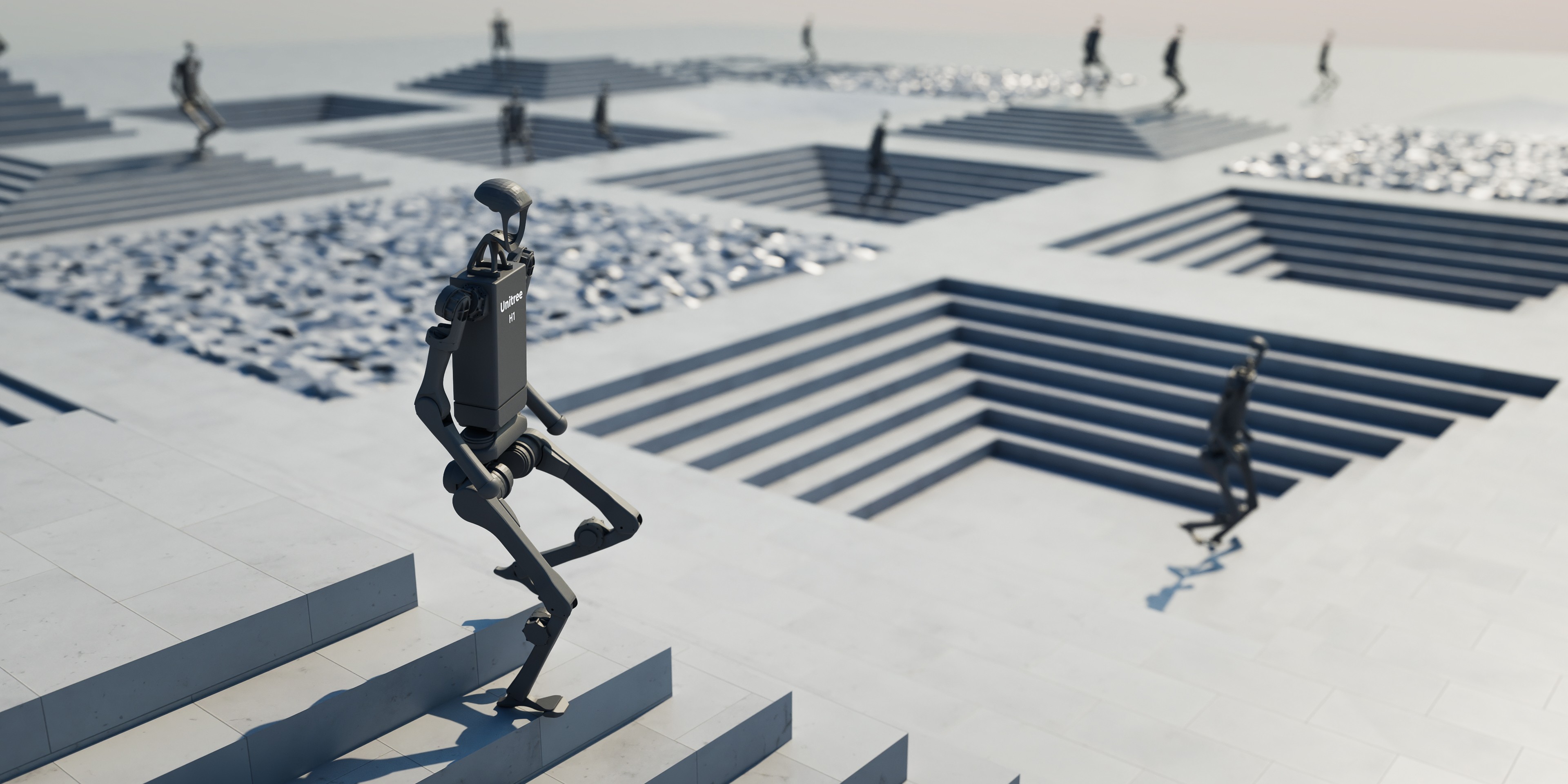
Learning Multi-Phase Robot Loco-Manipulation via Phase-Conditioned Policy Optimization

Simone Manni, Annika Wollschläger, Dario Bellicoso, Abel Gawel, Marco Hutter, Simon Le Cleac'h 等

Complex whole-body loco-manipulation requires executing diverse maneuvers, such as crouching, grasping, and locomotion, within a single long-horizon task. While performing simple p…

Complex whole-body loco-manipulation requires executing diverse maneuvers, such as crouching, grasping, and locomotion, within a single long-horizon task. While performing simple pick-and-place behaviors is well-established, scaling to complex, long-horizon tasks remains difficult. Currently, this challenge is addressed by relying on human motion data and correspondingly humanoid platforms, which limits platform independence and introduces substantial data processing overhead. Instead, we extend proximal policy optimization (PPO) to train a single policy for multi-phase tasks across diverse robotic hardware, leveraging prior task structure to shape behavior. Our method adapts PPO using a phase-conditioned critic, phase-gated reward functions, and a multi-phase reset curriculum to guide exploration. To support varied hardware, we employ a decoupled hierarchical control architecture that separates lower-level balancing dynamics from high-level phase execution. We demonstrate multi-stage loco-manipulation skills on hardware on both the Unitree G1 and a Boston Dynamics Spot equipped with a manipulator arm, and validate our design choices through ablations. Our approach enables the acquisition of complex loco-manipulation behaviors purely through environment interaction while directly incorporating high-level task structure into policy learning.

cs.ROrobotmanipulationhumanoidlocomotion

追踪学者:Marco Hutter;兴趣:reinforcement learning for legged locomotion and sim-to-real transfer

#22026-10-2799

PDRVLA: A Vision-Language-Action Model with Physical Dynamics Representations

Hanqing Wang, Zhaotian Cai, Ruichuan An, Bohan Zeng, Tao Zhang, Yilin Chen 等

Vision--Language--Action (VLA) models generate robot actions from visual observations and language instructions, but their understanding of physical dynamics remains limited. Video…

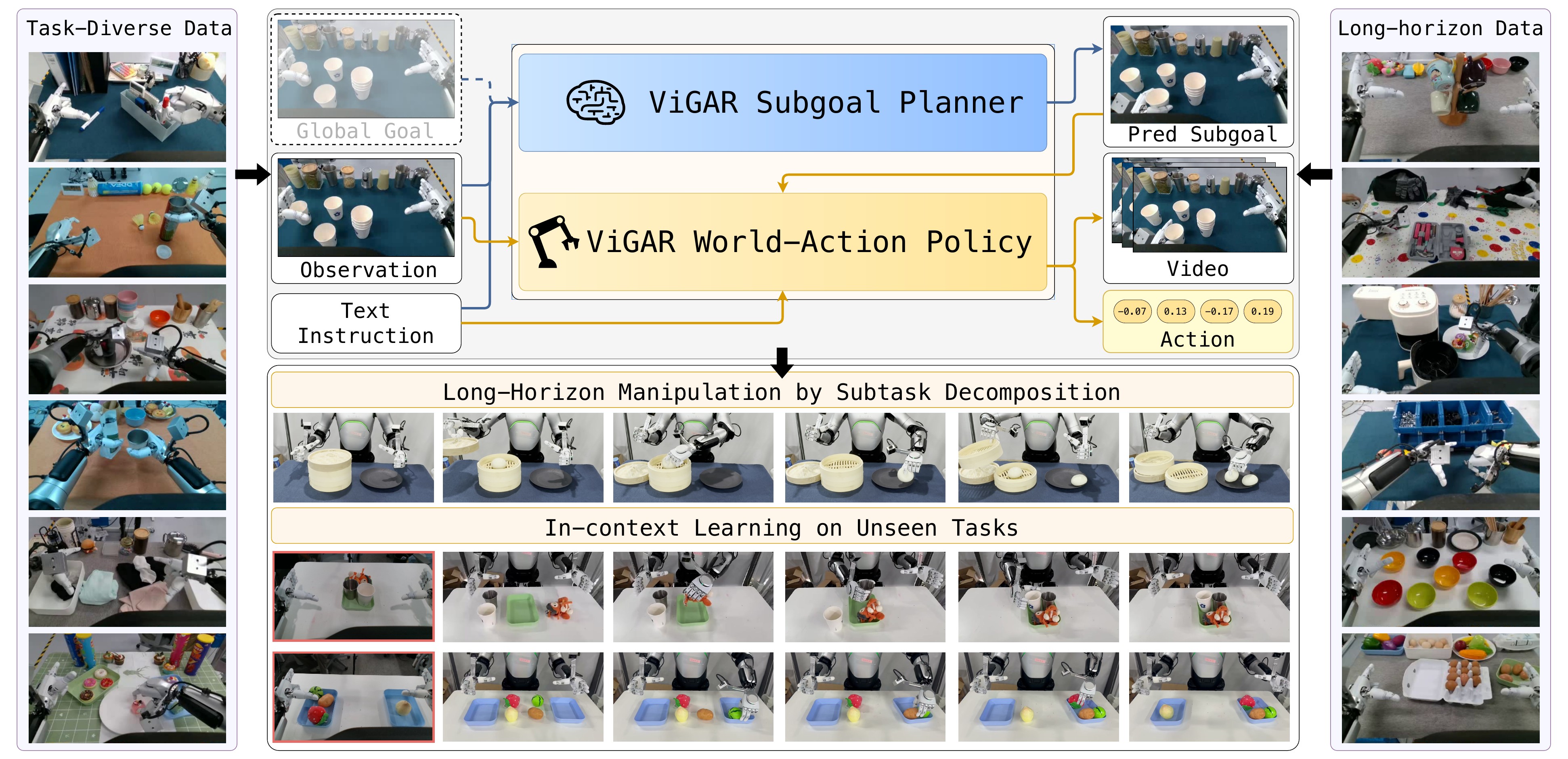
Vision--Language--Action (VLA) models generate robot actions from visual observations and language instructions, but their understanding of physical dynamics remains limited. Video world models can capture scene dynamics, yet generating future videos introduces high latency into the control loop. We introduce PDRVLA, whose lightweight Physical Dynamics Module extracts physical tokens from vision--language features to condition action generation without online video generation. The module learns through direct prediction of future RGB, depth, and optical-flow features, with auxiliary supervision through a frozen pretrained video world model. Training relies entirely on publicly available data, expanded through human-to-robot synthesis, subtask annotation, and embodied chain-of-thought (ECoT) annotation. Across four simulation benchmarks, PDRVLA achieves success rates of 99.3% on LIBERO, 89.9% on LIBERO-Plus, 93.6% on RoboTwin~2.0, and 81.5% on SimplerEnv. Ablations show improved future prediction with world-model supervision and evaluate how subtask conditioning, future object-pose supervision, and ECoT training affect action success.

cs.ROcs.CVcs.LGrobotVLAvision-language-actionembodiedworld model

兴趣:vision-language-action (VLA) models and foundation models for robots

#32026-10-27追踪学者 · Jan Peters94

Retrieve to Act: Motion Primitive Graph Retrieval for Robust VLA Execution

Pham Tri Quang, Bao-Ngoc Dao, Minh Duc Nguyen, Duc-Duy Nguyen, Hung T. Ho, Linh Dang Le 等

Vision-Language-Action (VLA) policies demonstrate remarkable semantic generalization, yet remain highly vulnerable to out-of-distribution (OOD) visual shifts during execution. Whil…

Vision-Language-Action (VLA) policies demonstrate remarkable semantic generalization, yet remain highly vulnerable to out-of-distribution (OOD) visual shifts during execution. While existing test-time methods attempt to suppress spurious visual cues, they fundamentally overlook the rich, uncorrupted kinematic priors embedded in the policy's own training experience. We introduce Retrieve to Act (R2A), a test-time scaling framework that formulates OOD robustness purely as a geometric motion primitive retrieval problem. R2A bypasses fragile visual features by structuring successful training demonstrations into an offline spatiotemporal motion primitive graph. During inference, a query-dependent Graph Neural Network dynamically localizes the robot's ongoing execution within this graph, retrieving structurally compatible future motion primitives. These retrieved geometric priors are then seamlessly harmonized with the frozen VLA's predicted actions via a learned, dimension-wise gating mechanism, adaptively rectifying erroneous spatial trajectories while preserving the policy's local reactivity. Extensive experiments across three state-of-the-art VLA architectures, GR00T N1.7, $π_{0.5}$, and StableVLA, demonstrate that R2A consistently and significantly enhances robustness against diverse contextual perturbations. R2A achieves absolute success rate improvements of up to +12% in simulation benchmarks (LIBERO-Plus, RoboTwin2.0-Plus) and +40% in real-world deployments, without requiring any finetuning of the base policies. Project page: https://retrieve2act.github.io/r2a/

cs.ROcs.AIrobotVLAvision-language-action

追踪学者:Jan Peters;兴趣:vision-language-action (VLA) models and foundation models for robots

#42026-10-2792

VLA-Stem: A Lightweight Safety Mechanism for Vision-Language-Action Models via Reinforcement Learning

Bojun Zou, Wenhao Yu, Jiaohao Li, Jiaxuan Lin, Guanting Ye, Haohan Geng 等

Vision-Language-Action (VLA) models integrate high-level reasoning with low-level action execution for end-to-end robotic control. However, most VLA models target static manipulati…

Vision-Language-Action (VLA) models integrate high-level reasoning with low-level action execution for end-to-end robotic control. However, most VLA models target static manipulation in unconstrained environments, overlooking spatial constraints and dynamic obstacles. Fine-tuning VLAs on obstacle-avoidance data is a straightforward solution, but collecting such data is costly, especially for dynamic scenarios, and may degrade their original task capabilities. To address these limitations, we propose VLA-Stem, a lightweight, reinforcement-learning-based safety mechanism for VLA systems. Without fine-tuning the underlying VLA policy, VLA-Stem converts its action chunks into motion references and uses trajectory-level guidance to preserve their spatial intent while allowing flexible motion and timing adjustments. Conditioned on these references, robot proprioception, and local obstacle information, the Stem policy adaptively modifies execution at inference time, preserving the original task intent while enabling responsive adaptation to spatial constraints and dynamic obstacles. For robust and sample-efficient training, we combine teacher-student distillation with curriculum learning. We evaluate VLA-Stem on reference following, static spatial constraints, and dynamic obstacle avoidance. Across six constrained simulation settings, VLA-Stem achieves 52.8% average collision-free task success versus 23.7% for the strongest safety baseline, while preserving base-policy performance in obstacle-free settings; real-world experiments further show consistent collision reductions under static and dynamic obstacles. These results demonstrate that VLA-Stem couples high-level VLA task intent with rapid, reflex-like responses to immediate physical risks, providing a brainstem-inspired mechanism for robust robot execution.

cs.ROrobotmanipulationVLAvision-language-action

兴趣:vision-language-action (VLA) models and foundation models for robots

#52026-10-27追踪学者 · Jan Peters92

Whole-Body Humanoid Control via Stochastic Motion Tokenization

Michael Drolet, Oleg Arenz, Jan Peters

While velocity-commanded RL policies are effective for controlling quadrupeds, they are a limited interface for humanoids that need to perform complex whole-body motions. Furthermo…

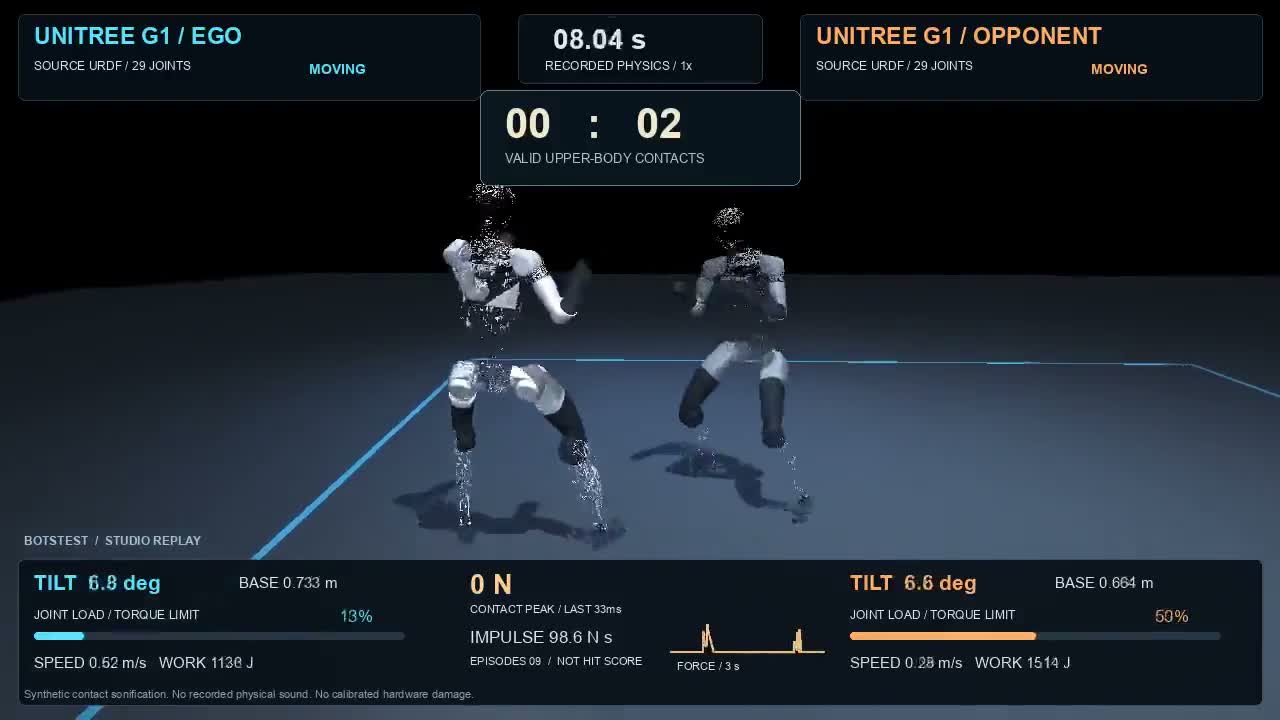
While velocity-commanded RL policies are effective for controlling quadrupeds, they are a limited interface for humanoids that need to perform complex whole-body motions. Furthermore, RL tracking policies for whole-body motions typically have limited information about the desired future motion, preventing them from performing controlled deviations to achieve long-term task success; such information is particularly relevant when a controller must prepare for transitions between behaviors. We address these challenges using concise motion representations that can be generated by a high-level controller, given a behavior label or text command. These representations can be fed directly into a tracking policy to provide a detailed motion reference. Our method exhibits a high degree of flexibility in performing real-world robot motions such as dancing, fighting, or walking based on conditional information. At matched capacity, our adopted stochastic motion tokenizer reconstructs motions from the Unitree G1 at a level that exceeds state-of-the-art approaches such as finite scalar quantization (FSQ) and the vector-quantized autoencoder (VQ-VAE). The resulting discrete interface conditions whole-body tracking policies that execute generated dance, fight, and walk motions lasting 16.8 s each and a 35 s fight-to-dance sequence on a physical Unitree G1.

cs.ROcs.LGrobothumanoid

追踪学者:Jan Peters;兴趣:humanoid robots and whole-body control

#62026-10-27追踪学者 · Jitendra Malik追踪学者 · Guanya Shi90

CARD: Contact-Anchored Retargeting for Dexterous Manipulation

Cunxi Dai, Botao He, Francois R Hogan, Wei Pan, Rao Fu, Wen-Han Hsieh 等

Humans are dexterous, but traditional data collection paradigms such as teleoperation, kinesthetic teaching, and wearable exoskeletons force humans to act through the robot embodim…

Humans are dexterous, but traditional data collection paradigms such as teleoperation, kinesthetic teaching, and wearable exoskeletons force humans to act through the robot embodiment, bottlenecking their dexterity. Retargeting can avoid this. However, existing methods purely translate kinematics and ignore the real-world contact dynamics essential for task success. We present CARD: Contact-Anchored Retargeting for Dexterous Manipulation, a simulator and object-free framework that retargets human demonstrations to robot actions by explicitly preserving contact force targets. CARD unifies human data sources including video, motion capture, and tactile gloves via a shared hand--contact representation and generates explicit contact force targets in addition to kinematics. To maintain these contact targets during hardware open-loop replay, CARD also introduces a tactile tracking controller. For video which does not contain an explicit tactile source, we present Vid-HACO, our video-to-contact model that sets a new state of the art. Across our video, glove, motion-capture data and the GRAB dataset, CARD maintains contact on $43$--$78%$ of contact frames, while kinematic and object-aware retargeting methods maintain contact on $<10%$ and $22.5%$ of the frames respectively. Further, integrating our formulation into physics-based retargeting improves strict task success from 12% to 32% on GRAB dataset. Finally, we show that our tactile tracker is critical to reproduce demonstrated forces during hardware replay. These results establish that contact preservation via CARD is a scalable interface for transferring human dexterity to robots.

cs.ROrobotmanipulationdexteroustactile

追踪学者:Jitendra Malik、Guanya Shi;兴趣:dexterous hands and tactile sensing

#72026-10-2788

RynnWorld-Latent: A Cross-Embodiment World Model Conditioned on Universal Latent Actions

Haoyu Zhao, Yinzhou Tang, Zixuan Wang, Minghao Zhu, Dongchi Huang, Xingyue Zhao 等

Learning controllable world dynamics from heterogeneous interaction videos is challenging because robot embodiments use incompatible action spaces, while human videos lack native c…

Learning controllable world dynamics from heterogeneous interaction videos is challenging because robot embodiments use incompatible action spaces, while human videos lack native control labels. We present RynnWorld-Latent, a cross-embodiment video world model that uses the 3D-grounded latent actions introduced by RynnLAM as a shared conditioning interface. This representation enables joint pretraining on human interaction videos, robot demonstrations, and simulation rollouts without requiring a common native action space. Built on a pretrained video transformer, RynnWorld-Latent combines global action tokens with an identity-initialized local pathway that aligns actions with future video latents. We pretrain on 23 datasets comprising approximately 553.5M frames and adapt the model to target robots through post-training. The framework supports two data-generation routes: digital teleoperation uses target robot commands to generate action-video demonstrations, while latent-action synthesis transfers source motion to an edited initial frame and pairs the resulting rollout with retargeted pseudo robot actions. Experiments show improved video prediction metrics on public benchmarks and two real-robot platforms, alongside qualitative action following when different action sequences share the same initial observation. Synthetic mid-training improves policy success rates on LIBERO and LIBERO-Plus, and both generation routes improve real-world policy success rates over real-demonstration-only training in the evaluated settings. These results support universal latent actions as a scalable interface for learning controllable visual dynamics across heterogeneous embodiments.

cs.ROrobotworld model

兴趣:world models and video prediction for embodied agents

#82026-10-2788

Tokens of Motion: Primitive Motion Learning for Human-Humanoid Skill Transfer

Hanwen Ren, Meng Zheng, Wenzhe Cui, Benjamin Planche, Zhongpai Gao, Anwesa Choudhuri 等

Vision-language-action (VLA) models provide a promising paradigm for scalable robotic manipulation, yet their reliance on success-only behavioral cloning leaves them brittle; lacki…

Vision-language-action (VLA) models provide a promising paradigm for scalable robotic manipulation, yet their reliance on success-only behavioral cloning leaves them brittle; lacking corrective training signals, minor execution errors rapidly compound into unrecoverable, out-of-distribution failures. To address this limitation, we propose Adaptive Failure-Informed Learning (AFIL), an end-to-end framework that leverages failure trajectories as adaptive negative guidance for diffusion- and flow-based VLA policies. AFIL uses a pretrained VLA to generate failure rollouts online, avoiding the need for handcrafted failure-mode design or human-in-the-loop recovery. It then jointly trains Dual Action Generators (DAGs) for successful and failed behaviors while sharing a common vision-language backbone, enabling efficient failure-aware policy learning with limited parameter overhead. During sampling, the failure generator adaptively steers action generation away from failure-prone regions and toward more reliable success modes, with guidance strength determined by the per-diffusion-step distance between success and failure distributions. Experiments across in-domain and out-of-domain robotic manipulation tasks, covering both short- and long-horizon settings, show that AFIL consistently improves task success rates and robustness over existing VLA baselines, demonstrating its effectiveness, efficiency, and generality.

cs.ROmanipulationVLAvision-language-actionhumanoid

兴趣:vision-language-action (VLA) models and foundation models for robots

#92026-10-2788

ThinkWorld: World Imagination Reinforces Chain-of-Dynamics Reasoning

Chaehyun Kim, Chi-Pin Huang, Jisoo Kim, Min-Hung Chen, Yu-Chiang Frank Wang, Seungryong Kim 等

Vision-Language-Action (VLA) models have made substantial progress in robotic manipulation, but their generalization remains constrained by the diversity and coverage of action-lab…

Vision-Language-Action (VLA) models have made substantial progress in robotic manipulation, but their generalization remains constrained by the diversity and coverage of action-labeled robot demonstrations. Human videos provide much broader behavioral and environmental experience, while learning from them faces a fundamental trade-off between scalable data and explicit action grounding. We introduce ThinkWorld, a VLA learning framework that grounds action reasoning in world dynamics and strengthens it through reinforcement learning with world imagination. ThinkWorld represents each action thought as a Chain-of-Dynamics (CoD), a sequence of discrete motion tokens that captures the intermediate dynamics connecting the current world to a future state and serves as a common action representation across embodiments. We first initialize CoD with action-labeled demonstrations, then predict the future induced by each CoD and reinforce those whose predictions better match the observed outcome. This enables videos without action annotations to provide direct supervision from observed state transitions, allowing human and robot experience to refine the same reasoning space. Experiments in simulation and on real robots demonstrate effective human-to-robot transfer and strong generalization to unseen tasks and environments.

cs.ROcs.AIcs.CVrobotmanipulationVLAvision-language-action

兴趣:vision-language-action (VLA) models and foundation models for robots

#102026-10-2788

SO-101 Bench: Accessible Spatial Manipulation

Truman Hickok

Low-cost arms such as the SO-101 have become the most common entry point to robot learning, yet no released policy performs spatially constrained, language-conditioned tasks on the…

Low-cost arms such as the SO-101 have become the most common entry point to robot learning, yet no released policy performs spatially constrained, language-conditioned tasks on them out of the box, and existing SO-101 benchmarks run only on physical hardware with simple tasks and few held-out objects. We introduce SO-101 Bench, a simulated benchmark for language-conditioned spatial manipulation built on an Isaac Lab digital twin of a real SO-101 setup. It has four tasks scored as five families, 138 objects in seen, unseen-instance and unseen-class splits, 916 evaluation episodes with subsets for held-out appearances, rotate-to-fit planning and occlusion memory, and 3,629 simulated demonstrations on which every learned policy is fine-tuned under an equal compute budget. The twin ranks policies as the real robot does: five policies trained without real data, four VLAs and an LLM agent, keep their exact ranking when the same weights run on the physical arm in an unseen environment with unseen objects (Spearman rho = 1.00, MMRV = 0.000), although simulation overestimates success. Across nine VLAs and world-action models, the best learned policies score near 61%, with spatial placement, unseen object classes and rotate-to-fit planning remaining open. An LLM agent that writes code and hands grasping to a learned policy scores 83.2%, and an ablation shows that this lead comes from the choice of harness and the choice of language model.

cs.CVrobotmanipulationLLM agent

兴趣:robot manipulation and grasping with learned policies

#112026-10-27追踪学者 · Animesh Garg88

TAPESTRY: A Single Backbone for Video Generation and Robot Control

Jeremy A. Collins, Seungjae Lee, Rachanon Wachakorn, Krishnan Srinivasan, Animesh Garg, Vitor Campagnolo Guizilini 等

Pretrained video generation models encode rich priors about physical interactions, but leveraging them for robot control typically requires either resource-intensive video generati…

Pretrained video generation models encode rich priors about physical interactions, but leveraging them for robot control typically requires either resource-intensive video generation at test time or action heads trained from scratch that do not fully utilize the pretrained backbone. We introduce Tokenizing Actions as Video Patches in a Shared Transformer Policy (TAPESTRY), a world action model that repurposes a pretrained video diffusion transformer into a robotic policy without requiring video generation at inference. Our key idea is to treat robot actions as single-patch tokens in the video model's latent space. A lightweight linear projection maps each action timestep to the patch dimensions of the pretrained VAE, and the resulting tokens are processed by the same patchifying layers and transformer backbone used for video. The shared backbone is optimized through three diffusion objectives sampled per minibatch element: Video diffusion uses VAE latents from robot and human videos to establish dynamics priors. Joint video+action diffusion trains on robot demonstrations using a coupled diffusion timestep and an asymmetric attention mask. Action-only diffusion denoises actions conditioned on clean image latents. At test time, the model generates a compact action token sequence in a single DDIM step from pure noise, producing smooth action chunks at 84 ms per action chunk on consumer hardware and avoiding the cost of full video generation. Across simulation benchmarks and real-robot experiments, TAPESTRY achieves strong performance with substantially lower inference cost than comparable joint video--action policies. More information can be found at https://tapestry-wam.github.io.

cs.ROcs.AIcs.CVcs.LGrobot

追踪学者:Animesh Garg;兴趣:imitation learning and diffusion policies for robot control

#122026-10-2787

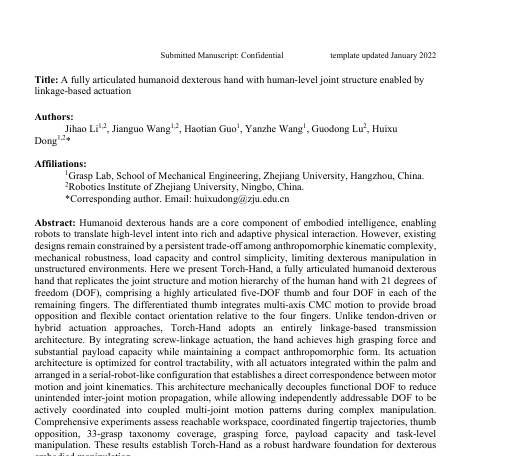
A fully articulated humanoid dexterous hand with human-level joint structure enabled by linkage-based actuation

Jihao Li, Jianguo Wang, Haotian Guo, Yanzhe Wang, Guodong Lu, Huixu Dong

Humanoid dexterous hands are a core component of embodied intelligence, enabling robots to translate high-level intent into rich and adaptive physical interaction. However, existin…

Humanoid dexterous hands are a core component of embodied intelligence, enabling robots to translate high-level intent into rich and adaptive physical interaction. However, existing designs remain constrained by a persistent trade-off among anthropomorphic kinematic complexity, mechanical robustness, load capacity and control simplicity, limiting dexterous manipulation in unstructured environments. Here we present Torch-Hand, a fully articulated humanoid dexterous hand that replicates the joint structure and motion hierarchy of the human hand with 21 degrees of freedom (DOF), comprising a highly articulated five-DOF thumb and four DOF in each of the remaining fingers. The differentiated thumb integrates multi-axis CMC motion to provide broad opposition and flexible contact orientation relative to the four fingers. Unlike tendon-driven or hybrid actuation approaches, Torch-Hand adopts an entirely linkage-based transmission architecture. By integrating screw-linkage actuation, the hand achieves high grasping force and substantial payload capacity while maintaining a compact anthropomorphic form. Its actuation architecture is optimized for control tractability, with all actuators integrated within the palm and arranged in a serial-robot-like configuration that establishes a direct correspondence between motor motion and joint kinematics. This architecture mechanically decouples functional DOF to reduce unintended inter-joint motion propagation, while allowing independently addressable DOF to be actively coordinated into coupled multi-joint motion patterns during complex manipulation. Comprehensive experiments assess reachable workspace, coordinated fingertip trajectories, thumb opposition, 33-grasp taxonomy coverage, grasping force, payload capacity and task-level manipulation. These results establish Torch-Hand as a robust hardware foundation for dexterous embodied manipulation.

cs.ROrobotmanipulationgrasphumanoidembodieddexterous

兴趣:dexterous hands and tactile sensing

#132026-10-2787

GAWM: A Compact Latent World-Action Model for Multi-Task Robot Manipulation

Yang Liu, Xiaoli Liu, Liuzhao Li, Yuduo Song, Muyuan Liu, Xiang Gao

World-action models (WAMs) incorporate the prediction of future observations into robot policy learning. However, most WAMs build on billion-parameter vision-language or video-gene…

World-action models (WAMs) incorporate the prediction of future observations into robot policy learning. However, most WAMs build on billion-parameter vision-language or video-generation backbones, which incur high training cost and inference latency. In this letter, we present GAWM (Geometry-Aware World Model), a compact multi-task WAM that predicts future observations in the latent space of a frozen DINOv3 encoder. GAWM compresses the features of each camera view into a small set of tokens. A lightweight predictor, conditioned on the task rather than on actions, forecasts these tokens at two future horizons. The forecast is supervised with the dense patch features of future frames, which requires it to encode the spatial layout of the future scene. An action decoder directly regresses a chunk of future actions from the current and predicted tokens. With fewer than 100M parameters and no robot or video pretraining, GAWM outperforms billion-parameter WAMs on RoboTwin 2.0 and performs comparably to billion-parameter VLAs on LIBERO. On a dual-arm robot, it achieves lower action-prediction error on held-out demonstrations than a fine-tuned billion-parameter VLA, with substantially lower inference latency. Ablation studies show that the latent world model substantially improves performance when training data or training time is limited. Code is available at https://github.com/gaoxiang12/ga-wm.

cs.ROrobotmanipulationVLAworld model

兴趣:world models and video prediction for embodied agents

#142026-10-2786

Pushing Dexterity and Safety for In-Hand Object Pose Reaching That Works Remarkably Well

Ian Chuang, Hiya Shah, Vamsi Chilamkur, Iman Soltani, Claire Tomlin

Dexterous manipulation with multi-fingered hands is the next frontier of robotics, yet learned hand skills remain limited to simple grasps or basic repeated motions, such as rotati…

Dexterous manipulation with multi-fingered hands is the next frontier of robotics, yet learned hand skills remain limited to simple grasps or basic repeated motions, such as rotating an object. As robots attempt more demanding in-hand maneuvers, safety, such as not dropping the object, becomes critical, yet it is rarely measured. We study in-hand object pose reaching, a task that demands diverse and difficult grasps: moving an object to almost any position and orientation within reach of the fingers, at any wrist orientation, through long sequences of consecutive goals. We present a recipe for training such policies for a LEAP hand in simulation without human data, built on a range of insights, from diverse resets and goals via generated grasp datasets to an adaptive friction curriculum. With careful system identification, the policies transfer zero-shot to the real hand, using either motion capture or a single wrist-mounted depth camera, and prove remarkably capable and robust. On top of the task policy, we add a learned residual safety filter with adjustable conservativeness, letting us tune the balance between performance and safety and greatly reduce object drops. In 13.3 hours of real-robot evaluation over 4,800 unseen goals across 4 objects and diverse wrist orientations, the state-based policy reaches 95.2% of goals within 2 cm and 0.4 rad, and the filter cuts its drops by 75% while still reaching 91.5% of goals. The policies can also spin a lightbulb held in an arbitrary pose, reach out-of-distribution goals, withstand fast arm motion and perturbations, and, needing only a wrist camera, serve as portable skills such as screwing in a lightbulb. We release the full recipe as a platform for studying performance, reliability, and safety in high-dimensional dexterous systems. Videos and more are available at https://ian-chuang.github.io/dexsafe/.

cs.ROcs.LGeess.SYrobotmanipulationgraspdexterous

兴趣:robot manipulation and grasping with learned policies

#152026-10-27追踪学者 · Jan Peters85

Remember Where You Walk: Learning Spatial Memory for End-to-End Legged Robot Exploration

Leon Magnus, Nico Bohlinger, Jan Peters, Oleg Arenz

Humanoids and other legged robots operating in complex environments must remember information that leaves their field of view and only becomes relevant much later. Reinforcement le…

Humanoids and other legged robots operating in complex environments must remember information that leaves their field of view and only becomes relevant much later. Reinforcement learning policies address this using memory networks such as LSTMs that are trained end-to-end with the policy to memorize such task-relevant aspects. Yet, such architectures often fail to preserve sufficient information over long horizons. In this work, we propose a network architecture based on Hadamard memory that specifically targets robot navigation. Our Local Spatial Matrix Memory (LSMM) enables RL agents to store generic task-relevant information at specific, position-based memory cells, enabling flexible and spatially grounded memorization. We evaluate LSMM on the task of autonomous maze exploration, where it matches the maze coverage of strong recurrent and finite-history baselines while being the only architecture that remembers the maze layout, reducing the reconstruction error threefold.

cs.ROrobotlegged

追踪学者:Jan Peters;兴趣:reinforcement learning for legged locomotion and sim-to-real transfer

#162026-10-2784

RoboAuto: Autonomous Robot Program Search through Multi-Level Physical Understanding

Buzhao Liu, Jianing Ye, Xiu Yuan, Yangtong Feng, Chengsong Huang, Tyler Dinh 等

Recently, LLM-based autonomous agents have shown strong capabilities in iteratively generating, evaluating, and refining executable solutions. In robotic manipulation, Code-as-Poli…

Recently, LLM-based autonomous agents have shown strong capabilities in iteratively generating, evaluating, and refining executable solutions. In robotic manipulation, Code-as-Policy lets these agents search over modular and editable robot programs. However, effective program search requires physical understanding: agents must understand how objects can be manipulated, how scene geometry constrains actions, and why interactions succeed or fail. Existing methods rely mainly on execution feedback for program refinement, often leaving these physical questions unresolved. We introduce RoboAuto, a framework for robot program search that explicitly organizes physical understanding at the object, scene, and interaction levels through three components. First, a hierarchical knowledge base combines executable skills with object-centric knowledge of affordances, spatial relations, and action effects, learned from embodied data and online task solving. Second, scene grounding connects this knowledge to the current environment by identifying relevant objects and resolving action-critical quantities. Third, multi-stage planning with self-designed experiments checks whether each stage produces its expected physical effects and actively tests competing hypotheses to resolve physical uncertainties. RoboAuto achieves superior performance across five benchmark families, attaining an 89.1% success rate on short-horizon LIBERO-PRO tasks and more than twice the mean success rate of ASPIRE on LIBERO-PRO Long and LIBERO-Plus. It also outperforms ASPIRE and $π_{0.5}$ on three challenging long-horizon real-robot tasks requiring precise manipulation. We further show that the knowledge base transfers across simulators and embodiments, and that program search performance scales with its size. Project page: https://roboauto-ai.github.io/

cs.ROcs.AIcs.CLcs.CVcs.LGrobotmanipulationembodied

兴趣:robot manipulation and grasping with learned policies

#172026-10-2684

E0.5: From Reconstructive to Future-Predictive 3D Foundations for Robotic World-Action Modeling

X-Era AI Lab Team, :, Jianhao Lai, Zhihao Zhan, Zhiquan Liao, Qichang Li 等

World-action models (WAMs) offer a promising framework for embodied intelligence, yet mainstream approaches remain centered on video foundation models or vision-language models. Ev…

World-action models (WAMs) offer a promising framework for embodied intelligence, yet mainstream approaches remain centered on video foundation models or vision-language models. Even when geometric features extracted by 3D models such as VGGT are incorporated, they are typically passed into a video model or VLM that serves as the primary backbone, leaving 3D geometry as an auxiliary input or prediction target rather than the native foundation for world modeling. We present E0.5, a geometry-native world-action model built directly on 3D foundation models. E0.5 introduces two key innovations. First, it adopts a 3D foundation model as the primary backbone, making 3D geometry the native representation for both world modeling and action prediction. Second, it explicitly predicts future 3D states together with actions, enabling the model to capture geometric world dynamics beyond action-only modeling or future video prediction. Experiments on RoboTwin 2.0 first demonstrate the effectiveness of E0.5 without embodied-data pretraining, achieving success rates of 89.90% and 50.09% under clean and randomized settings, respectively. Building on these results, we further pretrain E0.5 on more than 160k robot trajectories from AgiBotWorld-Beta, jointly learning robot actions and future geometry within the pretrained 3D foundation. This embodied pretraining improves mean real-world manipulation success rates by approximately 15 and 7 percentage points on AgileX Piper and Zerith H1, respectively. Together, these results demonstrate the potential of geometry-native foundations to acquire robot interaction knowledge and transfer it to physical manipulation. E0.5 embodies this geometry-native approach as a member of the VWA family of world-action models.

cs.ROrobotmanipulationembodied

兴趣:world models and video prediction for embodied agents

#182026-10-2784

TOPS: Reshaping Flow Source and Transport for Multi-Task Robot Manipulation

Tuo An, Chuhao Zhou, Jiahua Dong, Jingliang Li, Jiaqi Bai, Jindou Jia 等

Flow-based policies for language-conditioned multi-task manipulation commonly share a single $Gaussian$ source prior and a common linear transport path across tasks. However, relia…

Flow-based policies for language-conditioned multi-task manipulation commonly share a single $Gaussian$ source prior and a common linear transport path across tasks. However, reliably executing multiple tasks with distinct motion requirements remains challenging for a shared policy. We introduce $TOPS$ ($T$ask-$O$riented $P$riors and $S$chedules), which adapts the flow source prior and interpolation schedule to each task without modifying the network architecture. TOPS first constructs multimodal task sources from reverse-mapped expert action sequences, allowing language instructions to select where generation begins. Guided by source-target covariance mismatch, it then slows the transition toward expert actions early in denoising and accelerates it later along directions requiring expansion. Under a $Gaussian$ endpoint model, our analysis shows that this schedule adjustment can lower an upper bound on velocity-prediction risk. Experiments on LIBERO, LIBERO-Plus, and CALVIN demonstrate improved performance across in-distribution, perturbation and cross-environment settings, alongside better data efficiency. Using one integration step, TOPS raises LIBERO-10 success from $53.44%$ to $69.67%$ compared with ten-step Standard Flow Matching (FM), while reducing inference time to approximately one-sixth of the baseline. TOPS also yields consistent gains when transferred to the large-scale flow-based $π_{0.5}$ policy across all four evaluated settings. Real-world experiments further demonstrate improved task success, including an increase from $20%$ with standard FM to $80%$ with TOPS on the upper-drawer opening task.

cs.ROcs.AIrobotmanipulation

兴趣:large language models for robot task planning and reasoning

#192026-10-2783

When, Where, and What to Correct: Human-Guided Adaptive Residual Correction for Robot Policies

Anukriti Singh, Maxime Caniot, Pratap Tokekar, Firas Abi-Farraj

Imitation policies that reliably execute most of a manipulation trajectory can still fail in localized regions requiring last-mile precision. Updating the full policy or exploring …

Imitation policies that reliably execute most of a manipulation trajectory can still fail in localized regions requiring last-mile precision. Updating the full policy or exploring residual actions everywhere treats this local failure as a global learning problem. We introduce Adaptive Residual Correction (ARC), a lightweight post-training module that uses reinforcement learning (RL) to learn a residual correction on top of a frozen policy while using sparse human corrections to structure autonomous exploration. Rather than treating human corrections as imitation targets, ARC uses pre-intervention states to determine 'when' residual control should become active and correction geometry to determine 'where' in residual action space autonomous refinement should explore; task reward determines 'what' residual is ultimately executed. Across three precision-manipulation tasks on a real robot, ARC improves average task success from 33.3% to 75.0%. The human corrections define task-dependent 2-3 dimensional subspaces of the seven-joint residual space that retain 96.0-97.7% of squared correction magnitude. Together, these results show that sparse human corrections can localize and constrain autonomous post-training without requiring the observed correction itself to serve as the final action target.

cs.ROcs.AIrobotmanipulation

兴趣:imitation learning and diffusion policies for robot control

#202026-10-2783

REACH: An RL-based Hierarchical Humanoid Crawling Framework for Adaptable Confined Space Traversal

Shengzhang Xu, Yuning Guo, Weiyi Hu, Yifeng Xu, Zhongyu Li, He Kong

Humanoid locomotion in confined spaces requires continuous height adaptation across multiple locomotion modes, yet most existing approaches remain limited to height-adjustable bipe…

Humanoid locomotion in confined spaces requires continuous height adaptation across multiple locomotion modes, yet most existing approaches remain limited to height-adjustable bipedal walking. We present REACH, an RL-based hierarchical framework that enables a Unitree G1 humanoid to traverse height-constrained environments through variable-height bipedal walking and crawling. The learned policies regulate body height over complementary command ranges of 1.27--0.50m in bipedal locomotion and 0.50--0.20m in crawling, extending traversal beyond the clearance limits of crouched walking. To address contact-rich crawling dynamics, we employ a history-conditioned latent representation that captures terrain and interaction context from proprioceptive observations. A bidirectional transition policy further connects crouched bipedal locomotion and crawling across large kinematic and contact discontinuities. These skills are integrated with a LiDAR-based planner that converts point clouds into collision-free three-dimensional paths and locomotion commands, including proactive height targets. Real-world experiments demonstrate accurate height and velocity tracking, robust terrain traversal, reliable mode transitions and confined-space traversal with the proposed pipeline. Code and videos are available at https://aislab-sustech.github.io/REACH/.

cs.ROcs.AIhumanoidlocomotion

你点赞过:TANGO: Humanoid Navigation in Cluttered Environments with a

#212026-10-2783

Vision-Language-Action or World-Action? Just Action Models

Yonghao Yu, Lang Huang, Runyi Li, Toshihiko Yamasaki

The vision-language-action (VLA) and world-action model (WAM) communities debate whether control policies should inherit pretrained knowledge from vision-language models or from vi…

The vision-language-action (VLA) and world-action model (WAM) communities debate whether control policies should inherit pretrained knowledge from vision-language models or from visual generators. The debate, however, bundles three separable choices: backbone initialization, the objective applied to future observations, and whether the machinery for that future loss is kept at inference. A gap between a VLA and a WAM therefore cannot simply be attributed to any one of them. We show that decoupling these choices yields a common framework for both families, which we term Just Action Model (JAM): a pretrained visual backbone with an action expert, trained with an action loss and a foresight loss. The foresight loss trains current-observation features to predict frozen encodings of the recorded future through a prediction head discarded after training, so no visual generation is involved in either training or inference, and the backbone can be chosen freely. We first compare objectives within fixed policy architectures, then evaluate the foresight recipe across backbone families. The resulting JAM policies outperform their matched FastWAM and ImageWAM counterparts on LIBERO and LIBERO-Plus, and achieve similar or slightly higher success rates on RoboTwin. Compared with FastWAM, JAM improves the success rates from 97.0%/55.3%/91.2% to 98.2%/64.5%/91.4%, respectively. With cached foresight targets, JAM reduces estimated online training FLOPs per sample per update by 73% relative to FastWAM. Our results show that future supervision improves control without visual generation or additional inference machinery, and strong foresight performance is attainable with either generator-initialized or vision-language backbones. Project Page: https://y0uroy.github.io/JAM

cs.CVcs.ROVLAvision-language-action

兴趣:vision-language-action (VLA) models and foundation models for robots

#222026-10-2783

Adapting Video Models for Robot Control via Motion-guided Asymmetric Prediction

Taeyoung Kim, Junyoung Sung, Heeseung Kwon, Minseop Kim, Jinwoo Shin

World Action Models (WAMs) leverage pretrained video generative models for robotic control by jointly predicting future visual observations and actions. The visual prediction objec…

World Action Models (WAMs) leverage pretrained video generative models for robotic control by jointly predicting future visual observations and actions. The visual prediction objective plays a key role in adapting pretrained video representations to the target robot domain. Yet standard visual prediction inherited from video pretraining treats all visual regions uniformly, despite their differing relevance to robotic control. We therefore investigate the spatial allocation of visual supervision in WAMs and show that focusing supervision on dynamic regions can substantially improve policy performance. Building on this finding, we introduce Motion-Guided Asymmetric Prediction (MoGAP), which augments WAM training with motion-focused visual prediction. MoGAP allocates noise asymmetrically across regions, training the model to reconstruct more heavily corrupted dynamic regions using less corrupted static regions as context. MoGAP is trained alongside standard video-action prediction through a training-only auxiliary prediction path within the shared video diffusion backbone. It uses motion cues derived directly from training videos, requiring neither an external teacher nor additional modalities. Across robot manipulation benchmarks and WAM architectures, MoGAP consistently improves policy performance, increasing success rates on the GR-1 tabletop benchmark from 38.8% to 47.5% for Fast-WAM (Wan2.2-5B) and from 52.3% to 62.3% for Cosmos3-Nano.

cs.CVcs.AIrobotmanipulation

兴趣:world models and video prediction for embodied agents

#232026-10-2783

Trace-WAM: Learning to Act via 3D Motion Prediction for World Action Models

Xu Hu, Changjie Wu, Linzhe Shi, Hang Zhang, Chen Yang, Lingjun Zhang 等

World Action Models (WAMs) learn representations for robot control by coupling future visual prediction with action generation. Successful manipulation depends primarily on how the…

World Action Models (WAMs) learn representations for robot control by coupling future visual prediction with action generation. Successful manipulation depends primarily on how the robot and task-relevant objects evolve, whereas future-video prediction must also reconstruct the appearance and background of the entire scene. We therefore propose Trace-WAM, which augments video-action learning with future 3D motion prediction as an auxiliary objective. This objective supervises temporal point correspondence together with image-plane displacement and depth change, directly describing the interaction dynamics and spatial changes involved in manipulation. To this end, we adopt a three-branch Mixture-of-Transformer (Tri-MoT) architecture to jointly learn video prediction, motion prediction, and action generation. The motion expert predicts future trajectories from current visual features, allowing motion supervision to shape the representations used for action generation. Because the action expert does not consume predicted trajectories, inference retains the current-observation policy path: a single visual forward pass followed by action denoising. Experiments on RoboCasa-GR1, LIBERO, and LIBERO-Plus demonstrate strong in-distribution performance and out-of-distribution generalization, with particularly clear gains over Fast-WAM under limited demonstrations and distribution shifts.

cs.ROrobotmanipulation

兴趣:world models and video prediction for embodied agents

#242026-10-2782

Ego-CEVR: Learning Cross-Embodiment Visual Representations from Human Egocentric Videos

Keru Zhou, Zhirui Fang, Xinrun Xu, Yaopeng Lou, Zeyuan He, Zihao Zhu 等

As egocentric video becomes increasingly available for embodied learning, an important research question is how to turn this low-cost, scalable source of data into robot manipulati…

As egocentric video becomes increasingly available for embodied learning, an important research question is how to turn this low-cost, scalable source of data into robot manipulation capabilities. Egocentric videos naturally provide rich context for high-level task understanding, while real-robot demonstrations with wrist observations and action annotations provide supervision for fine-grained action alignment. We present Ego-CEVR, a data-native framework for hierarchical visual representation learning that assigns distinct learning objectives to global and interaction representations. The global module learns object relations, task state, and temporal progress through future prediction on egocentric video. The Interaction module interprets wrist observations in global context and learns local alignment and contact cues through robot action supervision. Separate residual paths expose both representations to the action policy, preserving direct access to task context alongside fine-grained execution information. Ego-CEVR supports independent pretraining of its global video module on large-scale human egocentric videos and videos from diverse robot embodiments, without requiring robot action labels or paired wrist observations.

cs.ROrobotmanipulationembodied

兴趣:world models and video prediction for embodied agents

#252026-10-2782

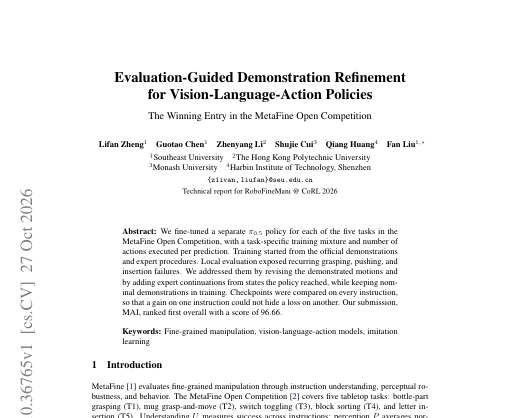
Evaluation-Guided Demonstration Refinement for Vision-Language-Action Policies: The Winning Entry in the MetaFine Open Competition

Lifan Zheng, Guotao Chen, Zhenyang Li, Shujie Cui, Qiang Huang, Fan Liu

We fine-tuned a separate $π_{0.5}$ policy for each of the five tasks in the MetaFine Open Competition, with a task-specific training mixture and number of actions executed per pred…

We fine-tuned a separate $π_{0.5}$ policy for each of the five tasks in the MetaFine Open Competition, with a task-specific training mixture and number of actions executed per prediction. Training started from the official demonstrations and expert procedures. Local evaluation exposed recurring grasping, pushing, and insertion failures. We addressed them by revising the demonstrated motions and by adding expert continuations from states the policy reached, while keeping nominal demonstrations in training. Checkpoints were compared on every instruction, so that a gain on one instruction could not hide a loss on another. Our submission, MAI, ranked first overall with a score of 96.66.

cs.CVvision-language-action

兴趣:robot manipulation and grasping with learned policies

#262026-10-2782

HC2Robot: Hyper-Connection Transformers with Predicted Foresight for Multi-Terrain Humanoid Parkour

Wenhao Xu, Yanheng Mai, Yifei Fu, Nan Zheng, Yanbo Zhou, Zirui Huang 等

Humanoid parkour requires robots to reason about future footholds and whole-body motions over highly discontinuous terrain. We revisit the information asymmetry in asymmetric actor…

Humanoid parkour requires robots to reason about future footholds and whole-body motions over highly discontinuous terrain. We revisit the information asymmetry in asymmetric actor-critic learning for perceptive humanoid locomotion: the critic exploits privileged simulator signals during training, whereas the deployable actor operates solely from onboard perception. We argue that the key is not exposing privileged information to the actor, but learning a deployable approximation of it to narrow the information gap between training and deployment. We present HC2Robot, a deployable perceptive humanoid parkour framework consisting of a Predicted Foresight Module (PFM) and a Hyper-Connection (HC) Transformer. PFM predicts from deployable observations the policy-conditioned timing, location, and support quality of each foot's next touchdown event, converting privileged supervision into a deployable latent representation that provides the actor with predicted touchdown information without privileged runtime sensing. The HC Transformer further enhances temporal reasoning through learnable multi-stream routing, while a future motion prediction head provides short-horizon motion priors for regularization. Across stairs, gaps, high platforms, and slopes, HC2Robot achieves a mean simulated traversal success rate of 97.60% and consistently higher safe foothold rates than strong perceptive locomotion baselines, supporting improved traversal performance and geometric foothold support under deployable sensing.

cs.ROhumanoidlocomotion

兴趣:reinforcement learning for legged locomotion and sim-to-real transfer

#272026-10-2782

EgoThumb: A Vision-Driven Supernumerary Robotic Thumb for Autonomous Grasp and Holding Assistance

Jianyu Hou, Jiawei Fu, Weikang Wan, Minghui Jiang, Jiajun Li, Hao Su

Supernumerary robotic fingers augment human dexterity by enabling a single hand to perform complex "hold-and-manipulate" tasks that typically require bimanual coordination. However…

Supernumerary robotic fingers augment human dexterity by enabling a single hand to perform complex "hold-and-manipulate" tasks that typically require bimanual coordination. However, existing devices are often hindered by bulky hardware that limits interaction to large objects and rely on explicit hand motion triggers that lack environmental context. To address these challenges, we present EgoThumb, a fully open-source, vision-driven supernumerary robotic thumb. EgoThumb features a compact, dual tendon-driven finger whose actuation is relocated to the forearm, reducing distal weight while enabling precise active joint control. The system utilizes a visual imitation learning policy that maps egocentric images from a palm-facing camera directly to continuous joint positions. By implicitly decoding human intent from visual cues capturing both the hand and the object of interest, EgoThumb achieves robust autonomous manipulation and strong generalization across diverse users and environments. All hardware designs and software implementations are fully open-sourced at https://ego-thumb.github.io.

cs.ROmanipulationgraspimitation learning

兴趣:robot manipulation and grasping with learned policies

#282026-10-2781

ActiveAlign: Aligning Egocentric Manipulation via Active Perception

Ri-Zhao Qiu, Bowen Wen, Yifeng Jiang, Chen Tessler, Eric Heiden, Xue Bin Peng 等

Real-to-Sim-to-Real (Real2Sim2Real) enables structured world representations for planning, interpretability, and safe execution. Most existing approaches rely on passive perception…

Real-to-Sim-to-Real (Real2Sim2Real) enables structured world representations for planning, interpretability, and safe execution. Most existing approaches rely on passive perception, which creates real2sim gaps due to imperfect observation. Inspired by how humans perceive actively through actions, we propose ActiveAlign, a framework that leverages active perception to align the Real2Sim2Real gap from interactions. ActiveAlign introduces two complementary modules: (i) ActiveAlign-Waving, which performs hand-eye calibration by exploiting active hand motions and differentiable rendering, and (ii) ActiveAlign-Touching, which refines object alignment through tactile feedback to achieve millimeter-level precision. Together, these capabilities enable strong real2sim alignment. We demonstrate that ActiveAlign-Waving can be used to curate simulation environments for open-sourced uncalibrated robot manipulation datasets, and demonstrate on a real Unitree G1 robot that ActiveAlign enables fine manipulation of millimeter-scale objects such as pressing buttons and moving sliders.

cs.ROcs.AIcs.CVrobotmanipulationsim-to-realtactile

兴趣:robot manipulation and grasping with learned policies

#292026-10-2681

OmniBrain-0: A Unified Agentic Model for Embodied Intelligence

Xiaomi Embodied Intelligence Team, Yuechen Luo, Chong He, Fang Li, Shaoqing Xu, Jingkai Wang 等

General-purpose embodied intelligence requires robots to coordinate diverse skills over long horizons, track task progress, and recover from failures. Specialist policies alone do …

General-purpose embodied intelligence requires robots to coordinate diverse skills over long horizons, track task progress, and recover from failures. Specialist policies alone do not ensure task-level reliability, while powerful multimodal agents rely on costly reasoning and external experience that compact models struggle to reproduce. We introduce OmniBrain-0, a lightweight unified embodied agent that coordinates manipulation and navigation through a shared high-level decision model, integrating task understanding, planning, progress tracking, and feedback-driven recovery. Our progressive training framework combines embodied pretraining, domain-specialized agent distillation, and multi-teacher on-policy distillation (MOPD). It distills powerful teachers' interaction experience into manipulation and navigation experts, then consolidates their decision capabilities into OmniBrain-0. Unification therefore occurs within the learned decision model rather than only at the tool interface. We further introduce Rubric-Guided Recursive Self-Improvement (RSI), a data flywheel in which a Meta-Agent turns execution evidence into refined rubrics, step-level reminders, and verified trajectories for domain-expert updates before their reconsolidation into OmniBrain-0 through MOPD. We evaluate OmniBrain-0 on LIBERO-Pro, LIBERO-Plus, RoboCasa365, RoboTwin 2.0, and R2R-CE Val-Unseen, as well as multiple real-world manipulation tasks. OmniBrain-0 combines strong cross-domain task performance with substantially lower inference and execution overhead than its closed-source teacher, demonstrating efficient transfer and consolidation of embodied capabilities into a compact unified agent.

cs.CLcs.CVmanipulationembodied

兴趣:world models and video prediction for embodied agents

#302026-10-2781

World Dreamer v5-lite: A Multi-Robot World Action Model with One Dreamer

Guoning Wu, Zijian Cai, Yuhang Zhang, Ying Liu, Yongbin Zheng

Multi-robot control requires integrating distributed camera views while predicting separate action sequences. Most vision-language-action and world-action models target one robot. …

Multi-robot control requires integrating distributed camera views while predicting separate action sequences. Most vision-language-action and world-action models target one robot. Combining multiple views alone does not establish spatial correspondence between them. World Dreamer v5-lite is a multi-robot world-action model built around a shared world state for robot-specific action prediction. Calibrated features from a pretrained video encoder populate this state in workspace coordinates; its spatial size remains fixed as views are added. A vision-language model provides scene context and one query per robot. The queries read the shared state and exchange pose-aware information, while their action streams remain separate. Masked-view cooperative training withholds selected camera views from both visual branches while retaining all action targets. This encourages the use of observations shared by other robots. Pretraining uses more than 10,000 hours of trajectories from 20 simulated robot types, RoboFactory, and real robots. On RoboFactory, World Dreamer v5-lite achieves 74.0% mean success, 23.7 percentage points above the strongest evaluated baseline. Across four real-robot tasks, it reaches 78.8% mean success, a margin of 13.8 points. It also reaches 58.08% overall on RoboCasa365.

cs.ROrobotvision-language-action

兴趣:vision-language-action (VLA) models and foundation models for robots

#312026-10-2780

Kinematic Constraint-Referenced Evaluation for Articulated Object Manipulation

Baptiste Bonin, Caro Strickland, Audrey Durand

Manipulation policies are evaluated predominantly by binary task success, which cannot tell whether the commanded gesture is the one the object's kinematics admit. We introduce Con…

Manipulation policies are evaluated predominantly by binary task success, which cannot tell whether the commanded gesture is the one the object's kinematics admit. We introduce Constraint-Referenced Strategy (CRS), which projects the commanded end-effector twist onto the object's joint axis, separating progress along the joint from off-constraint waste. CRS requires a joint model and a joint-following scripted controller derived from it, but no recorded demonstration or learned judge. On 74 simulated articulated objects, success registers three transfer failures as lower rates but attributes none, while the two CRS channels give each a distinct signature. A door-trained behavior-cloning policy opens drawers in 59 of 110 episodes, and in these passes it commands about $40\times$ the off-axis rotation of a drawer-trained policy's passes ($1.27$ vs.\ $0.032$~rad/s). Relative to a scripted controller scored with the same axis, CRS verdicts are unchanged under joint-axis errors up to $30^\circ$; absolute thresholds tolerate about $8^\circ$.

cs.ROcs.AImanipulation

兴趣:robot manipulation and grasping with learned policies

#322026-10-2780

Learning Quality-Controllable Robot Policies with Iterative Hindsight Relabeling

Sinjae Kang, Dong Kyu Shin, Jaehong Kim, Kamin Lee, Hyoeun Kim, Kaixin Wang 等

Robot policy evaluation often relies on a binary success signal for task completion. In real-world deployment, however, desired execution behaviors are also defined by quality attr…

Robot policy evaluation often relies on a binary success signal for task completion. In real-world deployment, however, desired execution behaviors are also defined by quality attributes such as execution speed and motion smoothness, which need to be dynamically controlled according to task requirements. To address this, we introduce Quality-Controllable Policy (QCP), a robot policy that enables inference-time control over both individual quality attributes and their combinations. To extend the controllable quality range beyond initial demonstrations, we further propose an iterative hindsight relabeling loop: QCP collects online rollouts under target quality labels, adds successful trajectories to the dataset, relabels the accumulated trajectories in hindsight according to their measured quality, and fine-tunes the policy. Experiments on Robomimic and RoboEval demonstrate that QCP consistently improves both task execution quality and success rates across iterations, producing successful rollouts that exceed the quality of the initial demonstrations. Finally, we validate QCP on real-world manipulation tasks, where controlling speed increases throughput in conveyor operations and controlling transport stability improves success when carrying wine glasses, demonstrating that quality-controllable policies yield practical gains in physical deployment.

cs.ROcs.AIcs.LGrobotmanipulation

兴趣:imitation learning and diffusion policies for robot control

#332026-10-2780

Mimetic Embodiment Transfer of Human-Humanoid Interaction from In-the-Wild Videos

Nghia Le, Khang Nguyen, Ba Long Tran, Thi Quynh Nhu Pham, Binh Nguyen, Tuong Do 等

Enabling a humanoid to interact naturally with human partners requires preserving not only individual motions but also the spatial, semantic, and contact relationships underlying t…

Enabling a humanoid to interact naturally with human partners requires preserving not only individual motions but also the spatial, semantic, and contact relationships underlying the interaction (i.e., hugging, dancing, hand-shaking, etc.). Furthermore, a practical solution should generalize across various humanoid embodiments with distinct morphologies and kinematic constraints. To tackle this challenge, we propose HumiTransfer, a mimetic embodiment transfer framework that converts in-the-wild human-human interaction videos into physically plausible human-humanoid interactions. HumiTransfer first reconstructs 3D human motion with consistent foot-ground contact, then transfers one participant to a target humanoid embodiment via interaction modeling, using weighted joint-relative directions and anatomical offsets to prioritize interaction-critical inter-body relationships, while post-retargeting optimization enforces balance, contact, and collision avoidance. Subsequently, we apply HumiTransfer to 1,200 in-the-wild videos, producing approximately 500,000 frames of diverse interactions for the 26-DoF Unitree R1 Edu and the 23-DoF HighTorque Mini-hi humanoid robot, resulting in our HumiMimic dataset. Across both robots, HumiTransfer achieves superior motion fidelity, preserves inter-body relationships, and maintains contact accuracy compared with existing baselines. Moreover, we demonstrate that HumiMimic supports motion generation methods for synthesizing interactive humanoid motions following a human partner. Finally, our real robot deployments confirm the physical executability of the transferred motions in real-world settings.

cs.ROrobothumanoid

兴趣:humanoid robots and whole-body control

#342026-10-2779

RoboSTD: Zero-Shot Single-to-Dual Transfer via Sagittal Mirroring for Bimanual Learning

Hongyu Wu, Chong Liu, Shaoxuan Xie, Shaqi Luo, Hanyu Feng, Shihan Wu 等

Bimanual robot manipulation plays an important role in real-world robotic applications, but the high cost of collecting bimanual demonstrations limits the scalable development of b…

Bimanual robot manipulation plays an important role in real-world robotic applications, but the high cost of collecting bimanual demonstrations limits the scalable development of bimanual policy learning. Meanwhile, existing single-arm manipulation data are difficult to directly transfer to bimanual systems due to the Single-to-Dual gap in action spaces, coordination requirements, and arm-side spatial preference. To address this issue, we propose RoboSTD, a zero-shot Single-to-Dual data construction method for bimanual robot learning. RoboSTD first applies sagittal-plane mirroring to observations, proprioception, and actions to construct executable contralateral pseudo-demonstrations. It then uses an LLM to generate structured spatio-temporal coordination constraints that guide the reconstruction of pseudo-bimanual supervision across workspace regions and task stages. We evaluate RoboSTD on the AgileX ALOHA platform in both RoboTwin simulation and real-world settings. Experiments demonstrate the effectiveness of RoboSTD for bimanual policy learning. Without requiring additional bimanual demonstrations, RoboSTD increases the average number of collected cups to 2.11x that of the single-arm baseline in the cup collection task. Project page: https://huahungy.github.io/RoboSTD/

cs.ROrobotmanipulation

兴趣:robot manipulation and grasping with learned policies

#352026-10-2779

GRAFT: Geometry-Aware Residual Adaptation for Foundation Trackers

Liang Li, Guoyao Zhang, Xingyu Chen, Sikai Wu, Qianyang Wu, Yuhang Lin 等

Humanoid behavior foundation models (BFMs) provide reusable whole-body motion priors: given a kinematic reference, they generate coordinated joint commands for motion replay, teleo…

Humanoid behavior foundation models (BFMs) provide reusable whole-body motion priors: given a kinematic reference, they generate coordinated joint commands for motion replay, teleoperation, and VLA control. However, trained primarily on flat-ground motion, BFMs lack an explicit mechanism to adapt foot placement, swing clearance, and contact timing to local terrain. Many terrain-aware BFM approaches address this limitation by retraining or fine-tuning the tracker together with perception, incurring substantial data and computation costs while coupling ordinary tracking to the perception pathway. To bridge this gap, we propose GRAFT, a geometry-aware residual adaptation framework for frozen behavior trackers. GRAFT preserves the BFM parameters and motion-reference interface, while a lightweight adapter adds terrain-conditioned corrections only to lower-body execution targets. The adapter is trained with task and foot-geometry rewards, regularized to suppress unnecessary corrections on flat ground, and distilled from privileged terrain observations to onboard depth. Because the frozen BFM already provides whole-body reference tracking and nominal locomotion, GRAFT reduces terrain learning to a focused execution-adaptation problem. We instantiate the framework on four frozen trackers and evaluate stairs, gaps, and platforms in simulation. We further validate it through real-world deployment on a Unitree G1, where the adapted SONIC tracker traverses terrain with onboard depth and unmodified references.

cs.ROVLAhumanoidlocomotion

兴趣:reinforcement learning for legged locomotion and sim-to-real transfer

#362026-10-2677

HIDRA: Hierarchical Dual-Routing Attention for Replay-Free Lifelong Imitation Learning

Fanqi Yu, Matteo Tiezzi, Cigdem Beyan, Tommaso Apicella, Vittorio Murino

Robotic agents operating in real-world environments must adapt continuously from a stream of multimodal demonstrations, often under constraints that preclude storing or revisiting …

Robotic agents operating in real-world environments must adapt continuously from a stream of multimodal demonstrations, often under constraints that preclude storing or revisiting past data. In this replay-free, single-pass lifelong imitation learning setting, sequential updates can progressively distort the representation space, making expert-based approaches particularly sensitive to routing interference, causing expert selection to degrade over time. We propose HIDRA, a structured routing framework that mitigates this issue through a hierarchical dual-attention mechanism, which decouples instruction-level expert retrieval from context-dependent refinement. To further stabilize routing under representation drift, HIDRA introduces a key-level geometric regularization that enforces both alignment within tasks and separation across tasks. The resulting approach enables reliable expert selection while supporting an expandable set of experts for continual adaptation. We evaluate HIDRA on several LIBERO benchmark suites, including more challenging variants with heterogeneous task sequences and paraphrased language instructions. Our approach consistently outperforms both replay-free and replay-based baselines, improving AUC and forward transfer while maintaining low forgetting, with stronger gains under high interference and language variation. The code is available at: https://github.com/yfqi/HIDRA.

cs.ROcs.AIimitation learning

兴趣:imitation learning and diffusion policies for robot control

#372026-10-2777

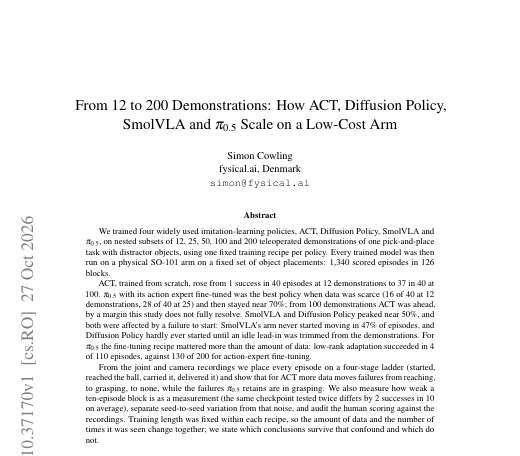
From 12 to 200 Demonstrations: How ACT, Diffusion Policy, SmolVLA and $π_{0.5}$ Scale on a Low-Cost Arm

Simon Cowling

We trained four widely used imitation-learning policies, ACT, Diffusion Policy, SmolVLA and $π_{0.5}$, on nested subsets of 12, 25, 50, 100 and 200 teleoperated demonstrations of o…

We trained four widely used imitation-learning policies, ACT, Diffusion Policy, SmolVLA and $π_{0.5}$, on nested subsets of 12, 25, 50, 100 and 200 teleoperated demonstrations of one pick-and-place task with distractor objects, using one fixed training recipe per policy. Every trained model was then run on a physical SO-101 arm on a fixed set of object placements: 1,340 scored episodes in 126 blocks. ACT, trained from scratch, rose from 1 success in 40 episodes at 12 demonstrations to 37 in 40 at 100. $π_{0.5}$ with its action expert fine-tuned was the best policy when data was scarce (16 of 40 at 12 demonstrations, 28 of 40 at 25) and then stayed near 70%; from 100 demonstrations ACT was ahead, by a margin this study does not fully resolve. SmolVLA and Diffusion Policy peaked near 50%, and both were affected by a failure to start: SmolVLA's arm never started moving in 47% of episodes, and Diffusion Policy hardly ever started until an idle lead-in was trimmed from the demonstrations. For $π_{0.5}$ the fine-tuning recipe mattered more than the amount of data: low-rank adaptation succeeded in 4 of 110 episodes, against 130 of 200 for action-expert fine-tuning. From the joint and camera recordings we place every episode on a four-stage ladder (started, reached the ball, carried it, delivered it) and show that for ACT more data moves failures from reaching, to grasping, to none, while the failures $π_{0.5}$ retains are in grasping. We also measure how weak a ten-episode block is as a measurement (the same checkpoint tested twice differs by 2 successes in 10 on average), separate seed-to-seed variation from that noise, and audit the human scoring against the recordings. Training length was fixed within each recipe, so the amount of data and the number of times it was seen change together; we state which conclusions survive that confound and which do not.

cs.ROdiffusion policy

兴趣:imitation learning and diffusion policies for robot control

#382026-10-2777

Vision-Language Agents Can Learn in Their Own Latent Worlds

Haoxi Li, Sikai Bai, Jianfei Ma, Qinglin Hou, Xiaocheng Lu, Tao Han 等

Learning from experience is essential for building the next generation of agents that continually expand their capabilities. Pretrained vision-language models (VLMs) already intern…

Learning from experience is essential for building the next generation of agents that continually expand their capabilities. Pretrained vision-language models (VLMs) already internalize rich world knowledge, yet this knowledge is rarely leveraged to drive policy improvement through online interaction. Realizing this potential efficiently remains challenging, as policy updates shift the agent's interaction distribution, requiring the world model to adapt accordingly, while continually updating large pretrained models is computationally expensive. To address this challenge, we introduce Dwell, a model-based reinforcement learning (RL) framework that reframes a VLM as a recurrent latent transition operator, endowing it with the ability to predict, adjust, and act in latent space. Leveraging the VLM's own representations and its dual role as both world model and policy, the agent continually learns from real interactions to anticipate and evaluate action outcomes, and from latent imagination to improve its behavior. Across five interactive visual environments, Dwell achieves the strongest overall performance among trainable methods while substantially reducing the compute required for imagination, showing that effective world models for VLM agents need not reconstruct the future; they need to predict futures that are useful for action. Our code is publicly available at https://github.com/Tom111-lhx/Dwell

cs.AIworld model

兴趣:vision-language-action (VLA) models and foundation models for robots

#392026-10-2777

Hy-Nomas: Towards Free-form Interactive World Generation

Qiaoling Chen, Jiaxiang Cheng, Xueqing Deng, Tiankai Hang, Ji Hou, Jiaqi Li 等

Interactive world generation requires models to follow successive commands while preserving relevant history and action consequences. We present Hy-Nomas, a video world model with …

Interactive world generation requires models to follow successive commands while preserving relevant history and action consequences. We present Hy-Nomas, a video world model with an 8B diffusion backbone that supports free-form text instructions and continuous camera control across multiple interaction turns. It generates variable-length segments conditioned on current inputs and cached history. Our central design aligns structured video captions with action-aware causal attention: descriptive context remains accessible across segments, while action instructions are restricted to their intended temporal windows. A vision-language Prompt Enhancer (PE) translates user requests and multimodal interaction histories into structured conditions for the next segment. A multi-stage curriculum progressively introduces causal generation, text interaction, camera control, and training on model-generated histories, followed by diffusion distillation. In human evaluation, Hy-Nomas shows superior performance over existing world models. We release model weights, code and benchmarks, together with a lightweight adaptation workflow, to support reproducible research on interactive world generation.

cs.CVworld model

兴趣:world models and video prediction for embodied agents

#402026-10-2776

SWIM: Learning What Matters from Behaviors for JEPA World Models

Jiaming Hu, Shi Bo, Yan Zheng, Tian Wang, Florian Dubost, Alejandro Mottini 等

Joint-embedding predictive architectures (JEPAs) enable world models to plan from images by predicting future embeddings. However, their visual prediction objectives do not explici…

Joint-embedding predictive architectures (JEPAs) enable world models to plan from images by predicting future embeddings. However, their visual prediction objectives do not explicitly incorporate task-relevant state information, so the physical state that determines task progress may not be reliably captured in the latent space. Supervising world models with simulator state can make planning more informative, but it requires deciding which state features matter. Features are typically selected by hand or weighted uniformly, and a uniform weighting gives every standardized state feature equal influence, so redundant coordinates can overcount the same variation, while irrelevant ones can obscure task-relevant differences. To address this limitation, we propose SWIM (State Weighting with Inverse-Dynamics Model), which learns state weights from offline trajectories by predicting recorded actions from current states and observed future displacements. The learned weights quantify each feature's contribution to action prediction and define a weighted state metric for state-supervised training, which we demonstrate by aligning latent and state distances. The inverse-dynamics model is used only during training, so the resulting world model plans from images with no additional planning-time computation. Across five simulated robotic manipulation tasks, SWIM consistently improves planning success over uniform state weighting.

cs.ROcs.CVmanipulationworld model

兴趣:world models and video prediction for embodied agents

#412026-10-2676

Rollback: Experience Backtracking in World Models for Policy Improvement

Jiayi Luo, Yang Zhang, Liliang Chen, Nan Wang, Chen Gao, Boxiang Qiu 等

Action-conditioned world models offer a scalable alternative to costly real-world interaction for improving robot policies. However, existing world-model-based methods largely trea…

Action-conditioned world models offer a scalable alternative to costly real-world interaction for improving robot policies. However, existing world-model-based methods largely treat world models as forward-only surrogates of the physical environment, leaving untapped a capability no physical environment affords: rewinding to past decision points to explore counterfactual futures. We introduce Rollback, a policy improvement paradigm that turns world models from passive simulators into counterfactual engines: it rolls back to critical decision points, branches into alternative actions, and contrasts their outcomes to attribute success to individual decisions. This concentrates imagination where it matters most and distills counterfactual outcomes into fine-grained, action-level supervision without a separately learned value model. We build a scalable training system that unifies distributed world-model search with asynchronous real-robot execution, forming a self-reinforcing cycle: real-world experience continually sharpens the world model, and a sharper world model in turn drives further policy improvement. We term the world-model side of this cycle test-time physics grounding, a capability that hand-built physics simulators lack: while the world model serves as the training environment, real transitions from the policy it trains correct its dynamics through a lightweight LoRA pipeline. Experiments on three challenging real-world tasks show that Rollback improves success rates over the strongest baseline by an absolute 10.67%, 11.11%, and 11.85% on block extraction, ball tossing, and tabletop curling, respectively, while achieving more stable improvement throughout training. Although initialized from teleoperated demonstrations far below human level, Rollback surpasses the average success rate of human players on both ball tossing and tabletop curling within 8 hours of training.

cs.ROcs.AIcs.LGrobotworld model

兴趣:imitation learning and diffusion policies for robot control

#422026-10-2774

OpenJaws: An Open Hardware UMI Framework with Stereo Localization for Generalist Manipulation

Adithyavairavan Murali, Yash Oza, Karanbir Chahal, Neel Jawale, Silas De Vries, Hesam Rabeti 等

Handheld data-collection interfaces such as the Universal Manipulation Interface (UMI) allow manipulation demonstrations to be gathered in the wild without a robot in the loop, but…

Handheld data-collection interfaces such as the Universal Manipulation Interface (UMI) allow manipulation demonstrations to be gathered in the wild without a robot in the loop, but the quality of the resulting action labels is bounded by the accuracy of vision-based localization. Existing systems recover end-effector pose from monocular visual-inertial odometry, which is subject to scale ambiguity and drift, or delegate tracking to closed-source modules and external infrastructure that reintroduce cost and setup burden. We present OpenJaws, a fully open hardware and software framework for sensorized UMI that improves localization and simplifies deployment across robot platforms. OpenJaws pairs a modular, 3D-printed gripper exposing a standardized ISO adapter with a low-cost stereo camera to recover metric camera trajectories. We further introduce UMI-Loc-Bench-v1, a benchmark quantifying real-world localization accuracy for handheld data-collection devices, and show that stereo localization substantially outperforms monocular alternatives. Finally, we demonstrate that policies trained on data collected with OpenJaws can be deployed on a real robot across multiple tasks. Hardware, software, and data are released under a commercially permissive license. Code, data, and videos are available at https://open-jaws.github.io/

cs.ROrobotmanipulation

兴趣:robot manipulation and grasping with learned policies

#432026-10-2674

ASPEN: Adaptive Semantic Reasoning via Command Persistence Prediction for Efficient Navigation VLAs

Vieri N. Akustia, Bin Hu

Navigation vision-language-action (VLA) policies repeatedly invoke costly semantic reasoning even when the next command remains unchanged. Command reuse can reduce computation but …

Navigation vision-language-action (VLA) policies repeatedly invoke costly semantic reasoning even when the next command remains unchanged. Command reuse can reduce computation but risks missing instruction-dependent turns or stops. We introduce ASPEN, an event-triggered scheduler based on command persistence prediction: estimating whether the frozen base policy would reissue its previous command. A lightweight multimodal predictor combines temporal observations, language instructions, execution history, and cached VLA confidence. At eligible command boundaries, sufficient predicted persistence permits command reuse. Otherwise, ASPEN triggers fresh semantic reasoning from the VLA. Evaluated with frozen NaVILA on cross-dataset RxR-CE val-unseen, ASPEN reduces VLA calls by 9.5% and estimated inference time by 8.1%, including scheduling overhead. It maintains comparable navigation performance and preserves identical baseline action sequences on 92.1% of episodes.

cs.ROVLAvision-language-action

兴趣:large language models for robot task planning and reasoning

#442026-10-2674

cuArms: GPU-Accelerated Conflict-Based Planning for Multi-Arm Manipulation

Philip Huang, Fabio Ramos, Jiaoyang Li, Caelan Garrett, Lars Johannsmeier

Multi-arm manipulation has the potential to dramatically improve the throughput, efficiency, and dexterity of many manipulation tasks. Recent work coordinates multiple robot arms i…

Multi-arm manipulation has the potential to dramatically improve the throughput, efficiency, and dexterity of many manipulation tasks. Recent work coordinates multiple robot arms in a shared workcell by allocating and scheduling tasks for greater parallelism, jointly planning multi-arm motions, or directly learning multi-arm policies. So far, these approaches are either too slow, rely on domain-specific assumptions, or scale poorly with the number of robots and task horizon. Thus, we introduce cuArms, a conflict-based planner co-designed with GPU parallelism that efficiently decomposes the search space using reusable multi-modal roadmaps for individual robots and resolves conflicts and deadlocks through a lazy search. To jointly optimize task assignment, schedules, motions, and manipulation skills, we integrate a high-level scheduler that proposes candidate skeletons for cuArms to ground into coordinated manipulation plans. Experimental results show that our method establishes a new state of the art, with real-time initial solutions and anytime improvements in both motion quality and scheduling, without days of domain-specific training required by learning approaches. Videos of both simulated and real-world industrial tasks are available on https://cuarms.github.io/.

cs.ROcs.AIcs.MArobotmanipulation

兴趣:robot manipulation and grasping with learned policies

#452026-10-2774

When Black-Box Robot Policies Fail: Online Sensor Diagnosis and Repair with a Transparent Surrogate

Marc Ziegler, Batu Özen, Sami Mentes, Thomas Waschulzik, Alois Knoll

Robot foundation models may generalize across tasks and embodiments, but their actions still depend on sensors that can fail. When the policy is frozen or inaccessible, can an exte…

Robot foundation models may generalize across tasks and embodiments, but their actions still depend on sensors that can fail. When the policy is frozen or inaccessible, can an external monitor diagnose and repair corrupted inputs without access to its internals? We test a structured surrogate that separates periodic gait from sensor-dependent corrections to guide input repair around a frozen locomotion policy. On simulated Go2, offline diagnosis raises walking success from 259/640 to 429/640 episodes; online repair reaches 382/640, with no triggers in 64 held-out fault-free episodes. A matched boosted-tree surrogate predicts clean actions similarly well but yields no detected repair improvement over no repair. Separate fits improve walking on Go1 and ANYmal C, although phase-aware gradients perform better. Evidence remains limited to one policy and a partly screened simulated fault suite; robot foundation model and hardware validation remain open.

cs.ROrobotlocomotion

兴趣:imitation learning and diffusion policies for robot control

#462026-10-2773

A Trainable CPG Framework for Quadruped Locomotion

Xiyan Liu, Yide Liu, Guoyong Mao, Shaoxing Qu

We present CPG-ENN, a trainable quadruped locomotion framework that combines explicit neural coordination with learned motion realization. A symmetry-based eight-neuron central pat…

We present CPG-ENN, a trainable quadruped locomotion framework that combines explicit neural coordination with learned motion realization. A symmetry-based eight-neuron central pattern generator (CPG) supplies gait rhythms, while a pretrained, leg-shared execution neural network (ENN) maps rhythmic signals and trajectory parameters to joint-angle references without online inverse kinematics. A single feedback policy modulates six physically interpretable trajectory variables. The controller tracks planar velocity and yaw-rate commands across walk, trot, pace, bound, and pronk without gait-specific learned controllers or transitionspecific rewards. Simulation yields 99.39% transition success across all 20 directed gait pairs and all source-target speed combinations from {0.5, 1.0, 1.5, 2.0} m/s. Ablations show high cross-gait transition feasibility without transition exposure; exposure mainly refines gait acquisition and velocity transients. Comparisons with AllGaits and Walk These Ways demonstrate accurate gait-speed regulation, and Unitree Go2 experiments validate five gaits and their transitions.

cs.ROlocomotion

兴趣:reinforcement learning for legged locomotion and sim-to-real transfer

#472026-10-2773

Keeping Contact: Task-Adaptive Friction Margins for Bimanual Non-Prehensile Manipulation

Qian Ying Lee, Lin Yang, Domenico Campolo

Maintaining contact in non-prehensile manipulation requires more than nominal friction cone feasibility: a force barely inside the cone and one well inside it are both feasible, bu…

Maintaining contact in non-prehensile manipulation requires more than nominal friction cone feasibility: a force barely inside the cone and one well inside it are both feasible, but they provide different margins against slip and contact loss. This paper uses signed friction distance to measure friction margin in force space and derives a task-adaptive margin from the force correction needed to balance pivot moment deviations in bimanual tilting. The resulting contact margins are embedded in a sequence of second-order cone programs (SOCPs), each giving a globally optimal contact force solution at a tilt angle. The optimizer balances the object about an environmental pivot while keeping robot and pivot contact forces away from the nominal friction boundary. Optimizer-level results show interpretable force redistribution and adaptation to object property changes. Real-world experiments demonstrate successful execution under object property variations and model mismatch, while fixed margin and no-margin comparisons illustrate the importance of adapting the margin to task demand. These results support signed friction distance margins as a force planning mechanism for maintaining contact in bimanual non-prehensile manipulation. Project page: https://keeping-contact.github.io/

cs.ROrobotmanipulation

兴趣:robot manipulation and grasping with learned policies

#482026-10-2672

Program-Level Adversarial Co-Adaptive Self-Play for Robotic Security

Leo Benaharon, Chi Zhang, Wei Zheng, Weifan Zhang, Yifan Wei

Coding agents can adapt robotic software by revising executable programs, but successful responses to an evolving opponent may not remain effective. We present a framework for prog…

Coding agents can adapt robotic software by revising executable programs, but successful responses to an evolving opponent may not remain effective. We present a framework for program-level adversarial co-adaptive self-play in which coding agents generate attacks and defenses from tested opponent code and mission feedback, without model fine-tuning. Environment-specific interfaces support external programs for autonomous driving and SDK-level defenses for humanoid locomotion. Two eight-generation case studies reveal concrete software responses: a driving defender introduces direct-actuation recovery, while a humanoid defender revises incoming-state validation. These responses provide local task recovery but do not establish sustained robustness. The framework makes such adaptation and limitations observable through executable artifacts and task-level evidence.

cs.ROhumanoidlocomotion

兴趣:humanoid robots and whole-body control

#492026-10-2671

Closed-Loop Aware Planning via Imitation-Free Speed Scoring for End-to-End Autonomous Driving

Emad Aghajanzadeh, Thomas Schwarzfischer, Marc Kaufeld, Moritz Thoma, Ryan Pégoud, Manoj Rohit Vemparala 等

End-to-end autonomous driving has predominantly relied on open-loop imitation learning for training, which presents two limitations. First, expert demonstrations show only one beha…

End-to-end autonomous driving has predominantly relied on open-loop imitation learning for training, which presents two limitations. First, expert demonstrations show only one behavior per scenario, so the model cannot learn alternative valid behaviors and, in turn, cannot adapt to user-specified preferences at test time. Second, noise or ambiguity in these demonstrations can produce inconsistent, unreliable supervision for the end-to-end models. Driving is inherently multi-modal: multiple different behaviors can be valid responses to the same scene, and this diversity arises largely from speed rather than path. We introduce a planning paradigm that learns the path through imitation while scoring a set of candidate speeds across multiple criteria with a learned function supervised by physically grounded safety constraints. We realize this paradigm as Closed-Loop Aware Planning for Autonomous Driving (CLAP-AD), a plug-in planning head that integrates with existing end-to-end driving models and, to our knowledge, is the first to enable explicit test-time control over their speed selection without speed-conditioned training. On Bench2Drive-Speed, CLAP-AD sets a new state of the art Speed-Adherence Score of 82.53, topping TFv6, the strongest baseline on this metric, by 12.9 points while retaining strong closed-loop driving performance. On Bench2Drive, it improves driving score by +28.5 and +32.7 over UniAD and VAD, and on NAVSIM v2, built on real-world driving data, EPDMS by +6.1 over its backbone. Project page: https://clap-ad.github.io

cs.ROcs.CVcs.LGimitation learning

兴趣:imitation learning and diffusion policies for robot control

#502026-10-2770

Zooming without Zooming v2: From Seeing Details to Connecting Evidence for Generalizable Multimodal Perception

Lai Wei, Yatai Li, Liangbo He, Jun Lan, Renjie Gu, Linhan Cao 等

Multimodal perception forms the foundation of multimodal intelligence. In particular, spatial perception and multimodal long-context understanding are two pivotal tasks that underp…

Multimodal perception forms the foundation of multimodal intelligence. In particular, spatial perception and multimodal long-context understanding are two pivotal tasks that underpin embodied AI and multimodal agents. However, synthesizing targeted, high-quality training data for these tasks remains difficult and costly. Our key insight is that these tasks share an underlying capability, which we call connecting evidence: identifying relevant visual facts, binding them to the correct entities, recovering their relations, and composing them into an answer. Crucially, targeted training data are far easier to synthesize for this capability than for these tasks themselves. To strengthen this capability, we propose EvidenceConnect, an easy-to-implement data synthesis framework that uses zoomed views of related regions within a single image to generate questions requiring comparison, aggregation, or chaining of visual evidence. To ensure quality, a reference answer is retained only when independent VLMs agree on it, and region-ablation tests discard questions whose answer survives the removal of selected regions. We then train base VLMs on the resulting data with RLVR, obtaining Zooming without Zooming v2 (ZwZ2). Although the synthesized data are not tailored to any downstream benchmark, ZwZ2 improves fine-grained and spatial perception, with further gains on embodied spatial reasoning, multimodal long-context understanding, multimodal agent tasks, and general visual reasoning. These results establish EvidenceConnect as an effective framework for supervising evidence connection and suggest that strengthening this shared capability leads to more generalizable multimodal perception.

cs.CVcs.AIcs.CLcs.LGembodied

兴趣:3D perception, point clouds and scene understanding for robotics

GitHub 项目

#12026-10-12★ 269新项目77

robosimstudio/robosimstudio

Python

An open interactive toolkit that accelerates human and agentic physics-based Real2Sim of Robot Manipulation Tasks

An open interactive toolkit that accelerates human and agentic physics-based Real2Sim of Robot Manipulation Tasks

agentinverse-physicsreal2simreal2sim2realroboticssimulationrobotmanipulation

兴趣:vision-language-action (VLA) models and foundation models for robots

#22024-12-08★ 4.3k +1775

datawhalechina/every-embodied

Python

仅需Python基础,从0构建自己的具身智能机器人;从0逐步构建VLA/OpenVLA/SmolVLA/Pi0, 深入理解具身智能

仅需Python基础,从0构建自己的具身智能机器人;从0逐步构建VLA/OpenVLA/SmolVLA/Pi0, 深入理解具身智能

embodied-agentembodied-aiembodied-intelligenceopenvlasmolvlavision-language-action-modelVLAvision-language-actionembodied

兴趣:world models and video prediction for embodied agents

#32026-10-05★ 211 +4新项目74

AetherLabsAI/Video2World

Python

Benchmarking Coding Agents for Interactive World Modeling from Embodied Videos - Rethinking Embodied Real2Sim from a Software Engineering Perspective

Benchmarking Coding Agents for Interactive World Modeling from Embodied Videos - Rethinking Embodied Real2Sim from a Software Engineering Perspective

benchmarkcoding-agentembodied-aifoundation-modelsreal-to-simrobot-learningroboticssimulationrobotembodied

兴趣:world models and video prediction for embodied agents

#52025-11-23★ 743 +373

sou350121/VLA-Handbook

HTML

本项目旨在为致力于进入VLA(Vision-Language-Action)领域的算法工程师提供一份全中文、实战导向的学习/面试手册。 不同于通用的 CV/NLP 面试指南,本项目聚焦于 Robotics 特有的挑战

本项目旨在为致力于进入VLA(Vision-Language-Action)领域的算法工程师提供一份全中文、实战导向的学习/面试手册。 不同于通用的 CV/NLP 面试指南,本项目聚焦于 Robotics 特有的挑战

chinesedeep-learningembodied-aillmrobot-learningroboticsvision-language-actionvlarobotVLAvision-language-actionembodied

兴趣:vision-language-action (VLA) models and foundation models for robots

#62025-04-04★ 1.9k +272

RoboVerseOrg/RoboVerse

Python

RoboVerse: Towards a Unified Platform, Dataset and Benchmark for Scalable and Generalizable Robot Learning

RoboVerse: Towards a Unified Platform, Dataset and Benchmark for Scalable and Generalizable Robot Learning

imitation-learningreinforcement-learningroboticssimulationrobot

兴趣:imitation learning and diffusion policies for robot control

#72024-01-26★ 28.5k +3072

huggingface/lerobot

Python

🤗 LeRobot: Making AI for Robotics more accessible with end-to-end learning

🤗 LeRobot: Making AI for Robotics more accessible with end-to-end learning

兴趣:imitation learning and diffusion policies for robot control

#82025-07-30★ 746 +372

HorizonRobotics/HoloMotion

Python

A Foundation Model for Whole-Body Humanoid Control

A Foundation Model for Whole-Body Humanoid Control

foundation-modelshumanoid-robotmotion-trackingroboticswhole-body-controlrobothumanoid

兴趣:humanoid robots and whole-body control

#92026-08-26★ 396 +372

OpenMOSS/EasyWAM

Python

A unified framework for training, fine-tuning, and evaluating World Action Models

A unified framework for training, fine-tuning, and evaluating World Action Models

benchmarkcodebaseembodied-aifoundation-modelsloraroboticsvision-language-actionworld-action-modelvision-language-actionembodied

兴趣:vision-language-action (VLA) models and foundation models for robots

#102024-12-24★ 387 +172

manumerous/wb_humanoid_mpc

C++

Whole-Body Nonlinear MPC for Realtime Humanoid Loco-Manipulation Planning and Control

Whole-Body Nonlinear MPC for Realtime Humanoid Loco-Manipulation Planning and Control

aidata-generationhumanoidhumanoid-robotlocomotionmpcnonlinearoptimizationrobotmanipulationhumanoidlocomotion

兴趣:humanoid robots and whole-body control

#112025-08-14★ 5.5k +1271

RLinf/RLinf

Python

RLinf: Reinforcement Learning Infrastructure for Embodied and Agentic AI

RLinf: Reinforcement Learning Infrastructure for Embodied and Agentic AI

agentic-aiembodied-aireinforcement-learningrl-infrarlinfvla-rlVLAembodied

兴趣:vision-language-action (VLA) models and foundation models for robots

#122026-07-19★ 685 +270

RealXiaoze/humanoid-motion-intelligence

人形机器人运动智能论文、开源项目、产业与求职知识库

人形机器人运动智能论文、开源项目、产业与求职知识库

embodied-aihumanoid-roboticslocomotionmotion-controlreinforcement-learningrobot-learningsim2realvlarobotVLAhumanoidlocomotionembodied

兴趣:humanoid robots and whole-body control

#132020-10-13★ 3.8k70

lightly-ai/lightly

Python

A python library for self-supervised learning and latent world models on images.

A python library for self-supervised learning and latent world models on images.

computer-visioncontrastive-learningcontributions-welcomedeep-learningembeddingshacktoberfestjepamachine-learning

兴趣:world models and video prediction for embodied agents

#142026-07-06★ 2.2k +270

dexmal/opendm

Python

An Open-World Foundation Model for General-Purpose Embodied Intelligence.

An Open-World Foundation Model for General-Purpose Embodied Intelligence.

embodied-aiembodied-intelligenceroboticsvision-language-actionvlaVLAvision-language-actionembodied

兴趣:vision-language-action (VLA) models and foundation models for robots

#152022-11-16★ 8.5k +1469

isaac-sim/IsaacLab

Python

Unified framework for robot learning with multi-physics/renderer support

Unified framework for robot learning with multi-physics/renderer support

isaac-simomniverse-kit-extensionrobot-learningroboticsrobot

兴趣:3D perception, point clouds and scene understanding for robotics

#162026-09-30★ 218 +16新项目69

groundingpi/GroundingPI

Python

A 4B grounding foundation model for physical intelligence. Unifies detection, referring, pointing, OCR, GUI, and layout grounding, achieving SOTA overall across 34 benchmarks and i…

A 4B grounding foundation model for physical intelligence. Unifies detection, referring, pointing, OCR, GUI, and layout grounding, achieving SOTA overall across 34 benchmarks and improving robot generalization and data efficiency in controlled evaluations.

embodied-aigui-groundingobject-detectionocrphysical-intelligencepointingrobot-learningvision-language-modelrobotVLAembodied

兴趣:vision-language-action (VLA) models and foundation models for robots

#172026-05-06★ 637 +9869

Rhoban/microban

Python

Microban is an affordable, fully 3D-printable, and 100% open-source humanoid robot. Powered by a Raspberry Pi Zero 2W and 19 Dynamixel servomotors, it serves as an accessible DIY p…

Microban is an affordable, fully 3D-printable, and 100% open-source humanoid robot. Powered by a Raspberry Pi Zero 2W and 19 Dynamixel servomotors, it serves as an accessible DIY platform for learning, experimentation, and research in robotics.

diyelectronicsengineeringhumanoid-robotroboticsrobothumanoid

兴趣:humanoid robots and whole-body control

#182024-05-11★ 1.8k +569

robocasa/robocasa

Python

RoboCasa: Large-Scale Simulation of Everyday Tasks for Generalist Robots

RoboCasa: Large-Scale Simulation of Everyday Tasks for Generalist Robots

humanoid-robotphysics-simulationrobot-learningroboticsrobothumanoid

兴趣:humanoid robots and whole-body control

#192026-09-28★ 112 +469

DAGroup-PKU/ViGAR

Python

Rethinking World-Action Model for Compositional and In-context Robotic Manipulation

Rethinking World-Action Model for Compositional and In-context Robotic Manipulation

efficiencylong-horizonpost-trainingroboticsrobotwinsimulationvideo-generationworld-action-modelmanipulation

兴趣:robot manipulation and grasping with learned policies

#202026-04-22★ 23.8k +32269

earthtojake/text-to-cad

Python

Design physical products with AI

Design physical products with AI

agentsai-agentscadmechanical-engineeringroboticsstepstlstp

兴趣:humanoid robots and whole-body control

#212026-08-29★ 101 +169

OpenBMB/SimpleMemVLA

Python

Native-video memory for vision-language-action models, using timestamped visual history and exact streaming inference for long-horizon robot manipulation.

Native-video memory for vision-language-action models, using timestamped visual history and exact streaming inference for long-horizon robot manipulation.

embodied-ailong-horizon-roboticsmultimodal-learningnative-video-memoryrobot-learningrobot-manipulationstreaming-inferencevideo-understandingrobotmanipulationVLAvision-language-actionembodied

兴趣:vision-language-action (VLA) models and foundation models for robots

#222025-10-09★ 3.9k +769

starVLA/starVLA

Python

StarVLA: A Lego-like Codebase for Vision-Language-Action Model Developing

StarVLA: A Lego-like Codebase for Vision-Language-Action Model Developing

robotic-foundation-modelroboticsvision-language-action-modelworld-action-modelvision-language-action

兴趣:vision-language-action (VLA) models and foundation models for robots

#232026-06-26★ 716 +669

robocurve/inspect-robots

Python

Open source evals for physical AI. Run any LLM/VLA on any arm/humanoid against any real/sim benchmark.

Open source evals for physical AI. Run any LLM/VLA on any arm/humanoid against any real/sim benchmark.

benchmarkembodied-aievaluationphysical-airerunroboticsvision-language-actionvlaVLAvision-language-actionhumanoidembodied

兴趣:vision-language-action (VLA) models and foundation models for robots

#242026-10-21★ 23新项目68

xuyicheng-zju/TARSphere

Python

A robot-oriented full-stack framework for long-horizon embodied agents in evolving physical and social environments.

A robot-oriented full-stack framework for long-horizon embodied agents in evolving physical and social environments.

benchmarkembodied-aiisaac-simroboticsrobotembodied

兴趣:world models and video prediction for embodied agents

#252026-09-18★ 203 +1168

mll-lab-nu/embodied-first-exam

Python

The first exam for code agents in the physical world: frozen robot tasks from many benchmark suites, each answered with a program and verified in a separate sandbox. Runs on Harbor…

The first exam for code agents in the physical world: frozen robot tasks from many benchmark suites, each answered with a program and verified in a separate sandbox. Runs on Harbor.

ai-agentsbenchmarkcoding-agentsembodied-aievaluationharborllm-agentsrobot-learningrobotembodied

兴趣:vision-language-action (VLA) models and foundation models for robots

#262024-02-29★ 16968

RobotControlStack/robot-control-stack

Python

A lean, ROS-free sim-to-real framework for training and deploying Vision-Language-Action (VLA) models and RL agents. Native MuJoCo Gymnasium wrappers with synchronous execution for…

A lean, ROS-free sim-to-real framework for training and deploying Vision-Language-Action (VLA) models and RL agents. Native MuJoCo Gymnasium wrappers with synchronous execution for Franka, UR5e, xArm, SO101, YAM and Rizon.

frankagymnasiummujocoreinforcement-learningrobot-learningrobot-manipulationsim-to-realvision-language-actions-modelsrobotmanipulationVLAvision-language-actionsim-to-real

兴趣:vision-language-action (VLA) models and foundation models for robots

#272026-10-09★ 155 +12新项目68

fendouai/awesome-embodied-ai

Python

2,000 curated embodied AI and robotics resources with bilingual metadata and transparent ranking

2,000 curated embodied AI and robotics resources with bilingual metadata and transparent ranking

awesomeawesome-listbenchmarksdatasetsembodied-aiembodied-intelligencefoundation-modelshumanoid-robotsrobotmanipulationVLAvision-language-actionhumanoidembodied

兴趣:world models and video prediction for embodied agents

#282026-10-04★ 67 +2新项目68

Holiday-Robot/FlashDexRetarget

Python

FlashDexRetarget: Accelerating Dexterous Manipulation Data Generation through Multi-Motion Retargeting

FlashDexRetarget: Accelerating Dexterous Manipulation Data Generation through Multi-Motion Retargeting

dexterous-manipulationreinforcement-learningroboticsrobotmanipulationdexterous

兴趣:robot manipulation and grasping with learned policies

#292025-06-07★ 100.6k +58068

ruvnet/RuView

Rust

π RuView turns commodity WiFi signals into real-time spatial intelligence, vital sign monitoring, and presence detection — all without a single pixel of video.

π RuView turns commodity WiFi signals into real-time spatial intelligence, vital sign monitoring, and presence detection — all without a single pixel of video.

awesomeclaudedenseposeesp32firmwarehome-assistanthome-automationiot

你点赞过:TANGO: Humanoid Navigation in Cluttered Environments with a

#302026-09-19★ 17368

roboninecom/SO-ARM102

An open-source SO-ARM102 robot arm, successor to SO-ARM100 and SO-ARM101. LeRobot-compatible leader-follower kit for teleoperation and imitation learning, with improved rigidity, p…

An open-source SO-ARM102 robot arm, successor to SO-ARM100 and SO-ARM101. LeRobot-compatible leader-follower kit for teleoperation and imitation learning, with improved rigidity, parallel gripper, STEP/STL files and BOM.

3d-printingimitation-learninglerobotopen-hardwarerobot-armrobot-learningroboticsso-100robotimitation learning

兴趣:imitation learning and diffusion policies for robot control