Tech Station

学者追踪 › 清北交

清华 / 北大 / 上交

5 位学者 · 最近 45 天 61 篇

Yang Gao 18 篇 专属页 →

2026-11-02追踪学者 · Yang Gao

MoSoLoco: Monocular 3D Human Localization through Visual Latent Features and Social Context

Yasamin Borhani, Javad Khoramdel, Yang Gao, Po-Chien Luan, Alexandre Alahi

Estimating the metric 3D position of people from a monocular camera is important for robot navigation and motion prediction. Lightweight pose-based localizers are attractive for ro…

Estimating the metric 3D position of people from a monocular camera is important for robot navigation and motion prediction. Lightweight pose-based localizers are attractive for robotic hardware with limited computational resources because they operate on compact 2D keypoints. However, they typically discard the richer visual representations computed by the pose estimator. We introduce MoSoLoco, a per-frame monocular 3D human localizer that combines the pose detector's internal visual features with the detected 2D skeleton, without requiring an additional RGB or depth encoder. MoSoLoco can further incorporate sparse same-frame multi-person context to refine individual position estimates. Experiments on JRDB and NuScenes show that reusing pose-detector representations improves localization, reducing the best JRDB error by approximately 23 percent relative to the strongest evaluated keypoint-based baseline. A sparse social-interaction module incorporates nearby detections from the same image for further refinement. Controlled trajectory-forecasting experiments show downstream benefits, while the complete pipeline remains suitable for efficient Jetson AGX Xavier inference.

cs.CVcs.RO
2026-11-02追踪学者 · Yang Gao

RecRSI: Mechanism-Guided Discovery of Recommendation Algorithms

Tingran Gan, Zhouziyue Lu, Dian Jin, Tao Li, Yang Gao, Ming Liu, Weiwen Liu, Jianghao Lin 等

Improving recommendation algorithms for the Web requires coordinating interacting design choices and learning from experiments. We present RecRSI, an LLM-based research framework t…

Improving recommendation algorithms for the Web requires coordinating interacting design choices and learning from experiments. We present RecRSI, an LLM-based research framework that uses mechanism hypotheses to organize algorithm discovery. Each hypothesis links a proposed mechanism change to a reference design, a rationale, and an expected observation. MechSpace derives implementable primitives and composition rules from the task source; Research Line uses this space and prior evidence to develop and test hypotheses; Mechanism Feedback carries outcomes and their design context into subsequent research. This organization makes each experiment inform which mechanisms to develop, revise, or combine next. Across four initial recommenders and four datasets, RecRSI yields average relative improvements of 8.48% in NDCG@5 and 6.88% in HR@5 over the initial algorithms, and 2.60% and 2.20%, respectively, over the strongest competing result for each setting and metric. Component and process studies link these gains to coordinated mechanism choices and evidence-guided follow-up. Our code is publicly available at https://github.com/DynamisG210/RecRSI.

2026-10-29追踪学者 · Yang Gao

Gaze-Assisted Supervisory Control for Lunar Robotic Arm Teleoperation Under Concurrent Monitoring

Jiayu He, Yifan Li, Oliver R. Runswick, Ernest N. Kamavuako, Yunjie Jia, Peter D. Hodkinson, Yang Gao

Rover-mounted robotic arms can extend human reach during lunar sample handling, but continuous joystick teleoperation requires repeated visual-motor alignment while operators may a…

Rover-mounted robotic arms can extend human reach during lunar sample handling, but continuous joystick teleoperation requires repeated visual-motor alignment while operators may also need to monitor system states. This paper presents a gaze-assisted supervisory control framework in which gaze nominates a rock or placement target, explicit confirmation authorizes the action, and the robot performs bounded autonomous grasp-and-place execution. The framework was evaluated against manual joystick teleoperation in a mission-analog virtual reality study with 16 participants. The study used a 2 x 2 x 3 within-subject design varying control mode, placement difficulty, and concurrent monitoring load. Mean recorded task completion time decreased from 47.65 to 18.43 s per rock, with 72.5% of this difference arising during grasping. Under the tested auditory monitoring conditions, gaze-assisted supervisory control showed less average proportional slowing, with no detected control-mode difference in monitoring-response accuracy or speed. The rate of gaze shifts between core areas of interest decreased from 49.98 to 27.73 shifts/min, while the raw NASA Task Load Index score decreased from 32.54 to 18.26. However, the benefit was task dependent. In precision placement, manual control yielded lower mean placement error and a higher placement success rate. These findings support a mixed-initiative allocation in which gaze enables rapid task-level intention specification and autonomous execution, while precision-critical stages retain manual refinement.

2026-10-24追踪学者 · Yang Gao

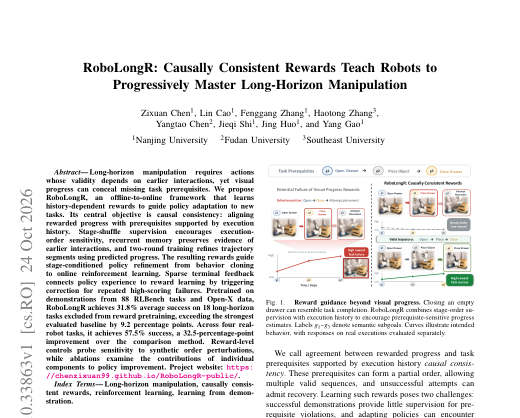
RoboLongR: Causally Consistent Rewards Teach Robots to Progressively Master Long-Horizon Manipulation

Zixuan Chen, Lin Cao, Fenggang Zhang, Haotong Zhang, Yangtao Chen, Jieqi Shi, Jing Huo, Yang Gao

Long-horizon manipulation requires actions whose validity depends on earlier interactions, yet visual progress can conceal missing task prerequisites. We propose RoboLongR, an offl…

Long-horizon manipulation requires actions whose validity depends on earlier interactions, yet visual progress can conceal missing task prerequisites. We propose RoboLongR, an offline-to-online framework that learns history-dependent rewards to guide policy adaptation to new tasks. Its central objective is causal consistency: aligning rewarded progress with prerequisites supported by execution history. Stage-shuffle supervision encourages execution-order sensitivity, recurrent memory preserves evidence of earlier interactions, and two-round training refines trajectory segments using predicted progress. The resulting rewards guide stage-conditioned policy refinement from behavior cloning to online reinforcement learning. Sparse terminal feedback connects policy experience to reward learning by triggering correction for repeated high-scoring failures. Pretrained on demonstrations from 88 RLBench tasks and Open-X data, RoboLongR achieves 31.8% average success on 18 long-horizon tasks excluded from reward pretraining, exceeding the strongest evaluated baseline by 9.2 percentage points. Across four real-robot tasks, it achieves 57.5% success, a 32.5-percentage-point improvement over the comparison method. Reward-level controls probe sensitivity to synthetic order perturbations, while ablations examine the contributions of individual components to policy improvement.

2026-10-22追踪学者 · Yang Gao

Echo: Coupled Action and Task Status Signal Denoising for Vision Language Action Models

Yufeng Liu, Bohao Fan, Juntu Zhao, Xinyi Wang, Hang Yu, Wenzhuan Luo, Yingzhi Wang, Qinghai Li 等

Recognizing task completion and failure enables robots to stop upon success and initiate recovery or replanning after failure. Existing methods augment Vision Language Action (VLA)…

Recognizing task completion and failure enables robots to stop upon success and initiate recovery or replanning after failure. Existing methods augment Vision Language Action (VLA) policies with task status signal prediction to support these execution decisions. However, learning and integrating these signals can require fine-grained supervision, external monitoring models, or complex architectural designs. Moreover, the potential of task status signals to directly guide action generation remains underexplored. We present Echo, a framework that combines task status signal learning without frame-level progress annotations with a compact design for status prediction and action generation within a single VLA. Specifically, Echo represents task status with stop and failure signals, added as two dimensions of each action chunk and denoised together with robot actions. Their combination distinguishes ongoing execution, successful completion, and failure. To learn these signals without fine-grained progress annotations, Echo constructs successful, failed, and recovery trajectories with complementary supervision properties. To enable status signal-guided action generation, Echo controls interactions between the signals and actions and denoises the signals faster than the actions. These allow later action denoising steps to condition on cleaner status estimates while preserving accurate signal prediction. Extensive real-world manipulation experiments show that Echo accurately predicts task status and consistently improves policy performance.

2026-10-19追踪学者 · Yang Gao

Nash-MOPD: Optimizing Task Trade-offs in Multi-Teacher On-Policy Distillation

Siyuan Gan, Bo Yang, Linjian Meng, Boyan Wang, Xiaolong Qi, Jing Huo, Yang Gao

Multi-teacher on-policy distillation (MOPD) aggregates the capabilities of multiple domain-expert teachers into a single student model. However, all domains in MOPD share the stude…

Multi-teacher on-policy distillation (MOPD) aggregates the capabilities of multiple domain-expert teachers into a single student model. However, all domains in MOPD share the student's finite budget of optimization steps and rollouts. Fixed uses constant domain sampling ratios based on corpus sizes; by contrast, D$^3$-MOPD adjusts the ratios using the teacher-student reverse-KL divergence and its recent decrease. However, favoring large recent decreases can direct more training toward domains that already improve quickly, while domains that improve more slowly may receive too few examples. To address inflexible allocation and the risk of giving insufficient training to domains that improve more slowly, we propose Nash-MOPD, an adaptive domain scheduler based on a local minimax game using existing reverse-KL statistics. The equilibrium maximizes the smallest predicted proportional reduction under the local model and gives more prompts to domains that need more examples for comparable improvement. Consequently, Nash-MOPD responds to changing learning progress and supports domains that improve more slowly without extra teacher queries or rollouts. At step 100, Nash-MOPD exceeds both baselines' final mathematics and code checkpoint scores on DeepSeek-R1-Distill-Qwen-1.5B and reaches Fixed's on Qwen3-8B-Base. Furthermore, it leads eight of nine reported metrics and is best or tied best on all six mathematics and code accuracy metrics, respectively.

cs.LGcs.AI
2026-10-16追踪学者 · Yang Gao

Agentic Physics-Grounded Video Generation via Memory-Augmented In-Context Reasoning

Xikang Guan, Shaocong Yang, Yanqi Bao, Can Wang, Zheng Gu, Zhengqing Chen, Kai Chen, Jing Huo 等

Physical plausibility is essential for realistic video generation. Existing methods impose physical guidance before synthesis via simulations or refined prompts, but this can limit…

Physical plausibility is essential for realistic video generation. Existing methods impose physical guidance before synthesis via simulations or refined prompts, but this can limit dynamic diversity, miss errors that emerge only after generation, and require repeated regeneration when inconsistencies remain. We therefore study a generate-diagnose-repair paradigm that preserves the original generation capability and selectively repairs physical inconsistencies afterward, raising two key questions: what to repair and how to repair? To address them, we introduce PhysRepair, an agentic video generation framework that combines causal reasoning over the observed physical failure with prior repair experience to enable localized and adaptive correction. Specifically, Spatiotemporal Causal Constraints identify the first invalid physical state and its causally affected states, producing a repair specification that guides physically plausible local regeneration while preserving unaffected content. Experience-augmented In-context Learning combines the ongoing repair context with relevant experience from previous repairs, allowing the agent to adapt its repair decisions across diverse physical failures and accumulate completed trajectories for future cases. Experiments on Physics-IQ Verified across solid mechanics, fluid dynamics, optics, thermodynamics, and magnetism demonstrate that PhysRepair consistently improves the physical plausibility of generated videos over existing methods. Our project page is available at https://xxkkxxx.github.io/PhysRepair-Website/.

2026-10-14追踪学者 · Yang Gao

HM3D-M3: A Benchmark for Multi-Agent, Multi-Modal, Multi-Object Goal Navigation

Hongyu Ding, Kanyu Xu, Mingjia Chen, Zixuan Chen, Jieqi Shi, Jing Huo, Yifan Zhang, Yang Gao

Rapid progress in AI agents and robotics makes it a matter of the near future that humans are served by a team of robots. Such a team will receive several goals at once, each speci…

Rapid progress in AI agents and robotics makes it a matter of the near future that humans are served by a team of robots. Such a team will receive several goals at once, each specified in whatever form is convenient for the human, such as a category name, a photo, or a spoken description. Existing benchmarks study multi-agent, multi-modal, and multi-object goal navigation in isolation, and a benchmark that places all three in one episode is missing. To fill this gap, we introduce HM3D-M3. A team of K agents starts at distributed locations in a photorealistic indoor scene and searches for an unordered set of M object goals, each given as an open-vocabulary category, an instance image, or an instance description. HM3D-M3 provides 1,000 validation episodes over 3,926 goals from 379 open-vocabulary categories, 100K observation-assignment training samples, and two team-level metrics, goal-level SR and makespan-normalized SPL. We further contribute two baselines. HiGA is a trained hierarchical goal assigner on top of a frozen open-vocabulary navigation policy, and LaViRA-M3 is a training-free team of VLM agents with shared mapping and progress analysis. Adapted multi-robot and zero-shot methods reach 16--27% SR, while our baselines reach 38--41% with complementary strengths and distinct failure modes. Furthermore, we deploy LaViRA-M3 on a heterogeneous three-robot team. Project page: https://robo-lavira.github.io/hm3d-m3/

2026-10-14追踪学者 · Yang Gao

DeepPV-MRF: End-to-End Partial-Volume Fraction Estimation from MR Fingerprinting Time Series

Tianyi Ding, Yang Gao, Zhuang Xiong, Feng Liu, Martijn A. Cloos, Jin Jin, Hongfu Sun

Background: Estimating subvoxel tissue fractions from magnetic resonance fingerprinting (MRF) is challenging. Conventional dictionary matching and segmentation pipelines can propag…

Background: Estimating subvoxel tissue fractions from magnetic resonance fingerprinting (MRF) is challenging. Conventional dictionary matching and segmentation pipelines can propagate errors from intermediate parametric maps into tissue fraction estimates. Purpose: We introduce DeepPV-MRF, a deep learning framework that directly estimates voxel-wise tissue fractions from raw MRF signals. Methods: A cascaded spatial-temporal network was trained on subject-derived Bloch simulations with radial k-space undersampling. The network combines temporal encoding and spatial U-Net refinement to estimate cerebrospinal fluid (CSF), gray matter (GM), and white matter (WM) fractions without intermediate T1/T2 maps. We compared DeepPV-MRF with partial-volume dictionary matching (PV-DM) and pseudoinverse estimation (PV-Pinv) using simulated and in vivo data. Results: DeepPV-MRF outperformed both methods across acquisition settings. In single-shot simulations, CSF/WM/GM mean absolute errors were 0.0418/0.0744/0.0757, versus 0.1281/0.2443/0.2958 for PV-DM and 0.2021/0.2793/0.2630 for PV-Pinv. Corresponding structural similarity values were 0.960/0.916/0.922. In vivo results showed sharper anatomical boundaries and smoother tissue transitions, while cross-shot analysis indicated improved consistency across volunteers. Conclusions: DeepPV-MRF enables accurate and efficient direct tissue fraction estimation from MRF signals, particularly with limited shots. Further validation is needed before clinical deployment.

eess.SPcs.AI
2026-10-12追踪学者 · Yang Gao

CryptoFlowBench: Benchmarking Multi-Hop Reasoning on Blockchains for Cryptocurrency Fund Tracing

Runang He, Tongya Zheng, Jing Cao, Yucheng Ying, Shunyu Liu, Bingde Hu, Yang Gao, Zeyuan Hu 等

Pseudonymous accounts and complex smart-contract ecosystems substantially hinder the tracing of illicit cryptocurrency fund flows. Existing Graph Neural Networks (GNNs) have achiev…

Pseudonymous accounts and complex smart-contract ecosystems substantially hinder the tracing of illicit cryptocurrency fund flows. Existing Graph Neural Networks (GNNs) have achieved promising performance in blockchain fraud detection, yet their static node- or edge-level predictions do not naturally generalize to multi-hop fund tracing. Meanwhile, existing tracing methods mainly rely on predefined heuristics to capture multi-hop relationships, limiting their adaptive reasoning capabilities. To bridge this gap, we introduce CryptoFlowBench, a benchmark constructed from authoritative reports on cryptocurrency-related illicit incidents, with four tasks spanning local to multi-hop fund tracing. These tasks pose substantial challenges to existing learning- and heuristic-based methods, particularly in complex multi-hop scenarios. We therefore propose ChainSleuth, a graph-tool-augmented agent that iteratively reasons, invokes graph tools, and updates its tracing trajectory, enabling adaptive information acquisition and recovery from erroneous paths. Experiments show that no baseline consistently dominates all four tasks, revealing substantial gaps between local fraud detection and multi-hop fund tracing. ChainSleuth achieves notable improvements on multi-hop tasks, demonstrating the potential of agentic graph reasoning for cryptocurrency fund investigation.

cs.CRcs.AIcs.LG
2026-10-08追踪学者 · Yang Gao

Scenes as an Attack Surface: Uncovering Scene-Grounded Safety Failures in MLLMs

Tongxi Wu, Yuyang Cheng, Jiacheng Xian, Hu Huang, Zhihao Wu, Menglin Yang, Jian Zhang, Yang Gao

Existing jailbreak attacks have exposed serious safety weaknesses in multimodal large language models (MLLMs). Most prior attacks rely on specially constructed visual inputs to car…

Existing jailbreak attacks have exposed serious safety weaknesses in multimodal large language models (MLLMs). Most prior attacks rely on specially constructed visual inputs to carry or support harmful intent. In this paper, we uncover a different vulnerability: task-relevant scene semantics alone can shift an MLLM from refusal to compliance, even when the visual input introduces no additional attack instructions and the original task intent remains unchanged. We formalize this failure as a scene-grounded visual safety vulnerability and introduce SceneSafetyBench to investigate it across eight risk categories and nine white- and black-box MLLMs. Our analysis reveals that this failure is associated with how task-relevant visual evidence influences downstream safety representations, suggesting that visual grounding alone cannot fully explain the observed safety shift. Building on this finding, we propose Scene-Grounded Attacks (SGA), which preserve the original task while constructing validated scene-grounded queries and combining their independent responses. Across nine target MLLMs, SGA achieves an average attack success rate (ASR) of 86.17%, outperforming the strongest baseline by 8.55 percentage points and achieving the highest ASR on eight models. Our results identify scene semantics as an overlooked attack surface in MLLMs and highlight a growing tension between stronger visual grounding and robust multimodal safety alignment.

2026-10-08追踪学者 · Yang Gao

Residual Modeling Closes the Regression and Generative Policy Gap in Robot Learning

Yuchen Zhou, Jiacheng You, Weikang Wan, Weijun Dong, Yang Gao, Jiayuan Mao

Learning from demonstration has enabled impressive robot behaviors. A common choice for policy learning is to use diffusion or flow matching (Flow-Policies), which often outperform…

Learning from demonstration has enabled impressive robot behaviors. A common choice for policy learning is to use diffusion or flow matching (Flow-Policies), which often outperforms direct action regression trained with mean squared error (MSE-Policies). This gap is commonly attributed to multimodal demonstrations. We revisit this gap from the perspective of statistical modeling: how action-prediction residuals shape policy optimization. Our analysis of real-world robot demonstration data reveals substantial state-dependent variation in residual scales and heavier-than-Gaussian tails. While both MSE-Policies and Flow-Policies exhibit heavy-tailed action residuals, their training gradients behave differently: MSE allocates more gradient magnitude to observations with large action residuals, which hurts optimization. Motivated by these findings, we introduce heteroscedastic Student-t action regression (HT-Policies), which learns input-dependent residual scales and reduces the influence of heavy tails. HT-Policies predict action chunks with a single feed-forward pass and can reuse pretrained flow-matching-based policy networks as the backbone. Across four simulation benchmarks and real-robot evaluations, HT-Policies achieves success rates competitive with generative policy baselines, both when trained from scratch and from pretrained vision-language-action and world-action models, despite being faster in training and inference. Together, these findings shed light on the practical advantages of generative objectives in robot learning from demonstrations and offer an efficient direct-regression alternative for a range of architectures and tasks. Project page: https://projects.thelabone.org/regression-policy/

2026-10-05追踪学者 · Yang Gao

MoonGS: High-quality Representation of the Lunar Surface via Gaussian Splatting Using Robust Depth Features from Image Pairs

Yun Jiang, Bo Zheng, Yingying Zhang, Xueming Xiao, Tao Hu, Hutao Cui, Zhiguo Meng, Ke Gao 等

High-quality 3D reconstruction of lunar terrain from sparse rover images is indispensable for autonomous lunar exploration, but remains challenging because viewpoint overlap is ins…

High-quality 3D reconstruction of lunar terrain from sparse rover images is indispensable for autonomous lunar exploration, but remains challenging because viewpoint overlap is insufficient, surface textures are weak, and data volume is limited. We propose MoonGS, the first feed-forward 3D Gaussian Splatting framework tailored to lunar scenes. Given only two input images, MoonGS predicts pixel-aligned Gaussian primitives in a single forward pass and renders photorealistic novel views without any per-scene optimization. MoonGS (i) adopts an adaptable backbone design that seamlessly integrates advanced vision foundation models to extract robust depth features; (ii) integrates semantic priors in two manners: merging semantic cues with visual features to refine Gaussian parameter estimation, and adopting a semantic ranking loss that regularizes background depth; and (iii) employs an entropy-guided heuristic resampling strategy to augment sparse observations by selecting the most informative distant viewpoints with negligible overhead. Experiments on the LuSNAR benchmark and our synthetic weak-texture MoonBlender dataset show that MoonGS surpasses state-of-the-art feed-forward NeRF/3DGS baselines by +4.9 dB PSNR, +0.29 SSIM, and 40% lower LPIPS while maintaining sub-second inference. Furthermore, we validate the broad applicability of our framework by demonstrating that it effectively leverages state-of-the-art backbones, including VGGT, to significantly boost performance. Qualitative evaluations on Chang'e mission imagery also show the best visual quality among compared methods, indicating robustness on real lunar data. The source code and dataset are publicly available at https://github.com/InRobots/MoonBlender.

2026-10-02追踪学者 · Yang Gao

GeoScaffold: Learning Compact Geometric Latents via Reconstruction for Efficient Vision-Language Navigation

Yixuan Jiang, Wentong Li, An Liu, Zihao Xin, Fulin Tang, Cong Leng, Yang Gao, Jian Cheng

Recent vision-and-language navigation (VLN) systems increasingly adopt streaming Video-LLM policies that map egocentric RGB observations and instructions directly to low-level acti…

Recent vision-and-language navigation (VLN) systems increasingly adopt streaming Video-LLM policies that map egocentric RGB observations and instructions directly to low-level actions. Yet these policies inherit weak 3D geometric priors from 2D pretraining. Existing geometry-aware extensions charge a persistent inference-time price: depth sensors, 3D encoders, or per-step perception tool calls. We propose GeoScaffold, a geometric supervision framework that pays this price once, at training time, by internalizing geometry into the policy itself. It first learns a compact depth tokenizer on depth maps from the training trajectories and freezes it. It then fine-tunes the policy with a handful of learnable geometry query tokens, training their hidden states to reconstruct navigation-critical geometry such as depth, connectivity, and traversability. This supervision turns the query states into compact geometric latents for action decoding, and through the shared weights also internalizes geometry into the backbone's own representations. Like a scaffold, the tokenizer, target generators, and reconstruction heads are discarded after training, leaving the backbone and action interface unchanged. Extensive experiments show that GeoScaffold consistently outperforms leading vision-only navigators on continuous VLN benchmarks, offering a practical paradigm for lightweight edge deployment of spatially aware embodied navigation models.

cs.ROcs.CV
2026-09-29追踪学者 · Yang Gao

Skill-Space Shooting for Autonomous Robot Policy Improvement

Zihang Rui, Renhao Wang, Haoxu Huang, Yang Gao

Robots deployed in the physical world must be able to improve beyond their initial training as they encounter new situations and failures. For this improvement to scale across task…

Robots deployed in the physical world must be able to improve beyond their initial training as they encounter new situations and failures. For this improvement to scale across tasks, it must make effective use of experience without requiring human demonstration of each correction. Recent agentic systems offer a way to reduce this reliance on human effort by using foundation models to autonomously compose learned behaviors to complete tasks. Yet completing tasks this way does not itself teach a task policy to overcome its own failures; that requires turning these behaviors into learnable corrections for the policy. Our insight is that many such corrections are familiar short behaviors, or skills: they recur across tasks and describe actions that foundation models can reason about from a scene. We introduce skill-space shooting, which uses foundation model guidance to explore corrections through these reusable skills and turn successful trials into policy improvement. Real-world experiments show repeated improvement in policies acting autonomously, while skills can also be shared to reduce the teaching needed to improve on new tasks. By making reusable skills a source of corrective supervision, skill-space shooting enables scalable and generalizable policy improvement within and across tasks. Additional results and videos at https://skill-space-shooting.github.io.

cs.ROcs.AIcs.LG
2026-09-29追踪学者 · Yang Gao

Automated Screw Planning for Reduced Pelvic Fractures Based on Statistical Shape Models and Deep Learning

Yang Gao, Sutuke Yibulayimu, Yanzhen Liu, Zian Zhao, Yudi Sang

Percutaneous iliosacral screw fixation is an important minimally invasive treatment for unstable pelvic fractures. Because the sacroiliac region has complex anatomy and narrow scre…

Percutaneous iliosacral screw fixation is an important minimally invasive treatment for unstable pelvic fractures. Because the sacroiliac region has complex anatomy and narrow screw corridors, the accuracy and safety of screw placement directly affect surgical outcomes. Accurate and reliable preoperative screw planning is therefore essential to improve surgical success and reduce intraoperative risks. Conventional preoperative planning typically requires surgeons to determine screw trajectories through manual measurements, a labor-intensive process that depends on subjective clinical experience. To address these challenges, we propose a fully automated pipeline for preoperative iliosacral screw planning in patients with pelvic fractures. Using patient-specific three-dimensional anatomy, the pipeline automatically identifies safe screw corridors and generates individualized insertion trajectories to support clinical preoperative planning. We evaluated the proposed pipeline on 200 clinical cases of pelvic fractures. Compared with conventional manual measurements, the safety margin of the safe insertion corridors increased by 2% across the four screw types, the mean planning time decreased by more than 90%, and the clinical acceptance rate reached 95%.

2026-09-24追踪学者 · Yang Gao

AD-WM: Action-Discriminative World Models for Counterfactual Model Predictive Control

Jiabin Qiu, Zixuan Chen, Hongye Cao, Jieqi Shi, Jing Huo, Yang Gao

Latent world models are typically trained to predict factual transitions, whereas model predictive control (MPC) must compare alternative actions from the same state. A model can t…

Latent world models are typically trained to predict factual transitions, whereas model predictive control (MPC) must compare alternative actions from the same state. A model can therefore achieve low factual prediction error yet poorly distinguish candidate actions. We introduce AD-WM, an action-discriminative joint-embedding world model for counterfactual MPC. AD-WM combines residual latent dynamics with predictor-level action-recovery regularization, using inverse dynamics and a normalized recovery objective motivated by conditional mutual information. Both objectives encourage planning transitions to preserve action information; their auxiliary heads are discarded at test time, leaving MPC unchanged. On OGBench-Cube, AD-WM improves hard-start success from 3.7% to 52.0% over a matched LeWM baseline and improves mean success over the reproduced baseline in four of five simulation environments. Planning diagnostics show that factual prediction error and whole-bank action ranking do not follow the closed-loop success ordering, whereas CEM-aligned elite regret tracks success more closely. With a frozen V-JEPA 2 encoder and matched DROID post-training, AD-WM also improves zero-shot transfer to our Franka setup, increasing basic pick-and-place success from 42.2% to 71.1% without lab-specific adaptation. These results suggest that world models for planning should preserve action-dependent differences needed for counterfactual selection, rather than optimize factual prediction accuracy alone. More videos and code are available at https://ad-wm.github.io/.

2026-09-21追踪学者 · Yang Gao

RGSQ: Riemannian Geometry-Sensitive Quantization for Large Vision-Language Models

Zhiping Wu, Dongdong Ren, Yangchengyu Zhou, Zhengjie Zhang, Wenbin Li, Hongbing Pan, Yang Gao

Large vision-language models (VLMs) can be efficiently deployed under stringent memory and latency constraints through post training quantization (PTQ). However, most PTQ methods a…

Large vision-language models (VLMs) can be efficiently deployed under stringent memory and latency constraints through post training quantization (PTQ). However, most PTQ methods are designed for unimodal large language models (LLMs). These methods treat quantization errors as isotropic perturbations under the Euclidean assumption, which provides weak guidance on directions most sensitive to quantization in VLMs. Consequently, directly adapting unimodal PTQ approaches or solely employing modality-specific scaling often leads to uneven bit-width distribution and inconsistent performance in low-bit settings. To address these challenges, we propose Riemannian Geometry-Sensitive Quantization (RGSQ), which formulates quantization as a reconstruction problem under a unified Fisher-Riemannian metric. RGSQ identifies modality-specific sensitive directions via Riemannian manifold mappings built from modality-partitioned empirical Fisher factors and fused into a modality-aware Kronecker-structured metric. We then apply geometry-aligned rotations to reorient the local tangent frame, steering low-bit perturbations toward loss-insensitive axes. Finally, we apply a whitening transformation that maps the Riemannian objective to an equivalent Euclidean form, enabling standard unimodal PTQ methods to evaluate multimodal quantization error under their original assumptions. Across an extensive and diverse set of mainstream VLM benchmarks, RGSQ achieves the highest accuracy and stability under extremely low-bit settings (W2A8 and W3A8). It outperforms VLM-aware baselines, such as MBQ and MQuant, by up to 5.9% and surpasses single-modality improvements by up to 8.6%.

cs.CVcs.AI

He Wang 16 篇 专属页 →

2026-11-03追踪学者 · He Wang

Large Language Model-Assisted Adaptive Heuristic Search for Agile Earth Observation Satellite Scheduling

He Wang, Yeye Liu, Ruijie Li, Xuemei Jiang, Junyu Wu, Lining Liu Zhuoqi Man, Tao Li, Yanjie Song

Agile Earth observation satellites must coordinate imaging tasks within limited observation windows, while accounting for attitude maneuvering and onboard energy constraints. Compe…

Agile Earth observation satellites must coordinate imaging tasks within limited observation windows, while accounting for attitude maneuvering and onboard energy constraints. Competition among observation opportunities makes scheduling performance sensitive to the heuristic rules used for task selection. This letter proposes a large language model (LLM)-assisted adaptive heuristic search method for agile Earth observation satellite scheduling. The LLM generates an initial heuristic rule according to the characteristics of the scheduling instance. During the subsequent ant colony search, search performance and scheduling information are fed back to the LLM to refine the heuristic rule. The proposed modifications are evaluated through paired solution constructions before being incorporated into the search process. A unified scheduling procedure determines task selection, satellite assignment, and observation timing under the operational constraints. Experiments on six scheduling scenarios involving 50--200 imaging tasks demonstrate that the proposed method achieves 4.3%--9.6% higher mean observation benefit than the strongest baseline.

cs.AIcs.CL
2026-11-03追踪学者 · He Wang

ReflexArc: Bottom-Up Integration of Instantaneous Tactile Reflexes into Whole-Body Humanoid Control

Mingyu Wang, Si Li, Ziqing Chen, He Wang, Li Yi

Humanoid robots operating in cluttered environments must react to unexpected contacts before the first impact peak, which arrives within tens of milliseconds. Learned whole-body po…

Humanoid robots operating in cluttered environments must react to unexpected contacts before the first impact peak, which arrives within tens of milliseconds. Learned whole-body policies running at 50 Hz introduce a policy-cycle delay and may suppress a protective withdrawal as a tracking error. To address these challenges, we propose ARC (Ascending Reflex Control), a bottom-up framework that integrates instantaneous tactile reflexes with learned whole-body control. ARC consists of two components: an instantaneous reflex pathway and bottom-up reflex integration. The reflex pathway detects hazardous contacts from full-body tactile sensing, solves a whole-body withdrawal pose, and delivers it directly to the motors within 10 ms. Bottom-up reflex integration combines reflex-in-the-loop policy learning, reflex-transparent policy alignment, and reflex-informed policy adaptation to sustain the withdrawal, maintain balance, and complete longer-horizon recovery. We deploy ARC on a Unitree G1 and evaluate three categories of hazardous contact. Compared with an otherwise identical reflex delayed by 20 ms, ARC reduces the first force peak by 34.1% and reduces the contact impulse from 0.2632 N s to 0.1225 N s (a 2.15x ratio). We further demonstrate protected motion tracking, teleoperation, and vision-free obstacle traversal guided by foot tactile sensing. Project page: https://minusmodulo.github.io/reflexarc-website/

2026-10-30追踪学者 · He Wang

Hard Constraint Projection in a Physics Informed Neural Network (Burgers)

Miranda J S Horne, Peter K Jimack, Amirul Khan, He Wang

Physics informed machine learning provides a framework to study and simulate fluid dynamics, potentially at a fraction of the computational cost of traditional numerical methods, w…

Physics informed machine learning provides a framework to study and simulate fluid dynamics, potentially at a fraction of the computational cost of traditional numerical methods, with the goal of improving the explainability, accuracy and robustness of purely data driven machine learning methods. In this work, we extend the hard constraint projection (HCP) method developed by Chen et al. [Journal of Computational Physics, 445, 110624, 2021] from a linear partial differential equation (PDE) to a nonlinear PDE: the 1D Burgers' equation. To strictly impose a discrete approximation of the governing equation, the Burgers' equation is first locally discretised (using a finite difference stencil) then decomposed into a constraint matrix and a prediction matrix. Using tools from linear algebra, the constraint matrix is used to construct a projection matrix. A physics informed neural network (PINN) [Raissi et al. Journal of Computational Physics, 378, 686, 2019] is used to predict the velocity, and a final unlearnable layer projects the velocity prediction to the hyperplane of exact solutions to a discretised form of the Burgers' equation. Our initial results indicate that the HCP-PINN initially trains similarly to an equivalent PINN, and as the PINN loss plateaus, the HCP-PINN loss continues to decline. When tested on a previously unseen uniform grid of points covering the domain, the HCP-PINN exhibits higher accuracy, converging to a data error approximately an order of magnitude lower than the comparable PINN. We also observe that the inclusion of the HCP layer results in better observance of the governing PDE. Our findings suggest that the HCP-PINN can be more robust to the selection of physics collocation points, and less dependent on collocation point quantity.

physics.flu-dyncs.LG
2026-10-25追踪学者 · He Wang

Reinforcement Learning for Adaptive Crowd Flow Control Using Dynamic Barriers

Alhanof Alolyan, He Wang, Amani Alonayzan

Crowd barriers are widely used to regulate pedestrian movement during large public events such as pilgrimages. However, fixed barrier layouts often create unnecessary stopping and …

Crowd barriers are widely used to regulate pedestrian movement during large public events such as pilgrimages. However, fixed barrier layouts often create unnecessary stopping and local congestion even when they successfully control the overall crowd flow. Finding better barrier configurations is difficult because there is no dataset that provides the best barrier placement for a given crowd scene. We address this challenge by introducing a simulation-driven reinforcement learning framework that learns barrier configurations without requiring labelled training data. Starting from a segmented crowd scene, we construct a realistic simulation environment that reproduces the observed pedestrian distribution. This environment is then used to train a Soft Actor-Critic (SAC) agent that continuously adjusts barrier positions to improve pedestrian movement. Unlike supervised approaches the proposed framework allows the agent to explore barrier configurations that have never been observed in real data. We evaluate the learned policy under unseen numbers of pedestrians. The learned policy consistently outperforms the existing manually designed barrier configuration by reducing pedestrian stops while maintaining effective flow regulation. These results demonstrate that combining computer vision crowd simulation and reinforcement learning provides an effective framework for optimizing crowd control infrastructure.

cs.CVcs.LG
2026-10-25追踪学者 · He Wang

HumanoidNDM: Closing the Training-Deployment Gap of Motion Tracking via Humanoid Neural Dynamics Model

Chao Chen, Zhenrong Wang, Jilong Wang, Yusen Feng, Jiangran Lyu, Li Yi, He Wang

Humanoid robots have recently achieved remarkable success in motion tracking. However, during real-world deployment, robots inevitably encounter dynamics gaps arising from either e…

Humanoid robots have recently achieved remarkable success in motion tracking. However, during real-world deployment, robots inevitably encounter dynamics gaps arising from either extra physical disturbances or inaccurate simulation modeling, resulting in a significant training-deployment gap. Therefore, effectively leveraging real-world data to fine-tune policies represents the crucial last mile for robust deployment. To bridge this gap, we propose HumanoidNDM, an online fine-tuning framework for humanoid motion tracking driven by a real-world-trained neural dynamics model. First, in the data collection stage, we introduce a low-frequency reference perturbation method with an adaptive intensity mechanism, balancing deployment feasibility and exploration efficiency. Second, for the model training stage, we train a robust history-based, proprioceptive neural dynamics model in Euclidean space by incorporating differentiable forward kinematics, eliminating the reliance on costly motion capture systems. Finally, in the policy fine-tuning stage, we directly fine-tune the policy via backpropagated model gradients, achieving high data efficiency. Through physical validation on the Unitree G1 robot, we demonstrate that HumanoidNDM enables rapid real-world adaptation to various perturbations, representing the first online, MoCap-free fine-tuning framework for humanoid tracking policies.

cs.ROcs.AIcs.LG
2026-10-24追踪学者 · He Wang

Tracking Is Not Sensing: Artifact-Aware Thermal Video Respiration Estimation in Head-Free Marmosets

Penghao Wang, Sen Yang, Fenghua Xie, He Wang, Xindong Song

Continuous physiological monitoring is essential for linking behavior, internal state, and neural activity in neuroscience and translational research. In common marmosets, a key no…

Continuous physiological monitoring is essential for linking behavior, internal state, and neural activity in neuroscience and translational research. In common marmosets, a key nonhuman primate model for social neuroscience, respiratory rate provides a basic readout of arousal, stress, and physiological regulation. Contact sensors can provide accurate measurements, but they add preparation burden and may interfere with head-free behavioral protocols. Thermal video offers a noncontact alternative by capturing breathing-related temperature changes around the nose and mouth. However, in head-free marmosets, these cues are weak, localized, and easily corrupted by head motion, pose changes, and fur. Here we show that this setting exposes a broader challenge in video-based physiological sensing: visually reliable tracking does not necessarily imply physiologically valid measurement. Using synchronized thermal video and contact respiration recordings, we show that marmoset respiration is recoverable from thermal video but strongly ROI-sensitive. Under head-free motion, visually plausible nasal tracking can still produce traces inconsistent with contact respiration, demonstrating that tracking is not sensing. We therefore estimate respiratory rate from learned temporal signals extracted from thermal clips and introduce Selective Temporal Attenuation Regularization (STAR). STAR selectively attenuates high-motion thermal discontinuities through local temporal imputation during training, regularizing models toward respiration-consistent dynamics while leaving inference unchanged on raw video. Across multiple deep-learning backbones, STAR improves head-free estimation, reaching 2.23 bpm MAE compared with 20.76 bpm for tracked ROI analysis.

2026-10-19追踪学者 · He Wang

Where is Physical RSI capability from? An Observational Scaling Law of LLM-as-policy

Zekai Li, Jiayi Yu, Jinlu Zhang, Luyang Niu, Zekun Qi, Jun Zheng, Xuchuan Chen, Dairu Liu 等

In this paper, we systematically investigate the mechanisms, scaling behavior, and generalization of physical Recursive self-improvement. We introduce PhysRSI-eval to quantify phys…

In this paper, we systematically investigate the mechanisms, scaling behavior, and generalization of physical Recursive self-improvement. We introduce PhysRSI-eval to quantify physical RSI through a five-axis metric: First-Attempt Performance, Efficiency, Success, Budget and Improvement from failure. Different VLMs are evaluated on 18 manipulation tasks under a fixed interaction budget. The analysis of experimental results motivates the Physical Barrel Hypothesis: different capabilities may constrain different parts of improvement. The five-axis metrics also distinguish systems with close public benchmark averages and show that high scores need not come with early or efficient gains. We study observational scaling from two perspectives: predicting the relative performance of VLM agents from their public capabilities, and forecasting later progress from early physical feedback. Together, these analyses ask how quickly and how far an agent can improve. Moreover, we conduct workspace interventions and then analyze what improvement leaves behind. Removing history reduces late-round success, frozen workspaces remain useful on unseen layouts, and three cross-task cases achieve success earlier. The results suggest that scene-specific adaptation and reusable experience can coexist.

cs.ROcs.AIcs.CV
2026-10-15追踪学者 · He Wang

Uni-PNP: Unified Prehensile and Non-prehensile Policy Learning for Generalizable Object Pose Reaching

Wenxuan Zhu, Yuze Wang, Jiangran Lyu, Jiayi Chen, Yixin Zheng, Mi Yan, Li Yi, Zhizheng Zhang 等

Object manipulation often requires combining non-prehensile actions with grasping. However, existing approaches typically develop these capabilities separately and integrate them b…

Object manipulation often requires combining non-prehensile actions with grasping. However, existing approaches typically develop these capabilities separately and integrate them by sequencing distinct primitives through prescribed intermediate objectives, limiting the coordination of contact motions and grasping. Their integration also remains sensitive to object and gripper geometry and depends on particular environmental supports, complicating real-world deployment. We present Uni-PNP, a unified policy that jointly learns prehensile and non-prehensile manipulation for object pose reaching across diverse objects and grippers. To achieve this, we first pretrain a geometry encoder to predict contact-induced object motion using a contact-dynamics dataset constructed from simulated interactions between diverse objects and grippers. We then train the policy in a two-stage reinforcement learning curriculum from graspable objects to ungraspable peers, encouraging the discovery of non-prehensile interactions and their integration with grasping. Experiments show 76.39% success on hundreds of seen objects with grippers, and 57.91% on unseen peers, outperforming the strongest pose-reaching baseline by 20.52 and 17.79 percentage points, respectively. We also analyze emergent behaviors, including nonprehensile and prehensile repositioning, grasp acquisition that requires grasping after tipping, and table-assisted reorientation while grasping, and transfer to the real-world scenario. Project page available at lgswdn.github.io/Uni-PNP.

2026-10-15追踪学者 · He Wang

CQDC-Warp: GPU-Accelerated Differentiable Quasi-Dynamic Simulation for Contact-Rich Manipulation

Yanchen Ding, Jiayi Chen, Jianfeng Xu, Wei Zhao, Li Yi, He Wang

Efficient synthesis of contact-rich manipulation trajectories is essential for downstream robot learning. Gradient-based planning offers a promising approach, but jointly optimizin…

Efficient synthesis of contact-rich manipulation trajectories is essential for downstream robot learning. Gradient-based planning offers a promising approach, but jointly optimizing motion and contact decisions remains challenging. Meanwhile, many existing planners run on CPUs with limited throughput. We present CQDC-Warp, a GPU-accelerated differentiable quasi-dynamic simulator for batched model predictive control (MPC). We use it to study contact-guided trajectory optimization, in which intended robot--object contacts are specified before planning and encouraged through soft costs, while the simulated dynamics determine contact geometry and frictional response without a prescribed contact-mode schedule. Across $17{,}408$ trials on the $17$-object Allegro in-hand rotation benchmark, our framework achieves $79.8%$ success, compared with $73.7%$ for CFree and $65.2%$ for IMPACT, and reduces mean trajectory-generation time by factors of $27.0$ and $50.2$, respectively. On a single NVIDIA RTX 4090 with $2{,}048$ parallel worlds, forward and backward throughput reach $2.06\times10^5$ and $2.25\times10^5$ world-steps per second, respectively. Further experiments cover manipulation with LEAP and Shadow hands, environmental contact exploitation, bimanual manipulation, whole-body control, and real-world trajectory replay on a Sharpa hand.

2026-10-09追踪学者 · He Wang

QCLR: A Plug-in Robustification Module via Quantization for Contrastive Learning in Self-Supervised Skeleton-Based Human Action Recognition

Nanzhu Chen, Feixiang He, Yunfeng Diao, Duygu Sarikaya, He Wang

Skeleton-based human action recognition has gained increasing attention due to the stability of skeleton data across diverse environments and advances in motion capture technologie…

Skeleton-based human action recognition has gained increasing attention due to the stability of skeleton data across diverse environments and advances in motion capture technologies. Following the success of supervised learning approaches, self-supervised learning approaches, particularly contrastive learning ones, have achieved impressive performance. However, they remain vulnerable to adversarial attacks. In this work, we propose a plug-in robustification module via quantization for contrastive learning in self-supervised skeleton-based human action recognition (QCLR), which enhances the robustness of representations against adversarial attacks while preserving their representational capability. Specifically, we employ a dual-level quantization scheme across the encoding pipeline, which breaks the gradient propagation and absorbs small adversarial perturbations within the quantization bins. To mitigate the impact of inevitable quantization error, we further design an attention-guided multi-faceted quantization strategy to maintain the representation quality. Experiments on several benchmark datasets demonstrate that integrating QCLR into a progressive lineage of mainstream contrastive learning models substantially improves robustness against both gradient-based white-box and gradient-free black-box adversarial attacks, while preserving highly competitive classification accuracy.

2026-10-09追踪学者 · He Wang

What Visual Representations Do World Action Models Need?

Kai Liu, Jiangran Lyu, Tingyu Deng, Yixin Zheng, Jingtian Wan, Wenbo Cui, Mi Yan, Yizhou Zhou 等

World Action Models (WAMs) inherit powerful priors from pretrained video generation models, but their variational autoencoder (VAE) representations are optimized for visual reconst…

World Action Models (WAMs) inherit powerful priors from pretrained video generation models, but their variational autoencoder (VAE) representations are optimized for visual reconstruction rather than manipulation. External visual representations can improve manipulation, but existing methods couple representation choices with different integration mechanisms, obscuring their individual effects. We systematically compare visual representations, five integration mechanisms, and feature combinations under controlled settings. Our study yields three main findings. First, strong general-purpose visual representations provide broader robustness gains and can match or outperform representations pretrained for specific visual capabilities. Second, channel-wise joint prediction achieves the highest average success rate; further analyses suggest that future-feature prediction and the action expert's effective use of added visual information contribute to its gains. Third, additional sources should be selected for the task-relevant information they contribute beyond existing representations, as the same source can help one combination but harm another. However, even the best evaluated composition provides a smaller additional gain than the initial improvement from adding a strong general-purpose representation to the VAE-only baseline. We instantiate the resulting Representation Recipe as R$^2$-WAM. It achieves state-of-the-art performance on RoboCasa GR1 Tabletop with an 84.7% success rate and reaches 92.8% on RoboTwin 2.0, improving over the VAE-only baselines by 5.9 and 2.2 percentage points, respectively. Taken together, these findings suggest that future work should prioritize stronger general-purpose visual representations and more effective mechanisms for integrating them into WAMs, with feature composition serving as a supplementary route to improvement.

2026-10-07追踪学者 · He Wang

Multi-Bandwidth Distribution Matching Distillation: On the Equivalence of Distribution Matching Distillation and Drifting Models

Jialin Zhu, Xing Liu, Feixiang He, He Wang

Researchers are exploring effective one-step generative model continuously, and, Drifting Models (Deng et al., 2026), demonstrate great potential in one-step generation recently. T…

Researchers are exploring effective one-step generative model continuously, and, Drifting Models (Deng et al., 2026), demonstrate great potential in one-step generation recently. There are works that reveal the connection between Diffusion & Flow Style Generative Models (DFSGMs) (Ho et al., 2020; Song et al., 2020a;b; Lipman et al., 2022; Liu et al., 2022) and Drifting Models (Li & Zhu, 2026; Lai et al., 2026; Turan et al., 2026). But no one has yet established a precise correspondence between the Drifting Model and the widely used distillation method- Distribution Matching Distillation (DMD/DMD2) (Yin et al., 2024b;a) to the best of our knowledge, even though their optimization objective formulas are virtually identical. In this paper, we prove that by converting the velocity-field / noise-field from the pre-trained DFSGMs into the attraction force field in Drifting Models and estimating the repulsion force field from the generative distribution, training the Drifting Model is naturally equivalent to the Distribution Matching Distillation. With this equivalent concept, we propose an improved method based on DMD from the Drifting Model's perspective- Multi-Bandwidth Distribution Matching Distillation (MBDMD).

cs.LGcs.CV
2026-10-06追踪学者 · He Wang

Neuromotor Hierarchy Network: Physiological Inductive Biases for Robust Generalization in sEMG Decoding

He Wang, Hongyuan Qi, Zhaoxian Zhang, Jinbin Luo, Linyi He, Mehul Motani, Changsheng Wu

Surface electromyography (sEMG) provides a wearable, noninvasive interface to neuromuscular activity for movement decoding and human-computer interaction. Population-scale decoding…

Surface electromyography (sEMG) provides a wearable, noninvasive interface to neuromuscular activity for movement decoding and human-computer interaction. Population-scale decoding remains difficult because the relationship between sEMG and neuromuscular activity varies across users and sessions, while task-relevant dynamics span channels and multiple timescales. Learning waveform-to-output mappings from task labels leaves the distinction between recording variability and coordinated motor activity implicit. We introduce the Neuromotor Hierarchy Network (NHN), which learns a compact latent neuromotor state from task supervision to represent task-relevant neuromuscular coordination. NHN constructs this latent state through a hierarchy inspired by neuromotor organization. It adapts recording statistics while preserving relative intensity. Its spatiotemporal encoder uses parameter-efficient channel interactions and modulates features with multi-timescale history. The resulting features yield candidate activations of learned motor primitives, which are temporally integrated and continuously weighted to form the state. Theoretical analysis characterizes the efficiency, temporal behavior, and optimization of NHN's core mechanisms. We evaluate the architecture for both continuous hand-pose estimation on emg2pose and touch-typing recognition on emg2qwerty. On emg2pose, NHN reduces user-averaged angular error by 0.52% to 2.84% across all three generalization splits in both Regression and Tracking relative to Hadidi et al.'s best task-specific variants, using 48.42% to 48.51% fewer parameters. On emg2qwerty, NHN reduces beam-search character error rate by 19.40% zero-shot and 30.42% after fine-tuning relative to SplashNet-Upscale, using 65.86% fewer parameters. Physiology-guided inference of a latent neuromotor state supports parameter-efficient sEMG decoding.

2026-09-29追踪学者 · He Wang

Systematically Exploring the Capabilities of GPT-6 Astra as Embodied Policies

Galbot Team, Xuchuan Chen, Xiaoqian Cheng, Yu Deng, Lihe Ding, Shaocong Dong, Xiangjun Gao, Haozhe Jia 等

GPT-6 Astra exhibits a remarkable ability to generate numerical robot actions, extending its role beyond high-level planning. To assess Astra's capabilities as general-purpose embo…

GPT-6 Astra exhibits a remarkable ability to generate numerical robot actions, extending its role beyond high-level planning. To assess Astra's capabilities as general-purpose embodied policies, we conduct comprehensive evaluations across six domains, examining direct control, cooperation with learned policies, and feedback-driven adaptation. In gripper manipulation, Astra can correct task targets and prepare contact conditions for subsequent policy execution; hybrid control with π0.5 achieves 48% success on the evaluated RoboDojo subset. In dexterous manipulation, hybrid control achieves 50% success in ten experience-guided DexJoCo trials, while direct in-hand control struggles to coordinate finger contacts. In mobile manipulation, hybrid control reaches 38.7% success on the evaluated RoboCasa365. In navigation, Astra leads our local comparisons, reaching 92% success on RxR instruction following and 82% on HM3D object search, although search incurs substantial detours. In locomotion, dense motion-reference generation remains unreliable: none of five sequential attempts on a single obstacle course reaches the goal, despite improvements in stability and forward progress. In humanoid loco-manipulation, Astra exceeds baseline methods on 13 of 30 HumanoidBench tasks with pretrained whole-body controllers. These findings reveal a gap between useful task decisions and reliable physical control. Inference latency further constrains practical control: across 50 RoboDojo instances per condition, policy-assisted and direct control consume 624.8 million and 1.132 billion tokens. A 30-second locomotion run requires 250 model calls averaging 39.86 seconds each, with physics paused during inference.

2026-09-24追踪学者 · He Wang

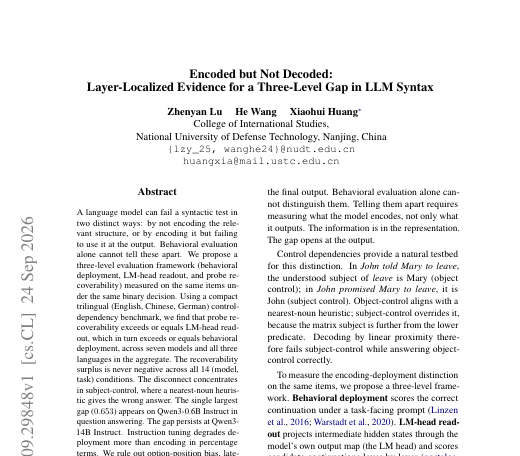
Encoded but Not Decoded: Layer-Localized Evidence for a Three-Level Gap in LLM Syntax

Zhenyan Lu, He Wang, Xiaohui Huang

A language model can fail a syntactic test in two distinct ways: by not encoding the relevant structure, or by encoding it but failing to use it at the output. Behavioral evaluatio…

A language model can fail a syntactic test in two distinct ways: by not encoding the relevant structure, or by encoding it but failing to use it at the output. Behavioral evaluation alone cannot tell these apart. We propose a three-level evaluation framework (behavioral deployment, LM-head readout, and probe recoverability) measured on the same items under the same binary decision. Using a compact trilingual (English, Chinese, German) control-dependency benchmark, we find that probe recoverability exceeds or equals LM-head readout, which in turn exceeds or equals behavioral deployment, across seven models and all three languages in the aggregate. The recoverability surplus is never negative across all 14 (model, task) conditions. The disconnect concentrates in subject-control, where a nearest-noun heuristic gives the wrong answer. The single largest gap (0.653) appears on Qwen3-0.6B Instruct in question answering. The gap persists at Qwen3-14B Instruct. Instruction tuning degrades deployment more than encoding in percentage terms. We rule out option-position bias, late-layer erasure, output-formatting artifacts, and probe-training variance. The pattern is consistent with decoding that favors surface shortcuts, and the behavior-probe gap measures the strength of that preference. Activation patching shows the gap is layer-localized. Under instruction tuning, the LM-head-decoded layer shifts approximately ten layers later than the probe-decoded layer. These findings argue that behavioral evaluation understates what models encode, while probing alone overstates what they deploy.

2026-09-21追踪学者 · He Wang

DualWAM: Dual-System World Action Models for Asynchronous Global Planning and Local Refinement

Yixin Zheng, Jiangran Lyu, Yuntian Deng, Kai Liu, Yizhou Zhou, Yizhou Wang, Xiaoguang Zhao, He Wang 等

World Action Models (WAMs) jointly generate robot actions and predict future world states, transferring priors from video pretraining to robot control. However, future visual predi…

World Action Models (WAMs) jointly generate robot actions and predict future world states, transferring priors from video pretraining to robot control. However, future visual prediction is computationally expensive, so existing WAMs often rely on long action chunks to amortize inference cost across control steps, at the cost of closed-loop responsiveness. We present \method, a dual-system WAM that preserves broader-horizon world-action generation while enabling high-frequency closed-loop action updates by decoupling global planning and local refinement. \systwo periodically performs high-noise bidirectional denoising over a broader world-action chunk to establish a global plan, while wrist-only \sysone extracts a temporally aligned short window from the intermediate denoising state and completes low-noise refinement using the latest wrist observations, which provide action-aligned cues about local geometry, motion, and contact during interaction. The two systems operate asynchronously along a shared denoising trajectory: each global plan is reused across multiple local updates, while \sysone repeatedly incorporates fresh interaction feedback. Across zero-shot manipulation tasks on Franka and Galbot, \method improves success over the strongest evaluated baseline by 4.5 percentage points on average, while achieving a 16.6$\times$ critical-path speedup. Further studies show that role-matched egocentric and UMI data improve success by 14 percentage points, and that the decoupled design naturally supports edge--cloud deployment with substantially lower communication overhead than the baseline.

Cewu Lu 16 篇 专属页 →

2026-10-22追踪学者 · Cewu Lu

UniFlowWAM: A Unified World-Action Model with Visual Semantics and 4D Geometry

Jialin Tian, Zhuofan Li, Xinkai Wang, Bokai Lin, Chenyi Wang, Xinyu Zhan, Cewu Lu, Lixin Yang

Robot demonstrations record what the robot saw and what it did. They do not specify how the 3D world changed in between. Scene-level 3D flow describes it by tracking 3D scene point…

Robot demonstrations record what the robot saw and what it did. They do not specify how the 3D world changed in between. Scene-level 3D flow describes it by tracking 3D scene points, providing the world representation with 4D geometry. Prior work has used flow to improve robot policies. Flow served as an intermediate prediction that a separate model converts into actions, as a prior injected at inference time, or as an extra output learned together with the action. In all of these designs, flow stays outside the policy, as a separate module or as an extra prediction head. We introduce UniFlowWAM, a Unified World-Action Model that makes 3D scene flow a third modality on par with vision and action. Its world representation therefore covers both visual semantics, through future visual features, and 4D geometry, through 3D flow, and flow receives its own supervision. UniFlowWAM is a diffusion transformer with one expert per modality, and the three experts exchange information through joint attention. We train UniFlowWAM under a ten-objective role grid, where each objective assigns every modality exactly one of three roles, namely target, condition, or absent. The same model thus serves as a policy, as forward and inverse dynamics, and as a predictor of future visual features or 3D flow. We evaluate UniFlowWAM on RoboCasa-GR1, LIBERO, and LIBERO-Plus in simulation, and on four real-world bimanual manipulation tasks. On RoboCasa-GR1, UniFlowWAM raises the success rate of its base model without flow from 52.1% to 56.4%. It preserves in-distribution success on LIBERO at 98.1% and reaches 87.7% zero-shot on LIBERO-Plus. On the real robot, it achieves 87.0% average success, compared with 68.5% for the strongest baseline.

2026-10-21追踪学者 · Cewu Lu

PRISM: Learning Realistic Depth via Physics-Grounded Noise Disentanglement with Semantic-Geometric Collaboration

Xiujian Liang, Jiacheng Liu, Mingyang Sun, Qichen He, Anda Cheng, Cewu Lu, Jianhua Sun

Real-world physical sensing exhibits complex, heterogeneous noise patterns that deviate significantly from idealized simulation, posing a fundamental bottleneck for sim-to-real tra…

Real-world physical sensing exhibits complex, heterogeneous noise patterns that deviate significantly from idealized simulation, posing a fundamental bottleneck for sim-to-real transfer. Existing sensor modelings typically treat depth noise as a monolithic black-box process, overlooking the distinct physical mechanisms that govern different error modalities. In this work, we introduce a physics-grounded paradigm that disentangles monolithic noise into two complementary modalities: sensing invalidation and measurement inaccuracy, enabling a tailored treatment of noise sources based on their physical origins. Building on this insight, we propose PRISM, a tripartite framework that distills 3D Visual Foundation Model features as rich spatial-semantic priors for physics-based reasoning. To address the inherent sparsity and class imbalance of invalidation regions, we develop Hierarchical Positive-Prioritized Supervision, integrating multi-scale positive-weighted objectives with a positive-preserving dynamic hard mining strategy to enforce precise artifact delineation. Extensive benchmarks demonstrate that PRISM achieves state-of-the-art fidelity in noisy depth synthesis. Furthermore, downstream robotic experiments show that PRISM facilitates a 92.1% average success rate in the real world, marking a significant improvement over monolithic baselines. Our project page is available at: \resizebox{\linewidth}{!}{\href{https://shawnleung-sii.github.io/prism-icml2026/}{https://shawnleung-sii.github.io/prism-icml2026/}.}

2026-10-21追踪学者 · Cewu Lu

DepState-JEPA: Learning Depth-Grounded State Representation for Visual Perception and Manipulation

Xiujian Liang, Liuyuan Na, Zehao Du, Jiacheng Xu, Weixi Song, Mingyang Sun, Xingjun Ma, Cewu Lu 等

Predictive representations for robot manipulation should connect scene geometry with the state changes induced by actions. Our intuition is that understanding what an action will c…

Predictive representations for robot manipulation should connect scene geometry with the state changes induced by actions. Our intuition is that understanding what an action will change starts with understanding where things are: complementary RGB and depth observations ground a common scene representation from which to infer those changes. Guided by this intuition, we introduce DepState-JEPA, a dual-stream RGB--Depth joint-embedding predictive architecture that connects spatial understanding with action-conditioned prediction through a shared latent state, DepState. Built on V-JEPA~2.1, the framework uses depth both as a complementary observation stream and to ground both modalities in metric 3D space, aggregating shared information into DepState while retaining modality-private features for decoding. Ray-conditioned readouts predict local features without target depth; after an action-conditioned transition, the same decoders predict future RGB and depth features using the predicted state and fixed initial private features. Robot-state readouts provide recursive proprioceptive inputs; object-trajectory supervision and calibrated forward kinematics shape state learning through motion targets and joint--TCP consistency. Comparisons show stronger RGB-encoder transfer after RGB-D adaptation, feature completion, conditioned visual forecasting, and manipulation success. Within-model ablations identify contributions from depth content, metric coordinates, and future-state matching, with additional control gains from FK regularization. The project page is available at https://shawnleung-sii.github.io/depstate-jepa/.

cs.ROcs.CV
2026-10-15追踪学者 · Cewu Lu

Value as Memory: Online Value-Guided Post-training for General Robot Policies

Wenye Yu, Yijin Chen, Kaiyi Xiong, Wenbo Han, Wendi Chen, Yang Jin, Han Xue, Jun Lv 等

Real-world post-training of generalist robot policies faces two challenges: partial observability makes action selection ambiguous, while offline post-training methods delay feedba…

Real-world post-training of generalist robot policies faces two challenges: partial observability makes action selection ambiguous, while offline post-training methods delay feedback from deployment experience. We present Value as Memory (VaM), a framework that addresses these challenges through value caching and online real-world reinforcement learning (RL). Value caching conditions actions on recent value predictions as task-progress memory, while online updates enable timely policy improvement by combining offline demonstrations, off-policy interventions, and on-policy rollouts for sample-efficient adaptation. As a result, VaM transitions from offline RL warmup to online autonomous learning with sparse rewards. Across long-horizon tasks involving deformable objects and contact-rich manipulation, VaM yields a mean absolute success-rate gain of $29.4%$ with value caching, while achieving a $32.8%$ gain with online autonomous learning over matched offline training. The evaluated online schedule performs $8\times$ as many policy iterations under the same gradient-step budget, with more than $2\times$ lower recorded time per gradient step with concurrent data collection and training.

2026-10-15追踪学者 · Cewu Lu

Can World and Action Modeling Benefit Each Other under Unified Causal Training?

Yue Su, Bokai Lin, Xinkai Wang, Chubin Zhang, Xiangnan Wu, Kuan Zhang, Weiyang Jin, Jiwen Yu 等

World and action modeling are closely related, yet their reciprocal benefits under unified causal training remain unclear. We introduce OneWM, a simple framework for unified causal…

World and action modeling are closely related, yet their reciprocal benefits under unified causal training remain unclear. We introduce OneWM, a simple framework for unified causal training that treats actions as both conditions for world prediction and targets for policy learning within a shared video-action architecture. Using this framework, we investigate whether learning forward dynamics conditioned on specified actions improves action learning, and whether learning to generate actions in turn improves action-conditioned world modeling. We use LIBERO, LIBERO-Plus, and RoboCasa365 as embodied testbeds to evaluate both policy learning and world modeling, complemented by real-world policy experiments. Learning the visual consequences of specified actions improves policy performance and generalization across changing scenes. In turn, action learning improves multi-view world-prediction fidelity under the same architecture. Together, these results answer both questions positively, supporting reciprocal benefits between world modeling and action generation under unified causal training.

2026-10-14追踪学者 · Cewu Lu

ObjDream: Guiding Vision-Language-Action Models with Object-Level Understanding and Future State Prediction

Huailiang Ma, Yuxuan Li, Ziyi Zhao, Xinkai Wang, Mingyu Li, Xinyu Guo, Lifeng Zhu, Aiguo Song 等

Vision-language-action (VLA) models have emerged as a powerful paradigm for robotic manipulation, enabling robots to generate actions from visual observations and language instruct…

Vision-language-action (VLA) models have emerged as a powerful paradigm for robotic manipulation, enabling robots to generate actions from visual observations and language instructions. However, most existing VLA models still operate on image-level visual representations inherited from pretrained vision-language backbones, while lacking fine-grained object understanding for manipulation. As a result, their robustness can degrade under out-of-distribution object layouts, clutter, and background variations. To address these limitations, we introduce ObjDream, an object-centric VLA framework centered on object-level understanding and future object state prediction. ObjDream uses a spatio-temporal object encoder to organize visual observations into temporal object slots, where persistent object identity and dynamic object state are represented through separate channels. These structured object representations are inserted into the token sequence of the vision-language model (VLM), where identity-guided routing modulates VLM attention to the corresponding object tokens. In addition, an action-conditioned object dynamics module predicts compact future object states relevant to manipulation during training, explicitly supervising object state evolution under robot actions without requiring future prediction at inference. Experiments on LIBERO, LIBERO-Plus, and RoboTwin 2.0 show that ObjDream improves generalization under diverse distribution shifts and scene perturbations. Real-world robot experiments further demonstrate that ObjDream transfers to physical manipulation settings with novel object arrangements and background changes.
2026-10-13追踪学者 · Cewu Lu

ForceWAM: Decoupling Future and Response Learning from Demo and Play Data for Contact-Rich Manipulation

Zijun Xu, Wendi Chen, Xinkai Wang, Jiachen Zou, Hongjin Chen, Hairuo Liu, Bokai Lin, Shihao Ma 等

Expert demonstrations show how to complete contact-rich tasks, but provide limited coverage of how interaction forces respond to different actions. Task-agnostic play provides broa…

Expert demonstrations show how to complete contact-rich tasks, but provide limited coverage of how interaction forces respond to different actions. Task-agnostic play provides broader experience of contact dynamics without specifying task goals. To fully leverage these two types of data, we introduce ForceWAM, a force world action model that decouples knowledge of task-compatible interaction outcomes from knowledge of how local actions change contact. A world model learns from successful demonstrations to jointly predict future video and six-axis force/torque trajectories. Together, these futures describe the expected evolution of motion and contact during the task. A separate inverse dynamics model (IDM) learns from both task and play, mapping current observations and recorded visual-wrench futures to their associated robot actions. Play data thus provide knowledge of force responses for goal-directed execution. At deployment, the IDM reactively translates generated futures into actions, reusing them with fresh wrench feedback between world-model updates. Across real-robot force-regulated sliding, box flipping with and without disturbances, and ring placement, ForceWAM achieves $85$-$95%$ mean success, surpassing world-modeling and reactive baselines. Our experiments further show that adding task-agnostic play data improves success by $15$-$45$ percentage points, demonstrating its value for learning contact-rich execution. Project page and code are available at https://force-wam.github.io/.

2026-10-13追踪学者 · Cewu Lu

Contact Trajectory Prompting: In-Context Transfer of Contact-Rich Behaviors from a Single Demonstration

Xian Nie, Yujie Zang, Yuhang Zheng, Yupeng Zheng, Songen Gu, Wendi Chen, Chuan Wen, Cewu Lu 等

In-context robot learning enables robots to acquire new behaviors from demonstrations without test-time parameter updates. However, visual and kinematic specifications alone may no…

In-context robot learning enables robots to acquire new behaviors from demonstrations without test-time parameter updates. However, visual and kinematic specifications alone may not distinguish contact-rich behaviors that share similar motions but require different interaction intensities or patterns. We propose Contact Trajectory Prompting (CTP), a framework for one-shot transfer of contact-rich manipulation behaviors. CTP encodes motion and contact information from a single demonstration into an ordered contact trajectory prompt that captures their temporal evolution and specifies the desired physical interaction behavior. During execution, the policy uses online sensory feedback to retrieve interaction-relevant information from the prompt, conditioning closed-loop action generation on the demonstrated contact behavior. Across real-world wiping, rotation, and insertion tasks on objects excluded from training, CTP achieves 78.7% overall success, outperforming the strongest evaluated baseline by 13.0 percentage points. Changing only the reference demonstration enables CTP to follow contact specifications for both intensity and direction, including an intermediate wiping force level and clockwise or counterclockwise cap rotation. These results demonstrate that contact trajectories serve as effective behavioral specifications, extending in-context robot learning beyond motion imitation to physical interaction transfer. Project website: https://ctp-robotics.github.io/project_page.

2026-10-13追踪学者 · Cewu Lu

SchemaPose: RGB-Based Category-Level Pose Estimation with Parametric Category Schema

Shuang Wu, Jiude Wei, Cewu Lu, Jianhua Sun

RGB-based category-level 9D pose estimation remains highly challenging because a monocular system must generalize across unseen object instances while jointly inferring 3D translat…

RGB-based category-level 9D pose estimation remains highly challenging because a monocular system must generalize across unseen object instances while jointly inferring 3D translation, 3D rotation, and 3D size. Unlike instance-level pose estimation, the category-level setting requires the network to learn both what is shared across objects within a category and how individual instances vary in structure. This challenge is amplified in the RGB-only setting, where pose cues, category-level commonality, and instance-specific variation are entangled in appearance without direct geometric constraints, making it difficult for existing frameworks to learn a representation that is truly aligned with the category-level estimation objective. To address this problem, we propose SchemaPose, a schema-guided framework for RGB-based category-level pose estimation. SchemaPose equips the estimation pipeline with an explicit parametric schema for modeling category-level regularities together with structured instance variation, and uses the inferred schema variables to guide pose-related prediction in an end-to-end query-based framework. The same formulation also supports template instantiation, synthetic annotation, and pose learning within a unified framework. Experiments on synthetic and real data show that SchemaPose achieves state-of-the-art performance among RGB-based methods for category-level 9D pose estimation.

2026-10-08追踪学者 · Cewu Lu

RoboRSI: Stable, efficient, and reusable robot self-evolution in complex real-world environments

Zimo Wen, Yijin Chen, Yuxuan Cao, Wendi Chen, Yanwen Zou, Wenye Yu, Fuhang Kuang, Han Xue 等

A generalist robot should not only perform diverse tasks but also improve through experience, turning what it learns during execution into capabilities that later tasks can reuse. …

A generalist robot should not only perform diverse tasks but also improve through experience, turning what it learns during execution into capabilities that later tasks can reuse. Robot agents that act through code can already repair programs from execution feedback, yet it remains a central challenge to organize this experience around the task structure that gives it meaning, so that each repair is attributed to the responsible capability, supported by execution evidence, and validated before it is reused. We introduce RoboRSI, a robot self-improvement system built on Top-Down Skill Refinement (TSR). TSR decomposes tasks into compound, atomic, and base skills with scoped responsibilities and explicit input--output contracts, attributes each execution outcome to the responsible branch, and confines revision to that branch. Building upon this structure, a Manager, Planner, Engineer, and Reviewer coordinate planning, execution, diagnosis, and the validated release of new skills, while people steer the process through objectives and corrections; stable skill sequences are further consolidated into reusable compound skills. On a mobile manipulator, RoboRSI develops multi-object household cleanup over 104 rounds. In simulation, it achieves the highest success rate on LIBERO, LIBERO-PRO, LIBERO-Plus, and RoboTwin, exceeding the strongest baseline by 2.7 to 11.0 percentage points.

2026-10-07追踪学者 · Cewu Lu

RoboPrompt: Intuitive Robot Policy Steering with Sparse Human Input

Yanwen Zou, Chenyang Shi, Guoxuan Xu, Wenye Yu, Wendi Chen, Ye Pan, Cewu Lu, Chuan Wen

End-to-end robot policies trained through imitation learning remain constrained by limited data diversity, making reliable zero-shot deployment in real-world settings challenging. …

End-to-end robot policies trained through imitation learning remain constrained by limited data diversity, making reliable zero-shot deployment in real-world settings challenging. Shared-autonomy methods enable human correction through teleoperation, but specialized hardware and operator training hinder deployment at scale. Other approaches incorporate human guidance as additional policy inputs, often requiring architectural changes and dedicated training for steerability, which limits their applicability across policies. We present RoboPrompt, a general-purpose, lightweight robot policy steering system that enables users to guide policy behavior through intuitive, sparse inputs, including drawn traces, target points, and coarse directional instructions. RoboPrompt decouples human-intention translation from the underlying policy: a reusable module converts human guidance into action drafts, which are refined through the diffusion or flow-matching dynamics of the base policy. By controlling action generation in noise space, RoboPrompt balances human intent with the policy prior without modifying the base policy architecture or fine-tuning it for steerability. Experiments demonstrate effective steering across Diffusion Policy, $π_{0.5}$, and FastWAM. We further use steered rollouts for online policy improvement through DAgger. After 2-3 rounds of iteration, average success rates increase by 15.5% for $π_{0.5}$ across three tasks and by 21.3% across three policies(Diffusion Policy, $π_{0.5}$, FastWAM) on the Insert Bread task, while average human intervention counts decrease by 44.0% (2.86 to 1.60) and 81.9% (2.60 to 0.47), respectively.

2026-10-05追踪学者 · Cewu Lu

MC-Sparse: Deconstructing and Closing the Dense-Sparse Attention Gap in Diffusion Transformers

Jiarui Chen, Zeqiang Lai, Jiangshan Wang, Ziheng Ouyang, Ye Huang, Xiangyu Yue, Cewu Lu, Chunchao Guo

Sparse attention is a primary approach to reducing the latency of diffusion transformers in long-sequence generation tasks, such as video and high-resolution 3D asset generation. H…

Sparse attention is a primary approach to reducing the latency of diffusion transformers in long-sequence generation tasks, such as video and high-resolution 3D asset generation. However, existing methods can degrade generation quality and fidelity at high sparsity levels. Through controlled oracle comparisons, we trace this degradation to three sources: constraints imposed by token grouping, inaccurate interaction selection, and the attention contributions lost when tokens are discarded. Guided by this analysis, we propose Meta-Cached Sparse Attention (MC-Sparse), a training-free framework that selects individual key-value (KV) tokens while organizing similar queries into tile-aligned groups for efficient GPU execution. MC-Sparse caches metadata comprising query groups, KV indices selected using exact attention probabilities, and residuals between dense and sparse attention outputs, and reuses them across subsequent denoising steps. Across video and 3D generation models, MC-Sparse achieves higher fidelity to dense-attention outputs and larger denoising speedups than existing sparse-attention baselines, without visible quality degradation. Relative to dense attention, it delivers a $1.80\times$ denoising speedup on Minimax-H3-Base and a $2.32\times$ speedup on 3D asset generation, both with negligible quality loss.

cs.CVcs.AI
2026-10-02追踪学者 · Cewu Lu

From bits to atoms: A survey of cross-layer safety in Embodied AI

Tuo Feng, Yue Zhang, Shiji Zhou, Zhaoxin Fan, Wenguan Wang, Xiaowei Chi, Tianyu Shen, Xiangtai Li 等

Embodied Artificial Intelligence (AI) introduces cyber-physical risks because digital failures and attacks can cause physical harm. This survey organizes embodied AI safety through…

Embodied Artificial Intelligence (AI) introduces cyber-physical risks because digital failures and attacks can cause physical harm. This survey organizes embodied AI safety through a four-layer reference architecture -- comprising the physical interaction, system and middleware, algorithm and decision, and cloud-edge and data layers -- and uses it to connect vulnerabilities, propagation paths, and safeguards across the system stack. It traces the evolution of safety paradigms and examines how faults and attacks cross architectural boundaries to produce physical consequences. Furthermore, the survey systematizes composite attack chains, outlines multi-layered defense strategies, and reviews representative embodied safety benchmarks. Ultimately, we advocate for unifying software alignment with rigorous hardware constraints to build trustworthy systems capable of operating safely within human-centric environments.

2026-09-29追踪学者 · Cewu Lu

FP2: Equipping Robotic Foundation Models with Force Control

Hongjie Fang, Shirun Tang, Junjian Hu, Shidong Zhang, Derek Zhang, Linhao Chen, Dehai Li, Mingyu Mei 等

Robotic foundation models (RFMs) are increasingly capable of general-purpose manipulation, yet reliable physical interaction remains challenging in contact-rich settings. We presen…

Robotic foundation models (RFMs) are increasingly capable of general-purpose manipulation, yet reliable physical interaction remains challenging in contact-rich settings. We present FP2, a lightweight downstream interface that equips task-adapted RFMs with explicit force control while preserving their action-generation capability. FP2 adopts an action-regulation decomposition: the task-adapted RFM serves as a foundation policy responsible for task-level action generation, while a high-frequency force control policy focuses solely on interaction regulation. To condition force regulation on the ongoing manipulation, FP2 compresses foundation-policy contextual representations and combines them with wrench and proprioceptive histories to predict structured force-control parameters. We evaluate FP2 with four RFM backbones across four real-world contact-rich manipulation tasks. FP2 consistently improves task performance and force regulation quality over the corresponding foundation policies, while comparing favorably with representative force-aware and force-control baselines. Ablations further show that foundation-policy context and physical feedback are complementary for effective force regulation, while preserving foundation-policy action generation improves both efficiency and novel-object generalization. Project website: http://force-policy.github.io/fp2

2026-09-25追踪学者 · Cewu Lu

HIRE: History-Conditioned Interaction Reasoning and High-Rate Execution for Visually Aliased Precision Manipulation

Rongji Li, Wenhao He, Cewu Lu, Xingyu Chen, Xu-Yao Zhang

Precision manipulation with contact-critical interactions is often history-dependent: visually similar observations can correspond to different latent interaction states and theref…

Precision manipulation with contact-critical interactions is often history-dependent: visually similar observations can correspond to different latent interaction states and therefore require different actions, while small execution errors can alter task outcomes. Policies relying on the current visual observation alone cannot resolve such ambiguity; force-aware and memory-augmented methods enrich physical or temporal context, while reactive high-rate policies improve local contact response, yet long-horizon temporal reasoning and precision execution remain largely decoupled in existing methods, limiting reliable progression in visually aliased precision manipulation. To bridge this gap, we introduce History-Conditioned Interaction Reasoning and Execution (HIRE), a cross-rate framework comprising a history-conditioned Interaction-State Reasoner (ISR) and a high-rate Interaction-Manifold Executor (IME). ISR encodes ordered wrench history with a temporal wrench encoder and Force Perceiver as persistent physical evidence for state-consistent action generation, while IME structures contact-critical motion into intrinsic progress and transverse correction for precise execution; their cross-rate loop allows the resulting physical traces to inform subsequent reasoning. In real-robot experiments across surface, insertion, and rotational interactions, HIRE achieves at least 90% completion across all evaluated task stages while improving interaction-state disambiguation, execution precision, and generalization. More broadly, HIRE provides a unified reasoning--execution perspective on precision manipulation under history-dependent partial observability, where physical interaction both realizes task intent and reveals latent-state evidence for future decisions. Code will be released upon publication.

2026-09-21追踪学者 · Cewu Lu

PredActor: Predictive Action Diffusion for Steerable Onboard Humanoid Control

Lei Ye, Haibo Gao, Yitang Li, Peng Xu, Zetong Jing, Junhan Sun, Fanrong Dong, Ziqi Han 等

Diffusion models provide a flexible framework for motion generation, but turning this flexibility into closed-loop humanoid control remains challenging. Hierarchical generator-trac…

Diffusion models provide a flexible framework for motion generation, but turning this flexibility into closed-loop humanoid control remains challenging. Hierarchical generator-tracker systems steer motion through reference trajectories, yet these references may exceed the capabilities of the downstream tracker, leaving physical feasibility and disturbance recovery largely to a separate control module. Action-only diffusion avoids this separation by directly generating executable actions, but provides no explicit future-state trajectory that can be steered toward test-time motion objectives. Joint state-action diffusion offers a natural alternative, but existing controllers often rely on privileged full-body states, while learned behavior selection and test-time motion steering remain only partially integrated. We present PredActor, a predictive action diffusion policy that unifies both steering modes in one directly executed policy using proprioception alone. Given proprioceptive history and optional task context, PredActor jointly predicts actions and an internal future-state trajectory that enables guidance: classifier-free guidance strengthens text-conditioned motion, while classifier guidance steers future states toward test-time objectives. Only actions are executed, requiring neither a motion-reference tracker nor privileged full-body states. In simulation, PredActor reaches 44 of 45 destination targets and achieves a text retrieval score of 0.539 versus 0.424 for conditional action diffusion, with similar disturbance survival. Rolling denoising and computation-preserving runtime optimizations reduce the complete callback to 16.790 ms median and 19.383 ms p95 on a Jetson Orin NX, within the 20 ms control period. Deployed on a Unitree G1, PredActor demonstrates text-conditioned motion, disturbance response, joystick control, and semantic interpolation in simulation and hardware.

Hao Dong 8 篇 专属页 →

2026-11-03追踪学者 · Hao Dong

DexHOT: Learning Hand-Object Configuration Transfer for Dexterous Manipulation

Zhewei Gui, Anthony Bolton, Jiyao Zhang, Zeyuan Chen, Qiyang Yan, Tianyu Wang, Hao Dong

Dexterous manipulation involves not only moving objects, but also arranging the hand around them to maintain useful contacts and enable subsequent actions. Yet many learning-based …

Dexterous manipulation involves not only moving objects, but also arranging the hand around them to maintain useful contacts and enable subsequent actions. Yet many learning-based systems specify goals primarily through object poses or trajectories, leaving hand-object configurations to emerge implicitly. We introduce DexHOT, which formulates dexterous manipulation as hand-object configuration transfer: moving between feasible configurations that jointly specify hand articulation and object pose relative to the wrist. DexHOT learns a reusable relation-conditioned transfer primitive from synthetic feasible configuration pairs, without human reference motions, and composes long-horizon behaviors through closed-loop tracking of configuration subgoals. On DexHOTBench with 120 objects, a single policy achieves 80.5% transfer success on seen objects and 69.4% on unseen objects; on a real dexterous hand, it achieves 61.5% success over 200 real-robot transfers and 90% task success across six demonstration-guided tasks. These results show that explicit hand-object goals provide an expressive and composable interface for dexterous manipulation. More details and videos are available at https://dex-hot.github.io/.

2026-11-03追踪学者 · Hao Dong

PrimeSim: A Generalist World Model Simulator from Large-Scale Cross-Embodiment Demonstrations

Travis Davies, Wentao Ma, Lihao Guo, Tengfei Ma, Xiaowen Chang, Jiafeng Xu, Shilong Wang, Yiqi Deng 等

A robot world model that serves as a simulator must do more than generate plausible videos: it must faithfully follow commanded actions, maintain consistency across camera views, a…

A robot world model that serves as a simulator must do more than generate plausible videos: it must faithfully follow commanded actions, maintain consistency across camera views, and sustain coherent long-horizon rollouts. We present PrimeSim, an action-conditioned, multiview world model simulator that addresses these challenges through progressive midtraining and posttraining. Starting from a pretrained video generator, we midtrain on 30,110 hours of robot demonstrations spanning 22 platforms. To improve action following, we introduce a unified cross-embodiment action representation and frame-aligned dual-path conditioning to strengthen action-frame correspondence. To maintain multiview consistency, we develop view-aware interleaved attention with explicit camera identities, enabling cross-view information exchange while preserving view-specific representations. We further introduce a fast-video, slow-memory posttraining framework that transforms the bidirectional video generator into an efficient autoregressive simulator. By combining fast causal generation, self-rollout training, and hierarchical temporal memory, PrimeSim mitigates error accumulation from self-generated histories and supports coherent long-horizon simulation. PrimeSim runs at 10.1 FPS, remains stable over long-horizon rollouts on rigid and deformable manipulation tasks, and transfers to held-out platforms within 100 to 200 gradient steps where the pretrained backbone does not. Against five open-source action-conditioned world models it leads four of the five WorldSimProbe suites and posts the best overall EWMBench score, while fine-grained local calibration still trails the field; its rollouts are faithful enough to support GRPO-based policy optimization. We release the model weights, inference code, and training code.

2026-10-30追踪学者 · Hao Dong

ResMerge: Residual Policy Learning and Merging for Continual Adaptation of Pre-trained Robot Policies

Kefei Zhu, Lingyun Xu, Yue Xin, Xiaoqi Li, Caixin Guo, Xincheng Du, Yuanpei Chen, Yaodong Yang 等

Continual adaptation to new tasks is essential for robots deployed in the real world, but adapting pre-trained policies remains challenging due to parameter growth and the need for…

Continual adaptation to new tasks is essential for robots deployed in the real world, but adapting pre-trained policies remains challenging due to parameter growth and the need for continual demonstration collection. Parameter-Efficient Continual Fine-Tuning (PECFT) isolates task-specific updates, but adapter-per-task designs require demonstrations and grow with the task set. We propose ResMerge, a two-stage framework that learns mergeable residual policies atop a frozen pre-trained policy: residual reinforcement learning (RL) acquires task-specific corrections without additional expert demonstrations during adaptation, and parameter-space merging consolidates compatible residuals to reduce stored parameters. We introduce Residual-Field Consistency (RFC), a simple, bounded, and interpretable metric that assesses compatibility in residual action-field space by comparing correction direction and magnitude. Experiments on LIBERO across two backbones and on a real-world Franka robot show improved continual learning performance over strong PECFT baselines, while selective merging reduces the residual-parameter footprint. Project website: https://resmerge.github.io/.

2026-10-24追踪学者 · Hao Dong

One Scan is Enough: Demonstration-Free Adaptation for Language-Guided Navigation

Zhuoyuan Yu, Yuxing Long, Du Wang, Junyang Wang, Hongwei Fan, Hao Dong

Deploying a language-guided navigation policy in a new building usually means watching it fail. Public-benchmark VLAs degrade scene by scene as layout, appearance, and language dri…

Deploying a language-guided navigation policy in a new building usually means watching it fail. Public-benchmark VLAs degrade scene by scene as layout, appearance, and language drift, and the standard fix of teleoperating fresh trajectories on site does not scale. We replace human demonstration with a single brief iPhone scan. Scan2Instruction compiles that scan into a complete training environment, automatically synthesizing executable navigation episodes with grounded instructions. PRPT-KS then adapts the policy through a closed-form Pareto utility read directly off the reconstructed scene, with no learned critic and no human labels. Across five real environments, the two designs together drive our RealNav to an 85% real-robot success rate, compared with 49% for a RealNav baseline post-trained on human demonstrations, and still achieve 82% in unscanned regions of the same buildings, compared with 41% for the same baseline. Our work turns demonstration-free scene adaptation for language-guided navigation from an aspiration into a working reality.

cs.ROcs.AIcs.CLcs.CVcs.LG
2026-10-17追踪学者 · Hao Dong

ReTRACE: Feedback-Guided LLM Agent in a Chemistry Harness for Retrosynthesis Planning

Jinxiang Xie, Yijian Zhang, Qingyuan Yi, Jianyi Wang, Hao Dong

Computer-aided retrosynthesis has advanced through single-step prediction, tree search and route scoring, but complex targets still require judgement over the whole route, where st…

Computer-aided retrosynthesis has advanced through single-step prediction, tree search and route scoring, but complex targets still require judgement over the whole route, where stereochemistry, functional-group compatibility, cost and greenness interact. Here we present \textbf{\mbox{ReTRACE}} (REtrosynthesis with Tool-orchestrated Reasoning And Context-aware Evidence), an agent that places a large language model (LLM) in a chemistry harness that integrates molecular tools, complementary single-step prediction engines, a purchasable starting-material library, a route memory and a multi-criterion route evaluator. Routes are judged by a new metric that combines programmatic checks with adversarial LLM review, and its verdicts are compared with a synthetic chemist's. The agent learns continually from evaluator feedback during search, diagnosing weak routes and backtracking to revise them. With Claude Opus 4.8, at least one of the top 10 routes proposed by ReTRACE passed the audit for 87.4%, 95.0% and 86.7% of targets on the three benchmarks. Two prospective wet-lab syntheses show that ReTRACE route proposals can be converted into executable procedures after expert revision.

2026-09-27追踪学者 · Hao Dong

The Model Knows Another Way: Strategy Switching for Effective RLVR Exploration

Jin Cui, Xinyue Long, Boran Zhao, Pengju Ren, Hao Dong

Reinforcement learning with verifiable rewards (RLVR) is often limited by insufficient exploration: difficult problems can yield uniformly incorrect rollout groups and therefore li…

Reinforcement learning with verifiable rewards (RLVR) is often limited by insufficient exploration: difficult problems can yield uniformly incorrect rollout groups and therefore little learning signal. We show that such failures need not reflect missing capability. Instead, finite sampling often concentrates on a problem-specific dominant reasoning strategy while leaving alternative strategies already supported by the model unexplored. Moreover, the accessibility of these strategies evolves during RL: some are internalized into autonomous behavior, while others become difficult to elicit before being absorbed. Motivated by these observations, we introduce Problem--Strategy Rollout Allocation (PSRA), which treats unguided and strategy-conditioned prompts as competing exploration arms and uses Bayesian sequential allocation to direct a fixed rollout budget toward arms most likely to yield informative, non-saturated groups. A preservation objective keeps useful strategy-conditioned routes accessible while successful guided behaviors are transferred to the unguided policy. Across Qwen2.5 models from 1.5B to 7B and two RL training corpora, PSRA consistently improves reasoning performance, reduces dead saturation, strengthens out-of-distribution transfer, and maintains larger gains under increased inference budgets.

2026-09-25追踪学者 · Hao Dong

UQ-LOB: Uncertainty-Aware Limit Order Book Mid-Price Forecasting

Derrick Gilchrist Edward Manoharan, Eljas Linna, Kestutis Baltakys, Hao Dong, Juho Kanniainen

Forecasting short-horizon mid-price movements from limit order book (LOB) data is central to algorithmic trading, yet most deep LOB forecasters are point predictors: they output a …

Forecasting short-horizon mid-price movements from limit order book (LOB) data is central to algorithmic trading, yet most deep LOB forecasters are point predictors: they output a direction or a displacement, but never indicate which of their forecasts can be trusted. We introduce UQ-LOB, a lightweight, encoder-agnostic uncertainty quantification module that attaches to any pretrained LOB encoder and, in the spirit of attentive neural processes, conditions each forecast on a context set of recently completed windows whose outcomes are already realised. The UQ-regression variant outputs a calibrated Gaussian over the future tick displacement, while the UQ-classification variant outputs a categorical distribution over down/up/stationary. Both expose a scalar confidence (predicted signal-to-noise ratio or class probability) that supports selective prediction. On 5.2 billion LOB events across seven cryptocurrency assets and horizons of 5, 10 and 15 seconds, UQ-regression attains near-nominal 68% interval coverage, and restricting to the most confident 10% of predictions raises directional macro F1 by 0.11-0.15 for UQ-regression and 0.05-0.11 for UQ-classification, at every horizon. On large, economically meaningful moves, the tightest confidence tier reaches a directional F1 of 0.88 (down) and 0.83 (up) at the 5-second horizon.

2026-09-24追踪学者 · Hao Dong

Rolling-WAM: World Action Models with Rolling Imagination

Yinghua Zhou, Junjie Ye, Yiqi Zhao, Hao Dong, Celina Shiyu Wang, Ruohai Ge, Tingyi Yang, Basile Van Hoorick 等

World Action Models (WAMs) couple action generation with future visual prediction for robotic manipulation. However, completing the joint video-action denoising process at each rep…

World Action Models (WAMs) couple action generation with future visual prediction for robotic manipulation. However, completing the joint video-action denoising process at each replanning cycle incurs substantial latency, delaying action updates and limiting closed-loop responsiveness. We present Rolling-WAM, a formulation that distributes joint denoising across successive replanning cycles. Our method maintains a sliding window of video-action chunks at staggered noise levels. At each step, a rolling noise schedule fully denoises the imminent action chunk for execution, while partially refining farther-future chunks. As the window advances with new camera observations, the retained future chunks continue their denoising process. This distributes the computational cost over time while carrying an evolving visual-action context across chunk boundaries. Evaluations on LIBERO, RoboTwin, and a real-world Unitree G1 humanoid show that Rolling-WAM achieves competitive manipulation performance. By removing the need to denoise the entire prediction horizon from scratch, it delivers a 4.5x steady-state replanning speedup over standard joint WAMs.

cs.ROcs.AIcs.CV

Huazhe Xu 3 篇 专属页 →

2026-10-29追踪学者 · Huazhe Xu

BURGER: Benchmarking and Understanding Robotic Generalization via Embodied Drawing

Xiangyu Xu, Bangshuai Peng, Ziyi Liu, Mengjie Zhao, Chenhao Lu, Zhengyang Fan, Huazhe Xu, Kaizhe Hu

How effectively can vision-language-action (VLA) models learn diverse language-conditioned behaviors as training data scales? Investigating this question requires large and varied …

How effectively can vision-language-action (VLA) models learn diverse language-conditioned behaviors as training data scales? Investigating this question requires large and varied robot datasets, whose collection on physical robots remains costly. We introduce BURGER, a language-conditioned robotic drawing benchmark with a scalable, prompt-driven pipeline for generating continuous drawing trajectories, both in simulation and the real world. In BURGER, an agent starts from the same blank canvas and controls a robot arm to draw the object or spatial composition specified by language, while each instruction allows an open-ended variety of valid drawings and stroke orders. Using 28,200 simulated demonstrations spanning 282 drawing tasks, we evaluate five representative VLA models across data scales, language grounding, and multimodal behavior. BURGER supports fine-grained analysis of language grounding, spatial composition, and action generation, revealing distinct failure patterns across VLA models. Our experiments suggest that some VLA models can benefit from greater task diversity and demonstration scale, capture multimodal drawing behaviors, and generalize to unseen compositions of familiar objects. Finally, we deploy a trained policy on a Franka Panda arm, demonstrating the ability to draw reactively under human intervention. Project homepage and code can be found at https://siyingzhao.github.io/BURGER/.

2026-10-29追踪学者 · Huazhe Xu

TouchBridge: Tactile-Conditioned Human-to-Robot Transfer for Dexterous Manipulation

Haozhe Zhang, Gu Zhang, Zirui Zou, Yuzheng Chen, Jinlong Wu, Zixuan Hu, Jianke Zhang, Yucheng Hu 等

Human demonstrations offer an efficient and scalable source of data for dexterous robot manipulation, but differences in sensing and hand morphology complicate the transfer of cont…

Human demonstrations offer an efficient and scalable source of data for dexterous robot manipulation, but differences in sensing and hand morphology complicate the transfer of contact-rich interactions. We present TouchBridge, a hardware--software co-designed framework for human-to-robot data transformation. A wearable human demonstration interface and a corresponding robot interface establish cross-embodiment correspondence in visual and fingertip tactile sensing. We introduce Tac-Retarget, a tactile-conditioned retargeting method that uses measured contact to align fingertip contact patches and preserve their spatial relations within and across hands. Unlike object-aware or simulation-based transfer pipelines, Tac-Retarget requires no object mesh, object-pose estimate, or physics simulation for retargeting, enabling direct and scalable conversion of human demonstrations into robot-domain training data. Combined with visual synthesis and camera-anchored action conversion, TouchBridge produces robot-domain demonstrations for fine-tuning a pretrained vision-language-action (VLA) model. Across four real-world contact-rich tasks, policies fine-tuned solely on TouchBridge-converted human demonstrations achieve a 72.5% average success rate, compared with 77.5% using an equal number of teleoperated robot demonstrations, while human demonstration collection is 7.0x faster. Under the same policy and training setup, Tac-Retarget outperforms DexPilot and UniDex by 25.0 and 42.5 percentage points, respectively.

2026-10-02追踪学者 · Huazhe Xu

AdaTempo: Learning Shared Relative Tempo from Demonstrations for Faster Robot Manipulation

Jiale Cao, Yike Niu, Zhengrong Xue, Huazhe Xu

Visuomotor policies trained via imitation learning often inherit the unnecessarily slow timing of teleoperated demonstrations. Yet uniform speedup is unreliable because different p…

Visuomotor policies trained via imitation learning often inherit the unnecessarily slow timing of teleoperated demonstrations. Yet uniform speedup is unreliable because different phases of a manipulation task tolerate acceleration differently. In this work, we introduce AdaTempo, a self-supervised method that accelerates visuomotor policies by exploiting shared relative-tempo structure in demonstrations. AdaTempo establishes phase correspondence, aggregates the aligned relative tempo into a consensus, and maps it to a continuous speedup profile used to resample demonstrations into accelerated training trajectories. Training standard policies such as ACT or Diffusion Policy on these resampled trajectories directly embeds the desired tempo in the learned behavior, without runtime tempo selection or online retiming. Extensive evaluations show that AdaTempo achieves up to a $3.57\times$ speedup and yields a stronger success--speed trade-off than the original policies and representative acceleration baselines.