Tech Station

学者追踪 › 清北交 › Cewu Lu

Cewu Lu

清华 / 北大 / 上交 · 最近 45 天 16 篇
#12026-10-22追踪学者 · Cewu Lu

UniFlowWAM: A Unified World-Action Model with Visual Semantics and 4D Geometry

Jialin Tian, Zhuofan Li, Xinkai Wang, Bokai Lin, Chenyi Wang, Xinyu Zhan, Cewu Lu, Lixin Yang

Robot demonstrations record what the robot saw and what it did. They do not specify how the 3D world changed in between. Scene-level 3D flow describes it by tracking 3D scene point…

Robot demonstrations record what the robot saw and what it did. They do not specify how the 3D world changed in between. Scene-level 3D flow describes it by tracking 3D scene points, providing the world representation with 4D geometry. Prior work has used flow to improve robot policies. Flow served as an intermediate prediction that a separate model converts into actions, as a prior injected at inference time, or as an extra output learned together with the action. In all of these designs, flow stays outside the policy, as a separate module or as an extra prediction head. We introduce UniFlowWAM, a Unified World-Action Model that makes 3D scene flow a third modality on par with vision and action. Its world representation therefore covers both visual semantics, through future visual features, and 4D geometry, through 3D flow, and flow receives its own supervision. UniFlowWAM is a diffusion transformer with one expert per modality, and the three experts exchange information through joint attention. We train UniFlowWAM under a ten-objective role grid, where each objective assigns every modality exactly one of three roles, namely target, condition, or absent. The same model thus serves as a policy, as forward and inverse dynamics, and as a predictor of future visual features or 3D flow. We evaluate UniFlowWAM on RoboCasa-GR1, LIBERO, and LIBERO-Plus in simulation, and on four real-world bimanual manipulation tasks. On RoboCasa-GR1, UniFlowWAM raises the success rate of its base model without flow from 52.1% to 56.4%. It preserves in-distribution success on LIBERO at 98.1% and reaches 87.7% zero-shot on LIBERO-Plus. On the real robot, it achieves 87.0% average success, compared with 68.5% for the strongest baseline.

#22026-10-21追踪学者 · Cewu Lu

PRISM: Learning Realistic Depth via Physics-Grounded Noise Disentanglement with Semantic-Geometric Collaboration

Xiujian Liang, Jiacheng Liu, Mingyang Sun, Qichen He, Anda Cheng, Cewu Lu, Jianhua Sun

Real-world physical sensing exhibits complex, heterogeneous noise patterns that deviate significantly from idealized simulation, posing a fundamental bottleneck for sim-to-real tra…

Real-world physical sensing exhibits complex, heterogeneous noise patterns that deviate significantly from idealized simulation, posing a fundamental bottleneck for sim-to-real transfer. Existing sensor modelings typically treat depth noise as a monolithic black-box process, overlooking the distinct physical mechanisms that govern different error modalities. In this work, we introduce a physics-grounded paradigm that disentangles monolithic noise into two complementary modalities: sensing invalidation and measurement inaccuracy, enabling a tailored treatment of noise sources based on their physical origins. Building on this insight, we propose PRISM, a tripartite framework that distills 3D Visual Foundation Model features as rich spatial-semantic priors for physics-based reasoning. To address the inherent sparsity and class imbalance of invalidation regions, we develop Hierarchical Positive-Prioritized Supervision, integrating multi-scale positive-weighted objectives with a positive-preserving dynamic hard mining strategy to enforce precise artifact delineation. Extensive benchmarks demonstrate that PRISM achieves state-of-the-art fidelity in noisy depth synthesis. Furthermore, downstream robotic experiments show that PRISM facilitates a 92.1% average success rate in the real world, marking a significant improvement over monolithic baselines. Our project page is available at: \resizebox{\linewidth}{!}{\href{https://shawnleung-sii.github.io/prism-icml2026/}{https://shawnleung-sii.github.io/prism-icml2026/}.}

#32026-10-21追踪学者 · Cewu Lu

DepState-JEPA: Learning Depth-Grounded State Representation for Visual Perception and Manipulation

Xiujian Liang, Liuyuan Na, Zehao Du, Jiacheng Xu, Weixi Song, Mingyang Sun, Xingjun Ma, Cewu Lu 等

Predictive representations for robot manipulation should connect scene geometry with the state changes induced by actions. Our intuition is that understanding what an action will c…

Predictive representations for robot manipulation should connect scene geometry with the state changes induced by actions. Our intuition is that understanding what an action will change starts with understanding where things are: complementary RGB and depth observations ground a common scene representation from which to infer those changes. Guided by this intuition, we introduce DepState-JEPA, a dual-stream RGB--Depth joint-embedding predictive architecture that connects spatial understanding with action-conditioned prediction through a shared latent state, DepState. Built on V-JEPA~2.1, the framework uses depth both as a complementary observation stream and to ground both modalities in metric 3D space, aggregating shared information into DepState while retaining modality-private features for decoding. Ray-conditioned readouts predict local features without target depth; after an action-conditioned transition, the same decoders predict future RGB and depth features using the predicted state and fixed initial private features. Robot-state readouts provide recursive proprioceptive inputs; object-trajectory supervision and calibrated forward kinematics shape state learning through motion targets and joint--TCP consistency. Comparisons show stronger RGB-encoder transfer after RGB-D adaptation, feature completion, conditioned visual forecasting, and manipulation success. Within-model ablations identify contributions from depth content, metric coordinates, and future-state matching, with additional control gains from FK regularization. The project page is available at https://shawnleung-sii.github.io/depstate-jepa/.

cs.ROcs.CV
#42026-10-15追踪学者 · Cewu Lu

Value as Memory: Online Value-Guided Post-training for General Robot Policies

Wenye Yu, Yijin Chen, Kaiyi Xiong, Wenbo Han, Wendi Chen, Yang Jin, Han Xue, Jun Lv 等

Real-world post-training of generalist robot policies faces two challenges: partial observability makes action selection ambiguous, while offline post-training methods delay feedba…

Real-world post-training of generalist robot policies faces two challenges: partial observability makes action selection ambiguous, while offline post-training methods delay feedback from deployment experience. We present Value as Memory (VaM), a framework that addresses these challenges through value caching and online real-world reinforcement learning (RL). Value caching conditions actions on recent value predictions as task-progress memory, while online updates enable timely policy improvement by combining offline demonstrations, off-policy interventions, and on-policy rollouts for sample-efficient adaptation. As a result, VaM transitions from offline RL warmup to online autonomous learning with sparse rewards. Across long-horizon tasks involving deformable objects and contact-rich manipulation, VaM yields a mean absolute success-rate gain of $29.4%$ with value caching, while achieving a $32.8%$ gain with online autonomous learning over matched offline training. The evaluated online schedule performs $8\times$ as many policy iterations under the same gradient-step budget, with more than $2\times$ lower recorded time per gradient step with concurrent data collection and training.

#52026-10-15追踪学者 · Cewu Lu

Can World and Action Modeling Benefit Each Other under Unified Causal Training?

Yue Su, Bokai Lin, Xinkai Wang, Chubin Zhang, Xiangnan Wu, Kuan Zhang, Weiyang Jin, Jiwen Yu 等

World and action modeling are closely related, yet their reciprocal benefits under unified causal training remain unclear. We introduce OneWM, a simple framework for unified causal…

World and action modeling are closely related, yet their reciprocal benefits under unified causal training remain unclear. We introduce OneWM, a simple framework for unified causal training that treats actions as both conditions for world prediction and targets for policy learning within a shared video-action architecture. Using this framework, we investigate whether learning forward dynamics conditioned on specified actions improves action learning, and whether learning to generate actions in turn improves action-conditioned world modeling. We use LIBERO, LIBERO-Plus, and RoboCasa365 as embodied testbeds to evaluate both policy learning and world modeling, complemented by real-world policy experiments. Learning the visual consequences of specified actions improves policy performance and generalization across changing scenes. In turn, action learning improves multi-view world-prediction fidelity under the same architecture. Together, these results answer both questions positively, supporting reciprocal benefits between world modeling and action generation under unified causal training.

#62026-10-14追踪学者 · Cewu Lu

ObjDream: Guiding Vision-Language-Action Models with Object-Level Understanding and Future State Prediction

Huailiang Ma, Yuxuan Li, Ziyi Zhao, Xinkai Wang, Mingyu Li, Xinyu Guo, Lifeng Zhu, Aiguo Song 等

Vision-language-action (VLA) models have emerged as a powerful paradigm for robotic manipulation, enabling robots to generate actions from visual observations and language instruct…

Vision-language-action (VLA) models have emerged as a powerful paradigm for robotic manipulation, enabling robots to generate actions from visual observations and language instructions. However, most existing VLA models still operate on image-level visual representations inherited from pretrained vision-language backbones, while lacking fine-grained object understanding for manipulation. As a result, their robustness can degrade under out-of-distribution object layouts, clutter, and background variations. To address these limitations, we introduce ObjDream, an object-centric VLA framework centered on object-level understanding and future object state prediction. ObjDream uses a spatio-temporal object encoder to organize visual observations into temporal object slots, where persistent object identity and dynamic object state are represented through separate channels. These structured object representations are inserted into the token sequence of the vision-language model (VLM), where identity-guided routing modulates VLM attention to the corresponding object tokens. In addition, an action-conditioned object dynamics module predicts compact future object states relevant to manipulation during training, explicitly supervising object state evolution under robot actions without requiring future prediction at inference. Experiments on LIBERO, LIBERO-Plus, and RoboTwin 2.0 show that ObjDream improves generalization under diverse distribution shifts and scene perturbations. Real-world robot experiments further demonstrate that ObjDream transfers to physical manipulation settings with novel object arrangements and background changes.

#72026-10-13追踪学者 · Cewu Lu

ForceWAM: Decoupling Future and Response Learning from Demo and Play Data for Contact-Rich Manipulation

Zijun Xu, Wendi Chen, Xinkai Wang, Jiachen Zou, Hongjin Chen, Hairuo Liu, Bokai Lin, Shihao Ma 等

Expert demonstrations show how to complete contact-rich tasks, but provide limited coverage of how interaction forces respond to different actions. Task-agnostic play provides broa…

Expert demonstrations show how to complete contact-rich tasks, but provide limited coverage of how interaction forces respond to different actions. Task-agnostic play provides broader experience of contact dynamics without specifying task goals. To fully leverage these two types of data, we introduce ForceWAM, a force world action model that decouples knowledge of task-compatible interaction outcomes from knowledge of how local actions change contact. A world model learns from successful demonstrations to jointly predict future video and six-axis force/torque trajectories. Together, these futures describe the expected evolution of motion and contact during the task. A separate inverse dynamics model (IDM) learns from both task and play, mapping current observations and recorded visual-wrench futures to their associated robot actions. Play data thus provide knowledge of force responses for goal-directed execution. At deployment, the IDM reactively translates generated futures into actions, reusing them with fresh wrench feedback between world-model updates. Across real-robot force-regulated sliding, box flipping with and without disturbances, and ring placement, ForceWAM achieves $85$-$95%$ mean success, surpassing world-modeling and reactive baselines. Our experiments further show that adding task-agnostic play data improves success by $15$-$45$ percentage points, demonstrating its value for learning contact-rich execution. Project page and code are available at https://force-wam.github.io/.

#82026-10-13追踪学者 · Cewu Lu

Contact Trajectory Prompting: In-Context Transfer of Contact-Rich Behaviors from a Single Demonstration

Xian Nie, Yujie Zang, Yuhang Zheng, Yupeng Zheng, Songen Gu, Wendi Chen, Chuan Wen, Cewu Lu 等

In-context robot learning enables robots to acquire new behaviors from demonstrations without test-time parameter updates. However, visual and kinematic specifications alone may no…

In-context robot learning enables robots to acquire new behaviors from demonstrations without test-time parameter updates. However, visual and kinematic specifications alone may not distinguish contact-rich behaviors that share similar motions but require different interaction intensities or patterns. We propose Contact Trajectory Prompting (CTP), a framework for one-shot transfer of contact-rich manipulation behaviors. CTP encodes motion and contact information from a single demonstration into an ordered contact trajectory prompt that captures their temporal evolution and specifies the desired physical interaction behavior. During execution, the policy uses online sensory feedback to retrieve interaction-relevant information from the prompt, conditioning closed-loop action generation on the demonstrated contact behavior. Across real-world wiping, rotation, and insertion tasks on objects excluded from training, CTP achieves 78.7% overall success, outperforming the strongest evaluated baseline by 13.0 percentage points. Changing only the reference demonstration enables CTP to follow contact specifications for both intensity and direction, including an intermediate wiping force level and clockwise or counterclockwise cap rotation. These results demonstrate that contact trajectories serve as effective behavioral specifications, extending in-context robot learning beyond motion imitation to physical interaction transfer. Project website: https://ctp-robotics.github.io/project_page.

#92026-10-13追踪学者 · Cewu Lu

SchemaPose: RGB-Based Category-Level Pose Estimation with Parametric Category Schema

Shuang Wu, Jiude Wei, Cewu Lu, Jianhua Sun

RGB-based category-level 9D pose estimation remains highly challenging because a monocular system must generalize across unseen object instances while jointly inferring 3D translat…

RGB-based category-level 9D pose estimation remains highly challenging because a monocular system must generalize across unseen object instances while jointly inferring 3D translation, 3D rotation, and 3D size. Unlike instance-level pose estimation, the category-level setting requires the network to learn both what is shared across objects within a category and how individual instances vary in structure. This challenge is amplified in the RGB-only setting, where pose cues, category-level commonality, and instance-specific variation are entangled in appearance without direct geometric constraints, making it difficult for existing frameworks to learn a representation that is truly aligned with the category-level estimation objective. To address this problem, we propose SchemaPose, a schema-guided framework for RGB-based category-level pose estimation. SchemaPose equips the estimation pipeline with an explicit parametric schema for modeling category-level regularities together with structured instance variation, and uses the inferred schema variables to guide pose-related prediction in an end-to-end query-based framework. The same formulation also supports template instantiation, synthetic annotation, and pose learning within a unified framework. Experiments on synthetic and real data show that SchemaPose achieves state-of-the-art performance among RGB-based methods for category-level 9D pose estimation.

#102026-10-08追踪学者 · Cewu Lu

RoboRSI: Stable, efficient, and reusable robot self-evolution in complex real-world environments

Zimo Wen, Yijin Chen, Yuxuan Cao, Wendi Chen, Yanwen Zou, Wenye Yu, Fuhang Kuang, Han Xue 等

A generalist robot should not only perform diverse tasks but also improve through experience, turning what it learns during execution into capabilities that later tasks can reuse. …

A generalist robot should not only perform diverse tasks but also improve through experience, turning what it learns during execution into capabilities that later tasks can reuse. Robot agents that act through code can already repair programs from execution feedback, yet it remains a central challenge to organize this experience around the task structure that gives it meaning, so that each repair is attributed to the responsible capability, supported by execution evidence, and validated before it is reused. We introduce RoboRSI, a robot self-improvement system built on Top-Down Skill Refinement (TSR). TSR decomposes tasks into compound, atomic, and base skills with scoped responsibilities and explicit input--output contracts, attributes each execution outcome to the responsible branch, and confines revision to that branch. Building upon this structure, a Manager, Planner, Engineer, and Reviewer coordinate planning, execution, diagnosis, and the validated release of new skills, while people steer the process through objectives and corrections; stable skill sequences are further consolidated into reusable compound skills. On a mobile manipulator, RoboRSI develops multi-object household cleanup over 104 rounds. In simulation, it achieves the highest success rate on LIBERO, LIBERO-PRO, LIBERO-Plus, and RoboTwin, exceeding the strongest baseline by 2.7 to 11.0 percentage points.

#112026-10-07追踪学者 · Cewu Lu

RoboPrompt: Intuitive Robot Policy Steering with Sparse Human Input

Yanwen Zou, Chenyang Shi, Guoxuan Xu, Wenye Yu, Wendi Chen, Ye Pan, Cewu Lu, Chuan Wen

End-to-end robot policies trained through imitation learning remain constrained by limited data diversity, making reliable zero-shot deployment in real-world settings challenging. …

End-to-end robot policies trained through imitation learning remain constrained by limited data diversity, making reliable zero-shot deployment in real-world settings challenging. Shared-autonomy methods enable human correction through teleoperation, but specialized hardware and operator training hinder deployment at scale. Other approaches incorporate human guidance as additional policy inputs, often requiring architectural changes and dedicated training for steerability, which limits their applicability across policies. We present RoboPrompt, a general-purpose, lightweight robot policy steering system that enables users to guide policy behavior through intuitive, sparse inputs, including drawn traces, target points, and coarse directional instructions. RoboPrompt decouples human-intention translation from the underlying policy: a reusable module converts human guidance into action drafts, which are refined through the diffusion or flow-matching dynamics of the base policy. By controlling action generation in noise space, RoboPrompt balances human intent with the policy prior without modifying the base policy architecture or fine-tuning it for steerability. Experiments demonstrate effective steering across Diffusion Policy, $π_{0.5}$, and FastWAM. We further use steered rollouts for online policy improvement through DAgger. After 2-3 rounds of iteration, average success rates increase by 15.5% for $π_{0.5}$ across three tasks and by 21.3% across three policies(Diffusion Policy, $π_{0.5}$, FastWAM) on the Insert Bread task, while average human intervention counts decrease by 44.0% (2.86 to 1.60) and 81.9% (2.60 to 0.47), respectively.

#122026-10-05追踪学者 · Cewu Lu

MC-Sparse: Deconstructing and Closing the Dense-Sparse Attention Gap in Diffusion Transformers

Jiarui Chen, Zeqiang Lai, Jiangshan Wang, Ziheng Ouyang, Ye Huang, Xiangyu Yue, Cewu Lu, Chunchao Guo

Sparse attention is a primary approach to reducing the latency of diffusion transformers in long-sequence generation tasks, such as video and high-resolution 3D asset generation. H…

Sparse attention is a primary approach to reducing the latency of diffusion transformers in long-sequence generation tasks, such as video and high-resolution 3D asset generation. However, existing methods can degrade generation quality and fidelity at high sparsity levels. Through controlled oracle comparisons, we trace this degradation to three sources: constraints imposed by token grouping, inaccurate interaction selection, and the attention contributions lost when tokens are discarded. Guided by this analysis, we propose Meta-Cached Sparse Attention (MC-Sparse), a training-free framework that selects individual key-value (KV) tokens while organizing similar queries into tile-aligned groups for efficient GPU execution. MC-Sparse caches metadata comprising query groups, KV indices selected using exact attention probabilities, and residuals between dense and sparse attention outputs, and reuses them across subsequent denoising steps. Across video and 3D generation models, MC-Sparse achieves higher fidelity to dense-attention outputs and larger denoising speedups than existing sparse-attention baselines, without visible quality degradation. Relative to dense attention, it delivers a $1.80\times$ denoising speedup on Minimax-H3-Base and a $2.32\times$ speedup on 3D asset generation, both with negligible quality loss.

cs.CVcs.AI
#132026-10-02追踪学者 · Cewu Lu

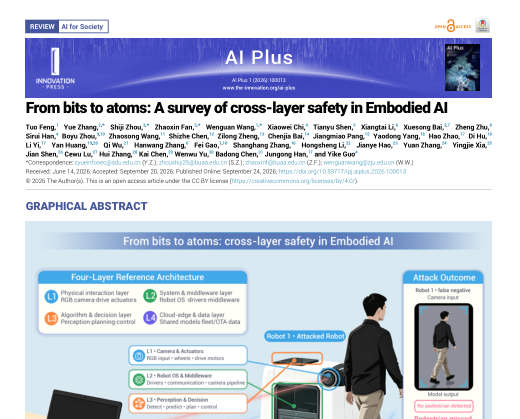
From bits to atoms: A survey of cross-layer safety in Embodied AI

Tuo Feng, Yue Zhang, Shiji Zhou, Zhaoxin Fan, Wenguan Wang, Xiaowei Chi, Tianyu Shen, Xiangtai Li 等

Embodied Artificial Intelligence (AI) introduces cyber-physical risks because digital failures and attacks can cause physical harm. This survey organizes embodied AI safety through…

Embodied Artificial Intelligence (AI) introduces cyber-physical risks because digital failures and attacks can cause physical harm. This survey organizes embodied AI safety through a four-layer reference architecture -- comprising the physical interaction, system and middleware, algorithm and decision, and cloud-edge and data layers -- and uses it to connect vulnerabilities, propagation paths, and safeguards across the system stack. It traces the evolution of safety paradigms and examines how faults and attacks cross architectural boundaries to produce physical consequences. Furthermore, the survey systematizes composite attack chains, outlines multi-layered defense strategies, and reviews representative embodied safety benchmarks. Ultimately, we advocate for unifying software alignment with rigorous hardware constraints to build trustworthy systems capable of operating safely within human-centric environments.

#142026-09-29追踪学者 · Cewu Lu

FP2: Equipping Robotic Foundation Models with Force Control

Hongjie Fang, Shirun Tang, Junjian Hu, Shidong Zhang, Derek Zhang, Linhao Chen, Dehai Li, Mingyu Mei 等

Robotic foundation models (RFMs) are increasingly capable of general-purpose manipulation, yet reliable physical interaction remains challenging in contact-rich settings. We presen…

Robotic foundation models (RFMs) are increasingly capable of general-purpose manipulation, yet reliable physical interaction remains challenging in contact-rich settings. We present FP2, a lightweight downstream interface that equips task-adapted RFMs with explicit force control while preserving their action-generation capability. FP2 adopts an action-regulation decomposition: the task-adapted RFM serves as a foundation policy responsible for task-level action generation, while a high-frequency force control policy focuses solely on interaction regulation. To condition force regulation on the ongoing manipulation, FP2 compresses foundation-policy contextual representations and combines them with wrench and proprioceptive histories to predict structured force-control parameters. We evaluate FP2 with four RFM backbones across four real-world contact-rich manipulation tasks. FP2 consistently improves task performance and force regulation quality over the corresponding foundation policies, while comparing favorably with representative force-aware and force-control baselines. Ablations further show that foundation-policy context and physical feedback are complementary for effective force regulation, while preserving foundation-policy action generation improves both efficiency and novel-object generalization. Project website: http://force-policy.github.io/fp2

#152026-09-25追踪学者 · Cewu Lu

HIRE: History-Conditioned Interaction Reasoning and High-Rate Execution for Visually Aliased Precision Manipulation

Rongji Li, Wenhao He, Cewu Lu, Xingyu Chen, Xu-Yao Zhang

Precision manipulation with contact-critical interactions is often history-dependent: visually similar observations can correspond to different latent interaction states and theref…

Precision manipulation with contact-critical interactions is often history-dependent: visually similar observations can correspond to different latent interaction states and therefore require different actions, while small execution errors can alter task outcomes. Policies relying on the current visual observation alone cannot resolve such ambiguity; force-aware and memory-augmented methods enrich physical or temporal context, while reactive high-rate policies improve local contact response, yet long-horizon temporal reasoning and precision execution remain largely decoupled in existing methods, limiting reliable progression in visually aliased precision manipulation. To bridge this gap, we introduce History-Conditioned Interaction Reasoning and Execution (HIRE), a cross-rate framework comprising a history-conditioned Interaction-State Reasoner (ISR) and a high-rate Interaction-Manifold Executor (IME). ISR encodes ordered wrench history with a temporal wrench encoder and Force Perceiver as persistent physical evidence for state-consistent action generation, while IME structures contact-critical motion into intrinsic progress and transverse correction for precise execution; their cross-rate loop allows the resulting physical traces to inform subsequent reasoning. In real-robot experiments across surface, insertion, and rotational interactions, HIRE achieves at least 90% completion across all evaluated task stages while improving interaction-state disambiguation, execution precision, and generalization. More broadly, HIRE provides a unified reasoning--execution perspective on precision manipulation under history-dependent partial observability, where physical interaction both realizes task intent and reveals latent-state evidence for future decisions. Code will be released upon publication.

#162026-09-21追踪学者 · Cewu Lu

PredActor: Predictive Action Diffusion for Steerable Onboard Humanoid Control

Lei Ye, Haibo Gao, Yitang Li, Peng Xu, Zetong Jing, Junhan Sun, Fanrong Dong, Ziqi Han 等

Diffusion models provide a flexible framework for motion generation, but turning this flexibility into closed-loop humanoid control remains challenging. Hierarchical generator-trac…

Diffusion models provide a flexible framework for motion generation, but turning this flexibility into closed-loop humanoid control remains challenging. Hierarchical generator-tracker systems steer motion through reference trajectories, yet these references may exceed the capabilities of the downstream tracker, leaving physical feasibility and disturbance recovery largely to a separate control module. Action-only diffusion avoids this separation by directly generating executable actions, but provides no explicit future-state trajectory that can be steered toward test-time motion objectives. Joint state-action diffusion offers a natural alternative, but existing controllers often rely on privileged full-body states, while learned behavior selection and test-time motion steering remain only partially integrated. We present PredActor, a predictive action diffusion policy that unifies both steering modes in one directly executed policy using proprioception alone. Given proprioceptive history and optional task context, PredActor jointly predicts actions and an internal future-state trajectory that enables guidance: classifier-free guidance strengthens text-conditioned motion, while classifier guidance steers future states toward test-time objectives. Only actions are executed, requiring neither a motion-reference tracker nor privileged full-body states. In simulation, PredActor reaches 44 of 45 destination targets and achieves a text retrieval score of 0.539 versus 0.424 for conditional action diffusion, with similar disturbance survival. Rolling denoising and computation-preserving runtime optimizations reduce the complete callback to 16.790 ms median and 19.383 ms p95 on a Jetson Orin NX, within the 20 ms control period. Deployed on a Unitree G1, PredActor demonstrates text-conditioned motion, disturbance response, joystick control, and semantic interpolation in simulation and hardware.

同实验室的其他学者