Tech Station

学者追踪 › 清北交 › Hao Dong

Hao Dong

清华 / 北大 / 上交 · 最近 45 天 8 篇
#12026-11-03追踪学者 · Hao Dong

DexHOT: Learning Hand-Object Configuration Transfer for Dexterous Manipulation

Zhewei Gui, Anthony Bolton, Jiyao Zhang, Zeyuan Chen, Qiyang Yan, Tianyu Wang, Hao Dong

Dexterous manipulation involves not only moving objects, but also arranging the hand around them to maintain useful contacts and enable subsequent actions. Yet many learning-based …

Dexterous manipulation involves not only moving objects, but also arranging the hand around them to maintain useful contacts and enable subsequent actions. Yet many learning-based systems specify goals primarily through object poses or trajectories, leaving hand-object configurations to emerge implicitly. We introduce DexHOT, which formulates dexterous manipulation as hand-object configuration transfer: moving between feasible configurations that jointly specify hand articulation and object pose relative to the wrist. DexHOT learns a reusable relation-conditioned transfer primitive from synthetic feasible configuration pairs, without human reference motions, and composes long-horizon behaviors through closed-loop tracking of configuration subgoals. On DexHOTBench with 120 objects, a single policy achieves 80.5% transfer success on seen objects and 69.4% on unseen objects; on a real dexterous hand, it achieves 61.5% success over 200 real-robot transfers and 90% task success across six demonstration-guided tasks. These results show that explicit hand-object goals provide an expressive and composable interface for dexterous manipulation. More details and videos are available at https://dex-hot.github.io/.

#22026-11-03追踪学者 · Hao Dong

PrimeSim: A Generalist World Model Simulator from Large-Scale Cross-Embodiment Demonstrations

Travis Davies, Wentao Ma, Lihao Guo, Tengfei Ma, Xiaowen Chang, Jiafeng Xu, Shilong Wang, Yiqi Deng 等

A robot world model that serves as a simulator must do more than generate plausible videos: it must faithfully follow commanded actions, maintain consistency across camera views, a…

A robot world model that serves as a simulator must do more than generate plausible videos: it must faithfully follow commanded actions, maintain consistency across camera views, and sustain coherent long-horizon rollouts. We present PrimeSim, an action-conditioned, multiview world model simulator that addresses these challenges through progressive midtraining and posttraining. Starting from a pretrained video generator, we midtrain on 30,110 hours of robot demonstrations spanning 22 platforms. To improve action following, we introduce a unified cross-embodiment action representation and frame-aligned dual-path conditioning to strengthen action-frame correspondence. To maintain multiview consistency, we develop view-aware interleaved attention with explicit camera identities, enabling cross-view information exchange while preserving view-specific representations. We further introduce a fast-video, slow-memory posttraining framework that transforms the bidirectional video generator into an efficient autoregressive simulator. By combining fast causal generation, self-rollout training, and hierarchical temporal memory, PrimeSim mitigates error accumulation from self-generated histories and supports coherent long-horizon simulation. PrimeSim runs at 10.1 FPS, remains stable over long-horizon rollouts on rigid and deformable manipulation tasks, and transfers to held-out platforms within 100 to 200 gradient steps where the pretrained backbone does not. Against five open-source action-conditioned world models it leads four of the five WorldSimProbe suites and posts the best overall EWMBench score, while fine-grained local calibration still trails the field; its rollouts are faithful enough to support GRPO-based policy optimization. We release the model weights, inference code, and training code.

#32026-10-30追踪学者 · Hao Dong

ResMerge: Residual Policy Learning and Merging for Continual Adaptation of Pre-trained Robot Policies

Kefei Zhu, Lingyun Xu, Yue Xin, Xiaoqi Li, Caixin Guo, Xincheng Du, Yuanpei Chen, Yaodong Yang 等

Continual adaptation to new tasks is essential for robots deployed in the real world, but adapting pre-trained policies remains challenging due to parameter growth and the need for…

Continual adaptation to new tasks is essential for robots deployed in the real world, but adapting pre-trained policies remains challenging due to parameter growth and the need for continual demonstration collection. Parameter-Efficient Continual Fine-Tuning (PECFT) isolates task-specific updates, but adapter-per-task designs require demonstrations and grow with the task set. We propose ResMerge, a two-stage framework that learns mergeable residual policies atop a frozen pre-trained policy: residual reinforcement learning (RL) acquires task-specific corrections without additional expert demonstrations during adaptation, and parameter-space merging consolidates compatible residuals to reduce stored parameters. We introduce Residual-Field Consistency (RFC), a simple, bounded, and interpretable metric that assesses compatibility in residual action-field space by comparing correction direction and magnitude. Experiments on LIBERO across two backbones and on a real-world Franka robot show improved continual learning performance over strong PECFT baselines, while selective merging reduces the residual-parameter footprint. Project website: https://resmerge.github.io/.

#42026-10-24追踪学者 · Hao Dong

One Scan is Enough: Demonstration-Free Adaptation for Language-Guided Navigation

Zhuoyuan Yu, Yuxing Long, Du Wang, Junyang Wang, Hongwei Fan, Hao Dong

Deploying a language-guided navigation policy in a new building usually means watching it fail. Public-benchmark VLAs degrade scene by scene as layout, appearance, and language dri…

Deploying a language-guided navigation policy in a new building usually means watching it fail. Public-benchmark VLAs degrade scene by scene as layout, appearance, and language drift, and the standard fix of teleoperating fresh trajectories on site does not scale. We replace human demonstration with a single brief iPhone scan. Scan2Instruction compiles that scan into a complete training environment, automatically synthesizing executable navigation episodes with grounded instructions. PRPT-KS then adapts the policy through a closed-form Pareto utility read directly off the reconstructed scene, with no learned critic and no human labels. Across five real environments, the two designs together drive our RealNav to an 85% real-robot success rate, compared with 49% for a RealNav baseline post-trained on human demonstrations, and still achieve 82% in unscanned regions of the same buildings, compared with 41% for the same baseline. Our work turns demonstration-free scene adaptation for language-guided navigation from an aspiration into a working reality.

cs.ROcs.AIcs.CLcs.CVcs.LG
#52026-10-17追踪学者 · Hao Dong

ReTRACE: Feedback-Guided LLM Agent in a Chemistry Harness for Retrosynthesis Planning

Jinxiang Xie, Yijian Zhang, Qingyuan Yi, Jianyi Wang, Hao Dong

Computer-aided retrosynthesis has advanced through single-step prediction, tree search and route scoring, but complex targets still require judgement over the whole route, where st…

Computer-aided retrosynthesis has advanced through single-step prediction, tree search and route scoring, but complex targets still require judgement over the whole route, where stereochemistry, functional-group compatibility, cost and greenness interact. Here we present \textbf{\mbox{ReTRACE}} (REtrosynthesis with Tool-orchestrated Reasoning And Context-aware Evidence), an agent that places a large language model (LLM) in a chemistry harness that integrates molecular tools, complementary single-step prediction engines, a purchasable starting-material library, a route memory and a multi-criterion route evaluator. Routes are judged by a new metric that combines programmatic checks with adversarial LLM review, and its verdicts are compared with a synthetic chemist's. The agent learns continually from evaluator feedback during search, diagnosing weak routes and backtracking to revise them. With Claude Opus 4.8, at least one of the top 10 routes proposed by ReTRACE passed the audit for 87.4%, 95.0% and 86.7% of targets on the three benchmarks. Two prospective wet-lab syntheses show that ReTRACE route proposals can be converted into executable procedures after expert revision.

#62026-09-27追踪学者 · Hao Dong

The Model Knows Another Way: Strategy Switching for Effective RLVR Exploration

Jin Cui, Xinyue Long, Boran Zhao, Pengju Ren, Hao Dong

Reinforcement learning with verifiable rewards (RLVR) is often limited by insufficient exploration: difficult problems can yield uniformly incorrect rollout groups and therefore li…

Reinforcement learning with verifiable rewards (RLVR) is often limited by insufficient exploration: difficult problems can yield uniformly incorrect rollout groups and therefore little learning signal. We show that such failures need not reflect missing capability. Instead, finite sampling often concentrates on a problem-specific dominant reasoning strategy while leaving alternative strategies already supported by the model unexplored. Moreover, the accessibility of these strategies evolves during RL: some are internalized into autonomous behavior, while others become difficult to elicit before being absorbed. Motivated by these observations, we introduce Problem--Strategy Rollout Allocation (PSRA), which treats unguided and strategy-conditioned prompts as competing exploration arms and uses Bayesian sequential allocation to direct a fixed rollout budget toward arms most likely to yield informative, non-saturated groups. A preservation objective keeps useful strategy-conditioned routes accessible while successful guided behaviors are transferred to the unguided policy. Across Qwen2.5 models from 1.5B to 7B and two RL training corpora, PSRA consistently improves reasoning performance, reduces dead saturation, strengthens out-of-distribution transfer, and maintains larger gains under increased inference budgets.

#72026-09-25追踪学者 · Hao Dong

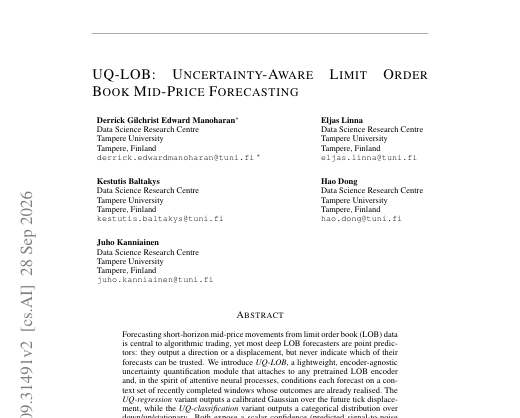
UQ-LOB: Uncertainty-Aware Limit Order Book Mid-Price Forecasting

Derrick Gilchrist Edward Manoharan, Eljas Linna, Kestutis Baltakys, Hao Dong, Juho Kanniainen

Forecasting short-horizon mid-price movements from limit order book (LOB) data is central to algorithmic trading, yet most deep LOB forecasters are point predictors: they output a …

Forecasting short-horizon mid-price movements from limit order book (LOB) data is central to algorithmic trading, yet most deep LOB forecasters are point predictors: they output a direction or a displacement, but never indicate which of their forecasts can be trusted. We introduce UQ-LOB, a lightweight, encoder-agnostic uncertainty quantification module that attaches to any pretrained LOB encoder and, in the spirit of attentive neural processes, conditions each forecast on a context set of recently completed windows whose outcomes are already realised. The UQ-regression variant outputs a calibrated Gaussian over the future tick displacement, while the UQ-classification variant outputs a categorical distribution over down/up/stationary. Both expose a scalar confidence (predicted signal-to-noise ratio or class probability) that supports selective prediction. On 5.2 billion LOB events across seven cryptocurrency assets and horizons of 5, 10 and 15 seconds, UQ-regression attains near-nominal 68% interval coverage, and restricting to the most confident 10% of predictions raises directional macro F1 by 0.11-0.15 for UQ-regression and 0.05-0.11 for UQ-classification, at every horizon. On large, economically meaningful moves, the tightest confidence tier reaches a directional F1 of 0.88 (down) and 0.83 (up) at the 5-second horizon.

#82026-09-24追踪学者 · Hao Dong

Rolling-WAM: World Action Models with Rolling Imagination

Yinghua Zhou, Junjie Ye, Yiqi Zhao, Hao Dong, Celina Shiyu Wang, Ruohai Ge, Tingyi Yang, Basile Van Hoorick 等

World Action Models (WAMs) couple action generation with future visual prediction for robotic manipulation. However, completing the joint video-action denoising process at each rep…

World Action Models (WAMs) couple action generation with future visual prediction for robotic manipulation. However, completing the joint video-action denoising process at each replanning cycle incurs substantial latency, delaying action updates and limiting closed-loop responsiveness. We present Rolling-WAM, a formulation that distributes joint denoising across successive replanning cycles. Our method maintains a sliding window of video-action chunks at staggered noise levels. At each step, a rolling noise schedule fully denoises the imminent action chunk for execution, while partially refining farther-future chunks. As the window advances with new camera observations, the retained future chunks continue their denoising process. This distributes the computational cost over time while carrying an evolving visual-action context across chunk boundaries. Evaluations on LIBERO, RoboTwin, and a real-world Unitree G1 humanoid show that Rolling-WAM achieves competitive manipulation performance. By removing the need to denoise the entire prediction horizon from scratch, it delivers a 4.5x steady-state replanning speedup over standard joint WAMs.

cs.ROcs.AIcs.CV

同实验室的其他学者