Tech Station

学者追踪 › 清北交 › Yang Gao

Yang Gao

清华 / 北大 / 上交 · 最近 45 天 18 篇
#12026-11-02追踪学者 · Yang Gao

MoSoLoco: Monocular 3D Human Localization through Visual Latent Features and Social Context

Yasamin Borhani, Javad Khoramdel, Yang Gao, Po-Chien Luan, Alexandre Alahi

Estimating the metric 3D position of people from a monocular camera is important for robot navigation and motion prediction. Lightweight pose-based localizers are attractive for ro…

Estimating the metric 3D position of people from a monocular camera is important for robot navigation and motion prediction. Lightweight pose-based localizers are attractive for robotic hardware with limited computational resources because they operate on compact 2D keypoints. However, they typically discard the richer visual representations computed by the pose estimator. We introduce MoSoLoco, a per-frame monocular 3D human localizer that combines the pose detector's internal visual features with the detected 2D skeleton, without requiring an additional RGB or depth encoder. MoSoLoco can further incorporate sparse same-frame multi-person context to refine individual position estimates. Experiments on JRDB and NuScenes show that reusing pose-detector representations improves localization, reducing the best JRDB error by approximately 23 percent relative to the strongest evaluated keypoint-based baseline. A sparse social-interaction module incorporates nearby detections from the same image for further refinement. Controlled trajectory-forecasting experiments show downstream benefits, while the complete pipeline remains suitable for efficient Jetson AGX Xavier inference.

cs.CVcs.RO
#22026-11-02追踪学者 · Yang Gao

RecRSI: Mechanism-Guided Discovery of Recommendation Algorithms

Tingran Gan, Zhouziyue Lu, Dian Jin, Tao Li, Yang Gao, Ming Liu, Weiwen Liu, Jianghao Lin 等

Improving recommendation algorithms for the Web requires coordinating interacting design choices and learning from experiments. We present RecRSI, an LLM-based research framework t…

Improving recommendation algorithms for the Web requires coordinating interacting design choices and learning from experiments. We present RecRSI, an LLM-based research framework that uses mechanism hypotheses to organize algorithm discovery. Each hypothesis links a proposed mechanism change to a reference design, a rationale, and an expected observation. MechSpace derives implementable primitives and composition rules from the task source; Research Line uses this space and prior evidence to develop and test hypotheses; Mechanism Feedback carries outcomes and their design context into subsequent research. This organization makes each experiment inform which mechanisms to develop, revise, or combine next. Across four initial recommenders and four datasets, RecRSI yields average relative improvements of 8.48% in NDCG@5 and 6.88% in HR@5 over the initial algorithms, and 2.60% and 2.20%, respectively, over the strongest competing result for each setting and metric. Component and process studies link these gains to coordinated mechanism choices and evidence-guided follow-up. Our code is publicly available at https://github.com/DynamisG210/RecRSI.

#32026-10-29追踪学者 · Yang Gao

Gaze-Assisted Supervisory Control for Lunar Robotic Arm Teleoperation Under Concurrent Monitoring

Jiayu He, Yifan Li, Oliver R. Runswick, Ernest N. Kamavuako, Yunjie Jia, Peter D. Hodkinson, Yang Gao

Rover-mounted robotic arms can extend human reach during lunar sample handling, but continuous joystick teleoperation requires repeated visual-motor alignment while operators may a…

Rover-mounted robotic arms can extend human reach during lunar sample handling, but continuous joystick teleoperation requires repeated visual-motor alignment while operators may also need to monitor system states. This paper presents a gaze-assisted supervisory control framework in which gaze nominates a rock or placement target, explicit confirmation authorizes the action, and the robot performs bounded autonomous grasp-and-place execution. The framework was evaluated against manual joystick teleoperation in a mission-analog virtual reality study with 16 participants. The study used a 2 x 2 x 3 within-subject design varying control mode, placement difficulty, and concurrent monitoring load. Mean recorded task completion time decreased from 47.65 to 18.43 s per rock, with 72.5% of this difference arising during grasping. Under the tested auditory monitoring conditions, gaze-assisted supervisory control showed less average proportional slowing, with no detected control-mode difference in monitoring-response accuracy or speed. The rate of gaze shifts between core areas of interest decreased from 49.98 to 27.73 shifts/min, while the raw NASA Task Load Index score decreased from 32.54 to 18.26. However, the benefit was task dependent. In precision placement, manual control yielded lower mean placement error and a higher placement success rate. These findings support a mixed-initiative allocation in which gaze enables rapid task-level intention specification and autonomous execution, while precision-critical stages retain manual refinement.

#42026-10-24追踪学者 · Yang Gao

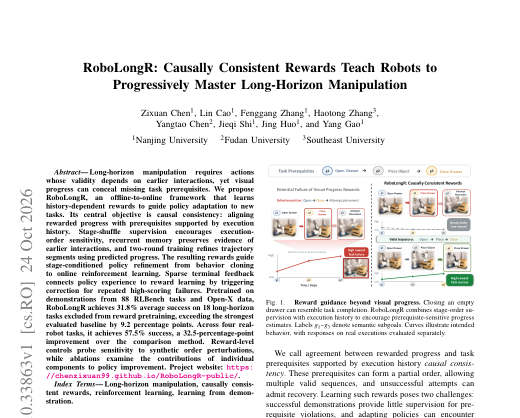
RoboLongR: Causally Consistent Rewards Teach Robots to Progressively Master Long-Horizon Manipulation

Zixuan Chen, Lin Cao, Fenggang Zhang, Haotong Zhang, Yangtao Chen, Jieqi Shi, Jing Huo, Yang Gao

Long-horizon manipulation requires actions whose validity depends on earlier interactions, yet visual progress can conceal missing task prerequisites. We propose RoboLongR, an offl…

Long-horizon manipulation requires actions whose validity depends on earlier interactions, yet visual progress can conceal missing task prerequisites. We propose RoboLongR, an offline-to-online framework that learns history-dependent rewards to guide policy adaptation to new tasks. Its central objective is causal consistency: aligning rewarded progress with prerequisites supported by execution history. Stage-shuffle supervision encourages execution-order sensitivity, recurrent memory preserves evidence of earlier interactions, and two-round training refines trajectory segments using predicted progress. The resulting rewards guide stage-conditioned policy refinement from behavior cloning to online reinforcement learning. Sparse terminal feedback connects policy experience to reward learning by triggering correction for repeated high-scoring failures. Pretrained on demonstrations from 88 RLBench tasks and Open-X data, RoboLongR achieves 31.8% average success on 18 long-horizon tasks excluded from reward pretraining, exceeding the strongest evaluated baseline by 9.2 percentage points. Across four real-robot tasks, it achieves 57.5% success, a 32.5-percentage-point improvement over the comparison method. Reward-level controls probe sensitivity to synthetic order perturbations, while ablations examine the contributions of individual components to policy improvement.

#52026-10-22追踪学者 · Yang Gao

Echo: Coupled Action and Task Status Signal Denoising for Vision Language Action Models

Yufeng Liu, Bohao Fan, Juntu Zhao, Xinyi Wang, Hang Yu, Wenzhuan Luo, Yingzhi Wang, Qinghai Li 等

Recognizing task completion and failure enables robots to stop upon success and initiate recovery or replanning after failure. Existing methods augment Vision Language Action (VLA)…

Recognizing task completion and failure enables robots to stop upon success and initiate recovery or replanning after failure. Existing methods augment Vision Language Action (VLA) policies with task status signal prediction to support these execution decisions. However, learning and integrating these signals can require fine-grained supervision, external monitoring models, or complex architectural designs. Moreover, the potential of task status signals to directly guide action generation remains underexplored. We present Echo, a framework that combines task status signal learning without frame-level progress annotations with a compact design for status prediction and action generation within a single VLA. Specifically, Echo represents task status with stop and failure signals, added as two dimensions of each action chunk and denoised together with robot actions. Their combination distinguishes ongoing execution, successful completion, and failure. To learn these signals without fine-grained progress annotations, Echo constructs successful, failed, and recovery trajectories with complementary supervision properties. To enable status signal-guided action generation, Echo controls interactions between the signals and actions and denoises the signals faster than the actions. These allow later action denoising steps to condition on cleaner status estimates while preserving accurate signal prediction. Extensive real-world manipulation experiments show that Echo accurately predicts task status and consistently improves policy performance.

#62026-10-19追踪学者 · Yang Gao

Nash-MOPD: Optimizing Task Trade-offs in Multi-Teacher On-Policy Distillation

Siyuan Gan, Bo Yang, Linjian Meng, Boyan Wang, Xiaolong Qi, Jing Huo, Yang Gao

Multi-teacher on-policy distillation (MOPD) aggregates the capabilities of multiple domain-expert teachers into a single student model. However, all domains in MOPD share the stude…

Multi-teacher on-policy distillation (MOPD) aggregates the capabilities of multiple domain-expert teachers into a single student model. However, all domains in MOPD share the student's finite budget of optimization steps and rollouts. Fixed uses constant domain sampling ratios based on corpus sizes; by contrast, D$^3$-MOPD adjusts the ratios using the teacher-student reverse-KL divergence and its recent decrease. However, favoring large recent decreases can direct more training toward domains that already improve quickly, while domains that improve more slowly may receive too few examples. To address inflexible allocation and the risk of giving insufficient training to domains that improve more slowly, we propose Nash-MOPD, an adaptive domain scheduler based on a local minimax game using existing reverse-KL statistics. The equilibrium maximizes the smallest predicted proportional reduction under the local model and gives more prompts to domains that need more examples for comparable improvement. Consequently, Nash-MOPD responds to changing learning progress and supports domains that improve more slowly without extra teacher queries or rollouts. At step 100, Nash-MOPD exceeds both baselines' final mathematics and code checkpoint scores on DeepSeek-R1-Distill-Qwen-1.5B and reaches Fixed's on Qwen3-8B-Base. Furthermore, it leads eight of nine reported metrics and is best or tied best on all six mathematics and code accuracy metrics, respectively.

cs.LGcs.AI
#72026-10-16追踪学者 · Yang Gao

Agentic Physics-Grounded Video Generation via Memory-Augmented In-Context Reasoning

Xikang Guan, Shaocong Yang, Yanqi Bao, Can Wang, Zheng Gu, Zhengqing Chen, Kai Chen, Jing Huo 等

Physical plausibility is essential for realistic video generation. Existing methods impose physical guidance before synthesis via simulations or refined prompts, but this can limit…

Physical plausibility is essential for realistic video generation. Existing methods impose physical guidance before synthesis via simulations or refined prompts, but this can limit dynamic diversity, miss errors that emerge only after generation, and require repeated regeneration when inconsistencies remain. We therefore study a generate-diagnose-repair paradigm that preserves the original generation capability and selectively repairs physical inconsistencies afterward, raising two key questions: what to repair and how to repair? To address them, we introduce PhysRepair, an agentic video generation framework that combines causal reasoning over the observed physical failure with prior repair experience to enable localized and adaptive correction. Specifically, Spatiotemporal Causal Constraints identify the first invalid physical state and its causally affected states, producing a repair specification that guides physically plausible local regeneration while preserving unaffected content. Experience-augmented In-context Learning combines the ongoing repair context with relevant experience from previous repairs, allowing the agent to adapt its repair decisions across diverse physical failures and accumulate completed trajectories for future cases. Experiments on Physics-IQ Verified across solid mechanics, fluid dynamics, optics, thermodynamics, and magnetism demonstrate that PhysRepair consistently improves the physical plausibility of generated videos over existing methods. Our project page is available at https://xxkkxxx.github.io/PhysRepair-Website/.

#82026-10-14追踪学者 · Yang Gao

HM3D-M3: A Benchmark for Multi-Agent, Multi-Modal, Multi-Object Goal Navigation

Hongyu Ding, Kanyu Xu, Mingjia Chen, Zixuan Chen, Jieqi Shi, Jing Huo, Yifan Zhang, Yang Gao

Rapid progress in AI agents and robotics makes it a matter of the near future that humans are served by a team of robots. Such a team will receive several goals at once, each speci…

Rapid progress in AI agents and robotics makes it a matter of the near future that humans are served by a team of robots. Such a team will receive several goals at once, each specified in whatever form is convenient for the human, such as a category name, a photo, or a spoken description. Existing benchmarks study multi-agent, multi-modal, and multi-object goal navigation in isolation, and a benchmark that places all three in one episode is missing. To fill this gap, we introduce HM3D-M3. A team of K agents starts at distributed locations in a photorealistic indoor scene and searches for an unordered set of M object goals, each given as an open-vocabulary category, an instance image, or an instance description. HM3D-M3 provides 1,000 validation episodes over 3,926 goals from 379 open-vocabulary categories, 100K observation-assignment training samples, and two team-level metrics, goal-level SR and makespan-normalized SPL. We further contribute two baselines. HiGA is a trained hierarchical goal assigner on top of a frozen open-vocabulary navigation policy, and LaViRA-M3 is a training-free team of VLM agents with shared mapping and progress analysis. Adapted multi-robot and zero-shot methods reach 16--27% SR, while our baselines reach 38--41% with complementary strengths and distinct failure modes. Furthermore, we deploy LaViRA-M3 on a heterogeneous three-robot team. Project page: https://robo-lavira.github.io/hm3d-m3/

#92026-10-14追踪学者 · Yang Gao

DeepPV-MRF: End-to-End Partial-Volume Fraction Estimation from MR Fingerprinting Time Series

Tianyi Ding, Yang Gao, Zhuang Xiong, Feng Liu, Martijn A. Cloos, Jin Jin, Hongfu Sun

Background: Estimating subvoxel tissue fractions from magnetic resonance fingerprinting (MRF) is challenging. Conventional dictionary matching and segmentation pipelines can propag…

Background: Estimating subvoxel tissue fractions from magnetic resonance fingerprinting (MRF) is challenging. Conventional dictionary matching and segmentation pipelines can propagate errors from intermediate parametric maps into tissue fraction estimates. Purpose: We introduce DeepPV-MRF, a deep learning framework that directly estimates voxel-wise tissue fractions from raw MRF signals. Methods: A cascaded spatial-temporal network was trained on subject-derived Bloch simulations with radial k-space undersampling. The network combines temporal encoding and spatial U-Net refinement to estimate cerebrospinal fluid (CSF), gray matter (GM), and white matter (WM) fractions without intermediate T1/T2 maps. We compared DeepPV-MRF with partial-volume dictionary matching (PV-DM) and pseudoinverse estimation (PV-Pinv) using simulated and in vivo data. Results: DeepPV-MRF outperformed both methods across acquisition settings. In single-shot simulations, CSF/WM/GM mean absolute errors were 0.0418/0.0744/0.0757, versus 0.1281/0.2443/0.2958 for PV-DM and 0.2021/0.2793/0.2630 for PV-Pinv. Corresponding structural similarity values were 0.960/0.916/0.922. In vivo results showed sharper anatomical boundaries and smoother tissue transitions, while cross-shot analysis indicated improved consistency across volunteers. Conclusions: DeepPV-MRF enables accurate and efficient direct tissue fraction estimation from MRF signals, particularly with limited shots. Further validation is needed before clinical deployment.

eess.SPcs.AI
#102026-10-12追踪学者 · Yang Gao

CryptoFlowBench: Benchmarking Multi-Hop Reasoning on Blockchains for Cryptocurrency Fund Tracing

Runang He, Tongya Zheng, Jing Cao, Yucheng Ying, Shunyu Liu, Bingde Hu, Yang Gao, Zeyuan Hu 等

Pseudonymous accounts and complex smart-contract ecosystems substantially hinder the tracing of illicit cryptocurrency fund flows. Existing Graph Neural Networks (GNNs) have achiev…

Pseudonymous accounts and complex smart-contract ecosystems substantially hinder the tracing of illicit cryptocurrency fund flows. Existing Graph Neural Networks (GNNs) have achieved promising performance in blockchain fraud detection, yet their static node- or edge-level predictions do not naturally generalize to multi-hop fund tracing. Meanwhile, existing tracing methods mainly rely on predefined heuristics to capture multi-hop relationships, limiting their adaptive reasoning capabilities. To bridge this gap, we introduce CryptoFlowBench, a benchmark constructed from authoritative reports on cryptocurrency-related illicit incidents, with four tasks spanning local to multi-hop fund tracing. These tasks pose substantial challenges to existing learning- and heuristic-based methods, particularly in complex multi-hop scenarios. We therefore propose ChainSleuth, a graph-tool-augmented agent that iteratively reasons, invokes graph tools, and updates its tracing trajectory, enabling adaptive information acquisition and recovery from erroneous paths. Experiments show that no baseline consistently dominates all four tasks, revealing substantial gaps between local fraud detection and multi-hop fund tracing. ChainSleuth achieves notable improvements on multi-hop tasks, demonstrating the potential of agentic graph reasoning for cryptocurrency fund investigation.

cs.CRcs.AIcs.LG
#112026-10-08追踪学者 · Yang Gao

Scenes as an Attack Surface: Uncovering Scene-Grounded Safety Failures in MLLMs

Tongxi Wu, Yuyang Cheng, Jiacheng Xian, Hu Huang, Zhihao Wu, Menglin Yang, Jian Zhang, Yang Gao

Existing jailbreak attacks have exposed serious safety weaknesses in multimodal large language models (MLLMs). Most prior attacks rely on specially constructed visual inputs to car…

Existing jailbreak attacks have exposed serious safety weaknesses in multimodal large language models (MLLMs). Most prior attacks rely on specially constructed visual inputs to carry or support harmful intent. In this paper, we uncover a different vulnerability: task-relevant scene semantics alone can shift an MLLM from refusal to compliance, even when the visual input introduces no additional attack instructions and the original task intent remains unchanged. We formalize this failure as a scene-grounded visual safety vulnerability and introduce SceneSafetyBench to investigate it across eight risk categories and nine white- and black-box MLLMs. Our analysis reveals that this failure is associated with how task-relevant visual evidence influences downstream safety representations, suggesting that visual grounding alone cannot fully explain the observed safety shift. Building on this finding, we propose Scene-Grounded Attacks (SGA), which preserve the original task while constructing validated scene-grounded queries and combining their independent responses. Across nine target MLLMs, SGA achieves an average attack success rate (ASR) of 86.17%, outperforming the strongest baseline by 8.55 percentage points and achieving the highest ASR on eight models. Our results identify scene semantics as an overlooked attack surface in MLLMs and highlight a growing tension between stronger visual grounding and robust multimodal safety alignment.

#122026-10-08追踪学者 · Yang Gao

Residual Modeling Closes the Regression and Generative Policy Gap in Robot Learning

Yuchen Zhou, Jiacheng You, Weikang Wan, Weijun Dong, Yang Gao, Jiayuan Mao

Learning from demonstration has enabled impressive robot behaviors. A common choice for policy learning is to use diffusion or flow matching (Flow-Policies), which often outperform…

Learning from demonstration has enabled impressive robot behaviors. A common choice for policy learning is to use diffusion or flow matching (Flow-Policies), which often outperforms direct action regression trained with mean squared error (MSE-Policies). This gap is commonly attributed to multimodal demonstrations. We revisit this gap from the perspective of statistical modeling: how action-prediction residuals shape policy optimization. Our analysis of real-world robot demonstration data reveals substantial state-dependent variation in residual scales and heavier-than-Gaussian tails. While both MSE-Policies and Flow-Policies exhibit heavy-tailed action residuals, their training gradients behave differently: MSE allocates more gradient magnitude to observations with large action residuals, which hurts optimization. Motivated by these findings, we introduce heteroscedastic Student-t action regression (HT-Policies), which learns input-dependent residual scales and reduces the influence of heavy tails. HT-Policies predict action chunks with a single feed-forward pass and can reuse pretrained flow-matching-based policy networks as the backbone. Across four simulation benchmarks and real-robot evaluations, HT-Policies achieves success rates competitive with generative policy baselines, both when trained from scratch and from pretrained vision-language-action and world-action models, despite being faster in training and inference. Together, these findings shed light on the practical advantages of generative objectives in robot learning from demonstrations and offer an efficient direct-regression alternative for a range of architectures and tasks. Project page: https://projects.thelabone.org/regression-policy/

#132026-10-05追踪学者 · Yang Gao

MoonGS: High-quality Representation of the Lunar Surface via Gaussian Splatting Using Robust Depth Features from Image Pairs

Yun Jiang, Bo Zheng, Yingying Zhang, Xueming Xiao, Tao Hu, Hutao Cui, Zhiguo Meng, Ke Gao 等

High-quality 3D reconstruction of lunar terrain from sparse rover images is indispensable for autonomous lunar exploration, but remains challenging because viewpoint overlap is ins…

High-quality 3D reconstruction of lunar terrain from sparse rover images is indispensable for autonomous lunar exploration, but remains challenging because viewpoint overlap is insufficient, surface textures are weak, and data volume is limited. We propose MoonGS, the first feed-forward 3D Gaussian Splatting framework tailored to lunar scenes. Given only two input images, MoonGS predicts pixel-aligned Gaussian primitives in a single forward pass and renders photorealistic novel views without any per-scene optimization. MoonGS (i) adopts an adaptable backbone design that seamlessly integrates advanced vision foundation models to extract robust depth features; (ii) integrates semantic priors in two manners: merging semantic cues with visual features to refine Gaussian parameter estimation, and adopting a semantic ranking loss that regularizes background depth; and (iii) employs an entropy-guided heuristic resampling strategy to augment sparse observations by selecting the most informative distant viewpoints with negligible overhead. Experiments on the LuSNAR benchmark and our synthetic weak-texture MoonBlender dataset show that MoonGS surpasses state-of-the-art feed-forward NeRF/3DGS baselines by +4.9 dB PSNR, +0.29 SSIM, and 40% lower LPIPS while maintaining sub-second inference. Furthermore, we validate the broad applicability of our framework by demonstrating that it effectively leverages state-of-the-art backbones, including VGGT, to significantly boost performance. Qualitative evaluations on Chang'e mission imagery also show the best visual quality among compared methods, indicating robustness on real lunar data. The source code and dataset are publicly available at https://github.com/InRobots/MoonBlender.

#142026-10-02追踪学者 · Yang Gao

GeoScaffold: Learning Compact Geometric Latents via Reconstruction for Efficient Vision-Language Navigation

Yixuan Jiang, Wentong Li, An Liu, Zihao Xin, Fulin Tang, Cong Leng, Yang Gao, Jian Cheng

Recent vision-and-language navigation (VLN) systems increasingly adopt streaming Video-LLM policies that map egocentric RGB observations and instructions directly to low-level acti…

Recent vision-and-language navigation (VLN) systems increasingly adopt streaming Video-LLM policies that map egocentric RGB observations and instructions directly to low-level actions. Yet these policies inherit weak 3D geometric priors from 2D pretraining. Existing geometry-aware extensions charge a persistent inference-time price: depth sensors, 3D encoders, or per-step perception tool calls. We propose GeoScaffold, a geometric supervision framework that pays this price once, at training time, by internalizing geometry into the policy itself. It first learns a compact depth tokenizer on depth maps from the training trajectories and freezes it. It then fine-tunes the policy with a handful of learnable geometry query tokens, training their hidden states to reconstruct navigation-critical geometry such as depth, connectivity, and traversability. This supervision turns the query states into compact geometric latents for action decoding, and through the shared weights also internalizes geometry into the backbone's own representations. Like a scaffold, the tokenizer, target generators, and reconstruction heads are discarded after training, leaving the backbone and action interface unchanged. Extensive experiments show that GeoScaffold consistently outperforms leading vision-only navigators on continuous VLN benchmarks, offering a practical paradigm for lightweight edge deployment of spatially aware embodied navigation models.

cs.ROcs.CV
#152026-09-29追踪学者 · Yang Gao

Skill-Space Shooting for Autonomous Robot Policy Improvement

Zihang Rui, Renhao Wang, Haoxu Huang, Yang Gao

Robots deployed in the physical world must be able to improve beyond their initial training as they encounter new situations and failures. For this improvement to scale across task…

Robots deployed in the physical world must be able to improve beyond their initial training as they encounter new situations and failures. For this improvement to scale across tasks, it must make effective use of experience without requiring human demonstration of each correction. Recent agentic systems offer a way to reduce this reliance on human effort by using foundation models to autonomously compose learned behaviors to complete tasks. Yet completing tasks this way does not itself teach a task policy to overcome its own failures; that requires turning these behaviors into learnable corrections for the policy. Our insight is that many such corrections are familiar short behaviors, or skills: they recur across tasks and describe actions that foundation models can reason about from a scene. We introduce skill-space shooting, which uses foundation model guidance to explore corrections through these reusable skills and turn successful trials into policy improvement. Real-world experiments show repeated improvement in policies acting autonomously, while skills can also be shared to reduce the teaching needed to improve on new tasks. By making reusable skills a source of corrective supervision, skill-space shooting enables scalable and generalizable policy improvement within and across tasks. Additional results and videos at https://skill-space-shooting.github.io.

cs.ROcs.AIcs.LG
#162026-09-29追踪学者 · Yang Gao

Automated Screw Planning for Reduced Pelvic Fractures Based on Statistical Shape Models and Deep Learning

Yang Gao, Sutuke Yibulayimu, Yanzhen Liu, Zian Zhao, Yudi Sang

Percutaneous iliosacral screw fixation is an important minimally invasive treatment for unstable pelvic fractures. Because the sacroiliac region has complex anatomy and narrow scre…

Percutaneous iliosacral screw fixation is an important minimally invasive treatment for unstable pelvic fractures. Because the sacroiliac region has complex anatomy and narrow screw corridors, the accuracy and safety of screw placement directly affect surgical outcomes. Accurate and reliable preoperative screw planning is therefore essential to improve surgical success and reduce intraoperative risks. Conventional preoperative planning typically requires surgeons to determine screw trajectories through manual measurements, a labor-intensive process that depends on subjective clinical experience. To address these challenges, we propose a fully automated pipeline for preoperative iliosacral screw planning in patients with pelvic fractures. Using patient-specific three-dimensional anatomy, the pipeline automatically identifies safe screw corridors and generates individualized insertion trajectories to support clinical preoperative planning. We evaluated the proposed pipeline on 200 clinical cases of pelvic fractures. Compared with conventional manual measurements, the safety margin of the safe insertion corridors increased by 2% across the four screw types, the mean planning time decreased by more than 90%, and the clinical acceptance rate reached 95%.

#172026-09-24追踪学者 · Yang Gao

AD-WM: Action-Discriminative World Models for Counterfactual Model Predictive Control

Jiabin Qiu, Zixuan Chen, Hongye Cao, Jieqi Shi, Jing Huo, Yang Gao

Latent world models are typically trained to predict factual transitions, whereas model predictive control (MPC) must compare alternative actions from the same state. A model can t…

Latent world models are typically trained to predict factual transitions, whereas model predictive control (MPC) must compare alternative actions from the same state. A model can therefore achieve low factual prediction error yet poorly distinguish candidate actions. We introduce AD-WM, an action-discriminative joint-embedding world model for counterfactual MPC. AD-WM combines residual latent dynamics with predictor-level action-recovery regularization, using inverse dynamics and a normalized recovery objective motivated by conditional mutual information. Both objectives encourage planning transitions to preserve action information; their auxiliary heads are discarded at test time, leaving MPC unchanged. On OGBench-Cube, AD-WM improves hard-start success from 3.7% to 52.0% over a matched LeWM baseline and improves mean success over the reproduced baseline in four of five simulation environments. Planning diagnostics show that factual prediction error and whole-bank action ranking do not follow the closed-loop success ordering, whereas CEM-aligned elite regret tracks success more closely. With a frozen V-JEPA 2 encoder and matched DROID post-training, AD-WM also improves zero-shot transfer to our Franka setup, increasing basic pick-and-place success from 42.2% to 71.1% without lab-specific adaptation. These results suggest that world models for planning should preserve action-dependent differences needed for counterfactual selection, rather than optimize factual prediction accuracy alone. More videos and code are available at https://ad-wm.github.io/.

#182026-09-21追踪学者 · Yang Gao

RGSQ: Riemannian Geometry-Sensitive Quantization for Large Vision-Language Models

Zhiping Wu, Dongdong Ren, Yangchengyu Zhou, Zhengjie Zhang, Wenbin Li, Hongbing Pan, Yang Gao

Large vision-language models (VLMs) can be efficiently deployed under stringent memory and latency constraints through post training quantization (PTQ). However, most PTQ methods a…

Large vision-language models (VLMs) can be efficiently deployed under stringent memory and latency constraints through post training quantization (PTQ). However, most PTQ methods are designed for unimodal large language models (LLMs). These methods treat quantization errors as isotropic perturbations under the Euclidean assumption, which provides weak guidance on directions most sensitive to quantization in VLMs. Consequently, directly adapting unimodal PTQ approaches or solely employing modality-specific scaling often leads to uneven bit-width distribution and inconsistent performance in low-bit settings. To address these challenges, we propose Riemannian Geometry-Sensitive Quantization (RGSQ), which formulates quantization as a reconstruction problem under a unified Fisher-Riemannian metric. RGSQ identifies modality-specific sensitive directions via Riemannian manifold mappings built from modality-partitioned empirical Fisher factors and fused into a modality-aware Kronecker-structured metric. We then apply geometry-aligned rotations to reorient the local tangent frame, steering low-bit perturbations toward loss-insensitive axes. Finally, we apply a whitening transformation that maps the Riemannian objective to an equivalent Euclidean form, enabling standard unimodal PTQ methods to evaluate multimodal quantization error under their original assumptions. Across an extensive and diverse set of mainstream VLM benchmarks, RGSQ achieves the highest accuracy and stability under extremely low-bit settings (W2A8 and W3A8). It outperforms VLM-aware baselines, such as MBQ and MQuant, by up to 5.9% and surpasses single-modality improvements by up to 8.6%.

cs.CVcs.AI

同实验室的其他学者