Tech Station

2026-10-02

50 篇论文 · 30 个项目 ← 2026-10-01 · 2026-10-03 →

论文

#12026-10-0199

ReCo: Response-Consistent Locomotion with Policy-Aware MPC for Legged Manipulation

Kuankuan Sima, Yichao Gao, Chenxi Gu, Kefan Zhao, Lin Zhao

Continuous legged manipulation requires accurate end-effector tracking while the base keeps walking. Combining reinforcement learning (RL) with model predictive control (MPC) suits…

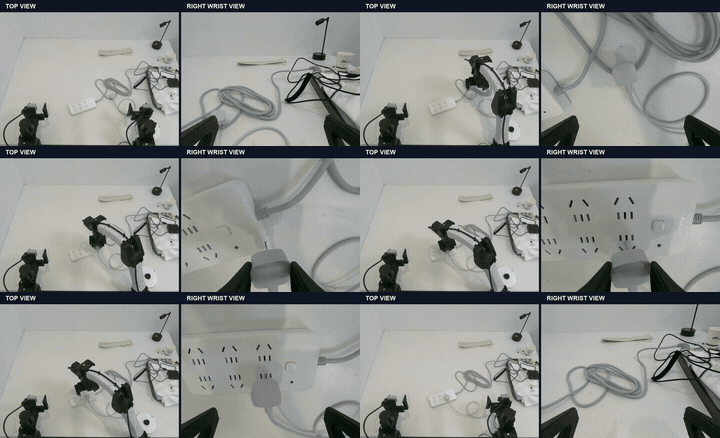
Continuous legged manipulation requires accurate end-effector tracking while the base keeps walking. Combining reinforcement learning (RL) with model predictive control (MPC) suits this task: the learned policy provides robust locomotion, while MPC coordinates the base and arm to compensate for tracking errors. However, MPC can compensate only for base motion that it can predict, and a learned policy's command response varies with gait phase, contact, and payload. We present ReCo, a framework that couples response-consistent locomotion with policy-aware MPC for legged manipulation. Response shaping trains the policy to respond to commands consistently and repeatably across randomized dynamics. An identified closed-loop response model then lets MPC jointly plan locomotion commands and arm motion. On the simulation benchmark, ReCo reduces position and orientation root-mean-square error (RMSE) by 28.7% and 27.4% relative to the best baseline for each metric. Real-world experiments demonstrate onboard continuous legged manipulation with coordinated base and arm motion.

cs.ROmanipulationleggedlocomotion

兴趣:reinforcement learning for legged locomotion and sim-to-real transfer

#22026-10-0196

ATI-VLA: Action-Centric Predictive Vision-Language-Action Models via Actionable Alignment Then Adaptive Injection

Yijie Zhu, Rui Shao, Jie He, Wei Li, Bo Zhao, Yelin Wang 等

Predictive Vision-Language-Action (VLA) models aim to improve robotic manipulation via future observation or world dynamics forecasting. However, existing approaches often fail to …

Predictive Vision-Language-Action (VLA) models aim to improve robotic manipulation via future observation or world dynamics forecasting. However, existing approaches often fail to realize this potential and underperform direct action prediction models. We argue that these limitations stem from modality misalignment between observations and actions, together with joint optimization conflicts that drive learning away from an action-centric objective. To this end, we introduce ATI-VLA, an Action-Centric Predictive Vision-Language-Action framework via Actionable Alignment Then Adaptive Injection. Specifically, it follows a two-step design: 1) Actionable Representation Alignment via a Shared Codebook. It aligns predictive observation and action representations by mapping both modalities into a shared discrete latent space via a unified codebook, making predictive observation latents readily usable for action generation and mitigating modality misalignment. 2) Action-Centric Adaptive Injection of Predictive Latents. Building upon this, it then injects predictive observation latents into action decoding as explicit predictive priors via a lightweight adaptive side-path, enabling adaptive predictive guidance under a single action-centric objective. Extensive experiments on both simulation and real-world robotic tasks demonstrate that ATI-VLA achieves state-of-the-art performance with faster convergence.

cs.CVmanipulationVLAvision-language-action

兴趣:vision-language-action (VLA) models and foundation models for robots

#32026-10-0195

DuoMind: Enabling Distributed Multi-Robot Coordination with Semantic Communication

Hanchu Zhou, Dechen Gao, Hang Wang, Brendan Lynch, Boqi Zhao, Qiyao Ma 等

Vision-language models (VLMs) and vision-language-action models (VLAs) have recently driven rapid progress in general-purpose robots, yet most progress has focused on single-robot …

Vision-language models (VLMs) and vision-language-action models (VLAs) have recently driven rapid progress in general-purpose robots, yet most progress has focused on single-robot settings. Extending these capabilities to multi-robot systems remains challenging because robots must coordinate long-horizon behaviors while maintaining reliable, fine-grained execution. We introduce DuoMind, a distributed hierarchical framework for multi-robot coordination through semantic communication. Each robot uses a VLA-based action model for low-level execution and a VLM-based orchestrator for high-level reasoning and inter-agent coordination. At each planning step, the orchestrator at each robot reasons over the task instruction, local observations, and messages received from other robots. It then generates low-level instructions for the action model and semantic messages for peer robots. This architecture exploits the complementary strengths of pretrained models by combining the semantic reasoning capabilities of VLMs with the precise action-generation capabilities of VLAs. To address the scarcity of benchmarks for multi-robot coordination, we further develop RoboPoly, a benchmark comprising long-horizon manipulation tasks that require coordinated, closed-loop execution under distributed control. Experiments on RoboPoly and RoboTwin demonstrate that DuoMind improves multi-robot task performance, while ablation studies confirm the contributions of hierarchical orchestration and semantic communication. More details are available on our project page.

cs.ROcs.AIrobotmanipulationVLAvision-language-action

兴趣:large language models for robot task planning and reasoning

#42026-10-0195

Are Frontier VLM Agents Ready to Be Robot Generalists? An Empirical Study with the Embodied Agent Arena

Haojian Huang, Pukun Zhao, Zexi Li, Yehang Zhang, Yangkai Wei, Wenqian Li 等

Frontier vision-language models (VLMs) combine scene estimation, interaction grounding, and executable actions. Understanding how these abilities support complete robotic tasks is …

Frontier vision-language models (VLMs) combine scene estimation, interaction grounding, and executable actions. Understanding how these abilities support complete robotic tasks is central to evaluating their readiness as robot generalists. We introduce Embodied Agent Arena to examine where local competence supports, or falls short of, complete task success across Geometry, Spatial Reasoning, Affordance, Task Planning, and Manipulation. The arena contains 1,000 cases drawn from 32 established sources and GeoProbe, our new benchmark for geometric estimation on Blender renders and real-scene images. A minimal harness preserves source observations and operations while separating metric precision, functional grounding, and native goal completion. We evaluate seven VLMs, analyze Astra's task-specific advantages, and compare richer-observation execution protocols and multi-round review. Across the arena, Astra's advantage is strongest in precise estimation and usable-contact localization; completing coordinated, goal-directed actions remains the key gap to robot generalism.

cs.ROrobotmanipulationembodiedtask planning

兴趣:vision-language-action (VLA) models and foundation models for robots

#52026-10-0195

eRLT: Efficient VLA Reinforcement Learning via Action-Relevant Token Routing

Dehao Huang, Jianbang Liu, Jianpan Gao, Chao Tang, Zilang Cen, Zedong Dan 等

Vision-Language-Action (VLA) models provide strong behavioral priors for robotic manipulation, yet efficiently adapting them to downstream tasks remains challenging. Recent work ad…

Vision-Language-Action (VLA) models provide strong behavioral priors for robotic manipulation, yet efficiently adapting them to downstream tasks remains challenging. Recent work addresses this challenge by adapting frozen VLAs through online reinforcement learning (RL), whose sample efficiency depends on the quality of the state representation used by the actor and critic. Existing methods construct such representations either with VLA-independent visual encoders or through fixed compression of internal VLA representations. Neither design explicitly extracts the task-specific action-relevant VLA features most useful for downstream action refinement and action-value estimation, therefore limiting sample efficiency. To address this limitation, we introduce eRLT, which constructs an effective state representation by routing task-specific action-relevant information across both tokens and layers of the frozen VLA. Specifically, learned routing tokens dynamically aggregate visual-language features at multiple depths, while a lightweight layer router combines these summaries into a fixed-dimensional RL token. The routing module is initialized using expert demonstrations to capture features predictive of expert actions and then refined using critic feedback from online interactions for action-value estimation. Across seven LIBERO and RoboTwin tasks, eRLT improves mean normalized learning-curve AUC by up to 23.7% over representative baselines. Real-robot experiments on USB connector insertion and motherboard ribbon-cable insertion further show AUC improvements of 108.9% and 46.7%, respectively, over the strongest baseline.

cs.ROrobotmanipulationVLAvision-language-action

兴趣:vision-language-action (VLA) models and foundation models for robots

#62026-09-3095

Towards a General Humanoid Loco-Manipulation Model via Egocentric Whole-Body Human Data Pretraining

Chongyang Xu, Zhao Wu, Jin Chen, Yiming Jiang, Jinhui Ye, Yuming Jiang 等

Humanoid whole-body manipulation has advanced rapidly, enabling policies to coordinate locomotion, posture, bimanual interaction, and dexterous hand movements. Meanwhile, egocentri…

Humanoid whole-body manipulation has advanced rapidly, enabling policies to coordinate locomotion, posture, bimanual interaction, and dexterous hand movements. Meanwhile, egocentric human videos provide diverse examples of everyday interactions across objects and scenes, offering scalable supervision without robot operation. However, existing supervision from these videos provides limited coverage of whole-body movement and coordination with hand-object interaction, while obtaining such supervision through humanoid teleoperation is also costly and difficult to scale. We therefore explore how human experience can support scalable learning of humanoid loco-manipulation. To support this study, we introduce HumanVerse-500, a 500-hour dataset of diverse human loco-manipulation behaviors in open-world environments, collected with a lightweight wearable system that synchronizes egocentric video with body and hand motion. Building on this dataset, we develop $λ_0$, a whole-body humanoid vision-language-action policy, through three-stage training that first learns interaction from diverse egocentric datasets, then coordinates body and hand motion using HumanVerse-500, and finally adapts the policy to downstream tasks and robot embodiments. Across these stages, $λ_0$ learns a shared representation space for human experience transfer, while domain-specific interfaces handle differences between human and robot states and actions. We evaluate $λ_0$ on SIMPLE and 4 real-world loco-manipulation tasks, achieving state-of-the-art performance, and further analyze its scaling behavior, generalization, and training-stage contributions to understand how human data support downstream whole-body humanoid control. We will release our code, models, and data to support further research.

cs.ROrobotmanipulationvision-language-actionhumanoidlocomotiondexterous

兴趣:humanoid robots and whole-body control

#72026-09-3094

MIKASA-Robo-VLA: Benchmarking Memory in VLA Models for Long-Horizon Manipulation

Egor Cherepanov, Nikita Kachaev, Aleksandr I. Panov, Alexey K. Kovalev

Vision-language-action policies often see only one or a few recent frames, which makes it difficult to evaluate how they use information that disappears during a task. We introduce…

Vision-language-action policies often see only one or a few recent frames, which makes it difficult to evaluate how they use information that disappears during a task. We introduce MIKASA-Robo-VLA, a benchmark of 90 language-conditioned manipulation tasks. All but 10 hide the cue an action depends on. Those 10 are reactive controls. MIKASA-Robo, the suite it rebuilds, has 32 tasks and uses language only in a representative VLA subset. Here every task provides an instruction, while memory-dependent tasks hide a task-relevant cue and reactive controls keep it available. For 70 tasks, environment phase timings specify an information gap, and for 28 of them the gap exceeds the 16-frame window of the widest fixed-context VLA we survey. The gap counts only the interval the cue is provably absent, not the full duration a policy must retain it, so every memory-dependent task still requires memory by construction, including the ones whose measured gap is short. We release 22,500 oracle trajectories across 10 memory types in RLDS and LeRobotDataset v3. A reference $π_{0.5}$ baseline with current images and proprioception, but no observation history or explicit memory module, is fine-tuned on 14 tasks and achieves 0.211 $\pm$ 0.044 mean task success. Its lower success on the evaluated Long-split tasks is confounded by open-loop chunking and the memory types represented in that subset. Project page: https://mikasarobo.github.io/

cs.LGcs.AIcs.ROmanipulationVLAvision-language-action

兴趣:vision-language-action (VLA) models and foundation models for robots

#82026-10-0193

UniWAM: Unified World-Action Model

Jiayi Chen, Wenxuan Song, Jingbo Wang, Shuai Zhou, Xicheng Gong, Zehua Fan 等

Vision-language-action models benefit from the understanding and reasoning capabilities of pretrained vision-language models, but action-only supervision provides limited grounding…

Vision-language-action models benefit from the understanding and reasoning capabilities of pretrained vision-language models, but action-only supervision provides limited grounding in world dynamics. Conversely, world-action models inherit spatiotemporal priors from video generation models, yet remain limited in semantic understanding and reasoning under distribution shifts. We introduce UniWAM, a unified architecture that integrates a physical reasoner, a world generator, and an action predictor to jointly learn semantic understanding of the physical world, visual generation, and action prediction. To ensure the quality of the training data, we developed a rigorous data cleaning and annotation pipeline for both human egocentric data and robot data. To adapt the vision-language component to embodied tasks while preserving its inherited language capabilities, we represent low-level actions in natural language and introduce a pre-training recipe that assigns complementary supervision from visual question answering (VQA) data, human egocentric data, and robot demonstrations to the appropriate model components. During post-training, future visual noise augmentation reduces reliance on precise future predictions, while history-conditioned flow matching uses encoded action history to initialize action generation. Together, these designs significantly reduce denoising steps while maintaining performance. UniWAM achieves state-of-the-art (SOTA) performance across multiple evaluations, including in-distribution performance, robustness, generalization, instruction following, and long-horizon task execution. Furthermore, we uncover a log-linear scaling law of unified human-robot co-training, demonstrating the effectiveness of large-scale pre-training on a mixture of human and robot data.

cs.ROrobotvision-language-actionembodied

兴趣:vision-language-action (VLA) models and foundation models for robots

#92026-10-0193

WBAG: A Whole-Body and Attached-Geometry Safety Framework for Vision-Language-Action Manipulation

Samuel Zhen, Siwon Jo, Yanze Zhang, Wenhao Luo

Vision-language-action (VLA) policies have demonstrated impressive capabilities in generalizable robotic manipulation, but their deployment in the real world remains challenging du…

Vision-language-action (VLA) policies have demonstrated impressive capabilities in generalizable robotic manipulation, but their deployment in the real world remains challenging due to potential collisions involving different parts of the robot, manipulated objects, and the surrounding environment. Existing inference-time VLA safety frameworks typically rely on simplified end-effector-centered representations that do not explicitly model the full articulated robot and attached-object geometry. In this paper, we present WBAG, a safety framework that models the robot's whole-body and grasp-dependent attached geometry. WBAG constructs a grasp-conditioned safe set that adapts the protected geometry as objects are grasped, then converts this evolving geometry into differentiable CBF constraints that minimally modify the VLA's native six-dimensional operational-space action for collision avoidance across robot, scene, and attached geometry. On the SafeLIBERO benchmark, a variant of LIBERO augmented with obstacles for safety evaluation, WBAG achieves the best overall safety and safe task success among the evaluated methods under a scene-level safety evaluator that monitors all eligible non-task objects, reaching 97.38% aggregate Scene Safety and 59.38% Safe Success.

cs.ROrobotmanipulationgraspVLAvision-language-action

兴趣:vision-language-action (VLA) models and foundation models for robots

#102026-09-2993

DriftOPD: Sequence-Level Reverse-KL Distillation for One-Step VLA Policies

Youngjun Jun, Kyumin Choi, Youngmin Kim, Seonghyun Jin, Sunwoo Park, Jangho Park 等

Vision-Language-Action (VLA) models increasingly rely on action experts that generate short action chunks under receding-horizon control. While chunk-level training is convenient a…

Vision-Language-Action (VLA) models increasingly rely on action experts that generate short action chunks under receding-horizon control. While chunk-level training is convenient across robot embodiments, it optimizes local action likelihood without explicitly accounting for long-horizon task success. Sequence-level reinforcement learning can address this limitation, but typically requires policy rollouts and closed-loop interaction, which are costly for real-robot manipulation. We introduce DriftOPD, a teacher-free, rollout-free framework for sequence-level on-policy distillation of continuous VLA action experts. We show that the sequence-level reverse Kullback-Leibler (KL) divergence decomposes into a chunk-level reverse-KL term and a future-potential term that captures the long-horizon effect of the current action. DriftOPD optimizes these two terms using a one-step drifting objective and a Q-function critic learned from offline demonstrations, respectively, enabling sequence-level optimization with only offline data and one-step action generation. Across multiple VLA architectures in simulation and real-world manipulation, DriftOPD generally outperforms existing one-step distillation baselines while achieving task success performance comparable to multi-step teacher policies. These results demonstrate that long-horizon behavior can be effectively distilled into one-step VLA action experts without online interaction or a separate teacher.

cs.ROcs.AIcs.CVcs.LGrobotmanipulationVLAvision-language-action

兴趣:vision-language-action (VLA) models and foundation models for robots

#112026-10-0192

MASkillBlender: Decentralized Whole-Body Coordination for Multi-Humanoid Loco-Manipulation via Skill Blending

Yifan Hu, Luhang Hong, Mingkang Long, Danning Wang, Chengfeng Jia, Rong Su 等

Coordinated multi-humanoid loco-manipulation is promising yet challenging due to high-dimensional whole-body control, decentralized decision making, and scalability. While recent r…

Coordinated multi-humanoid loco-manipulation is promising yet challenging due to high-dimensional whole-body control, decentralized decision making, and scalability. While recent reinforcement learning methods have improved single-humanoid whole-body control, extending them to the multi-humanoid setting remains nontrivial and often requires substantial reward engineering or task-specific design. We propose MASkillBlender, a general multi-agent reinforcement learning framework to achieve decentralized multi-humanoid whole-body coordination. By learning a shared decentralized high-level policy over reusable pre-trained single-humanoid skills, MASkillBlender enables coordinated behaviors using only task-level rewards, without requiring task-specific motion references. To improve learning efficiency, we further introduce a permutation-based data augmentation strategy for homogeneous multi-humanoid systems, and theoretically show that the permuted samples preserve the policy-gradient direction of the original samples under the homogeneous Markov game formulation. We evaluate MASkillBlender on multiple multi-humanoid coordination tasks across two humanoid embodiments. Simulation results demonstrate that the proposed framework consistently achieves strong task performance and enables coordinated behaviors across different tasks and humanoid embodiments.

cs.ROcs.LGcs.MAmanipulationhumanoid

兴趣:humanoid robots and whole-body control

#122026-09-3092

Token-World: World Modeling in Vision-Language Model Token Space for Robot Manipulation

Chuyao Fu, Xiaowei Chi, Yuhan Rui, Yu-kai Wang, Zezhong Qian, Xiaojie Zhang 等

A common approach to world-model simulation for vision-language-action (VLA) systems is to predict future RGB observations and then re-encode them into policy inputs, introducing a…

A common approach to world-model simulation for vision-language-action (VLA) systems is to predict future RGB observations and then re-encode them into policy inputs, introducing an indirect interface between simulation and downstream policy execution. We instead investigate whether world dynamics can be modeled in a compact, policy-oriented state derived from VLM visual tokens. A key challenge is that raw VLM visual tokens are high-dimensional, making efficient and accurate autoregressive dynamics modeling challenging. To address this, we introduce Token-World, an action-conditioned world model that compresses VLM features into a compact token state, learns future dynamics in this reduced space, and maps predicted states back to the original policy-facing representation for downstream use. Across manipulation benchmarks, Token-World improves open-loop feature fidelity and policy-action consistency over recent world-model simulators, with slower degradation over long rollout horizons. In closed-loop evaluation, its simulated policy performance correlates more strongly with reference policy performance than Ctrl-World ($r=0.794$ vs.\ $0.583$), while requiring lower simulation latency. Ablations further show that compact-representation design and dimensionality substantially affect future-state prediction. Code will be available at https://chuyaofu.github.io/Token-World/.

cs.ROrobotmanipulationVLAvision-language-actionworld model

兴趣:vision-language-action (VLA) models and foundation models for robots

#132026-10-0192

HumanoidToolBench: Benchmarking Humanoid Tool Use from Selection to Mobile Execution

Kyochul Jang, Seohyeon Park, Ohchul Kwon, Sangjun Park, Junhyeok Choi, Seungyeop Yi 等

As robotic hardware and learning methods advance, humanoids need tools to perform tasks beyond their inherent physical limits. Successful tool use requires selecting a suitable too…

As robotic hardware and learning methods advance, humanoids need tools to perform tasks beyond their inherent physical limits. Successful tool use requires selecting a suitable tool and coordinating manipulation and, when needed, locomotion to complete the task. Existing benchmarks do not jointly evaluate these capabilities on a humanoid. We introduce HumanoidToolBench, an 18-task benchmark spanning three scenarios, three execution levels, and two tool-set modes, together with ToolBook, a dataset of 3.1k demonstrations collected in simulation and on a real Unitree G1. Evaluation of seven policies in simulation and three on the real robot reveals substantial gaps between selecting a suitable tool and completing the task. Focused GR00T N1.7 probes show reduced selection accuracy on unseen tools and continued task execution under unrelated instructions. Code and data are available at https://snu-pi.github.io/HumanoidToolBench/.

cs.ROcs.AIrobotmanipulationhumanoidlocomotion

兴趣:humanoid robots and whole-body control

#142026-09-30追踪学者 · C. Karen Liu追踪学者 · Jiajun Wu91

DITTO-X: Forward and Reverse Teleoperation for Dexterous Manipulation and Human Intervention

Zhanpeng He, Joaquin Palacios, Zhangyu Wang, Chenhao Li, Katelyn Lee, Matei Ciocarlie 等

Teleoperated demonstrations are a primary source of data for robot manipulation, and teleoperated interventions are a primary mechanism for correcting policies at deployment. Yet m…

Teleoperated demonstrations are a primary source of data for robot manipulation, and teleoperated interventions are a primary mechanism for correcting policies at deployment. Yet most teleoperation systems close the loop through vision alone and are built around parallel-jaw grippers, limiting both what the robot can execute and what the operator can express through it. This is most damaging in shared autonomy, where the operator sees the scene only through occluded cameras and must take over a dexterous hand mid-task, often with an object already grasped. We present DITTO-X, a hand-agnostic dexterous teleoperation interface that renders joint-level force and fingertip contact events from sensing already on the robot hand, and drives three commercial dexterous hands (Sharpa, Wuji, and Inspire) without per-hand redesign. Because the exoskeleton is actuated, DITTO-X also supports reverse teleoperation, in which the robot back-drives the operator's fingers into its own configuration before control is transferred, so the human enters the loop already matched to the state they inherit. Our results show that DITTO-X improves demonstration quality and throughput over a commercial hand-tracking glove, both in regular data collection and in human intervention during policy deployment for contact-rich manipulation tasks. More information can be found from our website: https://tml.stanford.edu/ditto-x/.

cs.ROrobotmanipulationdexterous

追踪学者:C. Karen Liu、Jiajun Wu;兴趣:robot manipulation and grasping with learned policies

#152026-10-0191

InterEvolve: Test-Time Evolution of Reward Programs for Humanoid Loco-Manipulation

Zhuo Lin, Sirui Xu, Liuyu Bian, Yu-Xiong Wang, Liang-Yan Gui

We study test-time evolution for humanoid loco-manipulation: solving tasks that a controller was never trained for by repurposing its existing skills, improving from its own attemp…

We study test-time evolution for humanoid loco-manipulation: solving tasks that a controller was never trained for by repurposing its existing skills, improving from its own attempts, and retaining what it learns, without retraining. Our key insight is that a broad controller already holds much of the competence a new task needs, and that this competence becomes accessible through an interface between planning and control that is expressive enough to specify contact-rich, multi-stage interactions, yet executable and measurable enough that execution feedback can guide planning from experience. InterEvolve realizes this interface with two components. First, we develop an object-aware forward-backward (FB) behavioral foundation model, whose object residuals on a frozen body prior turn a new reward about the body or objects into loco-manipulation behavior at test time. Second, we specify tasks as reward programs: staged rewards with completion conditions and tunable constants. A large language model (LLM) agent revises the program structure in context, drawing on execution feedback and a skill library of verified programs, while a numerical optimizer tunes its constants. With every candidate verified across parallel simulation scenarios, the program explores new ways to induce, repurpose, and compose the controller's existing motor competence for the task at hand, and thus improves over iterations. Experiments show that human-designed rewards leave much of the FB model's loco-manipulation competence untapped, whereas the programs InterEvolve evolves release it, sometimes through novel strategies. It further produces behaviors for diverse tasks, complex scenes, and long-horizon compositions in simulation, and evolved skills run autonomously on a physical Unitree G1 from egocentric onboard perception.

cs.ROcs.CVcs.GRmanipulationhumanoid

兴趣:reinforcement learning for legged locomotion and sim-to-real transfer

#162026-09-30追踪学者 · Jiajun Wu91

ECoMEM: Explicit Concept Memory for Memory-Dependent Robot Control

Yize Liu, Ke Wang, Mac Schwager, Yiqing Xu, Jiajun Wu

A robot may lose sight of an object it must later retrieve, need to recall what a person demonstrated earlier, or track which steps of a task it has already completed. Current visi…

A robot may lose sight of an object it must later retrieve, need to recall what a person demonstrated earlier, or track which steps of a task it has already completed. Current vision-language-action (VLA) policies often fail once the information needed for action disappears from the current observation, making memory critical for long-horizon robot behavior. Existing approaches typically provide longer histories or learn implicit memory from observation-action trajectories. But action supervision tells a policy how to act, not what to remember: it does not specify which past facts should persist or how they should change as new evidence arrives. We therefore separate maintaining an evidence-grounded account of the past from learning how to act on it. This insight motivates Explicit Concept Memory (ECoMEM), which represents task-relevant history with a reusable library of grounded concepts. An evidence-based Writer selects and updates these records, while a learned Reader turns them into memory tokens that directly condition the VLA. Across 16 RoboMME tasks, ECoMEM leads the evaluated robot policies on 15 tasks. On two new real-robot tasks, the same memory library either transfers directly or requires only one new concept, achieving 86.1% success versus 8.6% for a no-memory VLA. These results show that explicit concepts provide a reusable and extensible memory interface for robot control. Project website: https://ecomem.github.io/

cs.ROrobotVLAvision-language-action

追踪学者:Jiajun Wu;兴趣:large language models for robot task planning and reasoning

#172026-10-0190

NarrativeFlow: Flow-Based Vision-Language-Action Model Using Robot Velocity Fields

Shota Kobayashi, Koki Seno, Daichi Yashima, Komei Sugiura

We focus on language-conditioned flow-based manipulation, where robot flows (robot velocity fields) serve as embodiment-agnostic, motion-centric representations for leveraging data…

We focus on language-conditioned flow-based manipulation, where robot flows (robot velocity fields) serve as embodiment-agnostic, motion-centric representations for leveraging data collected from multiple robot platforms. This task is crucial because language-conditioned manipulation is essential for practical robotic systems, yet scaling robot foundation models remains limited by the labor-intensive collection of embodiment-specific data. Existing methods either coarsely approximate robot flows with sparse keypoint displacements, or cannot handle language-conditioned manipulation. To address this limitation, we propose NarrativeFlow, which models robot flows as continuous velocity fields using a flow-matching formulation conditioned on language. Accordingly, NarrativeFlow generates robot flows that are physically consistent with real-world manipulation. To validate NarrativeFlow, we have conducted experiments on standard datasets for language-conditioned manipulation. The experimental results show that NarrativeFlow outperforms representative baseline methods on standard evaluation metrics. Furthermore, through real-world experiments, we show that NarrativeFlow achieves higher success rates than baseline methods across multiple manipulation tasks. The project page is available at https://shota0520.github.io/NarrativeFlow-project-page/

cs.ROcs.CVrobotmanipulationvision-language-action

兴趣:vision-language-action (VLA) models and foundation models for robots

#182026-10-0190

Divide-and-Remember: Recursive Action-Relevant Memory for Long-Horizon VLA Policies

Xuehui Yu, Eason Yu, Meiyi Wang, Haozhe Du, Stefano V. Albrecht, Harold Soh

Vision-language-action (VLA) models struggle on history-dependent manipulation tasks, where the current observation alone does not determine the action, and the policy needs a memo…

Vision-language-action (VLA) models struggle on history-dependent manipulation tasks, where the current observation alone does not determine the action, and the policy needs a memory of the history. Existing memory methods decide what to remember by design, for example, keeping frames with large pixel changes, and show inconsistent gains across tasks. We view what to remember as an optimisation problem. From the POMDP formulation of imitation learning, we show that the optimal memory maximises the conditional mutual information $I(a_t; m_t \mid o_t)$ between the action and the memory given the current observation. Intuitively, this means preserving the action-relevant information in the history that is not already contained in the current observation. Based on our analysis, we propose Divide-and-Remember (D&R), a recursive memory method that learns a memory function $m_t = M(h_t)$ and scales to long contexts while staying compute-light. It involves two strategies: (1) the selection over the full history is divided recursively into subproblems of top-$K$ selection over $2K$ tokens, so that fixed-size, lightweight selectors learned end-to-end support an unbounded history; (2) all recursion blocks share one selector, which captures the selection rule common to every block and keeps the method efficient. On RoboMME, a benchmark of 16 long-horizon manipulation tasks that require remembering when, where, what, and how to act, D&R achieves a state-of-the-art average success rate with consistent gains across all four suites under a budget of only 64 tokens; real-robot experiments show the same gain. Code, checkpoints and more results are at https://dnr-memory.github.io/

cs.ROcs.AIrobotmanipulationVLAvision-language-actionimitation learning

兴趣:vision-language-action (VLA) models and foundation models for robots

#192026-10-0190

TOAST: Stochastic Robot Action Tokenization for Autoregressive Vision-Language-Action Models

Keisuke Shirai, Tomohiro Motoda, Hanbit Oh, Ryoichi Nakajo, Roman Mykhailyshyn, Ryo Hanai 等

Autoregressive Vision-Language-Action models often represent continuous robot actions as discrete token sequences, enabling action prediction with standard next-token objectives. F…

Autoregressive Vision-Language-Action models often represent continuous robot actions as discrete token sequences, enabling action prediction with standard next-token objectives. FAST has substantially improved this representation by compactly encoding action containing diverse temporal frequencies into relatively few tokens. However, while such compression reduces the number of action tokens required for autoregressive prediction, it does not necessarily improve the efficiency of policy learning from limited demonstrations. In particular, FAST typically assigns a single deterministic tokenization to each quantized action sequence, although multiple token sequences can represent and decode to the same robot motion. We investigate whether exploiting this representational redundancy can improve policy learning. In this paper, we propose TOkenization of Action sequences with STochastic sampling (TOAST), a stochastic action tokenization method that samples alternative tokenizations of the same quantized action sequence during policy training. This diversifies the discrete supervision while preserving the underlying robot action and requires no additional demonstrations. Experiments on LIBERO show that TOAST consistently improves over its deterministic counterpart, with the improvement increasing as training data decreases, achieving a 6.8 point gain in success rate when only 1/16 of training data is available. Across four real-robot manipulation tasks, TOAST further improves mean success rate by 15.8 points over the deterministic counterpart. These results demonstrate the effectiveness of stochastic action tokenization for autoregressive robot policy learning, particularly when training data are limited.

cs.ROcs.AIcs.LGrobotmanipulationvision-language-action

兴趣:vision-language-action (VLA) models and foundation models for robots

#202026-10-01追踪学者 · Pieter Abbeel90

Reconstruct, Practice, Go Real: Guided Self-Improvement for Embodied Agents

Yen-Jen Wang, Haozhe Jiang, Shuying Deng, Haoru Xue, Weirui Ye, Rocky Duan 等

Building reliable robot capabilities across diverse tasks requires substantial human effort to develop and maintain skills, design rewards, and integrate perception with control. W…

Building reliable robot capabilities across diverse tasks requires substantial human effort to develop and maintain skills, design rewards, and integrate perception with control. We present Reconstruct, Practice, Go Real (RPG), a framework for autonomous improvement of robot execution systems without updating model weights. RPG identifies manipulation capabilities in an offline dataset and constructs related practice tasks in simulation. During practice, RPG uses execution feedback, privileged simulator state, and available dataset videos to diagnose failures. It develops new reusable symbolic skills, refines existing skills, and revises the system prompt based on these diagnoses. Cross-task evaluation tests individual candidate changes and merged revisions before they are retained for reuse. At test time, a multimodal LLM uses the resulting system prompt and skill library to coordinate perception and robot control. On held-out initializations of 22 manipulation tasks, RPG improves task success from 28.6% after the first practice round to 95.0% after 15 rounds, outperforming all evaluated baselines, including ASPIRE (75.5%) and CaP-Agent0 powered by GPT-6 Astra Pro (60.0%). After a common calibration and hardware-adaptation procedure, the frozen system succeeds in all 30 physical trials, with ten trials on each of three tasks. Project Website: https://rpg-robot.github.io/

cs.ROcs.AIeess.SYrobotmanipulationembodied

追踪学者:Pieter Abbeel;兴趣:imitation learning and diffusion policies for robot control

#212026-10-0189

Is Success All You Need? Investigating the Impact of Input Perturbations on VLA Behaviour in Tabletop Manipulation Tasks

Sophie Higham, Riccardo Andrea Izzo, Matteo Matteucci, Alessandro Suglia

Vision-Language-Action (VLA) models have achieved high task success rates on robot manipulation task benchmarks. More recently, there has been an emphasis on evaluating the robustn…

Vision-Language-Action (VLA) models have achieved high task success rates on robot manipulation task benchmarks. More recently, there has been an emphasis on evaluating the robustness of VLA models to perturbations. However, this robustness is still predominantly measured through Task Success Rate (TSR). In this work, we propose a benchmark-agnostic evaluation framework to measure the behavioural robustness of models by characterising how successful trajectories are executed under perturbation. We implement this methodology by extending the widely-used LIBERO and LIBERO-Plus benchmarks. Across three state-of-the-art VLA models, four LIBERO task suites and seven perturbation conditions, we evaluate changes in both typical successful behaviour and its variability, including metrics of motion smoothness, efficiency and gripper behaviour. We find that perturbations can alter the behaviour of successful trajectories, a phenomenon which cannot necessarily be inferred from TSR alone. Across LIBERO suites, we identify cases where state-of-the-art VLA models achieve comparable TSR under the same perturbation condition, yet behaviour on successful trajectories diverges substantially. Therefore, to have a more robust assessment of task performance, we argue that suitable measures of robustness should capture not only whether a task is completed, but also how the robot behaves while completing it. When evaluating the robustness of VLA models, TSR may be complemented by behavioural evaluation metrics that characterise the nature and variability of successful task execution by robots.

cs.ROrobotmanipulationVLAvision-language-action

兴趣:vision-language-action (VLA) models and foundation models for robots

#222026-10-0189

Fewer Tokens, Better Action: GPT-6 Astra Robot Agents with 14% Higher Success Rate but 65% Fewer Tokens

Ruiyang Si, Jianxin Bi, Shunyu Yang, Rui Ni, Wenbo Huang, Qiang Wang 等

Vision language model (VLM) agents can control robots through visual feedback and action primitives, but repeated model invocations and redundant observations incur substantial tok…

Vision language model (VLM) agents can control robots through visual feedback and action primitives, but repeated model invocations and redundant observations incur substantial token overhead. We introduce PyRUA-Lean, an interactive code-execution framework that couples feedback-driven primitive composition with selective observation: the agent composes classical robot primitives and learned vision-language-action (VLA) policies into Python cells that perform conditional checks and local retries, returning only explicitly requested images and state feedback for replanning. Across 700 simulated task instances from LIBERO-PRO, RoboTwin 2.0, and RoboCasa365, we compare PyRUA-Lean with a tool-calling baseline using the same GPT-6 Astra planner and underlying robot primitives. Under equal LLM-call budgets, PyRUA-Lean increases overall success from 63.1% to 71.7%. On instances solved by both agents, it uses 49% fewer LLM calls and 65% fewer input tokens.

cs.CVrobotVLAvision-language-action

兴趣:vision-language-action (VLA) models and foundation models for robots

#232026-10-0188

FlashDexRetarget: Accelerating Dexterous Manipulation Data Generation through Multi-Motion Retargeting

Kyungmin Lee, Sibeen Kim, Dongyoon Hwang, Yoonsang Oh, Donghu Kim, Youngdo Lee 等

Human hand-object demonstrations offer a reusable source of dexterous robot manipulation data, but transferring them across embodiments requires physically feasible retargeting. Ex…

Human hand-object demonstrations offer a reusable source of dexterous robot manipulation data, but transferring them across embodiments requires physically feasible retargeting. Existing physics-based approaches face limitations in retargeting success, motion-specific training efficiency, or both. To address these limitations, we introduce FlashDexRetarget, an RL-based framework for high-success, efficient dexterous motion retargeting. To make the demonstrated interaction easier to learn, we combine object point-cloud observations, hand-object distance features, and future trajectory encodings with complementary rewards that supervise object motion and reference hand-object relationships. To further accelerate learning, we employ separate left- and right-hand actor critic networks and adapt the off-policy algorithm, FlashSAC to dexterous motion tracking. On a benchmark of 50 motions spanning single-object and two-object interactions, FlashDexRetarget achieves a 90% success rate, approximately 2.5x that of the evaluated sampling-based baselines, while requiring up to 100x less training compute than the evaluated RL-based baselines. Evaluations on both XHand and Sharpa Wave Hand show consistent gains, and component-wise ablations examine the contributions of our design choices. Beyond the 50-motion benchmark, experiments with 200, 500, and 1,000 motions demonstrate that our method remains stable at larger scales and produces successful retargeted motions more efficiently as the training set grows. Qualitative replay results using real-world-captured demonstrations further illustrate the applicability of our framework to recorded human manipulation. Videos and code are available at https://davian-robotics.github.io/FlashDexRetarget/

cs.ROrobotmanipulationdexterous

兴趣:robot manipulation and grasping with learned policies

#242026-10-0188

SkeleWAM: Skeleton World-Action Modeling for Efficient Robotic Manipulation

Juyi Sheng, Hua Wang, Mengyuan Liu

World action models (WAMs) combine robot action generation with future state prediction. Existing WAMs typically predict videos or learned visual latents, which represent interacti…

World action models (WAMs) combine robot action generation with future state prediction. Existing WAMs typically predict videos or learned visual latents, which represent interaction geometry only implicitly and may retain appearance information unrelated to control. We introduce SkeleWAM, a compact WAM that represents a manipulation scene as a sparse 3D skeleton composed of robot joints, object centers, and interaction points. Constructed online from current RGB-D observations and robot proprioception, the skeleton provides a unified geometric state for action generation and future skeleton prediction. Future skeleton prediction provides additional geometric supervision for action learning without requiring visual reconstruction. At inference, SkeleWAM generates actions directly from the current skeleton and language instruction, while Medoid Action Consensus (MAC) serves as an auxiliary consensus strategy for stochastic action samples. On LIBERO-Plus, SkeleWAM achieves an overall success rate of 85.9% with 57.1M parameters, outperforming Cosmos-Policy by 3.7 percentage points. These results demonstrate that sparse 3D robot--object structure provides an effective state space for robust and parameter-efficient world action learning. The project is available at https://skelewam-project.github.io/.

cs.ROrobotmanipulation

兴趣:world models and video prediction for embodied agents

#252026-09-3088

Does Continual Imitation Learning Remain Grounded? A Language-Perturbed Benchmark for Robotic Task Retention

Siddeshwar Raghavan, Ziqin Yuan, Fengqing Zhu, Byung-Cheol Min

Continual imitation learning evaluates whether a robot can learn new knowledge without forgetting previously learned skills. However, retaining task performance does not ensure the…

Continual imitation learning evaluates whether a robot can learn new knowledge without forgetting previously learned skills. However, retaining task performance does not ensure the behavior remains grounded in language because policies may rely on scene cues, object associations, or memorized task structure. We introduce a benchmark protocol to study how language-guided behavior changes as robotic policies learn successive tasks. We construct meaning-preserving and meaning-changing instruction variants for the Goal, Spatial, Object, and Long suites of LIBERO. Policy experiments focus on LIBERO-Goal, evaluating Original and Paraphrase instructions after each continual-learning stage. We compare representative continual imitation learning methods under their original assumptions while separating task competence from language sensitivity. The proposed diagnostics complement standard learning and forgetting metrics by measuring semantic robustness, goal adaptation, and language sensitivity. Results show that strong continual-learning performance does not always translate to reliable language grounding, and our diagnostics help determine whether retained skills remain correctly guided by their instructions. Additional materials are available at https://sites.google.com/view/stillgrounded

cs.ROrobotimitation learning

兴趣:imitation learning and diffusion policies for robot control

#262026-10-01追踪学者 · Trevor Darrell88

World Motion Models: Flexible Sequence Modeling of SE(3) Trajectories

Jiahui Lei, Qianqian Wang, Trevor Darrell, Angjoo Kanazawa

Equipping artificial agents with spatial intelligence requires a comprehensive generative prior over the dynamic 3D world. We propose World Motion Models (WMMs) that capture "what …

Equipping artificial agents with spatial intelligence requires a comprehensive generative prior over the dynamic 3D world. We propose World Motion Models (WMMs) that capture "what was, is, and will be where across time" via sparse SE(3) pose trajectories. WMMs are built on the observation that elements of dynamic scenes can be well approximated by a set of rigid SE(3) trajectories, a minimal yet expressive primitive for 4D modeling. This representation unifies articulated objects, human bodies, hand-object interactions, piecewise-rigid scene dynamics, camera motion, and even robot states and actions into a single shared space. Given this representation, we cast the joint distribution of these entities as a flexible sequence modeling problem, utilizing flow-matching with per-token noise levels. Coupled with a context token mechanism for non-sequential conditioning, this formulation supports any-to-any marginal conditioning across an arbitrary number of entities and time steps. Tasks such as future prediction, motion infilling, model-predictive control, inverse kinematics, cross-embodiment retargeting, and policy learning all reduce to the application of different masks over the same network. Experiments on 6 diverse applications of 3D vision and robotics demonstrate the versatility and flexibility of WMMs with strong performance.

cs.ROcs.CVrobot

追踪学者:Trevor Darrell;兴趣:world models and video prediction for embodied agents

#272026-10-01追踪学者 · Jan Peters87

Continue, Abort, or Fall: Viability-Aware Policy Selection (VAPS) for Safe Humanoid Acrobatics

Siwei Ju, Lu Liu, Jan Peters, Oleg Arenz

Dynamic humanoid motions such as flips risk hardware damage due to suboptimal policies, disturbances or sim-to-real gaps. A motion tracking policy offers no way out once the maneuv…

Dynamic humanoid motions such as flips risk hardware damage due to suboptimal policies, disturbances or sim-to-real gaps. A motion tracking policy offers no way out once the maneuver leaves its reference, and a backup policy needs to take over to protect the hardware for a minimum-damage landing. Which backup to use matters as much as when to switch. We present Viability-Aware Policy Selection (VAPS), which treats safety as a policy-conditioned, receding-horizon decision. Besides a protective fall policy, we also train an abort policy which can abort the motion at any time, landing on its feet. At every control step, learned predictors estimate whether the nominal tracking policy and the abort policy remain viable over a short horizon, and a least-sacrificial hierarchy keeps the most task-ambitious behavior that remains viable. In simulation with randomized disturbances, VAPS sharply reduces head contact and hand contact, which are the dominant sources of hardware damage, with both a Unitree G1 and a LimX Oli; on the LimX Oli, we validate the viability predictors and the full VAPS controller for side-flip motions. VAPS Pareto-dominates the strongest single-network alternatives we could train, including an end-to-end safe-tracking policy and students distilled from VAPS's own oracle-routed decisions, in both task success and head impact. We also show that VAPS is a powerful framework to supervise undertrained policies and protect the hardware.

cs.ROhumanoidsim-to-real

追踪学者:Jan Peters;兴趣:humanoid robots and whole-body control

#282026-09-3087

Same Scene, Different Task: Skill Alignment for Compositional Generalization in VLAs

Taegeun Yang, Youngju Na, Yoonki Cho, Sung-Eui Yoon

Vision-language-action (VLA) models often struggle to generalize to skill combinations absent from their fine-tuning demonstrations, even when every constituent skill has been demo…

Vision-language-action (VLA) models often struggle to generalize to skill combinations absent from their fine-tuning demonstrations, even when every constituent skill has been demonstrated. We focus on a vision shortcut as one failure mode: during fine-tuning, visual observations can serve as a proxy for the instruction, so a policy may execute a demonstrated combination associated with similar observations rather than the instructed combination. This motivates training with counterfactual pairs formed by holding a demonstration observation fixed while changing the instruction to specify an undemonstrated combination. These pairs, however, lack corresponding demonstrated action targets. Crucially, the currently required skill has already been demonstrated, but actions from those executions cannot serve as direct targets because the same skill can require different actions across observations. We propose CRAFT, which transfers supervision from demonstrated executions of the required skill to counterfactual pairs using skill representations that can be reused across executions of the same skill. Across three VLA models and two simulation benchmarks, CRAFT improves success on undemonstrated combinations while maintaining high success on demonstrated ones; it also improves compositional generalization on a real robot. Project website: https://taegeunyang.github.io/craft/

cs.ROcs.LGrobotVLAvision-language-action

兴趣:vision-language-action (VLA) models and foundation models for robots

#292026-10-0187

PROMO: Preference-conditioned Multi-Objective Reinforcement Learning for Quadrupedal Robots

Amr Mousa, Rifny Rachman, Neil Karavis, Michele Caprio, Richard Allmendinger

Quadrupedal locomotion requires balancing conflicting objectives such as command tracking, stability, and energy efficiency, yet conventional reinforcement learning (RL) hardcodes …

Quadrupedal locomotion requires balancing conflicting objectives such as command tracking, stability, and energy efficiency, yet conventional reinforcement learning (RL) hardcodes these priorities into a fixed scalar reward at training time. We present PROMO (Preference-Conditioned Multi-Objective Reinforcement Learning), a semantic multi-objective approach that makes this trade-off an explicit runtime input to a single locomotion policy. PROMO conditions the policy on deployment facing preferences while keeping embodiment-specific locomotion priors fixed, thereby separating operator intent from reward shaping terms required for viable gait generation. Compared with fixed-objective controllers, multi-objective baselines, and independently trained specialists, PROMO achieves objective specialization and robustness from a single deployable policy. Across 100 sampled preferences in simulation, 67 behaviors are non-dominated under exact Pareto dominance, with a mean preference-objective correlation of 0.843, demonstrating broad Pareto coverage and predictable preference response. The same policy transfers zero-shot to a Unitree Go2, where preference changes alone reduce specific energy by up to 30.4%, position error by 38.7%, and peak body-attitude deviation by 59.0% relative to the balanced preference. These results establish preference-conditioned multi-objective RL as a practical runtime interface for adaptive legged locomotion, extending its role beyond offline Pareto-set construction. Open-source code and videos are available at https://amrmousa.com/promo/.

cs.ROcs.AIcs.HCcs.LGeess.SYleggedlocomotion

兴趣:reinforcement learning for legged locomotion and sim-to-real transfer

#302026-10-0187

ChunkVLA-AM: Parallel Action Chunking for Vision-Language-Action Robot Control in Additive Manufacturing

Zhugang Liu, Kaichuang Zhang, Jinman Zhang, Pu Sun, Martha Asare, Jose Hernandez 等

Vision-language-action (VLA) models unify visual perception, language understanding, and action generation, offering new opportunities for automation in additive manufacturing (AM)…

Vision-language-action (VLA) models unify visual perception, language understanding, and action generation, offering new opportunities for automation in additive manufacturing (AM). However, deployment in AM remains challenging because adapting these models to unseen robot embodiments is costly, and performance can degrade under environment changes. In this work, we present a framework for deploying OpenVLA-OFT on a FAIRINO FR3 robot in a fixed AM workcell. A data pipeline converts monocular real-world demonstrations into OpenVLA-compatible TFDS/RLDS datasets to support adaptation to the FR3 embodiment. At runtime, each inference request predicts an eight-step chunk of 7-D actions. The FR3 executes each chunk open loop before capturing a new observation, providing closed-loop feedback between chunks. The system uses a cloud-edge architecture in which the FR3 client streams observations to a remote inference server through a FastAPI interface. In 42 physical A-to-B object-transfer trials, evenly split between red and blue targets, the system succeeded in 39 (92.9%). All three failures occurred during final placement, when insufficient release-height control caused the object to topple. An illumination sweep identified a low-error luminance range of 85-125 on a 0-255 scale, with the lowest mean spatial error at 95.

cs.ROrobotVLAvision-language-action

兴趣:vision-language-action (VLA) models and foundation models for robots

#312026-10-0186

Ego2Act: Evaluating Goal-Directed Manipulation in Egocentric Video Generation

Patrick Amadeus Irawan, Iskandar Muda Rizky Parlambang, Rava Maulana, Qinrong Cui, Erland Hilman Fuadi, Zayd M. K. Zuhri 等

Video generation models are increasingly being explored as world simulators for embodied planning and learning. To do so effectively, these models must not only generate visually a…

Video generation models are increasingly being explored as world simulators for embodied planning and learning. To do so effectively, these models must not only generate visually appealing frames, but also predict how environments dynamically evolve when executing goal-directed actions. While evaluating these capabilities is crucial, existing benchmarks focus mainly on single short actions or step-by-step instructions. This leaves multi-step physical reasoning underexplored, especially in egocentric video generation that requires planning to simulate proper execution to accomplish high-level goals by carrying out multiple real-world manipulations. We introduce Ego2Act, a goal-directed benchmark featuring 2,640 videos from 110 real-world tasks across day-to-day settings, varying object clutter and multi-step complexity. Given an initial scene image and a high-level goal, Ego2Act evaluates whether video generation models can produce realistic egocentric videos of a hand manipulating objects to carry out the task. To support scalable evaluation, we also introduce Ego2ActJudge, a reference-free evaluation pipeline that achieves better task completion and physics plausibility evaluation alignment with human consensus compared to relevant baselines. Our findings reveal that models' generated simulations often skip or partially execute steps, leaving later steps missing dependent states, which leads to unfulfilled goal. Furthermore, models consistently fail at fine-grained physical dynamics, particularly during complex object manipulation and persistent world modeling. We hope Ego2Act provides a rigorous testbed for advancing video models toward physically plausible, goal-directed simulation.

cs.CVmanipulationembodied

兴趣:world models and video prediction for embodied agents

#322026-10-0186

Experience-Based Feasibility-Aware Generative Adversarial Imitation from Observation under Embodiment Mismatch

Yoshiki Takebayashi, Giovanni Perantoni, Hikaru Sasaki, Matteo Saveriano, Takamitsu Matsubara

With the increasing use of robot-free demonstration interfaces that provide state trajectories without action labels, imitation from observation has become a promising approach for…

With the increasing use of robot-free demonstration interfaces that provide state trajectories without action labels, imitation from observation has become a promising approach for learning robot behaviors from human demonstrations. However, due to differences in embodiment and dynamics between humans and robots, demonstrated human motions may not be feasible for the robot, potentially degrading policy performance. In this study, we propose Experience-Based Feasibility-Aware Generative Adversarial Imitation from Observation (EF-GAIfO), which estimates the feasibility of state-only demonstrations from the robot's own experience rather than relying on explicit dynamics models or large prior exploration datasets. A key feature of EF-GAIfO is that the notion of feasibility evolves with policy learning: as the policy improves and the robot experiences a broader range of state transitions, the feasible region is progressively expanded, allowing additional demonstrations to be incorporated into learning. This enables feasibility-aware imitation that adapts to the current stage of policy learning, rather than relying on a pre-designed feasibility criterion. We validate the effectiveness of EF-GAIfO on a locomotion task in simulation and on a real quadruped robot performing a object-reaching-and-grasping task.

cs.ROrobotlocomotion

兴趣:imitation learning and diffusion policies for robot control

#332026-10-0186

UniTrackPLA: Unified Panorama-Language-Action Model for Instruction-Guided Navigation and Dynamic Person Tracking

Pengfei Qi, Haoran Lin, Sizhuang Chen, Kai Luo, Sirui Zhang, Xinqi Liu 等

General-purpose embodied robots should support both navigation toward language-specified destinations and dynamic person tracking under arbitrary initial target azimuths. However, …

General-purpose embodied robots should support both navigation toward language-specified destinations and dynamic person tracking under arbitrary initial target azimuths. However, existing methods typically rely on forward-facing observations and address these tasks with separate policies, limiting omnidirectional perception and unified closed-loop control. We present UniTrackPLA, a unified panorama-language-action model for instruction-guided navigation and dynamic person tracking. Its Panoramic-Aware Encoding (PAE) preserves the temporal and azimuthal structure of perspective views projected from each panorama, enabling perspective-pretrained visual encoders to process omnidirectional observations. A shared vision-language backbone grounds instructions in the panoramic context and predicts continuous robot-centric waypoint chunks for both tasks. World-Action Consistency (WAC) further predicts action-conditioned future visual states and verifies waypoint prefixes online, allowing reliable actions to be reused while triggering replanning upon inconsistency. We also introduce OmniTrackNav-Bench, comprising 5,000 simulated tracking trajectories, 10,000 simulated VLN routes, and 96 verified real-world routes, providing 919,978 waypoint-supervision instances. UniTrackPLA improves overall tracking SR from 23.50% to 35.00% and Omni-VLN SR/SPL from 13.00%/12.77% to 19.75%/19.29%. Incorporating 76 real-world routes further improves held-out EP@0.2m from 42.92% to 92.08%. Closed-loop experiments on a Go2-W robot demonstrate unified panoramic tracking and navigation across indoor and outdoor environments. The project page is at https://tw5775.github.io/UniTrackPLA.

cs.ROcs.CVeess.IVrobotembodied

你点赞过:TANGO: Humanoid Navigation in Cluttered Environments with a

#342026-10-0185

Continual Learning for 6-DoF Grasp Synthesis via Experience and Demonstrations

Giulio Schiavi, Andrei Cramariuc, Michael Pantic, Roland Siegwart

Most current grasp synthesis systems are trained offline and remain fixed during deployment. While this works well when deployment conditions resemble the training data, performanc…

Most current grasp synthesis systems are trained offline and remain fixed during deployment. While this works well when deployment conditions resemble the training data, performance can degrade when robots encounter conditions they have not seen before, such as unfamiliar objects. In this work, we present a continual-learning framework for single-view 6-DoF grasp synthesis for a parallel-jaw gripper in cluttered scenes. Rather than finetuning a large parametric model, our method adapts through memory in a learned embedding space: grasp outcomes update future grasp scores, while optional user demonstrations are recalled and transferred to new scenes as additional candidate grasps. We evaluate our method in simulation and in extensive real-world experiments comprising over 1500 grasp trials. We show that our method matches the performance of existing 6-DoF grasping baselines even before adaptation, improves online on unseen objects from categories absent or underrepresented during training, and supports long-horizon continual learning with limited forgetting. In real-world experiments, our method reaches over 90% success rates on several challenging object categories after only 50 online grasp attempts. Videos and code at https://giuschio.github.io/cl_grasping/.

cs.ROcs.LGgrasp

兴趣:robot manipulation and grasping with learned policies

#352026-09-3085

TacDyn-WAM: Learning Implicit Tactile Dynamics in a Heterogeneous Visuo-Tactile World Action Model

Enyi Wang, Mingxin Wang, Quan Shi, Hetian Guo, Hongyu Wang, Xi Wang 等

World action models improve robotic manipulation by conditioning actions on predicted futures, yet existing tactile variants largely inherit video-generation pipelines that reconst…

World action models improve robotic manipulation by conditioning actions on predicted futures, yet existing tactile variants largely inherit video-generation pipelines that reconstruct future tactile observations through iterative denoising. Such prediction can become unreliable under deployment drift: small changes in contact position or force may substantially alter tactile pixels even when the underlying contact evolution remains predictable. We introduce TacDyn-WAM, a heterogeneous visuo-tactile world action model that predicts implicit tactile dynamics rather than reconstructing future tactile observations. It learns TacRep, a dynamics-aware tactile target space trained through masked spatio-temporal prediction on tactile clips and regularized by relational structure distillation. A visual expert and an Implicit Tactile Dynamics Expert predict future visual and tactile representations in separate target spaces while interacting through joint attention; the tactile expert predicts future representations and their changes at multiple horizons in a single forward pass, and a read-only tactile memory supplies the current tactile state. On UniVTAC, TacDyn-WAM achieves an average success rate of 81.5% using only the provided demonstrations, reaching state-of-the-art-level performance and remaining competitive with models pretrained on large-scale visuo-tactile trajectories. Ablations confirm the benefits of both tactile pathways and TacRep over pixel-reconstruction and static alternatives. On five real-robot tasks, TacDyn-WAM reaches 71.0% average success, and modest-scale pretraining raises it to 85.0%, further validating our method.

cs.ROrobotmanipulationtactile

兴趣:robot manipulation and grasping with learned policies

#362026-09-3084

When Reasoning Helps Action: Monitoring and Steering Chain-of-Thought in Vision-Language-Action Policies

Sathwik Karnik, Joseph JR. Lee, Aryaman Gupta, Somil Bansal

Reasoning-enabled VLA policies expose chain-of-thought (CoT) traces that appear to explain and guide their actions, creating a potential interface for runtime safety through reason…

Reasoning-enabled VLA policies expose chain-of-thought (CoT) traces that appear to explain and guide their actions, creating a potential interface for runtime safety through reasoning monitoring and correction. In this work, we define and operationalize two evaluation axes for assessing when this interface can improve embodied behavior: correctability, which measures whether unreliable reasoning can be detected and improved during generation, and actionability, which measures whether reasoning corrections produce behaviorally meaningful changes in the intended direction. To enable correctability, we introduce Token-level Reward for Utility-Steered Chain-of-Thought (TRUST), an offline-trained value model that predicts eventual reasoning correctness from partial prefixes and uses these estimates to monitor and selectively steer reasoning generation in frozen VLA policies. On the Alpamayo 1.5 driving VLA, TRUST monitors correctness with 88.9% accuracy and improves reasoning correctness from 75.9% to 90.0%. On a baseline-defined challenging subset in AlpaSim, TRUST reduces collision rate by 30.4% and maximum trajectory error by 11.5% relative to the unsteered policy, outperforming a compute-matched Best-of-4 baseline. On the DeepThinkVLA manipulation VLA, TRUST improves the correctness of grasp-state claims from 69.3% to 90.2% and action-choice claims from 68.8% to 85.9%, yet closed-loop task performance on LIBERO-Plus remains largely unchanged. Empirical analysis reveals intent-consistent behavioral effects in Alpamayo 1.5 but limited effects in DeepThinkVLA, helping interpret these different task-level outcomes. Together, our results show that gains in reasoning correctness do not automatically imply gains in embodied performance, motivating evaluation of correctability and actionability when using CoT as a runtime safety interface.

cs.ROcs.AImanipulationgraspVLAvision-language-actionembodied

兴趣:vision-language-action (VLA) models and foundation models for robots

#372026-09-3084

Toward Humanoid Robots in Construction: A Teleoperation Feasibility Study

Parastoo Ali Pour, David R. Martin, Chang Min Hur, Bo Zhang, Tommy Zhou, Brandon Thomas Lichter 等

We present a teleoperation system that enables a single operator to perform construction tasks on a Unitree G1 humanoid, combining extended reality (XR) based upper body control wi…

We present a teleoperation system that enables a single operator to perform construction tasks on a Unitree G1 humanoid, combining extended reality (XR) based upper body control with pedal-based locomotion to enable simultaneous manipulation and locomotion. Motivated by persistent labor shortages, hazardous working conditions, and challenges in humanoid autonomy, we investigate teleoperation as a practical near-term approach for reducing physical strain on workers while generating high quality demonstration data. We evaluate the system on two representative construction tasks drawn from O*NET occupational database, and report task success and completion time relative to a manual baseline. The system achieved 100% success on tool transport and 80% success on surface painting, with teleoperation requiring substantially more time compared to manual execution.

cs.ROcs.HCmanipulationhumanoidlocomotion

兴趣:humanoid robots and whole-body control

#382026-10-01追踪学者 · Yuke Zhu84

Recova: Agent-Guided Failure Recovery for Autonomous Robotic Manipulation

Isabella Liu, An-Chieh Cheng, Johan Bjorck, Zhiding Yu, Hongxu Yin, Jan Kautz 等

Manipulation failures can leave scenes in states from which a task policy cannot recover. Learning corrective behaviors requires scalable failure exploration and physical grounding…

Manipulation failures can leave scenes in states from which a task policy cannot recover. Learning corrective behaviors requires scalable failure exploration and physical grounding. We present Recova, an agent-guided framework that jointly develops task execution and recovery in a reconstructed digital twin, then verifies and refines both through real-world experience. In the twin, the agent diagnoses failures, tests corrective programs, and collects successful task and recovery rollouts for separate policies. During deployment, it monitors progress, invokes a learned or programmatic recovery, verifies scene restoration, and resumes execution. When no suitable recovery is available, a human demonstration resolves the failure and enters the learning loop, allowing the system to expand its recovery capabilities. Physical rollouts and human demonstrations are routed to the corresponding policy for DAgger training. Across six LIBERO-Pro settings and four MolmoSpaces categories, Recova achieves 78.8% and 64.9% mean success, compared with 71.7% and 38.0% for the strongest baselines. With parallel collection across four real-robot workstations, DAgger fine-tuning raises mean success from 23.8% to 77.5%, and recovery skills further raise it to 87.5%. Over four collection rounds on one task, observed human intervention falls from 87.5% to 0%. Together, these results show how agent-guided recovery turns failures into reusable capabilities, improving robustness while progressively reducing human intervention. Project page: https://www.liuisabella.com/Recova

cs.ROrobotmanipulation

追踪学者:Yuke Zhu;兴趣:robot manipulation and grasping with learned policies

#392026-10-0183

Screw Attention: Rigid-Body Algebra Inside a Transformer

Aly Magassouba

Learned manipulation policies rediscover from data the spatial relations that rigid-body mechanics supplies in closed form. This costs data, and it leaves the policies fragile to g…

Learned manipulation policies rediscover from data the spatial relations that rigid-body mechanics supplies in closed form. This costs data, and it leaves the policies fragile to geometric changes in the scene. We present Screw Attention, a transformer layer in which the relation between two bodies is a spatial transform rather than a graph edge. Every token is a body with a pose. Each pair of tokens carries the relative pose and, for robot joints, the joint screw. Messages are transported along this relation into the receiver's frame, while the attention scores see only frame-invariant quantities. By construction, the messages are equivariant to an independent change of frame at every token, and a single layer can express the velocity recursion of rigid-body mechanics. On simulated manipulation tasks, Screw Attention matches or outperforms controls of the same size, including graph, transformer and flat networks on LIBERO-Spatial. With 16,162 parameters it reaches 97.3% on LIBERO-Spatial from object poses (without images or language), above a flat network with 27x more parameters. Under a change of per-link frame convention its success is unchanged, while every other learned network falls below 3%. Placed on an analytic controller as a gated residual, it raises insertion success by 17.3 points. It is unaffected by pose noise up to 10,mm and by joint offsets within the factory calibration of a Franka arm. These results suggest a criterion: geometry is decisive when the task requires relations between frames that no other part of the system supplies. Code and trained policies will be released.

cs.ROcs.AIrobotmanipulation

兴趣:robot manipulation and grasping with learned policies

#402026-10-0182

Watch, Infer, Coordinate: Inferring Robot Partner Constraints for Zero-Shot Coordination

Suyu Ye, Zheyuan Zhang, Vaishnav Tadiparthi, Hossein Nourkhiz Mahjoub, Ehsan Moradi Pari, Tianmin Shu 等

Robots operating in the physical world will increasingly need to coordinate with other robots, particularly in manipulation tasks where an object may be too large or heavy for a si…

Robots operating in the physical world will increasingly need to coordinate with other robots, particularly in manipulation tasks where an object may be too large or heavy for a single robot to carry alone. Physical limitations caused by hardware degradation or actuator faults can restrict the actions a robot can reliably execute, yet these limitations may be unknown to its partner. We study whether a helper can infer a robot partner's physical constraints from observing it coordinate with another robot, then use the inferred capability to coordinate with the same partner on a new task. This is difficult because a demonstration shows what the constrained robot did, but not what it could have done. In physically coupled tasks, the other robot may also compensate for its limitations, making those limitations difficult to identify from the constrained robot's behavior alone. Our key insight is that these constraints shape the joint behavior of the team, making the actions of both robots informative about the constrained partner's capability. We introduce Watch, Infer, Coordinate, a benchmark spanning three physically coupled manipulation settings, together with an inference approach that scores candidate constraints using observed joint behavior. Across all three settings, our method substantially improves constraint inference and zero-shot coordination, approaching an oracle with access to the true constraints.

cs.ROcs.AIcs.MArobotmanipulation

兴趣:robot manipulation and grasping with learned policies

#412026-10-0182

CtrlWAM: Controllable World Action Models with Aligned Intent and Foresight

Chensheng Peng, Wenhao Ding, Ran Tian, Zewei Zhou, Jef Packer, Maximilian Igl 等

World action models (WAMs) jointly predict actions (intent) and visual future (foresight). Standard training adds noise to recorded actions and video simultaneously, but such train…

World action models (WAMs) jointly predict actions (intent) and visual future (foresight). Standard training adds noise to recorded actions and video simultaneously, but such training paradigms introduce a mismatch: perturbed actions imply counterfactual future visual, while the noised video remains tied to the GT recording. In low-noise regime, the scene geometry and even the dynamic behavior remain clearly visible from the noisy future frames despite the added noise. We present CtrlWAM, which executes perturbed actions in a simulator and pairs them with their noised visual consequences for joint WAM learning. To accommodate the different denoising requirements of video and actions, we introduce warped video--action noise schedules that aim to keep visual layout responsive as action predictions evolve. We further extend the action interface from ego-only control to a variable number of agent streams, allowing a unified model to represent predicted or commanded futures for multiple agents. Driving experiments show more accurate action forecasts, closer agreement between generated video and actions, and better following of supplied commands; robotics experiments show stronger motion fidelity and controllability. Matched controls support the benefit of off-path renders for command following and manipulation fidelity. Together, these findings contribute to a more controllable world action model. Project page: https://ctrl-wam.github.io/

cs.CVmanipulation

兴趣:world models and video prediction for embodied agents

#422026-09-3081

Reactive Humanoid Multi-Contact Using Learned Stability Models

Stephen McCrory, Beomyeong Park, Nicholas Kitchel, Nehar Poddar, Robert Griffin

We present a planning and control approach to reactively use hand contacts to stabilize a humanoid in low stability scenarios, where only using feet contacts may result in a fall. …

We present a planning and control approach to reactively use hand contacts to stabilize a humanoid in low stability scenarios, where only using feet contacts may result in a fall. Candidate contacts are sampled within the robot's reachable workspace, and a preview is computed by rolling out the centroidal dynamics through pre-impact, impact and post-impact phases. Sampled points are scored based on the Center of Pressure (CoP) control authority at the post-impact phase. Central to our approach is a learned model of the robot's CoP region during post-impact, which enables rapid evaluation of candidate contact points compared to traditional optimization-based methods. The presented planner has two stages: the first selects an optimal bracing region and the second computes an optimal bracing point within the region. Our simulation results demonstrate an average increase in impulse resilience of 89% over recovery without hand contacts and 17% over a naive planning strategy (closest reachable region). We validate our framework on hardware, performing push tests while standing and walking. The standing trials show an average 43% reduction in stabilization time compared to naive hand placement and the walking trials demonstrate a 18% reduction compared to baseline recovery (without hand contacts).

cs.ROrobothumanoid

兴趣:humanoid robots and whole-body control

#432026-09-3081

IndoorBEV: A Lightweight Real-Time LiDAR BEV Perception System for Indoor Mobile Robots

Haichuan Li

Efficient indoor LiDAR perception is challenging because mobile robots must understand cluttered three-dimensional environments under strict latency and memory constraints. Existin…

Efficient indoor LiDAR perception is challenging because mobile robots must understand cluttered three-dimensional environments under strict latency and memory constraints. Existing point-based and voxel-based methods often incur substantial computational overhead, whereas conventional bird's-eye-view (BEV) representations improve efficiency at the cost of discarding vertical geometric information. We present IndoorBEV, a lightweight LiDAR perception framework that mitigates this tradeoff through a height-aware BEV representation and geometry-conditioned feature fusion. IndoorBEV summarizes the vertical point distribution in each BEV cell using statistical height features and multi-frequency height encoding, allowing informative three-dimensional cues to be processed efficiently by two-dimensional convolutions. A lightweight encoder then integrates complementary geometric features with multi-scale local representations and compact global scene context. Decoupled dense prediction heads jointly produce semantic BEV maps and oriented object bounding boxes. IndoorBEV contains only 0.6M parameters and requires 2.3 MB of model storage. On an NVIDIA AGX Orin, it uses 21.52 MB of GPU memory per inference and achieves a mean latency of 169.6 ms under a 200 ms perception deadline, with a deadline miss ratio of 1.8%. Evaluations on simulated scenes, real-world robot scans, and an open-source indoor point-cloud dataset demonstrate a favorable tradeoff among perception accuracy, latency, and memory consumption. These results indicate that explicitly encoding vertical geometry within a compact BEV representation provides an effective approach to resource-efficient indoor LiDAR perception.

cs.ROrobot

兴趣:3D perception, point clouds and scene understanding for robotics

#442026-10-0180

ActiveWAM: Evidence-Aware Active Vision for World-Action Models

Renjun Wu, Luzhou Ge, Xuesong Li

Active vision manipulation requires a policy to control both its camera and its end-effectors, yet camera motion determines which evidence remains visible within finite observation…

Active vision manipulation requires a policy to control both its camera and its end-effectors, yet camera motion determines which evidence remains visible within finite observation windows. Acquiring a new view can displace task-critical cues, while retaining a view forgoes potentially useful observations. We formulate this as an evidence-aware retain--acquire problem and present ActiveWAM, a unified world--action model that learns observation and manipulation jointly. To this end, we propose training-time inversion which constrains a frozen video prior by task-bearing source evidence and visible temporal changes, eliminating the need for test-time inversion or candidate ranking. At deployment, the policy generates bimanual and pan/tilt actions-including stay and reacquisition behaviors-from view-aware history, and updates context from newly measured RGB observations. Future-video prediction serves as a co-training signal, while action generation requires neither future-video decoding nor optimal viewpoint annotations. We introduce RoboTwin-AV, a 50-task benchmark with executable pan/tilt control and automatically generated demonstrations. ActiveWAM improves TAVIS out-of-distribution success by up to 17.0 percentage points over the strongest baselines, achieves 20.0 additional points over Fast-WAM on RoboTwin-AV, and outperforms it by 26.7 points on real-world physical kitchen tasks.

cs.ROmanipulation

兴趣:world models and video prediction for embodied agents

#452026-10-0180

3DROID: A Renderable 3D Gaussian Dataset with Measured Per-Scene Reliability

Wonguen Cho, Junhoo Lee, Nojun Kwak

Robot manipulation models primarily reason from 2D observations while acting in the 3D physical world. To bridge this gap, recent work has augmented robot data with geometric prior…

Robot manipulation models primarily reason from 2D observations while acting in the 3D physical world. To bridge this gap, recent work has augmented robot data with geometric priors such as depth, point clouds, and 3D trajectories, while renderable 3D Gaussian representations provide another promising form of 3D supervision. However, 3DGS representation is designed mainly for photometric fidelity and may not preserve real-world metric scale, particularly when the supplied camera extrinsics are unreliable. We study the effect of extrinsic reliability and pose conditioning on feed-forward 3DGS, and propose a calibration-aware pipeline that anchors reconstructed scenes to the robot's metric workspace. Our experiments show that pose conditioning improves novel-view fidelity, while its geometric benefit depends on the reliability of the injected extrinsics. Using this pipeline, we present a renderable, metric-pose-anchored dataset with scene-level reliability information for robot manipulation research. Our dataset is available at https://huggingface.co/datasets/wonguen/3DROID

cs.CVcs.ROrobotmanipulation

兴趣:3D perception, point clouds and scene understanding for robotics

#462026-10-0180

Iterative Policy Refinement through Semantic Rollout Analysis

Feiyu Gavin Zhu, Qi Xu, Zhifei Deng, Zhigang Hua, Luke Simon, Jean Oh 等

Structured policies improve efficiency, robustness, and interpretability in imitation learning by introducing task-specific inductive bias, but existing structure generation method…

Structured policies improve efficiency, robustness, and interpretability in imitation learning by introducing task-specific inductive bias, but existing structure generation methods rely either on extensive human input or on static domain knowledge encoded in LLMs, which may be inconsistent with the expert demonstrations. We propose a closed-loop framework that iteratively refines structured policies using LLM-guided analysis of policy rollouts. By logging rollouts as semantically meaningful tabular data and prompting the LLM to generate diagnostic analysis code, our method identifies suboptimalities in the policy structure and iteratively corrects them without requiring human instruction. Experiments on car racing and door opening tasks show that our approach improves imitation learning performance by up to 15% over zero-shot LLM-generated structures and requires 75% less compute to achieve the same reinforcement learning performance. These results demonstrate that tabular rollout analysis provides an effective feedback signal to align LLM-generated policy structures with expert demonstrations, and we can utilize it to generate good policy structures automatically.

cs.LGcs.AIimitation learning

兴趣:imitation learning and diffusion policies for robot control

#472026-10-0180

Oneira: From Open-Ended Generation to Open-World Interaction in Video World Models

Xindi Yang, Baolu Li, Liam Lee, Zhenfei Yin, Songxin Zhang, Zhuoyang Song 等

Generative video world models can now synthesize open-ended environments that agents can navigate and interact with in simple ways. Yet open-ended generation does not imply full in…

Generative video world models can now synthesize open-ended environments that agents can navigate and interact with in simple ways. Yet open-ended generation does not imply full interaction: as a generated world expands, newly created content through navigation should expand what the agent can act upon, and as the agent changes the world, those changes should become persistent parts of the environment rather than transient visual effects. We characterize these two requirements as Open-World Interactivity, where newly generated or encountered entities are incorporated into the actionable world, and Persistent State, where interaction outcomes are committed to the world state and continue to influence subsequent observations and interactions. We present Oneira, an interactive video world model that closes the loop between generation and interaction through an explicit, extensible world state managed by a coding agent. Given the current observation and an action or high-level goal, the agent reads the world state, grounds the relevant entities, plans the interaction, and writes its outcome back into a world state table. When exploration reveals new objects, the agent incorporates them from generated observations, allowing the interaction space to expand with the generated world. Meanwhile, previously induced state changes are carried across video segments, making the consequences of interaction persistent parts of subsequent world evolution. The updated world state is rendered along the camera action trajectory into a coarse conditioning video, from which a video generator fills in the appearance, motion, and interaction details not represented in the state. Experiments show that Oneira enables direct and consistent interaction with newly generated objects, while preserving the effects of prior interactions over long horizons. Project page: https://madaoer.github.io/projects/oneira

cs.CVworld model

兴趣:world models and video prediction for embodied agents

#482026-10-0180

Continuous Conditioning of VLAs with Augmenting EMG and Visual Task Descriptors

Edward W. Staley, Connor O. Pyles, Rahul Hingorani, Frank Camargo, Griffin Milsap, Jared Markowitz 等

Vision-Language-Action (VLA) models rely strongly on language for describing task information, despite having multimodal inputs. We hypothesize that other modalities in the state s…

Vision-Language-Action (VLA) models rely strongly on language for describing task information, despite having multimodal inputs. We hypothesize that other modalities in the state space may present opportunities for supplemental task conditioning, which may be particularly relevant in cluttered or otherwise ambiguous scenes. We introduce two tuned models to test this hypothesis: (1) an electrophysiology-conditioned VLA (EC-VLA) that incorporates 8-channel electromyography envelopes as continuous conditioning input concatenated to the proprioceptive vector, and (2) a visually-annotated VLA (VA-VLA) that incorporates visual segmentation annotations to the image inputs. On a cube-selection task evaluated across three participants, EC-VLA matches a language-prompted baseline in uncluttered, in-distribution conditions and substantially outperforms it in cluttered, out-of-distribution scenes. Similarly, VA-VLA shows modest improvements over a language-prompted baseline in in-distribution scenes with substantial improvement in cluttered, out-of-distribution trials. Together, these results provide strong evidence for the potential benefit of task-conditioning beyond language.

cs.CVcs.ROVLAvision-language-action

兴趣:vision-language-action (VLA) models and foundation models for robots

#492026-09-3079

DexPolicy: Scheduled Exploration for Trajectory-Guided Dexterous Manipulation

Haoyu Wang, Siyuan Qian, Yanjun Li, Zeyu Zhang, Yandong Guo, Boxin Shi 等

Reinforcement learning (RL) for dexterous manipulation must discover finger-object contacts and then control the object precisely; the action noise that serves the first goal can i…

Reinforcement learning (RL) for dexterous manipulation must discover finger-object contacts and then control the object precisely; the action noise that serves the first goal can interfere with the second. In trajectory-guided settings such as ViViDex, where RL refine hand-object trajectories from human video, our baseline PPO runs end near their initial action noise after 5M steps, motivating explicit control of exploration scale. DexPolicy makes that scale an explicit function of training steps, annealing from broad to narrow exploration while holding loss, architecture, reward, and optimizer settings fixed. We study three policy-optimization settings: PPO, critic-free GRPO continuation, and a flow-parameterized PPO variant (FPO). Across five YCB objects and three training seeds, mean deterministic Target success rises from 49.4% to 68.1% (FPO), 14.1% to 45.4% (GRPO), and 32.0% to 35.7% (PPO). On a RealMan RM75 arm with an Inspire/RH56 hand, 360 trials over three objects raise mean Target success from 25.0% to 85.0% (FPO), 10.0% to 63.3% (GRPO), and 8.3% to 43.3% (PPO), with one trained model per object-method condition. PPO component screening favors noise control over the tested optimizer contraction; the selected PPO schedule yields higher mean Target success than linear decay with the same endpoints on three tested objects. Training return, deterministic Target success, and tolerance to execution noise dissociate; schedules should therefore be judged by terminal task success under the intended execution conditions, per task and policy-optimization setting. Code: https://github.com/AIGeeksGroup/DexPolicy. Website: https://aigeeksgroup.github.io/DexPolicy.

cs.ROcs.CVmanipulationdexterous

兴趣:robot manipulation and grasping with learned policies

#502026-10-0179

World Observer: Joint Actor-Observer Generation for Persistent World Modeling

Hyunwook Choi, Dahyun Chung, Hyunsung Kim, Siyoon Jin, Jinhyeok Choi, Junyoung Seo 等

How can a world model continuously observe regions beyond the actor's current view? Video world models simulate how an environment evolves from an agent's actions, yet remain actor…

How can a world model continuously observe regions beyond the actor's current view? Video world models simulate how an environment evolves from an agent's actions, yet remain actor-centric. Once an object leaves the actor's view, they lose direct evidence of its evolution, often failing to preserve its state and dynamics upon re-entry. To address this, we introduce World Observer, which decouples observing from acting by jointly generating a perspective actor for the agent-centric view with one or more panoramic observers that watch selected world regions. This allows objects that leave the actor's view to remain visually evolving in an observer, so their updated states are reflected when they re-enter. We ground the actor and observers by warping from a shared panoramic source for explicit geometric correspondence, and introduce an Observer Sink of high-resolution perspective references to restore fine appearance upon re-entry. Since the observers are decoupled from the actor, they can be placed freely across the scene, extended to multiple locations for broader coverage, and driven by control signals to steer out-of-view evolution. To evaluate out-of-view evolution, we further introduce world-space metrics and a benchmark spanning real and synthetic scenes. World Observer substantially improves out-of-view dynamics while remaining competitive in visual fidelity, camera control, and 3D adherence.

cs.CVworld model

兴趣:world models and video prediction for embodied agents

GitHub 项目

#12024-12-24★ 378 +176

manumerous/wb_humanoid_mpc

C++

Whole-Body Nonlinear MPC for Realtime Humanoid Loco-Manipulation Planning and Control

Whole-Body Nonlinear MPC for Realtime Humanoid Loco-Manipulation Planning and Control

aidata-generationhumanoidhumanoid-robotlocomotionmpcnonlinearoptimizationrobotmanipulationhumanoidlocomotion

兴趣:humanoid robots and whole-body control

#22026-02-08★ 39076

XPolicyLab/XPolicyLab

Python

[IROS 26 ScaleInfra Workshop Best Tool Paper] Involving over 40 Advanced Manipulation Policies

[IROS 26 ScaleInfra Workshop Best Tool Paper] Involving over 40 Advanced Manipulation Policies

embodied-aimanipulationpolicymanipulationembodied

兴趣:robot manipulation and grasping with learned policies

#32024-12-08★ 3.9k +572

datawhalechina/every-embodied

Jupyter Notebook

仅需Python基础,从0构建自己的具身智能机器人;从0逐步构建VLA/OpenVLA/SmolVLA/Pi0, 深入理解具身智能

仅需Python基础,从0构建自己的具身智能机器人;从0逐步构建VLA/OpenVLA/SmolVLA/Pi0, 深入理解具身智能

embodied-agentembodied-aiembodied-intelligenceopenvlasmolvlavision-language-action-modelVLAvision-language-actionembodied

兴趣:world models and video prediction for embodied agents

#42026-08-31★ 7.5k +7271

Human-Agent-Society/reef

Python

Infrastructure for continually self‑improving agents

Infrastructure for continually self‑improving agents

agent-infrastructureai-agentscontinual-learninginferencellmllm-trainingreinforcement-learningself-improving-agents

兴趣:multi-agent systems and LLM agents

#52026-09-08★ 44新项目71

lok-i/vibe

Python

Post-training humanoid whole-body trackers for perceptive control tasks

Post-training humanoid whole-body trackers for perceptive control tasks

humanoid-controlmjlabperceptive-locomotionpporeinforcement-learningrobot-learningviberobothumanoidlocomotion

兴趣:humanoid robots and whole-body control

#62026-07-19★ 610 +170

RealXiaoze/humanoid-motion-intelligence

人形机器人运动智能论文、开源项目、产业与求职知识库

人形机器人运动智能论文、开源项目、产业与求职知识库

embodied-aihumanoid-roboticslocomotionmotion-controlreinforcement-learningrobot-learningsim2realvlarobotVLAhumanoidlocomotionembodied

兴趣:humanoid robots and whole-body control

#72024-05-07★ 9.4k70

oumi-ai/oumi

Python

Easily fine-tune (SFT/RL), evaluate, and deploy Qwen, Gemma, or any open agentic LLM/VLM!

Easily fine-tune (SFT/RL), evaluate, and deploy Qwen, Gemma, or any open agentic LLM/VLM!

agentic-aidpofine-tuninggemmagpt-ossgrpoinferencellama

兴趣:multi-agent systems and LLM agents

#82026-08-26★ 391 +170

OpenMOSS/EasyWAM

Python

A unified framework for training, fine-tuning, and evaluating World Action Models

A unified framework for training, fine-tuning, and evaluating World Action Models

benchmarkcodebaseembodied-aifoundation-modelsloraroboticsvision-language-actionworld-action-modelvision-language-actionembodied

兴趣:vision-language-action (VLA) models and foundation models for robots

#92024-01-26★ 27.9k +1670

huggingface/lerobot

Python

🤗 LeRobot: Making AI for Robotics more accessible with end-to-end learning

🤗 LeRobot: Making AI for Robotics more accessible with end-to-end learning

兴趣:imitation learning and diffusion policies for robot control

#102026-09-14★ 15新项目70

luoyu100/PoS

Python

An inference-time framework for long-horizon LLM agents with explicit belief states, consistency validation, and trapping-aware recovery.

An inference-time framework for long-horizon LLM agents with explicit belief states, consistency validation, and trapping-aware recovery.

belief-statecontext-managementllm-agentslong-horizon

兴趣:multi-agent systems and LLM agents

#112025-04-04★ 1.9k69

RoboVerseOrg/RoboVerse

Python

RoboVerse: Towards a Unified Platform, Dataset and Benchmark for Scalable and Generalizable Robot Learning

RoboVerse: Towards a Unified Platform, Dataset and Benchmark for Scalable and Generalizable Robot Learning

imitation-learningreinforcement-learningroboticssimulationrobot

兴趣:imitation learning and diffusion policies for robot control

#122026-07-06★ 2.2k +169

dexmal/opendm

Python

An Open-World Foundation Model for General-Purpose Embodied Intelligence.

An Open-World Foundation Model for General-Purpose Embodied Intelligence.

embodied-aiembodied-intelligenceroboticsvision-language-actionvlaVLAvision-language-actionembodied

兴趣:vision-language-action (VLA) models and foundation models for robots

#132025-11-23★ 67269

sou350121/VLA-Handbook

HTML

本项目旨在为致力于进入VLA(Vision-Language-Action)领域的算法工程师提供一份全中文、实战导向的学习/面试手册。 不同于通用的 CV/NLP 面试指南,本项目聚焦于 Robotics 特有的挑战

本项目旨在为致力于进入VLA(Vision-Language-Action)领域的算法工程师提供一份全中文、实战导向的学习/面试手册。 不同于通用的 CV/NLP 面试指南,本项目聚焦于 Robotics 特有的挑战

chinesedeep-learningembodied-aillmrobot-learningroboticsvision-language-actionvlarobotVLAvision-language-actionembodied

兴趣:vision-language-action (VLA) models and foundation models for robots

#142026-09-15★ 99 +12新项目69

1173591564/Dynamics-memory

TypeScript

LLM agent 的有界自纠错长期记忆层:把连续、含矛盾的项目交互日志蒸馏成有界、可自更新的记忆库。Bounded, self-correcting long-term memory for LLM agents — candidate pool + value dynamics + tension adjudication + causal-replay…

LLM agent 的有界自纠错长期记忆层:把连续、含矛盾的项目交互日志蒸馏成有界、可自更新的记忆库。Bounded, self-correcting long-term memory for LLM agents — candidate pool + value dynamics + tension adjudication + causal-replay evals.

agent-memoryagentsllmllm-agentslong-term-memorymemorymemory-managementpythonLLM agent

兴趣:multi-agent systems and LLM agents

#152025-10-09★ 3.8k +168

starVLA/starVLA

Python

StarVLA: A Lego-like Codebase for Vision-Language-Action Model Developing

StarVLA: A Lego-like Codebase for Vision-Language-Action Model Developing

robotic-foundation-modelroboticsvision-language-action-modelworld-action-modelvision-language-action

兴趣:vision-language-action (VLA) models and foundation models for robots

#162026-08-29★ 8168

OpenBMB/SimpleMemVLA

Python

Native-video memory for vision-language-action models, using timestamped visual history and exact streaming inference for long-horizon robot manipulation.

Native-video memory for vision-language-action models, using timestamped visual history and exact streaming inference for long-horizon robot manipulation.

embodied-ailong-horizon-roboticsmultimodal-learningnative-video-memoryrobot-learningrobot-manipulationstreaming-inferencevideo-understandingrobotmanipulationVLAvision-language-actionembodied

兴趣:vision-language-action (VLA) models and foundation models for robots

#172026-07-02★ 89 +268

ZJU-OmniAI/vla-corrector

Python

[NeurIPS 2026] VLA-Corrector: Lightweight Detect-and-Correct Inference for Adaptive Action Horizon

[NeurIPS 2026] VLA-Corrector: Lightweight Detect-and-Correct Inference for Adaptive Action Horizon

action-chunkingembodied-ailerobotneurips-2026robot-learningrobot-manipulationroboticsvision-language-actionrobotmanipulationVLAvision-language-actionembodied

兴趣:vision-language-action (VLA) models and foundation models for robots

#182026-09-14★ 56 +9新项目68

xiao-yang25/robot-harness

C++

A harness for embodied intelligence — connecting agents, robot skills and the physical world through execution, feedback and recovery.

A harness for embodied intelligence — connecting agents, robot skills and the physical world through execution, feedback and recovery.

agentscppembodied-aiharnessphysical-airobot-runtimeroboticsros2robotembodied

你点赞过:TANGO: Humanoid Navigation in Cluttered Environments with a

#192026-03-18★ 62.6k +28468

rohitg00/ai-engineering-from-scratch

Python

Learn it. Build it. Ship it for others.

Learn it. Build it. Ship it for others.

agentsaiai-agentsai-engineeringcomputer-visioncoursedeep-learningfrom-scratch

兴趣:multi-agent systems and LLM agents

#202024-09-29★ 3.6k +667

enactic/openarm

MDX

A fully open-source humanoid arm for physical AI research and deployment in contact-rich environments.

A fully open-source humanoid arm for physical AI research and deployment in contact-rich environments.

bilateral-teleoperationforce-feedbackgenesisgravity-compensationhumanoid-robotimitation-learningmachine-learningmoveit2robothumanoid

兴趣:humanoid robots and whole-body control

#212024-02-29★ 16367

RobotControlStack/robot-control-stack

Python

A lean, ROS-free sim-to-real framework for training and deploying Vision-Language-Action (VLA) models and RL agents. Native MuJoCo Gymnasium wrappers with synchronous execution for…

A lean, ROS-free sim-to-real framework for training and deploying Vision-Language-Action (VLA) models and RL agents. Native MuJoCo Gymnasium wrappers with synchronous execution for Franka, UR5e, xArm, SO101 and YAM.

frankagymnasiummujocoreinforcement-learningrobot-learningrobot-manipulationsim-to-realvision-language-actions-modelsrobotmanipulationVLAvision-language-actionsim-to-real

兴趣:vision-language-action (VLA) models and foundation models for robots

#222025-05-23★ 25066

AoqunJin/Awesome-VLA-Post-Training

A collection of vision-language-action model post-training methods.

A collection of vision-language-action model post-training methods.

embodied-agentembodied-aifine-tuningpost-trainingvision-language-action-modelvlaVLAvision-language-actionembodied

兴趣:vision-language-action (VLA) models and foundation models for robots

#232026-09-02★ 15新项目66

JethroJames/awesome-robots-icl

TeX

Companion repository for “In-Context Learning for Robots: Methods and Applications” — methods, datasets, and benchmarks organized by taxonomy and release date.

Companion repository for “In-Context Learning for Robots: Methods and Applications” — methods, datasets, and benchmarks organized by taxonomy and release date.

awesome-listembodied-aiimitation-learningin-context-learningrobot-learningroboticsvision-language-actionworld-modelsrobotvision-language-actionembodied

兴趣:vision-language-action (VLA) models and foundation models for robots

#242026-06-26★ 632 +266

robocurve/inspect-robots

Python

Open source evals for physical AI. Run any LLM/VLA on any arm/humanoid against any real/sim benchmark.

Open source evals for physical AI. Run any LLM/VLA on any arm/humanoid against any real/sim benchmark.

benchmarkembodied-aievaluationphysical-airerunroboticsvision-language-actionvlaVLAvision-language-actionhumanoidembodied

兴趣:vision-language-action (VLA) models and foundation models for robots

#252025-01-16★ 3.6k +266

jonyzhang2023/awesome-embodied-vla-va-vln

A curated list of state-of-the-art research in embodied AI, focusing on vision-language-action (VLA) models, vision-language navigation (VLN), and related multimodal learning appro…

A curated list of state-of-the-art research in embodied AI, focusing on vision-language-action (VLA) models, vision-language navigation (VLN), and related multimodal learning approaches.

VLAvision-language-actionembodied

兴趣:vision-language-action (VLA) models and foundation models for robots

#262026-08-07★ 8k +2865

deeplethe/utopia

Rust

World's first open-source enterprise world model.

World's first open-source enterprise world model.

agent-memorybitemporalgraphragknowledge-baseknowledge-graphllmontologypgvectorworld model

兴趣:multi-agent systems and LLM agents

#272023-05-28★ 75.3k +2565

hiyouga/LlamaFactory

Python

Unified Efficient Fine-Tuning of 100+ LLMs & VLMs (ACL 2024)

Unified Efficient Fine-Tuning of 100+ LLMs & VLMs (ACL 2024)

agentaideepseekfine-tuninggemmagptinstruction-tuninglarge-language-models

兴趣:multi-agent systems and LLM agents

#282022-06-07★ 22465

microsoft/MoCapAct

Python

A Multi-Task Dataset for Simulated Humanoid Control

A Multi-Task Dataset for Simulated Humanoid Control

deepmind-control-suitedm-controlhumanoid-controlimitation-learninglocomotionmocapmotion-capturemotion-imitationhumanoidlocomotion

兴趣:humanoid robots and whole-body control

#292022-11-16★ 8.3k +365

isaac-sim/IsaacLab

Python

Unified framework for robot learning with multi-physics/renderer support

Unified framework for robot learning with multi-physics/renderer support

isaac-simomniverse-kit-extensionrobot-learningroboticsrobot

兴趣:3D perception, point clouds and scene understanding for robotics

#302026-09-15★ 24新项目65

Lin-Murphy/Awesome-Robot-Agents

A source-aware directory of Embodied AI agents, LLM/VLM systems, VLA models, and robotic manipulation projects.

A source-aware directory of Embodied AI agents, LLM/VLM systems, VLA models, and robotic manipulation projects.

astraembodied-aigpt-astrallm-agentsreal-world-roboticsrobot-armrobot-learningrobot-manipulationrobotmanipulationVLAvision-language-actionsim-to-realembodied

兴趣:vision-language-action (VLA) models and foundation models for robots