Tech Station

2026-10-07

50 篇论文 · 30 个项目 ← 2026-10-06 · 2026-10-08 →

论文

#12026-10-0698

Humanoid Horizon: Extending Task Horizon in Whole-Body Loco-Manipulation via Parallel Training, Dynamic Starting, and Reward Gating

Haozhuo Zhang, Qiang Zhang, Jian Tang, Mingzhe Ni, Michele Caprio, Angelo Cangelosi 等

Cluttered indoor environments, where large and heavy objects are scattered across diverse surfaces, require humanoid robots to sequentially navigate, grasp, transport, and accurate…

Cluttered indoor environments, where large and heavy objects are scattered across diverse surfaces, require humanoid robots to sequentially navigate, grasp, transport, and accurately place each item at its target location within a single uninterrupted episode. This long-horizon, whole-body loco-manipulation task remains a significant challenge for current methods. Previous approaches often suffer from two main issues: easy-reward bias, where training overemphasizes early transport stages at the expense of later ones, and catastrophic forgetting, where focusing on later stages leads to a decline in earlier-stage performance. In this work, we introduce Humanoid Horizon, a unified policy framework designed to overcome these limitations through three interrelated mechanisms. The Parallel Training Strategy organizes $N$ scenes into $S$ concurrent stage streams governed by a shared policy, ensuring all transport stages receive continuous gradient updates and removing the bottleneck of sequential optimization. The Dynamic Starting Mechanism updates each environment's initial state with terminal states from upstream rollouts, gradually broadening transition coverage and enhancing robustness at stage boundaries. Reward Gating sets the reward to zero for the rest of the episode in later-stage streams when the immediately preceding object is displaced beyond a set threshold, so the shared policy learns not to disturb a just-placed object and earlier placements are preserved throughout the episode. Collectively, these strategies achieve per-stage success rates exceeding 80% on the two-object LHM-Humanoid benchmark (350 training scenes, 66 held-out scenes). As the number of sequentially transported objects grows beyond two, success declines with the horizon, but the degradation is graceful relative to the sharp drop seen in all baselines.

cs.ROcs.GRmanipulationgrasphumanoid

兴趣:humanoid robots and whole-body control

#22026-10-0698

BiGym 2.0: Benchmarking Learned and Agent-Developed Policies for Humanoid Household Manipulation

Zexi Zhang, Zecheng Zhu, Zidong Chen, Zulkhuu Tuya, Stephen James

Humanoid household manipulation requires the arms to act while the body balances, steps and changes posture. We present BiGym 2.0, an adaptation of BiGym for the Unitree G1 across …

Humanoid household manipulation requires the arms to act while the body balances, steps and changes posture. We present BiGym 2.0, an adaptation of BiGym for the Unitree G1 across 20 household tasks using a unified whole-body controller for demonstration and evaluation. The suite provides 60 native human virtual-reality demonstrations per task with synchronised multi-camera views and full-body execution records. We benchmark vision-language-action fine-tuning, imitation learning, demo-driven reinforcement learning, and cold-start coding agents given the interaction budget of online reinforcement learning. With the same onboard views, proprioception and whole-body controller for every method, vision-language-action fine-tuning has the highest nine-task mean, and agent-developed programs outperform every demo-driven reinforcement learning baseline on this mean and lead on bimanual reaching. Cross-workspace stacking remains open, $π_{0.5}$ stays low on pick-box, and multi-object transport is hard for imitation learning, demo-driven reinforcement learning and coding agents. All environments, human demonstrations, and evaluation traces are open-sourced at https://github.com/swirl-uk/BiGym2.

cs.ROcs.LGmanipulationvision-language-actionimitation learninghumanoid

兴趣:humanoid robots and whole-body control

#32026-10-0697

VLA-ACL: Action-Consistent Visual Token Pruning for Efficient Vision-Language-Action Models

Owen Du, Yang Yue, Jie Zhang, Jiaqi Pi, Chi Bene Chen, Gao Huang

Vision-Language-Action (VLA) models achieve strong robotic manipulation performance but incur high computational costs from processing long token sequences at every control step, l…

Vision-Language-Action (VLA) models achieve strong robotic manipulation performance but incur high computational costs from processing long token sequences at every control step, limiting real-time deployment. Visual token pruning offers a direct solution, as visual patches dominate the input sequence and contain considerable redundancy. Existing approaches, however, either rely on indirect training-free heuristics, such as attention scores and motion thresholds, or require costly fine-tuning of the base VLA model. We introduce VLA-ACL (Action Consistency Learning), which learns a lightweight visual token pruning policy through action-level supervision while keeping the base VLA model entirely frozen. The training objective encourages actions produced from pruned visual contexts to remain consistent with the full-context teacher, with ground-truth actions as auxiliary supervision. This directly ties token selection to its effect on the downstream control output. Experiments on LIBERO and real-world manipulation tasks show that VLA-ACL prunes up to 87.5% of visual tokens while retaining competitive performance, reduces computation by up to 75%, and achieves a 1.5x inference speedup. These results establish a stronger performance-efficiency trade-off than existing frozen-VLA pruning methods and demonstrate the value of action-level supervision for visual token selection. Code is available at https://github.com/du-owen/VLA-ACL.

cs.ROcs.CVmanipulationVLAvision-language-action

兴趣:vision-language-action (VLA) models and foundation models for robots

#42026-10-0696

StairVLA: Stage-Aware Hierarchical Action Generation for Vision-Language-Action Models

Shangyuan Yuan, Xinda Qi, Yujiang Pu, Wenliang Guo, Xiaobo Tan

Vision-language-action (VLA) models increasingly rely on diffusion- or flow-matching-based action heads to generate continuous robot actions. These action heads typically process t…

Vision-language-action (VLA) models increasingly rely on diffusion- or flow-matching-based action heads to generate continuous robot actions. These action heads typically process the denoising trajectory in a largely uniform manner. However, we observe that the conditioning focus naturally shifts across denoising stages: early stages combine language instructions and visual observations to establish a coarse action trajectory, whereas later stages place greater emphasis on current visual observations for action alignment. Based on this insight, we introduce StairVLA, a stage-aware hierarchical action generation framework that uses partially denoised actions as a natural interface between coarse long-horizon action generation and local refinement. A high-level VLA performs early denoising to produce a reusable long-horizon partially denoised action trajectory, while a lightweight refiner operates at a higher frequency to refine local action chunks using the latest observations. This design amortizes expensive high-level VLA computation while preserving frequent closed-loop correction. On LIBERO, our GR00T-style instantiation improves average success from 96.5% to 97.8% while reducing amortized inference latency from 115.0 ms to 44.2 ms per action chunk. More broadly, across two VLA backbones, simulation benchmarks, and real-robot tasks, StairVLA consistently reduces inference cost while maintaining strong task performance.

cs.ROrobotVLAvision-language-action

兴趣:vision-language-action (VLA) models and foundation models for robots

#52026-10-0696

ViDAL: A Visual Dynamics-Grounded Action Latent Space for Vision-Language-Action Models

Yuan Xu, Yixiang Chen, Qisen Ma, Jiabing Yang, Peiyan Li, Kai Wang 等

Vision-Language-Action (VLA) models have become a central paradigm for robot policy learning, which predict actions in three forms: raw action chunks, discrete action tokens, or co…

Vision-Language-Action (VLA) models have become a central paradigm for robot policy learning, which predict actions in three forms: raw action chunks, discrete action tokens, or continuous action latents. However, existing action representations primarily model action trajectories, with limited consideration of the visual dynamics induced by these actions. We introduce ViDAL, a Visual Dynamics-grounded Action Latent Space that anchors continuous action latents in the future visual dynamics of the scene. Specifically, ViDAL learns action latent space by training an Action Variational Autoencoder (Action VAE) to reconstruct action chunks while aligning its latent with future scene dynamics. When integrated into downstream robot policies, the proposed Action VAE serves as a plug-in action interface compatible with multiple VLA architectures and enables optional future-video prediction as an additional capability. Empirically, ViDAL outperforms competitive baselines on LIBERO with 98.1% average success, improves a multi-task $π_{0.5}$ policy on RoboTwin 2.0 from 54.3% to 65.5% (Clean) and from 33.2% to 43.1% (Random) success rates over 50 dual-arm tasks, and yields 20.0% and 23.4% absolute success-rate gains on real-world single-arm Franka and dual-arm ARX robot platforms.

cs.ROrobotVLAvision-language-action

兴趣:vision-language-action (VLA) models and foundation models for robots

#62026-10-06追踪学者 · C. Karen Liu追踪学者 · Jeannette Bohg追踪学者 · Shuran Song95

EigenDEXplore: Structured Exploration for Dexterous Manipulation with Human Priors

Harsh Gupta, Tyler Ga Wei Lum, Changhao Wang, Chuer Pan, C. Karen Liu, Jeannette Bohg 等

Dexterous manipulation poses a challenging high-dimensional optimization problem, as useful behaviors require coordinated motion across many hand joints. In reinforcement learning …

Dexterous manipulation poses a challenging high-dimensional optimization problem, as useful behaviors require coordinated motion across many hand joints. In reinforcement learning (RL) and sampling-based trajectory optimization, exploration commonly relies on independent robot joint perturbations, making coordinated behaviors difficult to discover. Prior work reduces this search space for grasp learning using low-dimensional spaces of coordinated joint motions learned from human hand data, but this restricts the expressivity required for general manipulation. Some combine learned and joint-space actions to restore expressivity, but this increases dimensionality and introduces redundancy. We study these effects across diverse manipulation settings, varying action dimensionality, exploration strategy, and the source of human data. Our experiments suggest that human-motion priors are most effective when used to structure exploration rather than change the action representation. Motivated by this finding, we propose EigenDEXplore, which induces correlated exploration by adding perturbations along human-derived eigenvectors to independent joint-space noise, leaving the action space unchanged. Across multiple dexterous hands, EigenDEXplore consistently outperforms joint-space and learned action-space baselines in grasping, in-hand reorientation, and contact-rich manipulation. These gains span unstructured and reference-guided RL, trajectory optimization, and sim-to-real deployment, and are largest in settings with less reward shaping and curriculum design.

cs.ROcs.AIrobotmanipulationgraspsim-to-realdexterous

追踪学者:C. Karen Liu、Jeannette Bohg;兴趣:robot manipulation and grasping with learned policies

#72026-10-0695

WareFly-VLA: A Vision-Language-Action Framework for UAV Navigation and Human Tracking in Smart Warehouses

Thinh D. Le, Son T. Nguyen, Duong Q. Nguyen, Dung D. Le, Ngo Anh Vien, H. Nguyen-Xuan

Vision-Language-Action (VLA) models have achieved impressive results in robotic manipulation and ground-mobile navigation, yet language-conditioned control of unmanned aerial vehic…

Vision-Language-Action (VLA) models have achieved impressive results in robotic manipulation and ground-mobile navigation, yet language-conditioned control of unmanned aerial vehicles (UAVs) in smart warehouses remains largely unexplored, hindered by the lack of benchmarks that jointly provide continuous low-level flight actions, fine-grained natural-language target descriptions, and realistic industrial environments. This paper introduces WareFly-VLA, a photorealistic UAV VLA framework and dataset for language-guided human search, localization, and tracking in warehouse environments. It contains 507 human-teleoperated flight episodes and 8,504 high-resolution RGB transitions collected in NVIDIA Isaac Sim, each paired with a human-written appearance description of the target worker and a synchronized four-degree-of-freedom control command. Two aerial tasks are covered: target approach and person following, under occlusion, long-range search, altitude variation, and clutter. A unified benchmark of four open-source VLA architectures (SmolVLA, GR00T N1.7, pi_0 and OpenVLA) is established under a leakage-free episode-level protocol at two control rates. The results show that language-conditioned aerial control in warehouses is far from solved: performance drops substantially under strict generalization settings, continuous action modeling consistently outperforms discrete action tokenization, only the forward channel is reliably learnable from a single frame, and current foundation-model interfaces transfer poorly from ground and humanoid embodiments to aerial platforms. The synchronized video, language, action, pose, and difficulty annotations further support world-model research. The dataset, baselines, and evaluation protocol are released to support language-grounded aerial autonomy in smart warehouses.

cs.ROcs.CVmanipulationVLAvision-language-actionhumanoid

兴趣:vision-language-action (VLA) models and foundation models for robots

#82026-10-0695

OntoPlan: An Ontology-Grounded Scene Representation and Agentic Framework for Scalable Robot Task Planning

Hyeongwoo Nam, Woongje Cho, Juwon Kim, Jongeun Choi

Large language model (LLM)-based robot task planning is promising for open-ended instruction following, but degrades on long-horizon tasks in large environments. When spatial infor…

Large language model (LLM)-based robot task planning is promising for open-ended instruction following, but degrades on long-horizon tasks in large environments. When spatial information is conveyed to the LLM through text, the model can fail to capture spatial context, and token cost grows with environment size. Generating action sequences directly with an LLM also makes it difficult to satisfy the current world state and action preconditions. We address this with an ontology-grounded scene representation that aligns objects, spaces, relations, and states in a shared symbolic vocabulary for spatial reasoning and task planning, and with OntoPlan, an agentic framework that interprets instructions, selectively retrieves task-relevant information, formalizes goals and constraints, and produces executable plans. Across 150 general tasks spanning five indoor environments and three scene scales, OntoPlan achieves 0.89 average task success, compared with 0.27 for the strongest baseline, while using 18.1k total tokens per task on average, about 5.6$\times$ fewer than the most efficient baseline. These advantages persist as scene scale increases, whereas prior methods degrade more sharply in success and remain far more costly in tokens. OntoPlan also responds appropriately to ambiguous or infeasible instructions by asking follow-up questions or reporting insufficient information rather than committing to invalid plans. Code available at https://github.com/namhyeongwoo/OntoPlan.

cs.ROrobottask planning

兴趣:large language models for robot task planning and reasoning

#92026-10-0394

SWAP: Stepwise Action Policy Routing for Vision-Language-Action Models

Mousumi Das, Aditeya Prajapati, Abrar Anwar, Jesse Thomason

Robot manipulation systems using Vision-Language-Action (VLA) model backbones typically use just one VLA for task execution. However, individual VLAs do not perform well across dif…

Robot manipulation systems using Vision-Language-Action (VLA) model backbones typically use just one VLA for task execution. However, individual VLAs do not perform well across different task states and environments. We introduce a framework for dynamically composing multiple VLA policies during execution: StepWise Action Policy Routing (SWAP). SWAP formulates policy routing as an offline reinforcement learning problem, learning a routing critic that selects the most appropriate policy at each decision step given the current observation. SWAP enables robots to select new policies to execute online rather than committing to a single policy for the duration of an episode. We evaluate SWAP on both real-world DROID manipulation tasks and LIBERO simulation experiments. SWAP improves over fixed-policy execution and routing baselines, giving absolute improvements in real-world task success up to 33% while reducing successful trajectory robot action step length by 28.3%.

cs.ROrobotmanipulationVLAvision-language-action

兴趣:vision-language-action (VLA) models and foundation models for robots

#102026-10-0593

Sim-to-Real Transfer of Vision-Language Navigation in Continuous Environments Using an Ackermann-Steered Mobile Robot

Chalindu Abeywansa, Sahan Gunasekara, Devindi De Silva, Seniru Dissanayake, Ranga Rodrigo, Peshala Jayasekara

Vision-Language Navigation (VLN) enables robots to navigate through environments using natural language instructions, making human-robot interaction intuitive. Traditional VLN mode…

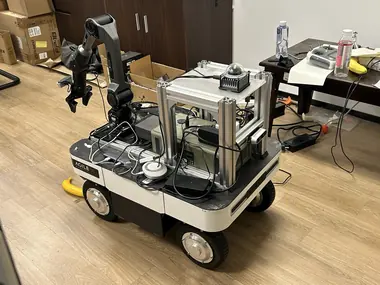
Vision-Language Navigation (VLN) enables robots to navigate through environments using natural language instructions, making human-robot interaction intuitive. Traditional VLN models often rely on navigation graphs, 360-degree views, and perfect localization which pose significant challenges when adapting these models to real-world settings. This work addresses these limitations by performing a simulation-to-real domain shift of a VLN approach that operates in continuous environments without requiring navigation graphs or panoramic views. The proposed system integrates vision-language models that align visual inputs and linguistic instructions within a shared embedding space, facilitating natural language-driven navigation. We employ a Cross-Modal Attention (CMA) based architecture trained on an existing dataset in a simulated environment and fine-tune it using real-world data collected from a custom-built Ackermann-steered robot equipped with a camera and a LiDAR sensor. By utilising linear photometric adjustments and fine-tuning on a limited number of episodes, our model successfully adapts to real-world environments, achieving effective navigation while running offline on dedicated hardware. Experimental results, evaluated using Success weighted by Path Length (SPL) and Normalized Dynamic Time Warping (nDTW) metrics, demonstrate the robustness and adaptability of our approach. Keywords: Vision-Language Navigation, Cross-Modal Attention, Natural Language Instructions, Sim-to-Real Transfer, Autonomous Navigation, Ackermann-steering.

cs.AIcs.ROrobotsim-to-real

兴趣:vision-language-action (VLA) models and foundation models for robots

#112026-10-05追踪学者 · Jiajun Wu93

MobileVISTA: Generative Data Augmentation for Pose Generalization in Mobile Manipulation

Suzannah Wistreich, Stephen Tian, Isabella Huang, Vitor Campagnolo Guizilini, Sergey Zakharov, Katherine Liu 等

Mobile manipulators such as humanoid robots are increasingly deployed in dynamic, unstructured environments to perform dexterous manipulation tasks. However, end-to-end manipulatio…

Mobile manipulators such as humanoid robots are increasingly deployed in dynamic, unstructured environments to perform dexterous manipulation tasks. However, end-to-end manipulation policies trained to imitate demonstration data collected from a single robot pose are brittle: even centimeter-scale deviations in robot pose at deployment can drive ego-centric observations and end-effector trajectories out of the training distribution, leading to sharp drops in performance. We introduce MobileVISTA, a data generation framework that transforms demonstrations captured at canonical poses into diverse, pose-perturbed training data by jointly (1) augmenting egocentric visual observations and (2) retargeting actions to compensate for base pose changes. Unlike prior methods, which assume a camera rigidly mounted off the actuated chain or non-trivial articulated robot geometry largely out of frame, MobileVISTA targets compatibility with egocentric platforms (e.g., humanoids) where the camera is both influenced by and must observe the robot's kinematic chain as it moves. We study MobileVISTA in simulated tasks spanning humanoid and bimanual embodiments, and on a real Galaxea R1 Pro. We find policies trained on MobileVISTA-augmented data demonstrate improved robustness to previously out-of-distribution poses encountered at test time, without additional demonstration collection or a trained generative model. Additionally, we find MobileVISTA's benefit is largest on tested humanoids, where the camera rides the actuated chain and the robot fills much of the frame. Additional videos and appendix can be found on our website: https://mobilevista.github.io

cs.ROcs.CVcs.LGrobotmanipulationhumanoiddexterous

追踪学者:Jiajun Wu;兴趣:robot manipulation and grasping with learned policies

#122026-10-06追踪学者 · Dhruv Shah92

EgoLAP: Learning from Egocentric Human Data through Language-Action Reasoning

Lihan Zha, Shresth Grover, Tenny Yin, Samuel M. Bateman, Hengkai Pan, Mengchao Zhang 等

Egocentric human data offer a path to scaling robot learning beyond costly robot demonstrations, yet the embodiment gap makes raw human trajectories a poor supervisory target for c…

Egocentric human data offer a path to scaling robot learning beyond costly robot demonstrations, yet the embodiment gap makes raw human trajectories a poor supervisory target for control. Our key insight is that, although low-level actions are embodiment-specific, their underlying motion intent can capture task-relevant structure that transfers across humans and robots. We introduce EgoLAP, a VLA pre-training framework that jointly learns from human and robot trajectories through a shared language-based action chain-of-thought. EgoLAP expresses motion intent as structured, temporally abstracted language actions and pairs them with motion-level reasoning grounded in scene geometry, physics, and object affordances. Across extensive real-world and simulated experiments, EgoLAP transfers human experience to robot control more effectively than alternative action representations and reaches 80.1% mean real-world task progress, a 2.3x performance gain over alternative action representations. Motion-level reasoning also outperforms a composite reasoning format that combines subtask, object-box, and visual-trace reasoning.

cs.ROcs.AIrobotVLA

追踪学者:Dhruv Shah;兴趣:vision-language-action (VLA) models and foundation models for robots

#132026-10-0691

MIM-VLA: Learning Physical Interaction Representations from Gripper Motor Feedback

Jaeyoung Lee, Jiyeon Koo, Taehwa Kim, Yerin Cha, Andrew Jaeyong Choi

Vision-language-action (VLA) policies infer grasp actions primarily from visual observations and robot state, but do not explicitly represent the physical response observed after c…

Vision-language-action (VLA) policies infer grasp actions primarily from visual observations and robot state, but do not explicitly represent the physical response observed after contact. We present MIM-VLA, a motor-feedback-based architecture that encodes recent gripper current, position, velocity, and signal validity as a 128-dimensional interaction token. A motor-only Motor Interaction Module (MIM) is pretrained with human-reviewed contact and interaction-phase labels and then conditions only the gripper-action pathway of SmolVLA; arm actions and the position-control interface remain unchanged. The same token supports the MEM selector VLM that compares candidate interactions and produces evidence-conditioned selections and explanations. We evaluate MIM-VLA in three real-world settings: comparing the interaction resistance of visually different objects, disambiguating visually similar real and replica objects through active probing, and gently grasping fragile objects, including held-out instances. Across 13 object pairs, MIM-VLA selects the higher-resistance object in 75.0% of trials, compared with 48.8% for the SmolVLA baseline. For the evaluated tasks, the approach uses motor feedback already available from the gripper and does not require an additional tactile array, force-torque sensor, calibrated force estimate, or direct current control.

cs.ROrobotgraspVLAvision-language-actiontactile

兴趣:vision-language-action (VLA) models and foundation models for robots

#142026-10-0691

PhoneBot: A Low-Cost Open Humanoid Robot Platform Reusing Smartphones

Ruochen Hou, Quanyou Wang, Daniel Koh, Dennis W. Hong

The adoption of humanoid robots in education and research remains limited by high hardware costs, complex sensing systems, and substantial computational requirements. This paper pr…

The adoption of humanoid robots in education and research remains limited by high hardware costs, complex sensing systems, and substantial computational requirements. This paper presents PhoneBot, a low-cost, open-source humanoid robot platform that repurposes commodity smartphones as its primary sensing and computing unit. By using a smartphone's integrated inertial measurement unit (IMU), camera, wireless connectivity, and onboard processing capabilities, PhoneBot reduces hardware costs and simplifies the system architecture. The robot combines a modular lower-body structure driven by 13 low-cost actuators with a torso-mounted smartphone that supports perception, control computation, and user interaction. We describe the mechanical design, software architecture, and real-time communication framework that support stable locomotion and capabilities including vision-based human following, conversational interaction, filming, and mobile telepresence. Experimental evaluations demonstrate reliable walking, perception-driven interaction, and straightforward deployment using off-the-shelf consumer smartphones. With fully open-source hardware and software designs, PhoneBot provides an affordable, reproducible platform for education, research, and rapid prototyping. More details are available at https://phonebot.dev.

cs.ROrobothumanoidlocomotion

兴趣:humanoid robots and whole-body control

#152026-10-06追踪学者 · Li Fei-Fei追踪学者 · Jiajun Wu91

OpenWAM: An Open Framework for Composable World-Action Models

Heng Yu, David D. Yuan, Juze Zhang, Changan Chen, Yao Feng, Michelle Baldonado 等

World-action models (WAMs) couple future prediction with robot control, yet existing systems often vary the video backbone, interaction structure, supervision, and inference proced…

World-action models (WAMs) couple future prediction with robot control, yet existing systems often vary the video backbone, interaction structure, supervision, and inference procedure simultaneously, making their design choices difficult to compare. We introduce OPENWAM, an open world-action modeling framework built around a common causal robot-video foundation and configurable video-action interaction. Starting from Wan2.2-5B, we perform causal robot-video pretraining on over 10,000 hours of video, then integrate an action expert through a shared Mixture-of-Transformers architecture that supports joint, video-then-action, action-then-video, and decoupled generation. OPENWAM achieves high success rates on four LIBERO suites and real-world bimanual tasks; robot-video training with causal adaptation improves VTA success on LIBERO-Long from 68.4% to 97.8%. The same configurable architecture naturally extends to inverse and forward dynamics, allowing us to study how counterfactual transitions improve independently trained dynamics models beyond demonstrations alone. When only the video predictor is adapted to a new task, a frozen local-context inverse dynamics model trained on counterfactual data and demonstrations achieves 84.0% mean success across four held-out LIBERO-90 tasks, compared with 47.0% for a full-context inverse model and 21.5% for a local-context model trained only on demonstrations. For forward dynamics, counterfactual supervision reduces RGB prediction error by 34.5% and raises outcome identification from 21.1% to 71.3% among 16 same-state outcomes. OPENWAM provides a common testbed for comparing WAM interaction designs and for studying dynamics learning from video data beyond successful demonstrations.

追踪学者:Li Fei-Fei、Jiajun Wu;兴趣:world models and video prediction for embodied agents

#162026-10-0591

BRACE: Adapting Whole-Body References for Force and Terrain Aware Humanoid Motion Tracking

Sudarshan Harithas, Chen Yu, Juan Borbon, Shubhankar Mondal, Winston Zha, Srinath Sridhar 等

Whole-body tracking has become the interface through which operators drive humanoid robots, yet the references it consumes are recorded on level ground and carrying nothing, so the…

Whole-body tracking has become the interface through which operators drive humanoid robots, yet the references it consumes are recorded on level ground and carrying nothing, so the tracker is aware of neither the forces the robot must exchange with objects nor the terrain it must stand on. Existing controllers address one side of this gap: force-capable policies command an end-effector force but prescribe no whole-body pose, while terrain-adaptive trackers treat loads as disturbances to reject rather than wrenches to command. We present BRACE, a whole-body tracker that exerts and compensates commanded hand forces from diverse poses while following a flat-ground reference on sloped terrain. Rather than leaving the tracker to absorb the load and the slope, BRACE folds both into the reference it follows: terrain conformance lifts footholds and root onto the local surface, and a wrench transformation resolves the hand displacement that produces a force jointly with the center-of-mass and center- of-pressure shifts it induces, bounded by teacher-specific arm-effort limits. Separate exertion and compensation teachers are distilled by DAgger into one flow-matching student that runs on proprioception alone, without a height map or measured wrench, so a teleoperator (even in remote locations) can supply a flat- ground trajectory and the robot resolves slope and load onboard. We extensive experiments on the Unitree-G1 to demonstrate the ability of BRACE to exert, compensate force and handle diverse terrain in simulation and real robot experiments.

cs.ROrobothumanoid

兴趣:humanoid robots and whole-body control

#172026-10-0691

OpenSplatGraph: From Dense Semantic Maps to Structured Scene Graphs for Open-Vocabulary Robot Perception

Binh Long Nguyen, Kien Nguyen, Clinton Fookes, Peyman Moghadam

Dense 3D mapping with semantic understanding is essential for robotic perception in complex environments. Recent 3D Gaussian Splatting-based mapping approaches enable high-fidelity…

Dense 3D mapping with semantic understanding is essential for robotic perception in complex environments. Recent 3D Gaussian Splatting-based mapping approaches enable high-fidelity geometry and efficient open-vocabulary perception, but typically represent semantics as unstructured feature fields that limit object-centric reasoning. In contrast, 3D scene graphs explicitly model objects and their relationships for structured reasoning, but are commonly constructed from sparse geometric representations that do not fully exploit dense semantic maps. In this work, we present OpenSplatGraph, a unified framework that constructs persistent 3D scene graphs directly from an online Gaussian-based open-vocabulary semantic map. The proposed framework augments the dense semantic map with a reliability-aware semantic field that maintains lightweight observation statistics for confidence-aware, query-conditioned object extraction. Extracted object instances are associated with persistent graph nodes, allowing object attributes and relationships to be incrementally updated across observations and queries. By tightly coupling dense semantic mapping with persistent object-centric representations, our framework supports both language-guided object grounding and structured relational reasoning while preserving the geometric fidelity of Gaussian-based mapping. Comprehensive evaluations on standard 3D scene understanding benchmarks and real-world robotic experiments demonstrate that OpenSplatGraph achieves competitive performance for online open-vocabulary perception and downstream robotic tasks. Project page: https://csiro-robotics.github.io/OpenSplatGraph.

cs.ROcs.AIcs.CVrobot

兴趣:3D perception, point clouds and scene understanding for robotics

#182026-10-0691

Adapting Vision-Language-Action Models to Unknown Visual Disruptions During Execution

Ahin Lee, Jinwoo Seo, Youngsoo Jang, Taesik Gong

Visual disruptions can arise while a robot is executing a task, leaving a vision-language-action (VLA) policy to respond without knowing the disruption type or timing. We introduce…

Visual disruptions can arise while a robot is executing a task, leaving a vision-language-action (VLA) policy to respond without knowing the disruption type or timing. We introduce Self-supervised Adaptation from Leftover Trajectories (SALT), which uses the leftover trajectory, the unexecuted part of the previous action chunk, as self-supervision for test-time adaptation. Because consecutive chunks overlap in time, the leftover provides a temporally aligned target for the current prediction over the same future control interval. At the onset of a visual shift, the leftover can retain a plan formed before the corruption, so updating the policy toward it anchors the adaptation across the shift (Transition Anchoring). SALT keeps the adapted policy and regenerates the current chunk, whose leftover becomes the target at the next replan, carrying the correction forward along the execution trajectory (Sequential Correction Propagation). Supervision comes entirely from the policy's own predictions, requiring no disruption annotations, expert actions, or target-domain demonstrations, and a lightweight adaptation gate calibrated only on nominal trajectories decides when updates begin. On LIBERO-10, SALT increases average success across five persistent visual corruptions from 43.9% to 53.2% with SmolVLA and from 58.7% to 66.0% with GR00T N1.7, while largely preserving nominal performance. On a real robot, it raises task progress averaged over digital and physical disruptions from 0.49 to 0.61.

cs.ROcs.AIrobotVLAvision-language-action

兴趣:vision-language-action (VLA) models and foundation models for robots

#192026-10-0690

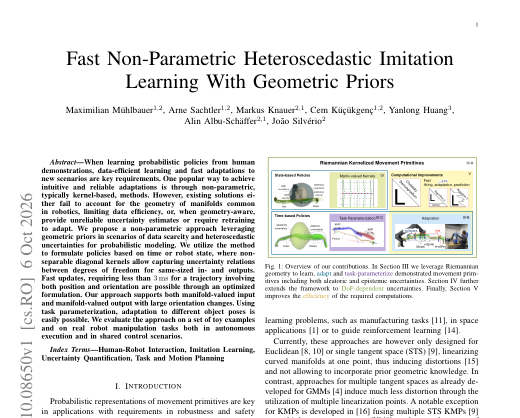
Fast Non-Parametric Heteroscedastic Imitation Learning With Geometric Priors

Maximilian Mühlbauer, Arne Sachtler, Markus Knauer, Cem Küçükgenç, Yanlong Huang, Alin Albu-Schäffer 等

When learning probabilistic policies from human demonstrations, data-efficient learning and fast adaptations to new scenarios are key requirements. One popular way to achieve intui…

When learning probabilistic policies from human demonstrations, data-efficient learning and fast adaptations to new scenarios are key requirements. One popular way to achieve intuitive and reliable adaptations is through non-parametric, typically kernel-based, methods. However, existing solutions either fail to account for the geometry of manifolds common in robotics, limiting data efficiency, or, when geometry-aware, provide unreliable uncertainty estimates or require retraining to adapt. We propose a non-parametric approach leveraging geometric priors in scenarios of data scarcity and heteroscedastic uncertainties for probabilistic modeling. We utilize the method to formulate policies based on time or robot state, where non-separable diagonal kernels allow capturing uncertainty relations between degrees of freedom for same-sized in- and outputs. Fast updates, requiring less than 3 ms for a trajectory involving both position and orientation are possible through an optimized formulation. Our approach supports both manifold-valued input and manifold-valued output with large orientation changes. Using task parameterization, adaptation to different object poses is easily possible. We evaluate the approach on a set of toy examples and on real robot manipulation tasks both in autonomous execution and in shared control scenarios.

cs.ROrobotmanipulationimitation learning

兴趣:imitation learning and diffusion policies for robot control

#202026-10-06追踪学者 · Ken Goldberg追踪学者 · Pieter Abbeel90

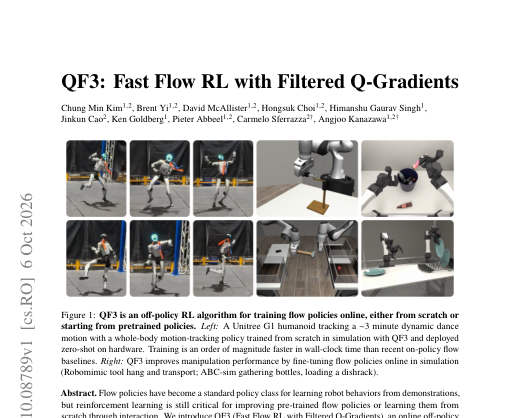
QF3: Fast Flow RL with Filtered Q-Gradients

Chung Min Kim, Brent Yi, David McAllister, Hongsuk Choi, Himanshu Gaurav Singh, Jinkun Cao 等

Flow policies have become a standard policy class for learning robot behaviors from demonstrations, but reinforcement learning is still critical for improving pre-trained flow poli…

Flow policies have become a standard policy class for learning robot behaviors from demonstrations, but reinforcement learning is still critical for improving pre-trained flow policies or learning them from scratch through interaction. We introduce QF3 (Fast Flow RL with Filtered Q-Gradients), an online off-policy RL algorithm that trains a flow policy with flow matching plus the critic's action gradient, backpropagated through a one-step prediction of the flow's output. To keep updates where the critic and this prediction are reliable, QF3 applies the critic gradient only to action dimensions that stay near the replay action. To our knowledge, QF3 is the first off-policy flow RL method to train humanoid locomotion policies from scratch and transfer them zero-shot to hardware. Paired with a high-throughput off-policy training recipe, it trains humanoid locomotion and motion-tracking policies with a 10x wall-clock speedup over FPO++, a recent on-policy flow RL method. We further apply QF3 to fine-tune pretrained flow-based manipulation policies on both ABC-Sim and Robomimic tasks. These results suggest that QF3 can both learn robot policies from scratch and refine those acquired from demonstrations. Website: https://qf3-rl.github.io/

cs.ROcs.LGrobotmanipulationhumanoidlocomotion

追踪学者:Ken Goldberg、Pieter Abbeel;兴趣:imitation learning and diffusion policies for robot control

#212026-10-0690

From Legs to Wheels: Embodiment-Aware Human Motion Retargeting for Mobile-Base Humanoids

Jiyeon Koo, Eunseom Pyo, Jeonghee Seo, Taehwa Kim, Andrew Jaeyong Choi

Human video offers a scalable source of robot demonstrations, yet most human-to-humanoid retargeting methods assume a legged robot with human-like kinematics. This assumption does …

Human video offers a scalable source of robot demonstrations, yet most human-to-humanoid retargeting methods assume a legged robot with human-like kinematics. This assumption does not hold for mobile-base humanoids equipped with a wheeled base, vertical lift, and two arms. Human walking must be expressed through base motion, while torso bending may require coordinated lift and arm motion. We address this mismatch with a task-conditioned framework that assigns reconstructed human motion to base, lift, and arm responsibilities before robot-specific realization. The allocator preserves the human-derived path, stabilizes heading, separates turn and translation when needed, retimes commands to satisfy base limits, and repairs lift and arm trajectories. A deployment adapter then converts the reference to 50 Hz commands using stationary-base detection, deadband and slew-rate filtering, time-consistent playback scaling, and separate linear and angular gains. We evaluate the resulting references with human-derived task-space comparisons, policy-free simulation replay, and a qualitative execution on a physical robot.

cs.ROrobothumanoidlegged

兴趣:humanoid robots and whole-body control

#222026-10-0689

ESP: Energy-Score Policy for One-Step Multimodal Action Generation

Lilika Makabe, Heecheol Kim, Yasuyuki Matsushita

Generative action models based on diffusion and flow matching have been increasingly adopted in vision-language-action (VLA) policies for their ability to capture diverse behaviors…

Generative action models based on diffusion and flow matching have been increasingly adopted in vision-language-action (VLA) policies for their ability to capture diverse behaviors, including multiple valid action sequences under the same observation and instruction. Their iterative sampling procedures, however, require repeated network evaluations to generate each action chunk, increasing inference latency in closed-loop control. We propose ESP (Energy-Score Policy), a teacher-free approach that maps policy context and noise directly to an action chunk in a single network evaluation. ESP trains the action head with the energy score rather than mean squared error. Whereas squared-error regression targets the conditional mean, the energy score is strictly proper: its expected value is uniquely minimized by the target distribution. This provides a principled objective for learning multimodal action distributions without iterative sampling, with exact recovery at the population optimum when the model can represent the target distribution. Experiments on both simulation and real-world manipulation tasks demonstrate competitive task success with substantially lower action-generation latency than the flow matching baseline. These results support direct distributional learning as an efficient alternative to iterative generative robot policies.

cs.ROrobotmanipulationVLAvision-language-action

兴趣:vision-language-action (VLA) models and foundation models for robots

#232026-10-0589

Task-Space Imitation Guidance for Efficient Reinforcement Learning

Salar Asayesh, Hossein Darani, Todd Cao, Evgeny Andriash, Mani Ranjbar

We introduce Task-Space Imitation Guidance for Efficient Reinforcement Learning (TIGER), a reward-construction and pretraining framework for sparse-reward tabletop robotic manipula…

We introduce Task-Space Imitation Guidance for Efficient Reinforcement Learning (TIGER), a reward-construction and pretraining framework for sparse-reward tabletop robotic manipulation. TIGER treats an action-chunked imitation policy not as an executable controller or action prior, but as a local task-space progress estimator: predicted action chunks are converted, using controller-aware action-to-motion mapping, into short-horizon end-effector references, and the RL agent receives dense progress rewards toward these references while the sparse environment reward remains the dominant objective. During pretraining, TIGER uses imitation-guided look-ahead signals to relax conservative value penalties for actions predicted to make task-space progress, reducing off-manifold exploration during early online RL. Across simulation and real-robot experiments, TIGER improves early sample efficiency and reduces measured safety violations while matching or improving final success rates relative to prior RL and IL-RL baselines on the evaluated tasks.

cs.ROrobotmanipulation

兴趣:imitation learning and diffusion policies for robot control

#242026-10-0489

ProactiveVLA: Augmenting Embodied Memory through Proactive Environment Exploration

Shizuo Tian, Haodong Luo, Yutong Li, Yuebing Song, Yunxin Liu, Yuanchun Li

Rapid adaptation to a new environment requires a robot to acquire useful knowledge about local objects, states, and interactions from limited experience. Systems that combine a rea…

Rapid adaptation to a new environment requires a robot to acquire useful knowledge about local objects, states, and interactions from limited experience. Systems that combine a reasoning agent with a frozen vision-language-action model (VLA) can adapt through execution feedback and memory, making the choice of experience central to their effectiveness. Repeated practice of a target task may refine a familiar solution while leaving other interactions relevant to changed conditions untested. We introduce ProactiveVLA, which uses proactive environment exploration to acquire reusable knowledge for deployment-time adaptation. After completing an initial task, the agent allocates the remaining interaction budget to self-proposed goals covering object affordances, state-changing interactions, and compositions of interactions. It verifies execution outcomes and consolidates both task-directed and exploratory experience into memory that guides subsequent planning and control. ProactiveVLA outperforms the baselines under the same turn budget on LIBERO-Pro and RoboCasa365 Composite-Seen. On LIBERO-Pro Goal-T, with at most one VLA primitive invocation allowed during evaluation, ProactiveVLA completes 48% of instances, compared with 19% for the state-of-the-art task-refinement baseline.

cs.ROrobotVLAvision-language-actionembodied

兴趣:vision-language-action (VLA) models and foundation models for robots

#252026-10-0688

Beyond Retargeting: Low-Latency and Robust Humanoid Whole-Body Teleoperation with Learned Atomic Motion Primitives

Xiayan Xu, Jiyu Yu, Xingzhou Chen, Siyi Qian, Zongyu Ma, Lilu Liu 等

Humanoid whole-body teleoperation translates human motion into stable robot behavior in real time. Existing systems typically rely on online motion retargeting to bridge human--rob…

Humanoid whole-body teleoperation translates human motion into stable robot behavior in real time. Existing systems typically rely on online motion retargeting to bridge human--robot morphological differences, but this process adds latency and can produce physically infeasible targets. Meanwhile, diverse, noisy, and partial human-motion observations often fall outside the training distribution, potentially causing unstable robot behavior. We propose a retargeting-free policy that maps raw human motion directly to robot joint commands in a single forward pass, eliminating online kinematic adaptation. To improve robustness, we learn a codebook of full-body motion primitives that projects out-of-distribution observations onto plausible motion prototypes and recovers full-body motion from partial inputs. Experiments on a Unitree~G1 in simulation and on hardware, using virtual reality, optical mocap, text-to-motion generation, and monocular video inputs, show that our method outperforms baselines in latency and robustness.

cs.ROrobothumanoid

兴趣:humanoid robots and whole-body control

#262026-10-0588

ReDex: Repairing Sim-to-Real Dexterous Policies by Finger-Level Compliant Interaction

Jinzhou Li, Hadi Tabatabaee, Kelin Yu, Yuyin Sun, Cheng-Hao Kuo, Roberto Martín-Martín 等

Dexterous manipulation policies trained in simulation often fail to transfer to the real world because of errors in contact timing and force regulation. Yet these policies can reta…

Dexterous manipulation policies trained in simulation often fail to transfer to the real world because of errors in contact timing and force regulation. Yet these policies can retain useful multi-finger coordination for task progression. We propose ReDex, a framework for adapting a simulation-trained base policy to the real world by correcting local contact failures and incorporating tactile feedback. Starting from a proprioception-only base policy, ReDex allows a human operator to physically correct contact failures at selected fingers under compliant control during real-world rollouts, while the frozen base policy continues to control the remaining fingers. These rollouts combine base policy execution, human-corrected finger motion, and fingertip force observations. We reconstruct force-informed targets from these rollouts to train a standalone force-conditioned policy via behavior cloning. This design reduces human correction effort, enables learning of contact regulation from real-world interaction, and introduces force feedback into a proprioception-only policy without tactile simulation or complex full-hand teleoperation. We evaluate ReDex on two challenging, contact-rich dexterous manipulation tasks on real hardware. Compared with sim-to-real transferred base policies, ReDex increases Object Flipping success rate from 14% to 86% across two objects and average Screwdriver Rotation progress from 26.0% to 95.3% across three objects.

cs.ROmanipulationsim-to-realdexteroustactile

兴趣:robot manipulation and grasping with learned policies

#272026-10-0688

VOMMI: Collecting and Leveraging Portable Demonstrations for Mobile Manipulation

Yutian Zhang, Xingrui Xiong, Siyuan Ma, Yang Li, Jiawen Wen, Jiaqi Zhai 等

Portable mobile-manipulation demonstrations can help alleviate data scarcity for embodied intelligence, but obtaining reliable, low-cost, and robot-free motion supervision from RGB…

Portable mobile-manipulation demonstrations can help alleviate data scarcity for embodied intelligence, but obtaining reliable, low-cost, and robot-free motion supervision from RGB observations remains challenging. Existing approaches often rely on teleoperation or specialized devices equipped with additional sensing hardware, while directly using estimated visual odometry (VO) trajectories can introduce inconsistencies due to accumulated drift and imperfect motion supervision. We present the Visual-Odometry-Conditioned Mobile Manipulation Interface (VOMMI), a portable demonstration collection and learning framework that connects portable RGB demonstrations to vision-language-action (VLA) post-training through offline trajectory reconstruction and online visual-motion conditioning. VOMMI synchronizes body and hand views to capture navigation context and local object interactions without requiring human-robot kinematic correspondence calibration. R2-VO refines offline demonstration trajectories using sparse geometric anchors and produces causal local-motion tokens over multiple prediction horizons for online policy conditioning. An action-group residual adapter incorporates these tokens only into the base branch. Experiments use a 500-trajectory portable for each task, with 75 trajectories held out for RGB-VO evaluation, and 200 robot demonstrations as references. Our policy, post-trained only on portable demonstrations, achieves 18.2% lower base-velocity error than a policy trained with robot-collected demonstrations, while maintaining comparable end-effector translation accuracy. Offline reconstruction reduces absolute trajectory errors for the body and hand streams by 24.6% on average relative to the best evaluated baseline for each stream. The complete system improves the mean success rate by 8.3 percentage points over OpenPI 0.5 across three real-robot tasks.

cs.ROcs.AIrobotmanipulationVLAvision-language-actionembodied

兴趣:robot manipulation and grasping with learned policies

#282026-10-0688

PEARS: Physical-Prior-Guided Efficient Adaptation via Failure Reasoning and Diffusion Steering for Tactile Manipulation

Kun Song, Yiming Wang, Yilin Chen, Tianyi Ding, Jiaxin Tian, Tianqi Gong 等

Pretrained robotic policies can suffer substantial performance degradation under out-of-distribution (OOD) conditions encountered during deployment, motivating post-training throug…

Pretrained robotic policies can suffer substantial performance degradation under out-of-distribution (OOD) conditions encountered during deployment, motivating post-training through real-world interaction. However, reinforcement-learning (RL)-based post-training typically requires substantial environment interactions, a burden that is especially significant in manipulation, where each trial can be slow, costly, or destructive. Therefore, we present PEARS, a physics-prior-guided hybrid RL framework for sample-efficient online adaptation of pretrained policies with tactile feedback. After each episode, its physics-guided force reasoning (PFR) module uses physical priors encoded in a vision-language model (VLM) to diagnose failures from the visual outcome and tactile interaction history and update task-appropriate contact-force bounds. A high-frequency hybrid force-position controller then enforces these bounds during contact. Complementarily, tactile-conditioned diffusion steering reinforcement learning adjusts the latent noise of the frozen flow-matching policy to correct errors in free-space motion and contact timing without updating the base model. In simulation, PEARS improves success rates by 12.4-37.4 percentage points over the strongest per-task baselines. PEARS also reduces the number of interaction episodes required for a certain success threshold by up to 53.2% relative to the fastest baseline. In real-world experiments, PEARS achieves success rates of 95% on Whiteboard Erasing and 90% on Pipette Liquid Aspiration. These results show that combining the PFR module with policy steering can accelerate adaptation while reducing costly interactions. The project website is available at https://song-kun.github.io/pears.

cs.ROmanipulationtactile

兴趣:robot manipulation and grasping with learned policies

#292026-10-0688

PACE: Stage-Consistent Long-Horizon Robot Manipulation via Progress-Aligned Context for Execution

Yenan Chen, Junjie Shi, Lu Chen, Zhongxiang Zhou, Rong Xiong

Demonstration-conditioned policies provide a natural interface for specifying robot behavior, yet long-horizon manipulation remains difficult when visually similar states recur acr…

Demonstration-conditioned policies provide a natural interface for specifying robot behavior, yet long-horizon manipulation remains difficult when visually similar states recur across different stages or when demonstrations and executions proceed at different speeds. We identify the resulting failure mode as stage confusion and introduce Progress-Aligned Context for Execution (PACE), a stateful method that continually reinterprets a complete demonstration according to realized execution progress. PACE compresses the demonstration into ordered multimodal prompt tokens and uses training-only dual-edge attention supervision to expose its latent stage structure. During execution, an episode-local fast-weight memory causally encodes realized action-observation transitions and modulates prompt cross-attention, producing a progress-aligned context for a unified diffusion action expert without test-time stage labels or stage-specific policies. PACE improves success from 88.9% to 94.0% on LIBERO-Gen Goal Chain, from 79.1% to 83.3% on Spatial Combination, and from 33.3% to 73.3% on the two-step Block Routing tasks. Failure analysis further indicates that structured demonstration alignment and causal execution memory jointly mitigate stage confusion.

cs.ROrobotmanipulation

兴趣:imitation learning and diffusion policies for robot control

#302026-10-0687

TacZero: Training-Free Peg Insertion Using a General-Purpose Vision-Language Model with Tactile Feedback

Kazutoshi Tanaka

Robots that autonomously determine their actions from language instructions and sensory observations could perform new contact-rich manipulation tasks without task-specific trainin…

Robots that autonomously determine their actions from language instructions and sensory observations could perform new contact-rich manipulation tasks without task-specific training or hand-designed rules. To perform these tasks, robots must infer how objects contact one another and move as a result, then select actions. For contact inference and action selection, prior approaches involve designing estimation models and tactile feedback control laws, or learning models for object-motion estimation, action-outcome prediction, and action selection from tactile data. Instead, we propose TacZero, which uses a pretrained general-purpose vision-language model (VLM) to interpret visual and tactile observations and select robot actions without additional tactile or manipulation training or task-specific rules for contact interpretation or action selection. TacZero provides the VLM with camera images, robot state, and three-axis tactile responses represented as numerical values or vectors overlaid on the images. From these observations and interaction history, the VLM generates commands specifying target end-effector positions and gripper opening or closing, which a low-level controller executes. In real-world cylindrical-peg insertion experiments, TacZero succeeded in 15 of 20 trials with numerical tactile input, compared with 10 of 20 without tactile input. This study provides a concrete starting point for further research on contact-rich manipulation using general-purpose VLMs and highlights challenges in pursuing this direction.

cs.ROrobotmanipulationtactile

兴趣:robot manipulation and grasping with learned policies

#312026-10-0687

EmbodiedSmith: Scaling Embodied Data through Recursive Self-Improvement Flywheel in Simulation

Yikai Qin, Yifei Deng, Mingjian Liang, Wenxuan Song, Zepeng Lin, Zhiyi Jiang 等

Scaling robotic foundation models requires diverse training data and reliable evaluation environments. Simulation offers a scalable solution, yet existing generation pipelines rema…

Scaling robotic foundation models requires diverse training data and reliable evaluation environments. Simulation offers a scalable solution, yet existing generation pipelines remain constrained by predefined assets and skills, a disconnect between scene generation and task generation, and limited support for complex embodiments and physics. We introduce EmbodiedSmith, a framework for scalable embodied data generation through recursive self-improvement (RSI). EmbodiedSmith unifies asset, scene, and task generation in a pipeline that supports autonomous creation and language-driven customization. Its core is an agentic refinement loop: scene generation anticipates downstream task requirements, while task generation guides targeted scene edits, allowing scenes and tasks to iteratively improve one another. This joint refinement improves task generation success, including for long-horizon tasks. The framework further supports mobile manipulators, humanoids, and dexterous hands, as well as interactions involving deformable objects and fluids, broadening the range of behaviors and physical phenomena represented in generated data. Together, these capabilities provide a flexible simulation engine for both robot pretraining and evaluation. Extensive experiments validate the quality, diversity, and generation efficiency of the resulting data, while downstream policy experiments demonstrate that increased data diversity improves generalization.

cs.CVcs.ROrobotembodieddexterous

兴趣:world models and video prediction for embodied agents

#322026-10-0587

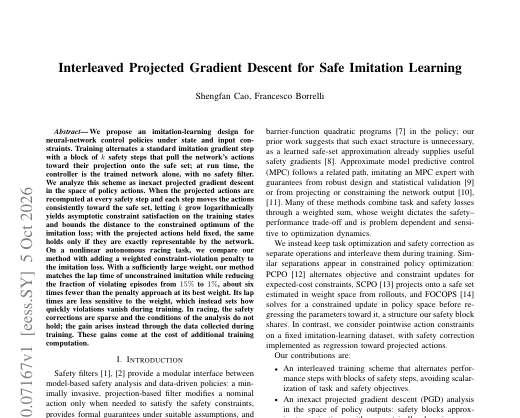
Interleaved Projected Gradient Descent for Safe Imitation Learning

Shengfan Cao, Francesco Borrelli

We propose an imitation-learning design for neural-network control policies under state and input constraints. Training alternates a standard imitation gradient step with a block o…

We propose an imitation-learning design for neural-network control policies under state and input constraints. Training alternates a standard imitation gradient step with a block of $k$ safety steps that pull the network's actions toward their projection onto the safe set; at run time, the controller is the trained network alone, with no safety filter. We analyze this scheme as inexact projected gradient descent in the space of policy actions. When the projected actions are recomputed at every safety step and each step moves the actions consistently toward the safe set, letting $k$ grow logarithmically yields asymptotic constraint satisfaction on the training states and bounds the distance to the constrained optimum of the imitation loss; with the projected actions held fixed, the same holds only if they are exactly representable by the network. On a nonlinear autonomous racing task, we compare our method with adding a weighted constraint-violation penalty to the imitation loss. With a sufficiently large weight, our method matches the lap time of unconstrained imitation while reducing the fraction of violating episodes from $15%$ to $1%$, about six times fewer than the penalty approach at its best weight. Its lap times are less sensitive to the weight, which instead sets how quickly violations vanish during training. In racing, the safety corrections are sparse and the conditions of the analysis do not hold; the gain arises instead through the data collected during training. These gains come at the cost of additional training computation.

eess.SYcs.LGimitation learning

兴趣:imitation learning and diffusion policies for robot control

#332026-10-0687

Post-Grasp Kinematic Repair for Robotic Insertion via Object-in-Gripper Reorientation

Haegu Lee, Christoffer Sloth

A stable grasp does not guarantee kinematically feasible robotic insertion because the object-in-gripper transform may force the robot towards singularities or joint limits along t…

A stable grasp does not guarantee kinematically feasible robotic insertion because the object-in-gripper transform may force the robot towards singularities or joint limits along the prescribed insertion path. We study post-grasp kinematic feasibility repair through object-in-gripper reorientation. Given an achieved grasp and a fixed insertion path, we seek a small reorientation that restores kinematic feasibility. Sequential IK can miss such candidates by following an unfavorable joint-space path, while the nonsmooth feasibility landscape makes the search computationally expensive. We evaluate candidates using a branch-aware IK graph that maximizes the minimum feasibility margin over the discretized insertion path and use a learned task-conditioned prior to improve query ordering. The selected reorientation is executed through tactile-based extrinsic manipulation. In UR5e simulations, the planner without learned ranking reduces mean reorientation over successful trials by 51.5% compared with grid-based sequential IK. Adding learned ranking reduces this planner's mean planning time by an additional 51.1%. Real-robot experiments validate the complete pipeline.

cs.ROrobotmanipulationgrasptactile

兴趣:robot manipulation and grasping with learned policies

#342026-10-0686

ExoBridge: Learning a Bare Hand to Hand-Worn Exoskeleton Mapping through Human Limb Coupling

Ruitong Tian, Xianyao Li, Noah B. Wilson, Fang Xu, Eric Jing Du

Human video offers a scalable source of experience for dexterous robot learning, but obtaining motion and tactile supervision while preserving bare hand interaction remains challen…

Human video offers a scalable source of experience for dexterous robot learning, but obtaining motion and tactile supervision while preserving bare hand interaction remains challenging. We present ExoBridge, a framework that leverages human limb coupling to learn a bridging function from bare hand video to the motion and tactile state of a sensorized exoskeleton. Our central idea is to use coordinated bimanual behavior to connect an uninstrumented visual source with a measured manipulation interface. During collection, one hand remains bare and provides visual observations, while the opposite hand wears the exoskeleton and supplies synchronized motion and tactile measurements. These paired demonstrations train a temporal visual model to predict fingertip contact, continuous tactile intensity, and relative encoder motion from bare hand video alone. The exoskeleton defines an intermediate state space whose motion coordinates are linked to a dexterous robot hand through existing calibration. Evaluation on 1,215 demonstrations across four manipulation tasks uses held out collection sessions and yields a pooled any contact AUROC of 0.916 and a Pearson correlation of 0.790 for tactile intensity. The learned bridge also predicts relative changes in exoskeleton configuration from bare hand video. These results demonstrate that human limb coupling can turn exoskeleton measurements into supervision for bare hand video, establishing a learned bridge between human visual demonstrations and a robot oriented manipulation interface.

cs.ROrobotmanipulationdexteroustactile

兴趣:dexterous hands and tactile sensing

#352026-10-0686

Event-Driven Proactive Robot Assistance through Vision-Language Reasoning

Fengkai Liu, Hao Su, Haozhuang Chi, Rui Geng, Congzhi Ren, Xuqing Liu 等

Assistance in collaborative manipulation is often initiated by user instructions, making high-level reasoning request-driven. In fluent human teamwork, however, partners often infe…

Assistance in collaborative manipulation is often initiated by user instructions, making high-level reasoning request-driven. In fluent human teamwork, however, partners often infer the next helpful step from the observed outcome of an action rather than waiting for instructions. Motivated by this, we investigate an event-driven formulation of proactive assistance, where human--object interaction outcomes initiate assistive reasoning without user-provided task specifications at inference time. To this end, we propose an event-driven framework that monitors workspace state changes with an event monitor and, upon event completion, extracts stabilized pre/post snapshots that characterize the resulting state transition. A frozen pretrained Vision-Language Model (VLM) then uses its semantic priors to infer the task context, decide whether assistance is appropriate, and, when needed, generate a sequence of assistive actions from the observed transition. To make outputs executable and verifiable, we restrict actions to a set of action primitives and reference objects via integer IDs.We evaluate the same framework across three distinct real world tabletop collaboration tasks without task-specific training or fine-tuning. The event-driven framework achieves performance comparable to variants given user instructions.

cs.ROrobotmanipulation

兴趣:large language models for robot task planning and reasoning

#362026-10-0686

DepthWorld: 3D World Model for Robot Manipulation

Jai Bardhan, Josef Sivic, Vladimir Petrik

World models offer a data-driven alternative to traditional simulators for robotics, with applications spanning policy evaluation, improvement, and planning. All of these uses depe…

World models offer a data-driven alternative to traditional simulators for robotics, with applications spanning policy evaluation, improvement, and planning. All of these uses depend on faithful 3D geometry, yet current video-based world models are trained on RGB alone and produce rollouts that look correct frame-by-frame but do not compose into a consistent 3D world. Closing this gap requires progress on two fronts: large-scale 3D supervision for manipulation, and an architecture that can absorb it without disturbing strong pretrained video priors. We introduce a calibration pipeline that combines learned stereo depth with a joint factor graph, pooling all episodes collected from the same physical robot to recover its shared kinematic parameters alongside per-scene extrinsics. Applied to the DROID dataset, this yields DROID-3D, a calibrated 3D dataset providing dense metric depth and recalibrated multi-view extrinsics (achieving <0.7 px reprojection error on 90% of episodes for external cameras). We then train DepthWorld, a Stable Video Diffusion-based world model that jointly predicts multi-view RGB and depth via spatial latent tiling, leaving the pretrained Variational Autoencoder (VAE) unchanged. Depth supervision improves RGB prediction itself by +1.48 dB PSNR over an identical RGB-only baseline at equal training budget, while simultaneously yielding accurate metric depth for downstream geometric reasoning.

cs.ROcs.AIcs.CVrobotmanipulationworld model

兴趣:world models and video prediction for embodied agents

#372026-10-0686

CoRE: Learning Collaboration-Role Experts for Decentralized Collaborative Manipulation with One Policy

Yanan Zhou, Zhaoyan Qian, Zihao Li, Mingyuan Ba, Ranpeng Qiu, Weiming Zhi

Collaborative manipulation requires robots to perform complementary actions as interactions unfold. We study single-policy decentralized collaboration: every robot runs the same po…

Collaborative manipulation requires robots to perform complementary actions as interactions unfold. We study single-policy decentralized collaboration: every robot runs the same policy from its visual observations and proprioception, without task prompts, identity labels, or inter-robot messages. The challenge is to learn complementary team behaviors within shared parameters and select appropriate actions from each robot's local observations. We introduce CoRE, which learns Collaboration-Role Experts from pooled multi-task, multi-robot demonstrations. Fused appearance and geometry provide local interaction evidence. Query-conditioned cross-attention experts provide adaptable prediction paths, which a local router combines at each action-chunk position. During training, an action-expert alignment loss supervises expert selection using relative forced-route prediction errors against demonstrations under fixed inputs, without role labels. Across simulation benchmarks, CoRE achieves the highest average performance among evaluated decentralized methods. Physical experiments demonstrate effective collaboration across diverse manipulation tasks and robustness to partner delays and slowdowns. Project page: https://aus.bot/research/core/.

cs.ROrobotmanipulation

兴趣:robot manipulation and grasping with learned policies

#382026-10-0686

iGPC: Generative Motion Priors for Object-Aware Humanoid Interaction

Anujith Muraleedharan, Abdul Ahad Butt, Nolan Fey, Yash Prabhu, Anamika J H, Sandor Felber 等

Humanoid robots operating in unstructured environments must combine robust whole-body control with the ability to perceive and physically interact with surrounding objects. While l…

Humanoid robots operating in unstructured environments must combine robust whole-body control with the ability to perceive and physically interact with surrounding objects. While large-scale human motion data provides powerful priors for natural and versatile humanoid control, effectively transferring such priors to perception-driven object interaction remains challenging. To address this bottleneck, we propose a framework that extends the recently proposed Generative Pretrained Controller (GPC) from general human motion to full-body humanoid-environment interaction. First, we adapt GPC into interaction experts conditioned on scene affordance cues and privileged state information. These experts leverage the pretrained human motion prior while learning task-specific contact behaviors, including reaching toward objects, grasping environmental supports for stabilization, and pushing movable objects. Second, we introduce a perception-driven student that retains the pretrained GPC policy and distills interaction skills from the experts using onboard sensory observations. To bridge the gap between privileged expert observations and sensory inputs, we propose two complementary training objectives that enable effective adaptation of the pretrained motion prior during distillation. Notably, our experiments across multiple whole-body interaction tasks demonstrate that large-scale generative human motion priors provide an effective foundation for learning deployable policies for humanoid interactions in contact-rich real-world environments.

cs.ROhumanoid

兴趣:humanoid robots and whole-body control

#392026-10-0586

What the Elevation Map Cannot See: Semantic-Aware Locomotion and Execution-Aware Navigation for Humanoid Robot

Shunyu Yao, Songyang Liu, Dinghao Chen, Yuanyuan Lei, Shuai Li

Navigation for humanoid robots is critical, yet large-scale evaluation on physical hardware is often impractical due to cost and safety concerns, making simulation benchmarks essen…

Navigation for humanoid robots is critical, yet large-scale evaluation on physical hardware is often impractical due to cost and safety concerns, making simulation benchmarks essential. Existing VLN benchmarks achieve physically executable navigation, but still assume (1) all hazards are observable from elevation maps; (2) realized motions closely match desired motions. In real environments, however, fallen bottles may be ambiguous in elevation maps, while phones and water spills may be difficult to differentiate; hazard avoidance by the locomotion policy can cause the robot's actual trajectory to deviate from the path intended by the VLN policy. Such command-execution mismatch can accumulate and lead the robot toward unintended locations. To expose these failure modes, we introduce a benchmark that models both elevation-subtle hazards and execution deviations, together with a closed-loop VLN + locomotion control framework that continuously realigns high-level navigation with the robot's actual state. We evaluate navigation in simulation and further validate the locomotion policy on a physical Unitree G1 humanoid robot. Results show that semantic input reduces contact with hazards poorly represented in elevation maps, while anti-deviation improves navigation success. These findings highlight the need to evaluate humanoid navigation jointly in terms of route completion and hazard avoidance.

cs.ROrobothumanoidlocomotion

你点赞过:TANGO: Humanoid Navigation in Cluttered Environments with a

#402026-10-0685

Navigation with RF Cues: Embodied Perception Action under Multipath Uncertainty

Wenlihan Lu, Tianshun Li, Liuqing Yang, Shijian Gao

Smart factory inspection requires robots to reach connected equipment without a prior map or known target coordinates. Radio frequency (RF) signals from the target can provide dire…

Smart factory inspection requires robots to reach connected equipment without a prior map or known target coordinates. Radio frequency (RF) signals from the target can provide directional cues to complement visual observations when occlusion or poor lighting limits target detection. However, multipath propagation can distort these cues, making it difficult to infer the target's true direction from instantaneous RF measurements. To enable navigation research under these conditions, we first construct a Habitat Sionna RT benchmark that uses detailed scene geometry and assigned material properties to generate aligned visual and RF observations in response to robot actions. Building on this benchmark, we propose an uncertainty aware multimodal navigation framework that jointly estimates target direction and its uncertainty from a history of RF, visual, and pose observations. These estimates inform action selection alongside visual context. Experiments in unseen scenes show relative improvements of 18.2% in success rate (SR) and 11.5% in success weighted by path length (SPL) over the strongest evaluated baseline.

cs.ROrobotembodied

兴趣:3D perception, point clouds and scene understanding for robotics

#412026-10-0685

SMART: Zero-Shot Sim-to-Real Articulated Object Manipulation via Large-Scale Synthetic Pretraining

Jicong Ao, Shuhan Jiang, Yuling Zhong, Yanwen Liu, Yuhan Gao, Jiangyuan Zhao 等

The ability to interact with articulated objects is essential for embodied intelligent systems, but collecting large-scale real-world demonstrations for these interactions remains …

The ability to interact with articulated objects is essential for embodied intelligent systems, but collecting large-scale real-world demonstrations for these interactions remains challenging due to the precise contact and constraint-following motions involved. Although simulation provides a promising alternative, existing synthetic data efforts cover limited articulated-object categories, while general-purpose synthesis pipelines lack explicit designs for part-level semantics and articulation constraints, hindering agentic task generation and scalable synthesis of high-quality articulated-manipulation demonstrations. To bridge this gap, we introduce SMART, a scalable system leveraging large-scale Synthesized Manipulation demonstrations for ARTiculated-object manipulation. At its core, we develop SMART-Sim, a simulation platform with articulation-aware design that enables effective task generation and efficient demonstration collection. Building on SMART-Sim, we apply agentic task generation and design a scalable distributed synthesis system, using them to synthesize SMART-Data, comprising over 1M demonstrations across 44 atomic task types, 5 robot setups, and 2,507 articulated objects. The vision-language-action (VLA) model pretrained on SMART-Data shows competitive performance on simulation benchmarks and achieves zero-shot sim-to-real transfer and scalable performance in real-world articulated-object manipulation tasks. This highlights the potential of synthetic demonstrations in providing effective and scalable supervision for improving VLA model performance in contact-rich articulated-object manipulation.

cs.ROcs.AIrobotmanipulationVLAvision-language-actionsim-to-realembodied

兴趣:world models and video prediction for embodied agents

#422026-10-0685

ActTune: Action-Aware Precision and GPU Operating-Point Adaptation for Energy-Efficient Vision-Language-Action Inference

Zou Qingyun, Bin Gao, Wenju Zhao, Weng-Fai Wong, Bingsheng He, Tulika Mitra

Vision-language-action (VLA) policies repeatedly invoke inference to control robots, making graphics processing unit (GPU) energy a recurring cost of task execution. Reducing energ…

Vision-language-action (VLA) policies repeatedly invoke inference to control robots, making graphics processing unit (GPU) energy a recurring cost of task execution. Reducing energy per inference call, however, may not reduce energy per successful task if numerical errors increase failures or slower inference prolongs execution. We therefore target GPU energy per successful task while preserving task success and keeping the inference-latency increase within 10%. Our approach builds on two observations: quantization sensitivity varies across action classes, model layers, and weights versus activations; and numerical precision changes the workload, shifting favorable GPU operating points. We introduce ActTune, an action-aware framework that connects layer-wise precision allocation with workload-dependent GPU operating-point selection over requested frequency--power-cap pairs. A lightweight decision tree learns its splits and leaf precision configurations directly from configuration action errors, then selects precision before each policy call. The controller forecasts the next workload and applies the selected GPU operating point asynchronously using a lookup table calibrated under a latency budget. A shared resident quantized weight bank enables configuration switching without weight reconstruction or additional policy evaluations. On LIBERO, a benchmark for lifelong robot learning, ActTune improves mean task success by up to 2.3% relative to state of the art. Relative to the original BF16 implementations, it delivers up to $2.02\times$ faster inference and, with GPU operating-point adaptation, reduces energy per successful task by up to 76.8%.

cs.ROcs.ARrobotVLAvision-language-action

兴趣:vision-language-action (VLA) models and foundation models for robots

#432026-10-0685

Compact Robot Policies Need Fine-Grained Visual Representations

Nanhe Chen, Runqiu Yang, Jiawei Tang, Sichao Liu, Yuquan Wang

Multi-task manipulation policies differ in architecture, scale, and pretrained priors all at once, so published comparisons cannot attribute performance to any single component. We…

Multi-task manipulation policies differ in architecture, scale, and pretrained priors all at once, so published comparisons cannot attribute performance to any single component. We argue that most of it comes from the visual representation, and that parameter scale and generative priors are largely incidental. To test this, we build CoRP (Compressed Representation Policy), a deliberately compact policy (48.9M parameters, no vision-language model and no video-generative prior) that factorizes into a representation extractor and a flow-matching action generator. It reaches 97.0% on LIBERO and 75.78%/73.36% on RoboTwin 2.0 Clean/Randomized, matching systems 40.9-163.6x larger. Holding the action generator fixed, we then vary one extractor property at a time. Pretrained initialization is decisive: a random ViT-S/14 drops to 78.1% and an ImageNet ResNet-34 to 74.5% on LIBERO. Pretraining alone is not enough, as freezing the encoder costs 19.8 points. Compression matters as much: resampling each view to 48 tokens beats passing all patch tokens (97.0% vs 83.2%), and a variational information bottleneck over those tokens is worse than a hard token budget, cutting LIBERO-Goal from 95.8% to 33.0% by suppressing the instruction-dependent token selection the policy relies on. Language conditioning contributes only where the observation leaves the goal ambiguous (LIBERO-Goal: 9.2% to 95.8%), while on RoboTwin 2.0, where observations are unambiguous, removing it slightly improves success. Therefore, we argue that a compact policy works when its representation is pretrained, task-adapted, and compressed. Project page: https://corp-policy.github.io/

cs.ROcs.AIcs.LGrobotmanipulation

兴趣:vision-language-action (VLA) models and foundation models for robots

#442026-10-0684

AutodidactWAM: Cross-Modal Self-Distillation from Generated Video to Robot Actions

Sergei Kurchev, Iaroslav Kolomiets, Miguel Altamirano Cabrera, Artem Lykov, Dzmitry Tsetserukou

World-action models (WAMs) such as Cosmos 3 jointly generate future video and robot actions from an observation and instruction. Adapting one such model with a lightweight LoRA fin…

World-action models (WAMs) such as Cosmos 3 jointly generate future video and robot actions from an observation and instruction. Adapting one such model with a lightweight LoRA fine-tune to a previously unseen robot, a Unitree G1 humanoid with five-fingered BrainCo hands, exposes a video-action asymmetry: the video renders plausible task executions, while the co-generated action is systematically mis-targeted. We evaluate closed-loop real-robot trials at three cumulative stages: pre-grasp, grasp, and pick-and-place. The native action succeeds only approximately 17%, 10%, and 7% of the time, respectively, and performs worse on held-out objects. We propose AutodidactWAM, a hand-pose estimator trained without teleoperation, followed by inverse kinematics, that runs on the model's generated video to recover action estimates. Paired with the native prediction, these recovered actions provide preferred targets for fine-tuning only the action-related layers, while the generated video is teacher-forced. We compare supervised relabeling with a rectified-flow adaptation of Diffusion-DPO. After one-time embodiment adaptation, self-distillation requires no additional task-specific teleoperation. The recovered-action gate reaches approximately 75%, 47%, and 42% pre-grasp, grasp, and pick-and-place success, compared with 17%, 10%, and 7% for the native action. A hybrid objective combining preference supervision, supervised target fitting, and Cartesian trajectory anchoring (DPO+SFT+DTW) performs best: on Oreo, the training object, it reaches 90% pre-grasp and 20% full-task success; on a held-out object, it reaches 80% and 30%. Plain Flow-DPO reaches 0% success despite 1.000 validation preference accuracy, indicating that the combination of training objectives, rather than the contrastive objective alone, drives the observed gains.

cs.ROrobotgrasphumanoid

兴趣:imitation learning and diffusion policies for robot control

#452026-10-0684

Commit While Futures Agree: Consequence-Aware Adaptive Action Chunking for Robot Manipulation

Yuyan Li, Yujia Wang, Yusong Huang, Junjie Yang, Yanggang Sheng, Ziyi Shi 等

Action-chunking policies predict multi-step control sequences, but a fundamental question remains: how much of a predicted action chunk should be committed before replanning? Exist…

Action-chunking policies predict multi-step control sequences, but a fundamental question remains: how much of a predicted action chunk should be committed before replanning? Existing systems typically execute a fixed-length prefix, implicitly assuming that the same execution horizon remains trustworthy across states. Some adaptive methods estimate this horizon from the similarity or stability of predicted actions. However, different actions may lead to the same successful outcome, whereas similar actions can produce different futures, suggesting that commitment should be determined by agreement among imagined futures rather than by similarity in action space. To this end, we propose Consequence-Aware Adaptive Action Chunking (CA$^3$C), an inference-time framework built on a simple principle: commit while imagined futures agree, and replan when they diverge. Without modifying or retraining the base policy, CA$^3$C uses an action-conditioned world model to imagine the future consequences of multiple candidate action chunks under the same sampling noise. Using these imagined consequences, we formulate execution-horizon estimation as a Bayesian change-point inference problem and select the execution candidate through future consensus. Across multiple simulation benchmarks and real-world robot manipulation tasks, CA$^3$C consistently improves diverse action-chunking policies, achieving up to a 71.8% relative reduction in failure rate over the corresponding base policies.

cs.ROrobotmanipulationworld model

兴趣:imitation learning and diffusion policies for robot control

#462026-10-0684

IronMan: Information-Constrained Video-Action Learning for Robot Manipulation

Yuanshuo Zhang, Wenzhe Zhao, Zixing Lei, Bin Chen, Siheng Chen

Video Action Models (VAMs) couple visual dynamics modeling with action generation for robot manipulation. However, video representations are not naturally suited to action generati…

Video Action Models (VAMs) couple visual dynamics modeling with action generation for robot manipulation. However, video representations are not naturally suited to action generation, as exposing the action policy to excessive visual detail can impair its generalization ability. Therefore, we introduce IronMan (Information-constRained videO-actioN learning for robot MANipulation), a robust video-action learning framework built on the information bottleneck principle. The core principle of this framework is to impose information constraints that suppress irrelevant visual information while preserving action-relevant dynamics cues. IronMan employs a dynamics-aware bottleneck that distills noisy, entangled one-step video features into compact world representations. Extensive simulation and real-world experiments demonstrate strong in-distribution (ID) performance and out-of-distribution (OOD) robustness while maintaining efficient inference. IronMan achieves success rates of 99.0% on LIBERO and 79.4% on RoboTwin clean2clean, outperforming all the evaluated baselines. Under OOD shifts, IronMan achieves a success rate of 79.1% on LIBERO-Plus, exceeding the strongest baseline by 10.4 percentage points. Project page: https://youngsoul0731.github.io/ironman-project-page/

cs.ROrobotmanipulation

兴趣:world models and video prediction for embodied agents

#472026-10-0683

EMHO: EMbodied Agent Harness Optimization via Experience Traces

Hyun Jung Lee, Jungtaek Kim, Jongwon Jeong, Tae-Eui Kam, Donghyun Kim, Yong Jae Lee

Improving embodied agents often focuses on optimizing the underlying model through training, while the surrounding agent harness that controls planning, context, and tool use is ty…

Improving embodied agents often focuses on optimizing the underlying model through training, while the surrounding agent harness that controls planning, context, and tool use is typically engineered. We ask whether this harness can instead improve itself directly from experience traces under sparse environmental feedback. We propose EMbodied Agent Harness Optimization (EMHO), a self-evolving framework that keeps the embodied model frozen and iteratively revises its harness by analyzing execution trajectories and prior harness history. EMHO optimizes beyond skills or recovery prompts, modifying how the agent monitors progress, uses vision tools, grounds observations, and responds to failures. To support multiple subtasks with a single harness, we introduce EMHO-Merge, which addresses trade-offs in jointly optimizing a single shared harness across subtasks by using episode-level gains and losses to guide evidence-supported refinement of when and how revised behaviors are applied. We evaluate EMHO on EmbodiedBench across navigation and manipulation tasks, and EMHO consistently improves task success for both Qwen 9B and 27B models. Qualitative analysis shows that EMHO goes beyond recovering from failures and unproductive actions to reshape how the embodied agent interprets and interacts with its environment.

cs.AImanipulationembodied

兴趣:world models and video prediction for embodied agents

#482026-10-0683

Learning Grasp Targeting from Point Clouds for Log Pile Clearing on a Hydraulic Crane

George Sideris, Lucas Bessai, Heshan Fernando, Elie Ayoub, Nicolas Lemieux, Inna Sharf

In mill yards, log loaders clear dense piles by a sequence of bundle grasps: hundreds of logs rest in contact, and each removal changes the pile available to the next grasp. A lear…

In mill yards, log loaders clear dense piles by a sequence of bundle grasps: hundreds of logs rest in contact, and each removal changes the pile available to the next grasp. A learned policy chooses where to place and orient the grapple from unsegmented point clouds and runs on a trailer-mounted hydraulic forestry crane. The policy classifies at which observed point to grasp and predicts depth and grapple orientation there. The same network outputs support behavior cloning (BC), reinforcement learning (RL), and deployment. BC learns from successful top-of-pile demonstrations; RL explores for improvements by fine-tuning the cloned policy (BC$\to$RL) or by training from scratch. In simulation, BC clears 98 of 100 piles of 200 logs, while BC$\to$RL improves load stability. Twelve field trials compare a geometric heuristic, RL from scratch, BC, and BC$\to$RL through complete grasp-transport-deposit cycles. BC and BC$\to$RL deposit 93.8% and 88.9% of pooled inventory, against 80.4% for the heuristic. BC$\to$RL deposits logs on 83.6% of its cycles, against 79.6% for the heuristic and 65.7% for BC, while its simulated stability gain does not carry over to the crane testbed. Trained entirely in simulation and run unchanged on the crane, the learned policies clear more than the hand-filtered heuristic while observing unfiltered clouds that still contain the storage rack's rails and poles.

cs.ROcs.LGgrasp

兴趣:robot manipulation and grasping with learned policies

#492026-10-0682

One for All, All for One: Coordinated Multi-Agent Diffusion Steering via Stochastic Optimal Control

Riccardo Barbano, Vincent Pauline, Runchang Li, George Webber, Alexander Denker, Željko Kereta 等

Deep generative models often produce structured outputs composed of interacting components. Modelling these outputs with a single model requires learning both the component distrib…

Deep generative models often produce structured outputs composed of interacting components. Modelling these outputs with a single model requires learning both the component distributions and their interactions. We pursue a modular alternative: reuse independently trained component generators and learn only how to coordinate them to produce coherent structured outputs. Our framework, Coordinated Multi-Agent Diffusion Steering (CMDS), treats frozen pretrained diffusion models as reusable generative primitives and coordinates their reverse processes through a learned control. We formulate coordination as a stochastic optimal control problem, balancing an assembly-level reward that specifies the desired properties of the combined output against deviations from the pretrained dynamics. The learned control amortises this optimisation, allowing reuse across new task instances. Experiments show that CMDS can recover a known target distribution, satisfy different spatial constraints with the same trained control, and recover individual sources from degraded mixtures. Across multi-agent maze navigation, articulated robot planning, and text-conditioned human motion, CMDS turns frozen models into coordinated multi-agent generators.

cs.ROcs.AIrobot

兴趣:imitation learning and diffusion policies for robot control

#502026-10-0682

Multi-Robot Multi-Goal Motion Planning with Stochastic Skills

William Schnyder, Valentin N. Hartmann, Stelian Coros

As robots are increasingly deployed in groups and share workspaces to execute real-world tasks, planning their concurrent motions around complex manipulation skills becomes essenti…

As robots are increasingly deployed in groups and share workspaces to execute real-world tasks, planning their concurrent motions around complex manipulation skills becomes essential. These skills involve continuous physical execution and may exhibit stochastic behavior, resulting in variable execution times and uncertain continuous trajectories. Existing planners either limit execution to single-robot scenarios, rely on open-loop paths, or use post-hoc scheduling that prevents dynamic coordination. In this paper, we address this gap by integrating stochastic skills into sampling-based multi-robot planning by formulating the problem as a Markov Decision Process (MDP) over a multi-modal composite roadmap. For stochastic skills, solving the MDP yields a reactive policy that allows controllable robots to dynamically adapt their motions in response to other robots' execution of manipulation skills. By resolving skill uncertainty directly at planning time, this approach avoids the pessimism of conservative baselines and unlocks robust, dynamic multi-robot coordination. Code for the planners is available at https://www.vhartmann.com/stochastic-skills.

cs.ROrobotmanipulation

兴趣:imitation learning and diffusion policies for robot control

GitHub 项目

#22026-09-28★ 1k +670新项目74

KingKongRobotics/jumper

Python

🦀 Jumper — an crab robot.

🦀 Jumper — an crab robot.

crab-robotrobotroboticsrobot

兴趣:humanoid robots and whole-body control

#32024-12-24★ 381 +173

manumerous/wb_humanoid_mpc

C++

Whole-Body Nonlinear MPC for Realtime Humanoid Loco-Manipulation Planning and Control

Whole-Body Nonlinear MPC for Realtime Humanoid Loco-Manipulation Planning and Control

aidata-generationhumanoidhumanoid-robotlocomotionmpcnonlinearoptimizationrobotmanipulationhumanoidlocomotion

兴趣:humanoid robots and whole-body control

#42026-10-04★ 29新项目73

Holiday-Robot/FlashDexRetarget

Python

FlashDexRetarget: Accelerating Dexterous Manipulation Data Generation through Multi-Motion Retargeting

FlashDexRetarget: Accelerating Dexterous Manipulation Data Generation through Multi-Motion Retargeting

dexterous-manipulationreinforcement-learningroboticsrobotmanipulationdexterous

兴趣:robot manipulation and grasping with learned policies

#52026-07-19★ 620 +372

RealXiaoze/humanoid-motion-intelligence

人形机器人运动智能论文、开源项目、产业与求职知识库

人形机器人运动智能论文、开源项目、产业与求职知识库

embodied-aihumanoid-roboticslocomotionmotion-controlreinforcement-learningrobot-learningsim2realvlarobotVLAhumanoidlocomotionembodied

兴趣:humanoid robots and whole-body control
#62025-11-23★ 678 +272

sou350121/VLA-Handbook

HTML

本项目旨在为致力于进入VLA(Vision-Language-Action)领域的算法工程师提供一份全中文、实战导向的学习/面试手册。 不同于通用的 CV/NLP 面试指南,本项目聚焦于 Robotics 特有的挑战

本项目旨在为致力于进入VLA(Vision-Language-Action)领域的算法工程师提供一份全中文、实战导向的学习/面试手册。 不同于通用的 CV/NLP 面试指南,本项目聚焦于 Robotics 特有的挑战

chinesedeep-learningembodied-aillmrobot-learningroboticsvision-language-actionvlarobotVLAvision-language-actionembodied

兴趣:vision-language-action (VLA) models and foundation models for robots

#72026-07-06★ 2.2k +271

dexmal/opendm

Python

An Open-World Foundation Model for General-Purpose Embodied Intelligence.

An Open-World Foundation Model for General-Purpose Embodied Intelligence.

embodied-aiembodied-intelligenceroboticsvision-language-actionvlaVLAvision-language-actionembodied

兴趣:vision-language-action (VLA) models and foundation models for robots

#82024-12-08★ 3.9k +671

datawhalechina/every-embodied

Python

仅需Python基础,从0构建自己的具身智能机器人;从0逐步构建VLA/OpenVLA/SmolVLA/Pi0, 深入理解具身智能

仅需Python基础,从0构建自己的具身智能机器人;从0逐步构建VLA/OpenVLA/SmolVLA/Pi0, 深入理解具身智能

embodied-agentembodied-aiembodied-intelligenceopenvlasmolvlavision-language-action-modelVLAvision-language-actionembodied

兴趣:world models and video prediction for embodied agents

#92026-09-08★ 50 +1新项目71

lok-i/vibe

Python

Post-training humanoid whole-body trackers for perceptive control tasks

Post-training humanoid whole-body trackers for perceptive control tasks

humanoid-controlmjlabperceptive-locomotionpporeinforcement-learningrobot-learningviberobothumanoidlocomotion

兴趣:humanoid robots and whole-body control

#102024-01-26★ 28k +2070

huggingface/lerobot

Python

🤗 LeRobot: Making AI for Robotics more accessible with end-to-end learning

🤗 LeRobot: Making AI for Robotics more accessible with end-to-end learning

兴趣:imitation learning and diffusion policies for robot control

#112025-05-23★ 253 +270

AoqunJin/Awesome-VLA-Post-Training

A collection of vision-language-action model post-training methods.

A collection of vision-language-action model post-training methods.

embodied-agentembodied-aifine-tuningpost-trainingvision-language-action-modelvlaVLAvision-language-actionembodied

兴趣:vision-language-action (VLA) models and foundation models for robots

#122024-02-29★ 16369

RobotControlStack/robot-control-stack

Python

A lean, ROS-free sim-to-real framework for training and deploying Vision-Language-Action (VLA) models and RL agents. Native MuJoCo Gymnasium wrappers with synchronous execution for…

A lean, ROS-free sim-to-real framework for training and deploying Vision-Language-Action (VLA) models and RL agents. Native MuJoCo Gymnasium wrappers with synchronous execution for Franka, UR5e, xArm, SO101 and YAM.

frankagymnasiummujocoreinforcement-learningrobot-learningrobot-manipulationsim-to-realvision-language-actions-modelsrobotmanipulationVLAvision-language-actionsim-to-real

兴趣:vision-language-action (VLA) models and foundation models for robots

#132026-04-22★ 18.2k +49869

earthtojake/text-to-cad

Python

Give your agent CAD superpowers.

Give your agent CAD superpowers.

agentsai-agentscadmechanical-engineeringroboticsstepstlstp

兴趣:multi-agent systems and LLM agents

#142025-10-09★ 3.8k +469

starVLA/starVLA

Python

StarVLA: A Lego-like Codebase for Vision-Language-Action Model Developing

StarVLA: A Lego-like Codebase for Vision-Language-Action Model Developing

robotic-foundation-modelroboticsvision-language-action-modelworld-action-modelvision-language-action

兴趣:vision-language-action (VLA) models and foundation models for robots

#152025-04-04★ 1.9k68

RoboVerseOrg/RoboVerse

Python

RoboVerse: Towards a Unified Platform, Dataset and Benchmark for Scalable and Generalizable Robot Learning

RoboVerse: Towards a Unified Platform, Dataset and Benchmark for Scalable and Generalizable Robot Learning

imitation-learningreinforcement-learningroboticssimulationrobot

兴趣:imitation learning and diffusion policies for robot control

#162026-03-18★ 65.5k +39568

rohitg00/ai-engineering-from-scratch

Python

Learn it. Build it. Ship it for others.

Learn it. Build it. Ship it for others.

agentsaiai-agentsai-engineeringcomputer-visioncoursedeep-learningfrom-scratch

兴趣:multi-agent systems and LLM agents

#172024-10-21★ 19768

AndrejOrsula/space_robotics_bench

Python

Robot Learning Beyond Earth

Robot Learning Beyond Earth

benchmarkrobot-learningroboticssimulationspacespace-roboticsspace-rosrobot

兴趣:robot manipulation and grasping with learned policies

#182026-02-08★ 399 +467

XPolicyLab/XPolicyLab

Python

[IROS 26 ScaleInfra Workshop Best Tool Paper] Involving over 50 Advanced Manipulation Policies

[IROS 26 ScaleInfra Workshop Best Tool Paper] Involving over 50 Advanced Manipulation Policies

embodied-aimanipulationpolicymanipulationembodied

兴趣:robot manipulation and grasping with learned policies

#192026-09-15★ 128 +13新项目67

1173591564/Dynamics-memory

TypeScript

LLM agent 的有界自纠错长期记忆层:把连续、含矛盾的项目交互日志蒸馏成有界、可自更新的记忆库。Bounded, self-correcting long-term memory for LLM agents — candidate pool + value dynamics + tension adjudication + causal-replay…

LLM agent 的有界自纠错长期记忆层:把连续、含矛盾的项目交互日志蒸馏成有界、可自更新的记忆库。Bounded, self-correcting long-term memory for LLM agents — candidate pool + value dynamics + tension adjudication + causal-replay evals.

agent-memoryagentsllmllm-agentslong-term-memorymemorymemory-managementpythonLLM agent

兴趣:multi-agent systems and LLM agents

#202024-09-29★ 3.6k +466

enactic/openarm

MDX

A fully open-source humanoid arm for physical AI research and deployment in contact-rich environments.

A fully open-source humanoid arm for physical AI research and deployment in contact-rich environments.

bilateral-teleoperationforce-feedbackgenesisgravity-compensationhumanoid-robotimitation-learningmachine-learningmoveit2robothumanoid

兴趣:humanoid robots and whole-body control

#212022-11-16★ 8.3k +666

isaac-sim/IsaacLab

Python

Unified framework for robot learning with multi-physics/renderer support

Unified framework for robot learning with multi-physics/renderer support

isaac-simomniverse-kit-extensionrobot-learningroboticsrobot

兴趣:3D perception, point clouds and scene understanding for robotics

#222026-08-29★ 8465

OpenBMB/SimpleMemVLA

Python

Native-video memory for vision-language-action models, using timestamped visual history and exact streaming inference for long-horizon robot manipulation.

Native-video memory for vision-language-action models, using timestamped visual history and exact streaming inference for long-horizon robot manipulation.

embodied-ailong-horizon-roboticsmultimodal-learningnative-video-memoryrobot-learningrobot-manipulationstreaming-inferencevideo-understandingrobotmanipulationVLAvision-language-actionembodied

兴趣:vision-language-action (VLA) models and foundation models for robots

#232026-08-26★ 39965

OpenMOSS/EasyWAM

Python

A unified framework for training, fine-tuning, and evaluating World Action Models

A unified framework for training, fine-tuning, and evaluating World Action Models

benchmarkcodebaseembodied-aifoundation-modelsloraroboticsvision-language-actionworld-action-modelvision-language-actionembodied

兴趣:vision-language-action (VLA) models and foundation models for robots

#242025-08-14★ 5.4k +465

RLinf/RLinf

Python

RLinf: Reinforcement Learning Infrastructure for Embodied and Agentic AI

RLinf: Reinforcement Learning Infrastructure for Embodied and Agentic AI

agentic-aiembodied-aireinforcement-learningrl-infrarlinfvla-rlVLAembodied

兴趣:vision-language-action (VLA) models and foundation models for robots

#252026-08-07★ 8.1k +2865

deeplethe/utopia

Rust

World's first open-source enterprise world model.

World's first open-source enterprise world model.

agent-memorybitemporalgraphragknowledge-baseknowledge-graphllmontologypgvectorworld model

兴趣:multi-agent systems and LLM agents

#262026-09-24★ 151 +124新项目64

scaleapi/agentenv-framework

Python

Creating realistic RL environments requires collaboration between researchers, engineers, and domain experts across many dimensions: artifacts, environments tools, dynamism of the …

Creating realistic RL environments requires collaboration between researchers, engineers, and domain experts across many dimensions: artifacts, environments tools, dynamism of the environment, reproducibility, and more. There is no open source framework for building these environments effectively. Until now.

a2aagent-evaluationagentic-aiai-agentsllm-agentsllm-evaluationmcpmodel-context-protocol

兴趣:multi-agent systems and LLM agents

#272026-06-26★ 645 +264

robocurve/inspect-robots

Python

Open source evals for physical AI. Run any LLM/VLA on any arm/humanoid against any real/sim benchmark.

Open source evals for physical AI. Run any LLM/VLA on any arm/humanoid against any real/sim benchmark.

benchmarkembodied-aievaluationphysical-airerunroboticsvision-language-actionvlaVLAvision-language-actionhumanoidembodied

兴趣:vision-language-action (VLA) models and foundation models for robots

#282025-09-25★ 367 +164

syswonder/robonix

Rust

The Agentic Operating System for Robots

The Agentic Operating System for Robots

agentembodied-airobotsskill-mdvlavlmVLAembodied

兴趣:vision-language-action (VLA) models and foundation models for robots

#292024-10-21★ 61164

maze-agent/Maze

Python

A distributed framework for LLM agents

A distributed framework for LLM agents

distributeddistributed-agentsdistributed-llm-agentsllm-agents

兴趣:multi-agent systems and LLM agents

#302025-09-11★ 7.1k +1064

vllm-project/vllm-omni

Python

A framework for efficient model inference with omni-modality models

A framework for efficient model inference with omni-modality models

audio-generationdiffusionimage-generationinferencemodel-servingmultimodalpytorchtransformer

兴趣:vision-language-action (VLA) models and foundation models for robots