Tech Station

2026-10-16

50 篇论文 · 30 个项目 ← 2026-10-15 · 2026-10-17 →

论文

#12026-10-1599

Whole-Body Dexterity

Conor Mc Gartoll, An Dang, Pranay Thangeda, Arjun Gupta, Carolina Higuera, Nima Fazeli 等

Current humanoid dexterous manipulation remains largely confined to end-effectors and simple grasps, falling short of humans' ability to engage the entire body by bracing and slidi…

Current humanoid dexterous manipulation remains largely confined to end-effectors and simple grasps, falling short of humans' ability to engage the entire body by bracing and sliding bulky objects against the arms and torso. We introduce Whole-Body Dexterity (WBD), a general framework that uses the robot's body and appendages as contact surfaces to grasp and manipulate objects. Our sim-to-real pipeline first generates a dataset of feasible whole-body grasps, then trains reinforcement-learning experts on a general any-to-any repositioning objective by sampling initial and goal grasps from the dataset, and distills these experts into a single policy that uses proprioception and object geometry. We show that the distilled policy transfers zero-shot to a real Unitree G1, where it repositions a basketball and a cardboard box to regions around the torso and completes a long-horizon task that stows a box under one arm, carries it from a shelf to a table, and places it. The controller operates interactively, steered by coarse motion references from a human teleoperator. Across real-world whole-body manipulation tasks, the distilled controller completes 90% of trials, compared with 18% for direct retargeting and 4% for a generalist whole-body controller.

cs.ROcs.AIcs.LGeess.SYrobotmanipulationgrasphumanoidsim-to-realdexterous

兴趣:humanoid robots and whole-body control

#22026-10-15追踪学者 · Jitendra Malik98

Dexterity from Supervised Play

Botao He, Yiming Dou, Yiannis Aloimonos, Jitendra Malik, Akash Sharma, Ruoshi Liu

How can robots autonomously collect the contact-rich experience needed to learn dexterous manipulation? We present DSP: Dexterity from supervised play, a framework in which a robot…

How can robots autonomously collect the contact-rich experience needed to learn dexterous manipulation? We present DSP: Dexterity from supervised play, a framework in which a robot learns a play policy from minutes of human play through behavior cloning, then deploys it autonomously to collect hours of interaction data to train a world model. During inference, the same play policy then guides model-predictive control (MPC) by proposing candidate action sequences for evaluation under the learned world model. To accelerate inference, we also introduce a method for distilling a closed-loop, goal-conditioned policy through self-play within the learned world model. We evaluate this framework on underactuated pushing and any-to-any in-hand pose reorientation with a multifingered hand, in simulation and real world. In real world experiment, our method outperforms hindsight behavior cloning by 69.6% in success rate and achieves comparable success to reinforcement learning with 490 times less interaction data. These results demonstrate that supervised play can autonomously collect interaction data, guide model-based planning, and enable policy learning without any task-specific demonstrations or sim-to-real transfer.

cs.ROcs.AIrobotmanipulationsim-to-realdexterousworld model

追踪学者:Jitendra Malik;兴趣:robot manipulation and grasping with learned policies

#32026-10-1596

VLA-$Δ$: Learning Physical State Transition for Vision-Language-Action Models

Qi Lu, Jiarun Li, Ce Zhang, Miao Pan, Yi Pan, Xu Wang 等

Vision-language-action (VLA) models transfer semantic knowledge acquired through vision-language pretraining to robot control, achieving strong performance across various benchmark…

Vision-language-action (VLA) models transfer semantic knowledge acquired through vision-language pretraining to robot control, achieving strong performance across various benchmarks. However, most VLAs directly map observations to demonstrated actions without explicit supervision of intermediate physical state changes, making them prone to overfitting observation-action correspondences. Some methods introduce intermediate reasoning or future-state prediction in language, visual, or latent spaces to guide action generation, but do not explicitly supervise the physical state transition itself. We therefore propose VLA-$Δ$, a general framework that uses physical changes between current and future states as explicit learning targets. To support this objective, we construct a large-scale pretraining dataset and derive physical state-transition annotations covering task-relevant semantics and visual motion changes, providing more direct supervision for continuous action generation. During inference, the model generates actions directly from current observations without additional inference overhead. VLA-$Δ$ achieves performance competitive with the state of the art on LIBERO and RoboTwin, and outperforms $π_{0.5}$ in real-robot experiments. Our code is available at https://github.com/ZJU-OmniAI/VLA-Delta

cs.CVrobotVLAvision-language-action

兴趣:vision-language-action (VLA) models and foundation models for robots

#42026-10-1495

Causal Analysis of Robot Foundation Models Enables Efficiency Gains

Aiden Swann, Mathilde Papillon, Mozes Jacobs, Siddharth Boppana, Tal Haklay, Eric Bigelow 等

Vision-language-action (VLA) models are a promising approach to general purpose robot manipulation. While the internal computation of vision-language models, which compose the back…

Vision-language-action (VLA) models are a promising approach to general purpose robot manipulation. While the internal computation of vision-language models, which compose the backbone of VLAs, has been studied extensively, less is known about how their perceptual and semantic representations are transformed into action in VLA models. We study this question mechanistically in three frontier VLA models ($π_{0.5}$, MolmoAct2, and MolmoBot) by analyzing the causal pathways through which the input image and the instruction shape actions. Across the three models, activation patching shows that causally relevant information influences the action expert (AE) through a narrow band of mid-to-late cross-attention layers, which we term the action-conditioning interface. The content of this information changes with token and layer within the model. Early-to-mid layer representations of the target noun token determine which object is selected, whereas mid-to-late layers carry the spatial information in text tokens that redirects the movement when patched. Where spatial information is stored in prompt tokens various based on the architecture. In MolmoAct2 the model forms task-conditioned representations at the text positions that follow the instruction, whereas $π_{0.5}$ additionally stores this information at image token positions. We show that these findings can be translated directly into improving model efficiency. We find that restricting MolmoBot's action expert conditioning to only 3 out of 36 layers reduces inference FLOPs by up to $33%$ while maintaining comparable task success with the default model across 3,000 evaluation episodes ($46.7%$ vs. $46.9%$), and the same principle carries over to real-robot deployment of $π_{0.5}$.

cs.ROrobotmanipulationVLAvision-language-action

兴趣:vision-language-action (VLA) models and foundation models for robots

#52026-10-1595

Fast-VLA: You Only Think Once for Robot Manipulation

Kehong Gong, Guanli Hou, Xiaoxu Zheng, Qi Wang, Mingxi Xu, Anbang Zhai 等

Vision-language-action (VLA) policies commonly place a multi-billion-parameter model inside the feedback loop, repeatedly recomputing task context whenever they predict a new actio…

Vision-language-action (VLA) policies commonly place a multi-billion-parameter model inside the feedback loop, repeatedly recomputing task context whenever they predict a new action chunk. Yet task understanding changes far more slowly than the robot state. We introduce Fast-VLA, which invokes a frozen 4B VLM once per episode to contextualize the instruction and initial views as fixed, multi-layer key-value task memory. During execution, a lightweight online actor fuses learned time- and arm-indexed queries with current visual and proprioceptive feedback to form action queries. These queries retrieve task context from the fixed memory and predict action chunks without re-running the foundation model. Fast-VLA achieves 92.46% and 92.40% success on RoboTwin 2.0 Clean and Randomized, and 95.95% and 79.11% on LIBERO and LIBERO-Plus evaluation. Against three continually conditioned baselines on the same hardware, it reduces RoboTwin amortized policy inference time by 10.9-17.1x and requires 1.22 GiB of post-prefill online resident memory. Task-memory swaps further show that the actor relies on episode-matched task memory. These results show that task context can be established once while closed-loop control remains responsive throughout execution. Project page: https://garfield-kh.github.io/FastVLA

cs.ROrobotmanipulationVLAvision-language-action

兴趣:vision-language-action (VLA) models and foundation models for robots

#62026-10-1594

What Should Robot Policies Learn to Predict? Rethinking Supervision Targets in Vision-Language-Action Learning

Haitao Shen, Hanyu Liu, Yihan Lin, Huiping Liu, Junbo Cui, Daoheng Li 等

Vision-language-action (VLA) policies are typically trained with action prediction as the primary supervision signal, since robots ultimately execute actions. Auxiliary objectives …

Vision-language-action (VLA) policies are typically trained with action prediction as the primary supervision signal, since robots ultimately execute actions. Auxiliary objectives such as latent-action (LA) and future-vision (FV) prediction are often added to improve policy learning, yet they compete with action prediction for the same training budget. We ask whether, under a fixed budget, allocating a substantial share of training samples to such objectives, rather than to further action prediction, can improve policy learning. We build a unified VLA framework that couples a two-stream multimodal diffusion transformer (MMDiT) with a sample-level router, which assigns each training sample to either action prediction or an auxiliary objective and thus makes supervision allocation explicit. Within this framework, we instantiate three LA targets based on LAPA and its DINO-feature variants, and three FV targets based on DINOv3, V-JEPA 2, and Wan2.2 representations. Across LIBERO, CALVIN, and four real-robot tasks, suitable LA and FV supervision outperforms action-only training under the same budget, even when action prediction receives no more than half of the training samples. FV generally outperforms LA, although the strongest LA target remains competitive on CALVIN. Diagnostic analyses suggest that DINO-based LA targets emphasize relative motion, whereas FV targets emphasize absolute position and task identity. We therefore argue that what robot policies learn to predict, and how training is allocated among these targets, should be treated as explicit design choices rather than defaulting to action-dominant training.

cs.ROrobotVLAvision-language-action

兴趣:vision-language-action (VLA) models and foundation models for robots

#72026-10-1593

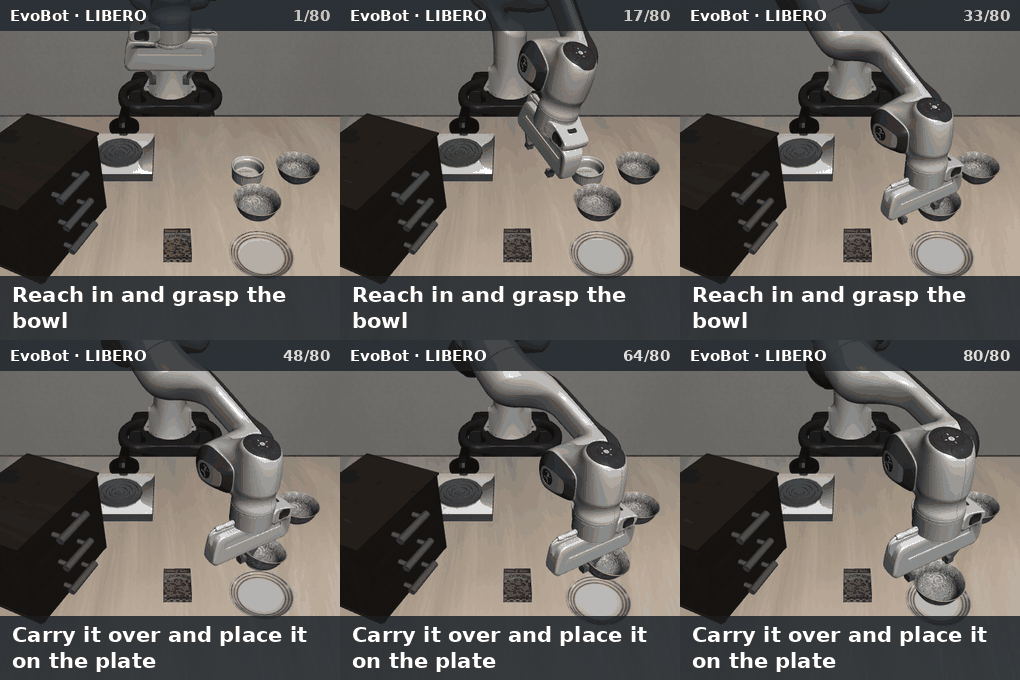
LIBERO-PeRM: Benchmarking Personalized Robotic Manipulation

Zhixu Li, Keqian Tang, Litian Gong, Jingyu Yao, Wenqian Zhang, Tianze Xu 等

Personalization is essential for general-purpose robots to transition into household environments and achieve true practicality. While general robotic manipulation has been extensi…

Personalization is essential for general-purpose robots to transition into household environments and achieve true practicality. While general robotic manipulation has been extensively studied, personalized robotic manipulation (PeRM) lacks a controlled benchmark for separating task completion from preference satisfaction. We introduce LIBERO-PeRM, a benchmark for preference learning in embodied agents. LIBERO-PeRM studies five questions: 1) how policies follow preferences in zero-shot settings; 2) how they learn single preferences from demonstrations; 3) how efficiently they acquire preferences as demonstrations increase; 4) how learned preferences generalize across layouts and tasks; and 5) how policies compose preferences and behave under conflicts. We propose a controlled formulation and taxonomy of observable preferences in simulation, covering motion, skill, and user-profile choices. This formulation is restricted to language-expressible preferences that can be instantiated in LIBERO without changing the task goal, evaluated automatically, and reused across tasks. Building on LIBERO, our procedural pipeline generates paired demonstrations with and without preferences. We create five task suites (312 tasks) with high-quality demonstrations, rich metadata, and preference-satisfaction metrics. Experiments show that current VLA policies struggle with zero-shot personalization, while SFT makes preferences learnable. Mixed training achieves better no-preference retention than sequential adaptation and improves performance with contextual prompts compared with preference-only training, but can weaken motion-preference learning; preference generalization, decomposition, and conflict handling remain difficult. The code, datasets, and demos can be found on the project website: https://libero-perm.github.io/.

cs.ROcs.AIcs.LGmanipulationVLAembodied

兴趣:imitation learning and diffusion policies for robot control

#82026-10-1493

A Phenomenology of Neural Geometry in Vision-Language-Action Models

Mozes Jacobs, Aiden Swann, Mathilde Papillon, Siddharth Boppana, Fenil R. Doshi, Usha Bhalla 等

Robotic manipulation is inherently geometric, but what shape does the world take inside the policy that performs it? Prior work on vision-language-action (VLA) policies establishes…

Robotic manipulation is inherently geometric, but what shape does the world take inside the policy that performs it? Prior work on vision-language-action (VLA) policies establishes that task-relevant variables are linearly readable from activations, yet readability certifies only that a variable is present and says nothing about the shape its values trace, which may be curved and multi-dimensional. Using controlled sweeps, natural rollouts, linear probes, and activation interventions, we build a taxonomy of seven task-relevant concepts in VLA models. We find that realized geometry is predominantly multi-dimensional and is shaped by the constraints under which the policy acts. Physical joint limits, for example, leave wrist orientation an open arc rather than a circle, and distance to the target, a single scalar, is realized in two orthogonal subspaces, a coarse ruler for the approach and a fine ruler for the grasp. The same geometries reappear in two further VLA models on real-world robot data, indicating that they are neither model-specific nor artifacts of simulation. We demonstrate how the findings are actionable by steering along the geometry a concept realizes. Overall, this work lays out an initial phenomenology of realized geometry in VLA policies and demonstrates that a concept's shape carries as much importance as its readability.

cs.ROcs.LGrobotmanipulationgraspVLAvision-language-action

兴趣:vision-language-action (VLA) models and foundation models for robots

#92026-10-15追踪学者 · Cewu Lu93

Value as Memory: Online Value-Guided Post-training for General Robot Policies

Wenye Yu, Yijin Chen, Kaiyi Xiong, Wenbo Han, Wendi Chen, Yang Jin 等

Real-world post-training of generalist robot policies faces two challenges: partial observability makes action selection ambiguous, while offline post-training methods delay feedba…

Real-world post-training of generalist robot policies faces two challenges: partial observability makes action selection ambiguous, while offline post-training methods delay feedback from deployment experience. We present Value as Memory (VaM), a framework that addresses these challenges through value caching and online real-world reinforcement learning (RL). Value caching conditions actions on recent value predictions as task-progress memory, while online updates enable timely policy improvement by combining offline demonstrations, off-policy interventions, and on-policy rollouts for sample-efficient adaptation. As a result, VaM transitions from offline RL warmup to online autonomous learning with sparse rewards. Across long-horizon tasks involving deformable objects and contact-rich manipulation, VaM yields a mean absolute success-rate gain of $29.4%$ with value caching, while achieving a $32.8%$ gain with online autonomous learning over matched offline training. The evaluated online schedule performs $8\times$ as many policy iterations under the same gradient-step budget, with more than $2\times$ lower recorded time per gradient step with concurrent data collection and training.

cs.ROrobotmanipulation

追踪学者:Cewu Lu;兴趣:imitation learning and diffusion policies for robot control

#102026-10-1592

KODA: Kinematics--Observation Data Alignment for Humanoid Learning from Human Egocentric Demonstration

Zibo Zhou, Yueru Chen, Junsong Wu, Weiji Xie, Qingyao Xu, Sheng Yin 等

Training humanoid whole-body vision-language-action (VLA) policies requires costly robot demonstrations with aligned robot-view observations and controller-compatible whole-body st…

Training humanoid whole-body vision-language-action (VLA) policies requires costly robot demonstrations with aligned robot-view observations and controller-compatible whole-body state-action labels. Egocentric human demonstrations offer scalable supervision but have misaligned views and sparse motion cues. Existing approaches either pretrain policies that still require robot data for adaptation or generate controller-specific commands that limit reuse. Conversion also requires robot-view observations aligned with the generated whole-body motion. We present KODA (Kinematics-Observation Data Alignment), which converts egocentric RGB demonstrations into whole-body VLA training data using a reusable canonical trajectory to guide robot-view synthesis and generate controller-specific whole-body state-action supervision. KODA first generates a simulator-checked whole-body trajectory using a sparse tracker with sampling-based command optimization. This generated trajectory directly determines the onboard camera poses used to synthesize corresponding robot-view observations. The motion, observations, and task instruction form a canonical record. For each deployment controller, KODA optimizes commands to track the stored motion and records the corresponding action labels and proprioceptive states. When switching controllers, KODA retains this canonical record and regenerates whole-body state-action supervision for co-training with matching robot demonstrations. We evaluate KODA on four Unitree G1 loco-manipulation tasks using two whole-body controllers, SONIC and HEFT. With robot data held fixed, macro-average success on conditions covered by human demonstrations but absent from robot data improves by 45.0 and 46.25 percentage points, respectively. Under both controllers, this metric shows an upward trend across the evaluated human-data budgets, suggesting potential for further scaling.

cs.ROrobotmanipulationVLAvision-language-actionhumanoid

兴趣:humanoid robots and whole-body control

#112026-10-1591

TS-WAM: Temporal Latent Actions and World-Action Coupling for Vision-Language Robot Control

Menghao Yin, Jiaju Yin, Xiyue Dong, Lixin Xu, Zhenhui Zhang, Ke Zhang 等

Many vision-language-action policies rely on action-labeled robot demonstrations and lack an explicit mechanism for predicting future visual states. These limitations hinder learni…

Many vision-language-action policies rely on action-labeled robot demonstrations and lack an explicit mechanism for predicting future visual states. These limitations hinder learning from action-free videos and can encourage overfitting to demonstration conditions, weakening generalization and robustness. We present TS-WAM, a lightweight Teacher-Student World-Action Model that addresses these challenges through self-supervised temporal learning and explicit future prediction. Its vlm-jepa framework learns from heterogeneous data, including robot demonstrations and action-free human videos, using an EMA target branch without requiring a separately trained external teacher. By coupling vlm-jepa with delta-lwm, TS-WAM learns to predict latent actions from the current observation and instruction and uses them to predict future visual features that guide action generation at inference. A unified end-to-end training architecture jointly optimizes temporal representation learning, visual dynamics, and robot control without a separate latent-action or world-model pretraining stage. The EMA target branch is removed at inference, keeping the deployed policy lightweight. Experiments on LIBERO, LIBERO-Plus, and SimplerEnv, together with real-world manipulation experiments on Franka Research 3 and RevoTron, demonstrate that TS-WAM achieves strong manipulation performance, generalization, and robustness.

cs.ROrobotmanipulationvision-language-action

兴趣:vision-language-action (VLA) models and foundation models for robots

#122026-10-1590

FastVLA: Task-Conditioned and Temporally Adaptive Visual Token Compression for Efficient Vision-Language-Action Models

Jiuyi Xu, Chengyuan Qian, Zhengzhong Tu, Yang Sui, Yangming Shi

Vision-Language-Action (VLA) models present a promising paradigm for general-purpose robot manipulation, but closed-loop deployment is often limited by inference efficiency: at eac…

Vision-Language-Action (VLA) models present a promising paradigm for general-purpose robot manipulation, but closed-loop deployment is often limited by inference efficiency: at each timestep, high-resolution, often multi-view images are encoded into hundreds of visual tokens that dominate transformer computation and latency. Token compression via attention is a natural solution but is challenging for VLA control because (1) decision-critical tokens are determined by the task, not generic visual saliency, and (2) the token budget varies substantially across steps, so static metrics and budgets waste computation or discard control-critical tokens. We introduce FastVLA, a training-free, task-aware, and temporally adaptive visual token compression framework. At each step, FastVLA scores token importance via task-to-vision attention and adaptively sets the compression rate from the importance-distribution uniformity, measured by an inverse-Simpson metric with online sliding-window calibration. We evaluate FastVLA on OpenVLA, OpenVLA-OFT, and CogACT across LIBERO and SIMPLER, and on a physical Franka Research 3 robot. In simulation, it reduces LLM-backbone FLOPs by 35-59% and action latency by 9-32% (a 1.09$\times$-1.46$\times$ speedup) while maintaining task success, achieving a comparable or better efficiency-performance trade-off than existing plug-and-play token compression/pruning/reuse baselines. On the real robot, it cuts end-to-end latency by 20% (1.25$\times$ speedup) at comparable success. Code is available at https://github.com/jiuyixu25/FastVLA.

cs.ROrobotmanipulationVLAvision-language-action

兴趣:vision-language-action (VLA) models and foundation models for robots

#132026-10-1588

REKI: Registering Knowledge in VLAs

Juliette Marrie, Paul Pacaud, Adrien Ramanana Rahary, Shizhe Chen, Moritz Böhle

We introduce REKI, a 2.4B vision-language-action model (VLA) pretrained exclusively on public data that sets a new Pareto frontier between performance and model size: on LIBERO-Plu…

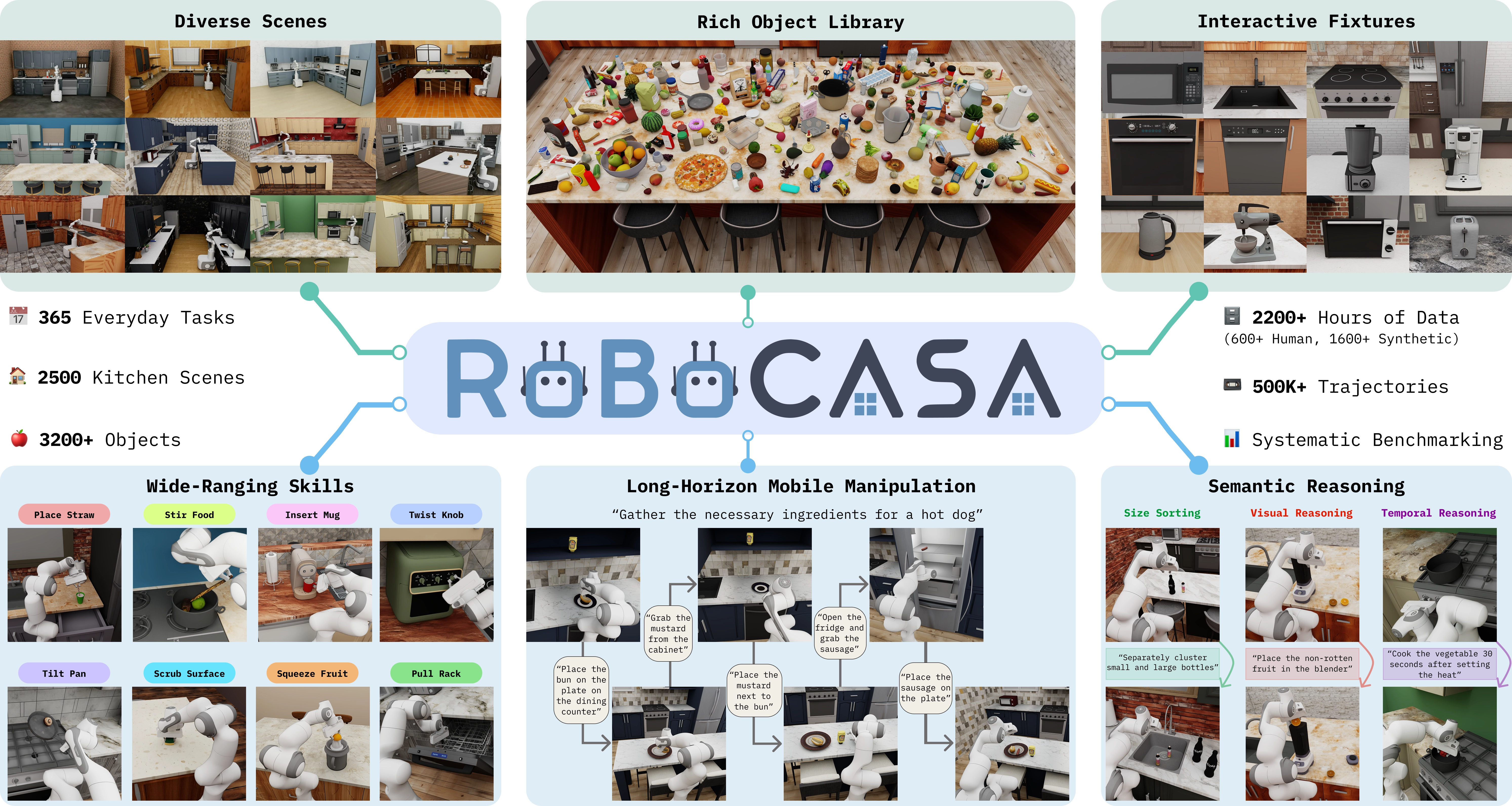
We introduce REKI, a 2.4B vision-language-action model (VLA) pretrained exclusively on public data that sets a new Pareto frontier between performance and model size: on LIBERO-Plus, RoboTwin Clean2Rand and RoboCasa365, it is outperformed only by models about twice its size. REKI consists of a vision-language model (VLM) followed by a flow-matching action expert, and is pretrained on a curated mixture of public robot, egocentric human and vision-language data. Additionally, we endow it with a memory that gives the policy access to its recent past at negligible cost: a few register tokens in the action expert summarise the output of the VLM at each frame and persist in the expert's cache. This memory improves success in simulation and on real robots, and makes oscillations between poses about four times rarer. REKI uses a simple model design and training paradigm, and is optimised to be efficient at training and inference. We release the full code across data curation, training, inference and evaluation, deployment, and all pretrained and finetuned model weights: https://github.com/kyutai-labs/reki.

cs.ROcs.CVcs.LGrobotVLAvision-language-action

兴趣:vision-language-action (VLA) models and foundation models for robots

#142026-10-1588

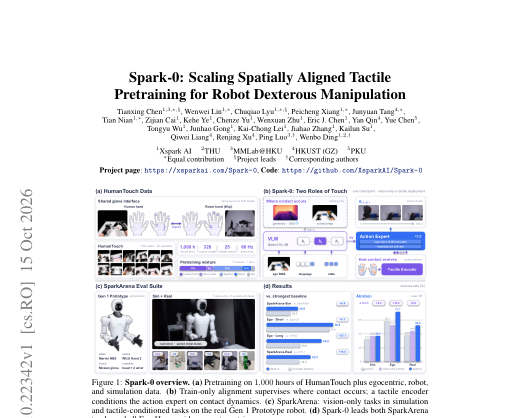
Spark-0: Scaling Spatially Aligned Tactile Pretraining for Robot Dexterous Manipulation

Tianxing Chen, Wenwei Lin, Chuqiao Lyu, Peicheng Xiang, Junyuan Tang, Tian Nian 等

Generalist robot policies benefit from large-scale visual pretraining but often struggle with contact-rich dexterous manipulation, where force, compliance, and incipient slip are h…

Generalist robot policies benefit from large-scale visual pretraining but often struggle with contact-rich dexterous manipulation, where force, compliance, and incipient slip are hard to observe from images. We present Spark-0, a spatially aligned vision-tactile-language-action (VTLA) model that uses touch in two complementary ways. During pretraining, image-space contact maps derived from tactile gloves, together with features from a frozen 3D geometry teacher, supervise the visual tokens; these objectives are removed at inference. In parallel, a tactile pathway encodes regional force histories and 3D taxel states to condition the action expert. A single checkpoint therefore supports both vision-only and tactile-conditioned deployment. To scale this supervision, we build HumanTouch, a 1,000-hour dataset of full-hand tactile human manipulation, and pretrain Spark-0 on it together with egocentric video, robot data, and simulation. We also release SparkArena, which pairs vision-only simulated tasks with tactile-conditioned real-robot tasks on one dexterous embodiment. Spark-0 achieves the highest mean success rate on both SparkArena tracks and ranks first on all eight aggregate metrics of the Ego Humanoid Manipulation Benchmark. Compared with vision-only pretraining on the same data and compute with touch discarded, retaining the touch of 1,000 hours of HumanTouch raises vision-only success on Ego Humanoid from 52.5% to 71.7%, and success on SparkArena-Real, where touch is also used at deployment, from 44.0% to 52.0%, indicating that touch serves not only as a policy input but also as scalable supervision for dexterous visuomotor pretraining. The Website is available at: https://xsparkai.com/Spark-0.

cs.ROrobotmanipulationhumanoiddexteroustactile

兴趣:robot manipulation and grasping with learned policies

#152026-10-15追踪学者 · He Wang87

Uni-PNP: Unified Prehensile and Non-prehensile Policy Learning for Generalizable Object Pose Reaching

Wenxuan Zhu, Yuze Wang, Jiangran Lyu, Jiayi Chen, Yixin Zheng, Mi Yan 等

Object manipulation often requires combining non-prehensile actions with grasping. However, existing approaches typically develop these capabilities separately and integrate them b…

Object manipulation often requires combining non-prehensile actions with grasping. However, existing approaches typically develop these capabilities separately and integrate them by sequencing distinct primitives through prescribed intermediate objectives, limiting the coordination of contact motions and grasping. Their integration also remains sensitive to object and gripper geometry and depends on particular environmental supports, complicating real-world deployment. We present Uni-PNP, a unified policy that jointly learns prehensile and non-prehensile manipulation for object pose reaching across diverse objects and grippers. To achieve this, we first pretrain a geometry encoder to predict contact-induced object motion using a contact-dynamics dataset constructed from simulated interactions between diverse objects and grippers. We then train the policy in a two-stage reinforcement learning curriculum from graspable objects to ungraspable peers, encouraging the discovery of non-prehensile interactions and their integration with grasping. Experiments show 76.39% success on hundreds of seen objects with grippers, and 57.91% on unseen peers, outperforming the strongest pose-reaching baseline by 20.52 and 17.79 percentage points, respectively. We also analyze emergent behaviors, including nonprehensile and prehensile repositioning, grasp acquisition that requires grasping after tipping, and table-assisted reorientation while grasping, and transfer to the real-world scenario. Project page available at lgswdn.github.io/Uni-PNP.

cs.ROmanipulationgrasp

追踪学者:He Wang;兴趣:robot manipulation and grasping with learned policies

#162026-10-1587

Policy-Aligned Predictive Verification for Adaptive VLA Action-Chunk Execution

Minkyu Kim, Junhoo Lee, Seungyeon Kim, Suhyun Jeon, Baekseung Kim, Donghoon Han 等

Vision-language-action (VLA) policies generate action sequences that reduce repeated inference, but deciding how much of each sequence to execute is critical to task success. Exist…

Vision-language-action (VLA) policies generate action sequences that reduce repeated inference, but deciding how much of each sequence to execute is critical to task success. Existing adaptive methods make this decision using generation stability or prediction agreement, yet these signals do not establish whether executing a candidate prefix preserves the ability to complete the task. We introduce a policy-aligned predictive verifier (PAV) that anticipates the consequences of candidate action prefixes and evaluates their compatibility with successful continuation before execution. Rather than using future prediction to generate actions, our method evaluates existing proposals in the VLA's internal task-conditioned representation space. To learn local judgments from terminal task outcomes, we combine trajectory-level survival supervision with a localization prior that preserves useful behavior within failed rollouts. The resulting validity scores guide execution-horizon selection. Evaluations with pi_0 and pi_0.5 across LIBERO, RoboTwin 2.0, and real-world manipulation show improved success-query trade-offs. These findings point toward a different role for future prediction in robotics, using it to assess how far to trust a policy's proposed actions rather than to generate new ones.

cs.ROcs.LGmanipulationVLAvision-language-action

兴趣:vision-language-action (VLA) models and foundation models for robots

#172026-10-1586

Diffeomorphic Hidden-State Steering: Improving Imitation Learning Policy Robustness through Expert Hidden-State Geometry

KwangBin Lee

Small observation or action errors can compound during closed-loop execution and disrupt a trained imitation learning policy. We study whether the original expert demonstrations ca…

Small observation or action errors can compound during closed-loop execution and disrupt a trained imitation learning policy. We study whether the original expert demonstrations can improve robustness through test-time hidden-state steering without additional demonstrations or policy retraining. Our analysis of a trained policy finds that expert hidden-state variation is concentrated in relatively few dimensions, while the directions capturing this variation differ across regions. Motivated by this geometry, we propose Diffeomorphic Hidden-State Steering (DHS), which learns an invertible nonlinear coordinate map from expert hidden states obtained by replaying the demonstrations through the frozen policy. DHS attenuates coordinates with low expert variance more strongly than those with high variance, then maps the modified coordinates back to hidden-state space. This allows steering directions to vary with the current hidden state while retaining every coordinate. Across four simulated manipulation tasks, DHS improves mean success under observation noise over the unmodified Transformer policies. Controlled comparisons yield higher mean success with learned nonlinear coordinates than with linear coordinates under both hard projection and full-rank rescaling. Combining DHS with action smoothing improves mean success rate under observation noise in certain tasks compared with action smoothing alone.

cs.ROmanipulationimitation learning

兴趣:imitation learning and diffusion policies for robot control

#182026-10-1585

SPEAR: Selective Preference Elicitation with Adaptive Rewards for VLM-Guided Robotic Manipulation

Zewen Wu, Ruizhe Liu, Pei Zhou, Feng Chen, Yanchao Yang

Recent Vision-Language Models (VLMs) enable automated preference labeling for robotic manipulation, yet their deployment remains impractical since each query incurs substantial inf…

Recent Vision-Language Models (VLMs) enable automated preference labeling for robotic manipulation, yet their deployment remains impractical since each query incurs substantial inference cost, while VLMs frequently abstain on visually challenging comparisons. We propose SPEAR, a framework that transforms VLMs into efficient preference oracles via two synergistic mechanisms. First, we design distinguishability-aware query selection to reduce abstention rates by targeting only informative and distinguishable comparisons. Second, we deploy an adaptive reward transition that bootstraps exploration with VLM-synthesized guidance before preference-based refinement. Experiments on the manipulation benchmarks demonstrate that SPEAR achieves 88.9% average success, outperforming baselines by 23.3 percentage points, while significantly reducing abstention and wall-clock training time on contact-rich tasks. SPEAR learns three Mobile ALOHA manipulation tasks fully online on real hardware, demonstrating end-to-end real-world applicability. By addressing query efficiency and exploration challenges, SPEAR establishes VLMs as practical preference oracles for scalable robot learning without manual reward engineering.

cs.ROrobotmanipulation

兴趣:robot manipulation and grasping with learned policies

#192026-10-1585

CarryOn: A Dual-Loop Harness for Personalized and Reliable Robot Assistance

Zixuan Wang, Yuqi Liu, Yuxin Chen, Sengqiao Yang, Jinhui Ye, Pengguang Chen 等

While generalist vision-language-action (VLA) models have enabled diverse open-world manipulation, real-world robotic assistance requires two critical capabilities they currently l…

While generalist vision-language-action (VLA) models have enabled diverse open-world manipulation, real-world robotic assistance requires two critical capabilities they currently lack: personalization and reliable execution. First, executing an instruction like "make me a sandwich" requires grounding subtask decomposition in persistent user preferences rather than relying on a single generic solution. Second, reliable deployment demands explainable safety assurance that proactively prevents hazards and gracefully recovers from occasional physical failures. To address these gaps, we present CarryOn, a dual-loop harness designed to augment a frozen VLA policy. The planning loop maintains persistent user-level and scene-level context that is continually grounded against new observations and revised through interaction, enabling personalized task selection and execution grounding across conversations and changing scenes. The execution loop actively supervises policy rollouts, shielding actions from predicted hazardous contact. When execution fails, the system invokes reusable control-based recovery skills that restore task progress and are refined through reflection on earlier failures. On a real robot and in simulation, CarryOn dispatches preference-consistent subtasks across users and scenes, reduces the violation rate of an already safety-finetuned VLA from 52.6% to 6.1%, and increases recovery success from 13% to 80% when refined skills are reused.

cs.ROcs.CVrobotmanipulationVLAvision-language-action

兴趣:vision-language-action (VLA) models and foundation models for robots

#202026-10-1585

VeriVLA: Adaptive Test-Time Verification for Flow-Based VLAs with Latent World Models

Xueli Sun, Yuxiang Lu, Yantong Liu, Xianzhe Fan, Xi Chen, Zhe Liu 等

Flow-based Vision-Language-Action (VLA) policies are inherently stochastic: different noise seeds can produce action chunks of varying quality from the same observation. At test ti…

Flow-based Vision-Language-Action (VLA) policies are inherently stochastic: different noise seeds can produce action chunks of varying quality from the same observation. At test time, however, the policy typically commits to a single sample without an explicit estimate of its quality. In fine-grained manipulation, executing a suboptimal action can irreversibly disrupt task progress and lead to failure. To exploit policy stochasticity, we introduce a training-free two-axis trigger that uses two initial samples to measure within-chunk temporal variation and cross-sample variance, detecting the critical states. Once triggered, a JEPA-based latent world model ranks candidate action chunks by predicting action-conditioned future latent states and the corresponding changes in task progress. By operating in latent space, the verifier avoids pixel reconstruction and enables efficient and more accurate ranking. Across three real-world tasks, $i.e.,$ pen insertion, pipetting, and apple placement), our method raises the average completion score from 50.8% to 65.5%, while adding 326 ms for sampling and verification per triggered decision on a single RTX 4090. Consistent gains are also observed in simulation, where the average success rate rises from 66.4% to 73.6% in the clean setting of RoboTwin 2.0, from 62.8% to 69.6% in its randomized setting, and from 96.9% to 97.6% on LIBERO.

cs.ROmanipulationVLAvision-language-actionworld model

兴趣:vision-language-action (VLA) models and foundation models for robots

#212026-10-1484

EgoJEPA: Beyond Retargeting for Dexterous Manipulation from Egocentric Videos

Meng Cao, Can Zhao, Jinjie Wei, Haonan Zhao, Yulong Zhang, Duo Han 等

Egocentric human videos offer a scalable alternative to costly robot demonstra- tions, yet transferring their manipulation priors to robot control remains chal- lenging. The common…

Egocentric human videos offer a scalable alternative to costly robot demonstra- tions, yet transferring their manipulation priors to robot control remains chal- lenging. The commonly adopted retargeting-based approaches convert human wrist and finger poses into embodiment-specific action commands through hand- crafted geometric mappings. However, such mappings require meticulous recal- ibration across different embodiments and risk propagating hand-tracking errors into downstream robot control pipelines. To this end, we propose EgoJEPA, a three-stage framework that learns embodiment-agnostic representations from ego- centric human videos without rule-based human-to-robot retargeting: 1) Human- action pre-training learns effect-aware latent actions through JEPA-style visual prediction conditioned on hand-motion differences; 2) Latent-action-based world modeling jointly predicts future visual dynamics and latent actions, which decou- ples human prior pre-training from robot-specific control parameterizations; 3) Embodiment-specific tuning adapts the pretrained model to diverse robots through lightweight action adapters. Experiments on five real-world manipulation tasks across three robot embodiments demonstrate the effectiveness and efficiency of EgoJEPA. It achieves a 74% average success rate under the out-of-domain evalu- ation, compared with 65% for the retargeting baseline, while reducing cumulative cross-embodiment wall-clock cost by 47.2%, from 743.2 to 392.7 hours.

cs.ROcs.CVrobotmanipulationdexterous

兴趣:world models and video prediction for embodied agents

#222026-10-1584

Perceive, Predict, and Plan: a Unified World Action Model for Egocentric Dexterous Manipulation

Zirui Wu, Chen Guo, Tianjian Jiang, Zeren Jiang, Zeming Li, Lingchen Yang 等

We introduce P$^{3}$-WAM, a unified world action model for egocentric dexterous manipulation that learns 3D perception, action-conditioned prediction, and goal-directed planning th…

We introduce P$^{3}$-WAM, a unified world action model for egocentric dexterous manipulation that learns 3D perception, action-conditioned prediction, and goal-directed planning through three complementary modes: Perceive, which reconstructs articulated hand motion and camera trajectories from video; Predict, which generates visual futures under prescribed actions; and Plan, which jointly generates action trajectories and their anticipated visual consequences conditioned on an initial image, a language instruction, and an optional visual goal. Our model integrates a compact, structured 3D action representation into a pretrained video diffusion transformer through a mixture-of-transformers architecture with shared base weights, modality-specific adaptation, and bidirectional visual-action attention. Randomized modality visibility lets video and 3D actions serve as either conditioning context or prediction targets across the three modes. Experiments show that unified training improves all three capabilities over single-mode training, including gains in planning quality under a vision-language model evaluation. Through unified training, our model outperforms specialized baselines on 3D hand reconstruction and action-conditioned video prediction across four datasets, while producing goal-directed manipulation videos with stronger instruction adherence and action progression than video-generation baselines. Project Page: https://p3-wam.pages.dev/

cs.CVcs.ROmanipulationdexterous

兴趣:robot manipulation and grasping with learned policies

#232026-10-1484

MoCaP: Mobile Code-as-Policies for Zero-Shot Mobile Manipulation from Passive Human Videos

Yiyang Cai, Tatsuya Kamijo, Ninghao Lu, Zijin Hu, Sherry Yang

Passive human videos of everyday activity offer robots access to a massive amount of human experience without requiring a demonstration for each task. However, using this experienc…

Passive human videos of everyday activity offer robots access to a massive amount of human experience without requiring a demonstration for each task. However, using this experience requires recovering knowledge from unstructured video recordings and adapting it to a different body (i.e., the robot). To overcome these challenges, we present mobile code-as-policy (MoCaP), an agentic framework that turns passive human video recordings into guidance for an end-to-end mobile manipulation policy. MoCaP extracts spatial memory and cues of how people prepare to interact with objects, which inform navigation and the search for a manipulation-ready configuration. Guided by passive human experience and current observations, MoCaP uses a closed-loop code-as-policy to coordinate planning and tool use primitives to solve motions under the robot's geometry and kinematic constraints. On a real mobile manipulator, MoCaP achieves 80% success on each of two mobile manipulation tasks in an indoor environment whereas existing approaches cannot succeed at the task. Video-derived spatial memory improves object-navigation success from 70% to 100%, and human approach prior raises the rate of finding a reachable base pose from 0% to 100% at an unfavorable start location. Videos and code are available on the project website: https://mocap-7.github.io/MoCAP-page/.

cs.ROrobotmanipulation

兴趣:robot manipulation and grasping with learned policies

#242026-10-1484

TGrasp6D: Task-Informed Vision-Language Priors and Pose Refinement enable Zero-Shot Task-Oriented 6DoF Grasping

Manav Kulshrestha, Apoorva Vashisth, Damon Conover, Aniket Bera

Task-Oriented Grasping (TOG) has emerged as an important skill for purposeful robotic manipulation. Given the task of using a knife to "slice bread," a robot must choose to grasp f…

Task-Oriented Grasping (TOG) has emerged as an important skill for purposeful robotic manipulation. Given the task of using a knife to "slice bread," a robot must choose to grasp from the handle, whereas for "hand[ing] the knife over," it is preferable for the handle to remain unobstructed for safe handoff. Current approaches for TOG either focus on 2D planar grasping, remain limited by their reliance on task-agnostic grasp generators, or are constrained by reliance on finite, manually-annotated, task-specific grasp datasets that cannot cover all possible grasp-task pairs. To that end, we present TGrasp6D, a vision-language based approach for generating task-oriented 6DoF grasps in a zero-shot manner. Given a task and a single RGB-D image of an associated object, TGrasp6D reasons about the appropriate semantic affordance for the given task and object geometry to produce an initial task- informed prior. This generated prior is further refined via 6DoF pose optimization for collision avoidance while preserving task consistency. Our approach achieves state-of-the-art success rate of 94% on the TaskGrasp dataset, with the best baseline at 74%. We also deploy our approach on a Franka Research 3 robot to demonstrate zero-shot generalization to real world objects

cs.ROcs.AIcs.LGrobotmanipulationgrasp

兴趣:robot manipulation and grasping with learned policies

#252026-10-1584

LTM: Latent Transition Based In-Context Memory for Vision-Language-Action Models

Qixin Sun, WenLong Gao, Xiansheng Chen, Zhongyuan Wang, Si Liu, Pengwei Wang

Robotic manipulation often requires remembering interactions that are no longer visible. We introduce Latent Transition Memory (LTM), which stores history as compact latent transit…

Robotic manipulation often requires remembering interactions that are no longer visible. We introduce Latent Transition Memory (LTM), which stores history as compact latent transitions between consecutive observations. Instantiated on $π_{0.5}$ as LTM-$π$, our method uses a frozen latent action encoder, a lightweight adapter, and causal KV caching for incremental inference without memory-specific semantic annotations or external reasoning-model calls. With DreamDojo transitions, LTM-$π$ achieves 58.54% success on RoboMME and 80.5% on LIBERO-Mem, performing best among baselines without external reasoning models or memory-specific annotations. Ablations support the contribution of transition content beyond temporal cues and the efficiency of delayed memory admission. Scaling RoboMME demonstrations tenfold improves success from 57.67% to 87.50%, while a Cup Swap diagnostic highlights the role of process supervision in temporal composition. Under a 200-token memory budget, success remains 84.00%, versus 87.50% without compression. Finally, real-robot counting success improves from 11.25% to 82.50%. Together, these results demonstrate the effectiveness, scalability, and efficiency of latent transition memory, highlighting its capacity for complex temporal information, bounded-context operation, and real-world robotic control.

cs.ROcs.AIrobotmanipulationvision-language-action

兴趣:large language models for robot task planning and reasoning

#262026-10-15追踪学者 · Pulkit Agrawal83

Compliant GMT: Making General Motion Tracking Compliant via Residual Reference Adaptation

Venki Parsuram, Michelle Wang, Jin-Hyuk Hong, Pulkit Agrawal

We propose Compliant GMT (C-GMT), a modular framework for full-body compliant responses in general motion tracking. As humanoid robots move into real world deployment, they not onl…

We propose Compliant GMT (C-GMT), a modular framework for full-body compliant responses in general motion tracking. As humanoid robots move into real world deployment, they not only need to perform any motion but also respond safely and robustly to interaction forces. Existing general motion tracking policies can imitate diverse motions but are trained to be stiff, leading to unexpected and unsafe behaviors under disturbance. Prior work in compliant humanoid control trades off compliance and generality. There exist examples of full-body compliant responses, but these are heavily curated to single-reference policies. On the other hand, general motion trackers (GMT) are trained to rigidly imitate massive motion capture datasets. Our key insight is to leverage the generality of pretrained GMTs for motion tracking while introducing compliance from a residual adapter that conditions on a history of proprioception. This enables our approach, C-GMT, to achieve both general motion tracking and whole-body compliant responses. Compared to state-of-the-art general motion trackers and single-motion compliant policies, C-GMT demonstrates competitive performance in both motion tracking accuracy and compliance adherence. We further demonstrate improved safety, robustness, and error tolerance in simulation and real-world G1 experiments.

追踪学者:Pulkit Agrawal;兴趣:humanoid robots and whole-body control

#272026-10-1582

Cross-Embodiment Causal Transfer from Human Videos to Robot Manipulation

Xingyu Zhang, Yingchao Li, Peizheng Guo, Jie Hu, Changwen Zheng, Wenwen Qiang

Scaling robot manipulation models requires large amounts of interaction data, yet collecting diverse real-robot experience remains costly. Human manipulation videos, in contrast, p…

Scaling robot manipulation models requires large amounts of interaction data, yet collecting diverse real-robot experience remains costly. Human manipulation videos, in contrast, provide abundant and diverse task experience that could potentially benefit robot learning. However, differences in morphology, action spaces, and control mechanisms make human motions unsuitable as direct supervision for robot actions, raising a scientific question: what knowledge in human videos should be transferred across embodiments to robot manipulation? To address this question, we analyze subtask transfer through the lens of causal beams, focusing on which contextual conditions and interaction dependencies should be retained to support local task effects. Based on this perspective, we propose Causal-Beam-Guided Subtask Transfer (CBST). CBST learns manipulation-related representations from human videos and grounds them in task-level semantic variables using robot demonstrations. Within a predefined manipulation model, causal-beam constraints guide contextual information selection by requiring retained assignments to sustain local mechanism outputs while preserving nontrivial responsiveness to retained inputs. The selected semantic information conditions a world-action model, allowing the robot to generate actions from its own observations without requiring human-robot motion correspondence. Experiments on robot manipulation benchmarks show improvements in task success over the corresponding world-action model baselines.

cs.ROcs.AIrobotmanipulation

兴趣:robot manipulation and grasping with learned policies

#282026-10-1582

Evo-DexBench: Benchmarking Generalization across Related Tasks for Dexterous Manipulation

Bing Cheng, Yiran Mao, Zewei Ye, Yifan Jin, Xinyi Chen, Ruifeng Tu 等

General-purpose dexterous manipulation requires policies to transfer knowledge from related tasks to new tasks with only a few target demonstrations. Existing benchmarks often prov…

General-purpose dexterous manipulation requires policies to transfer knowledge from related tasks to new tasks with only a few target demonstrations. Existing benchmarks often provide too many target demonstrations. They also leave the differences between source and target tasks uncontrolled. As a result, they cannot clearly distinguish knowledge transfer from task memorization. Our key insight is the Core-Gen principle. Core tasks are related tasks that share a functional interaction and provide source knowledge, while a Gen task is a novel target within the same functional family that has only a few demonstrations. This setup tests whether a policy can reuse functional interaction knowledge. Based on this principle, we propose Evo-DexBench, which controls both source-task relatedness and target-task exposure. It comprises 30 tasks in six functional families and a VR teleoperation pipeline. The resulting dataset covers three everyday scenes per task. It contains 1,248 multimodal demonstrations collected with simulated Shadow Hands equipped with 123 taxels. Experiments show that even the best-performing method achieves an average success rate of only 38.5%, highlighting the challenges existing methods face in transferring functional interaction knowledge. Further analysis shows that, across the two tasks, joint Core+Gen training improves performance by 12% and 38%, respectively, over training on Core followed by fine-tuning on Gen. This indicates that joint training makes better use of Core knowledge and that functionally matched Core data yields greater gains in success rate than mismatched data. We release the Evo-DexBench dataset and benchmark to support the evaluation of dexterous manipulation policies' generalization across related tasks.

cs.ROmanipulationdexterous

兴趣:robot manipulation and grasping with learned policies

#292026-10-1581

MOSS: Mode-Oriented Source Shaping for Robot Flow Matching Policies

Zirun Ma, Jindou Jia, Tuo An, Jiaqi Bai, Jiahua Dong, Jianfei Yang

In robotic manipulation, the same observation often admits multiple feasible actions. Generative policies such as diffusion and flow matching naturally capture such multimodal beha…

In robotic manipulation, the same observation often admits multiple feasible actions. Generative policies such as diffusion and flow matching naturally capture such multimodal behaviors, yet which mode is executed is left to random sampling and cannot be actively controlled. We propose Mode-Oriented Source Shaping (MOSS), which turns mode selection into an explicit choice of where generation starts. We first reveal, both empirically and theoretically, that deterministic flow transport induces mode-dependent structure in the source space. Under ideal deterministic ODE transport, distinct behavioral modes have distinct source-space preimages, while practical approximation errors can blur their boundaries due to imbalanced data, limited model capacity, and few inference steps. Motivated by this source-space structure, MOSS constructs semantically aligned mode-specific Gaussian sources that encode mode identity in the initial noise. A modality-strength estimator predicts the local degree of multimodality, which adaptively controls the geometry of the mode-specific sources. It contracts them toward a shared Gaussian where behaviors are similar and separates them near behavioral branching points. During deployment, the desired behavior is selected at inference simply by sampling from the corresponding component. Across 6 simulated and 3 real-world manipulation tasks, MOSS steers to the target mode up to 100% of the time with high task success, recovers minority modes at over 90% guidance rate under a 10:90 imbalance dataset, and surpasses mode-conditioned flow policy by 43.3 points of guidance rate on real robots.

cs.ROrobotmanipulation

兴趣:imitation learning and diffusion policies for robot control

#302026-10-1581

TRACE: Typed Reference-Aware Conversational Editing for Humanoid Motion Diffusion

Zejian Kang, Yifu Luo, Boyang Shen, Jingxuan Li, Zekai Chen, Zekun Shi 等

Language-conditioned humanoid motion generation enables users to create and refine robot movements through natural language. The central challenge is to connect an underspecified r…

Language-conditioned humanoid motion generation enables users to create and refine robot movements through natural language. The central challenge is to connect an underspecified request to concrete motion structure that can subsequently be revised relative to an accepted reference. We present TRACE, a generation and editing framework for the Unitree G1 humanoid robot built around typed, measurable kinematic quantities. Our insight is to ground generation conditions in paired training motions and editing goals in the current motion. A language model learns to predict support, root, and hand events from motion-derived supervision; their time-aligned encodings complement the original text in a diffusion generator. Gravity-referenced states and trajectory--contact objectives improve kinematic consistency. For editing, typed requests define body--time scopes and source-relative goals. A separate reference-conditioned diffusion editor uses these goals and revised events to realize changes, while sampling-time projection preserves protected state coordinates. Quantitative evaluation and human assessment show improved semantic alignment and motion quality over the compared methods. Controlled ablations support the value of motion-grounded conditioning and kinematic consistency, while multi-turn editing evaluations demonstrate more reliable execution of successive relative requests under shared preservation constraints. Together, these results support typed kinematic structure as a common basis for motion generation and reference-aware revision.

cs.ROrobothumanoid

你点赞过:TANGO: Humanoid Navigation in Cluttered Environments with a

#312026-10-1581

Trajectory-based Diffusion from One-shot Human Video for Generalizable Manipulation

Guoping Pan, Xinmiao Yu, Wannan Cao, Jincheng Li, Baolin Jiang, Yizhe Li 等

Imitation learning enables robots to perform complex tasks by leveraging human-collected demonstrations. However, most existing approaches require labor-intensive data collection w…

Imitation learning enables robots to perform complex tasks by leveraging human-collected demonstrations. However, most existing approaches require labor-intensive data collection with additional teleoperation systems, which hinders scalability. Human videos represent a natural source of data that implicitly contain knowledge of manipulation behaviors. However, transferring them to robots remains challenging due to the visual domain gap and the absence of explicit action labels. In this work, we introduce TDV, a trajectory-based framework that leverages data generation to enable generalizable manipulation. TDV focuses on task-relevant objects by leveraging plug-and-play 6D pose estimation techniques to extract object trajectories from human videos, thereby mitigating the impact of irrelevant backgrounds and varying viewpoints. As a modality-agnostic intermediate representation, trajectories are inherently independent of the visual domains and different embodiments, enabling efficient data generation. Our method outperforms previous approaches on RLBench simulation tasks, achieving near 100% success rates across seven tasks. In real-world experiments, TDV enables cross-embodiment generalization manipulation from one-shot human demonstrations by leveraging efficient trajectory generation techniques.

cs.ROmanipulationimitation learning

兴趣:imitation learning and diffusion policies for robot control

#322026-10-15追踪学者 · Li Fei-Fei追踪学者 · Jiajun Wu81

T2-z: Test-Time Optimization of Environment Latents for Robotic World Models

Chenyuan Zhou, Yining Hong, Huang Huang, Yunfan Jiang, Wenlong Huang, David Held 等

Predicting how the world responds to an action requires more than what can be seen: robots must account for environmental factors that are neither directly observable nor explicitl…

Predicting how the world responds to an action requires more than what can be seen: robots must account for environmental factors that are neither directly observable nor explicitly specified, from physical properties such as friction and mass to human-defined environmental rules. We introduce T2-Z for test-time optimization of environment latents, which augments a robotic world model with a learnable environment latent to condition world predictions. This compact latent captures underlying environmental variation without supervision of what environmental factors exist or what values they take. During training, T2-Z alternates between two stages: a world-model optimization stage that fixes the latents and learns general action-conditioned dynamics across environments; and an environment-latent optimization stage that freezes the world model and optimizes the conditioning latents, allowing latent structure to emerge purely through world prediction. At test time, the world model remains frozen and a newly initialized environment latent is optimized from one or more test-time interactions, adapting the model to previously unseen environmental configurations. Across 7 simulated settings and 4 real-world robotic tasks, T2-Z reduces object prediction error metric from 15.20 to 7.00 and raises action success from 33.73% to 72.96%. Its emergent latents capture structured representations of individual and compounded factors across diverse visual scenes. Ablations further show that T2-Z can efficiently infer environment latents from as little as a single test-time interaction trajectory.

cs.ROcs.AIcs.CVworld model

追踪学者:Li Fei-Fei、Jiajun Wu;兴趣:world models and video prediction for embodied agents

#332026-10-1581

Inertially Significant Humanoid Teleoperation via Whole Body Model Predictive Control and Online Parameter Estimation

James Foster, Beomyeong Park, Luigi Penco, Robert Griffin

The effective deployment of humanoid robots in practical tasks of interest will require a capability of sensing and adapting to variations in inertial parameters, as occurs during …

The effective deployment of humanoid robots in practical tasks of interest will require a capability of sensing and adapting to variations in inertial parameters, as occurs during heavy tool use or when carrying significant payload. Such payloads constitute a significant proportion of the combined payload-robot system, the effects of which cannot be ignored by delegating to feedback control. This paper showcases a general solution to this problem by integrating a whole body model predictive controller (WB-MPC) with an extended Kalman filter (EKF) for online estimation of fully physically consistent time-varying inertial parameters. These estimates are fed through to the WB-MPC's full rigid body dynamics model, resulting in more accurate feedforward torques for task demands under external load. Additionally, a virtual reality (VR) interface is provided that enables an operator to provide task-specific references without regard to payload while delegating dynamic balance to the WB-MPC. The framework is validated with simulation and hardware experiments on a humanoid system.

cs.ROrobothumanoid

兴趣:humanoid robots and whole-body control

#342026-10-15追踪学者 · Cewu Lu81

Can World and Action Modeling Benefit Each Other under Unified Causal Training?

Yue Su, Bokai Lin, Xinkai Wang, Chubin Zhang, Xiangnan Wu, Kuan Zhang 等

World and action modeling are closely related, yet their reciprocal benefits under unified causal training remain unclear. We introduce OneWM, a simple framework for unified causal…

World and action modeling are closely related, yet their reciprocal benefits under unified causal training remain unclear. We introduce OneWM, a simple framework for unified causal training that treats actions as both conditions for world prediction and targets for policy learning within a shared video-action architecture. Using this framework, we investigate whether learning forward dynamics conditioned on specified actions improves action learning, and whether learning to generate actions in turn improves action-conditioned world modeling. We use LIBERO, LIBERO-Plus, and RoboCasa365 as embodied testbeds to evaluate both policy learning and world modeling, complemented by real-world policy experiments. Learning the visual consequences of specified actions improves policy performance and generalization across changing scenes. In turn, action learning improves multi-view world-prediction fidelity under the same architecture. Together, these results answer both questions positively, supporting reciprocal benefits between world modeling and action generation under unified causal training.

追踪学者:Cewu Lu;兴趣:world models and video prediction for embodied agents

#352026-10-1581

Mem4Act: Learning Effective Latent Memory for Long-Horizon Robotic Manipulation

Yun Zhang, Zhiyu Huang, Tianhui Cai, Chen Tang, Wei Wang, Jiaqi Ma

Long-horizon robotic manipulation fundamentally requires memory: agents must retain task-relevant information from past observations and interactions and use it to guide future act…

Long-horizon robotic manipulation fundamentally requires memory: agents must retain task-relevant information from past observations and interactions and use it to guide future actions. Existing approaches typically preserve raw historical observations, compressed visual tokens, or language summaries, but these representations either expose the action policy to increasingly long histories or risk discarding task-relevant temporal, semantic, and perceptual information. We introduce Mem4Act, a framework for learning effective latent memory as a fixed-size representation explicitly optimized for long-horizon robotic control. Mem4Act addresses three coupled challenges: how to efficiently cover long histories, what information memory should retain, and how to ensure the policy actually relies on memory. To this end, it organizes history via multi-granularity temporal aggregation, preserves complementary semantic and perceptual information through question-answering supervision and key-frame DINO feature reconstruction, and employs memory-first two-stage training to encourage greater use of memory by the action policy. The resulting memory captures both high-level task state and fine-grained perceptual evidence while providing a bounded interface to the action policy. Across RoboMME, RMBench, and four real-world manipulation tasks, Mem4Act achieves state-of-the-art performance on memory-dependent control, with success rates of 49.88%, 61.0%, and 81.5%, respectively. Extensive ablations further demonstrate the importance of temporal aggregation, complementary memory supervision, and memory-first training.

cs.ROmanipulation

兴趣:robot manipulation and grasping with learned policies

#362026-10-1480

SOMA: Stack-of-Objects Manipulation using a Quadruped Robot

Stergios E. Bachoumas, Panagiotis Artemiadis

Executing heavy-duty physical manipulation in unpredictable environments remains a major challenge for quadrupedal robots lacking dedicated manipulators. This paper presents SOMA, …

Executing heavy-duty physical manipulation in unpredictable environments remains a major challenge for quadrupedal robots lacking dedicated manipulators. This paper presents SOMA, a hierarchical reinforcement learning framework for whole-body non-prehensile manipulation of multi-object stacks using a quadruped robot. Unlike traditional methods restricted to two-dimensional planar pushing, SOMA integrates explicit robot base-height control, unlocking full three-dimensional pushing strategies. This capability enables the quadruped to manipulate complex payload stacks as a unified system while preventing relative sliding or tipping of upper layers. The architecture factorizes control into a high-level manipulation policy using a Simplified Structured State Space Sequence (S5) encoder to reason over long-horizon temporal history and predict bounded target tracking commands via Beta distributions, and a low-level locomotion policy that dynamically adapts leg stance configurations. In extensive simulation benchmarks, SOMA achieves a $90.3%$ success rate for single-object reposing and up to $90.1%$ for dynamic two-box stacks under stringent error margins ($0.05 m$ position error, $1^\circ$ orientation error). Finally, we validate zero-shot sim-to-real transfer on a Unitree Go1 quadruped robot across diverse payload masses and geometries, demonstrating active base-height adjustments to maintain traction and balance during heavy pushing tasks.

cs.ROcs.AIrobotmanipulationlocomotionsim-to-real

兴趣:robot manipulation and grasping with learned policies

#372026-10-1580

An Agentic Framework for Proactive Robots with Procedural Assistance Memory

Dohyun Lee, Minho Park, Jeonghoon Park, Dongyoon Hwang, Junha Hyung, Sungwon Hwang 等

Proactive robots should anticipate user needs and provide assistance before being explicitly asked. A straightforward approach is to infer human intentions from commonsense knowled…

Proactive robots should anticipate user needs and provide assistance before being explicitly asked. A straightforward approach is to infer human intentions from commonsense knowledge, but the same observed behavior can imply different needs across users, potentially leading to unwanted assistance. We observe that everyday routines in the real world exhibit recurring patterns, so learning these patterns can reduce ambiguity in proactive decisions. Based on this, we propose a memory-based agentic framework in which a VLM task predictor reads a Procedural Assistance Memory (PAM) alongside the current observation to decide when to assist and what task to perform, and a VLA executor performs the predicted task. PAM is structured as a finite-state machine over activity phases, per-state assistance rules, and event-driven transitions; a reflection VLM revises PAM from each day's interaction trace without weight updates or retraining. In our 5-day desk-assistance evaluation, memory-free baselines remain conservative, with limited recall on proactive tasks. Our system improves consistently with accumulated experience, achieving the highest precision, recall, and F1 and reducing first-fire delay from approximately 5 seconds on Day 1 to 1 second by Day 5. Our approach also adapts to changes in the user's routine through continued memory reflection, recovering from memory--routine misalignment after a single memory update. The project page is available at https://davian-robotics.github.io/PAM/

兴趣:large language models for robot task planning and reasoning

#382026-10-1480

Multi-Dimensional Featurizers Yield Fine-Grained Steering and Data Shaping in Robot Foundation Models

Aiden Swann, Mozes Jacobs, Mathilde Papillon, Siddharth Boppana, David Chanin, Dron Hazra 等

Can better feature discovery improve control over robot behavior through internal interventions and training data? Recent work in vision and language models reveals multidimensiona…

Can better feature discovery improve control over robot behavior through internal interventions and training data? Recent work in vision and language models reveals multidimensional features, motivating block-sparse featurizers (BSFs), which represent each feature in a low-dimensional subspace. We investigate whether recovering this structure provides an interpretable interface for steering vision-language-action models and shaping the data from which they learn. We show that BSFs recover several multi-dimensional task-relevant features underlying the model's computation (e.g., perception, language, proprioceptive state, episode phase, and control variables). We causally validate these features through fine-grained steering: targeted changes in visual perception, semantic representation, and spatial localization produce predictable changes in downstream action prediction. Finally, we use feature-based data attribution to isolate where a specific behavior (failure recovery) arises in the training dataset, identifying fewer than $1.4%$ of training tokens whose masking is sufficient to remove the targeted behavior. Overall, our results show how matching featurizers to representation geometry can provide more effective tools for understanding and changing robot behavior.

cs.ROrobotvision-language-action

兴趣:vision-language-action (VLA) models and foundation models for robots

#392026-10-1580

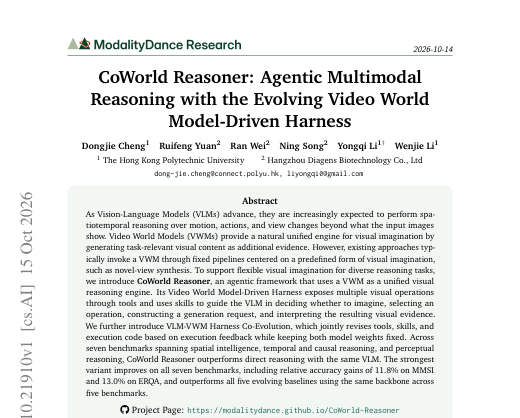
CoWorld Reasoner: Agentic Multimodal Reasoning with the Evolving Video World Model-Driven Harness

Dongjie Cheng, Ruifeng Yuan, Ran Wei, Ning Song, Yongqi Li, Wenjie Li

As Vision-Language Models (VLMs) advance, they are increasingly expected to perform spatiotemporal reasoning over motion, actions, and view changes beyond what the input images sho…

As Vision-Language Models (VLMs) advance, they are increasingly expected to perform spatiotemporal reasoning over motion, actions, and view changes beyond what the input images show. Video World Models (VWMs) provide a natural unified engine for visual imagination by generating task-relevant visual content as additional evidence. However, existing approaches typically invoke a VWM through fixed pipelines centered on a predefined form of visual imagination, such as novel-view synthesis. To support flexible visual imagination for diverse reasoning tasks, we introduce CoWorld Reasoner, an agentic framework that uses a VWM as a unified visual reasoning engine. Its Video World Model-Driven Harness exposes multiple visual operations through tools and uses skills to guide the VLM in deciding whether to imagine, selecting an operation, constructing a generation request, and interpreting the resulting visual evidence. We further introduce VLM-VWM Harness Co-Evolution, which jointly revises tools, skills, and execution code based on execution feedback while keeping both model weights fixed. Across seven benchmarks spanning spatial intelligence, temporal and causal reasoning, and perceptual reasoning, CoWorld Reasoner outperforms direct reasoning with the same VLM. The strongest variant improves on all seven benchmarks, including relative accuracy gains of 11.8% on MMSI and 13.0% on ERQA, and outperforms all five evolving baselines using the same backbone across five benchmarks.

cs.AIworld model

兴趣:vision-language-action (VLA) models and foundation models for robots

#402026-10-15追踪学者 · He Wang80

CQDC-Warp: GPU-Accelerated Differentiable Quasi-Dynamic Simulation for Contact-Rich Manipulation

Yanchen Ding, Jiayi Chen, Jianfeng Xu, Wei Zhao, Li Yi, He Wang

Efficient synthesis of contact-rich manipulation trajectories is essential for downstream robot learning. Gradient-based planning offers a promising approach, but jointly optimizin…

Efficient synthesis of contact-rich manipulation trajectories is essential for downstream robot learning. Gradient-based planning offers a promising approach, but jointly optimizing motion and contact decisions remains challenging. Meanwhile, many existing planners run on CPUs with limited throughput. We present CQDC-Warp, a GPU-accelerated differentiable quasi-dynamic simulator for batched model predictive control (MPC). We use it to study contact-guided trajectory optimization, in which intended robot--object contacts are specified before planning and encouraged through soft costs, while the simulated dynamics determine contact geometry and frictional response without a prescribed contact-mode schedule. Across $17{,}408$ trials on the $17$-object Allegro in-hand rotation benchmark, our framework achieves $79.8%$ success, compared with $73.7%$ for CFree and $65.2%$ for IMPACT, and reduces mean trajectory-generation time by factors of $27.0$ and $50.2$, respectively. On a single NVIDIA RTX 4090 with $2{,}048$ parallel worlds, forward and backward throughput reach $2.06\times10^5$ and $2.25\times10^5$ world-steps per second, respectively. Further experiments cover manipulation with LEAP and Shadow hands, environmental contact exploitation, bimanual manipulation, whole-body control, and real-world trajectory replay on a Sharpa hand.

cs.ROrobotmanipulation

追踪学者:He Wang;兴趣:robot manipulation and grasping with learned policies

#412026-10-1580

CoDA: Co-Evolution of Data Engines and Action Policies

Tianjiao Yu, Zhilin Ou, Yifan Shen, Xinzhuo Li, Yuanzhe Liu, Onkar Kishor Susladkar 等

Generative simulation can automate robot environment construction, but physically valid environments are not necessarily useful for training. The challenge is to identify environme…

Generative simulation can automate robot environment construction, but physically valid environments are not necessarily useful for training. The challenge is to identify environments that address a policy's failures and supervision that helps it overcome them. We introduce CoDA, a framework in which a simulation data engine and an action policy co-evolve through a shared heterogeneous memory of environment construction, policy failures, and learning progress. The memory compiles validated diagnoses from a vision-language critic into generation programs that recreate difficulties and training programs that help the policy overcome them. We further propose Text2potential to convert these diagnoses into staged potentials for action-chunk value learning, providing dense supervision for policy updates while preserving the task's optimal policy under standard shaping assumptions. Measured learning progress guides further generation and program refinement. Across four manipulation task families, CoDA improves out-of-distribution success from 5.3% after supervised fine-tuning to 27.6%, exceeding the strongest closed-loop baseline by 9.5 percentage points with the same generation budget. On LIBERO-Pro, 15 rounds of generation and training raise success from 25% to 84% under position perturbations and from 1% to 76% under instruction perturbations.

cs.ROcs.AIrobotmanipulation

兴趣:imitation learning and diffusion policies for robot control

#422026-10-1578

Training-Free Target-Aware Refinement of 3D Gaussian Language Map

Sibaek Lee, Kyeongsu Kang, Seongbo Ha, Yewon Jeon, Joonyeol Choi, Daegeol Ko 等

Distilling vision-language features into 3D Gaussian Splatting yields a language map that can be queried with arbitrary text. In deployment, however, a small set of user-specified …

Distilling vision-language features into 3D Gaussian Splatting yields a language map that can be queried with arbitrary text. In deployment, however, a small set of user-specified targets must be reliably located, which current distilled maps often miss, while open-vocabulary queryability for other words must remain intact. We propose a training-free, target-aware refinement of an already-distilled language map. Guided by a text-promptable segmenter, the visual embedding inside each detected target region is blended with the target text embedding, a convex combination whose coefficient sets the amount of injected prior, while non-target regions are left untouched. Injecting too much overwrites appearance cues and general queryability, so we seek, for each target, the smallest coefficient that still lets it win, and we obtain every coefficient in closed form, leaving no hyperparameters to tune. We further identify a failure mode of injection in language-goal localization. Text embeddings share a common component, and injecting them makes the standard cosine read-out query-agnostic, which a centering step in the read-out removes. Across three benchmarks, the refinement consistently improves open-vocabulary segmentation, roughly doubling the base mIoU on Replica, and localizes language goals more reliably than the base map. It also transfers as a plug-in to off-the-shelf field-based and object-level language maps and supports a real-world demonstration in which a legged robot navigates to natural-language goals. Project page and code: https://lab-of-ai-and-robotics.github.io/target-aware-langmap/

cs.ROcs.CVrobotlegged

兴趣:vision-language-action (VLA) models and foundation models for robots

#432026-10-1578

VP-EVT: Active Visibility Preservation for Embodied Visual Tracking

Yanci Wen, Tianle Zeng, Jianwei Peng, Weixi Situ, Hanjing Ye, Hong Zhang

Embodied Visual Tracking (EVT) is an essential capability for intelligent robots in human-robot collaboration, requiring an agent to follow a designated target person in dynamic en…

Embodied Visual Tracking (EVT) is an essential capability for intelligent robots in human-robot collaboration, requiring an agent to follow a designated target person in dynamic environments relying solely on egocentric visual perception. However, persistent pedestrian occlusions in dynamic scenes pose critical challenges to existing EVT methods. Lacking proactive visibility preservation, reactive tracking methods frequently experience prolonged target loss under severe occlusions. Therefore, we propose VP-EVT, a framework that treats target visibility as an explicit objective of motion control rather than a by-product of following. Acting on this objective requires understanding both what obstructs the target and how robot motion can change that obstruction. VP-EVT therefore uses language-guided perception to extract separate target and pedestrian observations. When occlusion makes current observations incomplete, VP-EVT combines visual history with ego-motion to maintain estimates of their relative positions and motion. Using these estimates and the current following waypoints, VP-EVT predicts whether continued following will sustain the obstruction. When the predicted risk is low, the original following motion is retained; otherwise, a recurrent controller combines updated estimates with maneuver context from preceding decisions to coordinate viewpoint adjustment and the return to stable following. Moreover, we introduce OccEVT-Bench for closed-loop evaluation of persistent occlusion and collect expert demonstrations for training. On its Risk split, VP-EVT improves success rate by 121.4% relative to a competitive baseline and reduces visibility deficit and longest target-loss duration by 78.8% and 74.4%, respectively.

cs.ROrobotembodied

兴趣:world models and video prediction for embodied agents

#442026-10-1478

LEAP: Gradient Flow Augmented Lagrangian Trajectory Optimization for Contact Constrained Robots

César E. Ramos Chuquiure, Ryan Tsai, Yutong Zhou, Zihang Huang, Vansh Thakur, Akshunn Trivedi 等

Generating dynamically feasible motions for legged and manipulating robots requires solving a large, nonlinear, non-convex optimal control problem (OCP) in which contact wrenches m…

Generating dynamically feasible motions for legged and manipulating robots requires solving a large, nonlinear, non-convex optimal control problem (OCP) in which contact wrenches must satisfy friction-cone constraints throughout the motion, not only at isolated instants. Existing solvers are sensitive to the initial guess and scale poorly with the number of joints. This paper introduces LEAP, which transcribes the OCP with pseudospectral collocation and, instead of a Newton or SQP solve, integrates a primal--dual gradient flow of a Powell--Hestenes--Rockafellar augmented Lagrangian to compute a solution. Because the flow is stiff, this paper designs a linearly implicit integrator with a Gauss--Newton metric, momentum, and a merit-based step controller that keeps the augmented Lagrangian monotone. Across locomotion benchmarks on five robot platforms, from planar hoppers to 32-joint humanoids, LEAP is the only method to solve every tested problem, achieves substantial speedups over Crocoddyl and Aligator on several benchmarks, and reaches trackable references at smaller compute budgets. The resulting trajectories are validated by tracking them in a high-fidelity simulator and on hardware. We will make the code public upon final acceptance of this paper.

cs.ROrobotleggedlocomotion

兴趣:reinforcement learning for legged locomotion and sim-to-real transfer

#452026-10-1577

Manifold Generative Annealing for Contact Constraint-aware Impedance Control with Reinforcement Learning Prior

Zhilin He, Guoquan Qi, Changliu Liu

Contact-rich robotic tasks require coordinated motion and impedance under uncertain interaction dynamics and physical constraints. While recent methods on learned policies provide …

Contact-rich robotic tasks require coordinated motion and impedance under uncertain interaction dynamics and physical constraints. While recent methods on learned policies provide useful interaction strategies, they may fail when contact conditions differ from those encountered during training. Model-based generative methods show promising receding-horizon trajectories optimization results, but often lack structured behavioral guidance and refinement that jointly accounts for constraint geometry and actual contact responses. To this end, we propose Manifold Generative Annealing (MGA), a joint model-free and model-based generative framework for motion--impedance optimization. MGA first organizes pretrained reinforcement learning policies into structured sequence proposals, retaining task-specific interaction strategies without committing to their execution. It then evaluates these proposals alongside exploratory samples through model-based rollouts for refinement or separate execution selection. Crucially, realization-aware manifold refinement aligns updates from the refinement bank with both task constraints and locally achievable physical responses, allowing learned experience to guide online adaptation under changing contact conditions. Experiments cover surface scanning, peg insertion, and humanoid pushing, with improved safety success rate of impedance control under nominal and sensing-shift conditions.

cs.ROhumanoid

兴趣:imitation learning and diffusion policies for robot control

#462026-10-1576

Multi-Teacher On-Policy Distillation for Flow-Based Vision-Language-Action Models

Lichao Ni, Yuhan Liu, Pengfei Li, Guanghuan Fang

Specialized vision-language-action (VLA) policies acquire strong domain-specific skills, yet consolidating these skills into one shared policy remains challenging. On-policy distil…

Specialized vision-language-action (VLA) policies acquire strong domain-specific skills, yet consolidating these skills into one shared policy remains challenging. On-policy distillation (OPD) transfers teacher knowledge on inputs induced by the student, addressing the distribution mismatch encountered during deployment. For flow-based VLAs, this mismatch arises at two levels: environment observations and intermediate action-generation states. We propose a two-level on-policy distillation framework that couples student-driven environment interaction with teacher velocity supervision along student-generated action flow trajectories. Frozen domain specialists jointly supervise one student. After each update, the student collects new environment experience and generates fresh action-flow trajectories. Starting from a joint supervised fine-tuning (SFT) initialization, Velocity Loss OPD yields absolute success-rate gains of 22.55% on LIBERO-40, 33.4% on CALVIN five-instruction sequences, and 22.6% on Meta-World MT50. Compared with Action Loss OPD and Teacher-rollout SFT, it achieves absolute success-rate gains of 6.4-9.5% on LIBERO-40, 9.7-18.3% on CALVIN, and 3.2-4.2% on Meta-World MT50. Analysis by sequence length further shows larger success-rate gains on longer CALVIN sequences. These results demonstrate effective multi-domain capability consolidation through two-level on-policy supervision, with a single student deployed across domains.

cs.ROVLAvision-language-action

兴趣:vision-language-action (VLA) models and foundation models for robots

#472026-10-1575

Progress Reward Model for Reinforcement Learning via Large Language Models

Xiuhui Zhang, Ning Gao, Xingyu Jiang, Yihui Chen, Yuheng Pan, Mohan Zhang 等

Traditional reinforcement learning (RL) algorithms face significant limitations in handling long-term tasks with sparse rewards. Recent advancements have leveraged large language m…

Traditional reinforcement learning (RL) algorithms face significant limitations in handling long-term tasks with sparse rewards. Recent advancements have leveraged large language models (LLMs) to enhance RL by utilizing their world knowledge for task planning and reward generation. However, planning-based approaches often depend on pre-defined skill libraries and fail to optimize low-level control policies, while reward-based methods require extensive human feedback or exhaustive searching due to the complexity of tasks. In this paper, we propose the Progress Reward Model for RL (PRM4RL), a novel framework that integrates task planning and dense reward to enhance RL. For high-level planning, a complex task is decomposed into a series of simple manageable subtasks, with a subtask-oriented, fine-grained progress function designed to monitor task execution progress. For low-level reward generation, inspired by potential-based reward shaping, we use the progress function to construct a Progress Reward Model (PRM), providing theoretically grounded optimality and convergence guarantees, thereby enabling effective policy optimization. Experimental results on robotics control tasks demonstrate that our approach outperforms both LLM-based planning and reward methods, achieving state-of-the-art performance. Code is available at https://github.com/deng-ai-lab/PRM4RL.

cs.AItask planning

兴趣:large language models for robot task planning and reasoning

#482026-10-1575

LICOA: Learning Instruction-Conditioned Optical Actions for Mobile Spatial Augmented Reality

Yuchen Deng, Shunkai Zhou, Ruixuan Zhu, Haibin Ling, Bingyao Huang

Spatial augmented reality (SAR) augments physical environments with projected content, but most systems assume that the projector pose, target region, or motion path has been fixed…

Spatial augmented reality (SAR) augments physical environments with projected content, but most systems assume that the projector pose, target region, or motion path has been fixed or specified. We instead make projected light an embodied action: given a language instruction and current visual observations, a system must decide how to move and where and at what scale to place the projection. We introduce LICOA to realize this capability. Its differential-drive chassis provides room-scale approach and repositioning, while a steerable mirror with two degrees of freedom (2DoF) and projection scale provide rapid local control of the beam. A shared interface maps synchronized external and onboard RGB cameras with robot control state to physical optical actions across pretrained action models. Because instruction-conditioned optical action lacks dedicated training data and a common evaluation protocol, we construct a matched simulation embodiment and a corpus with 150 tasks and 7,500 rendered episodes, then evaluate models trained only on this corpus in previously unseen real-world environments. Across 480 complete closed-loop real-world execution trials (rollouts) on 12 tasks, the best adapted action model achieves a 57.50% success rate and 40.64% success weighted by path length, compared with 8.33% and 5.15% for the same architecture trained from scratch. A further 150 real-world ablation rollouts support the need for both camera views and coordinated control of the chassis and mirror. These results establish a physical platform, shared perception and optical action interface, corpus, and real-world evaluation protocol for treating projected light as an embodied action.

cs.ROcs.CVrobotembodied

兴趣:vision-language-action (VLA) models and foundation models for robots

#492026-10-1575

DemoStream: Batched Task-and-Motion-Plan Optimization for Automated Learning from Demonstration

Caelan Garrett, Neel Jawale, Fabio Ramos

Learning from demonstration is an effective strategy for endowing robots with manipulation capabilities but requires training on datasets comprised of massive amounts of demonstrat…

Learning from demonstration is an effective strategy for endowing robots with manipulation capabilities but requires training on datasets comprised of massive amounts of demonstrations. Existing demonstration collection approaches either require constant human involvement, for example, via teleoperation or are specialized for a single task. Task and Motion Planning (TAMP) systems are able to autonomously solve and therefore generate demonstrations for general-purpose tasks; however, learning from their demonstrations has proven difficult due to multi-modality in their solutions. In this work, we build on recent work leveraging GPU acceleration for TAMP and propose DemoStream, a TAMP system that optimizes demonstration quality in order to improve behavior cloning success rates. First, we introduce batched TAMP sampling operations along with a new TAMP algorithm that correspondingly performs batched constraint satisfaction in order to explore many solutions in parallel. We conduct simulation experiments ablating different action spaces, cost functions, and batch sizes to analyze the effect of these choices on downstream policy success rates. Finally, we show that we can leverage the safety guarantees of TAMP to directly collect real-world demonstrations at an average rate of 66 demos per hour. See our website for policy rollout videos: demostream.github.io.

cs.ROcs.AIcs.LGmanipulation

兴趣:imitation learning and diffusion policies for robot control

#502026-10-1575

AgentPerturb: Evaluating LLM Agent Robustness under Controlled Interaction Perturbations

Yuanjian Xu, Jinyi Han, Jianing Hao, Yuxuan Sun, Fanyang Lu, Richeng Xuan 等

Real-world tasks are often complex and noisy, posing substantial challenges for LLM agents. Yet existing evaluations lack a systematic framework for jointly characterizing potentia…

Real-world tasks are often complex and noisy, posing substantial challenges for LLM agents. Yet existing evaluations lack a systematic framework for jointly characterizing potential perturbation targets and types. We use this two-dimensional view to conduct a unified study that quantifies the robustness of current frontier models, traces the mechanisms behind perturbation-induced failures, and draws implications for robustness-oriented training. Through controlled evaluations on APEX-Agents and Toolathlon, we find that perturbations consistently degrade performance, while the dominant vulnerabilities vary across task environments. Trajectory-level analysis reveals that agents rarely recognize altered inputs and often propagate corrupted information without verification. A focused cost analysis further shows that successful perturbed trajectories can require substantially more computation. These findings motivate training objectives that cover diverse forms of noise and reward verification, uncertainty awareness, and recovery. We provide a rigorous benchmark-construction pipeline. Code and data will be released at https://github.com/xuyj233/AgentPerturb.

兴趣:multi-agent systems and LLM agents

GitHub 项目

#12026-10-08★ 77 +30新项目80

DexForce/UNITAS

Python

Official codebase for Unitas: A 3D-Native World Action Model for Embodied Manipulation

Official codebase for Unitas: A 3D-Native World Action Model for Embodied Manipulation

robot-learningrobot-manipulationroboticsvision-language-action-modelworld-action-modelsworld-modelsrobotmanipulationvision-language-actionembodied

兴趣:vision-language-action (VLA) models and foundation models for robots

#22024-12-08★ 4.1k +1876

datawhalechina/every-embodied

Jupyter Notebook

仅需Python基础,从0构建自己的具身智能机器人;从0逐步构建VLA/OpenVLA/SmolVLA/Pi0, 深入理解具身智能

仅需Python基础,从0构建自己的具身智能机器人;从0逐步构建VLA/OpenVLA/SmolVLA/Pi0, 深入理解具身智能

embodied-agentembodied-aiembodied-intelligenceopenvlasmolvlavision-language-action-modelVLAvision-language-actionembodied

兴趣:world models and video prediction for embodied agents

#32026-09-23★ 100 +67新项目75

ABC12345anouys/EvoBot

Python

Agent + reusable skill library for LIBERO manipulation tasks (no RL / VLA / world model; no LLM calls at runtime)

Agent + reusable skill library for LIBERO manipulation tasks (no RL / VLA / world model; no LLM calls at runtime)

bddlembodied-ailiberomanipulationmujocorobosuiterobot-learningroboticsrobotmanipulationVLAembodiedworld model

兴趣:robot manipulation and grasping with learned policies

#42026-07-06★ 2.3k +575

dexmal/opendm

Python

An Open-World Foundation Model for General-Purpose Embodied Intelligence.

An Open-World Foundation Model for General-Purpose Embodied Intelligence.

embodied-aiembodied-intelligenceroboticsvision-language-actionvlaVLAvision-language-actionembodied

兴趣:vision-language-action (VLA) models and foundation models for robots

#52026-09-02★ 67 +5275

JethroJames/awesome-robots-icl

Python

Companion repository for “In-Context Learning for Robots: Methods and Applications” — methods, datasets, and benchmarks organized by taxonomy and release date.

Companion repository for “In-Context Learning for Robots: Methods and Applications” — methods, datasets, and benchmarks organized by taxonomy and release date.

awesome-listembodied-aiimitation-learningin-context-learningrobot-learningroboticsvision-language-actionworld-modelsrobotvision-language-actionembodied

兴趣:vision-language-action (VLA) models and foundation models for robots

#62026-10-05★ 162 +5新项目74

AetherLabsAI/Video2World

Python

Benchmarking Coding Agents for Interactive World Modeling from Embodied Videos - Rethinking Embodied Real2Sim from a Software Engineering Perspective

Benchmarking Coding Agents for Interactive World Modeling from Embodied Videos - Rethinking Embodied Real2Sim from a Software Engineering Perspective

benchmarkcoding-agentembodied-aifoundation-modelsreal-to-simrobot-learningroboticssimulationrobotembodied

兴趣:world models and video prediction for embodied agents

#82026-07-19★ 652 +473

RealXiaoze/humanoid-motion-intelligence

人形机器人运动智能论文、开源项目、产业与求职知识库

人形机器人运动智能论文、开源项目、产业与求职知识库

embodied-aihumanoid-roboticslocomotionmotion-controlreinforcement-learningrobot-learningsim2realvlarobotVLAhumanoidlocomotionembodied

兴趣:humanoid robots and whole-body control

#92026-10-04★ 45新项目72

Roboparty/P-BFM

Python

Perceptive behavioral foundation models for terrain-adaptive humanoid control: motion tracking, goal reaching, reward inference and teleoperation.

Perceptive behavioral foundation models for terrain-adaptive humanoid control: motion tracking, goal reaching, reward inference and teleoperation.

behavioral-foundation-modelshumanoid-controlmjlabmujocoperceptionreinforcement-learningteleoperationunsupervised-learninghumanoid

兴趣:humanoid robots and whole-body control

#102024-01-26★ 28.2k +2972

huggingface/lerobot

Python

🤗 LeRobot: Making AI for Robotics more accessible with end-to-end learning

🤗 LeRobot: Making AI for Robotics more accessible with end-to-end learning

兴趣:imitation learning and diffusion policies for robot control

#112026-09-30★ 101 +11新项目72

groundingpi/GroundingPI

Python

A 4B grounding foundation model for physical intelligence. Unifies detection, referring, pointing, OCR, GUI, and layout grounding, achieving SOTA overall across 34 benchmarks and i…

A 4B grounding foundation model for physical intelligence. Unifies detection, referring, pointing, OCR, GUI, and layout grounding, achieving SOTA overall across 34 benchmarks and improving robot generalization and data efficiency in controlled evaluations.

embodied-aigui-groundingobject-detectionocrphysical-intelligencepointingrobot-learningvision-language-modelrobotVLAembodied

兴趣:vision-language-action (VLA) models and foundation models for robots

#122025-09-25★ 392 +1372

syswonder/robonix

Rust

The Agentic Operating System for Robots

The Agentic Operating System for Robots

agentembodied-airobotsskill-mdvlavlmVLAembodied

兴趣:vision-language-action (VLA) models and foundation models for robots

#132025-04-04★ 1.9k +272

RoboVerseOrg/RoboVerse

Python

RoboVerse: Towards a Unified Platform, Dataset and Benchmark for Scalable and Generalizable Robot Learning

RoboVerse: Towards a Unified Platform, Dataset and Benchmark for Scalable and Generalizable Robot Learning

imitation-learningreinforcement-learningroboticssimulationrobot

兴趣:imitation learning and diffusion policies for robot control

#142024-12-24★ 38371

manumerous/wb_humanoid_mpc

C++

Whole-Body Nonlinear MPC for Realtime Humanoid Loco-Manipulation Planning and Control

Whole-Body Nonlinear MPC for Realtime Humanoid Loco-Manipulation Planning and Control

aidata-generationhumanoidhumanoid-robotlocomotionmpcnonlinearoptimizationrobotmanipulationhumanoidlocomotion

兴趣:humanoid robots and whole-body control

#152026-08-29★ 145 +571

nssmd/RoboRSI

Python

Robot-agent harness with a CLI and local Web console for LIBERO short evaluation

Robot-agent harness with a CLI and local Web console for LIBERO short evaluation

agentsembodied-aievaluationliberorobot-learningroboticsself-evolutionrobotembodied

兴趣:multi-agent systems and LLM agents

#162026-10-07★ 201 +47新项目71

fudan-generative-vision/Remory

Python

Remory: Learning Residual Memory for Context Compaction

Remory: Learning Residual Memory for Context Compaction

context-compactioninferencellm-agentsresidual-memory

兴趣:world models and video prediction for embodied agents

#172024-05-11★ 1.8k +571

robocasa/robocasa

Python

RoboCasa: Large-Scale Simulation of Everyday Tasks for Generalist Robots

RoboCasa: Large-Scale Simulation of Everyday Tasks for Generalist Robots

humanoid-robotphysics-simulationrobot-learningroboticsrobothumanoid

兴趣:humanoid robots and whole-body control

#182025-11-23★ 711 +170

sou350121/VLA-Handbook

HTML

本项目旨在为致力于进入VLA(Vision-Language-Action)领域的算法工程师提供一份全中文、实战导向的学习/面试手册。 不同于通用的 CV/NLP 面试指南,本项目聚焦于 Robotics 特有的挑战

本项目旨在为致力于进入VLA(Vision-Language-Action)领域的算法工程师提供一份全中文、实战导向的学习/面试手册。 不同于通用的 CV/NLP 面试指南,本项目聚焦于 Robotics 特有的挑战

chinesedeep-learningembodied-aillmrobot-learningroboticsvision-language-actionvlarobotVLAvision-language-actionembodied

兴趣:vision-language-action (VLA) models and foundation models for robots

#192026-09-29★ 191 +14新项目70

zqc3117/Spotter

Python

Official codebase for Spotter: Let the Embodied Model Lead, and the VLM Reflect for It

Official codebase for Spotter: Let the Embodied Model Lead, and the VLM Reflect for It

embodied-aillm-agentqwenrobocasarobodojorobot-learningrobot-manipulationroboticsrobotmanipulationembodied

兴趣:vision-language-action (VLA) models and foundation models for robots

#202025-10-09★ 3.8k +370

starVLA/starVLA

Python

StarVLA: A Lego-like Codebase for Vision-Language-Action Model Developing

StarVLA: A Lego-like Codebase for Vision-Language-Action Model Developing

robotic-foundation-modelroboticsvision-language-action-modelworld-action-modelvision-language-action

兴趣:vision-language-action (VLA) models and foundation models for robots

#212026-05-19★ 117 +1570

Open-X-Humanoid/HEX

Python

HEX is a whole-body vision-language-action framework for full-sized humanoid robots.

HEX is a whole-body vision-language-action framework for full-sized humanoid robots.

cross-embodimentembodied-aihumanoid-roboticsimitation-learningmultimodal-aivision-language-action-modelvla-modelwhole-body-manipulationmanipulationVLAvision-language-actionhumanoidembodied

兴趣:humanoid robots and whole-body control

#222025-08-14★ 5.4k +970

RLinf/RLinf

Python

RLinf: Reinforcement Learning Infrastructure for Embodied and Agentic AI

RLinf: Reinforcement Learning Infrastructure for Embodied and Agentic AI

agentic-aiembodied-aireinforcement-learningrl-infrarlinfvla-rlVLAembodied

兴趣:vision-language-action (VLA) models and foundation models for robots

#232022-11-16★ 8.4k +1469

isaac-sim/IsaacLab

Python

Unified framework for robot learning with multi-physics/renderer support

Unified framework for robot learning with multi-physics/renderer support

isaac-simomniverse-kit-extensionrobot-learningroboticsrobot

兴趣:3D perception, point clouds and scene understanding for robotics

#242024-11-02★ 2k69

vonzosten/awesome-LangGraph

JavaScript

An index of the LangChain + LangGraph ecosystem: concepts, projects, tools, templates, and guides for LLM & multi-agent apps.

An index of the LangChain + LangGraph ecosystem: concepts, projects, tools, templates, and guides for LLM & multi-agent apps.

aiawesomeawesome-listlangchainlanggraphllmllm-agents

兴趣:multi-agent systems and LLM agents

#252024-02-29★ 16669

RobotControlStack/robot-control-stack

Python

A lean, ROS-free sim-to-real framework for training and deploying Vision-Language-Action (VLA) models and RL agents. Native MuJoCo Gymnasium wrappers with synchronous execution for…

A lean, ROS-free sim-to-real framework for training and deploying Vision-Language-Action (VLA) models and RL agents. Native MuJoCo Gymnasium wrappers with synchronous execution for Franka, UR5e, xArm, SO101 and YAM.

frankagymnasiummujocoreinforcement-learningrobot-learningrobot-manipulationsim-to-realvision-language-actions-modelsrobotmanipulationVLAvision-language-actionsim-to-real

兴趣:vision-language-action (VLA) models and foundation models for robots

#262026-04-22★ 20.9k +29669

earthtojake/text-to-cad

Python

Give your agent CAD superpowers.

Give your agent CAD superpowers.

agentsai-agentscadmechanical-engineeringroboticsstepstlstp

兴趣:multi-agent systems and LLM agents

#272026-10-09★ 32 +2新项目69

ToberJ/reflex

Python

Reflex: Visually Grounded Reactive Humanoid Control (code coming soon)

Reflex: Visually Grounded Reactive Humanoid Control (code coming soon)

catchinghumanoidreinforcement-learningrobot-learningsim-to-realwhole-body-controlrobothumanoidsim-to-real

兴趣:humanoid robots and whole-body control

#282025-11-21★ 4.7k +4268

dorianborian/sesame-robot

C

An open and affordable mini quadruped robot based on ESP32.

An open and affordable mini quadruped robot based on ESP32.

hardwareroboticswalking-robotrobot

兴趣:humanoid robots and whole-body control

#292026-06-24★ 244 +768

MinghaoFu/lewam

Python

LeWAM: End-to-End World and Action Modeling with JEPAs

LeWAM: End-to-End World and Action Modeling with JEPAs

jeparobot-learningworld-modelsrobot

兴趣:vision-language-action (VLA) models and foundation models for robots

#302026-03-18★ 70k +57168

rohitg00/ai-engineering-from-scratch

Python

Learn AI Engineering! Learn it. Build it. Ship it for others.

Learn AI Engineering! Learn it. Build it. Ship it for others.

agentsaiai-agentsai-engineeringcomputer-visioncoursedeep-learningfrom-scratch

兴趣:multi-agent systems and LLM agents