Tech Station

2026-11-03

50 篇论文 · 30 个项目 ← 2026-11-02 · 2026-11-04 →

论文

#12026-11-0199

ODE Policy: Robot Learning via Action Dynamics, Not Actions

Jindou Jia, Jingliang Li, Kuangji Zuo, Tuo An, Yuxuan Hu, Mengfei Zhao 等

Most robot policies, whether trained by imitation learning (IL) or reinforcement learning (RL), map observations to action values at discrete control steps and leave the continuity…

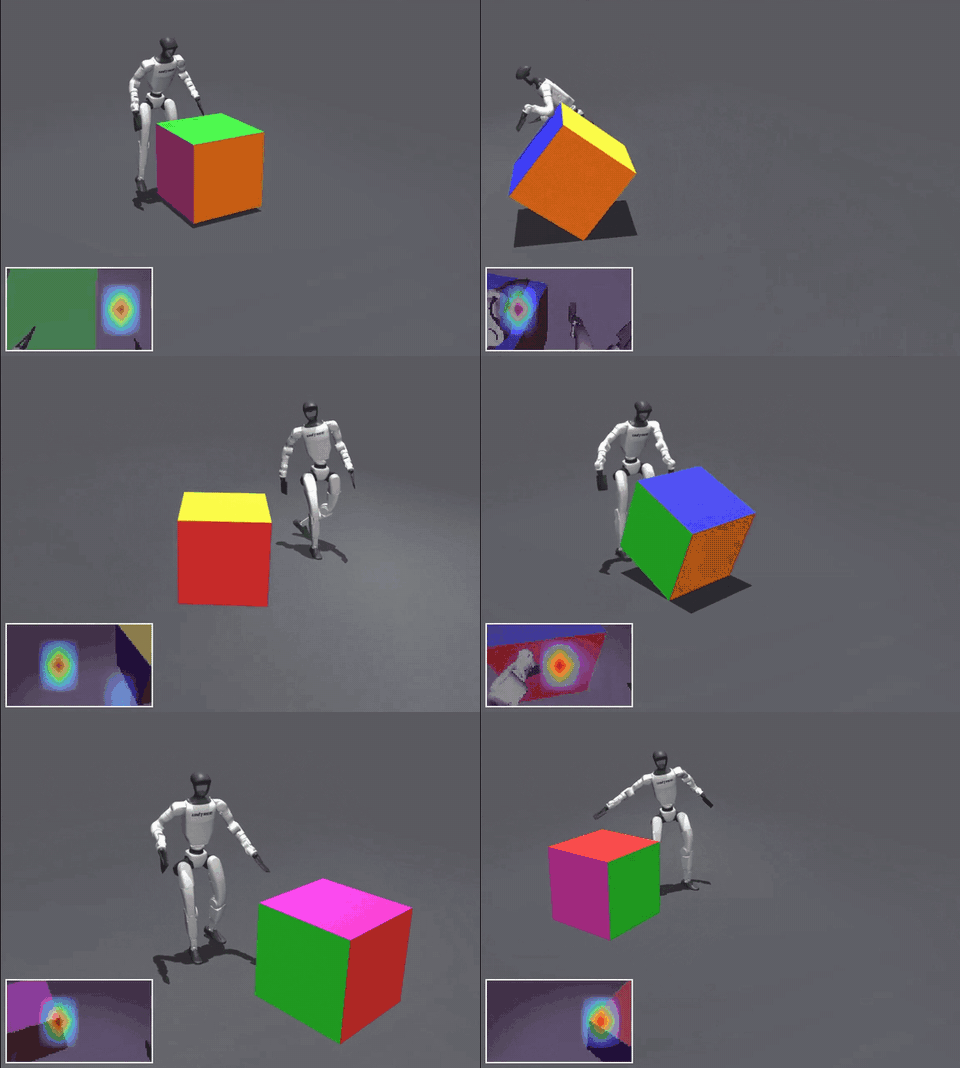
Most robot policies, whether trained by imitation learning (IL) or reinforcement learning (RL), map observations to action values at discrete control steps and leave the continuity of physical motion to be learned implicitly. We propose ODE policy, which learns the dynamics of the action rather than the action itself. A neural ordinary differential equation (ODE) learns the vector field of the action by matching the integrated actions to the targets over short action chunks in IL and single control steps in RL. A lightweight diversity head captures multi-modal behavior by randomizing the direction of the field. At deployment, each action is integrated from the previous one, so the executed trajectory is continuous by construction. We evaluate it as a visuomotor policy, as the action head of vision-language-action (VLA) and world action models (WAMs), and as the actor of model-based RL against 14 baselines on unimanual, bimanual, dexterous, locomotion, and loco-manipulation tasks. In IL, against flow matching, it reaches 5.9$\times$ the success, 5.4$\times$ the generalization, and 3.9$\times$ the mode balance after one epoch, and generates actions 10.8$\times$ faster. It mostly moves more smoothly than human demonstrations. On 14 real-world tasks across single-arm, dual-arm, dexterous, and humanoid robots, it achieves the highest success rate. In RL, it further speeds up SuperMimic for humanoid motion tracking and smooths its actions. Efficient in learning, data, parameters, and execution, ODE policy offers a promising path to scaling robot learning.

cs.ROrobotmanipulationVLAvision-language-actionimitation learninghumanoid

兴趣:imitation learning and diffusion policies for robot control

#22026-11-02追踪学者 · Deepak Pathak98

Pixel: A Co-Designed Full-Stack Robot System for Learning General-Purpose Mobile Manipulation

Tony Tao, Jason Jingzhou Liu, Ruslan Salakhutdinov, Deepak Pathak

General-purpose mobile manipulation requires a combination of capable robot hardware, scalable demonstration collection, expressive whole-body control, and effective policy learnin…

General-purpose mobile manipulation requires a combination of capable robot hardware, scalable demonstration collection, expressive whole-body control, and effective policy learning. Yet these components are often developed independently, creating mismatches that limit the capabilities of the complete system. We present Pixel, a co-designed full-stack system for learning general-purpose mobile manipulation. Pixel combines a low-cost wheeled humanoid with human-aligned kinematics and compliant grippers, multiple teleoperation and robot-free human data-collection interfaces, a unified whole-body controller, and a common policy learning pipeline across human and robot demonstrations. A hierarchical learning stack further enables language-conditioned visuomotor control and long-horizon task execution. We evaluate the system across hardware, data collection, and policy learning, and demonstrate mobile-manipulation behaviors requiring dexterity, active perception, navigation, and whole-body coordination. We hope that Pixel provides an integrated and extensible foundation for studying how robot hardware, data, control, and learning can be designed together for robot learning. More results at https://pixel-robot.com/pixel

cs.ROcs.AIcs.CVcs.LGeess.SYrobotmanipulationhumanoid

追踪学者:Deepak Pathak;兴趣:robot manipulation and grasping with learned policies

#32026-10-3096

Anchor 1: Precise and Stable Humanoid Control for Whole-Body Manipulation

Archon Robotics, :, Caojun Wang, Checheng Yu, Gangcheng Jiang, Guangjun Zeng 等

Humanoid controllers have acquired increasingly diverse motor skills, yet translating these capabilities into precise and stable whole-body manipulation remains challenging. Manipu…

Humanoid controllers have acquired increasingly diverse motor skills, yet translating these capabilities into precise and stable whole-body manipulation remains challenging. Manipulation tasks are sensitive to execution deviations -- even small errors or unintended steps can cause failure. Introducing Anchor 1, a whole-body controller for precise and stable whole-body manipulation, together with a benchmark spanning diverse coordination demands. Anchor 1 adopts calibrated sparse motion references to preserve task-relevant human motion structure without online joint-space retargeting, leaving kinematic freedom for precise control. To guide this freedom towards stable, physically plausible whole-body coordination, we shape the training distribution through offline curation of robot motions paired with these calibrated sparse references. We further introduce explicit error feedback decoupled from motion encoding, improving control precision while supporting flexible command interfaces. To achieve a systematic evaluation of these capabilities, a benchmark is proposed to assess precision, sustained execution stability, and reachability across diverse whole-body coordination demands. Evaluations in simulation and on hardware show stronger precision and stability across all evaluation tracks. Under the most strict real-world global scoring setting, Anchor 1 achieves a 30% to 80% decrease in tracking error with fewer look-ahead inputs, and without retargeting compared to all existing controllers. Downstream experiments demonstrate more efficient teleoperated data collection and higher task success using the same deployment pipeline as well. We believe Anchor 1 supports precise and stable whole-body control as a practical basis for humanoid task execution.

cs.ROrobotmanipulationhumanoid

兴趣:humanoid robots and whole-body control

#42026-11-02追踪学者 · Lerrel Pinto96

PanoTac: A Dense Three-Axis Tactile Sensor for Robust Touch-Centric Manipulation

Binglin, Wang, Xiaole, Jiang, Zicheng Teng, Xinqi Liu 等

Contact-rich manipulation benefits from tactile feedback that captures both detailed contact geometry and interaction forces. When scooping grains, contact patterns help infer spoo…

Contact-rich manipulation benefits from tactile feedback that captures both detailed contact geometry and interaction forces. When scooping grains, contact patterns help infer spoon orientation, while resistance transmitted through the grasp guides motion. To provide these complementary sensing capabilities, we present PanoTac, a low-cost, compliant tactile fingertip designed for dense three-axis tactile sensing. Each fingertip provides a $12 \times 32 \times 3$ tactile representation, with one normal ($z$) and two shear ($x$, $y$) response components at each taxel. The sensor operates at 60 Hz and costs less than $50 per fingertip. Sensor characterization quantifies response repeatability and consistency across sensor instances and contact locations. We integrate PanoTac into a robotic system with a visuo-tactile pipeline. Across test-tube preparation, grain scooping, and salt pouring, the resulting policies outperform vision-only baselines by an average of 46.7 percentage points. Ablations show that removing either spatial contact information or shear feedback reduces overall performance across the task suite. Our project page is available at https://panotac.github.io.

cs.ROcs.AIcs.LGmanipulationgrasptactile

追踪学者:Lerrel Pinto;兴趣:dexterous hands and tactile sensing

#52026-11-01追踪学者 · Marco Hutter93

GoalDex: Learning Image-Goal-Conditioned Policies for Dexterous In-Hand Manipulation

Arjun Bhardwaj, Mayank Mittal, Maximum Wilder-Smith, Vaishakh Patil, Marco Hutter

Dexterous in-hand manipulation is commonly formulated around explicit object pose estimation, yet reliable pose tracking is challenging under severe hand-object occlusions and ofte…

Dexterous in-hand manipulation is commonly formulated around explicit object pose estimation, yet reliable pose tracking is challenging under severe hand-object occlusions and often requires object-specific supervision. This dependence creates a bottleneck between perception and control that can limit robustness and scalability. We present an end-to-end visuomotor framework for dexterous in-hand reorientation that operates on RGB observations and proprioception without intermediate pose estimation. Our approach jointly learns visual representations and control policies through behavior distillation from privileged state teachers and auxiliary reconstruction objectives. Furthermore, we introduce image-goal-conditioned reorientation, allowing desired object configurations to be specified directly through images rather than canonical pose representations. We evaluate our approach across a diverse set of object geometries and instances in simulation, where it consistently outperforms pose-based methods and policies built on pretrained visual encoders. Finally, we demonstrate direct sim-to-real transfer of a single image-goal-conditioned policy across five real-world objects, showing that accurate dexterous reorientation can be achieved without explicit pose estimation. For videos and code release, please refer to the project website: https://rffr.leggedrobotics.com/works/goaldex/

cs.ROmanipulationsim-to-realdexterous

追踪学者:Marco Hutter;兴趣:robot manipulation and grasping with learned policies

#62026-11-0193

CompliantBot: Learning Whole-Body Compliance across Task Interfaces for Humanoid Control

Haoyang Li, Keqi Zhu, Zhanxiang Cao, Yang Zhang, Yizhi Chen, Xuekang Yang 等

Humanoid controllers need the ability to yield to external forces while retaining the capacity to resume their original tasks. However, tracking objectives penalize the deviations …

Humanoid controllers need the ability to yield to external forces while retaining the capacity to resume their original tasks. However, tracking objectives penalize the deviations needed for yielding, while relaxing tracking goals persistently can make task recovery harder. Existing approaches often rely on task-specific interaction command interfaces or constructed compliant motion data and reference trajectories, limiting the direct reuse of their compliance-training mechanisms across different task interfaces. We introduce CompliantBot, a compliance-training framework for motion tracking and velocity-command locomotion. It preserves the original task inputs and requires no preconstructed compliant data or target trajectories. A state-dependent interaction force field couples applied loads to the robot's motion, enabling local articulation and whole-body movement to change the forces experienced. A complementary force-magnitude reward encourages lower interaction loads, while task rewards are downweighted during loading and restored after release to coordinate yielding and task resumption. The trained policies use task inputs and proprioceptive history without explicit external-force measurements. Across both task interfaces, CompliantBot yields farther under constant pulls and experiences lower spring interaction loads than matched baselines, while resuming task tracking after force removal. CompliantBot achieves the highest task completion among the compared methods under stronger pulls. Power evaluations further show that CompliantBot has the lowest mean joint mechanical power among the compared methods. Real-robot demonstrations further illustrate compliant responses through arm motion, stepping, and body reorientation.

cs.ROrobothumanoidlocomotion

兴趣:humanoid robots and whole-body control

#72026-10-3193

Leap-VLA: High-Rate Robot Control from a Low-Rate VLM Backbone

Lin Yang, Yunjie Shen, Zheyu Li, Zhenjie Tian, Yongli Wang, Dongze Huang 等

Vision-language-action (VLA) models re-encode the full observation through a multi-billion-parameter vision-language model (VLM) at every control step, even though scene semantics …

Vision-language-action (VLA) models re-encode the full observation through a multi-billion-parameter vision-language model (VLM) at every control step, even though scene semantics evolve at roughly 1 Hz while reactive control requires 20-50 Hz. We present a VLA that decouples the two: a VLM runs as a low-frequency semantic anchor whose cached context is reused across control steps, while a flow-matching action expert operates at high frequency, consuming the cached semantics with a fresh, low-latency visual stream from a compact encoder pretrained on robot video with masked reconstruction, optical flow, and depth. The measured age $τ$ of the cache conditions the expert through adaptive layer normalization. Reusing the cache makes the policy a function of its age, and training covers that function explicitly: cache ages sampled from real episode history, plus an age-ramped pixel corruption that erases the stale snapshot the way deployed staleness corrupts content. On the asynchronous deployment stack, the recipe closes most of the staleness gap: on LIBERO-Spatial, 61.4% to 95.5% at a 2 s semantic refresh (95.9% at 1 s, within 1.6 points of the frequency-matched anchor); averaged over the four LIBERO suites, the deployed policy holds 95.2% at a 1 s refresh and 94.5% at 2 s against a 96.3% matched anchor. A forward-only chunk-boundary correction (soft-nudge), an autograd-free reformulation of real-time-chunking guidance, carries per-control-step re-planning without loss (97.1%) at zero added latency. The same lens exposes a second defect: under an instruction-scene mismatch the policy keeps manipulating the scene, and a chain-of-thought verdict gate trained on zero-cost negative episodes freezes execution exactly on mismatched instructions without hurting feasible success.

cs.AIrobotVLAvision-language-action

兴趣:vision-language-action (VLA) models and foundation models for robots

#82026-11-02追踪学者 · Dieter Fox92

RoboColosseum: Evaluating Physical Intelligence at Scale In-The-Wild

Tan Sang Nguyen, Yi Ru Wang, Shailesh Shailesh, Gang Yang, Jiamo Hu, Jianuo Jiang 等

General-purpose robot policies must work across robots, tasks, and environments, yet the variation that makes physical trials informative also makes them difficult to reproduce. We…

General-purpose robot policies must work across robots, tasks, and environments, yet the variation that makes physical trials informative also makes them difficult to reproduce. We introduce RoboColosseum, a distributed evaluation framework that combines unified policy serving and standardized protocols across a network of locally operated robots in diverse environments. Our initial study evaluates five vision-language-action (VLA) policies and three frontier AI agents across four embodiments (SO-101, Franka, Bimanual-YAM, and G1 Humanoid). The Open Track compares models without task-specific adaptation in blinded, pairwise trials under matched local conditions. The Fine-tune Track measures how well VLA policies adapt to 20 tasks across all four embodiments when each policy receives the same 100 demonstrations per task. Across 5,699 pairwise Open Track comparisons at 124 sites, frontier agents rival specialized VLA policies, while all systems struggle to complete open-world tasks reliably. After fine-tuning, GR00T N1.7 leads on SO-101 and pi0.5 leads on Franka and Bimanual-YAM. Policy rankings show weak agreement across embodiment-specific task suites (Kendall W = 0.24). Open Track rankings poorly predict relative performance after fine-tuning, with substantial rank reversals on all three embodiments shared between tracks. Measuring partial progress reveals differences that task success alone misses. On the G1 Humanoid, no policy completes any of the five tasks, yet average progress ranges from 13.3% to 23.2% across policies. Open Track rankings stabilize as trials accumulate, and active matchmaking achieves comparable ranking agreement with substantially fewer physical trials than uniform sampling. These results show how distributed physical evaluation can reveal where robot policies generalize, how well they adapt to new tasks, and how far they progress on tasks they fail to complete.

cs.ROcs.AIrobotVLAvision-language-actionhumanoid

追踪学者:Dieter Fox;兴趣:vision-language-action (VLA) models and foundation models for robots

#92026-11-02追踪学者 · Deepak Pathak92

Pixel-UMI: Learning Environment-Aware Whole-Body Manipulation from Sensorized Human Demonstrations

Jason Jingzhou Liu, Tony Tao, Deepak Pathak, Ruslan Salakhutdinov

Sensorized human demonstrations offer scalable data for mobile manipulation, but embodiment differences complicate policy learning. We present Pixel-UMI, a pipeline for learning en…

Sensorized human demonstrations offer scalable data for mobile manipulation, but embodiment differences complicate policy learning. We present Pixel-UMI, a pipeline for learning environment-aware whole-body policies from human data. We first introduce Environment-Aware Retargeting (EAR), which combines reconstructed scene geometry with demonstrated head and gripper trajectories to determine robot posture and generate collision-aware joint and base targets. Delay-calibrated action assignment converts these trajectories into actions. However, kinematic differences can leave residual pose errors, creating viewpoint mismatches between human demonstrations and robot observations. We therefore introduce Retargeting-Error-Aware Masking (REAM), which uses these errors during training to reduce reliance on mismatched views at deployment. Finally, because estimated actions cannot fully capture contact-rich interactions, we collect on-policy human corrections through DAgger to improve performance. We evaluate Pixel-UMI on five challenging tasks spanning articulated-object manipulation, deformable-object handling, constrained-space reaching, whole-body collision avoidance, and contact-rich bimanual coordination, achieving 87.0% average task progress. Video results are available at https://pixel-robot.com/pixel-umi

cs.ROcs.AIcs.CVcs.LGeess.SYrobotmanipulation

追踪学者:Deepak Pathak;兴趣:robot manipulation and grasping with learned policies

#102026-11-0292

VLALagBench: Understanding When and Why VLA Inference Latency Matters

Qi Wen, Borui Xu, Hussein Amro, Hongshi Tan, Hanmin Lin, Chaoyi Ruan 等

Vision-language-action (VLA) models offer a promising path toward general-purpose robot manipulation. While inference latency can affect task success in a constantly evolving physi…

Vision-language-action (VLA) models offer a promising path toward general-purpose robot manipulation. While inference latency can affect task success in a constantly evolving physical world, the relationship between latency and task success rate remains poorly understood. In this paper, we introduce VLALagBench, a comprehensive benchmark for studying VLA inference latency sensitivity across task types, object speeds, execution modes (synchronous and asynchronous), and VLA policies. Using VLALagBench, we find that even a modest inference latency of 100 ms can nearly halve task success on moving targets, with sensitivity varying substantially across tasks and policies. These differences reflect task-specific requirements for precision and continuous motion. By overlapping inference with action execution, asynchronous execution can recover some of the lost success at the cost of more frequent inference requests. Building on these findings, we develop an empirical model that predicts task success from limited calibration data, achieving root-mean-square prediction errors of only 5.7-7.8% across various VLA policies. Given an inference system's latency and per-robot throughput, these predictions guide the selection of system-specific VLA algorithm configurations to maximize task success. We believe VLALagBench and these findings provide a solid foundation for future robotics algorithm-system co-design.

cs.ROrobotmanipulationVLAvision-language-action

兴趣:vision-language-action (VLA) models and foundation models for robots

#112026-11-0291

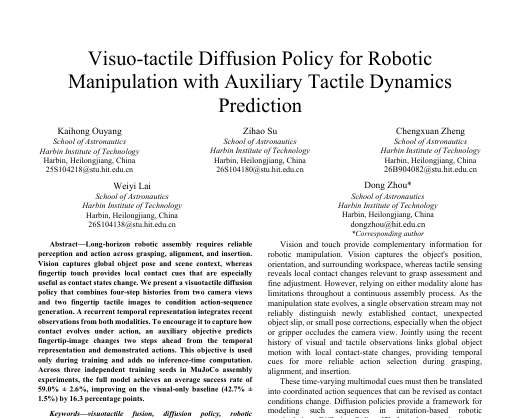
Visuo-tactile Diffusion Policy for Robotic Manipulation with Auxiliary Tactile Dynamics Prediction

Kaihong Ouyang, Zihao Su, Chengxuan Zheng, Weiyi Lai, Dong Zhou

Long-horizon robotic assembly requires reliable perception and action across grasping, alignment, and insertion. Vision captures global object pose and scene context, where as fing…

Long-horizon robotic assembly requires reliable perception and action across grasping, alignment, and insertion. Vision captures global object pose and scene context, where as fingertip touch provides local contact cues that are especially useful as contact states change. We present a visuotactile diffusion policy that combines four-step histories from two camera views and two fingertip tactile images to condition action-sequence generation. A recurrent temporal representation integrates recent observations from both modalities. To encourage it to capture how contact evolves under action, an auxiliary objective predicts fingertip-image changes two steps ahead from the temporal representation and demonstrated actions. This objective is used only during training and adds no inference-time computation. Across three independent training seeds in MuJoCo assembly experiments, the full model achieves an average success rate of $59.0% \pm 2.6%$, improving on the visual-only baseline ($42.7% \pm 1.5%$) by 16.3 percentage points.

cs.ROmanipulationdiffusion policytactile

兴趣:robot manipulation and grasping with learned policies

#122026-11-02追踪学者 · Pieter Abbeel追踪学者 · Leslie Pack Kaelbling追踪学者 · Tomás Lozano-Pérez90

Energy-Based Policy Orchestration

Weirui Ye, Yen-Jen Wang, Elvis Hsieh, Zhiyang Dou, Shibo Zhao, Pieter Abbeel 等

Hierarchical control scales robot behavior by separating task-level planning from low-level control. In dynamic, high-dimensional tasks, however, a fixed planner-to-policy interfac…

Hierarchical control scales robot behavior by separating task-level planning from low-level control. In dynamic, high-dimensional tasks, however, a fixed planner-to-policy interface can fail when contacts, balance, or disturbances evolve faster than high-level policy updates. Execution therefore requires choosing not only which low-level policy to run, but also which policy-specific goal should be given to it. We formulate this problem as policy orchestration: runtime selection of a policy-goal pair that is likely to remain feasible while tracking the planner target. We develop EPO, an energy-based policy orchestrator for modular goal-conditioned policy families. For each policy, EPO learns a composite energy over low-level goals, where lower energy corresponds to higher feasibility and more accurate target realization. At runtime, EPO refines each policy's goal and executes the lowest-energy policy-goal pair. Because energies are policy-specific, new policies can be incorporated by learning their own energy models, without retraining the existing policies or a centralized scheduler. In simulation, EPO improves the empirical precision-robustness trade-off by refining policy-specific goals before selectively switching among policies based on energy scores. We further demonstrate sim-to-real deployment of the same frozen policies and energy models on real humanoid loco-manipulation tasks. Project website: https://yewr.github.io/epo

cs.ROcs.LGrobotmanipulationhumanoidsim-to-real

追踪学者:Pieter Abbeel、Leslie Pack Kaelbling;兴趣:reinforcement learning for legged locomotion and sim-to-real transfer

#132026-11-0289

ForceLDM: A Force-aware Latent Dynamics Model for Contact-Rich Manipulation

Peiyuan Tang, Yao Li, Xiaodong Zhang, Wuyang Zhang, Qin Xia, Yanyong Zhang 等

Contact-rich manipulation requires fine-grained control and complex physical interactions with the environment, posing significant challenges for robot policy learning. Vision-only…

Contact-rich manipulation requires fine-grained control and complex physical interactions with the environment, posing significant challenges for robot policy learning. Vision-only policies struggle with such tasks, as contact states and interaction forces are difficult to infer from visual observations alone. Existing methods mitigate this issue by incorporating force or tactile sensing. However, they often treat these signals as auxiliary observations without fully exploiting their role in modeling future interaction dynamics. To address this, we propose ForceLDM, a force-aware latent dynamics model that learns future contact and motion dynamics to guide action generation. Rather than directly predicting future observations, which can entangle task-relevant dynamics with irrelevant sensory details, ForceLDM learns a compact representation of future dynamics through knowledge distillation. Specifically, a teacher network with privileged future force/torque and optical flow signals extracts future dynamic features, which are then distilled into a student network trained only on current observations. This enables the student model to reason about upcoming contacts and physical dynamics without relying on future sensory inputs at deployment. To improve robustness and generalization, we further introduce a curriculum-based progressive noise injection strategy to mitigate over-reliance on future features. Experiments on five real-world contact-rich manipulation tasks demonstrate that ForceLDM outperforms state-of-the-art baselines, generalizes effectively to novel objects, and remains robust to environmental perturbations. Project page and code are available at https://tpy001.github.io/ForceLDM/.

cs.ROrobotmanipulationtactile

兴趣:robot manipulation and grasping with learned policies

#142026-10-3189

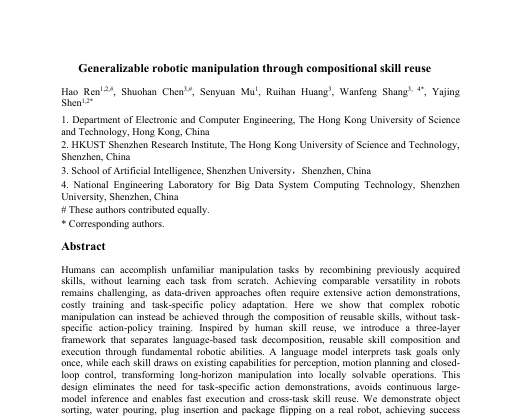
Generalizable robotic manipulation through compositional skill reuse

Hao Ren, Shuohan Chen, Senyuan Mu, Ruihan Huang, Wanfeng Shang, Yajing Shen

Hao Ren, Shuohan Chen, Senyuan Mu, Ruihan Huang, Wanfeng Shang, Yajing Shen

Hao Ren, Shuohan Chen, Senyuan Mu, Ruihan Huang, Wanfeng Shang, Yajing Shen

cs.ROmanipulation

兴趣:robot manipulation and grasping with learned policies

#152026-10-3188

WorldSketch: Sketching World Models for Zero-Shot Mobile Manipulation

Jiaming Wang

Most agentic robotic systems use vision-language models (VLMs) either to orchestrate predefined skills or to directly generate actions, constraints, and control programs. The forme…

Most agentic robotic systems use vision-language models (VLMs) either to orchestrate predefined skills or to directly generate actions, constraints, and control programs. The former is limited by the available skill library, while the latter requires VLMs to reason about precise geometry and contact. In this paper, we propose WorldSketch, a new paradigm for agentic robotics in which a VLM constructs a world model rather than generating robot actions. The VLM acts as an agent that actively queries perception tools to build and visually validate a minimal kinematic world model, capturing only task-relevant objects, their interaction geometry, and possible motions. A geometric planner then jointly optimizes contact and whole-body motion on the resulting model. Moreover, the world model is self-improving: execution feedback verifies outcomes, updates uncertain hypotheses, and enables the agent to revise the model when its predictions are contradicted. We demonstrate the generality of this paradigm across RoboCasa, LIBERO-PRO, and R2R-CE navigation, achieving zero-shot success rates of 91%, 97%, and 76%, respectively. On RoboCasa, WorldSketch outperforms the next-best zero-shot agent baseline by 58 percentage points while using 10 times fewer VLM input tokens; on LIBERO-PRO, it exceeds CaP-X by 82 percentage points. In navigation, it matches the success rate of step-by-step VLM agents while using 6 times fewer input tokens.

cs.ROrobotmanipulationworld model

兴趣:vision-language-action (VLA) models and foundation models for robots

#162026-11-0288

Beyond Policy Patches: Distilling RL Specialists into Vision-Language-Action Policies

Zhennan Jiang, Tingying Xie, Shilong Ji, Shu'ang Yu, Tianxing Zhou, Yuhui Chen 等

Vision-language-action (VLA) policies can handle noncritical stages of long-horizon manipulation yet fail during short precision-critical phases. Lightweight reinforcement learning…

Vision-language-action (VLA) policies can handle noncritical stages of long-horizon manipulation yet fail during short precision-critical phases. Lightweight reinforcement learning (RL) specialists can address these failures without directly applying RL to the full VLA, but retain auxiliary controllers and switching mechanisms at deployment. We study how to transfer their capabilities into a single flow-matching VLA. Direct imitation of specialist rollouts can reproduce action jitter and leave the VLA unprepared for states encountered during its own execution. We introduce REPAIR, a value-guided distillation framework that combines offline initialization with on-policy refinement. At each critical-phase observation, REPAIR queries the corresponding specialist for multiple action candidates and weights them using its critic to construct a supervision distribution. A shared weighted flow-matching objective trains the VLA first on observations from specialist-assisted rollouts, then on observations collected through its own execution. Specialists provide supervision without taking control during on-policy collection and are removed at deployment. Across six real-robot tasks with 30 evaluation trials per task, REPAIR achieves 100% success on all six tasks, with lower mean end-effector jerk than specialist-assisted execution on every task.

cs.ROrobotmanipulationVLAvision-language-action

兴趣:vision-language-action (VLA) models and foundation models for robots

#172026-11-0188

$TF^2$-Steering: Action Refinement with Tactile Forecasts and Feedback via Velocity-Field Steering

Yiming Chen, Xiaofei Wei, Chun Gu, Wei Xiao, Peidong Liu, Li Zhang

Tactile sensing plays a crucial role in everyday human interaction. Consider inserting a plug into a tight socket, vision alone provides limited guidance during the final insertion…

Tactile sensing plays a crucial role in everyday human interaction. Consider inserting a plug into a tight socket, vision alone provides limited guidance during the final insertion stage, and we instead rely on both anticipated contact and realized tactile feedback to ajust the insertion motion. The same capability is equally important for robots, particularly in dexterous manipulation tasks. Yet many contemporary robot policies remain vision-dominant. This visual bias, compounded by limited tactile data and sparse contact events, can cause directly incorporated tactile signals to be ignored or even compromise the policy's pretrained capabilities, yielding degrading performance as observed in our experiments. We present $TF^2$-Steering, which refines actions via learned residual steering of the flow-matching action expert's velocity field, using a tactile mixture-of-experts architecture to integrate both tactile forecasts and real-time tactile feedback. Together with specific designed three stages training recipe, $TF^2$-Steering enables tactile signals to correct and, when necessary, redirect the flow-matching action-generation process, while building on the strong action-generation capacity of the vision-based foundation policy. Extensive experiments across six simulated and six real-world manipulation tasks demonstrate the effectiveness of $TF^2$-Steering. It outperforms the strongest evaluated baselines by 10.7 percentage points in average simulation success rate and 9.1 percentage points in average real-world progress success rate. Project page: https://yiming-cc.github.io/tf2-steering/.

cs.ROrobotmanipulationdexteroustactile

兴趣:robot manipulation and grasping with learned policies

#182026-11-0288

DexArena: A Unified Benchmark for Long-Horizon Dexterous Manipulation

Haonan Ping, Jianshu Hu, Yimin Wang, Yi Zhu, Pai Liang, Qiyan Jin 等

Long-horizon dexterous manipulation remains a fundamental challenge for robot learning, requiring the composition of multiple skills, precise bimanual coordination, generalizable v…

Long-horizon dexterous manipulation remains a fundamental challenge for robot learning, requiring the composition of multiple skills, precise bimanual coordination, generalizable visual understanding, and robust skill transitions. Yet existing manipulation benchmarks largely emphasize isolated skills or support only a limited range of end-effectors, making these capabilities difficult to evaluate systematically. We introduce DexArena, a benchmark designed to evaluate learning and generalization in long-horizon bimanual dexterous manipulation. DexArena features 10 long-horizon tasks and 30 stage-level tasks spanning diverse household and industrial scenarios. Each long-horizon task is composed of explicitly defined stages with physically grounded success conditions, enabling reliable evaluation of both intermediate progress and end-to-end task completion. A unified benchmark interface and verified human-teleoperated demonstrations enable testing different policy learning algorithms, with standardized simulation configurations, scene randomization, trajectory replay, and task-level evaluation. Through extensive baseline experiments, we identify substantial challenges in precise manipulation, generalization to scene variation, and skill composition. DexArena establishes a challenging and reproducible benchmark for developing robot learning methods that move toward generalizable long-horizon dexterous behavior.

cs.ROrobotmanipulationdexterous

兴趣:robot manipulation and grasping with learned policies

#192026-10-3187

Task-Specialized Language-Conditioned Models for Fine-Grained Robotic Manipulation

Chanho Kim, Soyun Choi

Fine-grained robotic manipulation requires instruction grounding, robust perception, and precise contact control. We describe our submission to the MetaFine Open Competition at CoR…

Fine-grained robotic manipulation requires instruction grounding, robust perception, and precise contact control. We describe our submission to the MetaFine Open Competition at CoRL 2026. Five independently trained models use a common architecture with frozen DINOv2 and CLIP encoders, trainable language-conditioned feature modulation, and task-specific action heads. We improve demonstrations through contact-aware grasp filtering, instruction-matched data, and expert correction of insertion failures. At inference, task-dependent strategies include photometric test-time augmentation, stochastic action averaging, and uncertainty-triggered replanning. Our submission achieves an official overall score of 0.914 and ranks third among 15 teams. We analyze the models and their task-specific behavior.

cs.ROmanipulationgrasp

兴趣:robot manipulation and grasping with learned policies

#202026-11-0187

Same Path, Less Time: Training-Free Fast Execution of Vision-Language-Action Models under Inference Latency

Fuyi Chen

Vision-language-action (VLA) models predict chunks of future actions, yet deployed robots waste time in two ways that are independent of model capability: they halt while the next …

Vision-language-action (VLA) models predict chunks of future actions, yet deployed robots waste time in two ways that are independent of model capability: they halt while the next chunk is inferred, and they move at the speed of slow, cautious demonstrations. Existing remedies remove one loss each, and stacking them fails, because asynchrony and speed-up each change the correspondence between planned progress and executed motion. We present Path-preserving Time Scaling (PTS), a training-free execution layer for frozen action-chunking policies built on one principle: the robot's motion is a time reparameterization of a reference path, and the path changes only in response to new observations. A path layer decodes every replan deterministically in one step and enters it at the progress consumed during inference. A time layer sums the planned increments, keeps the arm at 1x while the gripper moves, and caps the rate by the actuator's linear range and by chunk feasibility under latency. We show that misaligned entry and stochastic sampling add a bias and a variance to the continuation error, and derive a break-even success rate that states when speeding up pays off. On LIBERO with two frozen VLAs under injected inference latency, PTS raises task throughput over the strongest deployable baseline by 33% for pi0.5 and 104% for SmolVLA while matching or improving the success rate, is best on all six model-suite combinations, and exceeds zero-latency 1x execution. Against asynchronous 1x execution with the same one-step decoder, the time layer alone adds 28% and 38%. On LIBERO-Dynamic it improves on stop-and-wait execution by 38% and is comparable to asynchronous 1x execution.

cs.ROcs.LGrobotVLAvision-language-action

兴趣:vision-language-action (VLA) models and foundation models for robots

#212026-10-3187

Vision-Language Models Are Joint Denoisers in Robotic Action Generation

Xicheng Gong, Wenxuan Song, Chengze Liu, Qiwei Li, Qize Yu, Jiaolong Yang 等

Diffusion-based vision-language-action (VLA) models cascade pretrained vision-language models (VLMs) with diffusion action experts, but typically restrict the VLM to providing stat…

Diffusion-based vision-language-action (VLA) models cascade pretrained vision-language models (VLMs) with diffusion action experts, but typically restrict the VLM to providing static conditioning. This separation limits how much pretrained perception and reasoning can guide action generation, especially in out-of-distribution settings. We introduce JADE, a Joint Action DEnoiser that enables the VLM and action expert to jointly refine actions. Our key insight is that structured action latents allow the VLM to read the current noisy action together with visual observations and language instructions. At every denoising step, the VLM contextualizes the noisy action and guides the action expert through gated cross-attention, so that its guidance evolves with the action being generated. We further supervise the VLM to recover clean action latents from noisy ones, which gives it a direct action-learning signal and couples perception with control. Additionally, joint denoising enables JADE to generate actions with fewer sampling steps, helping offset the additional cost of VLM participation. An adaptive step-size schedule further balances task performance and inference latency. On RoboDojo, JADE achieves an average success rate of 12.67%, the highest among the evaluated $π_{0.5}$-based methods, and is competitive with recent VLA and WAM foundation models pretrained at scale. It also improves performance on RoboTwin 2.0 and raises the average success rate across four real-world bimanual tasks by 20.8 percentage points compared with $π_{0.5}$.

cs.ROcs.AIcs.CVVLAvision-language-action

兴趣:vision-language-action (VLA) models and foundation models for robots

#222026-11-02追踪学者 · Dieter Fox追踪学者 · Abhishek Gupta87

D&A: Decoupling Description and Assessment Enables VLMs as Zero-Shot Robotic Reward Models

Marius Memmel, Shawn Yin, Urvi Rutia, Angad Wadhwa, Eldon Li, Gavin Angeloff 等

Vision-Language Models (VLMs) hold promise for zero-shot video task-progress estimation in robot learning, yet existing frameworks frequently suffer from confirmation bias, halluci…

Vision-Language Models (VLMs) hold promise for zero-shot video task-progress estimation in robot learning, yet existing frameworks frequently suffer from confirmation bias, hallucinating progress in failed executions due to implicit success assumptions or relative temporal ranking designs. Naive prompting of frontier models collapses into a binary success detector that fails to capture nuanced, non-linear progress and failures. While post-training approaches can mitigate this through explicit training, they demand expensive real-world robotics data and require computationally intensive post-training for every individual base model. To resolve these limitations, we introduce D&A (Describe & Assess): our approach decouples progress estimation into an objective, task-grounded textual description of scene dynamics followed by an assessment phase using explicit rubrics. By compelling the VLM to synthesize an explicit, text-based definition of absolute success before scoring, the framework anchors evaluations to an external, global criterion rather than the video's internal timeline. Empirical results demonstrate that our method calibrates zero-shot estimates and mitigates confirmation bias, providing fine-grained, partial progress metrics that accurately penalize failed executions while correctly interpolating successful runs. Being purely prompt-based, D&A generalizes across tasks, embodiments, and benchmarks---matching or surpassing post-trained reward models---and its reward estimates enable efficient downstream reinforcement learning.

cs.ROcs.AIcs.CLcs.LGeess.SYrobot

追踪学者:Dieter Fox、Abhishek Gupta;兴趣:vision-language-action (VLA) models and foundation models for robots

#232026-11-0287

KlaskTron-IL: A Contact-Rich Adversarial Imitation Learning Benchmark with a Validated Sim-to-Real Bridge

Nicklas Sohm, Aswin Ramachandran, Raffaello D'Andrea

KlaskTron is an open-hardware physical platform for two-player adversarial reinforcement learning, with a learned actuator model that supports zero-shot sim-to-real transfer of tra…

KlaskTron is an open-hardware physical platform for two-player adversarial reinforcement learning, with a learned actuator model that supports zero-shot sim-to-real transfer of trained policies. Building on this platform, we contribute KlaskTron-IL: a multi-tier imitation learning dataset (80k human demonstration timesteps collected directly on the physical robot, 320k symmetry-augmented timesteps, and synthetic expert trajectories up to 5M steps generated by the zero-shot-validated PPO policy), and diagnostic baselines that expose three characteristic failure modes of standard IL methods under contact-rich adversarial dynamics: BC's data scaling plateau, GAIL's interpretable but weak-gradient discriminator (Spearman $ρ= -1.0$ peg-ball proximity recovery, but a logit span under 0.1), and an asymmetric BC-prior x reward-density interaction. Because the policy interface used throughout this paper is the same one the actuator model bridges to hardware, a policy trained on this benchmark can run unchanged on the physical robot, as we demonstrate zero-shot for the strongest BC baseline, so long as its commands respect the actuator model's $\pm 0.2$ m/s identification range.

cs.ROrobotimitation learningsim-to-real

兴趣:imitation learning and diffusion policies for robot control

#242026-11-0287

HeLM: Hierarchical Explicit Language Memory for Non-Markovian Manipulation

Gyeonghun Kim, Donghoon Kim, Minsoo Choi, Suyun Lee

Recent advances in Vision-Language-Action (VLA) models have enabled fine manipulation capabilities, yet performing tasks that require working memory remains a key challenge. Most e…

Recent advances in Vision-Language-Action (VLA) models have enabled fine manipulation capabilities, yet performing tasks that require working memory remains a key challenge. Most existing VLA architectures operate under a Markovian assumption, mapping only the current observation to an action, which leads to failure in non-Markovian environments. Inspired by the human 'inner monologue', we propose Hierarchical Explicit Language Memory (HeLM), a hierarchical VLA framework that maintains task-relevant history in explicit language through factorized event detection and event-triggered memory updates. We evaluate HeLM across 10 non-Markovian real-world tasks with 56 variants, including five newly formulated inter-episode tasks that require persistent context across task boundaries. HeLM improves intra-episode success by 12.8 percentage points over the strongest baseline and achieves 78% subtask success on compositional generalization tasks, while using up to 4.5x less memory and running 2.5x faster than the keyframe baseline at long horizons.

cs.ROmanipulationVLAvision-language-action

兴趣:vision-language-action (VLA) models and foundation models for robots

#252026-11-0186

HuG: Learning Humanoid Whole-Body Affordance-Aware Grasping with Active Perception

Xuanbin Peng, Lai Wei, Yuze Zhai, Qingyuan Yu, Keyi Wang, Jianglong Ye 等

Acquiring objects in human environments is hard for humanoids: targets are partially occluded under egocentric viewpoints, and reaching them demands coordinated whole-body motion t…

Acquiring objects in human environments is hard for humanoids: targets are partially occluded under egocentric viewpoints, and reaching them demands coordinated whole-body motion that keeps the target visible and reachable while the base stays stable. We present HuG, a framework for whole-body affordance-aware grasping with active perception that couples perception and action through a Perceive-Align-Grasp pipeline: belief-driven active perception resolves occlusion by treating viewpoint as an explicit decision variable; a point-cloud-conditioned affordance policy proposes whole-body grasps; and an affordance-aware alignment stage repositions the body to the most executable configuration. A key insight is that, on a floating base, kinematic validity is not enough: we curate training data with controller-in-the-loop dynamics simulation, rejecting 73% of kinematically valid grasps that would destabilize the deployment controller, so the policy learns kinodynamically feasible affordances. Trained entirely in simulation with zero real demonstrations, HuG attains 87.5% real-world success on a multi-level shelf task, generalizes to novel objects, and holds at least 73% success at every tested height. Beyond generalizing within its training distribution, the policy extrapolates spatially: at scale in simulation it succeeds at table heights well below any seen during training, indicating that kinodynamically filtered synthetic data grounds affordances in object geometry and whole-body feasibility rather than in memorized configurations.

cs.ROgrasphumanoid

兴趣:robot manipulation and grasping with learned policies

#262026-10-3086

TacMind: Benchmarking and Modeling Tactile Interaction States for Robotic Manipulation

Jiaxin Shi, Zibin Wu, Yichi Zhang, Jianghua Duan, Siyu Zhu, Weihao Yuan

Tactile sensing provides robots with direct observations of contact physics, local geometry, and interaction dynamics, making it a vital source of feedback for contact-rich manipul…

Tactile sensing provides robots with direct observations of contact physics, local geometry, and interaction dynamics, making it a vital source of feedback for contact-rich manipulation. However, existing tactile manipulation studies are often developed and evaluated within specific task settings, making it difficult to systematically compare how tactile information contributes under different interaction conditions. In this work, we develop a benchmark in simulation comprising 128 tasks organized around three complementary evaluation regimes: Precise, Recognition, and Dynamic. The benchmark further includes controlled static and dynamic task variants and 12 perturbation settings for evaluating robustness under changes in visual and physical conditions. These settings motivate studying tactile information as a temporally evolving interaction representation rather than only as an instantaneous observation. We therefore propose an action-conditioned latent predictive world model that integrates tactile history and learns a tactile state through prediction of future tactile latents. Building on this representation, we design a model that conditions action generation on the learned tactile state and uses predicted future tactile information to refine candidate actions through predictive tactile reflection. Experiments on the proposed benchmark show consistent gains from incorporating tactile information across the evaluated regimes. Project Page: https://tacmind-bench.github.io/

cs.ROmanipulationtactileworld model

兴趣:dexterous hands and tactile sensing

#272026-11-01追踪学者 · Pieter Abbeel86

Democratizing Robot-Use Agents: A Unified Harness with Open Models

Jiarui Yuan, Yuxin Zuo, Xiaoyu Huang, Wenbo Zhang, Kwanyoung Park, Junlin Yang 等

Robot-use Agents (RUAs) have shown promising zero-shot manipulation capabilities, but reliance on frontier, proprietary models limits research into further training. To democratize…

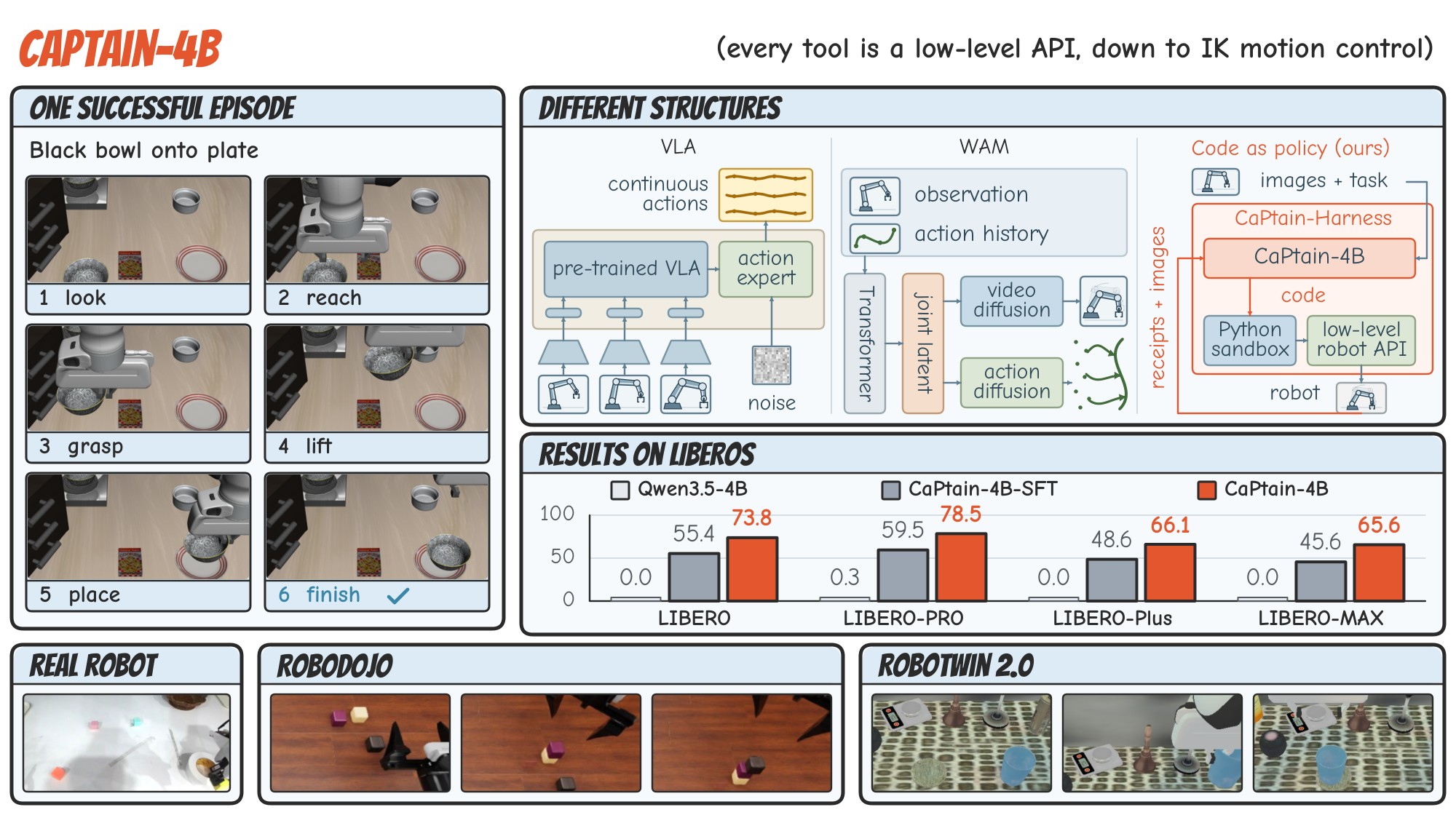
Robot-use Agents (RUAs) have shown promising zero-shot manipulation capabilities, but reliance on frontier, proprietary models limits research into further training. To democratize RUA research, we introduce uni-robot-agent, a unified harness for competitive open-weight robot use that supports further training. Without privileged inputs, an out-of-the-box Qwen3.8-Flash-Next achieves a RoboDojo Score of 31.39, surpassing the published GPT-6 Astra-RoboProbe result of 28.97 and many VLA/WAM baselines, and performs competitively on 19 real-world tasks. Our analysis across model generations, families, and sizes links effective robot use to four general capabilities, suggesting that future RUA training should develop them jointly.

cs.ROrobotmanipulationVLA

追踪学者:Pieter Abbeel;兴趣:humanoid robots and whole-body control

#282026-10-3186

MOST: Memory of Object States and Task Progress for Long-Horizon Mobile Manipulation

Diqi He, Jinbang Guo, Yijun Shen, Zhiwei Yu, Huan Yang, Dingwen Zhang 等

Long-horizon embodied manipulation requires policies to act on information that is no longer visible. Modified objects may leave the field of view, while completed subtasks continu…

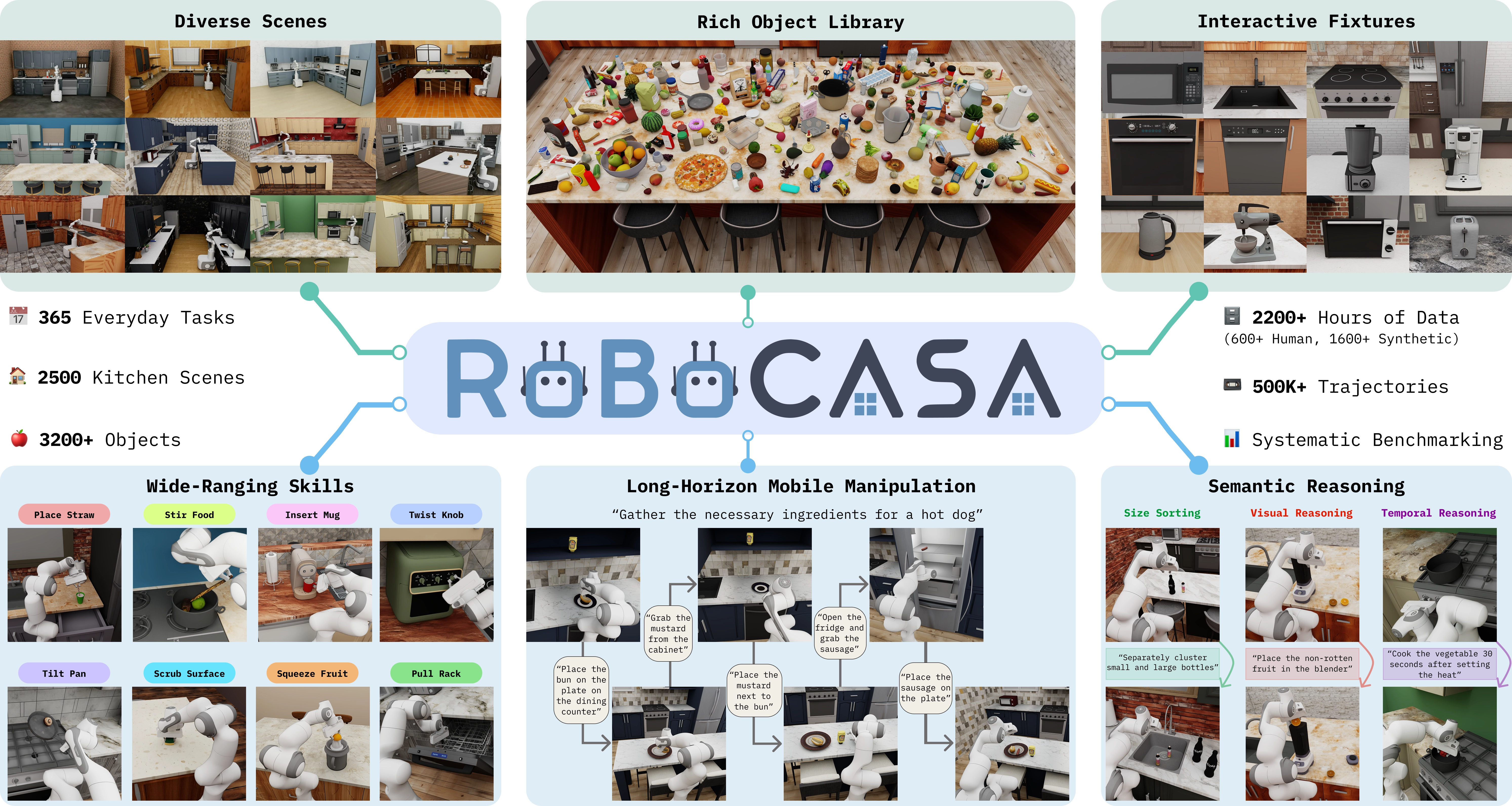
Long-horizon embodied manipulation requires policies to act on information that is no longer visible. Modified objects may leave the field of view, while completed subtasks continue to constrain future actions. Existing approaches extend temporal context through recurrent state updates, test-time training, or storage and retrieval of past observations. As horizons grow, these mechanisms can still leave the policy to infer task state from long, redundant, and viewpoint-dependent visual experience. We argue that long-horizon agents benefit not merely from remembering more, but from remembering task-relevant state changes and progress. We propose Memory of Object States and Task Progress (MOST), a policy-internal memory framework that compresses multi-view observations into temporal tokens. Historical and predictive future tokens are explicitly supervised with object states and subtask progress, structuring memory around what has changed in the world and what has already been accomplished. The resulting memory directly conditions action generation within a single end-to-end policy, without an external planner or retrieval stage. We further introduce RoboCasa-Long, a benchmark of multi-minute, multi-stage mobile manipulation tasks. Across RoboCasa365, RoboCasa-Long, and real-world robot experiments, MOST consistently outperforms Xiaomi-Robotics-1 (XR-1), the previous state-of-the-art model. It raises average success from 65.9% to 72.1% on RoboCasa365, average maximum task progress from 20.83% to 42.22% on RoboCasa-Long, and real-world success from 6.66% to 43.33%. MOST also outperforms a matched visual-history memory variant, showing that effective long-horizon memory depends not only on how much experience is retained, but on whether it preserves decision-relevant progress and world-state changes.

cs.ROrobotmanipulationembodied

兴趣:robot manipulation and grasping with learned policies

#292026-10-3085

AuroraWorld: Structured 4D World Modeling for Exo-to-Ego Video Generation in Robot Manipulation

Hao Xue, Peng-Fei Zhang, Ying Cheng, Lanyun Zhu, Lei Zhu, Heng Tao Shen

Egocentric observations provide a robot-centric view of manipulation processes, capturing contact interactions and object-state changes that are important for visuomotor policy lea…

Egocentric observations provide a robot-centric view of manipulation processes, capturing contact interactions and object-state changes that are important for visuomotor policy learning but difficult to observe from external cameras. However, collecting such data at scale remains expensive due to additional hardware requirements and platform-specific deployment costs. Synthesizing egocentric observations from large-scale exocentric manipulation videos provides a scalable alternative. However, existing methods struggle to synthesize physically consistent and policy-relevant egocentric videos under substantial viewpoint transformations, severe occlusions, complex object interactions, and inherently sparse observations from available exocentric viewpoints.

cs.AIcs.CVrobotmanipulation

兴趣:world models and video prediction for embodied agents

#302026-11-0285

PointPilot: Unified Robotic Manipulation via Object-Centric 3D Point Flow Prediction

Yihan Fang, Yuxin Tian, Ruixiang Wang, Zhanqi Zhang, Xing Hu, Zhen Yang 等

Generalization remains a central challenge in robotics, calling for policies that address domain variations from multiple dimensions such as diverse embodiments, camera poses, and/…

Generalization remains a central challenge in robotics, calling for policies that address domain variations from multiple dimensions such as diverse embodiments, camera poses, and/or scene layouts. In order to approach this problem, we introduce PointPilot, a task-focused and 3D aligned manipulation framework built on a 3D space point-flow prediction. Rather than modeling the global scene, PointPilot only represents task-focused objects (robot grippers treated as objects), avoiding the prediction of potentially redundant scene parts unrelated to the manipulation tasks. Moreover, PointPilot aligns 3D spatial representation in one unified coordinate and supports closed-loop and fully automatic action execution across different manipulation modes from object point flow without a separately trained action expert, while existing works typically need an extra action head or are (semi-)automatic and single-arm mode specific. Given sensor observations and language instructions, our model jointly learns subtask planning, task-relevant object grounding, and 3D point flow prediction in an end-to-end way. By processing heterogeneous data in a shared 3D point flow space, PointPilot is able to absorb demonstrations from different embodiments. Extensive simulative and real world experiments validate our method. Notably, we demonstrate zero-shot embodiment generalization with PointPilot. A single trained policy can be deployed on previously unseen embodiments and successfully complete manipulation tasks without any additional fine-tuning.

cs.ROrobotmanipulation

兴趣:robot manipulation and grasping with learned policies

#312026-11-0285

Gnomon4D: Learning Where and When to Focus for Geometric Motion-Grounded World-Action Modeling

Lingwei Dang, Yan Zhou, Juntong Li, Zhenhao Zhang, Yiteng Chen, Xiaoqiang Liu 等

World-action models (WAMs) use video-generation priors to jointly predict future observations and robot actions. Yet RGB futures entangle physical state changes with appearance, wh…

World-action models (WAMs) use video-generation priors to jointly predict future observations and robot actions. Yet RGB futures entangle physical state changes with appearance, while frame-wise depth and point maps lack temporal correspondence. Existing 4D approaches either keep motion implicit in visual features or translate predicted traces into actions through a separate interface. We present Gnomon4D, a WAM that jointly generates future video, robot actions, and GeoDelta, a video-aligned 4D geometric motion field encoding the cross-frame image-plane displacement and depth change of embodiment and object points. By placing embodiment motion and object responses in a shared space, GeoDelta exposes their motion relations to the action expert at inference. Interaction-Salient Attention (InSAttn) uses these relations to focus spatial readout on task-relevant interaction regions, while Transition-Anchored Aggregation (TransAgg) aggregates evidence around changes in their relative motion, such as grasp and release. GeoDelta describes surface motion independently of embodiment-specific controls, providing a shared human--robot quasi-action for action-free pretraining on EgoManip-5000H followed by robot mid-training on Robot-30H. Gnomon4D leads on RoboTwin~2.0, VLABench, and RoboDojo, and outperforms the strongest real-robot baseline by 7.0 and 16.0 percentage points under in-distribution and out-of-distribution settings, respectively.

cs.CVrobotgrasp

兴趣:world models and video prediction for embodied agents

#322026-10-31追踪学者 · Tomás Lozano-Pérez追踪学者 · Leslie Pack Kaelbling85

Knowing Where to Look: Interactive Object Search via Spatial-Semantic Fusion

Aditya Agarwal, Lucy Cai, Kelly Lu, Travis Manderson, Nicholas Roy, Tomás Lozano-Pérez 等

When searching for an object, humans naturally combine semantic intuition - reasoning about where the object is likely to be stored - with geometric awareness of what parts of the …

When searching for an object, humans naturally combine semantic intuition - reasoning about where the object is likely to be stored - with geometric awareness of what parts of the space are visible, occluded, or unexplored. Effective robot object search requires the same joint reasoning, yet existing methods rely on only one: geometric methods maintain principled spatial beliefs but lack deep semantic understanding, while language-model based methods leverage commonsense knowledge but maintain no explicit belief over space. We argue that jointly reasoning over semantic and geometric evidence in an explicit 3D belief enables human-like interactive object search that outperforms either modality alone. To test this claim, we build a system that accumulates per-object VLM plausibility scores and geometric occupancy evidence via Bayesian log-odds filtering into a unified 3D voxel belief field. High-belief regions in the combined belief field drive action selection at each step: taking a closer look from a different viewpoint, navigating toward an unexplored region of the workspace, or physically interacting with a closed cabinet. We deploy this system end-to-end on a bimanual mobile humanoid and find that it outperforms geometry-only search and LLM-based planning methods. Project website - https://skymanaditya1.github.io/objsearch-website/

cs.ROrobothumanoid

追踪学者:Tomás Lozano-Pérez、Leslie Pack Kaelbling;兴趣:3D perception, point clouds and scene understanding for robotics

#332026-10-3185

Behavioral Steering of Vision-Language-Action Models in the Low-Parameter Regime

James Tcheng, Feiyu Gavin Zhu

Reinforcement learning (RL) is increasingly used to adapt pretrained vision-language-action models (VLAs). We investigate the problem of behavioral steering: adapting a VLA's execu…

Reinforcement learning (RL) is increasingly used to adapt pretrained vision-language-action models (VLAs). We investigate the problem of behavioral steering: adapting a VLA's execution style to preferences such as carrying objects higher. To investigate how little trainable capacity such steering requires and how much pretrained capability can be retained, we freeze an OpenVLA-OFT 7B policy and optimize TinyLoRA adapters with 8 to 384 trainable parameters using either policy-gradient RL (GRPO) or evolutionary search (CMA-ES). With just 256 trainable parameters, we raise carry height by 120 mm on trained tasks at 92% success and by 74 mm on a held-out task at 80% success. By rescaling the learned update, we can tune the trade-off between style gains and capability retention without retraining. Increasing adapter capacity generally improves this trade-off, retaining more pretrained capability at comparable style gains. The choice of optimizer also depends on capacity, with CMA-ES being competitive at low parameter counts, while GRPO offers better trade-offs as capacity grows. These findings show that extremely low-dimensional updates can steer pretrained VLA behavior, with adapter capacity, optimizer choice, and update scaling offering practical control over adaptation and retention.

cs.ROcs.LGVLAvision-language-action

兴趣:vision-language-action (VLA) models and foundation models for robots

#342026-11-0185

Route-Guided CBF-QP Repair for Safe Vision-Language-Action Models

Chan Park, Sunwoo Hong, Kirak Kim, Yoonjeong Park, Alexander W. Olson, Ali Pesaranghader

Vision-language-action (VLA) models can generate task-oriented robot actions, but they do not guarantee safe execution in obstacle-rich manipulation scenes. Although CBF-QP safety …

Vision-language-action (VLA) models can generate task-oriented robot actions, but they do not guarantee safe execution in obstacle-rich manipulation scenes. Although CBF-QP safety filters can locally project unsafe actions into a safe set, such correction may push the robot away from the learned task trajectory and leave the VLA policy without a reliable recovery direction. We propose Route-Guided CBF-QP Repair, a post-hoc repair module that uses the short-horizon action chunk predicted by the VLA to detect blocked nominal trajectories and generate entry-exit-rejoin guidance around obstacles. The selected route is added to the CBF-QP objective as a soft guidance term, while the CBF safety constraint remains hard. On SafeLIBERO, our method improves collision avoidance, task success, and SafeSuccess compared with AEGIS. Our project page is available at GitHub.

cs.AIcs.ROrobotmanipulationVLAvision-language-action

兴趣:vision-language-action (VLA) models and foundation models for robots

#352026-10-3184

Evaluating Tactile Foundation Models for End-to-End Imitation Learning in Contact-Rich Manipulation

Masaki Murooka, Ryoichi Nakajo, Tomohiro Motoda, Koshi Makihara, Hanbit Oh, Keisuke Shirai 等

Tactile sensing plays an important role in imitation learning for contact-rich manipulation by providing direct observations of physical contact with objects. Recently, several tac…

Tactile sensing plays an important role in imitation learning for contact-rich manipulation by providing direct observations of physical contact with objects. Recently, several tactile foundation models (TFMs) have been proposed to learn general-purpose tactile representations through pretraining on large-scale tactile datasets. However, how these pretrained tactile representations should be leveraged for end-to-end imitation learning remains insufficiently explored. In this work, we integrate multiple TFMs into Diffusion Policy and systematically evaluate their effectiveness for contact-rich manipulation under common experimental settings. We further investigate adaptation strategies, including encoder fine-tuning and task-specific mid-training, to understand how pretrained tactile representations can be effectively used for downstream imitation learning. Through extensive evaluation across diverse manipulation tasks in both real-world and simulation environments, including more than 5,000 real-world policy rollouts, we provide empirical insights into the use of TFMs for end-to-end imitation learning. Project page: https://mmurooka.github.io/tfm4il-project-page/

cs.ROmanipulationimitation learningdiffusion policytactile

兴趣:dexterous hands and tactile sensing

#362026-10-31追踪学者 · Marco Hutter84

Learning Agile Humanoid Dodgeball with Onboard Monocular Vision

Feng Tian, Yulin An, Chenhao Li, Matthias Heyrman, Marco Hutter

Humanoid robots operating in shared, dynamic environments must respond to rapidly approaching objects while maintaining balance. We study dodgeball as a controlled test of this cap…

Humanoid robots operating in shared, dynamic environments must respond to rapidly approaching objects while maintaining balance. We study dodgeball as a controlled test of this capability, coupling visual threat assessment with whole-body evasion, recovery, and target reacquisition. We develop a system that integrates onboard monocular perception, temporal ball-state and threat-flag estimation, and learned whole-body control. A ball detector supplies bounding-box histories, and a temporal estimator predicts relative ball position and a binary threat flag. Separate dodge/recovery and search/track policies share this interface and are composed to support repeated encounters. A three-stage curriculum first trains control with privileged ball states, then starts estimator supervision from stable policy rollouts, and finally replaces the actor's privileged inputs with estimator outputs. Analytic projection and perception randomization provide detector-like training observations without image rendering. Across approach-angle bins in controlled simulation, dodge success ranges from 97.8--100.0% for 5.0 m launches at 6 m/s to 33.2--40.8% for 2.5 m launches at 10 m/s, with 1000 throws per speed--distance condition. On a physical Unitree G1, controlled single-throw success exceeds 85% over more than 15 trials. A hardware sequence demonstrates full-azimuth target reacquisition followed by another dodge. These results demonstrate an integrated onboard-monocular-vision system under highly dynamic motions.

cs.ROhumanoid

追踪学者:Marco Hutter;兴趣:humanoid robots and whole-body control

#372026-11-02追踪学者 · Marco Hutter84

SNAP: Semantic Navigation Among Pedestrians

Jakob Wolfram, Pascal Roth, Fan Yang, Cesar Cadena, Marco Hutter

Navigating crowded urban environments requires robots to avoid pedestrians while adhering to social norms such as remaining on sidewalks. Existing approaches typically address eith…

Navigating crowded urban environments requires robots to avoid pedestrians while adhering to social norms such as remaining on sidewalks. Existing approaches typically address either crowd avoidance or semantic path planning in isolation. We propose a reinforcement learning (RL) navigation policy that jointly reasons about semantic terrain and dynamic obstacles from a single semantically annotated bird's-eye-view (BEV) map, without relying on explicit human-state estimation. Our policy outperforms established crowd-navigation and semantic-aware baselines and transfers zero-shot to a legged robot, demonstrating socially compliant navigation in highly dynamic real-world scenarios.

cs.ROrobotlegged

追踪学者:Marco Hutter;你点赞过:TANGO: Humanoid Navigation in Cluttered Environments with a

#382026-11-0284

ReGATE: Recurrent Gated Visual Fusion for Reactive Humanoid-Object Interaction

Hao Zhu, Jorge Peña-Queralta

Humanoid loco-manipulation requires coordinating object acquisition, transport, and release from onboard sensing while responding to user commands and incomplete visual observation…

Humanoid loco-manipulation requires coordinating object acquisition, transport, and release from onboard sensing while responding to user commands and incomplete visual observations. We present ReGATE, a whole-body controller that combines egocentric depth, proprioception, and online locomotion and contact commands. Built on a teacher-student framework, ReGATE integrates interaction-state estimation through a recurrent adapter that predicts object geometry and physical contact without an external object-pose estimator. Head-wise and global gates regulate visual updates to a proprioceptive pathway. A visual-grounding and corruption curriculum trains the adapter, while phase-aware initialization increases coverage of brief contact transitions. In simulation, ReGATE achieves 85.2% success across 330 static-object acquisition trials, compared with 48.5% for VisualMimic under the same protocol, and 85.9% across 440 moving-object acquisition trials. Deployment on a Unitree G1 demonstrates commanded grasp-transport-release sequences and acquisition of laterally displaced boxes. A qualitative hardware experiment further demonstrates successful box acquisition when the camera is occluded after an initial observation and before the contact command. To the best of our knowledge, this is the first work to extend recurrent gated fusion of onboard depth and proprioception from perceptive locomotion to humanoid loco-manipulation under interrupted visual sensing.

cs.ROmanipulationgrasphumanoidlocomotion

你点赞过:TANGO: Humanoid Navigation in Cluttered Environments with a

#392026-11-01追踪学者 · Shuran Song84

Beyond Validation Loss: Coverage and Reliability Dynamics in Robot Policy Pretraining

Zhanyi Sun, Max Simchowitz, Shuran Song

In modern robot learning, generative robot policies are first pretrained through supervised learning from demonstrations, then refined through reinforcement learning, supervised fi…

In modern robot learning, generative robot policies are first pretrained through supervised learning from demonstrations, then refined through reinforcement learning, supervised finetuning, or other forms of posttraining. Yet conventional pretraining metrics, such as validation loss and average task success, provide an incomplete account of which policies support both effective direct deployment and subsequent posttraining. In this work, we study closed-loop pass@k, which evaluates the probability that k rollouts from the same initial condition attain at least one success. Thus, pass@1 measures mean task success; large-k pass@k measures whether success remains reachable under repeated sampling. Across a wide range of posttraining recipes, we show that large-k pass@k reveals posttraining differences not captured by pass@1. In particular, checkpoints with similar pass@1 but different large-k pass@k have different posttraining performance. Moreover, we show pass@k peaks at different checkpoints during supervised pretraining, revealing a coverage-reliability tradeoff over the course of training. Based on these observations, we propose two practical interventions: (1) a purely offline checkpoint-selection criterion that balances coverage and reliability without closed-loop evaluation, and (2) a generative data augmentation procedure that expands supervision beyond the finite demonstration set, preserving large-k pass@k while maintaining or improving pass@1 and raising the observed coverage-reliability Pareto frontier. Together, our results motivate evaluation, checkpoint selection, and training procedures that explicitly account for posttraining. Blog post, visualizations, and code are available at https://zhanyisun.github.io/robot-policy-learning-dynamics/.

cs.LGcs.ROrobot

追踪学者:Shuran Song;兴趣:imitation learning and diffusion policies for robot control

#402026-10-3084

Scaling Trusted Autonomy: Towards Generally Capable Verifiable Robots

Benedict Quartey

Robots powered by foundation models are increasingly able to interpret open-ended language, recognize unfamiliar objects, and operate across diverse environments. Yet broader capab…

Robots powered by foundation models are increasingly able to interpret open-ended language, recognize unfamiliar objects, and operate across diverse environments. Yet broader capability does not establish that a robot has understood a request, that its actions will produce the intended effects, or that its internal representation still corresponds to reality. Classical symbolic planning provides explicit structure for composition and verification, but traditionally depends on hand-engineered skills and representations. Learned policies can broaden the robot's repertoire, but provide weak guarantees about what will happen and why. This thesis argues that scaling trusted autonomy requires a neurosymbolic approach that unifies the generality of learned models with symbolic structure for robust robot behavior. It explores three complementary directions. First, LIMP uses foundation models and spatial reasoning to ground natural-language instructions in explicit task constraints and instruction-specific semantic maps, enabling task-and-motion planning while exposing the robot's interpretation for inspection. Second, REALM maintains an editable, photorealistic 3D Gaussian scene, predicts the consequences of planned manipulation, and locally reconciles the scene so that subsequent instructions obtain their grounding and planning geometry from an updated state. Third, PACTS learns visuomotor skills that jointly generate action trajectories and predictions of their symbolic effects, supporting skill composition, progress monitoring, and recovery through replanning. Together, these contributions preserve explicit structure for reasoning and verification while broadening how it is obtained, providing a foundation for generally capable robots whose behavior can be assessed under the assumptions of their models.

cs.ROrobotmanipulation

兴趣:large language models for robot task planning and reasoning

#412026-11-0284

Neuro Inspired Robotics: What Robot Learning Can Borrow from the Sensorimotor Brain

Ruihan Zhang, Davy Deng

Robot policies still fail at everyday manipulation: an unfamiliar task, an object never held before, a scene that changes mid-motion, a skill that should improve with use. They fai…

Robot policies still fail at everyday manipulation: an unfamiliar task, an object never held before, a scene that changes mid-motion, a skill that should improve with use. They fail despite pretraining on over a million trajectories, pooled from dozens of robots at great expense, while a child acquires all of these abilities within a few years of learning from a single body. This survey argues that the gap is one of design, and proposes designs for the next generation of robot models, drawn from how the nervous system solves the same problems. From the body we take compliance: the policy commands stiffness alongside position, so the controller yields where the task allows and presses where it must, which greatly lowers the demand for precise position output. From the visual system, where a fast pathway for action runs in parallel with the slow pathway for recognition, we take a dedicated fast vision system for motor behavior: it precomputes the quantities the policy needs and drives a reactive policy at camera rate. From the cerebellum we take a predictor beside the policy that forecasts the consequence of each command and recalibrates from its own error. From motor cortex we take a single model that composes action units from primitives, verifies each at a sensory boundary, practices the weakest unit with a hypothesis in mind, and reasons each attempt closer to the goal. Proven primitives are then consolidated from code into weights, so they run fluently and respond quickly the next time. Together these describe a robot that acts on its own initiative, the basis of deployment and recursive self-improvement, and we offer each proposal as a hypothesis to be tested.

cs.ROcs.AIrobotmanipulation

兴趣:imitation learning and diffusion policies for robot control

#422026-11-0184

Xiaomi Auto World Model 2.0: Causal World Models for Real-World Driving and Embodied Intelligence

Zhenxin Zhu, Zhijian Huang, Cheng Chi, Yuru Wang, Jianhua Wu, Jiayi Guan 等

We present Xiaomi Auto World Model 2.0, a unified streaming causal world model for Physical AI. It models and generates causal physical evolution in the real world, and unifies het…

We present Xiaomi Auto World Model 2.0, a unified streaming causal world model for Physical AI. It models and generates causal physical evolution in the real world, and unifies heterogeneous conditioning inputs for view-consistent generation. The architecture integrates View-Temporal Attention (VTA) to capture cross-view spatial dependencies and temporal dynamics, together with Multi-view Rotary Position Encoding (RoPE) to encode positional relationships across views and time. WorldRec 2.0 reconstructs static and dynamic 3D Gaussians from multi-view, multi-temporal observations in a single forward pass and uses their renderings as explicit scene context to preserve geometry and appearance during long-horizon generation. Conditioning inputs are fused through VAE latent concatenation in a shared representation space. We incorporate Gated Linear Attention (GLA) into the temporal layers of VTA for efficient streaming inference, reducing computation and KV-cache memory during multi-view rollouts. A physical-interaction data pipeline covers diverse interactions and long-tailed events. From Pre-train onward, these data are combined with large-scale videos and heterogeneous visual modalities to learn visual, geometric, and dynamic priors. During Mid-train, training across diverse view configurations further improves the model's ability to capture how actions and object states shape subsequent scene evolution. After distillation-based Post-train, we apply the model to closed-loop simulation, closed-loop training, and World Action Model (WAM) applications. These applications generate physically consistent future states and support world-state prediction, policy learning, and action generation for Physical AI.

cs.AIcs.LGembodiedworld model

兴趣:world models and video prediction for embodied agents

#432026-10-3084

Learning to Live: A Step Toward Lifelong Embodied Intelligence

Lirong Che, Peidong Wang, Yimeng Su, Jiong Wang, Yang Chen, Wenbo Fu 等

Embodied agents are usually organized around individual tasks, yet the physical world keeps changing between tasks and during execution. We introduce LIFE (Lifelong Intelligence fr…

Embodied agents are usually organized around individual tasks, yet the physical world keeps changing between tasks and during execution. We introduce LIFE (Lifelong Intelligence from Experience), a framework in which a robot observes continuously, remembers selectively, and turns experience into new capabilities. RoboBeats, a family of lightweight streaming gates, tracks conditions set by the agent and discovers new events, deciding when an observation warrants a response or a memory write. Selected observations enter Plastic Memory, a flat store of images and structured records that keeps the source evidence, so new fields and indexes can be added when later questions need them. When existing tools fall short, Explore-Distill-Mount (EDM) turns solutions found during problem solving into validated, reusable tools and skills. Under matched protocols, RoboBeats substantially improves condition tracking over its base models and, at the same writing budget, retains more useful evidence for memory question answering than uniform sampling. A case study of limited scale, replaying 24 hours of continuous video recorded by a real robot, illustrates how the integrated system builds memory from a day of experience and uses it to answer everyday questions. LIFE takes a step toward robots that become more familiar with their surroundings and more capable through experience: learning not only to complete tasks, but to live in the world.

cs.ROcs.CVrobotembodied

兴趣:world models and video prediction for embodied agents

#442026-11-0184

TriPhysBench: Evaluating Physical Intelligence for Embodied Agents

Zhongxiang Sun, Chenghao Yang, Haojie Ding, Boheng Zhang, Fan Yang, Qingsong Wen 等

Embodied agents need physical intelligence to understand their surroundings through physical perception, physical knowledge retrieval, and physical reasoning. These capabilities mu…

Embodied agents need physical intelligence to understand their surroundings through physical perception, physical knowledge retrieval, and physical reasoning. These capabilities must work together to interpret events and make quantitative judgments. Existing benchmarks advance physical understanding and general-purpose tool use, yet the coordination of these capabilities in physical scenarios remains insufficiently characterized. Inspired by Popper's Three Worlds, we introduce TriPhysBench, a benchmark of 410 questions from 200 videos that brings physical perception, physical knowledge retrieval, and physical reasoning into a shared evaluation setting. Its measurement-grounded and knowledge-grounded subtasks impose complementary demands on obtaining observations and acquiring external specifications, then applying them to quantitative problems. Among six representative vision-language models, the best achieves an answer accuracy of only 50.38%, revealing limited performance on tasks that require these capabilities to work together. We further introduce TriPhys, a framework that learns a unified policy for physical perception, knowledge retrieval, and quantitative reasoning from complete tool-integrated trajectories. The policy uses intermediate reasoning to guide retrieval and computation, then incorporates tool feedback into subsequent physical inference. On 110 questions from videos excluded from training, TriPhys improves answer and solution scores across three Qwen configurations, with a 17.7% relative gain in answer accuracy for TriPhys-27B over its Qwen3.6-27B backbone. This work provides a benchmark and a learning pathway toward embodied agents that move beyond recognizing events to understanding and reasoning about the physical processes behind them.

cs.AIcs.CVembodied

兴趣:world models and video prediction for embodied agents

#452026-11-0283

Exploring Proximity and Tactile Sensing for Robotic Manipulation

Eric T. Chang, Bianca Aumann, Zhanpeng He, Mohamed Elnoor, Thomas Liang, Matei Ciocarlie 等

Pre-touch sensing, or sensing information about an object before contact, is an attractive modality for robot hands as it can allow a robot to anticipate and respond to a contact b…

Pre-touch sensing, or sensing information about an object before contact, is an attractive modality for robot hands as it can allow a robot to anticipate and respond to a contact before it happens. In this work, we introduce ToFTouch, a multimodal tactile sensor combining three multizone (4$\times$4 resolution) time-of-flight sensors with an optics-based pressure sensing array. We mount this sensor on a parallel jaw gripper and demonstrate its utility on three distinct tasks: (i) pre-grasp adjustment, (ii) item extraction from clutter, and (iii) item insertion into tight spaces. For pre-grasp adjustment, ToF feedback reduced cycle time by 7.4$%$ by enabling anticipatory gripper closure during approach. For extraction, ToF sensing enabled successful retrieval across all tested depth offsets ($\pm$2 cm) deviating from the nominal pick point, including conditions where baseline approaches failed, with standard deviations below 0.4 cm. For insertion into dense clutter, we explore the proximity and tactile information provided from ToFTouch during an insertion trajectory. The results demonstrate the utility of multizone ToF sensing in a manipulation environment.

cs.ROrobotmanipulationgrasptactile

兴趣:dexterous hands and tactile sensing

#462026-11-0283

ReContact: Reconstruct and Retarget Human Contacts from Video for Contact-Rich Humanoid Manipulation

Zhongkai Gu, Yang Liu, Wei Zhu, Mitsuhiro Hayashibe

Contact transitions allow humanoid robots to redistribute object support across the whole body, enabling manipulation beyond hand-only grasps. Human videos provide a scalable sourc…

Contact transitions allow humanoid robots to redistribute object support across the whole body, enabling manipulation beyond hand-only grasps. Human videos provide a scalable source of such transitions for robots to learn from. However, body occlusion disrupts object pose tracking and corrupts retargeted motion. Moreover, accurately reproducing the object trajectory does not ensure that the robot applies stabilizing forces at the intended contacts, risking slips or drops in later phases. To address these challenges, we propose ReContact, which reconstructs and retargets human-object interactions through an object-centric contact plan. The plan specifies contact phases, contact pairs, anchors, pressing directions, and sticking or sliding modes. Contact priors stabilize object pose reconstruction through occlusion. A residual policy over a frozen whole-body tracker is rewarded for making contact at planned anchors with forces aligned to the specified directions. In simulation, on a thigh-supported regrasp task, ReContact achieves the planned two-palm bottom hold in 83.5 of episodes over three training seeds, versus 0.16% for the best adapted baseline. One policy trained on 247 references re-solved for new placements raises in-workspace tube-transfer success from 20.4% (source reference only) to 97.8%. On a real Unitree G1, policies execute seven contact-rich manipulation and two loco-manipulation tasks.

cs.ROrobotmanipulationhumanoid

兴趣:humanoid robots and whole-body control

#472026-10-3083

CalVLA: Shaping Native Confidence in Vision-Language-Action Policies with Outcome Supervision

Boniface Chukwuemeka Godwin

Can a vision-language-action (VLA) policy signal likely task failure from its own action probabilities? We introduce CalVLA, which shapes native action-token confidence using succe…

Can a vision-language-action (VLA) policy signal likely task failure from its own action probabilities? We introduce CalVLA, which shapes native action-token confidence using successful and failed rollouts and an Action-Confidence Alignment (ACal) squared margin-ranking loss. Low-rank adapters update OpenVLA-7B without an auxiliary failure detector. Observations are paired within tasks at similar normalized elapsed times, not necessarily equivalent physical progress. On a held-out test split from 500 LIBERO-10 configurations, adapted confidence achieves a joint failure-discrimination AUROC of $0.7392\pm0.0480$ over three seeds, averaging scores at 130 and 260 steps. Frozen-policy probes reach 0.6146--0.6436, but superiority over the linear probe is statistically inconclusive. For the same confidence summary, AUROC rises from 0.4485 before adaptation to 0.7327 after adaptation. Mean task success decreases from 58% to 55%. These results show improved failure discrimination, not improved control or established safety benefits.

cs.AIcs.ROVLAvision-language-action

兴趣:vision-language-action (VLA) models and foundation models for robots

#482026-10-3183

Reflex: Fast Robot Policy Serving by Reusing and Correcting Past Actions

Ziyang Lin, Zixuan Sun, Rami Nasser, Jianli Jin, Xuanle Li, Jayanth Srinivasa 等

Modern robot policies often perform expensive inference to generate action chunks, making serving a latency bottleneck for real-time control and a throughput bottleneck for multi-r…

Modern robot policies often perform expensive inference to generate action chunks, making serving a latency bottleneck for real-time control and a throughput bottleneck for multi-robot serving. Building on the success of caching in image, video, and audio generation, recent robot-policy advances have reported promising speedups by reusing intermediate denoising states to avoid redundant computation. Surprisingly, we find that such reuse often offers little advantage over simply running fewer denoising steps from fresh noise, without any cache. Moreover, accelerating denoising leaves the expensive policy backbone intact, which can account for 70% of GPU time. We present Reflex, a serving layer that turns past policy executions into a backbone-free path for future decisions. Rather than reusing intermediate computations, Reflex caches complete action chunks to bypass both the backbone and action head. This introduces two challenges: similar observations can demand different actions, and small action deviations (errors) in reuse can compound into execution stalls. Reflex addresses these through two-level cache correction. At the action level, it learns action-aware similarity from past policy decisions, assembles compatible chunks, and applies lightweight residual correction to limit action mismatch. At the execution level, it captures task progress and adaptively refreshes the original policy to limit accumulated errors and balance inference cost. Without modifying the underlying policy, Reflex improves inference latency by 1.4x to 11x and throughput by 2.0x to 2.2x on representative workloads and real robots, while preserving comparable task success.

cs.ROcs.AIrobot

兴趣:imitation learning and diffusion policies for robot control

#492026-10-3182

PREM: Prediction-Regulated Memory for Robot Manipulation

Xiao Huang, Ya Zhang, Weidi Xie

A robot's next action can depend on recent motion or earlier visual evidence absent from its current observation. A recurrent visual-memory architecture can retain this history in …

A robot's next action can depend on recent motion or earlier visual evidence absent from its current observation. A recurrent visual-memory architecture can retain this history in a visual state, but its usefulness depends on what the state represents and how it is updated with new observations. We introduce Prediction-Regulated Memory (PREM), a framework that uses action-conditioned future prediction to guide both memory learning and updating in vision-language-action policies. During training, predicting future visual features provides temporal supervision for memory learning. During execution, PREM compares current visual features with the prediction made at the preceding decision and uses the spatially normalized prediction discrepancy to regulate updates to the visual state at each spatial location. The updated visual state supplies temporal context for action generation alongside current observations. Built on $π_{0.5}$, PREM improves average success rate from 9.63% to 20.74% on DOMINO dynamic manipulation tasks and from 14.4% to 83.8% on the RMBench M(1) memory-dependent setting. Further evaluations on LIBERO and LIBERO-Pro show improvements in general manipulation and robustness to spatial perturbations. PREM incurs a mean inference overhead of 7.7 ms on a single NVIDIA H800 GPU.

cs.ROcs.CVrobotmanipulationvision-language-action

兴趣:robot manipulation and grasping with learned policies

#502026-11-0282

FineCraft: Enhancing VLA Models for Fine-Grained Manipulation

Shuaike Zhang, Ziheng Quan, Junhao Ran, Muhe Ding, Shaokun Wang, Jianlong Wu

Fine-grained manipulation couples instruction grounding, local visual precision, and sustained execution. We present FineCraft, a framework that adapts pretrained models for fine-g…

Fine-grained manipulation couples instruction grounding, local visual precision, and sustained execution. We present FineCraft, a framework that adapts pretrained models for fine-grained manipulation in the MetaFine Challenge. A task-routed mixture of policies selects independently adapted DINOv2-DiT or pretrained $π_{0.5}$ policies through a common observation-action interface. Local visual features help identify the instructed object parts, demonstrations and expert continuations teach the required actions, and new observations guide replanning during execution. FineCraft ranks fourth with an overall score of $0.878$, exceeding the published reference on all five tasks. Official results and local diagnostics characterize performance across visual perturbations, instruction changes, and multi-stage manipulation. Code is available at https://github.com/eqcy/FineCraft

cs.ROmanipulationVLA

兴趣:robot manipulation and grasping with learned policies

GitHub 项目

#12026-10-29★ 51 +20新项目80

cair-vinuni/roboworm

Python

RoboWorM: Evaluating Movement Realism, Consistency and Acceleration Affects in Embodied Video World Models

RoboWorM: Evaluating Movement Realism, Consistency and Acceleration Affects in Embodied Video World Models

roboticsvlaworld-modelsVLAembodied

兴趣:world models and video prediction for embodied agents

#22024-12-08★ 4.4k +1775

datawhalechina/every-embodied

Jupyter Notebook

仅需Python基础,从0构建自己的具身智能机器人;从0逐步构建VLA/OpenVLA/SmolVLA/Pi0, 深入理解具身智能

仅需Python基础,从0构建自己的具身智能机器人;从0逐步构建VLA/OpenVLA/SmolVLA/Pi0, 深入理解具身智能

embodied-agentembodied-aiembodied-intelligenceopenvlasmolvlavision-language-action-modelVLAvision-language-actionembodied

兴趣:world models and video prediction for embodied agents

#32026-09-16★ 6874

waltstephen/CaPtain

Python

CaPtain: A Pipeline for Post-Training Code-as-Policy Robot Agents — CaPtain-Harness, SFT and RL training code, benchmark adapters

CaPtain: A Pipeline for Post-Training Code-as-Policy Robot Agents — CaPtain-Harness, SFT and RL training code, benchmark adapters

code-as-policyembodied-ailiberollm-agentrobot-learningroboticsvision-language-modelrobotembodied

兴趣:vision-language-action (VLA) models and foundation models for robots

#42026-10-12★ 311 +16新项目73

robosimstudio/robosimstudio

Python

An open interactive toolkit that accelerates human and agentic physics-based Real2Sim of Robot Manipulation Tasks

An open interactive toolkit that accelerates human and agentic physics-based Real2Sim of Robot Manipulation Tasks

agentinverse-physicsreal2simreal2sim2realroboticssimulationrobotmanipulation

兴趣:vision-language-action (VLA) models and foundation models for robots

#52026-10-05★ 236 +6新项目73

AetherLabsAI/Video2World

Python

Benchmarking Coding Agents for Interactive World Modeling from Embodied Videos - Rethinking Embodied Real2Sim from a Software Engineering Perspective

Benchmarking Coding Agents for Interactive World Modeling from Embodied Videos - Rethinking Embodied Real2Sim from a Software Engineering Perspective

benchmarkcoding-agentembodied-aifoundation-modelsreal-to-simrobot-learningroboticssimulationrobotembodied

兴趣:world models and video prediction for embodied agents

#72026-09-08★ 72 +172

lok-i/vibe

Python

Post-training humanoid whole-body trackers for perceptive control tasks

Post-training humanoid whole-body trackers for perceptive control tasks

humanoid-controlmjlabperceptive-locomotionpporeinforcement-learningrobot-learningviberobothumanoidlocomotion

兴趣:humanoid robots and whole-body control

#82025-10-09★ 3.9k +371

starVLA/starVLA

Python

StarVLA: A Lego-like Codebase for Vision-Language-Action Model Developing

StarVLA: A Lego-like Codebase for Vision-Language-Action Model Developing

robotic-foundation-modelroboticsvision-language-action-modelworld-action-modelvision-language-action

兴趣:vision-language-action (VLA) models and foundation models for robots

#92026-09-30★ 304 +971

groundingpi/GroundingPI

Python

A 4B grounding foundation model for physical intelligence. Unifies detection, referring, pointing, OCR, GUI, and layout grounding, achieving SOTA overall across 34 benchmarks and i…

A 4B grounding foundation model for physical intelligence. Unifies detection, referring, pointing, OCR, GUI, and layout grounding, achieving SOTA overall across 34 benchmarks and improving robot generalization and data efficiency in controlled evaluations.

embodied-aigui-groundingobject-detectionocrphysical-intelligencepointingrobot-learningvision-language-modelrobotVLAembodied

兴趣:vision-language-action (VLA) models and foundation models for robots

#102025-11-23★ 758 +170

sou350121/VLA-Handbook

HTML

本项目旨在为致力于进入VLA(Vision-Language-Action)领域的算法工程师提供一份全中文、实战导向的学习/面试手册。 不同于通用的 CV/NLP 面试指南,本项目聚焦于 Robotics 特有的挑战

本项目旨在为致力于进入VLA(Vision-Language-Action)领域的算法工程师提供一份全中文、实战导向的学习/面试手册。 不同于通用的 CV/NLP 面试指南,本项目聚焦于 Robotics 特有的挑战

chinesedeep-learningembodied-aillmrobot-learningroboticsvision-language-actionvlarobotVLAvision-language-actionembodied

兴趣:vision-language-action (VLA) models and foundation models for robots

#112025-07-30★ 756 +370

HorizonRobotics/HoloMotion

Python

A Foundation Model for Whole-Body Humanoid Control

A Foundation Model for Whole-Body Humanoid Control

foundation-modelshumanoid-robotmotion-trackingroboticswhole-body-controlrobothumanoid

兴趣:humanoid robots and whole-body control

#122024-02-29★ 17070

RobotControlStack/robot-control-stack

Python

A lean, ROS-free sim-to-real framework for training and deploying Vision-Language-Action (VLA) models and RL agents. Native MuJoCo Gymnasium wrappers with synchronous execution for…

A lean, ROS-free sim-to-real framework for training and deploying Vision-Language-Action (VLA) models and RL agents. Native MuJoCo Gymnasium wrappers with synchronous execution for Franka, UR5e, xArm, SO101, YAM and Rizon.

frankagymnasiummujocoreinforcement-learningrobot-learningrobot-manipulationsim-to-realvision-language-actions-modelsrobotmanipulationVLAvision-language-actionsim-to-real

兴趣:vision-language-action (VLA) models and foundation models for robots

#132026-02-08★ 528 +770

XPolicyLab/XPolicyLab

Python

[IROS 26 ScaleInfra Workshop Best Tool Paper] Involving over 50 Advanced Manipulation Policies

[IROS 26 ScaleInfra Workshop Best Tool Paper] Involving over 50 Advanced Manipulation Policies

embodied-aimanipulationpolicymanipulationembodied

兴趣:robot manipulation and grasping with learned policies

#142024-01-26★ 28.7k +1670

huggingface/lerobot

Python

🤗 LeRobot: Making AI for Robotics more accessible with end-to-end learning

🤗 LeRobot: Making AI for Robotics more accessible with end-to-end learning

兴趣:imitation learning and diffusion policies for robot control

#152018-08-22★ 12.3k +24869

kornia/kornia

Python

🐍 Geometric Computer Vision Library for Spatial AI

🐍 Geometric Computer Vision Library for Spatial AI

artificial-intelligencecomputer-visiondeep-learninghacktoberfestimage-processingmachine-learningneural-networkpython

兴趣:3D perception, point clouds and scene understanding for robotics

#162024-05-11★ 1.9k +469

robocasa/robocasa

Python

RoboCasa: Large-Scale Simulation of Everyday Tasks for Generalist Robots

RoboCasa: Large-Scale Simulation of Everyday Tasks for Generalist Robots

humanoid-robotphysics-simulationrobot-learningroboticsrobothumanoid

兴趣:humanoid robots and whole-body control

#172026-10-21★ 28 +1新项目69

xuyicheng-zju/TARSphere

Python

A robot-oriented full-stack framework for long-horizon embodied agents in evolving physical and social environments.

A robot-oriented full-stack framework for long-horizon embodied agents in evolving physical and social environments.

benchmarkembodied-aiisaac-simroboticsrobotembodied

兴趣:world models and video prediction for embodied agents

#182025-04-04★ 1.9k68

RoboVerseOrg/RoboVerse

Python

RoboVerse: Towards a Unified Platform, Dataset and Benchmark for Scalable and Generalizable Robot Learning

RoboVerse: Towards a Unified Platform, Dataset and Benchmark for Scalable and Generalizable Robot Learning

imitation-learningreinforcement-learningroboticssimulationrobot

兴趣:imitation learning and diffusion policies for robot control

#192026-08-29★ 10468

OpenBMB/SimpleMemVLA

Python

Native-video memory for vision-language-action models, using timestamped visual history and exact streaming inference for long-horizon robot manipulation.

Native-video memory for vision-language-action models, using timestamped visual history and exact streaming inference for long-horizon robot manipulation.

embodied-ailong-horizon-roboticsmultimodal-learningnative-video-memoryrobot-learningrobot-manipulationstreaming-inferencevideo-understandingrobotmanipulationVLAvision-language-actionembodied

兴趣:vision-language-action (VLA) models and foundation models for robots

#202026-10-29★ 128 +6新项目68

tuotuoLyu/FPO

Python

Official code for "Reinforcement Fine-Tuning of Flow-Matching Policies for Vision-Language-Action Models" (ICRA 2026): Flow Policy Optimization for pi0

Official code for "Reinforcement Fine-Tuning of Flow-Matching Policies for Vision-Language-Action Models" (ICRA 2026): Flow Policy Optimization for pi0

alohaflow-matchingicra2026jaxliberoreinforcement-learningrobot-learningvision-language-actionrobotvision-language-action

兴趣:vision-language-action (VLA) models and foundation models for robots

#212022-11-16★ 8.6k +967

isaac-sim/IsaacLab

Python

Unified framework for robot learning with multi-physics/renderer support

Unified framework for robot learning with multi-physics/renderer support

isaac-simomniverse-kit-extensionrobot-learningroboticsrobot

兴趣:3D perception, point clouds and scene understanding for robotics

#222025-08-14★ 5.6k +567

RLinf/RLinf

Python

RLinf: Reinforcement Learning Infrastructure for Embodied and Agentic AI

RLinf: Reinforcement Learning Infrastructure for Embodied and Agentic AI

agentic-aiembodied-aireinforcement-learningrl-infrarlinfvla-rlVLAembodied

兴趣:vision-language-action (VLA) models and foundation models for robots

#232024-12-24★ 38767

manumerous/wb_humanoid_mpc

C++

Whole-Body Nonlinear MPC for Realtime Humanoid Loco-Manipulation Planning and Control

Whole-Body Nonlinear MPC for Realtime Humanoid Loco-Manipulation Planning and Control

aidata-generationhumanoidhumanoid-robotlocomotionmpcnonlinearoptimizationrobotmanipulationhumanoidlocomotion

兴趣:humanoid robots and whole-body control

#242025-09-11★ 7.5k +2167

vllm-project/vllm-omni

Python

A framework for efficient model inference with omni-modality models

A framework for efficient model inference with omni-modality models

audio-generationdiffusionimage-generationinferencemodel-servingmultimodalpytorchtransformer

兴趣:vision-language-action (VLA) models and foundation models for robots

#252026-04-22★ 25.2k +19966

earthtojake/text-to-cad

Python

Design physical products with AI

Design physical products with AI

agentsai-agentscadmechanical-engineeringroboticsstepstlstp

兴趣:humanoid robots and whole-body control

#262026-07-06★ 2.3k +166

dexmal/opendm

Python

An Open-World Foundation Model for General-Purpose Embodied Intelligence.

An Open-World Foundation Model for General-Purpose Embodied Intelligence.

embodied-aiembodied-intelligenceroboticsvision-language-actionvlaVLAvision-language-actionembodied

兴趣:vision-language-action (VLA) models and foundation models for robots

#272025-07-03★ 916 +266

Open-X-Humanoid/TienKung-Lab

Python

Tien Kung-Lab: Direct IsaacLab Workflow for Legged Robots

Tien Kung-Lab: Direct IsaacLab Workflow for Legged Robots

embodied-aihumanoid-robotisaaclabisaacsimreinforcement-learningsim2simtienkungrobothumanoidleggedembodied

兴趣:humanoid robots and whole-body control

#282024-09-29★ 3.7k +366

enactic/openarm

MDX

A fully open-source humanoid arm for physical AI research and deployment in contact-rich environments.

A fully open-source humanoid arm for physical AI research and deployment in contact-rich environments.

bilateral-teleoperationforce-feedbackgenesisgravity-compensationhumanoid-robotimitation-learningmachine-learningmoveit2robothumanoid

兴趣:humanoid robots and whole-body control

#292026-09-29★ 182 +366

zqc3117/Spotter

Python

Official codebase for Spotter: Let the Embodied Model Lead, and the VLM Reflect for It

Official codebase for Spotter: Let the Embodied Model Lead, and the VLM Reflect for It

embodied-aillm-agentqwenrobocasarobodojorobot-learningrobot-manipulationroboticsrobotmanipulationembodied

兴趣:vision-language-action (VLA) models and foundation models for robots

#302024-10-21★ 60865

maze-agent/Maze

Python

A distributed framework for LLM agents

A distributed framework for LLM agents

distributeddistributed-agentsdistributed-llm-agentsllm-agents

兴趣:multi-agent systems and LLM agents